- What does this device do?
- Features of the installation of the corrector
- Methods for integrating a flowmeter with a corrector
- How to set up the device?
- What is the benefit of correcting gas consumption?
- Convenience for regional gas services
- Benefits for household owners
- Purposes of natural gas meter correction
- What does this device do?
- Frequency of verification
- Gas corrector: functions and frequency of checking fuel volume correction devices
- Gas corrector: functions and frequency of checking fuel volume correction devices
- Frequency of verification
- Gas corrector: functions and frequency of checking fuel volume correction devices
- Injection time correction factor and its components
- Frequency of verification
- Specifications
- Purposes of natural gas meter correction
- Gas corrector: functions and frequency of checking fuel volume correction devices
- Conclusions and useful video on the topic
What does this device do?
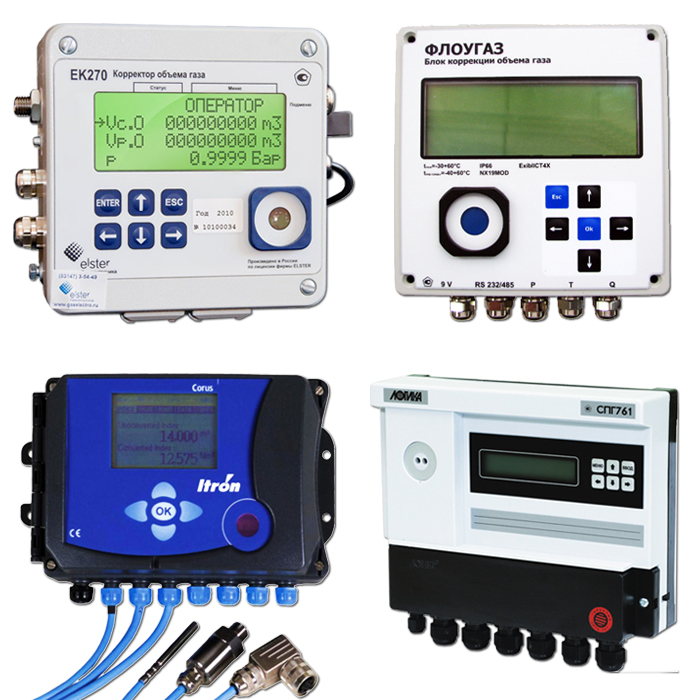
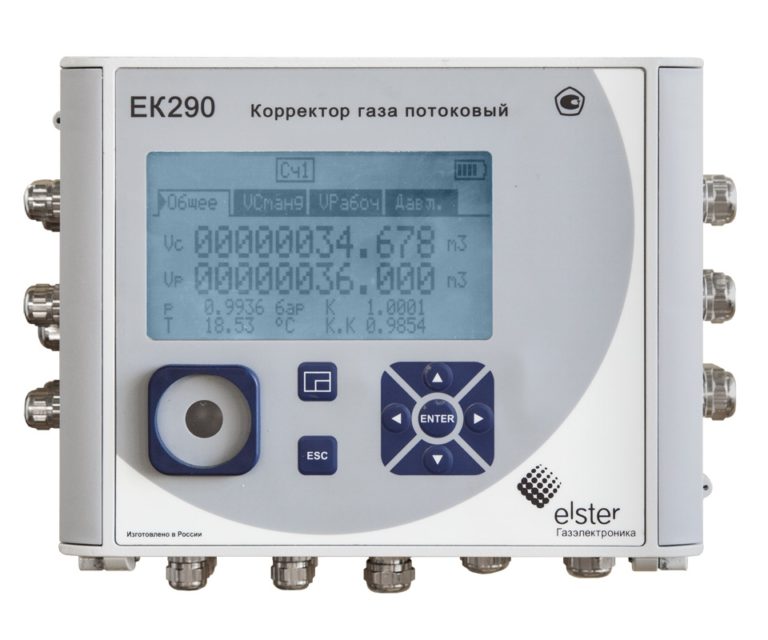
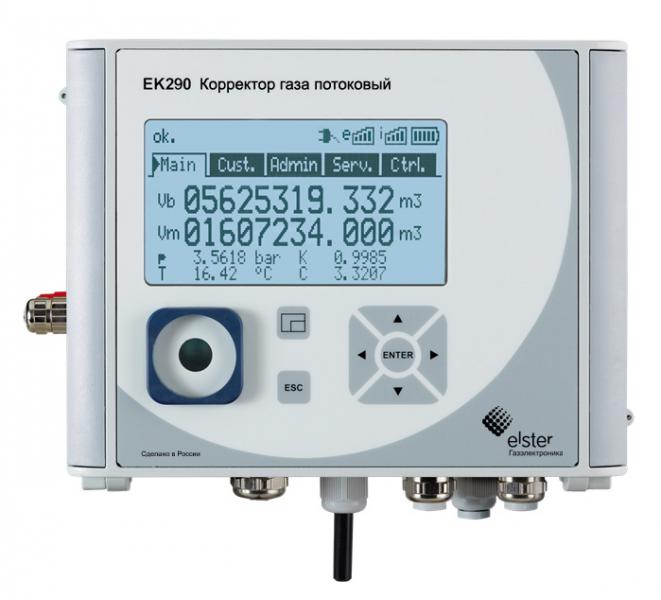
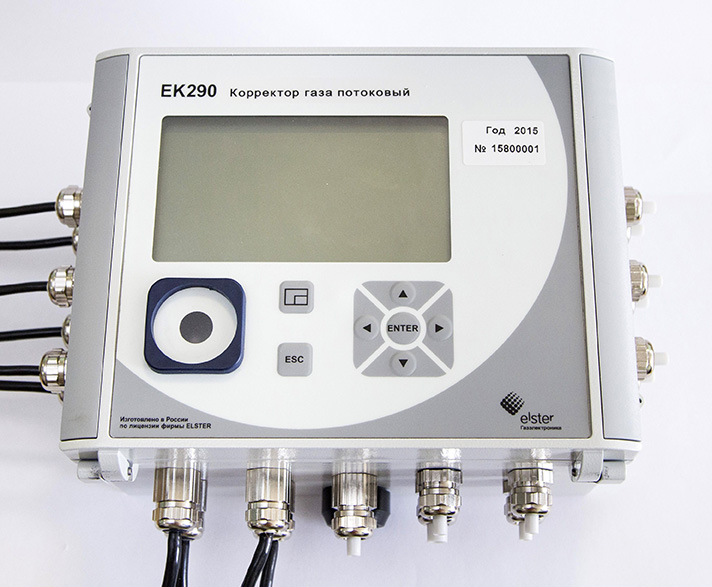
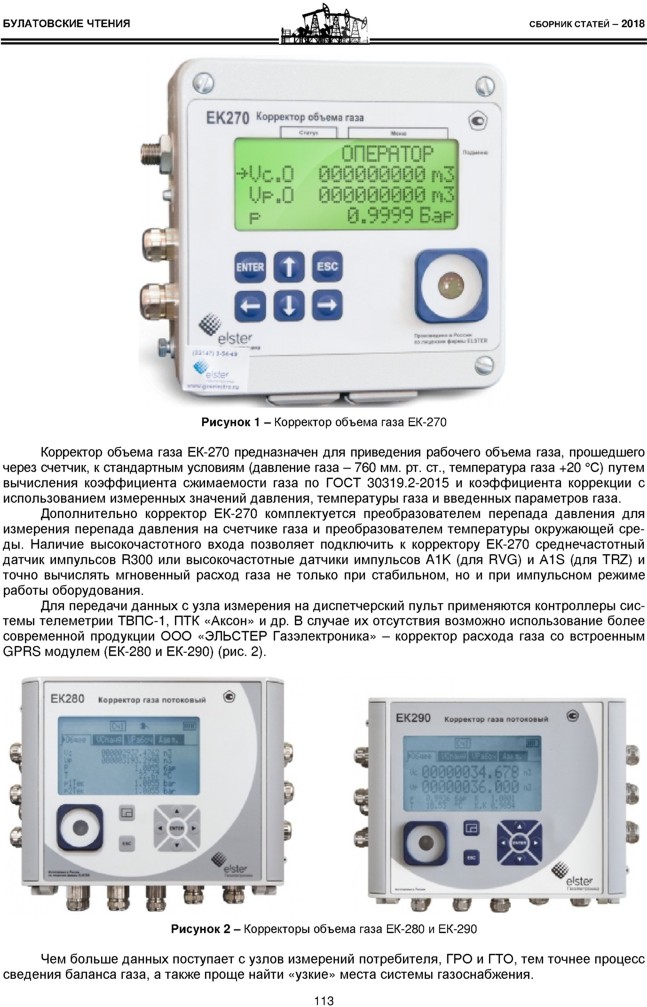
The purpose of the gas volume flow corrector is to measure pressure, temperature, and the working volumes of methane fuel recorded by the flow meter. The device is equipped with signal converters according to the measured criteria received from the gas meter and analyzed by the microprocessor.
The compressibility factor is calculated either by the corrector itself (GOST 30319.2-2015) or is substituted according to a preset value.
The measurement results make it possible to convert the consumed cubic meters of natural gas into volume under standard conditions of methane according to GOST 2939-63, taking into account the conditionally constant parameters of gas fuel - density under standard conditions, CO content2 and N2.
Relative error tolerances over the full operating temperature range are:
- by measuring pressure +/-0.4%;
- by temperature measurement +/-0.3%;
- to bring the volume to standard conditions +/-0.5%;
- by measuring the volume of methane in working conditions +/-0.05%.
As the corrector accumulates data on the parameters of the incoming gas, they are archived with a 60-minute interval. Depending on the device model, it stores data for the last 270-365 days at the time of accessing the archive. Archived data is stored on a smart card.
An autonomous power supply unit of the device will provide it with energy for at least 7 full days, provided that the interface screen is active for no more than 15 minutes during this period. It should be noted that the main power source of the methane data correction instrument is the household power supply through an AC/DC converter with a voltage of 9 V (current 100 A).
If necessary, the operating functions of the corrector can be used to control the consumption of blue fuel by setting a daily and monthly limit to track the balance.
Features of the installation of the corrector
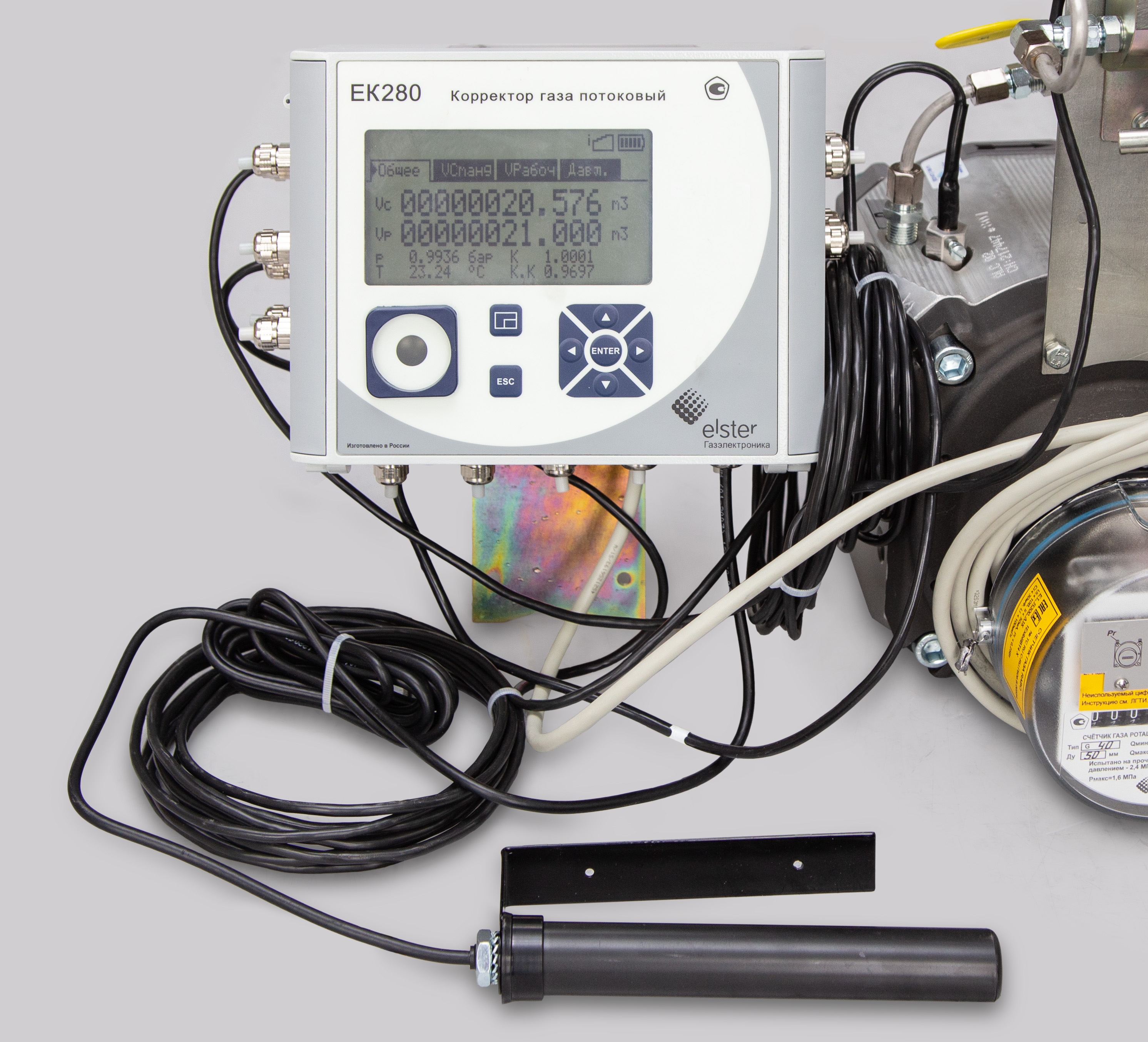
Methane accounting characteristics correction device is connected to a flow meter equipped with a pulse output signal (frequency range up to 2-8 Hz, pulse weight 0.01-100 m 3 ).It is also possible to connect to a gas meter with a position-coding mechanism (encoder) installed in the counting head.
The physical fixing of the device for correcting (standardizing) the data of the consumed volume of gas fuel is carried out on the meter body (if there is a mounting place), on a bracket, or on a wall. The correction device usually weighs up to 3 kg.
Be sure to ground the corrector using a rectangular bus with a cross section of 4 mm 2. External devices are connected to the device with a shielded cable with a core cross section of 0.25 mm 2 or more, no longer than 10 m.
Methods for integrating a flowmeter with a corrector
In the first variant, gas consumption control elements are supplied separately: a gas meter with an electrical outlet (for example, a pair of reed switch-magnet); pressure sensor having a unified current output; temperature sensor (electronic resistance thermometer); corrective device for standardizing the characteristics of the consumed volume of gas.
Combined in a complex, these devices form a single system of measuring instruments. However, it can be used in this capacity only after agreement with the local division of the State Standard. The advantage of this complex is the admissibility of standardizing readings from several gas meters (i.e. from several gas pipeline inlets).
The disadvantage of such a system is the different periods of verification of its elements, among which it is most often necessary to calibrate temperature and pressure sensors. It will be easier not to verify the latter, but simply replace them with new ones. The general advantage of such a measuring complex is that its final cost is lower than that of a factory multichannel system.
In the second option, the measuring complex is created entirely at the manufacturing plant
Here it is important to choose a system with a close calibration period of the elements. For example, for a rotary gas meter LGK-Ex, the verification period is two years, and for a corrector and pressure sensor, it is 5 years. This means the need to perform verification of the entire complex 2.5 times over a five-year interval of use, which is inconvenient and unprofitable.
This means the need to perform verification of the entire complex 2.5 times over a five-year interval of use, which is inconvenient and unprofitable.
How to set up the device?
Setting constant information is not required, they are entered at the device manufacturer. Those. after installation and connection of wires to the data source (gas meter), the corrector is completely ready for operation.
Access to changing the data of the corrector is divided between three parties - the metrological service, the gas supply organization with which the service agreement is concluded, and the consumer. Each side has its own code (an eight-digit combination of numbers) that provides access to the device's software menu.
The consumer is given the lowest access priority, and the highest - to the metrological organization. In fact, the user can only control the data output to the instrument interface - full or short display mode.
Changes to the parameters required for calculating the volume of consumed gas fuel (the “metrological” part of the software) are allowed only during official calibration, which is performed exclusively when calibrating natural gas volume correctors. The button of the calibration lock is protected by a hinged seal (easily destroyed!).
What is the benefit of correcting gas consumption?
Gas fuel is supplied to consumers in settlements from the main gas pipeline by a system of common collectors of high and medium pressure, stretching for tens of kilometers.
Before transferring gas volumes to a company that directly supplies fuel to end consumers through gas outlet pipelines, the main parameters of methane are measured at the outlet of the gas distribution station - volume (or flow rate), temperature and pressure. These parameters directly affect the income of organizations involved in the transportation and distribution of methane to households.
Therefore, bringing the volume of methane burned in boilers, boilers and gas stoves to standard temperature conditions in accordance with GOST 2939-63 is initially carried out in the interests of natural gas suppliers.
Convenience for regional gas services
During the frosty winter months, the pressure in the "air" gas pipeline decreases, since its value is directly proportional to the gas temperature (Charles' law). In this case, the density of gaseous fuel increases, and the volume decreases (Boyle-Mariotte law).


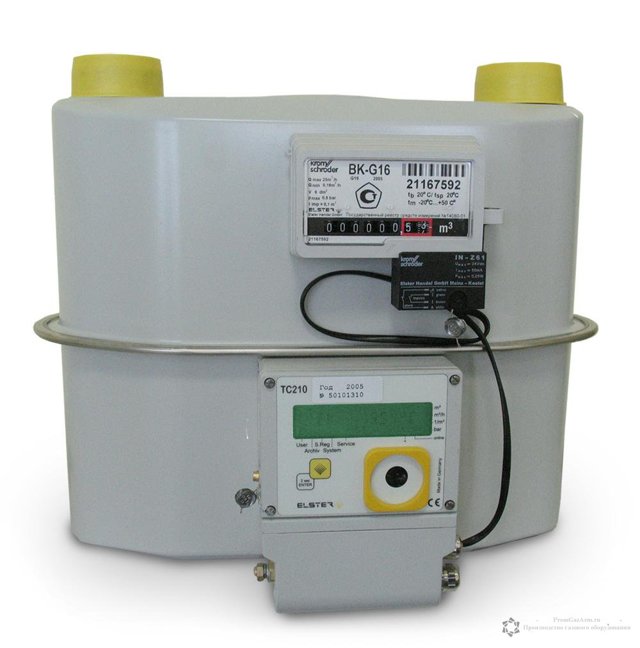


As a result, there is a so-called imbalance between the supplied and consumed volumes of blue fuel. Those. the house gas meter will record a smaller number of cubic meters of methane than actually consumed by the heating devices of the cottage.
And vice versa, at summer temperatures above 20 ° C, the gas meter of a private house will show a greater consumption of methane than actually received. However, households burn less natural gas in summer, because its main consumption is associated with the heating period.
Thus, the use by households of a full-fledged gas corrector or only a thermal corrector, or payment for the consumed volume of methane fuel with surcharge coefficients usually occurs to the benefit of the gas supply organization.
But in one, by the way, quite frequent situation with the supply of gas, a device that corrects the parameters of blue fuel can bring real benefits to the homeowner.
Benefits for household owners
During the frosty months, residents of suburban real estate are concerned about another problem - excessively low pressure in the gas transmission network, which complicates the process of heating the house. The flame above the burner is barely warm and the boiler equipment either turns off on its own or heats the coolant in the house heating circuit no higher than 60 ° C.
The reason for the weak gas supply in winter is understandable - floor and wall heating boilers of houses burn more methane, otherwise households simply cannot be heated. And the majority of owners of country cottages with year-round residence put up with weakened pressure in the gas pipeline, supplementing gas heating units with boiler equipment using alternative fuels (wood, coal).
However, they do not realize that they not only have to endure the cold atmosphere at home every winter, but also overpay for cubic meters of gas!
According to the "gas" Boyle-Mariotte law, when the pressure in the gaseous medium decreases, its volume increases. Those. when the pressure in the “air” decreases, the volume of methane supplied to the flow meter increases and the meter will begin to wind up non-existent cubic meters. Overpayment on "wound up" gas bills can reach 5-7% for the heating season.
And only a flow meter with an electronic natural gas corrector, adjusted according to the “local” parameters of methane standardization by the official metrological service, will allow consumers to pay for the cubic meters of blue fuel burned by thermal equipment at the actual consumption.
Purposes of natural gas meter correction
Note that although the passport operating temperature range of the flowmeter can be +/- 40 ° C, this does not matter to the temperature coefficient that increases the price of gas fuel.
Rules for civil gas supply for domestic purposes No. 549 approve the need to multiply the volume of consumed methane calculated by the meter by the coefficient of reduction to standard conditions (designation - Vp), normalized by GOST 2939-63:
- gas temperature - 20 o C (also 293.15 o K);
- gas pressure - 760 mm of mercury (also 101.325 kN / m 2);
- gas humidity is zero.
Since the "street" temperatures change during the calendar year, different conversion factors to the "gas standard" are applied to the consumed volume of gas - in the winter months they are always higher.
The values of these coefficients are set by the Federal Metrology Agency. In particular, since 2019, the temperature coefficients determined by order No. 1053 have been in force in the regions of Russia.
To avoid multiplying the consumed volume by the regional coefficient established by the norms, the homeowner must choose a flow meter equipped with a thermal compensator to account for gas consumption.
The location of the gas meter - external (outside the house) or internal (in the technical room) - does not matter.Here, either payment for the consumed volume of methane, taking into account the temperature coefficient, or installation of a gas flow meter with a built-in temperature compensator.
The device compensating for temperature fluctuations of gas fuel is a bimetallic plate built into the volume measurement mechanism during the passage of methane through the meter. Under the influence of natural gas temperature, the plate bends in a certain way and affects the gas consumption metering process so that the readings correspond to the standard conditions of the fuel condition.
What does this device do?
The purpose of the gas volume flow corrector is to measure pressure, temperature, and the working volumes of methane fuel recorded by the flow meter. The device is equipped with signal converters according to the measured criteria received from the gas meter and analyzed by the microprocessor.
The compressibility factor is calculated either by the corrector itself (GOST 30319.2-2015) or is substituted according to a preset value.
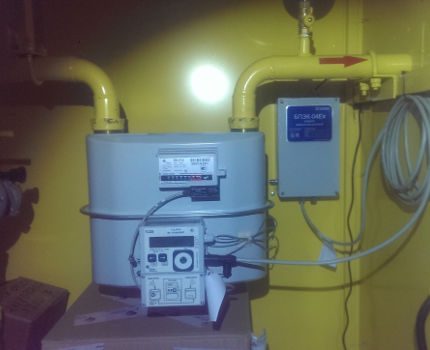 Equipping a natural gas meter with a corrective device is possible both for "street" and "home" placement. In winter, methane will be equally cold
The measurement results make it possible to convert the consumed cubic meters of natural gas into volume under standard conditions of methane according to GOST 2939-63, taking into account the conditionally constant parameters of gas fuel - density under standard conditions, CO content2 and N2.
Relative error tolerances over the full operating temperature range are:
- by measuring pressure +/-0.4%;
- by temperature measurement +/-0.3%;
- to bring the volume to standard conditions +/-0.5%;
- by measuring the volume of methane in working conditions +/-0.05%.
As the corrector accumulates data on the parameters of the incoming gas, they are archived with a 60-minute interval. Depending on the device model, it stores data for the last 270-365 days at the time of accessing the archive. Archived data is stored on a smart card.
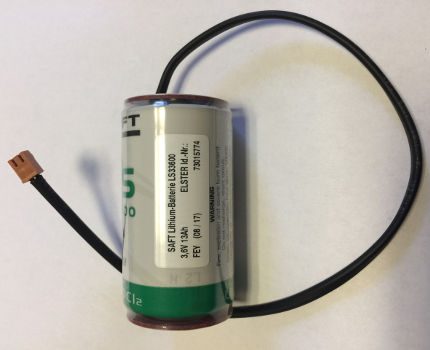 The device contains at least two batteries. They need to be changed simultaneously with the verification of the device, i.e. every 5 years





An autonomous power supply unit of the device will provide it with energy for at least 7 full days, provided that the interface screen is active for no more than 15 minutes during this period. It should be noted that the main power source of the methane data correction instrument is the household power supply through an AC/DC converter with a voltage of 9 V (current 100 A).
If necessary, the operating functions of the corrector can be used to control the consumption of blue fuel by setting a daily and monthly limit to track the balance.
Frequency of verification
A verification check of the validity of the measurements carried out by the natural gas volume correction device is required once every 5 years (provided that the corrector is in good working order during this period).
Verification methods are developed by manufacturers of corrective devices with mandatory approval by FSUE "VNIIMS" or regional FBU "CSM". The right to perform verification tests is granted to the state metrological service (FBU "CSM") or private metrological services that have the appropriate certificate of Rosaccreditation.
Gas corrector: functions and frequency of checking fuel volume correction devices
Agree, with the gas supply of an apartment is much easier than with a private house. In the cottage, a boiler and a gas stove, and in particular the boiler, consume methane in cubic meters, carefully calculated by a flow meter that is mandatory from 2019.
But the thermal caloric content and pressure of blue fuel are unstable, so the meter can wind up too much. The situation will be corrected by a gas corrector capable of reducing the “wound” cubic meters to the norm of the standard state of aggregation of methane. The special convenience of the device requires almost no attention.
Let's talk about it, explain the effect of temperature on the cost of main gas and how the corrector helps to reduce utility costs.
Gas corrector: functions and frequency of checking fuel volume correction devices
Agree, with the gas supply of an apartment is much easier than with a private house. In the cottage, a boiler and a gas stove, and in particular the boiler, consume methane in cubic meters, carefully calculated by a flow meter that is mandatory from 2019.
But the thermal caloric content and pressure of blue fuel are unstable, so the meter can wind up too much. The situation will be corrected by a gas corrector capable of reducing the “wound” cubic meters to the norm of the standard state of aggregation of methane. The special convenience of the device requires almost no attention.
Let's talk about it, explain the effect of temperature on the cost of main gas and how the corrector helps to reduce utility costs.
Frequency of verification
A verification check of the validity of the measurements carried out by the natural gas volume correction device is required once every 5 years (provided that the corrector is in good working order during this period).
Verification methods are developed by manufacturers of corrective devices with mandatory approval by FSUE "VNIIMS" or regional FBU "CSM". The right to perform verification tests is granted to the state metrological service (FBU "CSM") or private metrological services that have the appropriate certificate of Rosaccreditation.
Gas corrector: functions and frequency of checking fuel volume correction devices
Agree, with the gas supply of an apartment is much easier than with a private house. In the cottage, a boiler and a gas stove, and in particular the boiler, consume methane in cubic meters, carefully calculated by a flow meter that is mandatory from 2019.
But the thermal caloric content and pressure of blue fuel are unstable, so the meter can wind up too much. The situation will be corrected by a gas corrector capable of reducing the “wound” cubic meters to the norm of the standard state of aggregation of methane. The special convenience of the device requires almost no attention.
Let's talk about it, explain the effect of temperature on the cost of main gas and how the corrector helps to reduce utility costs.
Injection time correction factor and its components
The current correction factor Ktec responds to constant
occurring fluctuations in the composition of the mixture, but its function ends there. AT
the time when the injection car VAZ-2114 was produced with the installed
January-5.1 block, the injection time was corrected only based on the current
correction factor. Installed January-7.2 and Bocsh M7.9.7 blocks on the VAZ-2114 steel
take into account additive and multiplicative
coefficients the influence of long-term, slowly changing factors arising
during engine operation (decrease in compression, fuel pressure,
the performance of the fuel pump, the removal of the parameters of the mass air flow sensor, etc.).
How do they influence and bring into line the current correction factor Ktec its
component coefficients of self-learning (short-term and long-term) are given
For example.
On a Lacetti car, the engine is cold and there is no lambda
regulation, i.e. mixture adaptation mode is not enabled. At the same time, the current
correction factor Ktek = 1. Conditions
enabling adaptation mode: the engine must warm up to operating temperature,
oxygen sensors activated. If the conditions are met and the engine is not
has serious damage to the gas distribution mechanism and piston
group, as well as the absolute pressure sensor is working, then the coefficient Ktec will take values on
idling within 0.98–1.02.
If the engine is put into partial load mode, then the effect of the additive
coefficient that works only at idle does not have to be taken into account
meaning. The multiplier coefficient begins to function.
The task of all coefficients is to manage time
injector injection. And the main tone in this sets the control oxygen sensor.
Assume that the oxygen sensor signal curve
increases, informing the control unit about the decrease in oxygen in the mixture. Block
control responds instantly to the lack of oxygen and short correction reduces,
thereby shortening the open time of the injectors. Oxygen sensor response
the decrease in fuel supply is reflected by a falling curve towards a lean mixture.
The control unit, having received a signal from the oxygen sensor, immediately increases
short correction and the injection time increases accordingly.
The additive component of the self-learning correction CAD also controls changes
coefficient Ktec, but only in idle mode. The dimension of the additive
corrections are percentages or milliseconds.
In a simplified form, the change in the composition of the mixture, determined by
coefficient Cad, calculated by the formula: Cad * 100 / load. On serviceable
engine in idle mode, the load is in the range of 18-20%.
Assume that Qad has taken a value of 3%. Having calculated according to the simplified
formula the approximate composition of the mixture, we get a 15 percent enrichment.
Similarly, with the negative value of adaptation. If Kad \u003d -3%, then we get 15
percentage depletion of the mixture.
Frequency of verification
A verification check of the validity of the measurements carried out by the natural gas volume correction device is required once every 5 years (provided that the corrector is in good working order during this period).
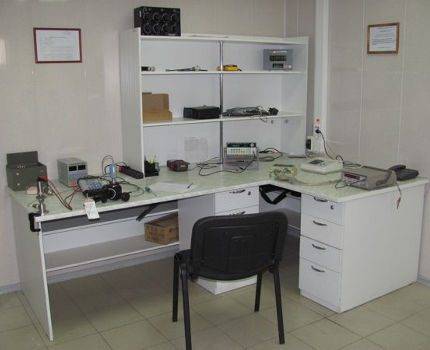
The requirements for the calibration interval for the corrective device and the gas meter are not necessarily the same. The frequency of verification of the entire complex depends on the device in its composition, which needs to be verified more often
Verification methods are developed by manufacturers of corrective devices with mandatory approval by FSUE "VNIIMS" or regional FBU "CSM". The right to perform verification tests is granted to the state metrological service (FBU "CSM") or private metrological services that have the appropriate certificate of Rosaccreditation.





Specifications
Table 3 - Metrological characteristics
| Characteristic name | Meaning |
| Maximum frequency of output pulses from the gas meter, Hz | 2 |
| Limits of permissible absolute error when measuring the number of pulses, pulse | ±1 |
| Measurement range of absolute gas pressure, MPa | from 0.09 to 1 |
| Limits of permissible error reduced to the upper limit of measurement when measuring absolute gas pressure, % | ±0,15 |
| Gas temperature measurement range, °C | -20 to +50 |
| Limits of permissible absolute temperature measurement errors gas, °С | ±0,3 |
| Limits of permissible relative error in calculating the volume of natural gas under standard conditions, due to the software implementation of algorithms, % | ±0,05 |
| Characteristic name | Meaning |
| Natural gas parameters: | |
| — range of changes in absolute gas pressure, MPa | from 0.183 to 0.307 |
| is the range of changes in the density of natural gas at standard | |
| conditions, kg/m3 | from 0.6934 to 0.7323 |
| — range of changes in the molar fraction of nitrogen, % | from 0.77 to 1.95 |
| — range of changes in the molar fraction of carbon dioxide, % | from 0.122 to 0.660 |
| Operating conditions: | |
| — ambient temperature range, °C | -25 to +55 |
| — relative humidity at +35 °С, % | up to 85 |
| — atmospheric pressure, kPa | from 84 to 106.7 |
| Battery life (powered from an internal source), years | 5 |
| Power supply, V | |
| lithium battery | 3,6 |
| Explosion protection marking | 0ExiaIICT4X |
| Overall dimensions of the electronic unit, mm, no more | |
| - length | 222 |
| - width | 145 |
| - depth | 86 |
| Weight, kg, no more | |
| - electronic block | 1,5 |
| — converters | 0,5 |
| Average corrector service life, years | 15 |
| Average time to failure of the corrector, h | 70000 |
Purposes of natural gas meter correction
Note that although the passport operating temperature range of the flowmeter can be +/- 40 ° C, this does not matter to the temperature coefficient that increases the price of gas fuel.
Rules for civil gas supply for domestic purposes No. 549 approve the need to multiply the volume of consumed methane calculated by the meter by the coefficient of reduction to standard conditions (designation - Vp), normalized by GOST 2939-63:
- gas temperature - 20 ° C (also 293.15 ° K);
- gas pressure - 760 mm Hg (also 101.325 kN/m2);
- gas humidity is zero.
Since the "street" temperatures change during the calendar year, different conversion factors to the "gas standard" are applied to the consumed volume of gas - in the winter months they are always higher.
The values of these coefficients are set by the Federal Metrology Agency. In particular, since 2019, the temperature coefficients determined by order No. 1053 have been in force in the regions of Russia.


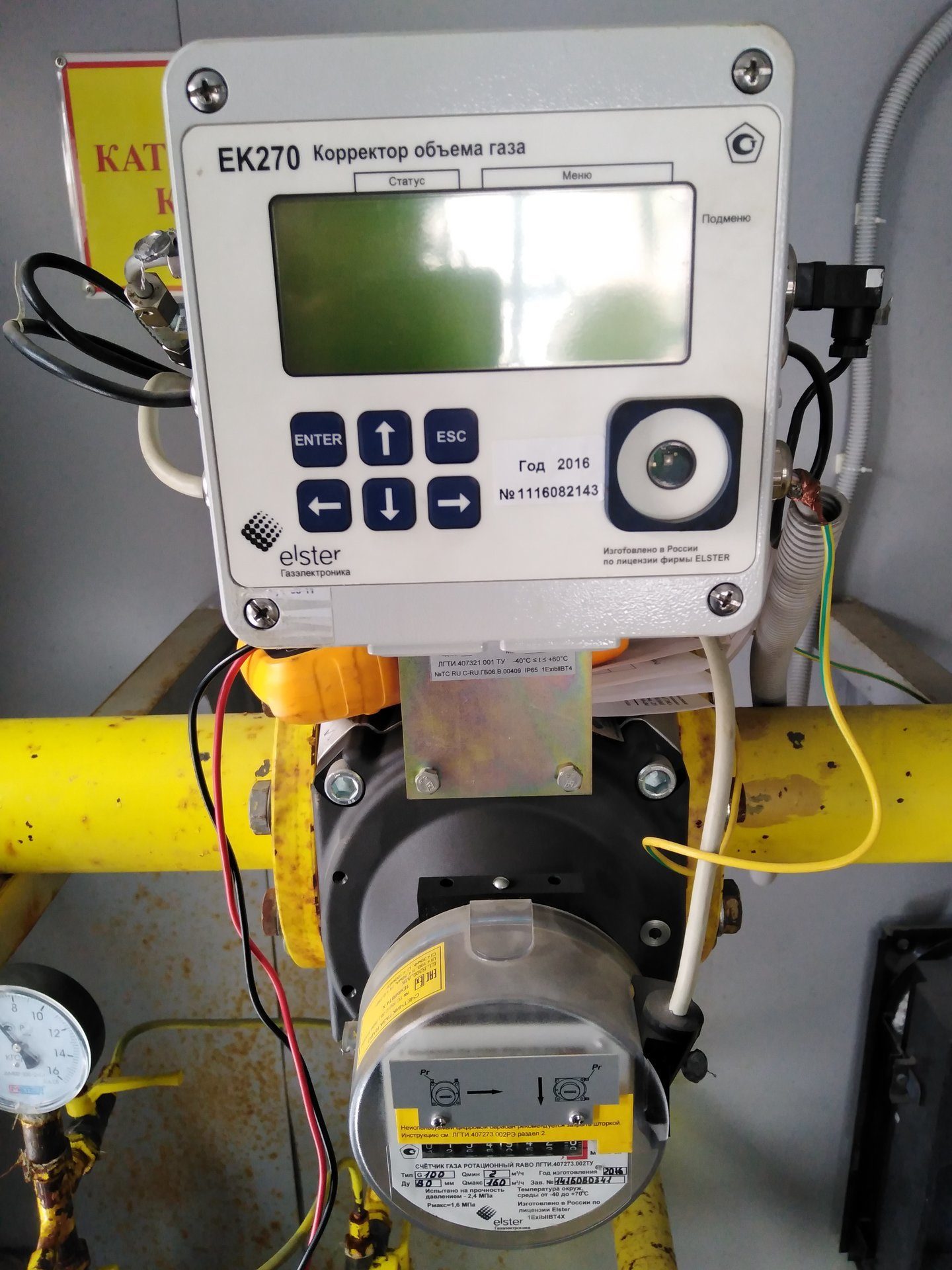
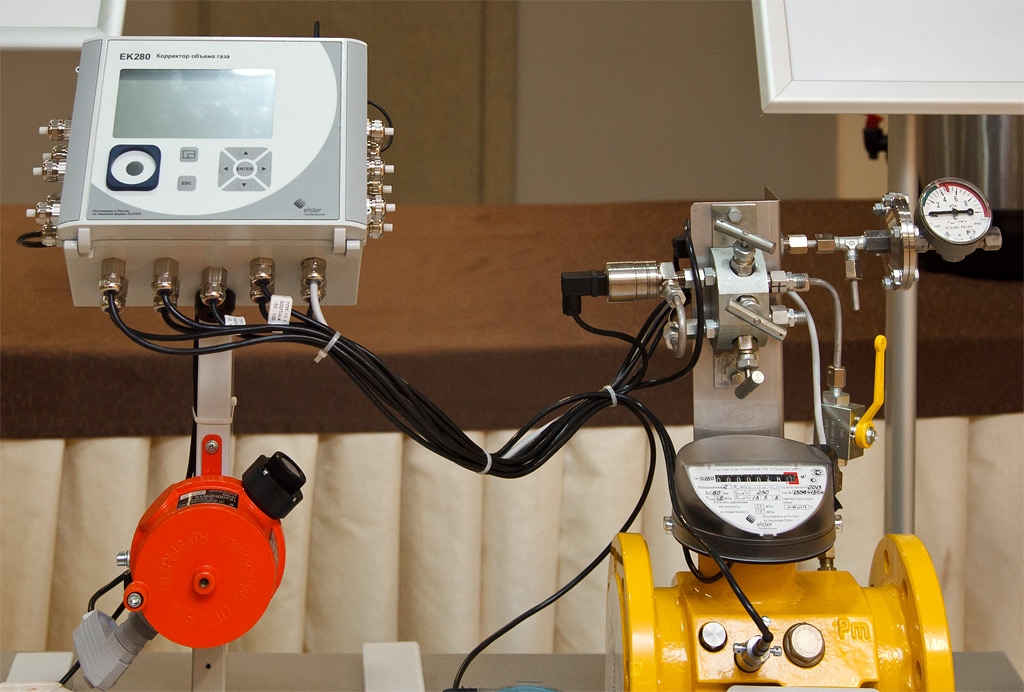
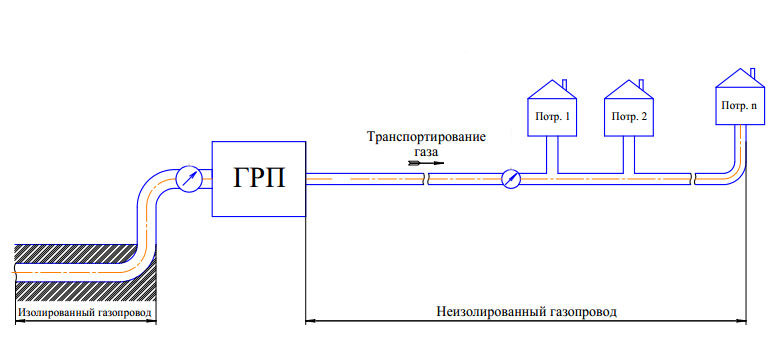
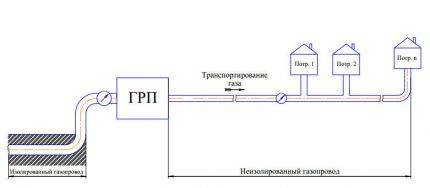 Since the simplest distribution scheme (air) is often used in the gasification of the private sector, methane cooling, increased fuel withdrawal and pressure drop in the gas pipeline are common. Therefore, it is useless to put the device in the hydraulic fracturing
To avoid multiplying the consumed volume by the regional coefficient established by the norms, the homeowner must choose a flow meter equipped with a thermal compensator to account for gas consumption.
The location of the gas meter - external (outside the house) or internal (in the technical room) - does not matter. Here, either payment for the consumed volume of methane, taking into account the temperature coefficient, or installation of a gas flow meter with a built-in temperature compensator.
The device compensating for temperature fluctuations of gas fuel is a bimetallic plate built into the volume measurement mechanism during the passage of methane through the meter. Under the influence of natural gas temperature, the plate bends in a certain way and affects the gas consumption metering process so that the readings correspond to the standard conditions of the fuel condition.
Gas corrector: functions and frequency of checking fuel volume correction devices
Agree, with the gas supply of an apartment is much easier than with a private house. In the cottage, a boiler and a gas stove, and in particular the boiler, consume methane in cubic meters, carefully calculated by a flow meter that is mandatory from 2019.
But the thermal caloric content and pressure of blue fuel are unstable, so the meter can wind up too much. The situation will be corrected by a gas corrector capable of reducing the “wound” cubic meters to the norm of the standard state of aggregation of methane. The special convenience of the device requires almost no attention.
Let's talk about it, explain the effect of temperature on the cost of main gas and how the corrector helps to reduce utility costs.
Conclusions and useful video on the topic
How to use the menu of the device for correcting the volume of consumed gas (for example, EK270):
How does the device for standardizing the volume of methane inside work (for example, LNG 741):
How to read and adjust the parameters in the corrector menu (for example, SPG 761):
With the additional equipment of a gas flow meter with a corrector, the cost savings on consumed gas will be noticeable if the consumption of blue fuel is more than 4 cubic meters per hour.After all, if one has to put up with weak pressure in the gas pipeline supplying the household, then there is absolutely no need to endure the overpayment for non-existent volumes of gas consumption.
Do you want to share your own experience in using a gaseous fuel flow corrector? Please write comments in the block below, ask questions, post photos on the topic of the article. It is possible that your recommendations will be useful to site visitors.
Source