- Design and principle of operation
- Selection Tips
- Manufacturers overview
- Choice
- Power calculation - a mandatory procedure
- Material
- Operating temperature, dimensions
- Tips for choosing the best option
- Types of water convectors
- Floor convectors
- Wall convectors
- Skirting convectors
- Floor convectors
- Ground convectors
- Principle of operation
- Characteristics of floor water convectors
- The design and principle of operation of the device
- Types of floor convectors
- Advantages and disadvantages of devices
- Fan convectors
- Which brand of convector is better to choose
- Operation of underfloor heaters with or without fan
- Principle of operation
- Equipment by type of installation
- floor standing
- wall
- Floor recessed or hidden plinth
- Installation work
- Varieties
- infrared
- Electrical
- Gas
- Water
Design and principle of operation
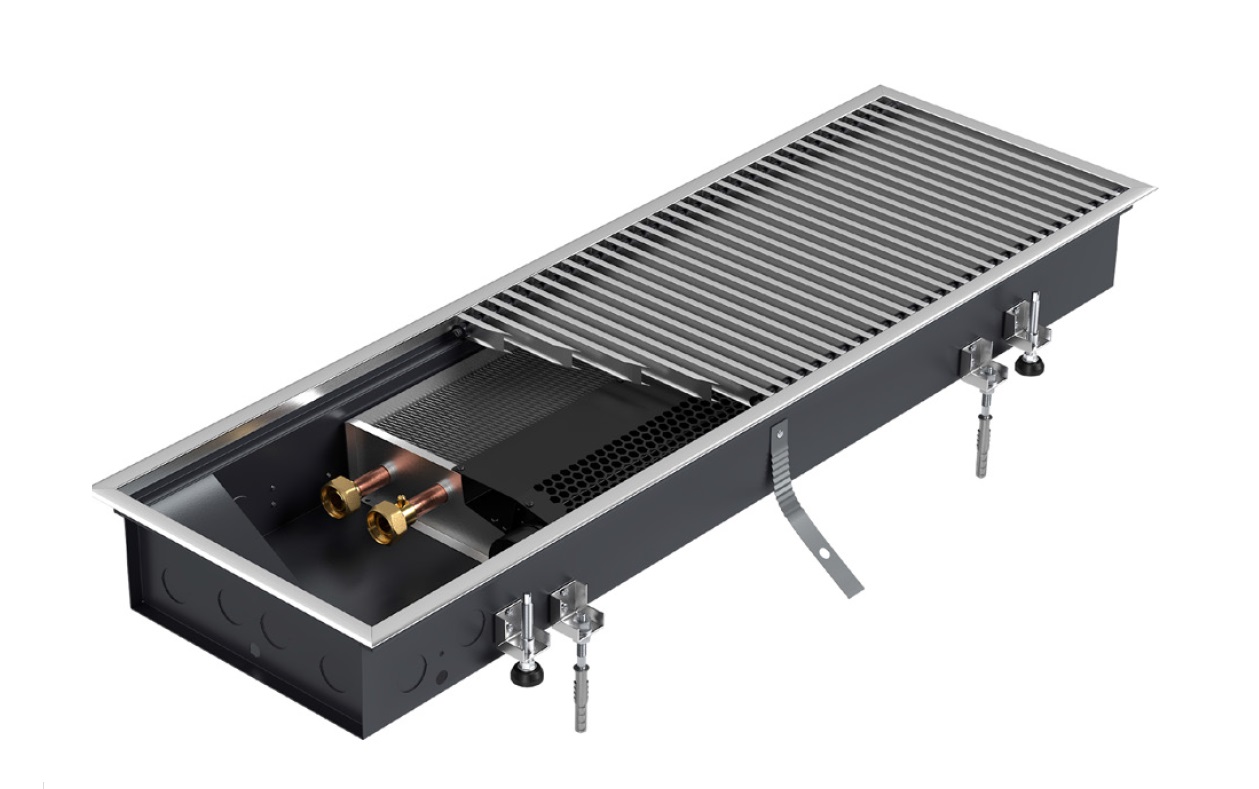
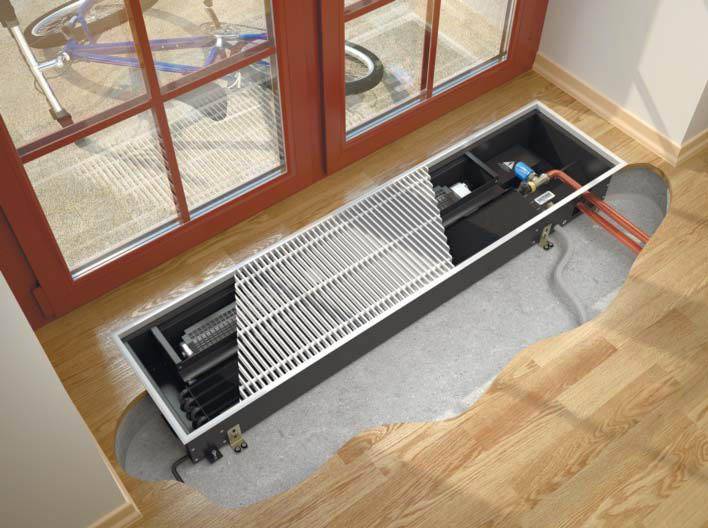
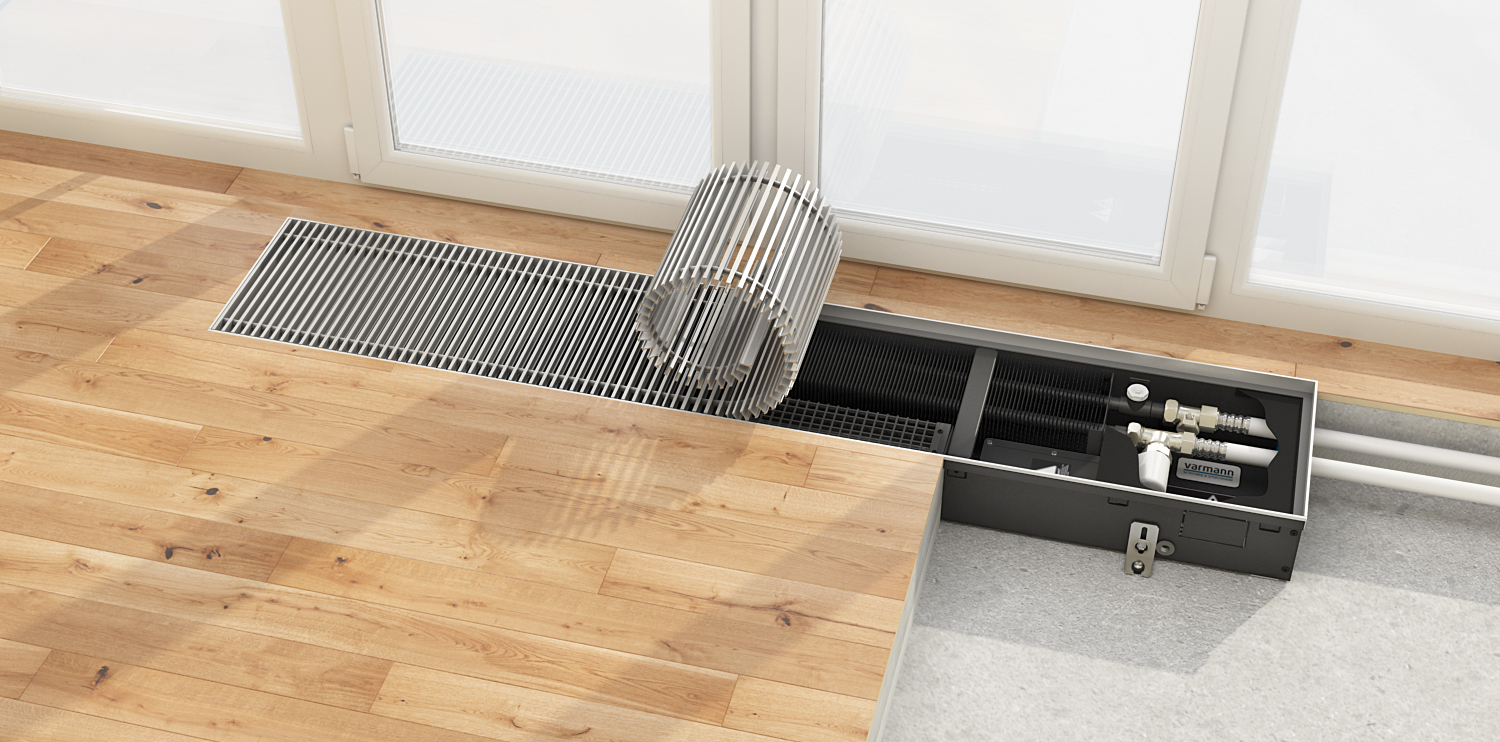
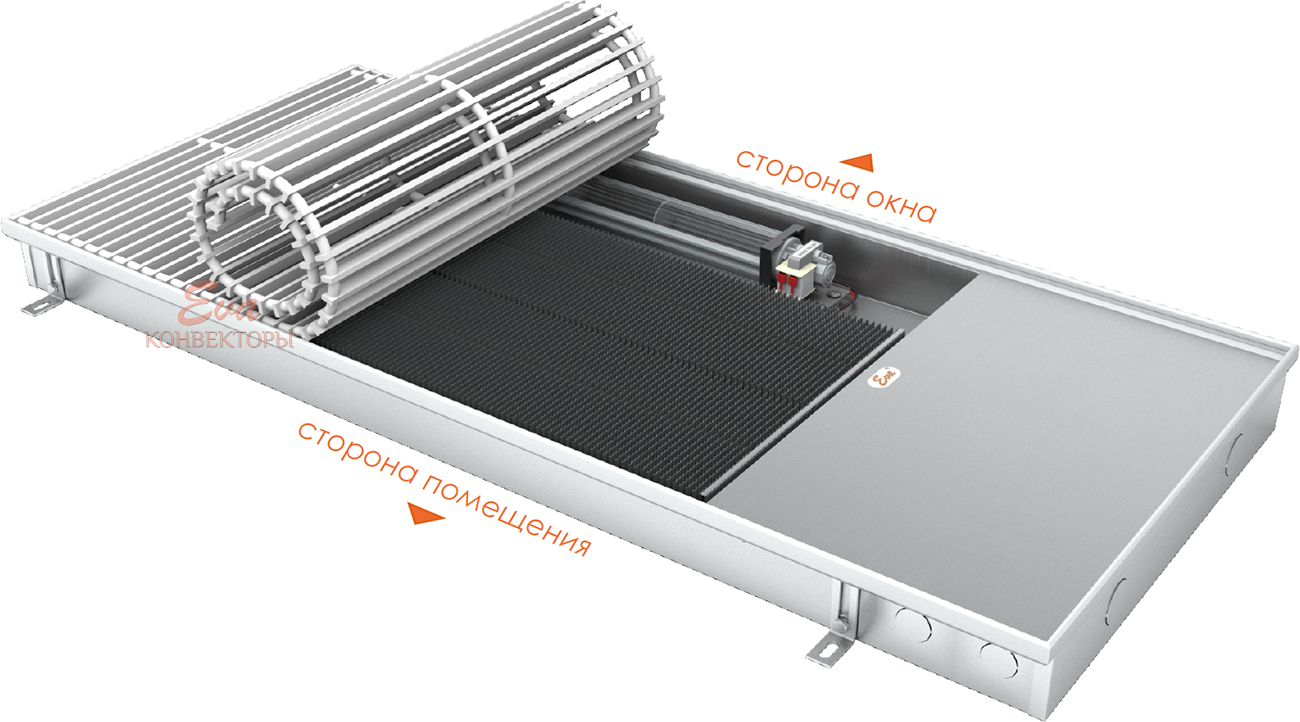
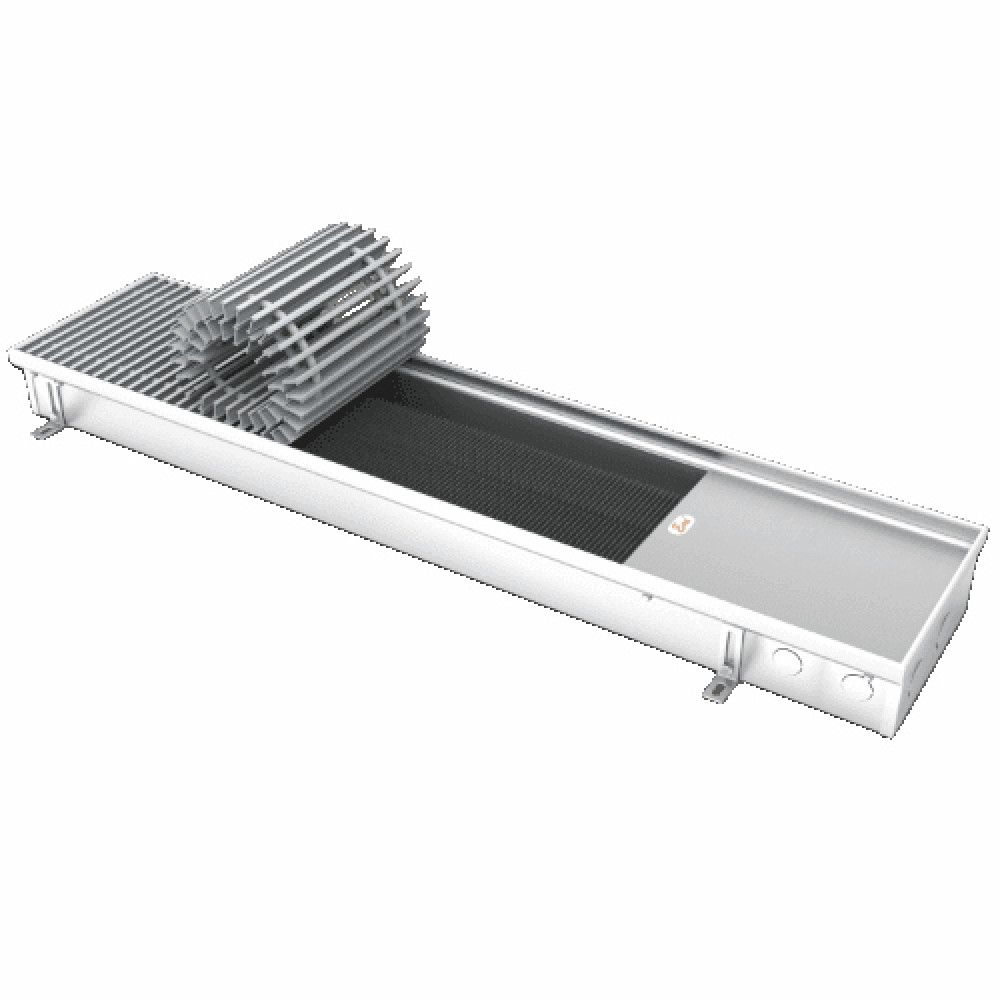
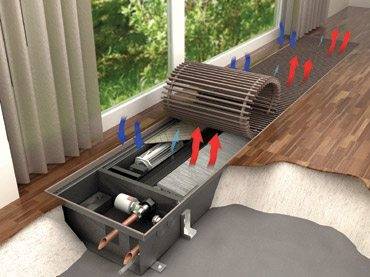
The floor convector is a new generation heating device that is able to fit perfectly into the design of any interior, since this device is almost invisible and does not hide space. The main feature is that the product is placed in a special niche created in the floor, and on top it is closed with a decorative lattice, which is installed flush with the floor covering.
As for the heat source used, in this capacity, convectors use electricity and water.
The electrical device is equipped with a heating element and is applicable anywhere where there is access to a power outlet. From a financial point of view, such a device will significantly hit your pocket, but due to the ease of installation and connection, electric models win, since no communications are required.
At the same time, the floor water unit is more economical during operation, however, it requires a heating line. A water convector can be defined as a type of underfloor heating system, but which has a different principle of operation. The warm floor gives out a radiant and convection flow, and in our case only one, convection, component is used.
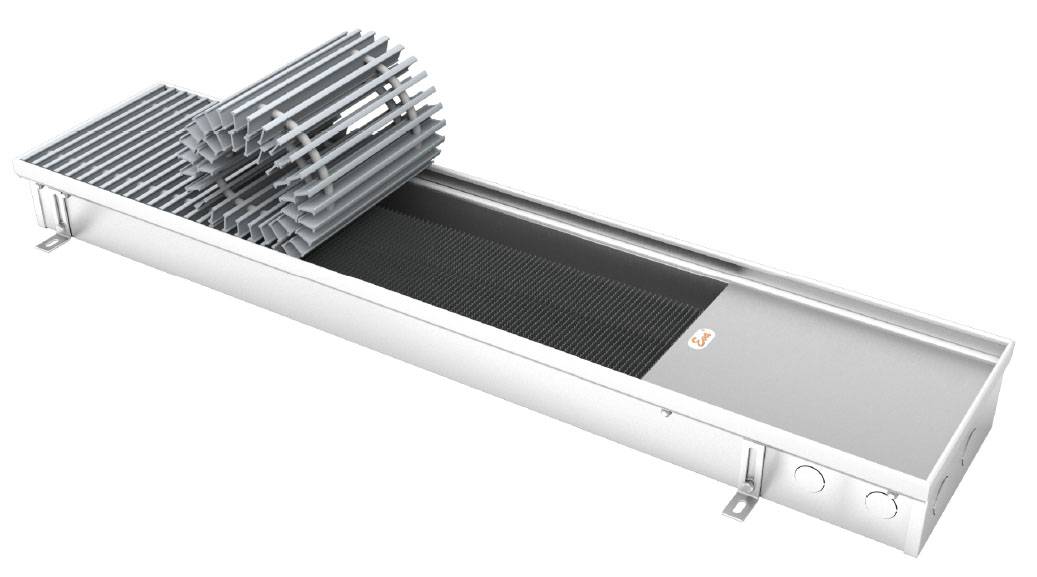
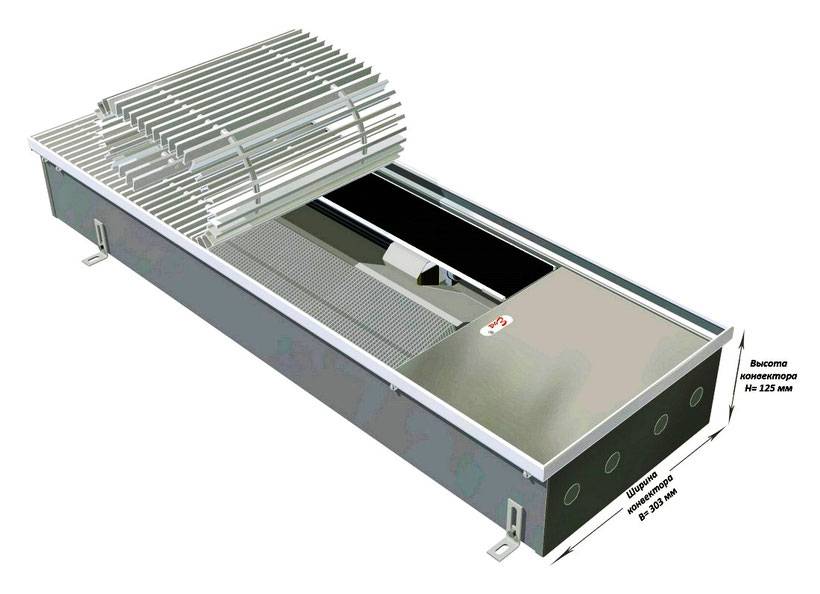
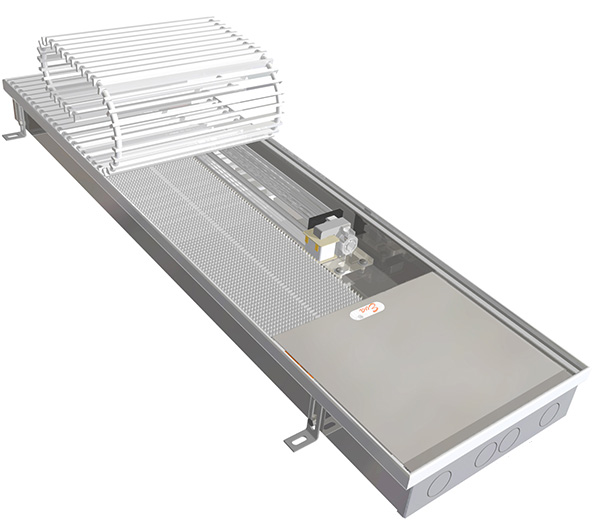
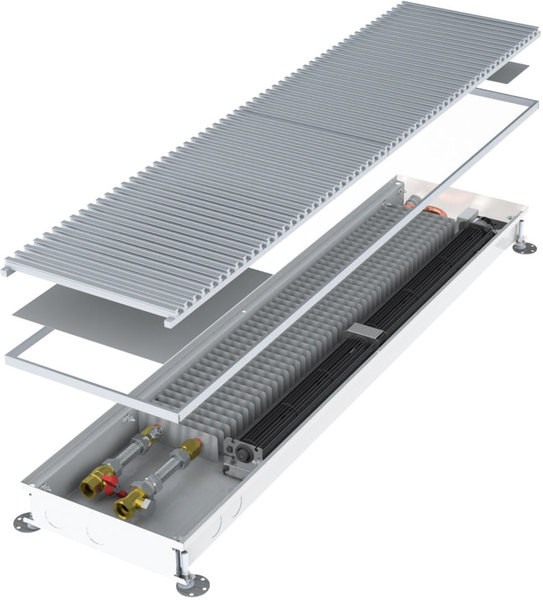
The design of this device is very simple. The convection heat exchanger is placed in a metal case and connected to the pipeline. Outside the housing there is a seat for installing a decorative grille with a high margin of safety, designed for a certain pressure by the weight of a person.
According to their design features, such heating units are of the following types:
- with natural air circulation;
- with a fan and forced movement of air masses;
- with heating / cooling function and air supply from the street.
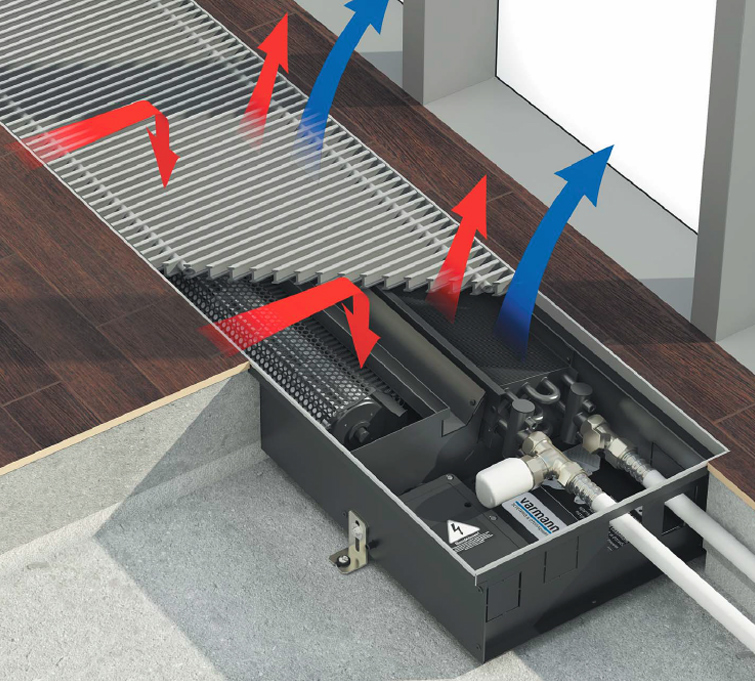
During the operation of the device of the first type, the air flows are heated by the heat exchanger and naturally rise upward, mixing with cold air masses in the area of the window opening.
Underfloor water heaters equipped with a fan function much better, since in them heat is removed from the heat exchanger plates more intensively and is forcibly directed upward, forcing the air environment of the room to constantly move. Therefore, units with a fan are the most popular.
Devices of the third type are expensive. They realize the possibility of connecting to a multi-circuit system, and both hot and cold water can be supplied to the heat exchanger, as well as a branch pipe for the inflow of air masses. This heater is controlled by a remote electronic unit, which can control the operation of several units at once.
Note! Floor convectors of the third type fully work only as an element of a centralized heating system, and they cannot heat and cool water on their own, the coolant must be supplied to the device through a pipeline. Supply air flows are also processed in ventilation, entering the unit through the duct
Selection Tips
When choosing a convector, you need to pay attention to several main factors.
- Decide on the type of convector. Gas can save a lot of money, but its initial cost is higher. Electric - this is ideal for those places where there is no gas wiring. Water is suitable as a replacement for the main heating system.
- Calculate the budget for the purchase. There are many heating devices and the price range is also very high. Much will depend on the type of heating element. Needle ones are not considered particularly reliable, but their price is much lower.Usually, heaters of the middle segment have the most necessary set of options and are highly reliable.
- Functionality. For example, an electronic regulator is more convenient, since it is able to keep exactly the set temperature. Here, too, much depends on the price. More functional devices cost more.
The main selection criteria for convenience are summarized in the table.
| Options | Values | Selection Guide |
| Power | The power of heating devices starts from 250 to 3000 W | In the case of work as an auxiliary element, it is necessary to proceed from the calculations of 25 W per square meter. As the main device, you need to consider 40 W per 1 m3 |
| Heating area | From 1 to 35 m3 | Suitable for small and medium rooms |
| Heating element | Needle, tubular, monolithic | The best option is tubular. Monolithic is considered the most worthy, but it has a high cost |
| Installation | Floor, wall | For use in one room, it is better to purchase a wall-mounted one. Floor standing is suitable in case of need for mobility |
| Control | Mechanical, electronic, touch | Each option is good in its own way. Touch is quite rare and costs a lot of money |
| Thermostat | Mechanical, electronic | The electronic version is better, as it maintains the set temperature more clearly |
| Timer | Model dependent | Having this option would be a big plus. |
| Built-in ionizer | Model dependent | Having this option would be a big plus. |
| Remote | Model dependent | Having this option would be a big plus. |
| Rollover protection | Model dependent | A very important feature that is necessary if there are small children or animals in the house |
| Height | Up to 65 centimeters | The lower the appliance, the faster the room will warm up. |
| Length | Up to 250 centimeters | Long heaters warm the room better and more thoroughly |
Watch the video on how to choose the right convector
Manufacturers overview
Those who wish to purchase such a water convector are often faced with the fact that they do not know which manufacturer's product should be preferred. Many companies today are engaged in the manufacture and sale of such radiators.
Convector Licon Okioc - Czech production. This is a modern and rather expensive device. The manufacturer offers unique water convectors that are designed for low-temperature systems. That is, such radiators are better suited for cooling the room than for heating it.
Producers from Russia are in no way inferior to their foreign competitors. Russian-made water convectors of the following brands are in high demand.
Varmann Planokon. The manufacturer's assortment includes convectors of all types and various capacities. The brand also has a flexible pricing policy, which allows each customer to purchase a water radiator at an affordable cost. Each model is made in accordance with all safety and quality requirements. On average, the maximum heating level of the heat exchanger is 130 degrees. The minimum cost of one convector is 120 thousand rubles.
Choice
During construction, it is necessary to calculate the parameters of future heaters in advance. If the water heating is already working and needs to be replaced, a recalculation is required. When there are several radiators in the house, they will be replaced with convectors, then the system may not need to be adjusted.Another thing is when part of the heat exchangers changes, the heating system is large and diverse. It is necessary to select the same power heating element. Otherwise, additional adjustment will be required.





Power calculation - a mandatory procedure
There is an erroneous opinion that the heat consumption in a room depends on the area and volume of the building. For each m2, it is recommended to take 100 watts. It turns out that for a room of 25 m2, a heater with a power of 2.5 kW is required. If the room is internal, has one small window, the power will be enough. In the basement of the same area, the power will be excessive, in the corner room with two or more windows - not enough.
The main heat loss occurs not in the walls, but in windows and doors. Especially big losses in panoramic, French windows. It's not about them, the manufacturers took good care of thermal insulation. Window frames are thin; cold bridges appear at the points of attachment to the wall. Through them, heat leaves the room. In order not to go into details, you can see the table. These are average values for small windows, walls with an average thermal conductivity. External surfaces - external walls. The area of the walls is measured, not the floor.
| External surfaces | Losses, W/m2 |
| wall, wall with a window | 100 |
| corner two walls, window | 120 |
| two walls, two windows | 130 |
In the case of replacing radiators, you do not need to calculate.
Material
The water system is a necessary attribute in the northern regions, which they try to embellish. The material does not affect the power. The plates do the job well, delivering the performance you need.
Operating temperature, dimensions
Heating devices are designed for the boiling point of a liquid in a closed system. Can be used at home. The size depends on the volume, type of heating.
Tips for choosing the best option
To create comfortable conditions, it is important to choose the right power of the device, as a basis, you can take 1 kW for every 10 sq.m. premises
In order to differentiate the risks, it is better to have several sources of heating whenever possible. For example, if there is a gas connection in the room or there is a central heating system, but not of very good quality, it is better to choose electric convectors. If it is impossible to use one of the sources, you can always switch to another alternative heating option.
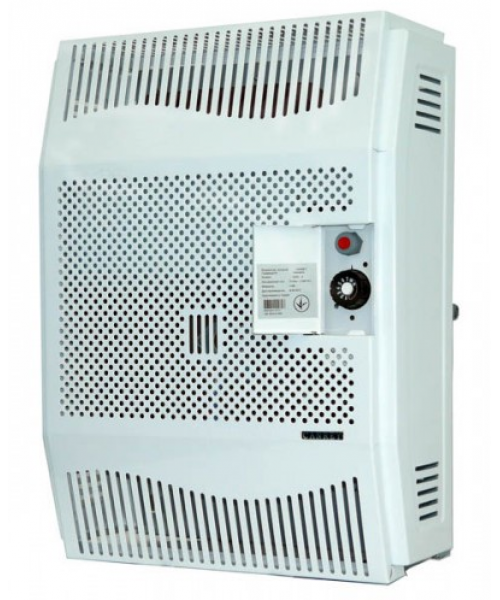
Convector Canrey CHC-2T
To prevent freezing of the system and in order to save energy resources, a gas installation is often used. It is more expensive, but much cheaper to maintain. For example, the Canrey CHC-2T convector provides fast air heating due to the built-in fan, and the Italian automation contributes to the uniform distribution of warm air flows. The device can heat residential and industrial premises, it can be turned on even at negative temperatures. The device has a flame sensor that stops the gas supply in its absence. Arson is carried out by means of a wick, i.e. the heating system starts regardless of the presence of electricity.
To ensure long-term operation, it is important to choose a quality unit from a well-known manufacturer. Reviews and recommendations of convectors of well-known brands will help to focus on the main points of use and determine the type of device and a specific model
Types of water convectors
Now we will talk about the most interesting - about the types of convector heaters on the water. On sale are:
- floor models - they are mounted on the floors;
- wall models - the most popular and common variety;
- plinth models - an innovation in the modern heating market;
- floor - devices for hidden installation in floors;
- plinth models - devices for embedding in walls, niches and even stairs.
Consider all types in more detail.
Floor convectors
Floor convectors are often used in rooms with panoramic windows. In this case, pipes for supplying hot coolant are laid in the floor. Installation of heaters is reduced to their fixing and connection to the heating system. Using the lowest and most compact models, you can achieve an ideal view from the window and high-quality space heating.
floor standing heating water convectors are regarded as the ideal solution for cinemas, exhibition pavilions and other buildings with high floor-to-ceiling panoramic windows.
Wall convectors
Wall-mounted convector heaters on water are characterized by minimal thickness and compactness. In size, they resemble electric convectors or conventional batteries. High models are installed under ordinary window sills, and miniature varieties of small height are suitable for windows with low window sills. Due to their design, they provide efficient heating. In addition, they can be installed along blank walls.
Wall-mounted water convectors are used to heat premises for various purposes - these are ordinary living rooms, offices, industrial buildings, shopping malls, warehouses and much more. They do not clutter up the space and provide a soft and almost imperceptible circulation of heated air. For designer interiors, devices with decorative trim are produced.
Skirting convectors
Skirting heating convectors are a comparative innovation. They are miniature and designed for installation of baseboard heating. Their advantages:



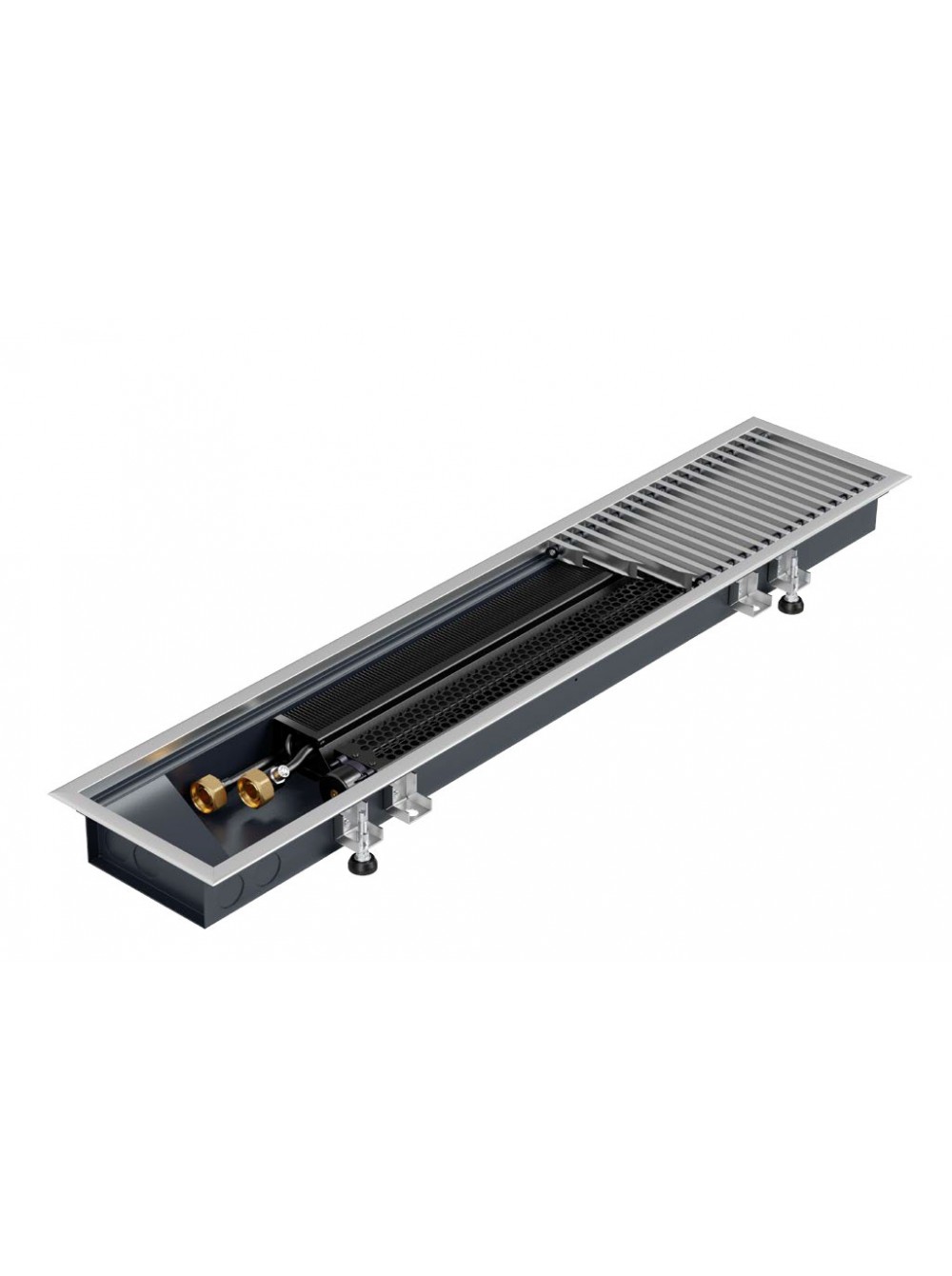


- uniform heating of the air over the entire height of the room;
- extremely compact dimensions;
- high heating efficiency.
Despite their diminutiveness, floor heating devices warm up living spaces well, creating a comfortable atmosphere.
Floor convectors
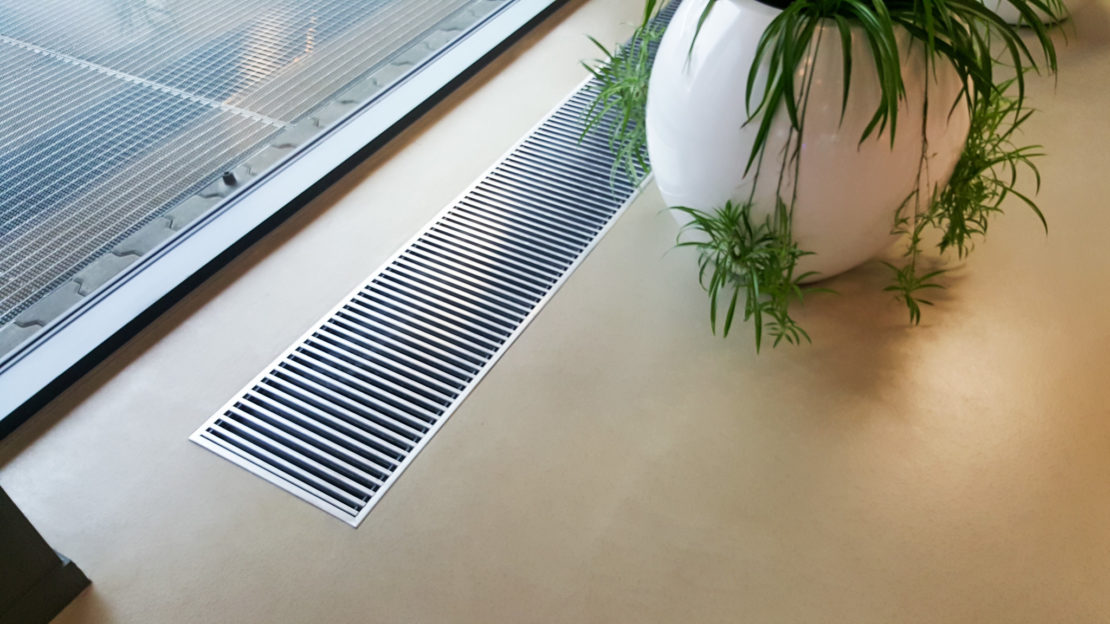
Underfloor water heating convectors will be a godsend for those who want to create the most hidden heating system. As their name implies, they are recessed directly into the floors, where special niches are created for them. Pipes are laid there, through which the coolant circulates. One floor water convector of a large width will provide high-quality heating and will not spoil the interior with its appearance - you can only guess about the presence of such a heater by a masking grate in the floor.
Where are floor water convectors used? They are indispensable for installation in rooms with panoramic windows - unlike low floor devices, they do not block the view from the windows, even partially.Being completely recessed into the floor, convector heaters do not interfere with the movement of people, so they can even be installed in doorways, creating a barrier to cold air flows.
Underfloor heating convectors are indispensable in interiors that are subject to increased requirements for finishing. These can be exhibition halls, concert halls, museums and other places where heaters sticking out of the floors or their wall-mounted counterparts would be inappropriate. They are also used to heat private houses - the absence of visible elements of heating systems allows you to create interesting interiors.
Ground convectors
Another novelty in the world of heating equipment is basement water convectors. They are relatives of floor devices, as they are designed for flush mounting. Their installation is carried out in small niches, in walls, in stair steps, in partitions between rooms. Basement convectors allow you to create an invisible heating system that is highly efficient. They will be an excellent choice for those who want to create an exclusive interior in which heating devices will not be found.
Basement heating convectors require connection to the electrical network. Electricity is needed here to rotate fans that create forced convection. In order to make them less noisy, manufacturers use low-noise fans. Thanks to this, they can work even at night without creating discomfort for the household.
Principle of operation
The floor water convector is one of the most popular types of heating in private homes today.Domestic and foreign manufacturers today offer a wide variety of models that differ from each other in appearance and power, but their principle of operation is the same.
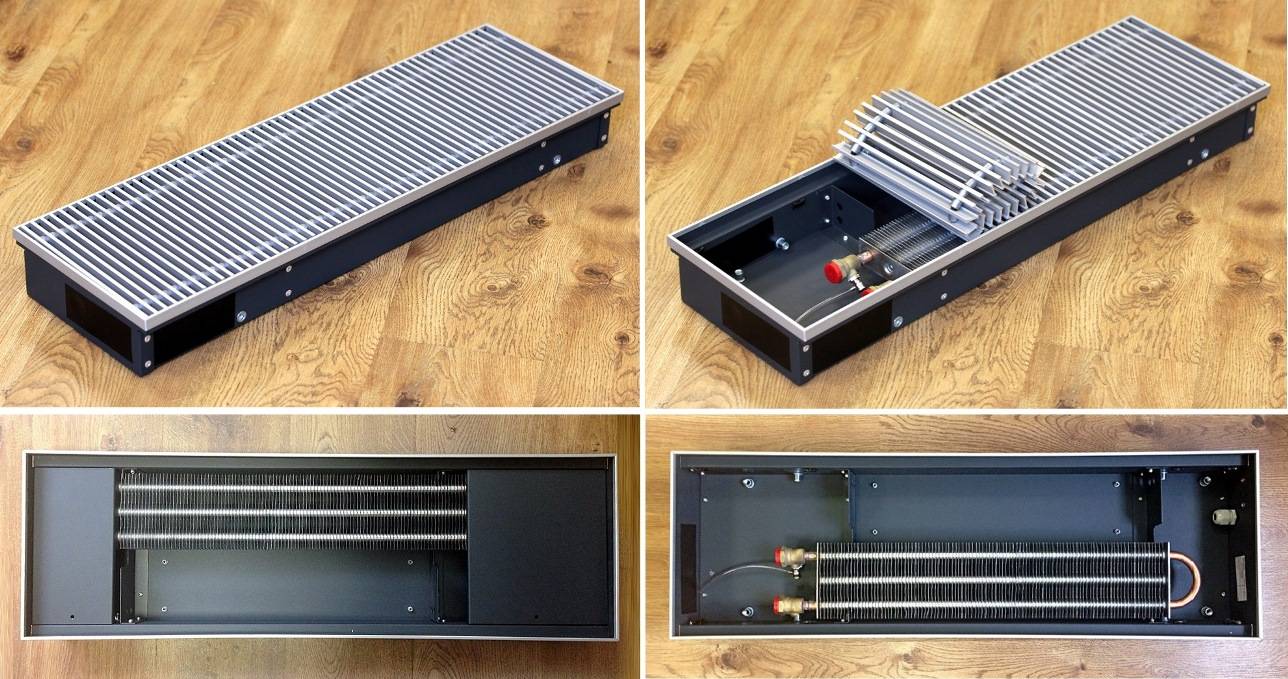
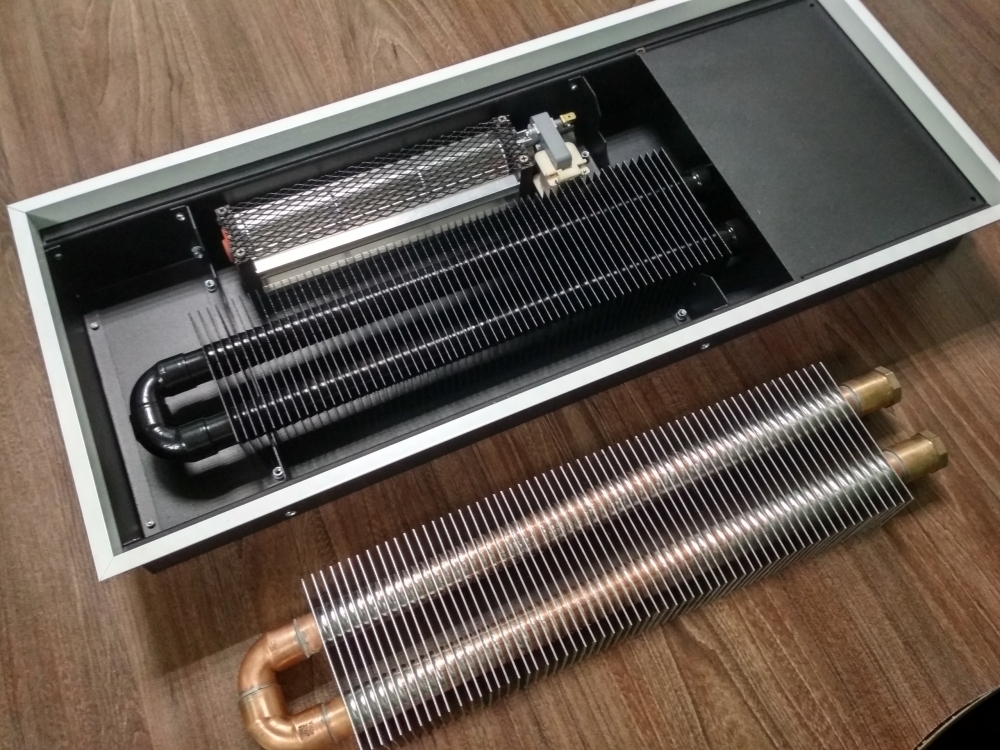
The body of the water floor convector is a galvanized rectangle. Inside it are special pipes, their number, depending on the model, can be in the range from 1 to 3. They are the heat exchangers.
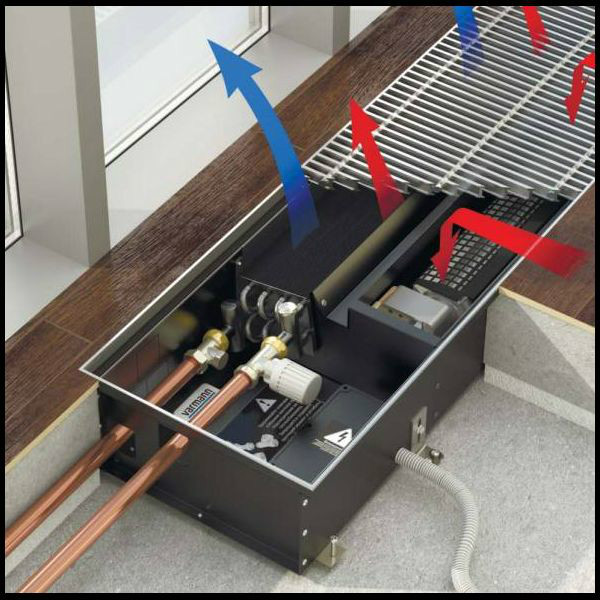
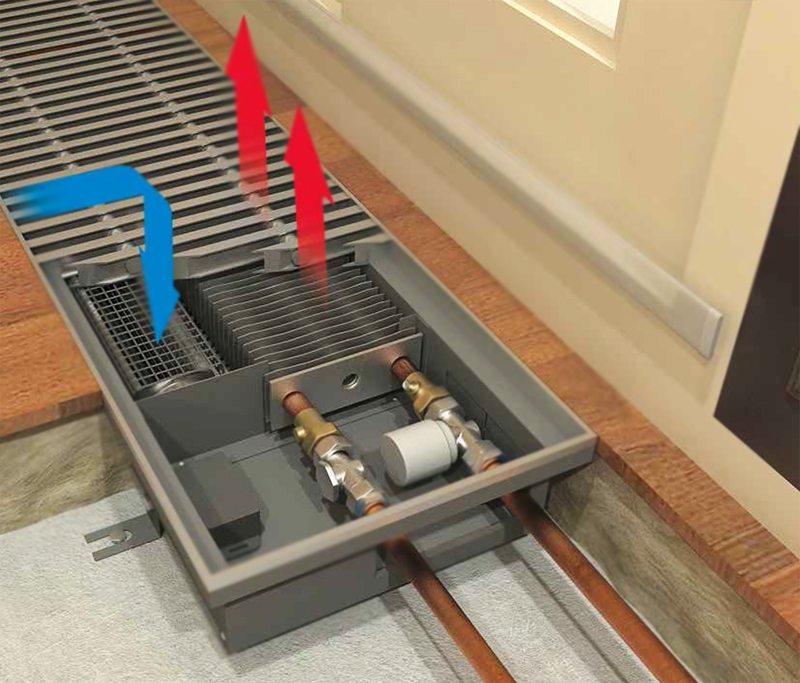
Heat disperses around the room very quickly, and all thanks to the rapid spread of heated air masses. In the case of the device, special corrugated tubes are installed on its sides, it is through them that air enters the case, where it quickly heats up under the influence of the heat of the pipes. They, in turn, are heated by the warm water poured into the system.
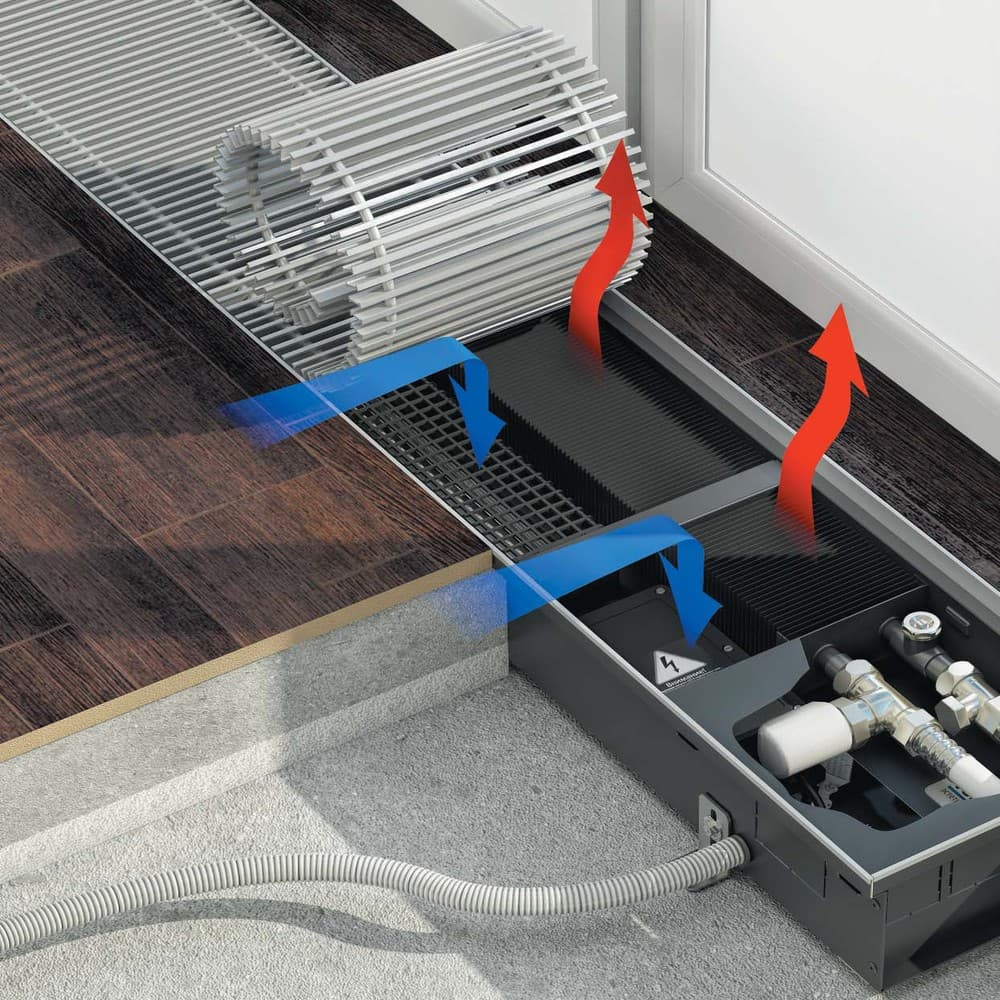
The heated air masses enter the room through the front part of the convector, in which a special grille is installed for this purpose. That is, to put it simply, water is poured into the pipes inside the casing and when the convector is turned on, it heats up. The air inside the case warms up and goes outside, and the cold stream again enters the inside, and so on until the temperature in the room becomes the same. It is worth noting here that such a system allows you to maintain a comfortable temperature in the room not only during the heating season itself, but also in the off-season.
Full heating of the room occurs quite quickly within 15-20 minutes.
Characteristics of floor water convectors
Heating appliances offered by domestic and foreign manufacturers differ significantly in appearance, material, variety of models and, of course, cost.To choose the right option for your home, you have to take a closer look at convector-type water heating equipment.
The design and principle of operation of the device
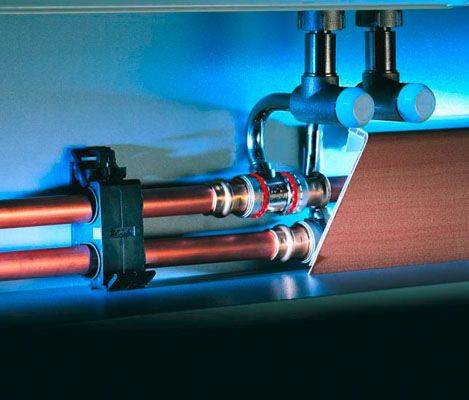
The floor convector has an elongated galvanized body 1-2.5 m long. Inside, one or more pipes are placed in a protective casing, which act as a heat exchanger. They are made of brass or copper and connected to aluminum plates. These materials are chosen for a reason - they quickly heat up and give off heat.
Thermal energy is distributed due to the circulation of air masses. Corrugated tubes are connected to the side or end inlets in the system, through which water is supplied, which heats the heat exchanger.
Air enters the holes made in the lower part of the device, contacts with the heating element and, increasing in volume, exits into the room through the upper lattice panel.
The principle of operation of the convector is simple: air passes through the heater from the bottom up, heats up and exits the room, instantly spreading heat
The heating process is carried out continuously. One cycle takes approximately 15 minutes. The convector heating system is practically silent - the sounds emitted do not exceed 20-23 dB.
Types of floor convectors
There are several types of underfloor water heaters on the market. They differ in the way of heating and purpose. Conventionally, there are two types of equipment:
- with natural convection;
- with forced convection.
The first option provides for natural convection in the devices according to the classical scheme: air enters from below, passes through the heat exchanger and is pushed into the room.
Efficiency in this case depends on the traction force and the size of the device. The longer the length, the higher the power. Appliances with natural convection can serve as an additional source of heat and form a heat shield near windows.
Floor convectors are indispensable in rooms with a large number of windows: they stop the flow of cold air seeping through them and prevent the accumulation of condensate on surfaces
Models operating on the principle of forced convection are additionally equipped with a fan that increases the efficiency of the device. It speeds up the heating process by pumping air and pushing it more intensively into the room. The power of such equipment is determined by the fan speed.

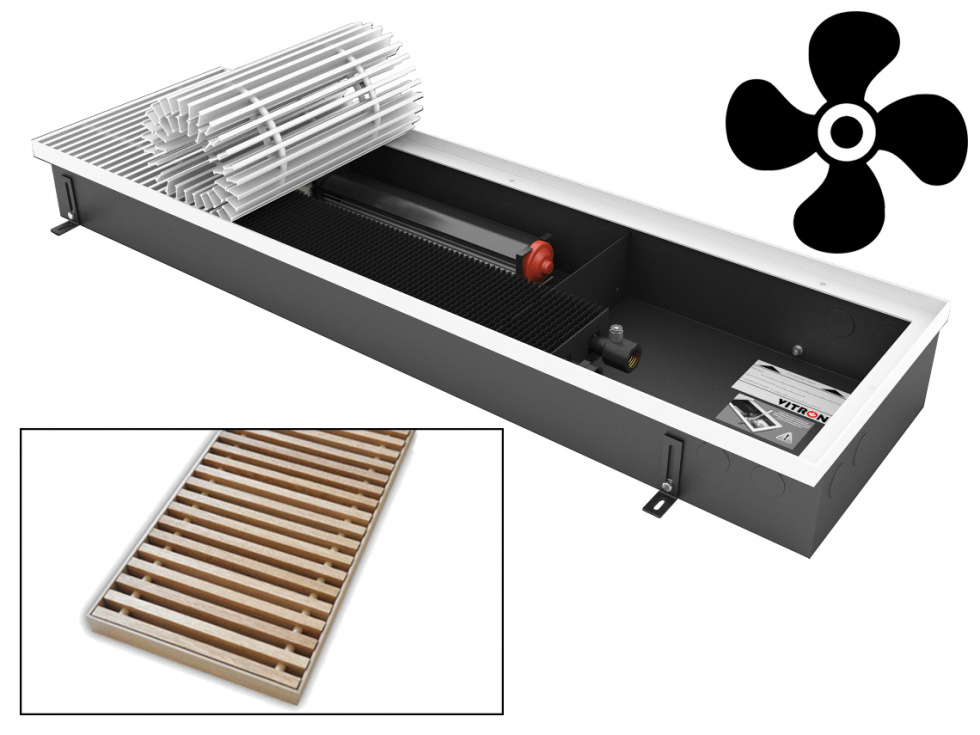

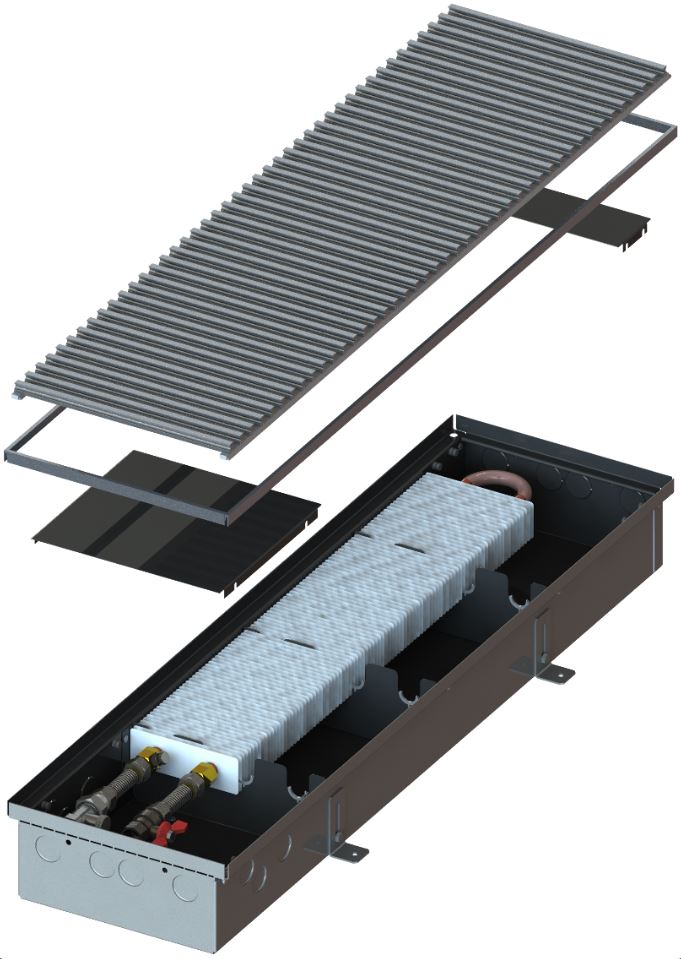
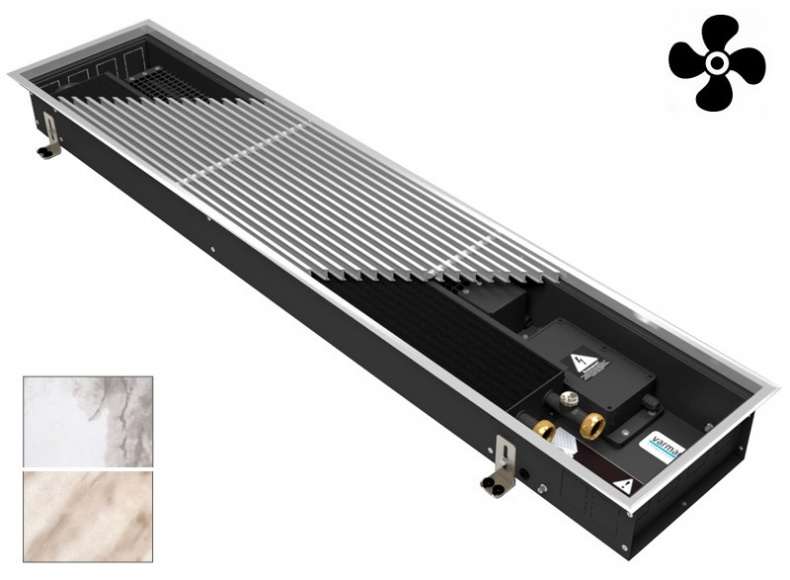


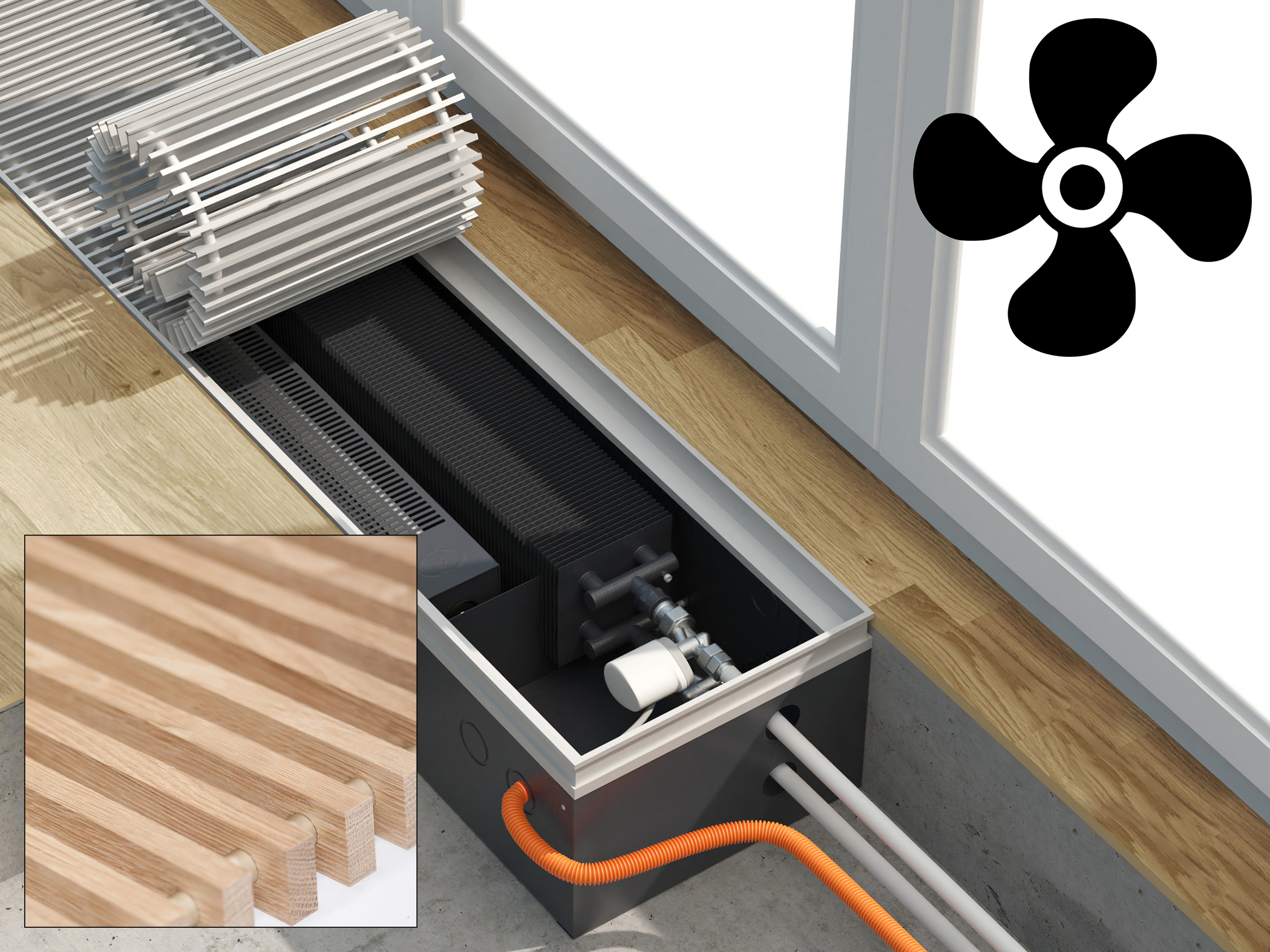
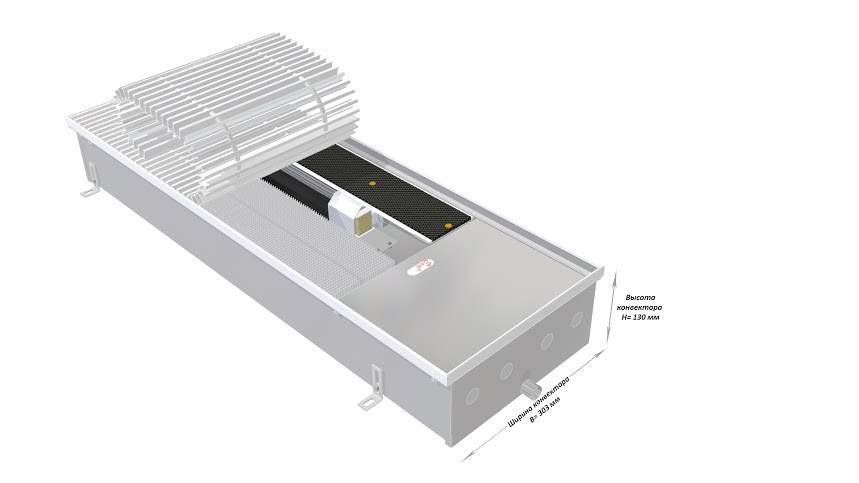

Devices equipped with one or more fans are characterized by greater power. They easily heat large rooms.
Devices with forced convection are used in both combined and autonomous heating systems of residential apartments, houses, offices, trading floors. In the lines of trade offers of most manufacturers there are models designed for especially wet rooms.
Advantages and disadvantages of devices
With the help of floor-type water convectors, it is possible to organize a heating system that provides fast, uniform and high-quality heating of rooms of different sizes. And this is far from the only advantage.
This equipment is different:
- stylish design and compact dimensions;
- fire safety;
- ease of installation and maintenance;
- economical consumption of electricity;
- low heating temperature of the coolant;
- the possibility of forming a reliable thermal curtain;
- long service life.
The equipment allows you to create and maintain an optimal comfortable climate and control the temperature using a thermostat. Most manufacturers integrate special cleaning systems into floor convectors. They destroy viruses, bacteria and prevent the spread of infections in the air.
Floor water heaters do not dry out the air and are completely safe for health. They are safely installed even in children's rooms.
The devices also have disadvantages. First, they are incompatible with artificial ventilation. Secondly, convection currents provoke excessive dustiness.
In addition, it is undesirable to install convectors in rooms where the ceiling height is less than 2.2 meters. This is due to the fact that the heated air will not have time to cool down to the parameters that ensure its downward movement. Because of this, circulation will slow down, and the air flow will begin to stagnate under the ceiling.
Fan convectors
When choosing a device, you should pay attention to the presence of a fan - such equipment accelerates the process of heating heat flows and moving them around the room. Increases heat transfer, the room warms up more evenly
An additional plus is that a convector with a fan lasts longer due to the cooling of the heat exchanger, and this is an extremely useful feature for water and gas appliances.
There is only one minus - a gas, water or air convector for heating with a fan becomes a volatile device that requires electric current to operate.If there is a power outage in the house, you will have to install an uninterruptible power supply or a generator.
Which brand of convector is better to choose
Companies producing convectors, as a rule, are engaged in a narrowly focused activity - the production of heating appliances. Surveys show that users prefer reliable, trusted companies that have a lot of positive reviews and a decent reputation. For review, brief characteristics were collected for each brand:
- Noirot Spot, a brand from France that produces heaters, manufactures and develops them only at its own facilities, importing heat sources to more than 90 countries.
- Stiebel Eltron is a brand from Germany that produces electric heating equipment. It has many subsidiaries in the territories of Asian and European countries, is a sponsor of sports and charity events, and is one of the market leaders in the field of heating.
- Electrolux is a popular company from Sweden that produces household appliances for the home, produces climatic and professional equipment. The company's products belong to the middle and low price segment.
- Timberk is another large corporation from Sweden that produces climate equipment. Focuses on the production of a wide range of products, from simple water heaters to functional split systems.
- Resanta is a Latvian brand that manufactures electrical goods. Offers a large selection of convectors, heaters, voltage stabilizers at average prices. Every year the company participates in international exhibitions, where it presents its own developments.
- Hyundai is a large holding from South Korea that manufactures consumer electronics.In creating its products, the company uses only modern innovative systems aimed at making the use of products more comfortable.
- Ballu is a Russian brand that produces climate control equipment for industrial and domestic purposes. It has production facilities not only in Russia, but also in China, uses only high-quality raw materials.
- Scoole is a manufacturer from Russia that produces climate equipment for the home, offering a large range of air conditioners, split systems, and fans. It sells goods on the territory of the Russian Federation and the CIS countries, in compliance with strict international quality standards.
- Power KVZ is another Russian company producing climate equipment. In production, components of well-known brands are used, which ensure the reliability, safety, and quality of devices.
- Varmann is the largest brand producing convectors, heat exchangers, facade heating systems. It sells goods to Russian and European markets, gives long warranty periods for all products, accepting orders for individual projects.
- KZTO Breeze is a plant for the production of thermal equipment, which has been a leader among Russian manufacturers for 20 years. The advantages of the company include reliability, style, reasonable price for premium goods.
- iThermic ITTZ is a trademark of the Rada-M company, which produces heating devices. It manufactures premium products, provides long-term guarantees, and uses high-quality raw materials in production.
Operation of underfloor heaters with or without fan
The process is a phenomenon of convection.Cold air coming from below, after contact with a hot heat exchanger made of steel or aluminum, warms up and begins to move upward. Thus, the heat disperses throughout the room.
Types of floor water convectors:
- With natural ventilation. This type is not equipped with additional auxiliary elements that enhance the flow of warm air masses. The process of convection occurs under the action of ordinary gravitational forces.
Photo 1. Scheme of operation of a floor water convector without forced ventilation: air masses move naturally.
- With forced ventilation (fan). The presence of a fan contributes to increased air circulation, and, consequently, an increase in the volume of moving air masses. This increases the efficiency of heat transfer.
Principle of operation
The difference between water convectors and radiators is in the method of heating. The use of convection evenly distributes heated air throughout the space of the room. The device heats the air, changing the density. It rises, where it mixes with cold air and descends.
The constant circulation of the air mass maintains the temperature almost the same throughout the entire volume of the room - when it is measured near the floor surface and under the ceiling, the difference is approximately 1-2 degrees.
Designs that use natural air convection for heating heat the room quickly enough, however, the use of forced circulation significantly speeds up the process.
Equipment by type of installation
According to the type of installation, convectors are divided into several types.
floor standing
Floor heating convectors are convenient and mobile heating devices. If necessary, they can be moved to any room or, if the power cord allows, taken outside the house, for example, to warm the covered veranda. The only drawback of such devices is precisely the dependence on the connection to the network. But the problem can be easily solved by using a conventional extension cord.
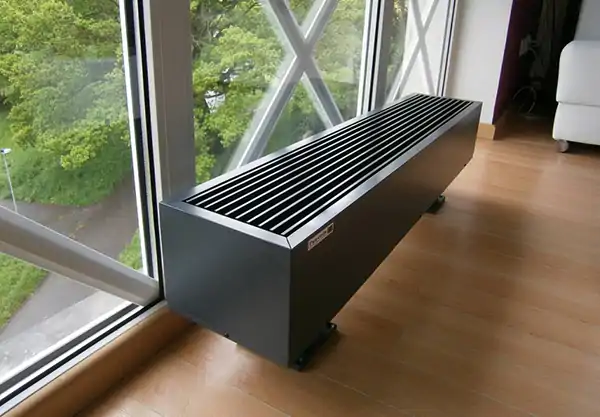
Photo 1. The floor heating convector is suitable for heating any premises, including the veranda.





wall
Such heaters are the most common among buyers. Their advantages are small thickness and attractive appearance. Wall-mounted devices are installed under windows, which creates reliable protection against the penetration of cold air from the street.
Floor recessed or hidden plinth
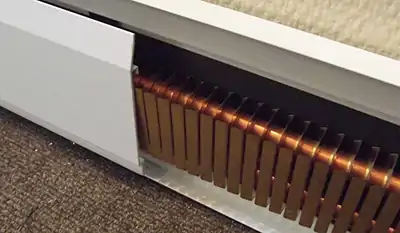
Such convectors are mounted in baseboards or on the floor anywhere in the room. This is their main advantage.
Devices are used in large rooms, when wall or floor devices cannot cope with heating a large area.
The disadvantage is that it is necessary to plan such a hidden heating system at the design stage of the building.
Special niches are prepared in the floor for the installation of appliances, a channel for pipelines. The appearance of such convectors does not spoil the interior, as it looks just like gratings in the floor.
Important! For greater efficiency of built-in appliances, these grilles should not be covered with carpets or furniture. Some built-in plinth appliances are equipped with fans to warm up the room as soon as possible.
For use at home, small devices that are mounted under a baseboard or in a built-in furniture case are suitable.
Some built-in plinth appliances are equipped with fans to warm up the room as soon as possible. For the purpose of use at home, small devices that are mounted under the baseboard or in the body of built-in furniture are suitable.
Installation work
Installation instructions for water heaters are simple and consist in connecting to a heating pipeline. Floor models are installed at the same time as the floor, wall or skirting models can be installed at any time.
The installation process includes the wiring of electrical cables, coolant supply circuits, the installation of a niche for the unit box, which must be flush with the finished floor. It is better to entrust this work to qualified specialists.
Depending on the purpose, the heating water convector can perform 2 functions:
- heat the room - the device is installed away from window openings;
- create an air barrier to cold air in the window area - a heater opposite the window at a distance of 20 to 30 cm.
Faultless heating is achieved by observing the mandatory conditions during installation:
- The supply / removal of heat carriers is carried out from rigid or flexible connections and stopcocks (included).
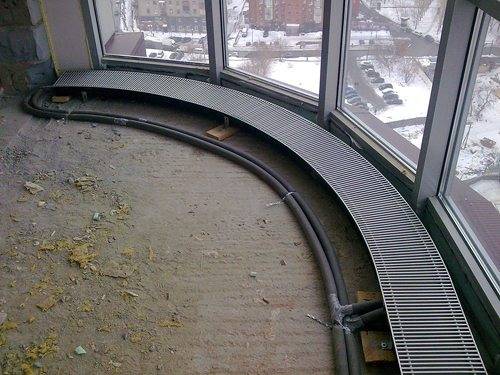
- The convector niche must have such a depth that the decorative cover of the appliance is flush with the finished floor
. - Permissible gaps for the width and height of the convector from 10 to 15 mm.
- With adjusting bolts, the water heating convector is aligned horizontally and fixed.
- Gaps are insulated and sealed with special material.
- After installing the finished floor, connect the piping (electrical is required if there is a built-in fan).
- Seal the remaining gaps with sealant / finishing material, turn on the device and cover with a grill.
The installation of wall and baseboard heaters does not have so many nuances and consists in connecting the object to the water supply network, and this is easy to do with your own hands.
Before working with a wall heater, you need to remove the battery, then proceed directly to the installation.
- Instead of radiator plugs, screw two couplings with a diameter similar to the liner - usually 20 mm onto the squeegees.
- Fix the convector on the brackets and align its thread axes with the axes of the spurs.
- Wind up the threads on the heater, drive the couplings on them to the stop and tighten the locknuts.
- To avoid water hammer, when starting the riser, open the valves slowly.
Varieties
Convectors have many varieties that differ:
- by type of heat carrier (electric, gas, water);
- by type of work (convection, infrared or mixed type);
- by installation method (floor, wall, ceiling, plinth);
- according to the material of manufacture (steel, ceramic, glass, quartz);
- according to additional options (with natural convection or forced with a fan, with an ionizer or humidifier, with a dust filter and others).
When choosing a convector for a summer residence or for a home, it is worth remembering about the different power of the devices. Preference for one or another type should be given based on the volume of heated air in the room. Manufacturers usually indicate the maximum number of square meters for which the device is designed.
If, for example, the room is poorly insulated, there are drafts, the windows face north, or there are other conditions that contribute to lowering the temperature and heat loss, you should choose a convector with a higher power. So, for a room of 15-20 square meters, a heat appliance with a capacity of at least 2 kW is purchased. A 1 kW device can heat a very small room up to 12 square meters. If the convector has additional options (air humidification, electronic thermoregulation), then these losses during the operation of the device should also be taken into account. Accordingly, it will fit the area less than the declared one by about 30-40%.



infrared
These are the latest innovative models. Their efficiency is increased due to the additional effect of infrared radiation. Combined type devices have 2 heating elements and can work even if one of them fails.
They have an increased efficiency and warm up the room faster than other types due to the release of heat by IR waves to objects in the environment. Such appliances often have decorative panels and are the latest generation of heating systems.
Electrical
Electric convectors work by heating the internal element (TEN) with electric current. The use of such a device is absolutely safe. The heating element is protected by insulation and the convector shell, therefore, at any set temperature, its surface does not heat up above 50-60 degrees.
They are equipped with automatic thermostats. It is worth remembering that an electric convector consumes a sufficient amount of energy. Therefore, you need to choose the option with maximum energy saving.It is suitable for a small room or intermittent work (during the breaks between heating seasons).
Gas
The gas convector is not very popular, although it was originally designed as a more economical alternative to the electric one. It runs on liquefied gas from a cylinder. It is convenient to use it in private households with the possibility of connecting to the highway. At the same time, its installation should be carefully considered, since it may be difficult to further dismantle and transfer the device.
In addition, a gas convector requires a flue gas removal and recovery system. Installing such a convector will require special skills. And the savings become relative, since significant heat losses will occur through ventilation to remove gases in the outer wall.
Water
Convectors with water as a heating medium are characterized by maximum efficiency, ease of use and safety.
Water intake for heating in them comes from a central heating system. They are compact and can be hidden under the floor surface (the so-called "skirting models"). Their only drawback is the small area of \u200b\u200bthe heated room. It should not exceed 10-12 square meters.