- How to choose the right boiler?
- Basic tools for heating installation
- Characteristics of the most popular heating systems
- Water heating
- Electric heating of a country house (electric convectors)
- Boilers from other manufacturers
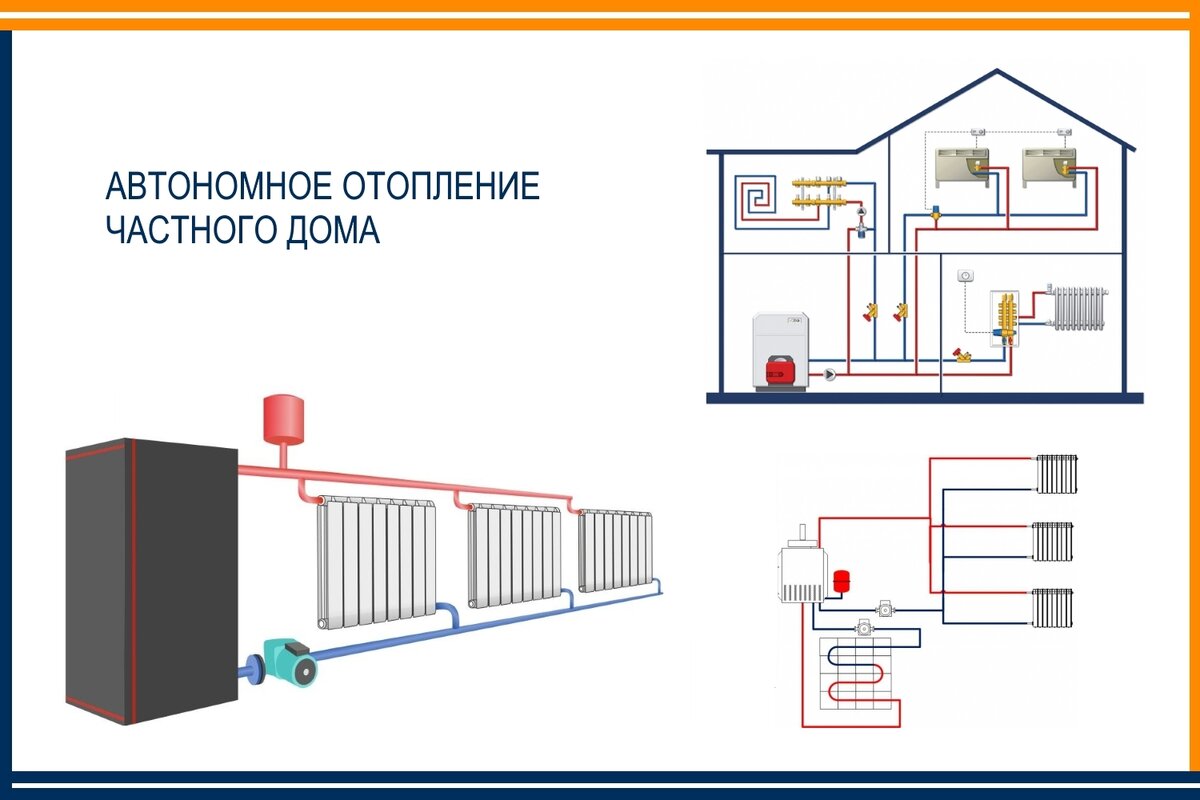
- Autonomous home heating
- Types of combined heating systems
- Gas + diesel boiler
- Gas + solid fuel
- Solid fuel + electricity
- Gas + solid fuels + electricity
- Pyrolysis + electrodes
- How to choose the best heating system?
- Steam heating boiler in a private house
- Feature of the horizontal pipe laying scheme
- Central horizontal heating
- Autonomous horizontal heating
- If the radiator does not heat up.
- Option 2: gas and diesel
- Device
- Advantages
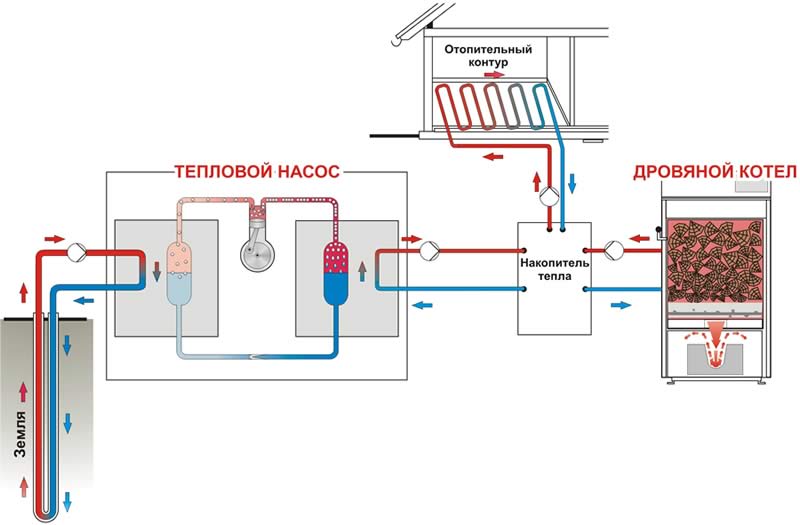
- Bivalent hybrid heating systems based on heat pumps
- Functioning of the bivalent system
- The procedure for the implementation of the heating system
- Selecting the type of heating
- Engineering calculations
- Selection and purchase of equipment
- Installation and debugging of the system
How to choose the right boiler?
The only objective criterion for choosing a combined boiler for your home is the required power to ensure the functioning of the heating system. Moreover, this indicator should not be affected by the number of connected circuits.
It makes no sense to pay more for a powerful boiler in the hope of adjusting its operation with automation. This approach contributes to the "idle" operation of the device, which leads to a faster failure. In addition, this mode of operation contributes to the acceleration of the condensation process.
As for the calculation of power, theoretically, to heat an area of 10 m2, it will be necessary to use 1 kW of heat energy.
But this is a rather conditional indicator, which is adjusted based on the following parameters:
- ceiling heights in the house;
- the number of floors;
- degree of building insulation.
Therefore, it is advisable to use a one-and-a-half coefficient in your calculations, i.e. in calculations, increase the margin by 0.5 kW. The power of a multi-circuit heating system is calculated with a surcharge of 25-30%.
So, in order to heat a building with an area of 100 m2, a power of 10-15 kW is required for single-circuit heating of the coolant and 15-20 kW for double-circuit heating.
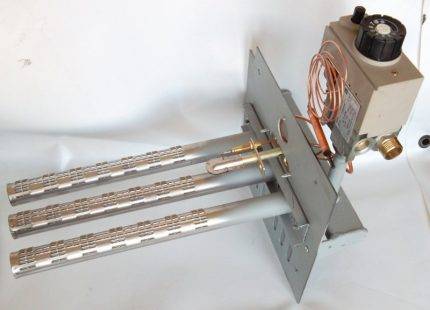 To select a gas burner for a solid fuel boiler, you need to accurately measure the dimensions of the combustion chamber. It is these proportions that will correspond to the size of the gas burner
An equally important criterion when choosing a combined heating boiler is the price category. The price of the device depends on the power, the number of functions and the manufacturer.
For users, other characteristics are no less important:
- DHW;
- material of manufacture;
- ease of management;
- dimensions;
- accessories;
- weight and installation features;
- other.
The issue with hot water supply will immediately have to be resolved: a boiler will provide hot water or there is an electric boiler for this.
In the case of determining the first option, the preferred method is chosen - storage or flow, as well as the parameters of the water reservoir according to needs (calculated based on the number of residents).
As for the dimensions of the equipment, they only matter in the case of installation in a room with a small area.
According to the material of manufacture, a wide range of boilers is presented. But the most popular options are steel or cast iron. Also, such a boiler is able to withstand a high and prolonged temperature load, has a longer service life.
Judging by the intensity of sales and relying on consumer reviews, the following models are actively in demand:
Automation of control affects the usability, and the security system depends on how automated the process of combustion of energy carriers is. Most models can be controlled using convenient remote controls or panels.
Most models are optional. This includes the presence of a hob for cooking, injectors, draft regulators, burners, a soundproof casing, etc.
The choice of a boiler according to this parameter should be based on personal preferences and the allocated amount for the purchase.
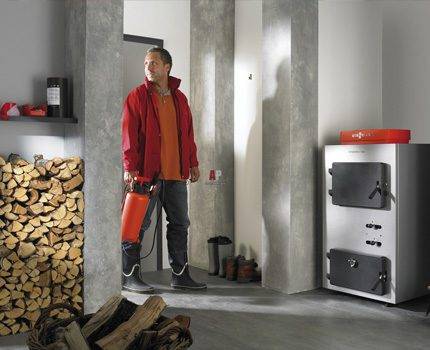
When choosing a heating boiler with a combination of wood / electricity, it is necessary to calculate the required power of the heating element. It is recommended to choose models with an indicator of at least 60% of the required coefficient for home heating
But the weight of the equipment and the complexity of its installation should immediately pay attention.Installation in a residential building of most floor models of combined boilers for heating, equipped with several combustion chambers, requires an additional concrete pedestal device, because a standard floor covering cannot withstand such a load
The best solution is to equip a separate boiler room
Installation in a residential building of most floor models of combined boilers for heating, equipped with several combustion chambers, requires an additional concrete pedestal device, because a standard floor covering cannot withstand such a load. The best solution is to equip a separate boiler room.
Knowing the main parameters that affect the choice of a combined boiler, you can choose the most suitable model.
Additional selection recommendations, as well as a comparative overview of different heating units for a private house, are given in.
Basic tools for heating installation
The whole complex of works on the installation of heating can be divided into two stages: the preparatory stage and the installation stage. Each stage has its own set of tools.
At the stage of preparing the installation of pipes and heating devices, general construction work is carried out related to the preparation of pipeline routes and installation sites for heating devices. To carry out such work, it is necessary to prepare a fairly standard set of basic construction tools, namely:
Perforator. It is necessary for the preparation of pipeline routes, the through passage of ceilings and walls. Do not replace the perforator when installing heating radiators, especially in rooms with stone and concrete walls. You need a puncher for open installation of heating pipes. Fixing a pipe to a concrete wall without a punch is almost impossible.


Being the basic tool of the installer, the choice of a rotary hammer is of great importance. On the one hand, the hammer drill should be powerful enough, on the other hand, it should not be heavy and should be easy to use.
As a recommendation, I can advise a professional Makita tool. It is powerful yet compact and very easy to use. In addition, Makita repair is available at the company's diagnostic and repair center, it is carried out with original parts in a very short time.
In addition to a perforator for general construction work, you will need:
- Grinders, they are also cutting machines of the "Bulgarian" type.
- Screwdrivers;
- To work in a wooden house you need a circular saw.

Characteristics of the most popular heating systems
The choice of a specific type of heating is not limited to connecting to a central line or autonomous operation, they are divided into several options that are suitable in a given situation.
Water heating
Many consumers choose water heating of a country house, the options and prices of which make it possible to provide the building with heat and hot water with minimal initial investment and an acceptable level of current costs.
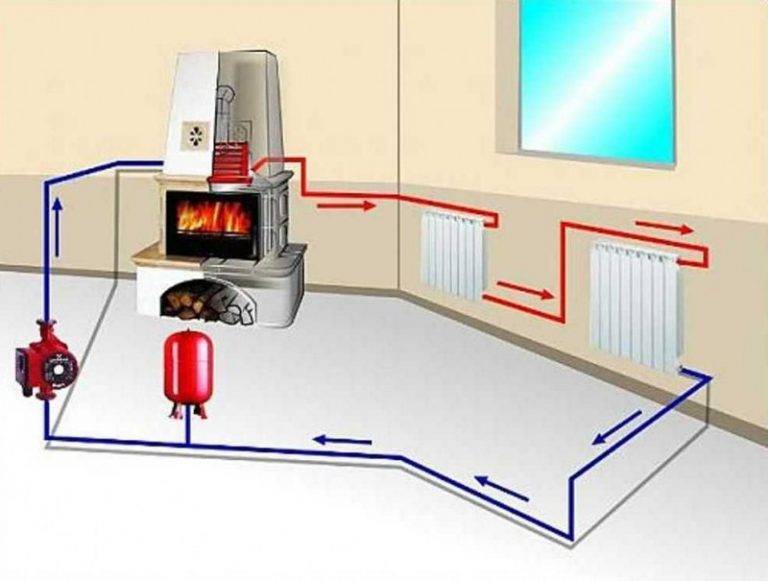
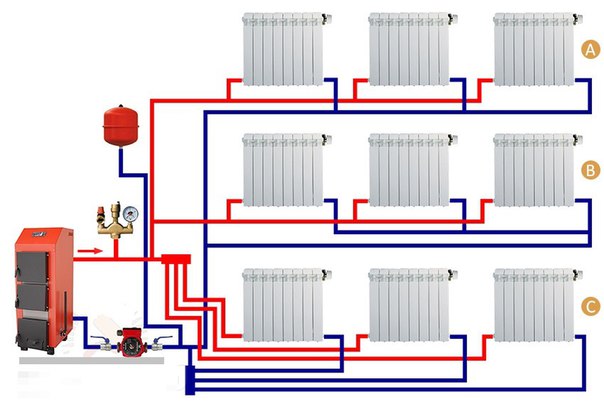
It is a closed loop system that consists of three main components:
-
heating boiler, which can operate on suitable gas, liquid or solid fuels and electricity.
-
Tru systemsb, which ensures the delivery of the coolant (heated water) to each room.
-
heating batteriesacting as heat sources in the room.
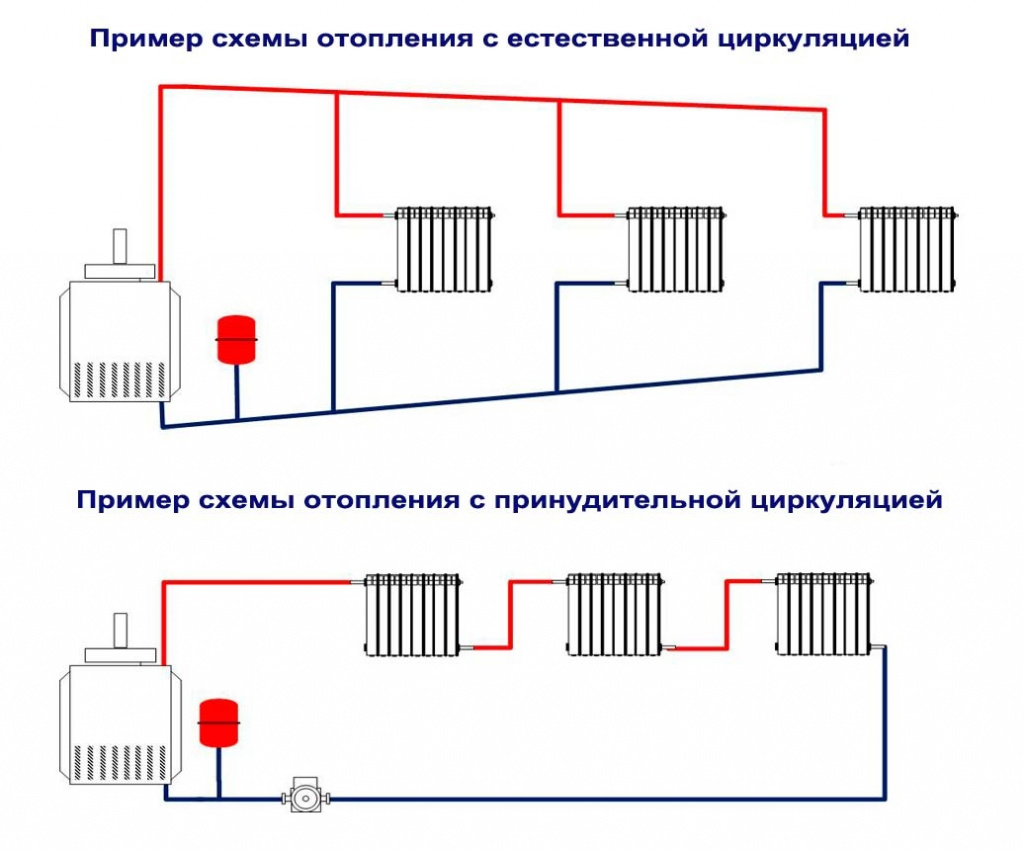
To ensure the quality of the functions, a constant circulation of water in the pipes is necessary, it can be forced or natural.

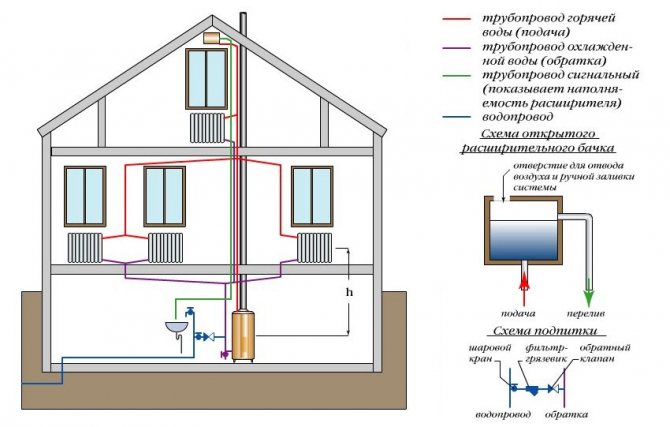
Schematic representation of a water heating system
The first option requires the connection of a pump of sufficient power, which will ensure the movement of the coolant in utilities. The second one is obtained due to a change in the density and degree of heating of water in different parts of the heating system, the heated coolant moves up, squeezing out colder water.
Despite the advantages, there are disadvantages:
-
Uneven heating - rooms located closer to the boiler heat up more than remote ones.
-
The rate of temperature increase is quite slow and it will take a while for the whole house to warm up.
-
impact on the interior. If the pipes are laid in the walls at the construction stage, then for their repair it will be necessary to remove the coatings. In the case of installing water heating after repair, it is difficult to naturally fit them into the design of the room.
-
The need to maintain a certain coolant temperature increases operating costs.
Despite this, water heating is the most popular.
Electric heating of a country house (electric convectors)
If only efficiency is taken into account, then electricity has the highest rate among all heating elements, so it is most often chosen if it is possible to connect to a common energy highway.

Electric heating radiator
The advantages of this type of heating include:
-
Relative ease of installation, which, with basic knowledge and skills, can be done independently.
-
High heating rate.
-
Lack of noise accompanying the operation of devices.
-
A wide range of devices based on a variety of operating principles, which allows you to use the most optimal option for yourself.
-
A wide range of different design solutions provides an opportunity to choose an electric heating device for a specific interior.
But there are a number of conditions that limit or make it impossible to use such equipment in some cases:
-
High cost per 1 kW of heat.
-
There are certain wiring requirements. It must be rated for the appropriate power.
-
-
An uninterrupted supply of electricity is required. If there are problems with this in the region, then another option should be sought.


Subject to these parameters, the installation of electric heating will bring only pluses.
Boilers from other manufacturers
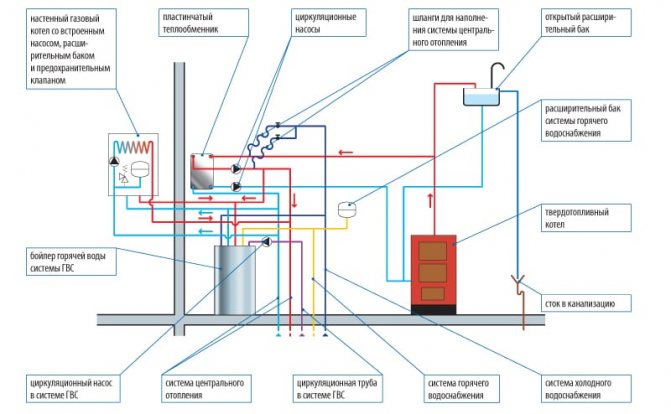
The most popular in a multi-fuel boiler is the combination: solid fuel + gas.
This is what Zota combined boilers look like
This allows you to perfectly heat cottages, near which gas pipelines pass. Along with Finnish boilers, there are also Polish, Zota firms. They can combine solid, gaseous and liquid fuels. However, the burner will need to be changed. The price of the boiler is small, such a model is suitable for those who are not going to often change energy sources.
The scheme of work here is different. The main solid fuel runs out, another burner is turned on automatically. Everything is fixed in the settings. This is an interesting model of a multi-variant boiler, but it also has disadvantages - size and cost. Other existing models:
- Finnish Jäspi Triplex and Swedish CTC represent a combination: gas + solid fuel + electricity, and there are also examples: diesel fuel + gas + firewood + coal + electricity;
Dimensional drawing of Finnish boilers Jäspi Triplex
- Czech cast-iron combined boilers DAKON FB operate with pellets;
- Finnish boilers Jäspi VPK operate with pellets, gas, diesel fuel, firewood, coal, there is an electric heater;
- Austrian combined boilers Wirbel Eko Sk Pellet Pus have two fireboxes;
- Russian combined boilers "FAX" work on wood and coal, there is a heating element;
- the combined Russian boiler "Dymok" runs on wood or coal.
Autonomous home heating
boiler
Understanding the principle of operation of the system will allow you to mount the most successful heating model in relation to the project of your house, and get the maximum amount of heat from it.
It is better to think over the project scheme at the construction stage in order to provide a place for risers and collectors. But if the moment is missed initially, in any case, the problem is solved.
The operation of the system depends on the type of fuel and the design features of the boiler. The resource used and the type of unit affect the durability of the system, cost and service, so it is better to familiarize yourself with their characteristics before buying.
Types of combined heating systems
Gas + diesel boiler
The operation and operation of this combination depends on the performance of the heat exchanger. Such a representative is made of cast iron and steel separately, or in combination. Consumers using a combined boiler for a private house are convinced that with a gas pipeline located nearby, it is possible to use both water heating and a combined system in the form of a combination of diesel fuel and gas. This is a very economical version of the acquisition and further operation of the structure.
Gas + solid fuel
Such a system is an independent combination of gas and solid fuel. A multi-fuel device operating on wood and coal is suitable here.
Combined heating boiler for gas, diesel and solid fuel
This combination is not always effective, the boiler requires the presence of a special automatic technology that controls safety. You need to treat this situation clearly and under the supervision of a specialist, then there will be a return. Despite the complex design, these devices are popular because of their inexpensive cost.
Solid fuel + electricity
Combined boilers for heating a private house with a similar combination are quite often used in practice, mainly in the country version. The volume of electricity here is from 220 to 380 volts, power - 4-9 kilowatts. There is a three-phase switching in the potential. Being present in the premises, the owners can use solid fuel, and when they leave, the automation will turn on, and the required temperature regime will be maintained in the building. The price of such a unit, of course, is rather big, but it is reliable and in the absence of other options, this one will be the best.
Gas + solid fuels + electricity
Consumers who value extreme power choose only this heating system, which operates with the help of some fuel sources. Coal, wood, coke, lumber briquettes are used here. A mixed heating system is suitable for different areas located far from the city, but with the presence of a gas pipeline. In the event of a shortage of gas or electricity, there is always a way out - to use wood or other solid fuels.
Pyrolysis + electrodes
This device is suitable for heating a two-story house or heating a summer cottage. The combination of the action of the pyrolysis and electrode boiler will allow you to maintain the required temperature, even when there are no owners. The scheme is not one multi-fuel mechanism, but two units, and has already managed to gain popularity.
This is interesting: Single-pipe heating system of a private house: device technology
How to choose the best heating system?
There are many heating systems. All of them have attractive sides and significant disadvantages. It is quite difficult for an unprepared person to navigate them and make the right choice.
In order not to be mistaken, you need to know exactly what points you should pay attention to.
First, it is the availability of fuel and its cost. You can consider this as a key point. As much as you like the system, but if the fuel for it is difficult to obtain, is supplied intermittently to the region, or is too expensive, you should consider another option. Otherwise, heating the house will cost a pretty penny and turn out to be inefficient.
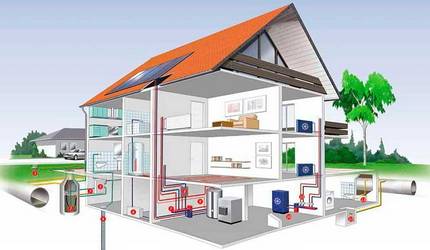
According to statistics, most owners of private houses choose heating systems with a liquid coolant. This is a practical, reliable and quite economical option.
The second point is the possibility of combining heating systems. In some cases it can be very practical to use a primary and secondary system. This gives confidence that in case of possible interruptions in the supply of energy, the house will not be left without heat.



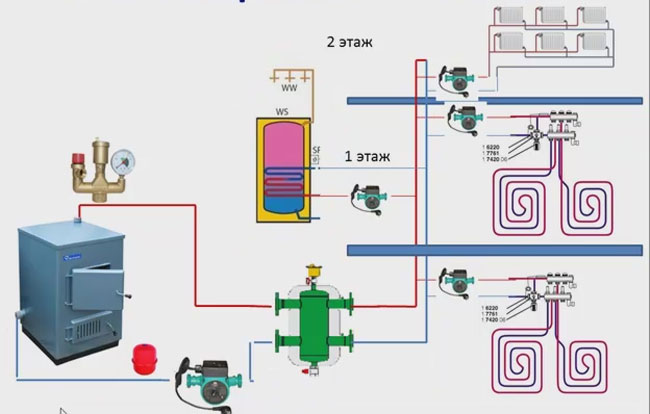
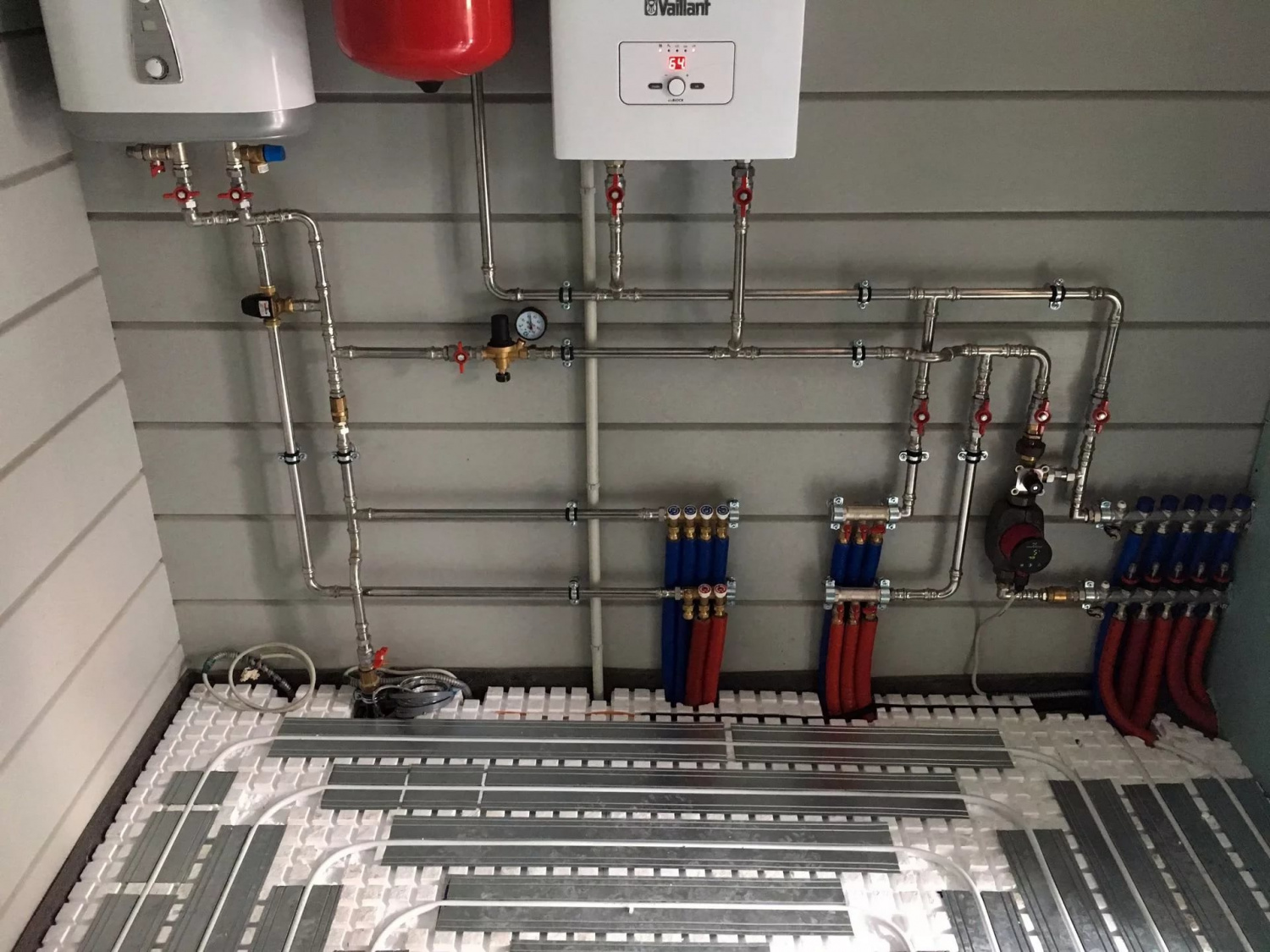
In addition, there is an opportunity to save money, since you can use the most economical heating method at the moment.
And finally, the financial side of the issue.It is necessary to determine how much the consumer will be able to allocate for the purchase of equipment, its competent installation and subsequent regular maintenance.
Steam heating boiler in a private house
A steam boiler is an alternative type of heating for private houses and cottages. Water heating of buildings is incorrectly called “steam” - such a confusion in the names is associated with the principle of heating apartment buildings, where an external coolant under pressure flows from a CHP to individual houses and transfers its heat to an internal carrier (water), which circulates in a closed system.
Steam heating in a private house is used much less frequently than other methods of space heating. It is economically justified to use the boiler in a country house or a country house, when year-round living is not provided, and the main role in heating is played by the speed of heating the premises and the ease of preparing the system for conservation.
The possibility of installing such equipment in addition to the existing one, for example, a furnace, is another advantage of using steam as a heat carrier.
As a result of water boiling in the boiler unit (steam generator), steam is formed, which is supplied to the system of pipelines and radiators. In the process of condensation, it gives off heat, providing rapid heating of the air in the room, and then returns in a liquid state in a vicious circle to the boiler. In a private house, this type of heating can be implemented in the form of a single- or double-circuit scheme (heating and hot water for domestic needs).
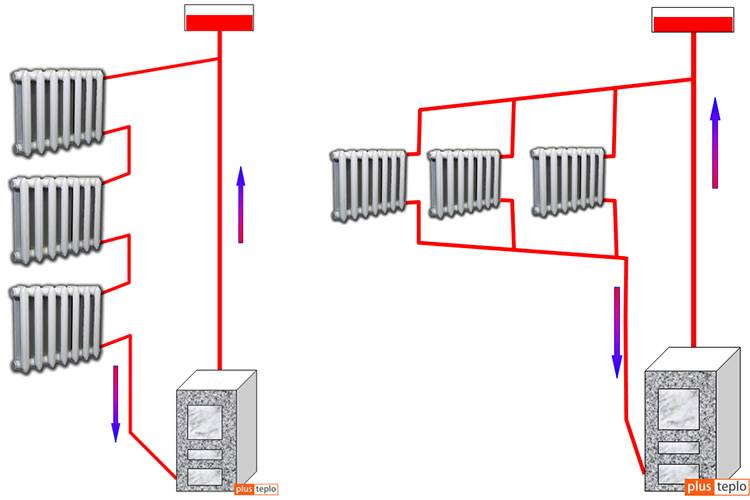
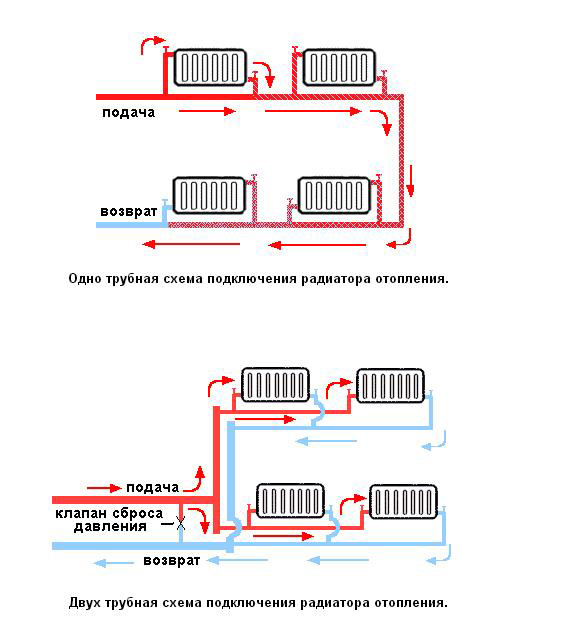
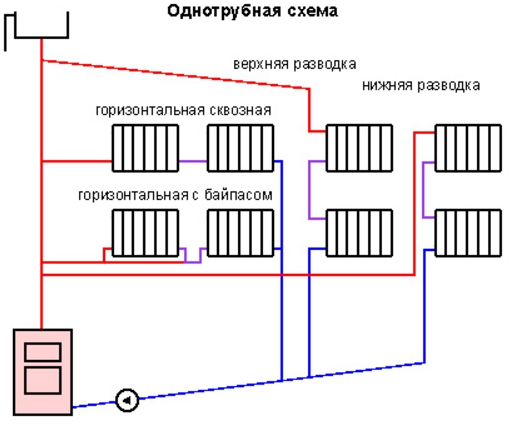
According to the wiring method, the system can be single-pipe (serial connection of all radiators, the pipeline runs horizontally and vertically) or two-pipe (parallel connection of radiators). Condensate can be returned to the steam generator by gravity (closed circuit) or forcibly by means of a circulation pump (open circuit).
The scheme of steam heating of the house includes:
- boiler;
- boiler (for a two-circuit system);
- radiators;
- pump;
- expansion tank;
- shut-off and safety fittings.
Description of steam heating boiler
The key element of space heating is the steam generator, the design of which includes:
- furnace (fuel combustion chamber);
- evaporator pipes;
- economizer (heat exchanger for heating water due to exhaust gases);
- drum (separator for separating the steam-water mixture).
Boilers can operate on various types of fuel, but it is better for private houses to use a household steam boiler with the ability to switch from one type to another (combined).
The efficiency and safety of such space heating depends on a competent approach to choosing a steam generator. The power of the boiler unit must be commensurate with its tasks. For example, to create an optimal microclimate in a house with an area of 60-200m 2, you need to buy a boiler with a capacity of 25 kW or more. For domestic purposes, it is effective to use water-tube units, which are more modern and reliable.
Self-installation of equipment
Work is carried out in stages, in a certain order:
1. Drawing up a project taking into account all the details and technical solutions (length and number of pipes, type of steam generator and its installation location, location of radiators, expansion tank and shutoff valves).This document must be agreed with the state control authorities.
2. Installation of the boiler (made below the level of the radiators to ensure steam advances upwards).
3. Piping and installation of radiators. When laying, a slope of about 5 mm should be set for each meter. Installation of radiators is carried out using a threaded connection or welding. In reviews of a steam heating system, experienced users recommend installing taps to eliminate problems when air locks occur and facilitate subsequent operation.
4. Installation of the expansion tank is carried out 3 meters above the level of the steam generator.
5. The piping of the boiler unit must be carried out only with metal pipes of the same diameter with outlets from the boiler (adapters must not be used). The heating circuit is closed in the unit, it is desirable to install a filter and a circulation pump. A drain unit must be installed at the lowest point of the system so that the pipeline can be easily emptied for repair work or conservation of the structure. Necessary sensors that control the process and ensure safety are necessarily mounted on the boiler unit.
6. Testing a steam heating system is best done in the presence of specialists who can not only perform all procedures in accordance with applicable norms and standards, but also eliminate any shortcomings and inaccuracies in the installation scheme with their own hands.
Feature of the horizontal pipe laying scheme
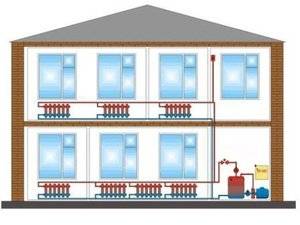
Horizontal heating scheme in a two-story house
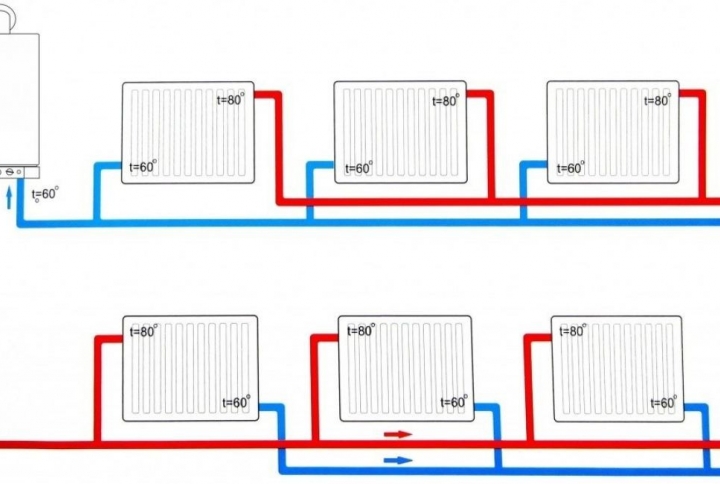
Mostly horizontal two-pipe heating system with lower wiring is installed in one or two-story private houses.But, besides this, it can be used to connect to centralized heating. A feature of such a system is the horizontal arrangement of the main and return (for a two-pipe) line.
When choosing this piping system, it is necessary to take into account the nuances of connecting to various types of heating.
Central horizontal heating
To draw up an engineering scheme, one should be guided by the norms of SNiP 41-01-2003. It says that the horizontal wiring of the heating system should ensure not only proper circulation of the coolant, but also ensure its accounting. To do this, two risers are equipped in apartment buildings - with hot water and for receiving cooled liquid. Be sure to calculate a horizontal two-pipe heating system, which includes the installation of a heat meter. It is installed on the inlet pipe immediately after connecting the pipe to the riser.
In addition, hydraulic resistance is taken into account in certain sections of the highway.
This is important, since the horizontal wiring of the heating system will only work effectively while maintaining the appropriate pressure of the coolant.
In most cases, a single-pipe horizontal heating system with a lower wiring is installed for apartment buildings. Therefore, when choosing the number of sections in radiators, one must take into account their distance from the central distribution riser. The further the battery is located, the larger its area should be.
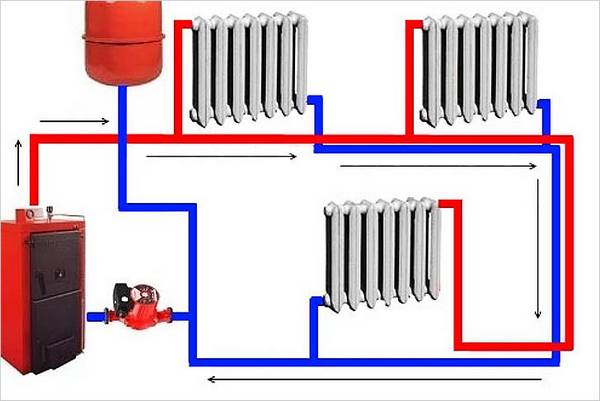

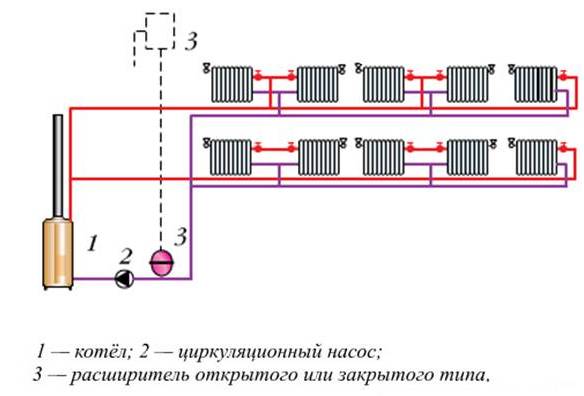

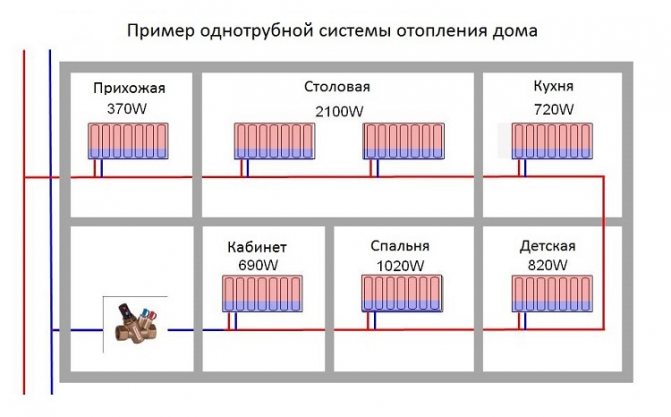
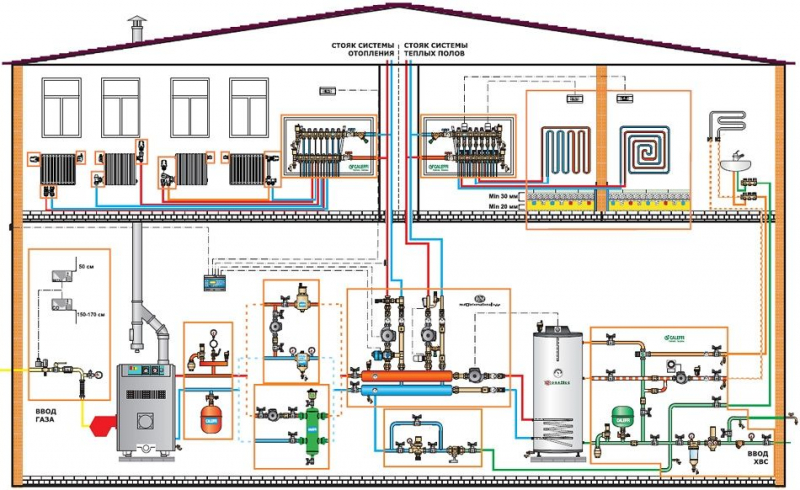


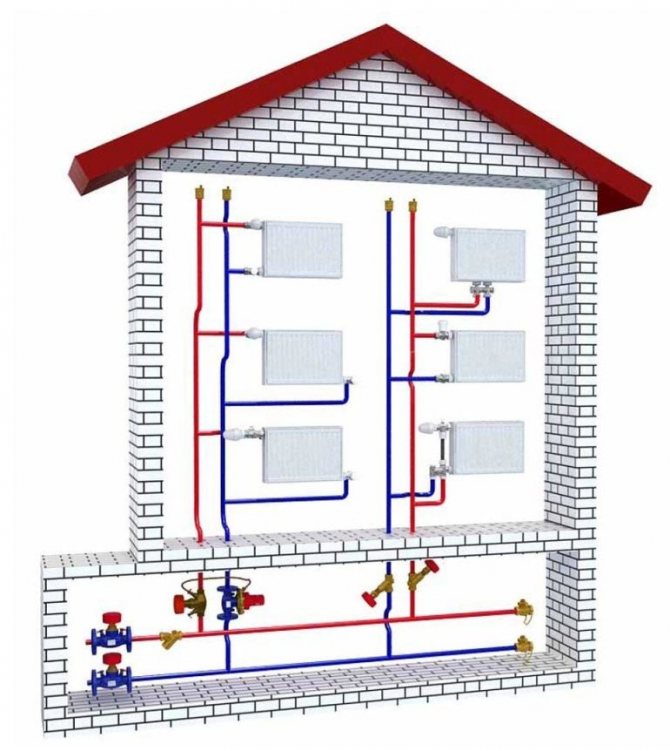
Autonomous horizontal heating
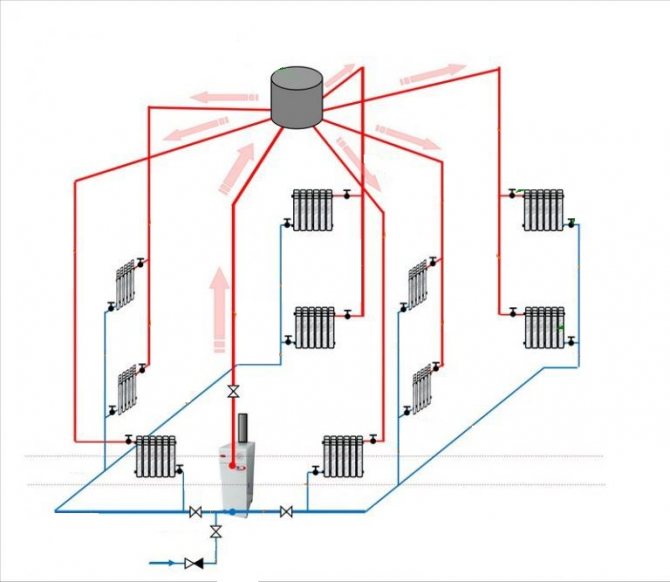
Heating with natural circulation
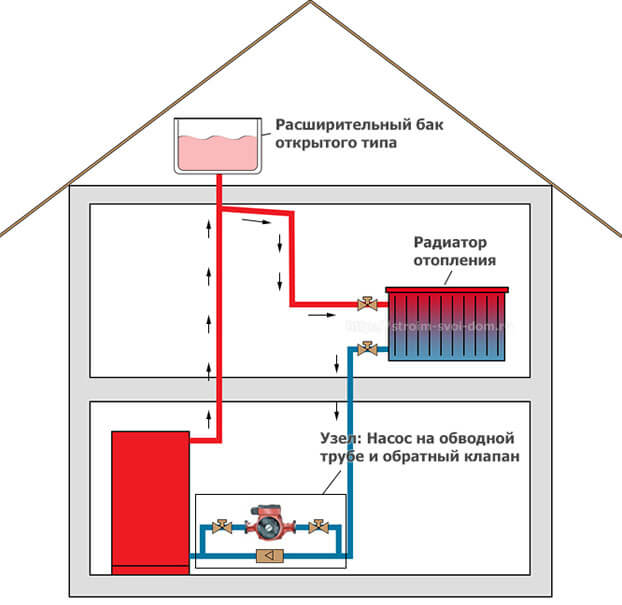
In a private house or in an apartment without a central heating connection, a horizontal heating system with a lower wiring is most often chosen.However, it is necessary to take into account the mode of operation - with natural circulation or forced under pressure. In the first case, immediately from the boiler, a vertical riser is mounted to which horizontal sections are connected.
The advantages of this arrangement for maintaining a comfortable temperature level include the following:
- The minimum cost for the purchase of consumables. In particular, a horizontal single-pipe heating system with natural circulation does not include a circulation pump, a membrane expansion tank and protective fittings - air vents;
- Work reliability. Since the pressure in the pipes is equal to atmospheric pressure, the excess temperature is compensated with the help of an expansion tank.
But there are also disadvantages to be noted. The main one is the inertia of the system. Even a well-designed horizontal one-pipe heating system of a two-story houses with natural circulation will not be able to provide rapid heating of the premises. This is due to the fact that the heating network begins its movement only after reaching a certain temperature. For houses with a large area (from 150 sq.m.) and with two floors or more, a horizontal heating system with lower wiring and forced circulation of the liquid is recommended.
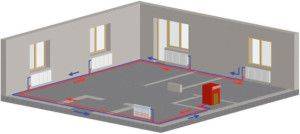
Heating with forced circulation and horizontal pipes
Unlike the above scheme, for forced circulation, it is not necessary to make a riser. The pressure of the coolant in a horizontal two-pipe heating system with bottom wiring is created using a circulation pump. This is reflected in the improvement of performance:
- Rapid distribution of hot water throughout the line;
- The ability to control the volume of coolant for each radiator (only for a two-pipe system);
- Requires less space for installation as there is no distribution riser.
In turn, the horizontal wiring of the heating system can be combined with a collector. This is true for long pipelines. Thus, it is possible to achieve an even distribution of hot water throughout all rooms of the house.
When calculating a horizontal two-pipe heating system, it is necessary to take into account the rotary nodes, it is in these places that the greatest hydraulic pressure losses are.
If the radiator does not heat up.
If water comes out of the radiator, and Radiator still not heating - what is the reason? In case of inaccurate installation, debris can get inside the pipes and accumulate in thin places, for example, in valves. Will have to clean up. Close both valves on a cold radiator. Loosen the union nuts on the valves
Drain the water carefully from the radiator
If the pressure in the system is working, then you can abruptly open the valve on the supply pipe, while the jet of water should take out the garbage. We put the radiator in place, open both valves, poison the air again through the Mayevsky tap ... well, I suppose everything is already clear enough. After such manipulations, two positive results should appear:
Option 2: gas and diesel
Device
In a single heating circuit, a universal boiler is installed, designed to use both types of fuel. Switching from solarium to gas and vice versa requires only the replacement of the burner.
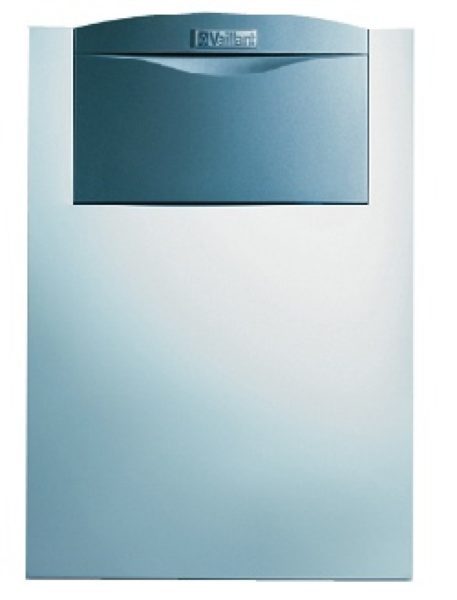
The universal boiler VAILLANT VKO 408 is able to switch from diesel fuel to main gas after a simple replacement of the burner.
Advantages
Coordination of the connection of the built house to the gas main and installation of the input take from several months to 2-3 years. If you have already moved into a built house, in winter you need something to heat.
A universal boiler will be an excellent compromise requiring minimal investment:
- Before connecting gas, you are heated with diesel fuel;
- As soon as the connection of the house to the gas main is completed, you switch to gas without any additional investments.
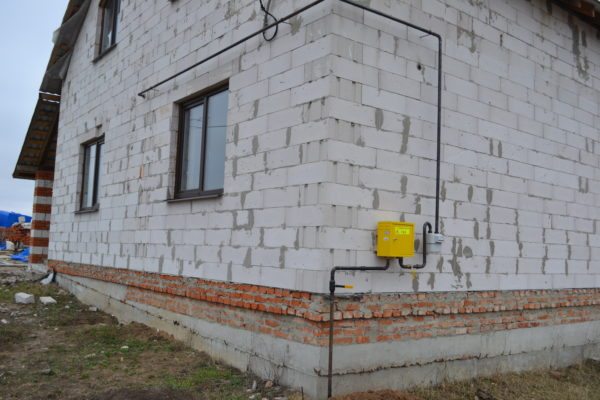
Waiting for gasification of the house can be delayed. A universal boiler will allow you to heat from the moment you move in and then quickly switch to a new type of fuel.
Bivalent hybrid heating systems based on heat pumps
A hybrid heating system (bivalent) consists of a main heat source, a peak reheater and a buffer tank. This system allows you to maximize the use of the heat pump with minimal investment.
Functioning of the bivalent system
As you know, heating equipment is selected according to the heat loss of the room at a minimum outdoor temperature (for Kyiv -22 ° C). This means that the selected boiler should heat your room in the temperature range: from -22 to +8 °C. If we analyze Climatology, it turns out that the number of days in the heating season when the temperature drops below -15 ° C is less than 5%.Therefore, it is not advisable to select a heat pump for the lowest possible outdoor temperature, it is much more profitable to purchase a heat pump of lower capacity and an inexpensive backup heat source (a peak heater is the cheapest electric boiler) that will be switched on only at a temperature below the divalence point (usually -15 °C). The advantage of this system is also the redundancy of the heating system.
Main Pros:
- Reservation of the heating system
- Possibility to purchase a heat pump with lower heat output
Main Cons:
Not
5. How much power do you need a heat pump?
If you have a new house made of gas block, insulated with 100-120-150 mm of mineral wool or foam (walls and foundation to the freezing depth), good double-chamber energy-saving double-glazed windows, insulated roof (150-200mm), insulated floor on the ground (minimum 100 mm.), then the heat loss of your house is 50 W/m2 (at -22 °C):
- House 100 m2 - 5 kW
- House 150 m2 -7.5 kW
- House 200 m2 - 10 kW
- House 250 m2 - 12.5 kW
- House 300 m2 - 15 kW
- House 350 m2 - 17.5 kW
- House 400 m2 - 20 kW
- House 450 m2 - 22.5 kW
- House 500 m2 - 25 kW
- Building 1000 m2 – 50 kW
In principle, such body losses can be freely covered by thermal air-to-water pump Zubadan series:
- House 100 m2 - 5 kW - PUHZ-SW50VHA
- House 150 m2 -7.5 kW - PUHZ-SHW80VHA
- House 200 m2 - 10 kW - PUHZ-SHW112VHA/PUHZ-SHW112YHA
- House 250 m2 - 12.5 kW - PUHZ-SHW140YHA
- House 300 m2 - 15 kW - PUHZ-SHW140YHA + reserve 3 kW
- House 350 m2 - 17.5 kW - PUHZ-SHW230YKA
- House 400 m2 – 20 kW – PUHZ-SHW230YKA
- House 450 m2 - 22.5 kW - PUHZ-SHW230YKA + reserve 3 kW
- House 500 m2 - 25 kW - PUHZ-SHW230YKA + reserve 5 kW
- Building 1000 m2 - 50 kW - Cascade of 2 heat pumps PUHZ-SHW230YKA + reserve 4 kW
When choosing the power of the heat pump, you should also take into account power required for ventilation heating, swimming pool, hot water, etc. Therefore, before purchasing, consult an expert and calculate heat loss.


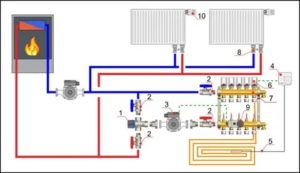


The procedure for the implementation of the heating system
It doesn’t matter if you do the installation of heating with your own hands or invite specialists - you will have to go through the same steps. Under certain conditions (for example, if the heating is assembled from scratch during construction, or the system is being upgraded during repairs, if it is a private cottage or apartment), the sequence of operations may change, some of them are performed in parallel
Selecting the type of heating
First of all, the developer needs to decide on the type of heating for the house. Water with a gas boiler, an air system with a solid fuel heat generator, electric underfloor heating, a good old wood-burning stove - there are a lot of options. The most important criteria here are:
- technical characteristics of the building (cubic capacity, configuration, quality of thermal insulation);
- climatic conditions;
- operating conditions (for permanent residence or temporary stay);
- availability of certain energy sources.
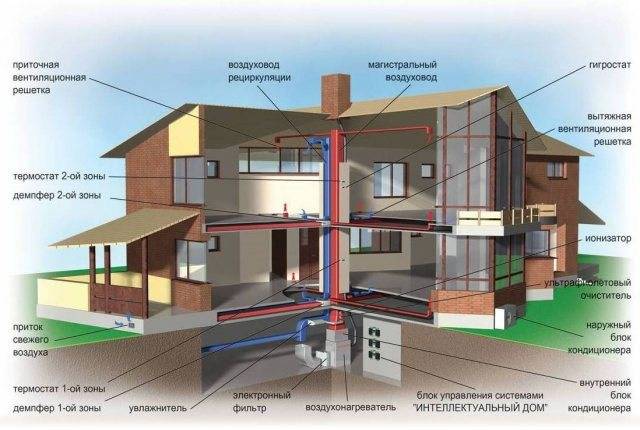
Heat distribution in air heating systems
Engineering calculations
- Thermotechnical. Possible heat losses through the building envelope are determined, which will have to be replenished using a heating system of a given capacity.
- Hydraulic. Allows you to design the optimal configuration of the system, select the cross-section of pipelines, equipment characteristics.
Based on these calculations, a working project is created, which includes the diagrams and drawings necessary for installation, as well as a complete list and specification of components. At this stage, an estimate is made for the installation of heating.
Selection and purchase of equipment
- Heat source (type, power, type of fuel).
- Air ducts or pipes (material, section for different sections).
- Heating devices (radiators of a certain type, registers, heaters, pipes/cables of underfloor heating).
- Auxiliary elements (pumps, manifolds, valves, control devices, expansion tank, heat storage boiler).
Installation and debugging of the system
Heating is directly installed in an apartment or house - a chimney is organized, pipelines are bred, heating appliances and a heat generator are tied.
To control the build quality of the system, it is pressure tested. Air or water is pumped into the pipeline and kept there for 6-8 hours at a pressure slightly higher than the nominal one.
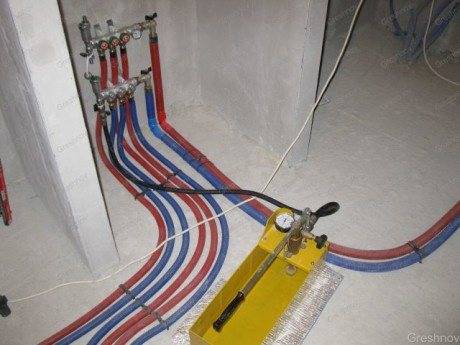
Crimping is carried out before pouring the screeds and sewing the frames. The tests are considered passed if the pressure gauge readings have not changed.
After starting the heating, the system is balanced using faucets or automatic thermostats.