- How to install according to requirements ↑
- Requirements
- Installation scheme: maximum length and other nuances
- Installation of an external coaxial chimney
- Installing the internal
- Chimneys with a complex configuration
- Installation scheme and selection of components
- Chimneys for gas boilers made of stainless steel
- footage
- Some installation features
- Mounting options
- Horizontal installation of coaxial pipes
- Vertical installation of a two-channel pipe
- The installation of a chimney can be considered using the example of a double-circuit design
- Advantages and disadvantages of coaxial chimneys
- Which manufacturer to choose
- Korean chimneys
- European coaxial systems
How to install according to requirements ↑
Similar designs can be assembled with your own hands, of course, if you know how to install in the nuances.
Requirements
The installation of the chimney takes place in accordance with SNiP and the rules prescribed in the instructions and technical documentation.
- The pressure of the supplied natural gas should not exceed 0.03 kgf/cm2 (0.003 MPa).
- The gas pipeline is introduced directly into the room in which the heating unit is located.
- It is allowed to remove flue gases through the outer walls of the building (for boilers with a power of up to 30 kW).
Installation scheme: maximum length and other nuances
Before starting work, calculations are carried out, in which it should be taken into account that
- the length of the coaxial chimney, if there are no special instructions in the instructions, starts from five meters, and horizontal sections - no more than one meter,
- the height of the chimney should not be higher than the roof ridge.
Even if the boiler is located at a considerable distance from the outer wall, the installation issue is solved quite simply, since it is very simple to extend the coaxial chimney (up to 3 meters) - this requires a special extension cord.
Recommended
The length of the pipes is calculated in such a way that the joints do not end up in the section of the wall.
The installation of such systems is carried out using socket technology. High-quality sealing of joints with heat-resistant rubber prevents the penetration of combustion products into the room. That is, they are not only effective and practical, but also safe for the health of users.
Installation of an external coaxial chimney
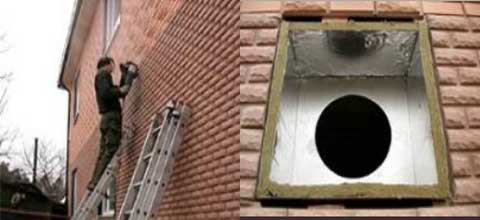 The external version of the design is used for finished buildings in which there is no heating.
-
- First, determine the correct location of the heating system and the beginning of the chimney inlet, make markings. The heating equipment itself can be installed later.
- Adhering to fire safety standards, open a hole for the outlet of the pipe.
- Places with low heat resistance are isolated using special means, then the pipe is removed.
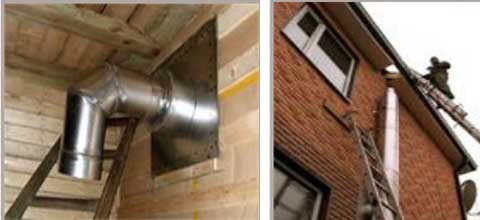
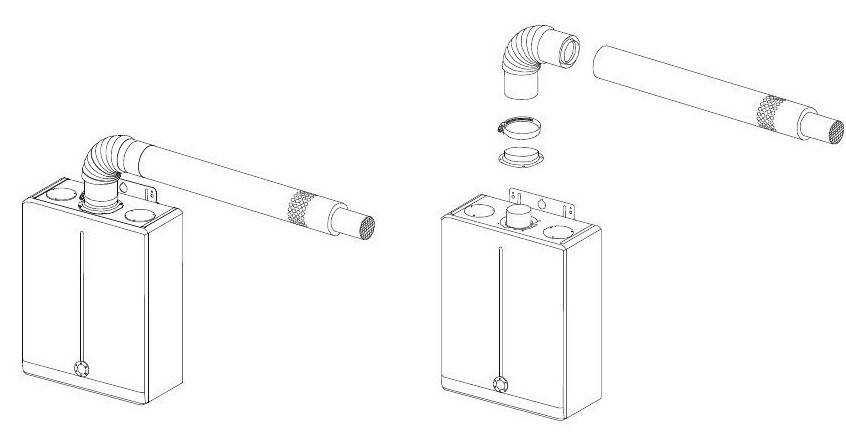
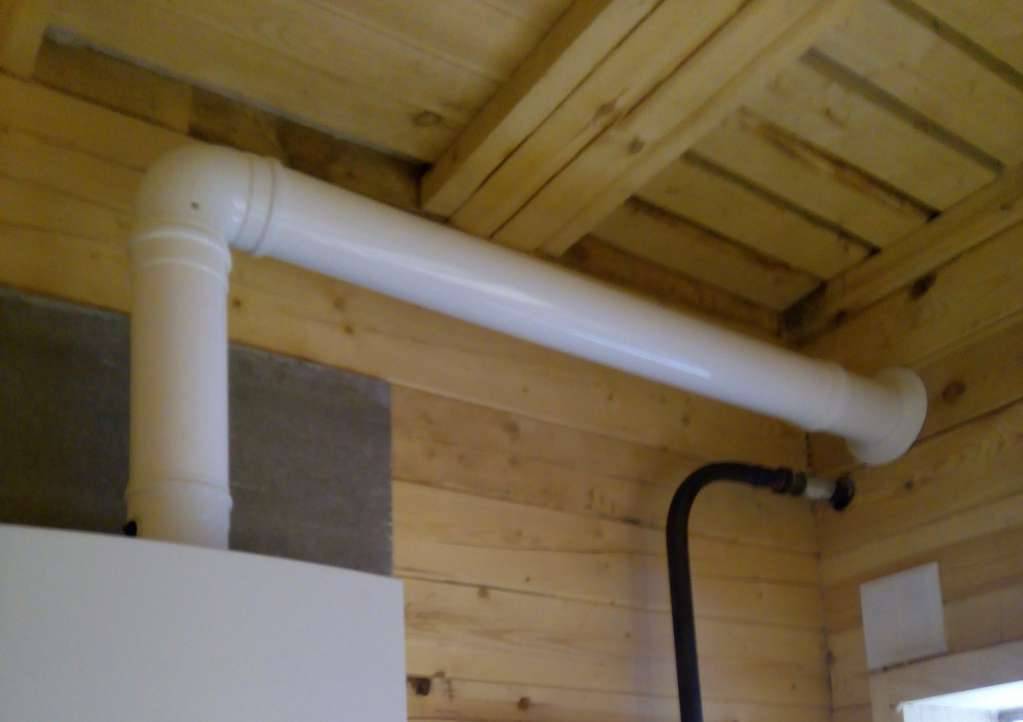
- The heating unit is connected to the chimney using a single-circuit sectional elbow, and subsequently, with a double-circuit tee.
- In the vertical direction, the chimney is fixed using a tee with a removable slope, and securely fastened to the wall with brackets.
Installing the internal
On a note
The diameter of the outlet of the heating device should not be wider than the diameter of the chimney itself.
- When installing double-circuit systems, an additional transition node is used.
- The joints with other nodes are rigidly fastened with clamps.
- Which elements will be needed depends on the location of the outlet pipe - on the side or at the top.
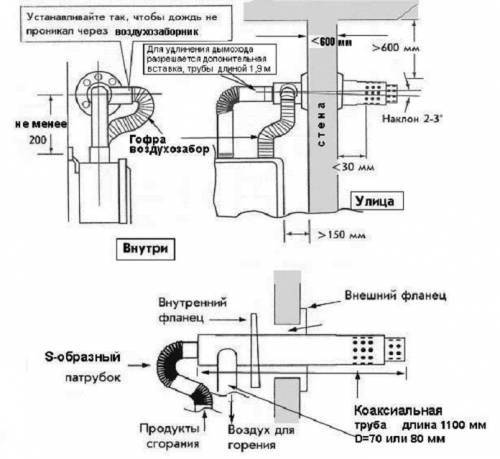
In the first case, horizontal assembly is performed by installing an adapter beforehand. The outlet should be located approximately 1.5 and higher than the level at which the pipe exits the boiler.
Important
If the installation is carried out in regions with heavy rainfall, it is located at such a distance from the surface of the earth that snow, hail and more do not get into the chimney.
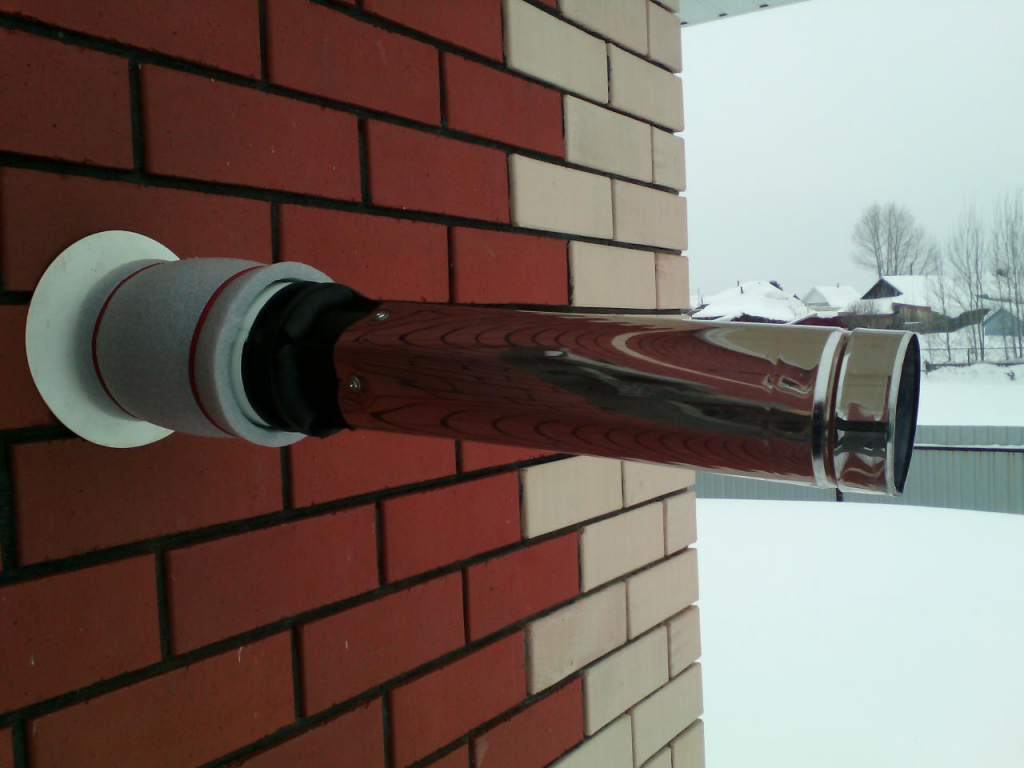
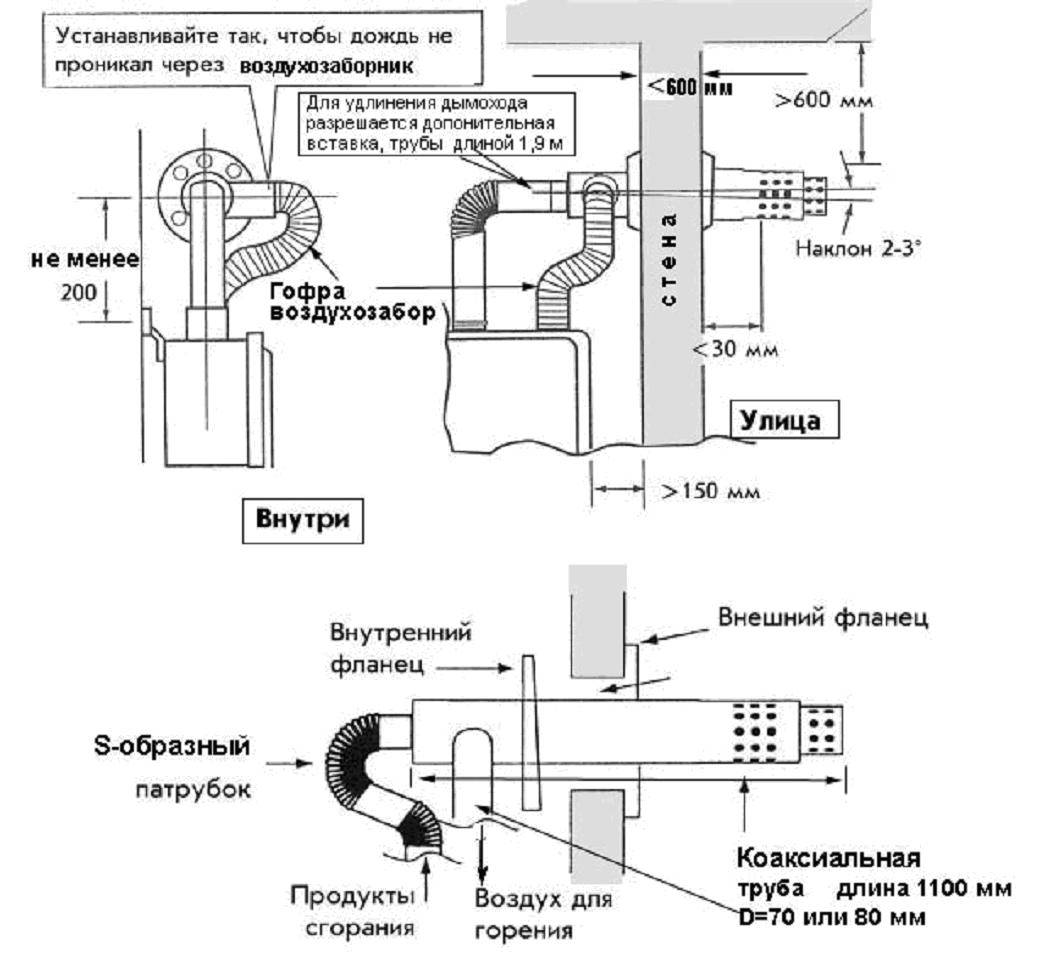
- The outer pipe should have a slight slope when exiting. This will allow the condensate to flow down by gravity. Decorative overlays on the wall protect the holes from closing.
- It is easier to remove the chimney if the outlet is located at the top.
- With the help of various brackets, the structure is brought to a vertical position.
- If during installation it is necessary to bypass an obstacle, say, a beam, the installation direction is changed. Before installation, the desired knee is selected, and to increase the deviation, if necessary, even two.
Recommended
When forming the bend of the chimney, special attention should be paid to the fact that the elbow of the coaxial chimney and the coupling must have a diameter that must exactly match the diameter of the pipe.
When passing through the roof, special pipes are used to ensure fire safety. An air gap is left between the ceiling and the chimney and mineral non-combustible insulation is fixed. The chimney outlet is completely sealed.The junction is securely closed with a special apron.
Chimneys with a complex configuration
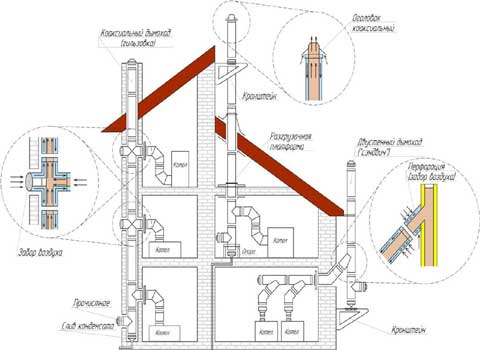
In multi-storey buildings that are heated by gas equipment, the removal of harmful combustion products must be organized. For this, a collective coaxial chimney is used, which is connected to a central pipe, which is installed on the roof. Oxygen enters the burners through the air outlets.


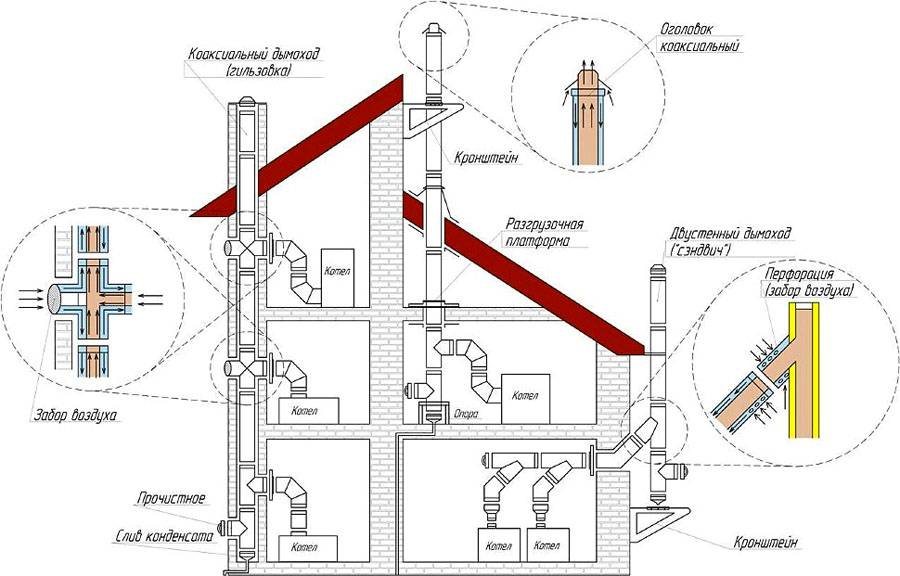

2020
Installation scheme and selection of components
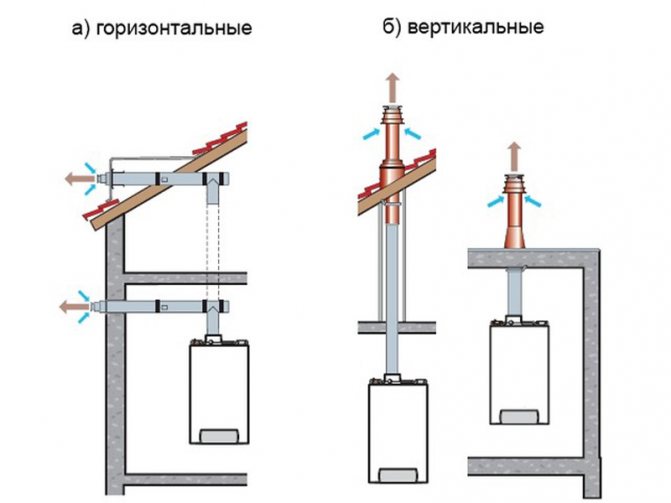
There are only 2 basic schemes for installing coaxial systems, the rest are their variations:
- horizontally from the boiler to the outside in the shortest way;
- vertically through the ceiling and roof.
In the case of double-walled chimneys, the second scheme is rarely used, since it is quite difficult to implement. Laying through ceilings is implemented in situations where it is impossible to bring the channel into the wall - a high fence is built right next to it, there are several windows nearby and other factors that interfere with proper installation.
The most commonly used scheme is No. 1 - a horizontal installation of a coaxial chimney. You plan the pipe laying route, measure the length and buy a ready-made set of parts listed in the first section of the publication.
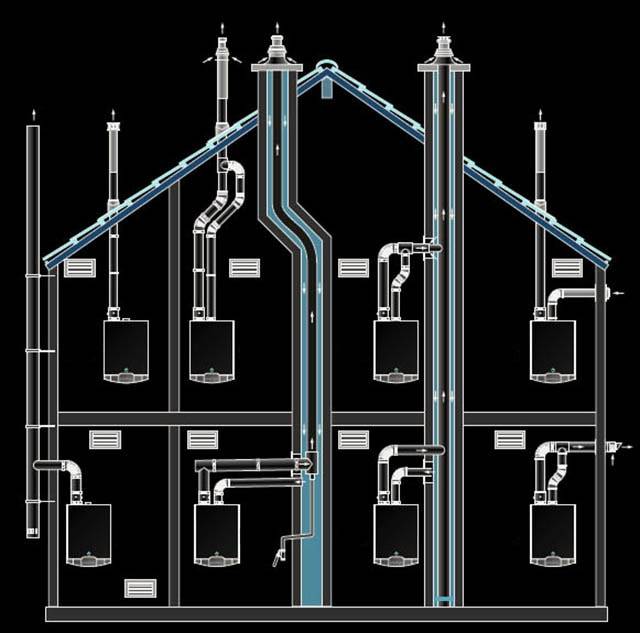
Options for laying coaxial channels in a private house
What are the nuances to consider:
- The channel diameter is selected strictly according to the coaxial outlet of the water heater. Most heat generators use 2 sizes - 60/100 and 80/125 mm. The first digit indicates the diameter of the gas duct, the second - the external duct.
- To connect the air-smoke channel with the heating unit, an adapter is used - an adapter suitable for a specific boiler model.
- The gap between the pipe and the wall case is sealed with fireproof material - basalt wool, asbestos cord.It is not necessary to blow out the slots with polyurethane foam.
- The chimney can be extended (increased with additional straight sections) without exceeding the value specified in the boiler passport. The indicator depends on the performance of the fan.
- If the duct is too short, a restrictive orifice of a certain diameter must be fitted. Otherwise, the exhaust fan will pump more air into the furnace than necessary.
- In regions with a cold climate, an anti-icing cap should be used.
- It is better to insulate the smoke channel passing through an unheated room from the outside with a layer of basalt fiber.
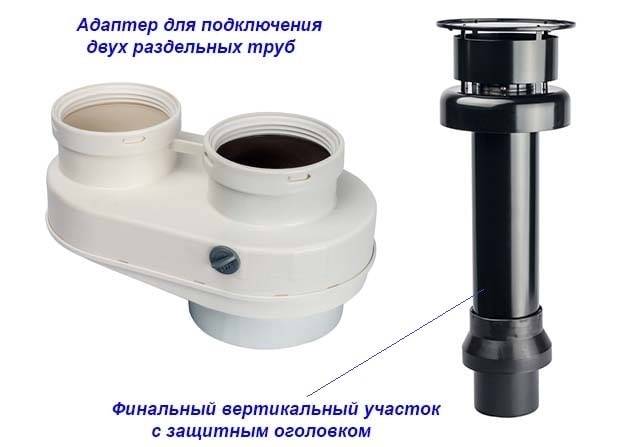
When it is necessary to bring the coaxial flue vertically out of the basement or basement, an inspection section with a condensate trap must be installed. If the total length of the route exceeds the allowable limit, instead of a double-walled single pipe, 2 separate pipes are laid - a chimney and an 80/80 mm air duct. A special separator adapter shown in the photo is connected to the boiler outlet.
Chimneys for gas boilers made of stainless steel
Steel chimneys can have a single-walled and double-walled design. Single-layer chimneys can be installed in heated rooms and used to line brick chimneys. In three-layer systems, there is a heat-insulating layer between two pipes, which makes it possible to use them for both indoor and outdoor installation.
Due to the fact that sulfur impurities are contained in gas fuel, when the waste products are removed, its vapors have an aggressive effect, corroding the walls of the flue ducts.Therefore, in the production of stainless steel chimneys for gas boilers, heat-resistant and acid-resistant material AISI 316L is used. Its use greatly increases the life of chimney systems.
 Chimneys made of stainless steel have many advantages, such as low weight, resistance to fire and aggressive chemical influences.
Of the weaknesses of the stainless chimney pipe for a gas boiler, a not entirely aesthetic appearance can be noted. The benefits include:
- resistance to corrosion and aggressive chemical composition;
- light weight, no need for a base device;
- incombustibility of the material - stainless steel does not melt even at a temperature of 500 ºС;
- modular design - factory production of a large number of tees, adapters and elbows allows you to build a chimney into any home;
- factory production of all elements of the steel chimney allows you to assemble and remove it at any convenient angle;
- absolutely smooth round inner surface - provides a minimum of obstacles to the removal of combustion products;
- the possibility of installation in an already built house;
- quite affordable price of a chimney for a gas boiler.
When installing an external chimney made of steel, there is a high probability of dew point formation: if the outside temperature is low, the exhaust vapors form condensate and a water lock is created. It clogs the channel, preventing the products from escaping, and thereby blocks the combustion process. This can be avoided by placing the pipe in a lined chimney channel made of brickwork. This technique will also decide the aesthetic side of the structure.
 Stainless steel chimney designs are easy to maintain.
Another option to avoid the formation of a water lock is to use a sandwich construction of two pipes, one of which is protected by a layer of basalt wool. Such a remote chimney system no longer needs additional insulation. The diameter of the chimney for a gas boiler is selected so that it matches the cross section of the outlet of the equipment.
On a note! Stainless steel chimneys are easy to maintain, however once every 3 years it is necessary to have the system inspected by a specialist.
footage
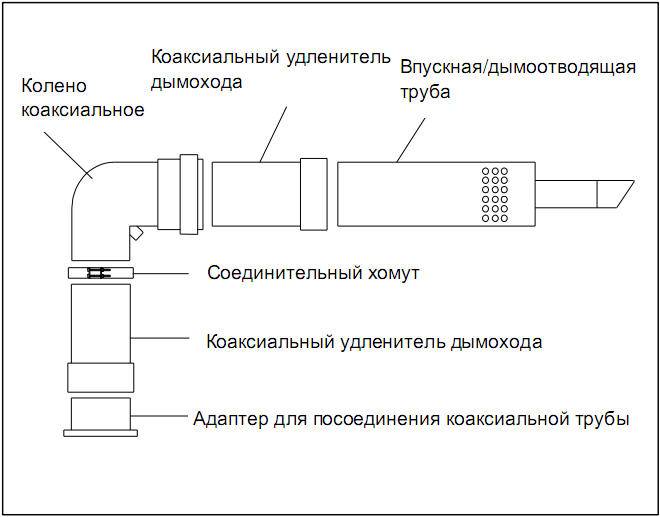
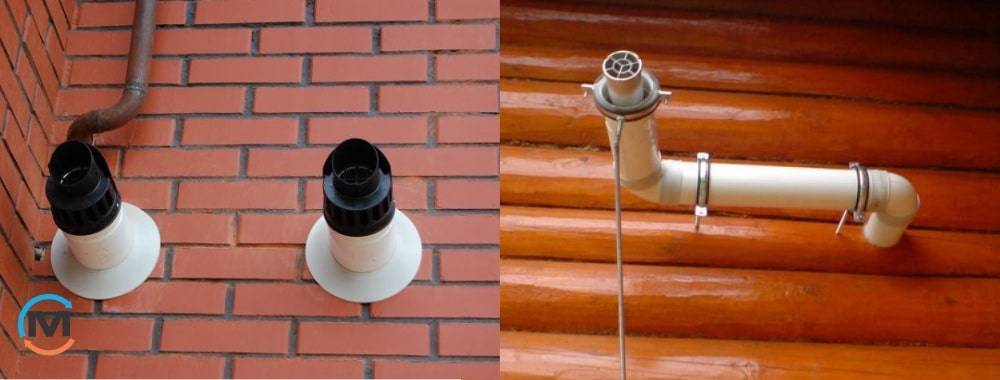


The ratio of affordable price, ease of installation, long working life and efficiency made coaxial pipelines very popular. If you also decide to give preference to just such, be sure to follow the installation rules given in the article.
Some installation features
For each boiler, the direction of the channel that discharges the combustion products is determined individually. Horizontal systems can only be used for devices with forced ventilation.
Errors in calculations and installation can lead to freezing of the system and freezing of condensate at the outlet. In such conditions, the boiler will not be able to work.
But even in this case, the maximum length of such a section should not be more than 3 m. It happens that the manufacturer sets other standards for their boilers, so you should familiarize yourself with the technical documentation of the device.
Vertical type structures for private houses are used only if there are reasons preventing the chimney from being led through the wall.
These can be windows close to the outlet pipe, a narrow street on which the building stands, and the like.In some cases, if it is very necessary, an inclined installation of a coaxial chimney is allowed.
The options for the passage of a coaxial chimney through building structures and the distances between the chimney and the elements of the house are given on the basis of many years of operating practice.
The system is connected to the heater using a tee, elbow or pipe. In this case, the diameters of the outlet channel and the boiler outlet must be the same.
During the installation process, all subsequent parts are fixed in the previous ones so that there are no obstacles that could interfere with the movement of combustion products. The number and type of elements for assembly directly depend on the location of the outlet pipe.
If it is on the side, it is supposed to arrange a horizontal system, if on top - vertical. The latter option is easier to install.
In the process of arranging a coaxial chimney, transitional nodes are necessarily used with rigid fastening of the junction areas of two elements using clamps. Some "craftsmen" prefer to use home-made options.
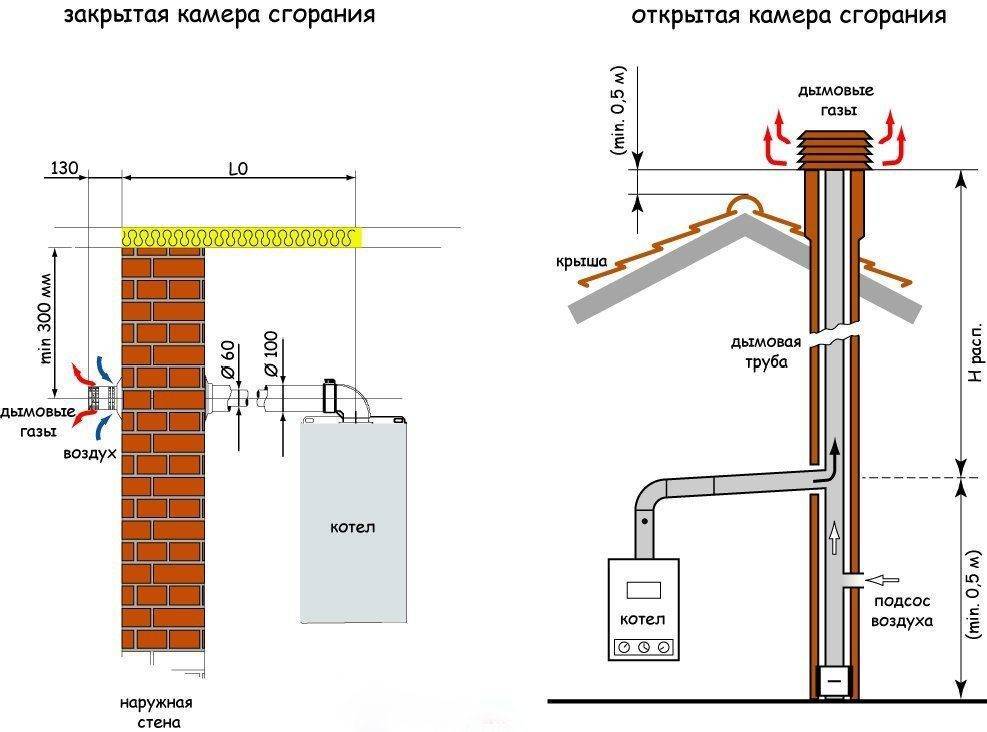
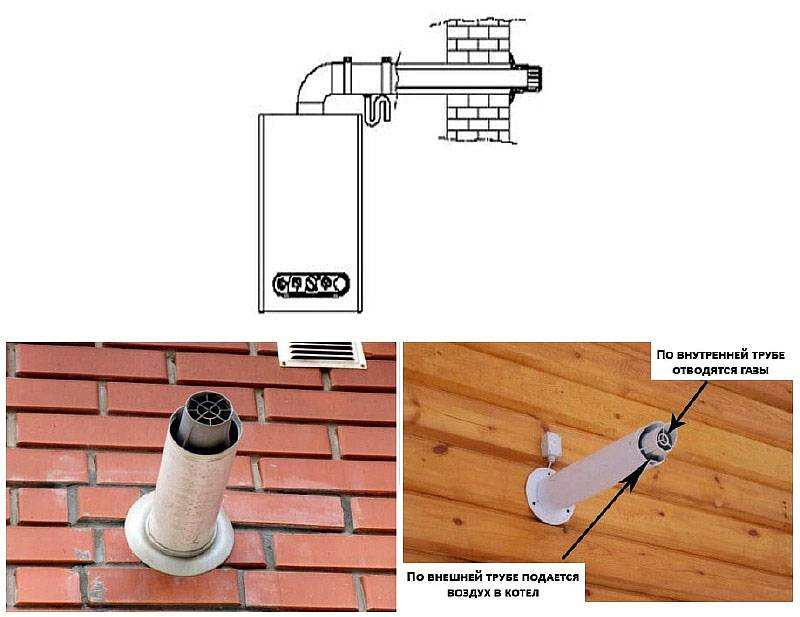
The figure shows a diagram of the arrangement of the passage of a horizontal coaxial chimney through the wall
These can be hand-made adapters, windings from tape or seals from sealant. Such things are unacceptable in use, because they are extremely unreliable. A system assembled using such elements is considered unsafe to operate.
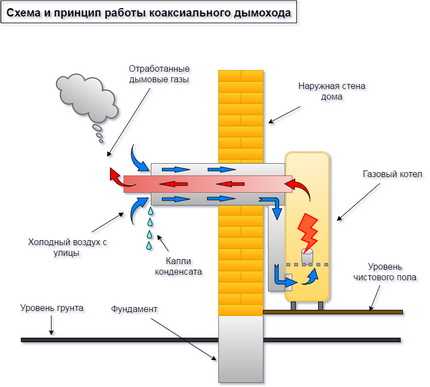

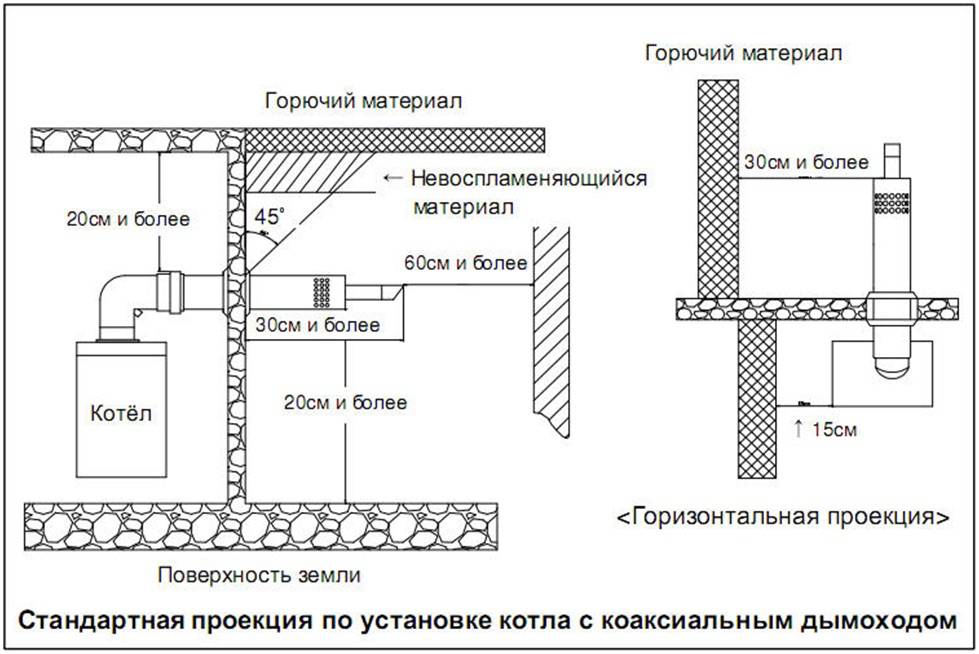


In addition, the following rules are observed during the installation process:
- The section of the horizontal chimney that goes out must be inclined 3° downwards.At the horizontal section of the chimney included in the common section, the slope is performed in the opposite direction, that is, it decreases towards the boiler. This is necessary for the unimpeded drainage of condensate.
- Throughout the chimney channel there should not be more than two folds.
- Inspection hatches, adapters and a condensate discharge device must be easily accessible for periodic inspection.
- The chimney cannot be led below ground level. In this case, the distance from the outlet of the coaxial chimney to the neighboring building must be more than 8 m. If a deflector is installed on the pipe, this distance is reduced to 2 m for a blank wall and 5 m for a wall with window openings.
- If a horizontal chimney is installed in a place where winds prevail, the direction of which is opposite to the direction of smoke extraction, a sheet metal barrier must be installed at the outlet of the chimney. The distance between it and the outlet must be at least 0.4 m.
- On coaxial chimneys rising above ground level less than 1.8 m, a deflector grille must be installed. It will work as a protection against hot smoke.
All structural elements must fit snugly against each other. Each subsequent part must go inside the previous one at a distance equal to at least half the diameter of the channel section.
To circle the structure around any obstacle, specially designed knees are used. The angle of their inclination may be different. If the system is removed through the roof, all fire safety requirements must be observed.
The arrangement of the passage of a coaxial chimney through the roof or through the wall must be carried out in strict compliance with all fire safety requirements
For this purpose, special insulating pipes and non-combustible insulating materials are used. There must be an air gap between the pipe and the ceiling.
A protective cover is used to avoid contact between the smoke channel and fragments of the roofing cake. The exit of the structure through the roof is carefully sealed. The joints are covered with a special apron.
Mounting options
Complete with a coaxial chimney, factory assembled, detailed installation instructions are required. Following and careful implementation of these recommendations affects the operation of the boiler and the efficiency of the smoke exhaust system. According to experts, the main reason for blowing out the boiler, the appearance of frost or ice, is associated with errors in the calculations and when connecting the chimney.
Horizontal installation of coaxial pipes
Horizontal installation is carried out taking into account the technical characteristics of the building. Initially, the place where the pipe exits the wall is selected. There are restrictions associated with the distance to the nearest window of a neighbor when a horizontal coaxial chimney is removed from the wall, which must be carefully observed.
Additionally, the following parameters are calculated:
- The height of the pipe is from the outlet pipe of the boiler to the passage hole in the wall; for floor-standing gas boilers, the height must be at least 1 m. The direct outlet of the pipe from the outlet pipe to the street is not allowed. For wall-mounted gas boilers, a height reduction of up to 0.5 m is allowed.
- The number of swivel couplings in the area should not exceed 2 pcs.
- The maximum length of the horizontal section is 3-5 m, depending on the boiler model. To extend the pipe, a coupling with heat-resistant sealing rubber is used. Do not use silicones or sealants.
A feature of using a two-channel chimney in winter is increased condensate production. The reason for the loss of moisture is that the system was originally designed for more favorable operating conditions. With increased formation of condensate, it will be necessary to insulate the pipe.
Vertical installation of a two-channel pipe
Vertical installation of the chimney provides two connection methods:
- Cascade scheme for connecting collective chimneys of condensing boilers. Several heating units are connected to one pipe at once. The cascade scheme is used in apartment buildings. The chimney is installed outside or inside the building.
Vertical installation of the pipe is carried out only after careful calculations and preparation of project documentation, taking into account the rules set forth in SP 60.13330 (SNiP 41-01-2003). - Individual connection - the maximum length of the vertical coaxial combustion products removal system is 7 m, which allows installation in a two-story building. In a house made of aerated concrete blocks, the pipe is installed exclusively inside the building. The walls of the building cannot withstand a large load on the walls.
In brick houses, a smoke exhaust system is installed inside and outside the building. In any case, a mandatory thermal insulation of the coaxial type chimney is carried out.
The installation of a chimney can be considered using the example of a double-circuit design
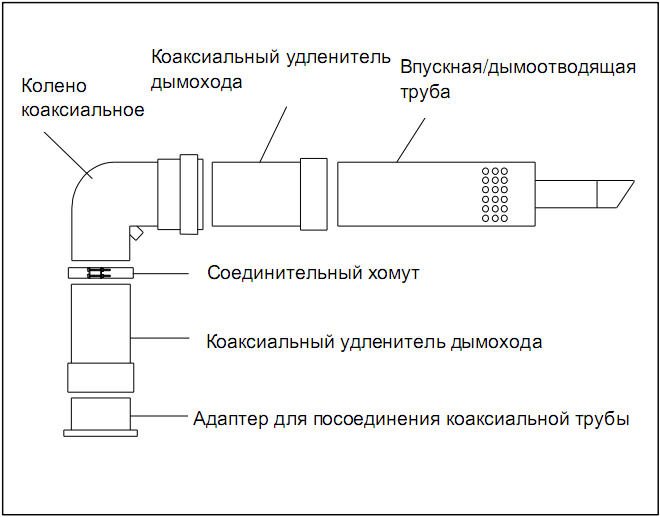
Chimneys for a gas boiler are being installed in the direction of the structure from the bottom up, that is, from the heating objects of the room towards the chimney. With this installation, the inner tube is put on the previous one, and the outer tube is inserted on the previous one.
All pipes are fastened to each other with clamps, and along the entire laying line, every 1.5–2 meters, brackets are installed to fix the pipe to a wall or other building element. A clamp is a special fastening element, with the help of which not only the parts are connected to each other, but also the tightness of the joints is ensured.
The laid sections of the structure in the horizontal direction up to 1 meter should not come into contact with elements that pass close to the communications. The working channels of the chimney are placed along the walls of buildings.
Be sure to install a bracket on the wall every 2 meters of the chimney, and the tee is attached using a support bracket. If it is necessary to fix the channel on a wooden wall, then the pipe is lined with non-combustible material, for example, asbestos.
When attaching to a concrete or brick wall, special aprons are used. Then we bring the end of the horizontal pipe through the wall and mount the tee necessary for the vertical pipe there. It is necessary to install the brackets on the wall after 2.5 m.
The next step is to mount, lift the vertical pipe and bring it out through the roof. The pipe is usually assembled on the ground and the mount for the brackets is prepared. The fully assembled volumetric pipe is difficult to install on the elbow.
To simplify, a hinge is used, which is made by welding pieces of sheet iron or cutting a pin.Typically, the vertical pipe is inserted into the tee pipe and secured with a pipe clamp. The hinge is attached to the knee in a similar way.
After raising the pipe in a vertical position, the pipe joints should be bolted where possible. Then you should unscrew the nuts of the bolts on which the hinge was fastened. Then we cut or knock out the bolts themselves.

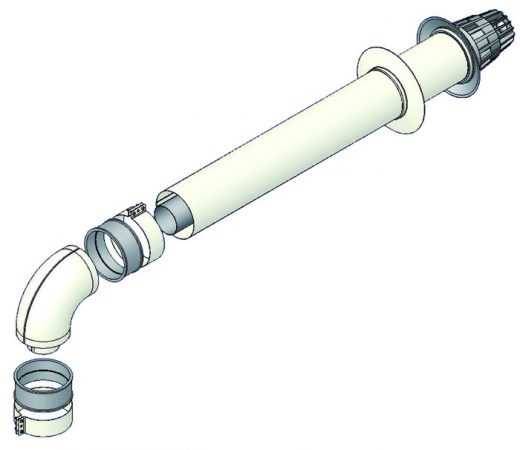



Having selected the hinge, we attach the remaining bolts in the connection. After that, we stretch the remaining brackets. We first adjust the tension manually, then we fix the cable and adjust it with screws.
Necessary distances to be observed when the chimney is located outside
The installation is completed by checking the chimney draft. To do this, bring a burning piece of paper to the fireplace or stove. Draft is present when the flame is deflected towards the chimney.
The figure below shows the distances that must be observed in various options for the location of the chimney from the outside:
- when installed on a flat roof, the distance must not be less than 500 mm;
- if the pipe is removed from the roof ridge to a distance that is less than 1.5 meters, the height of the pipe must be at least 500 mm in relation to the ridge;
- if the chimney outlet installation is located at a distance of more than 3 meters from the roof ridge, then the height should not be more than the expected straight line.
The setting depends on the type of duct directions required for the combustion of the fuel. In the interior of the room, there are several types of directions for the chimney channel:
Support bracket for chimney
- direction with a rotation of 90 or 45 degrees;
- vertical direction;
- horizontal direction;
- direction with a slope (at an angle).
It is necessary to install support brackets for fixing the tees every 2 meters of the smoke channel, it is necessary to provide additional wall mounting. In no case, when installing a chimney, horizontal sections higher than 1 meter should not be created.
When installing chimneys, consider:
- the distance from metal and reinforced concrete beams to the inner surface of the chimney walls, which should not exceed 130 mm;
- the distance to many flammable structures is at least 380 mm;
- cuttings for non-combustible metals are made for the passage of smoke channels through the ceiling to the roof or through the wall;
- the distance from combustible structures to an uninsulated metal chimney must be at least 1 meter.
The connection of the chimney of a gas boiler is carried out on the basis of building codes and the manufacturer's instructions. The chimney requires cleaning up to four times a year (see How to Clean a Chimney).
In order to optimally calculate the height of the chimney, it is necessary to take into account the type of roof and the height of the building:
- the elevation of the chimney pipe must be at least 1 meter when installed on a flat roof and at least 0.5 meters above a non-flat one;
- the location of the chimney on the roof must be made at a distance of 1.5 meters from the ridge;
- the height of an ideal chimney has a height of at least 5 meters.
Advantages and disadvantages of coaxial chimneys
Such systems for supplying air and removing combustion products have now gained the widest popularity. This is easily explained by the many advantages of such a scheme:
First of all, the advantage is that the air necessary for the combustion of "blue fuel" is taken not from the premises, but from the street. This circumstance greatly simplifies the organization of general ventilation - no additional inflow calculations are required, there is no need to resort to frequent ventilation or organizing other ways of air intake from the street
This is especially important for those cases when the boiler is installed in the "living area" of the house or in the apartment, for example, in the kitchen. In frosty weather, there will be no unnecessary influx of cold into the premises.
In principle, combustion products cannot enter the room - they are immediately discharged from the closed chamber to the street.
The air taken from the street receives a very noticeable heating from the inner pipe, through which the waste products flow in the opposite direction.
And this is important for uniform and complete combustion of gas, for maximum efficiency of the boiler. In addition, the complete combustion of the gas provides a minimum release of substances that can cause pollution to the atmosphere. And the products of combustion, on the contrary, are effectively cooled, which significantly increases the fire safety of the system. The likelihood of ignition of soot particles, which can accumulate in the pipe over time, is sharply reduced. And at the outlet, the gases no longer have a dangerous temperature.
The outer surface of the coaxial pipe does not heat up to too high temperatures. And this is a big “plus” in the sense that the requirements for organizing safe passage through walls (floors, roofs) are significantly reduced. No other type of chimney, including sandwich pipes, allows such "liberties".
Even through a wooden wall, you can lay a coaxial chimney without cutting out a huge window for this fireproof penetration.
- The installation of a coaxial flue gas exhaust system will not be associated with large-scale construction and installation work, as is usually the case with the installation of "classic" vertical chimneys.
- The installation itself is quite simple and intuitive. Any kit is always accompanied by detailed instructions. So in many cases it is quite possible to carry out installation work on your own.
- A wide range of sets of coaxial chimneys is on sale, and therefore it is possible to choose the right system for a boiler of a certain model. As a rule, it is purchased immediately along with heating equipment. And for any system in the assortment, the necessary additional parts are offered - tees, bends at 90 or 45 degrees, condensate collectors, inspection chambers, cuffs, clamps, fasteners, etc. That is, with the acquisition of problems does not arise.
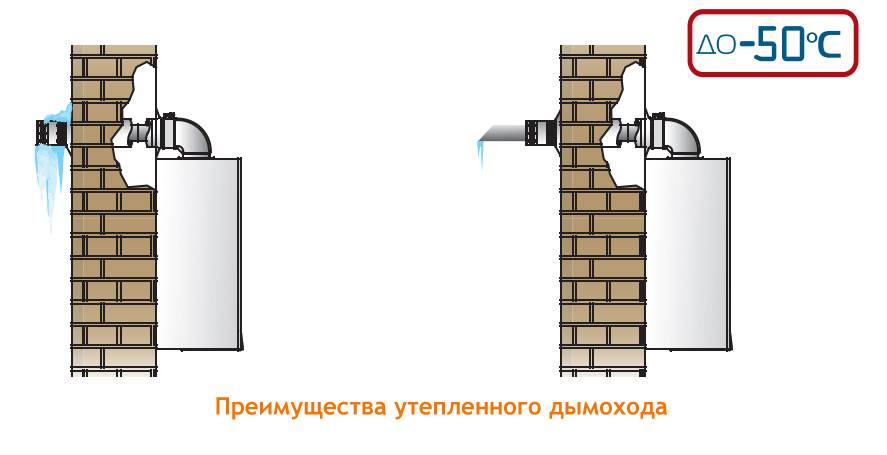
The main disadvantage of coaxial chimneys is the abundant formation of condensate, which is inevitable at the border of pronouncedly hot and cold gas flows. And as a result - freezing of ice at the head in severe frosts. And this, in turn, is fraught with failure not only of the combustion products removal system itself, but even of the heating unit.
In severe frosts, despite the very hot exhaust, ice growths can form on the coaxial chimney pipe. This phenomenon must be fought so as not to "ditch" the entire system.



Often such a disadvantage is attributed to the fact that initially coaxial chimneys were developed for European countries with much more gentle climatic conditions than in Russia. In an effort to increase the efficiency of boilers, the designers tried to minimize the possible diameter of the inner pipe for exhaust gases, which led to a shift in the dew point inside the air duct and abundant freezing of the condensate that had fallen out.
Additional insulation of the outer section of the outer pipe of the coaxial chimney is a simple and effective means of combating its icing.
The second, but very conditional drawback, is the high cost of high-quality coaxial chimneys. But there is something to argue about here. Firstly, the price still does not look frightening against the background of the total cost of the heating system. And secondly, if we add considerable savings on construction and installation work, then it becomes ridiculous to talk about the cost. And this is without taking into account the other advantages of the coaxial system.
Which manufacturer to choose
A wide range of coaxial pipes for air intake from the street and exhaust gases are on sale. To choose a quality option, you need to consider the products of leading manufacturers from Europe and South Korea.
Korean chimneys
Gas chimneys, which are produced in Korea, are in great demand because they have a lot of operational advantages and are not afraid of pressure surges.
The main advantages include:
- A good combination of affordable price and high quality.
- Ease of operation.
- The presence of powerful protective sensors in the amount of 12 units. For example, European models require additional installation of these elements.
- The heat exchanger is characterized by high strength properties and resistance to corrosive processes.
- Installation is possible in residential and industrial buildings.
- Efficiency indicators reach 109%.
Of the minuses of Korean models, there are a number of difficulties in the implementation of repair work. If 1 of the important parts fails, finding a good and suitable spare part will be problematic.
European coaxial systems
Baxi is one of the leading European brands producing coaxial systems. She is supplying storage and flow units more than 70 countries.
The advantages of such equipment include:
- Efficient smoke removal by natural draft, which is associated with the presence of an open combustion chamber.
- Capable of withstanding electrical, gas and water surges.
- Increased protection against corrosive processes due to the presence of an enameled tank coating and stainless products.
- Possibility of reconfiguration for work on liquefied gas.
- Support for the option to turn off the gas supply in case of blockages in the chimney system; burner flame control.
- Possibility of interaction with water collection points.