
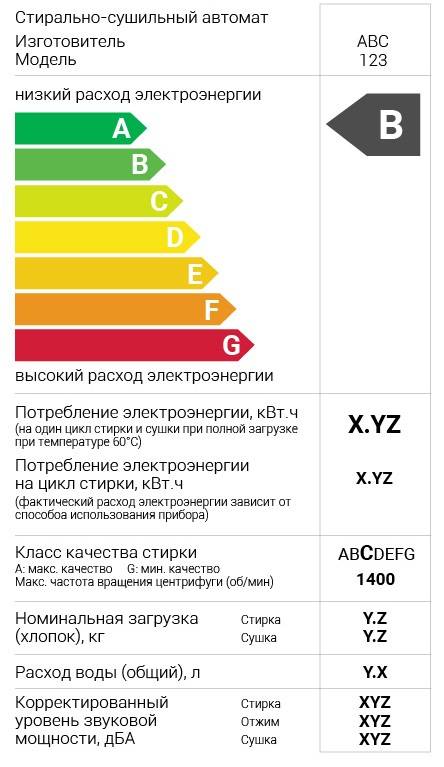
- Energy class
- Wash
- Wash and spin class
- Energy efficiency - what is it?
- At what temperature to wash bedding, how to choose the right mode
- Cotton fabric
- Silk
- linen fabric
- satin
- Synthetic fabrics
- Principle and purpose of classification
- Spin class
- Standard washing classification
- Types of classes in a typewriter
- Washing
- Spin
- Energy consumption
- Washing machine classification
- Spin class
- Wash class
- Energy efficiency class
- What is a reference machine
- Spin class
- Spin class: types and features
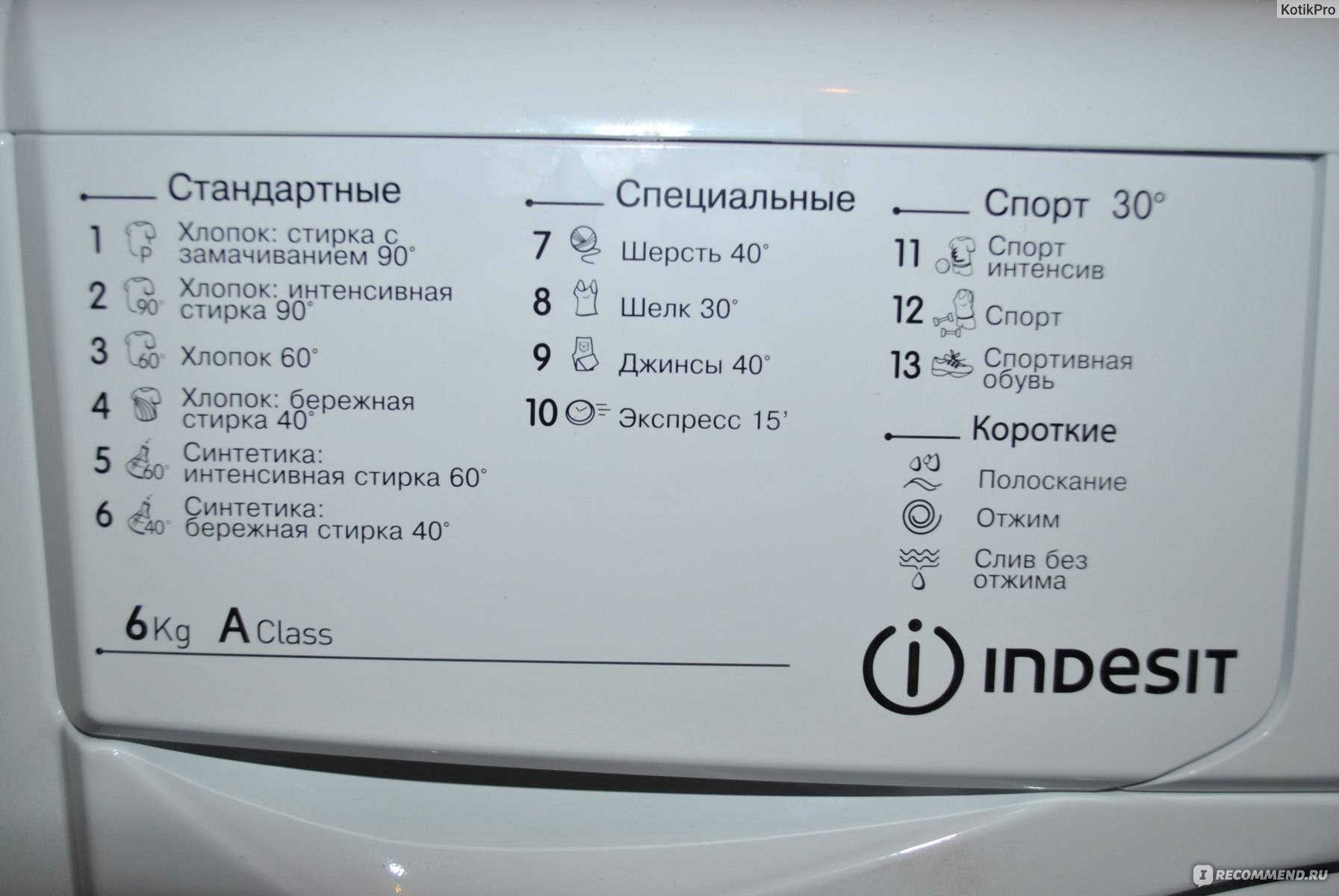
- Main programs
- Cotton (linen)
- Synthetics
- Wool
- Silk
- Jeans and sportswear
- intensive
- down jackets
- Baby clothes
- Handwash
- Economy mode
- Prewash
- Soak
- How much does the laundry weigh?
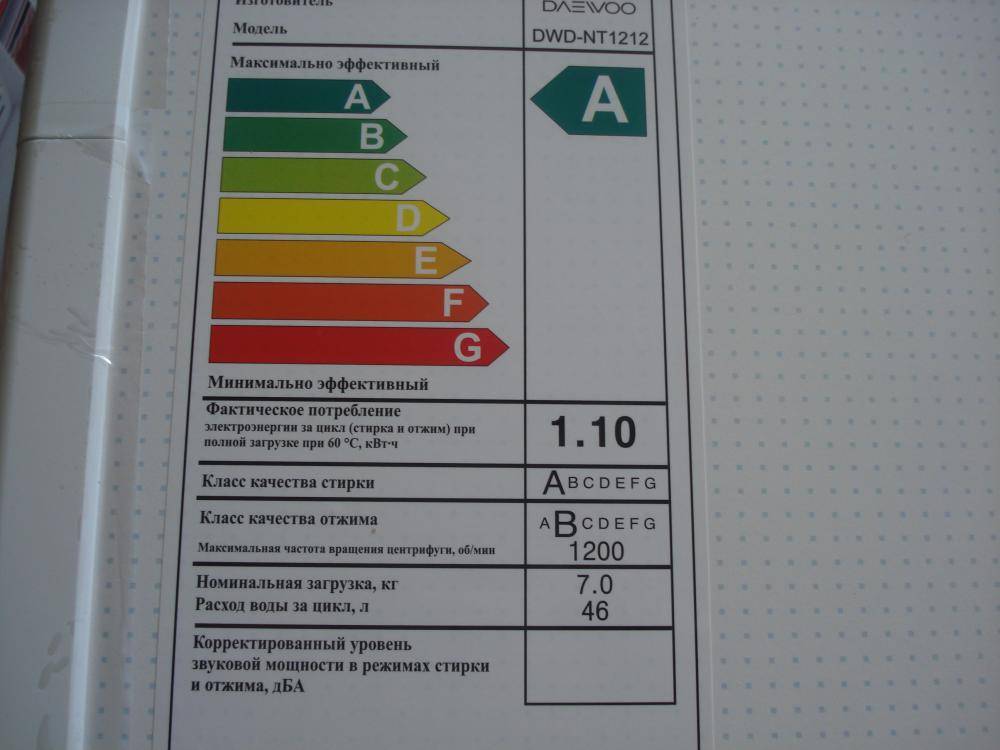
Energy class
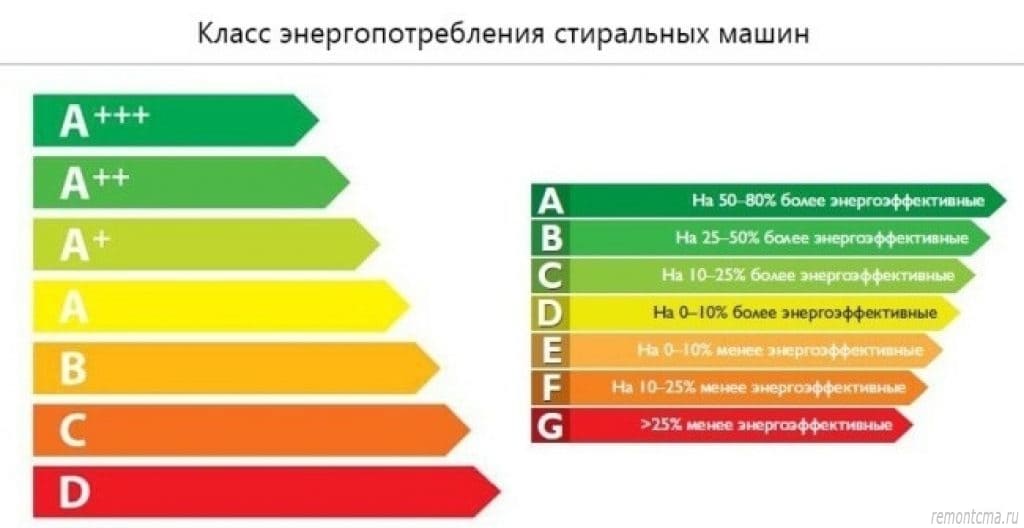
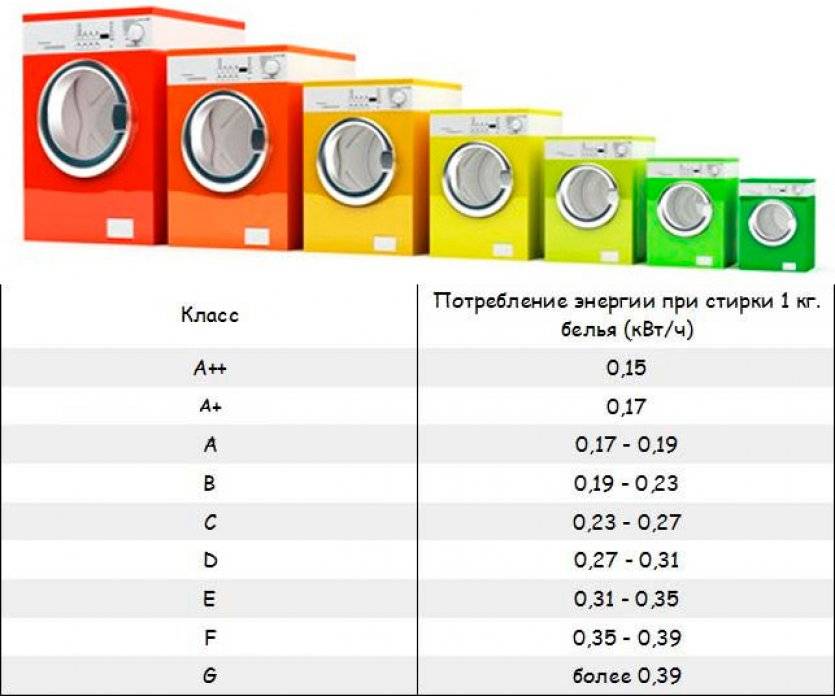
A good washing machine should be energy efficient. About how energy-saving it will be, the corresponding marking will show:
- "A +" (the latest generation) - electricity consumption - 0.17 kW / h.
- Class "A" shows that the machine will consume from 0.17 to 0.19 kW / h.
- In the case of "B", the power consumption will be in the range from 0.19 to 0.23 kW / h.
- Class "C" consumption will be from 0.23 to 0.27 kWh.
- A machine marked "D" will consume between 0.27 and 0.31 kWh.
- Equipment with the designation "E" will cost from 0.31 to 0.35 kW / h.
- Washing machine class "F" - from 0.35 to 0.39 kW / h.
- The most expensive will be "G" - from 0.39 kW / h.
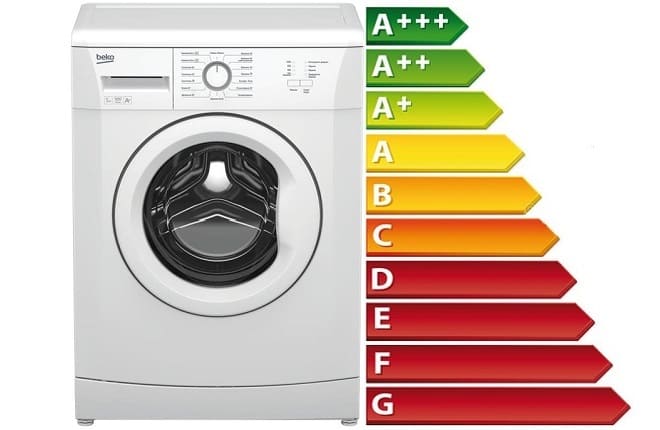
The competition in the car market today is great and the manufacturer is fighting for the buyer, constantly upgrading them. The usual classification of cars from seven ratings (“A” - “G”) has long included equipment with the sign “A +”. But the leaders in the production of washing machines do not stop there - in retail chains you can increasingly find models of a higher class.
Example of a tag on a car
Wash
The higher the washing class, the better the machine will remove stains, and the more careful it will be with linen. Naturally, different stains in the same model will be washed differently, it depends on the size of the stain, its origin and many other factors. That is why the washing classes are assigned as follows: the reference model and the tested one are taken, the same fabric with the same contamination, and as a result of an hourly wash at 60 degrees, the result obtained in both machines is compared. According to the type of washed fabric, they assign a class.
The cost of the machine itself is not directly related to the class of washing. That is, the most expensive model may not be A class, but lower. It often depends on the manufacturer, that is, on the advertising of the brand.
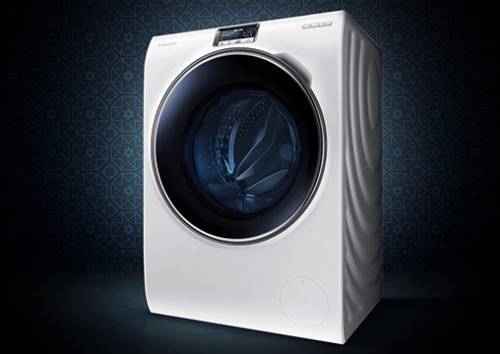
High cost and a well-known brand are not yet a guarantee of the effectiveness of the machine
Wash and spin class
The washing class shows how well the machine removes dirt on the fabric. To find out how this happens, conduct tests.
To do this, various kinds of stains are specially applied to clothes. Then they start the machine, wash things at a temperature of 60 degrees for about an hour.
The most optimal is the spin class D or B.This consumes the minimum amount of energy. Things after the process become half dry. The lowest grades, F and G, are very rare.
The spin mode in the washing machine, although it affects the price, but not always. The cost depends on a number of other factors, such as the brand. Recently, home appliance dealers have been claiming that older models, which have low or no spin rates, last much longer than modern washer-extractors. This is because not all manufacturers can boast of the high quality of the parts that are installed inside the products.
It is very important that the bearings and other important elements withstand the load from the operation of the machine drum. Washing and spinning classes in the washing machine are indicated by Latin letters
Only their meanings are slightly different from each other. The first criterion means how well the laundry will be washed, and the second - how well things will be wrung out
The washing and spin classes in the washing machine are indicated by Latin letters. Only their meanings are slightly different from each other. The first criterion means how well the laundry will be washed, and the second - how well things will be wrung out.
If the washing mode of category A is the most effective class, and the machine washes dirt completely, then for high-quality spin it is best to choose category B, C or D in order to save money. As for the number of revolutions, it is the spin speed in washing machines that affects the classification . The most popular is spinning at 800-1400 rpm, these are E, D, C and B classes.
Energy efficiency - what is it?
Everyone knows that the amount of payment for utilities is directly dependent on the consumption of electrical energy.With this in mind, every owner tries to use the most economical household appliances.
When talking about efficiency, it is necessary to take into account certain indicators called energy saving and energy efficiency. The concepts are similar, but have certain differences.
Let's look at a simple example with a 100 watt light bulb. If the light in the room is turned on only when necessary, then this is energy saving. You deliberately consume less electrical energy in order to save it.
To understand about energy efficiency, let's take a 20-watt energy-saving lamp. You do not follow the mode of its operation, but the effect will exceed the standard values by several times.
The same example applies to any household appliance. Naturally, the models of cars released not so long ago will be more efficient in terms of energy consumption than their outdated predecessors.
At what temperature to wash bedding, how to choose the right mode
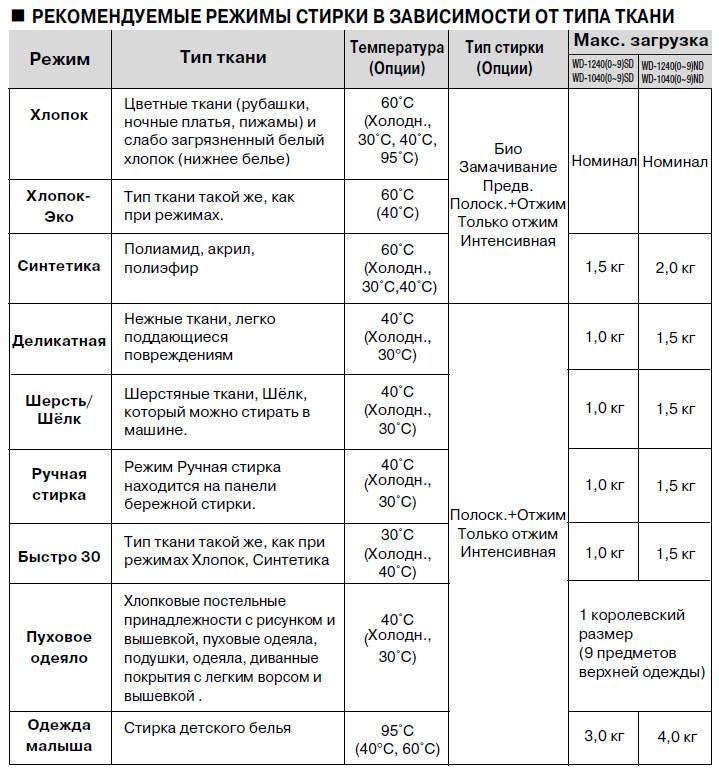
When choosing a washing program, the type of fabric must be taken into account. For example, synthetics and satin, made from silk and cotton threads, need to be washed in different temperature conditions. The duration of the wash and the number of revolutions of the drum during the spin cycle may also differ, since the fabrics have a different structure. Modern washing machines brands Bosch, LG, Siemens, Samsung and others have an impressive set of washing programs in their arsenal.
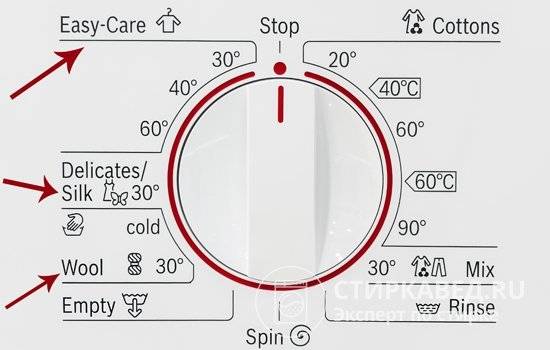 Each washing machine has washing modes for cotton, synthetics, wool
How to wash bed linen made from different fabrics? Next, we will talk about the temperature suitable for washing each of the common materials.
Cotton fabric
The optimum washing temperature is +60 ℃.Heavily soiled white linen should be washed at +90 ℃ using a bleaching powder. Colored bed linen is washed at a water temperature of +40…50 ℃, using powders and liquid detergents intended for colored fabrics. If there are stains on the fabric, it is better to pre-soak the kit.
 Children's bedding is washed at a temperature not lower than +60 ℃
Dirty baby bedding is best washed at elevated temperatures, at least +60 ℃, even if it is colored. If the degree of pollution is small, you can reduce the temperature to +40 ℃.

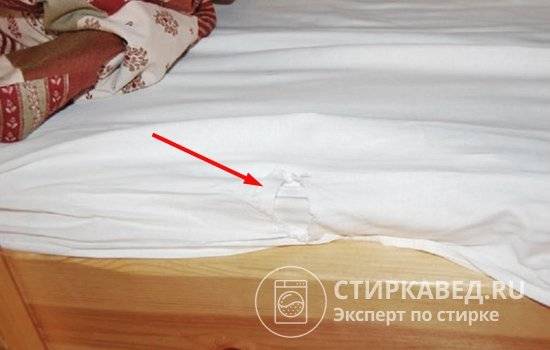 Do not get carried away washing at high temperatures - this leads to premature wear of the fabric
You need to iron the fabric from the front side, while it is recommended to moisten it. Drying is best in a well-ventilated area. Colored linen should not be hung in the sun, as the paint may fade.
Silk
Silk fabric has a delicate structure, so you need to use a manual or delicate mode to wash it. Wash bed linen in a washing machine at a water temperature not exceeding +30 ℃. Spinning at high speeds can damage delicate fabrics, so it's best to turn it off altogether. It is advisable to use a special detergent designed for silk and woolen fabrics.
Laundry should be dried in the shade, avoiding sunlight and the proximity of heating appliances. Iron only from the wrong side, at low temperatures. Humidification and steaming will damage the fabric, so do not use them.
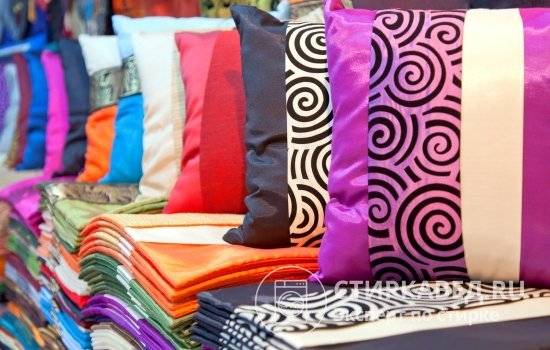 Silk bedding contributes to a good rest, because it is extremely soft and gentle to the touch.
linen fabric
Linen is a natural material.Bed linen from this fabric is practical and very popular. Contaminated fabric is well washed at +90 ℃, the material is not afraid of high temperatures. How many degrees should be chosen for the optimal washing mode? The same as for cotton: +60 ℃, - in this case, it is best to select the "Cotton" mode in the CM.
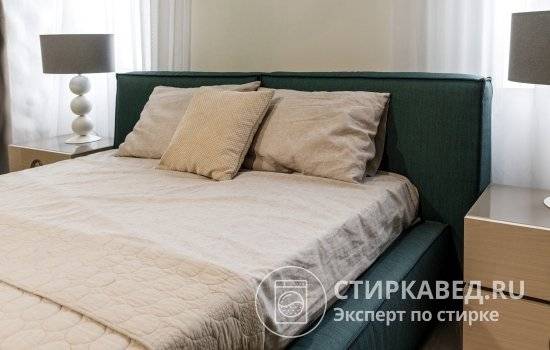 Linen bed linen
For products with a color pattern, a temperature of +40 ℃ is recommended. Linen products are well washed if they are pre-soaked in warm water with dissolved laundry soap. The fabric should not be dried near heat sources, as this will cause the material to shrink. The linen is ironed at the maximum temperature, the fabric must be damp.
satin
The material contains cotton in its composition, therefore it is washed in the same way as cotton fabric. The optimal temperature regime is +60 ℃, while it is allowed to increase up to +90 ℃ for heavily soiled fabrics. It is better to wring out the laundry at the average number of revolutions of the drum, but this can also be done at the maximum allowable revolutions.
Synthetic fabrics
Underwear is also made from synthetic material, although doctors do not recommend using it. People buy these products because of the lower price. Synthetics are afraid of high temperatures, so a temperature not exceeding +40 ℃ is suitable for washing such kits. Washing machines usually have a Synthetics program that automatically selects the temperature and cycle time. Drying near heat sources and ironing such products is impossible.
Synthetic bedding is not good for human health
Principle and purpose of classification
The division of washing units into classes greatly facilitates the choice of a machine with the necessary and sufficient capabilities. The higher they are, the better the washing is carried out, but the greater the amount will have to be paid to the buyer of the washing machine.
We note right away that for solving everyday problems, maximum quality indicators are often optional.
The classification is also carried out according to the criteria of spinning and energy consumption, these criteria are no less interesting than the quality of washing.
By analogy, it is worth deciding on them in advance so as not to overpay in vain for ultra-high performance, as well as for functions that have not found application.
Image gallery
Photo from
The classification of various parameters of the washing machine is carried out to facilitate the process of choosing the right brand and model for the buyer.
The division into classes will help future owners to get an idea about the efficiency of the unit during various operations.
An important characteristic to be classified is the washing class of the equipment offered for sale.
Effective assistance in finding suitable washing equipment is provided by stickers located on the body of the washers.
Stickers introduce the potential buyer to the technical capabilities, feature set, economy and efficiency of laundry equipment
To indicate the washing class, by analogy with the energy efficiency class, letters are used
The equipment of the highest class, which received the category as a result of test tests, is assigned the letter "A"
Most of the trade offers for washing parameters are marked with the letters "A" or "B", the difference between them can only be determined empirically
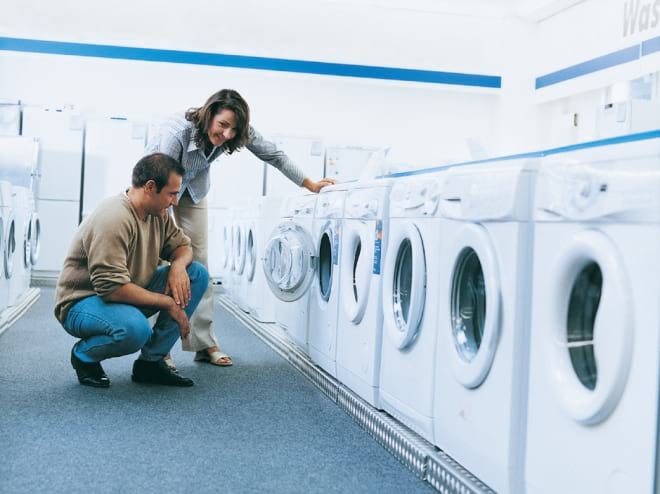
Washing machines in the store
Inspection of your favorite washers
Customers choose a washing machine
Information stickers on the body
The washing machine is installed on the workplace
Laundry class label
Sticker on the front of the washer
Washing machine with energy efficiency class A
In the 90s of the last century, information stickers were developed to inform potential owners of washing machines about the effectiveness of the device.
Classes are depicted on them with colored marking stripes and Latin letters from “A”, assigned to the technique with the maximum performance, to “G”, marking the unit with the lowest rating.
The letters and their corresponding gradation are valid in all classification options carried out for each brand and model of a washing machine by a manufacturer that adheres to international testing and control rules.
Note that the vast majority of washing machines offered for sale are marked with the letters “A” or “B” in terms of washing quality.
Manufacturers themselves do not see the point in producing and selling inefficient devices. However, with the nuances of the aforementioned division, one should understand the smallest details.

In addition to familiarizing yourself with the information colorfully marked on the stickers, before buying, you should carefully study the technical documentation attached to the equipment.
Spin class
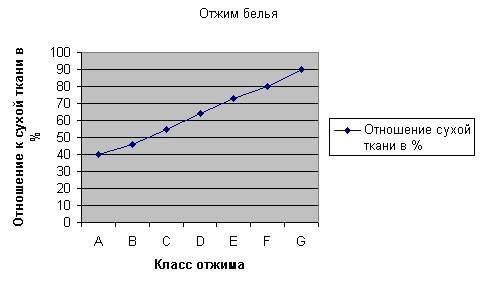
Several different classes can be indicated on the washing machine, and it is not necessary that this is the washing machine washing class, because there are other parameters. For example, spin class. It characterizes the percentage of moisture in the laundry that remains after washing with a spin cycle. This indicator completely depends on the number of revolutions of the drum per second - the higher the speed, the better the spin and the less humidity after washing.Like the washing class, the spin class (which you already know) is classified by indices from A to G. Here is a detailed table of classes:
| Class | Humidity (%) | Characteristic |
| A | Up to 45 | Extremely strong |
| B | 45 – 54 | Very strong |
| C | 55 – 63 | Strong |
| D | 64 – 72 | Very intense |
| E | 73 – 81 | Intensive |
| F | 82 – 90 | Weak |
| G | 90 and above | Very weak |
Being interested in the question of what the washing class and spin class are, remember that the highest spin class may not always be justified - sometimes high speeds lead to twisting and deformation of fabric structures. Machines with spin class A are suitable for washing coarse and thick fabrics. Washing machines with spin class F and G are designed for washing delicate and very thin fabrics, therefore they are also very popular.
Standard washing classification
Each washing machine that you can see for sale has special stickers with a classification of washing and spinning levels applied to them. It is designated by Latin letters from "A" to "G". Modern models may have designations with a certain number of pluses, such as "A+++". This suggests that washing machines are becoming more efficient.
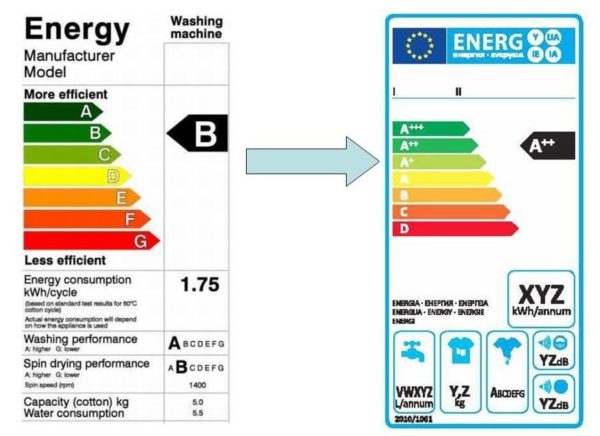
The effectiveness of washing is determined by comparing two indicators of the focus group (reference machine) to the test. The reference unit is created exclusively by authorized manufacturers, who are very strict to the requirements of European quality. Laundry with varying degrees of soiling is loaded into such an aggregate. The norm of powder for one wash is exactly 180 g. A specific washing cycle is selected. Further, with the help of special ultra-precise devices, the quality of laundry washing in the test and reference groups is assessed.
Based on this, a washing efficiency index is created relative to the tested machine to the focal one:
- "A" -\u003e 1.03.
- "IN 1.
- "C" - 0.97.
- "D" - 0.94.
- "E" - 0.91.
- "F" - 0.88.
- "G" - < 0.88.
Thus, a washing machine with a class "A" is able to wash clothes 1.03 times more efficiently.
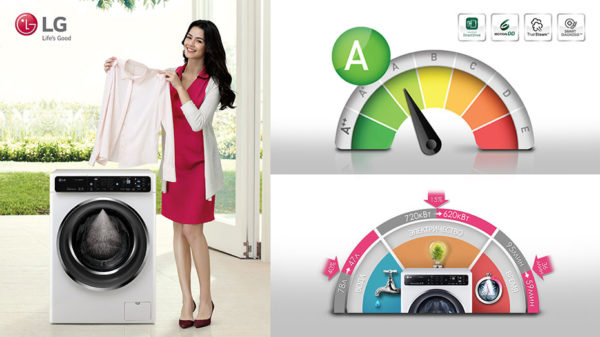
Types of classes in a typewriter
With the help of the standard, a classification of efficiency levels is formed. Washing equipment, like many other types of technological production, is subject to European standards, where a letter rating is relevant. Washing, spinning and energy classes are indicated by letters from A to G.
| Designation | Meaning |
| A | Excellent |
| B | Very well |
| C | Good |
| D | Fine |
| E | Satisfactorily |
| F | Badly |
| G | Very bad |
These are the options when choosing a washing machine. The first 3 are most often found on sale and guarantee the acceptable quality of the three indicators.
Washing
We specify the classification of washing devices for the process. The level of the machine in comparison with the standard for determining the quality must take into account the requirements:
- fabric uniformity;
- the identity of the washing powder;
- coincidence of pollution level;
- the water temperature is 60 degrees Celsius above zero.
This is how the efficiency class of washing in machines is revealed.
Comparison with the standard:
| Grade | Level of quality |
| A | 1,03 |
| B | 1 to 1.03 |
| C | 0.97 to 1 |
| D | 0.94 to 0.97 |
| E | 0.91 to 0.94 |
| F | 0.88 to 0.91 |
| G | Less than 0.88 |
When buying any thing, all the cards can be confused by flooded brands. A promoted brand does not imply a good quality product. You can pay a lot of money for a class A branded washing machine, and an unpromoted company will sell it much cheaper. The quality of the goods in both firms does not differ.
Spin
The labor activity of the drum of the device affects the percentage of laundry moisture remaining on the laundry at the time of completion. This percentage affects the quality of the spin. It is found by the ratio of the weight of the unwashed linen to the weight of the linen obtained by washing.
| Class score | Residual moisture, % | Drum rotation speed, number of revolutions / min. | Spin level | Material Application |
| A | Less than 45 | Over 1500 | Too strong | High density rough matter |
| B | 45 to 54 | From 1200 to 1500 | Quite strong | Terry |
| C | 54 to 63 | 1000 to 1200 | Strong | rough matter |
| D | 63 to 72 | 800 to 1000 | More intense | Synthetic and cotton |
| E | 72 to 81 | 600 to 800 | Intensive | Delicate fabrics |
| F | 81 to 90 | 400 to 600 | Weak | Thin |
| G | Over 90 | Less than 400 | Very weak | Very thin |
Not for all types of fabrics it will be safe to use equipment of degree A. The spin level is strong, therefore, laundry that is weak in density will not withstand.
The best option would be to use a machine with a class and number of drum revolutions per minute from 1000 to 1200. In this case, the laundry will not be torn, and you can dry it on a rope. With a huge number of revolutions, washing machines jump and vibrate. This is inconvenient and impractical.
Spinning uses centrifugal force. It pushes water out of the fabric. The throughput of the fabric, in addition to the number of revolutions, the size of the drum and the spin time, affects the level of dryness of the laundry.
Modern washing equipment is equipped with several spin modes at different speeds.
Energy consumption
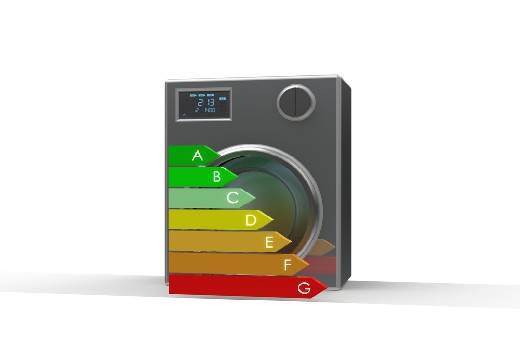
Manufacturers of washing machines do not sit still in development.Instead of 7 types of electricity consumption, they invented an economy class, designated A +. The energy consumption of the machinery is less than 0.17 kWh/kg.
For 1 hour at a temperature of 60 degrees Celsius, a kilogram of cotton linen is placed in the machine and the standard wash is turned on. After the run, the result of the spent energy is revealed.
| Class score | Degree of energy consumption | Electricity consumption, kWh/kg |
| +A | Least | Less than 0.17 |
| A | Small | 0.17 to 0.19 |
| B | Economical | 0.19 to 0.23 |
| C | Economical | 0.23 to 0.27 |
| D | Average | 0.27 to 0.31 |
| E | High | 0.31 to 0.35 |
| F | Very tall | 0.35 to 0.39 |
| G | Too high | More than 0.39 |
On each model you can find a tag with the name of the class.
Modern machines rarely have B and C. Even cheap washing machines are produced with class A. Engineers have achieved greater economy (A ++ and A +++).
Washing machine classification
A new washing machine always has stickers on which manufacturers indicate the washing class, energy saving class and spin class.
For evaluation, a foreign evaluation system is used in Latin letters, where A is the highest score, and G is the lowest.
Spin class
This indicator, like the rest, is determined using the installed system. There is a standard against which all figures are calculated. That is, they take a fabric with an exact weight and put it into a machine with certain characteristics.
They start a spin cycle suitable for the material, make the necessary measurements.
Peculiarities:
- The highest score A is given if, after washing, up to 45% moisture remains in the product. In this case, the rotation speed of the drum is at least 1200 rpm.
- Class B category allows a residual moisture content in the fabric ranging from 46 to 54%.
- Option C has an index of 54 to 63%.
Washing machines with other categories are not easy to meet now. They are not in demand and do not satisfy the needs of housewives.
Expert advice when choosing a washing machine spin class:
- If the bathroom or the room where the equipment will be installed is small, then it is better to choose a small-sized model. Usually in the spin class C.
- 1200 rpm are appropriate if the equipment is designed for 7 kg of loading. For a smaller volume, 1000 revolutions is sufficient.
- The disadvantage of high speed is that during the spin cycle, the clothes rub against each other, which leads to rapid wear and damage to things.
- To wash delicate and cotton linen, high speeds are not needed, on the contrary, the spin speed should be less than 800.
Wash class
This item is the most important of all, which is worth looking at when buying. The indicator makes it clear how effectively the machine copes with pollution.
To determine the washing class in washing machines, manufacturers conduct tests similar to regular washing:
- A piece of fabric with various types of stains is loaded;
- Washed within an hour.
After the experts determine the degree of quality:
- Between class A and B, there are few differences. At the same time, A is not always the most expensive, some models with lower rates, but from well-known brands, will cost more.
- Washing machines of washing classes C and D do their job well, but when using them, the use of expensive detergents is recommended.
Energy efficiency class
This indicator is determined not only for a washing machine, but also for any electronic household appliances.Since the world of technology does not stand still, new classes have been added by car manufacturers: A +, A ++ and even A +++.
But not all manufacturers resort to these designations. The higher the value, the less electricity is consumed during the washing process.
When making a choice, it is better to pay attention to energy efficiency not lower than B
The energy consumption class of the device is checked in the same way as the other indicators. The manufacturer takes a kilogram of fabric, loads it into a reference machine for an hour's wash at a temperature of 60 degrees.
After the end of the process, the cost of electricity is calculated.
What is a reference machine
Tests are required to establish the parameters. To do this, the performance of the new apparatus is compared with the performance of the Wascator reference washing machine manufactured by Electrolux. The cost is 20 thousand euros, the cost of the analysis is calculated in thousands of euros. However, the manufacturer may be different, but the device must undergo mandatory certification.
Wascator car
Its feature is the issuance of the same wash indicators, regardless of the number of starts. To start the test, the program of the test machine is set, which is installed next to the reference one. They are loaded with the same amount of laundry, which is contaminated in a special way, for the equivalence of research, because they also affect the results. The powder and water that are used during washing are also prepared in advance and have exactly the same composition and chemical parameters.
It is interesting to know: the reference does not mean the best, the machine gives the same parameters from time to time.
When the machines start washing, special automation measures the amount of electricity consumed by the reference and test models to determine the energy consumption. Laundry and drained water are also examined to determine the cleanliness and quality of the rinse. Each parameter is assigned its own class, which is subsequently applied to the label of household appliances.
Find out how much washing powder to put in the washing machine
Spin class
An important parameter for washing equipment is the spin class. It shows in percentage how wet your clothes will be after washing. This indicator directly depends on the number of revolutions per minute of the machine. That is, the more often the drum rotates, the drier things will be.
The percentage of moisture can be easily calculated - this is the ratio of the weight of the laundry before and after the washing process. Depending on the spin class, washing machines are assigned ratings from “A” to “G”, each of them corresponds to a certain humidity and speed:
- The best spin quality is marked with the letter "A", with it the residual moisture content of the laundry will be less than 45%.
-
The value "B" indicates that after squeezing the fabric will remain moist by 45-54%.
Do you wash by hand?
Oh yes! No
- "C" means that the technique will wring out the laundry, leaving it at the level of 54-63%.
- A value of 63-72% guarantees a "D" class.
- "E" means that after washing the clothes will be 72-81% damp.
- "F" corresponds to a result of 81-90%.
- A machine with a class "G" after washing will show the moisture content of the laundry more than 90%.
In addition, the spin efficiency depends on the diameter of the drum, and the time it takes to complete a full spin cycle. The longer the time and the larger the drum, the drier the laundry will be.
The permeability of the material also affects the dryness of the fabric.So, a chiffon blouse and jeans, after washing together, will have a different percentage of humidity.

In most modern-style washers, several push-up modes are programmed, you should also pay attention to this when buying.
The proportion of dry tissue depending on the class
Spin class: types and features

All washing machines are evaluated in several main categories. This also takes into account the spin class of washing machines. This indicator is one of the key ones. This factor means that the more revolutions per minute the machine makes during the spin cycle, the higher the class. Thus, the speed of rotation of the drum determines the height of the category, because the residual moisture of things after washing depends on this.
The efficiency of the automatic spin is determined by a simple calculation. To do this, it is necessary to weigh the laundry after processing with a certain number of revolutions, and then wait for the same laundry to dry and weigh it again. Further, the second indicator is subtracted from the first and multiplied by 100%. So you can find out how wet the laundry remains after spinning with different parameters.
There are several main classes that have a set of features:
- Class "A" is the highest, and the residual moisture content of the laundry after processing is no more than 45%. This class of spinning washing machines has a drum rotation speed of 1600 or more revolutions per minute;
- Equipment category "B" allows you to squeeze things to a moisture level of 45 to 54%. In this case, the rotation speed of the drum is 1400 rpm;
- For class “C”, the characteristic humidity is at the level of 54-63 percent. Such machines have a maximum spin speed of 1200 rpm;
- Category "D" assumes a residual moisture level of the laundry at 63-72%. At the same time, the speed of rotation of the drum during the processing of linen is 1000 revolutions;
- The spin class in washing machines "E" allows you to process things to a moisture content of 72 - 81%. The drum rotates at a speed of 800 revolutions in 60 seconds;
- For all models of category "F" equipment, the residual moisture content of linen is 81 - 90%. In this case, the drum rotates at a maximum speed of 600 revolutions.
Machines with a drum rotation speed of 400 rpm have the lowest spin level. This type of "G" leaves things wet by more than 90 percent.
Each spin level in washing machines affects the laundry in a certain way. Many machines have a spin adjustment function depending on the type of laundry. For example, things that require delicate care should be processed at a minimum speed. At the same time, the minimum for each model of equipment is different, but often this figure is 600 - 400 revolutions. Thus, in automatic units, you can change the spin parameter, which makes the operation of the equipment convenient.
Main programs
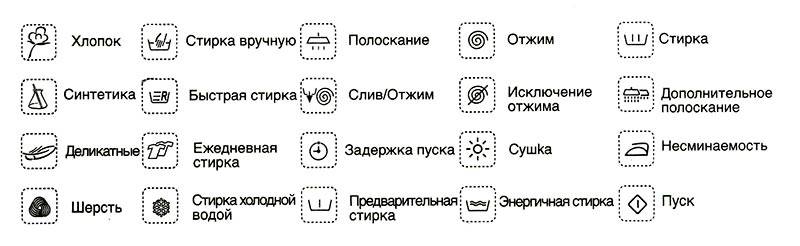
Different manufacturers equip the equipment with a different set of modes and programs. However, all devices have categories of modes:
- programs that regulate washing parameters based on the type of linen or fabric;
- economical modes to reduce cycle time. As a result, the consumption of water and electricity is reduced;
- options for health care: for allergy sufferers, disinfection and others.
Cotton (linen)
The program is designed for heavily soiled items made of cotton and linen, bedding.
You can set 4 modes: 30, 40, 60, 90-95 degrees. For example, white linen can be washed at the maximum temperature, and colored items should not be exposed to temperatures above 40 degrees, as they are prone to color fading.
The longest mode involves 4 rinses in cold water, because natural dense fabrics actively absorb water, and the powder from them is poorly rinsed out.
The longest mode consists of 4 rinse cycles, since cotton linen picks up moisture more strongly, the powder is washed out of it more slowly. Rinse things with cold water. Such laundry is wrung out at the maximum speed for the washing machine.
Synthetics
The mode is intended for synthetic and mixed things at 60 degrees. Things are washed for a long time, several rinses are provided, the spin cycle is performed at high speeds.
Wool
Modern technology allows you to carefully wash even items made of wool and cashmere. A small amount of water is drawn into the drum and it wobbles slightly. Thanks to the features of the program, things do not appear pellets and they do not sit down.
Silk
Delicate program for natural silk, viscose and lace. The program provides for a short rotation of the drum, after which it waits. Things are rinsed with a large amount of water and are not wrung out.
Washing machine repairs are best left to the professionals!
We present you our unique catalog of private craftsmen and service centers
—
Select your city and master in the filter: by rating, reviews, price!
The number of revolutions at the end of the cycle is not higher than 600 revolutions.
Jeans and sportswear
Initially, the pre-wash starts at a low temperature. Manufacturers recommend using biopowders for this program, which carefully and deeply remove complex stubborn stains. You can wash fabric sports shoes on the cycle, but only one pair should be loaded.
intensive
The program is suitable for things with heavy soiling and stains, a temperature of 90 degrees and an extended cycle time are provided. Not recommended for delicate fabrics.
down jackets
Program for washing down jackets and outerwear in general. Usually, the temperature of this program does not exceed 30-40 degrees. Find out how to wash a down jacket in a washing machine from our separate article.

Baby clothes
Thanks to the high temperature and extra rinse, it thoroughly washes children's clothes and rinses out the powder.
Handwash
Drum with low speed and gently turns, temperature 30-40 degrees. Spinning is not performed. It is used for delicate things that cannot be stretched to avoid deformation of the product.
Economy mode
With ECO programs, low temperatures are provided, which makes it possible to save up to 40% of electricity per wash cycle. The time saving program allows you to halve the duration of the cycle, while the quality of the wash does not suffer. Washing lasts 20-30 minutes and is suitable for lightly soiled garments.
Prewash
The program starts before the main wash cycle. In the container, the powder must be poured into two containers at the same time. The first cycle is provided at 40-50 degrees, after which the standard cycle is carried out.
Soak
The laundry is soaked in water at 30 degrees, the time varies depending on the manufacturer.The longest process is envisaged in the equipment of Gorenje and Electrolux manufacturers.
How much does the laundry weigh?
Now it is logical to talk about how much laundry can be washed in the machine in one wash without weighing it. Each item of clothing has its own weight in grams, for example, a women's T-shirt can weigh an average of 70 to 140 grams, depending on the size. A few more similar examples are shown in the table below. Using a similar table, you can easily calculate how much laundry to put in the drum.

In the machine with a load of 5 kg in any mode for cotton fabrics, you can wash a couple of sheets, a couple of pillowcases and 3-4 towels. The laundry will rotate freely in the drum without twisting or wrinkling. But outerwear should be washed separately.
In modern washing machines, there is an "Auto-weighing" function. Now a person does not need to think about how much the dirty laundry that he loads weighs, the machine will receive the necessary information itself. The main benefit of the function is that the machine, having learned the weight of the laundry, determines the amount of water needed for washing and selects the optimal washing program. There is a triple benefit:
- the machine eliminates the need to think about how much laundry to put;
- saves water and electricity;
- selects the best program to wash your laundry properly.
Auto-weighing also protects the washing machine from breakdowns, since overloading can be fraught with drum imbalance. If the machine has auto-weighing, then when the drum is overloaded, it simply will not start and will give an error.
Thus, it is necessary to put laundry into the drum of the washing machine not according to the maximum load of the machine, but according to the maximum load for a certain washing mode. We hope our article helped you understand how much to put in a drum. Good luck!



