- Choosing the right heater
- Criterion No. 1 - place and conditions of application
- Criterion No. 2 - technical characteristics
- Infrared catalytic gas heater for summer cottage
- The best floor gas heaters
- Timberk TGH 4200 M1
- Feg Zeus
- Bartolini Pullover K turbo plus
- Elitech TP 4GI
- Advantages and disadvantages of heating with a catalytic heater
- Which company's gas heater to choose
- How to choose and buy a catalytic gas heater
- Types of gas heaters for tents
- Catalytic convectors
- Gas heater for garage
- Popular models of catalytic heaters
- Gas catalytic heater
- Gas convector - country leader among heaters
Choosing the right heater
When choosing a suitable heater, it is necessary to take into account many nuances, evaluate the convenience of design, functionality, additional features and equipment of the model you like. Consider the main criteria for the right choice.
Criterion No. 1 - place and conditions of application
The first step is to decide on the purposes for which it is planned to buy a catalytic device. The optimal type of construction and the set of characteristics required in this case depend on where and under what conditions the device will be used.
For work in nature, small portable devices are designed that can easily fit in a backpack and do not depend on the presence of communications
The main indicators should be selected taking into account the conditions of the forthcoming operation, the parameters of the heated object. It is necessary to take into account the expected frequency of use, the heating area, and preview the reviews of real buyers about the model.
So, for space heating it is worth buying larger heaters with sufficient power and automatic safety sensors. If the device will need to be rearranged frequently, it is better to choose a mobile design on wheels.
Criterion No. 2 - technical characteristics
One of the main parameters of the heater is power. To choose a device with the correct performance, you should perform preliminary calculations, consult with the seller, carefully study the instructions. The technical documentation should indicate what area the power of a particular model is designed for.
In addition, you need to pay attention to the following characteristics:
- gas consumption - how much fuel is required for operation, is the device economical;
- dimensions - what is the width, length and height of the device, is there enough space in the room to provide free space around it (1.5 m - in front, 0.2 m - behind and on the sides);
- type of control - mechanical or electronic;
- the weight and volume of the provided cylinder - is the device too heavy, how difficult it will be in movement and installation.
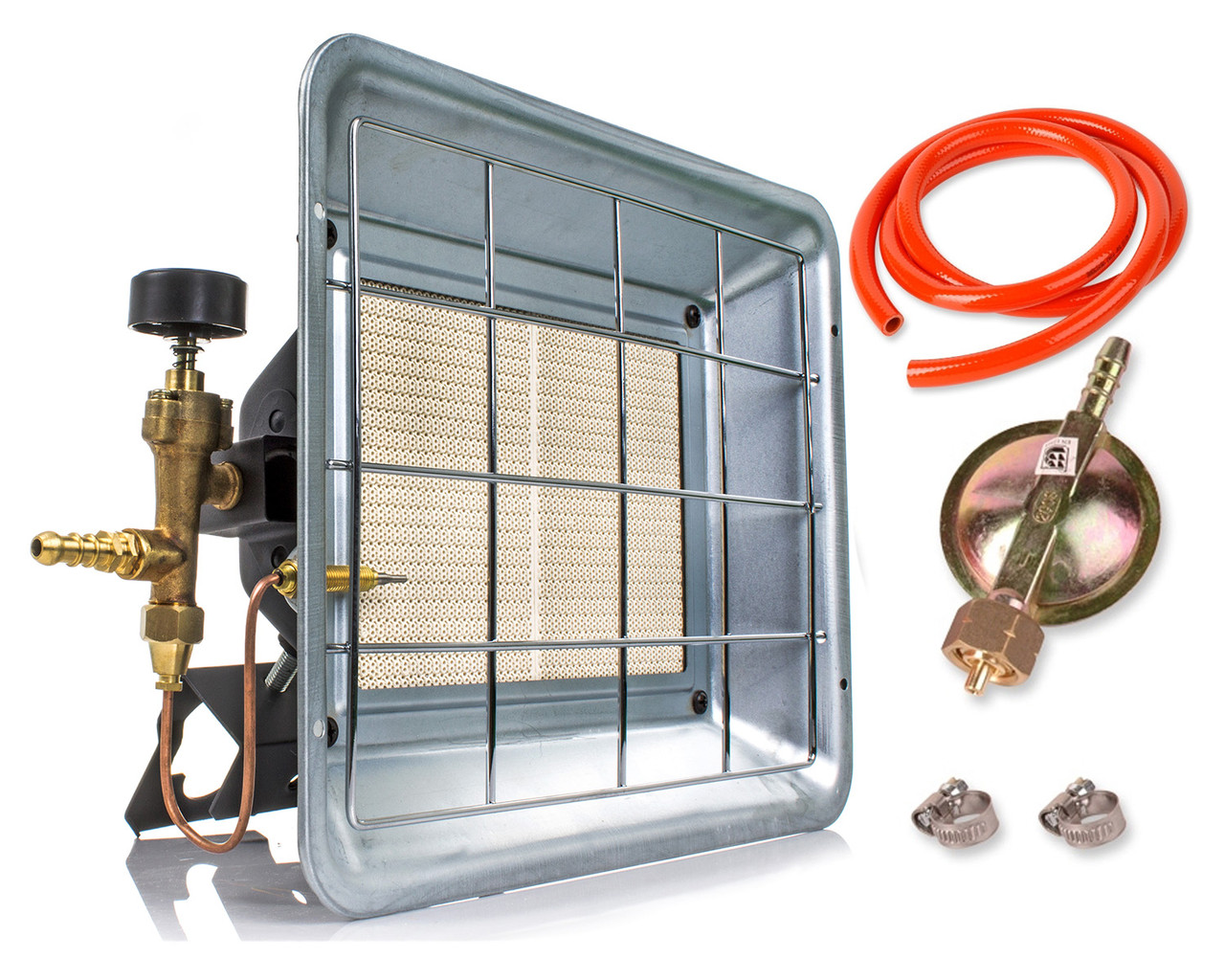
It is important to check the complete set and its compatibility with the equipment. The standard set includes a reducer, a gas hose, sometimes a cylinder
If any of the elements does not fit with the device, you must purchase suitable adapters.
The range of catalytic heaters includes models with different performance ranges. Devices with a power of up to 2.9 kW are capable of heating an area of 30-35 m². A power of approx. 4 kW is suitable for rooms up to 60 m². There are also low-power devices that warm up no more than 12 m². Their performance is about 1.2 kW
It is desirable that the heater be equipped with additional design and functionality.
The main additions and features are as follows:
- automatic power adjustment in several modes;
- horizontal position sensor that turns off the device in case of a sharp mechanical impact, skew, capsizing;
- indoor carbon dioxide monitoring system;
- infrared heating;
- piezo ignition;
- electric turbofan;
- overpressure relief valve.
For greater ease of use, you should choose a device with wheels for free movement, handles, pedestal legs installed in different positions.
Infrared catalytic gas heater for summer cottage
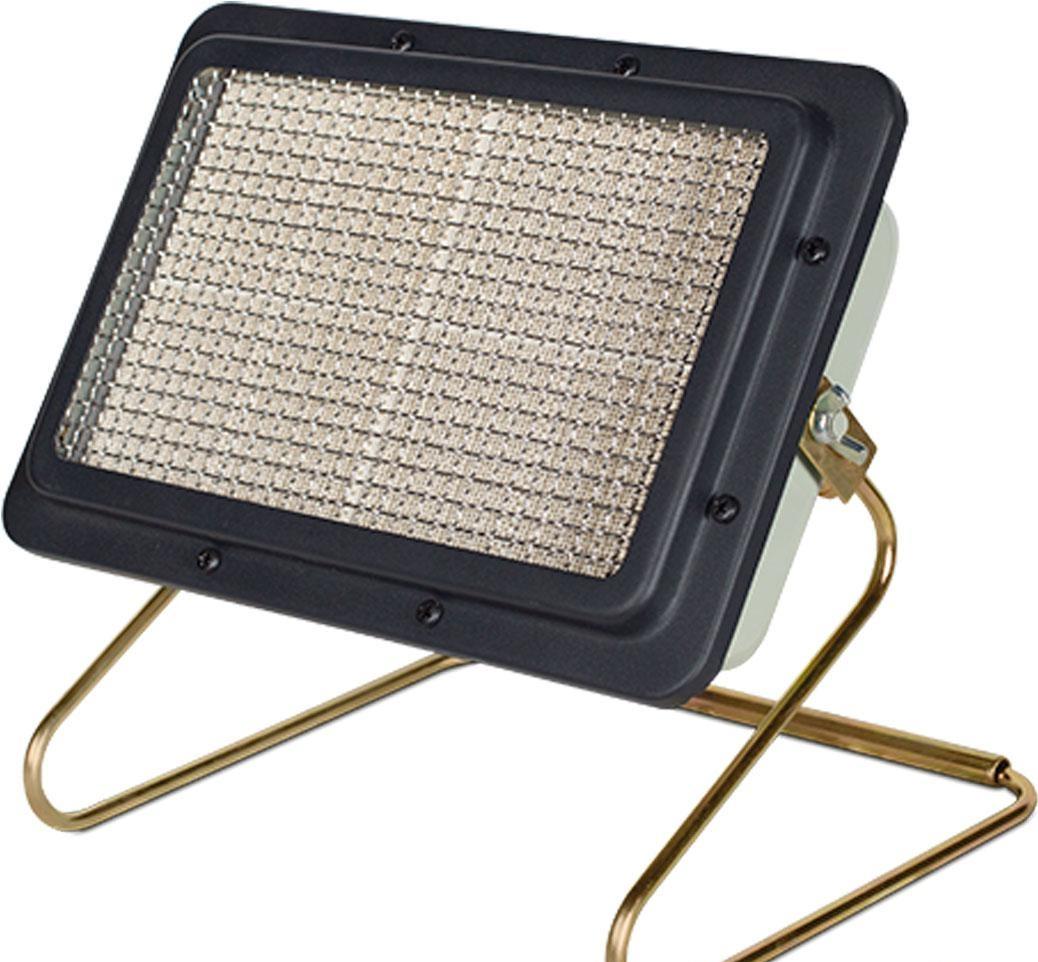
Another parameter by which it is customary to distinguish between catalytic heaters is the presence of an infrared emitter. Models with this addition have a point effect due to ceramic panels and reflectors located on the inner surface. So thermal energy, being converted into infrared radiation, enters the environment.
Such devices, as a rule, have extremely high performance and operate on gas fuel. Their use is not limited to home heating.Often you can find such heaters on the street: summer playgrounds and verandas can be equipped with them. Thanks to infrared radiation, devices do not consume energy to heat the surrounding air, but act on surrounding objects, heating them.
It is difficult to say unequivocally which gas heater is better: infrared or catalytic without a diffuser. In the second case, the device warms up the air, not objects, which is absolutely not appropriate when it comes to outdoor installation. In any case, it is worth exploring the issue of gas catalytic heaters in more depth: reviews of each model can be easily found on the net and draw the appropriate conclusions.

Many models of catalytic heaters are ideal for travel use.
The best floor gas heaters
Gas heaters with floor installation do not require fasteners and can be placed in any part of the room. Most of them have wheels for movement, which makes them mobile.
Timberk TGH 4200 M1
4.9
★★★★★
editorial score
94%
buyers recommend this product
See review
The TGH 4200 M1 heater from Timberk is equipped with a three-section ceramic burner with a sequential start, which ensures efficient heating of any premises up to 60 square meters. m.
The device is powered by gas from a 27-liter cylinder, which is placed inside the heater. You can install a cylinder of 50 liters nearby.
The model is distinguished by economical fuel consumption, which is no more than 0.31 grams of gas per hour. The presence of three operating modes allows you to configure the most comfortable conditions.
The device is equipped with a burner damping and carbon dioxide excess sensor that automatically turns off the heater.The presence of wheels makes the device mobile.
Advantages:
- 3-section burner;
- Economical fuel consumption;
- Three operating modes;
- Flame sensor;
- Carbon dioxide sensor;
- Mobility.
Flaws:
There is no rollover sensor.
Compact and mobile ceramic heater can be used for domestic and commercial premises, including large areas.
Feg Zeus
4.9
★★★★★
editorial score
90%
buyers recommend this product
The original Zeus gas heater from Feg is made in a classic design and stylized as a fireplace. Heat-resistant glass with ceramic inserts allows you to watch the play of the flame.




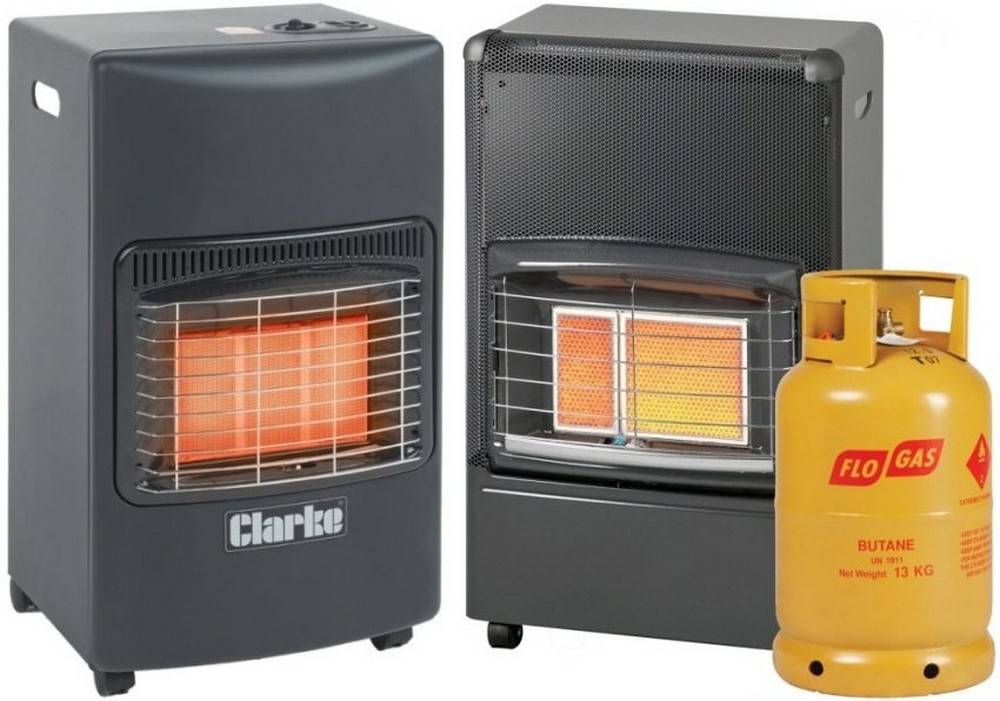
The body of the heater is made of high-alloy steel with galvanized coating. The uniquely shaped heat exchanger ensures rapid air convection even without a fan.
The heater has a built-in thermostat to regulate and maintain a comfortable temperature. The body is painted with heat-resistant paint that can withstand temperatures up to 1100 °C.
Advantages:
- original design;
- Highly efficient heat exchanger;
- thermostat;
- Heat resistant paint;
- Efficiency 90–95%;
- Work from the main and bottled gas.
Flaws:
Stationary installation without the possibility of movement.
The Zeus fireplace heater from Feg has a stylish design, high-quality materials and high performance.
Bartolini Pullover K turbo plus
4.8
★★★★★
editorial score
89%
buyers recommend this product
An innovative type of gas heater with a catalytic principle of operation, in which the gas does not burn, but forms heat, oxidizing from contact with a catalyst - platinum powder.
This heater is safe to use. In addition, it is equipped with sensors for tipping, overheating and is able to monitor the level of carbon dioxide.
The heater is equipped with a fan that accelerates the heating of the room. It can operate in standard and turbo mode, as well as in the "cold air" mode.
For convenient movement, wheels are provided on the body. Despite the compact dimensions of the case, there is free space inside for a 27-liter gas cylinder.
Advantages:
- Catalytic principle of action;
- Drop sensor;
- Carbon dioxide control;
- Three operating modes;
- Compact dimensions;
- Low price.
Flaws:
The gas bottle is not included.
The modern Pullover K heater from Bartolini will provide safe and efficient heating of rooms up to 40 square meters. m.
Elitech TP 4GI
4.8
★★★★★
editorial score
86%
buyers recommend this product
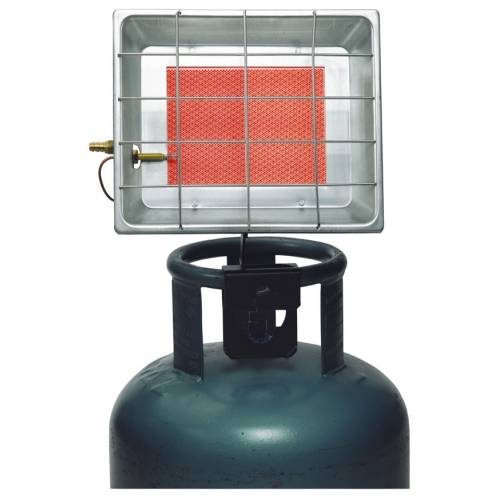
Gas heater TP 4GI from Elitech has an infrared type of heating. It is equipped with an enlarged ceramic panel that heats up the room quickly and efficiently.
The device is capable of operating in three power modes: 1.4 kW, 2.8 kW and 4.1 kW. The presence of a piezoelectric burner facilitates the operation of the installation.
The heater runs on propane from a built-in cylinder. It has swivel wheels for mobility. Gas leakage is prevented by a built-in thermocouple, as well as an oxygen level sensor.
Advantages:
- Large ceramic panel;
- Three power modes;
- Swivel wheels;
- Built-in balloon;
- Fuel leakage protection.
Flaws:
Not connected to the main gas supply.
Ceramic heater TP 4GI from Elitech is suitable for primary and secondary heating of residential and industrial premises.
Advantages and disadvantages of heating with a catalytic heater
Before you buy a catalytic heater, you need to understand all the advantages and disadvantages of this heating method.
Advantages of a catalytic heater:
a catalytic heater for a summer house or a house does not adversely affect the microclimate of the room. It does not disturb the natural balance of oxygen and carbon dioxide and does not emit harmful substances that are usually formed during the combustion process, thus maintaining a healthy microclimate;
Catalytic gas heaters are environmentally friendly and safe devices
the device is much safer than traditional gas ones, since there is no danger of poisoning as a result of excessive carbon monoxide emission. In addition, there is no risk of fire
Such a device can be safely used in the house, in a tent, and in an industrial workshop;
Another important advantage is the ability to adjust the power of the device. This allows not only to maintain a comfortable temperature, but also to significantly save;
mobility - even large and powerful devices move quite easily, not to mention compact heaters
According to device owners in reviews, catalytic heaters often fit easily into a bag or backpack.
Despite the abundance of significant advantages, catalytic heaters are not without disadvantages:
such devices have a rather limited operating period - about 2500 hours.The fact is that in the process of use, the catalyst gradually burns out and after a certain time it must be changed. The amount is about 2/3 of the cost of exactly the same new equipment, so it's easier to throw out the old device and purchase a new one;

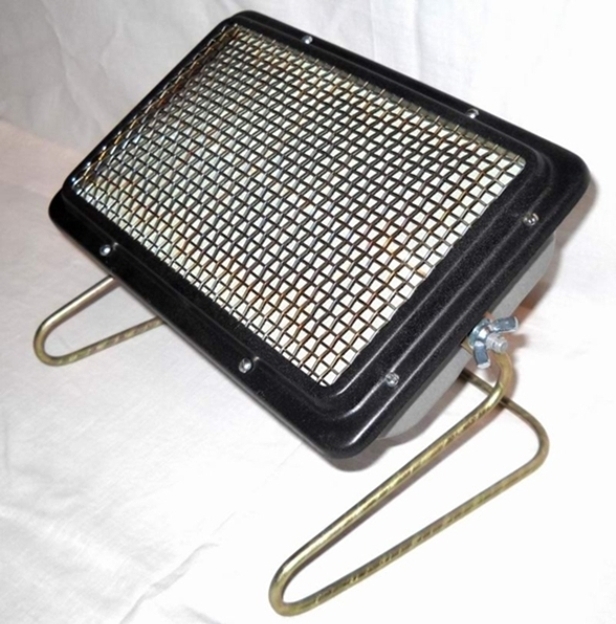


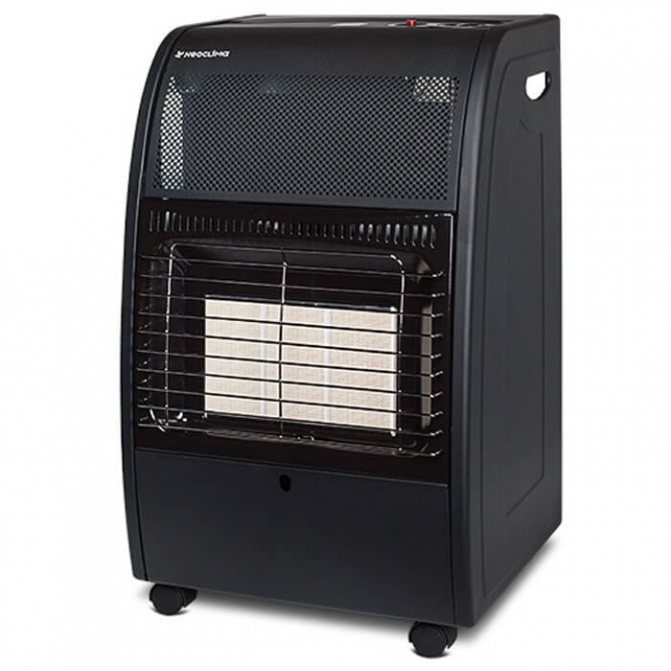
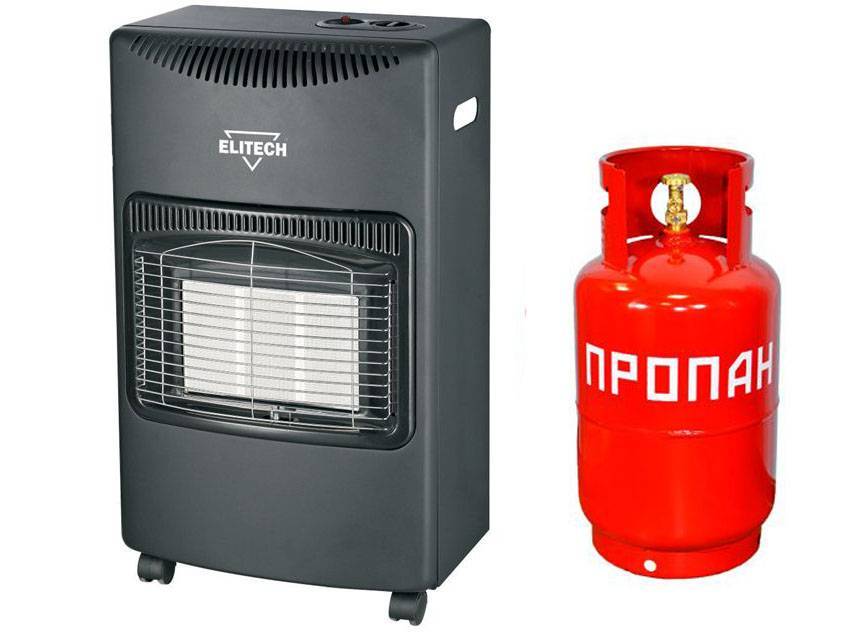


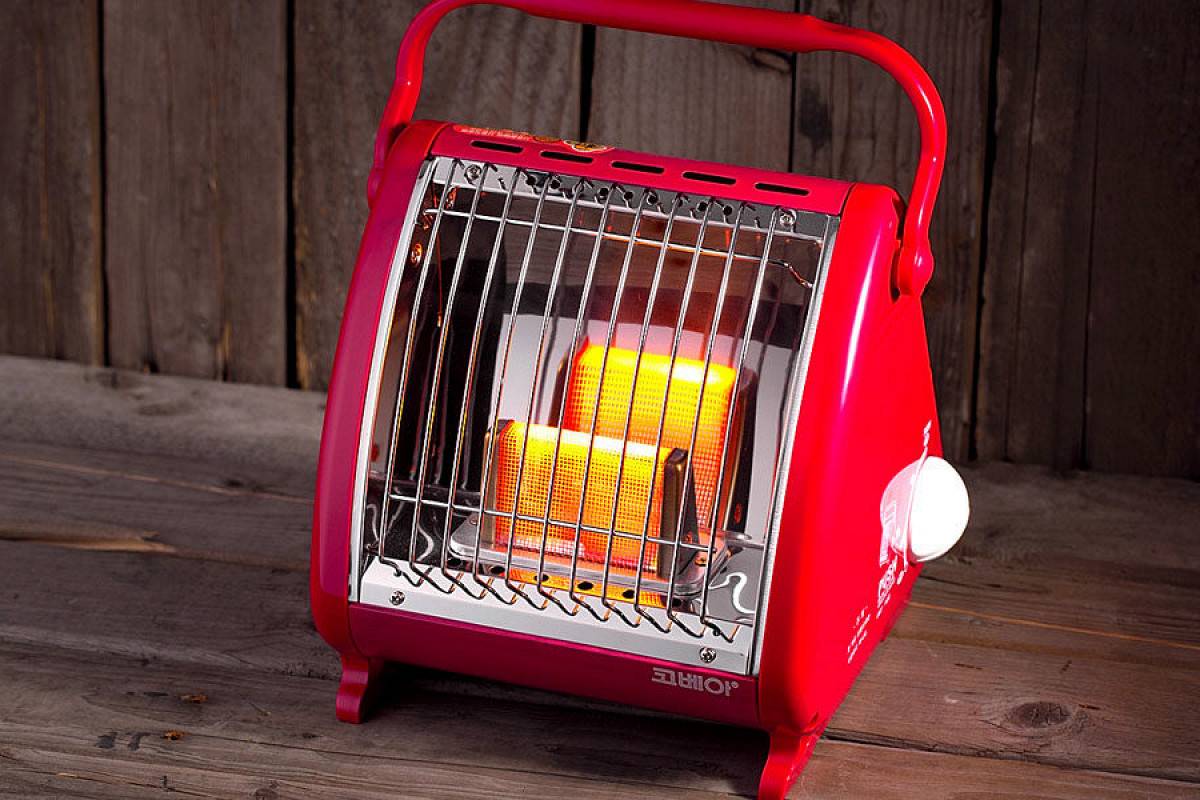
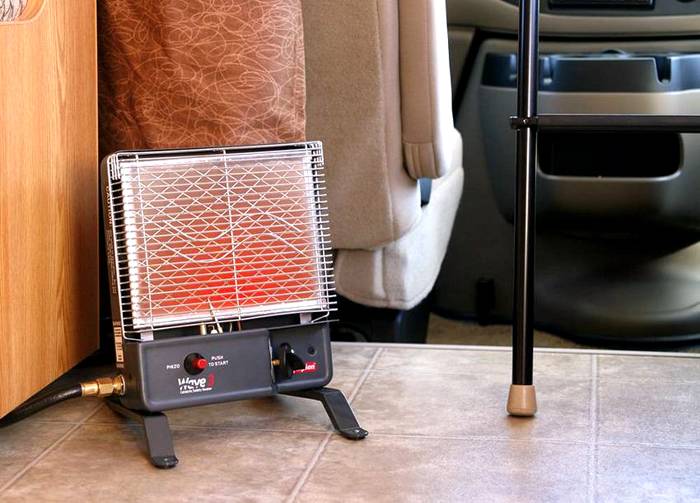
With its small dimensions, the portable catalytic heater can easily heat a small room or a tent.
The quality and life of a catalytic heater directly depend on how well refined fuel you use. Poor-quality gasoline or technical alcohol will very quickly lead the device to disrepair.
Which company's gas heater to choose
Various companies are fighting for world leadership in this field, but among them there are clear favorites, whose equipment is distributed in many countries.
Among the best representatives of the segment are:
1. Ballu
2. Timberk
3. Kovea
4. Pathfinder
5. Siabs
The first company has its headquarters in Hong Kong, but its branches are spread all over the world. Large offices are located in Japan, Lithuania, Korea, Poland and China. The main specialization of this corporation is climatic equipment. In her department there is a large design office and laboratories for experimental design.
Another concern originating in Asia is Timberk, which has existed since 2004. The marketing network covers all of Eastern Europe, Russia, and the CIS countries. The range includes more than 120 types of climatic products, including split systems and heaters.
A highly specialized company with domestic production and export to neighboring countries is the Pathfinder company.Operating since 1991, it has focused its activities on camping equipment and equipment, of which compact gas heaters are an integral part.
Innovative technologies are also actively used by the Italian company Siabs, whose models have no analogues and are reliable in operation.
How to choose and buy a catalytic gas heater
The purchase of any appliance, including a catalytic heater, requires attention. You need to be as accurate as possible: where, in what conditions and how often you plan to use the acquisition
When choosing, it is important to take into account both the price of a gas catalytic heater and the reviews of real buyers about this model.
Many models of catalytic heaters are convenient to take on a hike or trip due to their small size and light weight.
The parameters specified by the manufacturer will help determine the required power of the device. The packaging usually indicates information about the maximum area the heater can cover.
Types of gas heaters for tents
For a long time, the most ordinary fires were used for cooking on hikes and for warming. Of course, no one carried firewood with them, since they can always be found in the forest, having worked as a camp hatchet. Over time, portable gas cylinders and miniature gas stoves appeared, which pushed the fire into the background. Boiling water quickly, heating leftover food from the evening, drying some things - all this is easier to do with a portable burner than with a fire.
The sight of a burning fire is mesmerizing. Some people go camping just to enjoy this spectacle.
The fire, meanwhile, has not lost its charm - it still remains the center of evening and night gatherings, allowing you to warm up and feel blissful warmth without any gas. But he will not be able to heat the tent. Even if you move it close to the fire, it will not become warmer. But it will be possible to accidentally burn the tent along with its contents. For this reason, tents should be pitched away from the fire.
The problem with heating the tents was solved with the help of hot stones or bottles of water. But you can only carry bottles on a car trip, and on a hike they will become a burden. Not so long ago, portable gas cylinders appeared on the market, which made it possible to quickly solve the problem of heating tents - for this, special heating devices were created, which are small in size.
The tourist heater will allow:
- warm up on winter fishing;
- create a comfortable atmosphere in the tent;
- warm up at the campsite, and without a fire.
Tent infrared heaters, like all devices of this type, create infrared radiation that heats surrounding objects.
The general principle of their operation is that a portable gas heater is connected to a gas cylinder, and then a burner is ignited, which begins to radiate heat (in the infrared range). Infrared radiation, reaching the surrounding objects, begins to warm them up, and they, in turn, begin to give off heat into the air - it becomes warm in the tent.
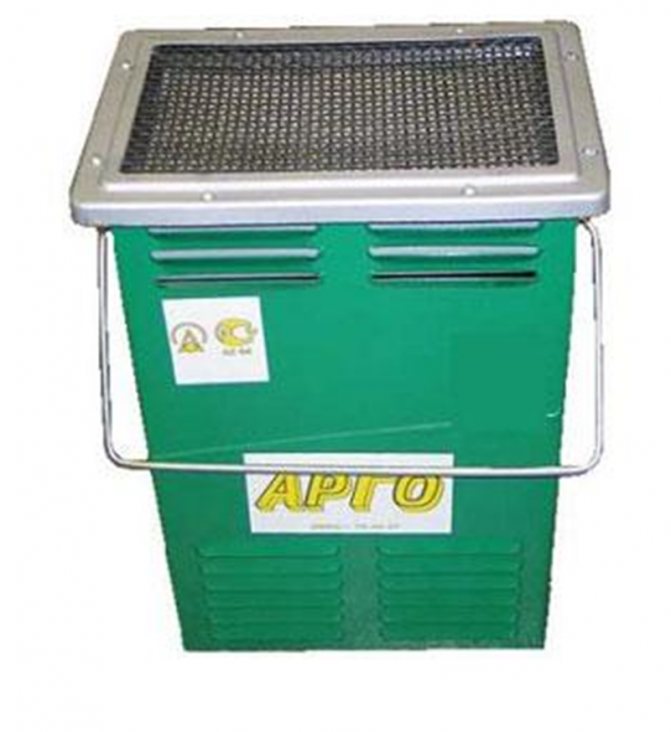
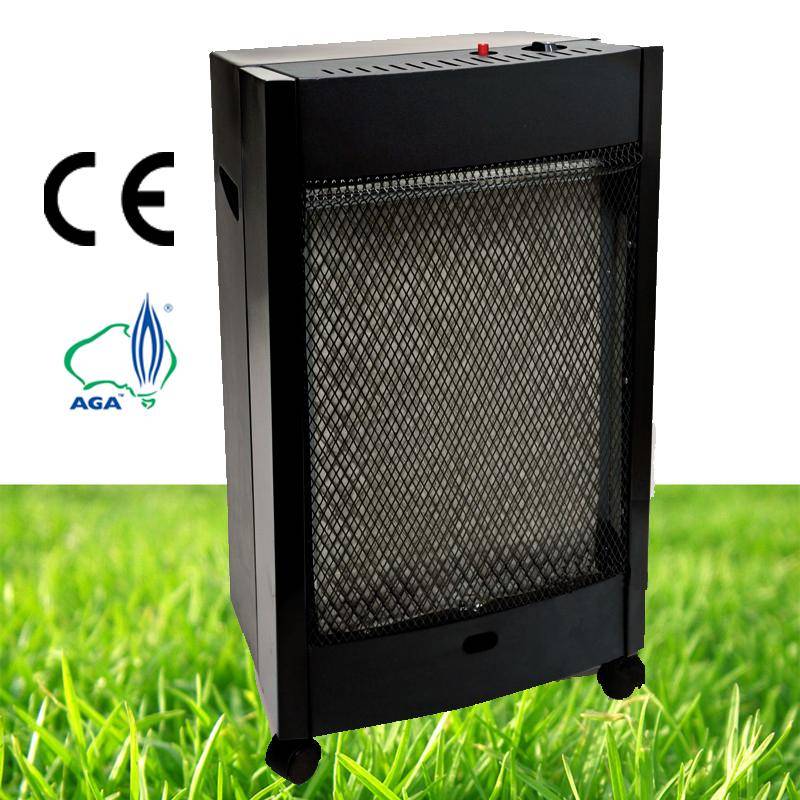


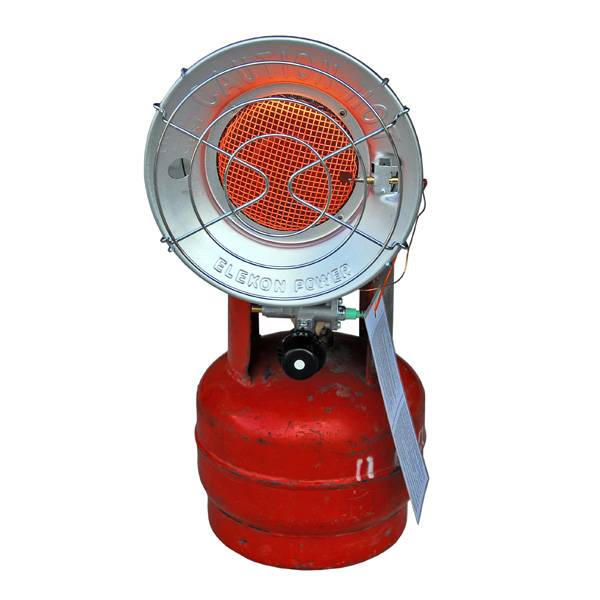
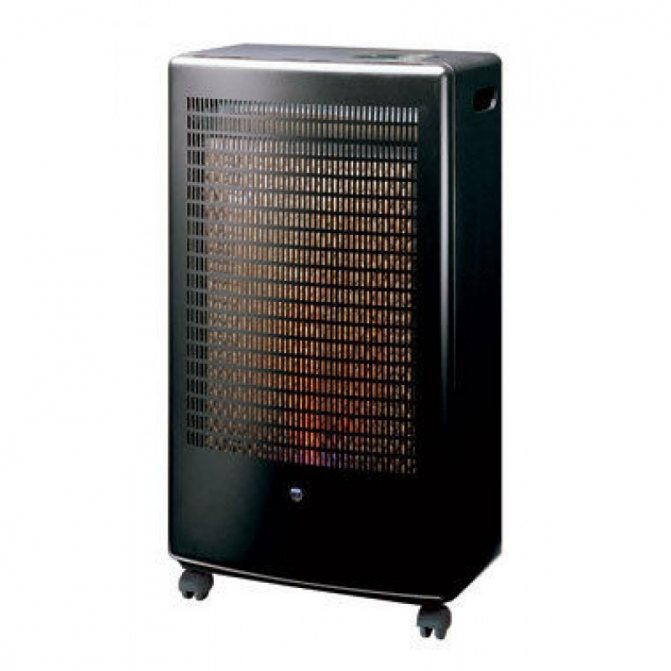


There are the following types of tourist portable gas heaters:
- with gas cylinders connected through a hose;
- with built-in gas cylinders;
- balloon nozzles;
- with piezo ignition;
- without piezo ignition.
A gas infrared heater for a tent with a gas cylinder connected through a hose cannot be called a camping option. Such devices are large in size, so they will be useful in road trips or ice fishing, when the equipment is delivered to its destination by any means of transport.
That is, this is such an option for camping - pay attention to this if you like to travel by car
The main advantage of such devices is that they can work for a very, very long time - for this you need to stock up on a capacious gas cylinder.
Compact gas infrared heater with a built-in cylinder.
Heaters with built-in cylinders are small in size and are the best suited for autonomous trips, when you have to carry all your belongings on yourself. Such units work from small gas cylinders installed in their housings (in tourist slang, such cylinders are often called "dichlorvos" due to their similarity with the insecticide of the same name, which is poisoned by cockroaches and other insects).
These devices can be used not only in tents, but also in the open air - in the manner of heaters for open areas. This is possible due to their increased power.
Heaters in the form of nozzles for gas cylinders are characterized by miniaturization. They are so small that they are held on the cylinders themselves. Such heaters are focused specifically on tents. They are characterized by low power and are designed for use in tents of various sizes (within the same tent "room").Having fixed the device on the cylinder, it is necessary to turn on the gas and click the ignition. If you are a lover of hiking, we recommend purchasing just such a model.
Gas infrared heaters for tents are available in two versions - with and without piezo ignition
Please note that the presence of a piezo ignition does not relieve you of the need to carry matches with you. It may fail in humid conditions, leaving you without heat.
Catalytic convectors
These devices can operate on electricity, gasoline or gas. Their use is optimal for heating a room of 20 "squares" with a power of about 2.9 kW. Gas models are equipped with a fan, they are designated "turbo +".
Catalytic combustion is the use of the "surface burning" principle, which is used for propane-butane gas flameless burners, it is characterized by the absence of a flame. The process proceeds as a result of the oxidation of certain organic compounds in the air.
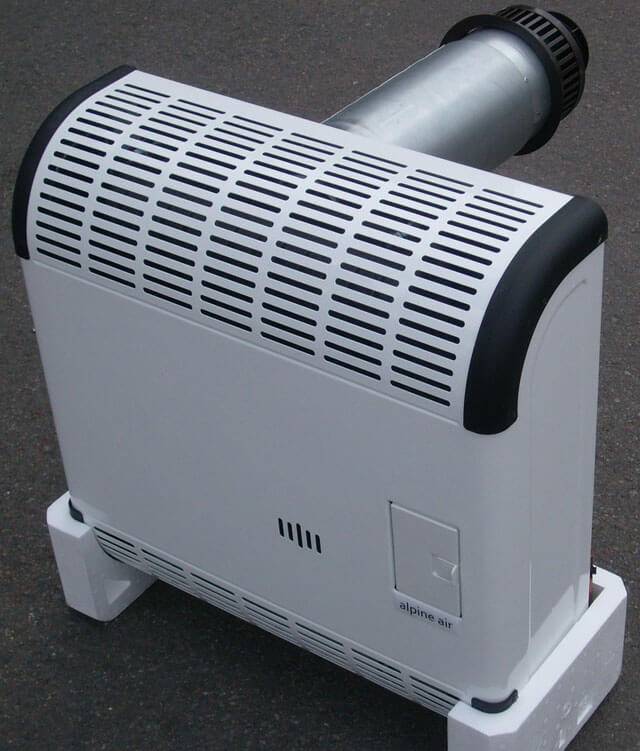
When burned, a lot of thermal energy is released, and the degree of heating of the catalyst can be determined by purple or yellow. The efficiency is about 80% higher than that of classic devices. Unlike European countries, catalytic convectors have not yet been widely used by domestic consumers.
Gas heater for garage
Recently, such devices have become very common and are very popular. They are used to heat houses, on construction sites, in garages. In garden plots, they are suitable for heating greenhouses.
To heat a summer house or other premises with a small area, it is best to purchase a gas heater.This device is able to raise the temperature to a comfortable level in a short time and even provide heat to any place in the open air (terrace, tent, gazebo). All models can work autonomously, without connection to the central highway.
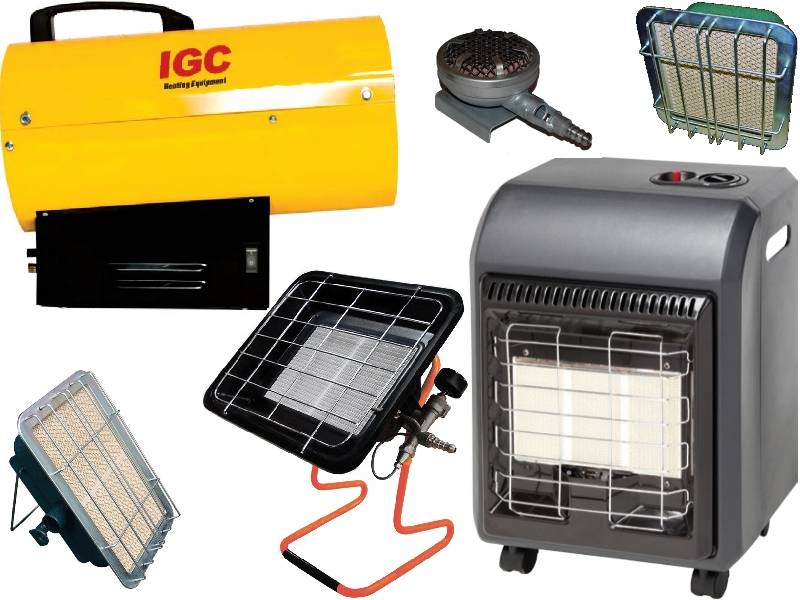
According to the principle of operation and device, gas heaters for home and summer cottages are divided into 3 types:
- infrared ceramic;
- convector;
- catalytic.
To heat a certain size area, such as a terrace or some part of a huge warehouse, an infrared ceramic heater should be chosen. Since it, due to its characteristics, is better than others for open spaces. The principle of operation of a gas infrared heater is as follows: the gas is mixed with the supply air, then it enters the ceramic tile, where it subsequently burns out, thereby increasing the temperature of the heating element. By spreading thermal radiation, it heats the objects around it, and the atmosphere warms up from them. The temperature of the heating element can reach 800°C or more, and it does not need to be connected to the electrical network for operation.
The power of a gas ceramic heater for a summer residence varies from 1.2 to 4.2 kW, and the efficiency is more than 80%. It works from gas cylinders or the central line, has a small weight, as a result, it is easy to move. Another positive characteristic is that it does not dry out the air. Also, it can be installed not only on the floor, but also on walls and ceilings.Before choosing an IR heater for giving, it should be remembered that it does not heat the entire room, but only a certain area, so if you need to cover a large space, you should buy a device with high power and the ability to control it.
Convectors operate on the principle of convection, that is, cold air is supplied from a room or street into an isolated combustion chamber, where it heats up to the required temperature, and then goes into the house. All combustion products are brought out through the tube. This is the main drawback of a convector gas household heater - it necessarily requires a ventilation system. The convector is usually installed under the window, it works both from gas from cylinders and from the main, and to change the type of fuel, it is enough to change the position of the switch. Power limits - 3-12 kW, well suited for cottages, offices, shopping pavilions and so on. Its main advantage is efficiency, which can reach 90%.
Gas catalytic heaters operate completely without flame and noise, which is why they are considered the safest. The average power is 2.9 kW, heating occurs due to the reaction of gas with a catalyst, as a result of which thermal energy is released, while hazardous substances do not appear. The heating element is able to heat up to 500 ° C, but, judging by the reviews of experts, it is still recommended to use it on areas of no more than 20 m2.
Popular models of catalytic heaters
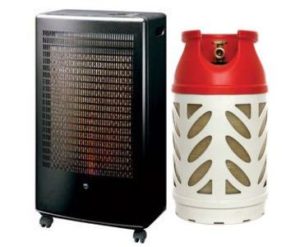
This approach provided their products with the greatest popularity among Russian buyers.
Demand is gas catalytic bottle heater Bartolini pullover k having the following characteristics:
- power 2900 W;
- approximate fuel consumption - 0.2 kg / hour;
- the volume of the cylinder is 27 liters.
- piezo ignition is missing.
This model can heat a room up to 35 m2. Its cost is about 12 thousand rubles, that is, it is quite affordable.


Campingaz, representing French manufacturers, ranks second in the ranking. The best model from the company's range is the Campingaz cr 5000 turbo heater, equipped with a power regulator and piezo ignition.
To use it at the maximum possible power of 3000 W, the heater will require no more than 0.2 kg of fuel per hour. This heater is usually used when going out into nature. The price of the model is from 8 thousand rubles.
American manufacturers presented Coleman ProCat heaters designed specifically for tourists to Russian buyers. With a surprisingly compact size, this catalytic heater has a power output of 1000W. It is quite enough to heat 10 square meters. meters.
Disposable liquefied gas cartridges are used for fuel storage. One container is enough for 7 hours of work. The heater is equipped with piezo ignition and gas control. The cost of the model is about 7 thousand rubles.
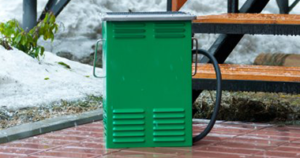
A cylinder with a volume of 5-15 liters is connected through a special hose. The power of the device is 2900 watts. Although the percentage of carbon dioxide emissions does not exceed 0.01%. It is not recommended to use the heater in rooms where there is no ventilation. The heater is very compact, but has a solid weight - 6.7 kg. The cost of the model is about 2000 rubles.
Catalytic heaters are more economical and safer than conventional heaters.In terms of performance, they are the main competitors of infrared heaters. Many consumers appreciated their portability. Even powerful large models move with ease.
In case of failure of elements such as piezo ignition, power regulator and even sensors, they can be easily replaced without contacting specialists.
However, the most important part of the device, the catalytic panel, has a limited service life. It withstands an average of 2500 hours of operation. The cost of the panel is two thirds of the cost of the heater, so there is no point in changing it.
Watch the video of how the Bartolini Pullover K gas catalytic heater works:
Gas catalytic heater
Gas - appearance.
A modern device designed for use in everyday life can fully heat with its power:
- country cottage;
- dacha;
- small workshop;
- warehouses;
- garage;
- any building object and many others.
The fuel in a gas catalytic heater is propane-butane gas exclusively in liquefied form. The heating element here is a catalytic panel. It is made in most cases from fiberglass containing platinum powder.
Be careful when choosing!
The latest models of deep oxidation catalysts are presented on the modern market, which do not contain platinum group metals in their composition.
The process of gas combustion due to the catalyst occurs quite efficiently and at the same time the room is saturated with absolutely clean air.Models of such heaters are currently on the market in various configurations, including those that make it possible to use an additional heating element or an electric fan heater.
When using these devices, the maximum power of the gas heater itself is reached, it can rise to a level of 4.9 kW.
Petrol - general appearance
The gasoline type works on the basis of gasoline vapors coming from the tank.
Fuel is poured into this very tank, after which it goes to the catalytic cartridge. In it, the complete oxidation of gasoline vapors by atmospheric oxygen occurs, that is, they burn on the hot surface of the catalyst without fire.
Special ventilation holes are used here for the output that appears during the processing of oxidation products. Through them, simultaneously with the removal of oxidation products, air containing oxygen enters the catalyst surface.
The catalyst is usually made in the form of a grid, which is located inside a mesh cartridge made of steel, and serves as a wick. In some models, the catalyst is made of platinum, and therefore it is the main component of the device itself.
The most optimal option among catalytic heaters used in everyday life is a catalytic heating pad. It is well known to all lovers of an active lifestyle and, mainly, lovers of camping and multi-day trips.
Good to know:
The fuel for heaters of this type can only be the gasoline that has the highest degree of purification.
Infrared - general appearance of the device
Many have heard how professionals in their environment use the serious term gas catalytic infrared heater.
In fact, here we are talking about the most ordinary infrared gas heater, which includes ceramic thermal panels that work on the principle of the sun.
To put it more simply, such a device does not heat the air itself, but those objects that are nearby it, and they, in turn, give off heat to heat the room itself.
Basically, infrared gas heaters are used as an additional heating system in the room. However, sometimes they are also used as the main heating element.
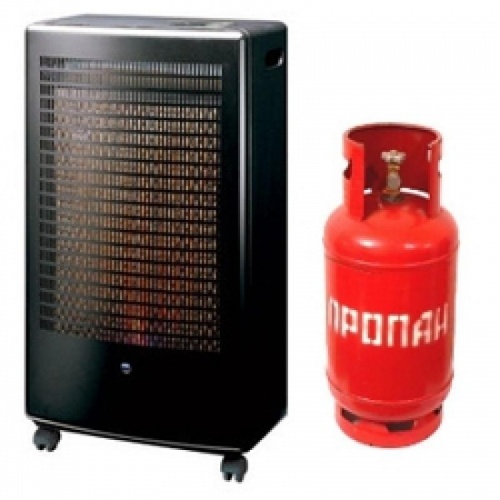
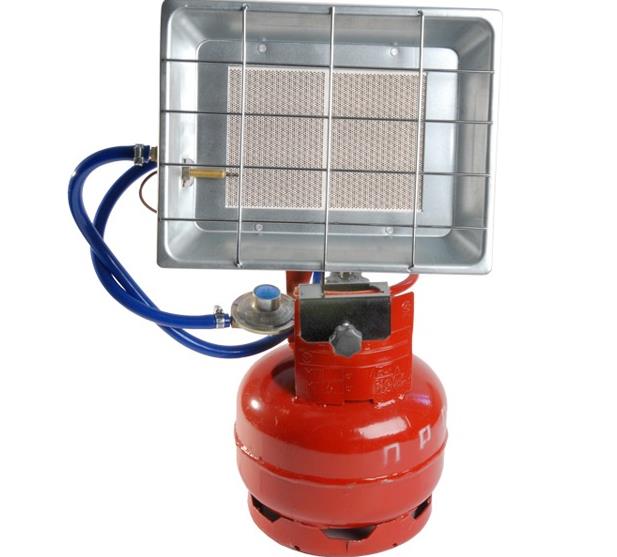


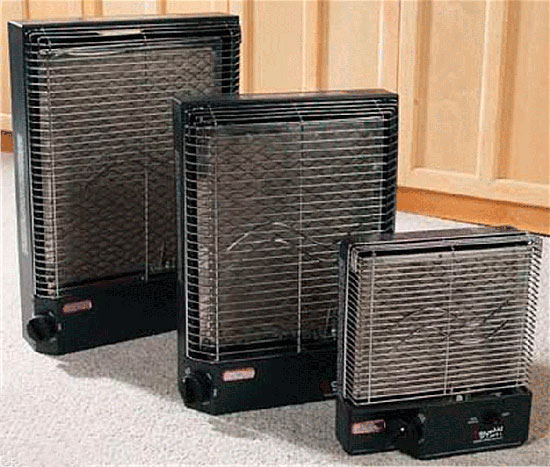
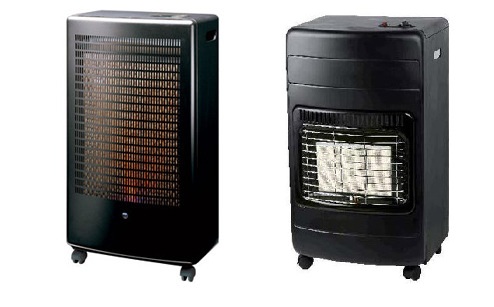


This device is advisable to use in large areas where the total quadrature exceeds 20 meters.
A catalytic gas heater is a heating device in which the generation of thermal energy occurs as a result of catalytic (flameless) combustion of fuel.
Gas convector - country leader among heaters
The gas convector looks very similar to the usual water heating radiator, it is even often placed in the same way - on the wall under the window.
Neither gas nor combustion products have a single chance to get into the room. It can work on both main and liquefied gas, the transition is carried out in a matter of minutes.
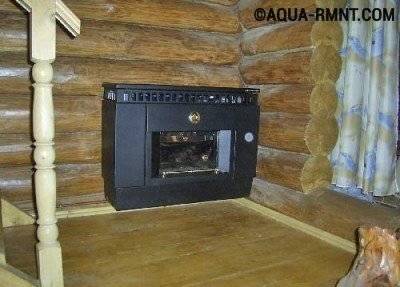
Heating with a gas convector is much more profitable than using electricity
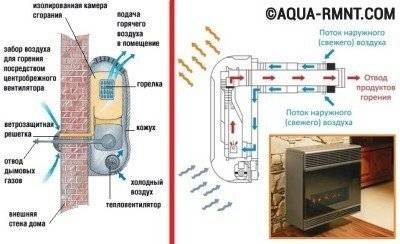
The principle of operation of a gas convector is based on the circulation of air taken from the street
The combustion of gas takes place in a special insulated chamber, the air between it and the decorative casing, warming up, rises.The design provides rapid heating of the air in the room, which is especially convenient for non-permanent heating mode, that is, only on weekends, for example. The device is quite convenient, automatically maintains the set temperature (from 13 to 38°C). The casing, in any case, will not heat up more than 60 ° C, it is quite safe for children and animals. When the desired temperature is reached, the intensity of combustion weakens. In the event that the flame disappears completely or the gas pressure drops to a critical level, an emergency system will work, which turns off the device.