
- Monoblocks
- Pros of monoblocks
- Cons of monoblocks
- How are cassette air conditioners different?
- Installation of cassette split systems
- Installation of air conditioning systems from "Fresh-Mont"
- The principle of operation of a multi-split system
- Advantages of a multi-system
- Disadvantages of the climate system
- Monoblock air conditioners
- Mobile air conditioners
- Window air conditioners
- Pros and cons
- Typical mistakes when installing air conditioners
- Advantages and disadvantages of equipment
- The main advantages of cassette models
- Obvious technical flaws
- What is the outdoor unit?
- Cleaning and maintenance
- Installation Features
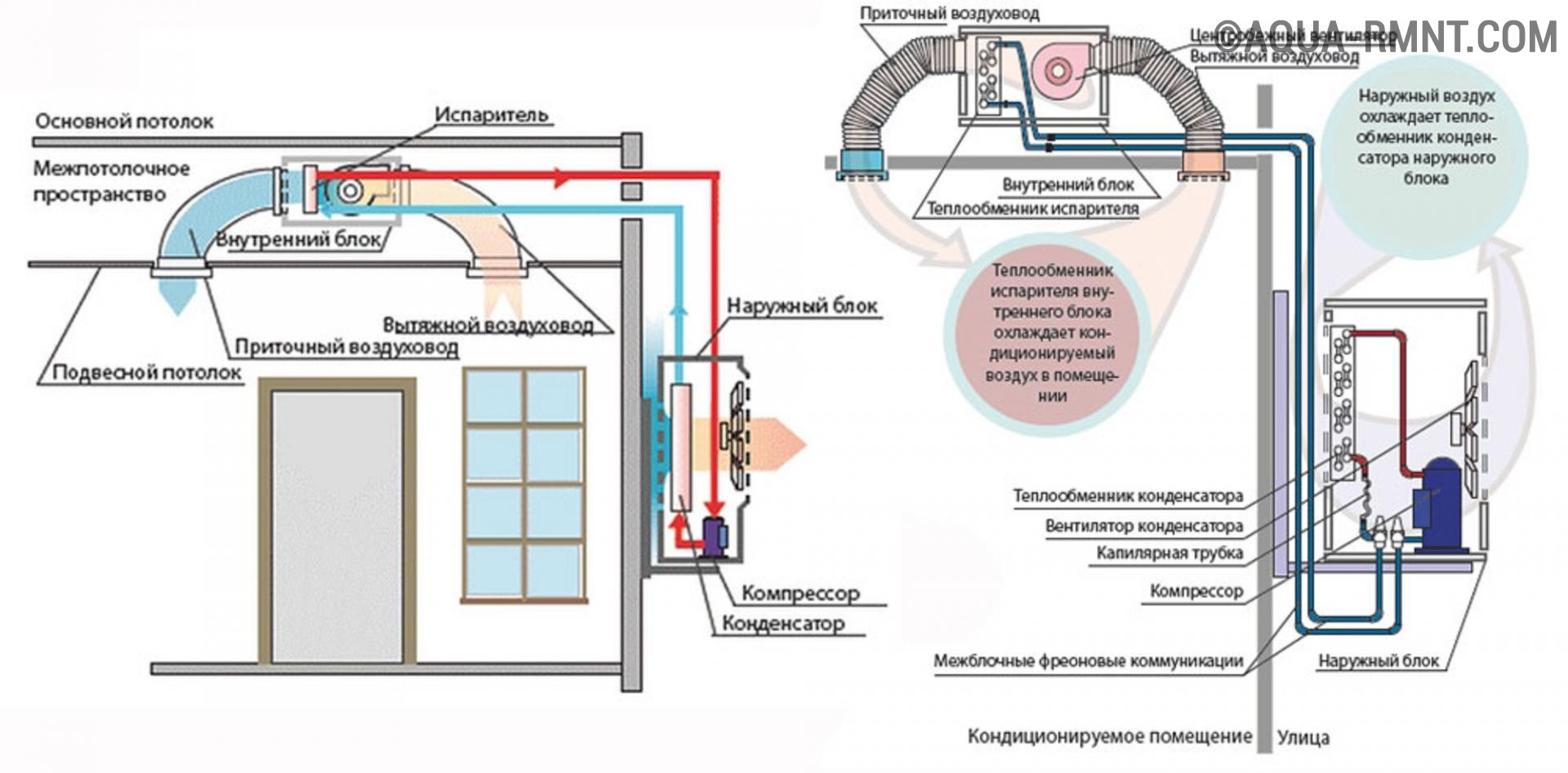
- Operation and placement of devices for indoor and outdoor units of a split system
- What to be guided by when choosing an air conditioner?
Monoblocks
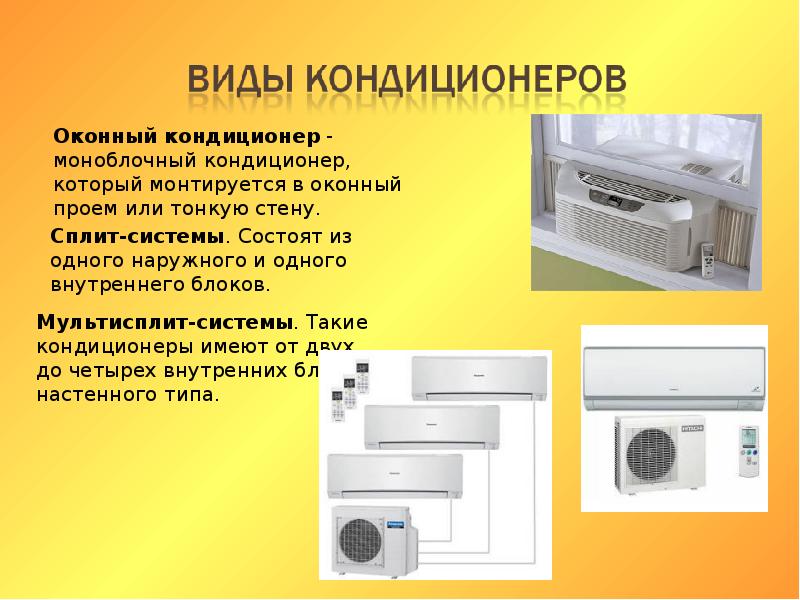
Monoblocks include window air conditioners, and mobile air conditioners.
Pros of monoblocks
- Ease of mounting and dismantling.
- Low price (significantly lower than split systems of similar capacity).
- Ease of maintenance and repair in case of failure.
Cons of monoblocks
Noise (significantly higher than that of split systems of similar power, due to the fact that the compressor, the main source of noise, is located directly in the room)
For window air conditioners - the need to order a special window frame with a "window" for the air conditioner
For mobile air conditioners, the hot air outlet hose must be led outside or through a window, so the location of the mobile air conditioner in the room is limited by the length of the hot air outlet hose (1.5 m). The air conditioner should be located near the windows, or at a special hole in the wall Ø120-160mm. Drilling a hole in the main wall, if it is not possible to bring the hot air outlet hose out the window, can cost a significant amount.
Limited capacity - the maximum cooling capacity of existing window air conditioners is -7 kW, mobile - 3.5 kW.
Lack of options available for split systems - air ionization, plasma cleaning, humidification, inverter power control, humidification, etc. For more information about the availability of certain options in various models of air conditioners - in the "catalog" section
A rather monotonous execution in form, the inability to fit into a modern interior.
For some models of mobile air conditioners that are not equipped with a condensate pump, the need to periodically empty the condensate collection tank located at the bottom of the air conditioner.
How are cassette air conditioners different?
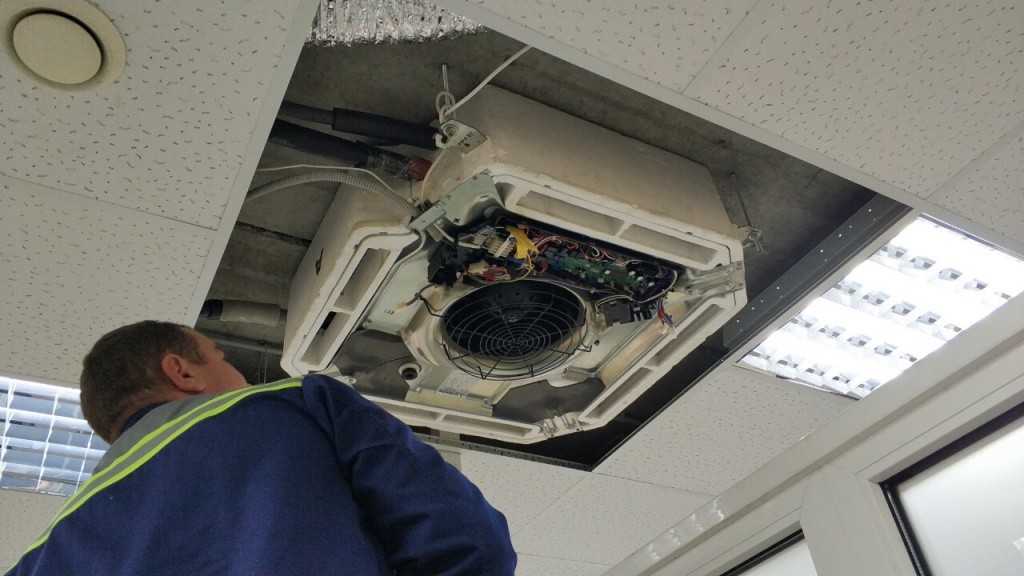
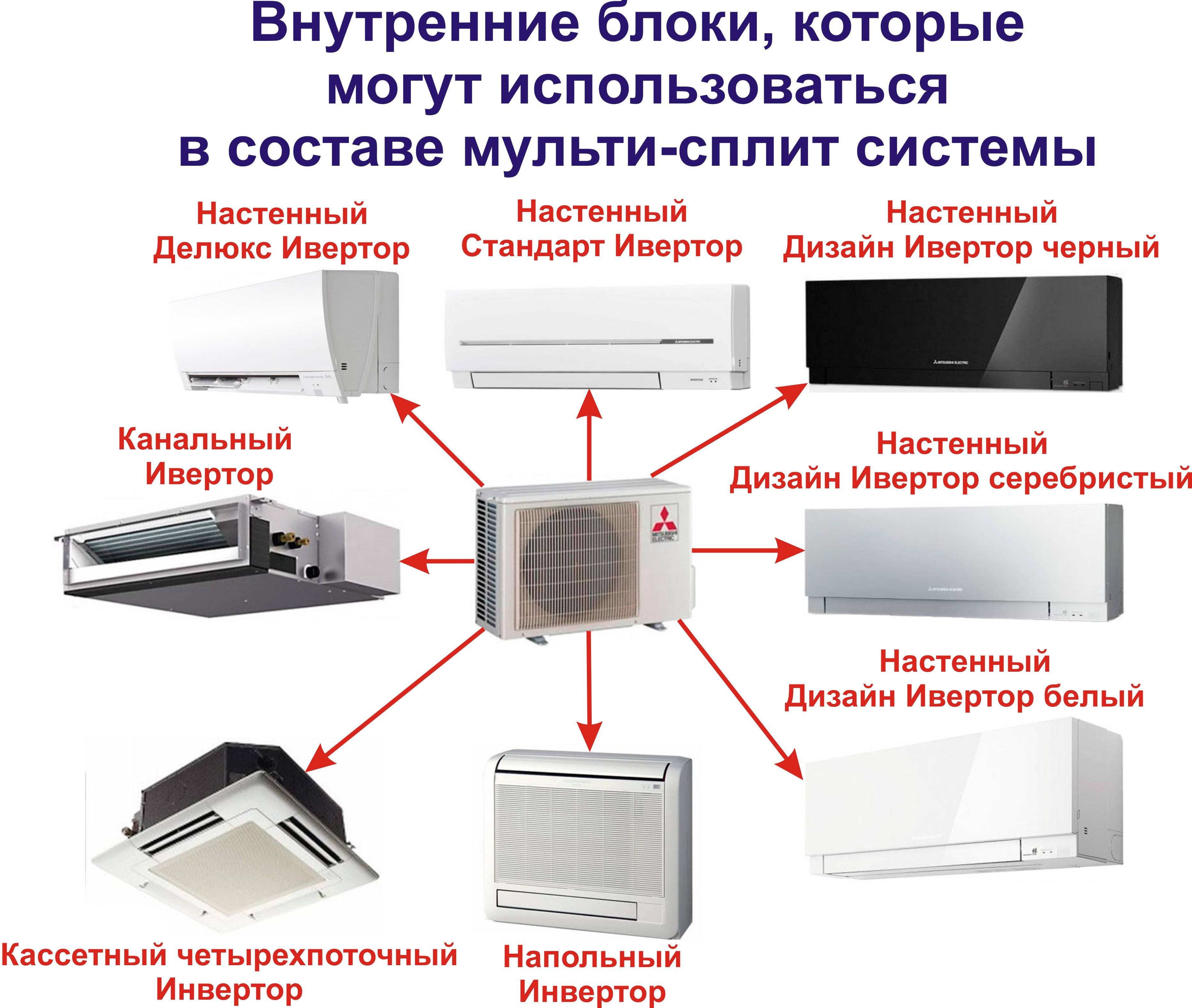
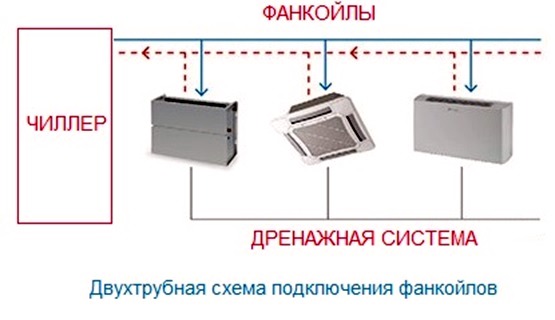
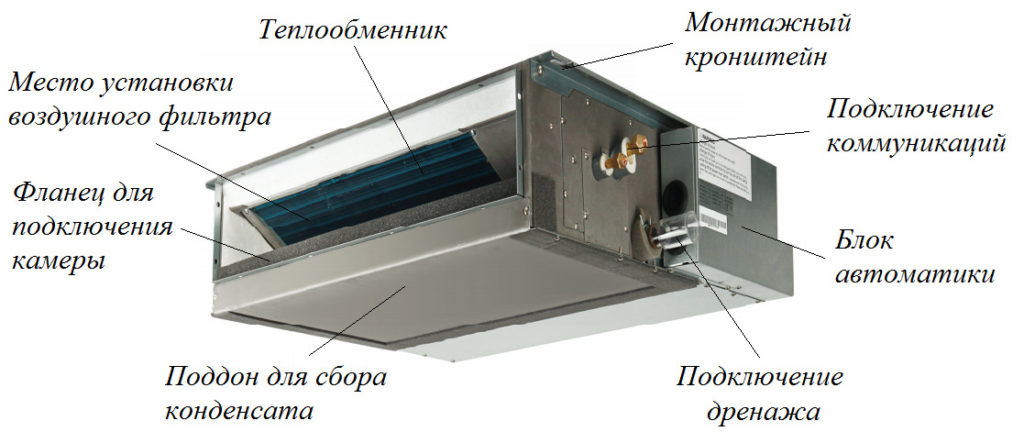
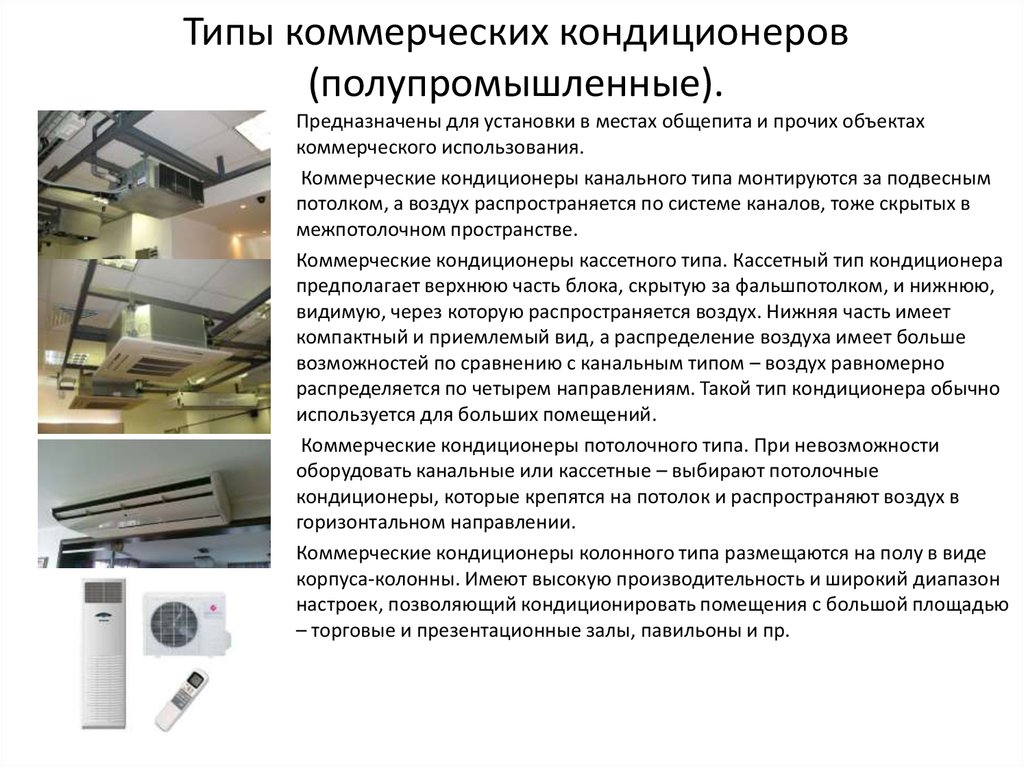
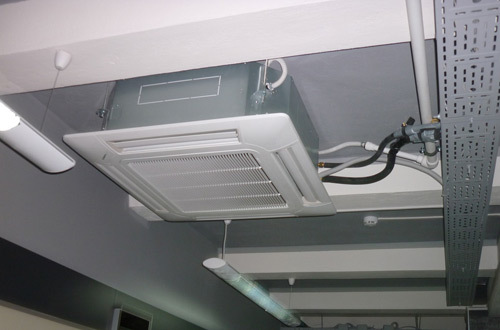
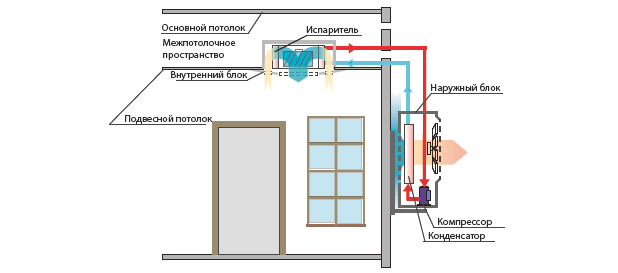
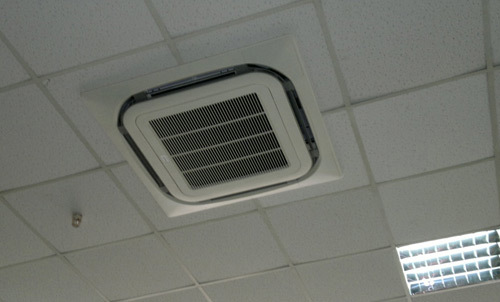
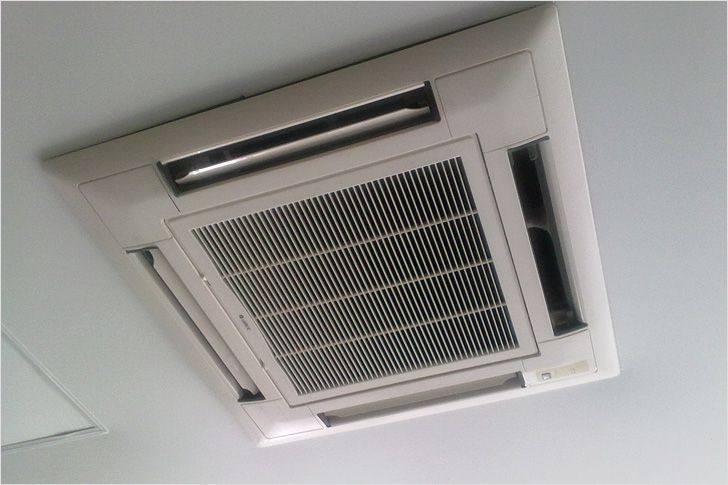
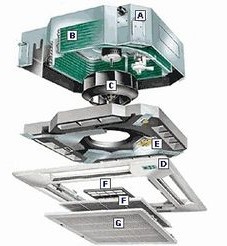
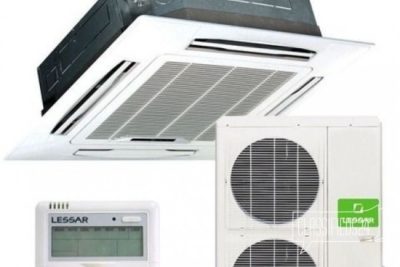
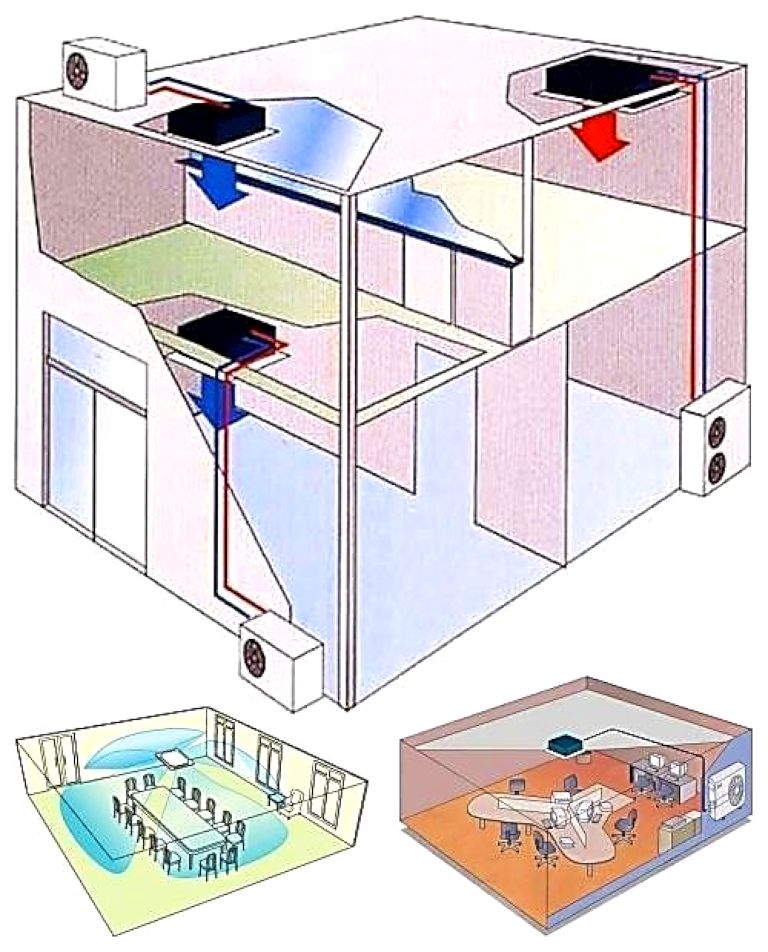
Cassette is a type of split system. Its indoor unit is built into the false ceiling. In size, it matches one or more ceiling tiles, so it fits seamlessly into the design. The entire body of the unit is hidden in the space between the ceilings, and only a flat front panel with gratings is visible on the ceiling. Several ceiling units can be combined into a multi-split system.
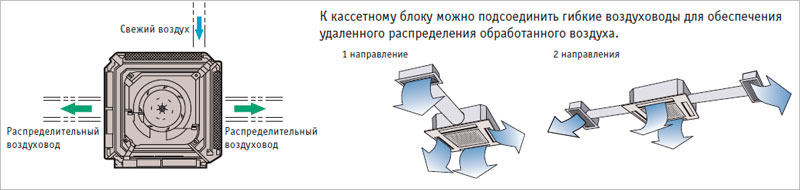
Functionally, the cassette air conditioner is distinguished by its ability to evenly distribute cold air in a room up to 200 m2.It releases air currents parallel to the ceiling, in four directions at once. Cold masses smoothly fall down, without creating drafts and zones of different temperatures. Also, "cassettes" work for heating and partially ventilate the room (the air flow is small - up to 10%).
Installation of cassette split systems
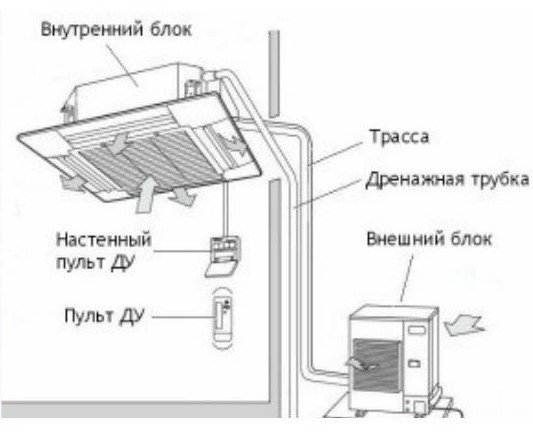
It is not difficult to install a “cassette player”, but specific knowledge is needed to set up its operation, because this equipment is equipped with sophisticated electronics and automation. In addition, it is necessary to lay outflow and supply air communications from the unit, and not just a freon pipeline. You will also need a condensate drainage system.
- The master mounts the outdoor unit on the wall of the building.
- Conducts a freon tube and other communications through the wall.
- Installs the indoor cassette unit.
- Connects the units to communications, pressurizes the system and fills it with refrigerant.
- Performs commissioning.
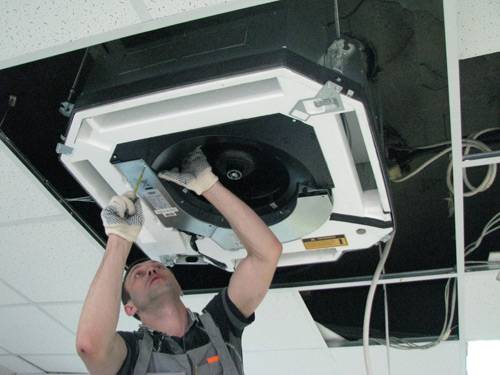
To install the indoor unit, you need to dismantle the ceiling tiles and install fasteners (the unit is attached to the floor with anchors). After installing the case and summing up the communications, the tiles are put in place, and the equipment is covered with a decorative grille. The need to disassemble and assemble the ceiling, as well as the laying of air communications, increase the cost of installing a cassette air conditioner.
Installation of air conditioning systems from "Fresh-Mont"
Our specialists install cassette air conditioners throughout St. Petersburg and the Leningrad region. We offer our clients the following terms of cooperation:
- Quality assurance for installation work - up to 3 years. We have extensive experience, qualified craftsmen, good consumables. You will receive an efficient, reliable and durable cassette split system.
- Careful installation. The master will not damage the ceiling when installing the indoor unit and will not hook the facade finish when fixing the outdoor unit. For laying communications through the wall, a hole of minimum diameter is drilled. At the end of the work, everything looks as if the air conditioner has always been there.
- Purity. Our employees always clean up after themselves dust and debris.
- Timely execution of orders. We work around the clock, seven days a week, and we can install your cassette air conditioner at any time.
- Favorable rates. Although installing a cassette air conditioner is more expensive than installing a conventional split system, our prices are not high. We do not include any extra charges in the price.
To find out the exact price of installing a cassette player, please contact us by phone +7 (812) 983-92-85. The Fresh-Mont appraiser will come to you free of charge and calculate the full cost of the work. During the installation process, the named amount will not change.
The principle of operation of a multi-split system
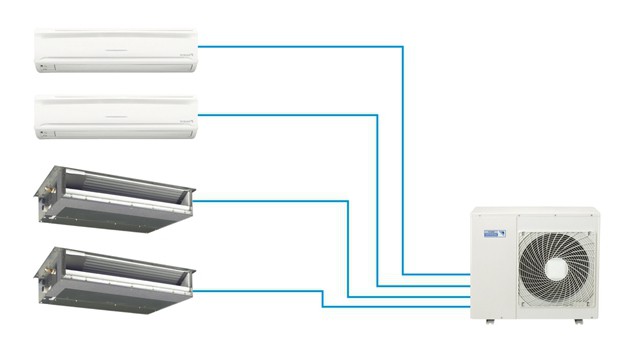
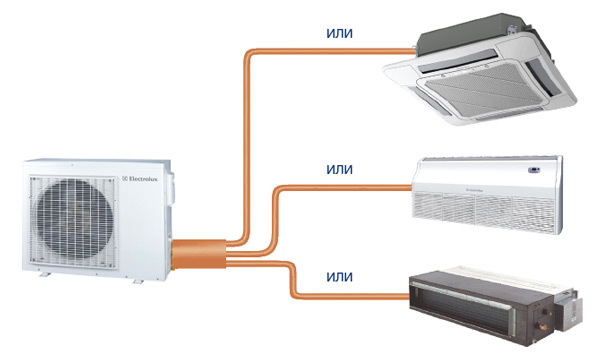
Technically, the operation of a multi-split system and a two-component split system is the same, since each indoor unit has its own, separately dedicated line leading to the outdoor unit.
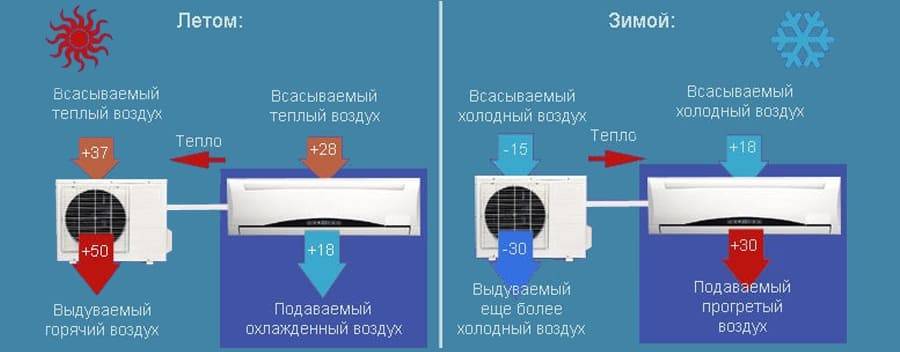
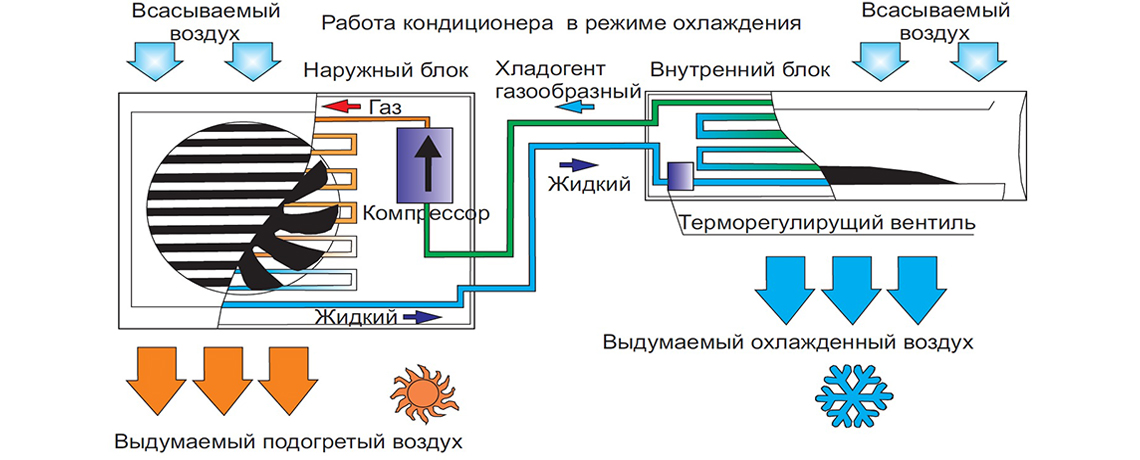
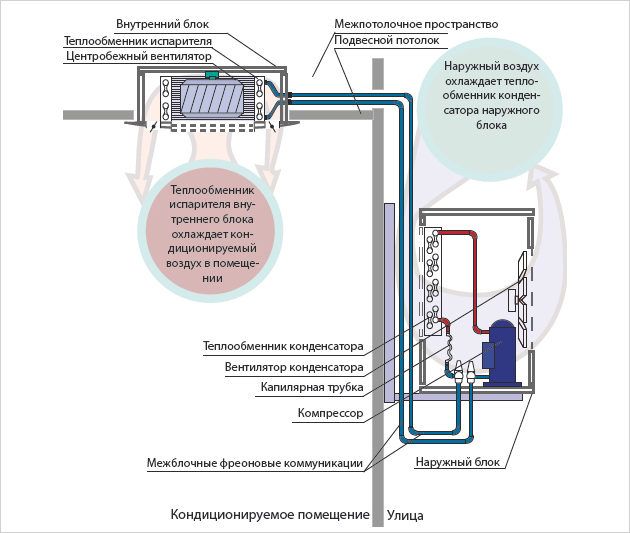
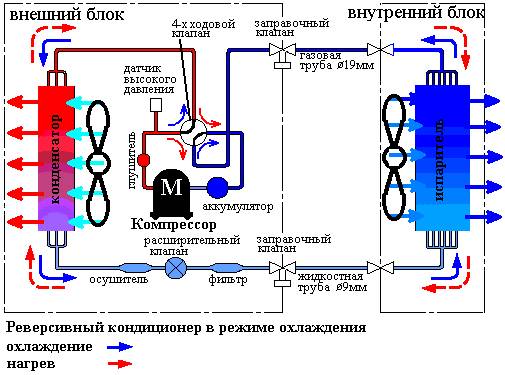
Heating and cooling is provided due to phase transitions of the refrigerant from liquid to gaseous state and vice versa, due to pressure and temperature differences.
When freon is converted from liquid to gas, the air in the room is cooled, and the reverse process generates heat.
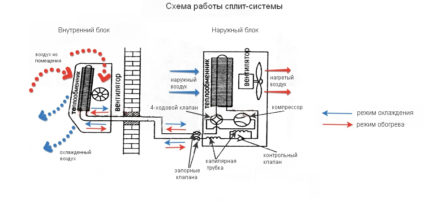 The principle of operation of the KKB air conditioner is always the same for all split devices of this power level. But, depending on the model, the block can be distinguished by separate, accompanying characteristics - noise levels and power
The movement of the refrigerant from the outdoor unit to the indoor goes through two-pipe channels-mains. This technical feature explains the main drawback of multi-split systems - the impossibility of simultaneous operation of air conditioners in different modes. Heating only or cooling only.
Advantages of a multi-system
The demand for multi-split systems is explained simply.
Their most important advantages:
- Aesthetics. There is no need to clutter up the facade or walls of the house with outdoor unit overall boxes, one for each indoor unit. One or two are enough to provide the necessary microclimate indicators to the necessary rooms of an apartment or a private house.
- Each conditioner is adjusted remotely by the individual control panel.
- Possibility to choose air conditioners of various types for operation in one system. So you can choose the best device for each room.
- Maximum soundproofing. Since the main source of noise - the compressor-condensing unit is mounted outside, and it is one - the noise of operating air conditioners is virtually inaudible even with open windows.
Moreover, at a cost such a multi-system is not much more expensive than an ordinary one.
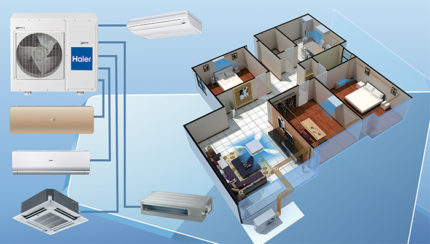 Most users call the main advantage of the system - a wide range of operating temperatures. This allows you to configure the equipment to work in the desired temperature range.
The combination of these advantages is often a very strong argument in favor of choosing a multi-split system. Even despite its obvious and not very shortcomings.
Disadvantages of the climate system
A multi split system is not ideal. She has her shortcomings, which must be taken into account.
This is first of all:
- complex installation. From each air conditioner it is necessary to conduct its own channel to the external unit;
- higher price for equipment installation;
- the impossibility of simultaneous operation of the air conditioners of the system in different modes. For example, in one room to warm the air, and in another to cool.
There are flaws in any device. But, for example, by choosing an invector-type compressor and installing it an order of magnitude lower than the internal modules, you can significantly reduce the amount of electricity consumed during system operation without losing its performance.
Monoblock air conditioners
Mobile air conditioners
Does not require special installation
Increased noise level, high price
mobile air conditioner (also called "floor-mounted air conditioner") is the only type of air conditioner that the user can install himself. To install such an air conditioner, it is enough to bring a flexible hose (air duct) through the window or an ajar window, through which hot air is removed from the air conditioner. Given that the hose of the mobile air conditioner is short (about 1 meter), the air conditioner must be located near the window during operation. It is not recommended to lengthen the hose, as this may affect the thermal regime of the refrigeration circuit. The disadvantages of mobile air conditioners are high noise from the compressor, limited power and high price, comparable to the cost of a split system.
In some models of mobile air conditioners, two air ducts are provided: through the first, street air enters the air conditioner, and through the second it is removed.This allows you to cool the heating radiator (condenser) without using the air inside the room (what radiators are in the air conditioner and why they are needed, see the section How the air conditioner works). Let us explain why this solution is better than the traditional version with one air duct. If there is no duct for air intake from the street, then the air that is discharged through a single duct to the outside is taken from the room. That is, the cooled air is removed from the room, and warm air enters in its place through the doors and cracks in the windows - this significantly reduces the efficiency of the air conditioner. To solve this problem, a mobile air conditioner with two air ducts has been created, which has a higher cooling efficiency.
With a power of more than 3–4 kW, it is not advisable to cool the condenser even through two air ducts, since the air flow through them becomes too large. In such models, the capacitor is made in the form of a separate unit with a fan. This unit is hung out of the window and connected to the indoor unit using quick connectors (latches). Such an air conditioner is called a mobile split system, since it consists of two blocks - indoor and outdoor. However, unlike a traditional split system, this type of air conditioner retains the advantages and disadvantages of its mobile counterparts: an unprepared user can install the air conditioner, but the noisy compressor is still located in the indoor unit.
Some modern models of mobile air conditioners are equipped with remote control. They can also have the function of automatic removal of condensate.During the operation of the air conditioner, moisture condenses on its heat exchanger, which flows into a special tank. When heated by the compressor, this water evaporates and is removed along with the hot air to the outside, but if the air humidity is high, then even in such models the water from the tank will have to be periodically poured out.
Given the shortcomings of mobile air conditioners, it is recommended to use them only where it is not possible to install a split system: in a country house, in a rented apartment, etc.
Window air conditioners
Lowest price, easy installation
Increased noise, installed in the window opening.
Once it was the most common type of air conditioner, but now, due to declining demand, only a few manufacturers offer such models. To install a window air conditioner, you need to cut a rectangular hole in a window pane or thin wall. The air conditioner is installed in such a way that most of it is outside the room. In this part of the housing there are ventilation grilles through which heated air is removed. Inside, only a small part of the monoblock with a decorative front panel remains, through which the cooled air enters the room. Typical power of window air conditioners is from 1.5 to 6 kW. The simplest of them can only cool the air, the more expensive ones have a heating mode and a remote control.
The main disadvantage of a window air conditioner is the high noise level generated by the compressor, and the advantages are the low price (from 5,000 rubles) and ease of installation.The low popularity of window air conditioners is explained by the fact that during their installation, the thermal insulation of the room is violated (in winter, cold air will penetrate through the air conditioner housing). However, in regions with a warm climate, this disadvantage is not critical, so in the south of Russia, window air conditioners occupy a significant market share.
Pros and cons
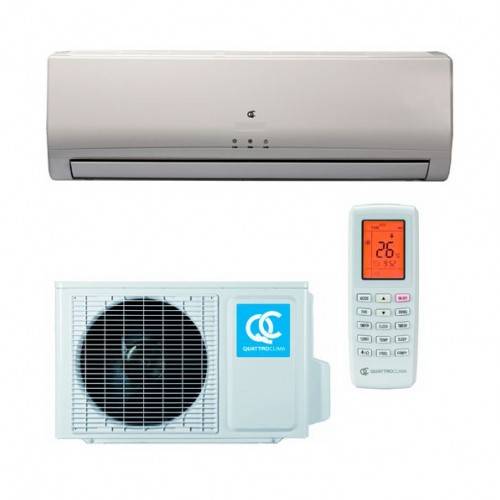
For split systems, as well as for any other technique, negative and positive sides are characteristic. The list of benefits consists of the following items:
- the temperature is maintained within the range specified by the user;
- ease of creating a comfortable microclimate;
- low level of electricity consumption;
- low noise level;
- the possibility of operation at negative temperatures;
- convenient management;
- simple service.
As for the negative points, we managed to find only two drawbacks:
- high cost, which directly depends on the functionality and reliability of the system;
- high sensitivity to power surges, which requires the use of a voltage stabilizer - otherwise the life of the split system can be very short.
Typical mistakes when installing air conditioners
Incorrect installation of the air conditioner is a common thing. It also happens that a mistake leads to the fall of the structure. The reason for this is the high cost of installation services provided by special firms, as well as the presence of non-professionals in this field. For example, skilled workers provided by the firm will charge almost half the cost of the air conditioner itself for their 2-3 hour installation of an air conditioner.Therefore, in order to save money, the owners prefer to hire an unskilled worker. The result of such an installation is different: for some, the air conditioner lasts for years, while for others it does not.

Note! Often, non-professionals do not pay attention to the material from which the facade is made, what load it will withstand, etc. Here is a list of the most typical and common mistakes that are made when installing air conditioners:
Here is a list of the most typical and common mistakes that are made when installing air conditioners:
- Freon tubes are too often and excessively bent. Then the load on the compressor increases, and it fails faster.
- Installation of a condenser unit on a glazed loggia. As a result, air circulation deteriorates.
- Installing an air conditioner in a room with appliances that emit high-frequency electromagnetic waves. These include: lathe or drilling machine, welding equipment.
- Installing the evaporator unit in a skewed fashion: condensate flows out onto the floor.
- Installing an air conditioner above a heat source.
When these errors are already made during the installation process, you will have to fix them. To do this, you need to understand the meaning of the error and the reason:
- If, after installation, the air conditioner creates a draft, it is enough to change the direction of the air flow, which is changed by the position of the damper on the device.
- When heating indoors, the outdoor unit is covered with ice. In this case, the product does not have an automatic defrosting system.It is enough to turn on the air conditioner in the cooling mode, after which the plaque will gradually melt.
- During the hot period, fresh air does not come from the installed air conditioner, there is no cooling effect. It is necessary to check the filters, close the windows in the room, turn on the heating device, replace the air conditioner with a more powerful one.
- If the air flow is weak, the filters are cleaned.
- If water is flowing from the air conditioner, the drain channel is blocked. It could be an ice block. You will have to call the master, who will warm up the unit.
- When a line noise is heard during the operation of the installed air conditioner, the bearings may be worn out or the fan may be out of balance. A master is hired to diagnose and repair the product.
- The compressor gets very hot - a sign of low freon pressure. It is enough to refuel the air conditioner with freon and check everything for leaks.
If you follow all these steps, you can be sure that the installed air conditioner will last for many more years.
Advantages and disadvantages of equipment
Climatic equipment of cassette version, like the classic one, has its pros and cons. Which we will consider in more detail below.
The main advantages of cassette models
A clear advantage of cassette split systems is the uniformity of the air flow distribution over the area of the room.
Moreover, this advantageous factor is directly related to the installation requirements, according to which the installation of the ceiling cassette is provided exclusively in the central part of the room.
Thanks to the optimal placement of the cassette and the same optimal air distribution, it is possible to cool the rooms more efficiently to the required temperature.
Another advantage is the architectural component. If classic split systems, where wall-mounted indoor modules are used, create real problems in terms of design organization, it is easier with cassette modules.
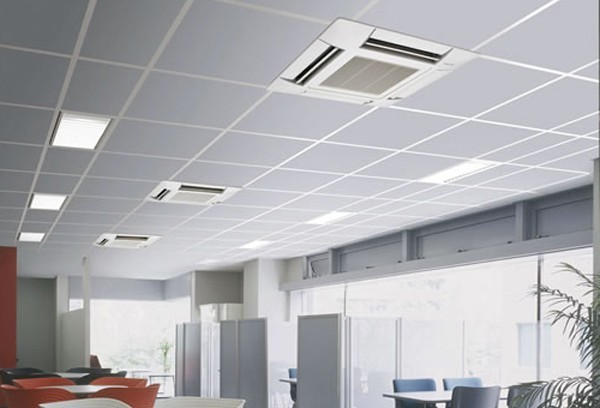
Moreover, often cassettes built into the ceiling become design elements that enhance the attractiveness of the whole. This is especially noted in the design of office and administrative premises.
Obvious technical flaws
Cassette split systems also have quite serious drawbacks. One of such pronounced shortcomings seems to be mounting restrictions. In particular, the possibility of installing equipment only in places with a false ceiling.
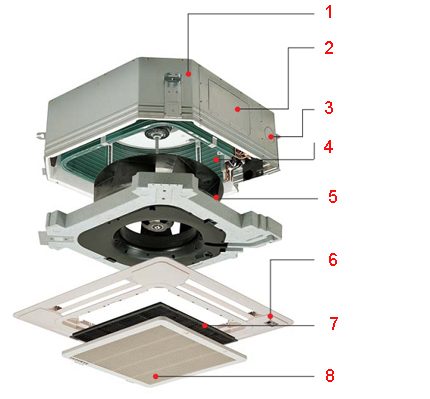
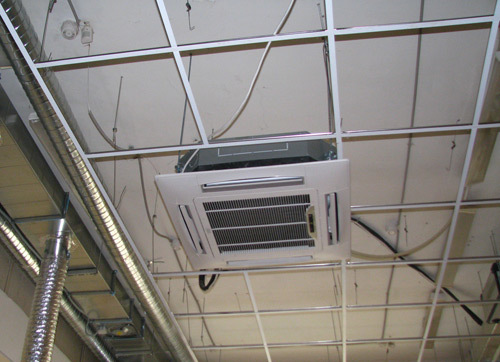
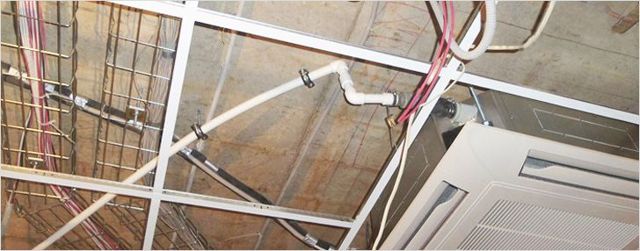
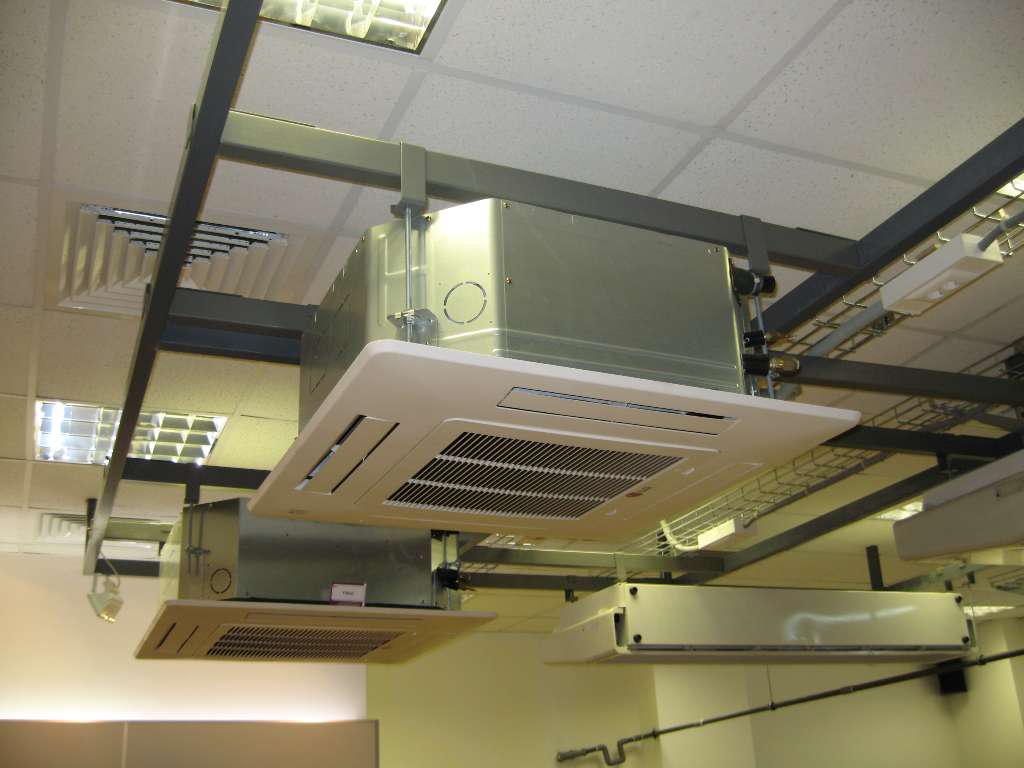
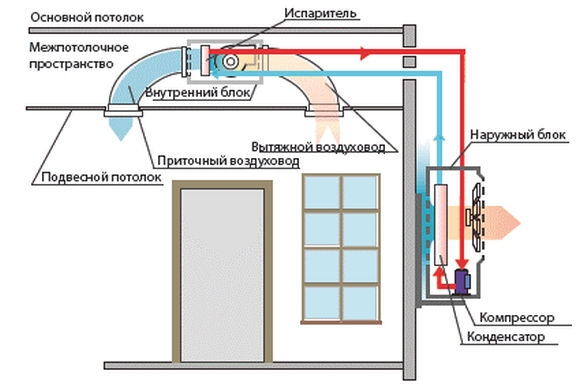
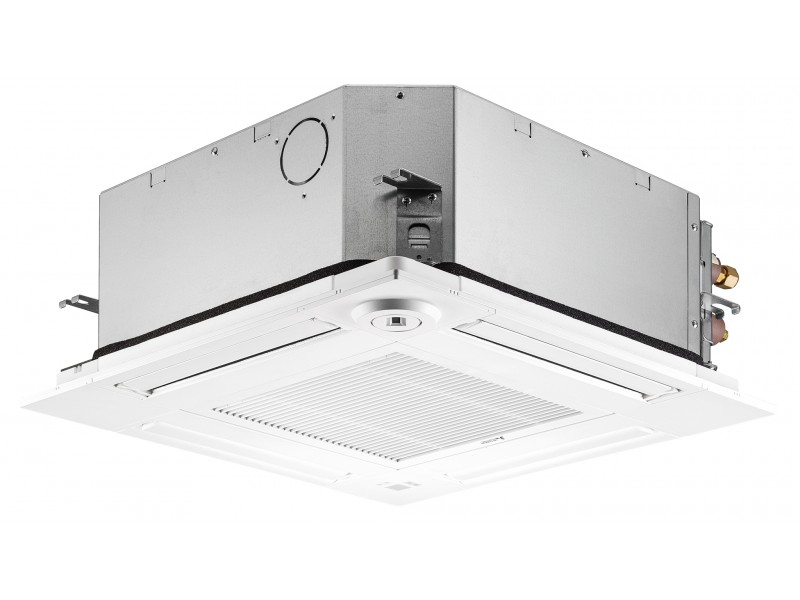
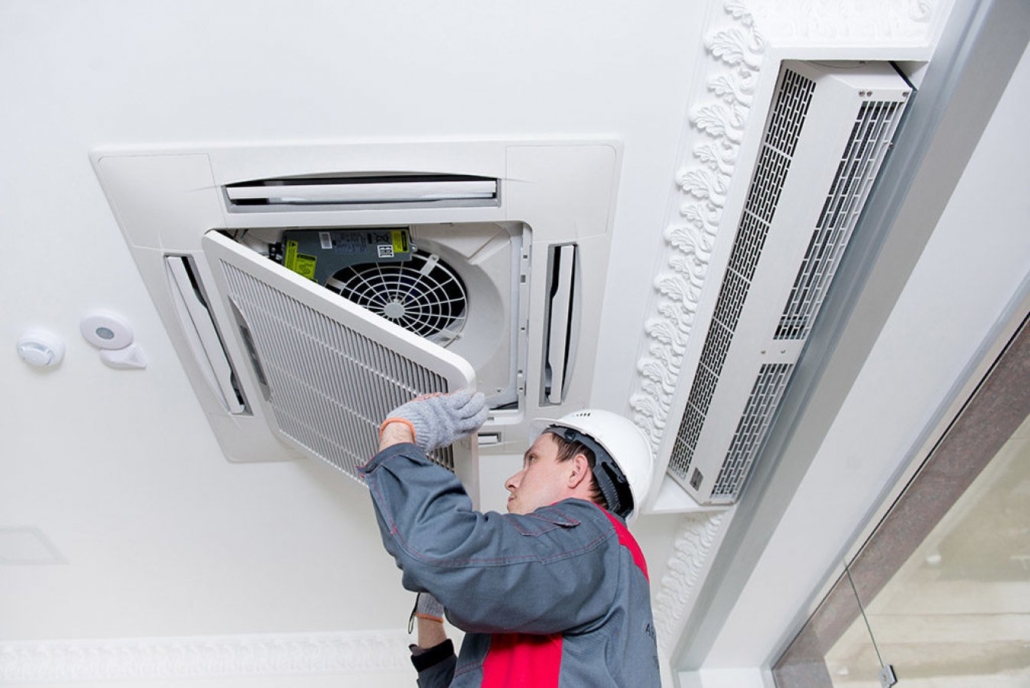
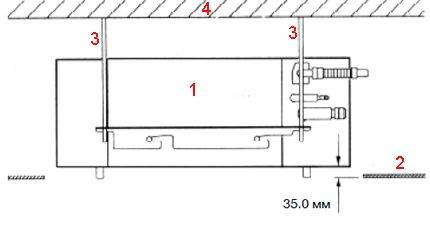
At the same time, not every suspended ceiling design can satisfy the installation requirements, since a certain gap is required between the real and false ceilings.
The disadvantage of such systems may also be poor-quality insulation between the underside of the cassette body and the distribution panel (figure above). In this case, the cooled air enters the subceiling space and condenses.
As a result, the effect of leaks is noted and, as a result, the destruction of part of the suspended ceiling structure. However, this drawback can be eliminated technically - by high-quality isolation.
What is the outdoor unit?
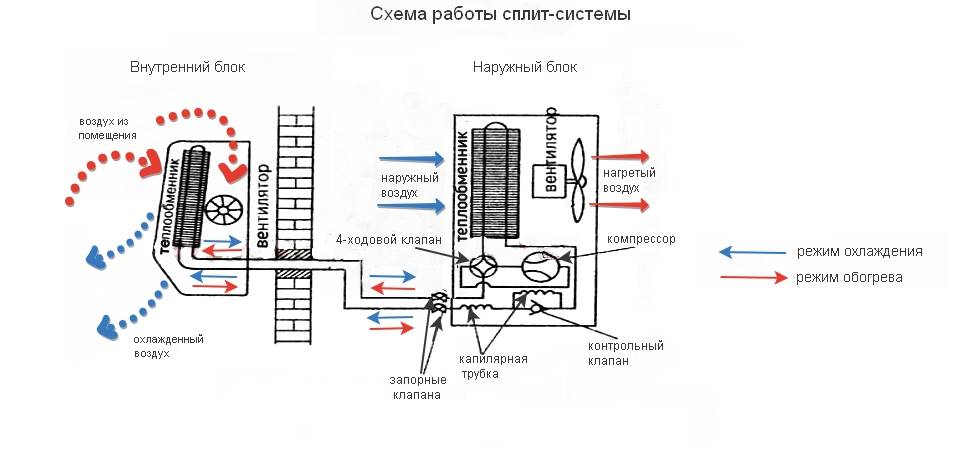
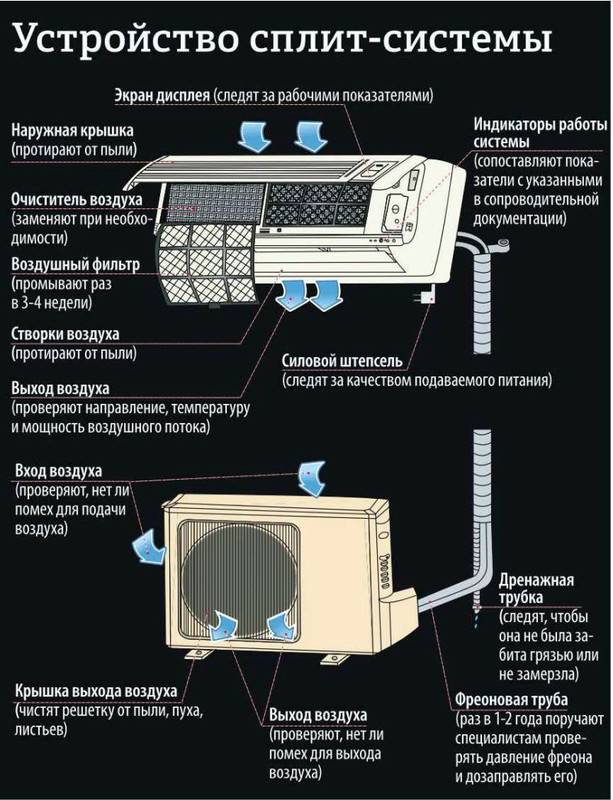
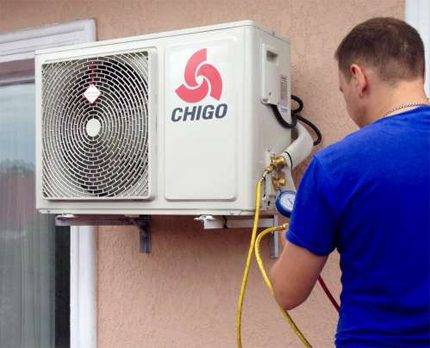
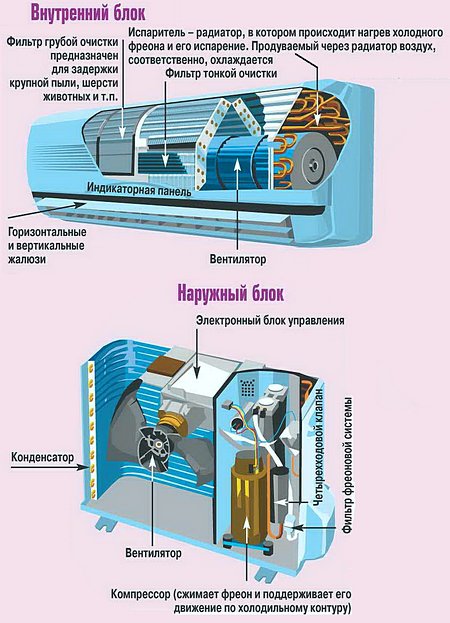
The external unit of the split system is not audible due to outdoor installation, and this is the main advantage of this equipment. On specially made brackets, it can be installed in almost any place suitable for this. The outdoor unit consists of a compressor, a condenser, a receiver, a drier filter, a four-way valve, a fan, if it is an inverter, then finally an inverter board.These are the most important elements of the system, of course there are many other things, for example, a heat exchanger, various relays, and so on, each of these elements creates an interdependent cycle of the system.
Cleaning and maintenance
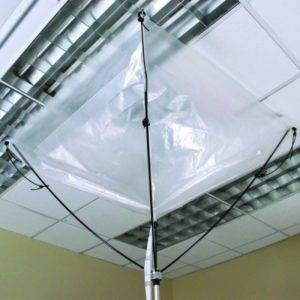 As is the case with other types of air conditioners, sooner or later cassette models also need to be cleaned. Naturally, from the outside, you yourself can quite wipe it. The most important thing that may be needed for this is a ladder. However, in the absence of certain knowledge and skills, it is better not to meddle inside the structure. As with installation, this issue is best left in the hands of qualified professionals. It will certainly not be difficult to call it, but at the same time you can save not only efforts and time, but also nerves, without worrying about the further performance of the device.
In addition to the cleaning itself, the maintenance of cassette air conditioners includes other options that you are unlikely to be able to perform on your own. Among them: checking the drainage system and refrigeration circuit, topping up refrigerant, checking electrical connections, etc.
Installation Features
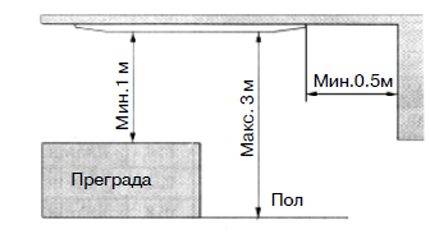
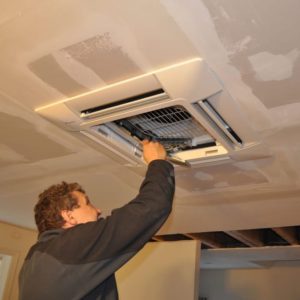 External and internal cassette air conditioner unit be mounted by specialists, since the reliability of fastening and the correct laying of communications are important. To place the indoor unit requires from 25 to 40 cm, so this equipment can only be used in rooms with high ceilings. From the side of the room, communications are completely covered with panels and removed from view. High performance equipment is combined with rich functionality, so this type of air conditioners are suitable for almost any organization.
This type of air conditioner works best when installed in the center of the ceiling. That's because they have four vents directing air to four sides. If for some reason you cannot install the device in the center of the ceiling, then you must close all openings directed directly to the wall
It is also important to consider whether the air conditioner will fit into the designated space. If you plan to install, say, between beams or rafters, it is worth making all measurements in advance
Also, these air conditioners are equipped with a built-in drain pump to remove condensate that is created during cooling. The pump is connected to a rigid PVC pipeline. For more efficient installation, you will need a minimum of 250-400 mm of inter-ceiling space, and the ceiling height should be at least 3 meters. If you install the device in an unconditioned space, such as an attic, you must insulate it. Operating the cassette air conditioner in such a space without insulation will cause condensation to form on the outside of the unit and then drip.
The devices themselves have built-in thermostats for reading the temperature in the room and adjusting their power accordingly. After all, if one part of the room is warmer or colder than the rest, this can cause some discomfort. One way or another, for proper and efficient functioning, without worrying about the reliability of the installation, it is worth entrusting this matter exclusively to professionals.
Operation and placement of devices for indoor and outdoor units of a split system
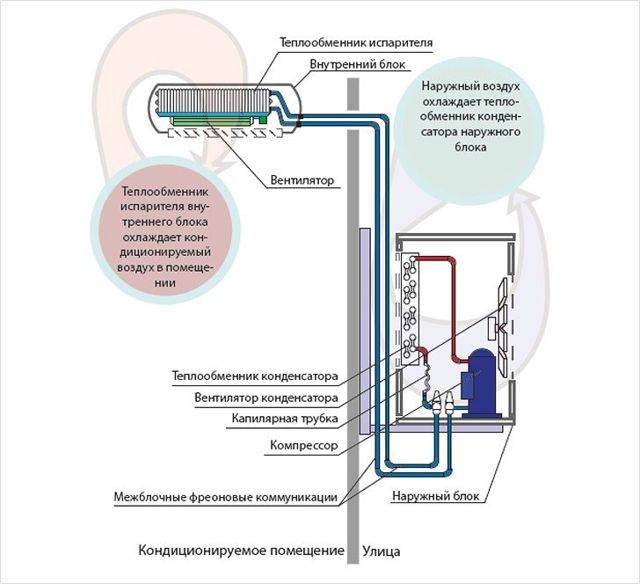
The principle of operation of the split system is as follows:
- the refrigerant (freon) located in the indoor unit is affected by the warm air of the room, as a result of which it passes into a gaseous state, while the pressure on it increases;
- freon moves to the device of the outdoor unit of the split system, in which the pressure is even higher, which leads to an increase in the gas condensation temperature and an increase in the efficiency of the entire device. Here, the refrigerant condenses, transferring thermal energy to the external environment;
- The next stage of how the split system works is the return of freon already in a liquid state to the indoor unit;
- a new cycle begins.
If the split system not only cools the air, but can also heat it up, then when the heating function is turned on, freon will go into a gaseous state in the outdoor unit, and condense in the indoor unit.
To place the device of the outdoor unit of the split system, as well as for the indoor unit, it is necessary to choose the optimal place in the room, bearing in mind the following:
- an outdoor unit that will generate heat cannot be installed in small closed and non-ventilated rooms;
- the outdoor unit must be attached to the main wall. When installing it on the roof, laying a soft roof on it is excluded;
- the wall-ceiling indoor unit is mounted on a flat surface, the dimensions of which are larger than the dimensions of the device;
- for cassette air conditioners under the false ceiling, sufficient space should be provided;
- the drain hose must have an inclination in the direction of the drain of at least 1-2°.
What to be guided by when choosing an air conditioner?
Before deciding which air conditioner to choose for an apartment, you should familiarize yourself with some selection options.
Choosing a good unit for an apartment should be guided by the following qualities:
- Noise level during operation. It is a significant quality for choosing a device to use it in an apartment. It will not be possible to completely get rid of the noise, because the fans and compressors are constantly doing their work in the device, there is an active air circulation.
- The “noise of the device” is influenced by the features of a particular model, power, installation location and other factors.
To prefer the least noisy machine, consider the following factors:
- the manual for the device contains information about the noise level for the indoor and outdoor unit separately. The noise level of the indoor unit is much more important, because it is located in the apartment. The system has an average noise level of only 24-35 dB. In the daytime, such noise is not perceived by the human ear.
- a split system is distinguished by minimal noise than others, since it has two blocks separated. Devices with one block are the most noisy. At night, the sounds of the air conditioner are too noticeable due to the lack of extraneous noise. Therefore, when choosing a model for a bedroom, it is optimal to choose a device that has a night mode. This is a special function that allows noise reduction up to 17-20 dB. Of course, in this case, the power of the device becomes minimal.
- system power calculation. To select a good device in an apartment, you need to calculate the power. You will need data on the area of \u200b\u200bthe apartment and the room where the device will be installed, on the height of the ceilings, the number of people living in the room and other parameters. Significant is even the technique that operates indoors and the warming of the room by the sun.
There are special calculators
If the power of the air conditioner is less than required, then the system will work for wear, which will soon lead to a malfunction. High power leads to unjustified waste of electricity.
Usually, the cooling capacity is 2-3 times higher than what is consumed. This means that a device with a cooling capacity of 2 kW is required, then 700 W of energy will be consumed, lower than the average iron consumes:
- location. You should immediately decide what type of construction would be preferable: floor, window, mobile, ceiling.
- energy saving device. This parameter directly affects the economy;
- the choice between a conventional type model and an inverter one;
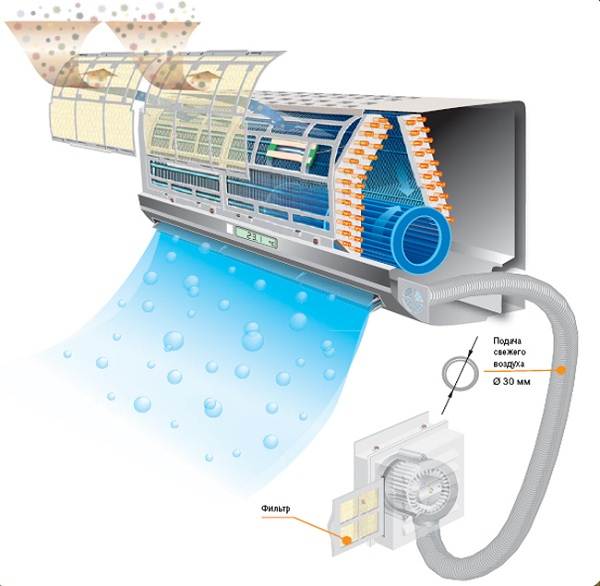
- equipment of additional functions in the form of air filtration and ionization;
- the need for additional automated equipment options;
- operating features. Will the appliance be used for cooling or heating too?
- class and rating of the manufacturer.



