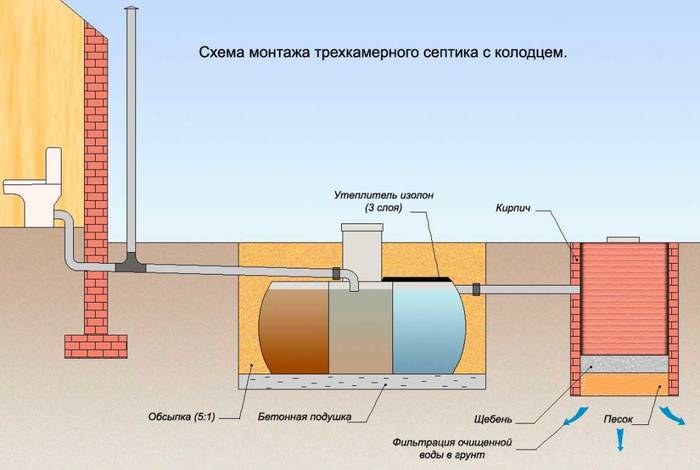
- septic tank material
- Septic tank made of concrete rings
- Concrete septic tank
- Country septic tanks from improvised means
- Sewerage device from concrete rings
- Sewerage device
- The device of the internal sewer system
- Stages of construction of a septic tank from concrete rings
- Preparation of a pit according to the size of the structure
- Installation of concrete blanks
- Waterproofing measures
- Pipe connection and testing
- Types of autonomous sewage
- How to properly conduct internal sewage in a private house: do-it-yourself installation
- General or separate sewerage: which is more profitable?
- The device of a septic tank without pumping
- Sealed cesspool from a finished container
- General criteria for choosing a septic tank for a country house
- Stage 2. Location of sewerage elements
- Features of the device of a private water supply
- Sewerage in the old tradition
- Tools and materials for arranging sewerage
septic tank material
When planning to build a septic tank with your own hands in the country, different materials are used:
- Reinforced concrete well rings;
- Concrete;
- Eurocubes;
- Brick;
- Car tires and other auxiliary materials.
Septic tank made of concrete rings
This option is one of the most common.Installation is carried out quickly enough, and the volume of the chambers is determined taking into account the diameter of the well rings used:
- Before installing the rings for the storage chambers, the bottom of the pits is concreted, and where a filter well is supposed to be arranged, a crushed stone pillow is made.
- Concrete structures are installed one on top of the other. When building a septic tank with your own hands from rings, the scheme should take into account the supply of all necessary pipes to the wells, taking into account their slope and diameter.
- Future chambers inside and out are carefully sealed with cement mortar, modern coating and built-up waterproofing materials.
- When the chambers are mounted, the pipeline is connected and thermal and waterproofing is done, the pits are filled up.
Concrete septic tank
When planning the construction of a septic tank for a summer residence, a lot of people choose the most durable and durable, in their opinion, option, which is a monolithic concrete structure:
- During the construction of such a septic tank, at the first stage, the bottom of the future chambers is concreted, after laying the reinforcing mesh. So that the metal does not undergo corrosion, which is inevitable under conditions of constant moisture, the layer of concrete on top of the mesh should not be thinner than three centimeters.
- Then, erecting the formwork and strengthening it with reinforcement, the walls of the chambers are concreted and partitions are made between them.
- Construction is completed by pouring the ceiling.
Concrete construction requires thorough and sufficiently long drying. This stage may take up to two weeks, and in order for the drying to proceed evenly, the solution is covered with a film.
Country septic tanks from improvised means
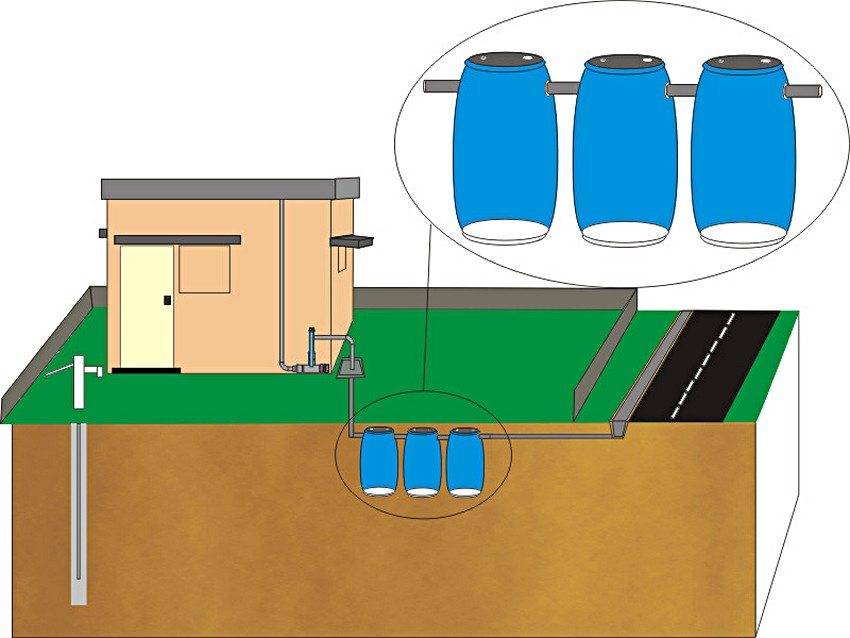
If the cottage is used periodically and only in the summer, then considering the question of how to make a septic tank for a summer residence with your own hands, you can make a fairly simple septic tank from improvised materials. It can be tires or plastic barrels. It will not work here to achieve tightness and long-term strength, so you should not use the design for cleaning and storing toilet drains. But for a country shower, such a septic tank is the best fit.
Sewerage device from concrete rings
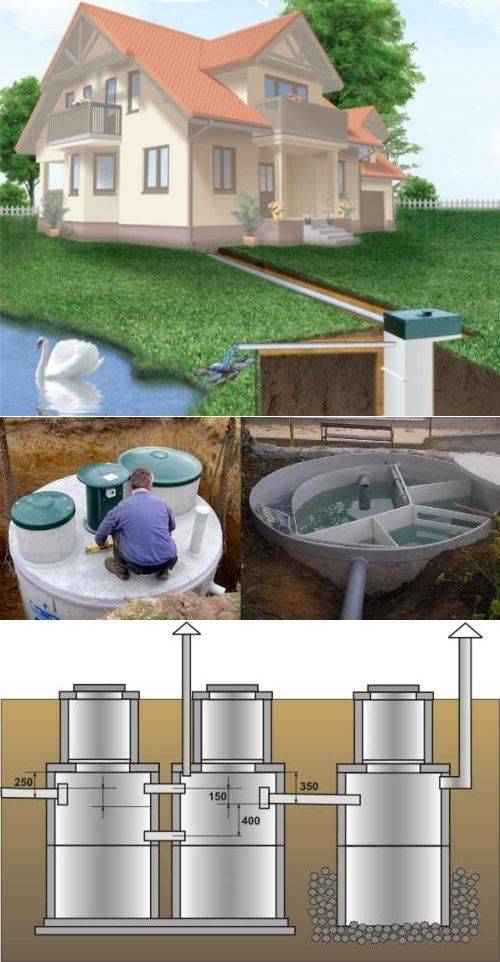
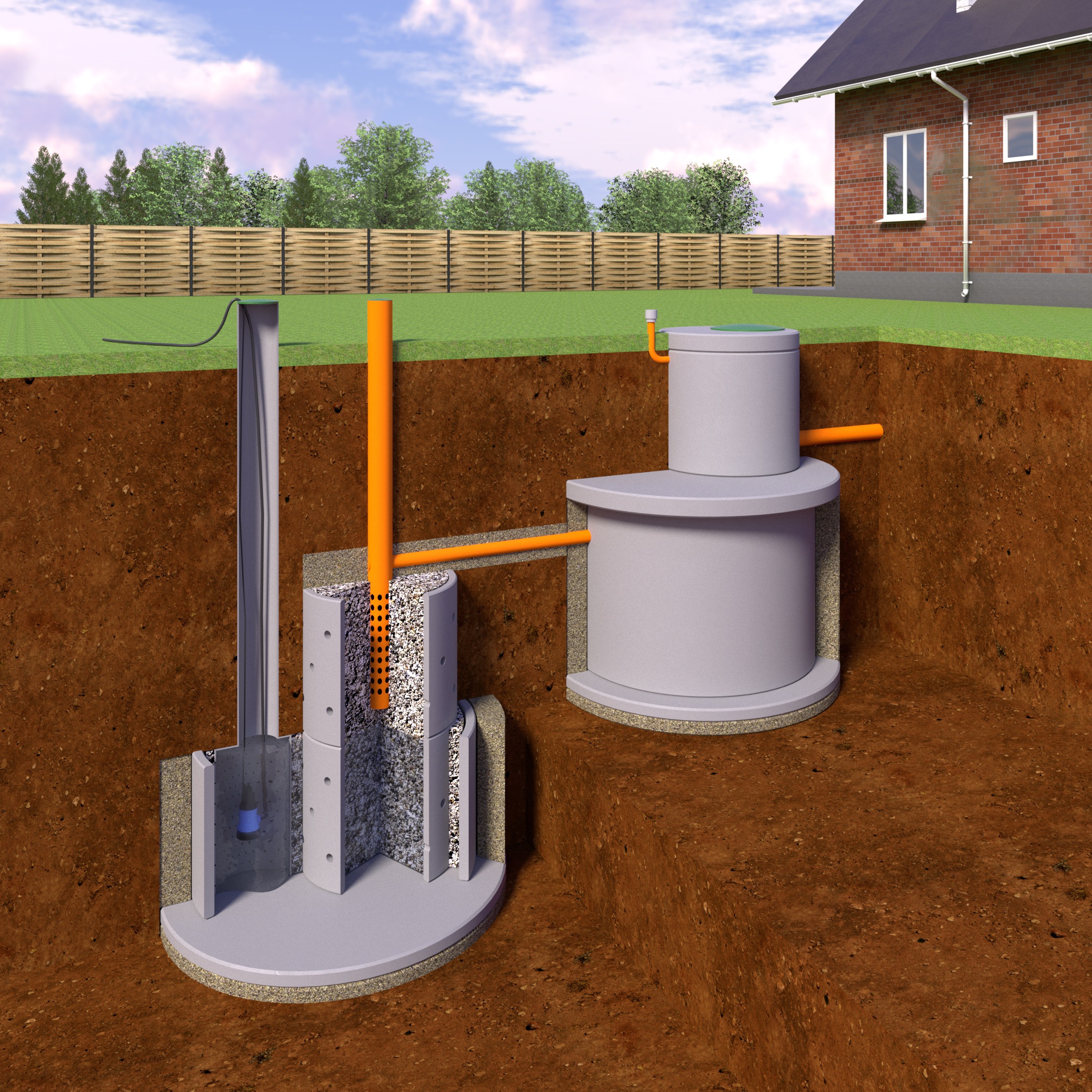
The simplest compartments can be made from concrete rings used in gravity-flowing street or storm sewers. Their diameter can be from 1 to 1.5 meters, height 1 meter. You can install 2 rings, one on top of the other, to increase the volume of the septic tank. The first compartment may be of larger diameter rings.
The bottom of the pits for all compartments is covered with rubble before installing the rings. And after installation, the bottom of the first two is concreted. At the third compartment from a concrete ring the bottom is only covered with rubble, but not concreted. In the walls of the third ring, holes are drilled with a crown, with a diameter of 7 to 12 cm, for additional drainage. FROM outer side wall of the ring it is covered with rubble to prevent washing away of the soil inside the ring.
Sewerage device
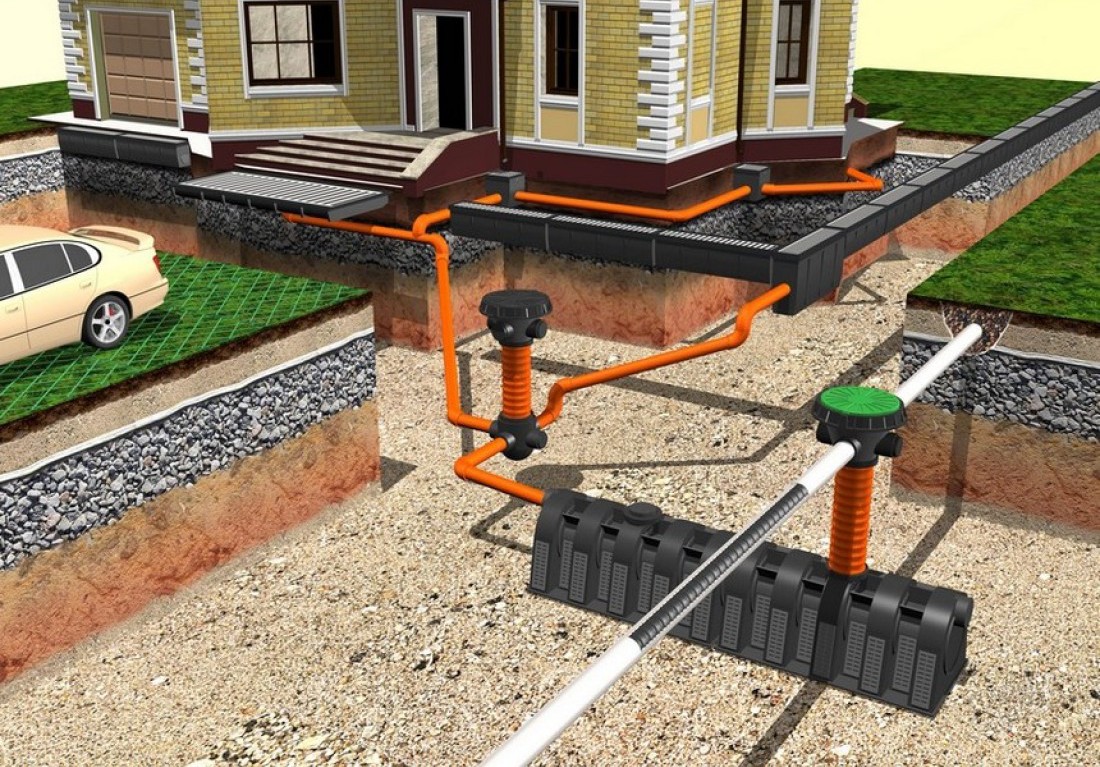
The sewerage system of a country house has several components.
Namely:
- Domestic networks. They divert effluents from the place of their formation. Usually these networks are plastic or cast iron pipelines and they are identical for summer cottages, cottages, and apartments in high-rise buildings.
The difference is only in the volume of the output fluid per unit of time. Although the issue with a large number of drains appears only if there is a pool in the household.
An intra-house local or autonomous sewage system is assembled quite simply from bends, tees, corrugated pipes and other ready-made elements that are in abundance on the modern market.
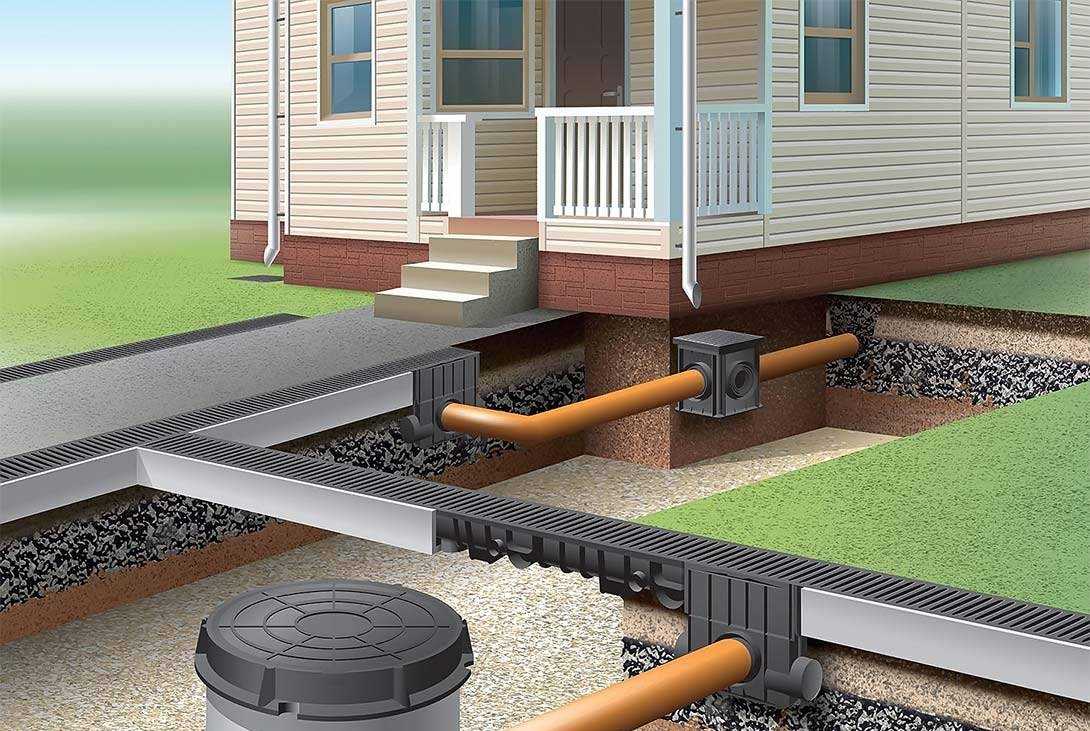
- Communications. Communications are called sewer pipes that divert sewage from a summer house / apartment / cottage to a container in which these effluents are stored or to a waste treatment point.
The materials from which external sewer pipes are made are traditional: cast iron or plastic. But the laying of sewerage is a laborious and complicated matter.
Here you need not to be mistaken with the diameter of the pipes, the slope, the depth of the laying.
- Waste collection point. The place where wastewater is concentrated - whether it is a cesspool or a special container - is probably an important point in the laying of sewerage for the Saami.
For a city dweller, this issue is not interesting, but for a summer resident, quite the opposite - it is extremely important.
Modern sewer systems have a special waste disposal site, which at the outlet turns into relatively clean water for technical needs - watering the garden, for example.
The device of the internal sewer system
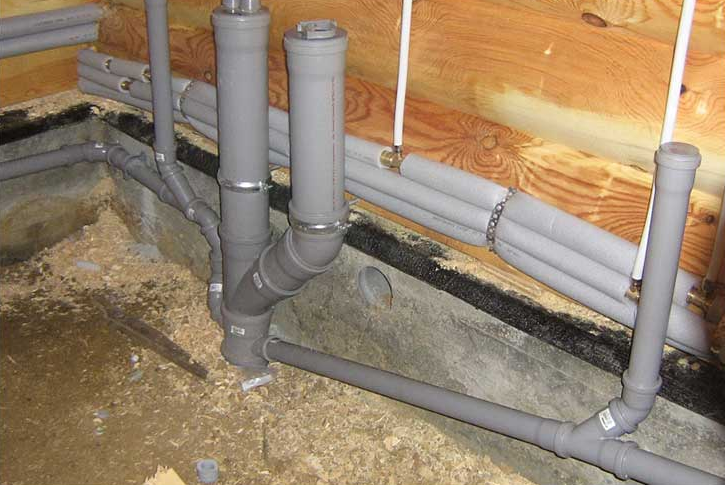
You can start installing the internal sewer system immediately after drawing up a plan and purchasing all the necessary materials and components. First you need to install a central riser. The optimal diameter for it is 110 mm, while it is necessary to provide for the removal of gases. Usually, for this purpose, the upper part of the riser rises up - either to the attic, or is displayed on the roof. Conclusion to the roof is more preferable: it is still better for the gases to immediately leave the house than to accumulate in the attic.
It must be borne in mind that, in accordance with the regulations, the main riser must be located at least 4 m from the nearest window. Such a requirement limits the number of rooms in the country where the riser can be located, and you need to know this before starting the installation of the system.
Pipes for the internal sewer system are selected not only by diameter, but also by the material of manufacture. Three options are currently offered:
- PVC pipes are very affordable prices, which attracts consumers, they are quite durable, lightweight, the inner surface is smooth and water passes easily, they are corrosion resistant, they do not grow inside, they are very easy to install. Do-it-yourself sewerage in the country is usually performed using PVC pipes;
- cast iron pipes - a time-tested classic option, the material is reliable, durable, however, not too corrosion resistant, the inner surface loses smoothness over time, which prevents the passage of sewage, special welding equipment is required for installation, and the price is far from democratic;
- ceramic pipes - combine all the advantages of PVC and cast iron pipes, have excellent characteristics ranging from smoothness to resistance to chemically aggressive environments, however, they have a very high cost, which is not very good for a small cottage.
Based on the price / quality ratio, as well as taking into account the requirements for ease of installation when installing a sewerage system in a country house with your own hands, PVC pipes are most often chosen - lightweight, fairly durable, chemically resistant and inexpensive.
After the installation of the main riser, you can start laying horizontal pipelines. At the same time, it is necessary to provide for the presence of inspection hatches - so that, if necessary, it is possible to control the sewer system, and most importantly, to clean it. Inspection hatches are usually arranged above the toilet, as well as at the lowest point of the entire sewer system (this is where traffic jams most often occur).
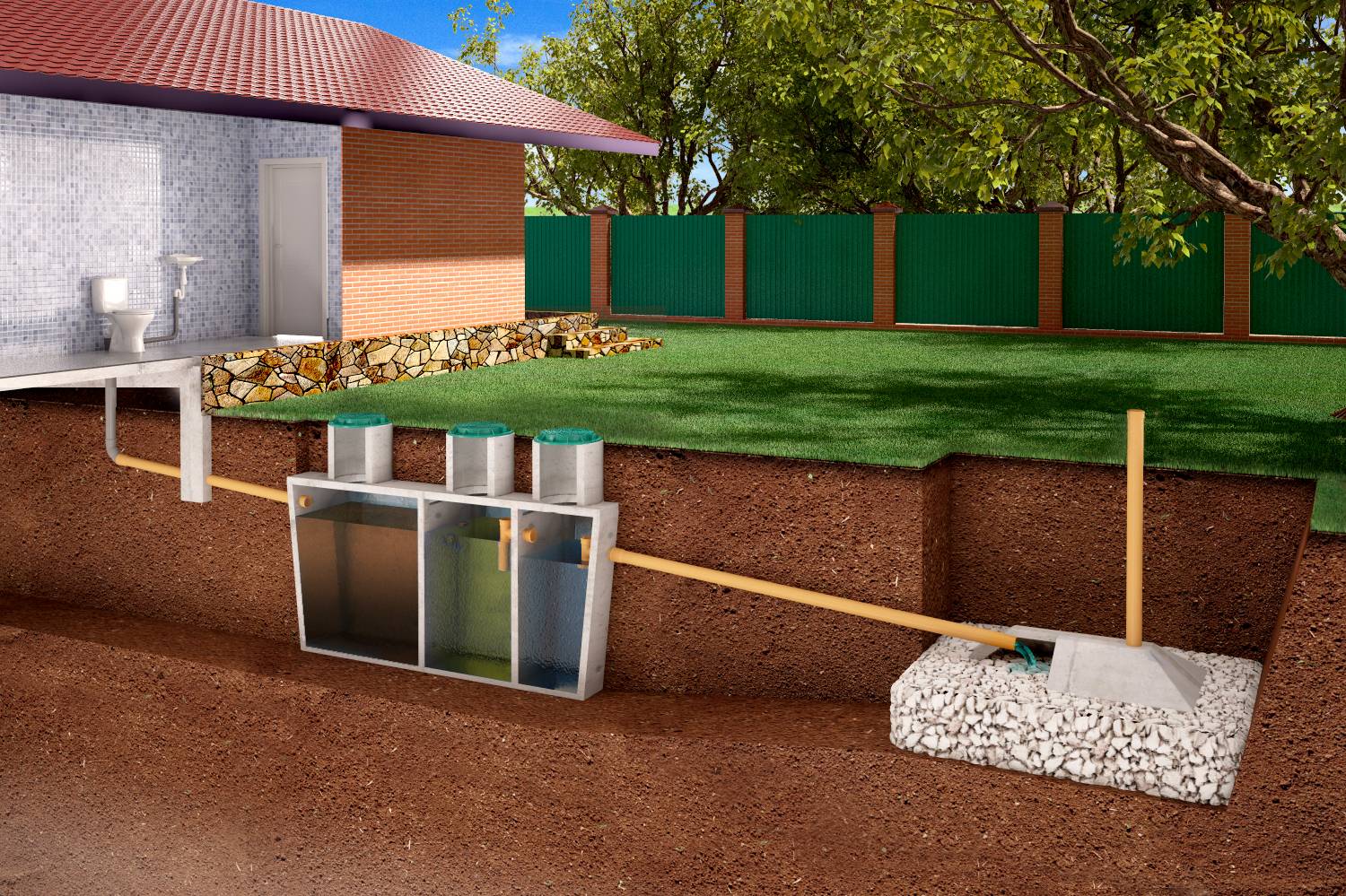
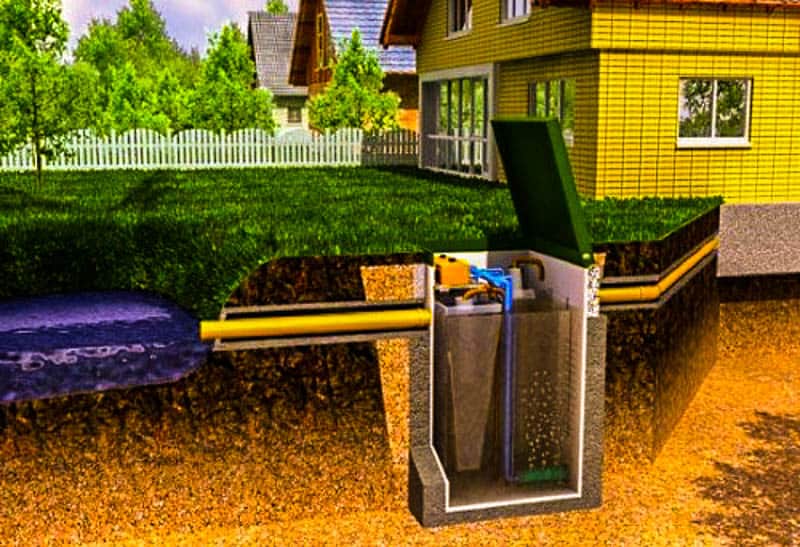




When mounting pipes, you should pay special attention to the corners of the joints: right angle turns make it difficult for wastewater to move, and in this case, plugs begin to accumulate at the joints, even the famous smoothness of PVC pipes does not save. It can get to the point that it will not be possible to throw toilet paper into the toilet - so that it does not serve as the germ of a cork before it dissolves
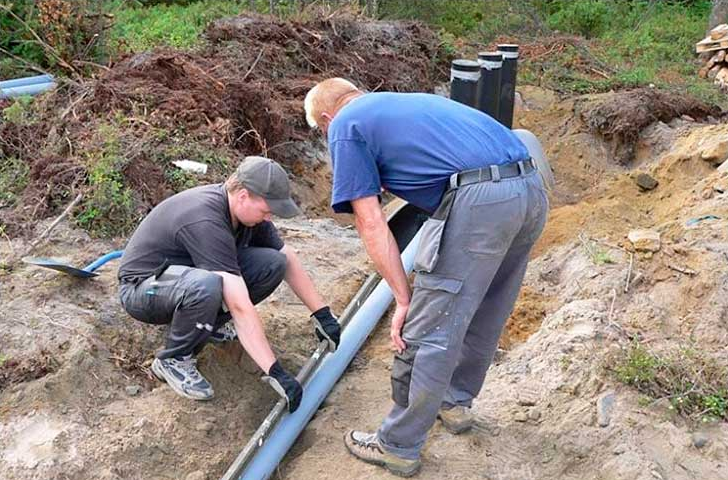
A prerequisite: each plumbing fixture, whether it be a toilet bowl or a sink, must have a siphon with a water lock, otherwise unpleasant odors from the sewer network will constantly penetrate into the room.
Pipe for connection of a branch pipe toilet should be with a diameter of at least 10 cm, the connection is made directly. At the same time, a diameter of 5 cm is enough to connect the sink and / or bath. The angle at which the pipes are laid must ensure gravity flow.
Note that usually the device of the sewerage system is planned in advance, even at the stage of building a house, and in this case, a place is immediately provided in the architectural plan for sewer pipes to the outsidethrough which the wastewater flows from house to well or septic. This is a hole located in the foundation.
However, it happens that it is necessary to arrange sewage in an already built house, where there is no hole in the foundation for laying a drain pipeline. Usually in such cases it is necessary to make an extension to the house in order to place a bathroom there, and a place for a drain pipeline is laid in the foundation of this extension.
At the point where the sewer system exits the house check valve required, otherwise, under certain conditions, wastewater may flow back into the house (slight slope, well overflow, groundwater penetration into the well, and so on).
Stages of construction of a septic tank from concrete rings
Installation of the treatment plant of their cylindrical blanks takes place according to the standard scheme. The process is simplified due to the large size of the parts, but for the same reason there is a difficulty - the mandatory rental of construction equipment and the participation of a team of workers.
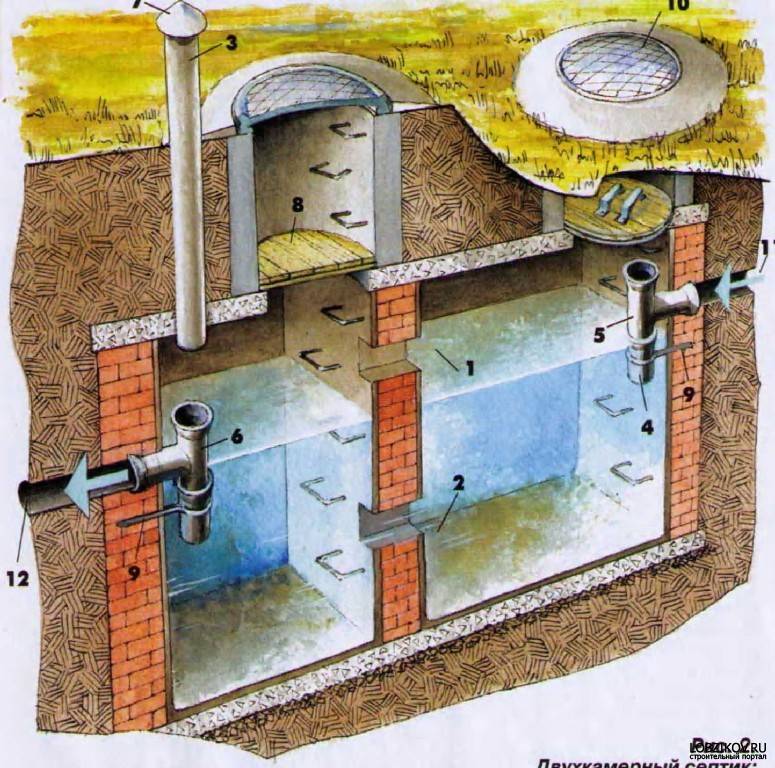
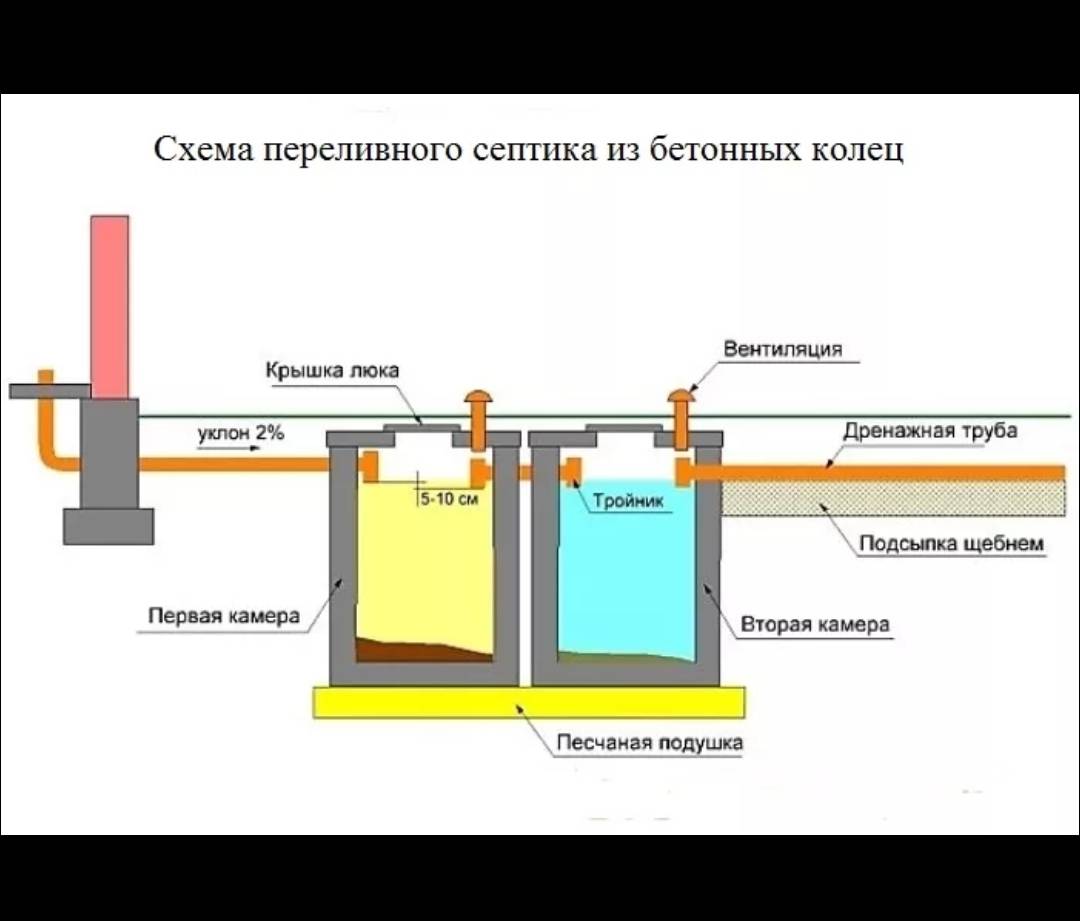
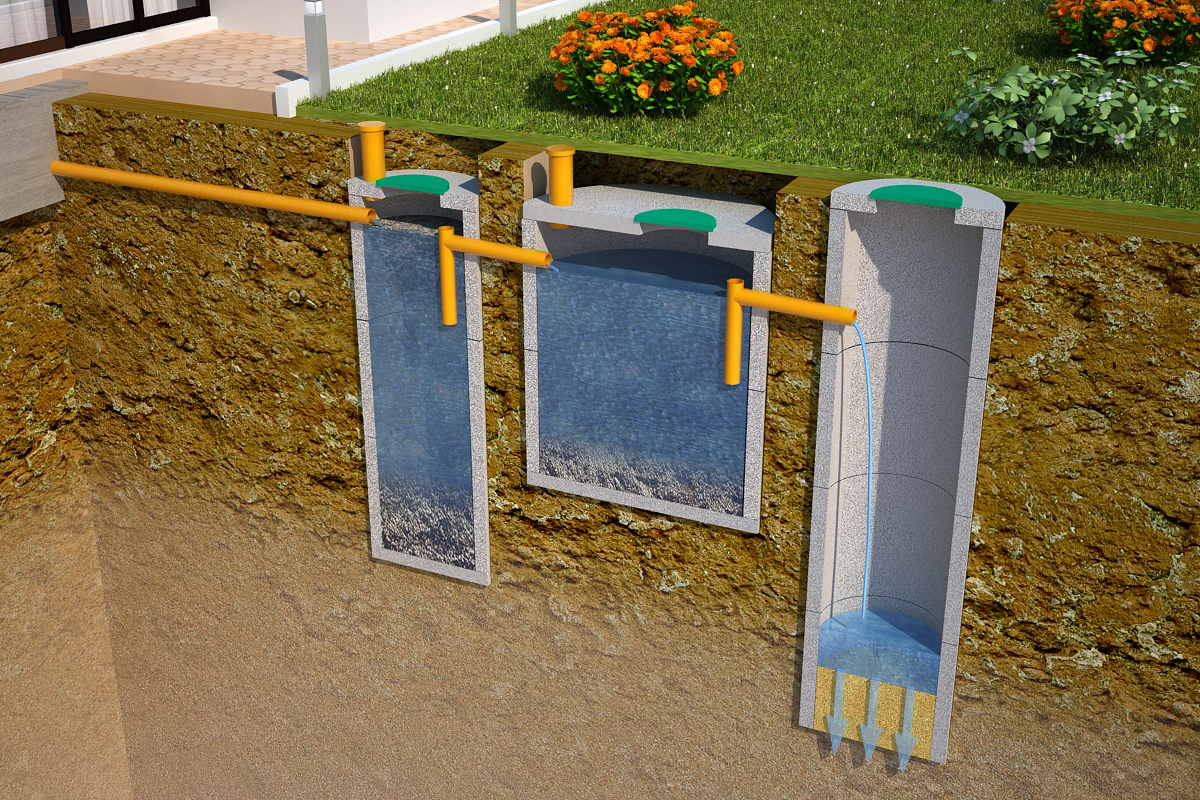
For the construction of a septic tank, 2 sets of parts will be required, since it will consist of two tanks. The function of the first is accumulative, the second is filtering.
The construction of a septic tank from concrete rings is carried out in several standard stages:
Preparation of a pit according to the size of the structure
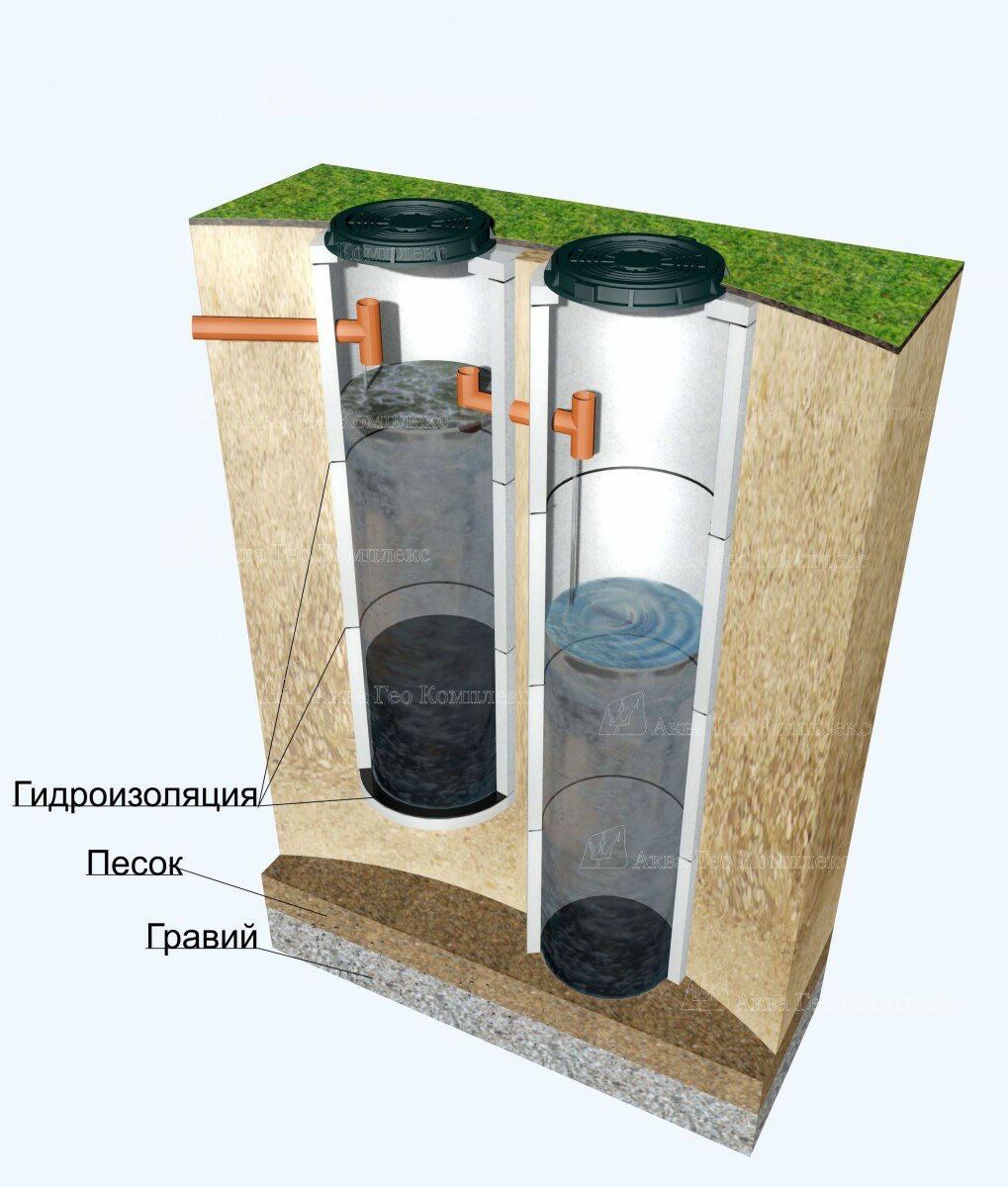
In the place indicated in the project, using an improvised tool (shovel), winch or mini-excavator, they dig a hole 2-3 rings deep + neck. 30-40 cm are added to the height of the assembled structure for the base device: 15-20 cm of sand + 15-20 cm of gravel (crushed stone, river pebbles). The drainage layer serves as a reliable base and filter "cushion".
The length of the pit should be such that two tanks are placed in it, connected by a short overflow.
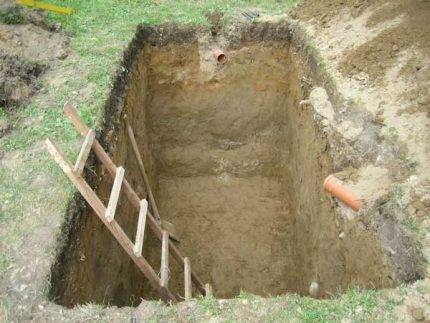
Sandy soil at the construction site of the excavation can cause problems in the form of wall shedding. If there is no way to strengthen the walls, it is better to dig a wide hole, and after installing and waterproofing the septic tank, fill it with heavier soil containing clay
The soil should not be removed from the site - it will be useful for backfilling. The remains can be used to form landscape objects, such as flower beds.
Installation of concrete blanks
Concrete rings are mounted one on top of the other, fastened at the joints with brackets and sealed with special gaskets. Manufacturers have simplified the installation of the lower ring of the storage tank - they came up with a part with a blank bottom, which does not require additional weighting.
One or two more parts are placed on it, covered with an overlap with a hole, a neck is erected on top and a technical hatch with a lid is equipped.
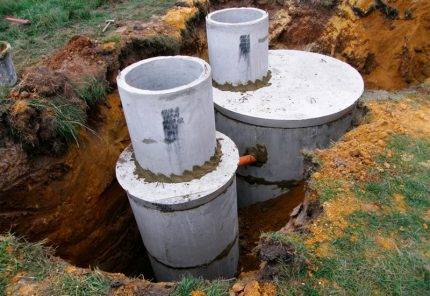
The second chamber is equipped in the same way, but instead of a deaf lower part, a conventional ring is used. For a filter well, there is not enough drainage layer - it is necessary to make a dense filter with a thickness of at least 50 cm
Now there is no need for any individual calculations. The dimensions of the blanks are standard, and you can always find out from the manufacturer what volume of drains the selected combination of elements is designed for.





Waterproofing measures
A concrete septic tank made of individual parts must be covered with waterproofing. In practice, two methods are used: applying a protective material on both sides or applying waterproofing from the outside, and from the inside - only finishing the seams.
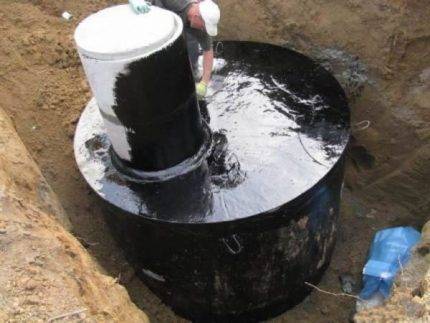
One of the protection options that is suitable for objects buried in the ground.A layer of bituminous waterproofing is applied to porous concrete, after which the walls of the parts become more durable and waterproof.
There are modern deeply penetrating materials that surpass the bitumen layer in terms of technical characteristics (for example, Penetron), but they are more expensive.
Pipe connection and testing
A fully assembled structure is connected into a single whole and connected to a pipe leading from the house. To do this, holes are made in concrete blanks for overflow - a short piece of pipe, then the same hole - for the entrance of the sewer line. All elements are hermetically connected and covered with waterproofing. Take out the ventilation shaft.
To check the performance and tightness of the structure, the first container is filled with water. Then, when the first effluent enters the reservoir, a bioactivator can be used to make the waste recycling process more efficient.
Types of autonomous sewage

Cesspool at the dacha
Therefore, if we talk about the varieties of autonomous sewage, it is necessary to take the tank as a basis. So the division here is:
- Cesspool pit. This is a sealed container, which, after filling, must be pumped out using a sewage machine or a special fecal pump into another container. The latter will have to be taken out independently for further disposal of sewage.
- Septic. This is equipment designed for partial or complete disposal of sewage. There are several positions that differ from each other in the degree of purification.
Let's leave the cesspool alone, as an archaic way to collect sewer discharges. Let's deal with septic tanks. And first of all, we will deal with purely organizational issues.
How to properly conduct internal sewage in a private house: do-it-yourself installation
Internal sewerage is a system located inside buildings and structures and includes devices and pipelines that are used to collect inside the house and divert used water and household waste into an external sewer.
Plumbing fixtures include bathtubs, sinks, sinks, urinals, toilet bowls, drains and shower trays, and the piping system includes soundproofing, ventilation risers, manifolds and inlets, cleaning revisions and shutoff valves at outlets.
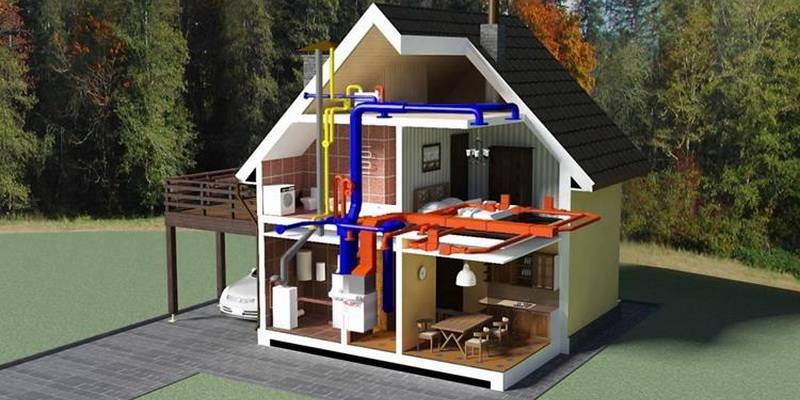
How to lay the internal sewerage for a private house correctly, taking into account all the necessary requirements? Installation of internal sewerage in a private house is carried out using plastic pipes and rubber sealing rings to seal socket-type joints. A ring is installed in the groove of the socket, after which the end of the pipe, which has a smooth surface, is placed in it. The connection can be facilitated if a chamfer is made on the cut of the smooth end of the pipe. Stop moving the pipe at the moment when the mark on the smooth surface of the pipe will be at the level of the bell. If the rotation of the parts connected to each other is easy, then the seal is located correctly. A pipe with a clearance of 5 cm is used for the drain of a sink, bathtub or washbasin, the outlet and riser for the toilet bowl are made with an inner diameter of at least 10 cm.
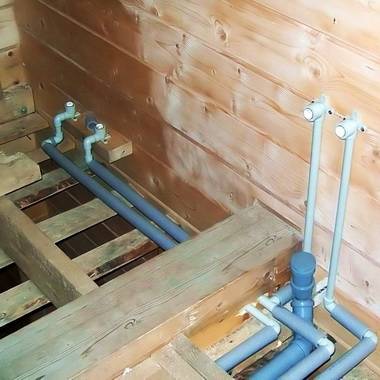
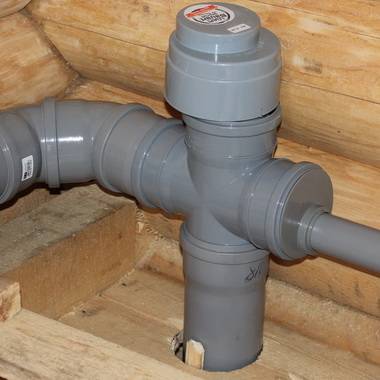
After the internal sewerage in a private house, laid by oneself, is prepared, they proceed to the final installation of the water supply and the connection of plumbing equipment, having previously completed the thermal insulation of the hot water pipeline
Particular attention should be paid to window sill niches, the main riser and the expansion tank. Pipes in the rooms and in the kitchen do not need thermal insulation
When installing an internal sewerage system in a private house, during the installation of the bathtub, you should check if there are rubber gaskets. It must be installed with a slope towards the hole. Sealing the outlet, as well as the joint of the drain pipe, is carried out by sealing the gap of the ring, using a linen tourniquet. Then the joint is closed with cement mortar or a mixture of cement and sand.
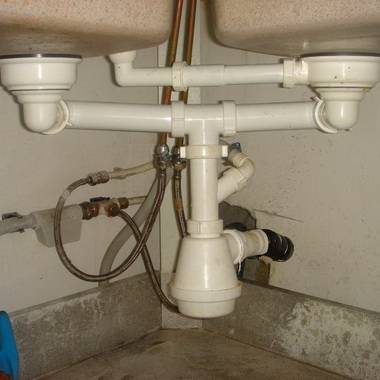
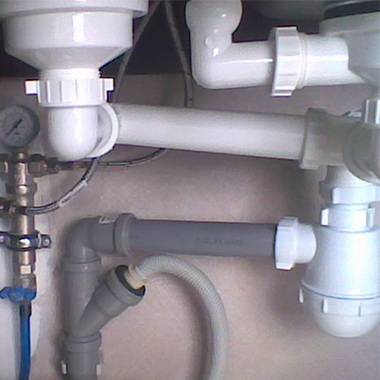
To installation plumbing in a private house a special approach is required. It will not be difficult to connect a sink or washbasin, while simultaneously installing a modern plastic siphon on the outlet pipe.
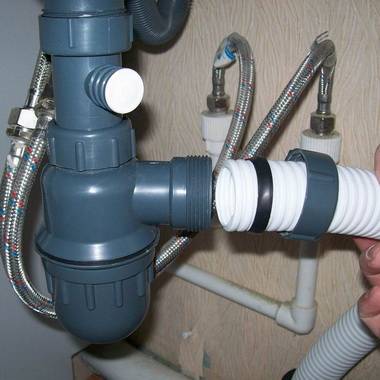
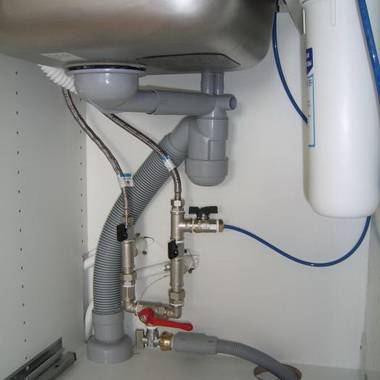
The metal siphon should be connected to the drain pipe using an additional pipe having a diameter of 32-34 mm
During operation, pay special attention to whether the rubber sealing rings are correctly installed (in the event that the sink or sink is already fixed to the brackets)
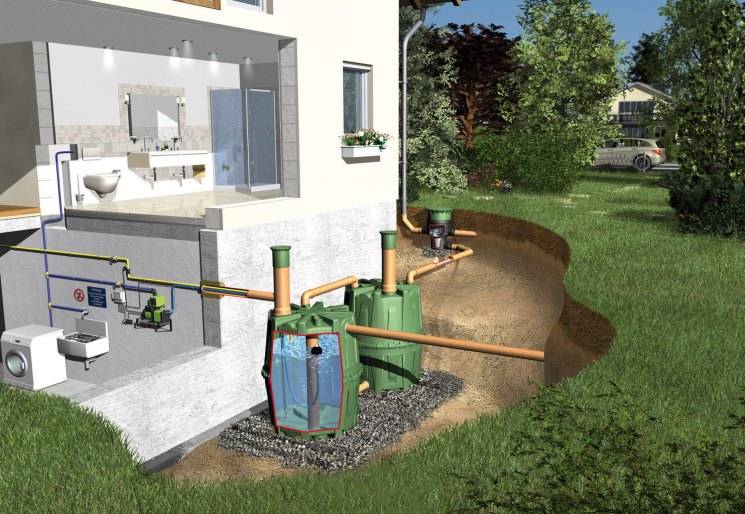


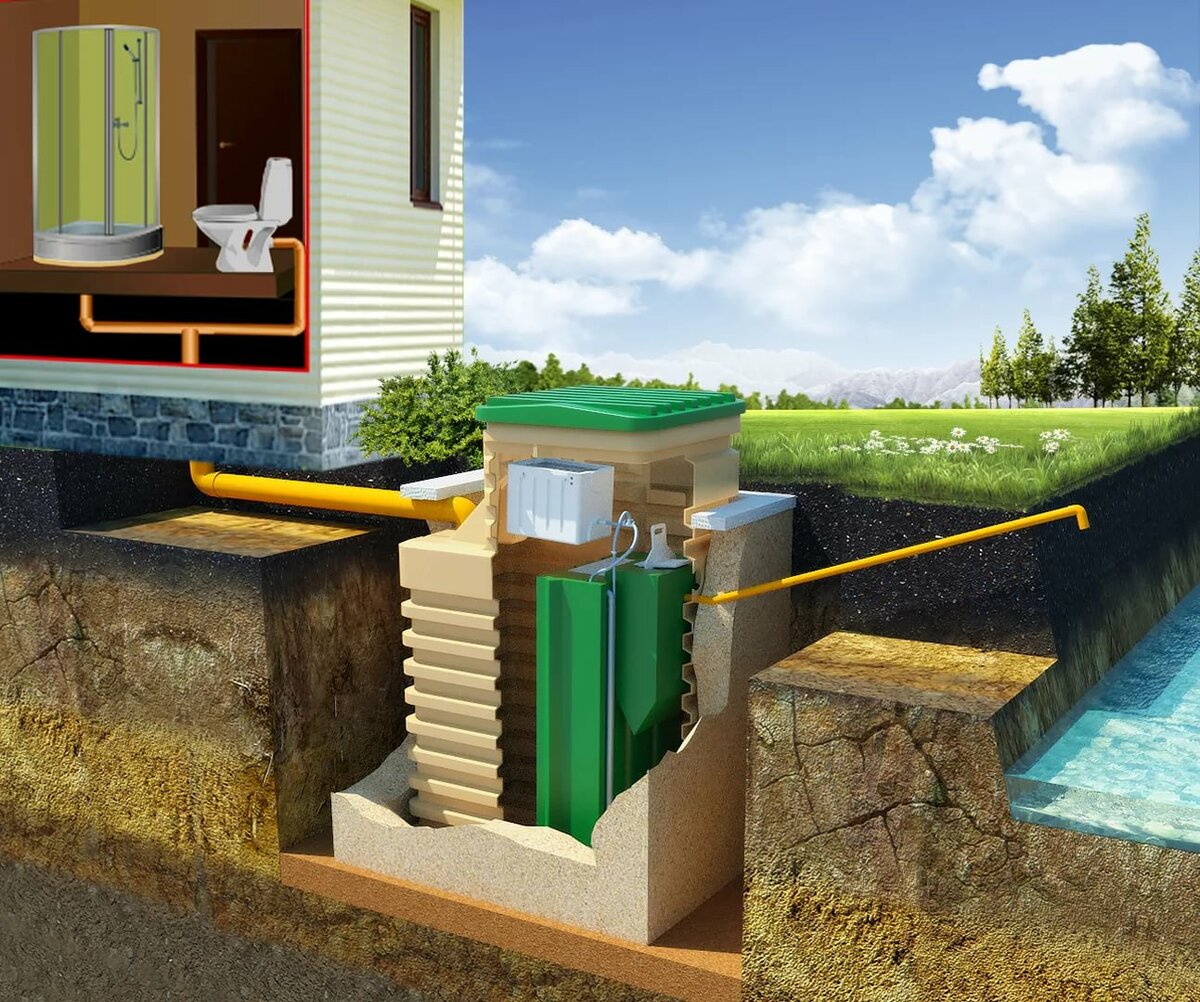
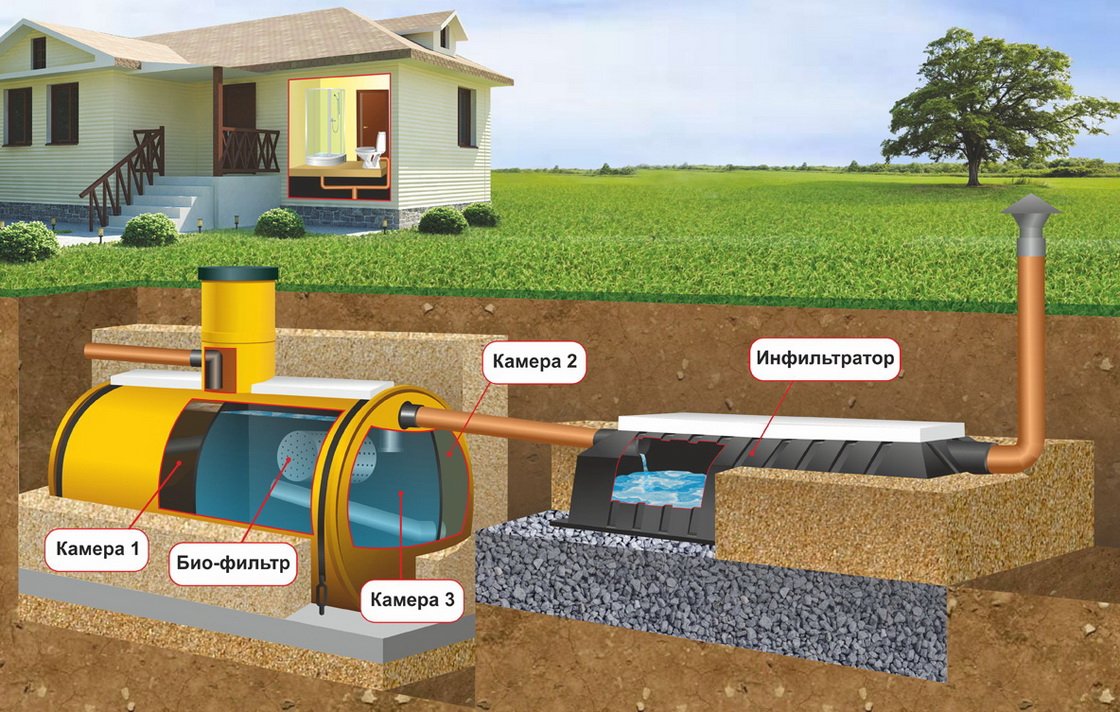



Depending on the placement, the pipes are selected with different diameters: from the bathroom (or shower), pool and toilet - 10 cm, from the washbasin - 5-6 cm, it is desirable to make the riser with a diameter of 11 cm. 11 cm, although in large private houses where a complex sewer system is performed, their diameter can reach 15 cm.
Gasket pipes with a diameter of 5 cm they make a slope of 3 cm every meter, pipes with a diameter of 10 cm - a slope of 2 cm every meter. The riser should go 0.8-1 m above the roof. From above it is closed with a dome having a diameter 2 times larger than that of the pipe.
General or separate sewerage: which is more profitable?
Before starting construction work, decide how you intend to discharge wastewater from the bathroom, kitchen and toilet - to one place or to different ones. The type of container into which the drains will flow will depend on this. If approached rationally, then the option of separate containers is more beneficial for the owners, because water from the kitchen, washing machine, shower, etc. can be released through the cesspool a hole without a bottom into the ground. They do not pose a danger to the soil, because the bacteria have time to process the effluent from washing powders, shampoos, etc.
Another thing - drains with feces. They should not be allowed into the ground, because you will create a lot of problems for yourself: you will violate the ecology of the earth, spoil the soil in the garden, and the worst thing is that these sewage will calmly fall into the groundwater and return with them back to the house as drinking water. For drains from the toilet, it is necessary to create an airtight cesspool or septic tank. In any case, it is not profitable for you if all the sewage from the house flows into this pit, because the container will fill up quickly, and you will often have to call a sewage truck or pump it out yourself with a special fecal pump and take it out for disposal.
The device of a septic tank without pumping
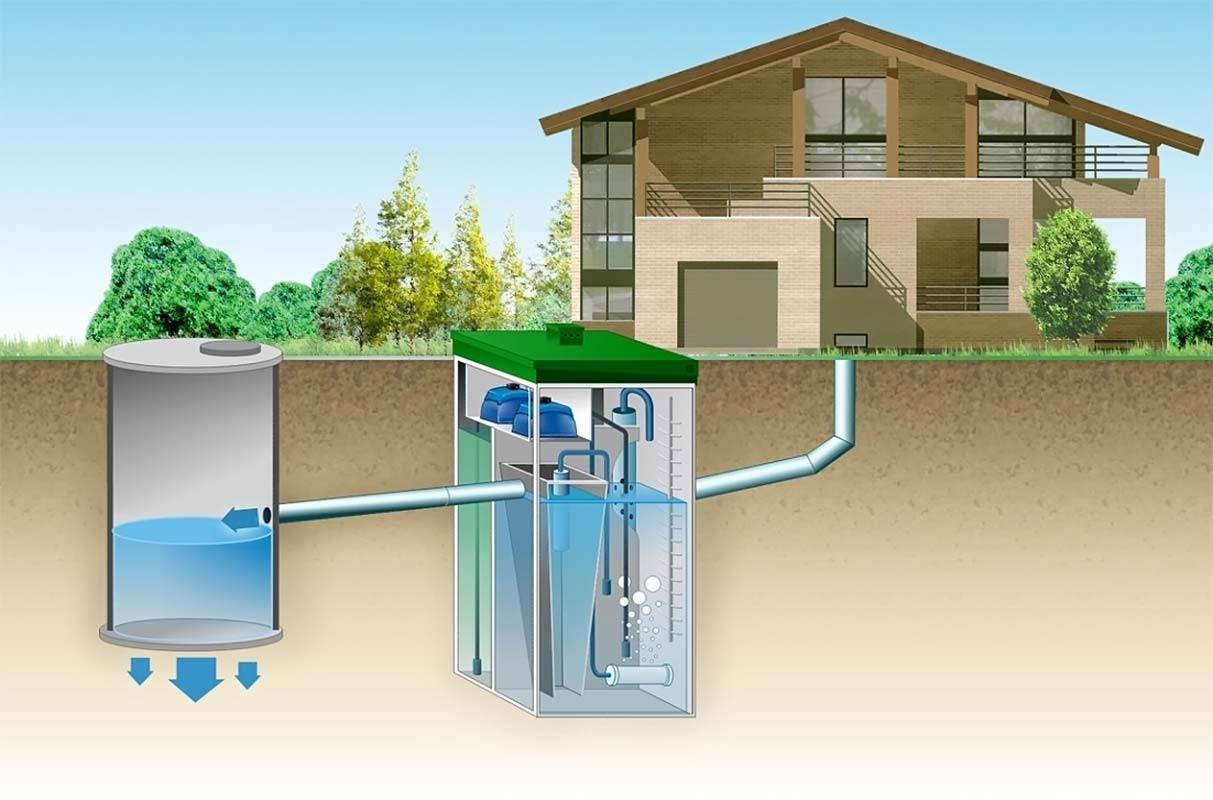
 A septic tank is a small treatment plant for a private house and cottage. It consists of 3 containers connected in series to each other.The technological process consists in settling wastewater in the first two compartments in order to separate it into fractions. And also for the processing of feces with biological bacterial preparations. The last compartment, in fact, is a drainage pit for purified liquid. The first two compartments must sometimes be cleared of accumulated sediment.
You can buy ready-made complexes, but it’s cheaper to make them yourself or assemble them from separate ready-made elements.
Sealed cesspool from a finished container
For fecal sewage in the country, they create the most airtight sewerage device, because the health of the inhabitants of this area depends primarily on this. The easiest way is to find a large capacity. They are sometimes written off by chemical processing plants. However, a barrel from fuel and lubricants, a milk tanker or a car that says “Live Fish” is also suitable. If you cannot find such containers, you can buy a ready-made sewer well made of plastic.
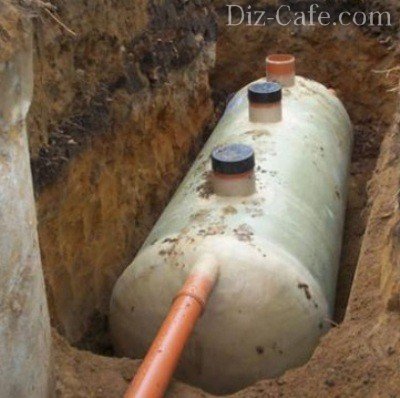
If you did not purchase a ready-made plastic container, but used an old one from fuel and lubricants, be sure to treat it on the outside with bituminous mastic to improve waterproofing
Fecal sewerage should not be located near the cottage itself. The smallest distance from the house is 9 meters, and from a well or well - 30 meters. It is more profitable to install it near the edge of the site, so that it is easier for transport to pump out without driving around the entire territory of the cottage.
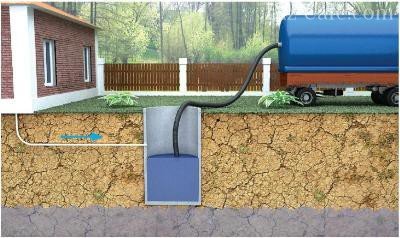
It is advisable to position the sewer hatch so that it is easy for the sewer machine to reach it along the path on the site, or to be located immediately near the entrance
Digging a hole for a barrel by hand is quite difficult, especially if the groundwater is high. Then the water will arrive faster than you dig. Order an excavator for these purposes.The size of the pit should be such that the barrel fits freely, and only the inlet of the hatch remains on the surface of the earth. At the same time, a slight slope towards the hatch is necessarily made at the bottom so that solid particles settle in this direction. Then it is easier for the hose of the sewer machine to grab them.
Dig along with the hole trench for laying external sewer pipes. Be sure to dig a trench so that there are no bends, because feces can get stuck in the places of turns and form traffic jams. If it does not work without turns, then the bending angle should not be more than 45˚.
They lower the barrel into the pit with the help of a crane, and if it is not available, they call on familiar men for help and, like barge haulers on the Volga, tighten it with ropes. The hole for the sewer pipe to enter can be cut at the top until the barrel is tightened, or after it is installed in the pit.
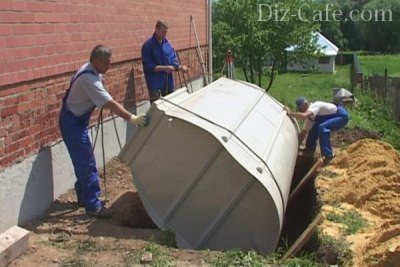
The container is not installed directly in the pit, but with a slight slope towards the hatch, so that it is easier to pump solid particles from the bottom
From the tank, they begin to lay pipes to the house, maintaining a slope of 4˚, and then they perform internal sewer wiring. When the outer pipes are mounted, the trench is filled up. The voids around the container are filled with soil, ramming it. A reinforced concrete slab is placed on top, which will prevent the barrel from being pushed out of the frozen soil in winter. A concrete blind area is poured around the upper opening of the container and a sewer hatch is installed in it.
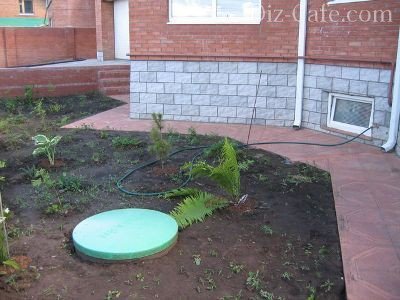
The entire cesspool is hidden underground, and only the manhole cover remains on the surface, through which wastewater will be pumped out
General criteria for choosing a septic tank for a country house
The issues of autonomous sewage installation in each case are solved individually, taking into account a number of factors. Main selection criteria autonomous sewerage for a residential building:
1. Purpose of the building: for permanent or temporary residence.

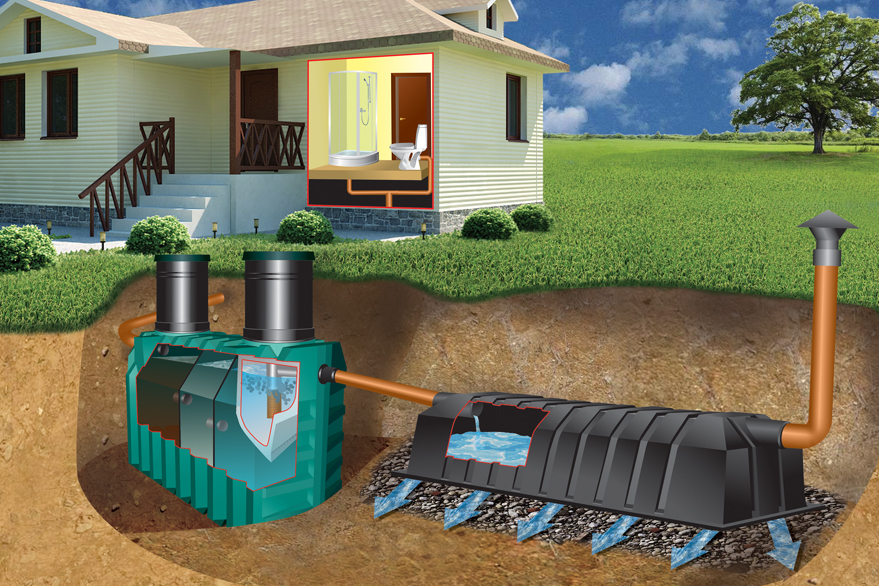


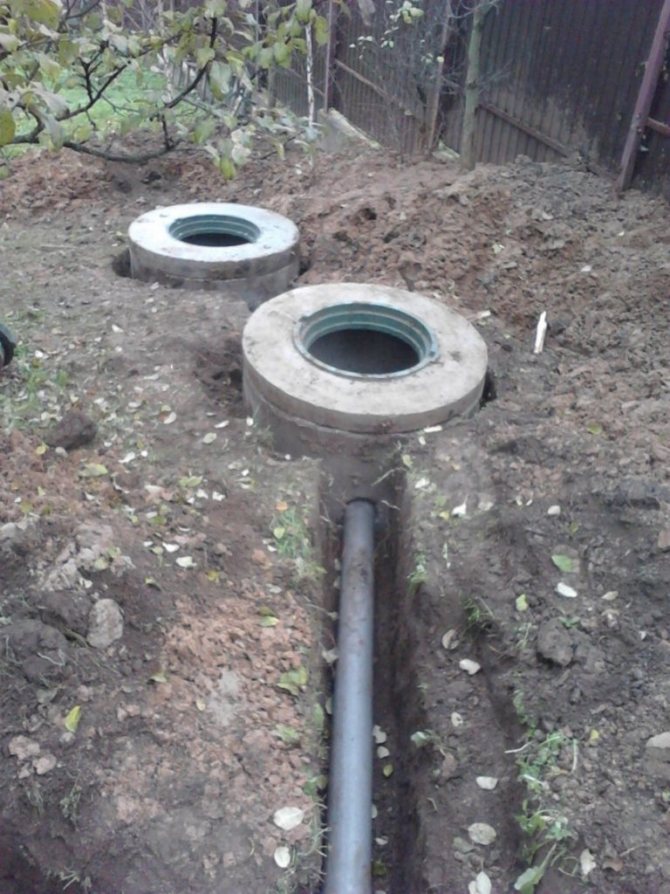
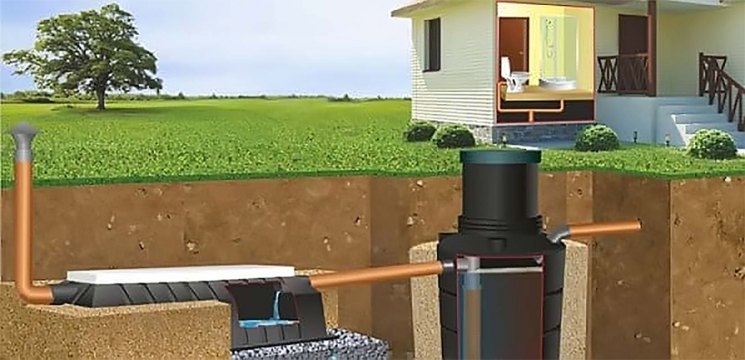
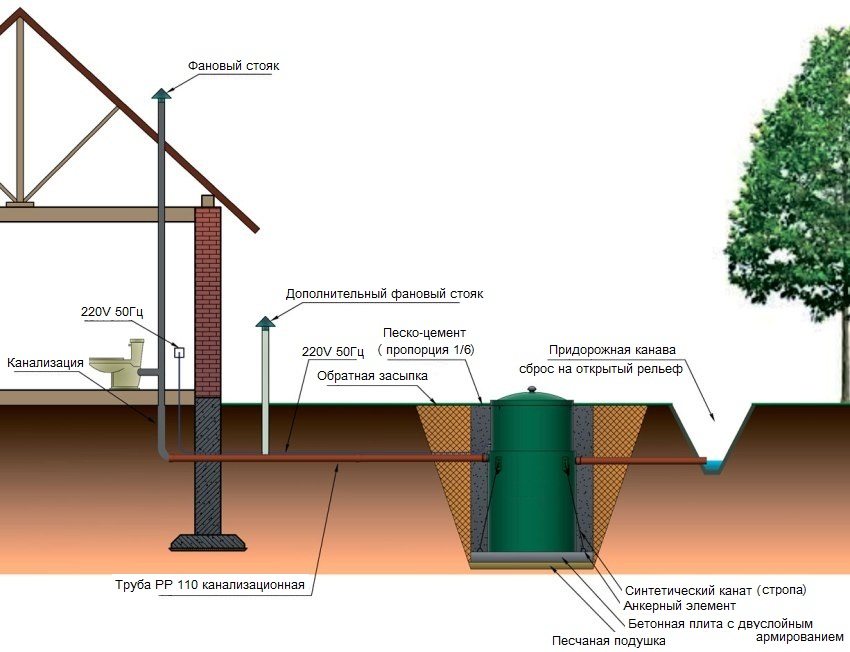
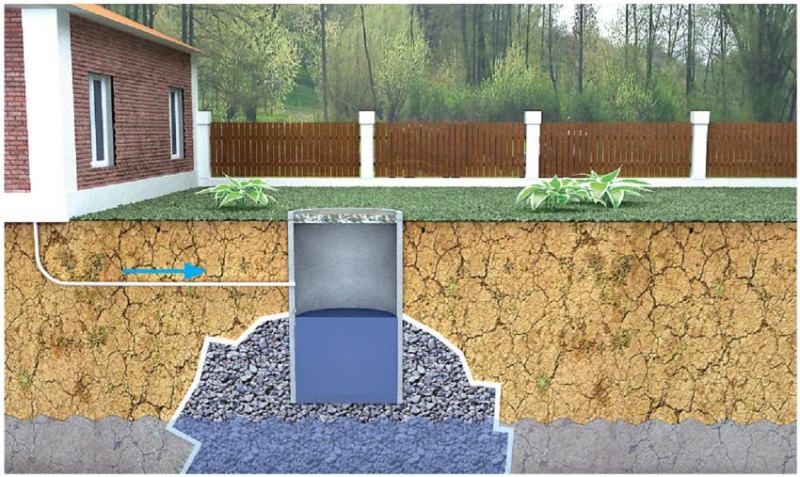

Some types of cleaning equipment do not allow long downtime in operation. For cottages and small houses, a cesspool of a storage type with a calculated volume is suitable.
2. The size and geology of the land plot, as well as the composition of the soil and the level of groundwater.
On small sites, it is impossible to use septic tanks with underground filtration fields. It is not allowed to use septic tanks with a filtration well at a high level of groundwater.
3. Daily volume of effluents and volley discharge.
It is calculated based on the number of permanent residents in the house and the number of guests who regularly visit the hosts. Knowledge of this indicator is necessary to determine the performance of the septic tank, which is indicated in the technical documentation.
4. Financial capacity of the homeowner.
High-tech equipment, taking into account the costs of installation and maintenance, will be quite expensive. To reduce costs, it is recommended to build one- or two-chamber septic tanks from available materials and without the involvement of specialists.
To determine which autonomous sewage system to choose for a private house, you should take into account all of the above factors and, if necessary, consult and involve specialists in the matter. Mistakes made in the design and installation of autonomous sewage systems can cause extremely negative consequences.
Stage 2. Location of sewerage elements
The layout of the septic tank
The location of network elements, in particular those located on the street, should be taken with all responsibility.
Example slope of sewer pipes
First of all, the terrain is taken into account. Usually, free-flow sewage is equipped in suburban areas, in which wastewater flows to the disposal site in a natural way. In such cases, pipes are laid at a certain slope (about 5 cm per linear meter) in order to avoid stagnation of drains.
Slopes of sewer pipes
Sanitary standards are no less important. According to them, the installation of treatment facilities near wells, wells and other sources of water is unacceptable.
Also, when choosing a place for installation of structures, the possibility of unhindered access of a sewage truck is checked.
Scheme of arrangement of a septic tank in the country
Features of the device of a private water supply
It is better if the planning of the water supply will be carried out on project development stage suburban area and home. A full-fledged project includes a number of drawings and documents, including:
- phased work plan;
- layouts of pipes and main elements of the plumbing system;
-
estimate, etc.
To equip the boiler and water meter unit, you need to allocate a small room on the ground floor of the house. A room of 3-4 m2 will suffice. It is more convenient when the water inlet unit and the necessary technical devices are located in the same room - this gives the owner the opportunity to fully control the process of water supply.
A typical private water supply system includes the following equipment:
- pipeline. Products made of polypropylene, metal-plastic and metal are suitable;
-
set of taps and fittings;
-
pump;
-
manometer;
-
expansion tank;
-
pressure switch;
- electrical support with full automatic protection;
-
purification filters to eliminate suspended particles and various kinds of contaminants from the composition of water;
-
water heater. Installed as needed. In most cases, the accumulative model is more convenient.
Sewerage in the old tradition
With a sewerage device of the simplest type, the easiest option is to create a cesspool. This method of wastewater collection should be considered as the cheapest and easiest to implement. The design of the pit is quite simple, which makes it possible for the summer resident to build it without resorting to the help of specialists. However, before the owner of the site begins to carry out land work to create a toilet without sewerage, you should find out the required volume of the structure.


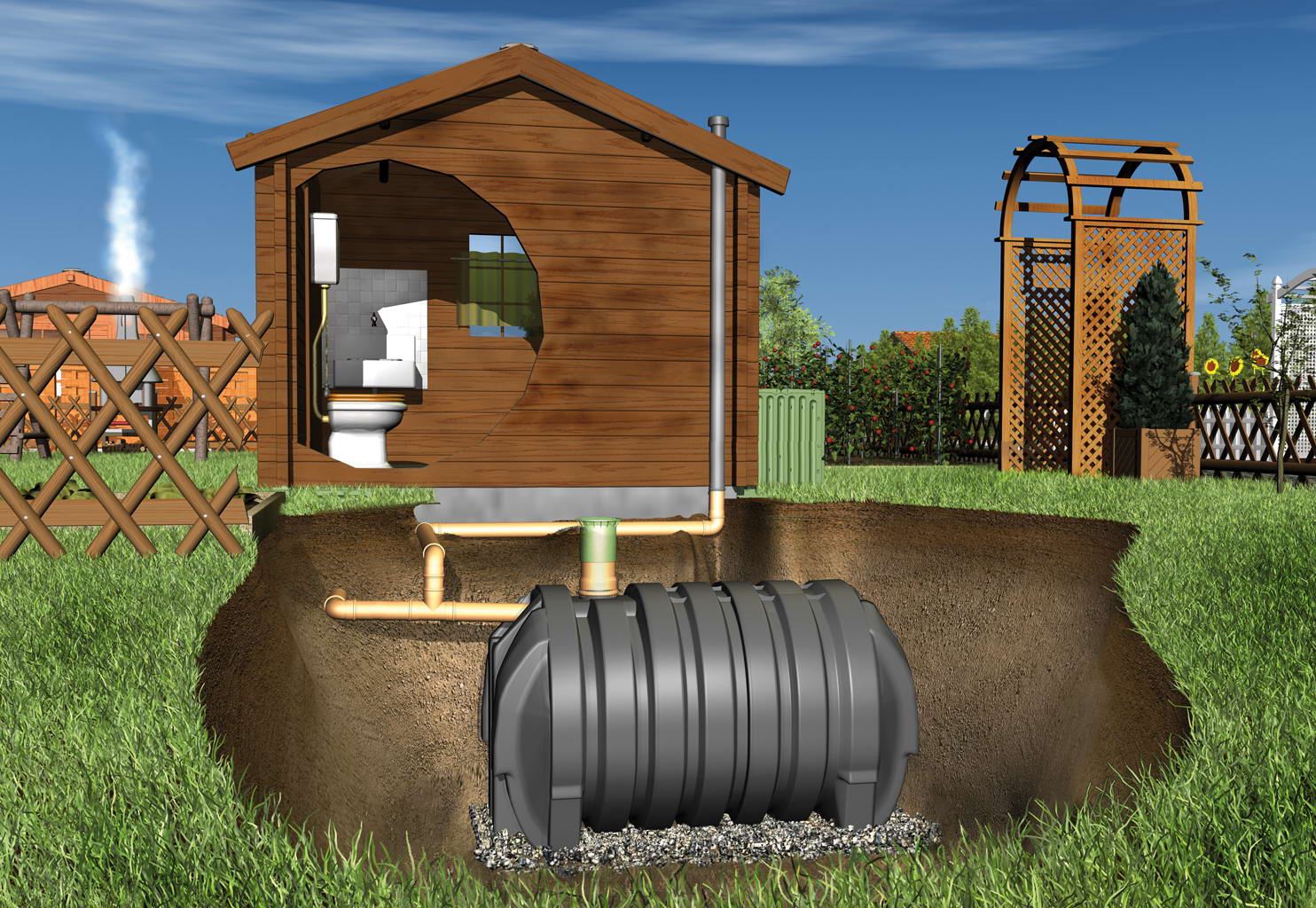

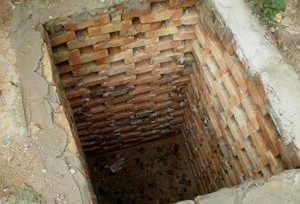 This can be done, starting from the fact that one inhabitant of the house usually has 0.7 cubic meters of liquid. When the volume is known, you can proceed to the next stage, which involves choosing the location of the future waste collector. For the reason that sewage is not a very pleasant substance, when choosing a place for cesspool devices guided by the following rules:
- the depth of the pit must be at least 2 m. This means that groundwater should not approach the surface even during the period when snow melts in spring;
- it is necessary to determine the minimum distance from the buildings located on the site. It is optimal when the cesspool is located at a distance of 5 m to the nearest buildings;
- if the water source is located on the territory of the site, then the cesspool must be built from it at least 30 m;
- when a cesspool is arranged on the site, one should also think about providing free access for the AC machine, which will pick up all the accumulated waste;
- if the site is located on rough terrain, then a storage pit for collecting wastewater must be organized in a lowland.
When creating a cesspool, you can use concrete rings or opt for tires. In addition, it can be laid out of bricks or blocks can be used to create a storage tank for drains. In this case, it is necessary to waterproof not only the joints, but also the bottom of the cesspool. In this case, the penetration of polluted water into the soil and the well will be excluded.
Tools and materials for arranging sewerage
For a sewerage device in a suburban home with your own hands tools and materials will be required. They are selected taking into account the materials from which the containers are made.
For concrete rings, you will need tools for working with mortar and materials for preparing concrete. As well as a drill for mixing the solution with a mixer and working with a crown.
For steel containers, an electric welding machine, bitumen, or bituminous mastic and brushes for their application are useful.
For plastic containers, you will need a drill with a drill and a jigsaw to cut holes.
It is possible to seal the joints of pipes inserted into the containers with the help of tow with cement mortar, subsequently covering them with bitumen.