
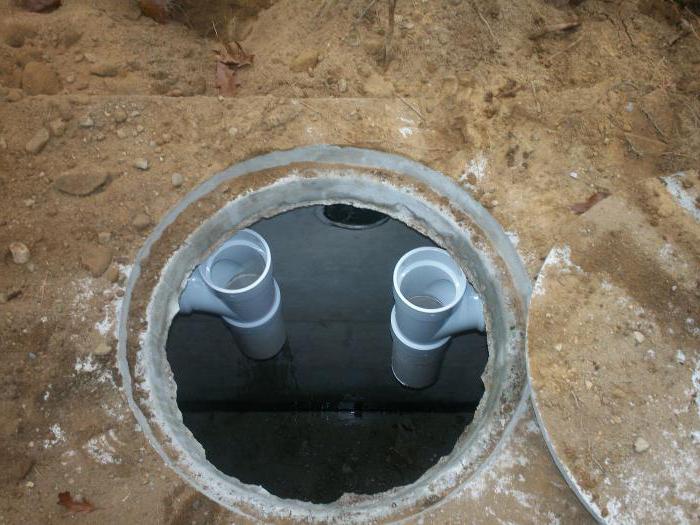
- The device of a septic tank from eurocubes
- Will such a volume of a septic tank be enough
- Types of materials for the septic tank body
- Barrels made of polyethylene
- Barrels made of polypropylene
- fiberglass tanks
- Advantages of plastic septic tanks
- What are the pros and cons of plastic and metal barrels
- Plastic variant
- Iron variant
- Plastic septic tanks
- Septic tank (sump) "Ground Master" for sewerage
- Types of septic tanks, their disadvantages and advantages
- Waste disposal types
- Well
- Autonomous
- Central
- Design features of a septic tank
- The nuances of making a eurocube
- Advantages of a septic tank from an eurocube
- Do-it-yourself Eurocube installation
- How to extend the life of a septic tank from eurocubes
- Common mistakes when installing a septic tank made of polymers
- What material to choose?
- Advantages of a homemade septic tank from barrels
- Metal barrels - temporary waste collection system
- Features of the installation work
- Stage # 1 - sizing and excavation
- Stage # 2 - installation of plastic containers
- Stage # 3 - filter field device
The device of a septic tank from eurocubes
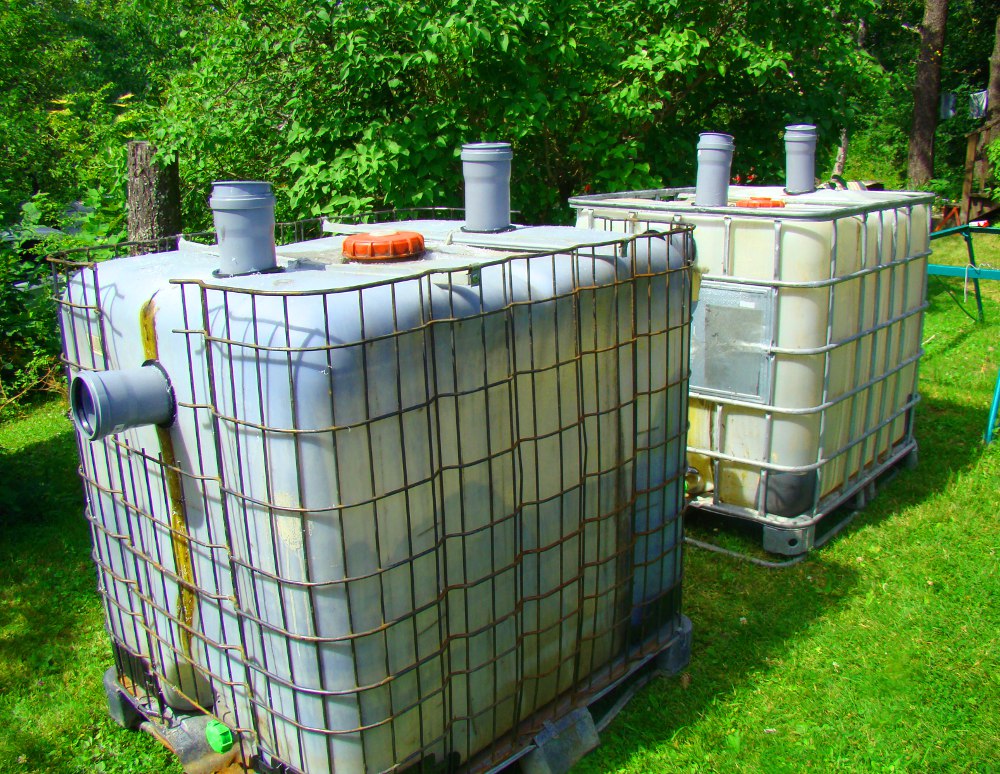
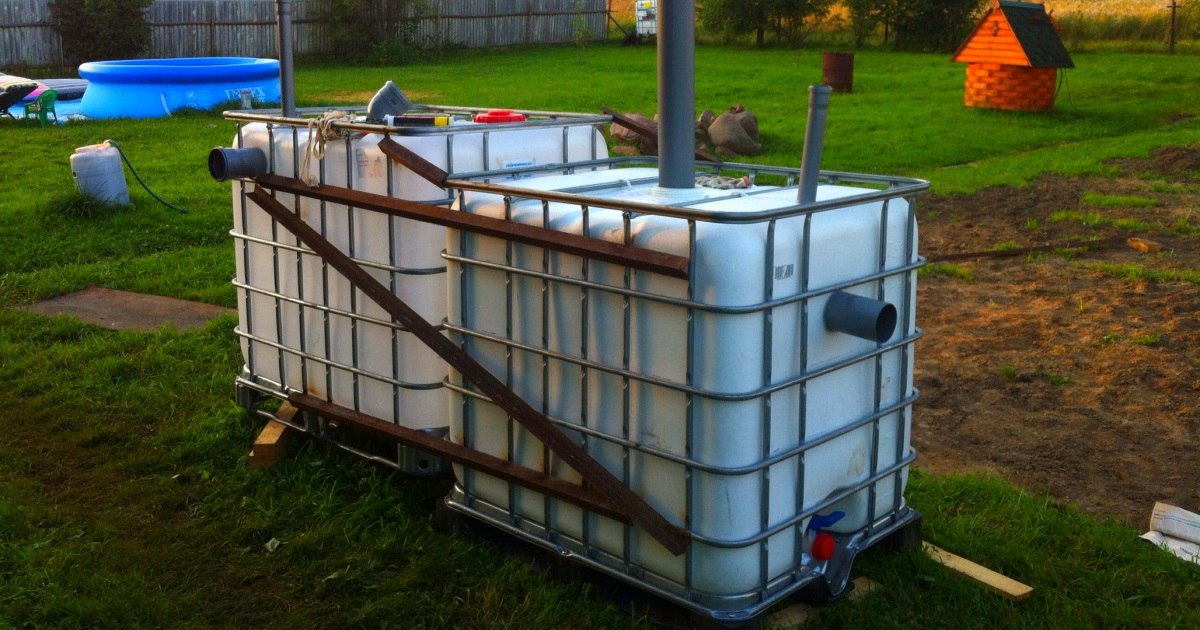
Residents living in a country house always face the issue of disposing of domestic sewer waste. Often the problem is solved with the help of eurocubes - special containers that are used to store water, various liquid substances, including sewage.They are made of polyethylene 1.5-2 mm thick, reinforced with stiffeners. To protect the walls from external influences, the product is enclosed from the outside with a steel mesh. For ease of transportation and installation, the tanks are mounted on wooden or metal pallets.
Tank characteristics:
- Dimensions - 1.2 × 1.0x1.175 m;
- Weight - 67 kg;
- Volume - 1 m3.
The factory-made container for sewer systems is equipped with a cleaning hatch, holes for supplying wastewater, draining clean water and ventilation of the internal cavity, as well as adapters for connecting external communications. Products that are used for transporting and storing liquids do not have technological holes necessary for the operation of the drive, so the openings are made in place. To create a septic tank from do-it-yourself eurocubes You may need several containers, depending on the wishes of the owner.
Brief information about such structures is given in the table:
| Number of Eurocubes | Application | Septic tank cleaning |
| 1 | For a family of 1-2 people who sometimes live in the house | Sewage is pumped out by a cesspool machine or discharged into a filter well |
| 2 | When creating a non-pumpable septic tank for a family of 3-4 people | Content flows by gravity to filter fields |
| 3 | If it is impossible to remove treated wastewater to the site | Purified water is collected in the third tank and taken out by a sewage machine |
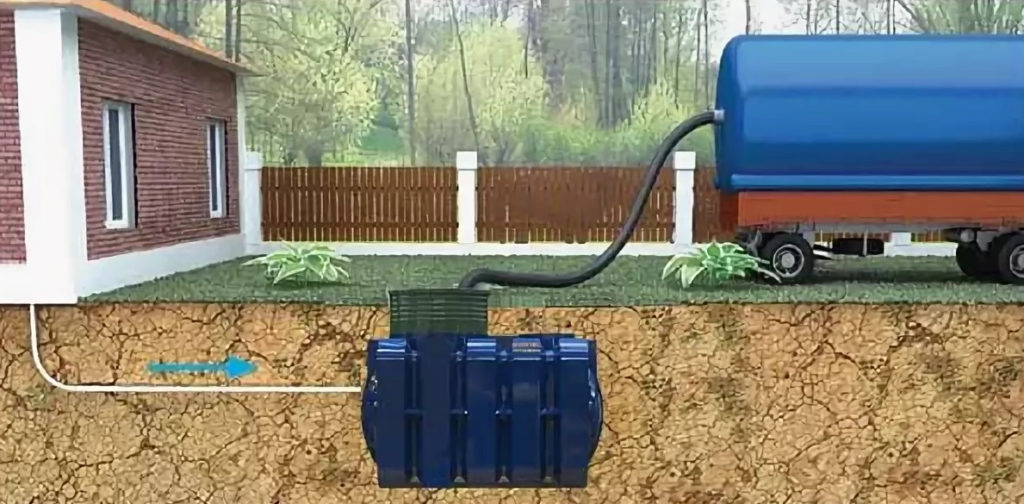
Single chamber septic tank from the eurocube resembles a classic cesspool with sealed walls and a bottom. However, the small volume limits its use in local sewer systems.
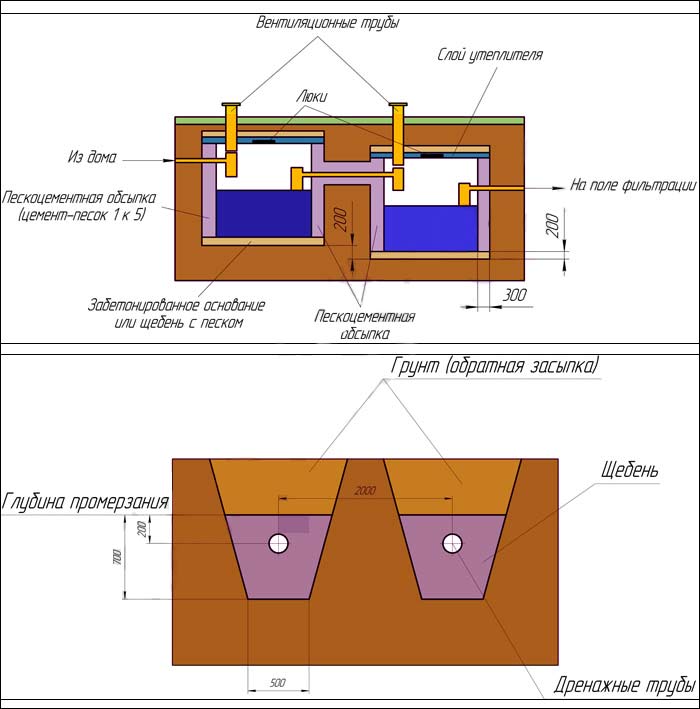
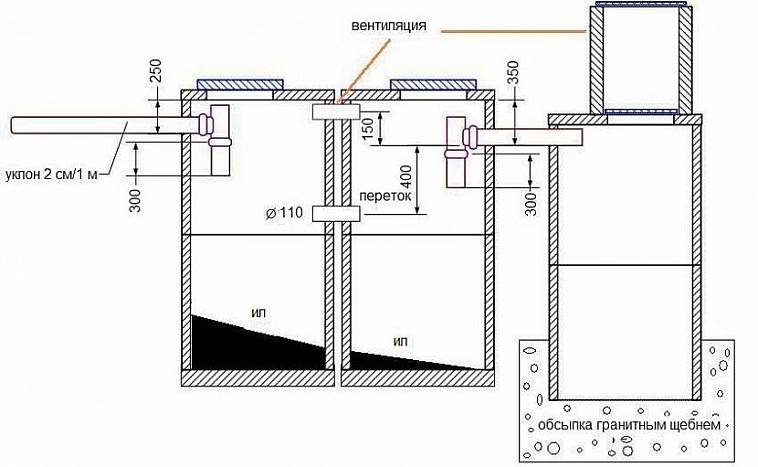
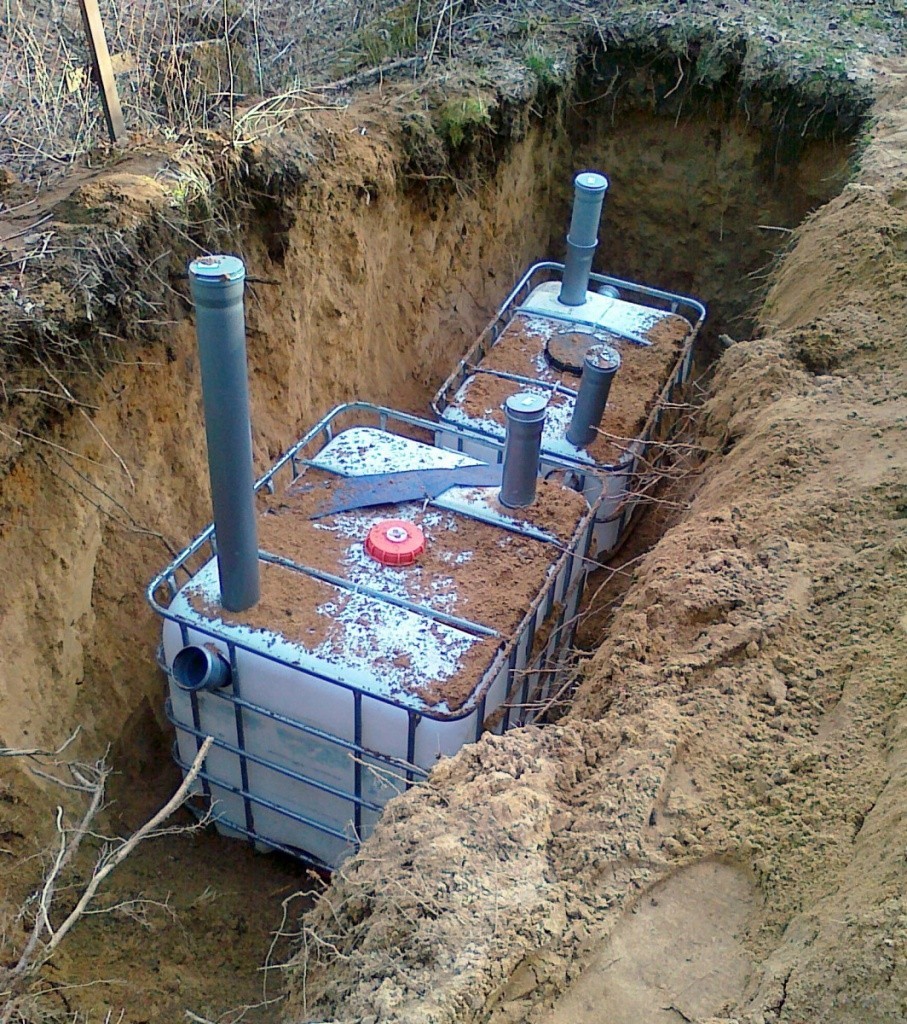
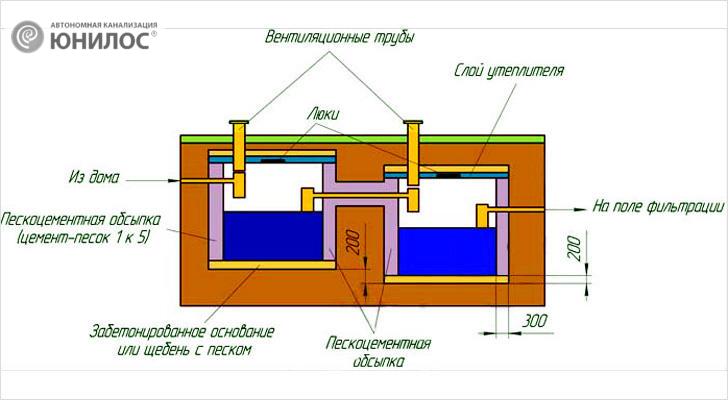
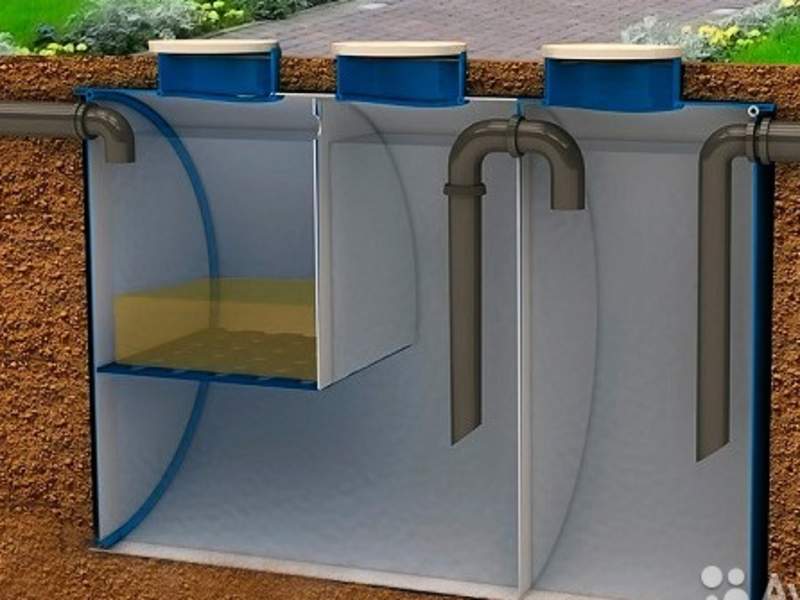
Most often, the owners collect septic tank of two eurocubesenough to serve an ordinary family.The two-chamber device functions as follows:
- Drainage from the house enters the first tank through the sewer pipe.
- Heavy fractions settle to the bottom in this tank, light fractions remain floating on the surface.
- When the liquid level reaches the overflow pipe, the effluents enter the second chamber.
- In it, fragments are decomposed into liquid and gaseous components. The gas exits through the ventilation system, the liquid fractions are removed to the outside through the drainage.
- To improve the rate of organics processing, special microorganisms are added to the second eurocube - bacteria for septic tanks, which are able to live without sunlight and oxygen.
- After the storage tank, the water must be additionally purified in soil filters, which are built nearby.
- Solid fractions from the first container will have to be removed mechanically once a year. The volume of insoluble elements is no more than 0.5% of the total volume of waste, so the tank will not be filled soon.
Third tank used in the scheme of septic tanks from European cups, if the soil in the area is swampy or the groundwater level is very high. The purified liquid is drained into it, which is then taken out by a sewage machine.
If there are no sewer products on sale, buy a non-food container or used unwashed containers (they will cost less). The main requirement for them is tightness, the absence of cracks and other defects.
Will such a volume of a septic tank be enough
If you use it to the fullest (shower, toilet, sink, etc.), then 200 liters per person per day are accepted for calculation.
If only the toilet, then 25 liters per person per day
The septic tank must be at least 3 daily water consumption.
However (from the photographs), it turns out that the second chamber-barrel "works" only for half the volume (about 100 liters), and the third, in general, for a quarter. In total, the total volume of the septic tank is 200 + 100 + 50 = 350 liters ... It seems to me that this is really not enough for peace of mind).
It turns out about 150 liters * 3 = 450 in one barrel. According to my calculations, it’s enough for three (only the toilet is hooked up).
I have an analogue. Three children and two adults year-round. It has been working for 1 year and 10 months. Has not been pumped out yet. In addition, 10 meters of a leaky pipe in the ground.
Types of materials for the septic tank body
When the conversation turns to plastic containers for septic tank, it is necessary to designate three options for the raw material:
- polyethylene;
- polypropylene;
- fiberglass.
Barrels made of polyethylene
They are made of low-pressure polyethylene using rotary technology. This provides high mechanical strength, but such containers are very fragile. For example, upon impact, the tank does not deform, but bursts. And this must be taken into account when installing a plastic container. Such tanks are made with stiffeners.
Advantages:
- Working temperature: from -50C to +70C.
- The body of the septic tank is made in the form of a multilayer structure, which makes it possible to operate it for up to 30 years;
- A wide range of containers for different purposes, different shapes and sizes.
Flaws:
- The upper temperature level is low, which can cause deformation of the tank. Because in the process of processing organic matter by bacteria, heat is generated;
- The specific gravity of the septic tank is small, and this is a high probability that it will float under the pressure of a high GWL. Under it, it is necessary to build either a thick concrete base or think over an anchoring system.
Barrels made of polypropylene
This type of polymer is not as dense as HDPE. But it is more resistant to external loads. Such tanks for a septic tank are often used as a basic design in VOCs.
Advantages:
- Working temperature: from -50С to +140С;
- Low abrasion;
- The service life is at least 50 years, if the tank is installed correctly.
Flaws:
- The thickness of the walls of the body is not more than 2 cm. This reduces the bearing capacity of the structure, if it were not for the stiffening ribs, then such tanks could not be used as septic tanks;
- The price is higher than that of polyethylene counterparts.
fiberglass tanks
The material of this type of plastic septic tank is resin, to which fiberglass is added. The weight of the tank is slightly more than similar polymer ones, but its stiffness coefficient is an order of magnitude higher. Such septic tanks can be characterized as follows - durability is commensurate with plastic tanks, and reliability corresponds to steel tanks.
Let's add to the benefits:
- Small specific gravity;
- During installation, some dimensional deviations can be allowed;
- High resistance to many aggressive environments.
Advantages of plastic septic tanks
From the foregoing, we can conclude that plastic containers for septic tanks are, first of all, one hundred percent corrosion resistance, design reliability and long-term operation. Manufacturers offer a huge range of tanks, which are selected according to the volume and installation method. For example, for horizontally located tanks there is no need to dig a deep pit. They are recommended to be installed in areas where the groundwater level is high.
Another important advantage is the price.Of all possible septic tanks, plastic ones are the cheapest.
This applies to both finished products and prefabricated structures in the form of concrete rings, brick or block structures. Installation of a plastic septic tank is so simple that even an inexperienced person can handle this process. You need to know some of the nuances of the construction process, but it's not difficult.


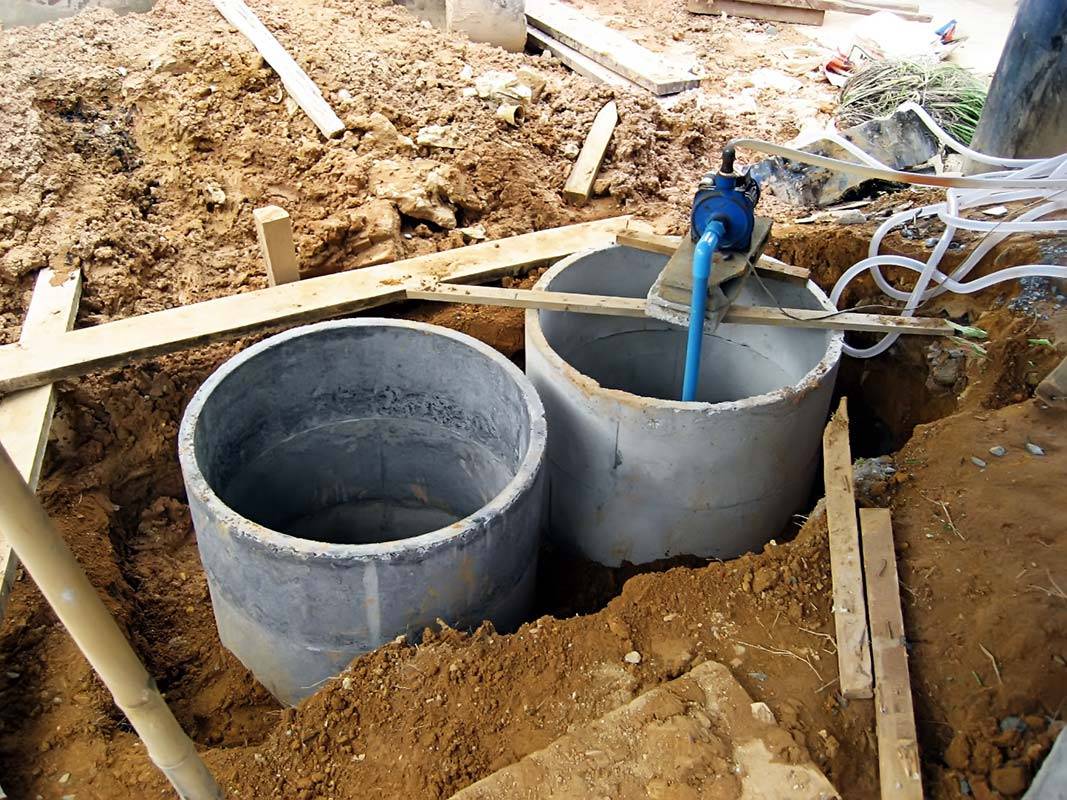

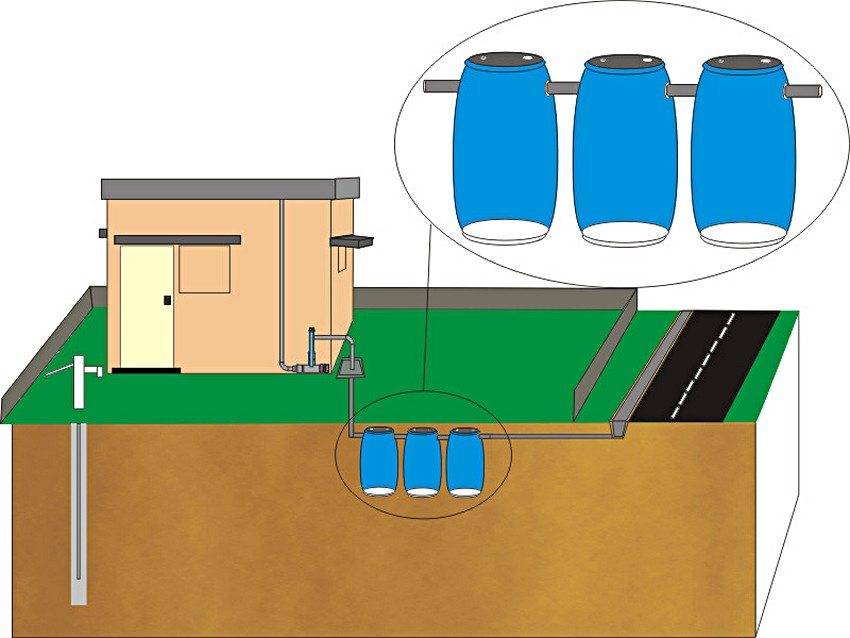


The following follows from the previous advantage. If you purchase not one septic tank, but two, then you can bring the sewage treatment to the maximum level of purity. And this is the criterion of environmental friendliness.
What are the pros and cons of plastic and metal barrels
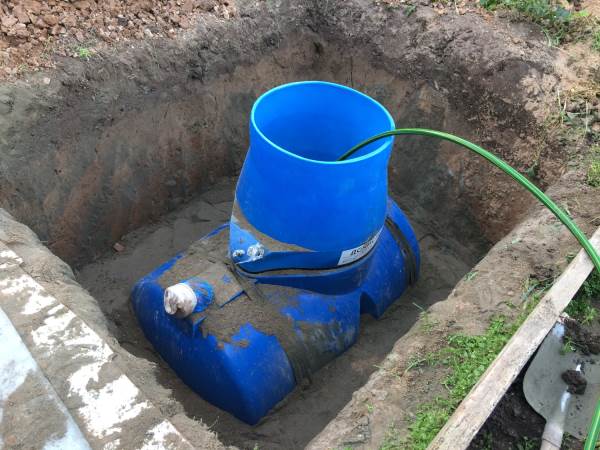
The basis for the construction of an autonomous sewer system is a barrel tank. For arrangement, two types are used - metal or plastic. Since it is not so easy to make a septic tank from barrels with your own hands, the choice of packaging is up to the owner. Metal containers usually have a capacity of 200 liters. Plastic - available in large sizes. For reasons of economy, it is better to install the existing tanks. But when you plan to buy a container, you should explore different options.
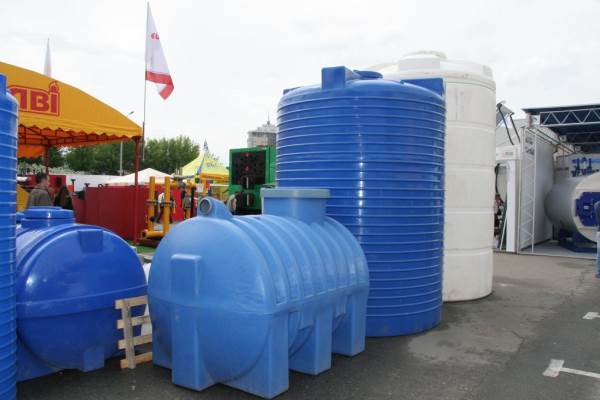
Plastic variant
Pros of using:
- Little weight;
- Ease of installation;
- Ease of making holes;
- Full waterproof;
- Corrosion resistance.
Cons of products:
- The light weight of the product requires stable attachment to the foundation to avoid "floating" when flooded from excessive rainfall;
- The elasticity of the material leads to the compression of containers by soils.
Iron variant
Advantages of iron barrels for the construction of a cesspool:
- High rigidity and strength of products;
- Sufficient water resistance;
- Structural stability.
Flaws:
- Susceptibility to corrosion, which requires the application of a waterproofing coating;
- The labor-intensive process of making holes, using power tools.
The main disadvantage of a sump from barrels is the small volume of chambers. This is the reason for the frequent pumping of sediment.
Plastic septic tanks
Septic tank (sump) "Ground Master" for sewerage
What is a septic tank, which one is better, advantages?
Septic tanks come in different designs:
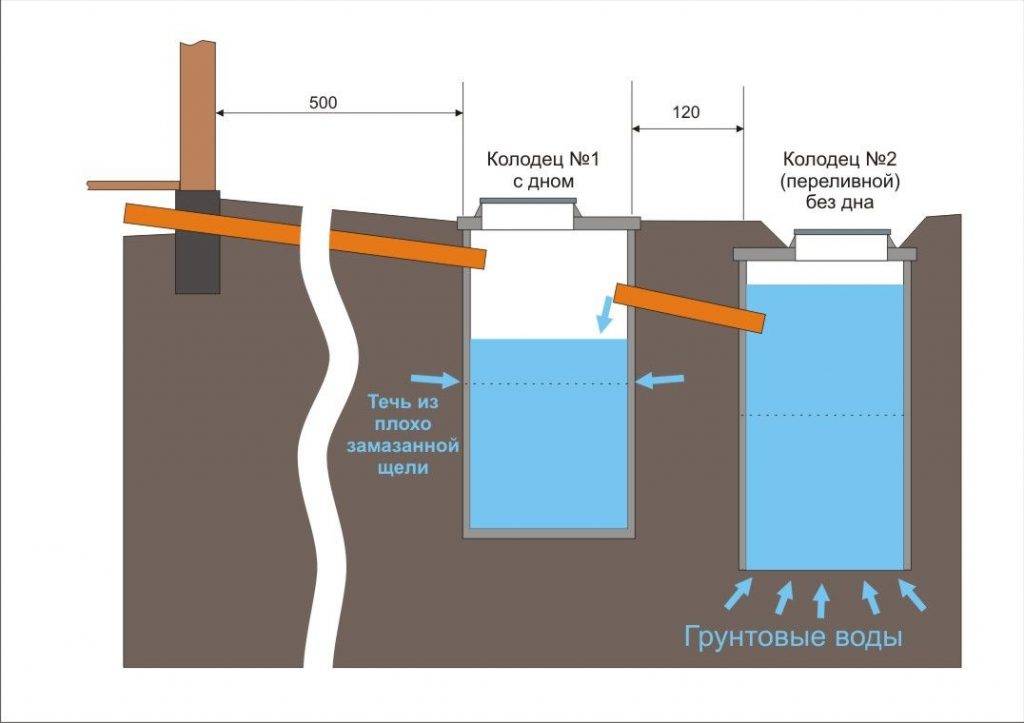
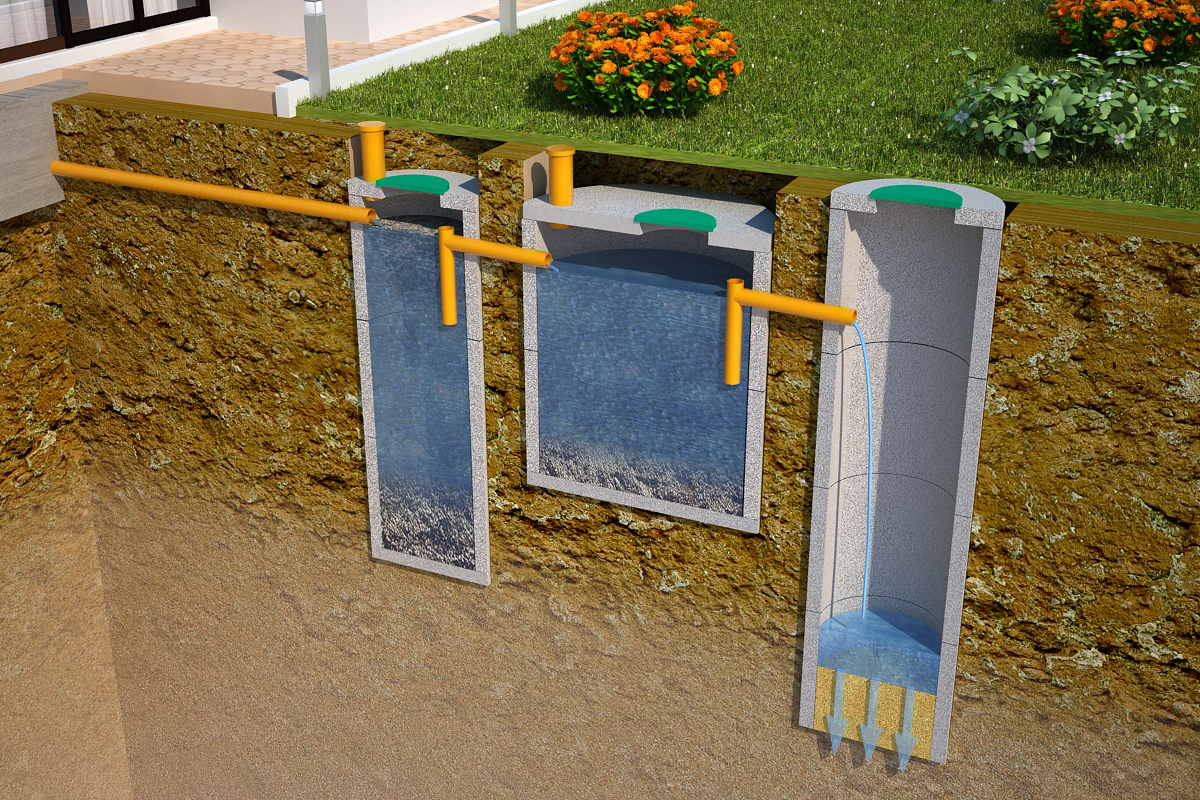
The first option is wells made of reinforced concrete rings, i.e. a cesspool with one or two additional wells for overflow. The first well will play the role of a sump, since it becomes deaf with a bottom, the rest of the wells will play the role of drainage, where conditionally purified water will overflow, which will subsequently have to go into the ground
This option is quite costly in terms of money, takes up a lot of space on your site, and what is important, does not give what you expect from it, comfort. Those
there will be an unpleasant smell on the site, since it is not airtight, sewage will seep into the ground through the cracks at the joints of the rings, and if you have a well nearby, then this does not bode well. If you have high groundwater at your site, a septic tank made of reinforced concrete rings will not cope with its task and therefore is not economically profitable.
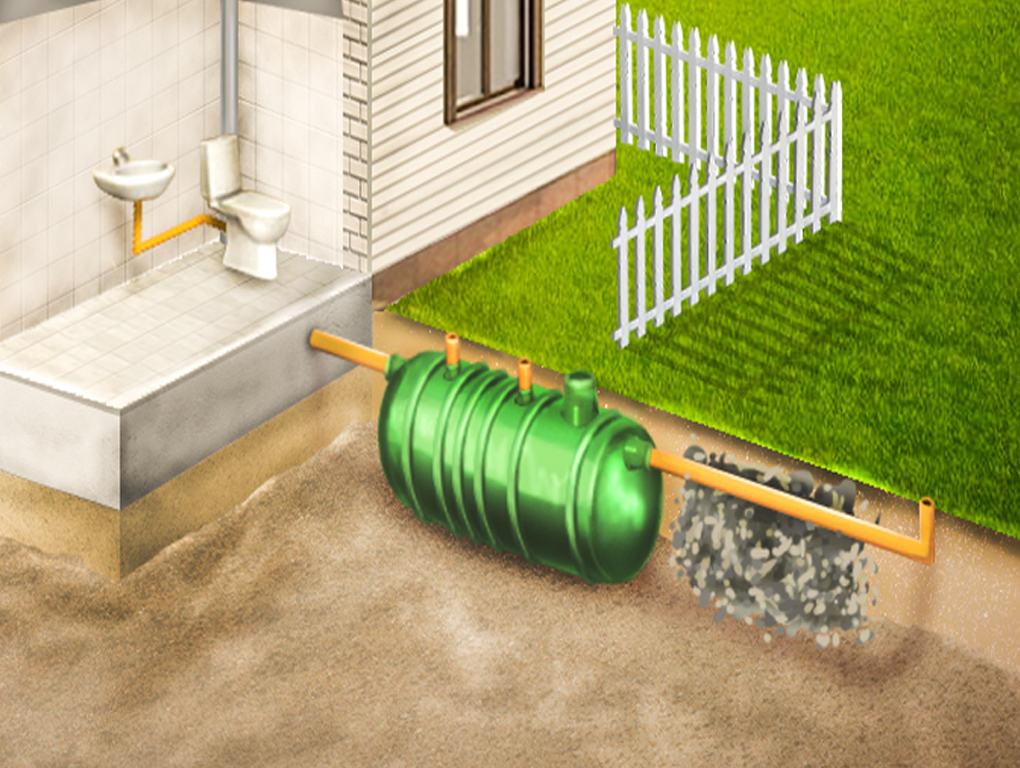
The second option is a plastic, 3-chamber, airtight septic tank, lightweight, which allows you not to use equipment during installation. What is a septic tank, it is a cylindrical container, divided into three chambers inside.It can be installed both in a dacha (up to 3 residents) and in a cottage (where from 6 or more residents). It is possible to install near the house, not volatile, does not require permanent residence. Discharge of purified water be carried out either in a drainage well, or in an old operating pit, if it is not possible to install a new drainage. From maintenance, it is required to pump out silt once every 2 years, for which you can call a sewer, or do it on your own using a drainage pump.
What is ground water?
Ground water is gravitational water, i.e. a permanent aquifer. The height of groundwater may vary depending on the season, rise in spring, go deep into the ground in summer, and rise again in autumn. Do not forget that groundwater has a devastating effect on concrete and other building materials. Of course, the most unpleasant thing in this situation is that your wells from reinforced concrete rings will periodically flood or simply stand in the water.
Septic tank plastic one, two, three chamber, which is better?
Why are two cameras better than one and worse than three cameras? What is the degree of purification?
Let's look at each of these options:
A single-chamber septic tank is - it doesn’t matter if it is a cylindrical, square or rectangular container, but without internal partitions, and the role of this septic tank will only be to accumulate household wastewater, cleaning is no more than 10%. Two-chamber septic tank, i.e.
inside there will be one partition dividing the container in half, where the first chamber will act as a sump (everything heavy will settle in the first chamber), conditionally purified water will overflow into the second chamber.In this case, the wastewater treatment at the outlet will be 10-20%
Two-chamber septic tank, i.e. inside there will be one partition dividing the container in half, where the first chamber will act as a sump (everything heavy will settle in the first chamber), conditionally purified water will overflow into the second chamber. In this case, the wastewater treatment at the outlet will be 10-20%.
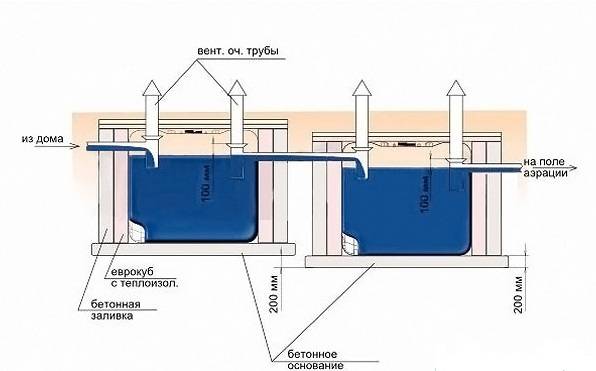
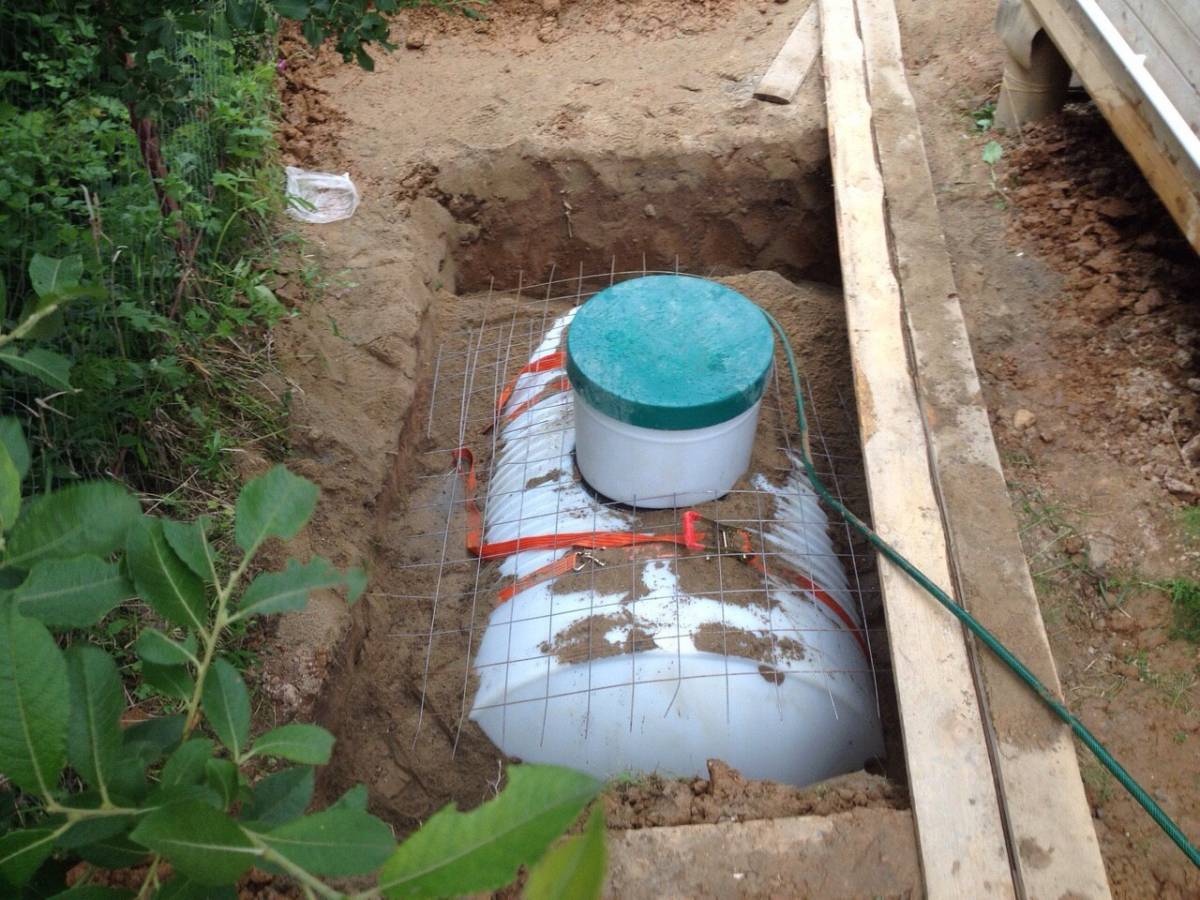



A three-chamber septic tank, I want to emphasize that this is already a septic tank, in which household wastewater goes through all degrees of mechanical treatment. Heavy sewage will settle in the first chamber, coarsely dispersed particles will settle in the second chamber, gray drain is already pouring into the third chamber, with 30-60% purification at the outlet of the septic tank.
Usually, purified water is discharged into a drainage well or soil post-treatment, and the higher the % of treatment, the better and longer the drainage will work.
Do-it-yourself installation of a septic tank?
Installation is quite simple, if you have the desire and time, then it will not be difficult for you to mount a septic tank on your own. But you can also contact the specialists, our company will carry out the installation in one day, saving your time and nerves. Beforehand, we will help you choose the right septic tank, tell you where it is better to mount it, we will make high-quality and inexpensive installation, we give a 3-year guarantee for our materials used during installation and for the work itself.
Plastic septic tanks Plastic septic tanks Septic tank (sump) "Ground Master" for sewerage What is a septic tank, which one is better, advantages? Septic tanks come in different designs: The first option is wells
Types of septic tanks, their disadvantages and advantages
In a private house or in a summer cottage, you can organize this in several ways:
- Purchase a fully ready-to-use treatment plant. This is the most expensive way to solve the problem, but also the most reliable. Installation of a factory-made treatment plant will allow for the most complete treatment of the waste liquid, which in turn allows minimizing the cost of operational maintenance. Septic tanks of this design are almost never pumped out. Over time, the installation of a low-maintenance treatment plant pays off, so this option is recommended for those who have the opportunity to spend a fairly impressive amount at a time. Also, the advantages of these designs include a huge variety of existing models, which allows you to equip an automated drain pit for comfortable use by a family of any size.
- Install a simple plastic container. This method is more suitable for buildings located near service sewage organizations, since in this case it will be necessary to periodically pump out the accumulated waste as it is filled. The advantages of this design are ease of installation and reliability, subject to the recommended installation technology and operating mode. The disadvantage is the need for regular emptying of the filled container, which entails quite large operating costs. This device cannot be fully called a septic tank, since it practically does not process human waste.
Waste disposal types
- Central.
- Autonomous.
- Well.
Well
The well is intended for diversion of sanitary drains in private houses. Its advantages are simple installation and low cost.To use such a system, a sufficiently large depression in the ground is used, which is fenced with concrete and plastic rings, or with a home-made brick structure.
The disadvantage of the well is the frequent need for pumping. Since all the waste that enters the sewer without treatment is drained into the well, a dense sediment forms at the bottom, which prevents the absorption of moisture.
Another disadvantage is environmental pollution. Since the drains are not subject to pre-treatment, all the chemicals that are used in the house have a negative impact on the environment.
Autonomous
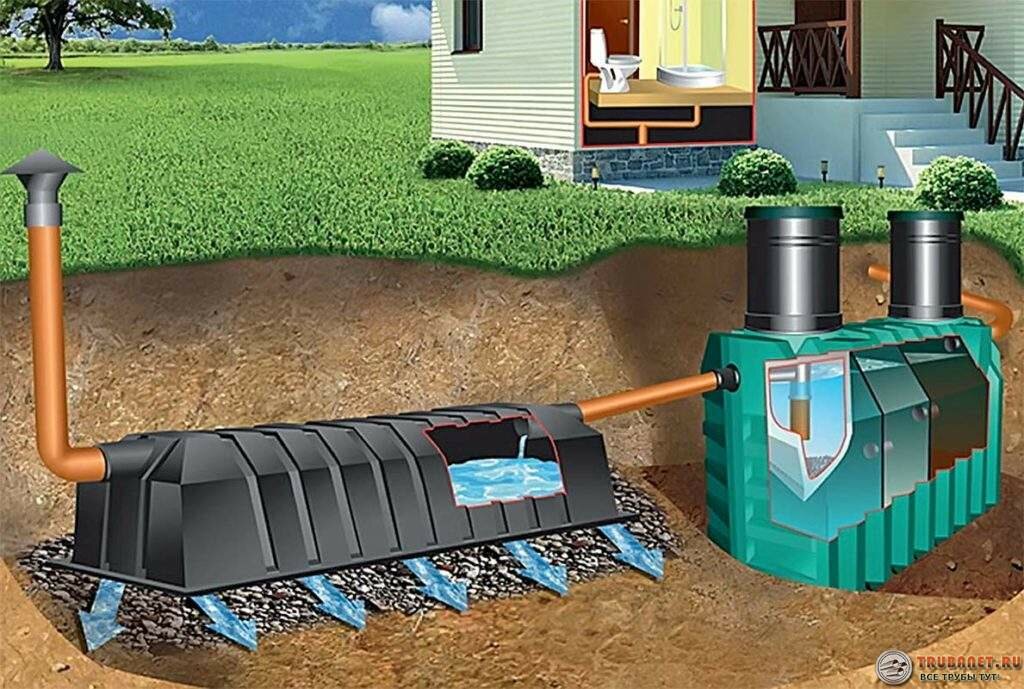
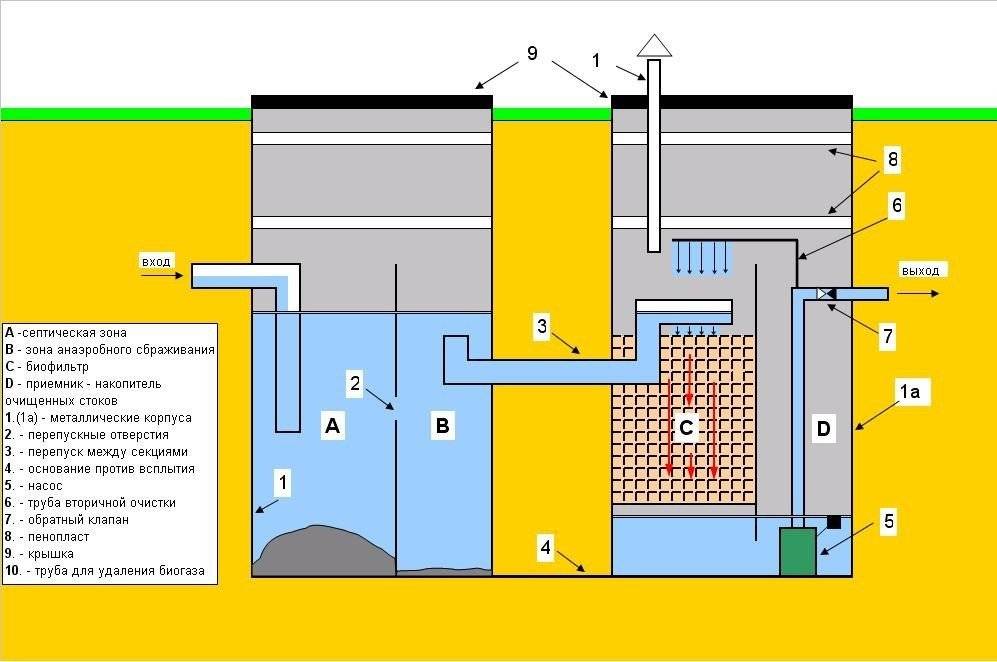
A septic tank is a more humane way of removing wastewater. The basic principle of its work is the initial purification of water from toxic impurities and solid waste. This system consists of several reservoirs. Sewerage is released into the first tank. Due to the different mass, solid waste and chemical components settle to the bottom, lighter fats and objects rise to the surface, and water passes to the second stage of purification through a special pipe.
The second tank can be used as a backup sump, or have the function of decomposing household chemicals into components. To do this, biological additives are used, which in a short time help to decompose all the impurities contained in the water.
In the future, already purified water can be pumped out or used for irrigation. Before making decisions about the use of irrigation fluid, it is necessary to measure the level of contamination of water with chemicals. If the content of harmful substances is high, specialized filters should be used.
Thus, it is possible to reduce water consumption and provide an opportunity to revise the water supply project, which will significantly reduce costs.
Important! When using this method, it is necessary to provide the septic tank with inspection hatches for cleaning, as well as provide it with a ventilation system to eliminate fumes and gas that is formed during the decomposition of various substances. Advantages of a septic tank:
Advantages of a septic tank:
- Increased environmental friendliness compared to a well.
- Possibility of separate cleaning.
Flaws:
Increased system and installation cost.
Central
Not everyone can use the central sewerage system due to the fact that pipes for draining sewage are often not stretched to the private sector. If this is possible, then it is necessary to obtain special permission at the planning stage, which will allow the use of this method.
Despite the fact that obtaining permission will require additional financial costs, the user gets the opportunity to freely use this system in his home. There is also no need for regular pumping and the use of various means that accelerate the decomposition of substances in the well.




There are factors that may affect the use of a waste disposal method:
- Climate.
- The number of water disposal units in the house.
- Possibility of use for discharge of rainfall.
Depending on the surrounding climate, the depth of freezing of the earth in winter can be different. Based on this, the depth and volume of the septic tank or well used is designed. In order not to damage the pipe system and the well itself, it is necessary to calculate the correct depth to which the tank will be immersed.If the calculations are not correct, this can lead to additional costs for repairing or replacing the entire project.
The number of nodes also affects the volume of the tanks and the diameter of the discharge pipes. If the house uses one bath, then the volume of liquid passing through the pipes will be small, respectively, you can use a pipe of a smaller diameter.
In order to protect the adjacent area from the formation of large puddles, storm trays are often used around the house, which drain all the liquid into the tank or remove water outside the house area, which can harm neighbors.
Design features of a septic tank
When choosing purchased products, pay attention to the price and manufacturer
It is important to purchase a quality tank, even if it is more expensive than other samples. Otherwise, it may leak and contaminate the area.
Otherwise, it may leak and contaminate the area.
| Material | Advantages | Flaws | Application |
| concrete rings | Short construction time, easy installation | It is impossible to ensure the complete tightness of the tank, installation is carried out using a crane | Areas with low groundwater levels |
| Monolithic concrete structure | High strength, tank tightness, long service life | Installation is very laborious, long construction time | With a high level of groundwater, if it is necessary to create an airtight cleaning tank |
| Plastic | Light weight, easy installation, long service life | Tanks are limited | With a high level of groundwater and the need to create an airtight cleaning tank |
| Brick | You can do the work yourself | It is difficult to ensure the tightness of the tank, installation is very laborious | In areas with low groundwater levels |
- single chamber. It is often called a cesspool. It is used if groundwater is located close to the surface or there is a source of drinking water nearby. It is a sealed container where drains from the house are drained through pipes. After filling the tank, the liquid is taken out by a sewage machine.
- Two-chamber with mechanical cleaning. The first container serves to receive waste. In it, the heaviest elements sink to the bottom. Water with light inclusions overflows into the second compartment, where other elements continue to settle. Thanks to microorganisms, the sediment decomposes into simple elements, which makes it easy to bring them out. In a septic tank, drains are cleaned by more than 50%. Then they enter the soil filter made of sand and gravel, which is also called the filtration field. In it, water is purified up to 95%. Bacteria present in the upper layers of the soil destroy organic matter left in the drains. The purified liquid seeps into the ground. Two-chamber septic tanks need periodic cleaning from bottom sediments. If it is impossible to drain the wastewater, a third tank is built, sealed, to collect the clarified liquid. Then it is used for economic purposes, for example, for irrigation.
- Two-chamber with biological treatment. In this design, there are special bacteria that decompose organic matter. Most of the inclusions are soluble in water. The liquid after the sump can be reused for household purposes. Such septic tanks are extremely rarely cleaned, because. microorganisms process almost all dirt.
The nuances of making a eurocube
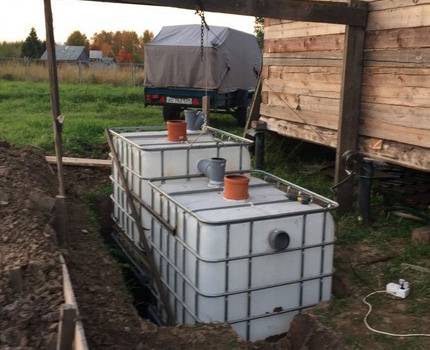
You can make a septic tank with your own hands from 2-3 eurocubes connected in turn.
Eurocubes should be located at different levels, i.e. each will be lower than the previous one, then the drains will flow from one eurocube to another.
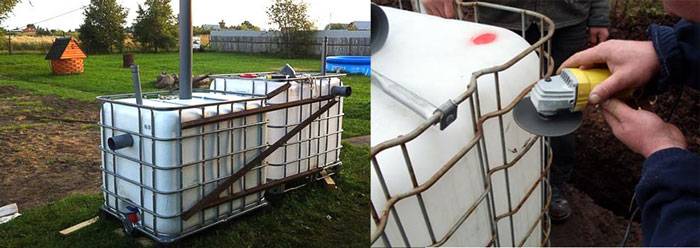
During the cleaning process, they will be broken down by anaerobic bacteria.
In order for a do-it-yourself septic tank made of eurocubes to exist for a long time without pumping out, it is necessary to fill in biologically active substances during the installation process, after interacting with which, the purified liquid is absorbed into the soil.
Silt can be removed once every few years, leaving an appropriate hole in the eurocube for this.
Advantages of a septic tank from an eurocube
- Resistant to sufficiently large loads;
- High tightness;
- Ease of installation of pipes in eurocubes;
- Resists the effects of chemicals;
- democratic value;
- Does not require special care;
- Light weight;
- With the accuracy of self-assembly, an excellent septic tank is obtained.
Cons of using Eurocube for septic tanks:
- The need for good fastening of the eurocube in the ground, or concreting, because due to its low weight, groundwater can push it out of the ground to the surface;
- Possible deformation of the eurocube surface, both in severe frosts and at too high loads.
Do-it-yourself Eurocube installation
Self-installation of a septic tank from eurocubes in the country includes several stages:
- It is necessary to calculate the volume of the tank. Since sufficient purification occurs in 3 days, the volume of the tank should include three times the daily volume of water consumption.For example, if 4 people live in a house, who use 150 liters each per day, then 600 liters must be multiplied by 3 and we get 1800 liters as a result. Thus, you need to buy 3 containers for a septic tank from 3 eurocubes with a volume of approximately 1.8 m3 each. You should take a septic tank with a volume slightly larger than calculated if you often have guests.
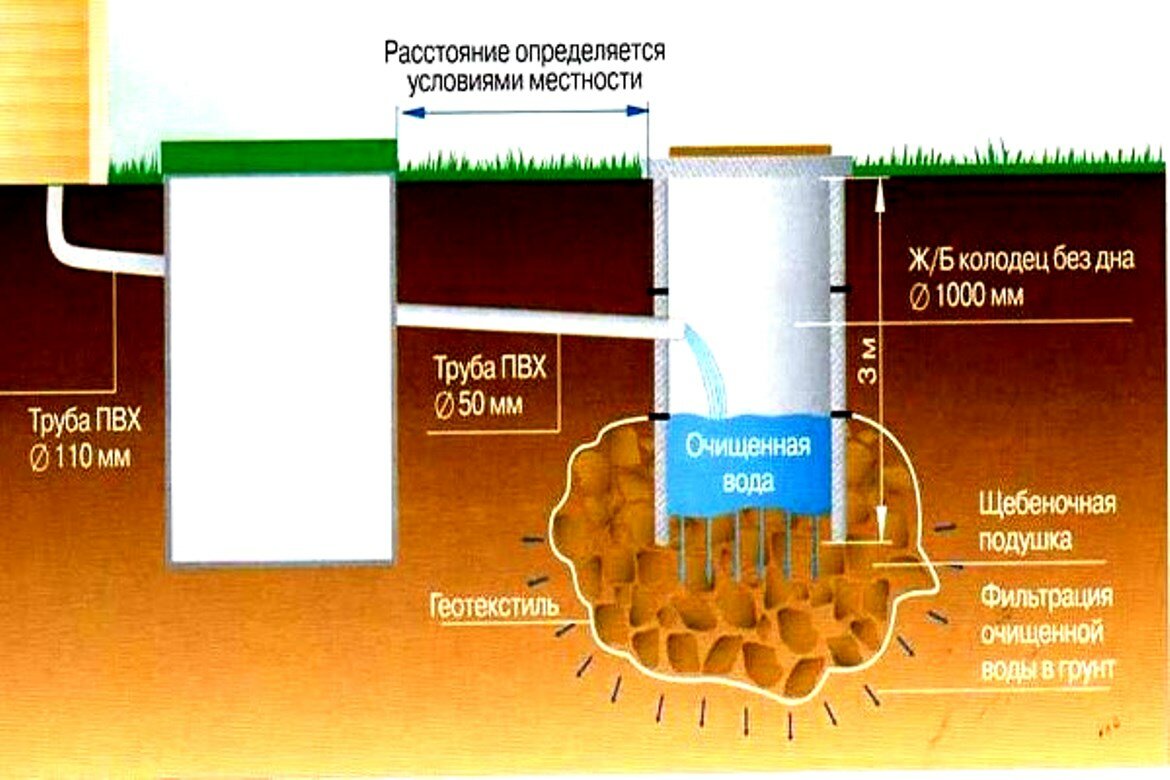
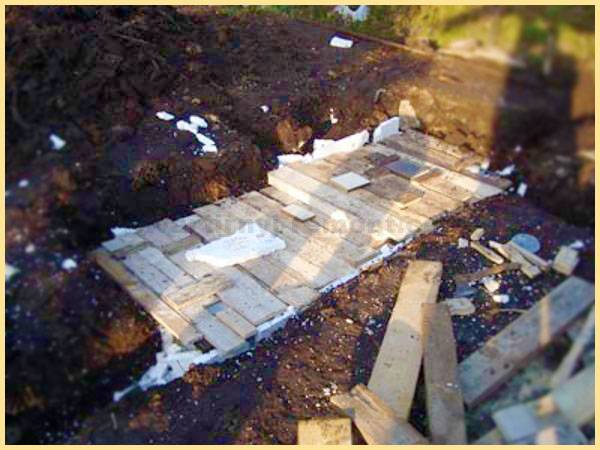
- Excavation. First of all, you need to start preparing trenches for pipes for a septic tank and a pit. Dig a hole 30 cm wider than the Eurocube itself. When calculating the depth, consider the dimensions of the concrete base, insulation and the zero temperature point. It must be remembered that the pipes run with a slope of 3 cm per meter, and also lie below the zero temperature point. The bottom of the pit is poured with concrete and hinges are installed for attaching the eurocube. Before concrete is poured, a sand cushion is usually placed at the bottom of the pit under the septic tank pipes.
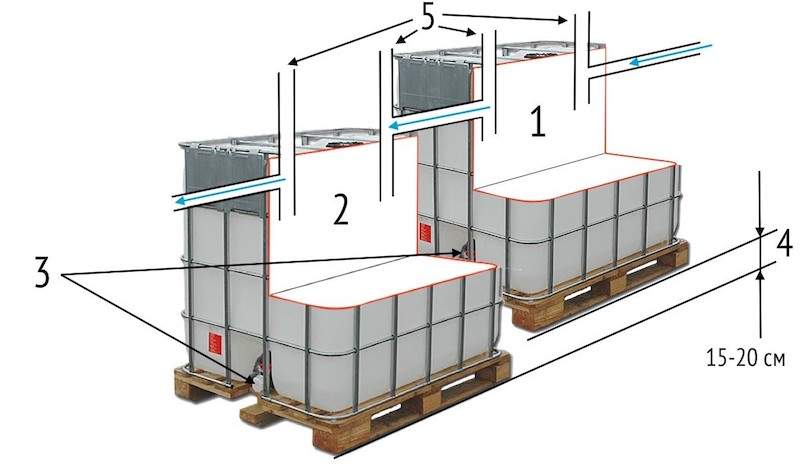
- Construction collection. The first 2 eurocubes are connected to each other and to the sewer pipe, an overflow outlet is placed between the 2nd and 3rd eurocubes. The latter is directly connected to the filter field.
In order to carry out the installation of a septic tank, it is necessary to have eurocubes, several pipes with a cross section of 150 mm (their number varies and depends on the number of ventilation, transitions between tanks), as well as 6 adapters.
At the beginning, it is required to make cuts for tees in the necks of the eurocube. After 20 cm from the top down, make passages for the outlet pipe, which must be connected to the tee inside the chamber.
Next, on the opposite side of the eurocube, you need to cut a pass 40 cm from the top. Don't forget to make a slot for ventilation in the lid, and install each camera exactly 20 cm below.
With self-installation of a septic tank, it is necessary to seal the junctions of the pipe with the Eurocube with high quality.
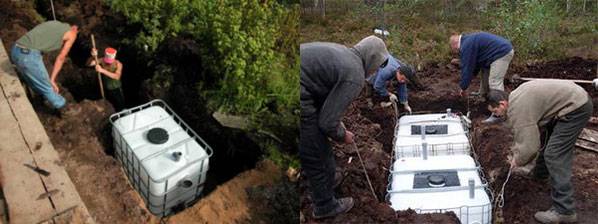
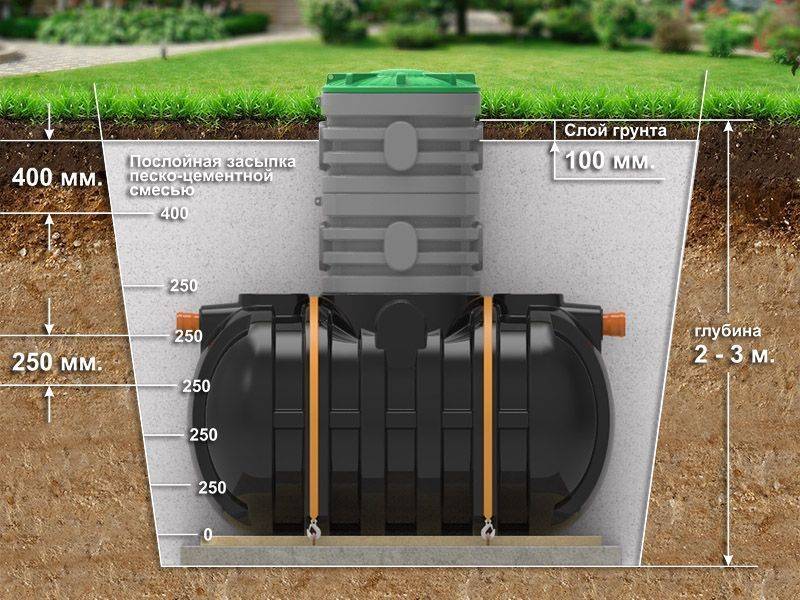
- Pit processing. To protect the eurocube from deformation, a mixture of cement and sand is used 5: 1, respectively. The top of the structure is covered with this mixture several times, it is necessary to press each layer.
In order to prevent deformation of the eurocube walls from soil pressure during installation, fill it with water. You will also need penoizol in order to cover the upper surface of the septic tank.


How to extend the life of a septic tank from eurocubes
The septic tank does not require special maintenance, but some points should be considered in order to extend its useful life:
- Once every couple of years, it is required to remove the sediment from the tank;
- Periodically add supplements.
A do-it-yourself septic tank made of eurocubes is an economical and excellent option for its use in any climate zone.
Common mistakes when installing a septic tank made of polymers
Often hosts who seek to establish plastic sewer welldo-it-yourself sump without the help of professionals, make annoying mistakes. Those, in turn, lead to a disruption in the operation of the treatment plant and, accordingly, a decrease in its efficiency. But in the worst case scenario, it may be necessary to dismantle the tank and install a new one.
So, common mistakes:
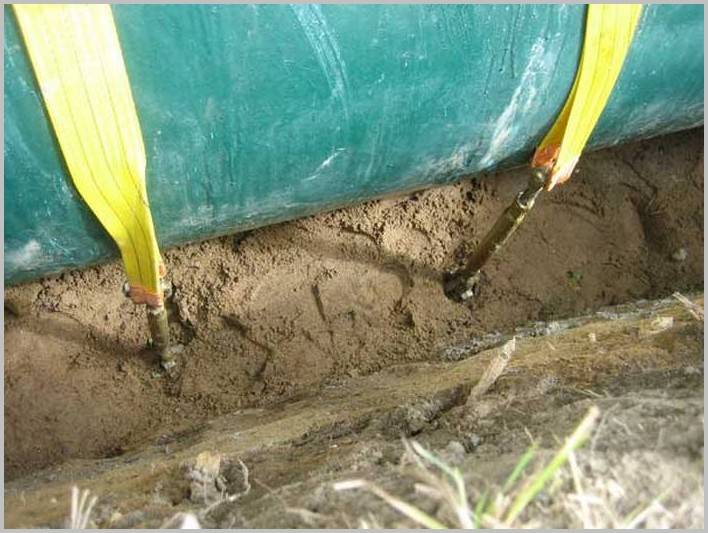
A polymer septic tank is not attached to a concrete slab. It should be borne in mind that too low specific gravity of the tank does not work in favor of the tank if it is not anchored.That is, even a filled sump will feel like a float in the ground. And therefore, it is possible that the container will be washed out of the soil to the surface.
- The absence of a cement-sand sarcophagus. Such neglect can lead to freezing of drains in the tank. Or the septic tank will be pushed out due to seasonal heaving of the soil.
- Use of unsifted coarse sand for sprinkling the tank. Here it is worth considering that large grains of sand under the influence of cold in the ground and possible moisture can behave according to the principle of a cutting mechanism. That is, under the load of soil for compression, coarse sand at low temperatures is able to form microcracks on the walls of the tank, which over time will lead to depressurization of the tank.
Thus, it can be seen that a polymer septic tank is a good solution for creating a private sewerage and wastewater treatment system, but with a competent approach to its installation.
What material to choose?
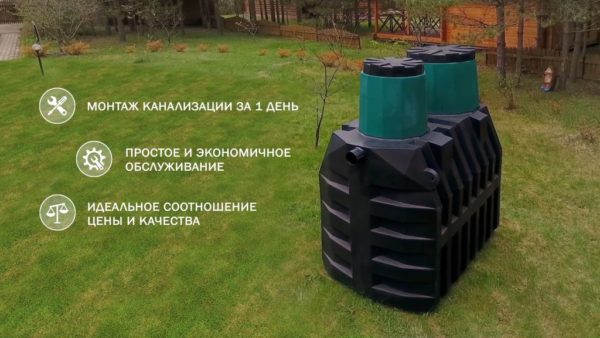
Anaerobic septic tanks without pumping can be purchased ready-made. For example, for four people, the Termit company offers the Profi 2.0 model. The price of such devices is lower than for aerobic installations, however, it often exceeds the final cost of a soil-filtered septic tank, equipped independently.
 "Profi 2.0"
Homemade devices can be made from various materials.
| A photo | Description |
|---|---|
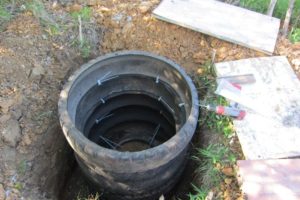 | Tire septic tank. |
| Metal septic tank treated with anti-corrosion coating. | |
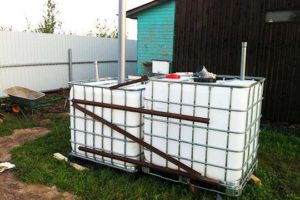 Septic tank from eurocubes Septic tank from eurocubes | A plastic septic tank, for example, from eurocubes. |
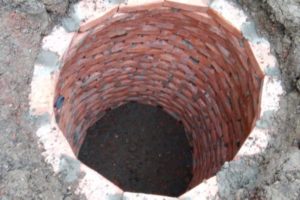 | Brick septic tank. |
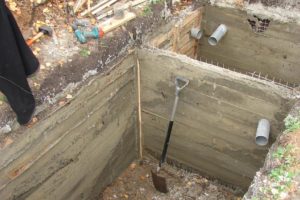 | Monolithic concrete septic tank. Concrete is made, poured into a pre-constructed formwork. |
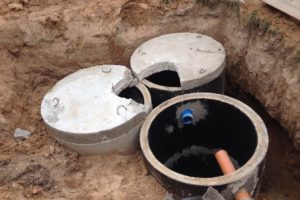 Septic tank made of concrete rings Septic tank made of concrete rings | Concrete septic tank. |
The least successful option is tires, bricks and metal containers.They most often lose their tightness. Arrangement monolithic concrete septic tank - It's very hard work. Concrete rings are the most popular. It is on the installation of such septic tanks that we will dwell in more detail.
Advantages of a homemade septic tank from barrels
Manufacturers offer cleaning devices with different performance and a wide price range. Many owners of summer cottages prefer to make them with their own hands. The option is in demand for good reasons:
- cost savings - they purchase material at a low cost, including used ones, choosing where it is cheaper;
- use of the capacities available on the farm;
- the possibility of using a modular scheme - options for future changes and additions are calculated in advance.
Feedback from Golodov A.N. At the dacha, first arranged toilet barrel septic tank. Then he connected the bath, kitchen, washing machine. To do this, I prepared the connection points in advance: I cut the pipes into containers and drowned them out for a while.
Metal barrels - temporary waste collection system
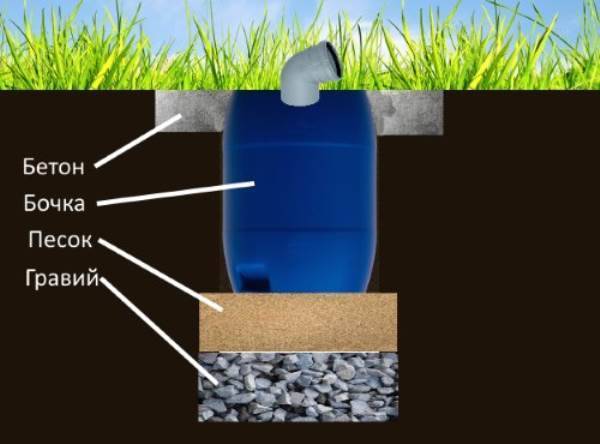
When arranging a septic tank from iron containers, it is required to dig a pit of suitable sizes and, without fail, concrete its bottom. Then prepare two barrels, drill holes on their sides. In them you will insert the outlet of the drainage and the inlet of the overflow pipe. Remember - the tubular product coming from the house is always inserted into the first barrel with a certain slope. Due to this, wastewater will flow by gravity into the septic tank without any problems.
Important pro tips to follow when equipping a sewer system from metal barrels:
- the second metal container should be installed in the pit a little lower than the first;
- use barrels with a volume of at least 200 liters;
- high-quality insulation of the septic tank from all sides is mandatory (it is not necessary to lay heat-insulating material only at the bottom of the pit);
- the tanks are backfilled with soil, the septic tank is covered with roofing material, covers made of wood, iron (do not forget to make a hole in the coating through which the effluents will be periodically pumped out of the tanks).
Arrangement of a sewer system from metal barrels
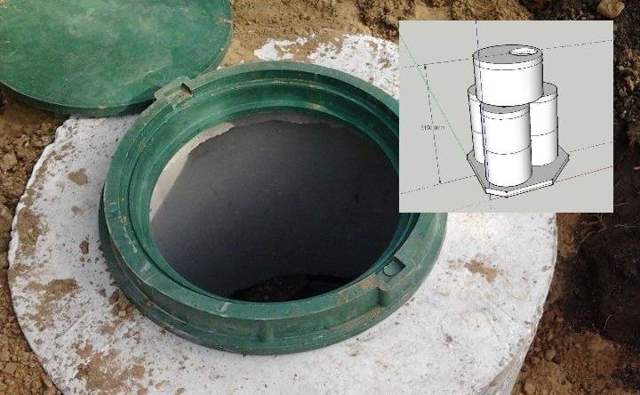
If you want to increase the volume of the structure under consideration, it is allowed to install several barrels on top of each other and weld them together. In addition, additional iron jumpers can be mounted. They will provide a more secure fastening of the barrels. All joints between barrels should be carefully waterproofed. For this, hot bitumen is most often used.
Let's say right away. No matter how you equip the system from iron barrels, after 3-4 years the metal tanks will have to be changed. They will begin to rot and rust under the influence of aggressive drains.
Features of the installation work
First, using a jigsaw, holes are cut in the barrels for installing overflow pipes and a ventilation riser. The hole for connecting the incoming pipe to the chamber is made at a distance of 20 cm from the upper edge of the container. The outlet is made on the opposite side of the chamber 10 cm below the inlet, that is, at a distance of 30 cm from the top edge of the barrel.





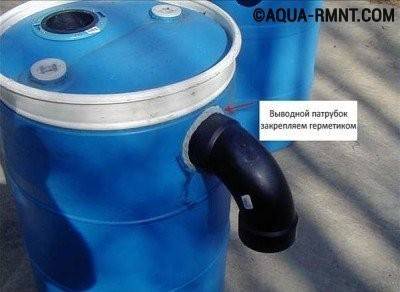
Installing the overflow pipe into the hole cut in the first plastic sump drum and filling the gap with a two-component epoxy sealant
The ventilation riser for the removal of gases is mounted only in the first settling barrel.It is also desirable to provide for this chamber to have a removable cover, which makes it possible to periodically clean the bottom of settled solid particles. In second settling tank at the bottom, two holes are made, located relative to each other at an angle of 45 degrees, for connecting drainage pipes laid along the filtration field.
Stage # 1 - sizing and excavation
When calculating the dimensions of the pit, it is assumed that between the barrels and its walls there should be a gap of 25 cm around the entire perimeter. This gap will be filled in the future. dry sand-cement a mixture that serves to protect the walls of the septic tank from damage during seasonal soil movement.
If you have finances, the bottom under the settling chambers can be filled with concrete mortar, providing in the “cushion” the presence of embedded metal parts with loops that will serve to secure the plastic containers. Such fastening will not allow the barrels to “float” with a vein, and, thereby, disrupt the equipped autonomous sewage system.
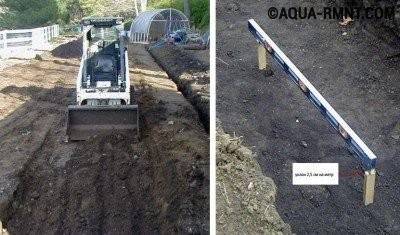
The stepped bottom of the pit must be leveled and covered with a layer of compacted sand, the thickness of which must be at least 10 cm.
Stage # 2 - installation of plastic containers
Barrels are installed on the prepared bottom of the pit, fixed with straps to metal loops immured in concrete. Connect all pipes and seal the gaps in the holes. The remaining space between the walls of the pit and the tanks is filled with a mixture of cement and sand, not forgetting to carry out layer-by-layer tamping. As the pit is filled with backfill, water is poured into the containers to prevent deformation of the walls of the barrels under the pressure of the sand-cement mixture.
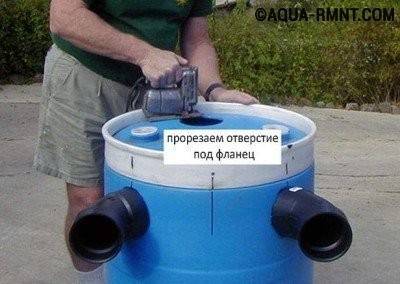
Preparation of a hole in the second settling barrel for connecting an overflow pipe. In this version, the flange is connected not from the side, but from above
Stage # 3 - filter field device
In the immediate vicinity of the septic tank, a trench is dug 60-70 cm deep, the dimensions of which should allow the placement of two perforated pipes. The bottom and walls of the trench are lined with a geotextile fabric with a margin, which is necessary to cover pipes covered with rubble from above.
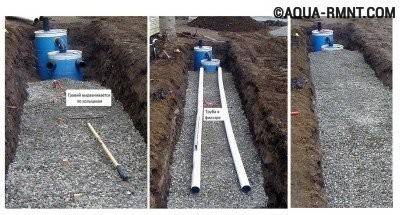
A 30-cm layer of crushed stone is poured onto the geotextile, the bulk material is leveled and rammed
Drainage pipes with perforation in the walls are laid, which are connected to the second settling barrel. Then another 10 cm of crushed stone is poured on top of the pipes, leveled and covered with a geotextile cloth so that the edges overlap each other by 15-20 cm. Then it remains to fill the filtration field with soil and decorate this place with lawn grass.
As you can see, any summer resident can make a septic tank from barrels. It should only be remembered that this facility is designed for the collection and disposal of a small amount of liquid household waste.



