
- Recuperator - what is it?
- Operating principle
- Common Ventilation Problems
- Types of valves and differences between them
- Where to install the inlet valve
- Pros and cons of supply ventilation valves
- Advantages:
- Flaws:
- Choosing a quality system
- Purpose of the device
- Tips of the masters
- Operation features
- Rating of the best supply valves for 2020
- For PVC structures
- 2nd place: Air-Box Comfort
- 1st place: Aereco EFM 1289
- With adjustable feed
- 2nd place: Maico ALD 125/125 VA
- 1st place: Vents PS 101
- With mechanical ventilation
- 2nd place: KPV-125 (KIV-125)
- 1st place: Vakio Kiv
- What is a supply valve for plastic windows?
- Supply valve for plastic windows - device
- The principle of operation of the inlet valve on plastic windows
- Design features and principle of operation
- Points for and against"
- Window air inlet device
Recuperator - what is it?

Any building, and especially domestic, must have unhindered access to clean outdoor air. And its volume must correspond to the volume of "exhaust" air removed from the room. Thus, circulation must be carried out. However, something very valuable is leaving with the air outflow.In winter it is warm, and in summer it is cool, diligently generated by powerful energy-consuming air conditioners. It was in order to prevent this that the recuperator (or recuper) was developed.
The word "recuperator" itself has Latin roots and comes from the word "recuperation", which can be translated as "receipt", "return". In this case, we can talk about this device as a heat exchanger, which in the cold season prevents heat loss, and in the hot season does not allow heat to enter the house along with a new air flow. Thanks to this, in a system with air conditioning, the heat exchanger provides a favorable microclimate without high electricity costs.
Operating principle

The recuperation method is an energy-saving technology that reduces heat losses due to ventilation. The heat exchanger makes it possible to save up to 70% of the heat "going" to the street and reuse it.
The operating scheme of the recuperator is quite simple. In fact, the device is a double-walled heat exchanger, where two air flows meet without mixing with each other - supply and exhaust. Due to the fact that the flows have different temperature indicators, when they meet, an exchange of thermal energy occurs between them. Simply put, a cold stream heats up, and a warm stream cools. Also, during the cooling of the warm stream, moisture is removed from the air. In the form of condensate, it settles on the walls of the heat exchanger or returns back to the room.
Common Ventilation Problems
Natural ventilation of residential premises is based on the presence of micro-slits characteristic of wooden window structures.Through such small openings, air regularly entered from the outside and was removed from the house through ventilation ducts arranged in building structures.
So in the apartment there was a constant change of air masses, contributing to the normal level of humidity, the removal of unpleasant odors, etc.
Regular renewal of the air mass, which occurs naturally through the loose fit of window sashes and door panels, as well as through ventilation, forms an optimal microclimate for life, removes excess moisture, carbon dioxide and other harmful toxic substances.
Incorrect air exchange in the house is an almost inevitable problem when carrying out measures to reduce heat loss. Installing new windows and doors, trying to minimize heat leakage, few people think about ventilating their homes.
But problems soon manifest themselves in the form of a stuffy atmosphere, mold growth in the bathroom and other similar phenomena. Soon, the abnormal microclimate begins to adversely affect the health of those who live in such a house.
Ventilation supply units of various types and types help to deal with excessive sealing of premises, but this may not be enough for normal ventilation.
The draft of natural exhaust ventilation is often weak, if not completely absent. Due to problems with ventilation structures part of the air masses that must be removed from the house penetrates back.
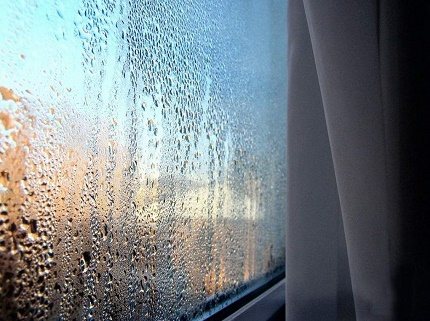
The lack of ventilation or its improper organization is dangerous not only for human life.Moisture condensing on surfaces, not eliminated as a result of ventilation, causes premature failure of structures, communications, and finishes.
The state of draft in the ventilation system of a house or apartment is also reflected in the air temperature in the street, or rather, the temperature difference between indoors and outdoors.
In winter, this gap is large enough to provide good traction. But in the summer, the temperature difference between the outdoor and indoor air is not so significant, and this does not affect the quality of traction too well.
For these reasons, you should think about the need to install special exhaust valves. They will ensure the quick and efficient removal of exhaust air from the home, as well as prevent its re-entry.
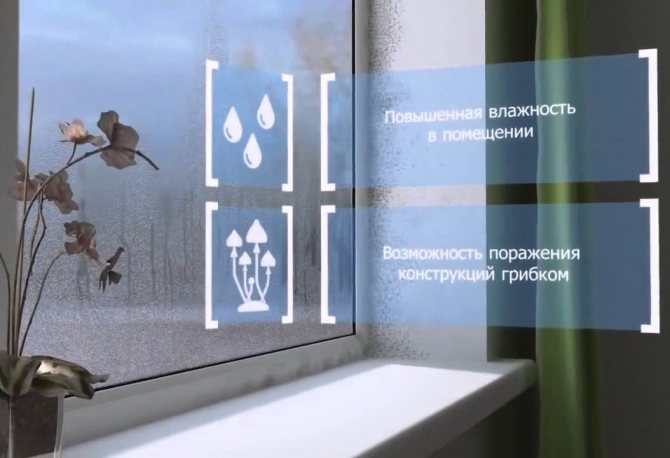
Stagnant musty air and excessively humid environment contribute to the spread of fungal colonies that threaten residents with serious diseases and the destruction of building materials (+)
Types of valves and differences between them
There are the following models depending on specific criteria:
- by appointment - industrial and standard;
- in shape - rectangular and round;
- for additional equipment - valves with thermal insulation and sound insulation and without them;
- by the presence of a forced ventilation system - with and without forced ventilation;
- at the place of installation - window and wall.
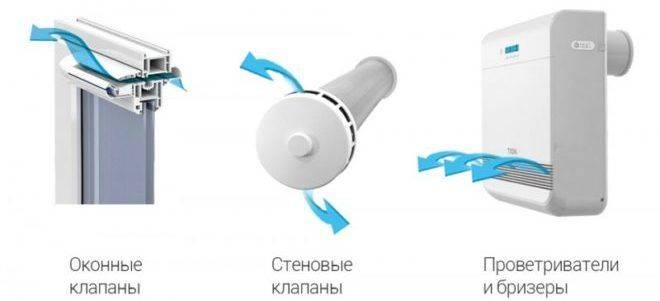 Additional criteria for dividing ventilation valves into types are:
- depending on the diameter of the duct;
- depending on the presence or absence of an automatic control system for the operation of the device;
- depending on the volume of air passing through the valve;
- depending on the presence or absence of the possibility of closing the valve;
- according to the material of manufacture - from metal, plastic or polystyrene foam.
Where to install the inlet valve
There are three main options for installing an inlet valve:
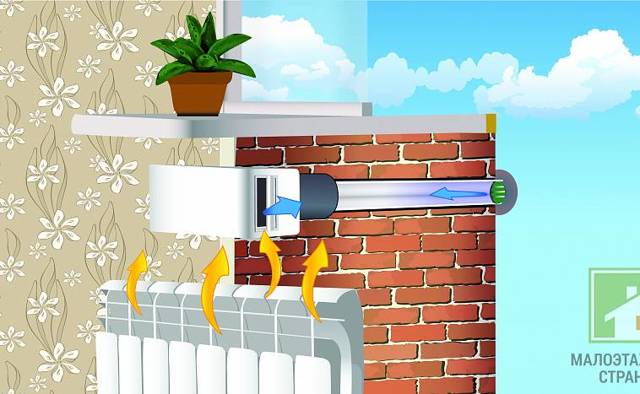
- over a heat source. In this case, the outside air enters the room already heated, and its convection is also stimulated.
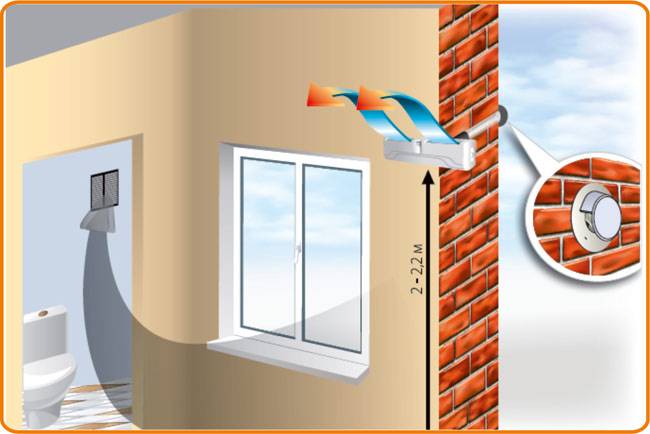
- At a height of 2/3 from the window, which is about two meters from the floor, and at a distance of 0.3 m from the window slope. The air mass will be directed towards the ceiling, where it will mix with the warm room air.
- In places with high dampness. It may be a corner of the house that has already begun to grow moldy.
Supply valves to enhance ventilation are appropriate not only in the walls of private houses, but also on the lower floors of apartment buildings. In the latter case, the best place would be the space between the window sill and the radiator. These devices are in demand in children's institutions, where fresh air is especially important. With the help of this design, they provide an optimal microclimate in rooms for keeping animals and birds.



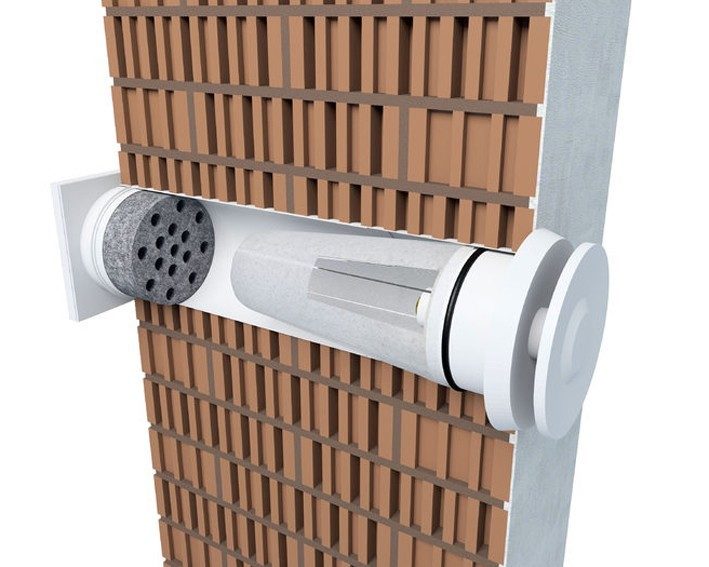

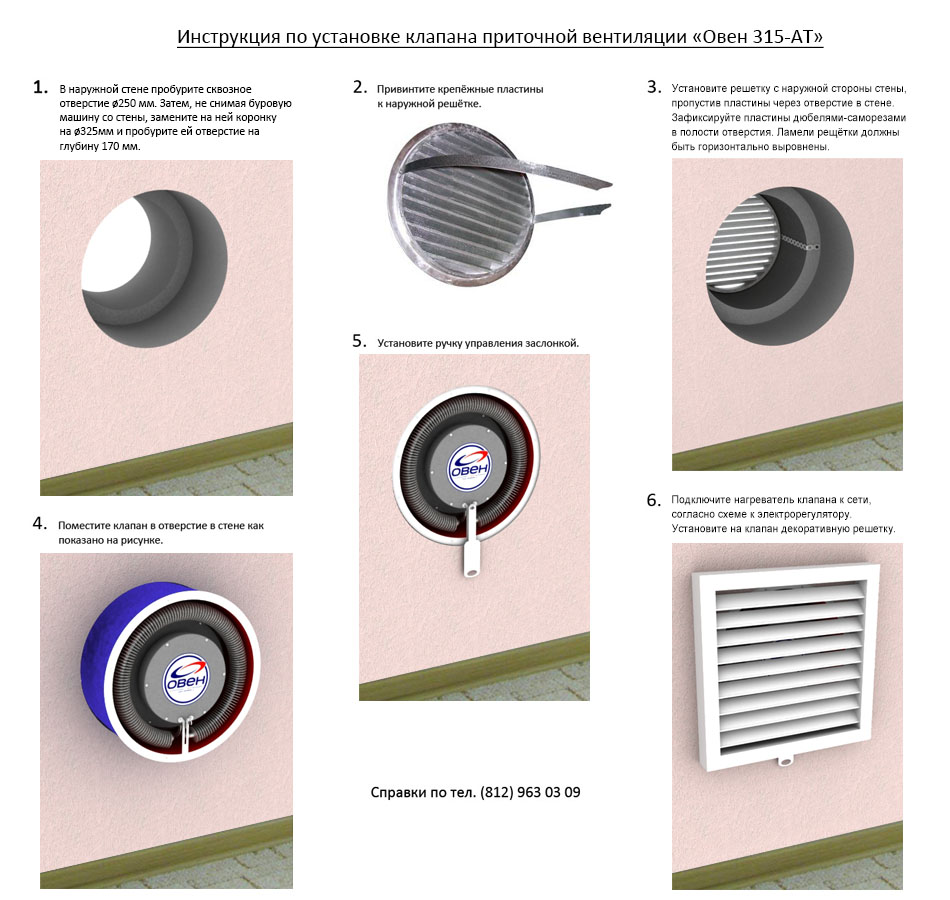
The ventilator or air supply unit can be installed on any wall. The valve does not affect the structure of the walls and does not disfigure the appearance of the facade
It is a mistake to think that by installing one valve, you will solve the problem with the lack of clean air. This is only possible if a device for forced ventilation is included in its design. When this is not the case, air exchange occurs as a result of the pressure difference between inside and outside.
One wall valve with a pressure drop within 10 Pa, which is observed under normal conditions, provides a flow of up to 30 mᶾ / h. This is the norm for one person. With a greater pressure difference, the volume of air entering the room also increases. Therefore, to achieve the desired effect, you will have to install another valve in addition or forced ventilation.
Supply valves are also produced, which are built into ventilation shafts. Usually this is done in the bathroom, in the bathroom, in the kitchen. Before installing them, the traction should be tested. To do this, check the presence of air flow with the window open, using a lit match brought to the hole.
If it turns out that the existing ventilation is not functioning well, then the supply valve installed in the wall will not guarantee the supply of fresh inflow in the volume for which it is designed.
These manual verification methods may not work during the hot season. The air heated by the summer sun becomes heavier than during the cool. Because of this, the pressure in the ventilation duct will decrease and even with a satisfactorily working system, the flame or sheet of paper will not be attracted.
When choosing on the facade of the installation site valve, you need to consider where this wall is directed. It is better when the air is taken not from the side of the street, where there is an active movement of vehicles, but from the yard.
Pros and cons of supply ventilation valves
Advantages:
- Household appliances are simple and reliable. You can install them yourself.
- The ventilation pad removes excess moisture from the most favorable place for its formation - the border of the temperature difference.If there was perspiration or condensate on the double-glazed windows, the number of drops decreases or they disappear altogether.
- There are no drafts in the room, as with micro-ventilation or full opening of the window. This means that the risk of colds is reduced.
- Air exchange between the apartment and the street is continuous. You breathe fresh air all day long, and not just while airing.
Flaws:
- In severe frosts, budget models can freeze over.
- The vast majority of products do not have filter elements. Because of this, dust and odors enter the house.
- Only expensive models cope with full microclimate control. In budget ones, you have to independently monitor the temperature and humidity in the house - constantly change the position of the damper depending on weather conditions.
Choosing a quality system
Before choosing a system, keep in mind the following criteria:
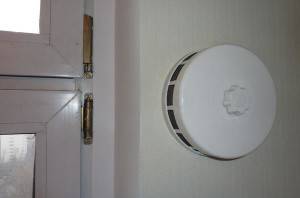
Cost: This can vary quite a lot as there are many supply valve companies nowadays. All of them differ not only in functionality, but also in the materials used. It should be noted that the cost of the valve itself reaches about half the cost of the whole window;
Installation area: a modern ventilation system can be installed not only in the window itself, but also through the adjacent wall. It is worth saying that the second method is much more expensive and more difficult than the first. In this regard, you should be very careful when choosing a ventilation valve;
Way of management: all ventilation has the manual drive and automatic. The first method requires a lot of control over all kinds of sensors. After all, not only humidity, but also air quality will depend on this.As for the second method, everything is very simple. The system fully automatically adjusts the climate of the room and regulates the humidity of the air;
Noise isolation level: All systems currently have good noise protection. Due to this, the population will not experience discomfort during the operation of housing
It is worth noting that the supply valve should be selected in accordance with the requirements of the residents and the installed window;
Complies with air exchange standards: any valve according to the standard can produce fairly clean air that meets all modern standards;
Health: You should also pay attention to the health of the system. The fact is that the valve must ensure the flow of fresh air even in adverse conditions.
An example is condensate and its freezing at low temperatures. I would like to say that the formation of condensate depends on temperature and humidity.
Purpose of the device
The need for installation is explained by the fact that a modern apartment is a completely sealed room due to the fact that PVC windows do not allow air inflow when closed. It is not always convenient to open them for ventilation, since too much cold air enters in winter.
In this regard, several difficulties arise at once:
- an excess of exhaled carbon dioxide accumulates in the room;
- chronic lack of oxygen leads to stuffiness, stale air and often to heaviness in the head;
- moisture quickly accumulates in a closed space; systematic waterlogging of the air leads to the formation of mold on the walls and products.
The supply valve, mounted in the wall, is convenient in that it creates a uniform and constant weak inflow, which essentially replaces the need to use the window in the cold season.
The valve is designed for use in any residential and commercial premises. Its use is especially relevant:
- if a lot of people live in the apartment, especially small children;
- if there are often many people in the room;
- if the apartment has pets and / or plants that constantly need fresh air.
The need for additional ventilation increases if the house is old, since in this case the natural ventilation system, which was installed during construction, most likely does not function or does not work efficiently enough.
Tips of the masters
Wall models are recommended to be laid during the construction of walls, but their installation in finished premises is also possible. Window valves are not advised to be installed by yourself - it is easy to break the tightness of window frames and lose warranty service from the manufacturer. But the main thing is to choose the right type of additional ventilation you need. Poorly selected models can clog the natural ventilation system of the premises, overturn it or create uncomfortable conditions with additional noise from the fan.


In the next video you will find the installation of the ventilation valve.
Operation features
Vent valves need to be cleaned. Its filters and noise insulator are especially susceptible to severe clogging.
When cleaning the device, it is necessary to first dismantle its case, remove the sound insulator along with the filter. These elements can be washed in a soapy solution, after which they must be thoroughly dried. You can only wash those elements that are made of plastic.
In case of clogging inside the device, it is possible to blow through its air duct with a vacuum cleaner.
With a noticeable decrease in the air temperature outside the window and with strong winds, when the internal air temperature in the room can noticeably decrease, it is necessary to adjust the air passage in the damper in the direction of its decrease. So it will be possible to avoid a strong pressure drop between the street and the room.
Rating of the best supply valves for 2020
For PVC structures
2nd place: Air-Box Comfort
The model provides the normative air flow required for a standard room in an apartment. Maintains heat and sound insulation well. Perfectly compatible with all types of tilt-and-turn PVC windows. Provides smooth regulation of air flow.

| Name | Index |
|---|---|
| Manufacturer country | China |
| Width, mm | 44 |
| Height, mm | 20 |
| Length, mm | 355 |
| Weight, grams | 75 |
| Price, rubles | 500 |
Air Box Comfort
Advantages:
- Installation does not require window milling;
- Confident protection against the formation of fungus and mold;
- Maintaining the normative circulation of air masses.
Flaws:
The need to replace the standard seal in the window with a special one.
1st place: Aereco EFM 1289
Standard self-adjusting valve for a plastic window. Unlike other models, the incoming air masses are not directed vertically upwards, but at a certain angle relative to the window, which prevents the formation of frost in cold weather.It has a good level of thermal insulation, maintains the set mode of suppression of sound vibrations.

| Name | Index |
|---|---|
| Manufacturer country | France |
| Width, mm | 50 |
| Height, mm | 25 |
| Length, mm | 390 |
| Weight, grams | 120 |
| Price, rubles | 1200 |
Aereco EFM 1289
Advantages:
- Democratic price;
- Large flap opening angle;
- Increased thickness.
Flaws:
During installation, additional window milling will be required
With adjustable feed
2nd place: Maico ALD 125/125 VA
A popular model from a European manufacturer. By fine-tuning the damper setting variability, air exchange can be adjusted between 30 and 125 cubic meters per hour. Comes with insect net and extra sleeve. The design uses the latest G-2 air filter.

Maico ALD 125/125VA
| Name | Index |
|---|---|
| Manufacturer country | Germany |
| Air exchange, cubic meters/hour | 30 to 125 |
| Air filter | G-2 |
| Diameter, mm | 125 |
| Depth, mm | 500 |
| Price, rubles | 11000 |
Advantages:
- Good complete set;
- Elegant appearance;
- Soundproofing materials are used in the design.
Flaws:
Small service area - 30 square meters
1st place: Vents PS 101
The modern model of the valve is designed to ensure efficient circulation of oxygen both in domestic premises and in production. The grilles are made of high quality ABS plastic. The special design of the open section allows for a uniform and smooth intake of the air volume. Thanks to its discreet design, it fits perfectly into any interior.




| Name | Index |
|---|---|
| Manufacturer country | Ukraine |
| Air exchange, cubic meters/hour | 45 |
| Air filter | G-3 |
| Diameter, mm | 103 |
| Depth, mm | 305 |
| Price, rubles | 1700 |
Vents PS 101
Advantages:
- Eco-friendly and compact body;
- Improved filter;
- Quiet work.
Flaws:
Insulation not included, sold separately
With mechanical ventilation
2nd place: KPV-125 (KIV-125)
This valve has a democratic design and demonstrates average performance in operation. It has a rather noisy fan. The control of the valve is simplified: a cord is specially brought out, with the help of which the position of the damper is adjusted. In the cold season, the model showed good thermal insulation properties.

| Name | Index |
|---|---|
| Manufacturer country | Russia |
| Filter class | F5 |
| Dimensions, mm | 400x200x100 |
| Diameter, mm | 133 |
| Price, rubles | 2500 |
KPV-125 (KIV-125)
Advantages:
- Democratic price;
- Relatively easy installation process for a specialist;
- Great for dealing with condensation.
Flaws:
The exterior may be out of harmony with the interior.
1st place: Vakio Kiv
This valve is designed for installation as part of a wall system. Mechanical ventilation is provided by an ultra-quiet fan that evenly blows air inside. The built-in filter does not let small fractions of dirt and fluff with dust into the serviced room. Thanks to its modest design, it fits perfectly into the interior.

| Name | Index |
|---|---|
| Manufacturer country | Russia |
| Filter class | F6 |
| Dimensions, mm | 470x222x94 |
| Diameter, mm | 132 |
| Price, rubles | 4900 |
Vakio Kiv
Advantages:
- Excellent ratio in the category "price / quality";
- Super quiet fan operation;
- Guaranteed absence of drafts.
Flaws:
Not detected
What is a supply valve for plastic windows?
The problem can be easily solved by using a vent valve for plastic windows.This device provides natural ventilation of the room. Air exchange is normalized without the occurrence of drafts and heavy heat loss, as happens in the situation with the opening of the valves. Air circulation through the holes is enough to maintain a pleasant microclimate and an optimal humidity indicator in the room.
Supply valve for plastic windows - device
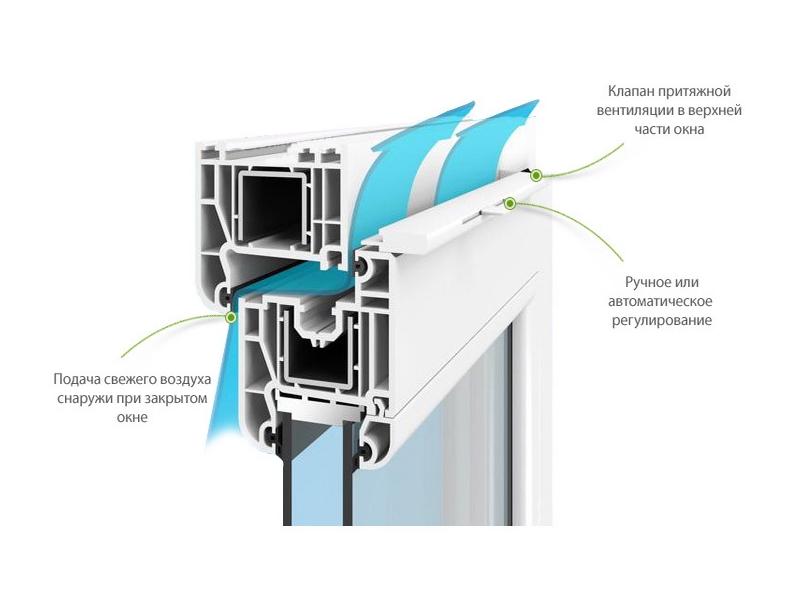
An additional ventilator is built into the double-glazed window, forming a narrow gap through which air continuously seeps into the room in the required volume and stabilizes air exchange. Its design often consists of the main elements:
- air intake. Its purpose is to receive a clean stream from the street. The element is located outside the room outside the frame.
- Visor for air intake. Protects openings from precipitation, dirt, dust.
- telescopic channel. Through it, air seeps into the dwelling. It is a tube that is milled into the frame body and fixed with a sleeve.
- Internal node. Needed to launch a jet into the room. It is mounted to the inside of the frame, consists of an outlet nozzle, a regulator and a filter element.

The principle of operation of the inlet valve on plastic windows
An additional supply ventilation valve can be supplied with the window or installed separately. The principle of its operation is that fresh air from the street is sucked into the room, and warm masses and carbon dioxide are squeezed out through the ventilation ducts under the influence of a pressure difference. Such circulation of flows is considered passive.
The natural operation of the supply valve on plastic windows occurs only at an external air temperature not higher than + 5 ° С. In hotter conditions, there is no pressure drop. Then the valve can only function by force, but in practice the need for it decreases - you can simply open the window without disturbing the comfort in the room.




Design features and principle of operation
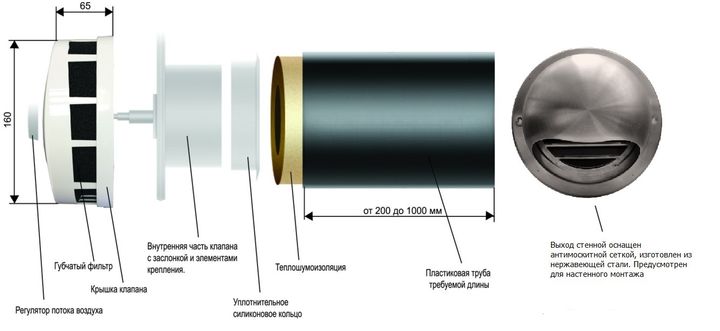
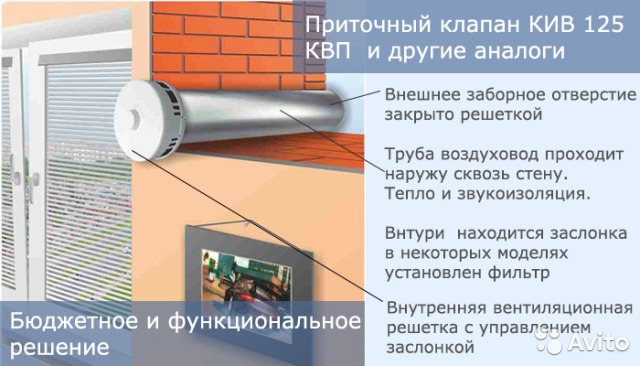
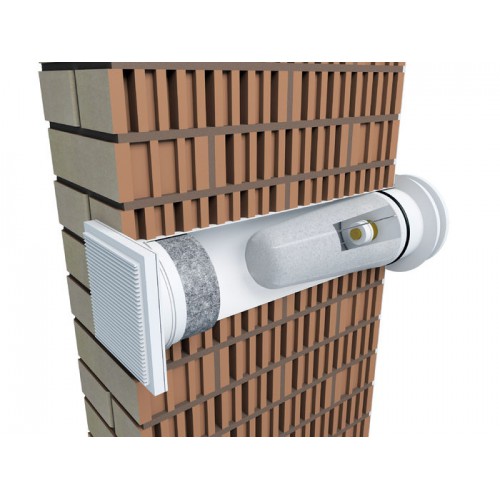
When looking through information about which model of the supply valve is better to choose, where it is worth installing the device, it is important to first understand the design features, as well as study the principle of operation of the device. In fact, the valve is a cylinder equipped with a filtration system, noise reduction
In fact, the valve is a cylinder equipped with a filtration system, noise reduction.
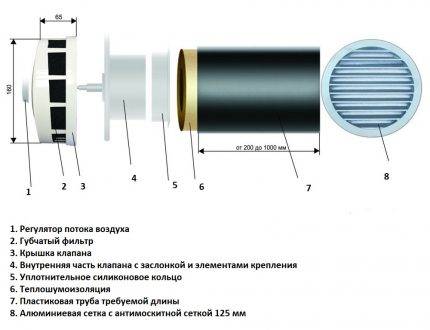 The design of the supply valve is elementary. Installation of the device does not require narrow-profile skills. However, a miniature device is able to provide comfortable conditions, a healthy atmosphere in an apartment of a multi-storey building, a private house
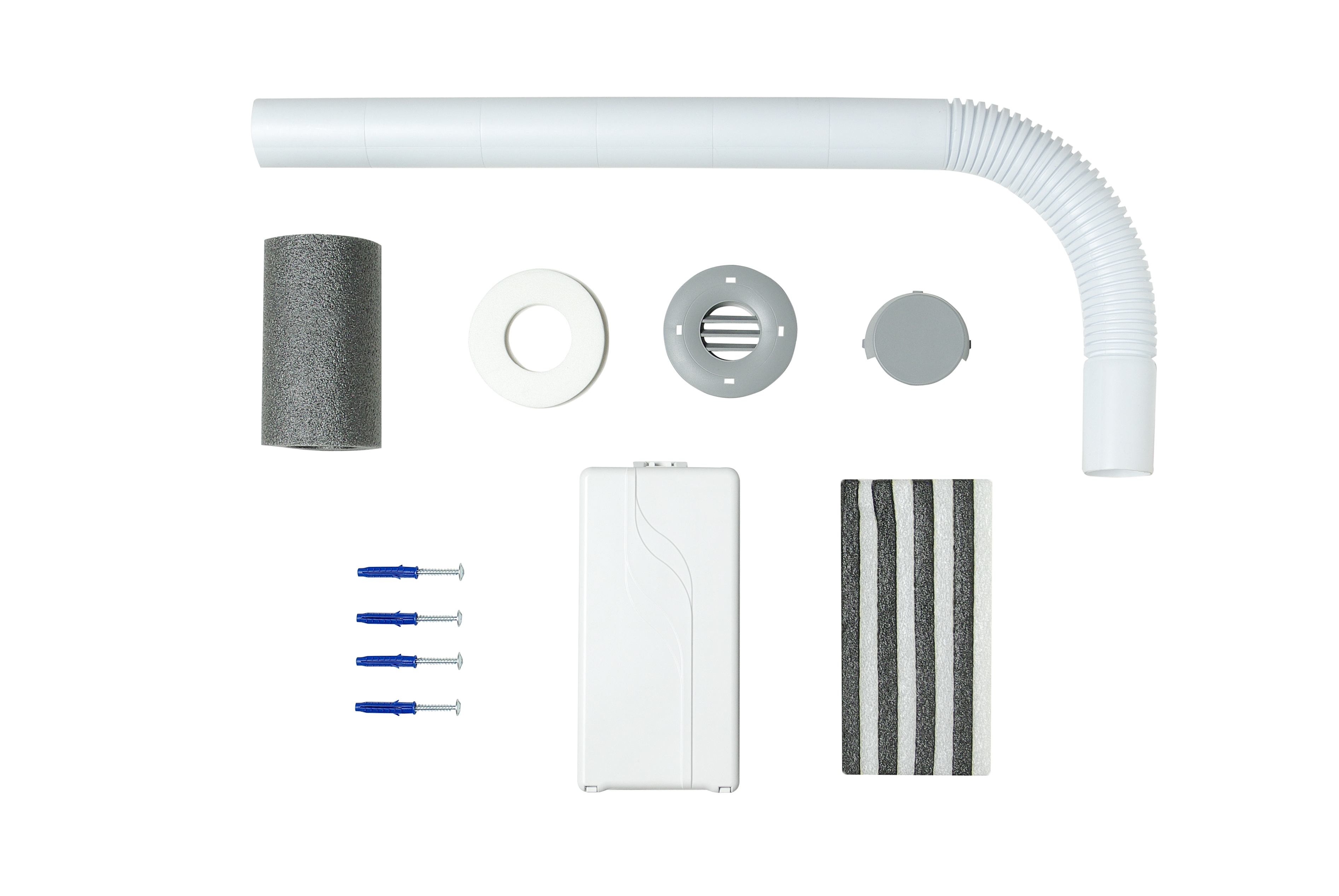
Next, let's take a closer look at the main design elements of the inlet valve:
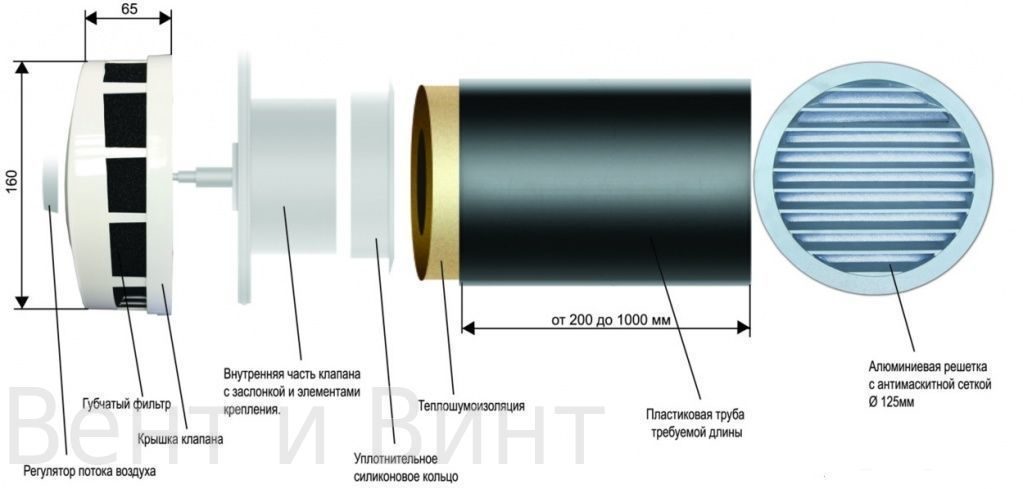
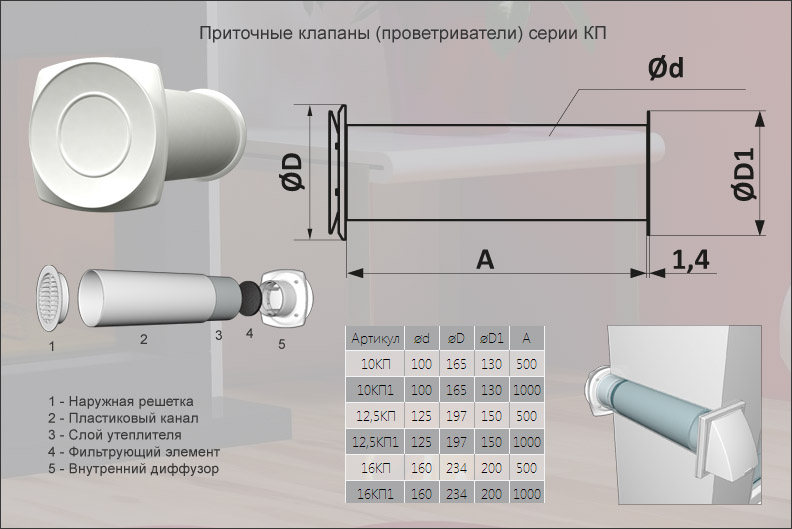
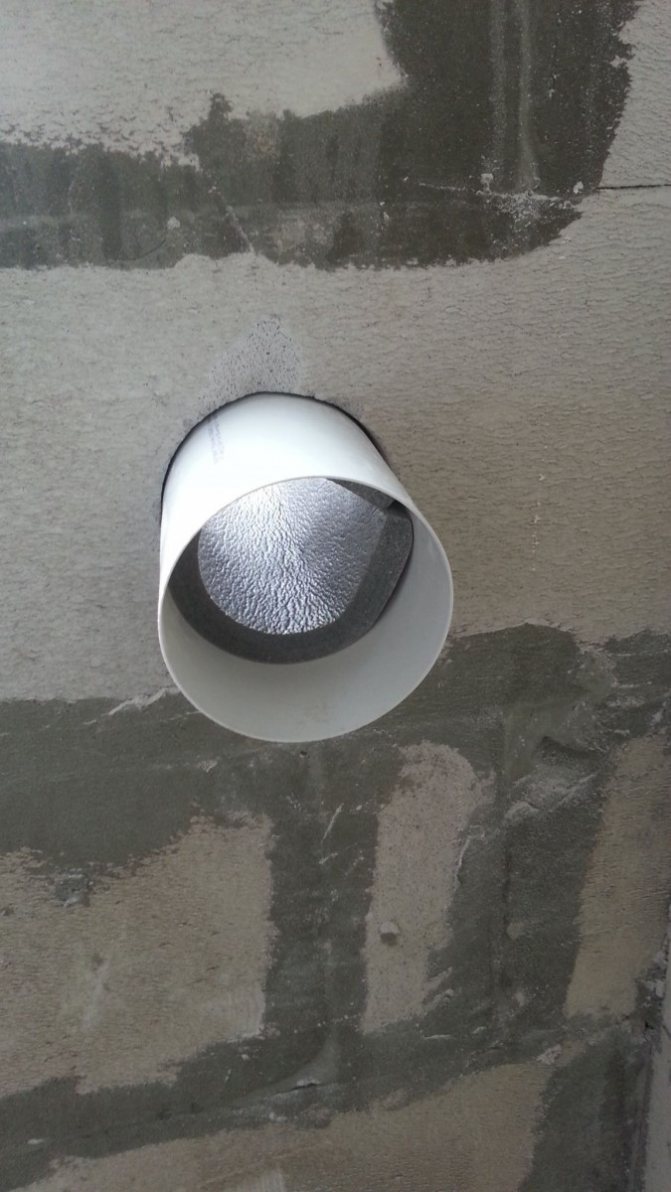
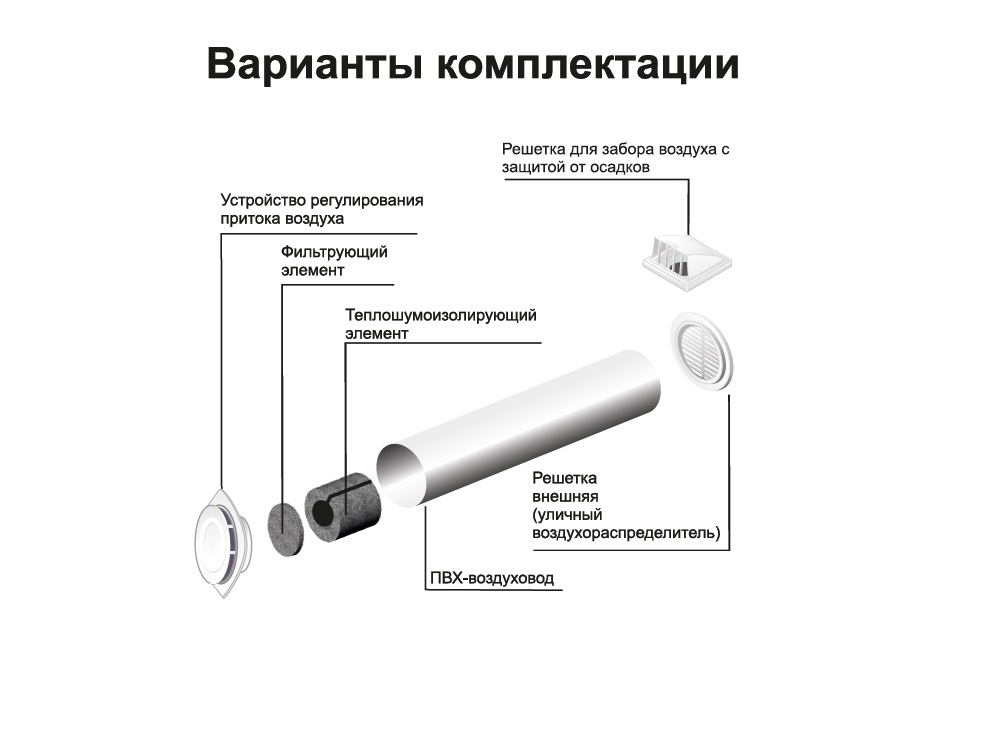
- Air inlet valve. It looks like a plastic tube with a diameter of 6-14 cm. The performance of the valve depends on this parameter, the maximum amount of air that can be supplied to the apartment with its help. Air from the outside enters the room through the tube.
- The ventilation grille of the ventilator may have a different appearance, differ in functionality. The simplest option is an aluminum or plastic mesh that prevents debris and large insects from entering the apartment.More advanced models provide protection from precipitation, are equipped with a mosquito net that can resist flies, mosquitoes, midges.
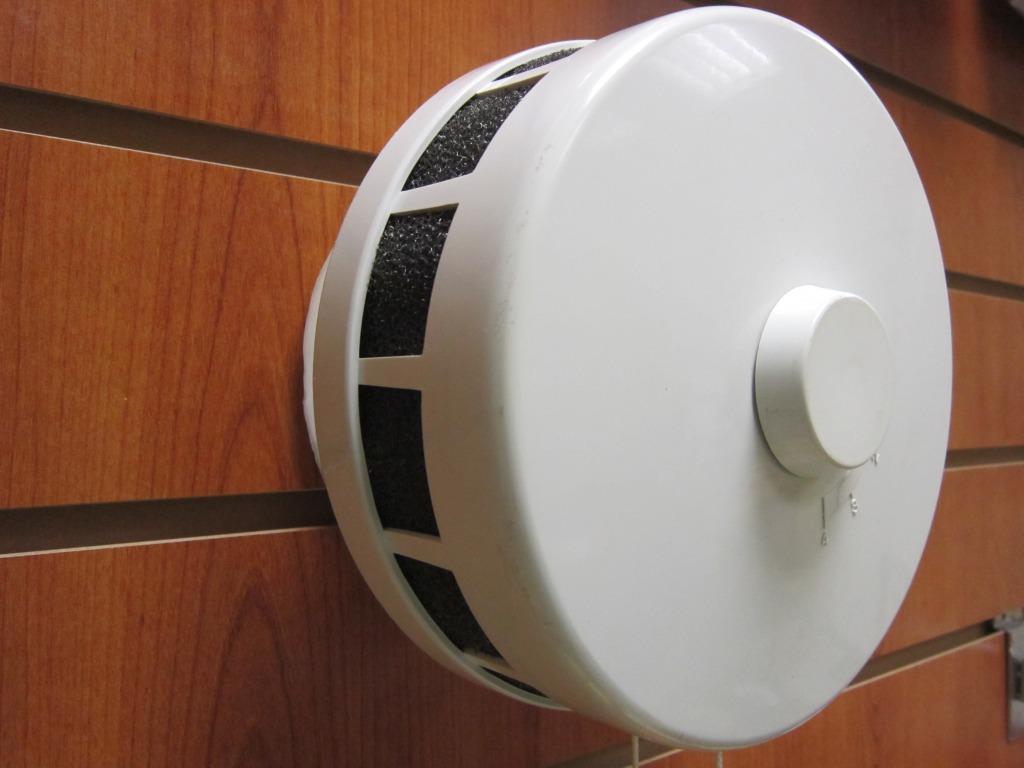
- Head (work intensity regulator) - an element that closes the valve from the inside. It provides adjustable air supply, has an attractive appearance. Dimensions, shape, location of air holes may vary in different models.
- Heat and sound insulation of the valve. To prevent the wall in contact with the duct from freezing in winter, a plastic tube is laid out along its entire length with heat-insulating material. Often the product has the shape of a sleeve.
- Wall vent filter. The material is located in the head, does not allow dust, pollen, and other allergens to enter the apartment. Depending on the model, brand, different fillers are used.
An additional element in the design of the inlet valve is a sealing ring, a damper. Thanks to their use, strong gusts of wind do not cause discomfort during the operation of the device.
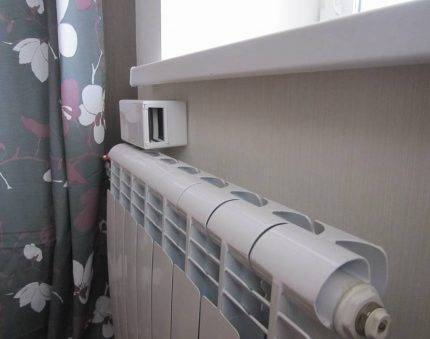 The undoubted advantage of the supply valve is its small size, the ability to install anywhere. By placing the device above the heating radiator, it is easy to avoid lowering the air temperature in the room without additional effort.
The principle of operation of the ventilator is as simple as its design:
- The air is taken from the street through the grate.
- Passing through the duct, the flow warms up.
- The filter provides cleaning of air masses from dust.
- The flow rate is controlled by a special damper.
In the presence of a supply valve, air enters the apartment without interruption.At the same time, the windows will be closed, cold, dust from the street will not penetrate into the room, as with normal ventilation.
When installing an inlet valve, it is important to understand that only by creating an influx of air will not solve ventilation problems. To ensure a healthy atmosphere in the room, it is necessary to establish the operation of the hood, create conditions for the movement of air flows between rooms
To do this, gratings are installed or a gap is left between the sash and the floor of at least 15 centimeters.
To understand the intricacies of creating effective air exchange in rooms, we recommend that you familiarize yourself with the rules for arranging ventilation in a private house or apartment.
Points for and against"
The wall supply valve, like any other device, has undeniable advantages and disadvantages.
Arguments in favor of the ventilator:
- The window opening/closing frequency is reduced. This extends the life of the window fittings and saves time.
- The capacity of the ventilation valves installed in the wall exceeds the performance of the window "supplies" and can reach 60-70 cubic meters per hour.
- The device partially eliminates pollution and filters street air.
- The ability to regulate the air flow based on the season and the needs of a particular home.
- The device has compact dimensions - the inner box is almost invisible on the wall, it can be hidden behind a curtain.
- Compared to conventional ventilation through a window, the operation of a wall damper is not accompanied by heat loss.
- The supply unit increases the efficiency of the exhaust - moist exhaust air is removed faster.
The system operates autonomously - the valve operates due to pressure differences in the street and in the room.
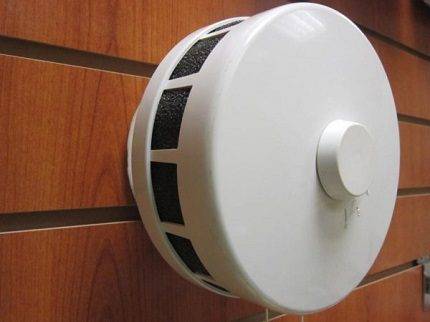
The ventilation valve is relatively inexpensive. If desired, the simplest model of the device can be made from available materials with your own hands
Negative aspects of the use of supply equipment:
- the need to make a through hole in the wall - the integrity of the structure is somehow violated;
- non-compliance with the installation technology is fraught with freezing of the wall or duct;
- in severe frosts, supply ventilation can lead to a decrease in the temperature inside the room.
Some refuse to install a wall valve due to the need to drill the structure. The job requires certain skills from the performer. To ensure effective ventilation, the filter of the device should be regularly cleaned of accumulated debris.


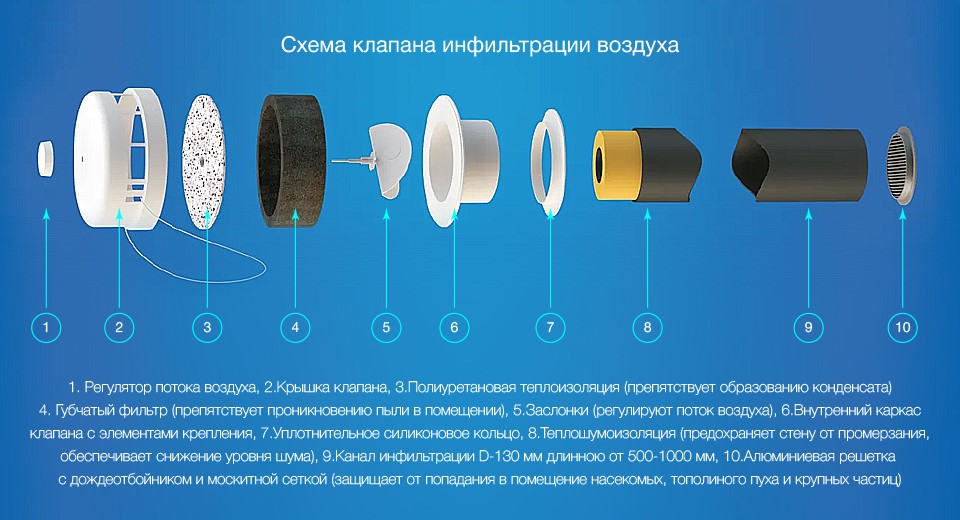

Window air inlet device
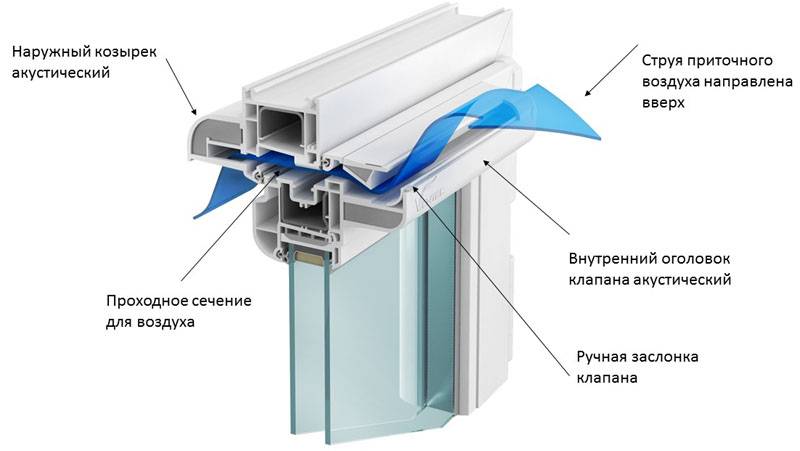
The device of the window inlet valve cannot be name something supernatural. It consists of three parts:
- External, outer part with a visor. It is specially created to prevent precipitation and moisture from entering the frame.
- telescopic channel. It is installed inside the frame. Fixed with a sleeve.
- The interior part. Most often equipped with a protective mesh or filter. There is also a nozzle and an adjustment mechanism that you can adjust to adjust the desired gap and airflow.
 Window air inlet device
In order for the valve to form the necessary draft, the hoods must work properly in the apartment, and the doors to the rooms, if possible, were not locked in order to enhance the natural flow of air from the street. However, if the height of the door leaves a gap of more than 2 cm from the floor, this will be enough to form the necessary traction.



