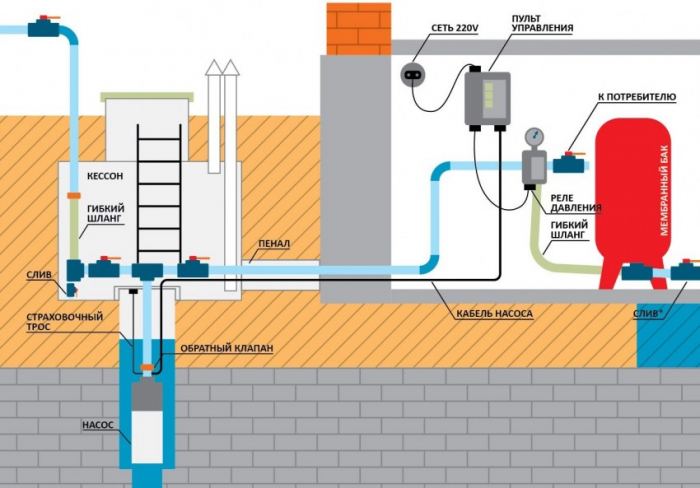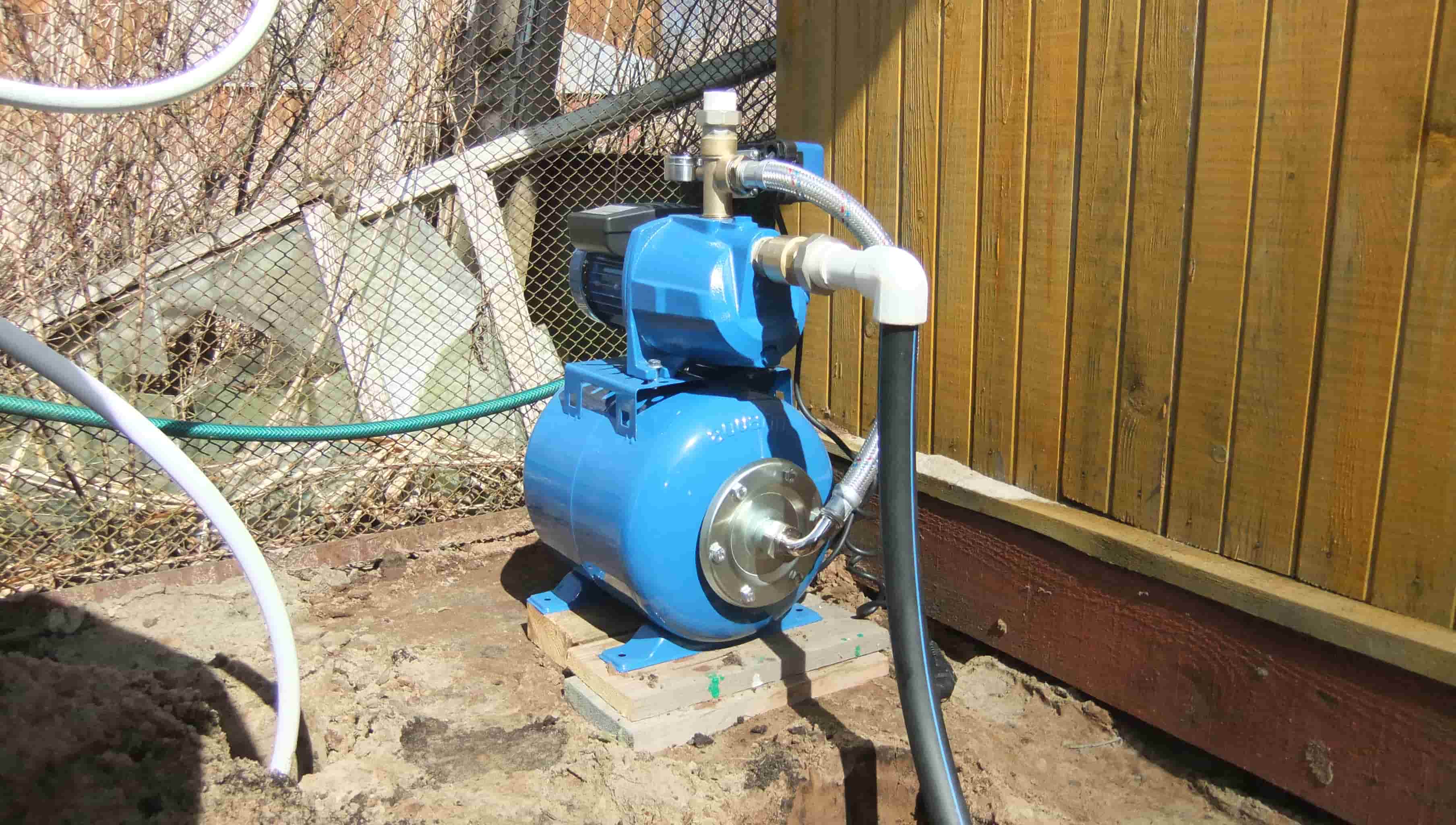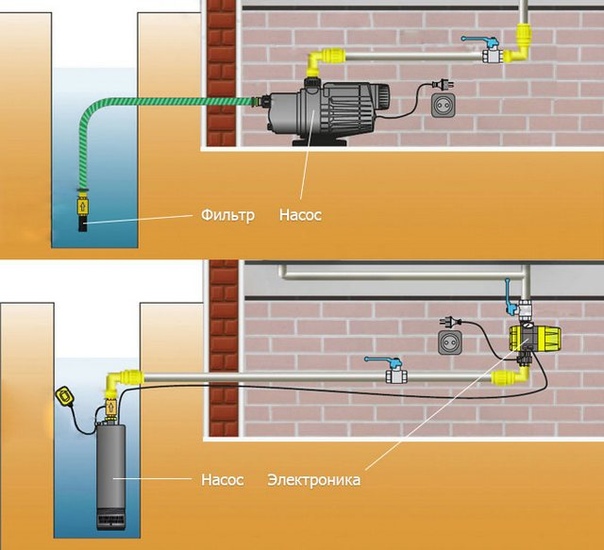
- Expert advice
- How to decide on the type of pump
- Submersible or surface pump for a well
- What you need to know about pump performance
- Pump head
- pump efficiency
- How to choose the right pump for your home
- Pros and cons of the "well" option
- Features, pros and cons of each
- Advantages and disadvantages of stations
- Pros and cons of pumps
- Rules for the operation of pumps for a well
- Six rules for operating a submersible well pump
- Three rules for the selection and operation of a surface well pump
- Types of surface pumps
- Features of surface pumps
- Pump selection by performance and pressure
- Principle of operation
- Conclusions and useful video on the topic
Expert advice
Electrical appliances experience the heaviest load at startup. Electronics is sensitive to voltage drops, but this problem is solved by connecting a transformer with a stabilizer. Considering which pump is best for the well, you need to evaluate the configuration of the entire system.
If a storage tank is included in it, then switching on is necessary only when it is full. This means that the container itself can be equipped with a float switch. If the level drops, the pump will turn on, and when the tank is full, it will turn off.If the assembly process is too complicated and incomprehensible, you can always seek advice from the managers of the trading company that sells the pumps.
HelpfulUseless
How to decide on the type of pump
If you want to organize the water supply of a country house or summer cottage by digging your own well, you should also take care of the method of extracting water from it. The easiest way to solve this problem is with an electric pump. Before purchasing a suitable model, it is necessary to formulate the technical requirements for the unit, which will be discussed in this section.
Submersible or surface pump for a well
For domestic use, two main types of pumps are produced: submersible and surface. Their choice is largely determined by the depth of the well and the level of the water table relative to the surface of the earth.
Surface pumps are installed on specially equipped sites or in utility rooms. For fluid intake, they are equipped with a suction pipeline with a check valve that prevents spontaneous emptying of the system. At the moment of start-up, the impeller rotating at high speed creates a vacuum that sucks water from the well, which is then pushed out at high pressure through the discharge nozzle.
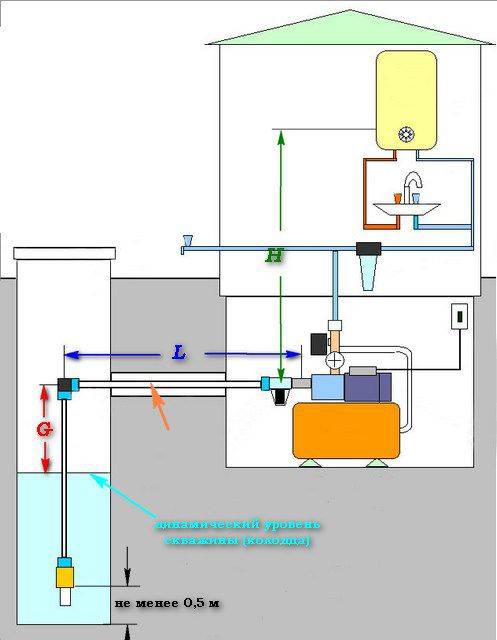
Surface pump installed near the well.
The theoretically possible suction head of such pumps cannot exceed 10.3 meters. In real conditions, depending on the design features and the quality of the pump, it reaches 5-9 meters. To reduce the distance to water, such units are installed in the immediate vicinity of the mouth of the well or inside it on rigid supports or a floating raft.
Surface pump installed inside the well.
Option to install a surface pump inside the well.
The advantages of such models:
- relatively low requirements for the tightness of the structure and the quality of the materials used;
- affordable price;
- simple maintenance.
There is a way to take water with a surface pump from a depth of 25-40 m using a lowering ejector. At the same time, the piping of the unit becomes more complicated and a significant part of the power spent on the operation of additional equipment is lost.
Pump station with remote ejector.
Submersible pumps are lowered directly into a well or other body of water used as a source of water. They do not have problems with suction and the risk of jet rupture, but there is a possibility of picking up soil particles or plant debris. They are usually equipped with a receiving mechanical filter. The body of such units is made of expensive stainless steel, and all current-carrying elements are placed in a sealed casing.
Strengths of such equipment:
- no problems with filling and suction;
- simple start;
- compact dimensions.
During the operation of the submersible pump, it is necessary to monitor the condition of the receiving grate and prevent dry running in the event of a drop in the liquid level.
What you need to know about pump performance
The performance of the pump shows the maximum amount of water pumped by it per unit of time. It is expressed in m3/h or l/min. At the factory, it is determined under ideal conditions for the equipment. In reality, the flow rate is highly dependent on the hydraulic resistance of the system, which is usually shown in the performance curve attached to the data sheet.


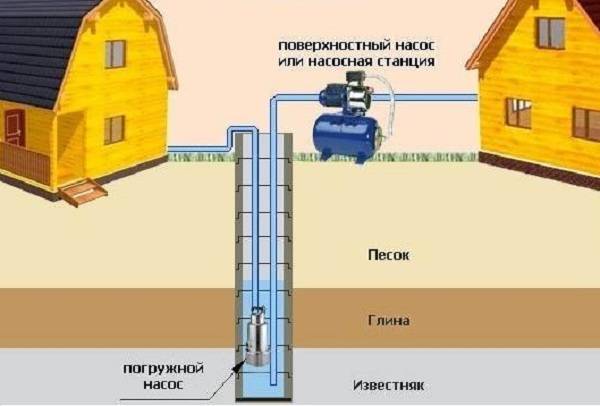
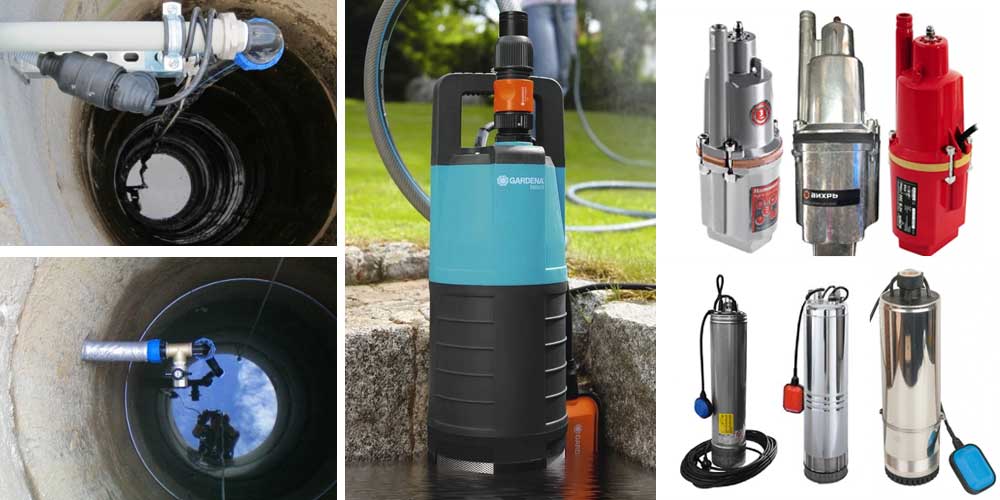


When choosing a unit for a well, they are guided by the number of residents and plumbing fixtures, including the needs for watering the garden. Sometimes the fluid replenishment rate associated with the carrying capacity of the aquifer plays a decisive role. To smooth out peak loads when using not the most powerful models, pressure tanks with a supply of water or hydraulic storage tanks, which are part of pumping stations equipped with the manufacturer, help.
Pump head
The head of the pump is expressed in meters of liquid column. It is equal to the maximum height to which it can be raised, although the consumption in this case will be minimal. With a stable pumping mode, pressure is spent not only on overcoming the difference in elevation, but also on the hydraulic resistance of pipelines and fittings installed on them.
pump efficiency
The efficiency of a pump, like any other mechanism, shows the ratio of useful work to the amount of energy expended. The higher it is, the more economically the equipment is operated, the less will be the payment to power engineers. This indicator depends not only on the design of the machine pumping liquid, but also on the chosen water distribution scheme in your home. Usually, for submersible units, it is somewhat higher than for surface units, since they do not have to expend suction forces.
How to choose the right pump for your home
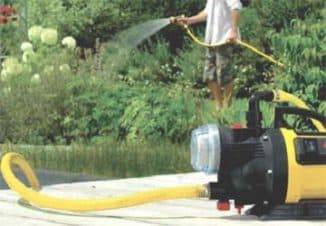
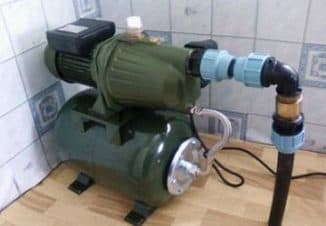
Despite the huge number of advantages of pumping stations, they have one significant drawback - noise during operation. This is the main reason why experts recommend placing it away from home.
There are modern stations on sale that were developed with the expectation of smoothing out this shortcoming. As a striking example, GRUNDFOS of the MQ type can be distinguished. The model is completely ready for connection and does not require special skills to use.
Be sure to put a check valve on the water supply, which will prevent backflow. A striking representative of the model with an integrated valve is GRUNDFOS type MQ.
After selecting the source, the type of station, you can proceed to the selection of the model. If the pressure is 2 atmospheres, then through an open tap the flow rate will be 4 liters per minute, when using a shower 12 liters.
If you count the sampling points and take into account the probability of simultaneous sampling in several of them at once, you can find out the performance of the selected equipment. The BELAMOS XA 06 ALL station with a lift height of 33 meters will cost 9,500 thousand rubles, the model 13 I ALL with a lift of 50 meters is already 13,000 rubles
Caliber SVD -650CH 00000044891 with a lifting height of 35 meters is a little cheaper - 7500 rubles and Gileks Jumbo 70/50 P-50 4751 with a lift of 50 meters 10500 rubles. If the volume of the tank is 50 liters, then the price of Dzhilek Jumbo increases to 17,500 rubles
The BELAMOS XA 06 ALL station with a lift height of 33 meters will cost 9,500 thousand rubles, the model 13 I ALL with a lift of 50 meters will already cost 13,000 rubles. Caliber SVD-650CH 00000044891 with a lift height of 35 meters is 7,500 rubles and Gilex Jumbo 70/50 P-50 4751 with a lift of 50 meters is 10,500 rubles a little cheaper. If the volume of the tank is 50 liters, then the price of Dzhilek Jumbo increases to 17,500 rubles.
To choose the right device, you should take into account several recommendations:
- At the dacha, the consumption will be up to 1.5 m3 / h in the summer heat.
- In a cottage for 6 people, the consumption is up to 2 m3 / h.
- In a mansion with irrigation, a pool and fountains, the flow rate is from 4 m3 / h.
Do not forget about the capabilities of your source, if the flow is greater than the return, then the source will be empty. If in doubt, it is better to install equipment with dry-running protection.




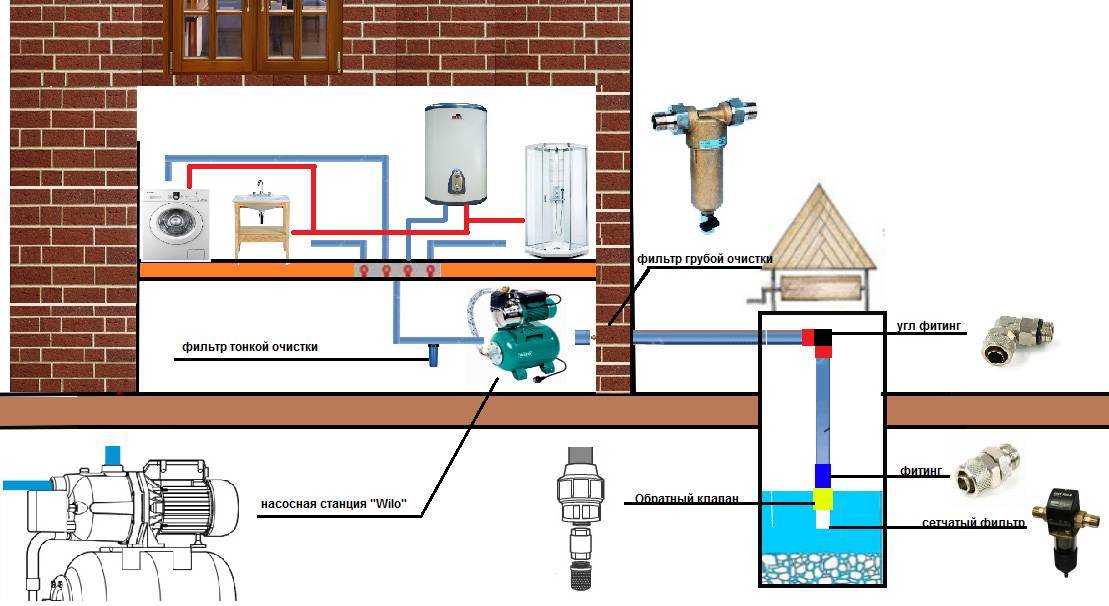
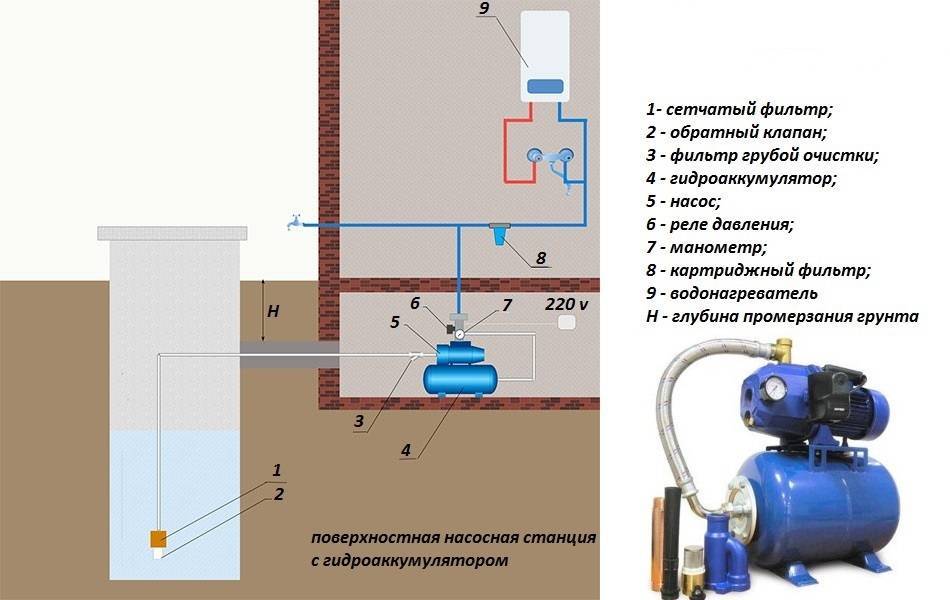
Pros and cons of the "well" option
Before starting such a large-scale project, you should evaluate its pros and cons. In addition to the relatively low construction costs, it is worth noting the ability to use the well even during power outages, simply by collecting water with a bucket. In addition, a well does not need permits, it can simply be dug in a suitable place.
But do not ignore some of the problems associated with water supply from the well. The water in the upper horizon is rarely of high quality, which will invariably affect the operation of the equipment. For technical needs, it is quite acceptable, but it is usually not suitable for drinking and cooking.
To provide the house with clean water, you will have to dig a fairly deep well. Unlike a well, a well needs regular cleaning, which should be done once or twice a year. To improve the quality of well water, it is recommended to install a reliable filter system.
Flood and sewage pollution is a familiar problem for many well owners. To avoid it, you need special protective measures. Another problem is the seasonal change in the groundwater level, which can be very significant.
Sometimes the appearance of a well on the site changes the nature of the groundwater flow under the surface of the site in such a way that there may be a threat to the integrity of the foundation. To prevent such a problem, it is worth consulting with a specialist or discussing the situation with neighbors who already have a well.
Features, pros and cons of each
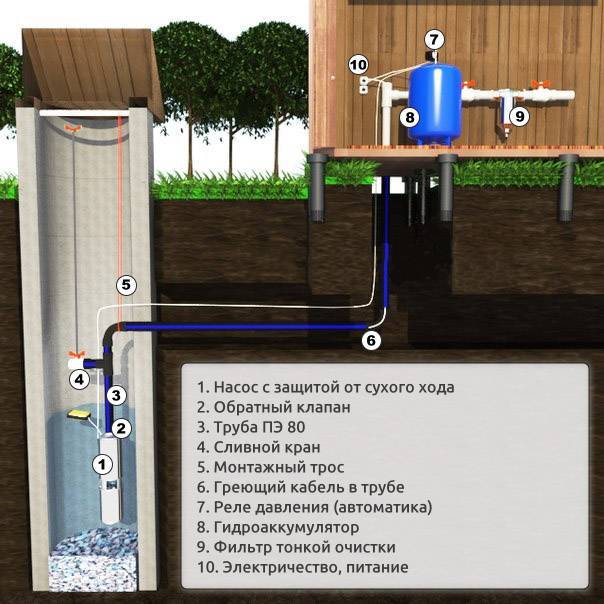
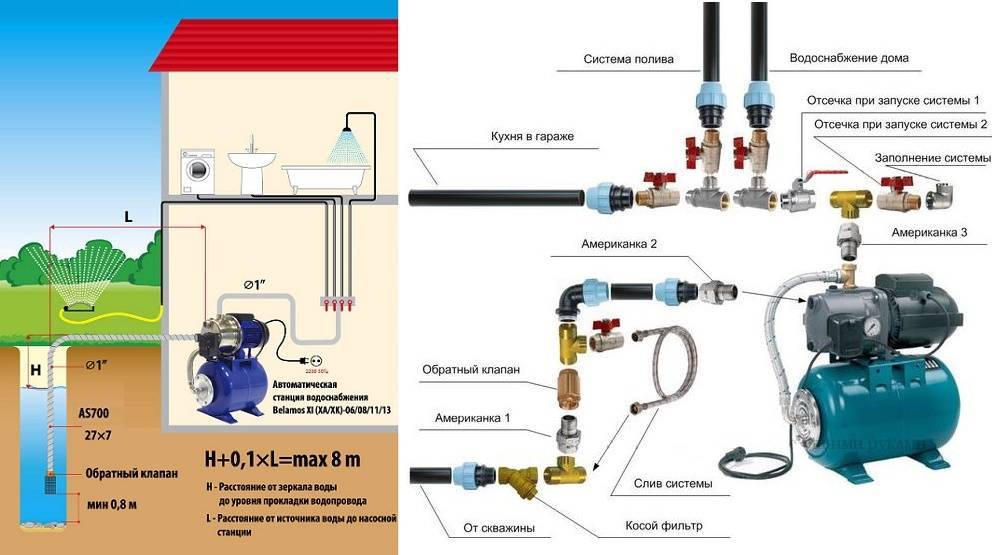
pump house well station or well is a specific technique, consisting of several very important details and components:
- hydraulic accumulator;
- pump;
- a relay that controls the on and off of the pump;
- water filtration system from impurities;
- protective valve;
- pipes for water supply or their soft counterparts.
More expensive models are additionally equipped with functions overheating protection and work without water.
The submersible pump was designed to be installed underwater inside a well.
In order for the equipment to work effectively, it is very important to provide effective protection when the groundwater level drops sharply. Therefore, experts in the operation of similar equipment advise using a float type system that opens the electrical circuit when the water level drops sharply.
Advantages and disadvantages of stations
The benefits include:
- small size of the hydraulic accumulator;
- easy installation and disassembly if necessary;
- affordable maintenance and repair work;
- democratic value.
Like any technique, they have specific negative qualities:
- when installed inside a building or in close proximity, it emits a lot of noise, so its installation is associated with significant costs for soundproofing;
- high consumption of electrical energy;
- it is necessary to insulate for the winter and ensure constant ventilation of the room where the equipment is located;
- to take water from a depth of more than 8 m, you need to install an ejector;
- the electric motor is cooled only by the pumped liquid, so it can turn off - the overheating protection system is activated;
- sometimes the pump may produce low efficiency, and the use of a more powerful unit will lead to excessive consumption of electrical energy;
- short service life;
- the use of an additional filter system, because the efficiency of work depends on the purity of the water.
Compared to submersible pumps, stations have lower performance, even with pressure stabilization.
Pros and cons of pumps
Let's look at the positives first:
- silent operation, because the engine is under water;
- can lift water from great depths up to 40 m;
- compact size of the product allows you to install it in the well;
- very high work efficiency;
- high reliability and long service life;
- you can select products based on water pressure;
- its location inside the well allows you to save space not only in the house, but also on the territory of the personal plot;
- when storing for the winter, you need to get it out of the water to the surface, drain the water and close the suction hole.
Flaws:
- each opening of taps in the house, for example, in order to wash hands before eating, to draw water into the kettle, causes the pump to start, and each product is designed for a certain number of such cycles;
- the complexity of carrying out preventive work, because the units are mounted inside the well, each time it must be raised to the surface for inspection and maintenance;
- quite high cost. maintenance and repair.
For deep wells, it is recommended to install submersible centrifugal pumps to prevent damage to the filtration system and the inner walls of the borehole.
Rules for the operation of pumps for a well
Well pumps are suspended on a cable stretched through two lugs in the top cover. The choice of cable must be approached responsibly. The fact is that the boundary of liquid and air is the most dangerous zone in terms of corrosion. An ordinary metal cable at the point of exit from the water will collapse in 3-4 years. To mount the pump, it is necessary to use cables with a protective coating, made of stainless steel, and even better - made of fiberglass. For the same reason, it is best to use pipes with maximum corrosion protection, such as polymer pipes, to connect the pump to the outlet pipeline.


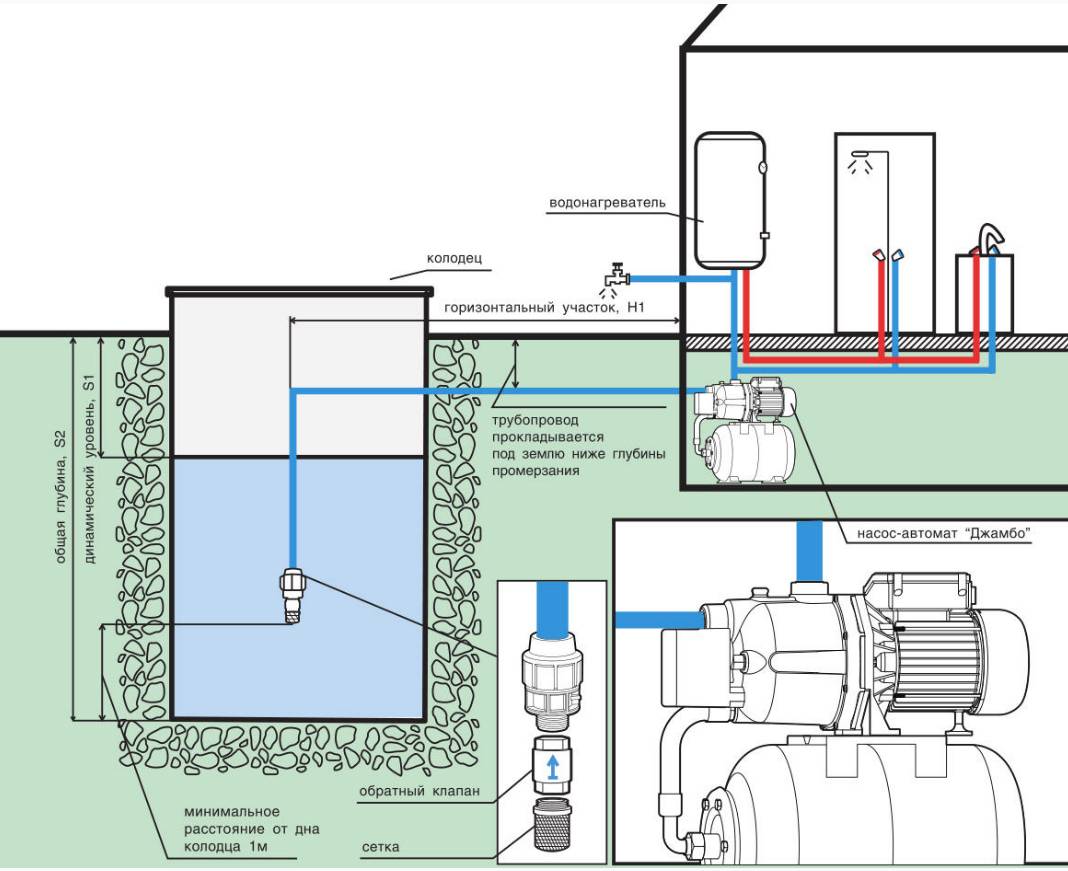


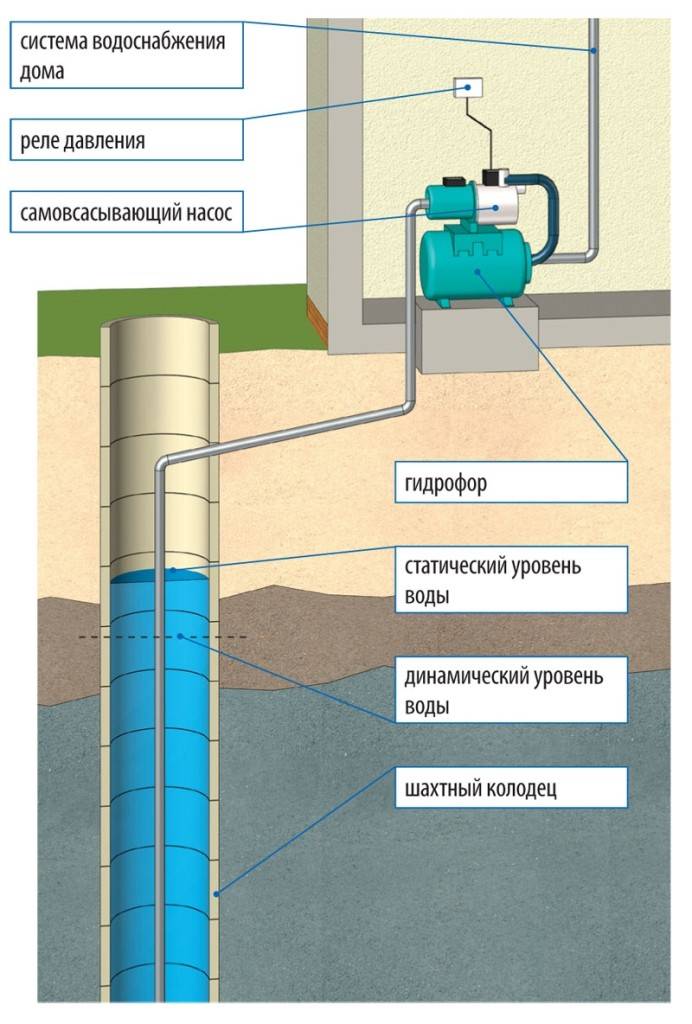

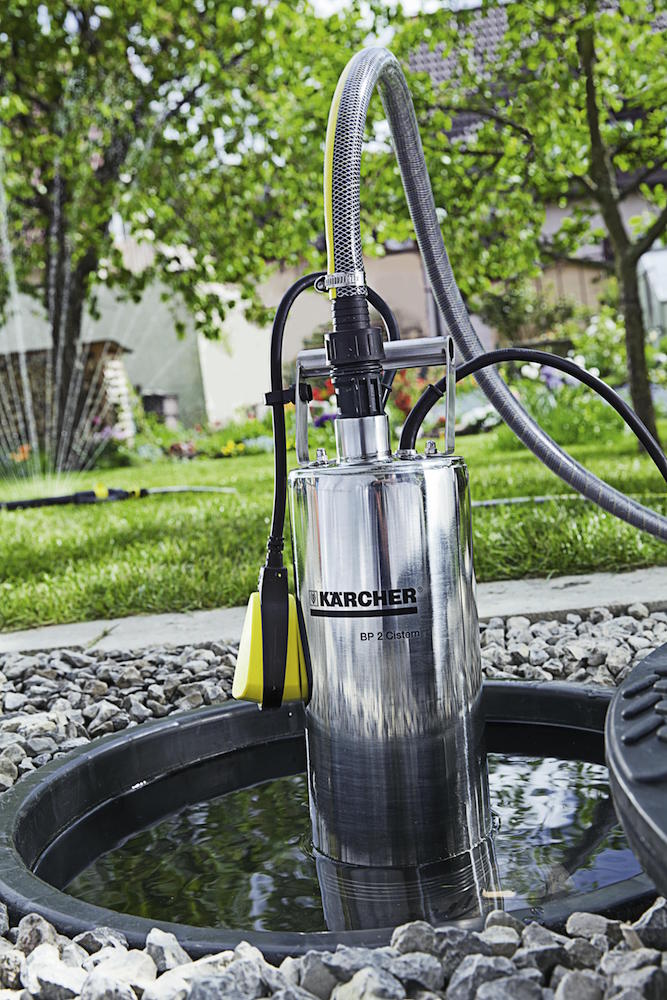
Submersible pump.
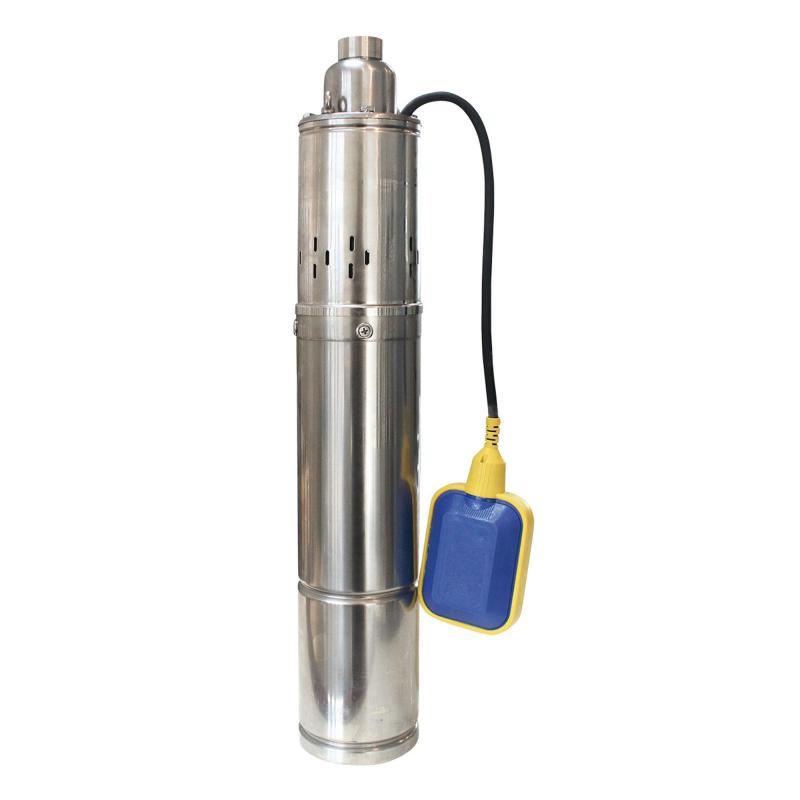
Submersible well pump. Merlin
Six rules for operating a submersible well pump
- The pump must not run dry! Otherwise, it may burn out if it does not have dry-running protection. Therefore, the immersion depth should be chosen with some margin, so that the pump does not accidentally end up on the surface if the water level in the well drops.
- The pump must not be too close to the bottom. It is desirable to have a gap of about two meters so that the pump does not suck in sludge.
- The pump must not be too deep under water.In many pumps, the maximum immersion depth under the water level is indicated - if it is exceeded, protective seals may be broken and the pump motor may be damaged.
- A well pump cannot be used for pumping contaminated water - for this it is necessary to use other types of pumps, for example, drainage.
- The well pump must be protected from dirt getting into them. For this, there are special filters that can be purchased separately.
- The pump must not disturb the water! Therefore, vibration-type garden pumps, such as the Malysh pumps, are not very suitable for installation in a well. For pumping clean water, centrifugal pumps are preferred, which practically do not produce vibration during operation.
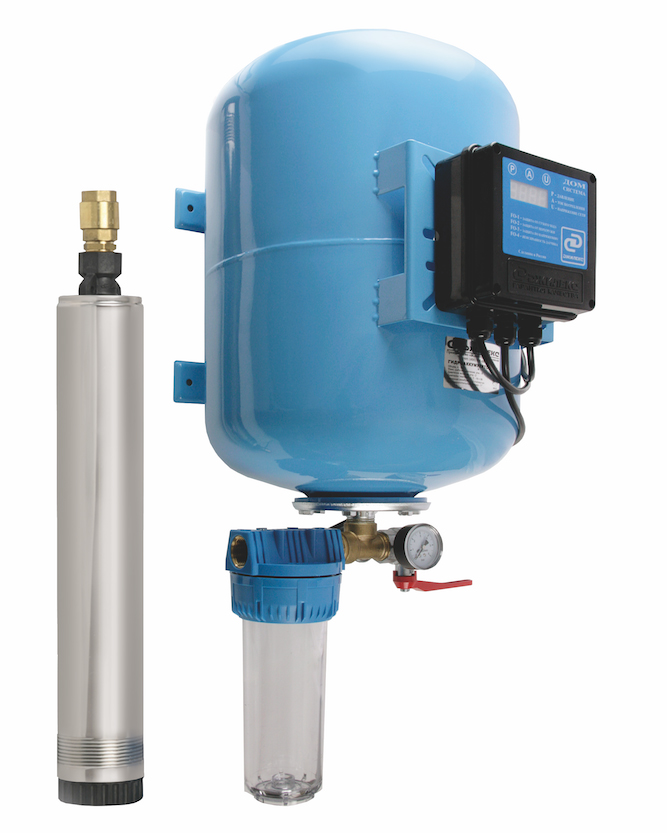
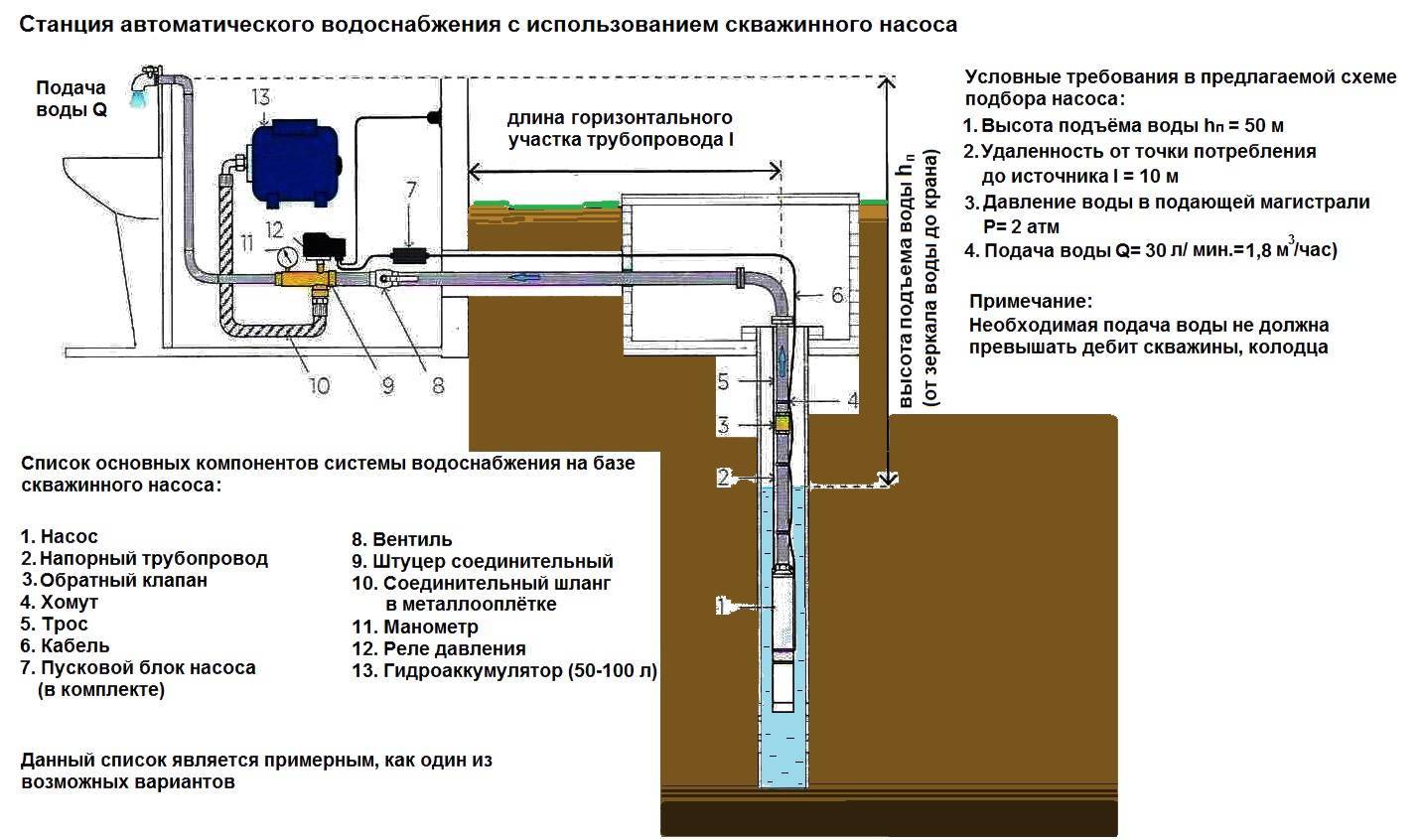
Submersible water jet pump with hydraulic accumulator and other equipment.
Three rules for the selection and operation of a surface well pump
A surface pump is chosen if there is a convenient place for its installation. For example, when the well is near the house
Surface pumps are rarely designed to generate a head of more than 40-50 m, submersible ones are more powerful in this regard.
When choosing a surface pump, you should pay attention to the material of its body. It can be cast iron or stainless steel.
The cast iron body is heavier, in addition, cast iron is more susceptible to the deposition of various salt deposits contained in the water. but the cast-iron case is not so noisy, if the utility room for placing the pumps is located near the bedroom, this point must be taken into account.
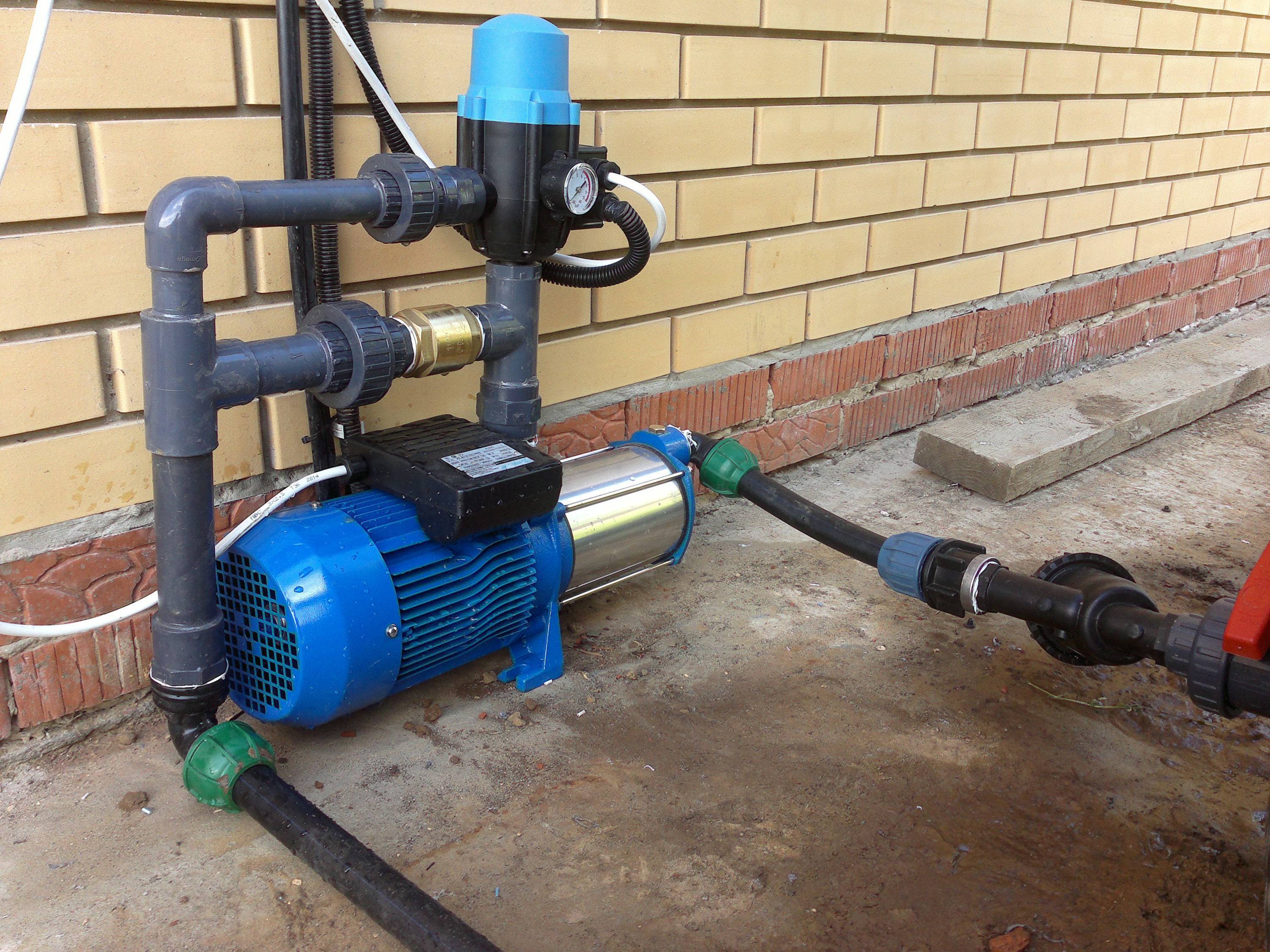
When choosing a pump, do not forget about the accessories necessary for its normal operation.The most important parts of any pumping unit include hydroaccumulators (hydraulic accumulators), check valves (so that water does not flow back into the well), protection devices against dry running, power surges, instrumentation (pressure switch, pressure gauge). All these devices can be bought in a complex - such devices are called a household pumping station (usually based on a surface self-priming pump).
Types of surface pumps
This design is divided into several types:
| Vortex | The most inexpensive and compact pumps that create high pressure in the water supply network, but they have a low efficiency - no more than 45%. They are mainly used for watering and pumping water from rooms that have been flooded. However, low efficiency and unreliability make it impossible to use these pumps as a permanent device for supplying water in an autonomous mode. |
| Centrifugal | They cost more, but they are more reliable. They create less pressure than vortex pumps. But it is enough to ensure the operation of the system. Such pumps have a high efficiency - up to 92%, the reliability for use is sufficient. This allows the use of this equipment during the operation of water intake pumping units. |
| Jet pumps | They have two circuits of the water cycle. In one circuit, water enters the ejector nozzle, where, due to the Bernoulli effect, a pressure difference is provided. This makes it possible to suck water from the second circuit - from the external environment. This circumstance allows you to place the ejector to a depth and not limit the suction height. But today, for this purpose, much more productive submersible pumps are used, in which the price is lower and the quality is higher. |
Features of surface pumps
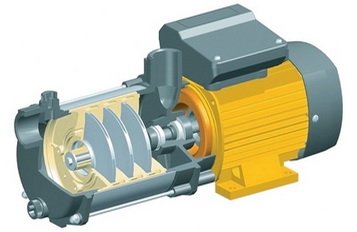
Surface pump for a summer cottage
When arranging a shallow well or well in a summer cottage or a country house, the best option is to use surface pumps. Such equipment has rather big advantages in comparison with deep units.
Among them:
The small size of the equipment, such a unit will not take up much space. In this case, there is no need to build a large and heavy foundation, and it is enough to take small dimensions of the caisson.
Surface pumps are cheaper, there is no need to use special equipment or tools during installation. Automatic blocks for controlling devices are purchased ready-made, and their cost is not very high.
The operating instructions attached to such equipment indicate that the warranty period for their service offered by manufacturers is most often more than 5 years, and two years is enough for its full payback, which greatly distinguishes it from similar submersible pumps used in more aggressive environment.
Ease of installation of the device. In this case, it is enough to connect the cables and pipes, and then check the operation of the unit. The surface pump is supplied with an expansion tank that contains a supply of water.
Under a variety of operating conditions, the device provides a continuous supply of fluid. The flow rate, pressure and other characteristics of the unit are very high.
The equipment consumes a minimum amount of electricity, which characterizes the device as economical.
For a summer cottage, it is very beneficial to use a surface pump for a shallow well or well
The minimum height of the water column can be only 70-80 cm, this is unacceptable for other models.
During operation of the equipment, the electric cable does not come into contact with water, which is important from a safety point of view.
When the water level drops, when air pumping starts, the built-in automation stops the device.
The disadvantages of surface pumps are:
- The depth of the well should be small.
- It is imperative to install special filtering equipment in the device, otherwise the unit may quickly fail.
- Before turning on the pump, it must be filled with water.
- The operation of the device is accompanied by strong noise, which may disturb the residents of the house.
- The equipment can only work in an insulated building, the caisson must be thermally insulated
Pump selection by performance and pressure
These include the performance of the device and the output water pressure:
The capacity of a water pump refers to the volume of water that it can pump per unit of time. It is measured in liters / hour, or m³ / hour. This parameter shows how effective this device is, for what period of time it will be able to pump a certain volume of liquid. The head refers to the lifting height to which the liquid can be raised using this pumping device.

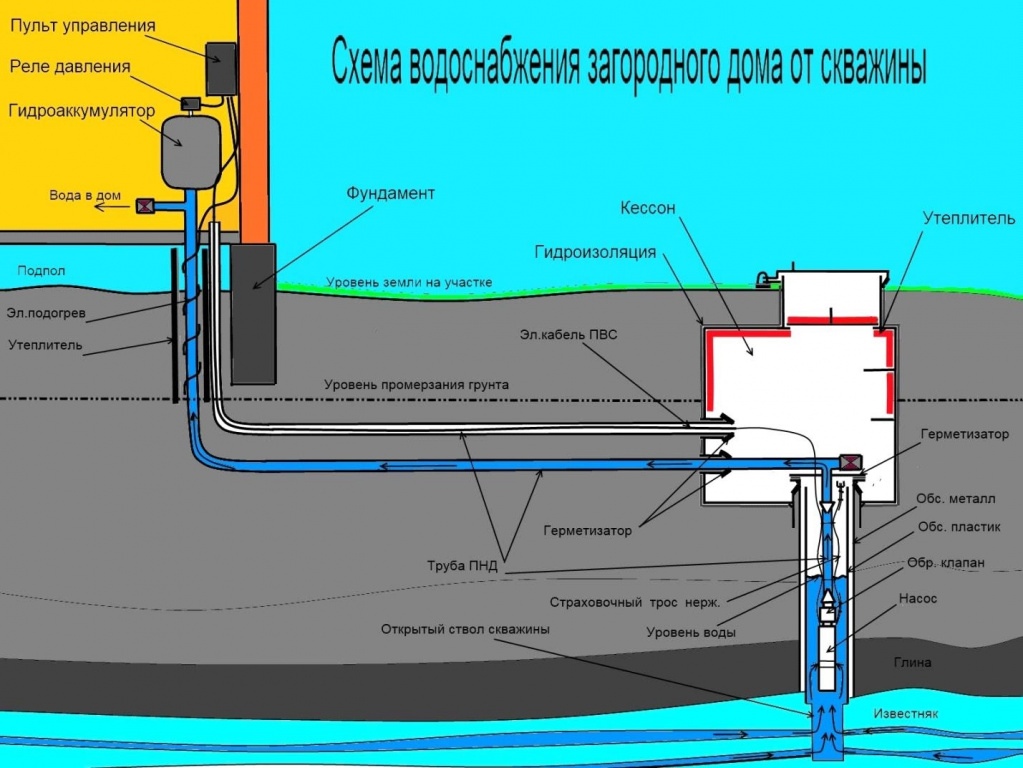
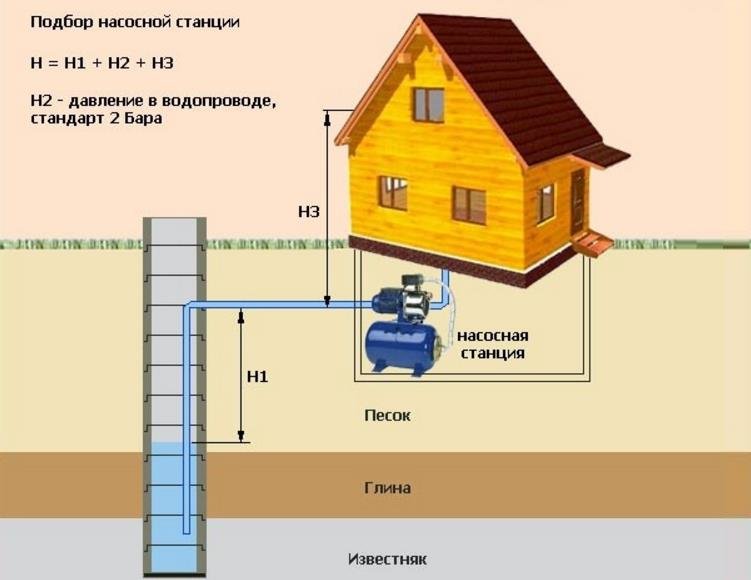
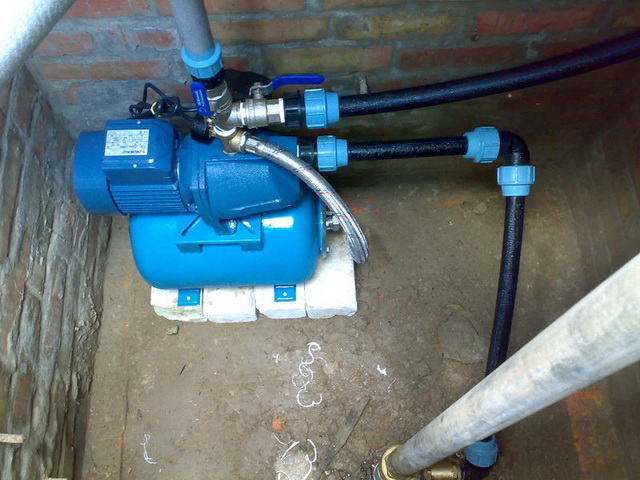


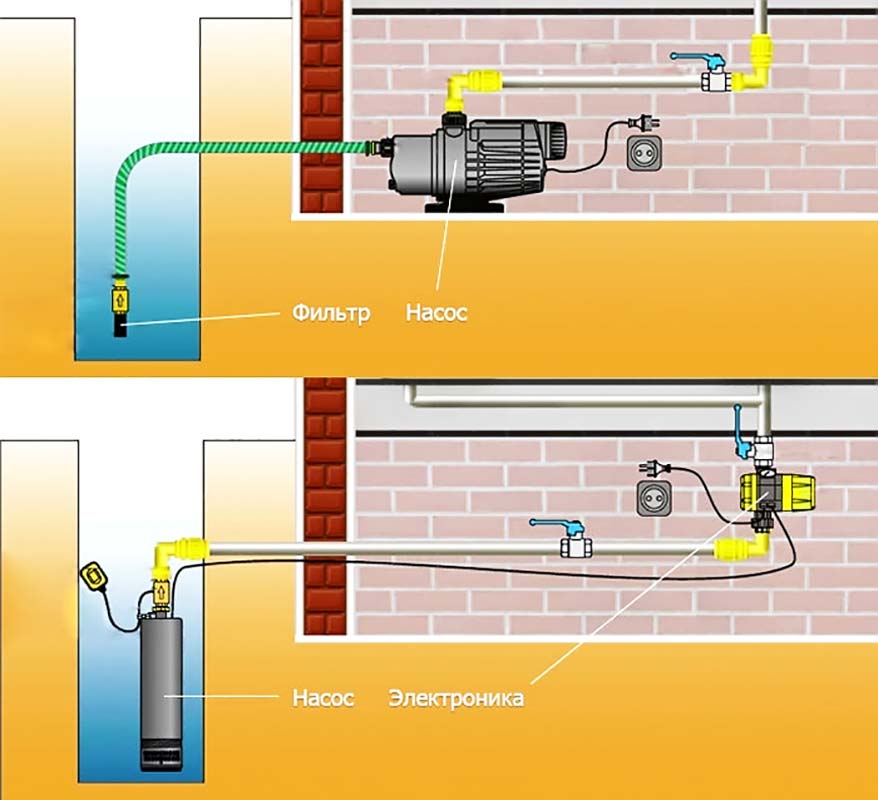

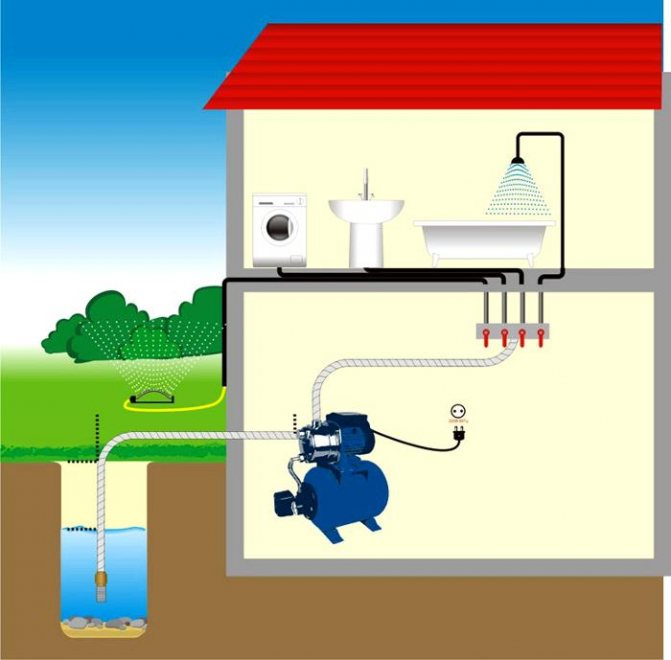
For drainage pumps, this figure is small, up to 10 meters
Here it is important to take into account the horizontal pressure of water, namely, the task of such pumps is not only to lift the liquid, but also to divert it to a certain distance from the source of accumulation.The performance of the entire device will depend on these indicators.
It is important to consider these two factors when choosing a product, because the device must be operated without overloads, and it is also important to exclude its unjustified switching on and off.
Principle of operation
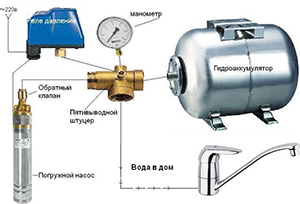
The pump fills the tank with water, creating pressure in the system. A rubber membrane in the form of a pear separates the accumulator for water and air. Through the tap, water from the tank enters the sink, reducing the pressure in the water supply and tank.
When the pressure drops to 2.2 bar, the relay turns on the motor. When the initial level (3 bar) is reached, the relay starts, turning off the pumping station.
Cooling - due to the circulation of water, automatic controls the overload. If the motor overheats, the power is turned off and the pump is restored only after a certain time.
Some models have a sensor that protects the motor from load in idle mode. If there is no water in the suction pipe, it sends a signal to the control system and the motor turns off. After 15 - 40 min. NS is ready to go.
But if the working volume of water is not restored within 24 hours, the HC turns off, and it will have to be started manually.
Conclusions and useful video on the topic
Videos will help you decide on the choice of technical equipment and the method of installing a water supply system.
Water supply systems from a well and heating based on a condensing boiler:
How to choose and assemble a pumping station with your own hands:
How to make plumbing in the country with your own hands (equipment inside the house):
p> Recommendations are provided for review, the process of plumbing is described in general terms.To draw up an individual project, it is necessary to rely on specific data, and make the choice of equipment only after studying the instructions.