
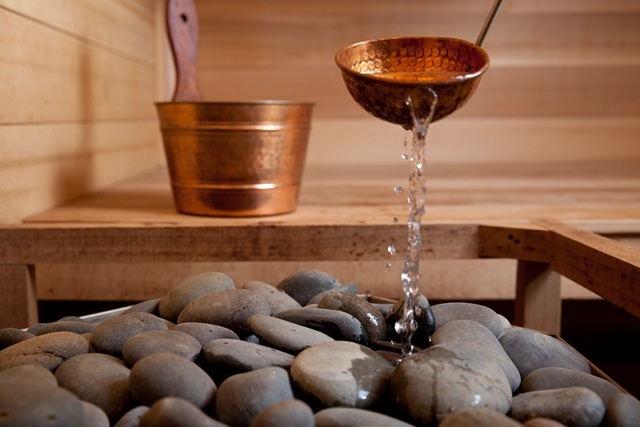
- Primary requirements:
- 1. Thermal resistance
- 2. Heat capacity
- Size 3
- 4. Security
- 5. High quality
- 6. Appearance
- Proper location and care instructions
- Bath attendants' advice
- What stones for a bath to choose?
- In nature
- On sale
- Chiseled or polished?
- Originality and durability
- Purchase Features
- Briefly about the main
- What should be the stones
- Breed Selection Criteria
- Heat resistance
- Heat capacity
- boulder sizes
- Structure of molecular compounds
- Safety of use
- Bath attendants' advice
Primary requirements:
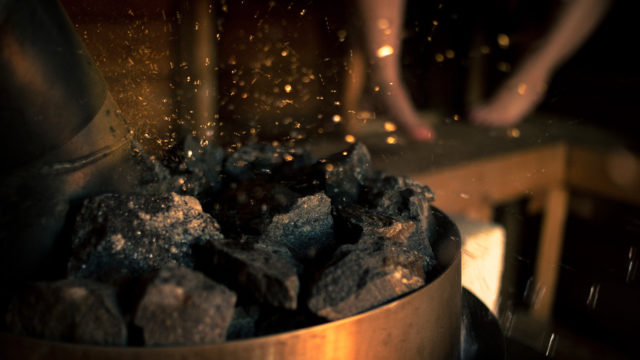
1. Thermal resistance
The rocks that are used in the bath are subjected to excessively high loads. Initially, they are heated to the highest possible temperature, then poured with water, after which they are subjected to uneven cooling. Not all of these accessories are capable of such heroic deeds.
In order not to make a mistake in the correct choice, you need to check their density. How? The mineral you like is taken, heated up strongly and thrown into ice water. If it has retained its integrity, then you have a really high-quality copy in your hands, which can easily withstand all sorts of "bullying".
2. Heat capacity
Zealous duties have long been assigned to the rocks that are used in the bath - this is the fastest possible heating and extremely slow cooling. That is, the main task is a long heat transfer. To choose the best stone for a bath in relation to this indicator, you need to check it. How? The breed is taken and examined. It should be distinguished by density, uniformity and high specific gravity.
Size 3
In order for the breed to serve faithfully for a long period, you should pay attention to its format when buying. It is required to push off from the type of furnace
For example, wood-burning fireboxes love minerals of impressive size, while electric stoves prefer small shapes.
4. Security
Under the influence of high temperature, minerals are able to release substances hazardous to human health. Therefore, stones for laying on the stove must be bought in specialized stores. Do you want to collect the breed yourself? Forward and with a song! The main thing is to know where to collect. In order for you to understand the danger of the undertaking, I will give a small example.
One person was walking near the railway tracks, saw beautiful pebbles, collected them, brought them home, went to the steam room, arranged them beautifully. He flooded the stove and from the bath he returned not at his best. Sleepers intended for railway tracks are treated with the most dangerous poison - creosote. Further, I think, no need to explain. Although the wooden sleeper is now practically not used ...
5. High quality
Minerals should be of excellent appearance. A flat and smooth surface without any inclusions and impurities is a guarantee of high-quality rock.The presence of mica or traces of other rocks is a bell, loudly announcing imminent splitting, which is fraught with disastrous consequences.
6. Appearance
In appearance, they are chipped and polished. The first ones are loved by inveterate bathhouse attendants, because they have a wide heating surface, which contributes to maximum heat transfer when water enters. The latter are distinguished by a smooth and rounded surface, which contributes to much better air circulation - this is a plus and extremely slow heating - and this is a minus.
Thus, dear readers, be vigilant!
Proper location and care instructions
For the best effect, it is recommended to select stones for the Russian bath of various sizes, however, it is desirable that the diameter be in the range from 50 mm to 140 mm. It is necessary to have stones of small, medium and large sizes in equal proportions. It is necessary to put large ones down, medium ones on top and small ones at the very top.
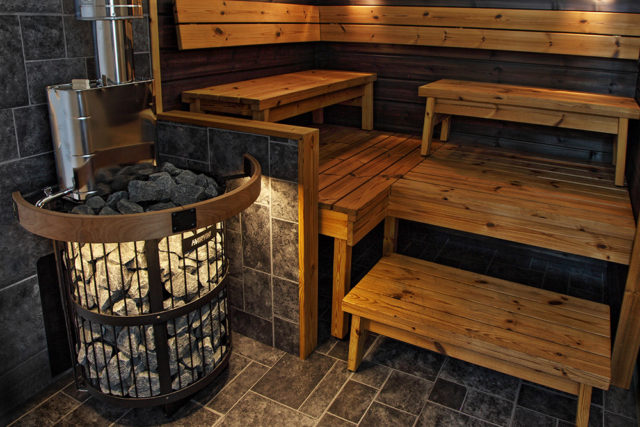
So that the "natural healers" do not lose their properties, they should be regularly looked after. So, for example, you need:
- Check for cracks and chips on the stones;
- remove minerals with defects;
- withstand the breed in salted water;
- thoroughly wash the minerals without the use of chemicals;
- dry the breed naturally;
- fill the furnace with minerals in three layers;
- temper the stone.
Scrupulous care and careful attitude is the key to durability, attractiveness and healing!
It is important to replace old stones with new ones in a timely manner, since usually any “lumps” begin to collapse over time. Twice a year, be sure to wash the stones thoroughly in water, as an unpleasant smell is formed from dust and dirt.
At the same time, you will wash off dust and salt deposits from them, and also check for cracks and chips.
It is very convenient to use a pressure washer for these purposes. You just soak the stones in powdered water or faerie for a while. And then, with a jet under pressure, you wash off the dead dirt from all the cracks and pores. Fast and practical. I recommend!
Do you want to feel the magic of minerals? Then it's time to attack shops or local waters! And I will finish, to whom it was informative - subscribe to the news, join our groups on social networks and introduce your friends to the blog. The right choice for you. Bye!

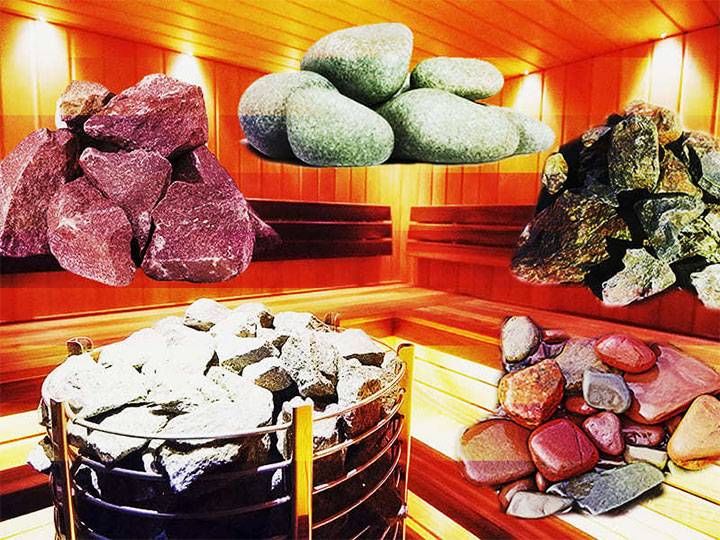
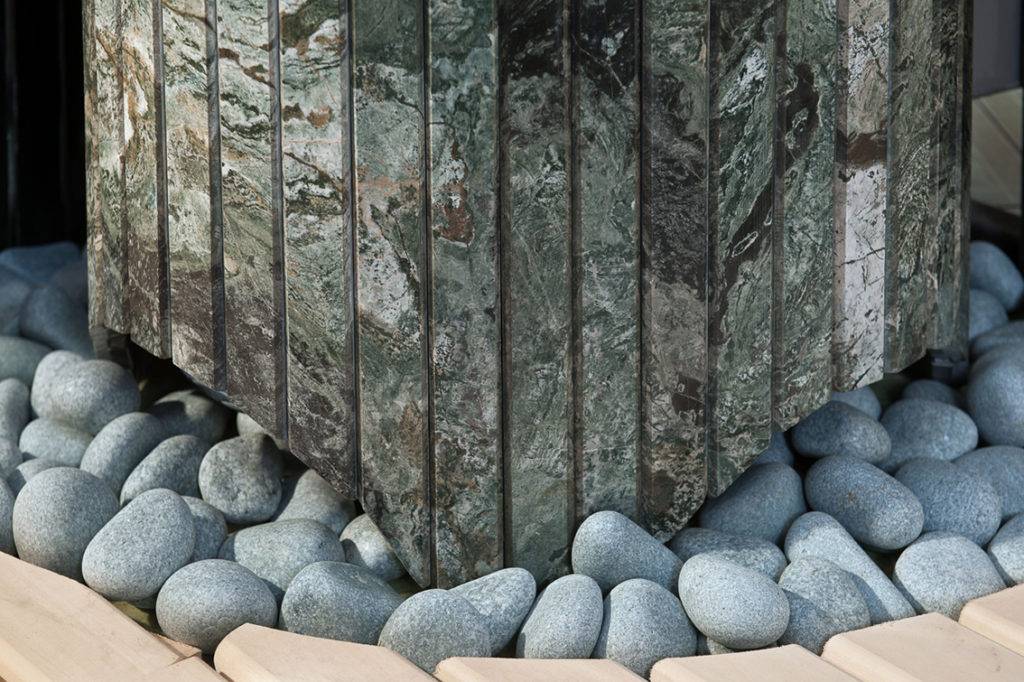


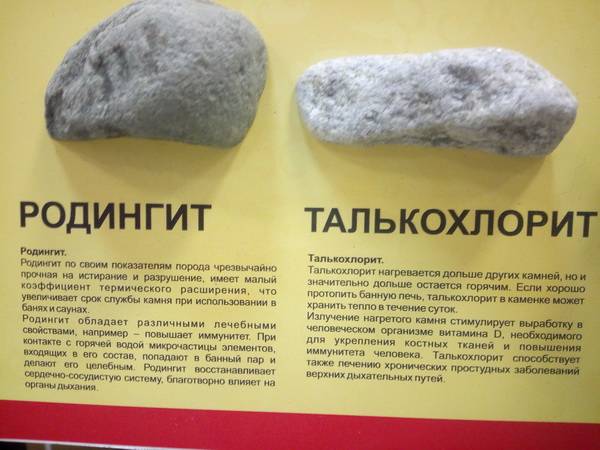
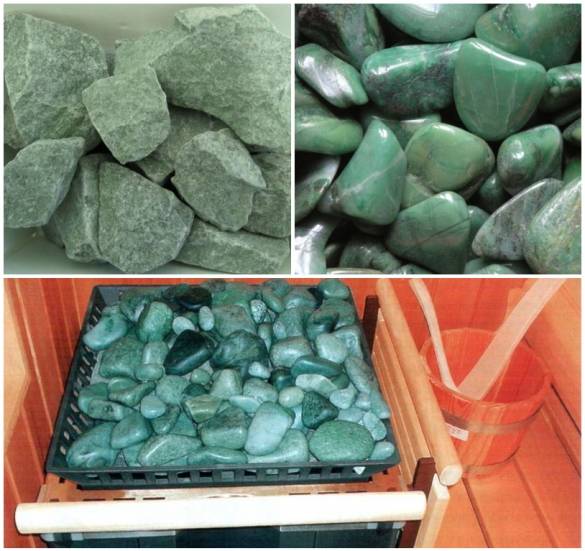
Wisdom Quote: Experience is the best teacher.
Bath attendants' advice
Sauna stoves are allowed to fill up with several varieties. Minerals with the lowest heat capacity are placed down, then with an average value, and on top - with the highest value.
Bath attendants advise:
- replace the mineral filler every 3-4 years (porcelain, cast iron and stainless products last for decades);
- soapstone is often washed from dust, calcined and washed again with water, dried;
- when selecting mineral filling, it is necessary to buy / collect samples with the lowest porosity, high specific gravity.
It is better to buy backfill for a bath in stores. The product has been tested for safety, treated against fungi and infections. They have a wide range of minerals of different fractions. They also sell mixes: in one package there are 2-5 types of stones.
The best stones for sauna and Russian bath:
| Furnace type | Ideally | Recommended for backfilling | Can be used in bath/sauna |
| Boulders are in contact with fire (Kuznetsov designs or intermittent action) | Jade, cast iron, chromite | Porcelain balls, quartz | Varieties of dunite, soapstone, rodingite, porphyrite |
| Open heaters (minerals are poured with water) | Rodingite, quartz, jade | Jasper, jadeite, dunites | Chromite, gabbrodolite, porphyrite, talcochlorite |
| Closed heaters, stoves with an open bottom | Porcelain, quartzite, cast iron grade SCh20, ChKh16 | Jasper, quartz, rodingite | Dunites, jadeite, porphyrite, varieties of diabase, jade |
| Sauna stove (minerals are in contact with air: the top is open, the stones are held by a mesh around the structure) | Jasper, jade | Ceramic or porcelain balls, quartz, jadeite | Gabbrodolite, rodingite, quartzite, dunites, chromite |
For a Russian bath or a Finnish sauna, natural minerals that do not contain harmful impurities are suitable. There are many varieties of fillings, the price range is large. Cheaper than all natural river boulder or sea pebbles. They cost from 10 rubles / 1 kg.
In addition, watch the video on how to fold the sauna stove yourself:
What fillings are used in your bath? Comment on the article, share your experience, interesting filling options. Send information to friends on social networks. Good luck.
What stones for a bath to choose?
To begin with, it is worth talking about what they generally are. There are three main sources of their occurrence:
- exit to the surface of magma;
- weathering products or deposition of biological remains;
- transformation of existing rocks.
Igneous rocks 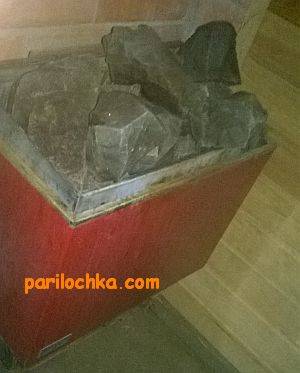 are among the most durable and heat-resistant. They are best suited for our purposes.
But sedimentary rocks are categorically not recommended for use in a bath - they are soft, easily and quickly destroyed under the influence of temperature and humidity.
Metamorphic rocks are the result of the transformation of both igneous and sedimentary rocks under the influence of pressure, temperature, gases and solutions. Of these, the most interesting is quartzite (the result of the metamorphosis of quartz sand), as well as soapstone.
The easiest way to distinguish stones is by hardness. The harder (and denser) they are, the more suitable for our purposes. (Although the talc in soapstone makes it quite soft, this is more of an exception.)
Now let's decide, here we have stones lying around: how to choose the best ones for a bath and what are the good ones that we are offered to buy?
In nature
You won't spend a dime if you just pick up the pebbles that are on the ground. Take a hammer with you - geological, if you have one, or a regular one. Try to split the vending specimens. Look at their cleavage - you should be interested in the internal structure, the presence of inclusions. Give preference to stones with a homogeneous structure, without inclusions, pores, cavities. It is desirable that the sound when stressed be sonorous (deaf - a sign of cracks and voids).
Any place far from landfills, industrial zones and railway lines can become a collection point - there stones can become contaminated with creosote and other substances that can not only spoil the pleasure of the bath, but also cause harm to health. After all, the same creosote is a carcinogen.
IMPORTANT! Connoisseurs advise collecting on the banks of rivers that have their source in the mountains.
 It is also good to have a Geiger counter with you, because it makes no sense to drag stones with an increased background radiation into your bathhouse, which, in general, is not so rare in nature and without human intervention.
After collecting the samples, subject them to further research. Start with calcination.Heat the stones so hot that they become red-hot, then drop them into warm water. According to the test results, leave those that have retained integrity.


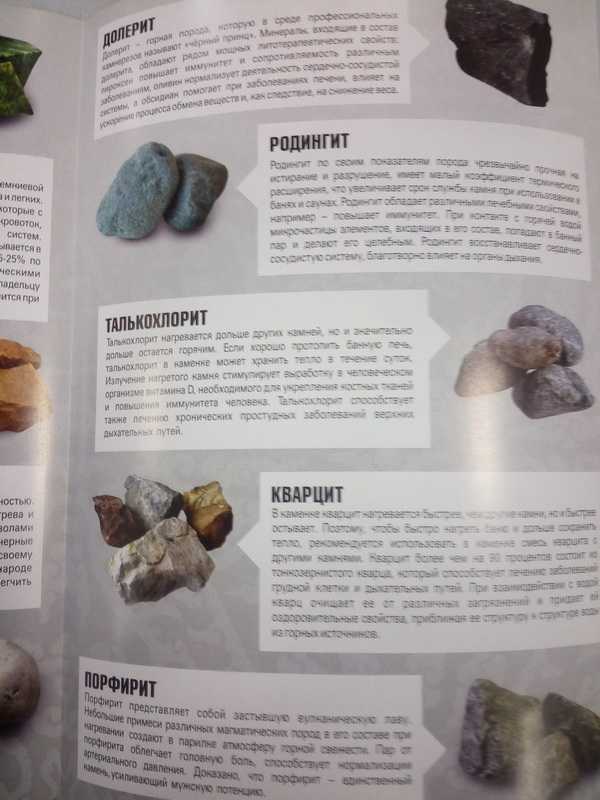
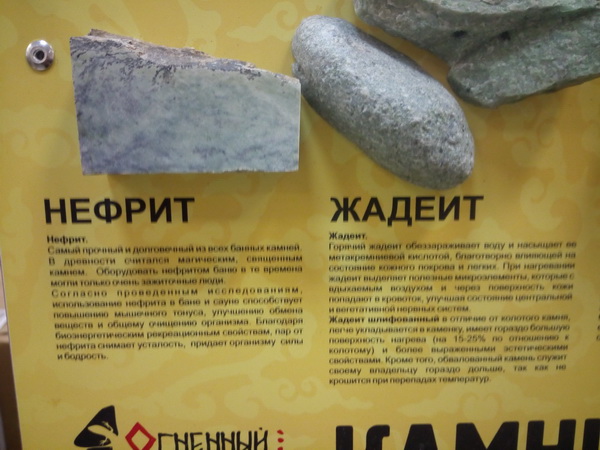

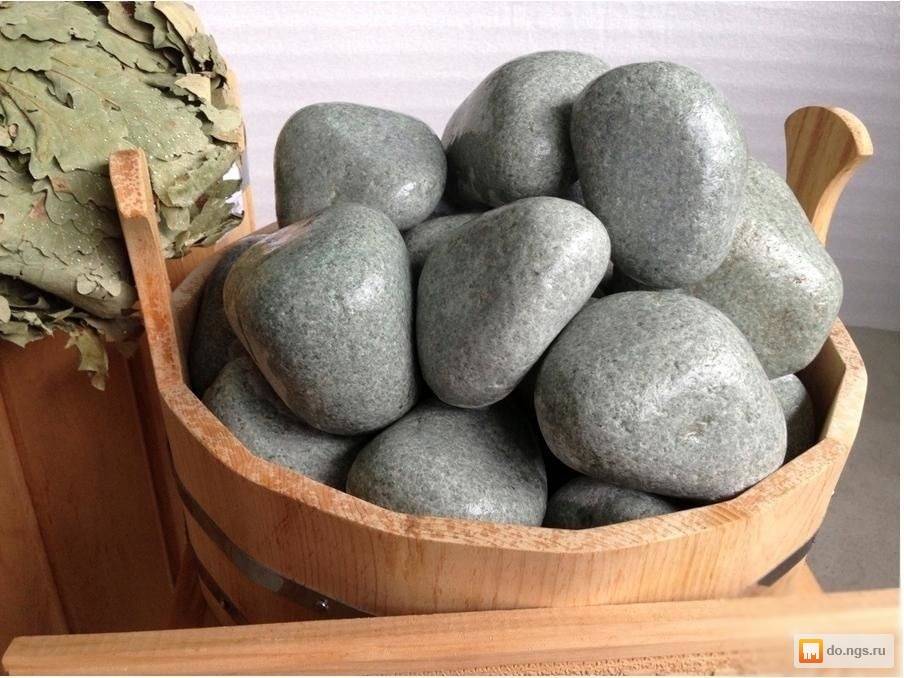
The next test is for the presence of gases inside minerals. Dip the stones in the water and watch to see if air bubbles appear on their surface. You do not need these, because you cannot check the composition of the gases contained in them.
Select several fractions - large (up to 20 cm), medium (up to 10 cm) and small (up to 6 cm). For an electric furnace, only a fine fraction is needed.
IMPORTANT! Talk to knowledgeable people in the neighborhood, old people can tell you where it is better to take stones. Surely there is a place that is used by more than one generation of local residents.
On sale
There is no need to do research here. You are being sold a product that must be certified. And this means that neither excess radiation, nor harmful gases, nor other troubles from these stones for a bath can be expected. Just do not forget to ask the seller to show the relevant documents. (By the way, it’s worth checking, because instead of jadeite they can sell another pyroxene, or even not pyroxene at all - watch the video for tips on how to distinguish a fake.)
As for the variety of species that are on sale, we will talk about this later.
Chiseled or polished?
No matter where the stones come from, they will in any case be in one of two forms: either chipped, with sharp irregular edges, or rounded. If the roundness of the outlines is the work of human hands, then these are called "bundled", "tumbling" or "polished"
Rivers and seas cope with such work no worse than a person.
But how to choose stones for a bath from these varieties? This could be considered a matter of aesthetic preference for the owner, but there is a difference for the bath itself:
- chipped ones have a large surface, so they give off heat more easily;
- rounded ones fill the space less densely, so air circulates between them better.
In addition, there is another difference when caring for the heater - sharp edges often break off and can clog the stove, which requires more thorough cleaning.
IMPORTANT! So, if you want the stove to keep warm longer and not cause problems with care, take smooth, rounded stones.
Originality and durability
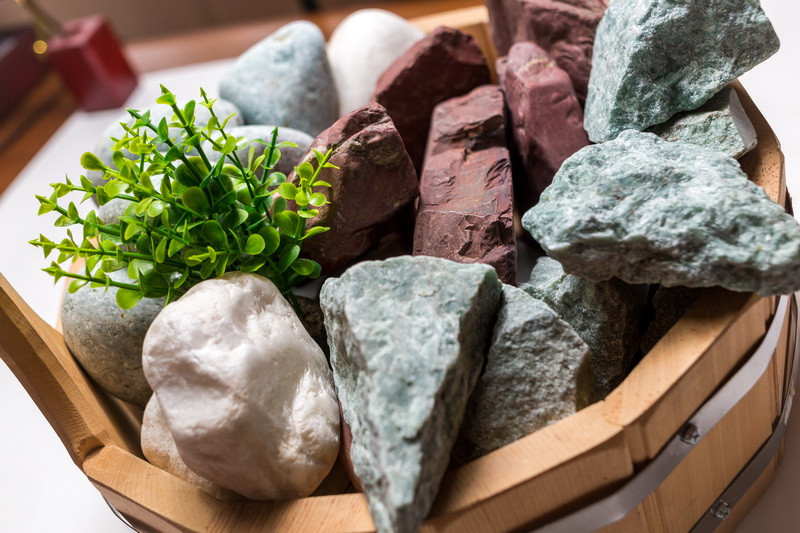
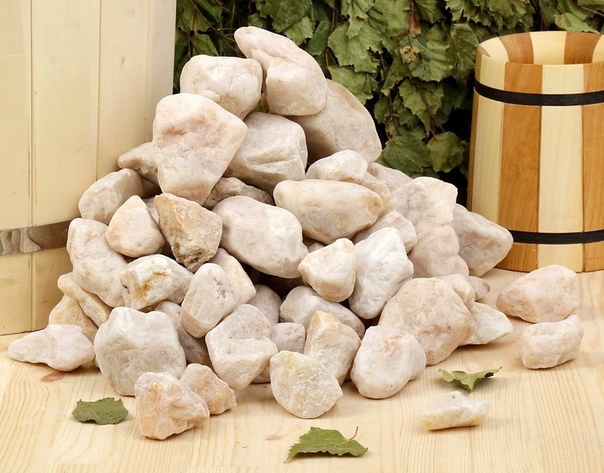
When the filling of the heater acts as a separate decorative decoration, quartzite is often used. This rare valuable variant can be the original purple or white. The first variety has a higher density, which means it is harder, more durable and “wear-resistant”. If cold water is poured on red-hot stones, they will not crack, they will not lose their shape.
The emitted steam does not contain harmful impurities. Raspberry quartzite is mined by crushing a large block. With this method of extraction, the appearance of individual elements with cracks inside occurs. Such specimens are not suitable for filling heaters. Therefore, when buying quartzite, you need to choose only solid cobblestones. The healing properties of purple stone are well known, the steam it produces helps improve blood circulation and stabilize blood pressure.

Very beautiful pink quartzite
White quartzite looks very picturesque in the bath, but in terms of durability, it is the most vulnerable. It is based on silicon and oxygen molecules.Under the action of high temperatures, the components quickly disintegrate, causing the cobblestones to burst or become covered with deep cracks. Anyone who rarely uses the steam room can turn a blind eye to this drawback. For saunas used on a regular basis, white quartzite filling is not suitable.
The video tells how the stones should be laid in the heater:
Purchase Features
Today, there are a variety of sauna stones on sale - you can better understand which ones if you know what to look for when buying. Many try to measure the level of radiation in cold specimens with special devices.
It's completely useless. The fact is that most often rocks are used to fill the furnace. It is formed in the deepest layers of the earth's crust, where radiation does not fall. Those who are concerned about this aspect can buy peridotite, jadeite, dunite. And even those rocks that form above their occurrence are also completely safe. The exception is granite, but it is not suitable for steam rooms in terms of other technical indicators.


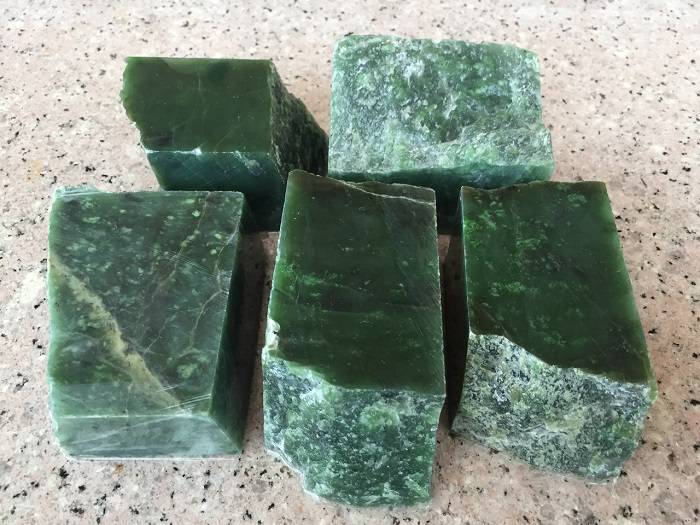

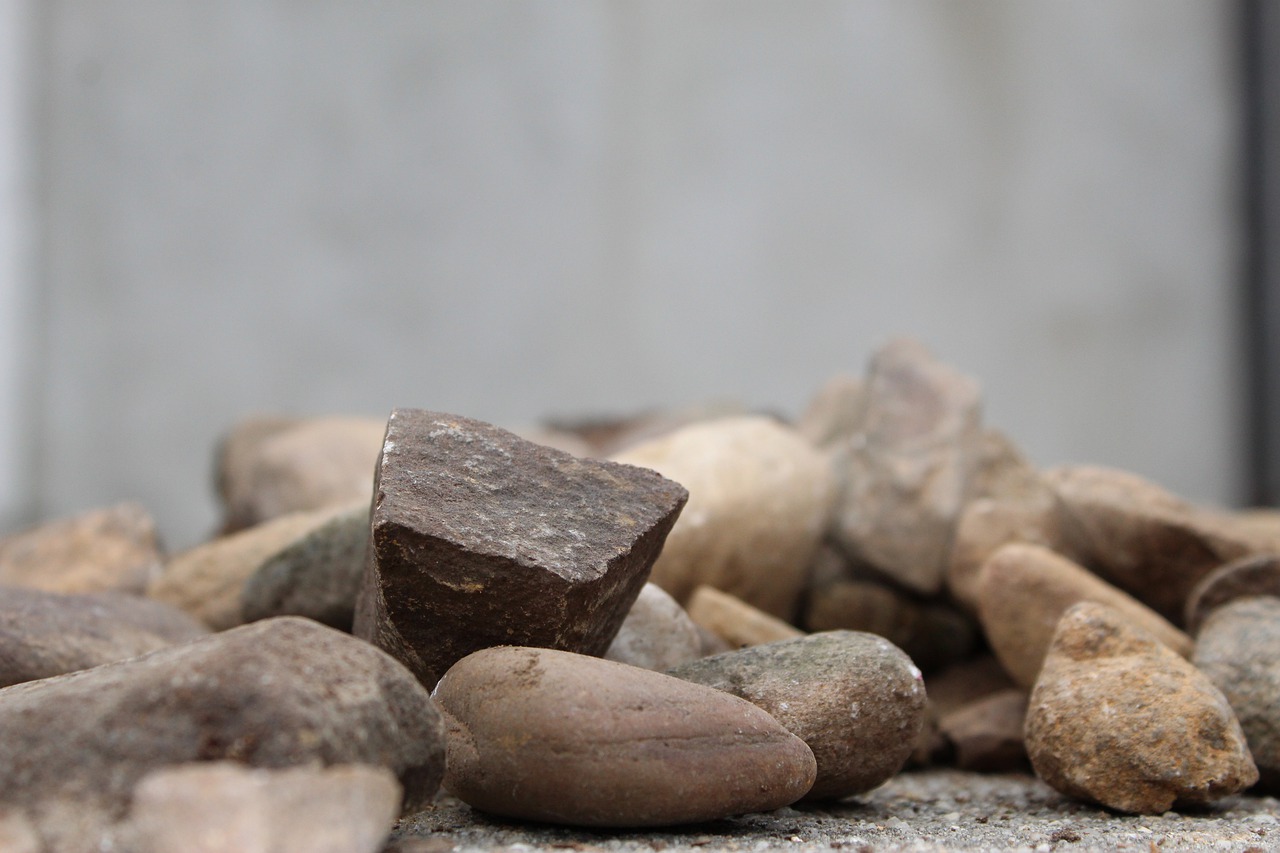


Bath stones are difficult to choose
Another selection criterion is the presence or absence of sulfides. They are an unpleasant additive, which can often be seen in the composition of mountain stones. It is found in almost any breed that is mined in Karelia. Sulfides are dangerous because when heated, they decompose and form sulfur oxide. Those, mixing with water, turn into acids. Inhalation of vapors with their content can provoke a burn of the mucous membrane of the upper respiratory tract.
You can determine the presence of sulfides by carefully examining the stones.If they have streaks or uneven spots that have a metallic or golden sheen, the cobblestones should be set aside. The presence of sulfides on the surface is considered acceptable if the "damage" is no more than 5% of the total surface area of the stone. This indicator is determined by eye. A small amount of sulfides quickly burns out when heated, after one or two furnaces there will be no trace of them. True, you will have to ventilate the bath every time after that and do not swim until the stones are burned. But then you can bathe without fear for your health.

Traces of sulphides on the stone
Other impurities can also settle on stones, which is why cobblestones that were previously laid as paving stones on public paths, sidewalks along freeways should not be used if they were picked up along railway lines or near industrial production facilities. This information will be useful to those who are looking for an answer to the question of how to choose stones for a bath yourself in nature, where it is safe to look for them.
The video lists the features of choosing stones for a bath:
Briefly about the main
The best stones for a bath are described, it is difficult to identify a clear leader among them. If you need the most heat-intensive cobblestone, you should buy porphyrite, if the safest, then jadeite and peridotite, if the cheapest, then gabbro diabase. No one forbids interfering with stones at their discretion. Basalt and quartz, rodingite and jasper work well together
It is important to always remember that only the correct placement of stones in the sauna stove is capable of producing high-quality steam.
What should be the stones
Resistant to high temperatures.This requirement for the choice of material is one of the most important, since the constant aggressive exposure to high temperatures quickly "wears out" the stones. Some options simply do not withstand the exhausted temperature conditions and literally explode when exposed to cold water. You can check whether the stone is suitable for use in the bath as follows: heat the sample to red and throw it into cold water. If the stone has not cracked, then it may well serve faithfully in the bath.
Heat accumulation. Stones should heat up quickly and release heat slowly. This ability to accumulate heat will come in handy when guests are steaming - there is no need for a constant heating of the sauna to reheat the stones in the steam room. Such stones should be very dense, heavy, have a uniform structure without inclusions.
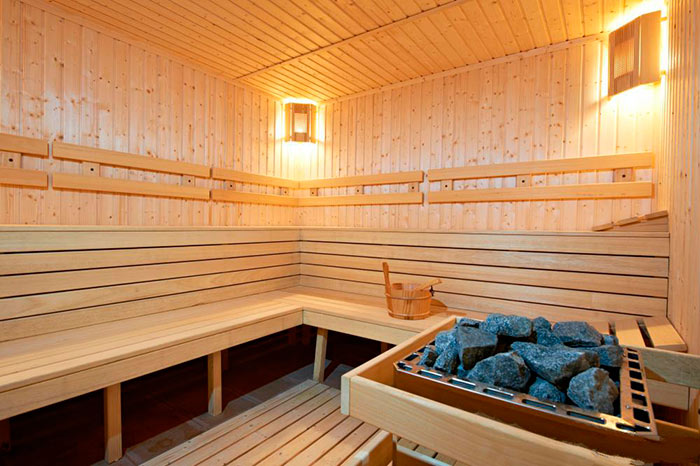
Before using the stones for the bath, it is necessary to check for resistance to high temperatures.
Certain size. The larger the capacity for stones, the larger the filler should be. This unspoken rule of all attendants is often forgotten by amateurs, who are much more important than the quality of the steam room, but the very fact of the presence of stones. The average size of the stones should be about 10 cm in diameter.
Safety. When interacting with water, the stones should not break off, swell, fly off. This safety law is the most important. Otherwise, visitors to the steam room may suffer from an unexpectedly flying off heated piece.
The form. For uniform heating of the main bath elements, smooth stones with the correct shape are recommended.
Such rapidly exhausting, intense temperature loads, not all stones can withstand.Experienced bath attendants know which ones are ideal for the stove. Consider the main types of heater filler to make the right choice.
Breed Selection Criteria
The success of the soaring procedure largely depends on the correct choice of stones for the bath. One of the main parameters is how quickly the rock heats up and cools down. Heat must be released slowly, while heating must occur in a matter of minutes.
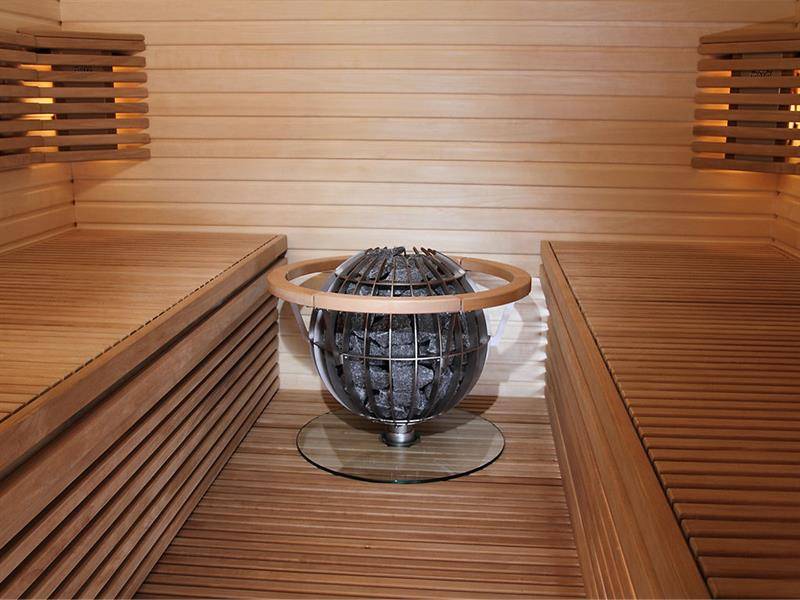
Photo from the site
In order for the main functional element of the steam room not to fail for as long as possible, the following requirements must be taken into account:
- resistance to sudden temperature changes;
- ability to cool down gradually;
- the size of the stones;
- structure of molecular compounds;
- environmental friendliness.
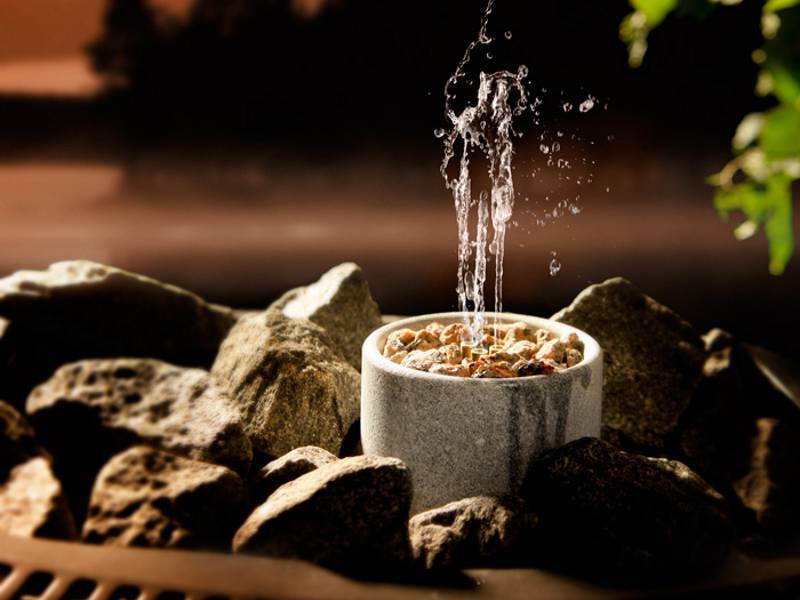
Heat resistance
This criterion can be called one of the most important, since the durability of the material depends on it. A sharp incandescence, and then treatment with water, the degree which is always lower, the boulders are under high stress. With regular use, cracks and bumps appear. But when buying high-quality and strong breed, the service life increases significantly.




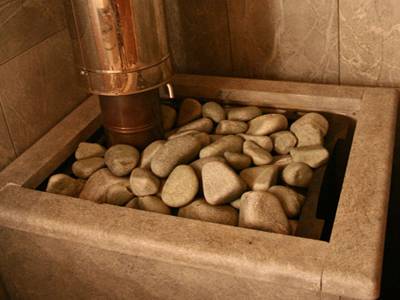

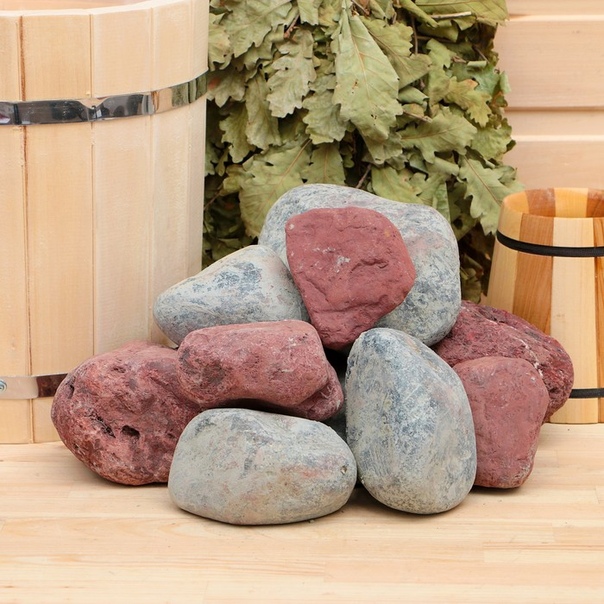


For many lovers of cool steam, the question is how to choose the right stones for the heater in the bath?
You can test them out on your own.
You will need:
- jackhammer;
- container with cold water (not plastic).
To test the impact resistance, walk hard on the surface of the cobblestone. If damage appears, you should refrain from purchasing the entire batch. The second test directly shows resistance to temperature changes. After heating the sample, immediately place it in a tub of water or pour liquid over it. The occurrence of defects indicates the low quality of raw materials.
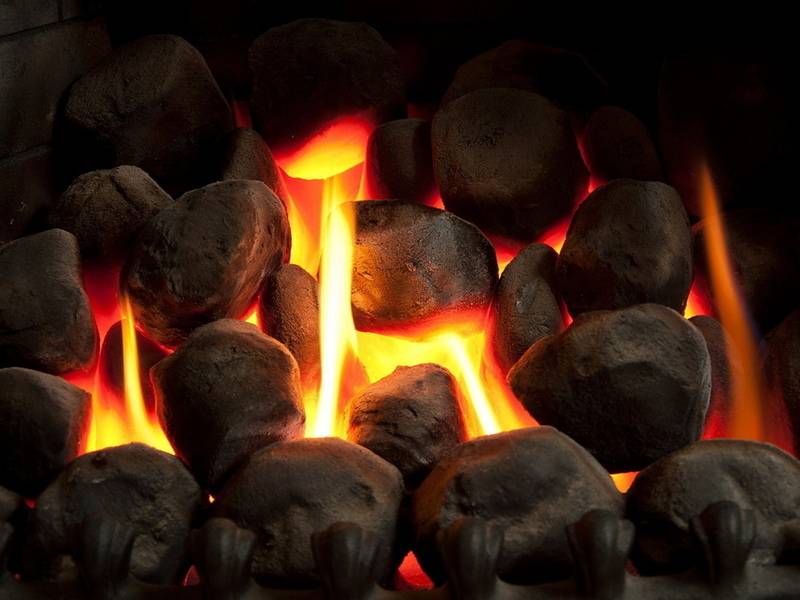
Heat capacity
A regular in the steam room will tell you that the main thing in the breed is its density and uniformity. It is these qualities that ensure the slow cooling of the material.
Therefore, thinking about which stones are better to choose for a Russian bath, pay attention to their dimensions. Large, massive boulders have a high level of heat capacity
The room will be heated for a long time by the heat emanating from them.
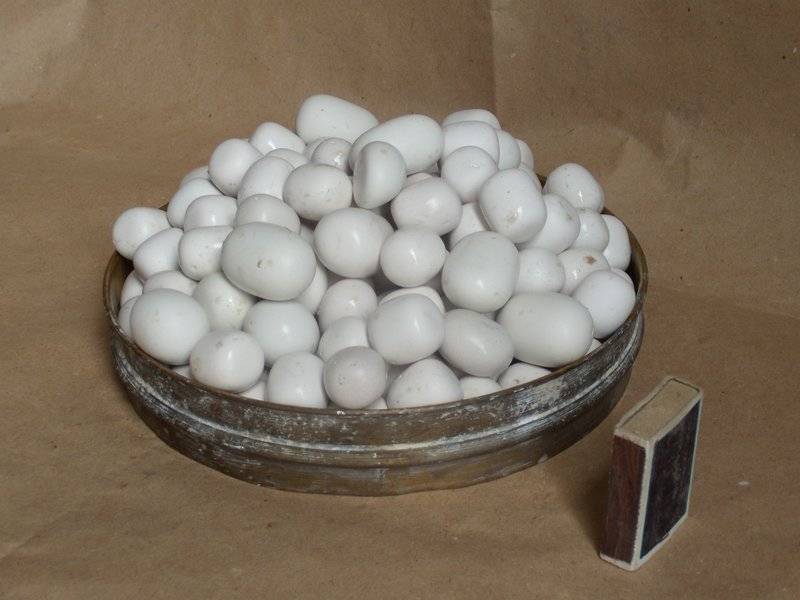
Photo from the site
boulder sizes
When choosing the right dimensions, not only the breed is important, but also the principle of operation of the furnace. If the unit runs on wood, then medium ones will be ideal, with a diameter of seven to fifteen centimeters. What size stones are best for an electric sauna stove? Considering the design of modern systems, stop your eyes on small ones, the coverage of which does not exceed eight centimeters.
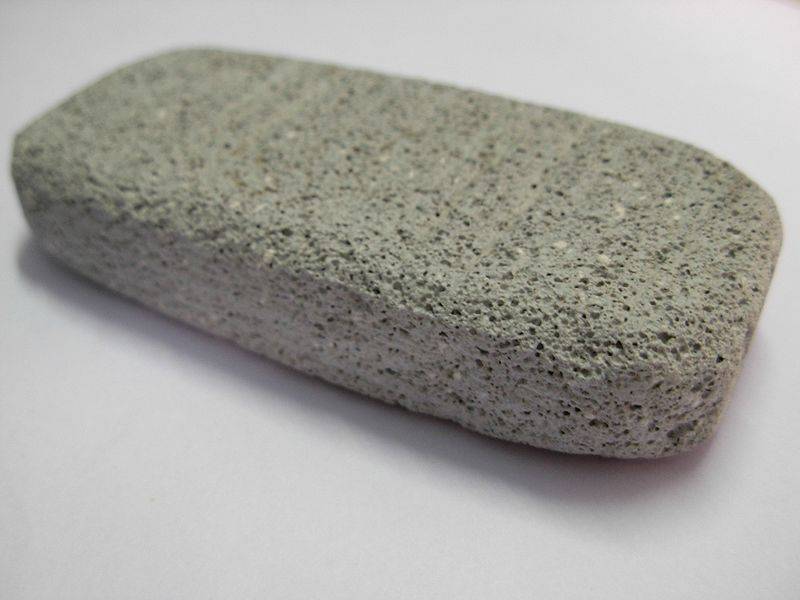
Photo from the site
Structure of molecular compounds
This parameter affects the ability of the boulder to absorb moisture. Experts use such concepts as "inhalation" and "exhalation" of the stone. The first means the speed with which the stone absorbs water, and the second - how quickly and in what quantity it gives it away as steam. There are more porous and smooth surfaces, respectively, they have different levels of vapor capacity. From this criterion depends which stones for a bath are better in a steam room? It all depends on what you prefer: for more water to remain in the array or to go out into the room.
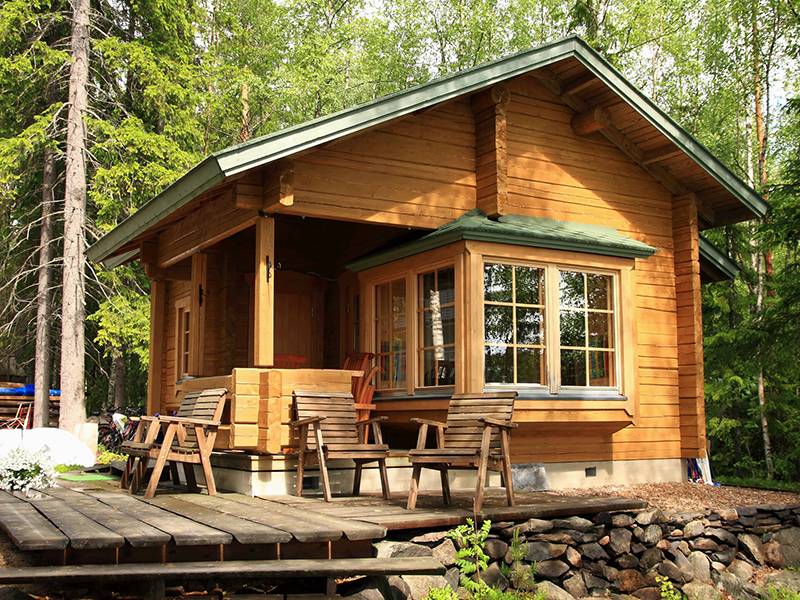
Photo from the site
Safety of use
When exposed to incandescent and dousing with water, even the most durable material begins to exude certain substances into the atmosphere.One must refer to the chemical composition of the purchase: refrain from using toxic samples. Natural minerals have healing properties.
Such breeds are more expensive, but you should not save on health. In addition, there is a way to get them for free. While relaxing by a clean pond, ask the locals where to collect suitable stones or pebbles for a bath. On the coast, you should not look for perfectly polished cobblestones, as in factory processing, but you should not take cracked ones with sharp chips either.
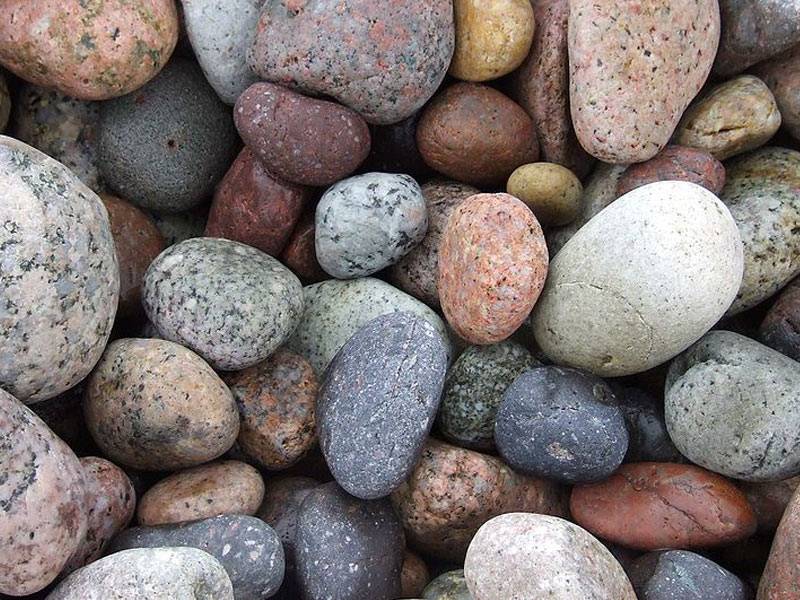
Photo from the site
Bath attendants' advice
Sauna stoves are allowed to fill up with several varieties. Minerals with the lowest heat capacity are placed down, then with an average value, and on top - with the highest value.
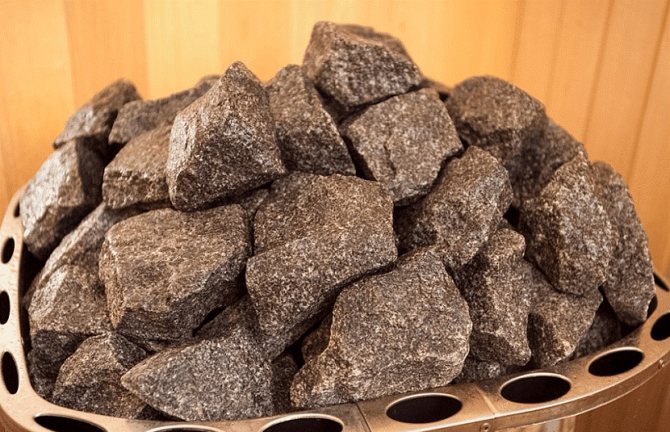

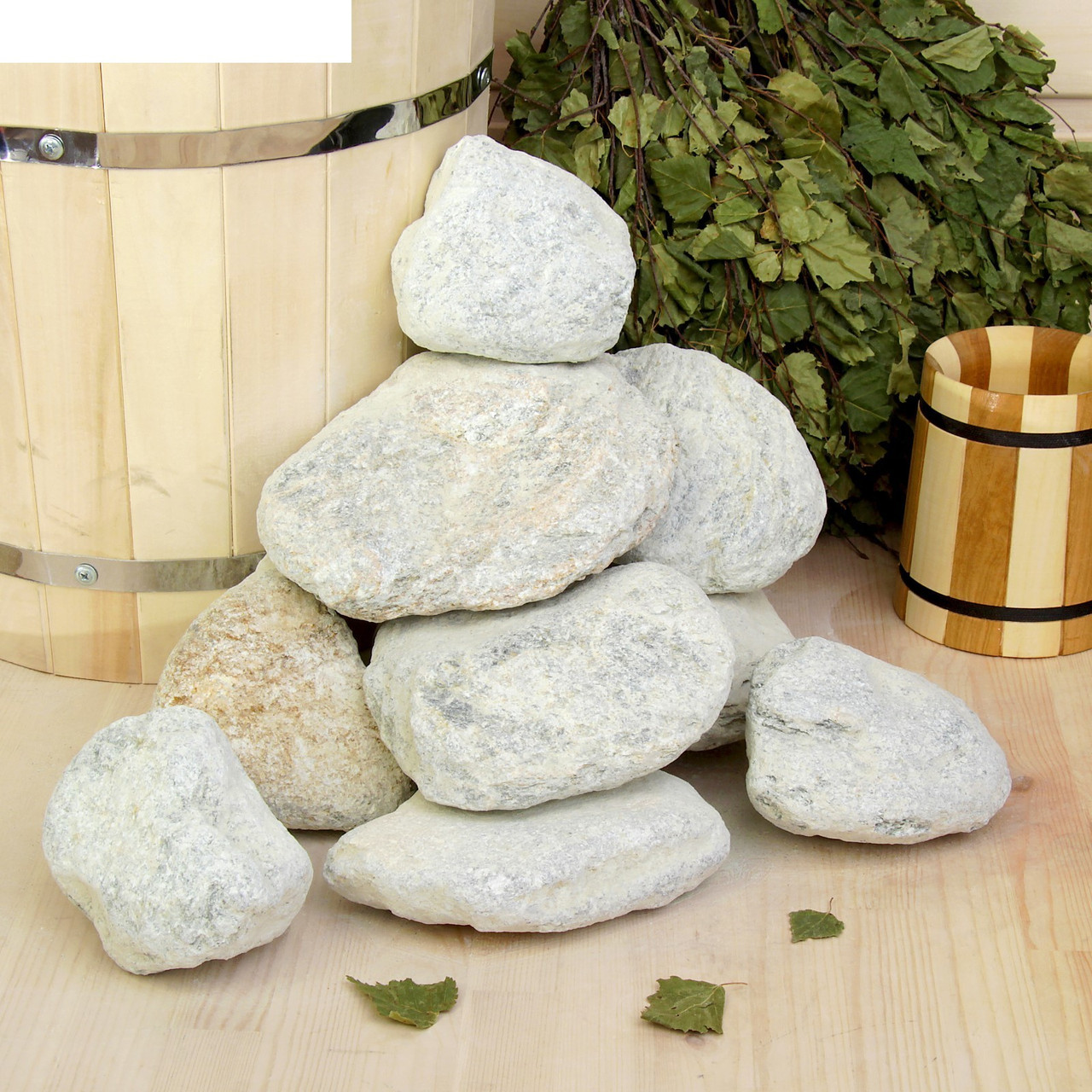
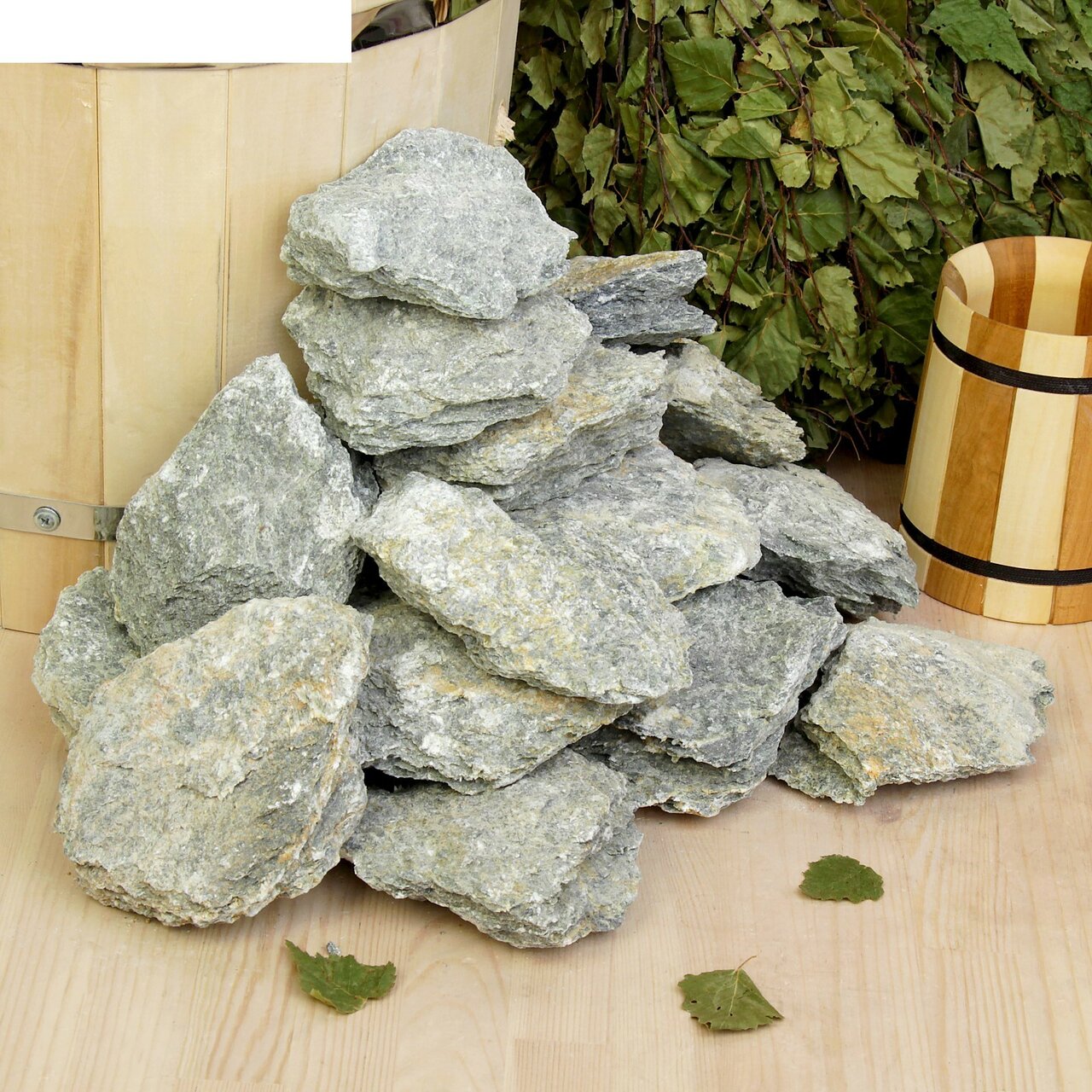
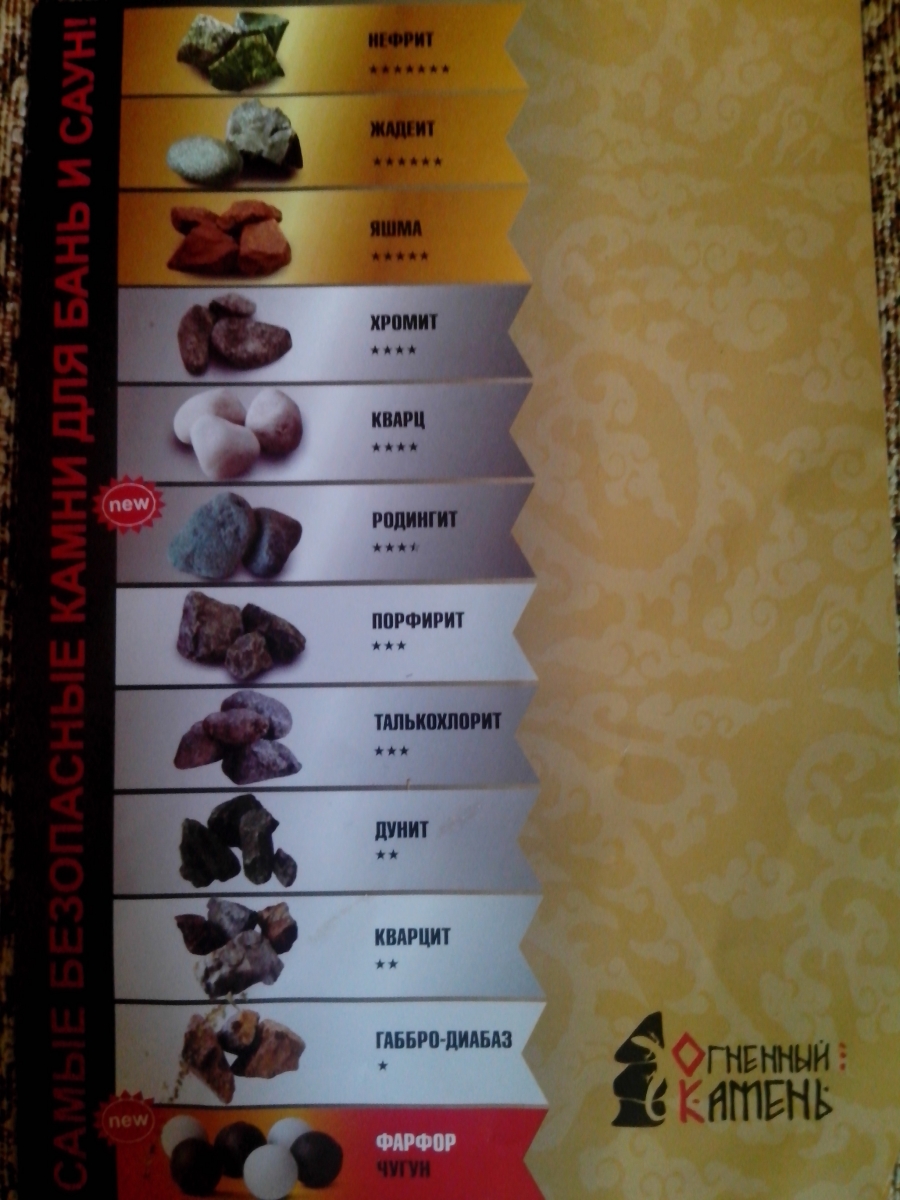

Bath attendants advise:
- replace the mineral filler every 3-4 years (porcelain, cast iron and stainless products last for decades);
- soapstone is often washed from dust, calcined and washed again with water, dried;
- when selecting mineral filling, it is necessary to buy / collect samples with the lowest porosity, high specific gravity.
It is better to buy backfill for a bath in stores. The product has been tested for safety, treated against fungi and infections. They have a wide range of minerals of different fractions. They also sell mixes: in one package there are 2-5 types of stones.
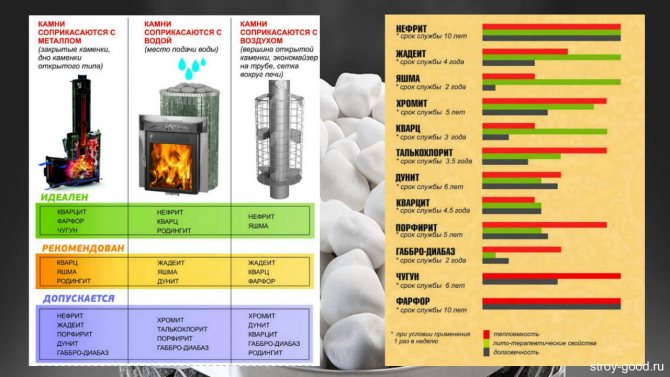
| Furnace type | Ideally | Recommended for backfilling | Can be used in bath/sauna |
| Boulders are in contact with fire (Kuznetsov designs or intermittent action) | Jade, cast iron, chromite | Porcelain balls, quartz | Varieties of dunite, soapstone, rodingite, porphyrite |
| Open heaters (minerals are poured with water) | Rodingite, quartz, jade | Jasper, jadeite, dunites | Chromite, gabbrodolite, porphyrite, talcochlorite |
| Closed heaters, stoves with an open bottom | Porcelain, quartzite, cast iron grade SCh20, ChKh16 | Jasper, quartz, rodingite | Dunites, jadeite, porphyrite, varieties of diabase, jade |
| Sauna stove (minerals are in contact with air: the top is open, the stones are held by a mesh around the structure) | Jasper, jade | Ceramic or porcelain balls, quartz, jadeite | Gabbrodolite, rodingite, quartzite, dunites, chromite |
What fillings are used in your bath? Comment on the article, share your experience, interesting filling options. Send information to friends on social networks. Good luck.
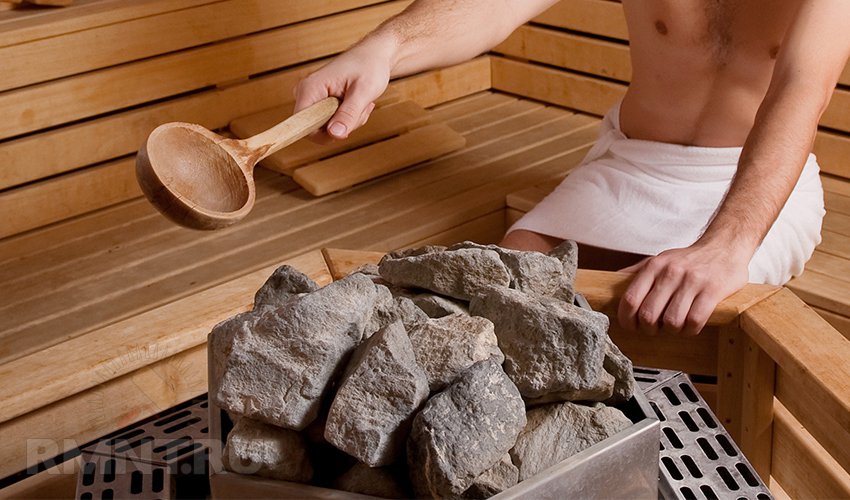
It is not enough just to choose the right stones, because you also need to properly place them in the oven so that the heat is comfortable and the steam fine and really light.
It is also equally important to arrange proper ventilation in a room with an electric heater or other type of stove. In masonry, it is imperative to provide a sufficient number of unfilled vertical channels through which hot air will circulate. In masonry, it is imperative to provide a sufficient number of unfilled vertical channels through which hot air will circulate.
In masonry, it is imperative to provide a sufficient number of unfilled vertical channels through which hot air will circulate.
The nuances of filling the stove:
- Before laying, the filler must be thoroughly washed and dried.
- The lower layers are laid in large fragments that accumulate heat well. It can be peridotite, soapstone, gabbro-diabase, basalt or cast-iron cores.
- Medium and small particles of jadeite, quartzite, jade or other rocks with suitable healing properties are placed on top.
- Stones should be placed tightly enough, but not tamped. After laying, the proportion of air gaps should be approximately 10-15 percent of the total volume.
- It is not necessary to lay the filler close to the tubes and other elements of the electric heater - when heated, the stone expands and can deform the device.
- Only hot water can be poured onto the heater, and in small portions and without additives like honey, oils or beer, otherwise the stones will quickly become covered with soot and smoke. If you can’t imagine a bath without fragrant steam, simply dissolve the mixture in water, pour it into a metal bowl and place it on top or hang it over the stove for evaporation.
- Porphyry and other rocks may crackle slightly when first fired - this is normal. But if crackling is constantly heard, the stones should be reviewed and, if necessary, replaced - perhaps you got heterogeneous specimens with foreign impurities.
And lastly, do not forget to check the condition of the heater at least once a year and check the filler for cracks and breaks.
Damaged stones must be removed and replaced with new ones, and those that have withstood the test of heat and steam must be washed under running water and sent back to service.



