
- Features of mounting lamps of various types
- Chandelier installation
- Installation of spotlights
- Mounting the LED strip
- Technical features
- Dimensions and shape
- Luminaire spacing and spacing
- Location Recommendations
- Mounting Features
- In stretch ceilings
- In plasterboard ceilings
- Examples of the location of fixtures on the ceiling
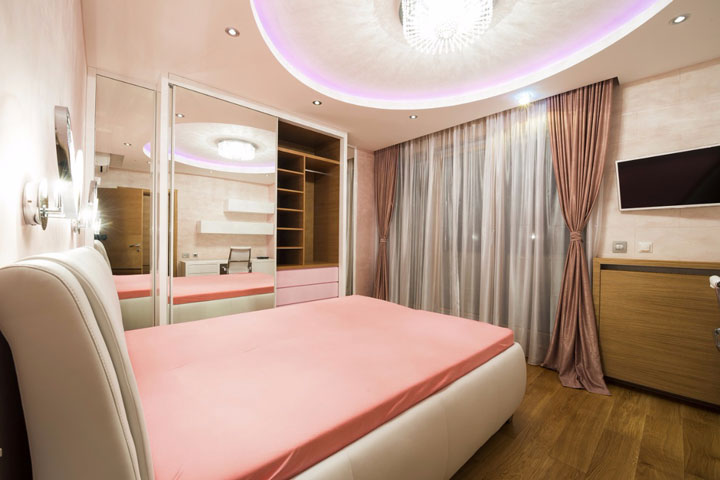
- In the bedroom
- In the living room
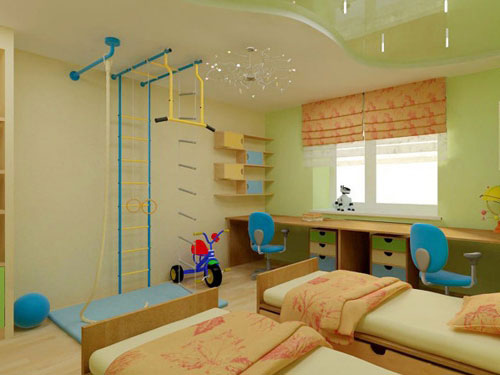
- In the nursery
- Kitchen
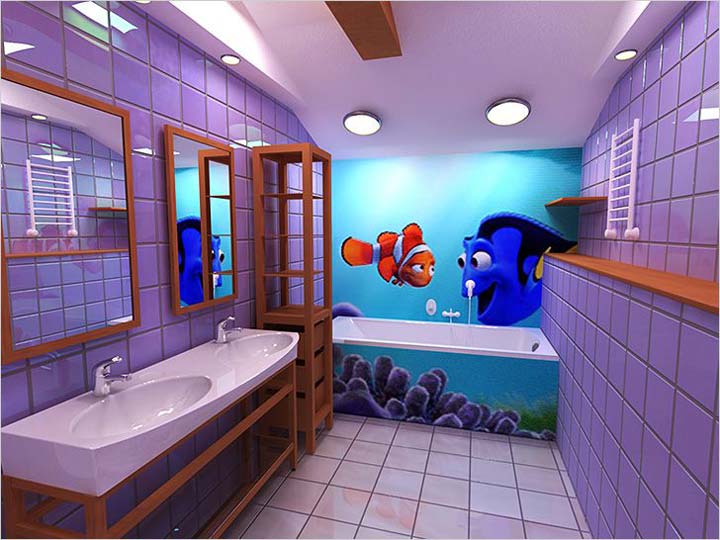
- Bathroom
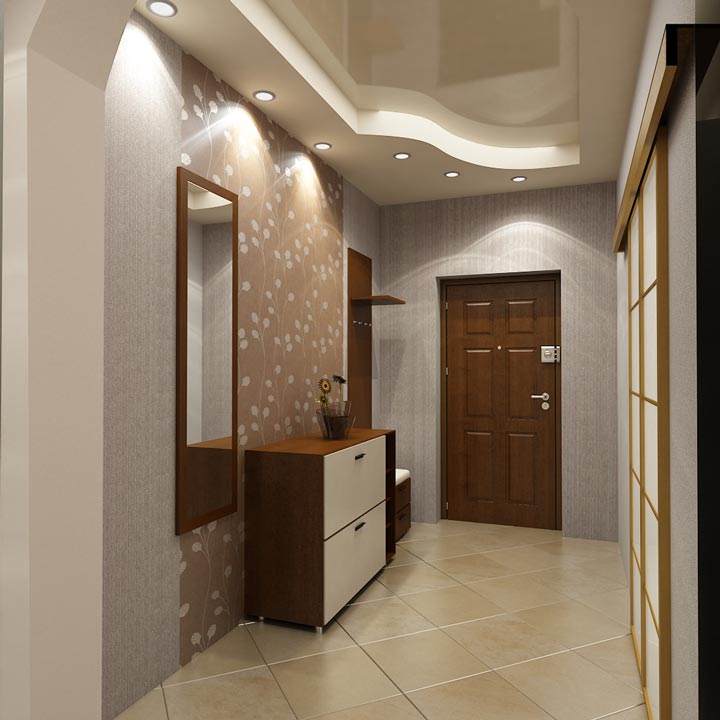
- Corridor and hallway
- Lighting Design Recommendations
- How to choose spotlights for stretch ceilings?
- Types of spotlights
- Dimensions and shape
- Type of adjustment of spotlights
- Installation nuances
- Spotlights
- Prices for recessed luminaires
- Requirements for placing lamps on the ceiling
- Photo in the interior of the rooms
- Chandelier in the hall under the stretch ceiling
- Chandeliers in the bedroom to the stretch ceiling
- Chandeliers in the interior of the kitchen
- Ideas in the bathroom for stretch ceilings
- Examples for the hallway and corridor
- Chandelier in the interior of the nursery
- Types of light bulbs according to the type of luminous element for a stretch ceiling
- Spotlights
- Recessed luminaires
- Overhead lamps
- Hanging chandeliers
Features of mounting lamps of various types
To install lighting in a kitchen or other premises on your own on a stretch ceiling, you need to take into account some of the nuances that depend on the type of fixtures chosen.
Chandelier installation
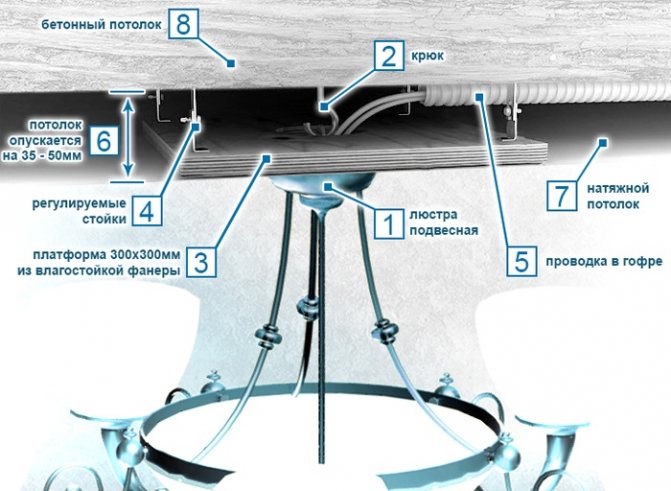
The installation of the chandelier is carried out before and after stretching the canvas on the ceiling:
- before stretching, it is necessary to install a hook or platform for fixing lighting equipment;
- after stretching, a reinforcing ring is glued to the place of attachment of the chandelier, which makes it possible to strengthen the ceiling covering;
- after the adhesive has completely dried, a hole is cut on the ring for connecting and attaching the chandelier;
- lighting equipment is installed.
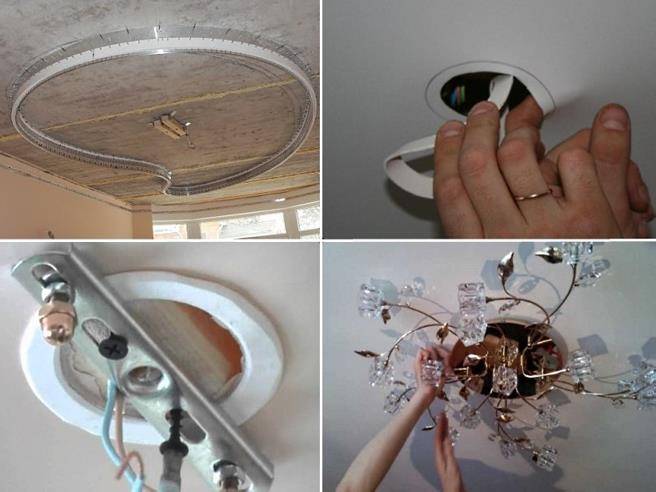
Chandelier installation process
Installation of spotlights
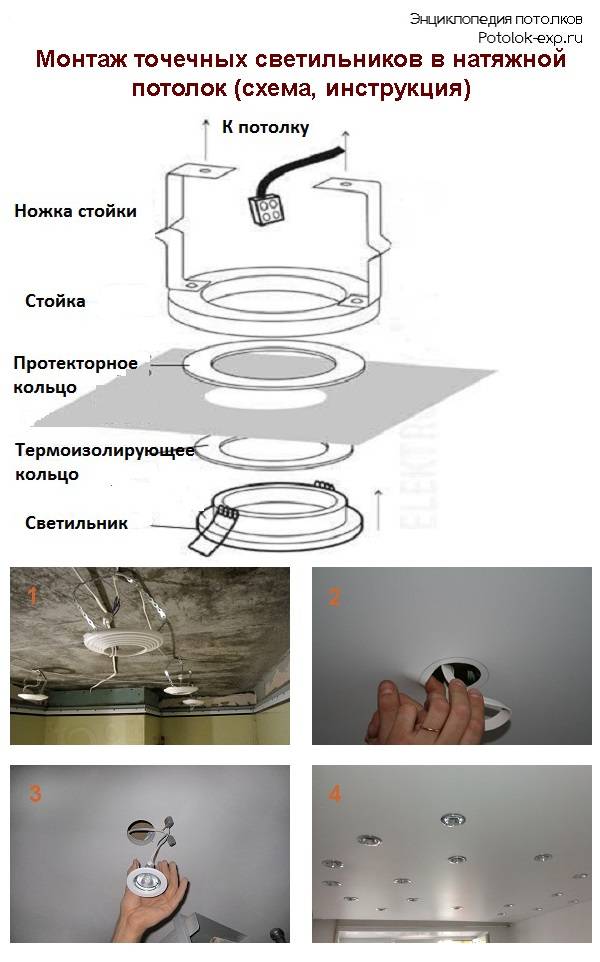
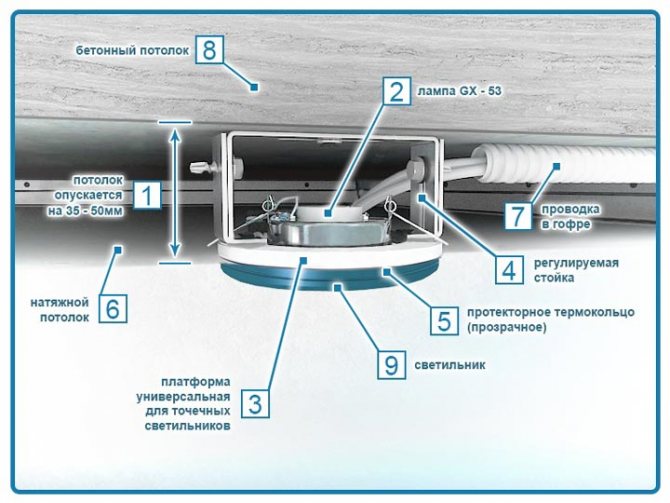
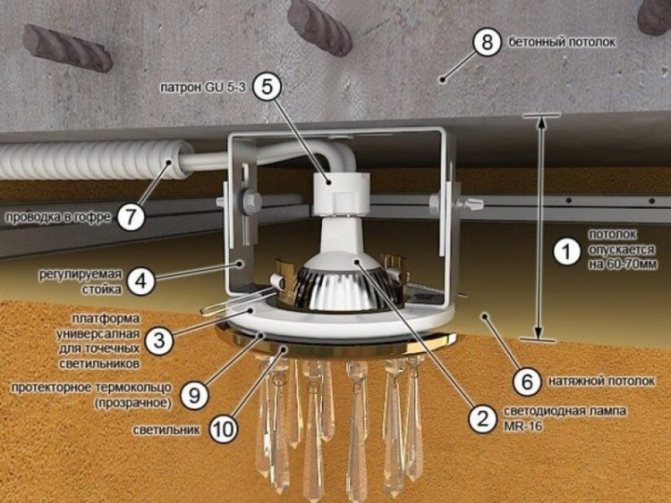
Installation of spotlights is carried out according to the following scheme:
- choice of layout of lighting equipment;
Luminaires should be evenly placed over all areas of the ceiling. Only in this case it will be possible to illuminate all areas of the room.
- base fastening;
- electrical cable laying;
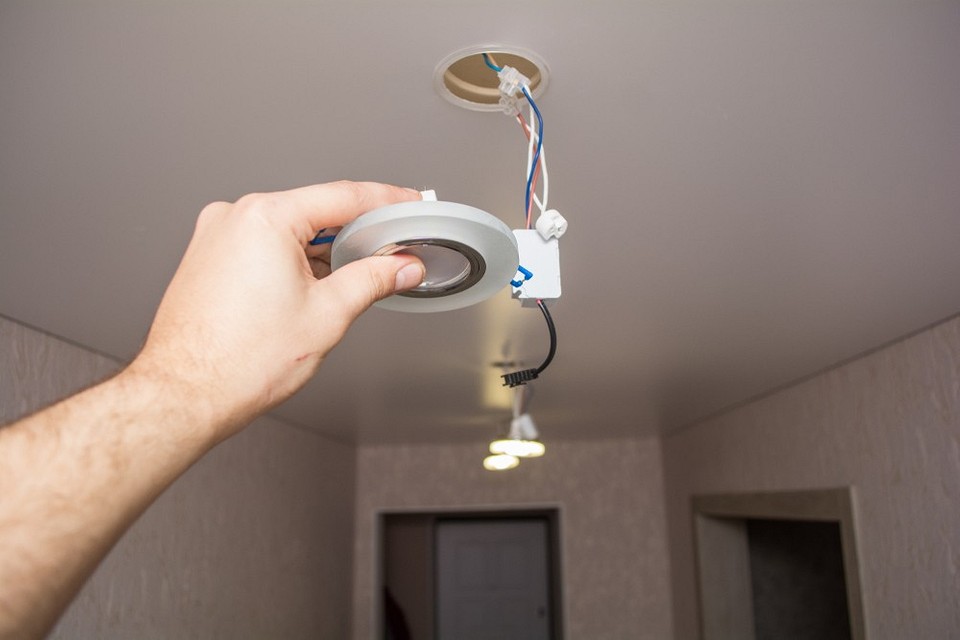
- after stretching the ceiling covering at the locations of the fixtures, mounting rings are glued, after which holes are cut out and equipment is installed.
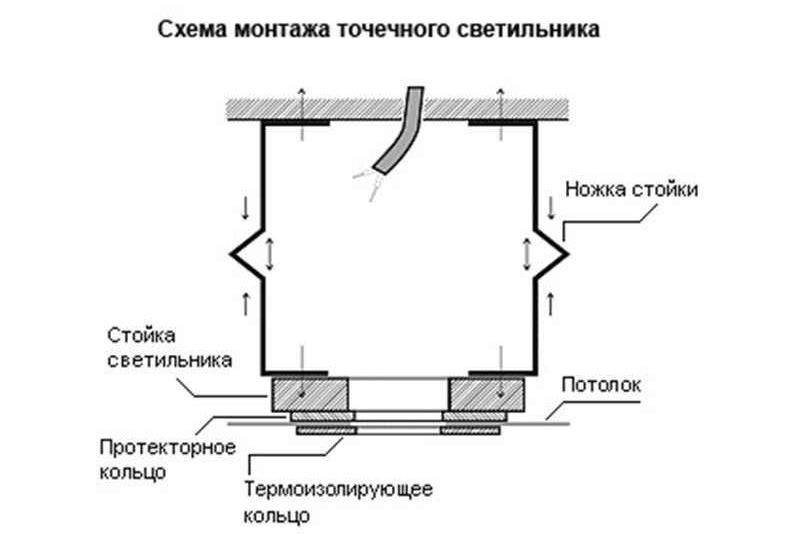
Installation rules for spotlights
For more information on the installation process, see the video.
Mounting the LED strip
How to make a backlight diode tape? Installation work is carried out in the following order:
- connecting parts of the tape until the required length is reached;
- release of the tape from the protective layer;
- tape fixation. If there is no adhesive base, then the installation of the LED strip is carried out on an aluminum profile;
- installation of additional equipment (controller, power supply, and so on);
- connection to the mains.
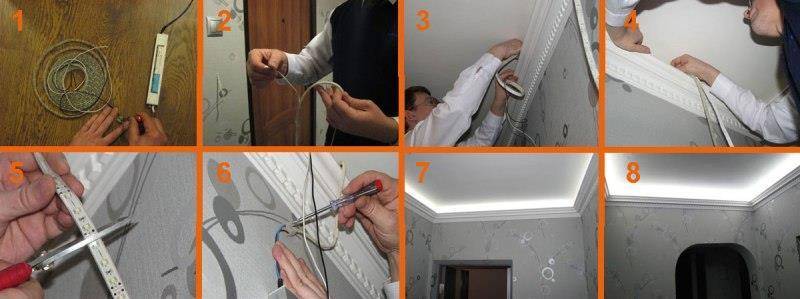
Mounting the LED strip
In most cases, you can install fixtures on a stretch ceiling yourself. The main thing is to develop a lighting project before stretching the canvas.
Technical features
The location of the lighting fixtures on the tension web is calculated at the measurement stage. The coating itself needs preliminary cutting, which takes into account all possible holes:
- for pipes;
- for smoke detectors;
- for ventilation;
- for CCTV cameras;
- for hooks for various suspensions (for example, wicker hanging swings)
- for hanging chandeliers;
- for spotlights.

An already stretched canvas cannot be cut on its own, therefore it is necessary to clearly understand what and where will be located when ordering. As a rule, installation organizations know how to properly position the fixtures on a stretch ceiling. At the same time, the customer is often offered template options from the catalog of work performed, but they are far from exhausting the possibilities of lighting design.
Dimensions and shape
Spotlights are ideal as additional lighting in large rooms. These include:
living room
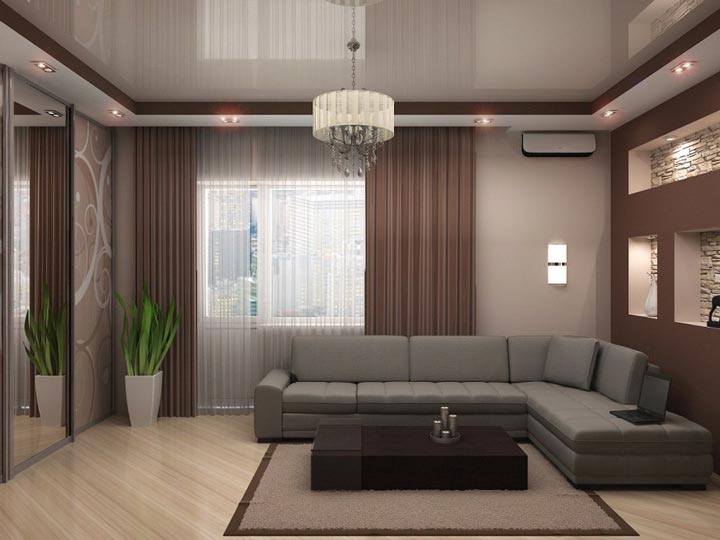

And as the main source of lighting, they are suitable for small rooms:
bathroom
Why exactly? Firstly, any spotlight has a certain size of the inner part, which is hidden in a niche.
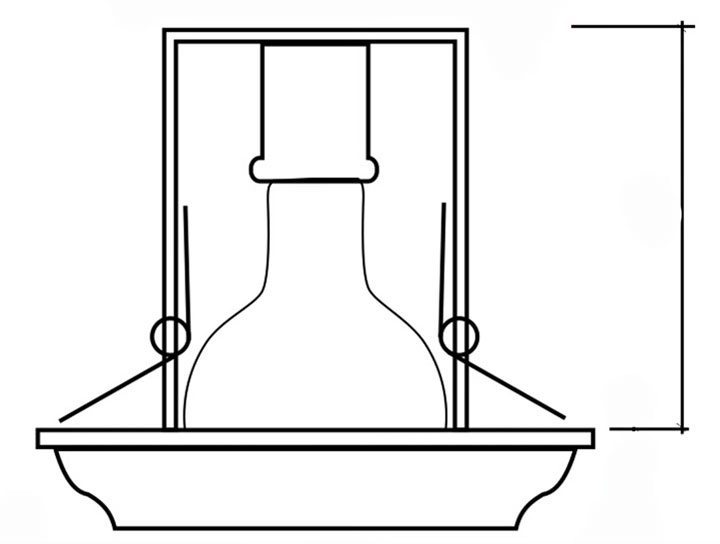
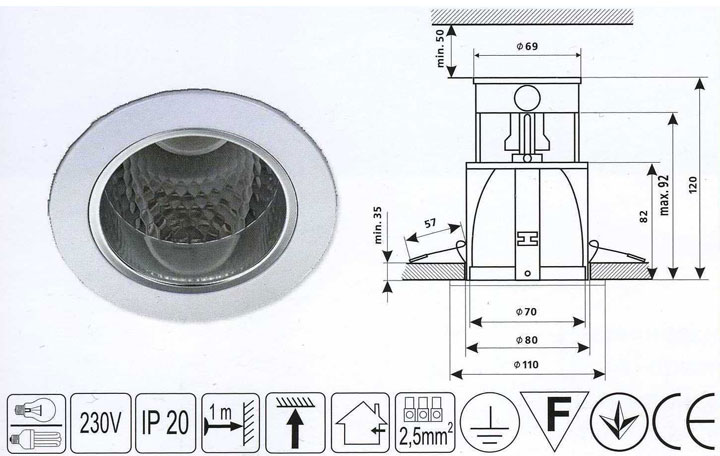
Because of this, it is necessary to reduce the overall height of the ceiling in the room. The size of the niche will depend on the type of spot.
Therefore, when buying in a store, pay attention not only to how they shine or the design of the ceiling itself, but also to the overall dimensions. Otherwise, you will be unpleasantly surprised by the reduction in the size of your room.
For example:
for luminaires with incandescent lamps, the ceiling will drop by as much as 12cm


It is considered not a very good solution to lower the ceiling by 12cm in the entire room. In this case, it would be correct to choose a chandelier as the main lighting, or one large ceiling lamp that is attached to the zero mark.




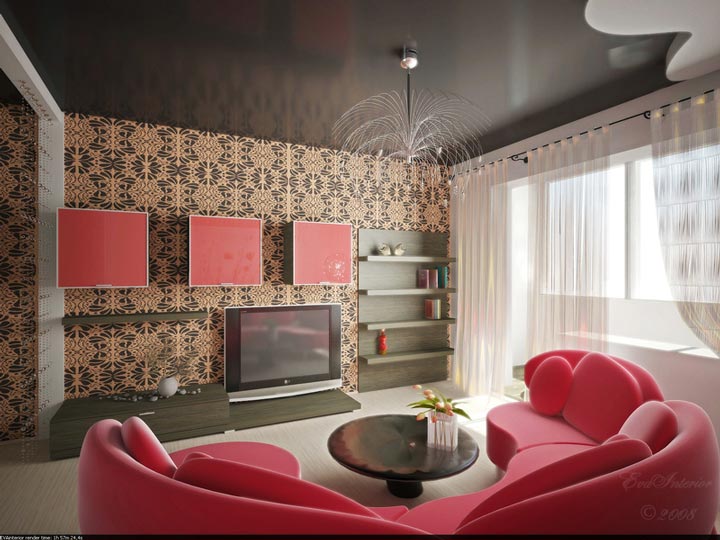
And do dot as additional. At the same time, lowering the ceiling for them, only in the necessary areas of the room.
In bathrooms, the stretch ceiling is mounted around the entire perimeter and initially lowered to a certain height. As a result, the very niche is formed, ideally suited for embedded spots.
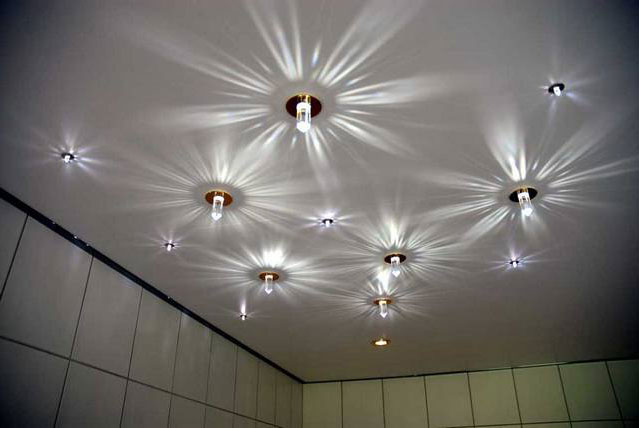
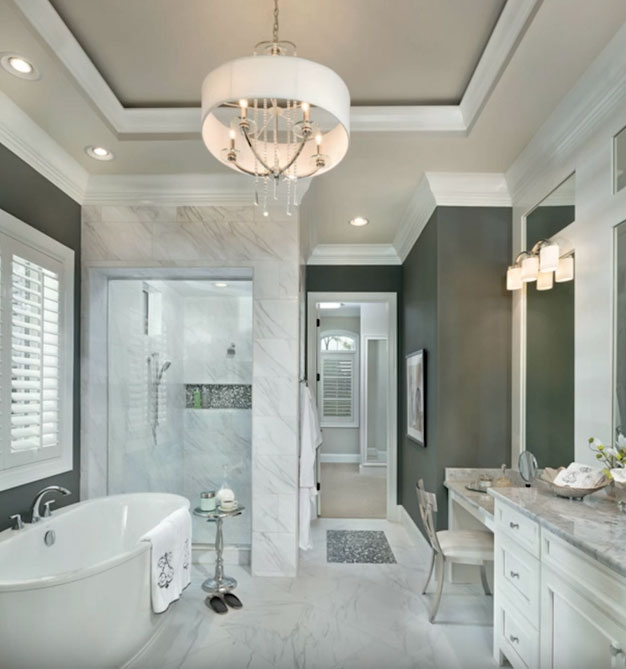
However, if your bathroom is of royal size, then it makes sense to do the same here as in large rooms. That is, the main point of illumination in the center, plus additional ones around the perimeter.
Recessed luminaires are also ideal for small and oblong corridors. They can be easily distributed over the entire area, and thereby achieve uniform illumination.
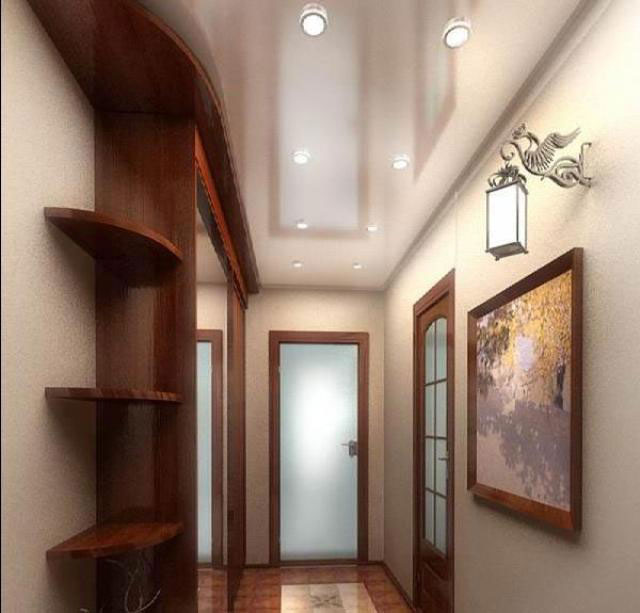
In fact, the corridor is a passage zone
And the low ceiling here won't draw much attention to itself.
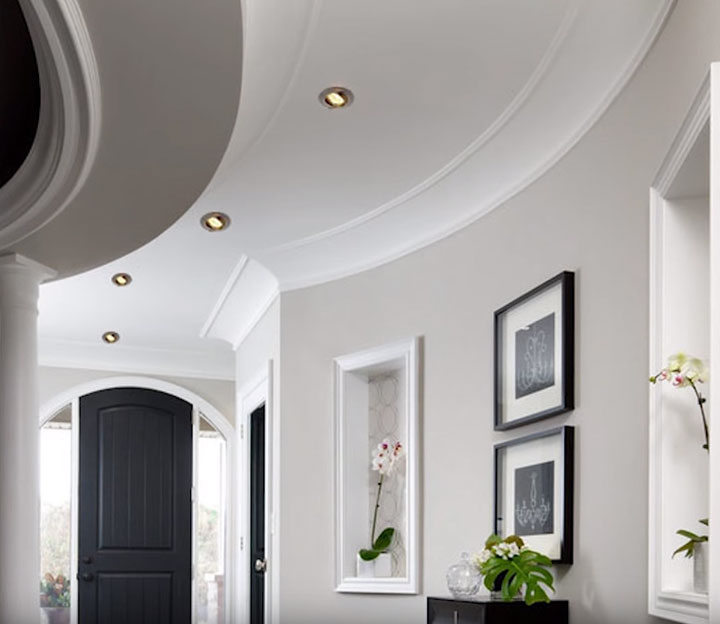
One of the important mistakes that can ruin the whole design is the color of the spotlight housings.
The simplest and most suitable for any style of room will be a white spot.
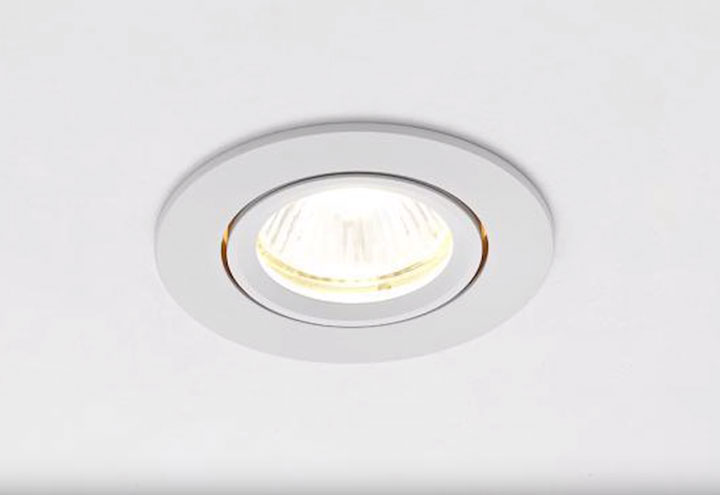
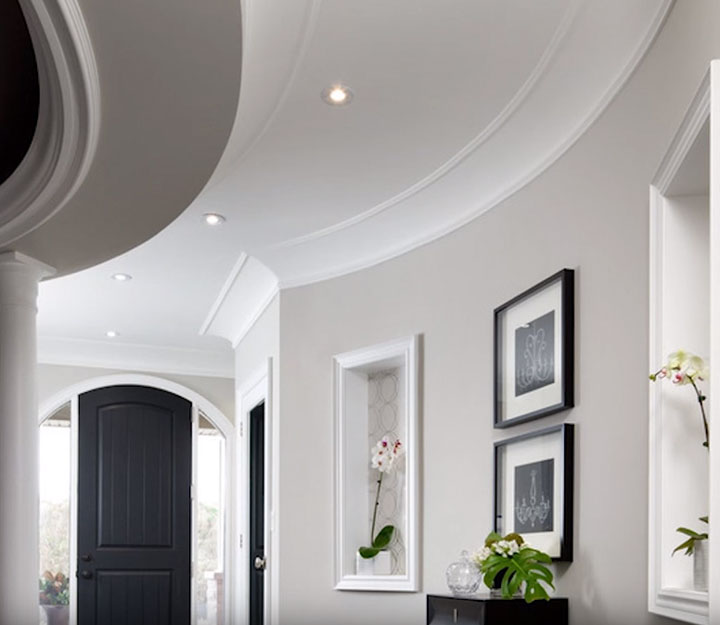
Unlike dot patterns in gold, silver or bronze.
Luminaire spacing and spacing
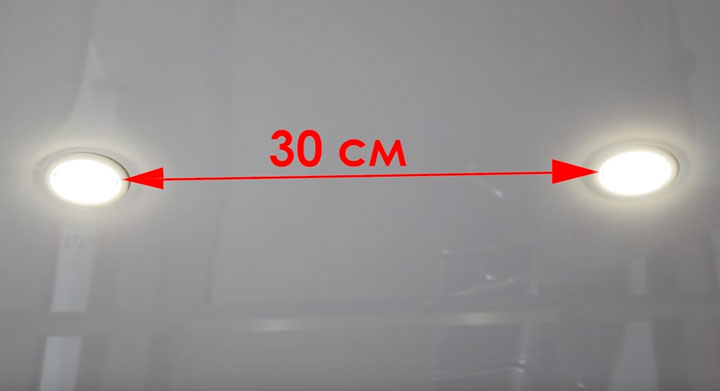
Here are the main distances that should be followed when choosing the location of spotlights in a stretch ceiling:
from the edge of the wall to the first lamp, a minimum distance of 20 cm must be observed

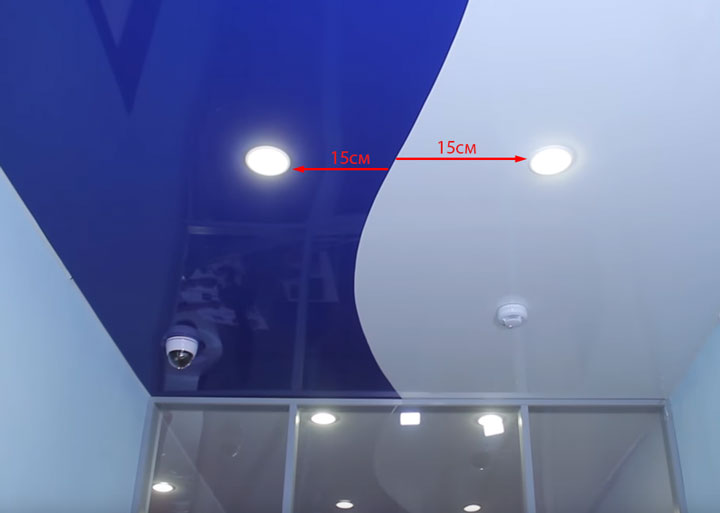
Location Recommendations
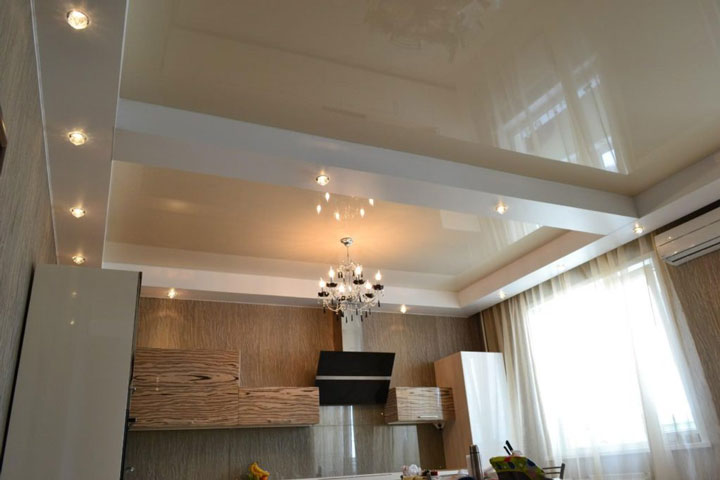
In large areas with a central chandelier, fixtures should be installed in the corners and the least illuminated areas of the ceiling.
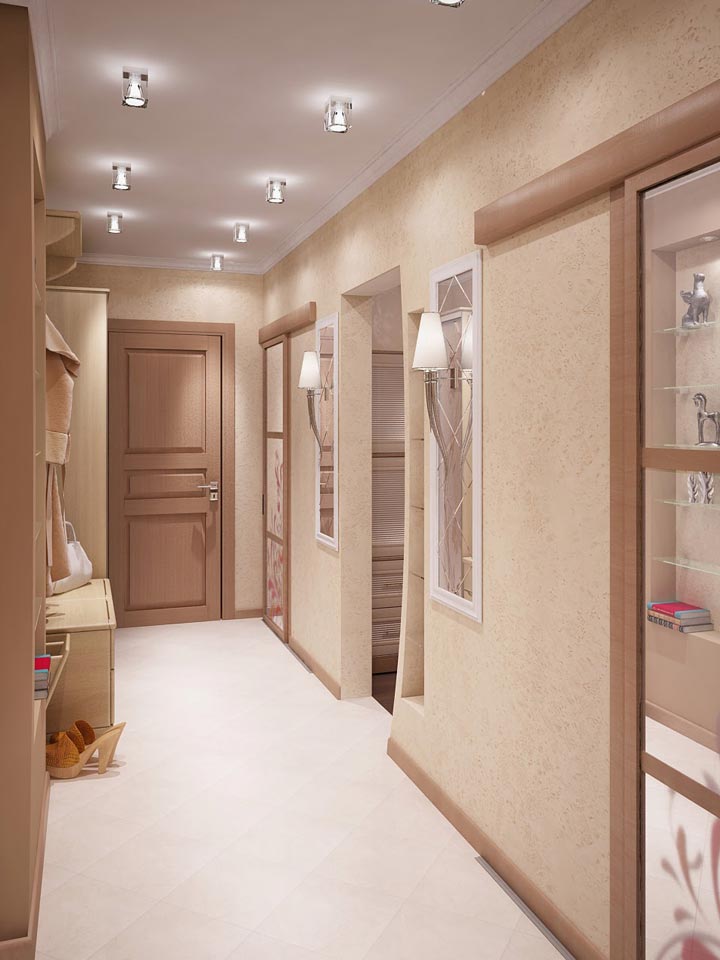
Transverse lighting in a narrow room will visually expand it.
And when using 20 or more light points, it is recommended to group them into zones with a separate, independent power supply.
When installing a chandelier, it is placed as usual in the center. Relative to this point, the whole further composition is built. However, it can be:
symmetrical
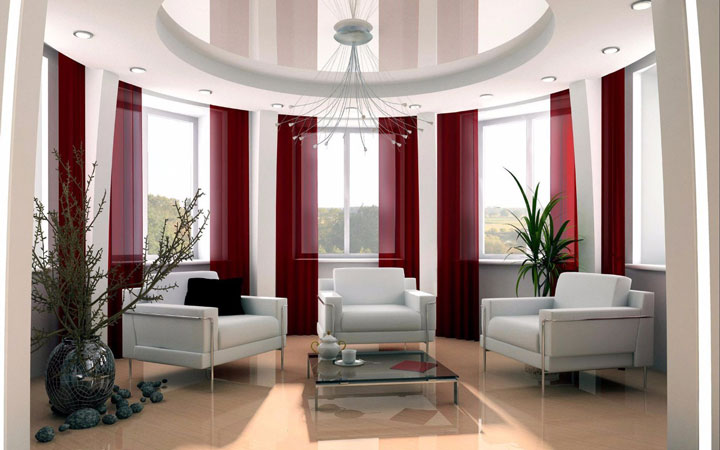
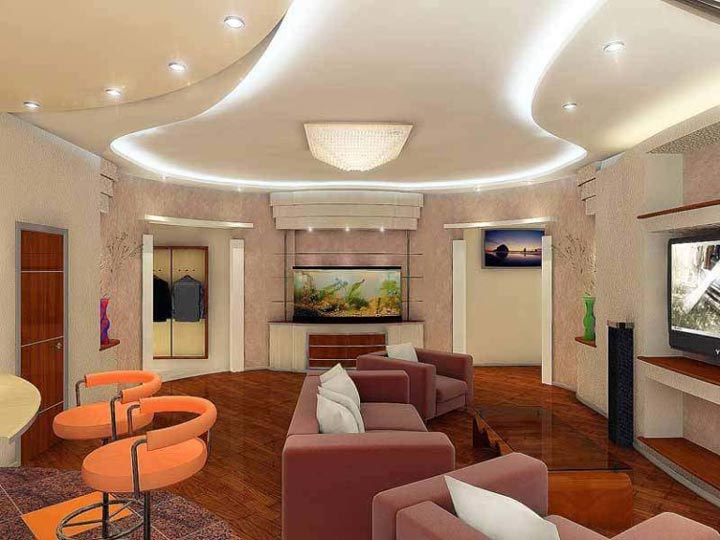
However, regardless of this, the chandelier is always the starting point for the whole picture.
Mounting Features
In order to properly connect spotlights, it is necessary not only to correctly select the circuit. It is necessary to follow a certain sequence of actions, which depends on the type of ceiling.
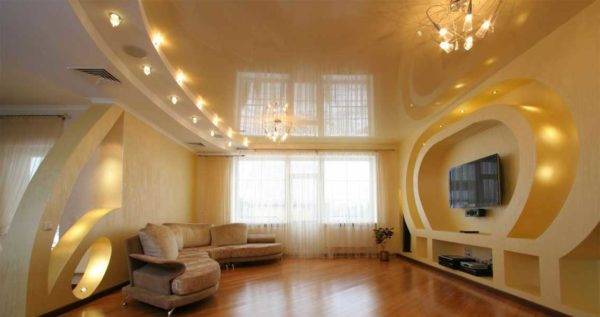
You just need to connect a few spotlights - and you have a beautiful interior
In stretch ceilings
Spotlights are usually installed with suspended or stretch ceilings. If the ceilings are stretched, all the wires are laid in advance. They are attached to the ceiling without being connected to the power supply, the lamps are placed and fixed on the suspensions, then the wires are connected to them and the work is checked.
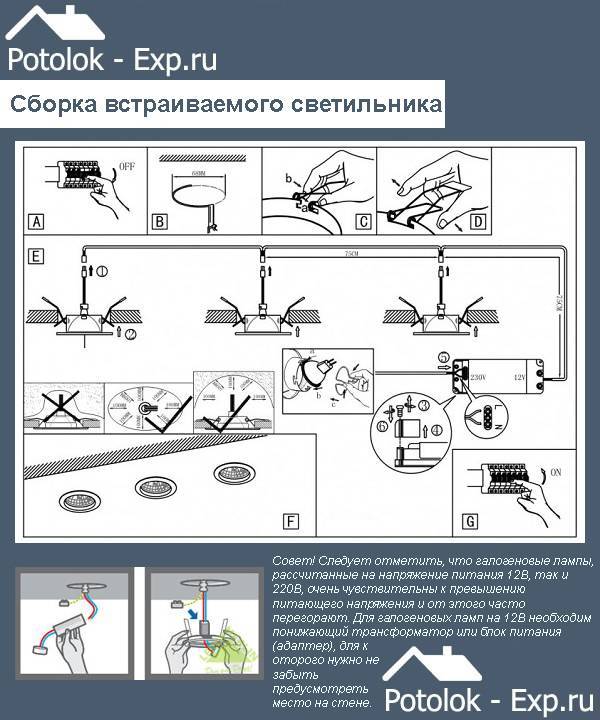
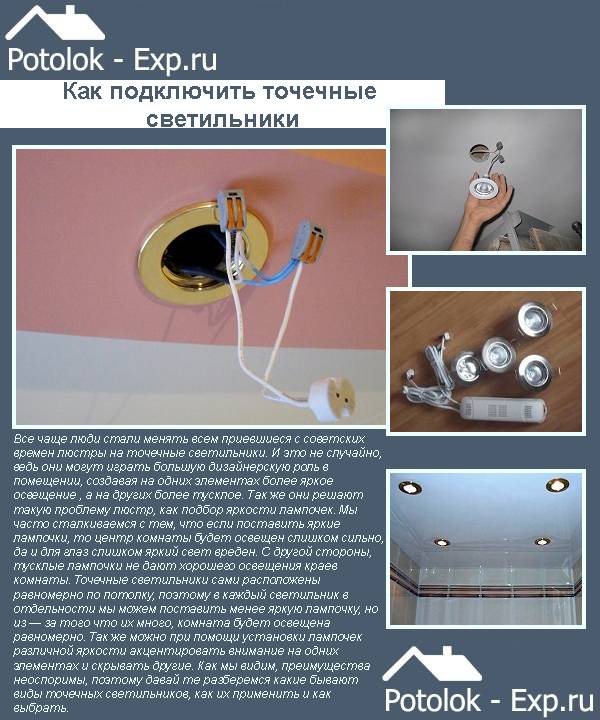


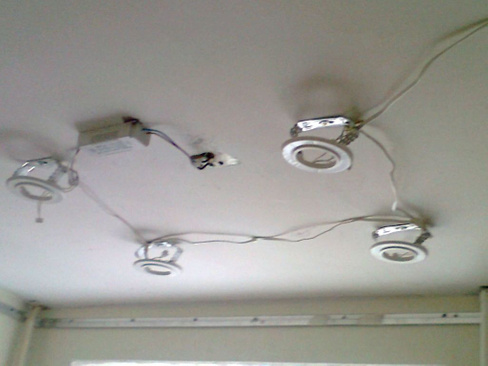

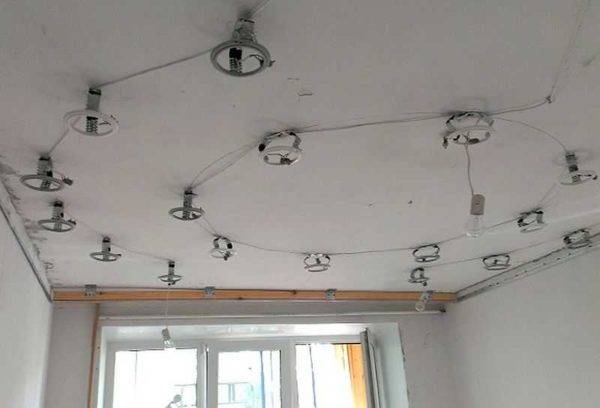
Prepared for installation of stretch ceilings
Before installing stretch ceilings, turn off the power, remove the lamps and remove parts that may be affected by temperature. After installing the stretch ceilings, holes are cut in the material (the lamps are visible or they can be felt), sealing rings are installed, and then the lamps are assembled.
In plasterboard ceilings
If the ceiling is made of drywall, you can follow the same pattern, but you need to mount the fixtures after the ceiling has been puttied. That is, spread the wiring, leave the ends of the wiring hanging freely. In order to avoid problems with determining the location of lighting fixtures, it is necessary to draw a detailed plan indicating the exact distances from the walls and from each other. According to this plan, markings are made and holes are cut out with a drill with a crown of the appropriate size. Since small movements - a few centimeters - can be, when cutting the cable, leave a margin of 15-20 cm. This will be quite enough (but do not forget that the wires are attached to the main ceiling and they should go 7-10 cm beyond the drywall level. If the ends are too long, they can always be shortened, but building up is a big problem.
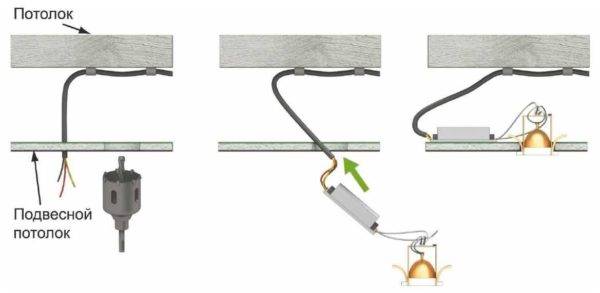
If a converter is required
There is a second way to connect spotlights to a plasterboard ceiling. It is used if there are few light sources - four to six pieces. The entire installation of spotlights, along with wiring, is done after they have completed work with the ceiling. Prior to installation, the cable / cables from the junction box are led beyond the ceiling level. After finishing work on puttying and grinding, markings are made, holes are drilled. A cable is passed through them, bringing the ends out. After they mount the lamps themselves.
Everything is simple, but this method cannot be called correct: the cables simply lie on drywall, which definitely does not comply with fire safety standards. You can still turn a blind eye to this, if the floor is concrete, the cable is non-combustible, the wire cross section is not small, the wire connection is done correctly.
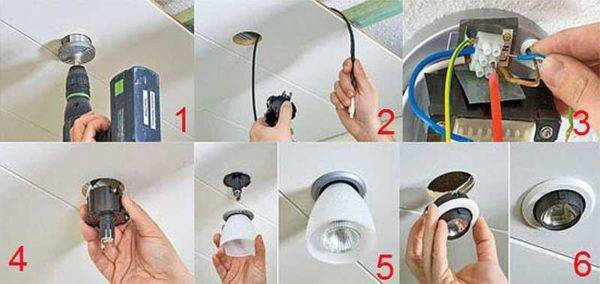
Sequence of works in photo format
If the floors are wooden, according to the PUE, laying in non-combustible all-metal trays (cable channels) or metal pipes is required. It is possible to mount such wiring only before starting work with the ceiling. Violating the installation rules is very undesirable - wood, electricity, heat during operation ... not the safest combination.
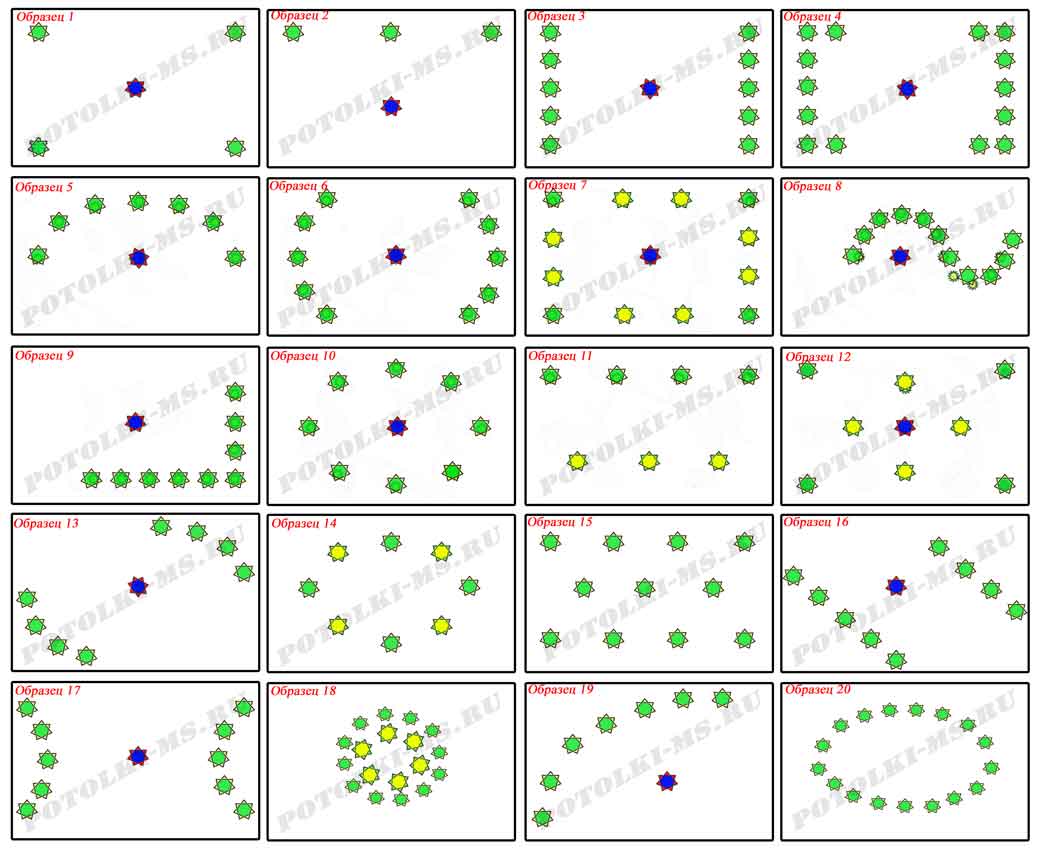
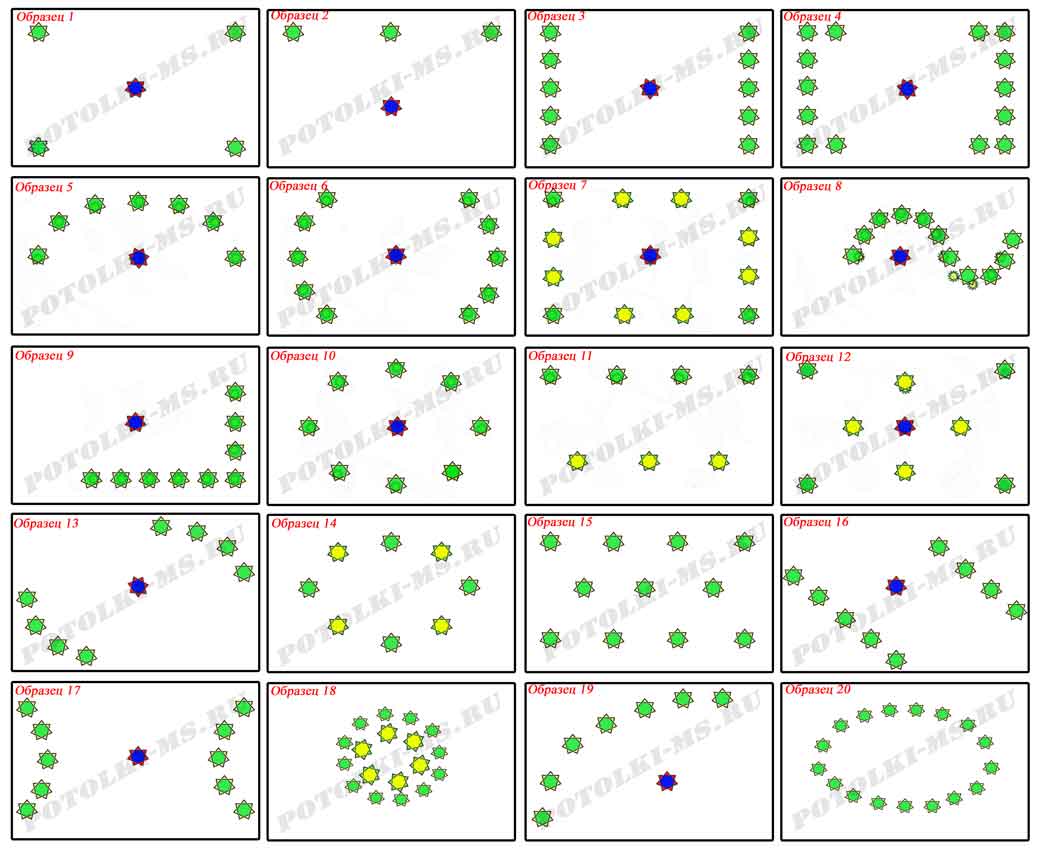
Examples of the location of fixtures on the ceiling
You can talk about typical schemes for a long time, but specific examples for each room will help you see the magic of the play of light with your own eyes. Each specific interior has its own shape of lamps, light temperature or backlight color. Proper use of soffit reception will help to diversify any interior.
In the bedroom
For the bedroom, we do not recommend arranging an abundance of light points, which will only distract you from your rest and will not allow you to relax. It is also recommended to set up a separate controller for decorative lighting for such rooms in order to turn off the additional light at will. It is better to replace strict symmetry with a grouping of spots in the working area (near the wardrobe, dressing table) and soft lighting by the bed.
In the living room
As a rule, this is the largest room in the house, so there should be more lighting here. You can replace the chandelier with spots evenly distributed over the stretch ceiling. It is also a good option to make the zoning of the room with the help of light bulbs of different colors and power.
In the nursery
According to the standards, a children's room requires more lighting, since a working room is often combined with a place to relax here. Where the child will study and practice, more directional lamps are mounted. The same goes for the play area.But for the area with the bed it is better to do with lighting or soft sconces.
Kitchen
The classic distribution of lamps for the kitchen is their location above the working area in sufficient quantities. Thus, you will always have enough light to cook food. In addition to the tension structure, additional lamps are equipped with the lower side of the wall cabinets. But for the area with a dining table, it is better to choose calm lighting to create additional comfort.
Bathroom
A small room with a bathroom will be enough for a pair of spotlights under the ceiling, mounted in a symmetrical pattern. Additionally arrange lighting in the area with a washbasin or above the bath.
Corridor and hallway
Often the corridor is a narrow space, so the play of light will help make it visually more spacious. To do this, the spots are placed symmetrically in the center of the stretch ceiling or in a checkerboard pattern. In areas with a mirror in the hallways, additional lighting is installed.
Lighting Design Recommendations
Everyone can decide for himself where to place the lighting fixture. In this case, it is better to follow a few basic rules.
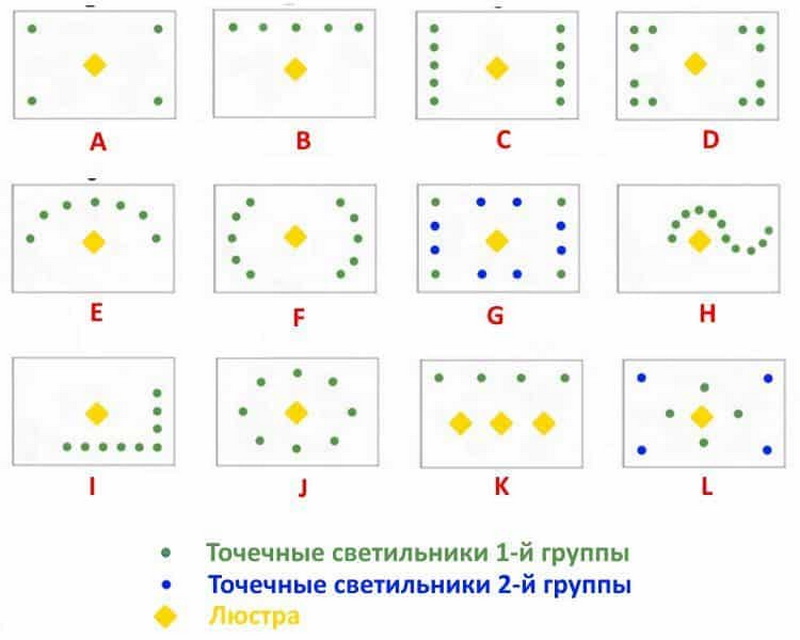
In the premises, you can always make a light accent, which can significantly increase convenience. For example, you can emphasize the work area, play area, a place to relax. If you like to read books, you can organize a reading area for yourself. A spotlight can autonomously change the power of light in a particular area.
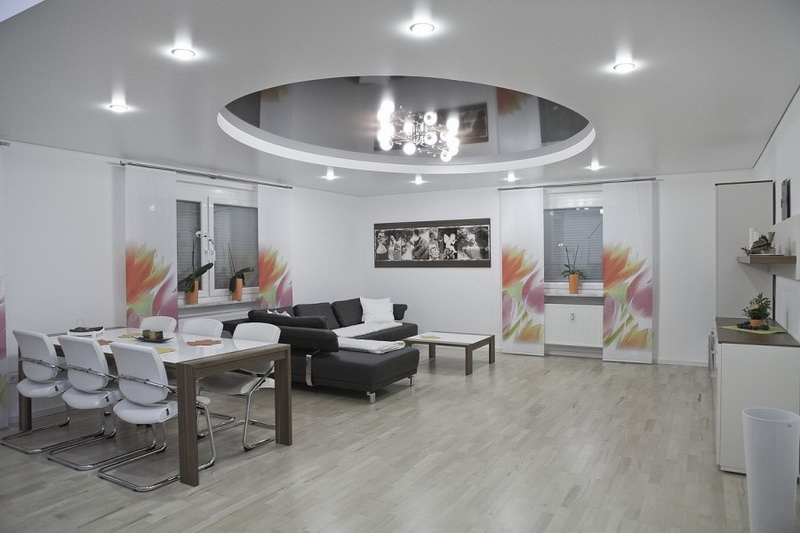
Additionally, you need to remember that:
- Luminaires are placed at a distance of at least 30 centimeters, since a smaller gap will worsen dispersion;
- The distance from the walls should be at least 20 cm.
- On average, a spotlight can illuminate 2 square places, but, depending on the power of the lamp, the indicator may float;
- With a large ceiling area, it is possible to combine different types of lamps into groups, which is useful in one-room apartments and studios.
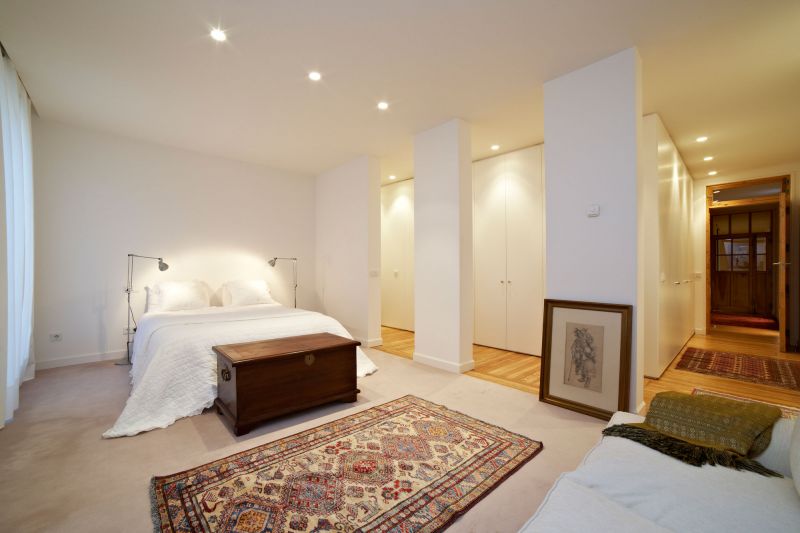
Recessed luminaires for stretch ceilings must be LED. Their heating temperature is low. Halogen bulbs or incandescent bulbs raise temperatures and melt the canvas. This can damage the panel and the appliance. According to the requirements of the PUE, the control unit must be located in a place with a free air outlet to prevent overheating of the microcircuits.
How to choose spotlights for stretch ceilings?
Types of spotlights
Under the concept of spotlights, a large group of lighting fixtures is combined. Their common characteristic is one light source. Most models have a rather laconic design compared to chandeliers, but thanks to various placement schemes, you can create interesting lighting effects.
Spotlights can be classified depending on the location on the stretch ceiling:
- Above ceiling level. It is possible to achieve the effect when light pours from under the ceiling, as if the entire surface is shining. Typically, this installation method is chosen to create the illusion of a starry sky in children's rooms and bedrooms. The amount of light is small, so additional light sources are required.
- Flush with ceiling. This way of arranging the lamps is good because the bulbs do not “eat up” the place at all. If the apartment has low ceilings, spot lighting will make them appear higher.There is only one minus for such lamps: the power limit is 35 W, so as not to melt the PVC film.
- below the flow level. Overhead luminaire models are used with a much more diverse design than built-in ones. There are overhead models that are simply attached to the ceiling, and suspended ones, where the main part of the lamp is suspended on a cable, and the base is very small. Another plus of the location of spotlights below the stretch ceiling is in a brighter light. Almost all restrictions on the power of light bulbs are removed, and the light is scattered at a larger angle than in the case of built-in models.
Spotlights are divided depending on the bulbs that can be installed in them: LED, halogen, conventional incandescent lamps. The safest, economical, compact in size and durable are LED light bulbs, so most modern spotlights are designed for them.
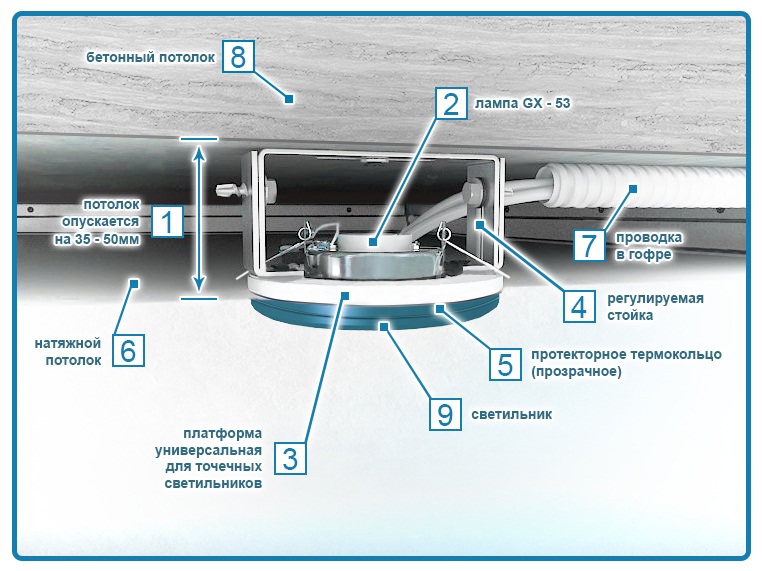


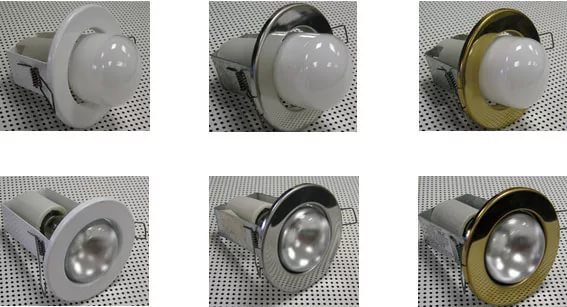


Please note that special spotlights are selected for wet rooms. They must withstand high humidity, water droplets, temperature changes.
As a rule, it is recommended to buy models with a degree of protection IP 67. The wiring must be hidden, and the lamps themselves should be placed at a distance of at least 50 mm from the taps.
Dimensions and shape
Compact size is one of the main advantages of spotlights. The most common embedded models have the following options:
- Diode - standard diameter 77 mm (mortise - 52 mm).
- Halogen - diameter 110 mm.
- Devices using incandescent bulbs - from 80 mm or more.
The shape of the lamps is the most diverse: the lining can be in the form of a circle, oval, square.Available in different decor models, which is selected according to the style of the interior.
Type of adjustment of spotlights
Another way to separate spotlights for the ceiling is by the type of adjustment. Due to the design features, such models can produce a luminous flux of different scattering angles and intensity.
- Swivel. Such models are recommended to choose if there is an objective need to regularly change the direction of the light: for example, in stores or showrooms. Lamps allow you to adjust the angle of the beam of light and highlight the desired details. This also includes rotary-retractable models, which allow you to even more flexibly adjust the lighting area.
- Fixed. Such models highlight only a certain part of the room directly from below. The most traditional built-in lamps on the ceiling are fixed.
- Cardan. These models allow you to adjust the color spectrum and light intensity in a wide range.
- Spots. This is a separate type of spotlights that have a rotary mechanism. As a rule, they are several lampshades located on the same bus. Such lamps are ideal for modern interior styles: loft, minimalism, hi-tech.
Installation nuances
If low-voltage halogen lamps are used in the lamp, then when arranging the wiring, it is necessary to connect a step-down electronic or induction transformer that converts the voltage to 220 V to 12. This is necessary to extend the life of the lamp, which tends to burn out with a minimum voltage drop.
Another feature of halogen lamps is that installation requires increased accuracy.When installing or replacing the lamp, it is strictly forbidden to touch it with your hands, otherwise this will lead to crystallization of the shell, and the lamp will burn out. The laboriousness of the installation process pays off with the design of the lamp body, which is notable for its short length, which is why it can be used for a false ceiling with a minimum height of the interceiling space.
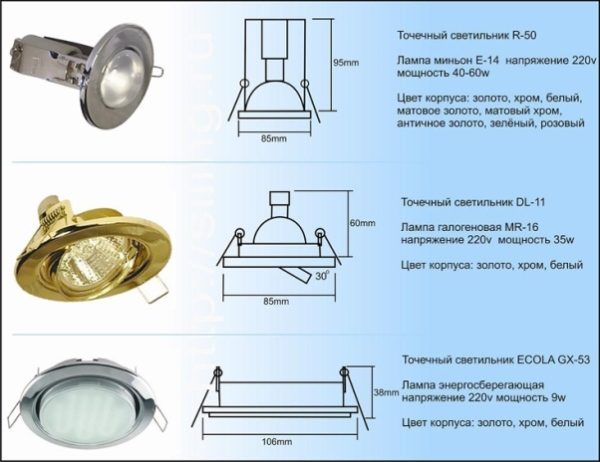
The shape and thickness of lamp sockets with different types of lamps
LED luminaires are even thinner (up to 4 mm) and are installed as a standard point or as an LED strip. Such lighting turns out to be expensive, but the costs are covered by the long service life of LED lamps, which are 5 times longer than halogen ones, their bright and uniform glow and minimal heating. Less profitable is the installation of incandescent lamps, which, despite their affordable cost, consume a lot of electricity and are too massive.
Spotlights
Spot (overhead and built-in) lamps are an integral part of modern living space. Proper lighting can emphasize the beauty of the interior and hide its flaws. Technically well-placed lamps create a comfortable environment for the eyes.
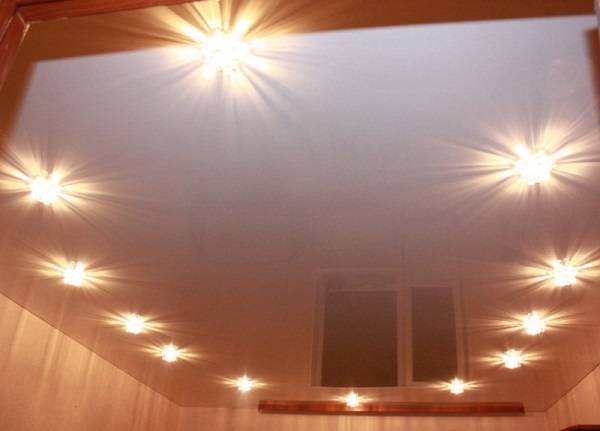
Stretch ceiling with spotlights
Spotlights are best suited for additional lighting of large rooms such as living rooms, bedrooms, children's rooms, dining rooms. As the main lighting, they are good for small rooms - bathrooms, toilets, dressing rooms and corridors. In small rooms, point sources evenly distribute light over the entire ceiling area. This allows you to equally illuminate all parts of the room.
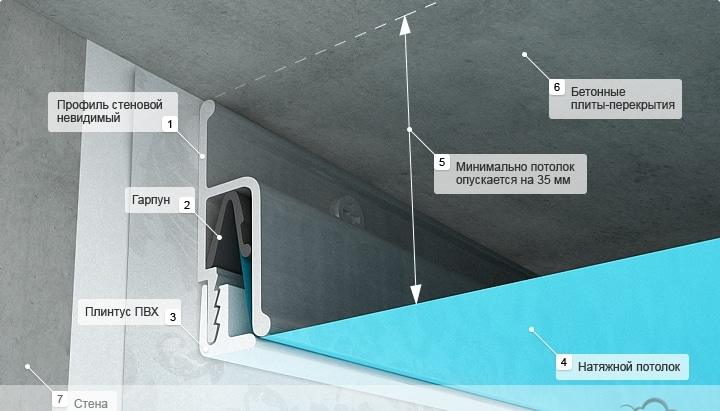
The electrical equipment required to connect the lamps occupies a certain part of the space of the house. The size of the niche above the stretch ceilings depends on the type of luminaire. If wiring is installed for halogen or fluorescent lamps, the stretch ceiling is placed approximately 8-12 cm below the main one, for LED spotlights - 6 cm.
Since the corridor and the entrance hall are the passage part of the apartment or house, the lowered ceiling will not be striking. In spacious hallways, a small chandelier can be installed as the main lighting, and built-in lamps can be used as an additional light source.
If only spotlights are turned on in the room, a calm, peaceful atmosphere with soft subdued light is created. If the designer wants to emphasize the different levels of the stretch ceiling and decorate its protruding part, then you should first choose a chandelier, and select spotlights under it.
Prices for recessed luminaires
recessed luminaires
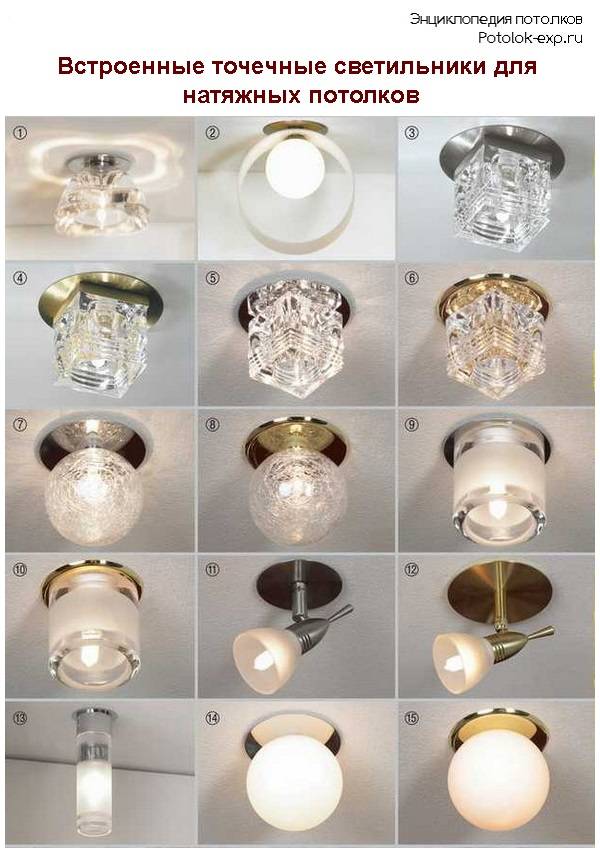
Built-in spotlights for stretch ceilings
Spotlights can be swivel and non-swivel. Rotating shades are designed to direct light only to a specific area - a desk, a section of a kitchen table or a wall to show off its texture.
According to the degree of protection against moisture, these electrical appliances are divided into moisture-proof lamps and lamps for dry rooms. The choice of moisture-proof electrical appliances is very important if they are to be installed in bathrooms, toilets and basements.
In the lighting market, you can see hundreds of types of spotlights.They are made of a wide variety of materials - glass, gypsum, aluminum, crystal, plastic. Plafonds are decorated with stained glass overlays, rhinestones, carved wooden elements, metal openwork details. If, according to the designer's idea, the lamp should be hidden or inconspicuous, you can choose the most minimalistic option (a white lamp with the same white ring around).
Installation of spotlights in a stretch ceiling
Crystal spotlights are interesting and very beautiful. They can scatter light, creating beams and patterns on the ceiling and walls. These electrical appliances are designed in different styles. Art Nouveau lamps have a geometric, square or rectangular shape of decorative elements; in classical style models, you can see hanging details made of glass or crystal. Models in the style of "floristry" combine combinations of glass leaves, buds and petals. Especially beautiful are crystal lamps with built-in LEDs at the edges or inside.
A crystal lamp will not cast glare if a lamp with a matte finish is inserted into it. For the same reason, it is not recommended to put fluorescent light sources in it. LEDs are the ideal choice in this situation.
Requirements for placing lamps on the ceiling
When designing lighting, follow a few simple rules:
- The first row of lamps is planned so that it is at least 20 cm from the wall.
- If there is only one pendant lamp, it is installed in the center of the ceiling.
- Seams are the weak points of PVC structures. At a distance of less than 15-20 cm from them there should be no light sources.
- When calculating lamps, you can focus on average indicators: 1 device per 1.5-2 sq.m.area. If it is necessary to provide powerful lighting, then proceed from the first digit. If special brightness is not needed - from the second.
- With a symmetrical arrangement of the lamps, the distances between them, the indents from the wall are taken into account.
Windows are sources of natural sunlight. When calculating the layout of light bulbs, they must be taken into account, but there are no special requirements here. The main thing is to keep the distance from the walls.
Photo in the interior of the rooms
For each room, it is planned to install lighting, including certain types of devices.
Chandelier in the hall under the stretch ceiling
The priority is the use of bright and warm light, which improves mood and encourages pleasant communication. For a living room with a high stretch ceiling, you can choose a more massive chandelier. Such a product will endow the atmosphere of the hall with luxury and solemnity. An expensive crystal construction will favorably complement the interior, designed in a classic style.
In the photo there is a hall with a stretch ceiling, complemented by a wrought-iron chandelier.
For a small living room, it is better to choose a neat and elegant lamp without unnecessary decor. In an elongated and narrow room, a symmetrical placement of two small light sources would be appropriate.
Chandeliers in the bedroom to the stretch ceiling
A rest room with a calm and cozy atmosphere involves the installation of a chandelier that will harmoniously fit into the design and merge with the design of the stretch ceiling, but at the same time will not be lost against its background. An excellent solution would be designs made of crystal or frosted glass, as well as products with shades made of light-colored fabric.From lamps in delicate sand or beige colors, a yellowish glow emanates, setting you up for relaxation.




Convenient for the bedroom are lamps with several lighting modes and a remote control. Such models will create a special atmosphere in the room.
The photo shows a single-level stretch ceiling with a suspended chandelier with frosted glass shades.
A multi-level stretch ceiling can be equipped with built-in lights or perimeter lighting. A similar design will create a bewitching atmosphere in the bedroom. A popular option for a rest room is the use of zonal lighting. For example, a place with a dressing table suggests a brighter light, and sources with a muffled light flux are installed above the bed.
Chandeliers in the interior of the kitchen
Spotlights or one chandelier will look great on a stretch canvas in a small space. For a spacious room, several sources or a lamp with spotlights are suitable.
You can add lightness to the interior of the kitchen, fill the atmosphere with solemnity and elegance due to lamps with a body and lampshades in white. Brown models look natural and cozy, which fit perfectly into the rustic and rustic style.
The photo shows a kitchen design with a black glossy stretch ceiling decorated with a white chandelier.
In a kitchen with a light stretch ceiling, it is appropriate to hang a contrast lamp made of bronze, copper or other dark metal. A black or chocolate canvas will be in harmony with a white or steel lighting fixture.
Ideas in the bathroom for stretch ceilings
The best solution is to install recessed lights that will not protrude beyond the ceiling surface.Devices can be located perimeterally or in a checkerboard pattern.
The photo shows a chandelier for a stretch ceiling in the interior of the bathroom.
In a fairly spacious bathroom with a high ceiling, it is possible to place a not too bulky chandelier. When choosing a product, you need to consider that the lamp is waterproof.
Examples for the hallway and corridor
It is recommended to install diffused light sources. For example, a chandelier with frosted glass shades or a model with a luminous flux directed upwards is perfect. However, the latter option can spoil the stretch ceiling as the canvas does not withstand high temperatures. In this case, the problem can be solved with the help of reflectors or light bulbs with low power.
A stretch ceiling in a narrow and long corridor will perfectly complement a rectangular and elongated lamp. To correct the proportions of the hallway, it would be appropriate to highlight individual zones with spots.
The photo shows a stretch ceiling structure with a white chandelier and spotlights in the hallway.
Chandelier in the interior of the nursery
The room is equipped with warm, dim and diffused lighting. For a nursery, it is not recommended to purchase glass lamps. It is better to give preference to products made of materials in the form of wood or plastic. The chandelier should have a matte finish, as gloss can create glare and irritate a child's eyes. Models with conventional textile or paper shades will be the best option.
In the nursery, it is not appropriate to install bulky structures with decorative details in large quantities. A compact but bright lamp or an unusually shaped device will successfully fit into the room.
The photo shows a children's room with a spherical chandelier on a white stretch ceiling.
Types of light bulbs according to the type of luminous element for a stretch ceiling
For stretch ceiling structures, it is most often customary to use the following types of light bulbs, classified by the type of lighting elements:
- Halogen.
- Energy-saving luminescent operating principle.
- Tapes or spot LED.
- Standard incandescent, different power.
- Fiber optic strands.

Spotlights
Spotlights provide good illumination of the entire space of the room, as they can be placed a certain number evenly over the entire surface or where necessary.

Spotlights for the ceiling can be made with LED and have different power. Their body is made of different metals and chrome-plated surfaces. The illumination light can be either warm yellow or cold white.




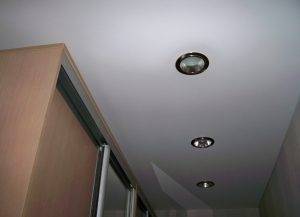
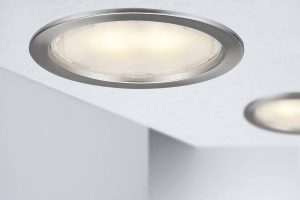
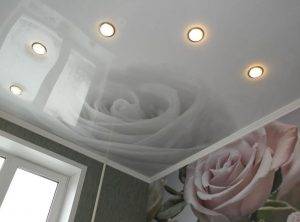
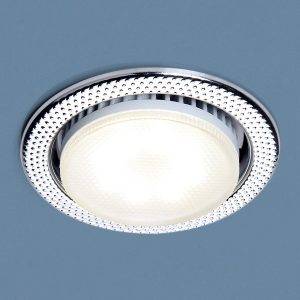
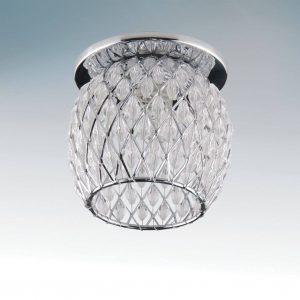
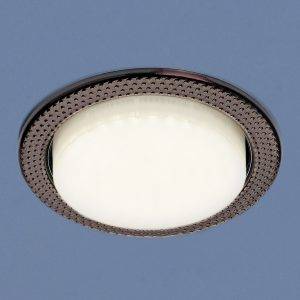
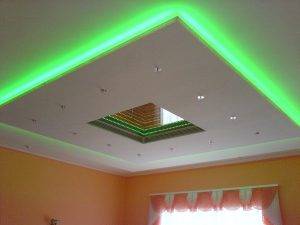
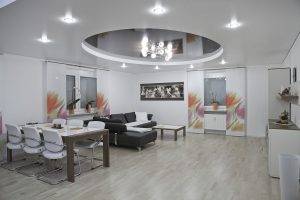
These types of lighting fixtures give good surface illumination, but their cost is quite high, especially if you need to install a lot of them over the entire ceiling area.

Recessed luminaires
Light fixtures of a certain design can be built into the design of the stretch ceiling. They are a frame with a metal ceiling.

Used in such devices halogen type light bulbs. The power of such devices is quite high, and the cost is quite acceptable.

Overhead lamps
Overhead fixtures will require a special pre-mounted stand. After installation, they are covered with a cloth and a special ring is used to ensure that its material does not come into contact with the heating elements.
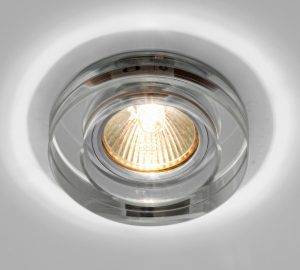
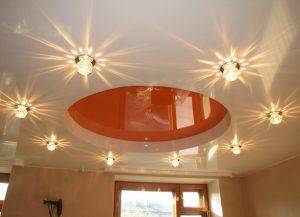
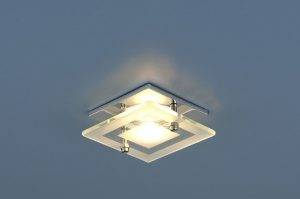
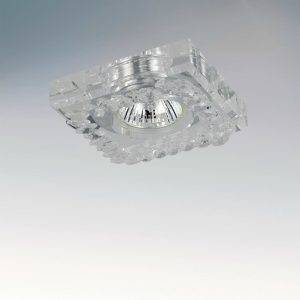
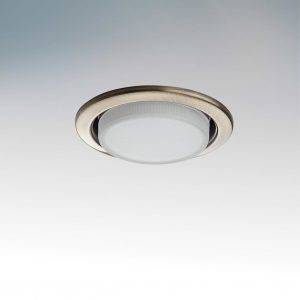
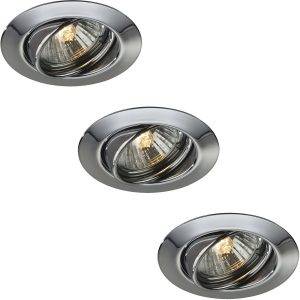

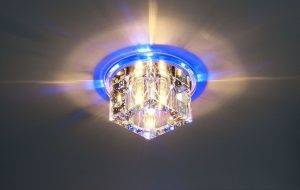
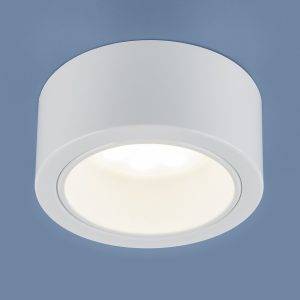
This type of lighting fixtures is inherent in the intensity of illumination and attractive appearance.

Hanging chandeliers
This type of chandelier is the most common, especially for residential premises.


The main advantages of a suspended ceiling chandelier are:
- Excellent appearance.
- Wide range of choices.
- The ability to choose a product that matches the design of the entire room. And this, in turn, leads to the formation of a harmonious space of the entire apartment.
- The ability to choose any design that will satisfy the needs of the lighting level. That is, you can choose a certain number of horns in the product.
- Structural strength and reliability.

The only downside is the high cost. Moreover, it directly depends on the appearance and materials used.

An important point that should be taken into account when choosing a ceiling chandelier is the following - the height from the stretched ceiling to the light bulb in the base must be at least 25 cm.




