- 3 Ballu BIGH-55
- Design features
- Advantages and disadvantages
- Heating control systems
- Insulator issue.
- Mounting type
- Which is better: convectors or infrared heaters
- Characteristics of infrared heaters Almak
- Table of technical characteristics and main criteria for choosing infrared heaters
- Control and indication
- The best shortwave infrared heaters
- Ballu BIH-LM-1.5
- Hyundai H-HC4-30-UI711
- Timberk TCH A3 1000
- Distinctive features of oil and infrared heaters
- Oil heater-radiator
- IR heater
- Accommodation Recommendations
3 Ballu BIGH-55
Ballu BIGH-55 is the optimal solution for rooms with a large area, the device is most often used for heating production and work rooms. The heater is powered by a gas cylinder that heats a ceramic plate, converting heat into infrared radiation, thereby generating a large flow of warm air. Due to the high power (4200 W), the device instantly heats up and heats a room up to 60 square meters in a matter of minutes. The heater consumes not so much - 300 grams of fuel is enough for an hour of continuous operation of the device.
The gas heater is made in a classic black and gray case, which looks very presentable and stylish. For ease of use, the device is equipped with wheels, due to them and the small dimensions of the heater, it is easy to move. This model has a thermostat, which is located on the top of the device, with its help you can independently set the desired temperature, the heater will maintain it all the time. The disadvantages include the lack of auto-ignition and protection against overheating, but this does not detract from its main advantages.
Design features
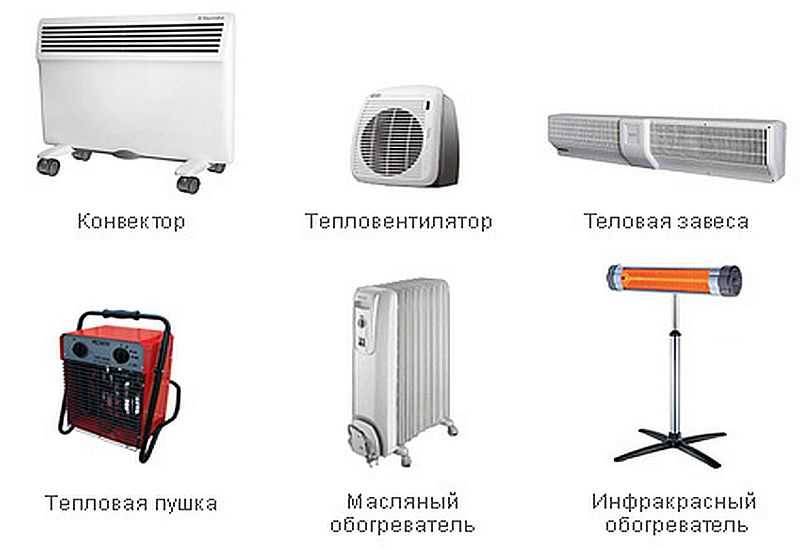
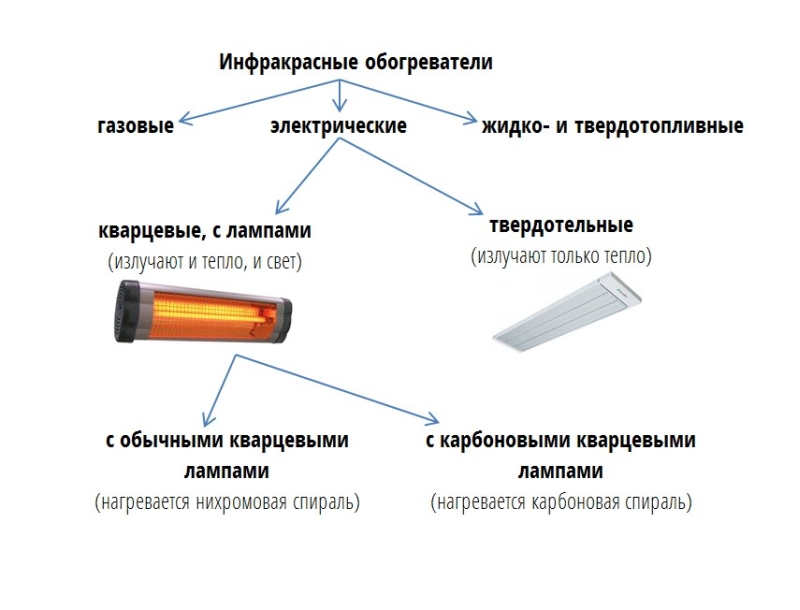
There are several types of infrared (IR) heaters that differ in their energy source:
- electrical;
- gas;
- liquid fuel.
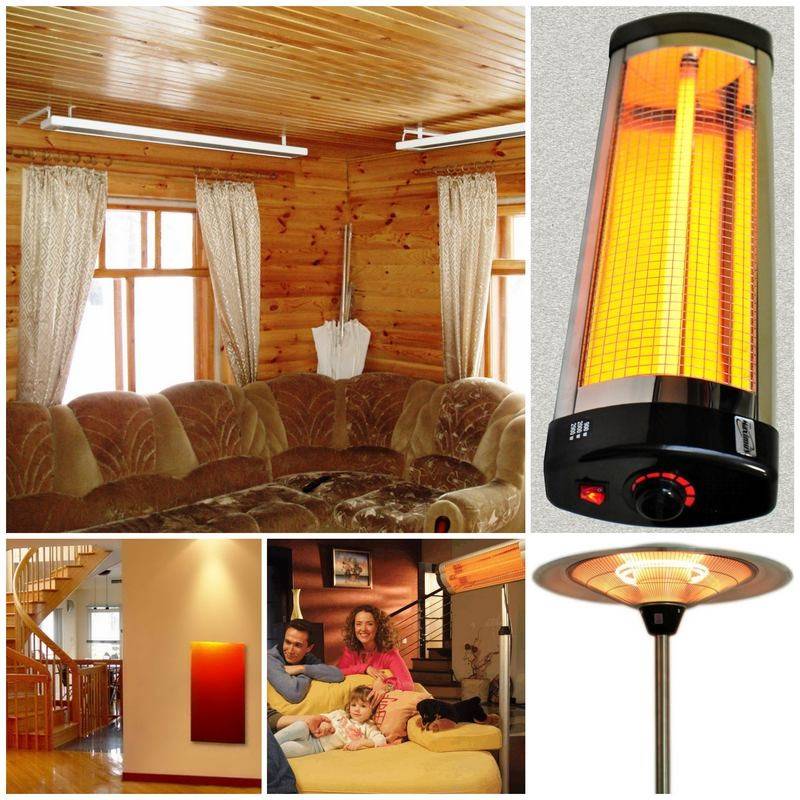
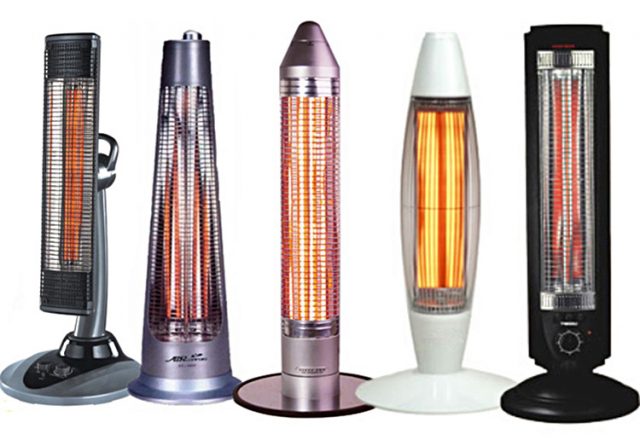
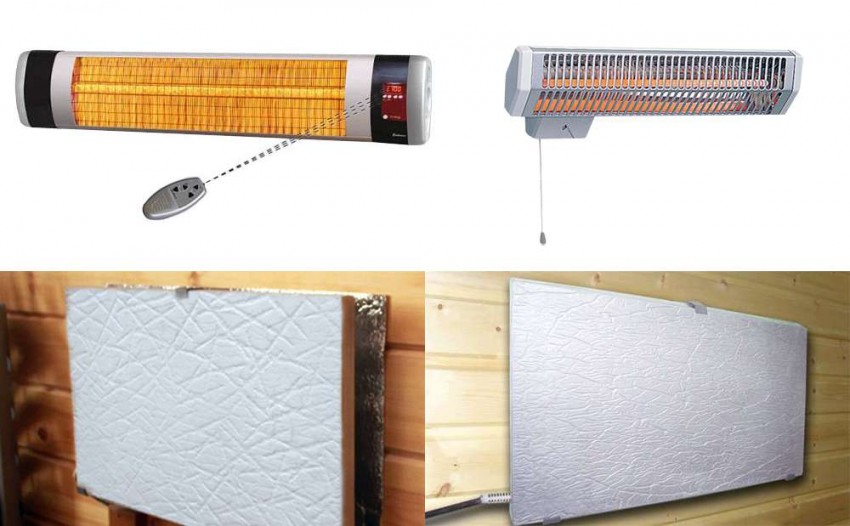
In everyday life, electrical appliances are most often used. Structurally, they are divided into two types: lamp and film.
Lamps consist of the following components:
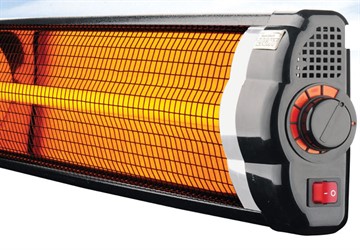
- IR emitter in the form of a halogen lamp or a metal spiral placed in a glass tube (dust protection) or a ceramic case;
- reflector (reflector);
- protective grille;
- frame.
In the film version, the IR emitter is graphite paste tracks deposited on a polymer film and covered with another film.
Advantages and disadvantages
Thanks to a powerful advertising campaign of many manufacturers, infrared heaters have acquired numerous fictional advantages. Therefore, it is necessary to list the real advantages from the operation of these heaters:
- The infrared heating device will cost less than the installation of thermal power equipment and water systems.
- Rapid heating of objects and surfaces in the area of the device. Under the influence of radiation, a person feels heat immediately after turning on the heater.
- A group of 2-3 panel or lamp models installed in one cold room is able to reach a comfortable temperature regime within 2-3 hours.
- The devices are fireproof and absolutely silent in operation.
- Radiant heaters are economical compared to heating equipment that burns various types of hydrocarbon fuels.
- There are no moving parts in the products, which increases the service life.
- Wall and ceiling versions of devices allow you to save the usable area of rooms.
- Light weight - mobile devices are easy to move to the right place.
- Film elements, laid under the flooring, heat the entire volume of the room evenly and create a feeling of increased comfort.
- Ceramic models and film work without problems in rooms with high humidity.
- Low-temperature models do not burn oxygen in the premises and do not emit any odors.
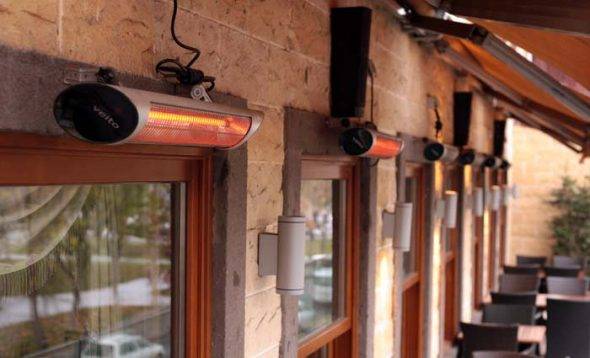
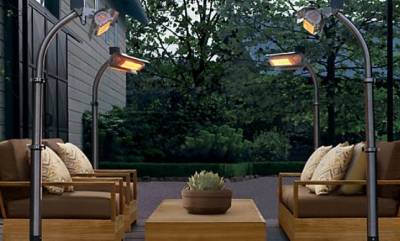
With the help of infrared devices, it is easy to organize spot heating on the street
An important point should be highlighted: in terms of efficiency, infrared heaters do not have any advantages over convectors, electric boilers and other electric heaters. The efficiency of all these devices lies in the range of 98-99%. The difference is only in the way the heat is transferred into the room.
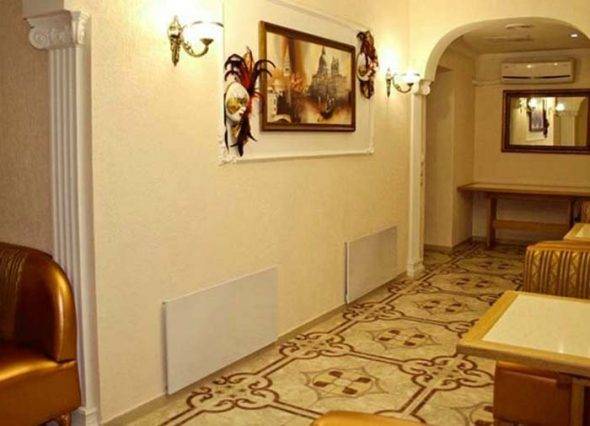
Ceramic heating panels fit perfectly into the interior of the room
The negative aspects of infrared devices look like this:
- the high cost of the consumed energy carrier - electricity;
- at a distance of 1-2 m from the heater, it is uncomfortable for a person to be, there is a burning sensation (exception - low-temperature panels and film);
- the surfaces of furniture and paintings that are constantly in the area of IR radiation may lose their appearance over time;
- in the process of warming up the room, the air remains cold for a long time;
- gas and diesel heaters emit toxic combustion products; ventilation is required in enclosed spaces, which leads to heat loss along with exhaust air;
- the thermostat is often located inside the case, which heats up faster and turns off the device ahead of time;
- ceramic and mikathermic modifications are characterized by a high price.
Statement about dangers of infrared heaters for human health is unreasonable. The intolerance of individual users to this type of heating is due to the individual characteristics of the body or the presence of a disease.
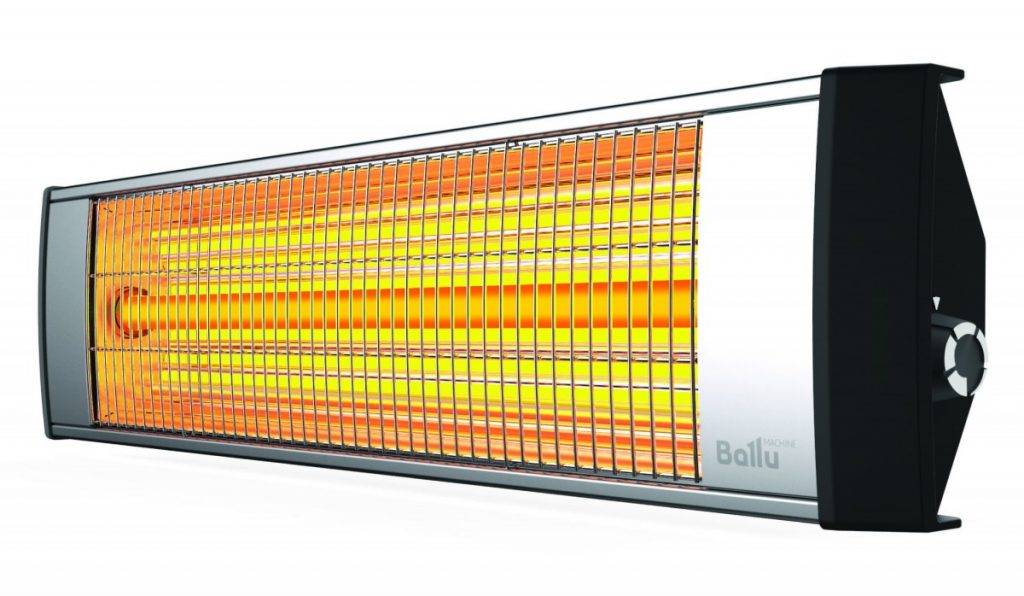


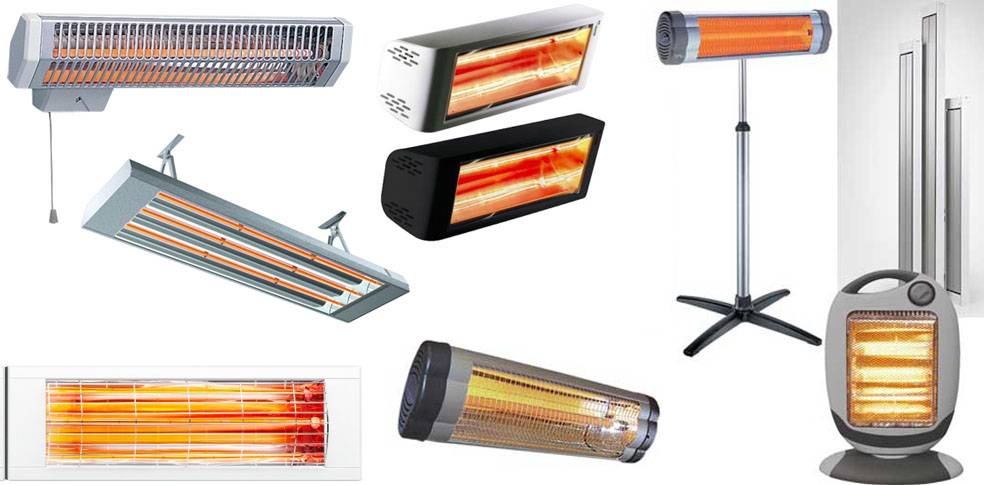
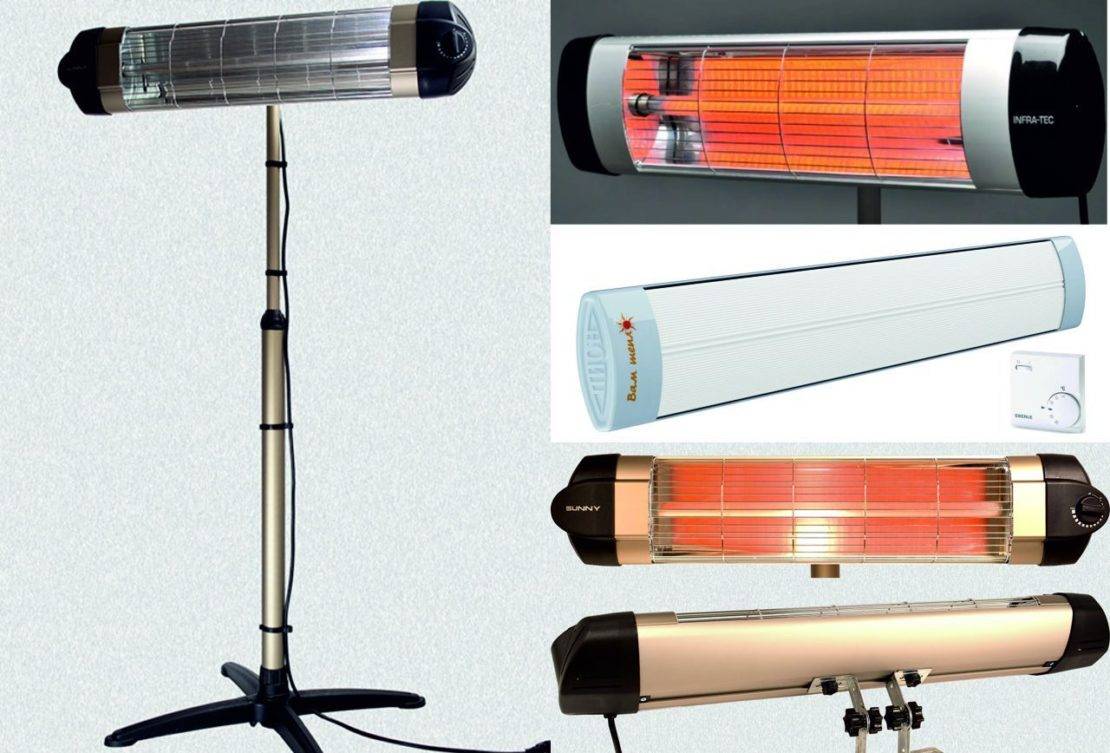

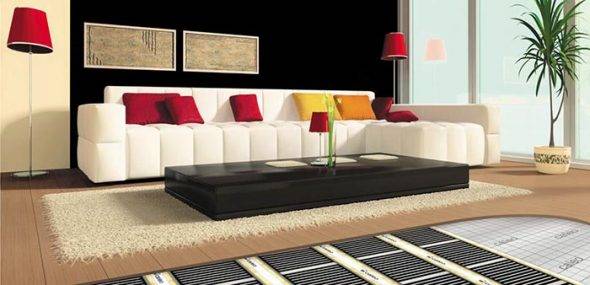
The infrared film will evenly heat the room, consuming a minimum of electricity.
Heating control systems
In the budget configuration, infrared heaters of all types are equipped with adjustable heating power and maximum room temperature. When it reaches the set value, the thermostat turns off the heating elements. Floor models are additionally equipped with a safety sensor that turns off the device in the event of a tip over.
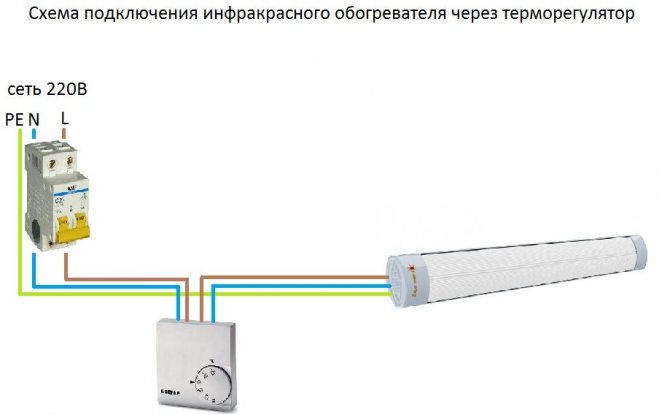
Panel and individual modifications of lamp heaters can be combined into groups controlled by an external thermostat and a common temperature sensor. Film elements of infrared heating are also controlled in this way, since they are not equipped with their own safety automatics.
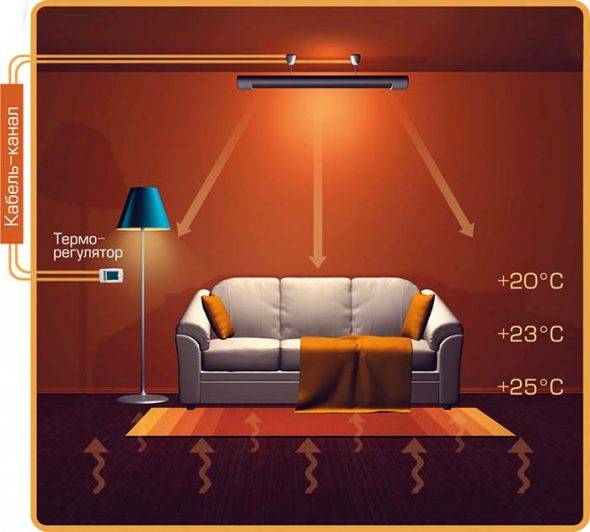
Control of the ceiling model is best used from a remote thermostat
Manufacturers provide the following additional functions in the devices:
- programming the time and temperature of heating for 1 day or a week ahead;
- LCD display;
- Digital Watch;
- remote control control;
- remote control from a smartphone via the built-in GSM module.
Insulator issue.
The body of the EUT shall not be warmed up by more than 95 degrees. For this, an insulator is arranged in it. Types of insulators are different. The leader in safety and practicality is the basalt look without any additives. Additives only harm human health, because at high temperatures they can release formaldehyde.
When buying an AI, the seller must show a special mark on the permission to use the insulator in the food industry. The mark is usually placed on a special certificate.
Mounting type
Different heaters allow different mounting methods. Many of them are simply placed on the floor (oil heaters) and have special wheels for moving. Others allow installation on any flat surface, for example, on a table or window sill (these include many fan heaters). Such heaters do not require special installation efforts. As a maximum, the user will have to independently assemble the legs with wheels.
Also, many heaters have several mounting options for the user's choice: wall, floor, ceiling or false ceiling. At the same time, the same model can allow several installation options at once (for example, wall or ceiling). In this case, the installation will require a drill or puncher and other related tools with which the fasteners are mounted.
Which is better: convectors or infrared heaters
Comparing infrared and convector heaters, it should be noted the main advantages and disadvantages of each. The advantage of convectors is the heating of the entire room, but this principle can also be attributed to the disadvantage of such a heater. After all, there is always a risk of losing warm flows through loosely closed doors and windows and, as a result, the room will remain insufficiently heated.

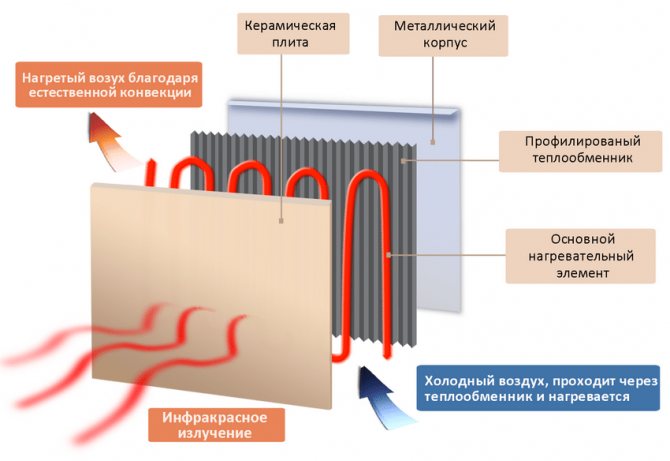
The principle of operation of infrared heaters and convectors in comparison
In this sense, convector heaters are suitable for heating a small, maximally hermetic room. After turning on the device, the room quickly warms up, and due to the low surface temperature of the device, oxygen from the air is not burned. In addition, accidental contact with the device is safe for humans, which allows its use in children's rooms.
Unlike convector heating, infrared heating operates locally, spending energy only on heating a specific place. Thanks to this, all the energy consumed will be converted into heat, which contributes to the rational use of energy. This feature is successfully used by enterprises with large premises, when it is necessary to create comfortable working areas. Spot heat is directed only to a certain place without heating the entire room, which is economically justified.

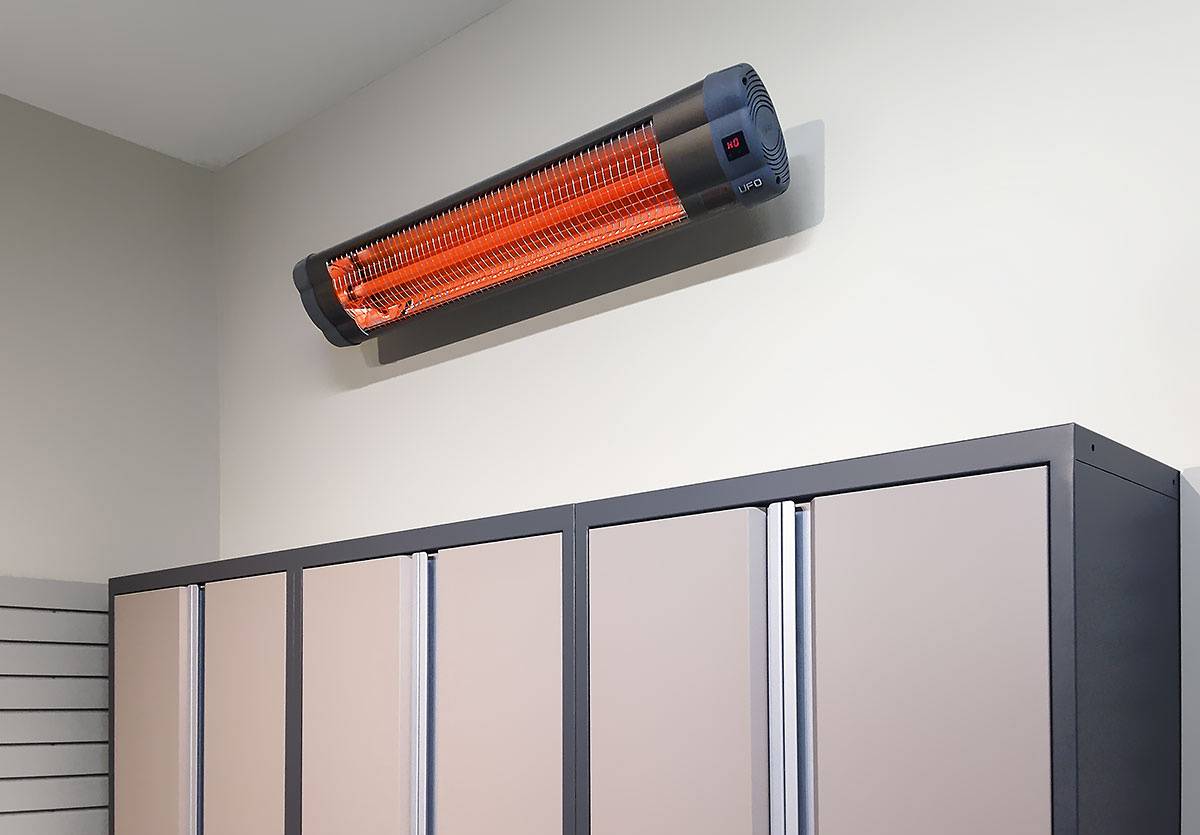
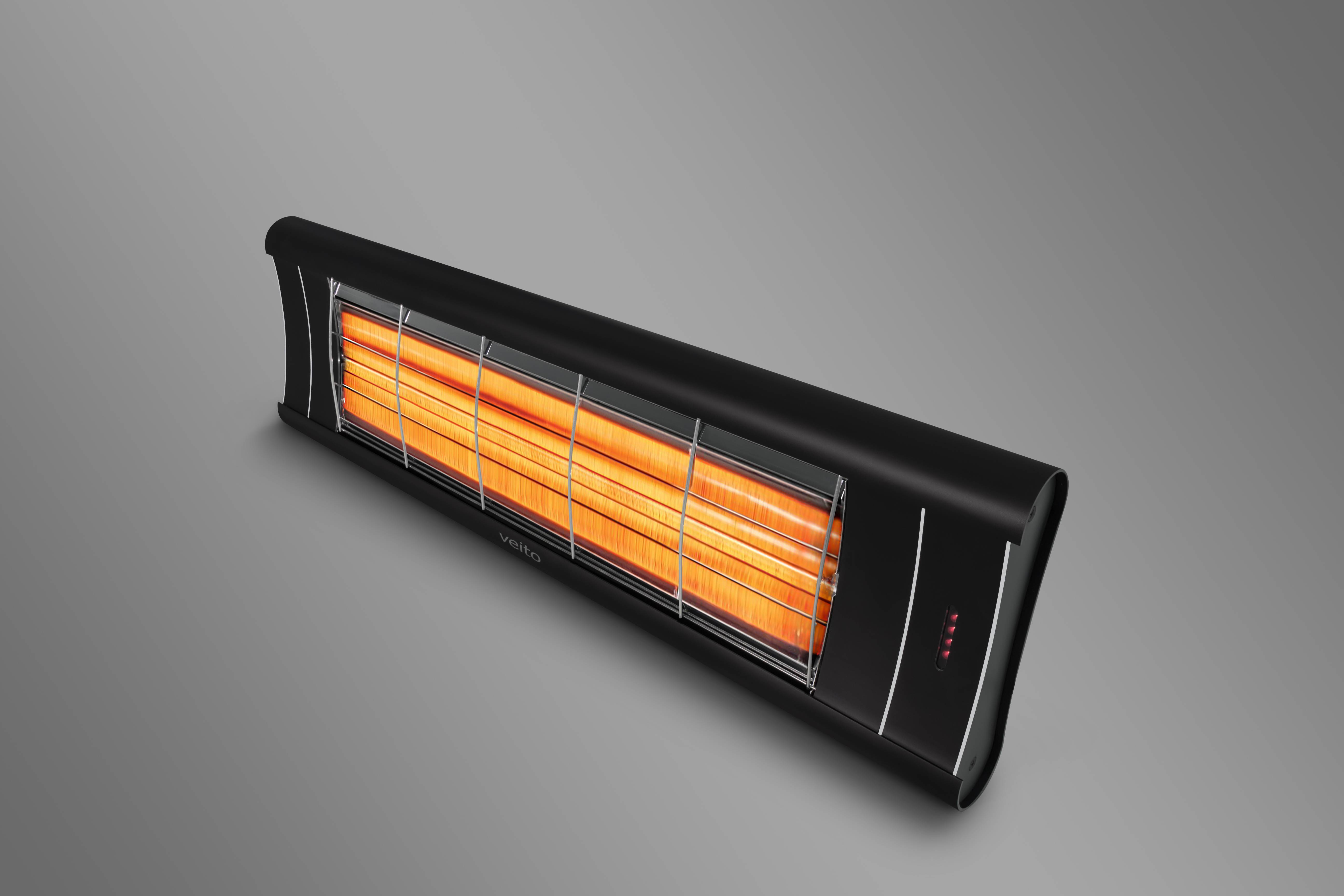
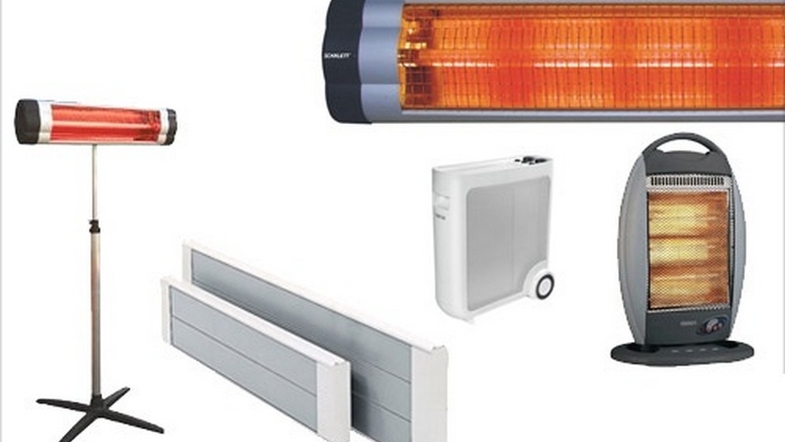

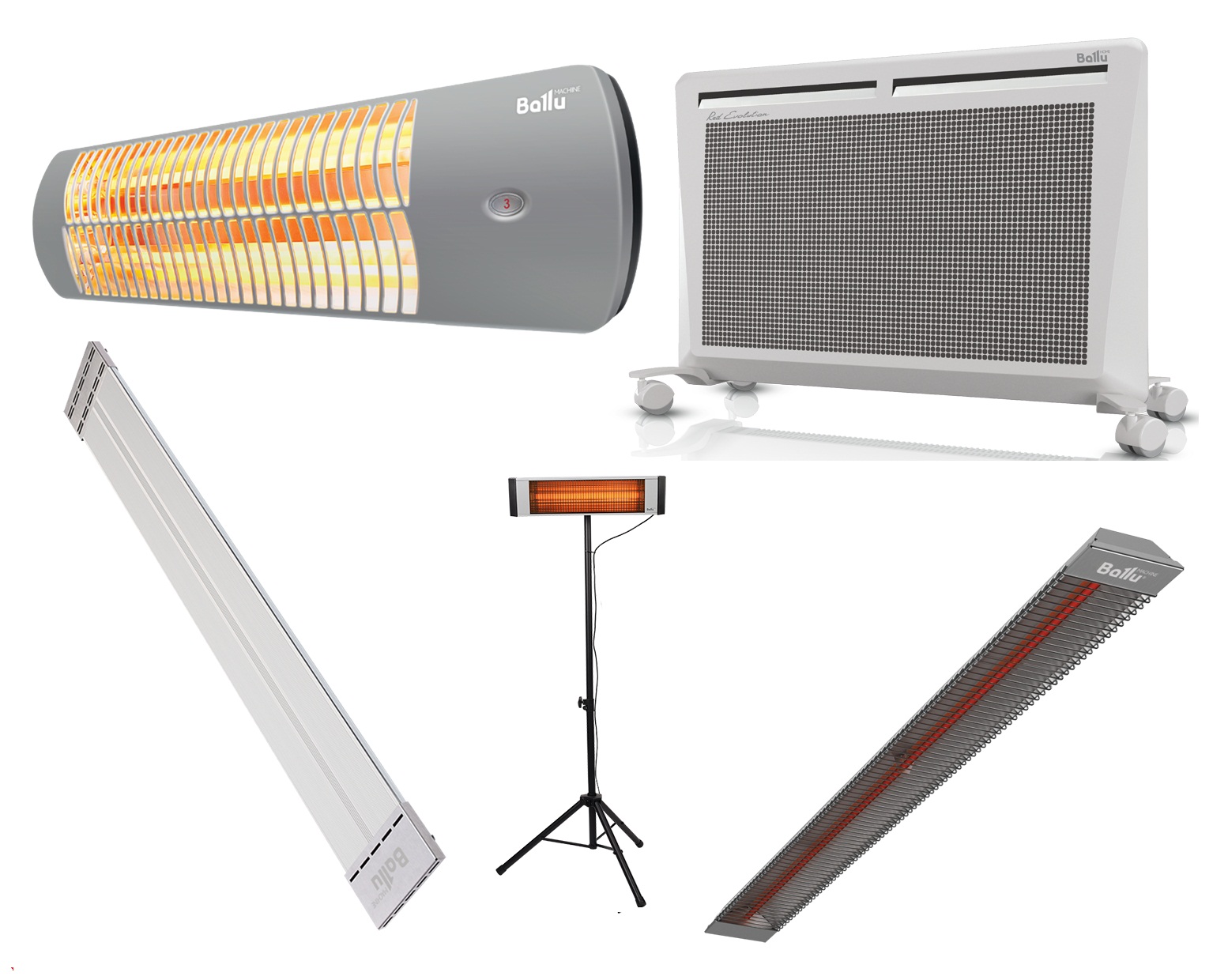
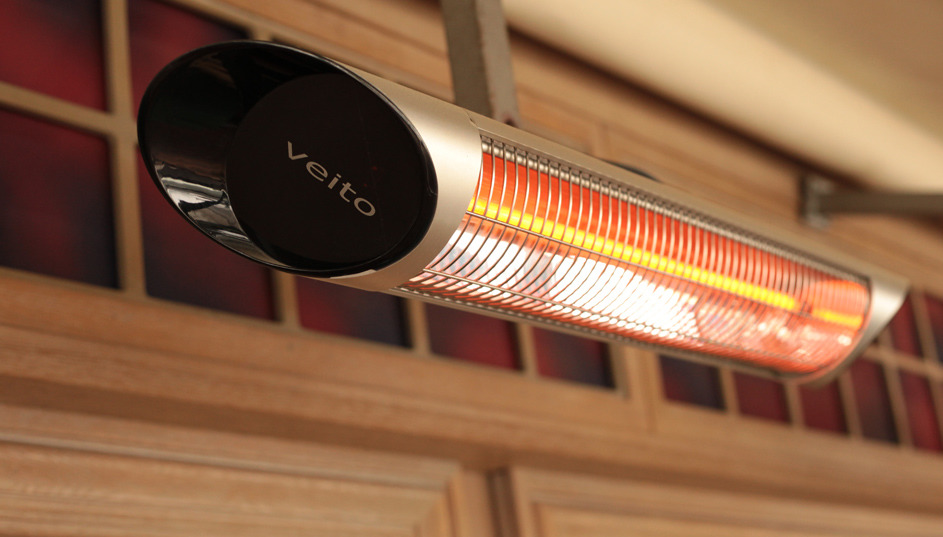
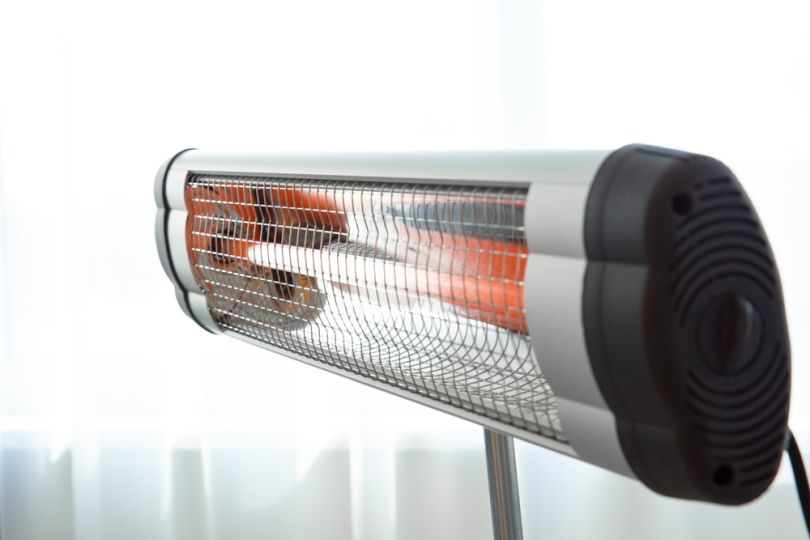
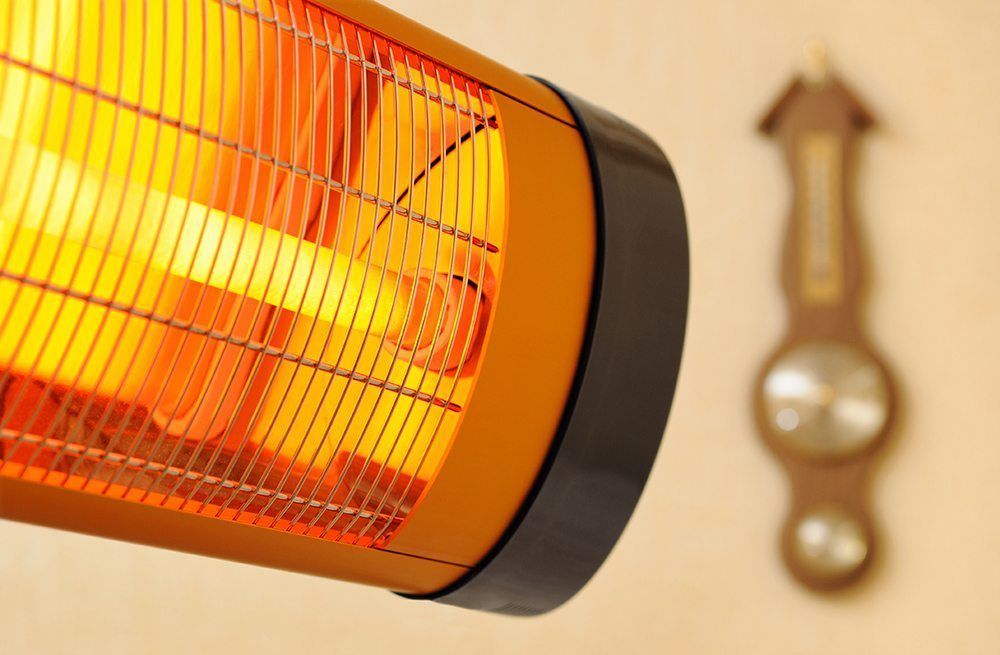
Another advantage of infrared models over convector ones is the localization of heat in the required place. The radiant energy of infrared devices acts directly on the required area, while when using convectors, there is a possibility of accumulation of warm air masses under the ceiling. The space in which the person is located remains slightly warmed up.

The principle of operation of an infrared heater
Comparing these two types of heaters, I would like to note the light weight and compact dimensions of the ceiling-wall household electric infrared heaters, their simple and affordable installation for everyone. Thanks to the modern design in various color schemes, the devices harmoniously fit into any interior, without taking up extra space and remaining almost invisible.
Characteristics of infrared heaters Almak
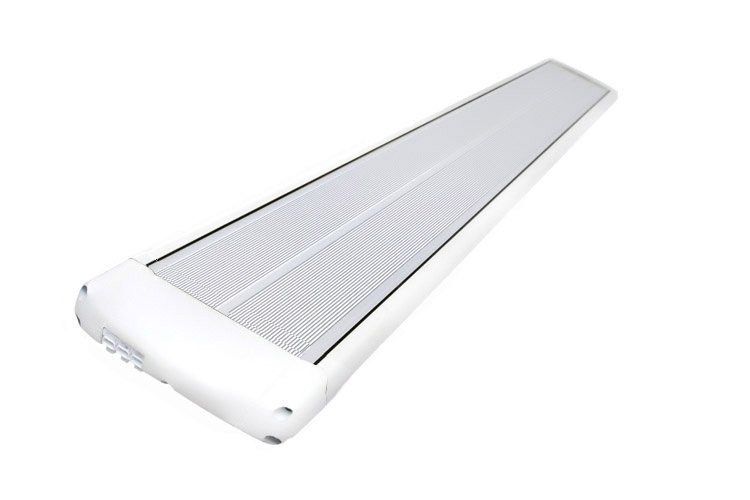
Lined up infrared heaters Almak includes models with a capacity of 5, 8, 10, 13, 15 kW, designed for heating, respectively, 5, 8, 11, 13, 16 m² of area. It should be noted that Almak heaters have an interesting modern design, their thickness is only 3 cm. Devices are produced in several colors: white, beige, gold, silver, wenge.

Infrared heating panels Almak differ in their power
Almak heaters can be used to heat office and industrial premises, they fit perfectly into any interior of an apartment or house. Thanks to convenient mountings that can be moved along the body, the device can be quickly and accurately installed without additional assistance. In the product catalogs, you can choose a device of suitable power, depending on the area of \u200b\u200bthe room.
Almak heaters can be equipped with a thermostat that will maintain a predetermined temperature in the room. The most powerful heater IK-16 can be used as the main heating in winter, if the area of the room does not exceed 16 m². In rooms up to 32 m², such a device can serve as an additional heat source.
The table shows the estimated power for objects with different operating modes when using the Almak IK-16 model.
| Room type | Approximate power per 1 m² of area, W |
| Private well insulated house | 70 |
| Country house insulated | 100 |
| Outbuilding without insulation | 120 |
| Loggia, balcony without insulation | 120 |
| Greenhouse with polycarbonate walls (8 mm) without insulation | 130-150 |
| A barn, a winter chicken coop with poor insulation, where a positive temperature of no higher than 10-12 degrees is enough | 100 |
Table of technical characteristics and main criteria for choosing infrared heaters
| Options | Values | Recommendations |
|---|---|---|
| Power | From 100 to 9000 watts. | It is necessary to take at the rate of 1 m2 - 100 watts. |
| Execution | Ceiling; wall; Outdoor. | It is best to use if you intend to constantly heat one room. Ceiling warms up all places of the room better. It is convenient to quickly heat up any room locally. |
| Heating element type | 1. Halogen; 2. Quartz;3. Ceramic;4. Tubular (micathermic). | 1. Emits short waves - not recommended.2. They glow with a red color that irritates the eyes, they are best chosen for short-term use. 3. Has a short service life, it is better to refuse to use it in wall and ceiling models.4. The best option for long-term use, the only negative is a slight crackle, mainly during heating and cooling. |
| Rollover sensors | Availability varies by model. | Presence in floor models is very desirable. |
| Overheating sensor | Availability varies by model. | Availability is mandatory if the device is to be left unattended for a long time. |
| Thermostat | Availability varies by model. | It is better if it is available - to maintain a constant temperature. |
| Remote control | Ceiling models are mainly supplied with them. | Availability would be a plus. |
Control and indication
Simple heaters have a mechanical control system that looks like a set of temperature control knobs and on/off buttons. Such heaters can operate in full or partial load mode and turn off on their own when a certain temperature is reached, but, as a rule, they are not capable of more.
It should also be noted that the temperature control will be rather rough, and, as a rule, not in degrees, but in the form of a rotary knob with the values “minimum”, “maximum” and several intermediate unnamed gradations. Thus, you are waiting for a rather long procedure for selecting the optimal position of this knob in accordance with your own feelings about the temperature in the room.
Mechanical heater control system
Modern models are increasingly equipped with an electronic control system, including a set of mechanical or touch buttons and a digital display. The possibilities of such heaters are much wider: they can turn on and off according to a schedule, maintain the set temperature (in degrees) in the room, display the temperature and current time on the display, and much more. These heaters often come with remote control.
Electronic control system with temperature display
Finally, the most "advanced" heaters have the ability to remote control. Such devices have a built-in transmitter WiFi or Bluetooth, thanks to which you can control the device from your smartphone - using a special application.
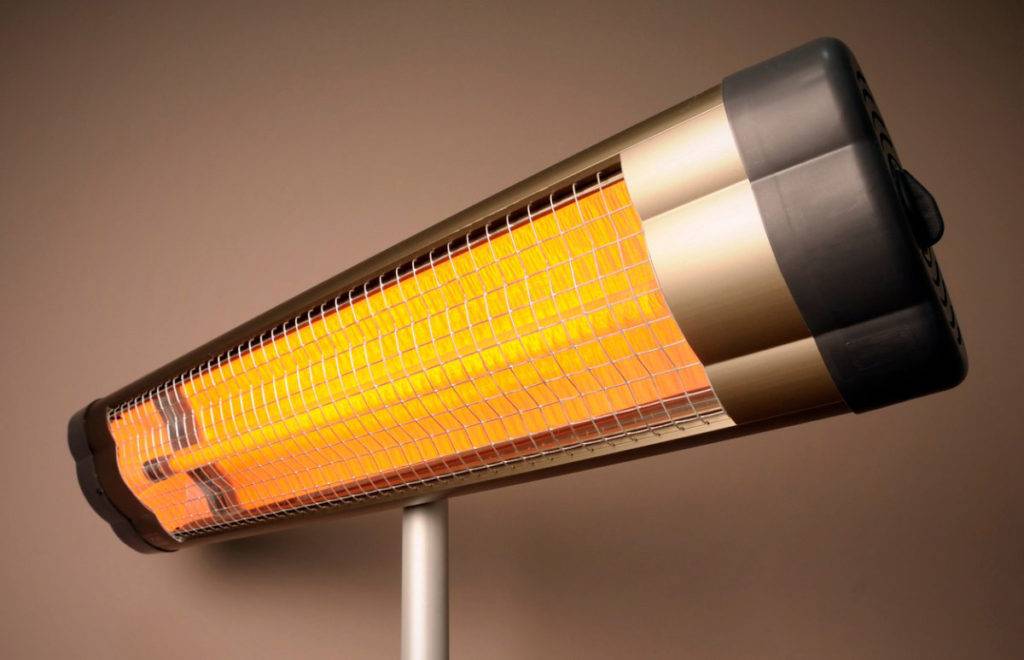
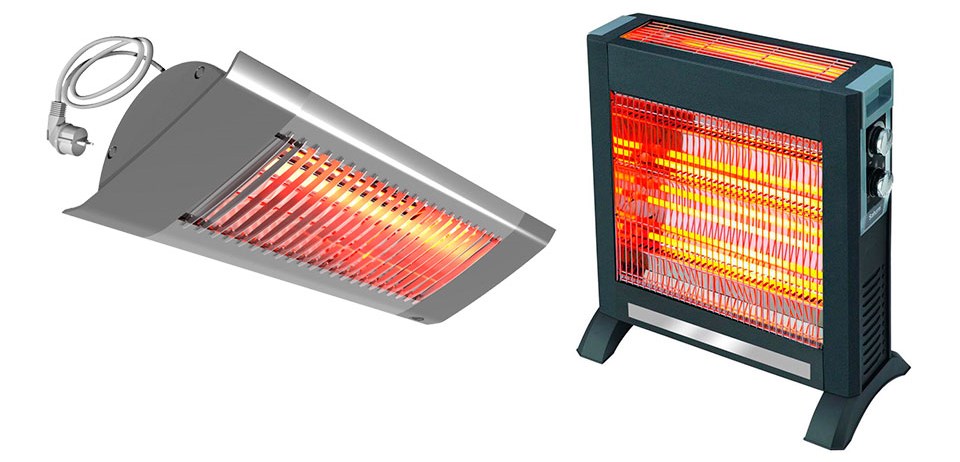


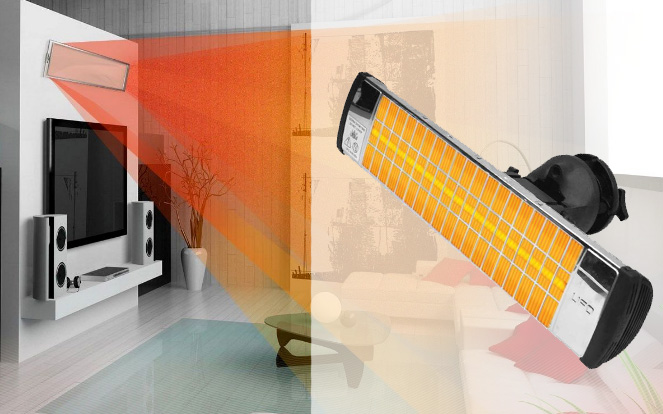


The best shortwave infrared heaters
Short-wave heaters provide the fastest warming up of the premises. They are valued for their high performance at an affordable purchase price.
Ballu BIH-LM-1.5
Main characteristics:
- Power, W - 1500/1000/1500 W;
- Recommended heating area, sq. m. - 25;
- Management is mechanical.
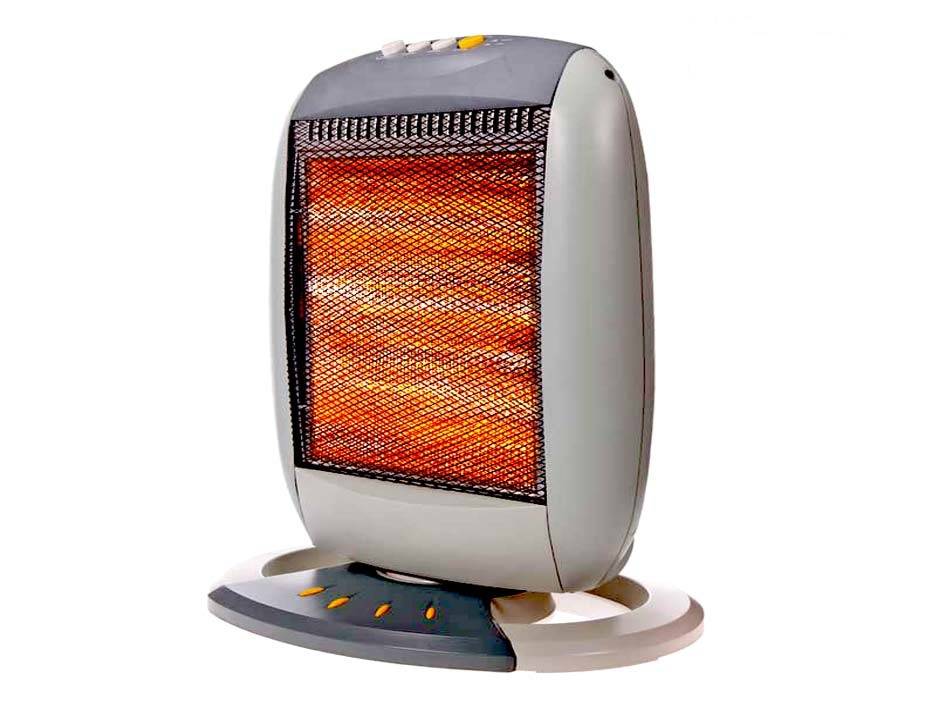
Frame. The infrared floor-type heater has a durable, heat-resistant paint-coated rectangular body measuring 35x46x31.5 cm, mounted on a pair of supports made of bent metal tubes. The front grill protects the heating elements from accidental contact and mechanical damage. Ventilation holes prevent excessive heating of the walls, which eliminates the risk of burns. The device can be carried by holding the wide handle.
Air vents Ballu BIH-LM-1.5.
Control. A pair of switches is installed on the side surface, allowing you to use 1/3, 2/3 or the full power of the emitter, designed for a maximum consumption of 1500 watts.
Switches Ballu BIH-LM-1.5.
Heating element. The source of heat waves here are three quartz tubes fixed in a horizontal position. A wide reflector made of heat-resistant stainless steel creates a directed stream of soft radiation. Its surface does not lose its original luster during the entire service life.
Quartz tubes Ballu BIH-LM-1.5.
Pros of Ballu BIH-LM-1.5
- Compact dimensions and weight of only 3.5 kg.
- Quality accessories.
- There is a compartment for laying the power cable.
- Simple power control.
- Safety shutdown in case of capsizing.
- Affordable cost.
Cons of Ballu BIH-LM-1.5
- Short wire.
- Narrow heating sector.
- You cannot change the angle of inclination.
- Plain appearance.
Hyundai H-HC4-30-UI711
Main characteristics:
- Power, W - 3000;
- Recommended heating area, sq. m. 35;
- Thermostat - yes;
- Control - mechanical, temperature control.
Frame. The device for local heating is enclosed in an oblong metal case measuring 1010x95x195 mm. The decoration contains elements of heat-resistant plastic. The heater is sold with a wall mounting kit. Additionally, you can purchase a tripod that turns it into a mobile model. The direction of radiation is adjustable. The weight of the product is slightly more than 3 kg.
Control. The degree of heating is smoothly regulated by means of a mechanical thermostat located on the end wall. The maximum power reaches 3 kW, which is enough to quickly warm up rooms with an area of 30-35 sq.m.
Heating element. Thermal waves are generated on a long tube with a stainless reflector. The protective metal lattice reliably protects it from mechanical influence.
Pros of Hyundai H-HC4-30-UI711
- High power.
- Quality build.
- Silent operation.
- Stylish appearance.
- Universal mount.
- Smooth setting.
- Built-in overheat protection.
- Acceptable price.
Cons of Hyundai H-HC4-30-UI711
- With a recommended installation height of at least 1.8 meters, not everyone can control the mechanical thermostat located on the case.
Timberk TCH A3 1000
Main characteristics:
- Power, W - 1000;
- Mounting options - wall, ceiling;
- Management - the ability to connect a remote control, the ability to connect a room thermostat.
Frame. This model is designed for ceiling or wall installation at a height of about 2.5 m. It has a lightweight aluminum case measuring 93.5x11x5 cm. The weight of one product does not exceed 2 kg, which makes installation extremely simple. The front surface of the device is protected from mechanical damage by metal brackets.
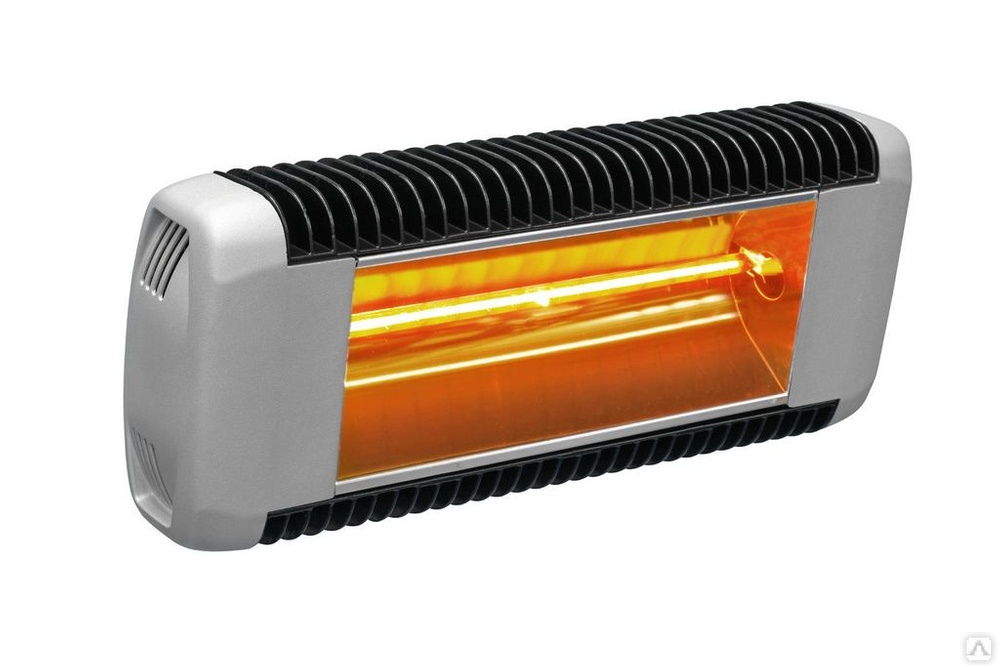


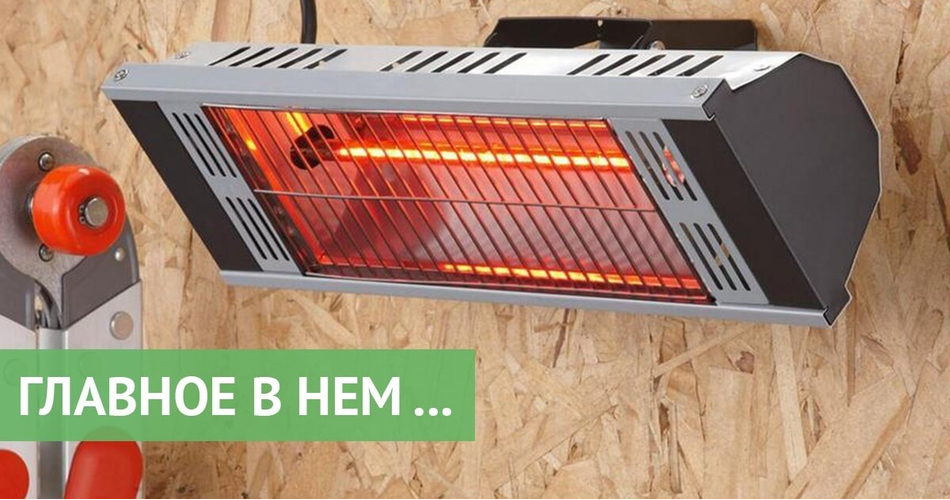


Control. The infrared heater in the working position is located at a considerable height, therefore, a remote control is provided for controlling it, which is not included in the price of the device. It is possible to turn off by timer and operate in automatic mode with correction according to the readings of the room thermostat.
Heating element. The source of thermal energy here is a straight tubular heating element with a reflector made of stainless steel. Power consumption reaches 1000 W, which is enough to heat small rooms or local work areas.
Pros Timberk TCH A3 1000
- The high quality of the materials used.
- Silent operation.
- Possibility of remote control and automatic operation.
- Aesthetic appearance.
- Easy installation.
- Low cost.
Cons Timberk TCH A3 1000
- Little power.
- The remote control and power cable must be purchased separately.
- The instruction in Russian is not attached, but it can be found on the Internet.
Distinctive features of oil and infrared heaters
To understand what is better to use for heating a house, an infrared heater or an oil heater, consider their design, principle of operation and some operational features. This will help shed light on solving the problem of choosing the optimal heating device.
Oil heater-radiator
The classic oil cooler is a container in the form of a panel or multi-section battery filled with transformer oil. The heating element built into the lower part of the device heats the coolant, which then gives off the accumulated heat to the environment for a long time. The main method of heat transfer is convection.
The intensity of heating is set by a mechanical thermostat. Most modern models are equipped with the function of automatically maintaining the heating temperature. In all devices of this type, protection is provided for the temperature of the coolant and the pressure in the tank.
Oil cooler design
An extensive range of products presented on the domestic market climate technology models has a floor version. Despite the significant weight, such a heater is quite mobile, as it is equipped with wheels for easy movement. Depending on the goals, the following models are also available to the consumer:
- wall;
- desktop;
- designed for baby cots.
The power of oil heaters varies from 1 to 2.5 kW. At the maximum power value, one such device can heat a room up to 25 m2 (1 kW per 10 m2 of area).
To reduce energy costs, modern models are equipped with a timer that allows you to turn on the device at a user-specified time.
IR heater
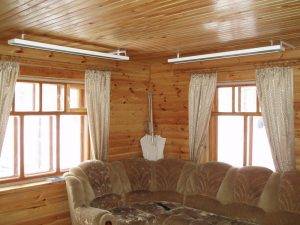 In order to be able to decide which modern infrared heater or classic oil heater is better, let's consider what they consist of and how infrared heating devices work.
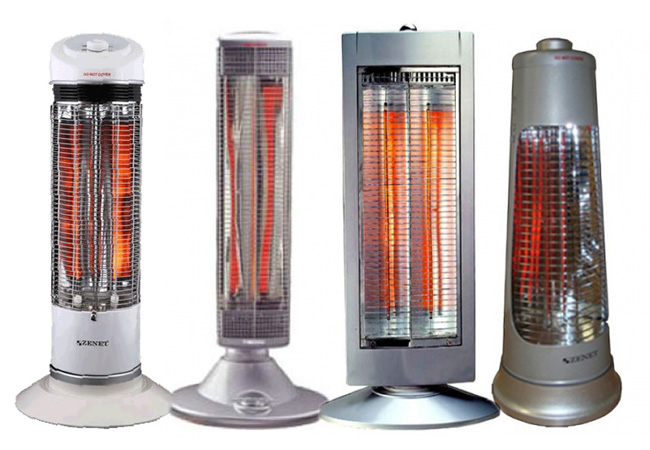
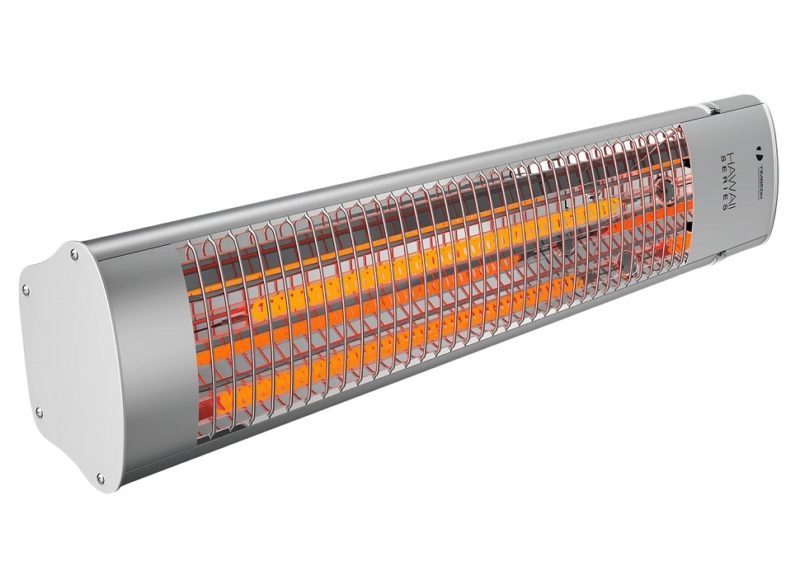
The classical design of such a device consists of a metal case, an aluminum reflector, on which a heating element is installed.There are four types of this element:
- halogen lamp;
- heater with carbon fiber;
- ceramic emitter;
- tubular element.
For heating residential premises, infrared heaters with a carbon or tubular heating element are most often used.
 The principle of operation of the infrared heater
The principle of operation of infrared heating devices is simple: the rays produced by the emitter pass through the air without changing its temperature. Meeting with objects, absorption of infrared rays occurs with simultaneous heating of the surface of the object. Further, the objects themselves begin to accumulate heat to the surrounding air. The radiation intensity is set by a temperature controller responsible for the temperature of the heating element. Most modern models are equipped with a thermostat with the function of automatically maintaining the heating temperature.



Accommodation Recommendations
Before purchasing an IO, the following premises data are taken into account:
- his appointment;
- dimensions;
- humidity level.
Other important factors:
- type of main heating source;
- ceiling parameters (height, format);
- number and parameters of windows;
- lighting technology;
- the perimeter of the outer walls.

In the bathroom and kitchen, a compact ceiling or wall model with waterproofing is usually mounted. She also has to fit in there. Suitable options: Royat 2 1200 and AR 2002. Manufacturers: Noirot and Maximus (respectively).
A silent and non-luminous apparatus fits into the bedroom. Examples: SFH-3325 Sinbo, Nikaten 200.
Any AI that has the required heating area is placed in the living room. Examples: good wall fixtures (any of the appropriate ones listed above).
On a balcony, in a garage or a country house, Almac IK11 or IK5 are good.
In one room, you can not put one powerful AI. It is much more profitable to distribute here 2-3 devices with a more modest power.