
- Technical parameters and customization
- Selecting and purchasing a device
- How to connect a motion sensor
- Wiring diagram
- Mounting
- Kinds
- The principle of operation of the infrared sensor for the lighting system
- Checking the installation
- Viewing angle
- Light level
- Breaker Delay
- Sensitivity
- What is a time relay?
- Advantages and disadvantages
- How to choose
- Main characteristics of circuit breakers operating with off-delay
- How to make the lighting in the apartment "smart"?
- Buy smart lamps…
- or equip ordinary lamps with smart cartridges
- or install smart lamps
- …or install smart switches
- Conclusions and useful video on the topic
Technical parameters and customization
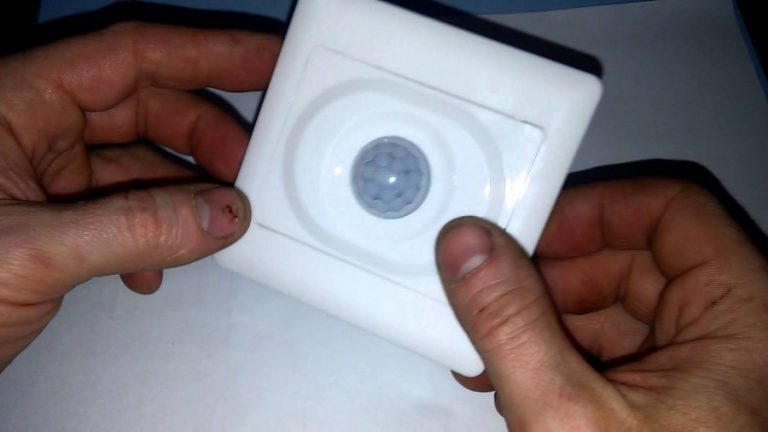
Most models of light switches with a motion sensor are designed for direct connection of lighting fixtures to a 220 volt network. In fact, this is a standard key switch on the light, but supplemented by a detector and an automation board.
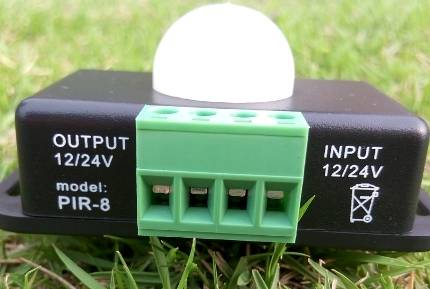
Motion sensors can be powered directly from the mains 220 V, batteries and through the power supply 12 V - the first option requires more wires, but is more reliable and preferable
Each model of the circuit breaker under consideration has a parameter in the passport - the maximum connected power. It reflects the total power of the connected lamps.If the device is taken on a group of lanterns in the fence near the cottage, then this value should be in the region of 1000 watts.
Otherwise, it will burn out the first time you turn it on. For installation in the rooms of a frequent house or apartment, a device of 300–500 watts is more than enough.
With the rules for connecting a motion sensor to a lighting device served by it, an article will be introduced, the content of which is devoted to the analysis of this difficult issue.
The minimum degree of protection must be IP44. For heated rooms in the cottage, this is quite enough. But for installation on the street or in the bathroom, it is better to take with IP "55", "56" or higher.
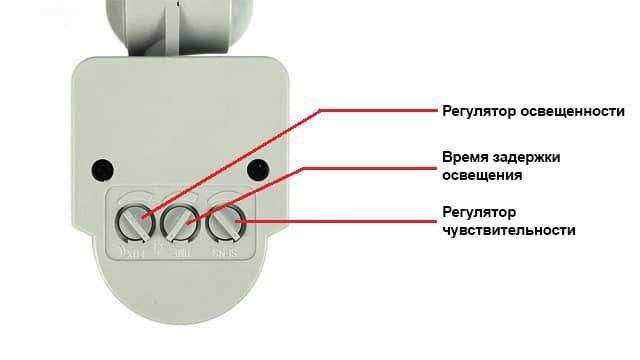
As a rule, a switch equipped with a motion sensor on the housing has three settings:
- "TIME" - the response time to turn off the light after a person leaves the room.
- "LUX" ("DAY_LIGHT") - sensitivity to light (if there is a photorelay).
- "SENSE" - sensitivity to movement (temperature in the case of an infrared sensor).
The first parameter can vary from 0 to 10 minutes. If the narrow sensor is aimed only at the door in the pantry, then it is better to set this adjustment to the maximum. Then, when entering the “dead zone”, it will be possible not to be afraid that the light will turn off at the most inopportune time. At the same time, 5–10 minutes is enough to take something from a shelf in a closet.
The sensitivity to motion triggering and the degree of illumination are set by trial method. This affects the level of insolation, the presence of animals in the house and radiators nearby, and even swaying trees nearby. If there are too many false positives, then gradually this parameter should be reduced and brought to optimal values.
Selecting and purchasing a device
The choice of sensor, like any purchase, depends on the preferences of the buyer and his financial capabilities.
But above all, from such factors as:
- Function Requests to the device.
- Installation locations.
- Appointment.
- The need for interaction with other devices.
As can be seen from the table above, the price level for producing countries is approximately the same. Devices with a wireless control system stand apart. They are powered by 9 volt batteries.
With a comparative high cost, they provide a number of advantages in the form of the absence of wiring as such and the uselessness of its manufacture, which also costs money.
Manufacturers and price examples:
| Model | Imagenie | Dimensions (cm) | Manufacturer | Price, rub) | Notes | ||
| length | width | depth | |||||
| motion sensor wall-mounted, review 110 o | 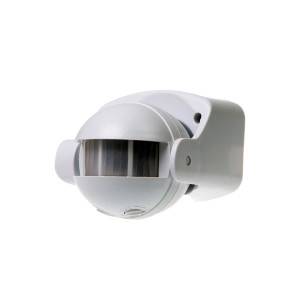 | 13 | 10 | 8 | PRC | 490 | |
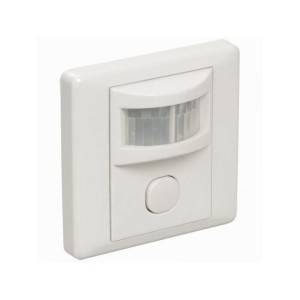 | Russia | 456 | 140 gr | ||||
| Wireless motion sensor IP 44 RIP | 8,4 | 14,6 | Holland | 2800 | 325 gr | ||
| Outdoor motion sensor IP 44 | 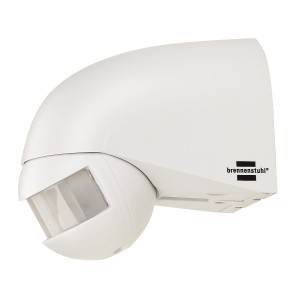 | 8,4 | 9,6 | 14,6 | Germany | 580 | 170 gr |
| Ceiling room motion sensor DDP-01 360 o | 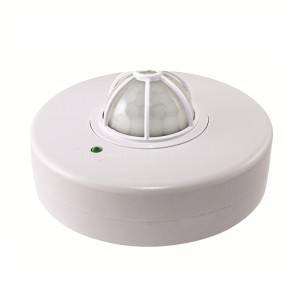 | Russia | 500 | 213 | |||
| Wall motion sensor, 180 о | 13 | 10 | 8 | PRC | 520 | ||
| Motion sensor 110 o | 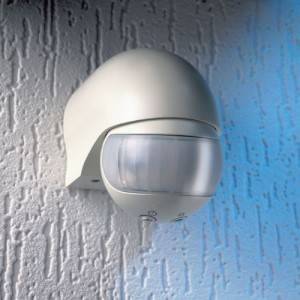 | 8,4 | 9,4 | 14 | Germany | 570 | 168 |
| Motion sensor AWST-6000 b/wire for rooms | 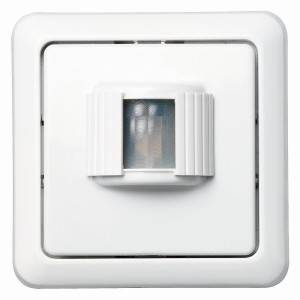 | 4,3 | 14,6 | 13,8 | Holland | 2800 | 135 |
| Motion sensor IK-120 b/wire room | 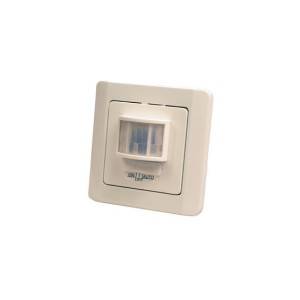 | 6,4 | 8,9 | 12 | Germany | 1286 | 140 |
How to connect a motion sensor
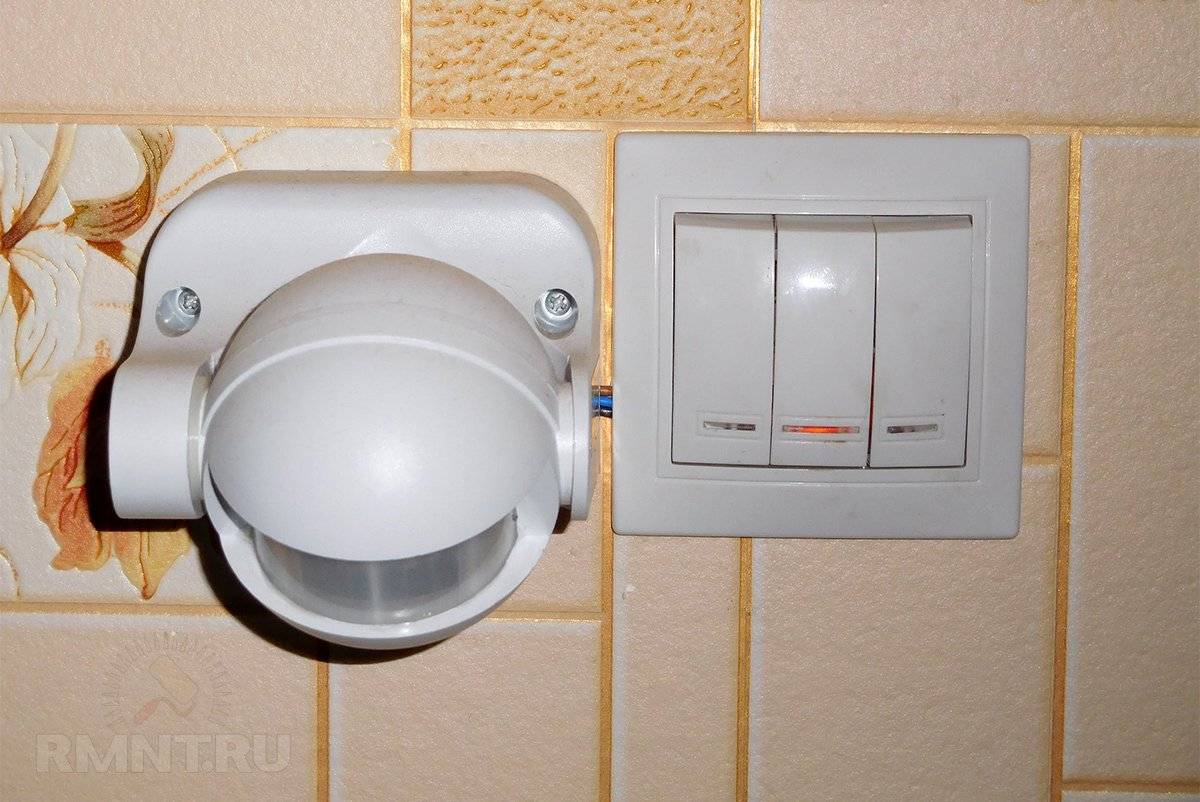
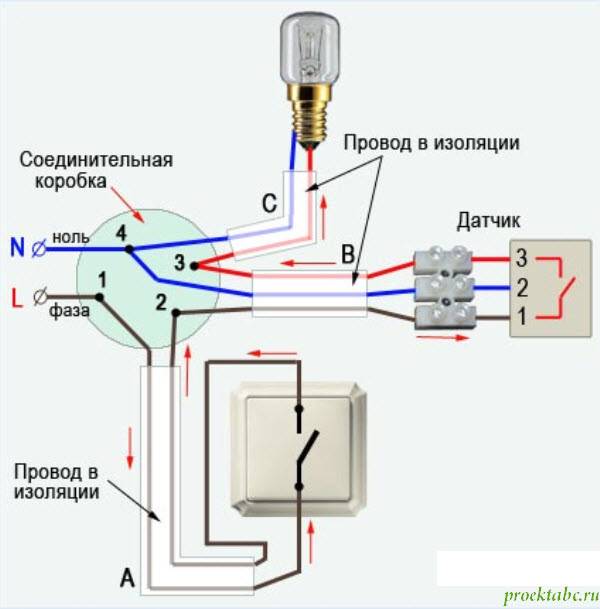
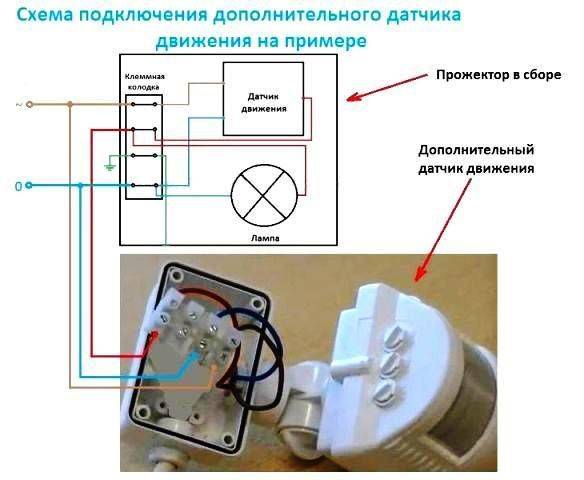
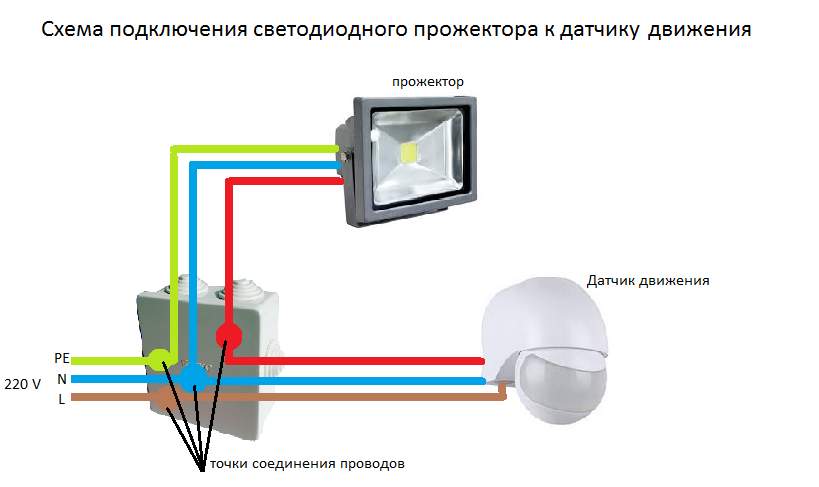
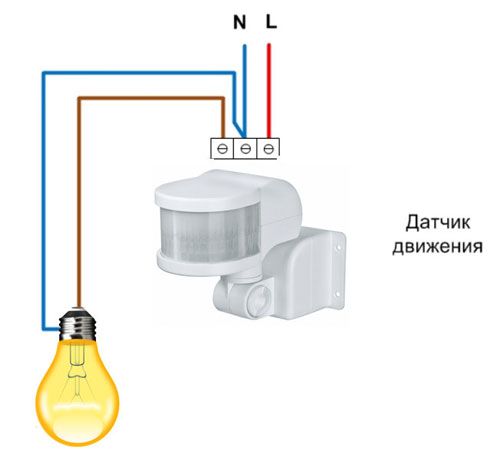
Connecting a sensor to turn on the light indoors or outdoors according to the movement of an object is not particularly difficult. The wiring diagram and installation procedure are not much different from similar parameters and actions for a conventional household switch.





Wiring diagram
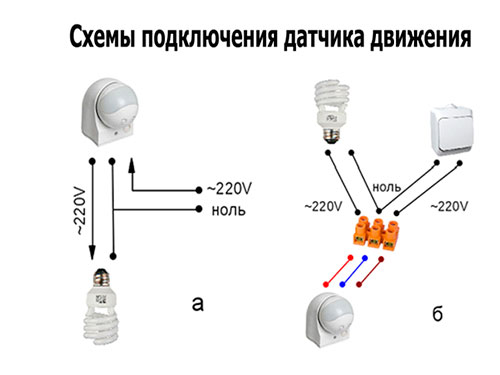
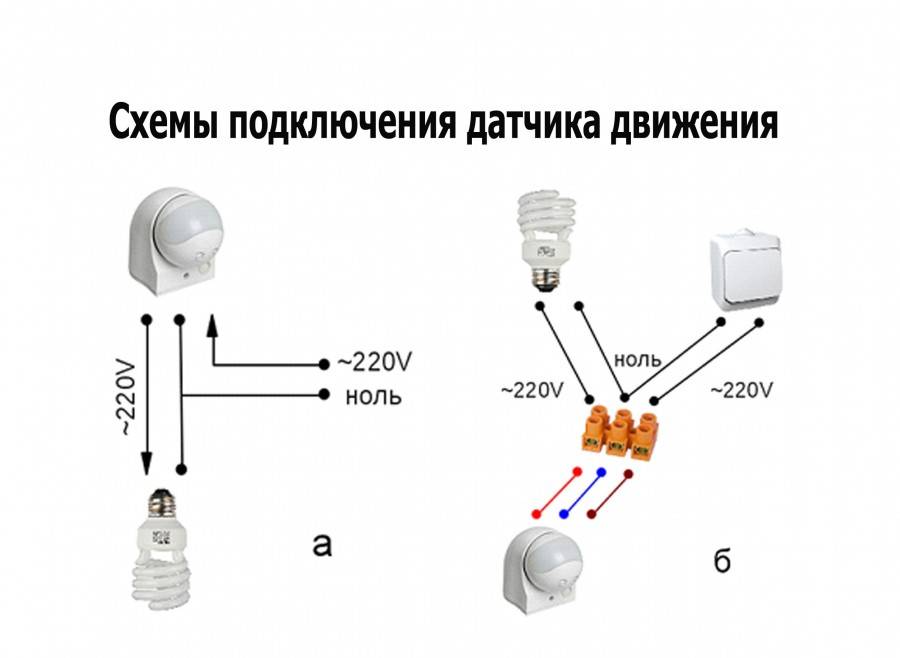
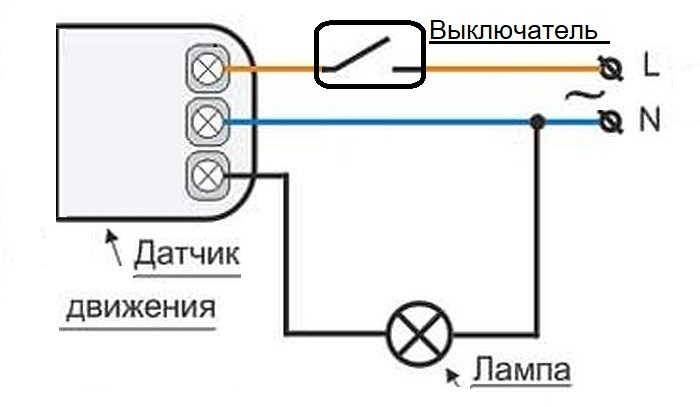
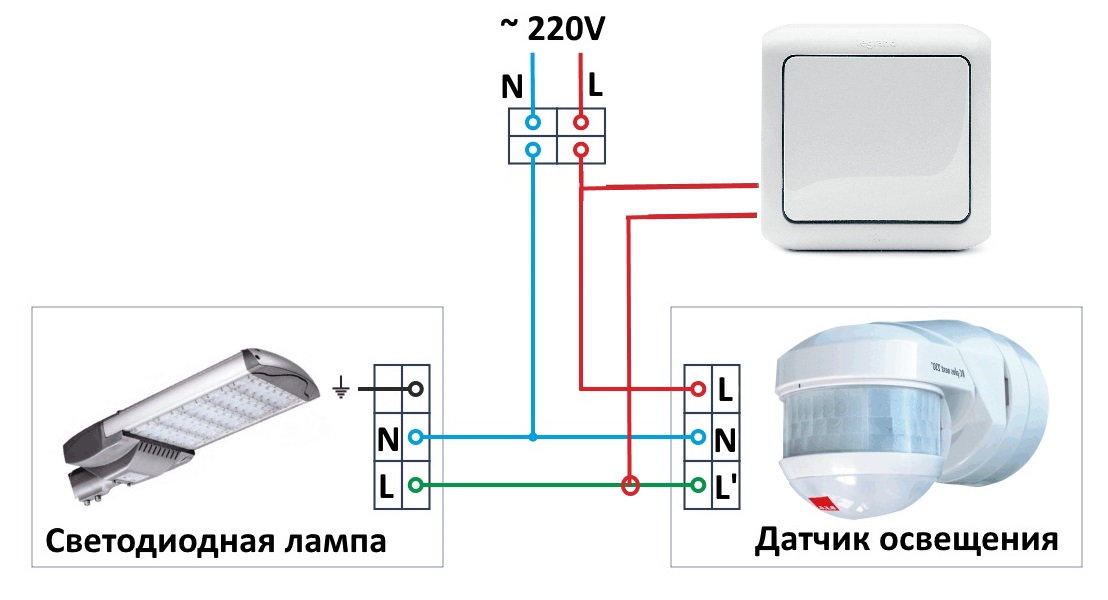
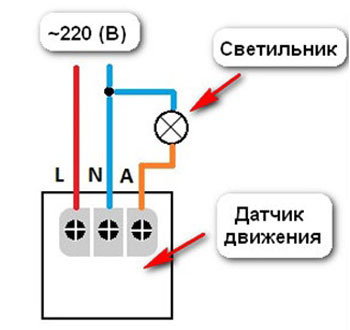
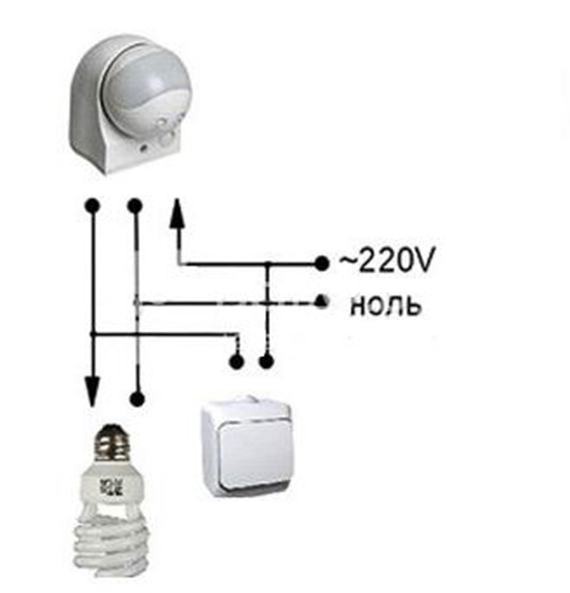
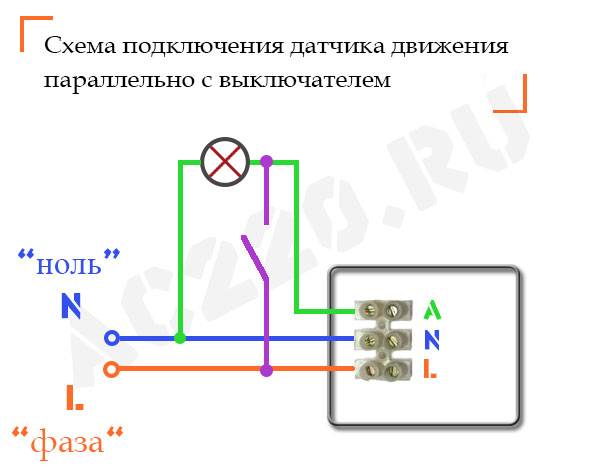
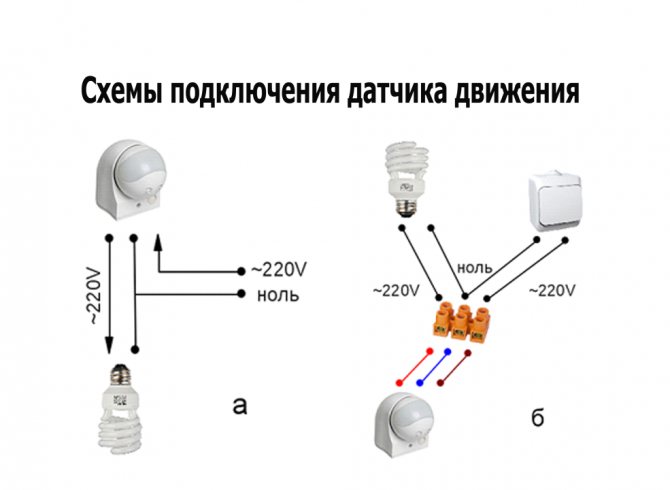
To connect the device, you can use two main schemes:
- Directly.
- With switch.
The first one allows you to control the lamp only through the sensor, the second one adds the ability to turn on the light with a switch regardless of whether there is movement in the sensor’s visibility zone or not (the sensor works in the “off” state).
Mounting
To connect a motion sensor and use it to automatically turn on the light, you must perform the following series of actions:
- Choose the location of the detector, lamp, prepare consumables and tools.
- Mount the luminaire with connected wiring, install the junction box, fix the base of the motion sensor.
- Connect a three-wire wire (preferably with multi-colored wires) to the sensor.
- A total of seven cores should be suitable for the distribution module - three from the sensor, two (phase + zero) from the shield and two from the lamp.
- Correctly connect all the wires (having previously found the contact terminals with the designation in the sensor) in the following order - three zero wires (from the sensor, from the shield and from the lamp) are connected into one contact; two cores (phase!), Coming from the shield and the sensor, are also combined into contact; the two remaining wires (coming from the sensor and from the lamp) are also twisted together - the phase will be transmitted through them as movement appears in the sensor area and the light will turn on.
Kinds
There are two main designs of these devices:
- For outdoor use.
- Installed indoors.
Devices designed for indoor use will quickly fail in outdoor conditions. The use of outdoor appliances in the house is not economically feasible.
Devices differ in the place of installation:
- Peripheral - they are placed on objects remote from the house, such as: a device for turning on the backlight of the pool, turning on the lighting of the paths when walking around the site at night, and so on.
- Installed for perimeter control - these devices control the turning on of the light when a car approaches the house or a person approaches, they are usually placed on the fence of the estate.
- Internal - are located indoors, in the toilet or bathroom, at the entrance to the basement and, in general, in any separate room. The use of such devices allows you to significantly save electricity, the lighting will turn on where it is needed at the moment.
All outdoor sensors are usually equipped with mass detectors so as not to react to the appearance of small animals in the area of the device. Lighting control sensors are also needed to prevent switching on during daylight hours.
The principle of operation of the infrared sensor for the lighting system
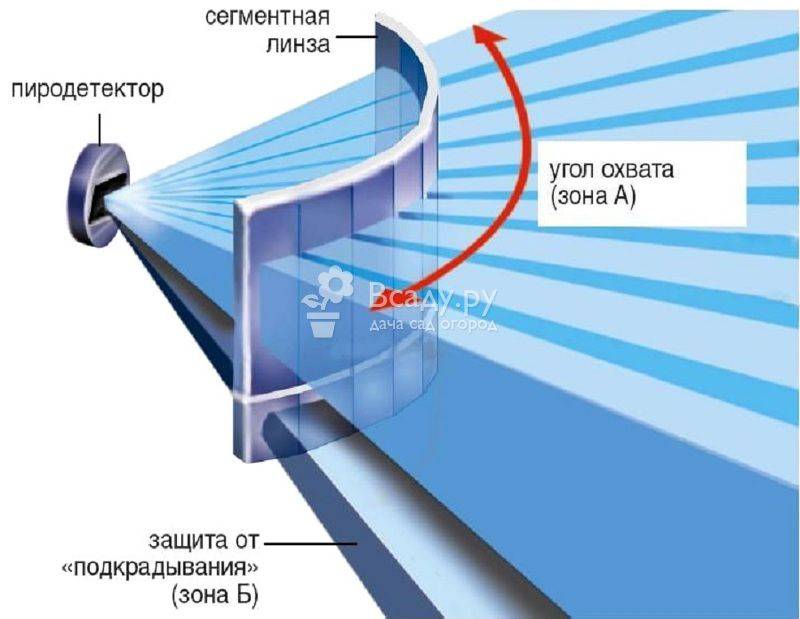
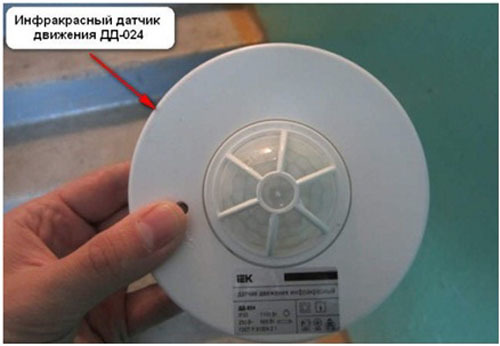
The basis of the motion sensor is an infrared photocell with an electronic signal processing circuit. The sensor responds to any changes in infrared radiation in the controlled area. Since people and pets have a higher temperature than the environment, the detector immediately notes their appearance in the tracking area. To prevent the photocell from reacting to stationary heated objects, several technological methods are used at once:
- infrared filter eliminates the influence of visible light;
- segmented Fresnel lens divides the field of view into many narrow beams;
- the electronic circuit highlights a signal characteristic of the thermal "portrait" of a person;
- multi-element photodetectors are used to prevent false positives.
While moving, a person crosses the narrow lines of visibility formed by the lens. The changing signal from the photocell is processed by the electronic circuit and triggers the sensor.
It is the Fresnel lens that is responsible for the directional pattern of the motion sensor. Moreover, the line is formed both in horizontal and vertical planes.
The detection range depends on the sensitivity of the photocell and the power factor of the amplifier. The retention time after actuation is also determined by the electronic filling.
Checking the installation
Before the final installation, you need to check the health of the system. There are several switches on the sensor that are responsible for setting the detector:
- LUX. The switch is responsible for the threshold illumination. If there is enough light from the sun outside, then the sensor will not respond to movement.
- TIME. The time for which the light will turn on after operation (from 2 seconds to 15 minutes). The countdown starts from the moment when the object leaves the area of effect.
- SENS. The sensitivity depends on the brightness of the IR light to which the device is to respond.
 Motion sensor controllers
Viewing angle
In cheap versions of devices, only settings for sensitivity, action time and threshold illumination level are available, and the viewing angle is fixed. More expensive analogues allow you to adjust this characteristic. If the device often does not work on time or blind spots appear, then it is worth checking the correct direction of the viewing angle.




Advice! For maximum efficiency of wall-mounted outdoor sensors, the optimal installation location is at a height of 2.5-3 m.The range is about 10-20 m and the height is 1.5 m. Do not try to increase the regulated range by setting the detector at a higher or lower level.
Wall sensor installation
Light level
Proper adjustment of the light level will increase the efficiency of the lighting fixture: running a fixture with sufficient light from the sun is a waste of money. To adjust the LUX-parameter, the regulator must be set to the maximum position (night operation), and then gradually turn it to the right.
Breaker Delay
The delay time varies from 2 seconds to 15 minutes. The optimal time is considered to be 50-60 s. You need to unscrew TIME to the minimum value, and then smoothly increase the time. The first shutdown after setting will occur a little later than it was set. Subsequent will be made according to the settings.
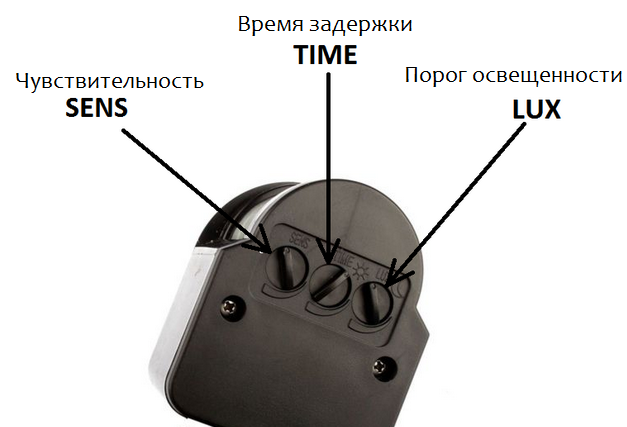 The location of the regulators on the sensor
Sensitivity
With increased sensitivity of the motion detector, false alarms are likely. At a high level of sensitivity, the detector is triggered by the appearance of animals in the area. To set up the device correctly, you should start from the minimum value and slowly increase the SENS controller.
What is a time relay?
To understand the features of the device, it is worth studying its principle of operation. The relay working backwards operates according to the following scheme:
- The device is signaled to turn off the device.
- The switch-off time countdown starts. Time expires and shutdown occurs.
If such a relay is adopted in front of the lamp, then you should not wait for an instant operation. Everything will turn off only after the delay time has passed.
Dual Relay:
As soon as a signal is given, the mechanism is turned on and the delay interval is counted down. As the specified time is counted, the device turns on the necessary device within the specified time. We can say that two time relays are connected in series - this is a double relay.
Advantages and disadvantages
Using a sensor to turn on the light in the house has a number of advantages:
- significant energy savings. All sensors are equipped with automatic self-control, which allows you to turn off the light when there is no person in the room;
- practicality and ease of use. In order to turn on the light, there is no need to look for a switch in the dark with your hand, rummaging through the walls. This will only damage the wallpaper or paint. And so you just need to enter the room and the light will turn on automatically;
- functionality. For most modern models, there is no need to run wires. They can work from the network. In addition to this device, you can freely connect to other devices: tape recorder, TV, etc.
But, despite such obvious advantages, such equipment also has some disadvantages that you should be aware of before buying them. The disadvantages of such devices include:
- rather high cost of equipment. Of course, everyone strives for a comfortable and convenient life, but you will have to pay for it. Although in the case of sensors, the existing advantages may somewhat compensate for this disadvantage;
- rather complicated installation. Of course, such products can be installed with your own hands, but difficulties arise at the stage of connecting the device to the power supply. Therefore, it is still better to entrust the installation to professionals, because working with electricity without proper preparation is very dangerous.
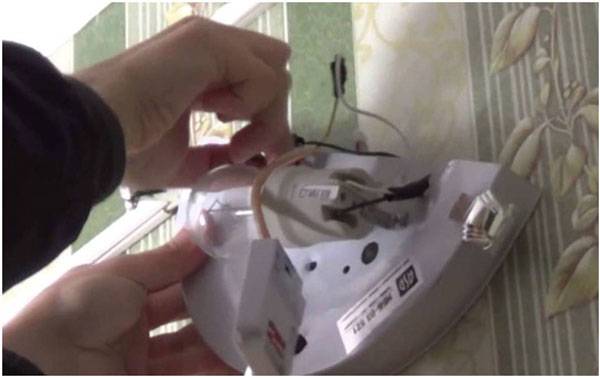
Mounting the device
Despite the presence of certain disadvantages, nevertheless, the installation of such equipment in the house will be relevant and very effective.
How to choose
There are many models on the market. You can purchase a combined type electrical appliance in one housing, or you can buy several devices that will have to be installed and connected to each other in a certain way. The choice of one or another option depends on several factors:


- terms of Use;
- load value (number and type of light bulbs);
- room configuration;
- sensor type.
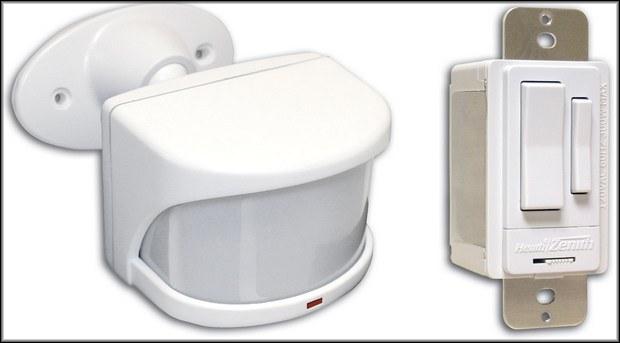
Sometimes a separate motion sensor is purchased, which is connected to the switch.
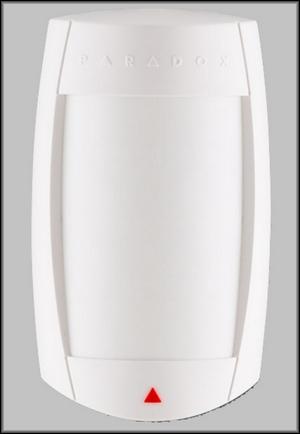
More often use combined devices with an additional light sensor. During daylight hours, they turn off the motion detector so as not to waste electricity.
It is necessary to determine in advance the degree of workload and the main tasks of the device. Sometimes it is more convenient to purchase a separate motion sensor and plug it in with a switch. Both devices can be separated indoors, but they will work in pairs. This option is good if the location of the switch does not allow you to control the most critical section of the room, corridor or other area.
Main characteristics of circuit breakers operating with off-delay
The device is equipped with a program that allows you to set the control parameters for all appliances in the house. Characteristic features of switches operating with a delay:
- Interval accuracy, no errors.
- The maximum duration of the device programming time. The larger the time range, the more functions the switch is able to perform.
- Resistant to voltage drops, supports operating mode at 230 V, a frequency of 50 Hz and a current of 16 A.
- A large list of functions that allows you to work with other devices and perform different tasks.
How to make the lighting in the apartment "smart"?
There are several ways to make the light in an apartment or house smart. At the design stage of future housing or during a major overhaul, any option below is suitable.
In the conditions of an existing repair, laid wiring and purchased fixtures, you can also get out.
Buy smart lamps…

This option is suitable only for those who are just planning a global renovation of the interior in their home. Of the obvious disadvantages of the solution is a small assortment of suitable gadgets and their price.
In addition, ordinary light switches will de-energize such lamps, depriving them of smart functions. You will have to change them too.
Buy a Yeelight ceiling lamp - 5527 rubles. Buy a Yeelight diode lamp - 7143 rubles.
or equip ordinary lamps with smart cartridges

Special "adapters" will help turn any light bulb or lamp into a smart one. Just install it in a standard illuminator cartridge and screw in any light bulb. It turns out a smart lighting device.
Unfortunately, this method is only suitable for lighting fixtures in which light bulbs are installed. Diode lamps in the span.




You will have to install an adapter for each cartridge, which can be expensive. Not every lighting device will fit such a device.
Well, do not forget that when the light is turned off through a conventional switch, the smart cartridge loses all its capabilities.
Buy a smart socket for a Koogeek light bulb: 1431 rubles. Buy a smart socket Sonoff: 808 rubles.
or install smart lamps

Instead of the so-called adapters, you can immediately buy smart bulbs.
Diode lamps are again in flight, several smart bulbs in one lamp will have to be connected in the application for easy control.
Light bulbs, although they work for a long time, but their resource is much less than that of the same smart cartridges or switches, and when the light is turned off with an ordinary switch, a de-energized smart light bulb ceases to be smart.
Buy smart bulb Koogeek: 1512 rubles. Buy smart bulb Yeelight: 1096 rubles.
…or install smart switches

The most true and correct decision.
With conventional switches, you will have to use apps or remote controls to control smart lights, bulbs or sockets. When a phase is opened with a conventional switch, smart devices simply turn off and stop receiving commands.
If you install smart switches in the room, then you can always control them, because they will always be supplied with voltage for power.
In the future, when expanding a smart home, it will be possible to equip it with smart lamps, light bulbs, and cartridges, expanding the possibilities without losing functionality.
You need to start with the switches.
At the same time, if you choose between light bulbs with a limited service life, cartridges that are not suitable everywhere, and switches. The choice in favor of the latter is obvious, while the prices for all gadgets are approximately comparable.


Conclusions and useful video on the topic
This short video guide demonstrates clearly how the connection operations are carried out for some instrument modifications.It makes sense to look to improve practice.
An overview video on the use of microwave sensors. These modern modifications are marked by a high level of “flair” and reliable operation as part of intelligent home systems.
Concluding the review, we should add information on the technical requirements for devices such as motion sensors.
Thus, the load capacity of devices usually does not exceed 1 kW, and the maximum switching current is not more than 10A. The devices are designed to operate in AC networks with a frequency of 50-60 Hz at a nominal voltage of 230 V.
These basic parameters must be kept in mind before connecting sensors for specific applications.
Share with readers your experience of connecting and using motion sensors. Please leave comments, ask questions on the topic of the article and participate in discussions - the feedback form is located below.



