- The device of electric heating convectors
- Types of heating elements for electric convectors
- Types of thermostats and controls
- Tips for choosing a convector
- Heating element
- Fan heaters - device, pros and cons
- Convector heating control unit
- The convector can be equipped with one of the following types of heating element
- How does a convector work?
- Heating element
- Control unit or thermostat
- The use of inverters in heating
- Device and principle of operation
- Infrared radiation
- Manufacturers and popular models: rating of the best and prices
- Ballu BEC/EVU-2500
- Electrolux ECH/R-1500T
- Split system Aeronik ASO/ASI-12HM
- Toshiba RAS-07EKV-EE/07EAV-EE
- Climate device Mitsubishi Heavy Industries SRK-25ZM-S
- Samsung AR09HSSFRWK/ER
- Timberk TEC.E0 M 2000
- How to install a convector
- Which is better, a gas convector or a boiler
- What is a convector
The device of electric heating convectors
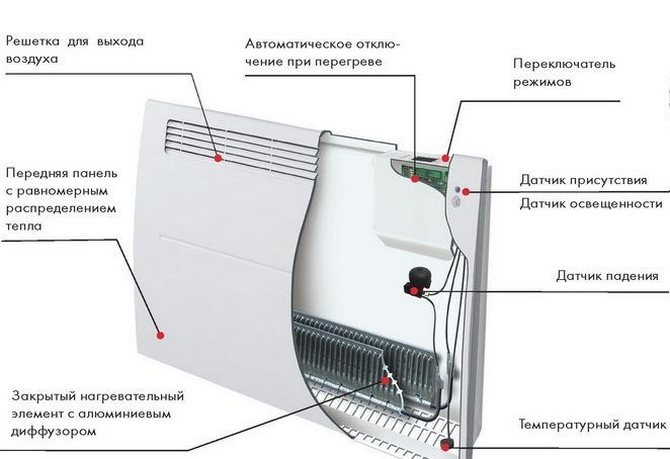
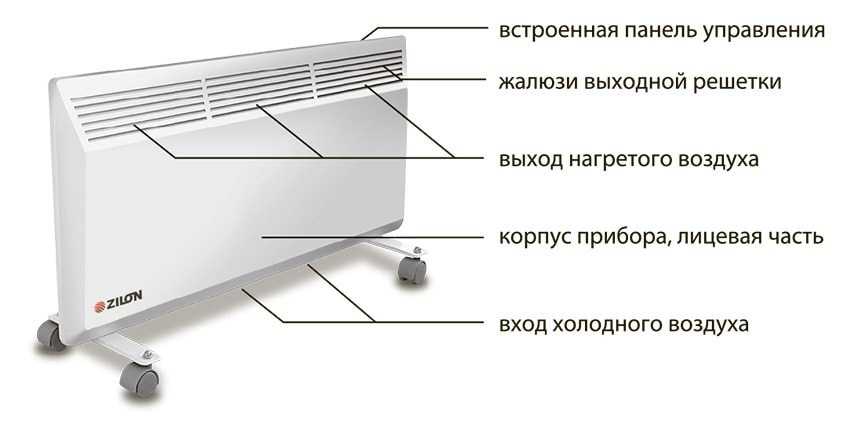
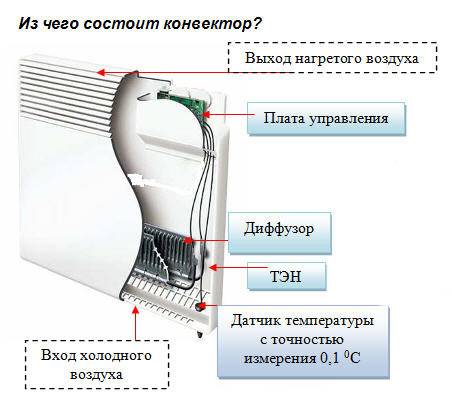
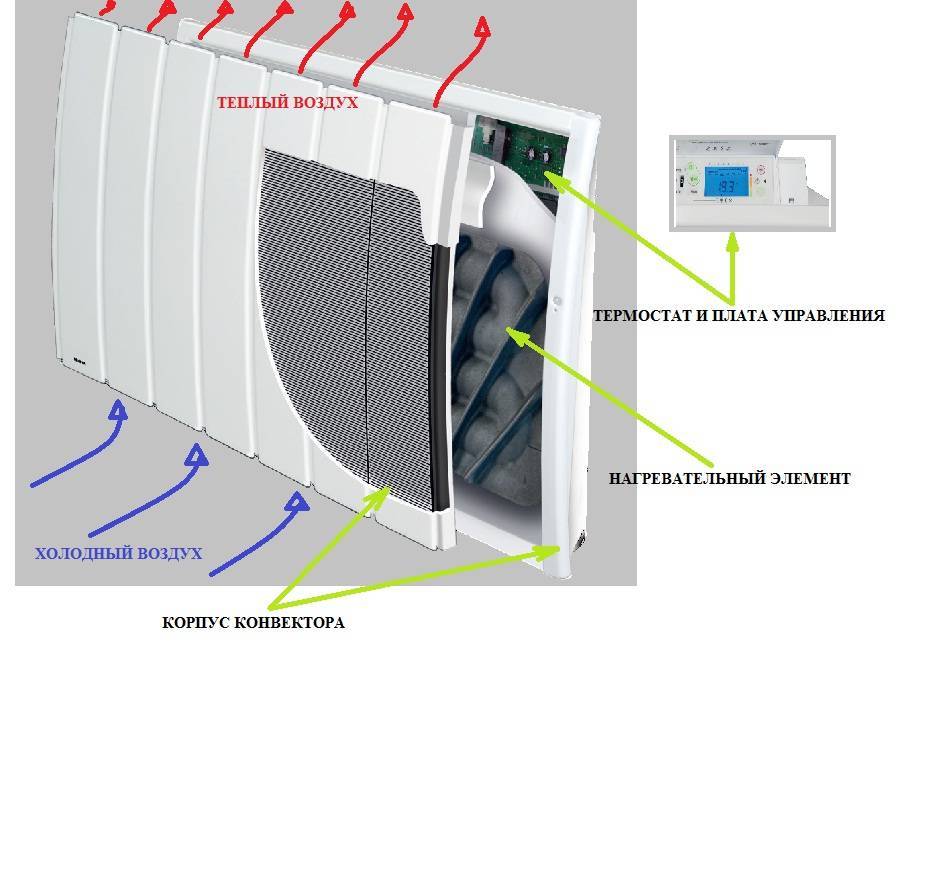
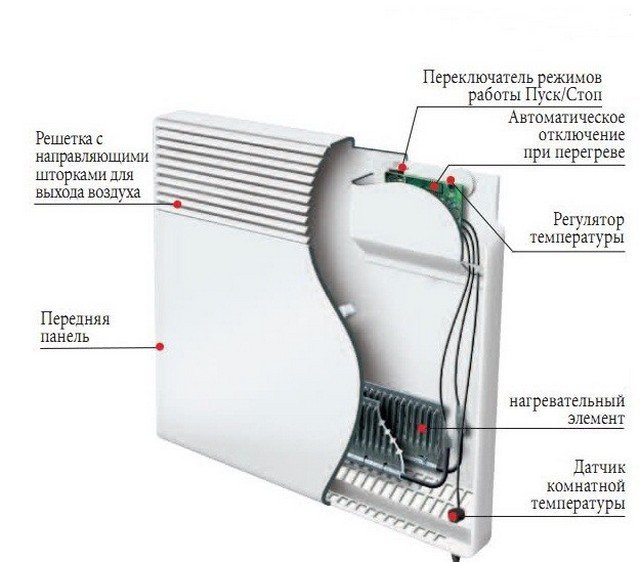
The device of the electric convector is simple:
- a housing in which there are openings for air intake and exhaust;
- heating element;
- sensors and control and monitoring device.
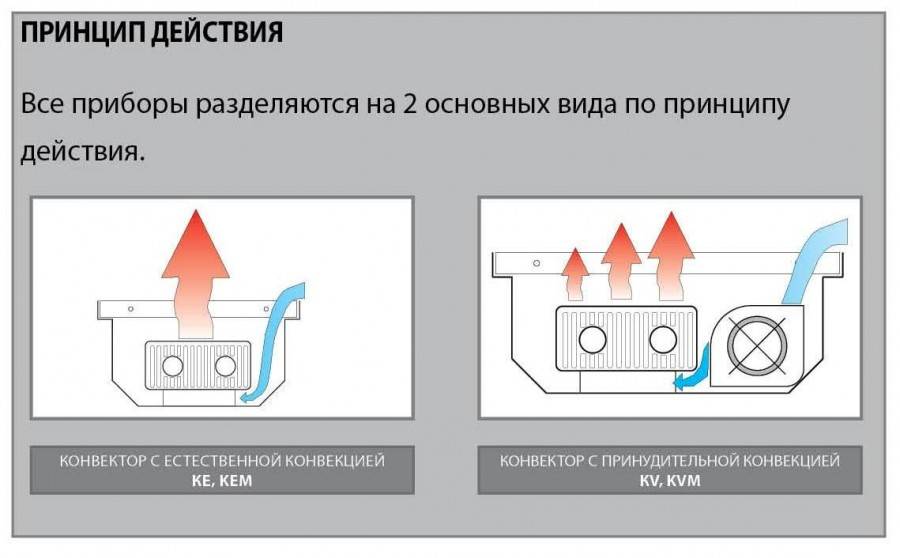
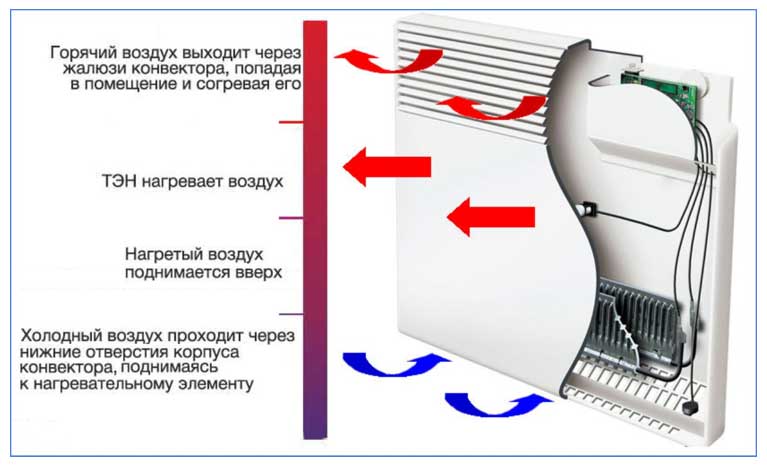
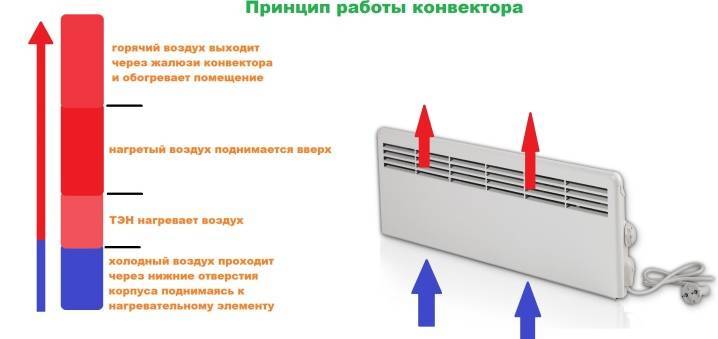
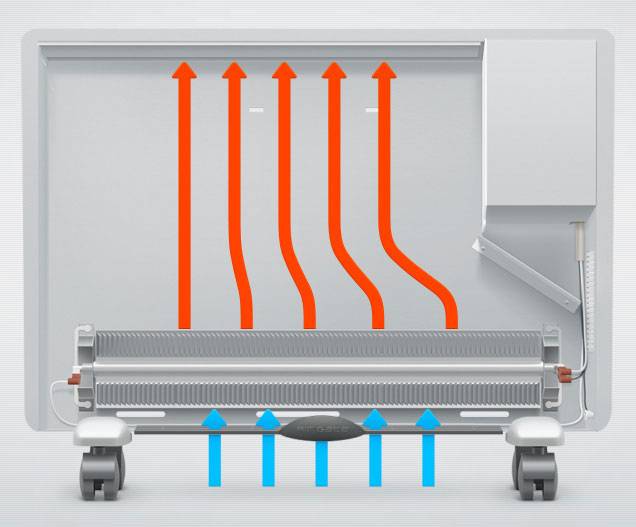
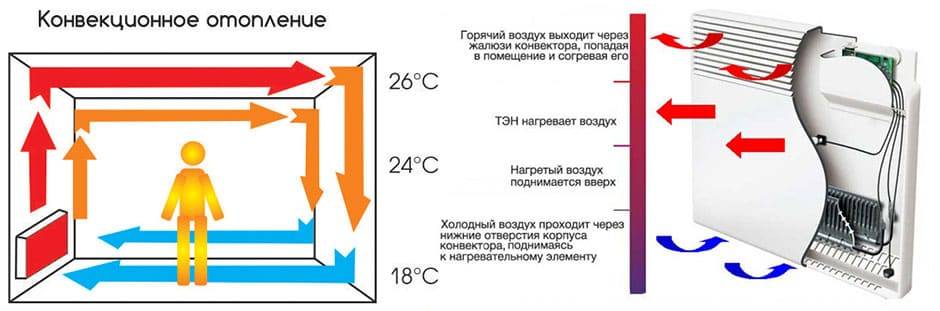
The case is heat-resistant plastic. The shape can be flat or convex, rectangular or square. There are holes in the bottom of the case - cold air is sucked into them. There are also holes in the top of the case.Hot air comes out of them. The movement of air occurs without stopping, and the room warms up.
Convector heater device
The heating element of an electric convector is what you need to pay attention to when choosing. The type of heater determines the service life of the equipment and the air condition.
Types of heating elements for electric convectors
Heating elements in electric heating convectors are of three types:
-
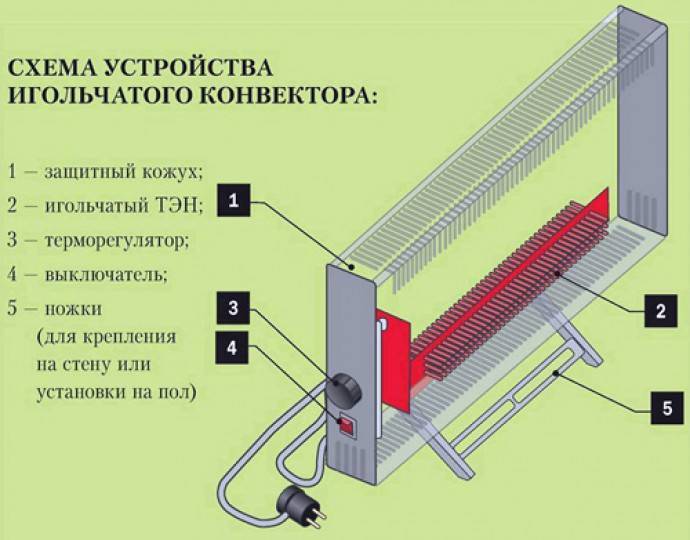
Needle. This is a dielectric tape in which needle loops made of an alloy of chromium and nickel are mounted. The surface of the heater is filled with a layer of protective varnish. The hinges stick out from both sides, heat up very quickly, cool down just as quickly, and this is a plus of such heaters - it is easy to maintain the set temperature. The second positive point is the low cost. Electric convectors with needle-type heaters are a third cheaper. disadvantages - it cannot be used at high humidity, the fragility of the needles leads to the fact that such a heating element quickly fails.
-
TEN. Tubular electric heater. This is a hollow metal tube inside which a spiral is sealed. The distance between the spiral and the body is filled with heat-conducting backfill. Plate-fins are additionally soldered on the heating elements for convectors to increase heat transfer. The disadvantages of this heater are relatively low efficiency, large inertia - due to losses in the transfer of heat from the coil to the body - it takes time to reach the operating mode. Another drawback: during operation, the heating element may crackle. The reason is the different temperature expansions of the materials used. Advantages - the spiral is reliably protected, the convector heater can be used in wet rooms.Also a positive point is a long service life.
-
Monolithic heaters are the quietest, with minimal heat loss. The same thread made of nickel-chromium alloy is soldered in a cast body with fins. Heat loss during transfer from the thread to the body is minimal, the thermal expansion of all parts is the same.
Electric heating convectors with monolithic heaters are considered the best, but they are also the most expensive. With the use of heating elements - a little cheaper.
Types of thermostats and controls
Electric heating convectors can be controlled by a mechanical thermostat or electronics. The cheapest convector electric heaters have a thermostat, which, when the set temperature is reached, breaks the power supply circuit of the heating element. When cooling down, the contact appears again, the heater turns on. Devices of this type cannot maintain a constant temperature in the room - the thermostat is triggered by heating the contact plate, and not by air temperature. But they are simple and quite reliable.
Mechanical thermostat on electric heating convectors Nobo
Electronic control uses several sensors that monitor the state of the air in the room, the degree of heating of the device itself. The data is processed by a microprocessor, which corrects the operation of the heater. The desired mode is set from the control panel located on the case, and there are also models with a control panel. You can find programmable models that allow you to set the heating mode for a whole week - while no one is at home, set it to maintain about + 10 ° C or lower and save on bills, warm up the room to a comfortable temperature by the time people arrive.There are generally “smart” models that can be integrated into the “smart home” system and controlled from a computer.
Tips for choosing a convector
When choosing a convector heater, consider its following characteristics:
- power consumption;
- Type of heating element;
- Instrument dimensions;
- Operational safety;
- Additional features;
- Price;
- Manufacturer;
- Inspection indicators.
1. So, power. It is selected based on the size of the room to be heated. For example, if it is planned to use the device in addition to heating during the period when they are not heating yet or are not heating, then we calculate the power as follows: for each cubic meter of room volume, 25 watts of power are needed. But if there is no heating in the house at all, then you will have to count based on 40 watts per cubic meter.
2. Type of heating element. As for the heating element, if there is a choice, take a heater with a cast monolithic heater - it will last longer and work more efficiently.
3. Instrument dimensions
When inspecting the device, pay attention to its dimensions, especially the height. After all, it depends on it at what speed the air will move.
So, for example, low convectors with a height of only 60 centimeters are able to provide very fast movement of air masses and, accordingly, heat the room faster.
It is also important how heavy the device is - after all, you may have to move it from place to place during use.
4. Operational safety. The heater must be as safe as possible. Strictly speaking, convectors are the safest devices for heating.After all, their body heats up only up to 60 degrees, no more, and therefore will not leave burns. Parents of small children prefer models in which the body is devoid of corners and has smooth contours. Grounding for convectors is not necessary, and they withstand voltage drops with honor.



5. Additional features. Of the additional features that a good convector has, the following can be noted:
- The temperature controller is very handy. If it is warm outside, you can screw it up a little, and in severe frost, set it to the maximum.
- The thermostat will allow you to constantly maintain the temperature in the room that is most comfortable for you.
- The timer will make it possible to turn on the heater for a certain time, after which the shutdown device will work. This opportunity is good to use in the evening, before going to bed.
- The built-in ionizer absorbs dust, saturating the air with negative ions. It is very good for health. In a room with such a microclimate, you sleep better and work more productively.
- The remote control and the on timer will allow you not to get out from under a warm blanket in the morning to heat the room.
- Rollover protection is a very important feature, especially if you have playful animals or restless children in your home.
Mechanical control system.
Convector with electronic control system
6. When choosing a heater manufacturer, keep in mind that a good thing cannot be cheap. After all, we all want the heater to be efficient and safe, to work for a long time and have a normal warranty service. Therefore, when choosing a device, turn your eyes towards well-known brands, the guarantee of which is not empty words.They are really responsible for the quality of their products, which they have been producing for a long time and successfully sell them on the world market.
Remember the following three rules: 1. Each convector-type heater will dry the air in the room. Another is simply not given, according to the principle of work. The maximum that can help: a container of water for evaporation.2. Since air is constantly moving in the process of convection, dust will move with it. Over time, it will accumulate between the plates. If a lying seller tells that "only this model" of the convector does not accumulate dust, do not listen to these fables and call another consultant.3. Any electric heater has an efficiency close to 100 percent. Therefore, do not believe that only this model, stubbornly imposed by the seller, is capable of giving such efficiency.
Heating element
Electric convectors are equipped with various heating elements. The most inexpensive solution is steel products found in the cheapest appliances. The high temperature of the heating coil (up to +160 degrees) allows the room to warm up quickly. However, coils of this type have a low degree of safety: phenomena such as the accumulation of dust or accidentally ingress of water can cause the device to ignite. The popularity of spiral convectors is explained, first of all, by their cheapness. Some manufacturers additionally equip the body of the devices with special fans, which, in combination with a high-temperature coil, increases the intensity of heating.
More expensive models are equipped with safe low-temperature coils that heat up only up to +100 degrees. Elements of this type have the form of dissipative radiators made of aluminum with a built-in steel pipe. A special heating thread is inside this tube. Thanks to the aluminum housing, the heating efficiency is noticeably increased. In some models, instead of one, two tubes are used, which allows you to adjust the operation of the heating block.
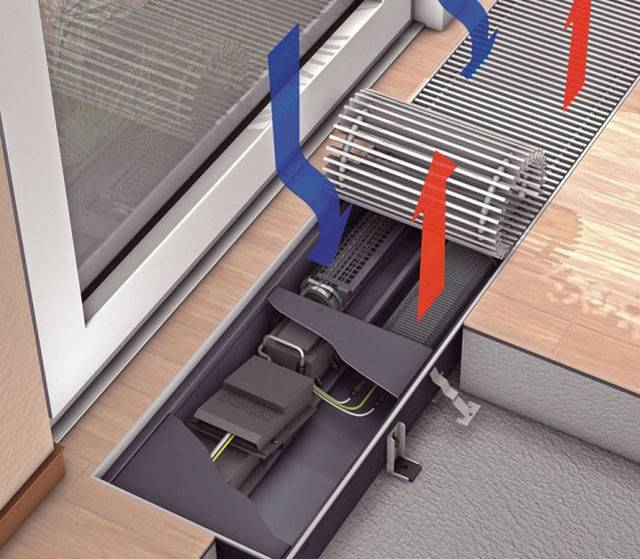
The different degree of expansion that aluminum and steel exhibit provokes a gradual decrease in the reliability of the connection between the heating tube and the housing. As a result, this can lead to the complete destruction of the connection between them. As a result, there is a danger of local overheating of the tube and breakage of the heating element. Manufacturers of convection equipment are constantly looking for a solution to this problem.
RX-Silence heating devices developed and patented by NOIROT (France) are of particular uniqueness. The innovation of the design of these convector boilers lies in the complete tightness of the silumin body, where magnesia powder filling is used to seal the nichrome heating filament. The coefficient of expansion of the materials used has very similar values, which makes it possible to significantly reduce energy consumption and increase the convector's service life up to 15-17 years.
Fan heaters - device, pros and cons
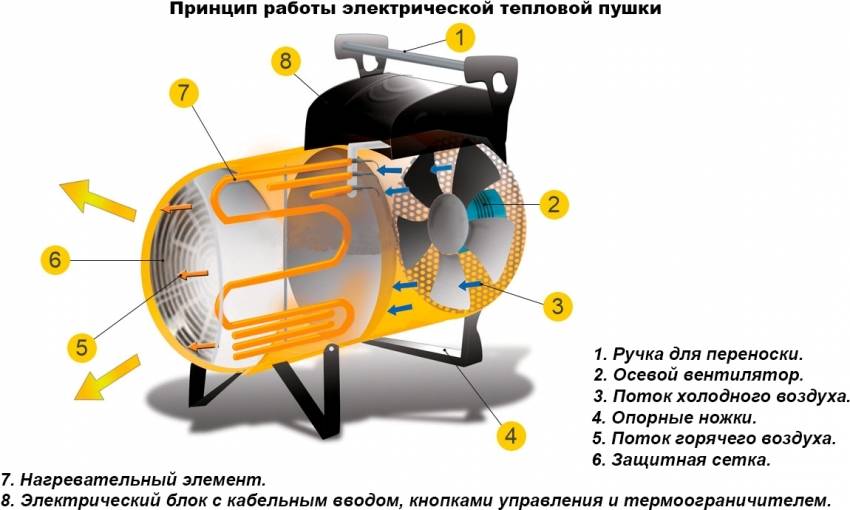
We continue to figure out which is better, convector or fan heater. Next, we will talk about fan heaters. They are fairly compact electrical appliances equipped with open spiral heating elements.Through them, air is blown at a decent speed, since powerful fans are present in the design.
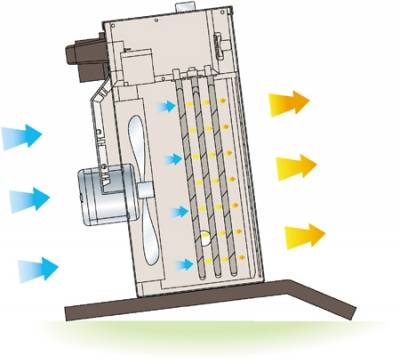
The principle of operation of a heat gun is similar to the principle of convection, only here the air is blown using a powerful fan.
Fan heaters are equipped with two main controls - a temperature controller (mechanical or electronic) and a step power controller (allows you to reduce the load on the power grid). Also on board there is an indication. And in order for the heating of the premises to be more uniform, some models of fan heaters are equipped with rotary devices (sliding curtains are used in wall-mounted models).
Fan heaters are divided into the following categories:
- Wall-mounted - can work as a thermal curtain, being installed above the entrance doors (practiced in commercial premises with access to the street);
- Floor-standing - fairly simple fan heaters, often equipped with rotation mechanisms;
- With axial fans - somewhat noisy modifications, equipped with simple fans with familiar blades;
- With tangential fans - characterized by a flat shape and low noise level. Therefore, they are better than axle units. Most often these are wall models, somewhat reminiscent of the internal blocks of split systems;
- Mechanically controlled - equipped with simple mechanical thermostats based on a bimetallic plate;
- Electronically controlled - advanced fan heaters equipped with electronics. They know how to accurately observe the temperature regime, they can work according to the program, they can be controlled from the remote control - this is why they are better than "mechanics".
The choice of equipment is quite wide.
Let's look at the positive features of fan heaters:
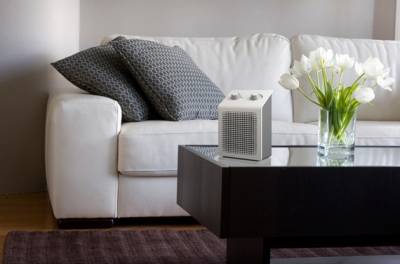
You can pick up a very compact model with a good design.
- Operational heating of the room - literally in 10-15 minutes the room will become warm. In this regard, they have no equal;
- Compact design - some models of fan heaters are 2-3 times smaller than convectors of the same power;
- It can be used in any type of premises - including in shops where a large number of people pass and the doors to the street often open.
Disadvantages of fan heaters:
- Noisy operation - no matter how quiet the built-in fan, fan heaters are noisy. At night it will bring discomfort;
- Unpleasant smell - it occurs due to the combustion of dust on a hot heating element. And it is impossible to get rid of the "stink";
- Influence on the level of oxygen - although not very intense, but fan heaters affect the chemical composition of the atmosphere;
- Influence on air humidity - thermal fans dry the air a little, it is not always pleasant to breathe it.
In comparison with convectors, the shortcomings are quite critical, but we will draw the final conclusions in the next part of our review.
Convector heating control unit
The simplest version of the control unit for convection heating is a thermostat installed inside the heater housing. Thermostats are divided into electromechanical and electronic. Electromechanical devices are cheaper, which affects their accuracy (the error sometimes reaches 2C0). It is also worth highlighting the resulting noise from the clicks of the bimetallic sensor when the device is turned on. To set the required temperature regime in electromechanical models, there is a handle with the marking of the conventional values of the convector power.
Electronic thermostats are more accurate: their error rarely exceeds 0.1 C0. In addition, convectors of this type are completely silent. A number of models make it possible to program the electronic control unit to switch on various operating modes and power, depending on the time of day and day of the week. At the same time, electronic thermostats have the function of remote control of the heating element using an external control device.




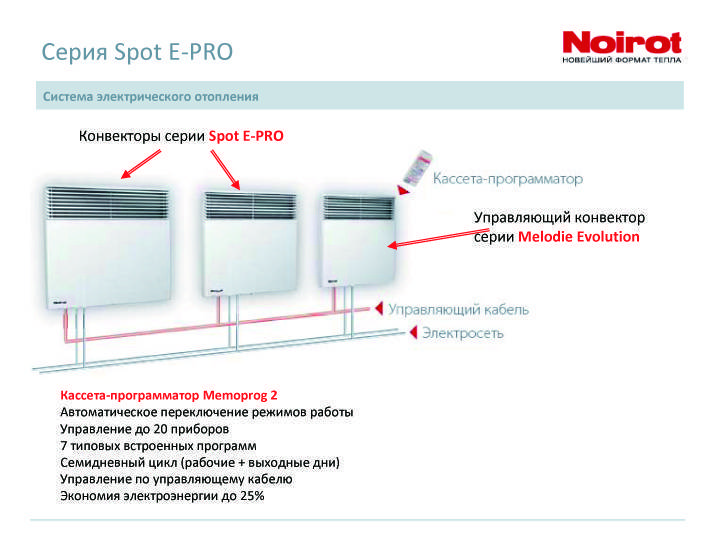
As a result, it becomes possible to monitor the operation of a significant number of heaters located in different parts of the dwelling. The block of the convector heating system allows the use of built-in operating mode programs separately for each room, or for the whole house in the complex. The French manufacturer NOIROT and the German corporation Siemens excel in the market of "intelligent" convectors. Their products provide the ability to control the temperature remotely, via telephone. This allows you to warm up your home well before your arrival.
The convector can be equipped with one of the following types of heating element
- Needle - is a thin plate with a nickel thread. This design is very fragile and can quickly fail, so it is not popular with specialists.
- Tubular - has a reliable design and not too high cost. But keep in mind that such a convector at the initial stage of operation after switching on can click until the tubes heat up.
- A monolithic element is the most reliable and expensive, but it will last a long time.
For the needs of stationary heating in a country house, convectors with monolithic heaters will be the best option.If the budget is not designed for such expenses, then choose a convector with a tubular heater.
How does a convector work?
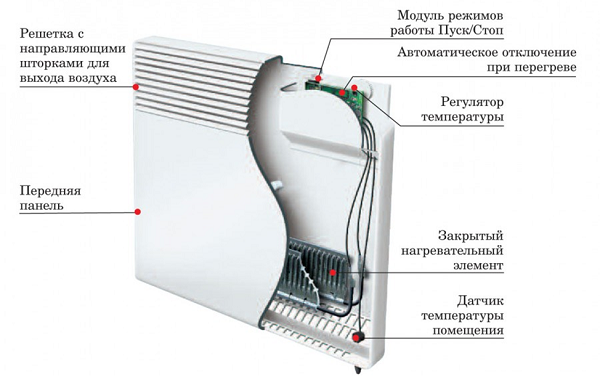
The device of the convector is quite simple. The general scheme of the device is shown in the figure below. Let's consider the main details in more detail.
Heating element
In electric heaters of convective type, heaters of 3 types are installed.
- Needle ones consist of a body on which nichrome loops (an alloy of nickel and chromium) are mounted in the form of needles. The loops are located on both sides and tend to quickly warm up and cool down. Due to this, it is convenient to regulate the desired temperature in the room. Another advantage of units with a needle heater is their low price. But these heaters also have disadvantages: needle elements cannot be used in rooms with high humidity, and they can burn through oxygen, as well as dry the air.
- TEN (tubular electric heater) is a hollow tube with a nichrome spiral located in it. The area between the body and the spiral is filled with a dielectric. For better heat transfer, ribs are installed on the heating element body. The advantage of the heating element is that its body is hermetically sealed, so devices with such a heater can be used in damp rooms. The disadvantages of the heater can be called: low efficiency, long warm-up time to enter the operating mode, the operating heater emits a slight crackle.
- Monolithic ones consist of a ribbed body with a nichrome thread soldered into it. Such heaters have maximum heat transfer, are silent, all parts of the body are heated evenly. Devices with monolithic heaters are the most expensive, in comparison with the above, and are considered the best.Read more about the features of each type in the article types of heating elements in convectors.
Control unit or thermostat
The heating unit is controlled by a mechanical or electronic thermostat:
Cheaper models of units have a mechanical thermostat, which, when a certain temperature of the heater is reached, breaks the electrical circuit. When the device cools down, the circuit closes again, and the heater continues to work.
The disadvantage is that with such a regulator it is not possible to maintain the desired temperature in the room, since the thermostat is triggered by heating the bimetallic plate, and the air temperature is not taken into account.
With electronic control, several sensors interact. Their principle of operation is to monitor the heating of the unit itself, as well as the ambient temperature.
After processing the data by the microprocessor, the operation of the heater is corrected. Operating modes can be set from the panel located on the case, or from the remote control (if provided). There are models of devices with programmable modules. With their help, you can set the heating program for the room for a week. This is convenient, for example, if no one is at home on weekdays from 8:00 to 17:00. Therefore, a maintaining temperature is set on the device, and by the time the household arrives, the device turns on at full power and quickly heats the room to the desired performance.
The use of inverters in heating
In the production of heating appliances, inverters are used as a device that allows precise pre-setting or adjustment during the operation of the unit.
High-tech electrical heating devices that do not have heating elements, lamps, filaments and heating coils in their design necessarily include inverters as devices to increase the functionality and efficiency of the heating unit. Such means of heating include vortex induction heaters (VHE) and inverter air conditioners. Both of these devices originated from their less advanced predecessors: VIN - from induction boilers of the SAV type, inverter split systems - from conventional air conditioning systems.
Device and principle of operation
Convectors and infrared radiators fundamentally differ in the way they heat. To determine which device is more efficient and more appropriate to use in specific conditions, it is necessary to study the device and features of each variety.
Everything you need to know when choosing a heater | Tips
The device ensures constant air circulation in the room. The main difference of this type of devices is the almost complete absence of direct heating of objects. The room creates a favorable atmosphere, which is quite comfortable to be in. However, this is not enough for difficult conditions.
As an additional source of heating, convectors are a good solution, so they are well suited for rooms in apartment buildings with central heating. If there is a need to warm up the cold room of a country house, the features of such devices will not allow creating the necessary microclimate. The feeling of warm air is deceptive.Cold walls and furnishings can cause colds.
Type of heating element convectors are divided into three groups:
Modern models can be additionally equipped with a temperature controller. Some of them allow you to set not only the heating power, but also the required air temperature. With the help of control modules, you can combine several devices into one group and control the microclimate in the house by their joint work.
As additional options, the devices can be equipped with timers that set the duration of work, remote controls, air humidifiers.
Choosing a heater Which is better? Pros and cons
Infrared radiation
This feature allows for effective local heating of certain areas in the room. Comfort is achieved already at the very beginning of the operation of the device, and there is no need to wait for the air in the room to warm up completely.


The main elements of the device are an infrared emitter and a reflector that focuses and directs the rays in the desired direction. Emitters are most often of the following three types:
The reflector is made of polished steel or aluminum sheet. The bending radius of the reflector affects the radiation dispersion and the heating area.
The heater is supplied with a protective device that turns off the heating when the device falls or exceeds the set temperature. This allows you to ensure fire safety during operation.
Infrared do a better job of heating than devices using a single heating method.The combination of different operating principles is optimal for quickly creating a comfortable indoor climate, however, combined devices are still extremely expensive, so in most cases it is cheaper to buy a convector and an infrared heater separately. Perhaps in the future, the IR convector will become more affordable, which will lead to the widespread use of devices of this type.
How to choose a heater What is the best electric convector.
Manufacturers and popular models: rating of the best and prices
The most widespread use of inverter heaters in everyday life falls on convector heaters and split systems - a new generation of air conditioners with an improved freon conversion mechanism.
Split systems
Mitsubishi, Toshiba, Samsung, Aeronik can be singled out among manufacturers with a developed dealer network in the Russian market. The most popular are models in the middle price segment, designed for heating a room with an area of 20-30 m2. These are models with a low noise level - within 15-30 dB.
Ballu BEC/EVU-2500
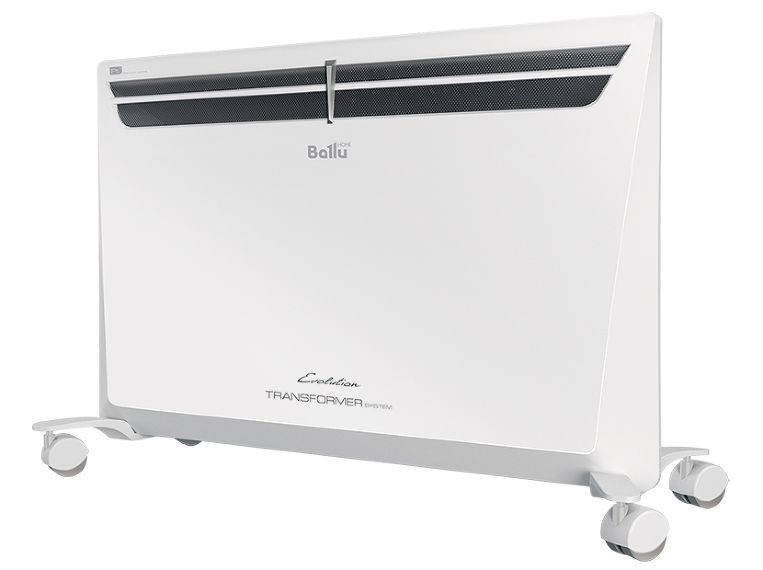
pros
- Convenient control via smart Wi-Fi module
- Easy to install even on your own
- Has overheating protection
- Interesting design
Minuses
Short power cord
From 4 000 ₽
The review begins with the best heater, capable of heating the space around it in the shortest possible time. At the same time, the module itself does not overheat, but remains at operating temperature. It works almost silently and is absolutely safe. If you mount it on a wall, the included mounts will work just fine. Otherwise, you may need to purchase additional fasteners.
Electrolux ECH/R-1500T
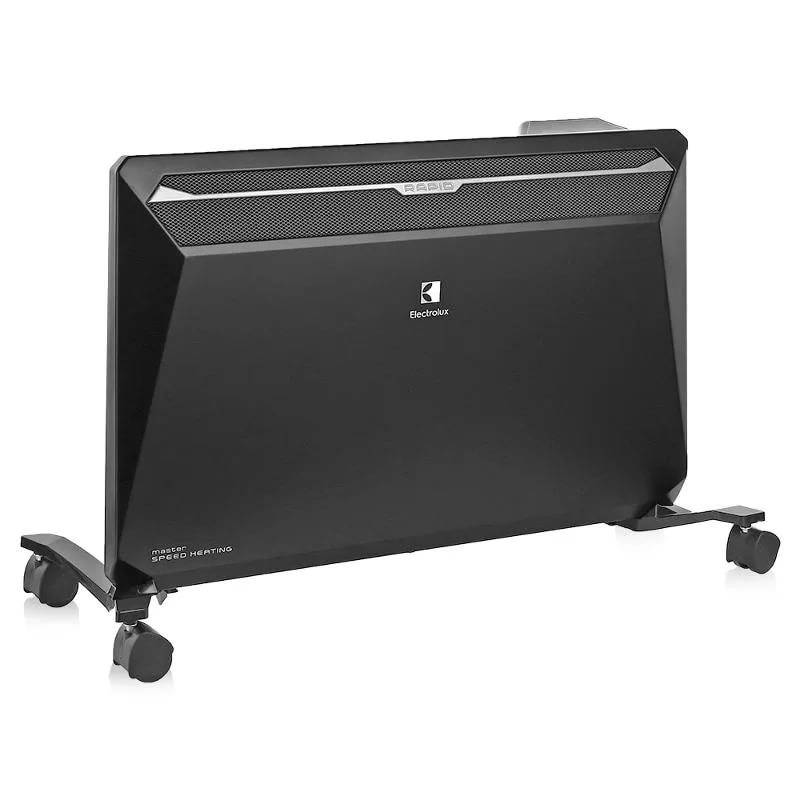
pros
- Heats the air evenly
- low cost
- Possibility to connect a control unit
- Great design
- Convenient wall mount
Minuses
Gets dirty easily
From 3 000 ₽
If you need to choose an inverter heater for your home, then it is recommended to pay attention to this model. Compact device with good features
Guarantees excellent heating of the air at some distance from the source. At the same time, energy consumption is much more economical. Manufacturers have slightly modified the shape of the body so that the blinds redirect air flows with the greatest efficiency. The device reaches the desired temperature quickly enough.



Split system Aeronik ASO/ASI-12HM
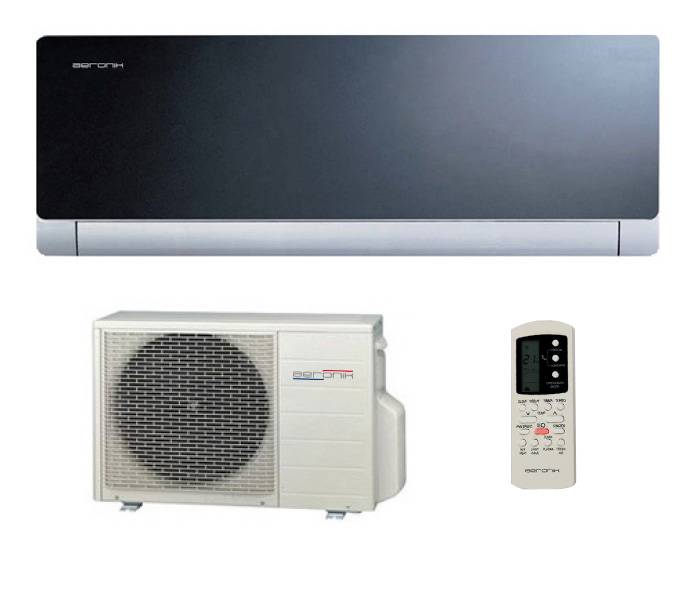
Development of the Australian company Aeronik PTY LTD. Model ASO / ASI-12HM is positioned as the best solution for allergy sufferers, it is equipped with additional filters for air purification and ionization. Another feature of this model is interchangeable mirror panels of different colors, which allows you to easily fit it into the interior.
Characteristics:
- Cooling power: 3200W
- Heating power: 3400 W
- Heating power consumption: 987 W
- Heating area: 33 m2
- Inner side dimensions (WxHxD): 80x29x18.6 cm
- Outdoor unit dimensions (WxHxD): 74.5×55.2×32.8
- Price: 23600 rubles.
Toshiba RAS-07EKV-EE/07EAV-EE
Split systems of the EKV series are manufactured at the Toshiba plant in Thailand. The model is positioned as a low power solution for serving city apartments with small rooms.
Characteristics:
- Power in cooling mode: 2000 W
- Heating power: 2500 W
- Heating power consumption: 590 W
- Heating area: 20 m2
- Inner side dimensions (WxHxD): 79×27.5×20.5
- Outdoor unit dimensions (WxHxD): 66x53x24
- Price: 25 100 rubles.

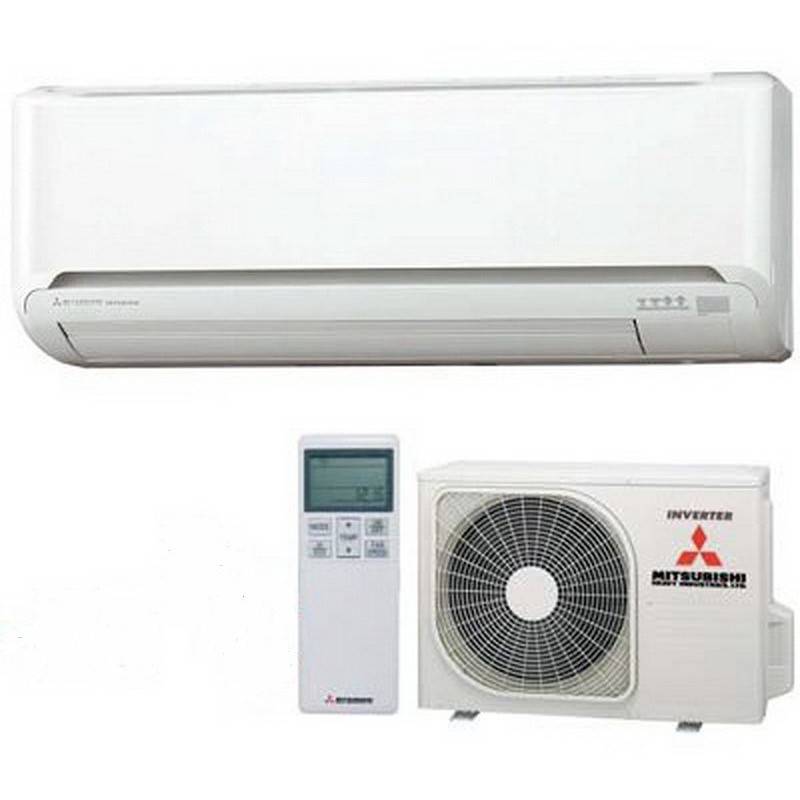
Climate device Mitsubishi Heavy Industries SRK-25ZM-S
In terms of consumer properties, this is a premium class model. It implements the most comfortable options for the distribution of heat flows. Air purity is ensured by multi-stage filtration, and constant ionization is carried out even when the system is turned off due to the tourmaline coating of the block elements.
Characteristics:
- Cooling power: 2500W
- Heating power: 3200 W
- Heating power consumption: 800 W
- Heating area: 25 m2
- Inner side dimensions (WxHxD): 79.8×29.4×22.9
- Outdoor unit dimensions (WxHxD): 78x54x29
- Price: 39060 rubles.
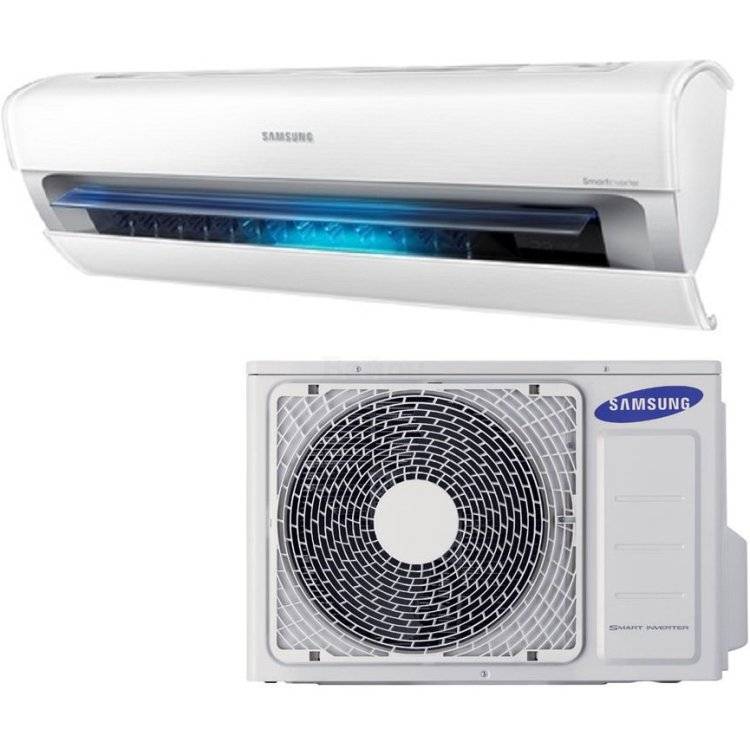
Samsung AR09HSSFRWK/ER
A modern split system from a South Korean manufacturer. The model belongs to the Luxury line. The AR09HSSFRWK/ER uses its own Visual Doctor technology to purify the air. It can work in fan mode.
Characteristics:
- Cooling power: 2500W
- Heating power: 3200 W
- Heating power consumption: 620 W
- Heating area: 26 m2
- Inner side dimensions (WxHxD): 93.6 x 27 x 26.4
- Outdoor unit dimensions (WxHxD): 79 x 54.5 x 28.5
- Price: 35000 rub.
Convector heaters
According to the opinion of consumers and experts, the most popular models are convector heaters with a built-in inverter from Timberg and Huyndai.
Timberk TEC.E0 M 2000
Timberk convectors are manufactured in Finland. The TEC.E0 M 2000 features floor and wall mounting options, rollover protection and UltraSilence technology.
Characteristics:
- Heating power: 2000W
- Dimensions (WxHxD): 80x45x8 cm
- Weight: 4.6 kg
- Price: 2600 rubles.

How to install a convector
Installation guidelines, requirements and limitations are detailed in the instruction manual. In particular, it states:
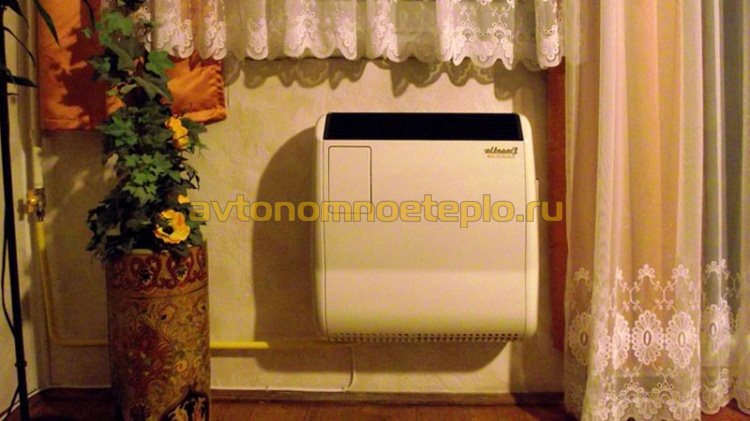
- Installation of a gas convector in a wooden house. During operation, the body heats up to 50-55°C. It is necessary to isolate wooden surfaces in contact with heating parts of the structure. The rules for installation in a wooden house prescribe the manufacture of fire breaks in the roof. If a coaxial pipe is used, insulation is not required at the point of passage through a wooden wall. The surface of the coaxial chimney heats up slightly, due to the special design of the burner and pipe.
- Location from the floor. Air heating of a country or residential building has certain features that affect the heating efficiency. To ensure maximum performance, install the convector as close to the floor as possible. As a result of this solution, the intensity of the circulation of convection flows increases and the efficiency of the equipment increases.
- The gas pipe is brought to the heater exclusively along the street. A shut-off valve must be installed at the connection point.
A test run is carried out in the presence of a representative of the gas service. A corresponding note is made in the convector documentation.
Which is better, a gas convector or a boiler
It all depends on the technical characteristics of the building and the features of its operation. The installation of the convector requires less time and material resources.
Air heating is recommended for use in country houses that are not heated in the winter season.During installation, there is no need to use a water circuit, it is possible to heat the building only from time to time. Even at a negative temperature in the room, you can warm up the room in 20-30 minutes.


A gas convector for a house on bottled gas is inferior to a boiler connected to the main pipeline in terms of efficiency, but superior in functionality. The choice of an air heater is justified in the absence of gasification. On a fully charged cylinder, the heater will operate for approximately 10 days.
The convector heats the room better and faster and spends less fuel for this, but its efficiency is limited by the properties of convection flows. The intensity of heating decreases as obstacles appear: walls, furniture, etc.
For heating a country house or small rooms, a convector-type heater is best suited. But for residential heated houses with large rooms, it is better to install a traditional gas boiler.
Calculation of power and temperature of a warm water floor
What is a convector
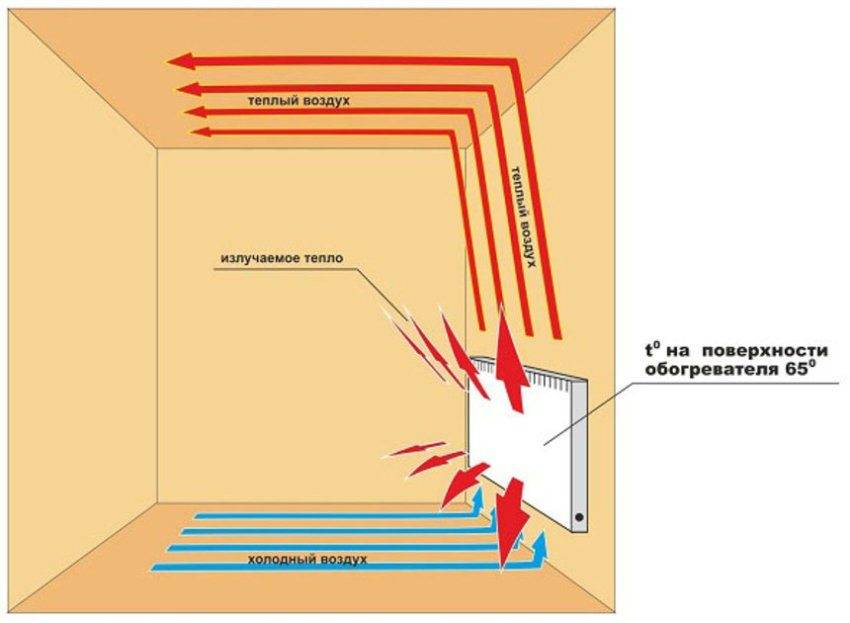
Heating devices can work on two principles - to radiate heat, heating surrounding objects, and to create convection, providing air circulation in heated rooms. Convection allows you to quickly create a comfortable environment in your home by gently taking in cold air and generating warm air instead. Not only conventional radiators for water systems are built on this principle, but also electric convectors.
An electric heating convector is a small heater that resembles the most common heating battery in its appearance. It works from the electrical network and does not require a coolant supply.Thus, some energy savings are achieved, heat losses are reduced. In order for the convector to work, you need to connect it to the mains - for this, the most ordinary socket is suitable.
The process of convection is that the air heated by the radiator rises, and cold air comes in its place.
The electric convector works offline. He does not need to lay pipes throughout the house, in an electric boiler, in an expansion tank and other appliances necessary for water heating. The convector is designed to heat the air and ensure its continuous circulation through the heated rooms. The result is high-quality and almost uniform heating of all rooms in a house or apartment.
What are the advantages and disadvantages of electric heating convectors? Why are they better than other heaters? To begin with, we will consider the positive qualities of this equipment:
- effective heating of the room provides comfort at any point in it - natural convection allows you to deliver warm air to any place in the room, displacing cold air from there;
- completely autonomous operation - you do not need to create a whole heating system, just hang the required number of convectors in the rooms;
- almost uniform temperature at all points after full warm-up - this is ensured by natural convection and reduced heating intensity of heating elements in modern convectors, resulting in a more uniform distribution of heat;
- compactness - this is characteristic of many modern heating devices. Thanks to this, electric convectors look good in any room;
- the possibility of using it as the main or auxiliary heating equipment - if your heating is often turned off, you can purchase an additional source of heat in the form of an electric convector;
- no significant effect on air humidity and oxygen content - electric heating convectors do not burn oxygen and do not dry the air, maintaining a healthy and healthy microclimate in the house;
- instant start and complete noiselessness in operation - convectors heat up very quickly, and natural air circulation provides immediate heating of residential premises;
- Extreme ease of installation - just place a wall-mounted model on the wall or install a floor convector. After that, you can start the convector and enjoy the heat.
In addition, electric heating convectors are maintenance-free, do not require permits for installation, are safe for others and are characterized by high efficiency.
If it is possible to connect your house to gas communications, then a heating system with fuel in the form of gas will be much more economical than heating with electric convectors.
There are also disadvantages, which are listed below:
- together with warm air, radiators carry dust, distributing it to all heated rooms;
- despite the high efficiency, heating costs will be high. Electric heating is the most expensive heat source;
- too high heating costs for large households - if you have a large house, it is more profitable to create a water heating system.
There are not very many cons, so electric heating convectors can be considered almost ideal heating equipment.
Electric convector heaters will be an excellent solution for small one-room and two-room households, as well as for small country houses. They are also useful as accessories for apartments.