- Plumbing cable
- We clean the clog in the sink at home
- Use a plunger or cable
- We clean the siphon
- How to clean and clear blockages
- boiling water
- plunger
- soda and salt
- Vinegar
- A vacuum cleaner
- Boer
- Cable
- How to clean the pipe in the kitchen with improvised means
- Boiling water cleaning
- Cleaning the sink with baking soda and salt
- Removing clogs with vinegar and baking soda
- Removing blockages with Alka-Seltzer
- Cleaning blockages with a vacuum cleaner
- Siphon cleaning
- Dealing with clogs with household chemicals
- Back to chemicals
- How to clean the blockage in the pipes at home and not spoil them
- Cleaning the sink with a plunger
- Plunger Tips
- Radical solutions to the problem
- Option number 1 - vacuum cleaner
- Option number 2 - plunger
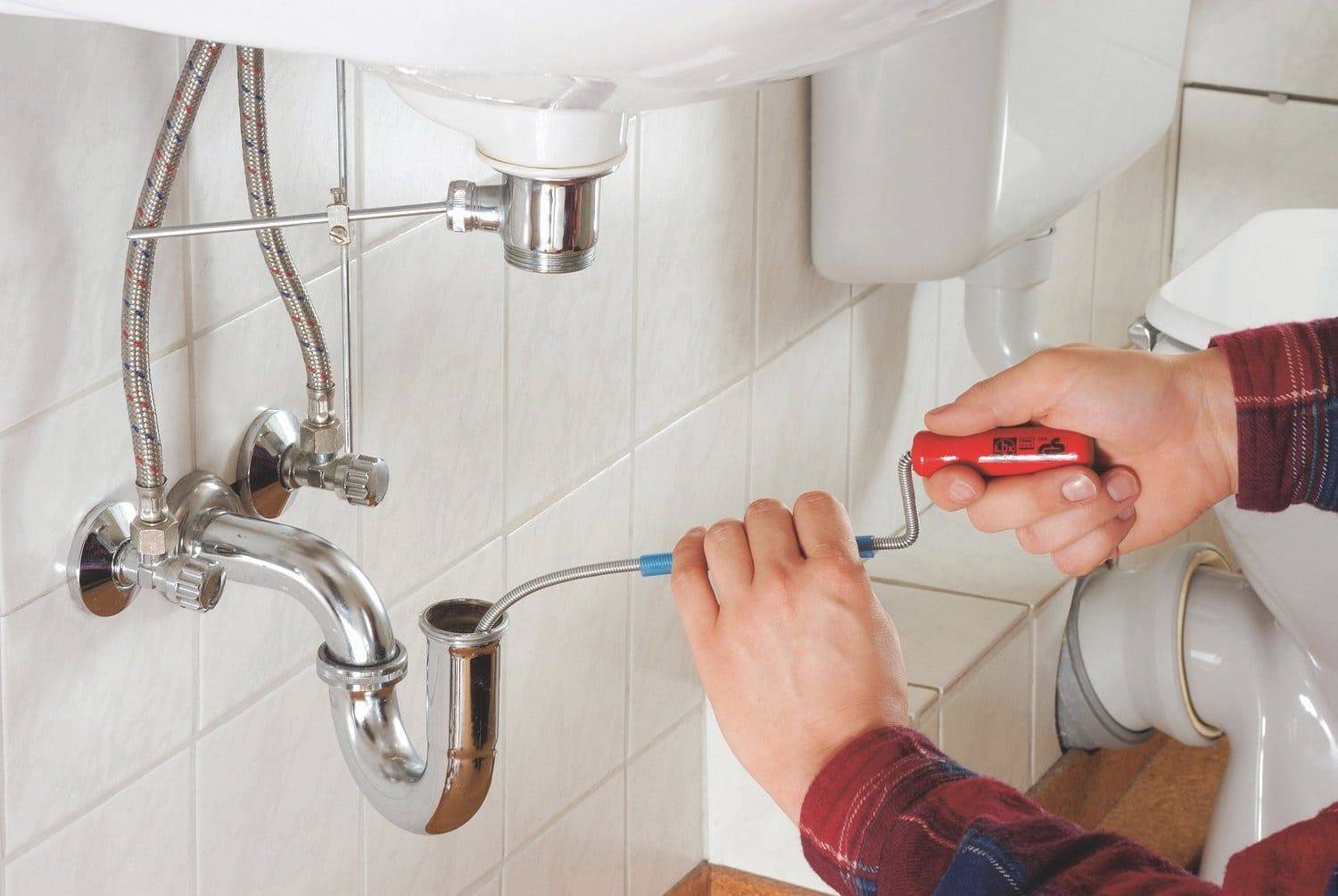
- Option number 3 - plumbing cable
- Option number 4 - disassembly and cleaning of the siphon
- Chemicals for removing blockages
- Folk methods of dealing with the problem
- Boiling water and salt
- A solution of baking soda and vinegar
- soda and salt
- Lemon juice or acid
- Alka-Zeltzer
- washing powder
- Vinegar, baking soda and chlorine
- Rock salt
- Alkali-based preparations
- Caustic soda
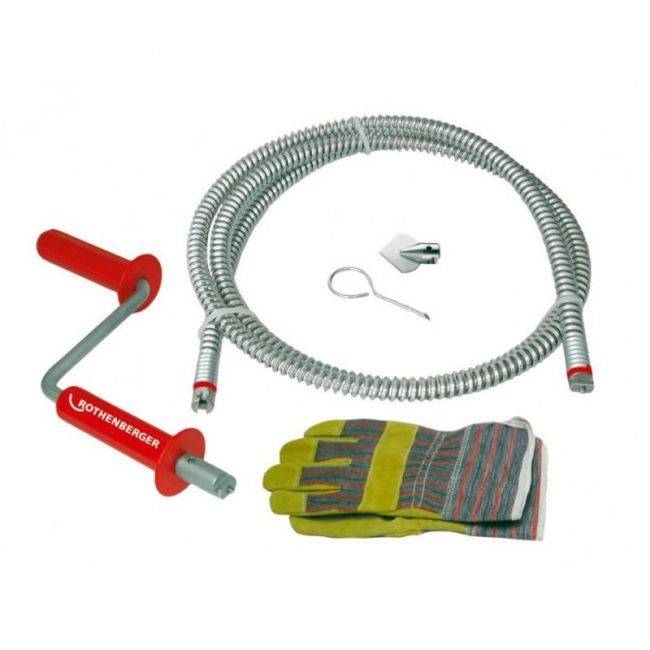
Plumbing cable
The previous method is only suitable if the blockage is minor, it cannot cope with a serious blockage. Option - plumbing cable. It is suitable if:
- Blockage deep in the pipe.
- The “cork” that closes the outflow of water is strongly compressed.
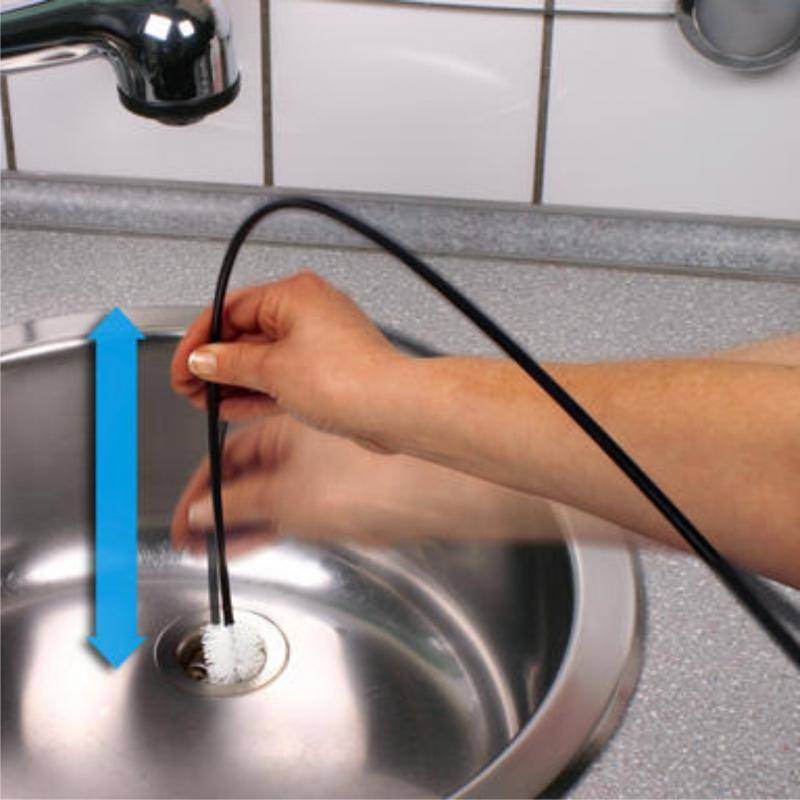
Plumbing cable is a dense wire in the form of a spiral
The essence of the method is to get rid of the blockage mechanically, pull it out or push it deeper into a wider pipe. The length of the standard cable is 3 meters, and this is quite enough to extract deep blockages.
The technique of using the cable is simple, but it must be clearly maintained. Subsequence:
- the cable is inserted into the drain hole;
- one person pushes, the other rotates the cable. This contributes to the destruction of the blockage and prevents the cable from breaking at pipe bends;
- after the blockage has been passed, you need to make a couple of jerks back and forth. After opening the hot water, you will wash away the dirt that has formed on the pipe;
- Now you can carefully pull out the cable.
Such a cleaning tool can be purchased at any hardware store.
We clean the clog in the sink at home
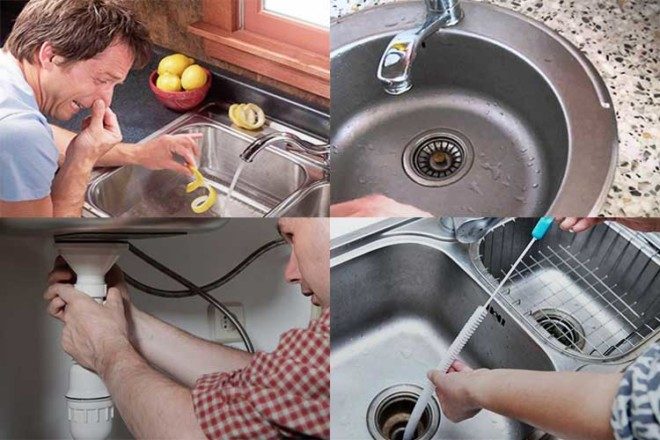
There are several ways to eliminate clogging in the sink, using improvised means, household chemicals, folk methods. Common methods: disassembling the siphon, using a plunger and a plumbing cable.
Use a plunger or cable
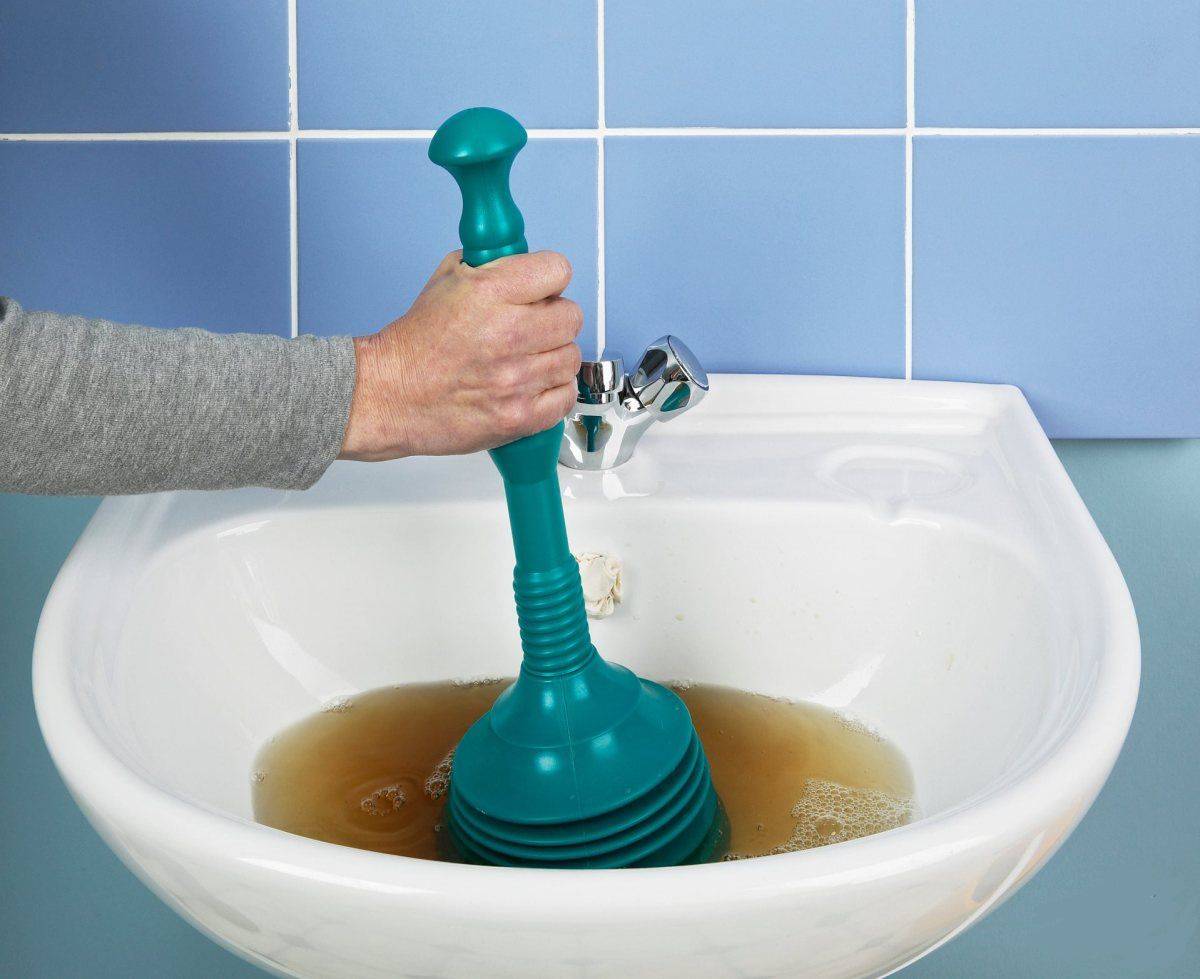
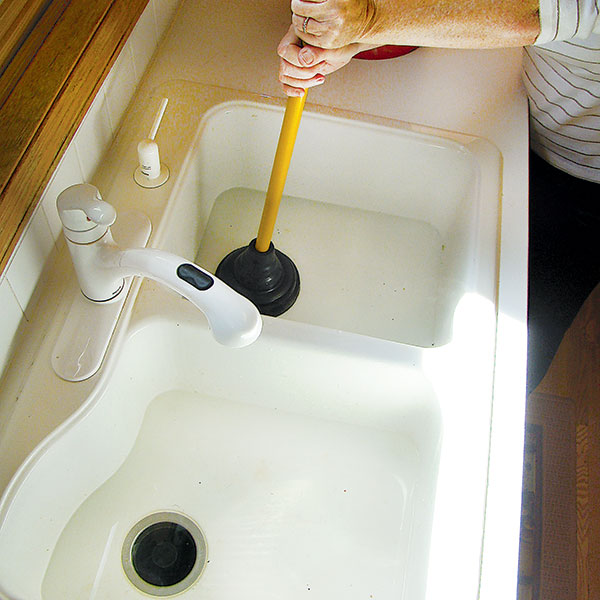
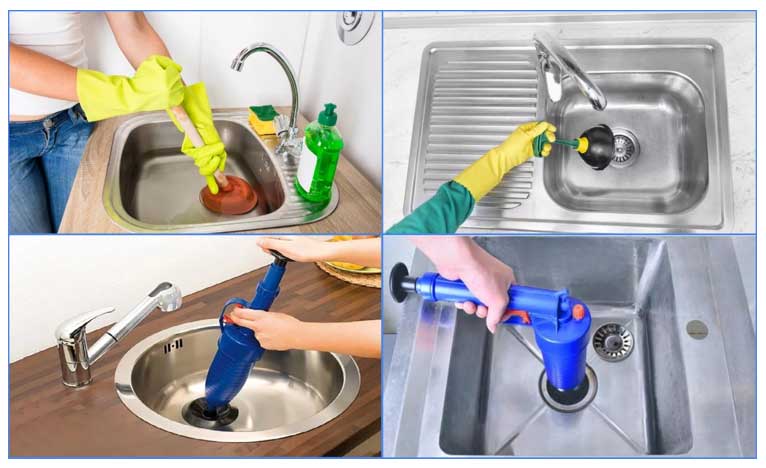
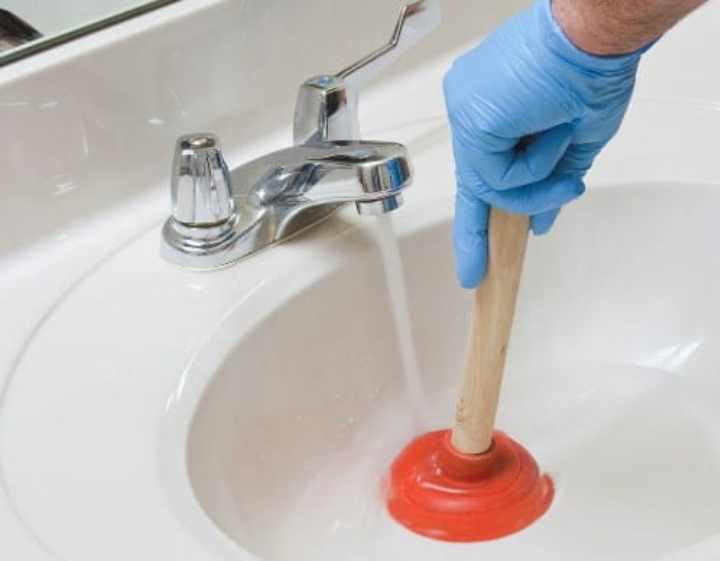
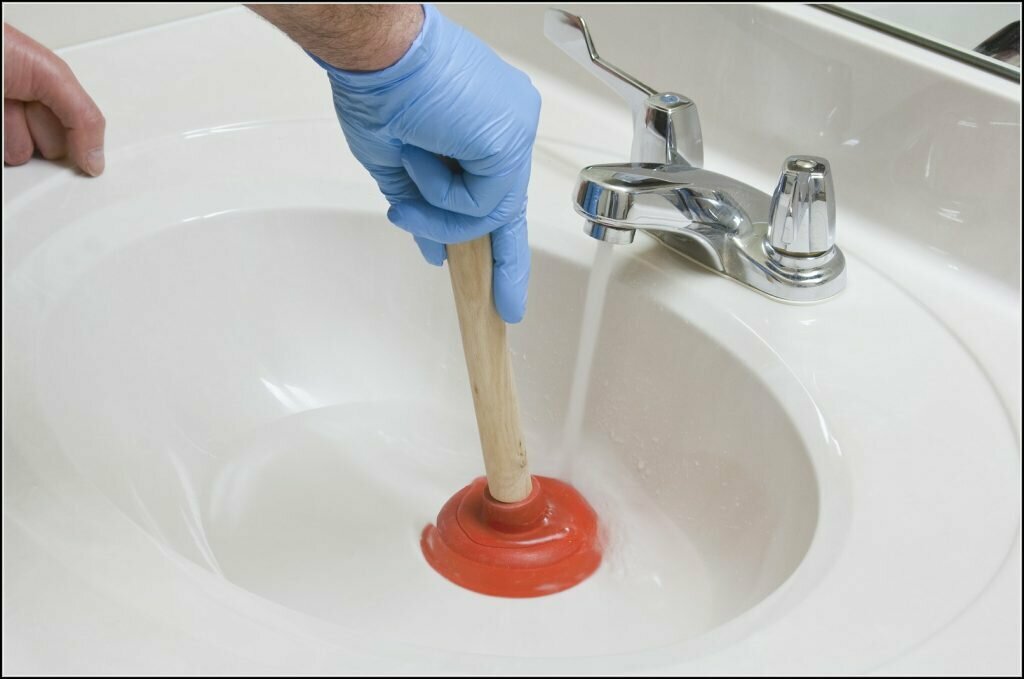
A plunger is a handle with a rubber bowl-shaped tip for mechanical cleaning of sewer pipes. With the help of a simple but effective device, even an inexperienced person can cope with a violation of the movement of water in pipes at home. The principle of operation of the plunger is to create a hydraulic shock that pushes the debris plug into the sewer, which frees up the gap in the pipe and resumes the free flow of water.
Cleaning the sewer with a plunger is performed according to the following algorithm:
- Plumbing is freed from foreign objects.If we are talking about a kitchen sink, dishes, sponges, scrapers are removed from it. Manually, using rubber gloves, clean the drain hole from food debris.
- A rubber suction cup is installed over the sink opening.
- With sharp movements, the plunger handle is pressed and returned to its original position. Several intense pressures, made 5-6 times in a row, with the help of water shocks, will break through the blockage and the water will go away.
- After removing the contamination, flush the drain with a large volume of hot water.
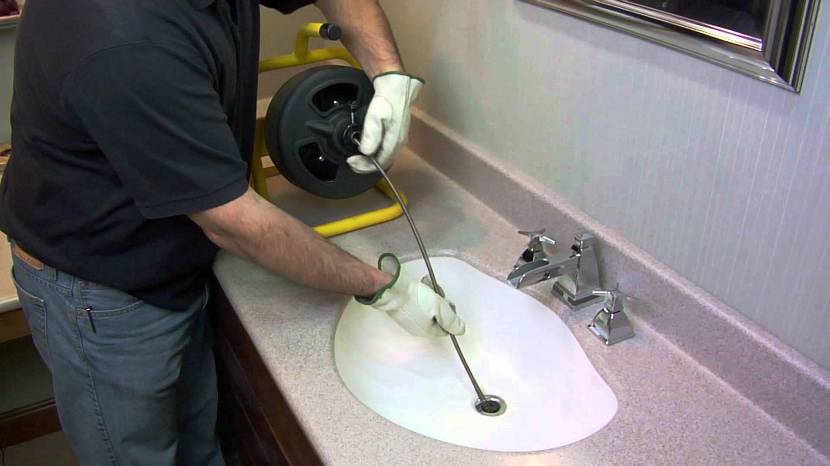
The next device for cleaning sewer pipes is a plumbing cable. The item is a special cable, at one end of which a drill or a brush is attached, and on the other hand, a handle for easy scrolling inside the drain pipe.
To remove the blockage, you need:
- insert the end of the cable with a drill or a special brush into the drain hole of the sink and gently move it deep into the drain pipe, turning the device clockwise. It will be more convenient for two people to clean it: one directs the cable into the sewer, the other rotates the handle;
- after introducing a sufficient length of the cable, it is necessary to move it back and forth and pull it out;
- flush the drain with plenty of hot water;
- wash and roll the rope.
We clean the siphon
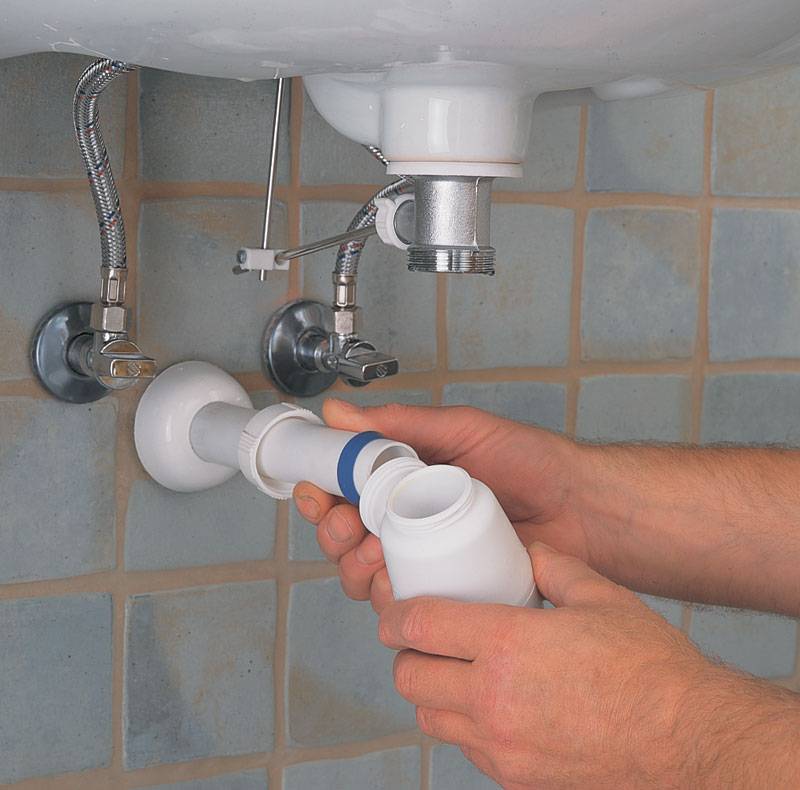
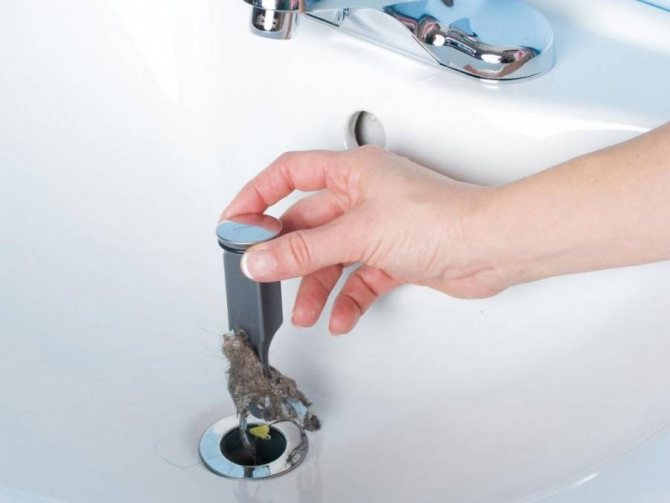
Untwisting parts and cleaning plumbing under the sink is a trouble-free method of eliminating water obstruction, which men mostly resort to. To unscrew the coupling and disconnect the PVC or stainless steel siphon tank, you will need to apply force or use an adjustable wrench.
To clean the siphon, you must:
- Substitute a basin or bucket under the sink in the bathroom or sink in the kitchen.
- Unscrew the bottom of the tank. If the debris is above this section, you should unscrew the coupling connecting the middle part of the tank to the part of the pipe leading to the sink.
- Empty the sump and washbasin connection pipe from accumulated dirt, rinse it with water.
- Install the siphon component in place and tighten the coupling.
- Flush the sewer by pouring a significant amount of hot water into the drain hole.
If the cleaning did not work or the tank with the pipe turned out to be clean, it should be assumed that the blockage formed further in the sewer pipe. In this case, you can use a plumbing cable and clean the distant sections of the sewer system.
Siphons can be made of different materials and have different configurations, but the principle of the structure of all types is similar. Mechanical and manual methods for removing contaminants in pipes will not differ.
How to clean and clear blockages
There are many popular ways to clean the sink quickly and effectively. Everything for this can be found in the house or stock up in advance at a hardware store. And most importantly, it will cost a penny.
 You can quickly and easily clear a clogged kitchen sink without spending a dime.
boiling water
You can remove the blockage in the sink at home, consisting of a fatty layer, using hot water.
 Hot water removes small blockages.
- Turn on hot water at full power for 15-20 minutes. A strong jet will pierce the resulting plug, and the high temperature will dissolve fat deposits.
- Heat water in a kettle and pour boiling water directly into the drain. This instantly eliminates sebaceous layers. The method is suitable provided that the house has metal and cast iron pipes.If your system is made of plastic, this method is not suitable. This may melt and deform the pipe.
plunger
Plunger is considered an effective and safe remedy for removing blockages. The method is suitable for all pipes, since the weed plug is knocked out by the pressure created by the rubber or silicone hemisphere of the plunger.
 Plunger is the most effective and free way to remove clogs.
It is important here that the diameter of the nozzle is much larger than the drain hole. So the compression pressure will be more efficient and effective
soda and salt
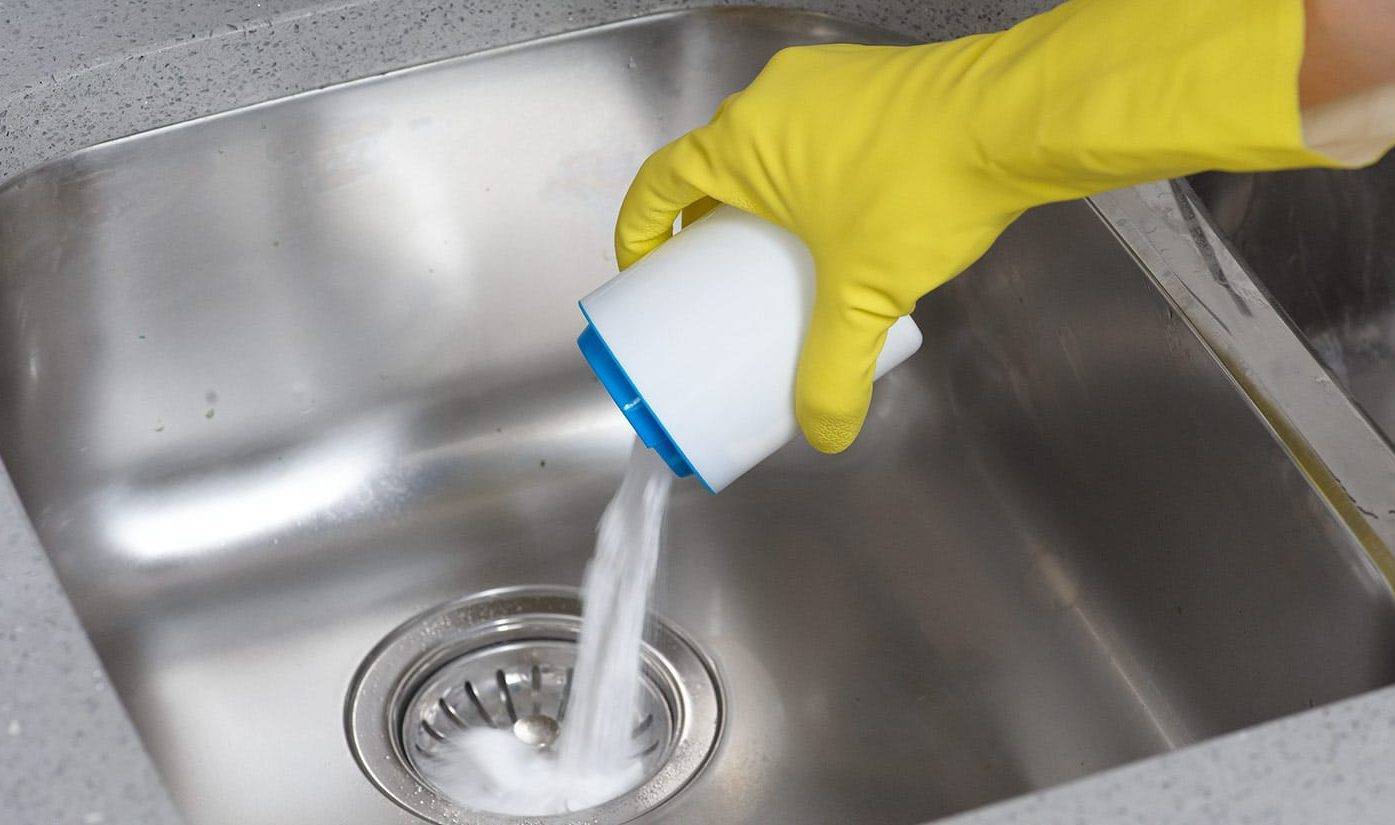
A mixture of soda and salt can be poured into the drain at night. The crystals will gradually dissolve the formed fatty plug. In the morning, turn on a strong pressure of hot water for 5 minutes.
 Baking soda helps to break through a very small cork and remove an unpleasant odor.
There is another way: take two parts of soda and one part of salt. Dilute the mixture with water to a liquid state and pour into the pipe. After 10 minutes, turn on hot water to wash out the insides of the pipes with a saline-soda solution. The same tool can be used to clean the sink in the kitchen.
 Baking soda is a cheap way to get rid of clogged sinks.
Vinegar
The vinegar method is best used for a sewer system made from resistant materials. Plastic can deteriorate from such a strong agent.


 Pour a glass of soda into the drain, pour a glass of 9% vinegar on top.
It is important that the bubbling reaction occurs at the site of the blockage, and not in your cup. Therefore, pour soda into the drain hole, and pour 9% table vinegar on top of it
The bubbling will dissolve, reduce and expel grease and stuck-on solids.
 Vinegar is an effective and affordable remedy.
A vacuum cleaner
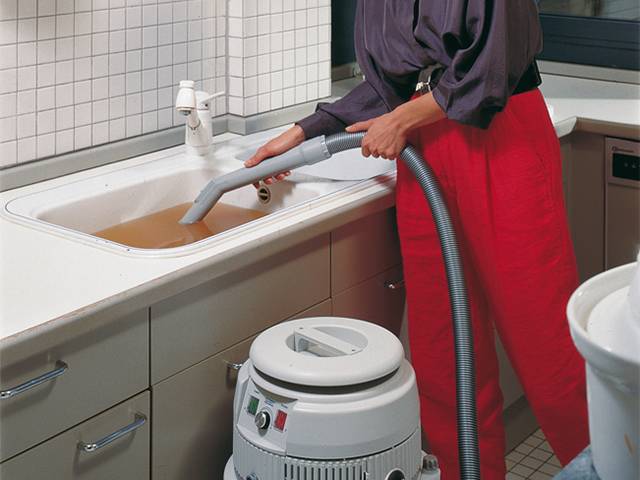
A vacuum cleaner set to the air blowing function can help clean and push through the blockage. This innovative method is suitable for light blockages. With a serious garbage plug created over a long time, the vacuum cleaner may not be able to cope and significantly aggravate the situation.
 A vacuum cleaner will also help you deal with clogged sinks.
Wrap the pipe of the vacuum cleaner with a clean cloth and fix it in this position. Attach it to the drain and turn on the vacuum cleaner. Under pressure, the blockage breaks through and is pushed into the sewer.
Boer
The drill works on the principle of a cable, familiar to every home master. The accessory has a large thickness and length. Along the entire length, the drill is wrapped with a strong spring spiral, which additionally collects small rubbish.
 A drill can quickly solve the problem of clogging the sink.
This is a great option for clearing wide sewer pipes, especially around bends and bends.
Cable
The metal cable is introduced into the clogged drain with rotational movements. At its end is one or more hooks, a brush or a point. This is a universal helper for cleaning pipes of any material. If you handle the cable with care, it can serve you for decades.
 A plumber solves a clogged sink with a cable.
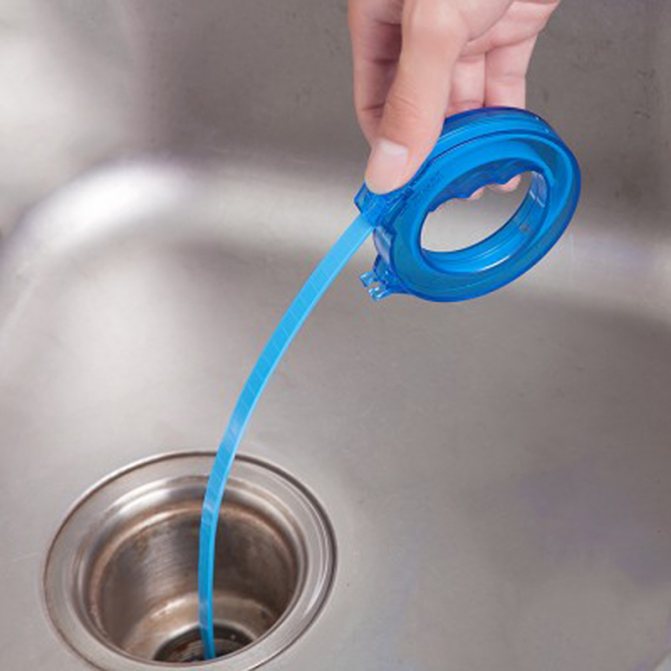
When there is no such device in the house, and you need to clean the sewer immediately, try making it from an ordinary plastic bottle. Cut it in a spiral so that a long, elastic ribbon is formed.
 Use a cable to clean the sink.
Such a plastic cable must be inserted into the pipe carefully, with screwing movements, so that the material does not tear and does not bring even more problems with the sewerage in the kitchen.
How to clean the pipe in the kitchen with improvised means
If pipes become clogged too often, using a plunger or a conventional plumbing cable is not an effective way to get rid of them for a long time, so many owners are faced with the question of what to do in this case. The search for another solution in the form of purchasing factory-made household chemicals often becomes problematic - the cost of advertised potent effective drugs is quite high, and paying a small price for an unknown product, you can most likely throw it away money down the drain.
Therefore, on the Internet resources you can find a considerable number of videos using inexpensive improvised home remedies for cleaning pipes, and the simplest of them is hot water.

Rice. 4 Handy cleaning reagents
Boiling water cleaning
To make pipes less likely to become clogged, hot water should be used as often as possible in the kitchen sink, do not forget to use boiling water before cleaning the sewer pipeline from blockage. The use of hot water in case of failure to eliminate the plug will facilitate further work, dissolve fatty deposits with adhering dirt on the pipe walls.
Cleaning the sink with baking soda and salt
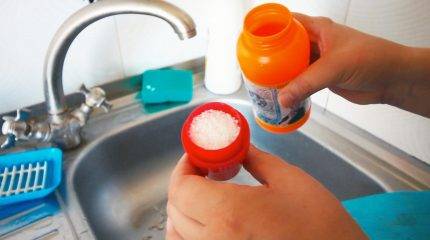
Baking soda and salt are usually used to prevent and clean pipe walls from contamination, for this they are dissolved in one liter of hot water in the following ratio: 500 g of a pack of soda is mixed with 200 g of salt.The hot solution is poured into the sewer system and the drain hole is closed with a stopper for 60 - 120 minutes, after which the sewer can be used. To more effectively remove dirt deposits on the walls, you can additionally use a plunger, moving the flow of dissolved reagents through the pipeline.
An effective and inexpensive cleaning agent is caustic soda, it is used as a solution, diluting 200 g of the reagent in one liter of hot water. The resulting composition is poured into the drain hole, closed with a stopper and the liquid is allowed to settle for 30-60 minutes.
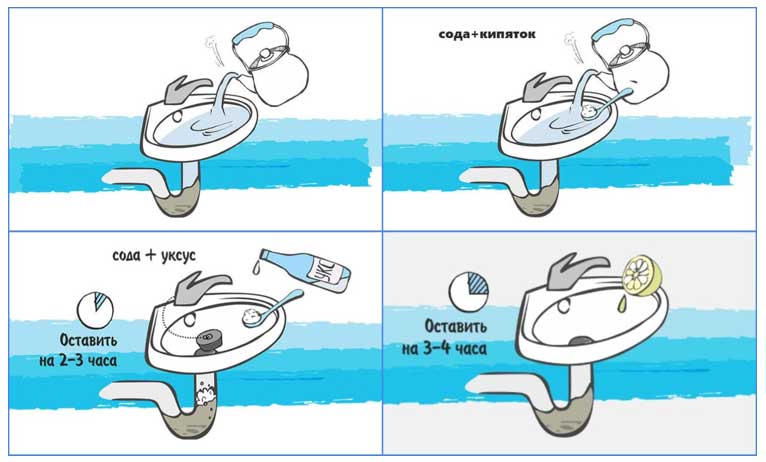
Rice. 5 Options for the use of improvised materials
Removing clogs with vinegar and baking soda
The method of removing blockages with vinegar and soda is the most popular in the household, before removing the plug or heavy pollution, the sink is slightly filled with hot water and waiting for it to go into the pipeline. After that, 500 g of a pack of baking soda is poured into the drain hole, which should quickly dissolve in the water remaining in the siphon. Pour one glass (200 g) of 9% vinegar essence into the drain and close it with a cork for about 20 minutes, after the specified time, the sewer drain is washed with hot water.
Removing blockages with Alka-Seltzer
Often in the household of a certain category of unmarried men, a situation arises when there is no soda, vinegar and factory chemicals at hand, but there is a great desire to carry out preventive cleaning of the pipeline. In this case, some owners use expensive food reagents in the form of lemon juice and even medications, one of which is Alka-Seltzer.An effective hangover remedy contains dry acetylsalicylic and citric acids, sodium bicarbonate (soda) in its composition - it is clear that when these substances are dissolved, a violent chemical reaction occurs. A similar cleaning pop can be arranged in pipes - for this, 2 - 3 tablets of Alka-Seltser are thrown into the drain of the sink and close it with a cork for 20 minutes.
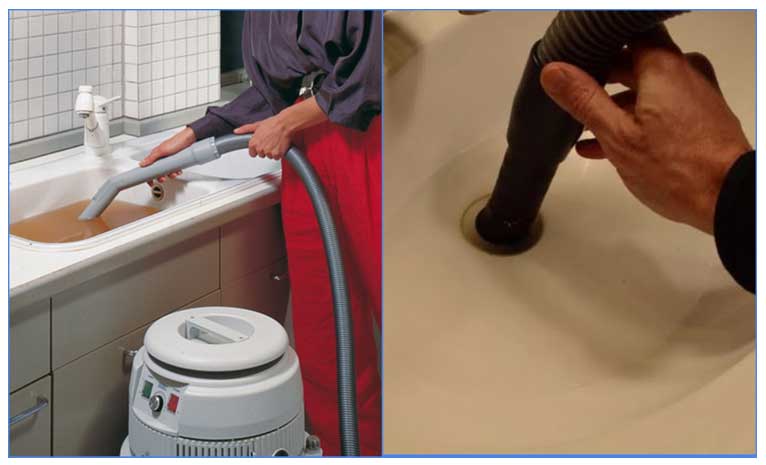
Rice. 6 Vacuuming the sink
Cleaning blockages with a vacuum cleaner
Kitchen sinks tend to get clogged with solid food waste to form tight plugs, one of the original methods of cleaning the sink is to use air pressure. You can get a strong air flow at home using a household vacuum cleaner, for this, its outlet pipe is inserted into the drain and the unit is turned on to blow out air, after removing the package from it for garbage collection. To eliminate air leaks in the sink, the vacuum cleaner nozzle is sealed in the hole with a small rag wrapped in a plastic bag. Some craftsmen use the rubber hemisphere of the plunger to seal and supply air, cutting a hole in it and inserting the outlet pipe from the vacuum cleaner into it.




Siphon cleaning
This sink element should be cleaned periodically, because without this procedure it can clog at the most inopportune moment. It is advisable to wash the siphon at regular intervals, so that the sink will not emit an unpleasant odor.
Next, you need to consider the cleaning process in more detail. To carry it out, it is necessary to prepare a soft rag and place a container under the siphon to drain the water. Then you need to unscrew the fasteners and remove the bulb
When all the liquid has drained out, carefully clean the siphon. Next, it is necessary to flush the device and reinstall it in its original place, while not forgetting to place the nozzle so that it does not rest on the flask
Next, you can open the water in the tap. Only after making sure that there are no leaks, you can be sure of the correct installation of the siphon and remove the liquid container previously placed under it.
Dealing with clogs with household chemicals
Chemical exposure to blockage requires special preparation. Do not use chemicals to deal with blockages if there are children nearby. Toddlers may unknowingly drink or swallow poisonous liquids or powders, or inhale gases resulting from the dissolution of a blockage in a pipe.

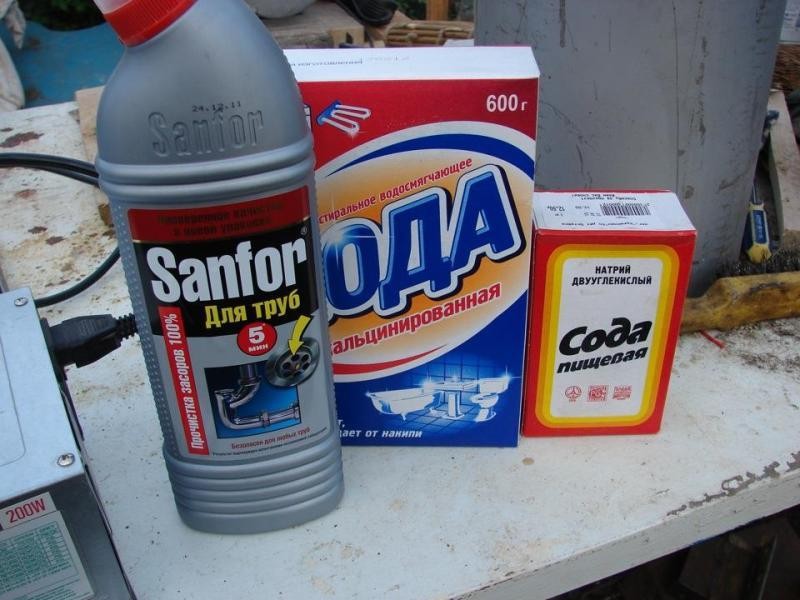
Today, consumers are offered the widest range of chemicals that can cope with a blockage in a few minutes.

Great advice for self-clearing blockages - before use, be sure to read the instructions and the composition of the contents of the cherished bottle with beautiful promises to defeat the cork and not disturb the sewer. Perhaps the tool has a number of limitations in use (for example, it is intended only for plastic pipes and is not suitable for metal).

On average, all funds for sinks act on blockage within half an hour. This greatly simplifies the cleaning process. Poured or poured chemicals into the pipe - and you're done! You do not need to unwind anything and put extra effort. Only after such a chemical attack on the blockage, be sure to ventilate the room and thoroughly rinse the pipe by opening the tap with water for a couple of minutes.

Back to chemicals
 If the drain is completely blocked, purchase products that are marked "suitable for standing water", as other options simply will not cope with severe blockages.
Let's dwell on the most popular chemicals used by housewives to eliminate blockages.
After the specified time, supply water with strong pressure. If the plug cannot be eliminated immediately, use the tool again.
Debouche is a universal liquid for eliminating mechanical and fatty blockages. Scheme of application: pour 500 ml of liquid into the drain and leave for 3 hours.
With severe pollution, twice as much product is used, and the duration increases to 10-12 hours. Be sure to flush the pipes with plenty of water after using the Debouche.
Pothan - a solution to eliminate any type of blockage in cast iron and plastic pipes. First, you need to lower the water level in the drain by 5 cm. Next, 100 ml of the product and 100 ml of boiling water are poured. After 5 minutes, warm water is supplied to the drain.
Mr. Muscle is a popular powder for eliminating fatty plugs. It penetrates into the most difficult places and, due to its special composition, removes not only blockages, but also harmful bacteria and unpleasant odors. According to the manufacturer, Mister Muscle copes with the problem in just 5-10 minutes.
Using specialized tools for cleaning sewer pipes, it is very important to follow the instructions on the package exactly. Otherwise, the active substances of the agent may damage the pipeline. Flup - a cleaner that dissolves fat, organic and hair plugs
The tool is quite caustic, so when working with it, be sure to arm yourself with protective clothing, a respirator and rubber gloves.
Flup is a cleaner that dissolves fatty, organic and hair plugs. The tool is quite caustic, so when working with it, be sure to arm yourself with protective clothing, a respirator and rubber gloves.
When adding Floop to the drain, it is important to avoid getting it on plumbing, as well as on exposed parts of the body or clothing. The product is poured with hot water and left for the time specified in the instructions.
Then the drain is washed abundantly with cold water.
Tiret Turbo is a universal solvent available in the form of a gel and granules. In the first case, it is poured into the drain and left for 5-10 minutes. Using the granular version, it is first poured into the drain, and then 500 ml of hot water is added and left for at least 10 minutes.




It is forbidden to use the last remedy longer than the time specified in the instructions. The active substances in its composition can cause destruction of the pipe walls.
On our website there is an article where we examined in detail the best chemicals for cleaning sewer pipes. More details - read on.
How to clean the blockage in the pipes at home and not spoil them
Keep in mind that using chemical clog cleaners can damage plumbing fixtures, aluminum pipes, and sinks. The fact is that some chemical reactions proceed with the release of a large amount of heat. It is not recommended to lean over the sink and look into the drain hole if a gurgle is clearly heard. This indicates a reaction is taking place and can be dangerous.
It is important to remember that the choice of sewer cleaning chemicals should be based on the material of the water supply and the type of pollution. In most cases, the universal remedy "Mole" is suitable, which copes with various types of pollution. The use of a plumbing cable is suitable for cleaning metal pipes, as it helps to effectively remove, including rust from pipe walls
Plastic pipes can be damaged as a result of increased mechanical stress.
The use of a plumbing cable is suitable for cleaning metal pipes, as it helps to effectively remove, including rust, from pipe walls. Plastic pipes can be damaged as a result of increased mechanical stress.
They must be cleaned with extreme care. By itself, this material is not subject to corrosion, and contaminants adhere poorly to its surface. But over time, fat gradually clogs the drains, and when it becomes necessary to eliminate the blockage, it is best to use chemicals or a plunger.
But over time, fat gradually clogs the drains, and when it becomes necessary to eliminate the blockage, it is best to use chemicals or a plunger.
Cleaning the sink with a plunger
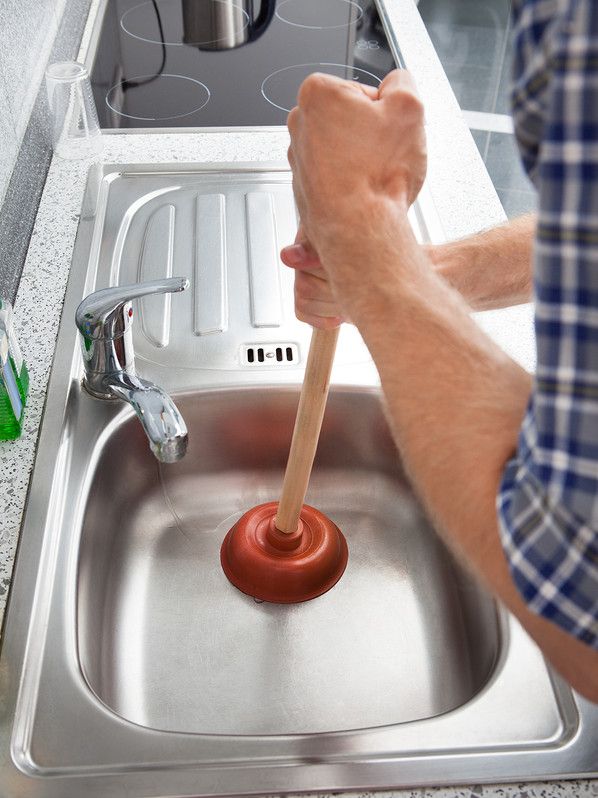
Most often, owners use a plunger to deal with blockages. Each of us, of course, knows what this device looks like. The plunger has a fairly simple device and looks like a wooden stick, at the end of which a rubber cap is fixed.
The principle of operation of the plunger is quite simple:
- The main working element is a rubber cap, which creates a tight grip of the plunger with the surface of the sink;
- Removal of blockage is carried out by performing translational force movements with the handle of the tool, as a result, the effect of water hammer occurs in the system;
- Due to the impact of water hammer, dirt and plaque begin to move through the space of the siphon or elbow, gradually rise to the level of sewer pipes;
- After a successful cleaning of the drain pipe, the debris is carried away by water further through the sewer system.
The plunger seems to be a fairly simple device to use, allowing each person to clean the drain hole with it. It is enough to make a couple of movements, and pretty soon all the accumulated water will leave the sink and go into the sewer, forming a water funnel in the sink.
Plunger Tips
- To eliminate clogging in the sink, a plunger is installed on the surface of the sink. You can pre-lubricate the edge of the cap with cream. This will improve the adhesion of the plunger to the surface of the sink.
- Now you need to fill the sink with water in such an amount that it completely covers the rubber cap.
- Begin to make progressive movements, exerting force on the handle with your hands.
- Raise the plunger. If the blockage is small, then the water will easily leave.
If the first attempt to eliminate the blockage was unsuccessful, then you need to do the following:
- Prepare a remedy from half a glass of soda and the same amount of salt, mix everything and pour into the drain hole;
- Now you need to pour a glass of hot water there;
- Wait 15 minutes;
- Use the plunger, performing the usual actions according to the instructions above.
Radical solutions to the problem
When the blockage cannot be eliminated with the help of folk remedies and chemicals, it is worth trying to deal with it using mechanical methods.
Option number 1 - vacuum cleaner
You can use a vacuum cleaner to deal with blockages. However, the appliance must have a blow function. If you are the owner of such a technique, then first wrap the end of the hose of the device with a loose rag
It is very important to fix it well.
Lean the hose firmly against the drain hole and turn on the vacuum cleaner to the maximum. A powerful stream of air will push out the plug formed in the pipe.
It is necessary to install the device tube at a right angle, trying to press its end to the drain hole as much as possible.
Using a vacuum cleaner is effective when the problem is no more than 1 meter from the drain hole.
Option number 2 - plunger
Use a plunger to pump the drain, which can be manual or mechanical. This device is sure to be found in every home. It helps to create strong pressure inside the pipe, due to which the blockage is broken or pumped deeper.
While pumping, move the plunger back and forth without lifting the bowl from the drain. Take a few approaches, and then remove the plunger and evaluate the effectiveness of the work. If the liquid comes off slowly, you will have to repeat everything from the beginning.
Before working with a plunger, it is advisable to lubricate its edges with grease or petroleum jelly. Then a tighter contact with the sink will be ensured.
Option number 3 - plumbing cable
When a plug has formed at pipe bends or far in communications, a plumbing cable is used. With it, you can hook and pull out the blockage or clear it.
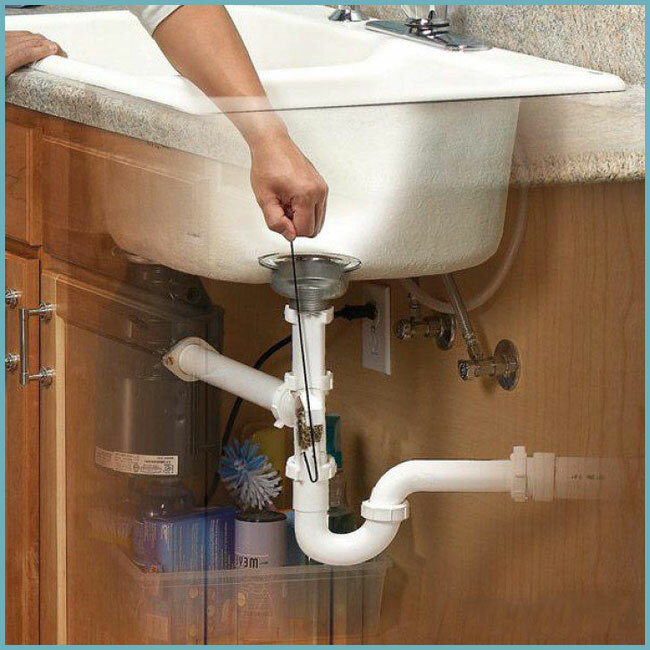
The process of cleaning pipes with a cable begins with the dismantling of the siphon.Do not attempt to cable straight through a plumbing drain. Only by removing the siphon will you get free access to the sewer.


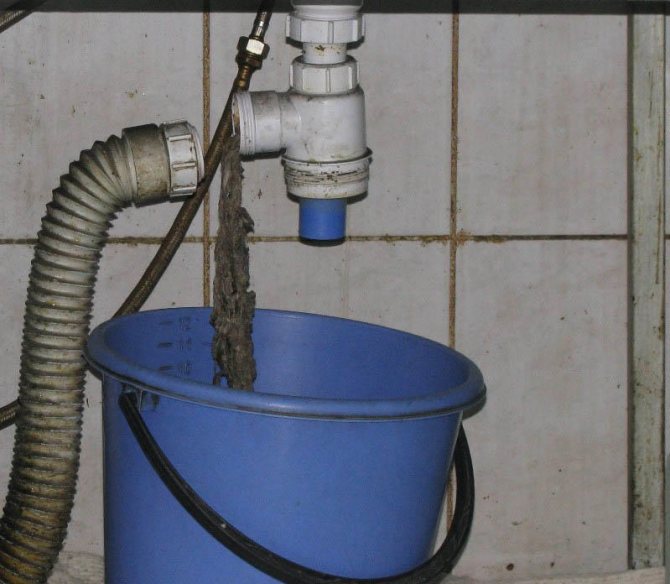


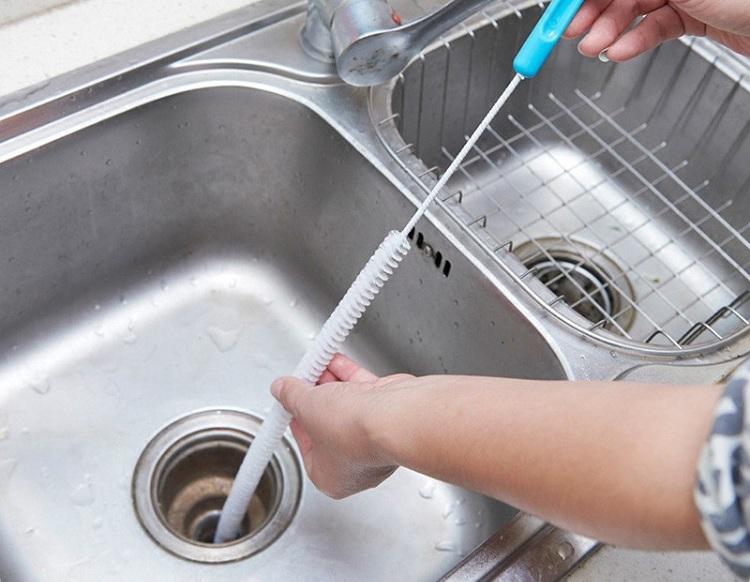
After installing the cable into the pipe, start screwing it clockwise, trying to slowly push it forward. Act smoothly and gradually, avoiding sudden movements.
There is a hook at the end of the cable, so use the tool carefully when cleaning plastic pipes so as not to damage them
If you encounter resistance, rotate the device until it continues to move. After that, you can put the siphon in place and flush the system.
Not everyone has a plumbing cable, but if you want, you can buy it at any plumbing store.
Read about the types of plumbing cables for cleaning sewers in this material.
In addition, you can build this device with your own hands from a plastic bottle and improvised materials.
The instruction is as follows:
- Tape the bottle from top to bottom with strips of tape so that you get a spiral.
- Draw lines along the border of the adhesive tape with a colored marker.
- Cut the bottle according to the marks you made.
- Be sure to leave the bottom - it will act as a handle.
- On the resulting spiral, make small notches.
- Insert a homemade cable into the drain and push it slowly holding the "handle". Due to the notches, debris will cling to it, thus it will be possible to overcome the cork.
This device is only suitable for plugs that are not too far from the siphon.
During sewer cleaning work, do not forget to periodically turn on the water. This will help you get rid of dirt faster.
For blockages at great depths, steel wire with a diameter of 5-6 mm is used.One end is crochet.
Option number 4 - disassembly and cleaning of the siphon
As mentioned at the beginning of the article, in 90% of cases, water does not pass beyond the sink due to clogging of the siphon.
The procedure for cleaning it is as follows:
- Spread an unnecessary rag on the floor that absorbs water well. It should be directly under the siphon.
- Place a basin under the sink into which the liquid will merge in the future.
- Unscrew the lock nut that secures the siphon tube.
- Remove the siphon. Remove all dirt from it (it is convenient to do this with a brush), and then rinse thoroughly under running water.
- Pour a solution based on soda and vinegar into the pipe connected to the sewer. When the reaction is complete, add another 150 ml of vinegar. Repeat this procedure several times.
- After 15-20 minutes, pour a few liters of hot water into the pipe and wait 5 minutes.
- Reinstall the siphon and tighten the lock nut.
As a rule, if you follow the instructions given, you will be able to deal with the blockage the first time.
Chemicals for removing blockages
Household chemicals for sewerage make life easier for people who do not have the opportunity to use tools for mechanical cleaning. The advantages of industrial production tools are undeniable: they act quickly, efficiently, and you do not need to make special efforts to use them. Household chemicals are used not only to eliminate, but also to prevent blockages.
Chemical compounds have disadvantages compared to mechanical tools. Too aggressive products can damage the plastic sewer.Another disadvantage is that they are harmful to the environment. These are good reasons to consider their feasibility.
The principle of action of chemical compounds is simple: they dissolve organic substances. Fat, hair that has fallen into the sewer soften and are easily washed off with hot water. After applying the funds, no deposits remain on the inner surfaces of the pipes, which make it difficult to use the sewer. The walls become smooth and pass wastewater well.
The composition of sewer household chemicals may contain acids or alkalis. The former are excellent at removing grease and are better suited for kitchen sinks, while the latter should be used in bathrooms and toilets, because. they dissolve hair, residues of detergents and cleaning products that have settled on the pipes.
When choosing chemicals, pay attention to their composition and purpose. Some drugs are too aggressive, and their constant use may result in the replacement of sewer pipes. Funds differ in the form of release
They can be liquid, free-flowing or gel-like. It is believed that powders and granules are most effective, but if used incorrectly, they can damage plastic pipes. The action of liquid products is the mildest, but they are not concentrated enough
Funds differ in the form of release. They can be liquid, free-flowing or gel-like. It is believed that powders and granules are most effective, but if used incorrectly, they can damage plastic pipes. The action of liquid products is the mildest, but they are not concentrated enough.
When using, be sure to read the manufacturer's information and strictly follow the instructions.

Neglect of safety measures when using chemical cleaning agents is unacceptable. Allergy sufferers and people with respiratory disease without protection may feel ill
There are a few general rules that should be followed when cleaning the sink with chemical compounds:
- Be sure to open windows and doors to increase the flow of air. It is advisable to cover the mouth and nose with a mask. If not, then at least try not to inhale caustic fumes.
- Hands should be protected with gloves. If the composition gets on the skin, it must be washed off immediately under a powerful stream of cold water. Hot water and detergents should not be used.
- The chemical agent is used carefully and left exactly for the period specified in the instructions. During this period, do not drain the water into the sink.
Some housewives neglect the instructions and leave household chemicals in the sink drain all night, believing that this improves the result. If you have plastic pipes, such experiments are dangerous, because. caustic compounds damage materials. The sewer can leak, and then you have to seal it or even replace the pipe section.
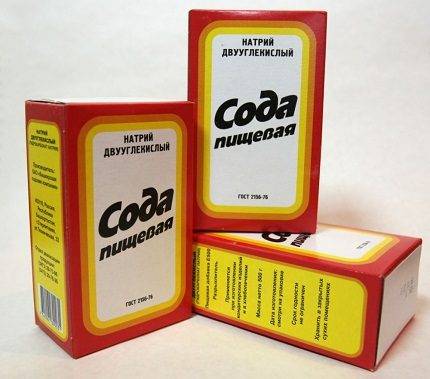
Baking soda is used to clean drains, either on its own or in combination with vinegar. It disinfects pipes well, eliminates blockages and odors.
For people who are worried about the state of the environment and do not want to use aggressive chemicals, alternative (“folk”) remedies are available - citric acid, soda and vinegar.
These substances do not clear blockages so quickly and efficiently, but they are safe and great for preventive measures. You can see how to use them in the video below.


Folk methods of dealing with the problem
If there are no chemicals, and the blockage is insignificant, then you can clean the pipes using folk remedies. They are safe not only for human health, but also for pipes.
Boiling water and salt
A solution of hot water and salt eliminates small plugs. But this method is not suitable for plastic pipes, since the maximum temperature they can withstand is 70 degrees. First, salt is poured into the drain hole, and after 20-30 minutes liquid is poured.
A solution of baking soda and vinegar
This method will allow you to clean the drain system from fatty deposits. 200 g of powder is poured into the hole, after which 200 ml of acetic acid is poured there.
To improve the effect, soda can be calcined in a pan to a golden hue. For the reaction to be successful, the hole in the sink must be closed. After 15-20 minutes, the pipe should be washed with hot water under pressure. This method will only help with relatively recent blockages. Old traffic jams require drastic measures.
soda and salt
The drain is cleaned as follows: first, the dry components are mixed (half a glass each). The composition is poured into the drain hole and left for 10-12 hours. After that, the pipe is washed with hot water.
Lemon juice or acid
Acid crystals are poured into the siphon hole, then it is filled with water and vinegar. An acidic environment is created to clean the pipes from limescale. Acid is poured into the pipe in an amount of 100 g, and then 250 ml of boiling water is poured. After 20 minutes, the pipe is washed with boiling water. If lemon juice is used, then it is simply poured into the drain for an hour. Requires 100 ml of liquid.
Alka-Zeltzer
This is a medical preparation, which contains citric acid and acetylsalicylic acid. Additionally, it contains soda.
When interacting with water, these components enter into a chemical reaction. To clean the drain, it is enough to throw 2-3 tablets of the product into it and clog the hole.
The procedure lasts no more than 20 minutes.
washing powder
In this case, a granular agent is required. 2 measuring spoons of powder are poured into the pipe. Next, boiling water is poured into it for 5 minutes.
Vinegar, baking soda and chlorine
Before cleaning with the use of these components, all liquid is removed from the sink. Soda ash and baking soda (50 g each) are poured into the drain, and after half an hour vinegar and chlorine (150 ml each) are poured into it. The hole must be well sealed, otherwise a pungent smell will appear in the room. After 40 minutes, the drain is washed.
Soda and vinegar for cleaning pipes: 6 ways to clean the sewer at home There can be various reasons for clogged pipes. To combat the problem, various store tools are used, for example, Mole. However, you can get rid of it with the means that can be found in ...
Rock salt
You can clean plugs in cast-iron pipes with coarse salt. To obtain the reaction, vinegar essence is additionally required. First, 300 g of salt is poured into the pipe, 2 liters of boiling water are poured, as well as 100 ml of essence. After 30 minutes, the drain is washed. If necessary, the procedure can be repeated.
Alkali-based preparations
Alkaline products clean well with fatty deposits. Popular is the drug KEMI in orange granules
You will have to work with them carefully, as the substance is caustic. To clean the sewer pipe, pour 1 cap of the product into the sink and pour it with hot water
Alkaline-based liquid cleaners are more effective at removing clogs.
Caustic soda
Strong blockage can be cleaned with caustic soda (caustic soda). Powder in the amount of 2-3 is placed in a metal container and 12 liters of liquid (cold) are poured.
The composition is gently stirred for half an hour.
It is important to take precautions so that the composition does not get on the skin or mucous membranes. The powder must be completely dissolved
After that, the bucket is put on fire so that the mixture warms up to 70 degrees. Half of the composition for cleaning is poured into the drain hole and left for 1.5-2 hours. Further, the remaining part of the substance is introduced into the pipe, after which again wait 2 hours.
After the action of soda is completed, the pipeline is washed with hot water.