- Classifications of sanitary devices
- Toilet material
- What you need to know when buying a toilet
- Common Errors and How to Fix Them
- Video: editing errors
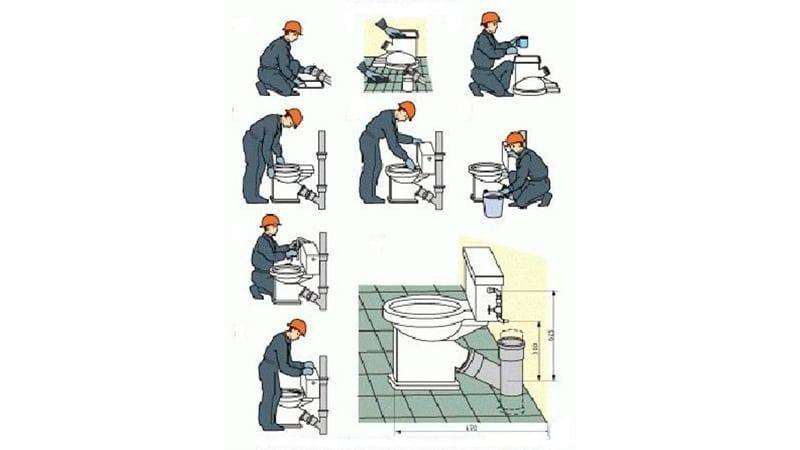
- Algorithm of work on installing a vertical device
- Removing the old appliance
- Selecting an installation site
- Mounting the toilet bowl
- Assembling and connecting the tank
- Connection without the use of corrugations
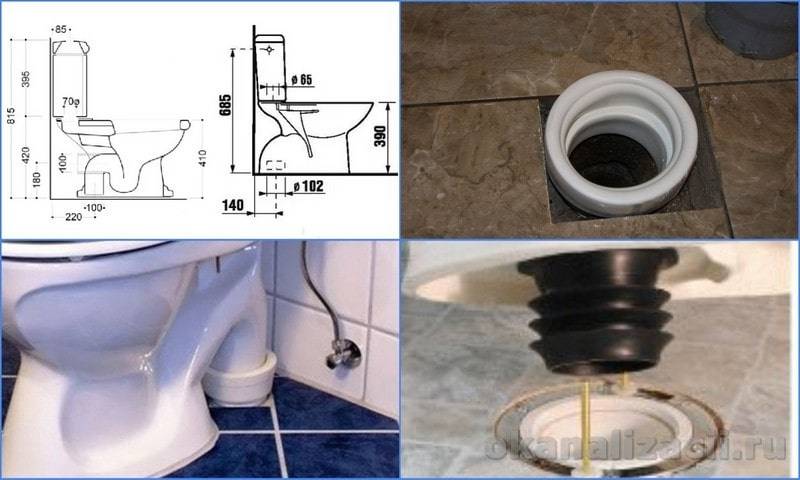
- Option #1 - Vertical Outlet Toilet
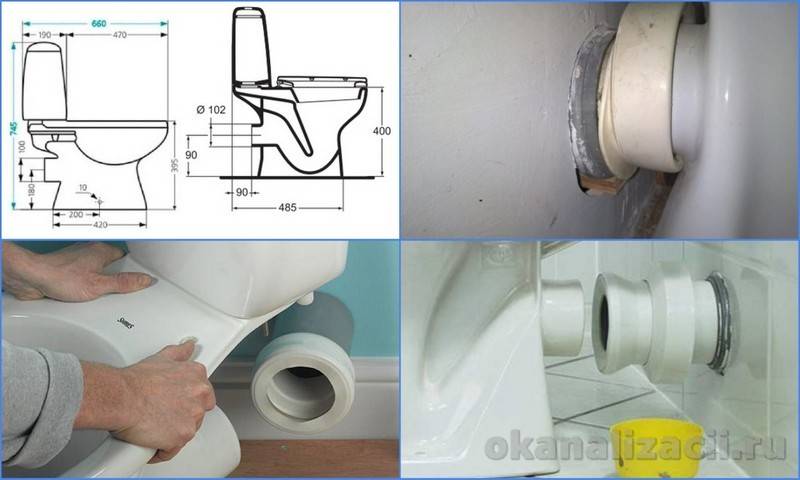
- Option #2 - horizontal release type
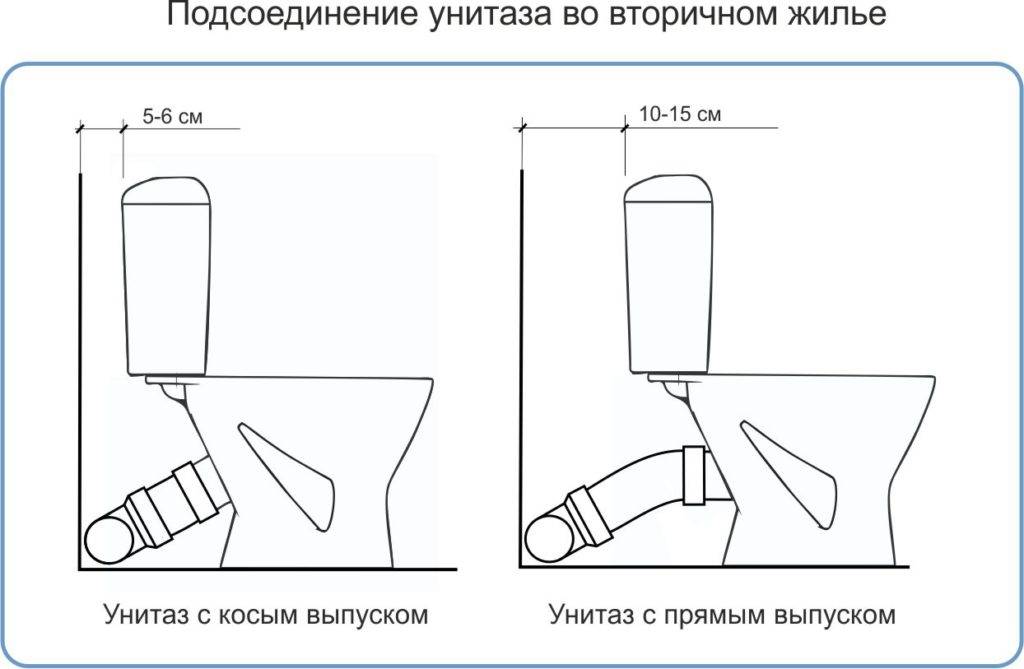
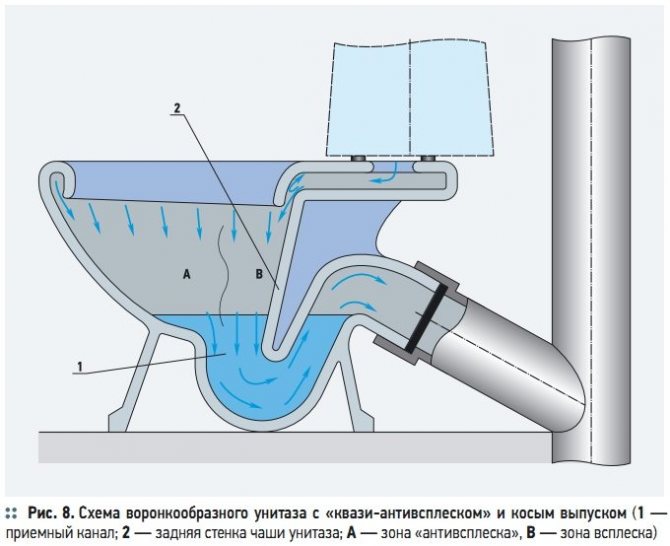
- Option # 3 - oblique toilet outlet
- Connection according to the type of toilet outlet
- Vertical
- Horizontal
- Difficulties cast iron sewer
- Instructions for replacing the toilet
- Installation cost
- Connecting a toilet without using corrugations: basic rules
- Toilets with vertical outlet
- Toilet with horizontal outlet
- Installation of a toilet equipped with an oblique outlet
- Description of the "release"
Classifications of sanitary devices
Progress does not stand still - manufacturers systematically supply more and more new varieties to the market. They can be classified into several groups based on criteria.
Depending on the place of fixation, it is customary to distinguish the following categories:
- Floor.
- Suspended.
Manufacturers also make adjustments for the age of their customers and offer:
- Sanitary products for adults.
- Children's options.
The bowl in the equipment may differ in shape:
- Funnel-shaped.
- rounded.
- Design form (in cases where custom production is acceptable).
The drain system has differences, and in this matter the manufacturers have gone as far as possible. The following options are available:
- Single mode. When you press the button, the tank is completely empty.
- Dual mode. You can pour out all the water, or only part of it.
- Contactless. Flushing is carried out automatically. This is the most expensive option.
A common question is the availability of side-descent devices. The reasonableness of such a question takes place only if you have to deal with the already very small dimensions of the bathroom. The ingenuity of our people is truly limitless, and the side issue is proof of this. The thing is that if you place the toilet sideways, you can easily free up the space needed to install a washing machine.
So, such varieties have not yet been officially sold, but if you wish, you can literally do everything with your own hands. In order to provide a side descent, adapters can be used. On horizontal sections, you should make a 90 degree turn out of two 45s, although some recommend 90 at once, just to ensure the slope.
Toilet material
An important role in the choice of plumbing is played by the material from which it is made. Now, basically, the following toilets are produced:
- Faience.
- Porcelain.
- From an artificial stone.
Faience models are quite cheap, resistant to household chemicals. One drawback can be noted: the porous structure of the material contributes to rapid contamination.
Porcelain toilet bowls are more expensive, but more hygienic, as they attract dirt to a lesser extent.
Recently, they began to produce models from polymer concrete, in addition to a beautiful texture - there are solid minuses here. The material is not highly resistant to acids, alkalis and abrasive materials, so the process of cleaning such a toilet bowl is difficult.
What you need to know when buying a toilet
The main criteria that you should pay attention to when choosing a plumbing fixture are not only its model, brand and color, but also its dimensions. It is necessary to measure the distance from the sewer drain to the door to the toilet room before buying a toilet, and the result must be divided by 2. The result will be the maximum size of the device that can be installed in this room.
The result is the maximum size of the device that can be installed in this room.
The color and shape of the toilet bowl is chosen in accordance with the interior design of the toilet room, it should match the design to the maximum. When purchasing plumbing, they certainly check its integrity and completeness. The existing mechanisms in it should work easily, without making creaking sounds.
Common Errors and How to Fix Them
When performing self-installation of the toilet bowl, home craftsmen can make typical mistakes, which you can also eliminate with your own hands:
- non-compliance with the rule of height difference - when moving the toilet, the angle between it and the sewer system should be 15 o or 3–5% of the displacement distance. For example, when transferring a toilet bowl by 2 m, it must be raised to a height of 6–10 cm;
- no revision.On the sewer riser, it is imperative to provide a technological window through which the system is cleaned. It must be freely accessible;
- violation of the order of work. Installation of the toilet bowl must be carried out at the very end of the repair, so as not to damage it during finishing;
-
incorrect bidet installation. The toilet and bidet should be located side by side, while their bowls should be on the same horizontal line;
- wrong seat selection. It may not coincide with the edges of the bowl, then there is a risk of damage to the enamel on the toilet and breakage of the seat itself;
- improper installation of shut-off valves. If water constantly flows from the tank or overflows, this indicates damage to the drain or fill valve;
- water leak. This malfunction is associated with poor tightness of the joints, they are eliminated by installing new seals;
- the appearance of an unpleasant odor. Usually this problem indicates a leak in the connection between the toilet and the sewer.
If you loosely fasten the toilet, then this can soon lead to a violation of the tightness of the joints, as well as damage to it.
Video: editing errors


Almost any home master can install a toilet bowl on his own. To do this, you need to choose the right type of toilet bowl and, in accordance with this, perform its installation. If you strictly follow the instructions and recommendations of specialists, then a self-installed toilet bowl will perform the necessary functions for a long time and reliably.
Algorithm of work on installing a vertical device
Once again, returning to the list of advantages of a toilet bowl with a direct type of outlet, you can add an item to it: the installation of the device is so simple that any man who has not worked with plumbing before can handle it.
The biggest requirement in the work is the accuracy of all actions. Otherwise, it is fraught with a leak after a certain period of time. Not following all the step-by-step instructions provokes the appearance of "aromas" of the sewer.
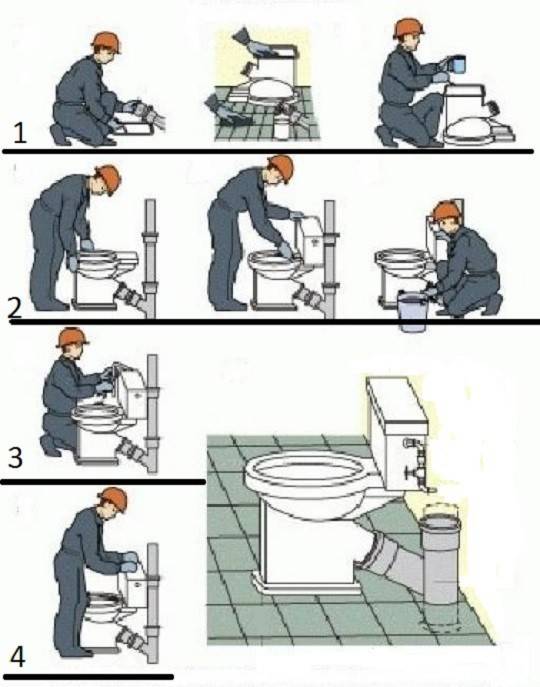
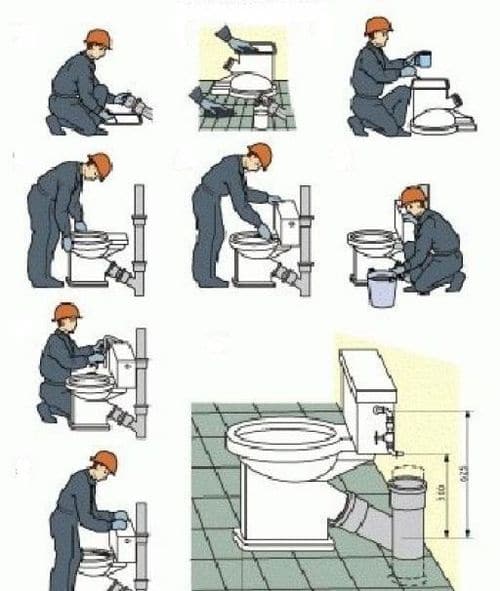
Removing the old appliance
- In the common riser, the water supply is blocked.
- The liquid remaining in the drain tank is drained into the bowl.
- The flexible supply hose is disconnected.
- The old structure is removed from its place.
Cement mortar may interfere with the rapid removal of the structure. If the old toilet gets damaged, then it's not so bad. In this situation, the sewer pipe must be more protected. Therefore, the cement is knocked down neatly.
A simple method for quickly separating the structure from the sewer is used:
a sharp blow is applied to the waste neck. The neck will crack from the impact, the remaining elements will be easier to remove.
Selecting an installation site
If the wiring of the sewer system does not change, then it is recommended to install a new toilet bowl with a direct outlet to the floor in place of the old one. Garbage is removed from the floor, if necessary, its surface is leveled.
- Measurements of the location of the sewer pipe are carried out.
- A felt-tip pen outlines the installation site of plumbing.
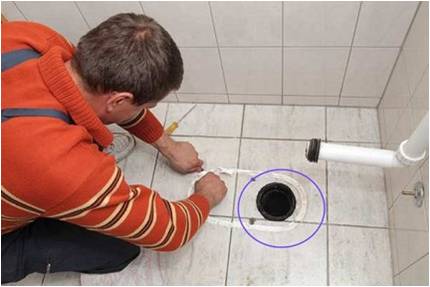
A screw flange is installed at the selected location according to the marking. There are fasteners that make installation easy.
The counterpart of the flange is located under the toilet.The standard flange model is connected to the sewer pipe through its round hole. The end of the sewer is inserted into it.
When the fixing of the flange is completed, a check is made for the correct connection to the sewer. If the floor is prepared, then proceed with the installation of the plumbing fixture.
Mounting the toilet bowl
The installation itself is quick and hassle-free.
It is important that the flange is strictly under the counterpart of the toilet bowl with its bottom drain to the floor. Or in other words, this bottom drain into the floor of the toilet coincided with a hole in the sewer
- The design of the toilet scrolls until you hear the click of the latch. There is no need to show force in such actions.
- After the automatic connection of plumbing to the sewer thanks to the flange, the work is considered completed.
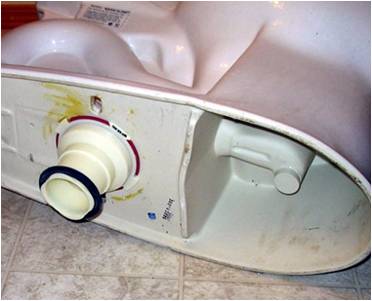
The sealing of the installation is provided by a sealing ring. The flange presses the outlet of the toilet bowl to it after the final fixation of its position. Therefore, if the installation work is carried out with the utmost care, then there can be no leakage.
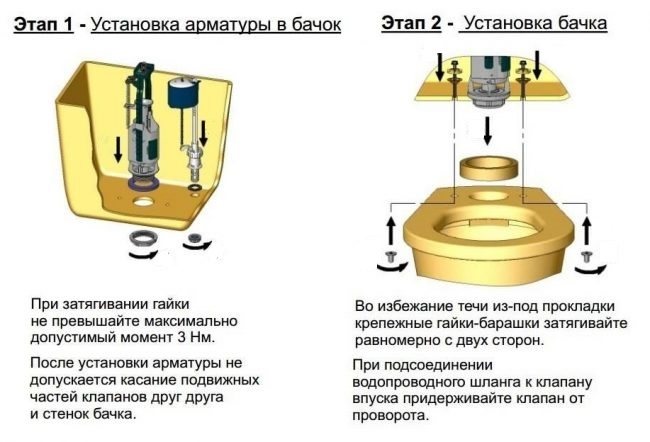
Assembling and connecting the tank
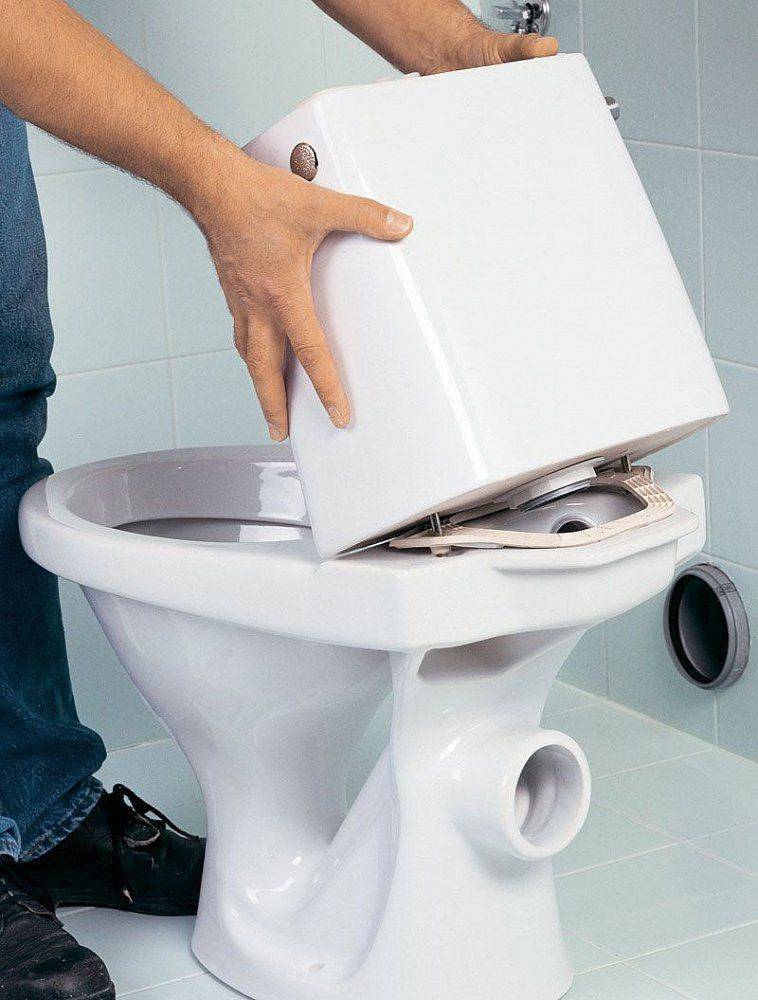
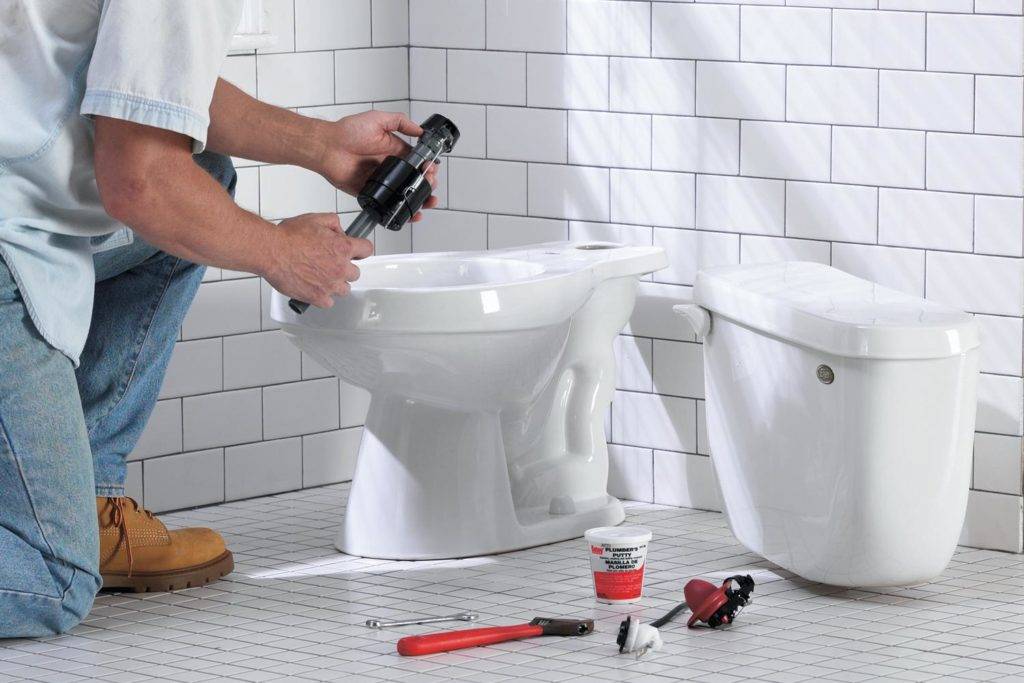
At the last stage of the work, they are related to the performance of the drain tank, the fittings are adjusted (water must be collected and not drained independently).
- A regulator valve is put on the water pipe leading to the tank to open and shut off if water is needed.
- A flexible hose connects the outlet of the installed faucet and the outlet of the drain tank. Connections are sealed. Upon completion, the work is checked for the absence of leaks.
If there are no drops of water anywhere, then everything is done correctly. A toilet with a vertical outlet, which is mounted on the floor, can be safely used.
Connection without the use of corrugations
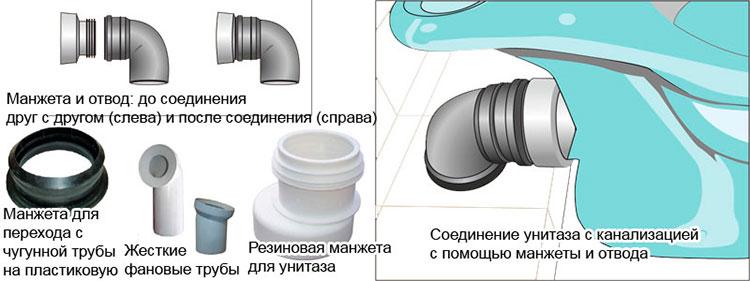
If the outlet shapes of the toilet bowl and the sewer pipe match, you can do without corrugations. Connecting the toilet without the use of corrugations‚ follow certain rules. At the same time, an adapter is used, which is also called a fan pipe or branch pipe.
The installation method is chosen depending on the shape of the outlet of the toilet bowl: in the case of an oblique outlet, they are installed on the floor; with a vertical outlet, the toilet bowl is mounted into the wall at an angle of 90⁰; while horizontally, it is also into the wall, but at an angle of 30 to 40⁰.
Option #1 - Vertical Outlet Toilet
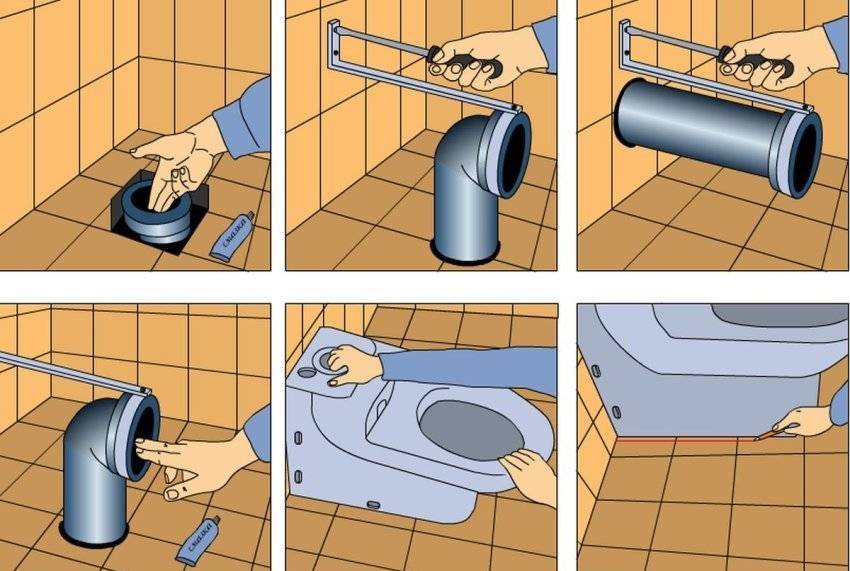
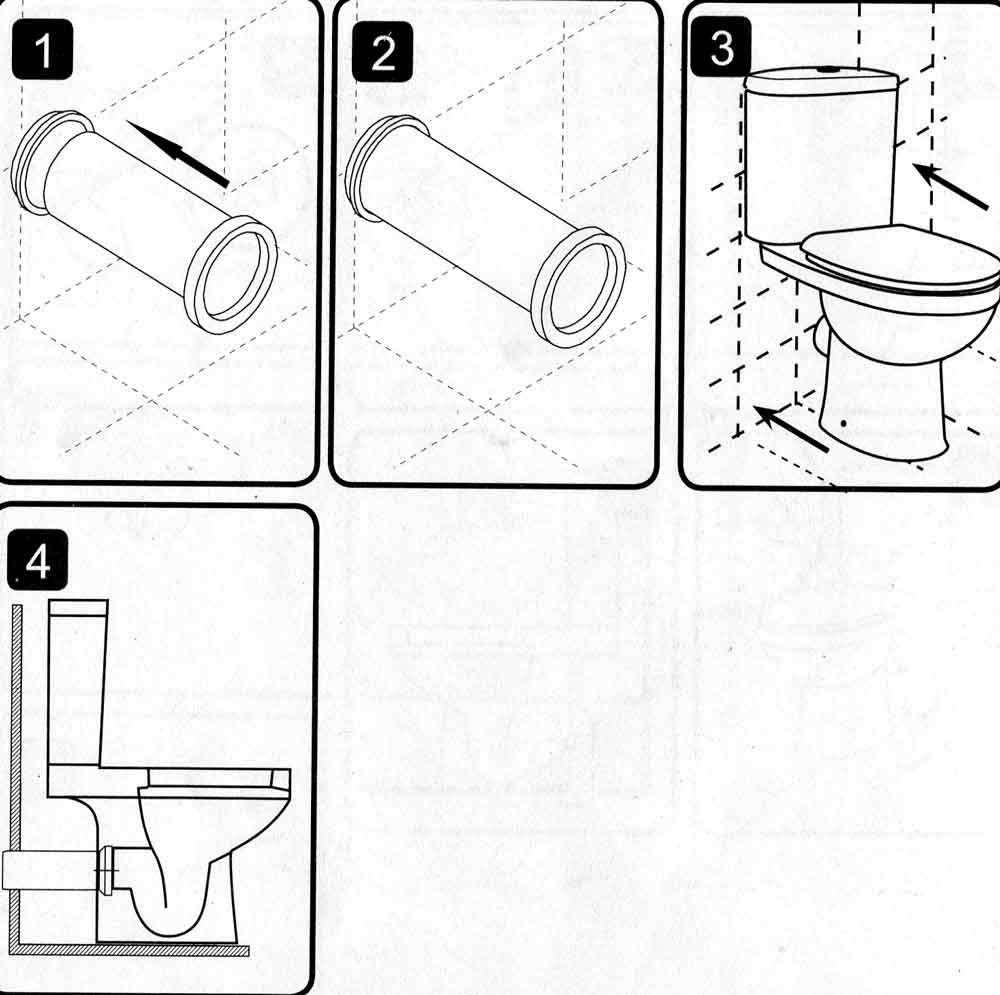
The model of such a toilet bowl is equipped with a siphon having an outlet pipe. Under this design, first mark the place, then install the flange with the lock.
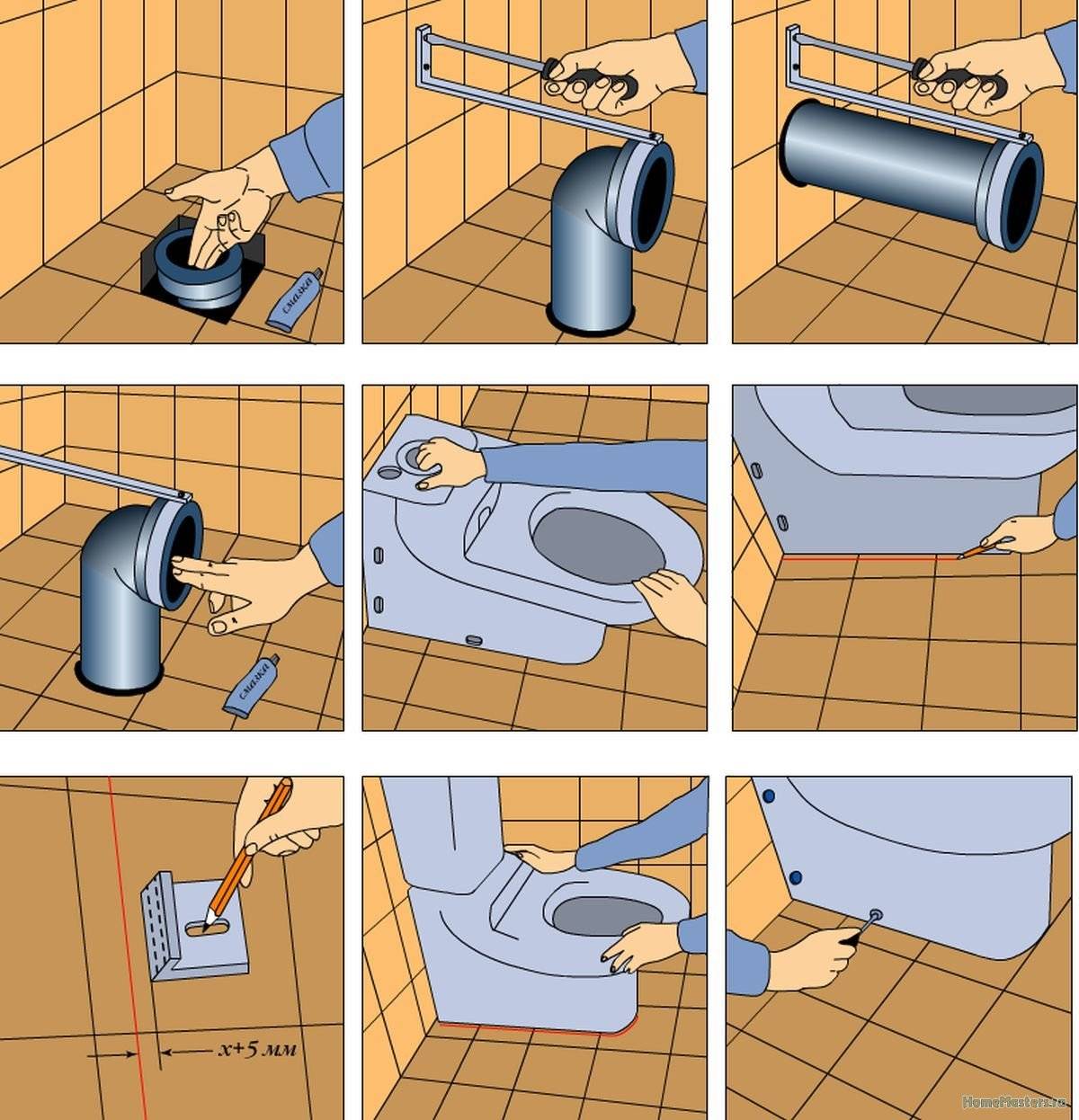



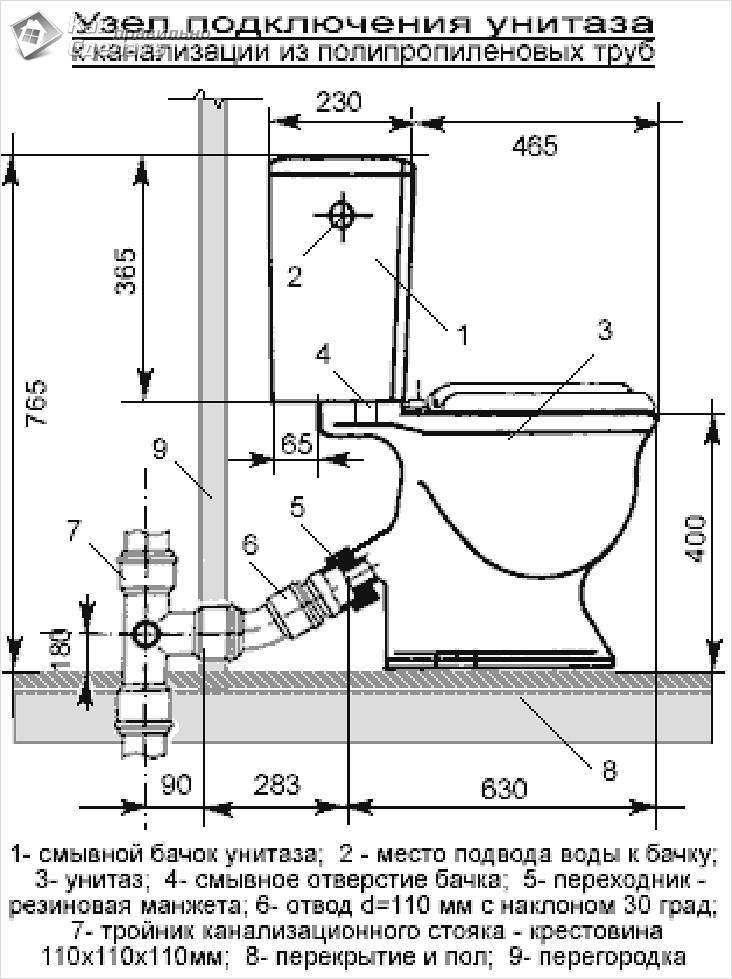
The sewer pipe is mounted in its center and a plumbing fixture is installed. The toilet is rotated until it is fully fixed. The pipe takes its place automatically.
Such a scheme is good in that the wiring becomes invisible. pipes are hidden in the floor. This saves space. The downside is that to eliminate the leakage that has arisen, you will have to crack the floor covering.
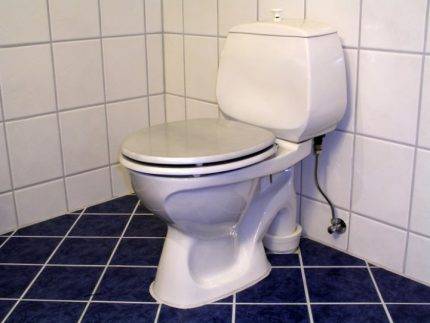 The toilet bowl, the design of which provides for a vertical drain, is aesthetically pleasing and looks neat in the interior. Yes, and it's easier to clean around him
Option #2 - horizontal release type
This release is directed back into the wall. Here you can not do without a sealing cuff. First, the toilet bowl is fixed to the floor with dowels. For more information on the best methods for attaching a toilet to the floor, see here.
Then very carefully carry out the connection. First, the cuff-seal is installed without sealant, then it is tested by pressing the drain
If it doesn't leak anywhere, make the final installation
First, the cuff-seal is installed without sealant, then it is tested by pressing the drain. If it doesn't leak anywhere‚ make the final installation.
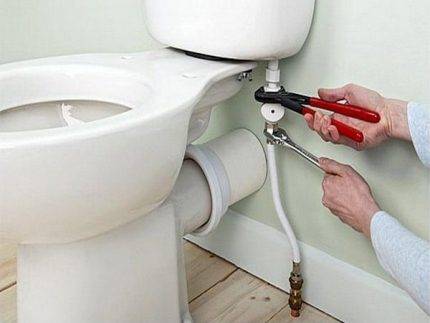 Not every apartment can have a toilet of this design. The use of the scheme is possible only if there is a vertical sewer riser
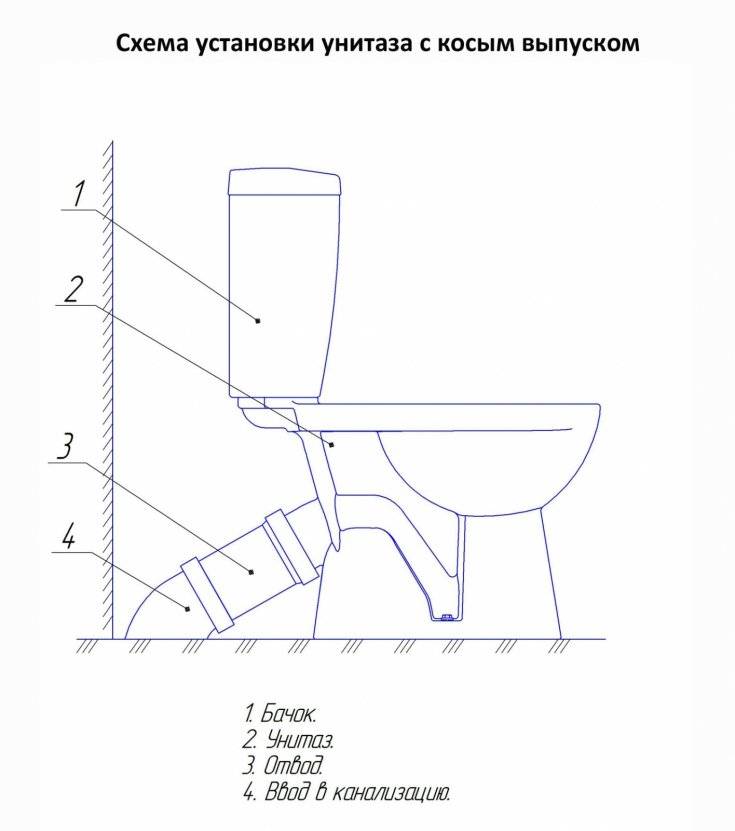
Option # 3 - oblique toilet outlet
To connect using a plastic pipe, minium is mixed with drying oil and smeared with this toilet outlet. From above, a seal is made in the form of a resin strand. The seal is coated with red lead. The outlet is inserted into the sewer pipe and the toilet is mounted.
A sealing collar can also be used here. Having dressed it for release, the latter is placed in the socket of the sewer. Be sure to seal the connection.
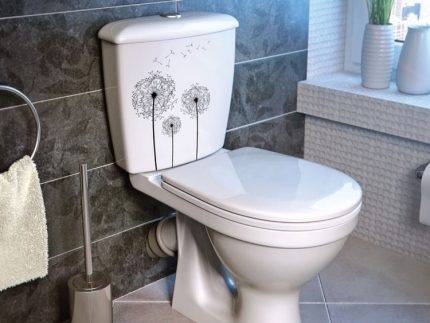 Models of toilet bowls, in which an oblique outlet is implemented, are quite in demand among buyers. One of the significant advantages of this design is the ease of replacing the cuff if necessary.
Connection according to the type of toilet outlet
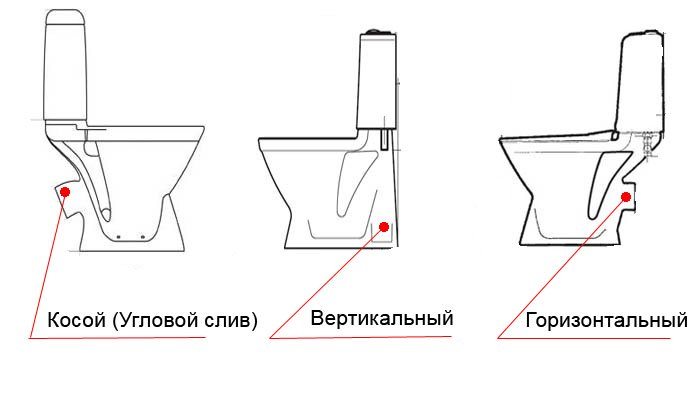
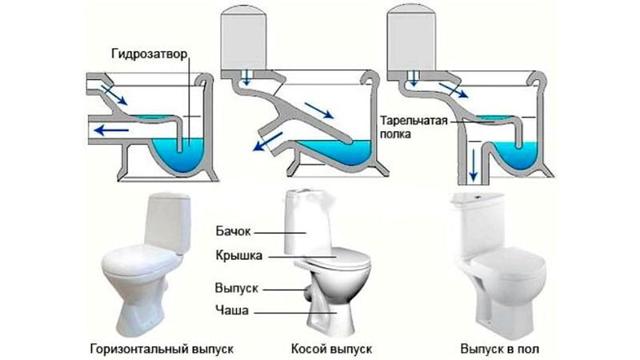
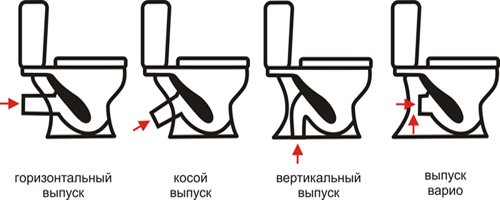
Note that the connection of the toilet bowl to the sewer should be carried out, taking into account the type of outlet of the toilet bowl. And it comes in three types: vertical, horizontal and oblique. We will discuss each type in more detail below.
Vertical
Many people are wondering how to connect the toilet to the sewer if it has a vertical drain? It is popular to install such models of toilet bowls in the bathrooms of country cottages and old multi-storey buildings. They have a certain feature: a siphon and a branch pipe are a constructive part of such devices, and after installation it will not be possible to see them.
Such a toilet can be installed close to the wall, because in this case you do not need to take care of the space for the location of pipeline fittings. Installation of this kind of plumbing is carried out after dismantling the previous model and removing the old solution from the surface of the site. To do this, mark up for future fasteners, and then install a screw-type flange with a retainer and a hole for docking into the floor. At the end of the work, you need to check the coincidence of all holes and joints, and then turn the toilet.
Note that all flanges have the same dimensions, and vertical models of toilet bowls almost always include accessories for tight connection with flanges. That is why it is not difficult to do the work of installing them with your own hands and without the help of a professional plumber.
 Initial stage of work
 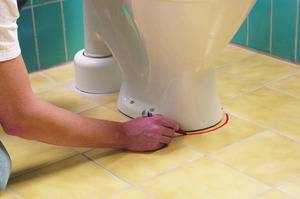 Surface marking
  Flange installation
 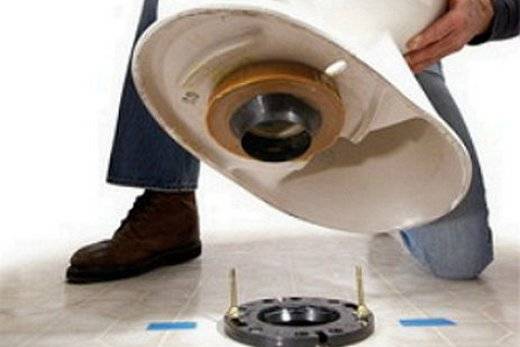 toilet mount
Horizontal
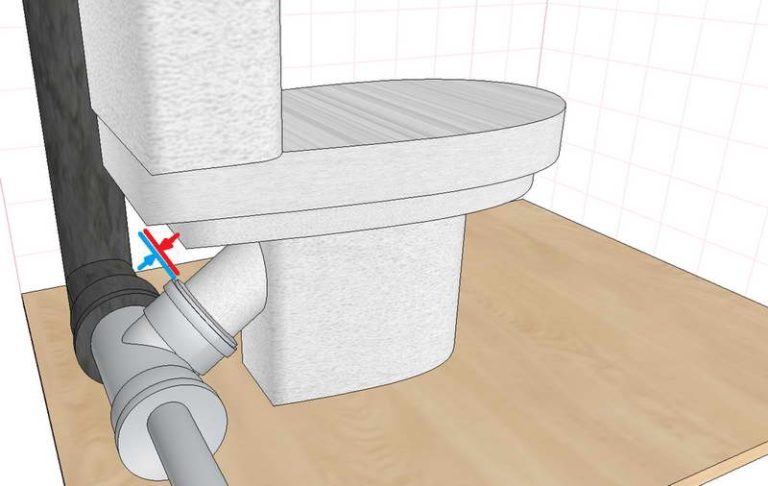
Connecting a toilet bowl to a horizontal sewer to a riser is quite simple. To do this, the product is installed at a short distance from the pipe socket, which must be taken into account when planning a bathroom.
If we are talking about an apartment in a high-rise building, then it is unreasonable to create a sewerage wiring with a horizontal outlet in it. The fact is that it is extremely problematic to build a 110 mm pipe into the floor or hide it in a decorative box.
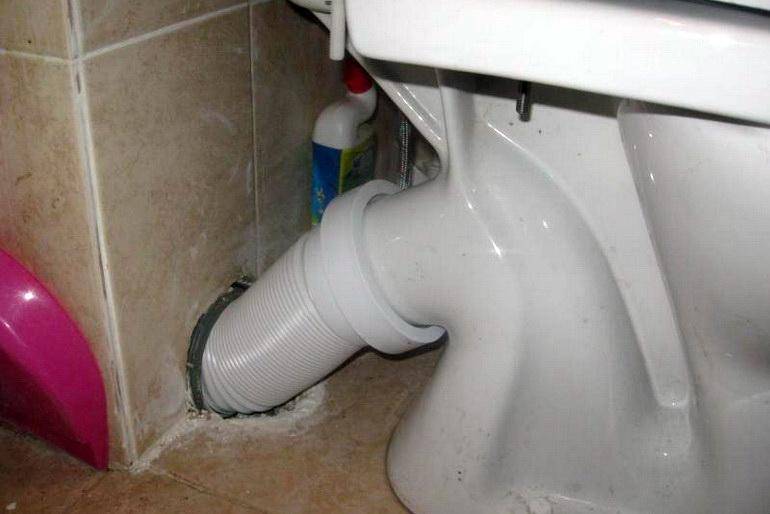
In this case, qualified specialists recommend connecting the device to a vertical riser using a sealing cuff or corrugation. Qualified specialists recommend that the created connection be treated with liquid silicone.This will help prevent leaks or unpleasant odors in the bathroom.

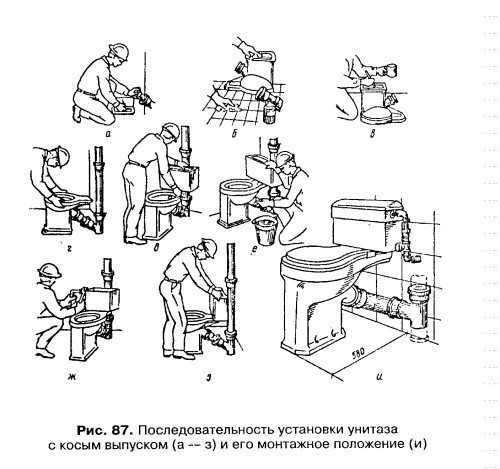


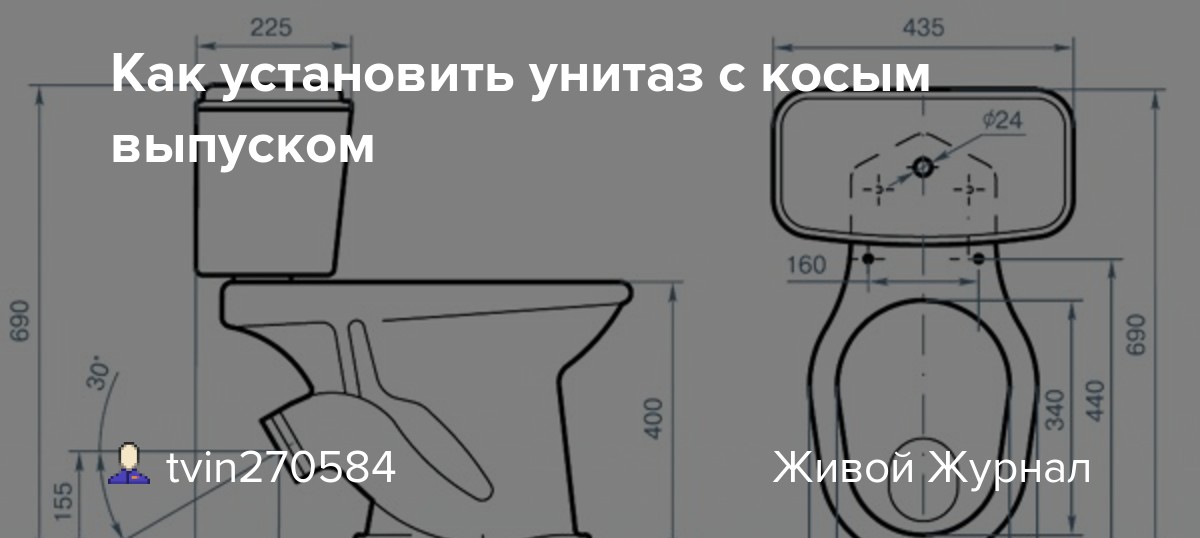


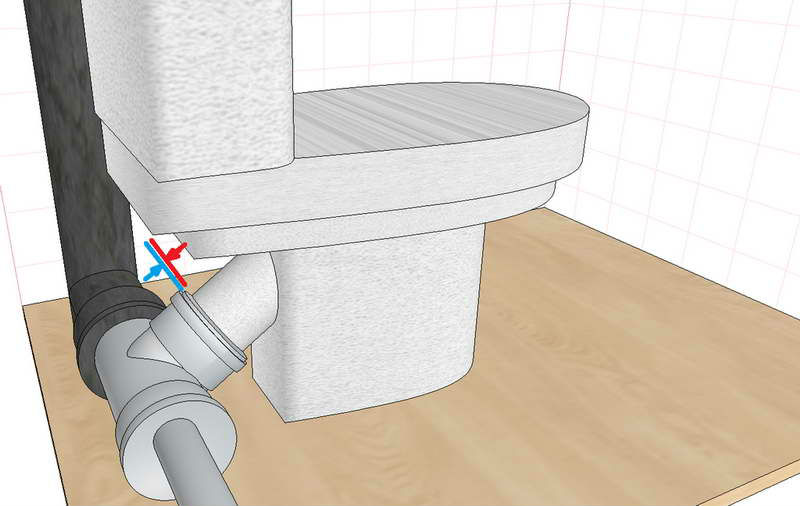

If it is necessary to shift the center of the outlet in relation to the socket of the sewer system, then a corrugation or a corner with a short pipe should be used to connect the elements. Plumbing is connected to the sewer by using a rubber cuff, which allows you to complete the work quite quickly.
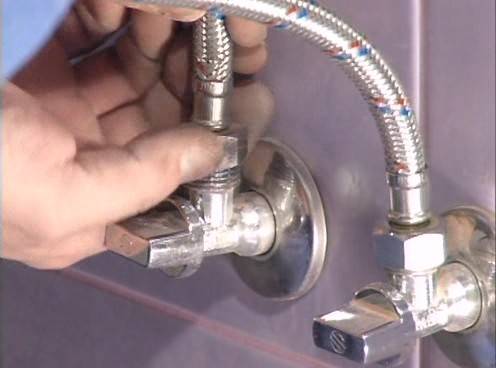 A hose is used to connect the toilet to the water supply.
  Toilet installation
  Connection with a downpipe
If you need to make a reliable connection of the toilet bowl with an oblique sewer, you will need to prepare a cement mortar. With it, you should dock the oblique outlet with a socket made of cast iron. But first, a layer of a mixture of minium and drying oil is applied to the release of the product. Next, you need to take a resin strand and carefully wind several layers of material, leaving one end hanging freely. Then, the outlet should again be smeared with red lead and mounted in the sewer socket. Remember, the plumbing product must be clearly fixed.
You can also use another method to perform this operation. It is less hassle and more efficient. To do this, you will need to use a rubber cuff, which is put on the outlet pipe, and then it is connected to the central sewer pipe.
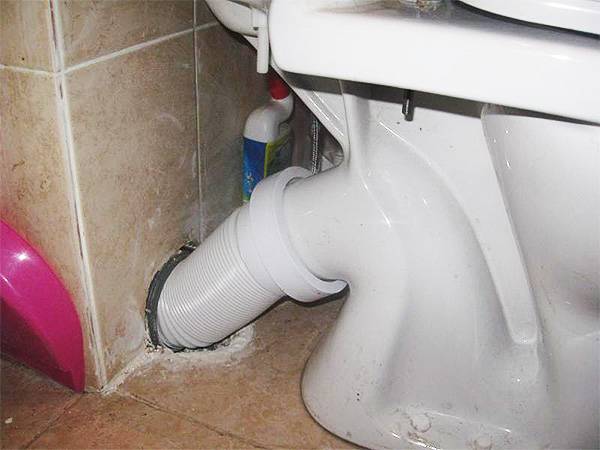
For maximum resistance to stress, durability of the created connection, you must first very carefully clean off the remnants of the solution from the socket. If the toilet needs to be moved away from the opening of the sewer system, you will need to use corrugated pipes.
When the entire sewerage system is built of plastic, which is typical for apartment buildings, you will need to connect the toilet in the same way, but without the use of cement mortar.
 Wiring diagram for oblique type model
Difficulties cast iron sewer
- The complexity of the connection;
- Impossibility of re-equipment;
- Complicated installation;
- High price.
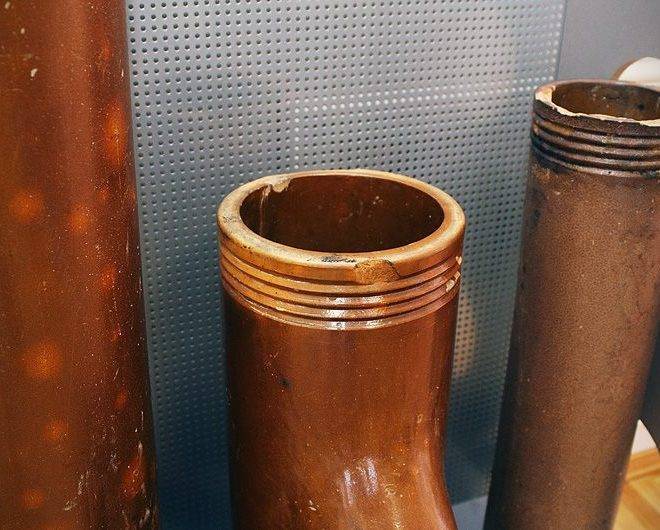
The installation of a cast-iron sewer is a difficult task. Specialists quickly cope with it, but in the absence of professional skills, it is better to abandon such an undertaking. Subsequently, the conversion will be unrealistic, since it is almost impossible to cut a piece and install another in its place. Moreover, branched communications are also impossible, because the choice of elements supplied by manufacturers is limited.
The only major advantage is the service life. Cast iron almost does not collapse under the influence of aggressive environments, which makes it indispensable for harsh conditions. Also, designers always take into account possible mechanical loads. The iron alloy perfectly withstands them, so it is convenient to mount it in multi-storey buildings for risers. Structural skew is a common situation, but now it will not affect the functionality of the system.
You can connect a toilet, a bathtub, and a sink to the sewer with your own hands. Such actions do not require any special knowledge. You should take all the details seriously so as not to make mistakes. Practice shows how easy it is to get rid of difficulties if you carefully check your own system.Only this guarantees reliability and durability, which every home owner dreams of, trying to assemble engineering communications without outside help in accordance with the existing schemes.
Instructions for replacing the toilet
wall hung toilet in the bathroom
Now it remains to solve the main problem, namely, to install a new toilet. The choice of toilet installation depends on many factors. The most important is the type of attachment and the type of the toilet itself. A hanging toilet for a small bathroom is often installed by specialists, since its design is quite complicated. If we are talking about installing a floor version, then you can use traditional installation methods. So, you can get to work.
Replacing the toilet can be done by installing it on a tiled or concrete floor. This is the traditional method. In this case, self-tapping dowels serve as fasteners. the second option is to attach the toilet bowl to a wooden board or taffeta. The best wood for this installation method is oak.
fixing the toilet to the floor with dowels
At the same time, anchors are installed at the bottom of the board. They provide a fairly strong attachment to the floor. As anchors, you can use nails that are driven in a checkerboard pattern. At the same time, they should protrude from the board by 30 centimeters. A recess is made in the floor, which is poured with cement mortar. It has taffeta in it. After the mortar hardens a little, you can screw the toilet bowl with ordinary screws.
Whatever method the toilet is attached to, rubber washers should be placed under it to protect the base from damage.There are times when fastening is not done with screws, but with epoxy glue. For proper connection of the surface, it is necessary to carefully clean and then degrease. Only then can you connect them together. It is worth pressing the toilet firmly to the floor so that the connection is reliable and durable. The toilet cannot be used immediately. First you need to withstand it for 10-12 hours so that the solution or glue can harden.
You should also pay special attention when connecting the toilet to the outlet line. The part of the toilet that connects to the sewer is called the outlet. However, it can be straight or oblique.
On any issue there are grooves that must be smeared with red lead diluted in drying oil. The release itself must be wrapped with a resin strand. At the same time, it is worth making sure that it does not reach the pipe by 2-4 millimeters. If this rule is not followed, the resin strand can get into the pipes and clog them.





Moreover, it can be straight or oblique. On any issue there are grooves that must be smeared with red lead diluted in drying oil. The release itself must be wrapped with a resin strand. At the same time, it is worth making sure that it does not reach the pipe by 2-4 millimeters. If this rule is not followed, the resin strand can get into the pipes and clog them.
The release itself must then be inserted into the socket. In this case, the annular gap is caulked with the help of flagella made of linen yarn. After that, the gap must be sealed with cement mortar.
Installation cost
If it is necessary to replace or properly install a toilet bowl, the first thing that interests us is how much it costs to install a toilet bowl. The cost of installing a toilet bowl by an experienced master in the capital is at least 1,500 rubles. This does not include the cost of consumables - screws, corrugations, lubricants and the cost of dismantling if necessary.
You will have to buy them anyway, but if we have all the necessary tools for installing and connecting the toilet bowl to the sewer, then the cost of all work is reduced exactly by the cost of ordering a qualified craftsman. You can perform many toilet installation operations for free, unless of course you do this business yourself.
Connecting a toilet without using corrugations: basic rules
If you decide not to use the corrugation, you will need the basic rules by which it is connected in this case:
Connection spigot without corrugation
- If the toilet is connected without a corrugation, then it is necessary to use a pipe, which is also called an adapter or a fan pipe. The connection to the adapter in this case is carried out differently depending on the angle that the toilet has. There are 3 options for this:
- connecting a toilet with an oblique outlet - it is installed on the floor - such an installation is no longer relevant, although it was used very widely in the last century;
- if the outlet of the toilet bowl is vertical, then the installation is carried out at an angle of 90º into the wall;
- if the outlet of the toilet bowl is horizontal, then the installation is carried out into the wall at an angle of 30-40º.
Toilet bowls with different types of release
- In the event that the outlet of the toilet bowl does not correspond to the outlet of the sewer network, then you will either have to choose a different model of the toilet bowl, or use curved adapter pipes at a certain angle.
Now consider in detail the features of the installation of plumbing of each type.
Toilets with vertical outlet
Such models are widely used in European countries. This is largely due to the fact that such plumbing fixtures have a downward-facing outlet and a siphon located in the toilet bowl. This design allows you to put the toilet against the wall at any angle. Installation is simple:
- after marking, a standard screw flange equipped with a lock is installed on the floor;
- a sewer pipe is installed in the round hole located in the center of the flange;
- a toilet bowl is mounted on the flange, rotated until it is fully fixed; the outlet pipe, which has a special sealing ring, while the pipe is automatically pressed against the end of the sewer pipe.
Installed o-ring
Toilet with horizontal outlet
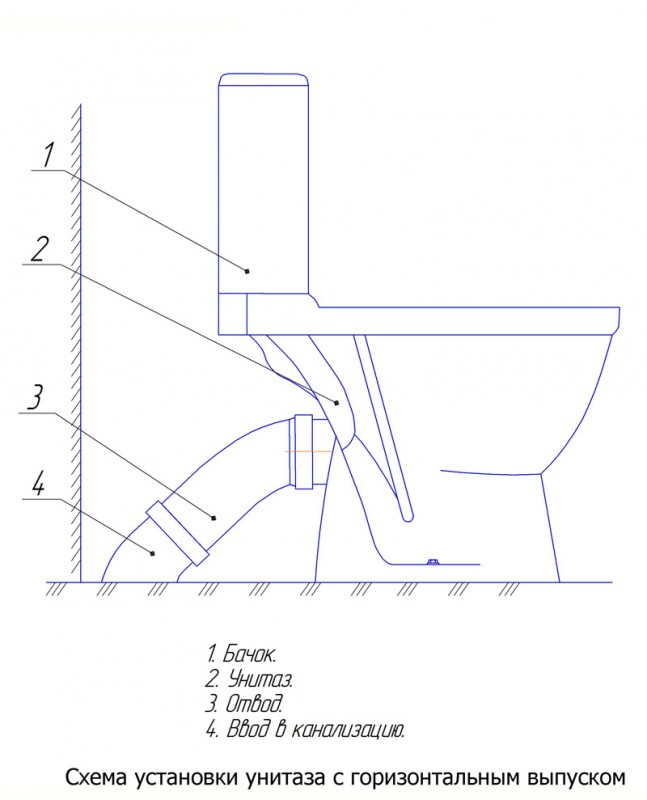
Connecting a toilet with a horizontal outlet (it also has the name of a toilet with a “wall outlet”) is most relevant for the conditions of our country at the present time, which is associated with the attachment of the bathroom to a specific wall in the bathroom due to the specifics of the sewer system pipe layout in typical Russian houses. Since the outlet of the toilet in this case is directed backwards, it is located in the rear of the bathroom. In this case, the outlet pipe is connected to the sewer pipe using a special sealing cuff.
Connection diagram for a toilet bowl with a horizontal outlet
Particular attention should be paid to fixing the toilet bowl to the floor. As a rule, the legs of the toilet bowl with a horizontal outlet are equipped with special holes that are designed to fix the device to the floor.
Appearance of the finished connection
Pro tip:
Connecting a direct outlet toilet begins with installation, using dowels and screws
Fastening must be carried out carefully, as if the screw is pulled too hard, the surface of the toilet bowl can be damaged.
Installation of a toilet equipped with an oblique outlet
The installation technology for this type of toilet is as follows:
Connection diagram for a toilet bowl with an oblique outlet
- Before you properly connect the toilet to the sewer, the outlet of the toilet bowl with the grooves located on it is lubricated with red lead mixed with drying oil.
- A resin strand is wound on top. At the same time, the end of the 0.5 cm process must remain free (otherwise the ends of the strand will fall into the hole and contribute to clogging).
- The wrapped strand is also carefully lubricated with red lead.
- Next, the toilet bowl is installed, fixing the outlet process into the socket of the sewer pipe.
Ready connection
Thus, we examined how to connect a toilet bowl drain of various configurations to a sewer pipe. Thanks to the information received, the installation itself is realistically feasible. Plus, you can save money. However, if you feel that your existing skills are not enough to perform such work, it will still be more economical to use the services of professionals.





Description of the "release"
The drain hole that connects to the sewer is the outlet of the toilet. Connection is carried out in three ways:
- A universal option for connecting to a drain system, when the drain hole and its pipe are in a horizontal plane, on the same level. Finnish plumbing and Swedish models are produced.
- The drain pipe of the structure is directed to the floor, where the sewer wiring is hidden. Distributed in houses built in Soviet times (Stalin).
- The drain hole of the model is connected to the drainage pipe at a 45° angle - this is the oblique outlet direction. Models are produced by manufacturers in the Russian Federation.
Which outlet of the toilet is suitable will be prompted by the selected design of the sewer wiring. If its installation is entrusted to a specialist, then his recommendations will not interfere in the same way.