- Types of sinks in the bathroom
- Hanging sink
- Sink "Tulip"
- Countertop sink
- Varieties of sinks with a pedestal
- Tulip sink installation
- Preparing for installation
- Mounting a sink with a pedestal
- Pros and cons of a tulip sink
- Types and methods of installation
- How to clean the sink siphon with a leg if the leg gets in the way?
- Common Mistakes
- History of creation
- Installation of a sink with a pedestal (tulip)
- What is a tulip shell?
- Conclusions and useful video on the topic
- Features of installing a tulip sink
Types of sinks in the bathroom
When choosing washbasins, the main attention is paid to the method of installation. First of all, its price and the ability to independently perform all the necessary work depend on how easy plumbing is attached.
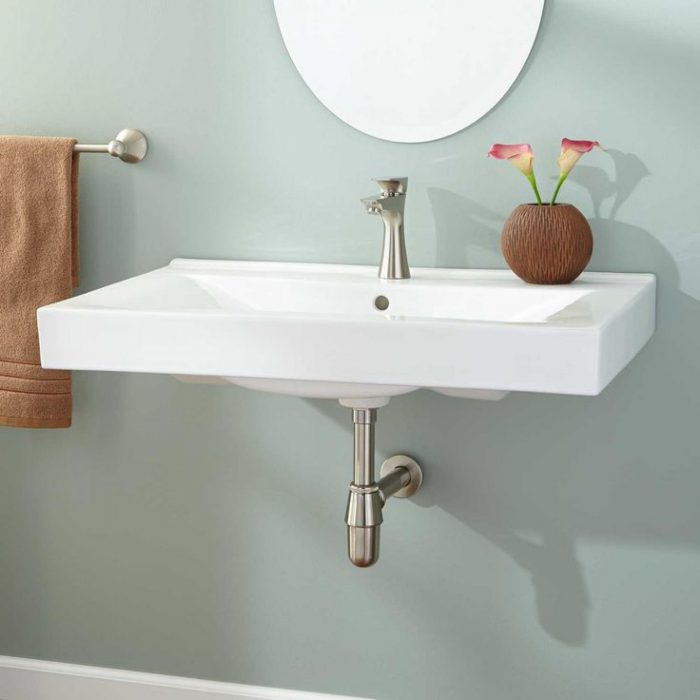
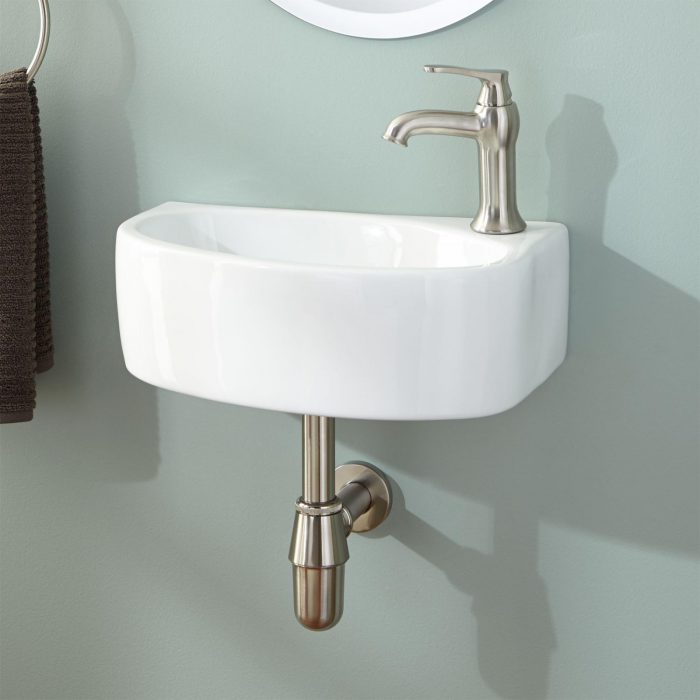
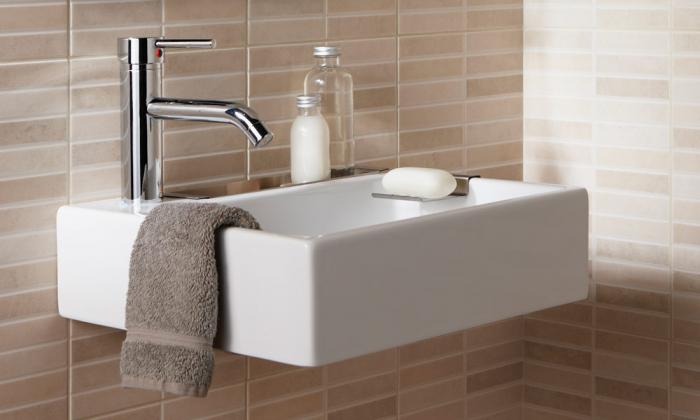
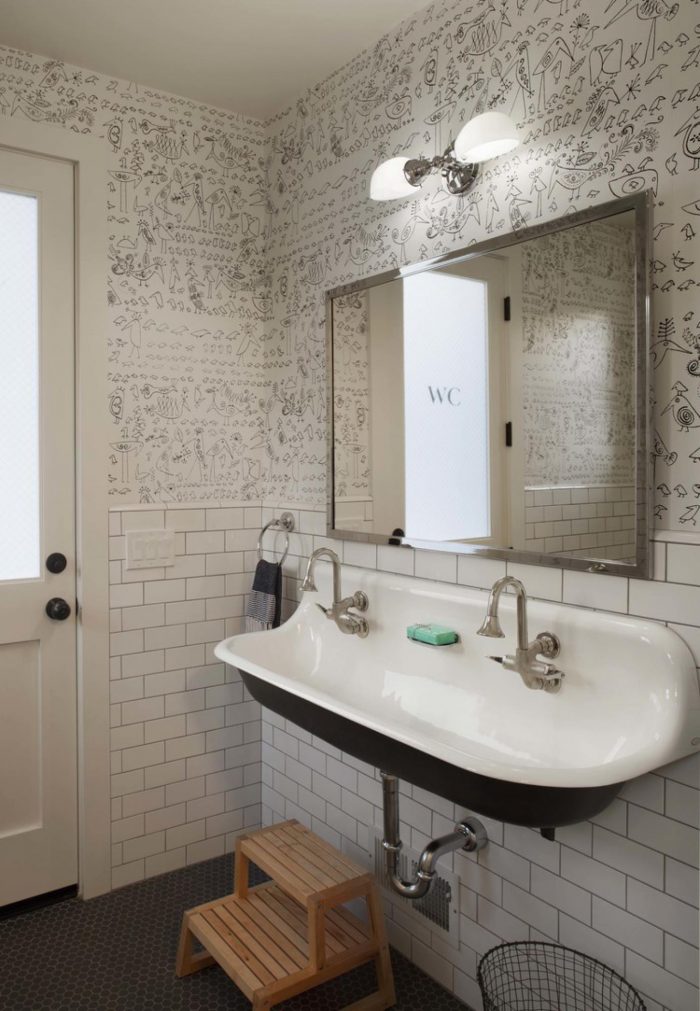
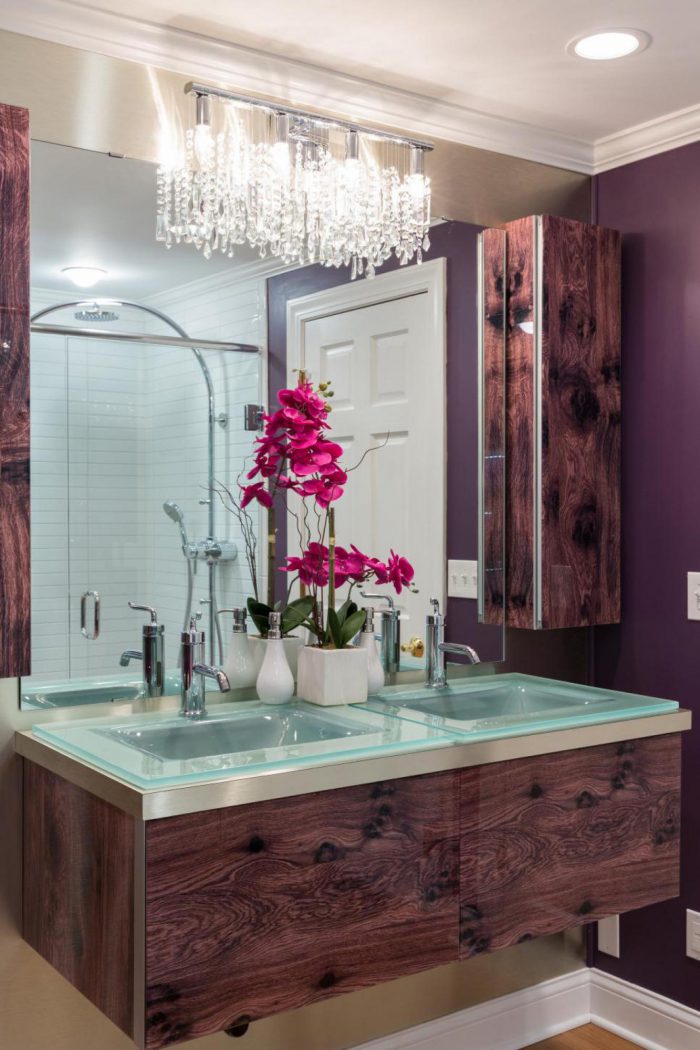
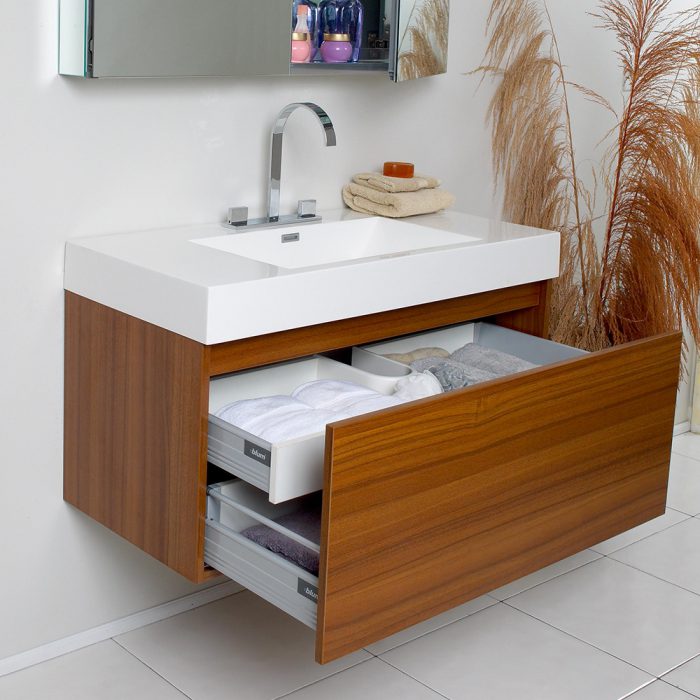
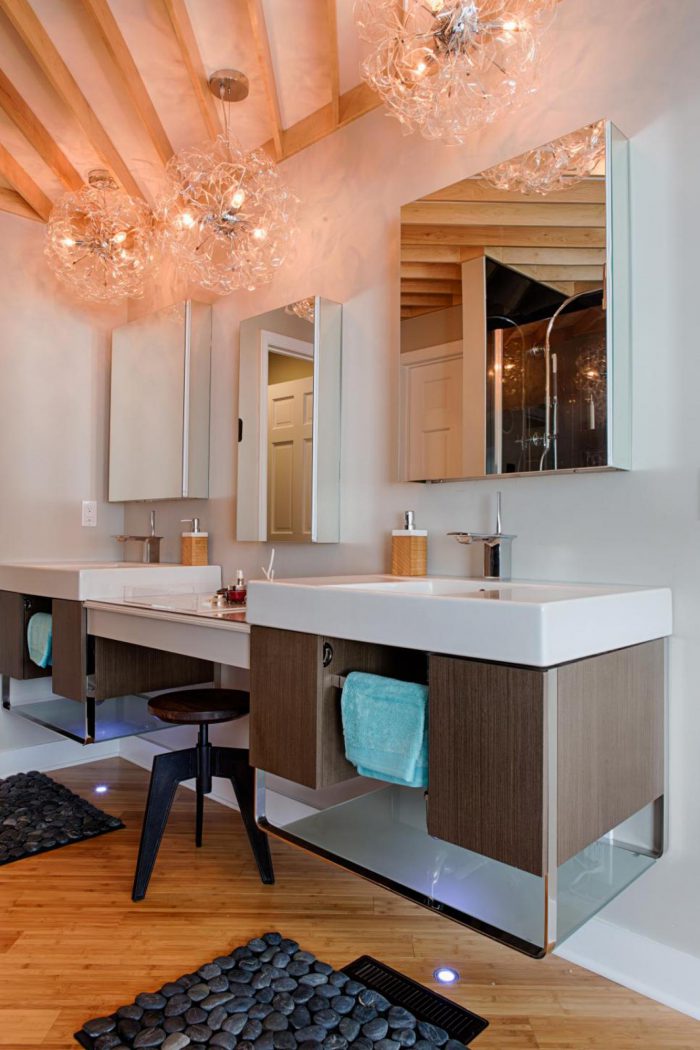
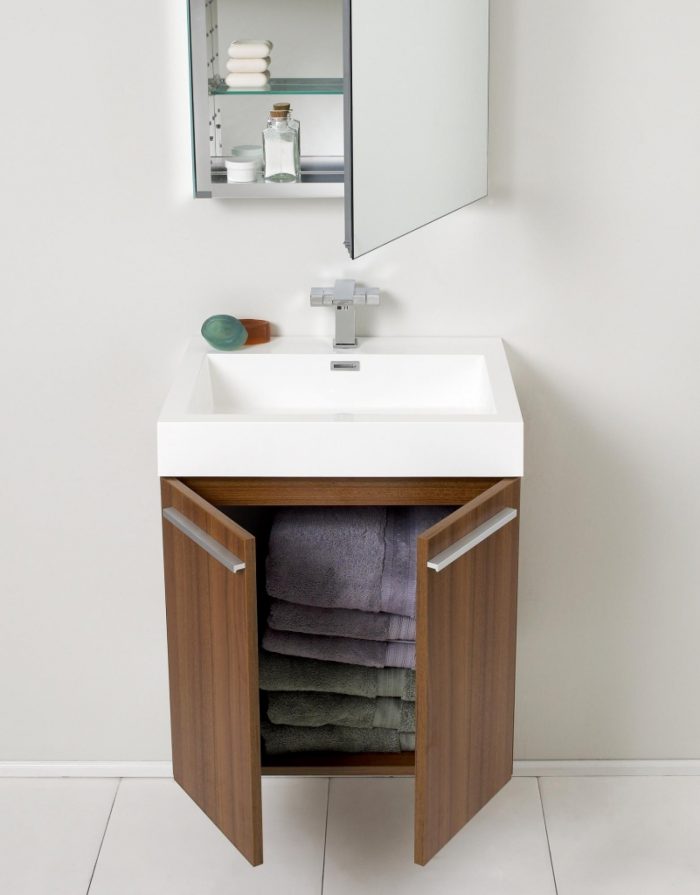
Hanging sink
Such models are mounted directly on the wall, either with dowels, or using brackets, if the product is massive enough. Another option is to equip the sink with a hanging pedestal, which allows not only to hide unattractive communications, but also to organize a reliable support with additional storage spaces.
Attention: When buying a washbasin, you need to pay attention to the hole for the faucet.If there is none, you will have to make a niche to hide the water pipes, and install the tap on the wall
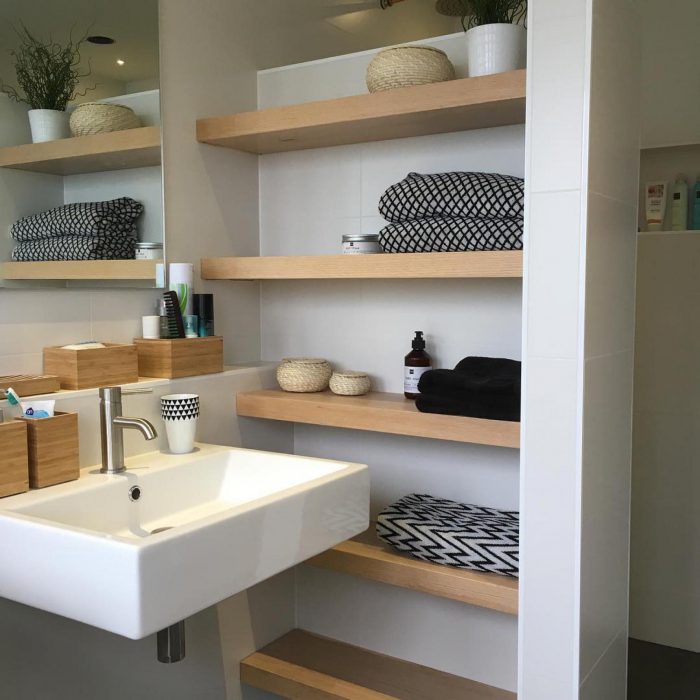
Suspended structures are ideal for small bathrooms, as the space under them remains free. Here you can install a laundry basket, shelves or a stand with bath accessories.
Washbasins look good in modern or retro interiors, but they are much less often chosen for classic or country interiors.
The minus of the model is a problematic installation, which not everyone can handle. The wall should only be capital, partitions are unlikely to withstand the weight of the product.
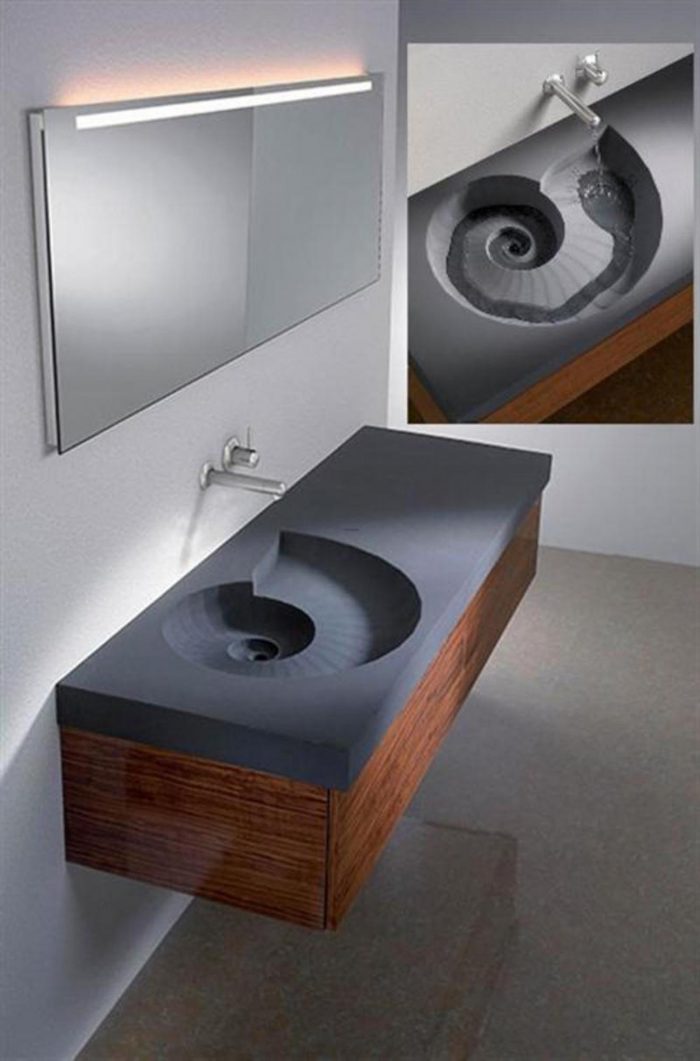
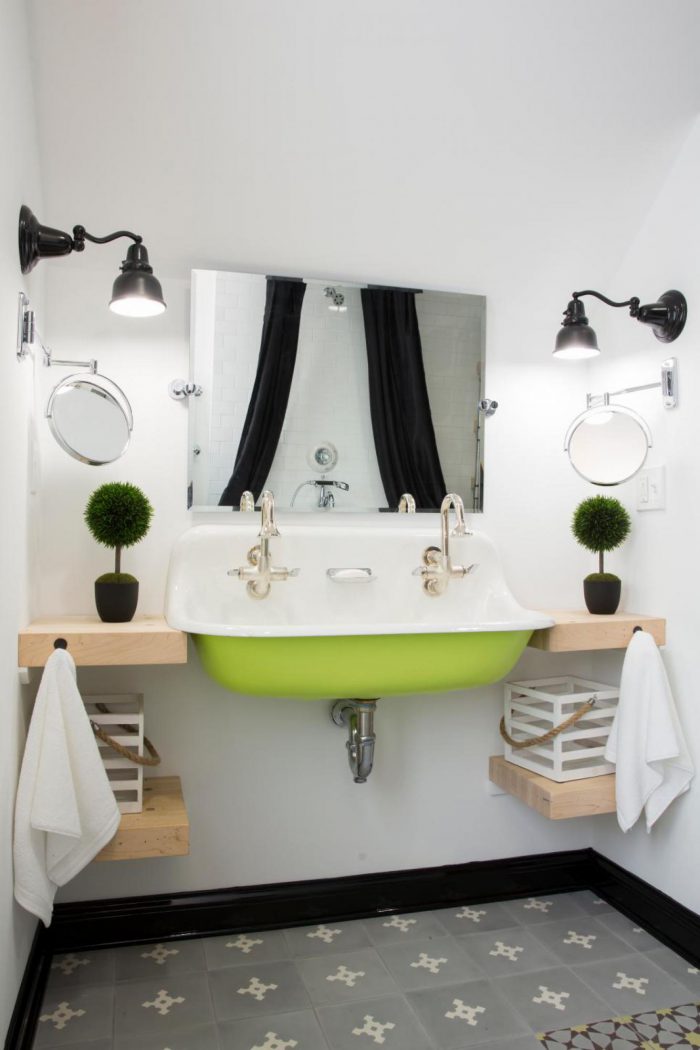
In the photo - the sinks in the bathroom are suspended:
Sink "Tulip"
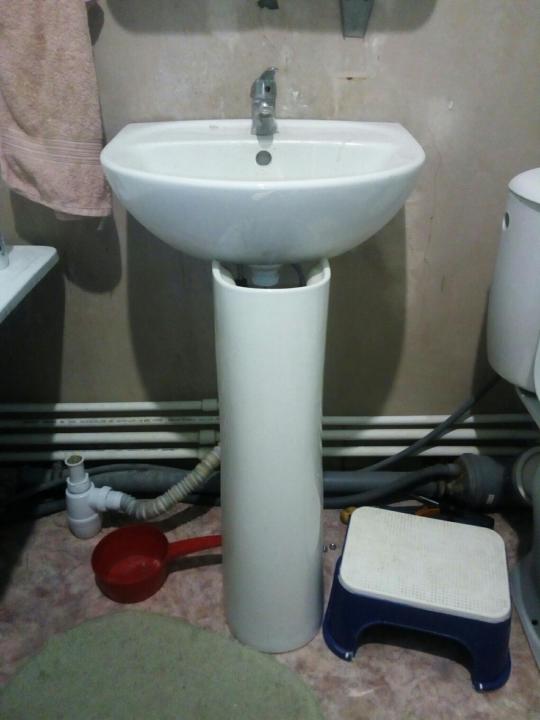
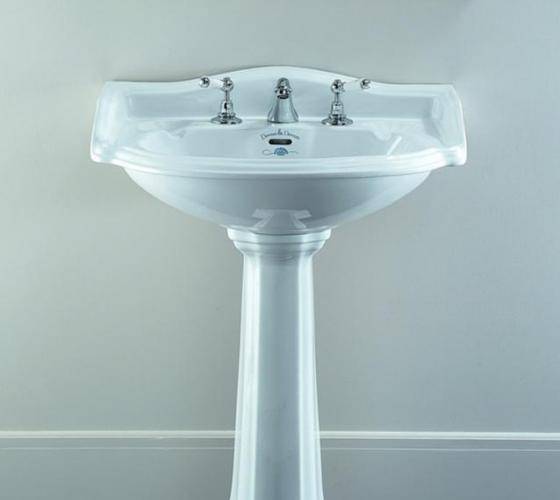
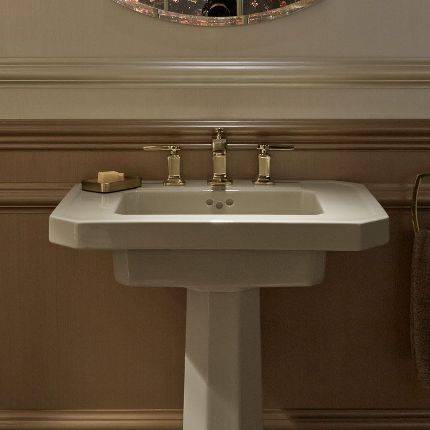
The name of this type of washbasin very accurately reflects their design features. The bowl is installed on a separate pedestal, which masks the siphon and communications wiring. Outwardly, the shell really resembles a flower on a thin stem.
The "tulip", which has become a classic among plumbing fixtures, has several advantages at once:
- simplicity and reliability of fastening
- spectacular appearance
- compact dimensions
- democratic price, compared, for example, with overhead or built-in analogues
Tip: A pedestal sink works best in a classic-style bathroom. It will harmoniously fit into the interior. In addition, in a spacious room (and for the classics only rooms with a large area are used) there are no problems with storing things.




What is important, because there is no place for them under such a washbasin
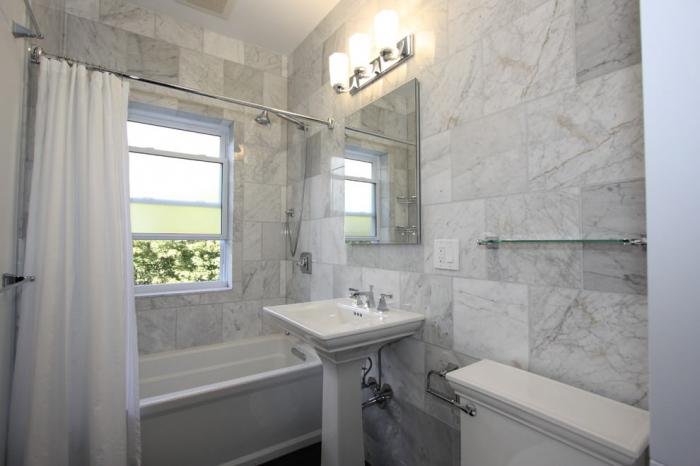
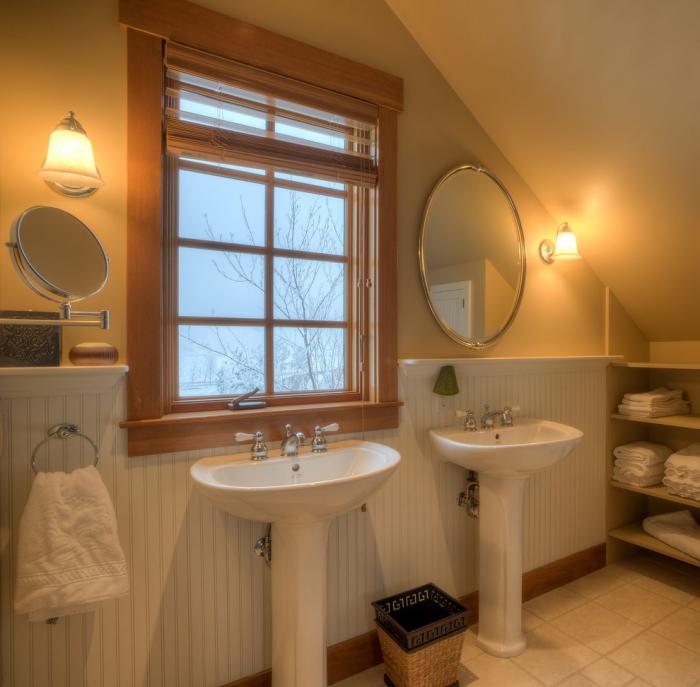
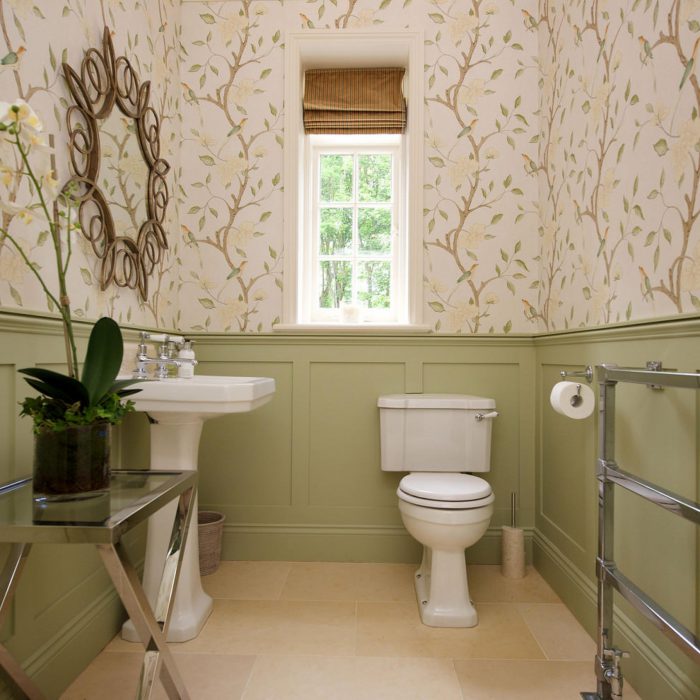
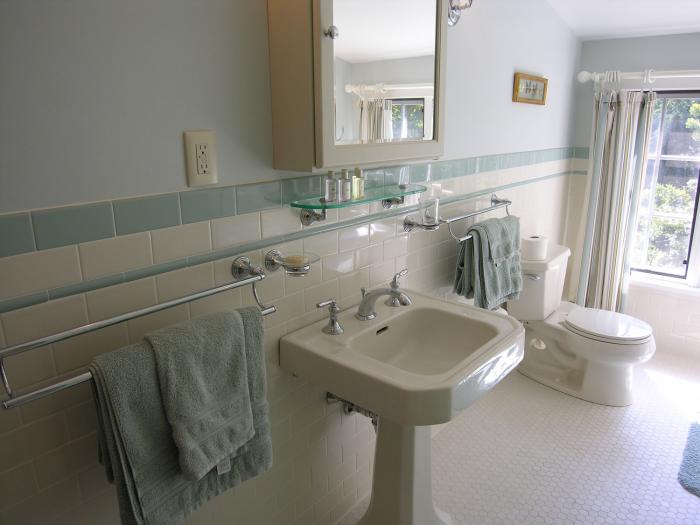
How tulip sinks look in the bathroom can be seen in the following photos:
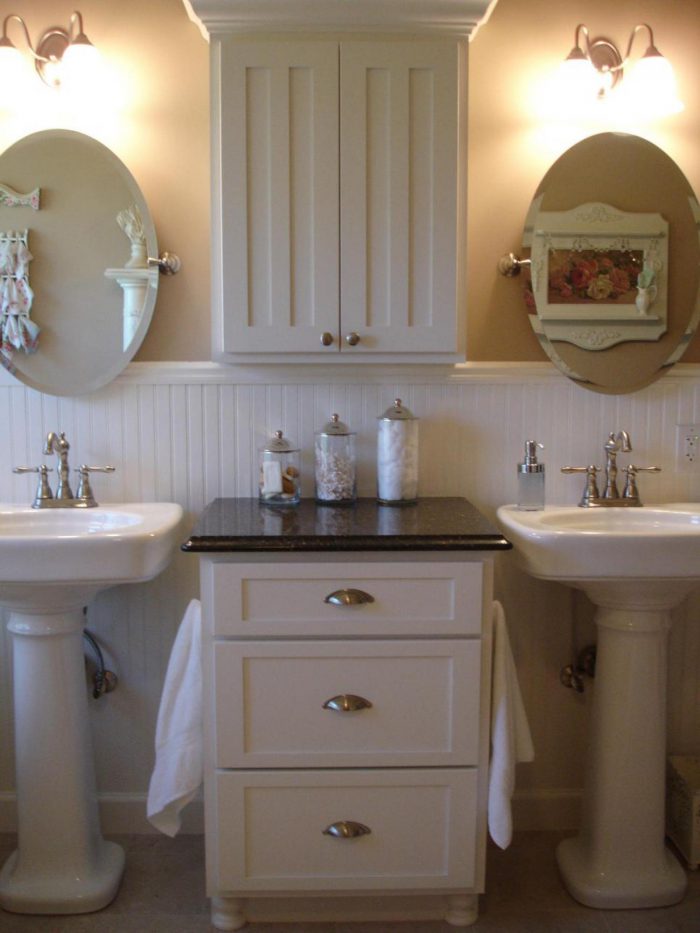
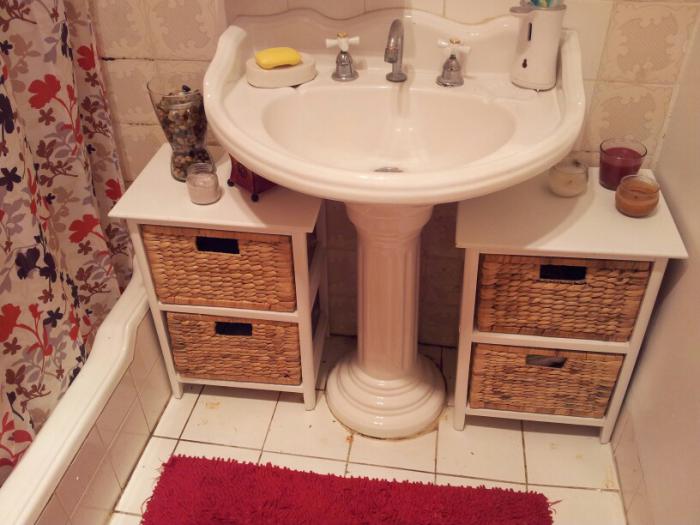
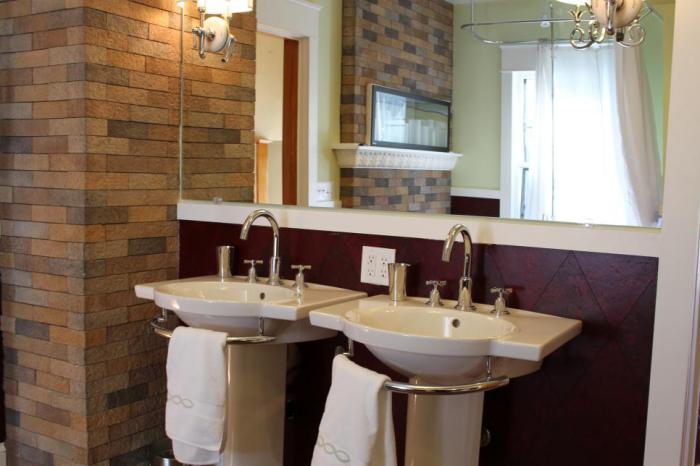
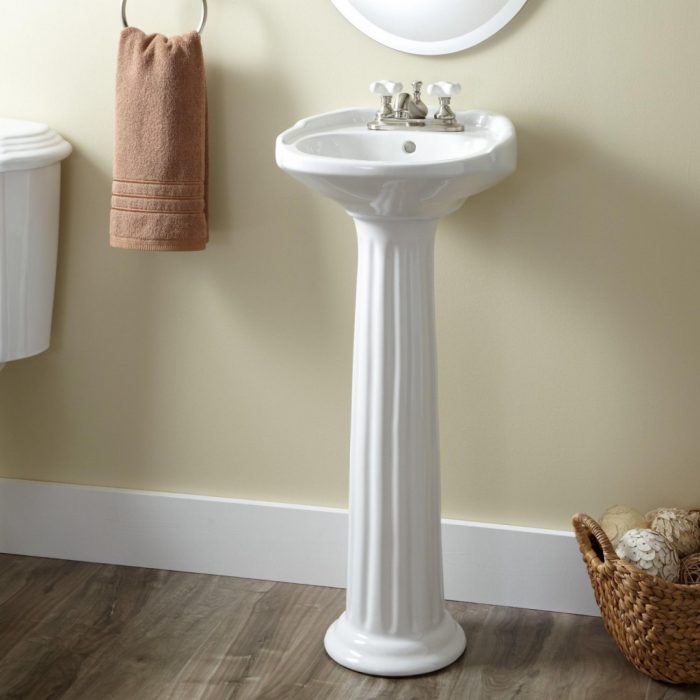

Countertop sink
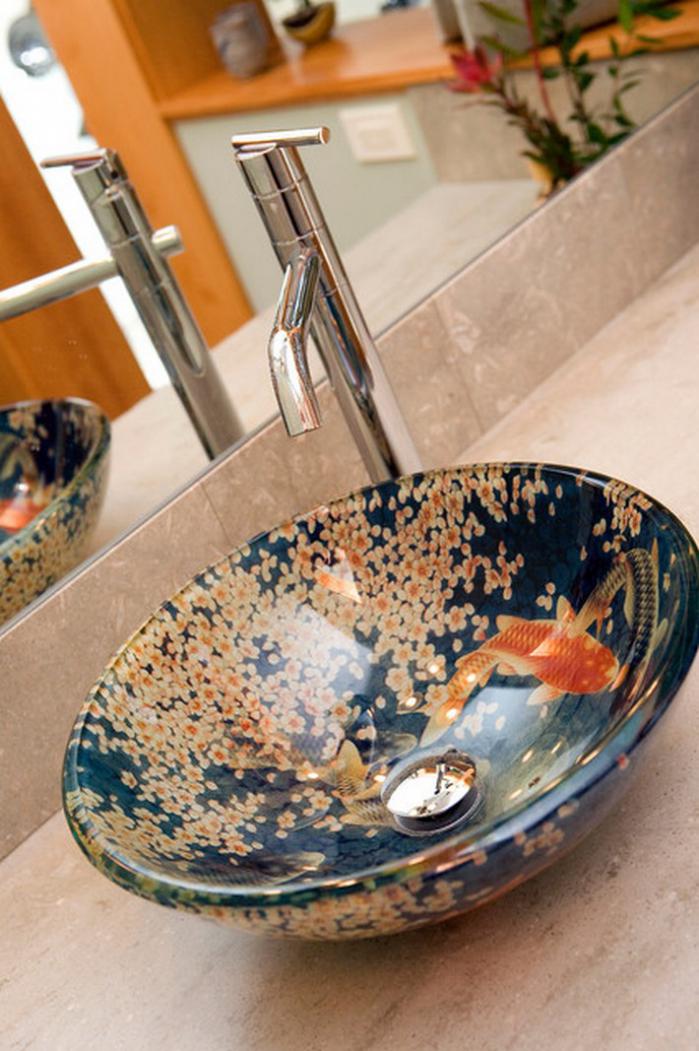
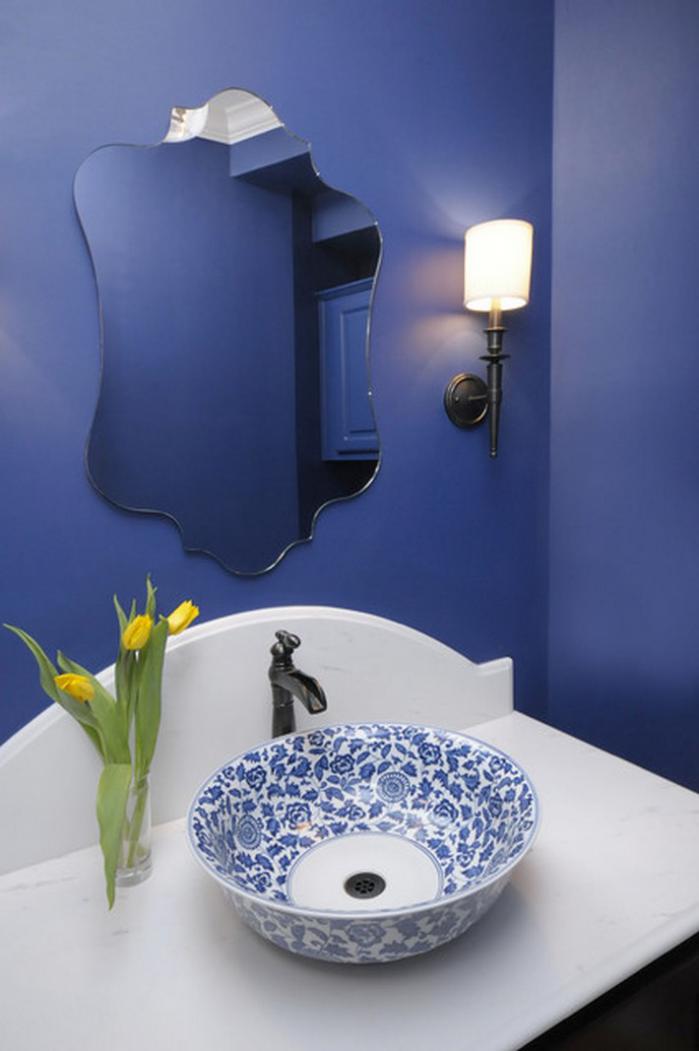
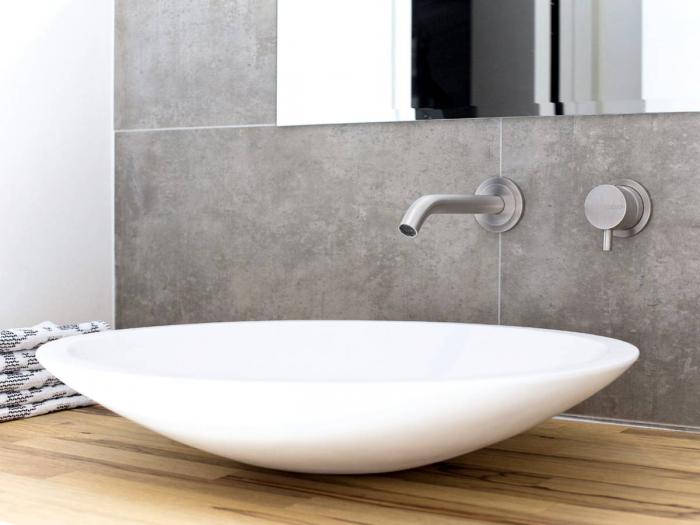
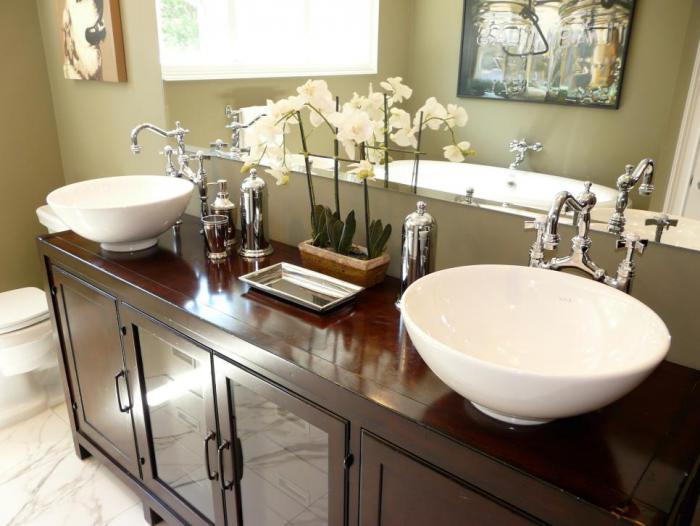
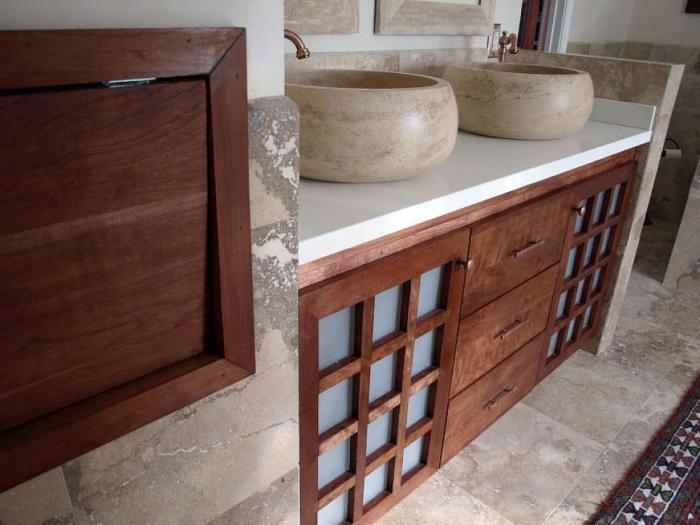
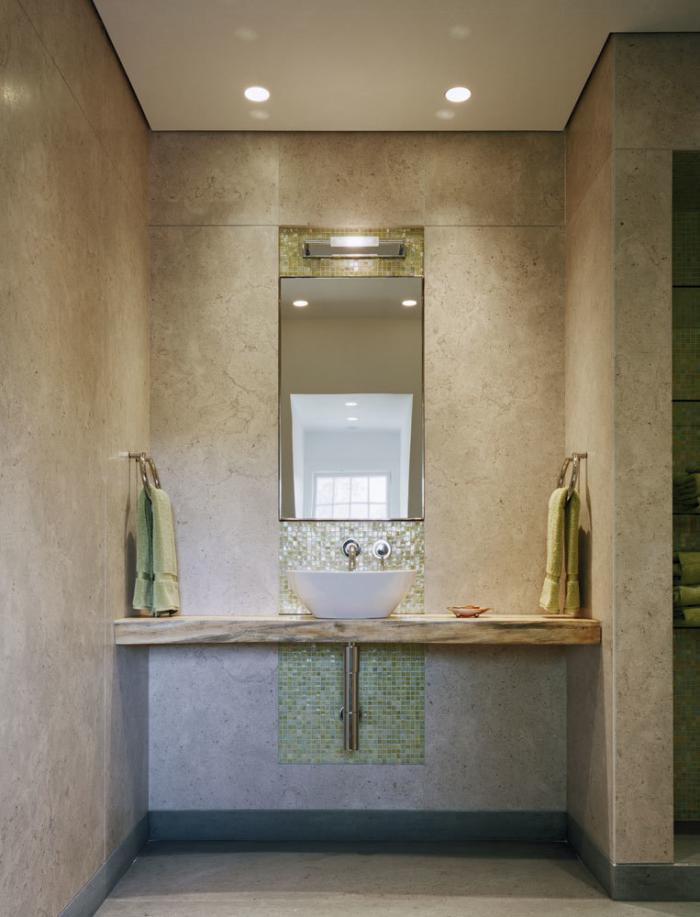
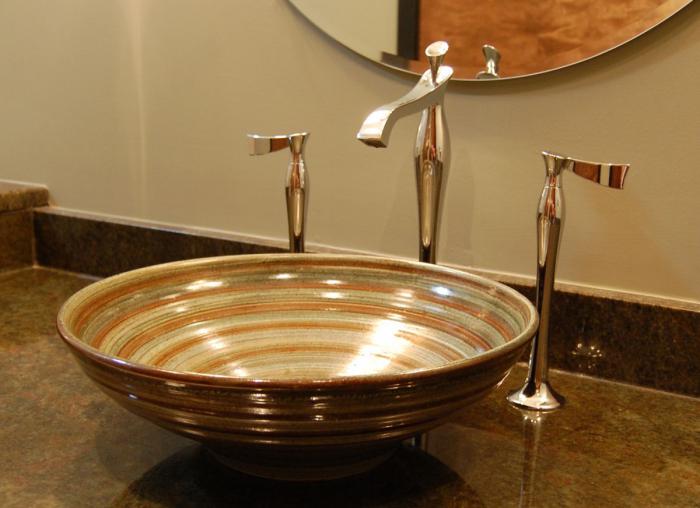
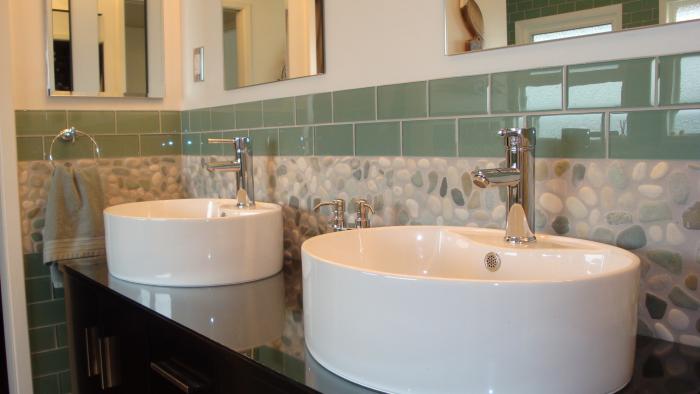
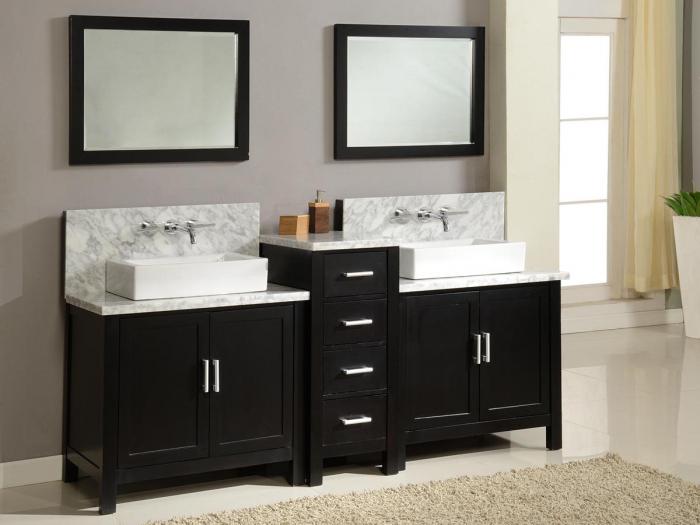
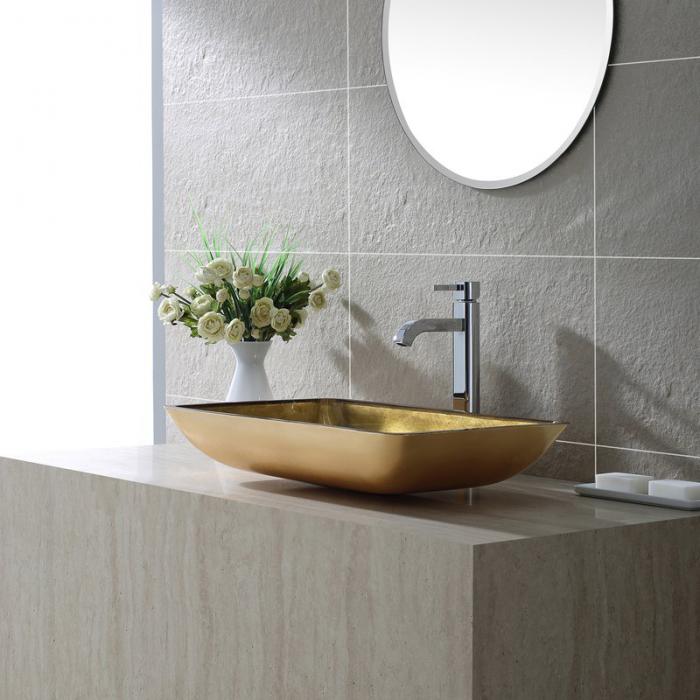
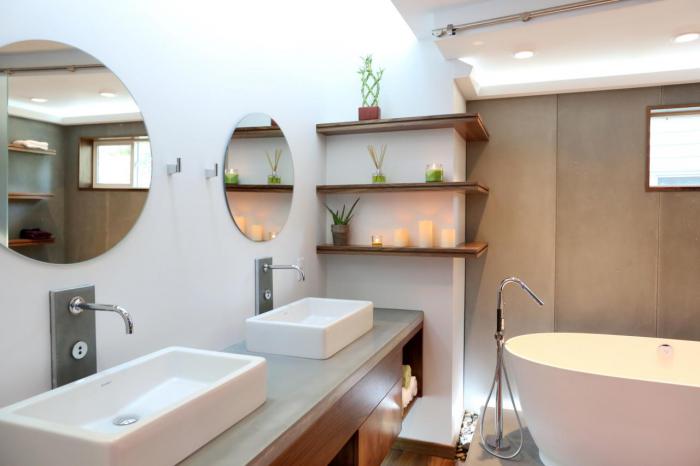
One of the most popular models. It is a bowl mounted on a base.Most often it is a cabinet, less often - a tabletop with legs or a console.
The sink bowl looks very stylish, which won her the love of consumers. But the model is in demand not only because of the original design. Among its advantages:
- speed and ease of installation
- Possibility of support on a tabletop of any size
- a wide range of materials and decorative techniques used
- variety of forms
- convenient sealing of joints, guaranteed protection against leakage
Important: all junctions with the countertop and communication tie-ins must be carefully insulated to avoid dampness and its attendant troubles. The only thing that can scare off consumers is the price of an overhead bowl.
This is the most expensive model on the modern plumbing market.
The only thing that can scare off consumers is the price of the overhead bowl. This is the most expensive model on the modern plumbing market.
Further in the photo - examples of sinks overhead on the countertop:


Varieties of sinks with a pedestal
Depending on the design of the shell-tulips are divided into three types:
- the classic version, consisting of a pedestal and a bowl. Both elements are mounted alternately, and the bowl is attached to the wall, and the pedestal is installed without additional fasteners. Such models are considered the most convenient: individually, parts of the washbasin are easier to fix than a solid structure, and in case of a clogged siphon, it is enough to move the leg aside;
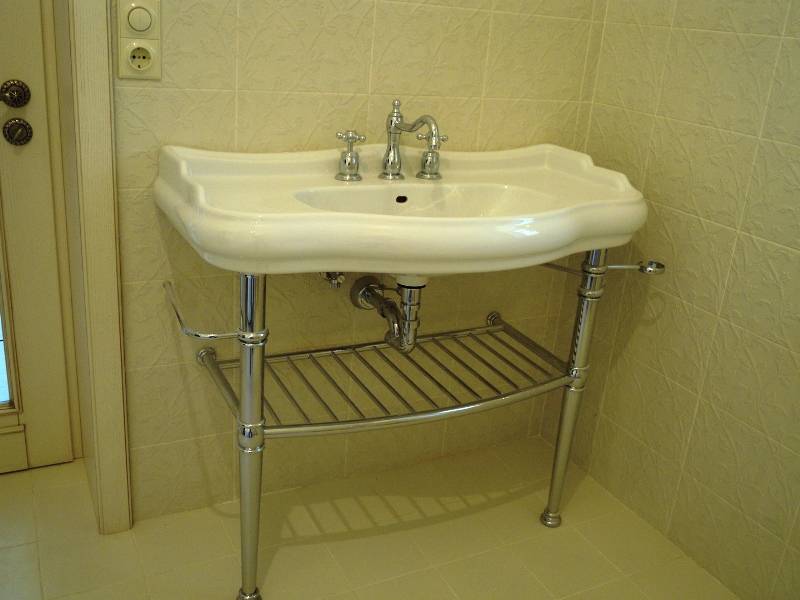
Sink-tulip - consists of two parts: a bowl and a stand (pedestal), in which the pipes for supplying water and sewage are hidden
- monolithic products. They are produced in limited quantities, most often to order, due to the complexity of manufacturing.These washbasins have an original design and look spectacular, but they are more difficult to install. The design is heavy, with an accidental impact it can crack, it is better to carry out installation with an assistant;
- semi-tulip shell. These models have a short pedestal, which is attached close to the wall. Since there is no emphasis on the floor, and the entire load falls on the walls, installation is carried out only on a solid foundation - concrete or brick. Installation is not much more complicated than standard tulip sinks, but in case of blockage, you will have to unscrew the fasteners to get to the siphon. The advantage of such models is that there is free space under the pedestal, which can be used at your discretion.
According to the installation method, the sinks are divided into ordinary and corner ones, and only the bowl has an angular shape, for better adjoining to the walls. The pedestal is not included in the corner itself, so its shape remains the same as that of conventional models mounted against a flat wall. Corner can be made all three types of sinks described above.




The second most popular can be called products made of artificial stone. They are more expensive, but in terms of decorativeness they are significantly superior to ceramic ones, and besides, they have excellent performance characteristics. The casting method allows you to get products of the most non-standard shape with imitation of natural stone of various breeds. The material lends itself well to restoration and polishing, so these sinks can retain their magnificent appearance for years.
For the manufacture of tulip shells, glass, metal, natural stone and even wood are also used. Models made of these materials belong to elite plumbing, so they are distinguished by their original design and a very high price.
Standard washbasins with a pedestal have a width of 45 to 70 cm, small-sized corner ones - only about 30 cm, and sinks with additional side surfaces - from 80 to 90 cm. The total height of the structures is usually 80-90 cm, while the height of the pedestal itself is on average equals 60 cm. Fastening is carried out on studs or anchors, which are screwed into the walls.
Tulip sink installation
To install the washbasin on a pedestal, first of all, you need to prepare everything you need:
- bubble level;
- drill and drill bits for concrete and tiles;
- wrench or adjustable;
- expansion dowels and fixing screws;
- plastic gaskets;
- FUM tape;
- marker;
- silicone sealant.
Preparing for installation
Before installing the washbasin, it is necessary to check and prepare the wall, floor and communication outlets. You can not fix the sink to the wall if the cladding is not firmly held, there are cracks or voids under the tiles. So, to begin with, lightly tap on the tile with a hammer: where the sound is deaf, there is no glue under the cladding, which means you should not install fasteners in this place. Exfoliated and cracked tiles must be replaced with a whole one, empty seams should be filled with grout. If you leave everything as it is, dust, moisture will accumulate in the cracks and seams, and mold will appear over time. Regular cleaning will not work there, because everything will be covered by the washbasin body.
A level is applied to the floor at the installation site of the pedestal, checking the horizontality and evenness of the base.If there are slight differences in height, you will have to additionally use silicone pads so that the washbasin does not stagger. Floor tiles are also inspected for damage, if necessary, close the seams.
Plumbing outlets must be brought to the installation site in advance. If an old sink is being replaced, check the integrity of the stopcocks, the tightness of the pipe connections, and replace rusted parts with new ones.
Mounting a sink with a pedestal
Step 1.
Unpack the sink and pedestal, check the package.
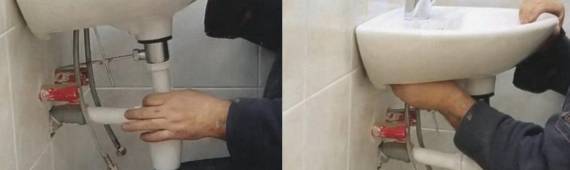
Mount the washbasin on a pedestal
Step 2
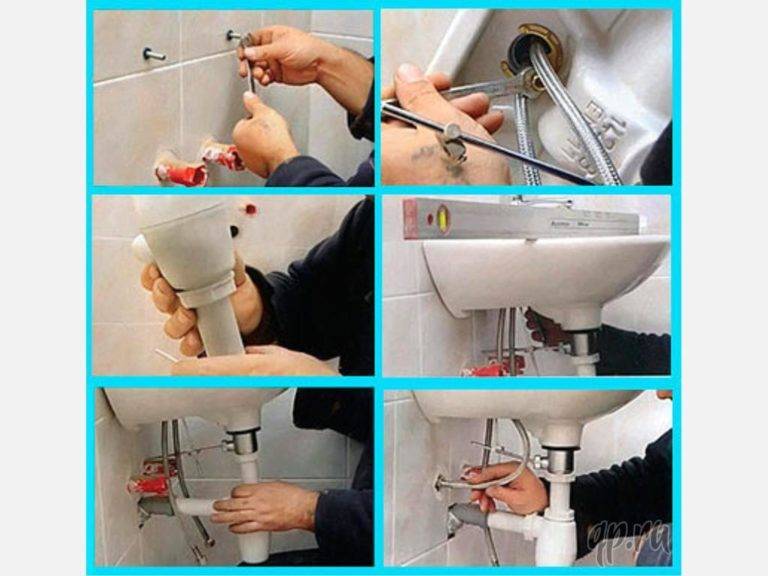
The washbasin is set aside, they take a drill and make holes for the studs. To drill ceramic tiles, you will need a spear-shaped drill with a pobedit soldering, and to further deepen into the wall, it is changed to a conventional concrete drill. The depth of the hole should be 5-10 mm more than the length of the dowel, but the diameter, on the contrary, is a couple of millimeters less.
Step 3
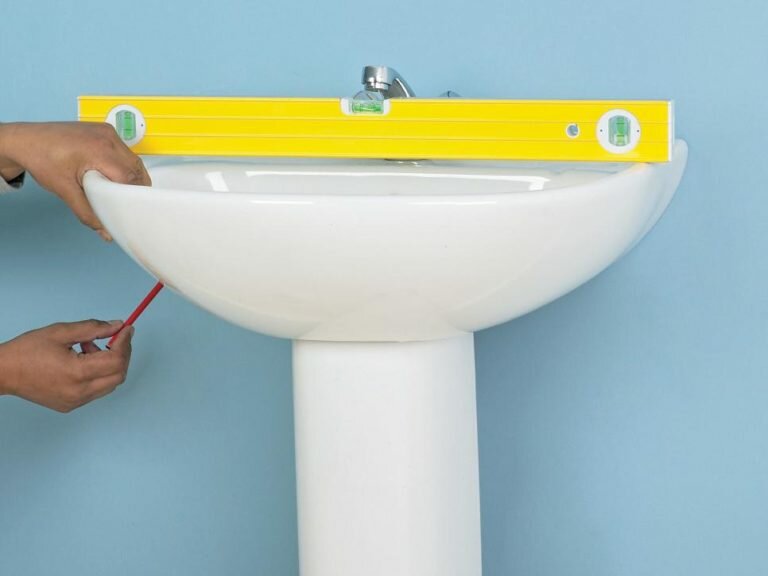
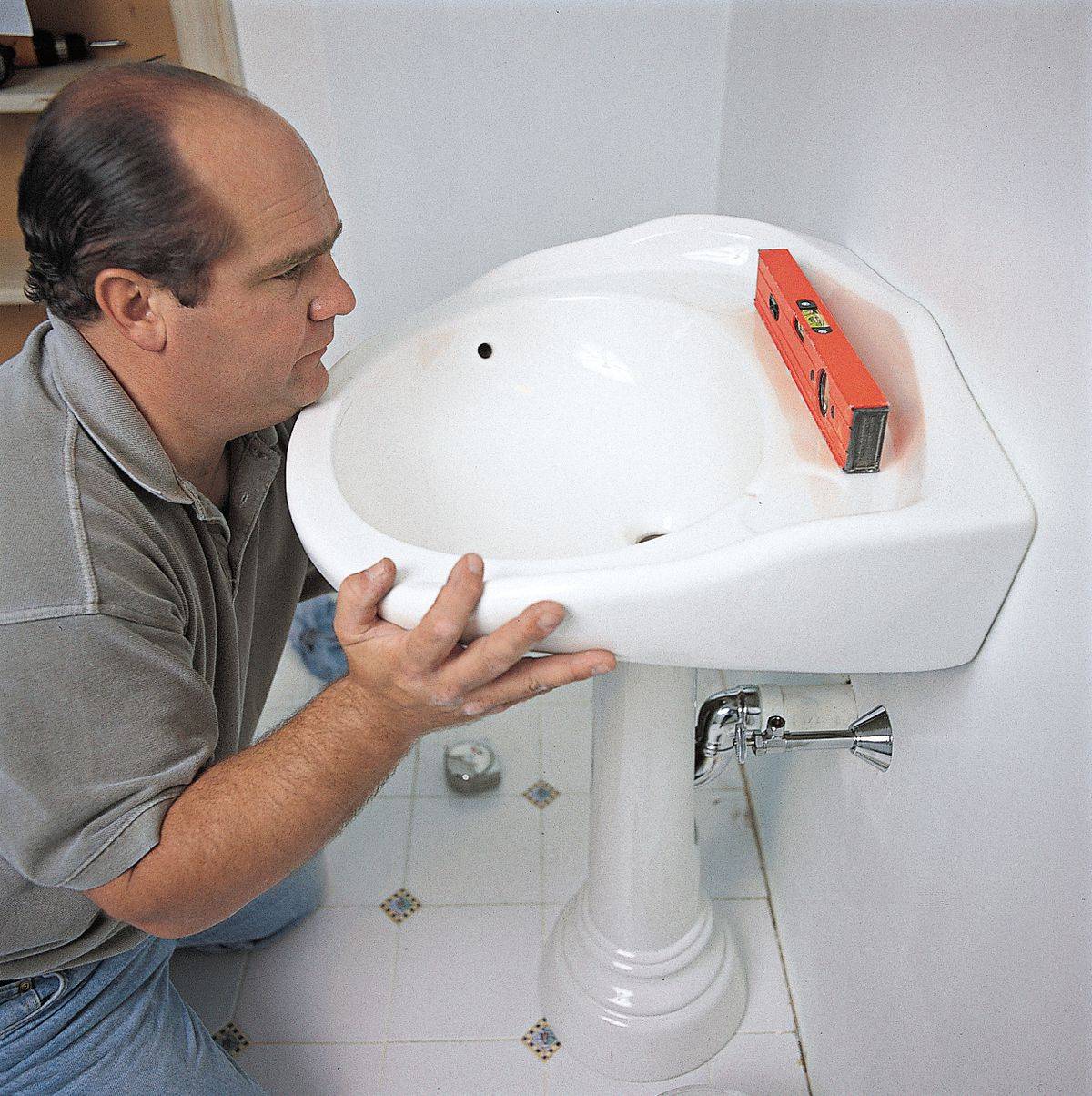
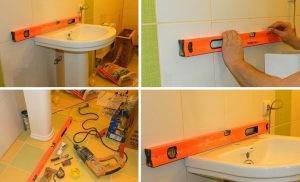
Dowels are hammered into the holes to the stop, screws are inserted, plastic gaskets are put on top and the sink is hung. While holding it in the desired position, carefully tighten the screws on both sides, but not completely. A level is placed on top of the bowl and the horizontal is checked. If the sink is skewed, adjust its position by tightening the screws from the desired side.
Today, the market for sanitary equipment offers a huge variety of different models of sinks.Just some time ago, you could only find standard shells of the usual form of white color. Today, when repairing a bathroom, you can not limit yourself to anything and purchase a sink of any shape, color and design. A unique model is the Tulip sink.
Not only does it look great, but it also has excellent performance. Tulip washbasins were known in our country back in Soviet times, but then they were not so elegant, creative and original. The design of that time practically did not change, but the development of technology made it possible to use various materials and apply original design methods. Thus, today the tulip shell can become an interesting element of the interior.
Pros and cons of a tulip sink
Wash basins with a pedestal have a large number of important advantages:
- Large range of models. On sale there are various modifications that differ not only in design features, but also in design, color, size. Thanks to this, you can always choose the option suitable for the interior of a different stylistic orientation.
- Affordable cost. The cost of a "tulip" mainly depends on the material from which it is made. However, ceteris paribus, the price of this type of washbasin is somewhat lower than for other models (for example, “moidodyr”).
- Compact design. Even conventional modifications have relatively small dimensions, which allows them to be installed in fairly compact rooms. In addition, there are miniature models - corner tulip shells and options with a semi-pedestal.At the same time, even small-sized structures can effectively remove service communications (water and sewer systems) from the eyes.
The tulip shell is practically devoid of flaws. Some inconvenience can be considered the impossibility of using the space under the washbasin (for example, under the bedside tables).
However, there are models that provide additional cabinets and shelves that are attached to the column.
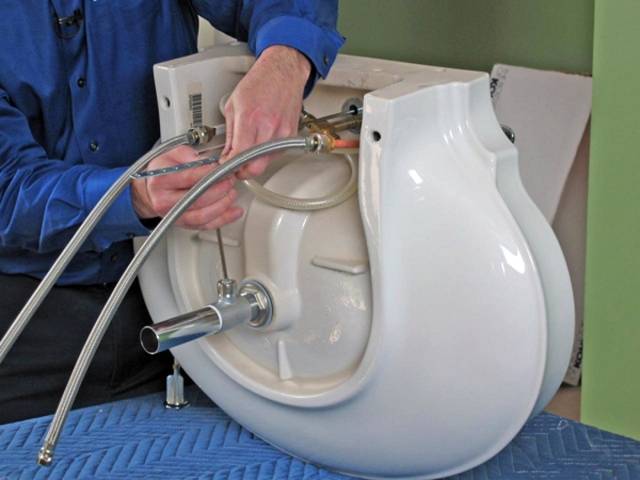
Compared to other types of sanitary ware, the installation of a washbasin with a pedestal is quite easy.
It is only important to attach the bowl to the wall, as well as correctly assemble the mixer and siphon. All this can be done by hand without the involvement of specialists.
You should also take into account the features of models made from different types of materials (porcelain structures are fragile, stone structures are heavy, and so on).
When choosing a model, it is important to pay attention to the following factors:
Support column height. Its length should be such that a person does not have to bend over much when washing. Typical size is 70-80 cm; if it does not fit, it is better to look for another model or stop at a tulip shell with a semi-pedestal. In another article, we took a closer look at sink height standards.
The size and depth of the bowl. The best option is a sink with a width of 55-65 cm. A large modification will take up a lot of space, and from a smaller splash, during washing, they will scatter around. It is also not very convenient to wash from a very shallow bowl, it is better to choose a deeper sink. We talked about the dimensions of the sink in more detail in this material.
Mixer holes.Depending on your preferences, you can choose a model that includes one modern mixer or separate faucets for hot and cold water.
The presence of an overflow. The function prevents the bathroom from flooding when the outlet is clogged. It should only be remembered that overflow requires a special siphon and an additional non-standard pipe.
Accessories. Since pedestal washbasins usually do not include drain fittings, they will most likely have to be purchased separately. It is better to immediately pick up a tulip sink, siphon and faucet made by the same company.
Compliance with the size of the wash basin service communications. If a tulip sink is purchased to install it in a bathroom after a major overhaul with the replacement of water and sewer pipes, absolutely any option will do.
When choosing a washbasin to replace previous sanitary ware, it is important that it matches the remaining communication systems.
Before going to the store, it is advisable to measure and record the distance from the floor to the supply of water pipes and other communication parameters.
Unfortunately, the discrepancy between the conclusions provided on the model and the existing wiring is very difficult, and often impossible to correct. In this case, it is better to return the model that did not fit back to the store.
Before installing a tulip sink, it is important to carefully study the scheme of a particular model, which can have different sizes and design features.
After the purchase, do not forget to check the availability of all the parts of the kit, and only then proceed with the installation of the washbasin.
Types and methods of installation
The installation method of this plumbing fixture directly depends on its type.The most common include:
- Hanging or console washbasin - mounted to the wall on brackets. The shape and dimensions of the device can vary greatly, it is easy to install it. But there is a significant drawback - communications remain in sight;
- Built-in sink - installed in the countertop. The design hides all unsightly communications and makes it possible to use furniture with a built-in sink for storing small items. True, such a design takes up a lot of space;
- "Tulip" (with a pedestal) - it is distinguished by a special pedestal on which a bowl is installed, attractive in appearance and allowing you to hide communications, which led to the popularity of this model;
- A sink in the bathroom with a semi-pedestal - for such products, the pedestal is attached to the wall, it requires a sewer pipe to be connected at a certain height.
How to clean the sink siphon with a leg if the leg gets in the way?
We bought and installed a sink with a leg (tulip), after a while the siphon clogged up, you need to clean it, the leg of the sink interferes with this, how to clean the siphon in such a situation (the pedestal interferes)?
The legs of shells with a pedestal (tulip shell) can be different.
There are hollow legs, there are legs with jumpers.
If your sink does not have a jumper in the leg, then simply move the leg to the side and you will have access to the siphon.
The bowl of the sink is attached to the wall with studs + nuts (there are 2 of them).
We unscrew the nuts, but not completely, then slightly raise the bowl of the sink and move the leg away.
The leg of the sink is not fixed in any way, the bowl, even if you loosen the nuts, will still hold on to the studs.
Everything, we unscrew the siphon flask (sump), clean it and rinse it.
Next, twist in reverse order.
The sealing ring (gasket) must be squeezed out with high quality, in some cases (there is nowhere to squeeze the gasket) it is better to replace it.
If you have a leg with such a jumper,
In this case, we turn off the water (2 root taps on the risers).
We unscrew the hoses of the flexible water supply (all these actions are necessary if a mixer is installed on the sink, if there is only one mixer on the sink and on the bath, we skip all these actions).
We take out the corrugation of the siphon from the sewer tee, or from the pipe, the corner.
We unscrew the screw securing the siphon to the sink.
In some cases, this is not necessary if the siphon sump (flask) allows you to raise the sink bowl through the jumper in the leg.
Next, unscrew the nuts on the studs of the sink bowl.
Completely remove the sink bowl.
Everything, only now you have access to the siphon, clean it as in case 21 (see above), then install the sink in the reverse order.




From personal experience, I can add, I cut off the angle grinder + diamond disc, this jumper on the leg, constantly dismantling the sink to clean the siphon is not the best option.
Now it is enough just to lift the sink and move the leg to the side.
Yes, many people love these. pedestals under the sink, my parents put one for themselves, after six months it was necessary to clean the siphon (it was not installed correctly), but I suffered with this pedestal.
In short, the siphon began to clog, the water does not come down, whatever you do. I tried to break through with a plunger, and poured various means into it, but I couldn’t clean it in any way, I had to disassemble the siphon, but for this it was necessary to move the pedestal.
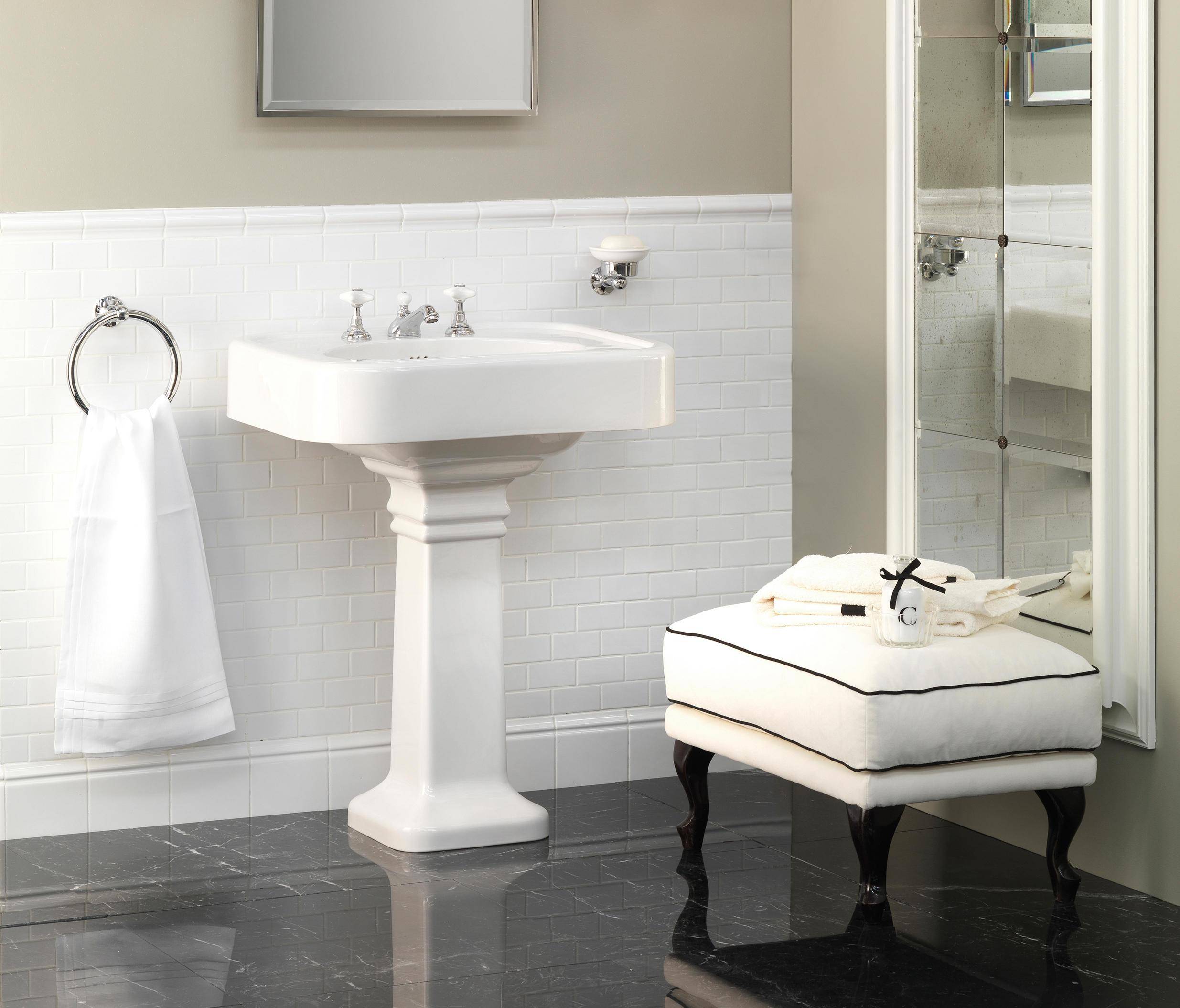
Firstly, I was lucky, they installed the most common option, namely, these are the most common ones, with a cut from above:
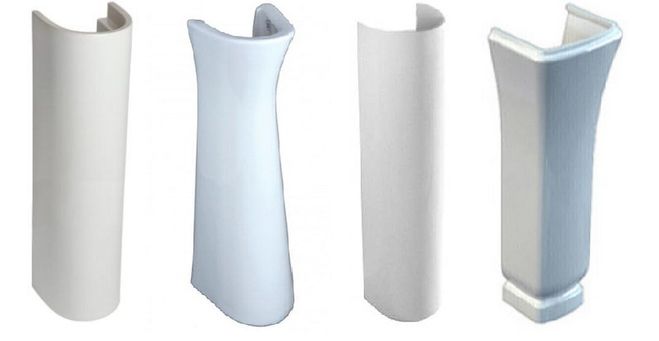
Those. after the sink rises, you can safely remove it onto yourself, but for this you also had to tinker.
- First, I had to slightly loosen the nuts of the sink studs, about 1.5 centimeters on each side. The sink no longer stood rigidly and rose.
- I tore off the sealant between the sink and the wall, because when I started to lift it, it tore itself.
- I had to cut off the sealant between the pedestal and the sink, as well as between the pedestal and the floor (they generally had to be torn off the floor, it stuck well).
- Next, the assistant lifted the sink, and I removed the pedestal.
there was such a problem in the siphon, the pipe was pulled up too much, which made the drain too small, and the siphon was clogged with sand and stones (mother washes shoes in the sink).
After I cleaned the siphon, I didn’t have much difficulty putting the pedestal back, I was more busy with silicone sealant to silicone the seams.
But there are different pedestals, if one is installed like this, then you will have to remove the sink completely in order to get to the drain.
Common Mistakes
An unfortunate mistake can interfere with the installation process, which will spoil the results of the work. Usually there are such problems:
- Mounts are located at different levels, which leads to the tilt of the bowl. Fixings should be adjusted or new ones made.
- The distance between the plumbing and the wall is too wide, so water is poured there. Silicone sealant will solve the problem.
- The connections are too loose. In this case, a leakage problem appears, which is easy to solve using a sealant.
- The structure is fragile and wobbles from side to side. This happens if the screws are not tightened enough or the floor is uneven. Tighten the screws or level the surface.
WATCH VIDEO
The choice of a sink in a bathroom with a pedestal and its installation is not such a difficult matter that a non-professional can not cope with it. But if you have purchased non-standard plumbing, made of fragile material, or are not sure that you can do the job yourself, contact experienced craftsmen.
History of creation
During the time of Khrushchev, the artillery troops were, in principle, declared not to meet the requirements of the time. The development of rockets was required. At that time, several promising samples were in the stage of experimental testing, which pierced the armor of any tank. But it was customary to carry out the order, and the equipment was dismantled.
Something was preserved somewhere, someone’s hand did not rise to disassemble their creation, and thanks to this, the SU-100P Taran anti-tank gun now stands in the famous museum of armored vehicles in Kubinka.
It clearly showed the lag of our artillery from the American one. The United States used the M109 installation, which hit a target at a distance of up to 14 km. They urgently began to recall old developments, to catch up with the West in the development of artillery. Then the creation of an armor-piercing bouquet was started in the Urals - "Acacia", "Hyacinth" and "Tulip" - a howitzer, the photo of which is presented below. The deadlines were given tight, and already in 1971 the machines were field tested and put into service. Since then, they have remained there, of course, with some modifications and modifications.
Installation of a sink with a pedestal (tulip)
Installation begins with marking the places where the sink is attached to the wall.
To do this, put the sink on your leg and mark the holes.
But before that, you need to completely assemble all the fittings attached to the sink in order to do the fitting taking into account the entire “body kit”. Attach a faucet, flexible hoses, siphon outlets or corrugation to the sink. This will determine whether it will be convenient enough to connect to the connection points of existing water supply and sewerage networks.
The outlet is fastened through the gasket with a screwdriver, tightening the screw on the stainless steel divider grill, which serves to trap large debris.
After that, a faucet, outlet fittings and connections are screwed to the sink.
The leg (pedestal) of the sink is placed against the wall where the sink will be located.
A sink with fittings screwed to it is installed on the leg. In the process of fitting, it is desirable to check the horizontal installation of the rear wall of the sink using a hydraulic level.
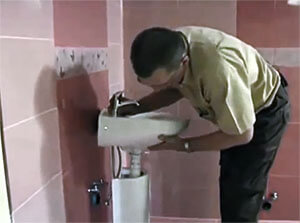
After that, we check whether all the inlets and outlets can freely reach the points of connection. If necessary, you should immediately make adjustments - move the sink or use a different length of inlet / outlet.
After that, using a soft pencil, you should mark on the wall the location of the mounting holes in the ceramic body of the sink from the side of the tailgate. In these places, you will need to drill a wall, insert dowels into the holes made and screw in the studs that will fix the sink to the wall.
When the installation sites are marked, with the help of a core, a light blow of a hammer on the wall marks the drilling site.
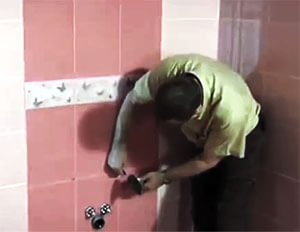
If the core is not at hand, you can use a drill with a carbide tip.
If tiles are laid on the wall, be very careful not to split them. In this case, you can use the tips from the article How to drill tiles and stick thick tape at the drilling sites to prevent the drill from slipping at the beginning of drilling.
After that, you need to drill holes to the desired depth. If the wall is covered with tiles, you should first go through the tile with a special drill bit, and then continue drilling by rearranging the drill with a carbide tip and turning on the drill in shock mode.
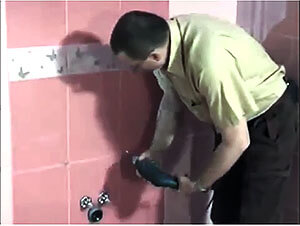
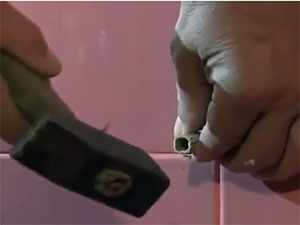
After that, using an adjustable or open-end wrench of a suitable size, you need to tighten the studs:
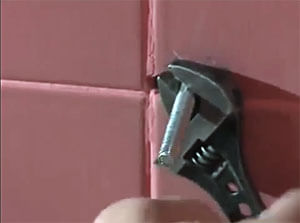
Everything, metal threaded studs are screwed into the wall and you can screw the sink to them.
The leg is placed at the installation site on the floor, and the sink is installed on the leg, putting on metal studs sticking out of the wall.
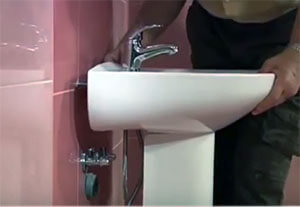
The sink is fixed to the studs with nuts through elastic gaskets.
The nuts should be tightened very carefully so that the earthenware does not burst at the attachment point from excessive force. As soon as the nut begins to go with effort, you should stop tightening
In addition, when tightening the nuts, you need to tighten them in turn - a little first, then the second, then again a little first, then again a little second, and so on. The same method of tightening the nuts is used when installing the toilet bowl - it is fixed to the floor in exactly the same way by tightening the nuts one by one. This allows you to more evenly distribute the resulting forces in the body of a fragile plumbing fixture and prevent cracks.




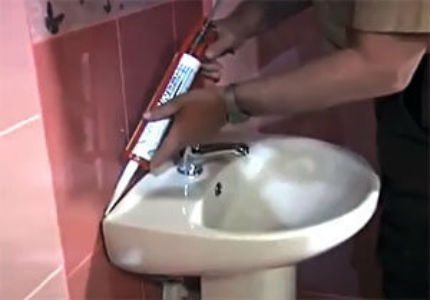
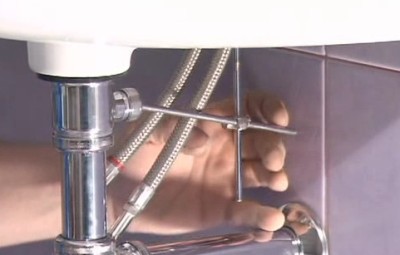

Special caps are put on the nuts to prevent debris from entering and preventing metal corrosion.Under the caps, you can smear a little grease. In this place, no one will see him, and if necessary, remove the sink, the nuts can be easily unscrewed even after a year, as if you screwed them yesterday.
Combining good looks with functionality, the pedestal washbasin is a popular sanitary ware option.
Having learned how to install the tulip sink yourself, you can decorate the bathroom with your own hands.
A distinctive feature of the tulip shell is a high hollow pedestal stem, thanks to which the model acquires a resemblance to the flower from which it takes its name.
The support column not only gives the model an elegant look, but also performs a number of useful functions:
- The pedestal gives to a design necessary rigidity, stability, reliability.
- Under mechanical influences on the bowl, the leg takes the load on itself, protecting the sink from damage.
- A hollow column allows you to remove service communications (water supply and drainage systems) from view, making the room look neat and beautiful.
The pedestal, like the bowl, can have a different decorative design, thanks to which a wide variety of models is achieved.
Image gallery
What is a tulip shell?
As mentioned above, the type of washbasin called "tulip" has been quite popular for many years, so there is hardly a person who will ask the question: what is a "tulip" sink? In fact, this washbasin has only one difference from the usual one: it is located on a leg. The leg-column has two important functions: firstly, it hides water and sewer pipes, and secondly, it serves as a support that makes the structure more stable.If desired, you can make a pedestal for the sink with your own hands.
This type of sink has a number of advantages:
Variety of models, their colors and shapes
Everyone can find something to their liking.
Suitable for various interiors - such a washbasin will look great in any bathroom.
The washbasin bowl is very compact, especially if you pay attention to the "mini" models.
Under the sink there is a lot of free space that can be usefully disposed of.
Ease of installation. If you prepare, you can master the installation of the sink even with your own hands.
budget
The price of such models is relatively low, but we must remember that the cost of an item is mainly determined not by the external design, but by the material and quality of the product. However, if you look at other models of washbasins made of a similar material, then the tulip will certainly cost less.
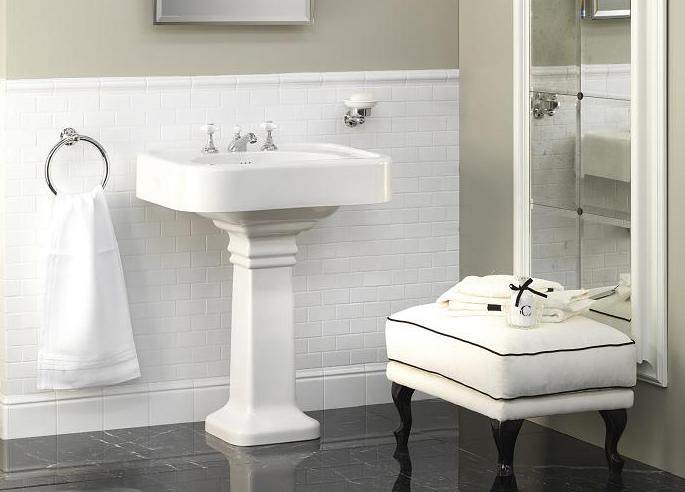
When choosing a product, you should pay attention to important differences. Tulip-type washbasins can be distinguished by some characteristics:
Conclusions and useful video on the topic
In the video below, you can clearly see how to install the sink.
As you can see, having the available tools at hand, the installation of the “tulip” is quite easy. A little effort and time spent - and your bathroom will be decorated with an elegant washbasin, resembling the head of a beautiful flower.
.
Or maybe you are just understanding the process of installing the sink and you still have unexplained points? Feel free to ask questions - we will try to help you.
Add site to bookmarks
- Kinds
- Choice
- Mounting
- Finishing
- Repair
- Installation
- Device
- Cleaning
Features of installing a tulip sink
Many people decide to install the sink themselves at home, but first you need to choose it wisely. One of the common options is the installation of a tulip sink, it, like other options, has some features.
Drawing and dimensions of the shell-tulip.
If you already have all communications in the bathroom, then before you put the tulip sink, you need to measure the distance from the floor to the water supply point and, based on this, purchase a washbasin of a certain height. You can not select the height in the case when communications are planned to be mounted after the installation of the tulip sink is completed.
The tulip sink can have a monolithic design or consist of two parts: a washbasin and a stand.
All communications are hidden in the stand, a bowl rests on it, which is additionally attached to the wall. As a design flaw, one can call the fact that the cranes on it have a fixed height, and this is not always convenient for children.