- Classification of gas pipelines
- High pressure I-A category
- High pressure category I
- Medium pressure
- Low pressure
- What does turnkey gasification include?
- Designing a gas fire extinguishing installation
- Registration of gasification of the house
- Obtaining specifications
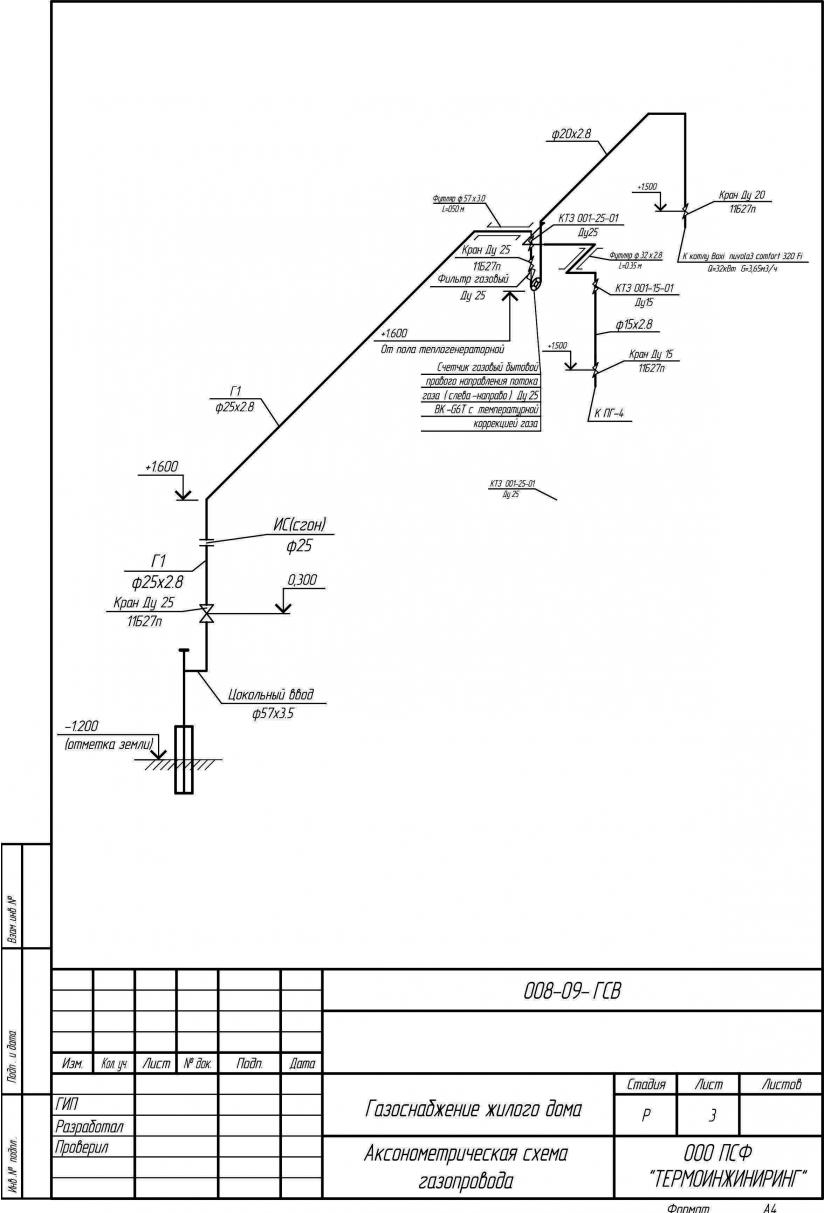
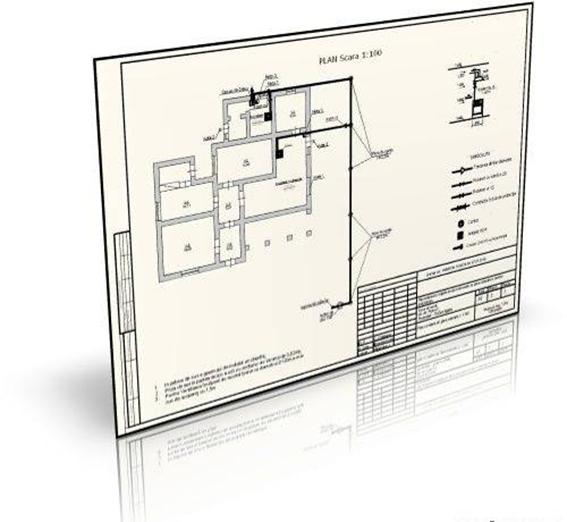
- Development of a gas supply project
- Issuance of a power of attorney for gas connection
- How to choose a project contractor
- The cost of autonomous gasification of a private house
- Design of gas supply systems - Turnkey project: GK OdinPROEKT
- Features and necessity of the gas supply system
- Our services
- Gas pipeline design process
- Factors taken into account when designing a gas pipeline
- The documents
- The cost of a gas supply project
- Call! +7 (903) 541-07-34
- List of required documents
- Taxes and Government fees for connection to the gas pipeline
- Required information for the design of outdoor and underground systems
- 1.2 Information about climatic and engineering-geological studies
- The need for design
- Conclusions and useful video on the topic
- conclusions
Classification of gas pipelines
According to GOST standards, all gas pipelines are divided into categories or classes according to the pressure of the substance being moved.The main facilities that carry out transit delivery over long distances are divided into two categories, the first is capable of transporting gas with parameters from 25.0 to 100.0 kgf/cm2, the second is calculated for indicators from 12.0 to 25.0 kgf/cm2.
The design of gas networks that perform distribution functions in settlements provides for the use of other indicators of the gaseous medium for the calculated values.
Distribution branches, depending on the pressure, are divided into categories:
High pressure I-A category
It is used to supply gas over 12.0 kgf/cm2 to large urban areas or industrial enterprises with large volumes of consumption for technological needs.
High pressure category I
It is used in urban networks at values from 3.0 to 6.0 kgf/cm2 for further transmission through gas control units (GRP, ShRP, GRPSH, GSGO, GRPSHN, PGB, UGRSH, GRPB) to medium and low pressure networks.
Medium pressure
From 0.05 to 3.0 kgf / cm2, concentrated in district and street distribution networks, from which low-pressure consumers or industrial enterprises with large consumption are fed.
Low pressure
From 0.05 kgf / cm2 and below, they are used to connect gas appliances in private sector houses, multi-apartment residential buildings (not higher than 10-story buildings), public buildings, catering establishments and other facilities, the gas supply to which does not contradict the requirements of construction norms and rules.
The design of gas pipelines should provide for permissible distances between gas pipes and city communications, as well as the allocation of a security zone of up to 10.0 meters on both sides of the main gas pipelines, which is regulated by safety rules.
What does turnkey gasification include?
This includes:
- Departure to the place and measurement of all dimensions of the site. This work is necessary to draw up a site plan, place all existing buildings on it, determine the degree of improvement and outline the location of the future gas tank and gas pipeline.
- Building a plan of the house with the application of all gas-consuming devices on it. Collection of passport and technical characteristics of equipment.
- System design taking into account the requirements of modern regulatory documentation. This includes the selection and proper placement of a gas tank, the routing of a low-pressure gas pipeline throughout the site and the house, the selection of the necessary shut-off, control valves and automation.
- Purchase of certified equipment and materials in specialized stores and its delivery to the construction site.
- Installation of the designed system. If it is impossible to carry out the construction strictly in accordance with the project, the designers are called to correct the decisions made.
- Gas pipeline testing, troubleshooting.
- Providing a guarantee for the work performed.
Designing a gas fire extinguishing installation
Now is the time to find out what is needed to prepare for the design, what stages the project consists of. We draw up the project, guided by the document SP 5.13130.2009.
Before the first stage of the project, we need to collect and study the following information:
- purpose of the premises: warehouse, public, industrial or residential;
- location of utilities: water, electricity, ventilation, internet and telephone cables;
- architectural and planning, design features of the object;
- climatic conditions, maintained air temperature;
- class of fire and explosion hazard of the structure.
Having studied and analyzed this information in detail, we will be able to identify the successive stages of our planning.
Development of project documentation is carried out in accordance with this plan.
- Definition and approval of TOR for the project.
- Setting the efficiency indicator of AUGPT, taking into account the indicator of leakage of the protected object.
- Determining the type of fire extinguishing agent.
- Hydraulic calculation of AUGPT. We produce it according to the methodology from the document SNiP RK 2.02-15-2003. It includes calculation:
- estimated mass of OM for fire suppression;
- the duration of the substance delivery;
- irrigation intensity;
- maximum extinguishing area with one sprinkler;
- the diameter of the pipelines of the system, outlets, the number and type of nozzles (filters) for uniform distribution of gas throughout the facility;
- the maximum value of excess pressure during injection of the working solution;
- the number of system modules, as well as the stock of RH.
- Estimation of costs for equipment, installation of AUGPT.
- Calculation of the size of openings for ejecting a substance into a room under excessive pressure.
- Calculation of the delay time for the release of gas to the outside, which will be required to turn off the ventilation system, etc., as well as the safe evacuation of people (at least 10 seconds).
- Selecting the type of device: centralized or modular.
- Determining the number of RH cylinders to be installed.
- Decision on the need to keep a stock of fire extinguishing agent.
- Create a piping layout.
- Deciding on the need for a local start device for a centralized AUGPT.
- Establishment of the correct design of pipelines.
- The choice of control devices for a gas fire extinguishing installation.
After the completion of the project, i.e. a complete calculation of the installation, as well as the purchase of the necessary equipment, we can begin the process of installation and commissioning, which are regulated by regulatory documents SNiP 3.05.06-85, RD 78.145-93 and other engineering, technical, legal documentation.
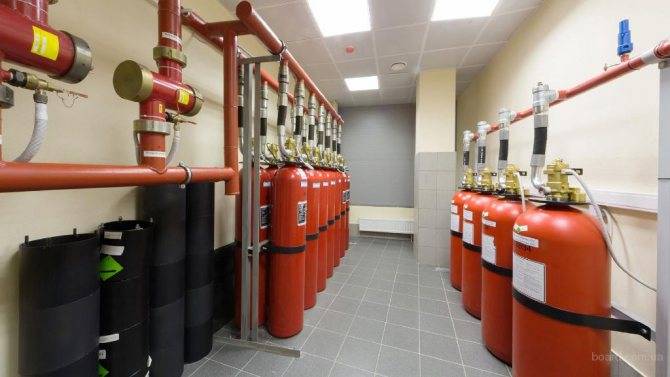
Dear readers, we have reviewed the process and stages of designing a gas fire extinguishing installation.
This typical AUGPT project for the server room of a credit institution is, rather, an academic guide for everyone who wants to implement this equipment at their facility.
If this material was useful to you, recommend it to your friends.
See you soon on our blog pages.
Registration of gasification of the house
To obtain permission to lay a gas pipeline to a private house, you need to collect an impressive package of documents and go through four stages:
- obtaining TU;
- project development;
- installation of gas pipeline equipment;
- connection.
Required documents:
- application for gasification from the owner of the property;
- passport of a citizen of the Russian Federation;
- a document on the right of ownership where gasification is planned;
- if the pipeline will be laid through neighboring sections, the written consent of their owners is required for such a procedure.
Often, owners begin the gasification process when the house is still under construction. Naturally, they are interested in whether it is possible to supply gas to an unfinished and still unregistered house?
In this case, in addition to the documents listed above, you must provide additional papers:
- ownership of the plot of land where the construction is carried out;
- a copy of the registration certificate for the building, which is in the process of construction, entered by a notary;
- application for obtaining TU (technical conditions);
- written confirmation of the territorial state body of the legality of construction work.
Connection of an unregistered house is carried out as gasification of an auxiliary building, and not a residential one.
Obtaining specifications
Technical specifications are necessary in order to design an external gas pipeline and an intra-house gas supply system. To obtain technical specifications, you should contact the gas service to determine whether there is enough capacity for connection.




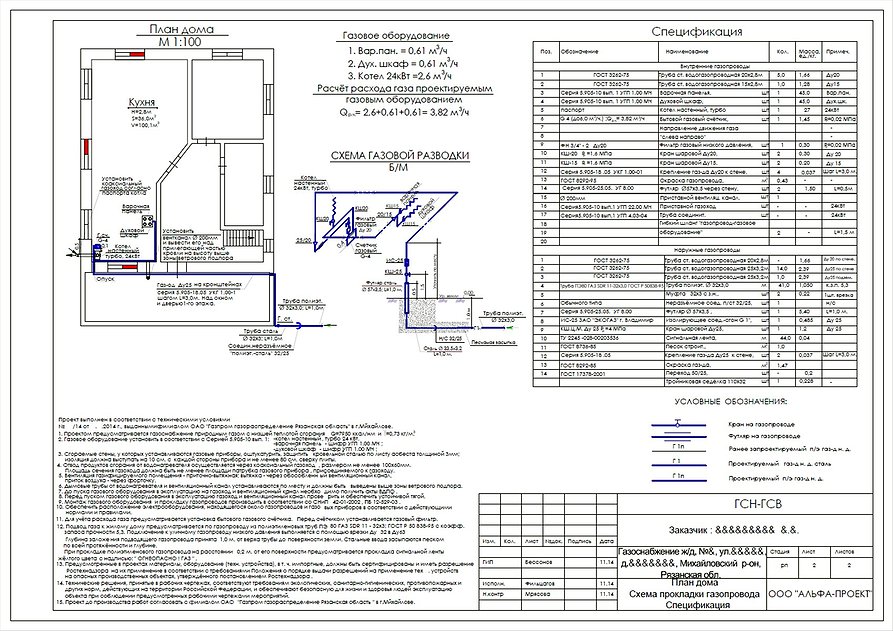
Required papers:
- land ownership;
- floor plan of the house or permission to build it (must be certified in the district "Architecture");
- site plan on a scale of 1:5,000;
- a statement signed by the head of the Gas Trust.
The minimum time for preparation of specifications is 2 weeks. The term may be extended up to one month. In practice, coordination takes much longer.
After accepting the application for gasification, according to the legislation, gas connection must take place within three months
The term of validity of the technical specifications is up to two years. After this time, the gas pipeline must be built.
Development of a gas supply project
After the owner receives the specifications for the supply of gas, a project is being developed.
The following package of documents must be submitted to the design organization:
- THAT;
- geodetic survey of a personal plot with all communications and buildings with reference to the terrain;
- all documents for the construction;
- for gasification of a non-residential building (unfinished), a statement of technical characteristics is required (the building must be at least 70% ready).
After that, you should call the master, who will carry out all the necessary measurements and draw up the documentation. Consideration of the project is carried out within 15 working days. The next step is to pay for the project. The cost of the service depends on the distance of the object to the gas pipeline.
Two projects are needed for unfinished construction. In one, the gas supply system of the building is displayed, where construction is not completed, and in the second, on the contrary, on completed housing
The project takes into account all gas appliances that are planned to be installed in the house (floor-mounted boiler or wall-mounted instantaneous water heater, gas stove, fireplace, etc.). This is done in order to calculate the required volume of raw materials.
The consumed volume of gas is indicated in the equipment passport. In addition, you must also provide a plan for the location of appliances in the house.
The customer must definitely check the finished project, so that subsequently there is no need to redevelop the premises
After the paperwork has been completed, installation and construction work begins.
Issuance of a power of attorney for gas connection
Gasification is a complex and lengthy process. Not all owners have enough free time to personally deal with this issue.
In this case, a power of attorney is issued to a private person who represents the interests of the owner of the house. This document must be notarized and attached to other papers.
How to choose a project contractor
It is impossible to independently carry out a gasification project with all the desire. And save on its development too. This is a mandatory document, which is developed taking into account many requirements. They are indicated in special technical literature, reference books and codes of practice, as well as in state standards. All these requirements are known to professional designers, who should be engaged in design.
Moreover, these should be employees of special design departments, and not just specialists offering their services. As a rule, in your city you can find several organizations involved in the implementation of housing gasification projects at once. Most often, credible organizations are members of the SRO. This acronym stands for "Self-Regulatory Organizations".
All organizations included in the SRO receive a certificate that must be studied when choosing a design company (+)
It is best for the customer to deal with such companies. In this case, he can be sure that the work will be done efficiently, competently and on time. Indeed, otherwise the organization faces serious troubles associated with problems with reputation and financial losses. Non-SRO companies are limited in their choice of clients. They cannot count on serious orders and cannot take part in tenders.
To join the SRO, an organization must exactly meet certain requirements. They must have at least two professional design engineers on a full-time basis. Every three years they are required to be tested, thereby confirming their qualifications and knowledge.The check is carried out by a special commission, according to its results, certificates are issued or not issued to specialists.
In addition, only an organization licensed to conduct this type of activity can develop a project. This point must be clarified before concluding a contract for the implementation of a gasification project.
Also, when concluding it, it is important to clarify that the contractor assumes the responsibility for coordinating and approving documents, taking measurements and visiting gas services. Such a clause in the contract allows the customer to take a minimal part in the design process.
The cost of autonomous gasification of a private house
To calculate the potential costs for autonomous gasification of the site, you need to know the heated area and calculate the degree of intensity of use of the gas system.
The price of a gas tank of 1000 liters is approximately 230 thousand rubles, a tank for 1650 liters will cost 260 thousand rubles, for 5000 liters - 520 thousand rubles.
Some residents unite to install an autonomous gas supply system in several neighboring areas.
Of course, the cost of buying a gas tank is not the only cost for autonomous gasification of a private house.
However, connection to the main gas pipelines may require substantial expenses.
Obviously, in this case, the main requirement is the availability of low-pressure gas networks for connection to centralized networks. If they are not available, then the possibility of connecting natural gas can be expected for years.


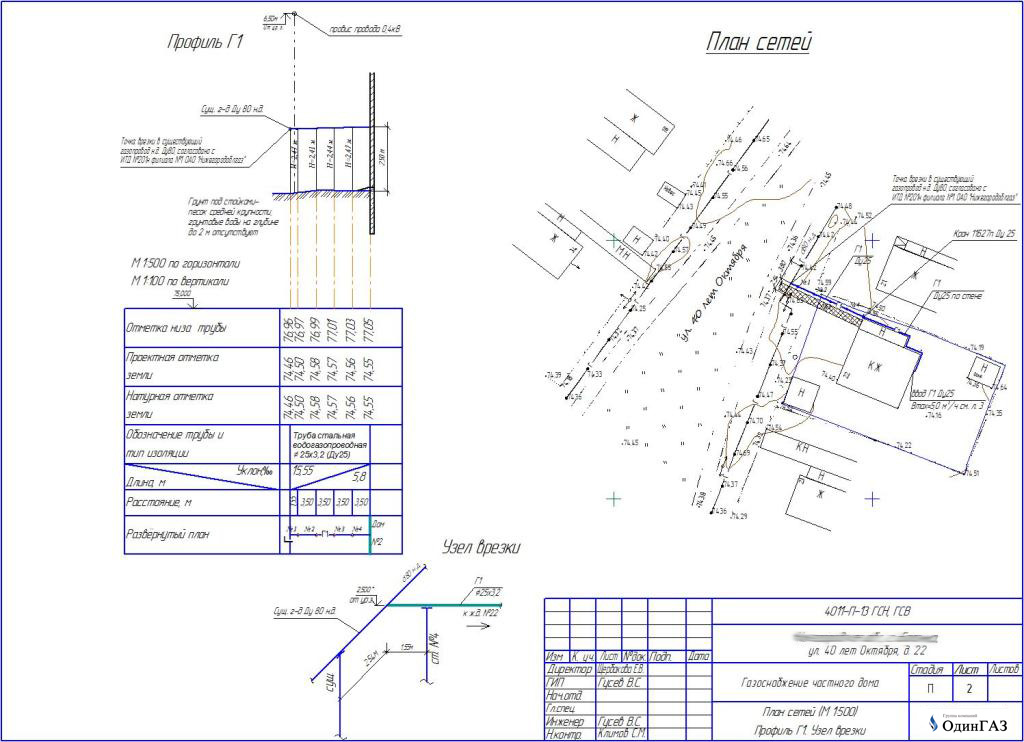

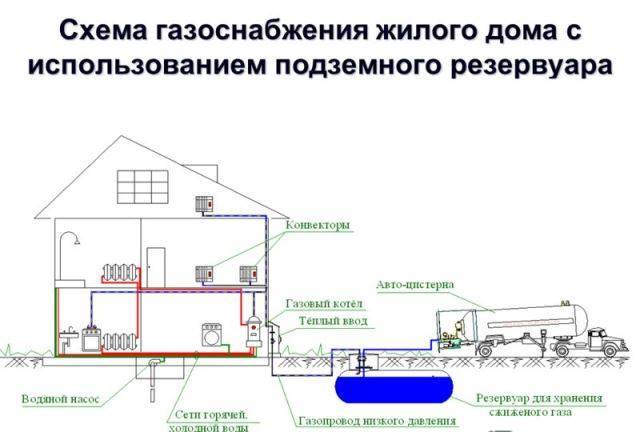
In this case, the only alternative is autonomous gasification, which is carried out quickly and relatively hassle-free, and at the same time can cost less.
The average cost of connecting to centralized gas supply networks in the Moscow Region to a natural gas network is 400 thousand rubles. (provided that a low-pressure gas pipeline runs close by). The presence of a medium or high pressure gas pipeline is not suitable.
Comparison of different options for heating costs
In this table, we analyzed the costs of various types of fuel for heating a residential building with an area of 100 sq.m.
| Type of heating | Specific calorific value kW/ MJ | The amount of fuel for heating 100m2 | Price for 1 unit (rub.) | Cost of 1 kW/h of heat (rub) | Approximate annual heating costs (rub.) |
| Electric, / 1kW*h | 1 / 3,62 | 10 | 3,2 | 32 | 80 000 |
| Diesel fuel, diesel fuel, / l | 11,9 / 43,12 | 0,84 | 35 | 29,41 | 73 529 |
| Autonomous gasification (liquefied gas / m 3) | 29,2 / 105,5 | 0,34 | 54,05 | 18,51 | 46 276 |
| Connection to gas networks (Natural gas / m 3) | 9,3/33,5 | 1,08 | 5,13 | 5,52 | 13 790 |
For more information about the possibility of connecting gas in a private house (to the main gas pipeline), see this article.
Still have questions? Do you want answers to them?
Design of gas supply systems - Turnkey project: GK OdinPROEKT
For the supply of natural gas using a pipeline, a special structure is used - a gas pipeline.
Gas supply is the delivery and distribution of the most accessible type of fuel - gas, which can be either centralized or autonomous.
Features and necessity of the gas supply system
The presence of a gas supply system is an essential condition for the functioning of all modern facilities (both residential and commercial). Thanks to gas supply, it is possible to create comfortable conditions for people to stay at no particular cost - in public, industrial and technical buildings.
There are two types of gas pipelines - main and distribution. The first type is designed to supply gas over long distances. The pressure level in the pipeline is maintained thanks to the compressor stations installed at regular intervals. The pressure is reduced to a level suitable for supplying consumers at the last point of the gas pipeline.
Distribution stations are used to deliver gas to the consumer from distribution stations.
Our services
The design of gas supply systems is a complex task, the solution of which is largely based on the location of the object. We develop projects for objects in Moscow, the Moscow region and for the regions of Russia.
In our company you can order a project:
- external gas pipeline (intershop, street, yard, quarter);
- internal gas pipeline (built inside the building);
- other types of gas pipelines, including introductory, impulse, distribution, waste, etc.
Gas pipeline design process
The design of autonomous gas supply systems is a necessary condition for the high-quality construction of an efficient gas supply system. Thanks to the gasification project of the facility, it is possible to determine the location of ventilation equipment, chimneys, and pipelines. The design phase also determines the type of equipment used.
Inaccurate calculations can lead to problems with the functioning of the gas supply system, therefore only experienced specialists are allowed to design in our company.
Regardless of the pressure level and the purpose of the gas pipeline, it is usually laid underground.
Depending on the pressure level, networks are distinguished:
- low;
- average;
- high;
- super high pressure.
In some cases, it is permissible to lay gas pipelines above the ground (mainly inside residential areas, as well as on the territory of municipal and industrial enterprises).
Factors taken into account when designing a gas pipeline
The operating conditions of the gas pipeline are influenced by many factors, each of which is necessarily taken into account by our specialists when developing the project.
The most significant of them are:
- estimated volume of gas used;
- soil type;
- the remoteness of the facility to which gas is supplied from the main gas pipeline;
- type of gas equipment;
- position of pipelines, ventilation shafts, chimneys;
- features of the route for the organization of the gas pipeline.
The project is developed in accordance with the operating conditions and must be agreed with the owner of communications and organizations responsible for gas supply specifications.
The documents
The following documents are required for design work:
- topographic survey of the area (scale 1:500);
- technical conditions for gasification;
- design assignment.
The cost of a gas supply project
The gas supply project for settlements, industrial and commercial enterprises is calculated individually and depends on the complexity and scope of work. For a residential building, the cost of the project usually ranges from 25-30 thousand rubles.


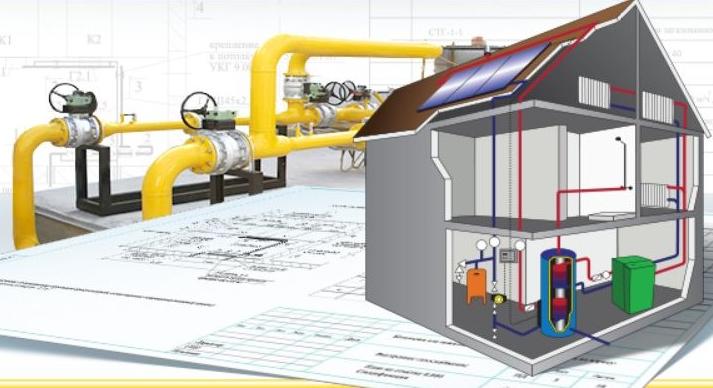

Design and construction of gas supply systems is one of the main areas of our work.
We guarantee high-quality performance of all stages of gasification of facilities.
Call! +7 (903) 541-07-34
List of required documents
In order for designers to get started, the customer must provide design data. This includes:
- technical conditions for connection to gas networks obtained in Gorgaz;
- situational plan of the site, issued by the Administration of the settlement;
- the protocol of geological research, which is carried out by specialized organizations;
- plan of the house indicating the desired placement of equipment.
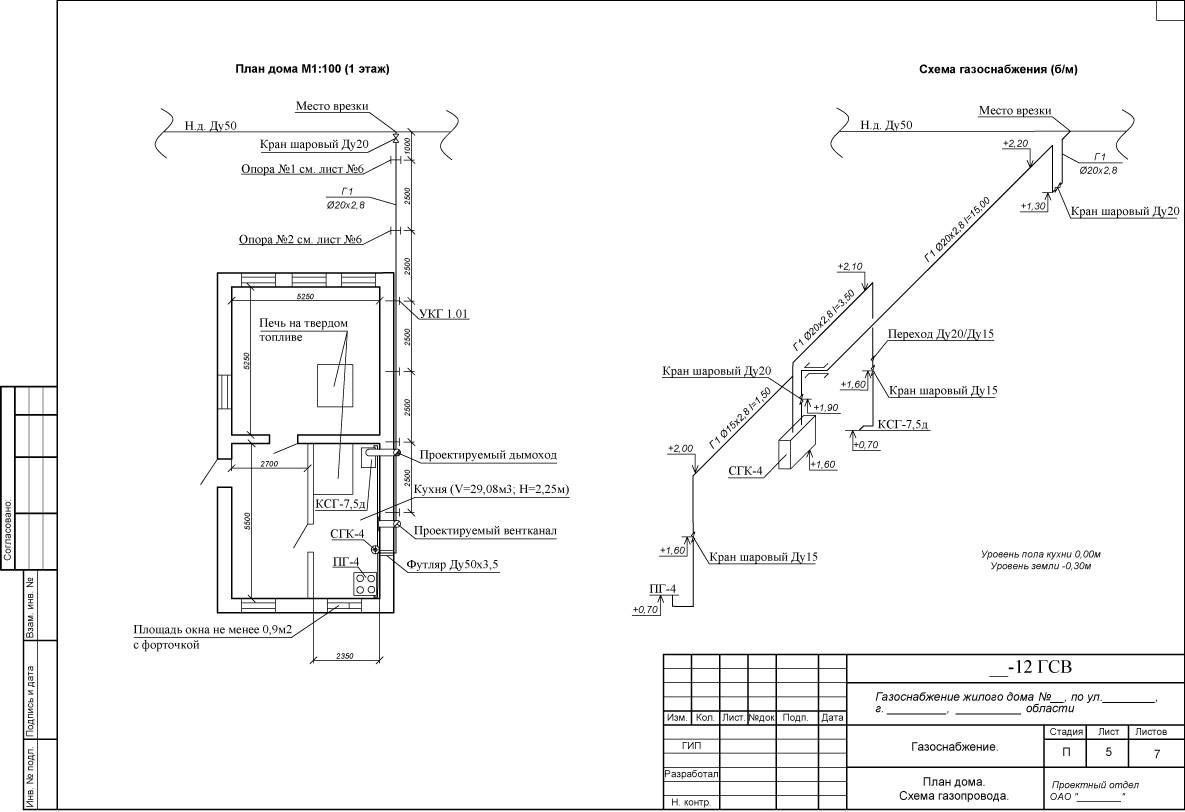
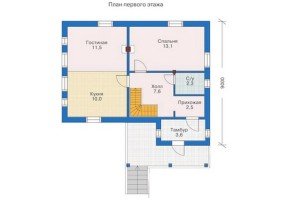 An example of a house plan. (Click to enlarge) The plan of the house can be reproduced by the design engineer if the building already exists.
At the same time, he will be able to perform all the necessary measurements.
When designing, a specialist may need:
- distance from the source of gas supply to the walls of the house;
- dimensions of the premises;
- the distance between structures, buildings and communications located on the site.
Only if all the initial data is available, the engineer can proceed to calculations and drawing.
This article is about how to choose a geyser.
Read an article with reviews on gas heating boilers here.
Taxes and Government fees for connection to the gas pipeline
To connect the facility to the gas pipeline, you will need to pay the following taxes and state duties.
Coordination of the gas pipeline project - the fee is paid to the account of the GRO "PeterburgGaz" "Gazprom Distribution" - from 2,700 rubles. up to 7 500 rubles
Obtaining an act on the inspection of ventilation and chimney systems - 3,000 rubles.
Verification of executive documentation in GRO "PeterburgGaz" if the Leningrad region. JSC "Gazprom Distribution" - from 500 rubles. up to 3 000 r.
Agreement for technical and emergency maintenance of GDO "PeterburgGaz" if the Leningrad Region. JSC "Gazprom Distribution" - 500 rubles. up to 3 000 r. for 1 year
Contract for technological connection of GRO "PeterburgGaz" if the Leningrad Region JSC "Gazprom Distribution" - 20,000 rubles.
Gas start-up GRO "PeterburgGaz" if the Leningrad region.JSC "Gazprom Distribution" - from 1,500 rubles. up to 3000 r.
Required information for the design of outdoor and underground systems
For the development of technical documentation, which begins with a comprehensive study of the gasified object, the specialists of Energia and Co. Ltd. collect all the necessary materials.
Our employees study the data on the conducted geological surveys, as well as the results of the topographic survey of the area. The basis for the design of main and secondary pipelines is also the situational plan of the area along which the above-ground or underground laying will be carried out. If the gas pipeline crosses railway or road routes, other communications routes, technical conditions are additionally obtained.
At the last stage of the preparatory stage, the specialists of Energia and Co LLC prepare a section of the plan of the building or structure with the allowable laying of existing communications and the gas pipeline being designed.
- the distance of a commercial or industrial facility from the main pipeline;
- soil features, depth of groundwater;
- possible schemes for laying a gas pipeline, the location of chimneys and ventilation shafts;
- the volume of gas that the customer plans to use in a limited period of time;
- route features, outer diameter and selected type of pipes - for steel or polyethylene gas pipelines;
- types of gas processing equipment used;
- architectural features of buildings and structures.
Energia & Co LLC provides professional assistance in the development of design documentation for aboveground and underground gas pipelines. Our employees are ready to perform the whole range of surveys for networks of any level of complexity. All operations related to the calculation and laying of underground gas pipeline routes are carried out in accordance with current licenses.
1.2 Information about climatic and engineering-geological studies
The climatic region of the village of Nadeevo according to - II.
Climatic subregion - II century.
Outside air temperature, °C:
- the coldest five-day period (with a probability of 0.92) -32;
- the coldest day (with a probability of 0.92) -37;
- duration of the heating period -231 days.
Degree-day of the heating period - 5567 ° C * day.
Snow cover weight per 1m2, Wo = 240 kg/m2.
Velocity wind head So = 23 kg/m2.
The climate of the region is temperate continental.
The coldest month is January, with an average monthly temperature = -12.6 C.
The warmest month is July, with an average monthly temperature of 16.8 C.
The duration of the warm period is up to 205 days, the cold period is 160 days.
According to the report on engineering and geological surveys produced by GeoStroyIzyskaniya LLC, the construction area is characterized by the following soil layers and their physical and mechanical indications:
— modern formations (b IV) were exposed by all boreholes and are represented by a soil-vegetative layer with roots of herbaceous plants. The soil thickness is 0.2 m.





- Middle Quaternary lacustrine-glacial deposits (lg III) everywhere under modern formations and are represented by several layers. In the upper part of the section, light clays of a hard-plastic consistency with a layered texture occur.The thickness of such deposits is 1.3-2.8 m.
Well No. 1 from a depth of 1.5 to 3.0 m (bottom hole) exposed loams of a layered texture, fluid-plastic consistency with gravel inclusions up to 10%.
Well No. 2 from a depth of 2.0 to 3.0 m (bottom hole) revealed gray loams of soft-plastic consistency.
Based on the field visual description and laboratory studies, the Quaternary deposits are divided into engineering-geological elements. 4 engineering-geological elements have been identified.
According to the materials of engineering and geological surveys carried out by GSI LLC in 2012. soils at the construction site are:
EGE-1 (p IV) - soil-vegetative layer. Thickness 0.2-0.3 m.
EGE-2 (lg III) is a heavy, fluid-plastic loam. Power 1.7 m.
EGE-3 (lg III) - heavy, gray, soft-plastic loam. Power 1.0 m.
EGE-4 (lg III) - clay is light, hard-plastic. Thickness 1.3-2.8 m.
Corrosive activity of soils in relation to carbon and low-carbon steel according to GOST 9.602-2005 is medium.
The normative depth of seasonal freezing is:
- for loams and clays -1.50m.
For the period of drilling operations, groundwater was noted at a depth of 3.0 m from the surface of the earth, a steady level was noted at a depth of 1.0 m-1.3 m, which corresponds to the boundaries of absolute marks of 90.40-100.58 m.
According to the conditions of occurrence, distribution, nutrition and discharge, the waters are groundwater. The waters have a free surface, are not pressurized, and are fed by infiltration of atmospheric precipitation.
The need for design
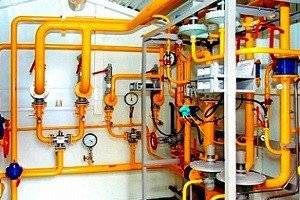
The main task of engineers in the design of gas systems is to ensure an uninterrupted supply of fuel to all devices.
At the same time, it is necessary to take into account a number of requirements for gas-using devices and systems that supply gas to consumers.
All design standards are indicated in special technical literature - state standards, codes of practice and reference books. Knowledge of these rules is the prerogative of competent specialists.
That is why gas supply design should be done not just by civilian specialists, but by staff members of design departments.
Without a project approved and agreed upon by the gas service, it will be impossible to proceed with the installation of the system, and even more so its operation.
Conclusions and useful video on the topic
To make it easier to understand the nuances of gas supply to your cottage, we recommend that you familiarize yourself with a small selection of video materials.
About the execution of documents for connection to the gas main and the cost of certain types of work:
The procedure for performing work on gasification of the house - the nuances of connecting to the main pipeline:
Stages of gasification of a private house:




And finally advice. If the highway is far away or the specifics of the relief poses difficult problems for bringing the pipeline to the site, there is an alternative option for supplying "blue fuel" to the house - autonomous gasification with a gas tank.
Have you recently completed the gasification of your home and want to share your experience with other owners of country houses? Leave your comments in the block under the article - tell us how much this event cost you, did you do something on your own or entrusted the entire scope of work to specialists? What pipes did you recommend for laying the gas pipeline? Many users will be grateful for your advice.
conclusions
The gas supply system in buildings is used for space heating, heating the coolant, for cooking at home or on an industrial scale. The subsection “Gas supply system” is included in the design documentation for the construction, reconstruction or overhaul of facilities. When designing, it is necessary to take into account the technical conditions of the gas distribution organization, building rules and fire safety standards.
Order the design of a gas supply system from Smart Way. We offer the most favorable terms of cooperation, affordable prices, quality assurance. Contact us, we will consult for free on all your questions!