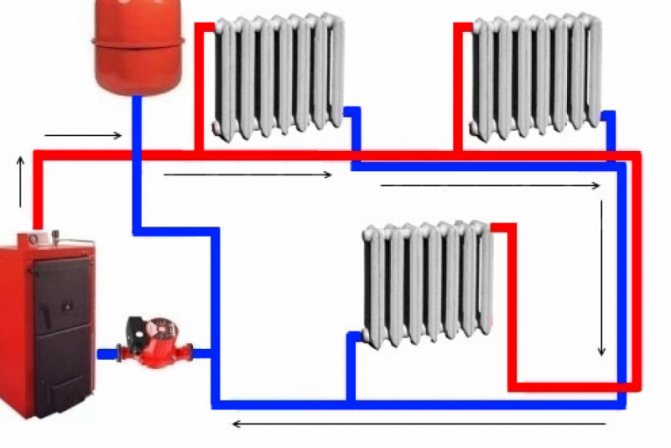
- What do you need to do before starting work?
- How to hide heating pipes in a private house with decoration
- Kinds
- Do-it-yourself drywall box
- Step 1: Getting Ready
- Step 2: assembly of the structure
- Step 3: Completion
- Photo in the interior of the rooms
- Kitchen
- Living room
- Bedroom and nursery
- Bathroom
- Hallway
- Some interesting ideas
- Coloring
- decoration
- stained glass
- Masking heating pipes in the wall
- How to hide pipes in a private house
- Examples in the interior
- How to decorate pipes with your own hands?
- Dye
- Hide under the twine
- Shelf imitation
- Hide in a box
- Hide in a locker
- Types of decorative screens
What do you need to do before starting work?
You need to start decorating the heating risers in your apartment only after you have completed the preliminary preparation. If the communications in your apartment are old, then before installation they must be replaced with new ones. Sheathing involves an insulation device. A layer of polyethylene must be put on the pipe or a special sleeve instead of it. Regardless of the chosen method of decorating, the highway must be washed before decorating. If you decide to paint the heating pipes, then serious preparation will be required here.
- It is necessary to remove traces of the previous finish from the surface of the pipe.
- The surface must be cleaned with a wire brush.
- It is also necessary to perform priming.
Having decided to decorate the pipes in your home in an original way and showing your imagination, you can get an original element of the interior and achieve an incredible effect in the room.
How to hide heating pipes in a private house with decoration
Hiding pipes in a wall or duct significantly reduces the heat transfer of heating elements. Sometimes these measures are contraindicated. That is why pipe decor is widely used to close communications.
In this option, you can safely listen to your imagination. The main thing is that the initial effect harmoniously fits into the interior of the room. You can simply paint the pipes to match the color scheme of the room.
Paint requirements:
- Mechanical resistance;
- Thermal strength;
- Not toxicity.
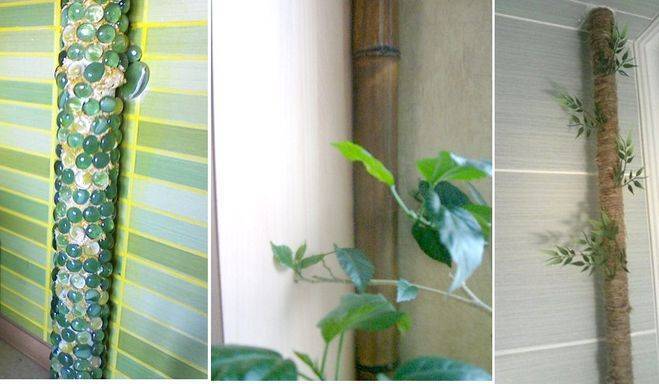
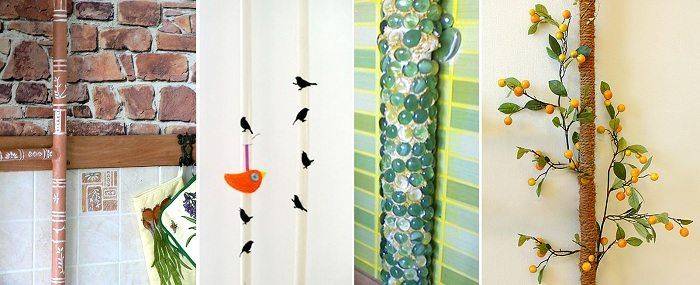
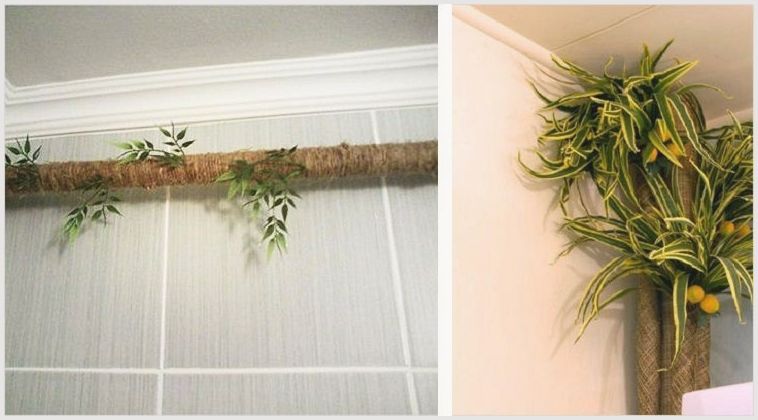
As a decor, you can use jute or hemp rope. But this will reduce the heat transfer of the pipes. You can also try split bamboo. You can additionally decorate with branches and leaves, creating a branch. Highly located pipes can be closed with curtains.
It is easier to hide pipes at the stage of laying communications. Then it becomes possible to mount the system as discreetly as possible. Also in this case, it becomes possible to make a warm floor.
Kinds
In order to decorate the pipes in the room and hide them from those present, you can use several options, these are:
Drowning heating structures directly into the wall, which in itself is very convenient and not so difficult to implement, but in case of any malfunctions, the consequences will be very bad
When installing the pipeline, it is important to completely replace it and carefully check all attachment points, solderings and any joints that may leak.
Disguise with the help of furniture, which is most often typical for the kitchen, but can sometimes be found in other rooms.
Using a special box where pipes are placed. You can make such a design from different materials, these are: plastic lining, brick, drywall, wood.
The box for heating pipes can have a variety of appearance, which depends on which room it is mounted in.
- A box-wardrobe that forms a closed space where you can not only hide pipes, but also arrange small things in everyday life. It is very convenient to use it in the toilet, where space is significantly limited.
- A plinth box is needed in order to hide pipes with a small diameter, it is very convenient to install sockets near them, especially for a bathroom where the humidity level is high and you need to choose the right place to turn on electrical appliances.
- Box-shelf, having a horizontal arrangement. This is convenient for the appropriate installation of heating structures in the room. You can effectively, but at the same time effectively hide all communications, making the area useful.
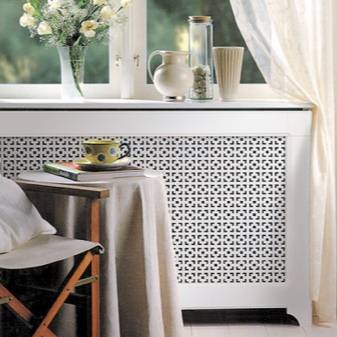
- A box screen that helps close large structures. Screens can be the most diverse in design and size, they will have one thing in common, a mesh structure that allows you to minimize heat loss without depriving the room of aesthetics.
- Decorative vertical structures are installed in places of common house communications, most often these are risers.
When planning the construction of any of the above options, you need to know that you can build two types of structures that will have radically opposite characteristics:
- Collapsible structures, their installation makes it easy to monitor the condition of the pipeline in any part of the room and control problem areas, if any.
- Stationary, structures that are installed for the longest possible service life and are not planned to be dismantled for a long time. Most often, such boxes are made on gas pipes; for heating, they will not be the best option.
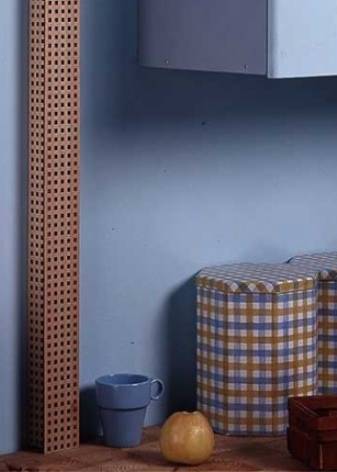
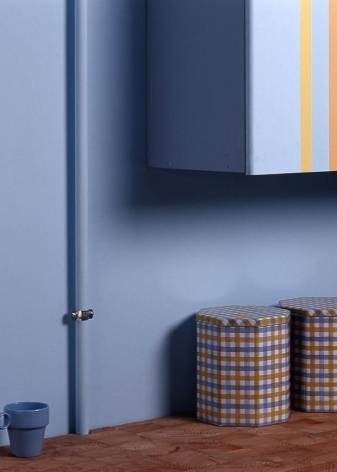
Any type of structure can be bought or made independently, which requires an understanding of what exactly will be built and the use of the correct structural elements. If you need to hide the battery, then you cannot do without a screen, and it must be perforated, otherwise it will not be able to cope with the task, and the box itself will overheat, while the room will remain cold. Lattices can be both plastic and wooden, but if desired, you can even order forged products.
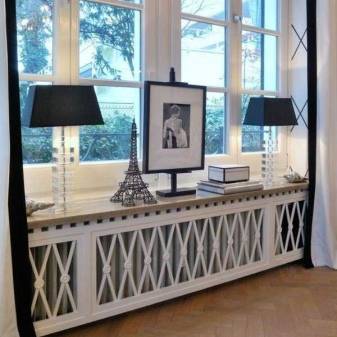
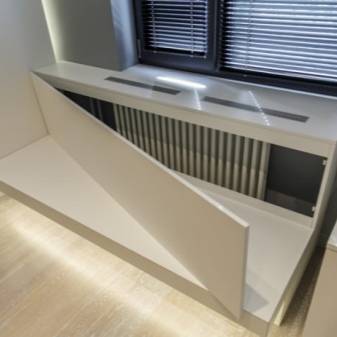
Any pipes that are in a house or apartment have an entry and exit point from the room, which makes it necessary to decorate these areas as well. The best thing to do with this is pads or plugs. Outwardly, they can have a varied appearance and even be made of different materials, but they have one task, to hide the pipe and make the interior of the room stylish and beautiful. Rings are the most common, but you can also find square, oval options, in addition, they can be designed for one or two pipes.
Modern technologies also require new approaches to the use of materials, so when installing stretch ceilings, pipes need to be bypassed, which, in turn, requires making holes in the canvas that need to be closed. For such purposes, decorative rings are now used.
Their design is extremely simple, but still effective, these are two identical halves that have a special lock at the junction that snaps into place and is securely held in place.
It is important to choose the right material and color for these plugs so that they fulfill their role.
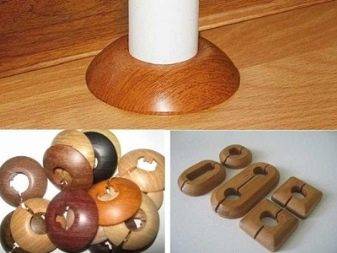
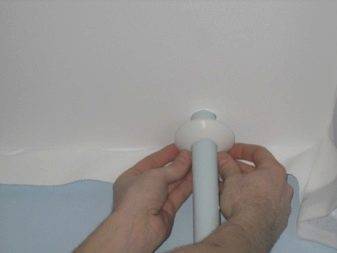
In the event that it is not possible to hide the entire pipe, but you need to decorate it beautifully, for which cups are great. They can be made in different sizes, shapes and materials. Chrome is most often used, but there may also be plastic, which has a detachable design.
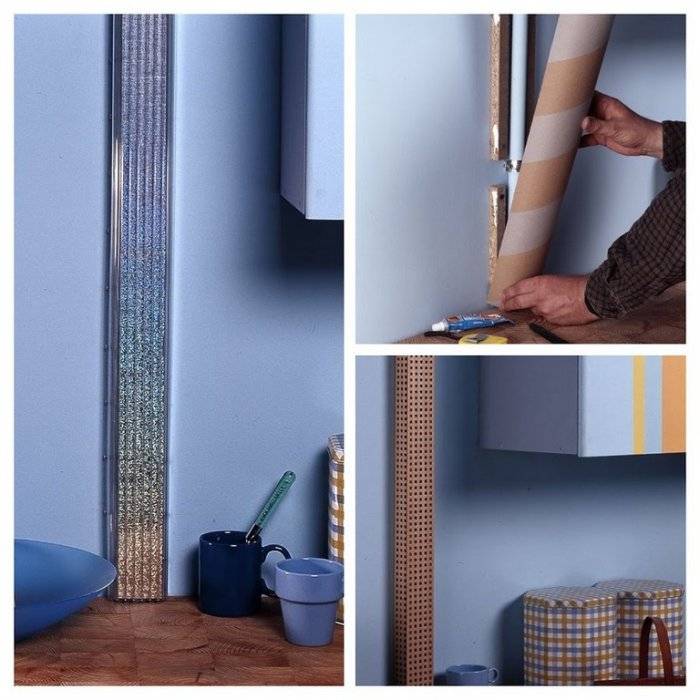



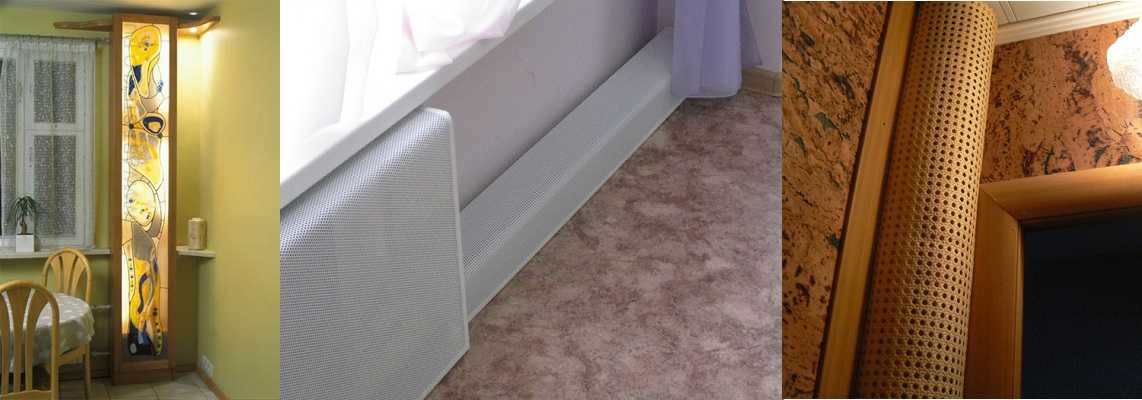


If the design has valves or other moving elements that need to be used from time to time, then you can hide them under a cap that matches the decor of the room, so as to merge with it and not be noticeable, but if necessary, give the opportunity to use everything you need.
Do-it-yourself drywall box
The easiest way is to hide the heating system in structures made of drywall. This material attracts with a combination of ease of processing, excellent performance properties, and relatively low cost.
Assembly guide you will find a protective and decorative design in the bathrooms in the article, the contents of which we recommend that you familiarize yourself with.
Another important advantage is the compatibility of drywall boxes with various finishing methods, which allows you to perfectly fit the design into any interior.
To make a drywall box, you will need the following materials and tools:
- screwdriver;
- scissors (cutter, hacksaw) and drywall planer;
- sheets of drywall (for the bathroom and kitchen it is better to take moisture resistant, for other rooms - standard);
- wooden bars (metal profile);
- dowels, self-tapping screws for fastening the structure;
- building materials for putty, primer, finishing;
- skirting boards.
Decorative accessories will also help to improve the appearance of the structure, with which you can mask the joints of the box with the walls / floor (sockets, linings, rings, plugs). The work is carried out in several stages.
Step 1: Getting Ready
First of all, you need to determine the dimensions of the structure, for which accurate measurements of heating pipes are carried out.
When calculating the parameters of the manufactured device, it is important to add a few centimeters to the depth and width indicators for free fit: heating pipes should not touch the walls and frame components
In accordance with certain dimensions, wooden planks or metal profiles are cut under the frame, as well as cutting drywall sheets (in this case, a minimum number of seams should be allowed).
Step 2: assembly of the structure
The starting profile, which will serve as the basis for assembling the frame, is fixed to the floor. Other parts of the structure are attached to it, creating a crate.
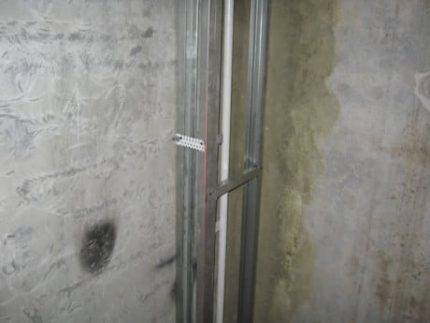
If the design of the drywall box turns out to be too massive, it is recommended to reinforce it with guides, which will make it possible to more securely fix the sheathing from the plates.
The edges of the cut drywall parts are processed with a special planer for this material, after which they are applied to the frame base and fixed with self-tapping screws. To protect the edges of the plates from damage, the corners of the device can be glued with special overlays, which are made of perforated metal.
Step 3: Completion
In conclusion, finishing work is carried out. The joints between the plates of the structure, as well as the entry point, are covered with putty.
After that, the surface of the box is primed, and then the finishing is performed (painting, wallpapering, decorative plaster coating). The final touch for a neat look is the installation of skirting boards at the junction of the boxes with the wall and / or floor.
Photo in the interior of the rooms
Kitchen
The kitchen is the perfect room in which all the ways to hide the batteries become practical and convenient. If the room is small, then you can hide the battery using a beautiful tabletop or make a folding table, which, if possible, will unfold.
Metal-plastic structures factories offer a large selection of beautiful large-sized window sills that imitate stone, wood and other materials. A modern window sill does not break under weight, is not afraid of external factors, it is easy to care for it, wipe it, it is not afraid of scratches and so on. Any kind of battery can be hidden in this way, including cast iron.
In the photo, wooden boxes are used to mask the radiators.
Living room
If the radiator is in a niche, then a wide window sill will help create a working area.
Souvenirs, vases or flowers in pots can be placed on the designed wooden box. You can also close unsightly batteries in the living room with blackout curtains.
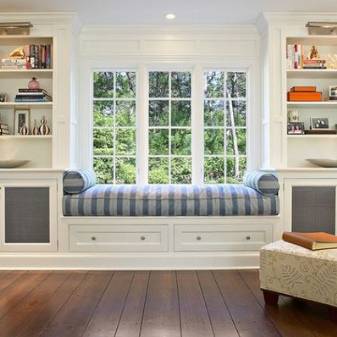
Pictured is a modern living room. In order to hide the radiators, a wooden structure was mounted, which also serves as a place for rest, storage and decoration.



Bedroom and nursery
In the interior of the bedroom and nursery, batteries can be used as another place to relax, a tabletop for decorative elements or a workplace.
Bathroom
You can hide the pipes in the bathroom using a louvered door, plastic gratings or a cabinet with opening doors.
We hide heating batteries with the help of wooden, glass or plastic screens.
In the photo, the radiators in the bathroom are hidden using a wooden box.
Hallway
For radiators in the hallways, glass screens or wooden boxes are suitable. In a small room, it is necessary to close the battery only from the point of view of practicality. It can be a shoe storage cabinet, or the battery will become a small coffee table where keys and other necessary items will be stored.
Some interesting ideas
Let's take a closer look at some of the design techniques that can be useful when working on "hiding" or giving a more aesthetic appearance to heating pipes. Examples can be seen in detail in the photo.
Coloring
Here are some examples of ready-made solutions:
- You can try to make the pipe part of the interior, for example, a children's room.
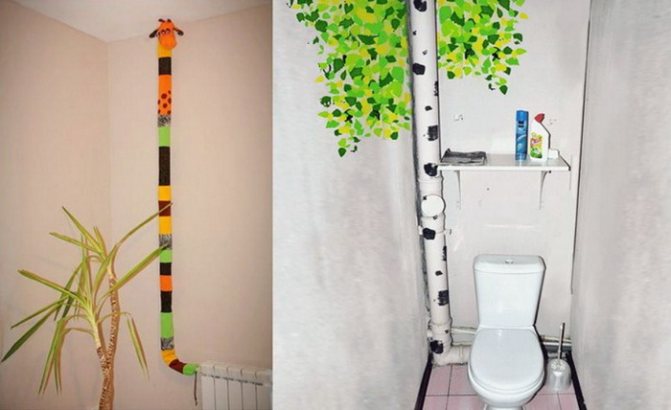
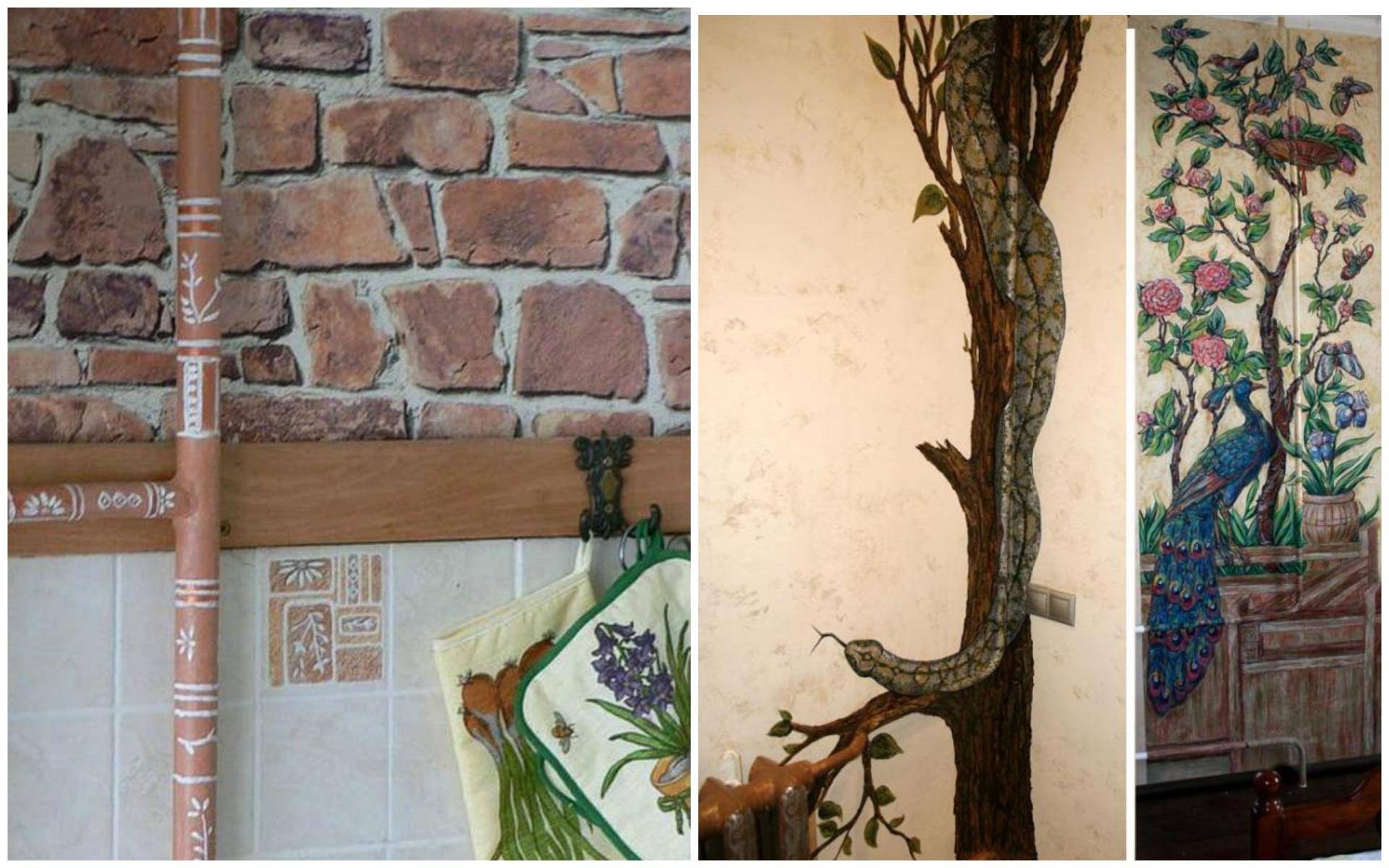
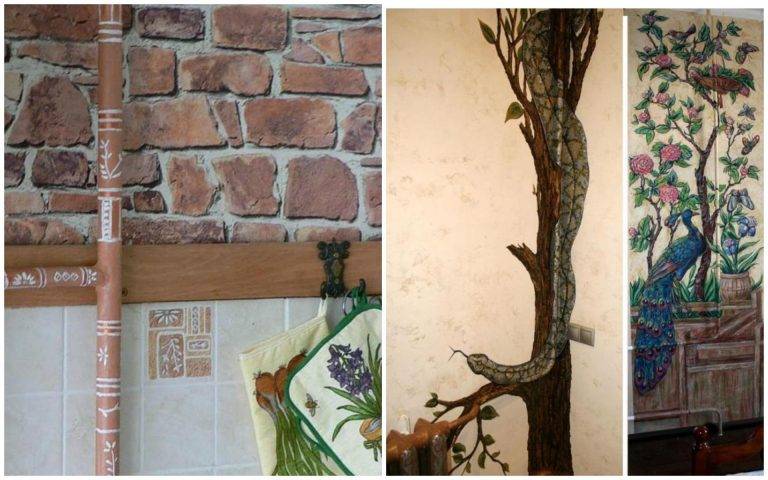
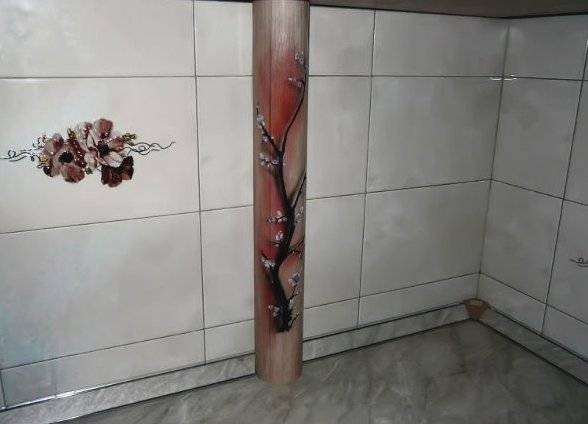
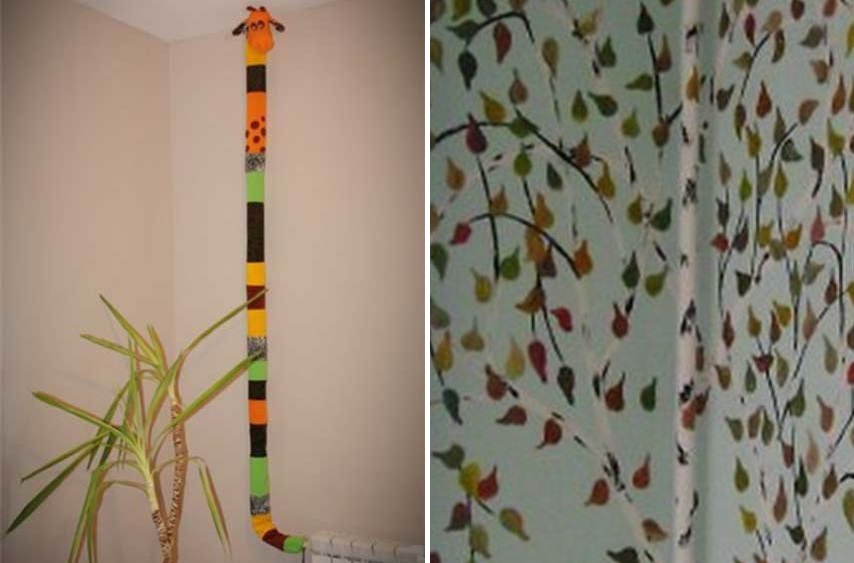
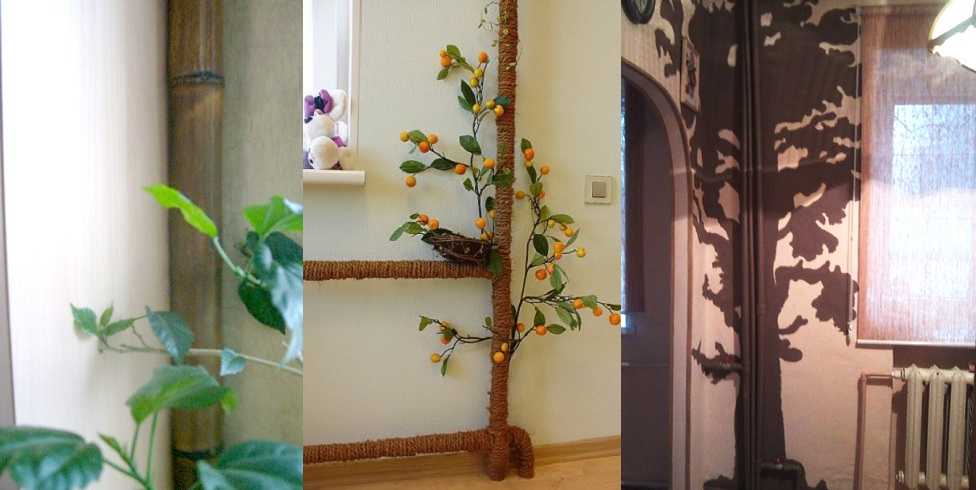
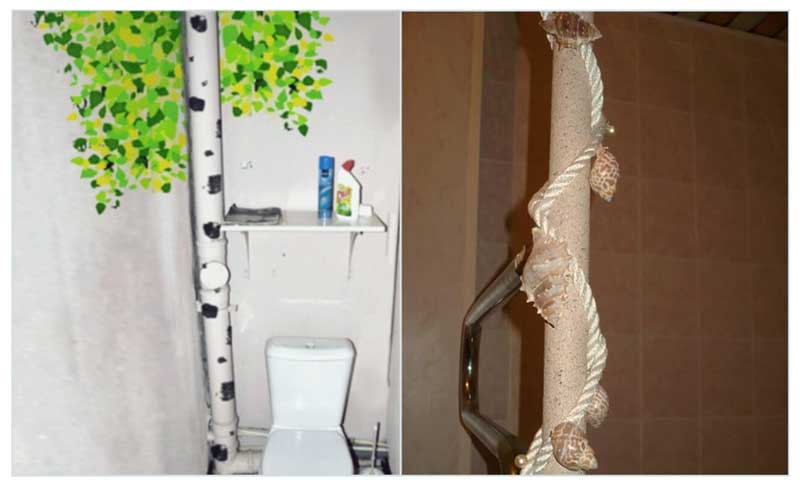
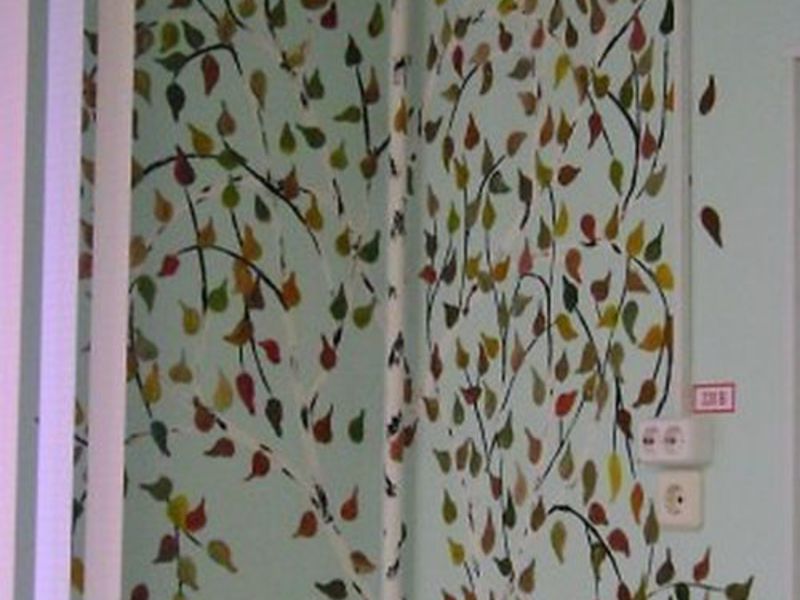
If you deviate from the generally accepted white color, which is traditionally painted pipes of the heating system, you can "turn" a vertical pipe in the corner of the room into a tree.And already from this trunk, move on to painting the adjacent walls, drawing branches on them. Such work is within the power of even a non-professional artist.
And since there are already branches on the “tree”, then leaves are also needed. The process of “growing” leaves on a tree can be entrusted to your child if he has already learned to hold a brush in his hands. It is very easy to interest your child in this process if you periodically change the color of the leaves on the home tree according to the seasons. Such a “seasonal” decoration of heating pipes will be an excellent game that combines not only the unobtrusive teaching of a child to be accurate in work, but also a way to develop observation and love for nature.
- Quite differently than in the nursery, you can approach the issue of painting heating pipes in the bedroom or living room.
Here, a noble golden tint, or discreet silver, would be appropriate for decoration. A muted bronze color will also look good. The main thing is that this color is in harmony with the overall style of the room.
decoration
You can not limit your imagination or use one of the ideas in your own way:
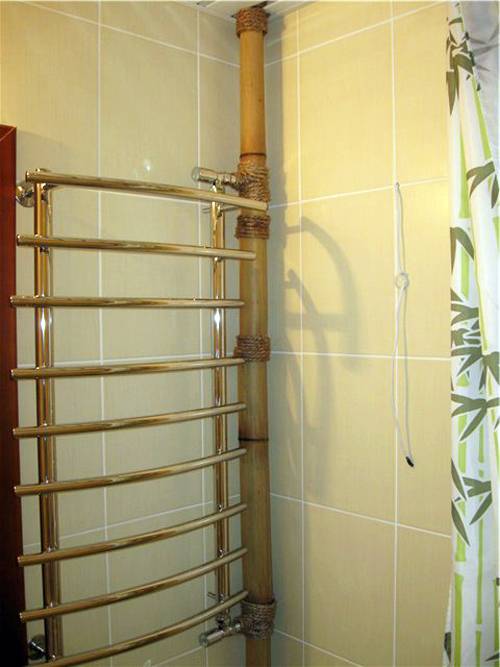
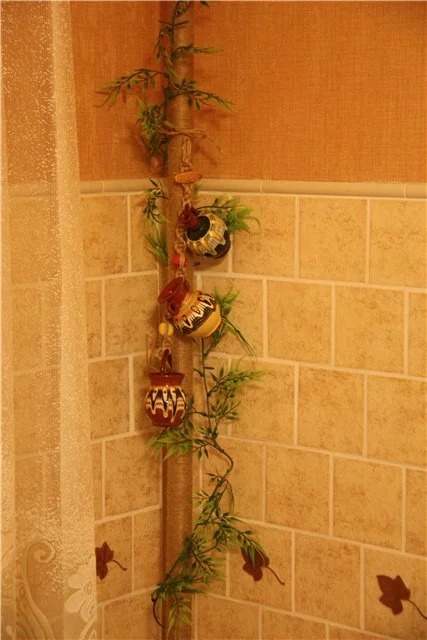
An interesting technique for decorating a heating pipe is simply wrapping it with a hemp or jute rope. If you are not embarrassed by a slight decrease in the heat transfer of the pipes, then this option can be considered.
- An interesting option may be the use of bamboo trunks split along. Such halves can be glued into the original likeness of a casing for a vertical pipe.
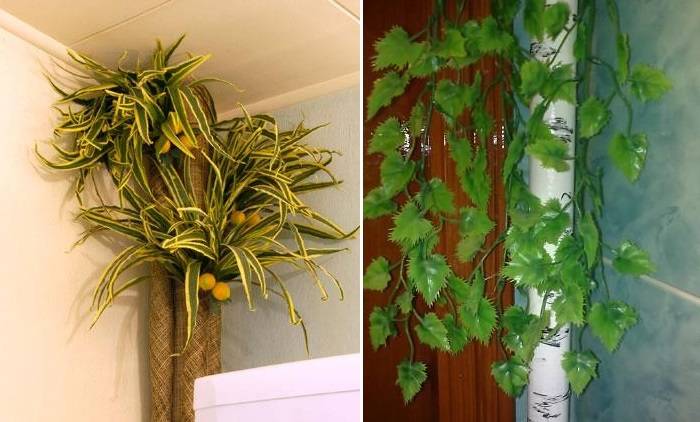
- And if artificial flowers are used instead of bamboo (or together with it), such decoration will not go unnoticed by your guests, completely hiding its “base” - the heating pipe.
- In those places where the pipes enter the floor or ceiling of the room, as well as in the places where there are outlets from the riser to the radiators, you can install nice decorative overlays on the heating pipes. By choosing the color and texture of such a decoration, you can logically complete the image that was conceived.
- One of the options for ceiling linings can be rings, usually hiding the inevitable cuts that are made around risers in stretch ceilings.
- Using fabric drapery similar to curtains on windows will add some charm to the room.
stained glass
The once fashionable way of decorating a home - stained glass - is returning to modern design developments. It is worth thinking about using such an unusual way to decorate a room by combining an original decorative element with the most ordinary heating pipe. An elegant partition with elements of stained glass can change beyond recognition that corner of the room that did not look very elegant before.
Before decorating the heating pipes with stained-glass windows, you can also provide a supply to the lighting composition. In this case, in addition to the decorative function, the stained-glass attire of heating pipes can serve as a night light or simply create romantic comfort in the room.
We hope that the ideas proposed in the article will allow you not only to hide unsightly heating pipes, but also to create an interesting interior “chip” in the decorated room.
Masking heating pipes in the wall
Pipes, risers and radiators can be disguised in several ways.A fairly popular option is to hide communications in a wall or in a field.
At the same time, it is important to replace old pipes with new ones in the apartment before such work. It is better to choose plastic communications. Otherwise, leaks will occur, which are quite expensive to fix.
Otherwise, leaks will occur, which are quite expensive to fix.
You can mask the heating pipe in the wall using drywall
The sequence of installing pipes in the wall:
- First, a communication layout diagram is created. At the same time, the cross-section of pipes, thermal insulation and the thickness of the wall layer to be sealed are taken into account.
- Next, you need to make a hole in the wall. This is a special recess in which communications will be placed. Provide space for bends and tees.
- Then the insulation is put on the pipe and mounted in the provided niche. Communications should be well fixed, ensuring a secure fit.
- Pipes are fastened with brackets. To do this, holes with dowels are made in the wall. They will fix the device.
- Next, you should check the performance of the pipes. Only after that close up the niche.
The second method involves sealing pipes in the floor. First, think over the laying scheme. A strobe is made in the floor. The top of the pipe should be slightly below floor level. Next, pipe insulation, inspection and installation are carried out. Communications are closed with concrete mortar. For normal water circulation, a pump is installed.




But hiding the pipes in this way, you should be prepared that in the event of a leak, you will have to completely disassemble the floor or wall
That is why it is important to minimize all risks. Solid pipes or with a minimum number of joints should be selected. This option can be called a warm floor
This option can be called a warm floor.
How to hide pipes in a private house
The arrangement of a hidden pipeline in private homes directly depends on the characteristics of the building itself. For example, if the floor is poured with concrete, then it makes sense to connect the pipeline to its heating system
In this case, special attention should be paid to the quality of the screed and insulation of the base. During the installation process, it is imperative to use a damper tape.
This method of laying the pipeline will ensure maximum efficiency of the heating system. When creating strobes, you need to make a margin of 10 mm so that thermal insulation and mortar can fit into the structure.
If there is no need for floor heating, the pipes can be covered with a heat-insulating layer and arranged in grooves made in the floor. This method of laying the pipeline will ensure maximum efficiency of the heating system. When creating strobes, you need to make a margin of 10 mm so that thermal insulation and mortar can fit into the structure.
Fastening pipes to the floor itself is best done with staples or clips. When the pipeline is installed, it must be connected to the heating equipment and checked for leaks. If everything works correctly, then you can safely proceed to pouring the screed.
Examples in the interior
Beautifully decorate or hide the radiators in the room so that they are not a “fly in the ointment” and do not spoil the whole appearance of the room is not such a difficult task. Modern materials allow to solve this problem with minimal costs.
Vertical, horizontal, sectional, copper, cast iron - the modern market offers a wide variety of radiators for every taste.
In the children's room, a battery of bright, cheerful colors, for example, yellow, will look good - it has a positive effect on the nervous system and emotional state of a person.
New models, unusual for the eyes - vertical radiators. They are located vertically on the wall, they can occupy the entire height from floor to ceiling. Such an element looks quite stylish and perfectly copes with its task - to maintain a comfortable temperature in the room.
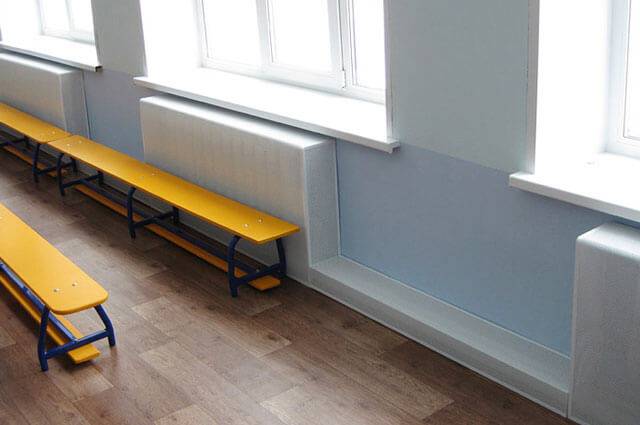
In the bathroom, you can place a wide radiator of small height (resembling a bench). He will be able to perform not only his direct task, but also serve as a dryer for clothes or towels. By the way, the dryer can be connected to a battery - you get an interesting combination, again performing several functions. Rational use of space and objects never hurts.
An interesting finish - with the help of chrome - brings to the interior some touch of freedom, emancipation inherent in bikers. They are what come to mind when looking at these sparkling designs.
Designer radiators will also decorate any interior. Unusual designs, shapes, when you look at which you will not immediately understand that this is an element of the heating system, they become a bright accent, like a picture on the wall.Such batteries should not be hidden, on the contrary, they are put on public display, emphasized with a contrasting background, placed in the center of the wall without any addition, so that nothing distracts attention from an unusual object.




Copper radiators - both vertical and horizontal - can also serve as a spectacular room decor.
Their design is not complicated, but they have such advantages as:
- High heat dissipation.
- Attractive color.
- Ease.
Pleasing to the eye, discreet color of copper will be a worthy addition to the interior in any style.
Laconic black elements of the heating system will look good against the background of brickwork - white or gray. They can also be vertical or horizontal, in any case they will be an attractive, spectacular, but at the same time discreet element of decor.
In modern interiors, you can often find heating radiators displayed as an independent element of decor than hidden in boxes or covered with screens. Even cast-iron batteries, which evoke memories of the Soviet Union for many, are now distinguished by an interesting design, unusual color schemes and high decorative effect.
Batteries left open do a better job of heating the room, nothing prevents either air circulation or infrared radiation. This means that the temperature in the room remains comfortable, objects and air heat up evenly, heat does not remain inside the box or niche, but spreads throughout the room. And this is the main function of the heating system
How to hide a heating radiator, see the following video.
How to decorate pipes with your own hands?

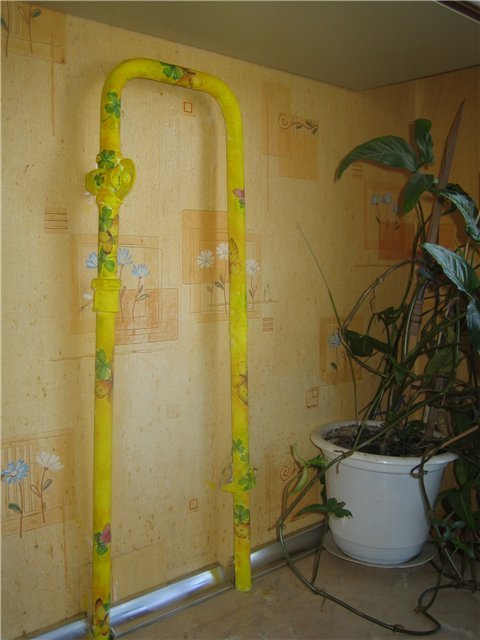
The easiest way is to paint the pipes to match the wall
Dye
The correct selection of decor colors, it is easy to revive even the most unsightly thing; give mood to the living room, bedroom or nursery. By the way, if communications run through the children's room, you simply need to connect your child to the creative process: it will be interesting for him, and handy for you. If you have drawing skills, then the batteries are easy to color under different animals. For example: a boa constrictor or a giraffe. All sorts of decoration attributes will add great originality.

A giraffe pipe or a birch pipe is a suitable decor for a child's room
Hide under the twine
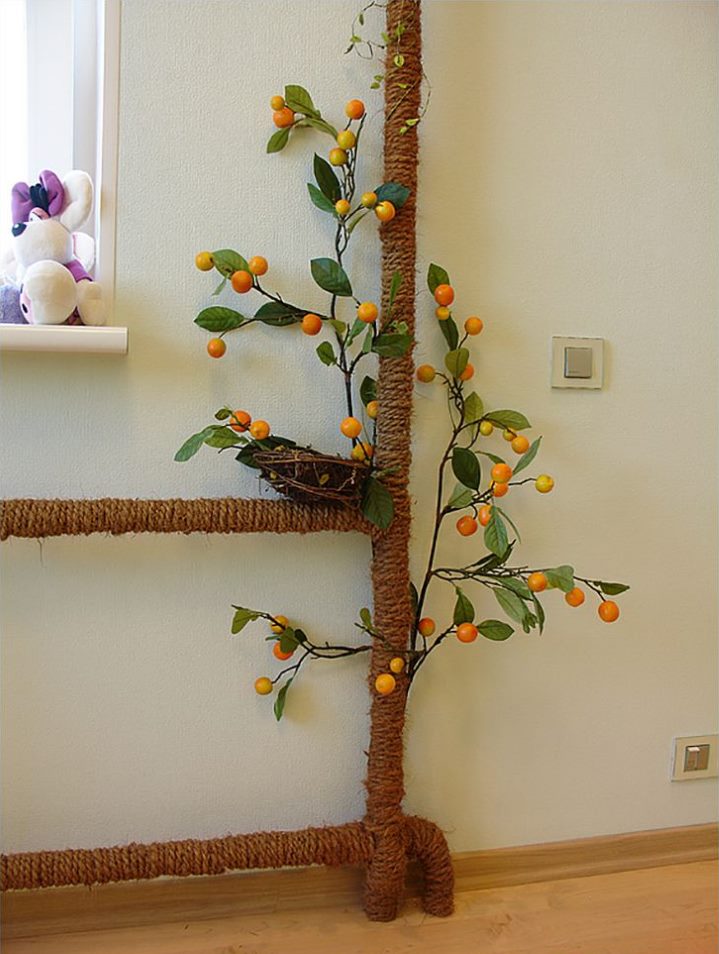
A freshly painted heating system must be braided around with a rigid rope (colored cord), thus simulating a tree trunk (palm tree). Artificial leaves, real tree branches, wooden rings will help complete the picture. Also, you can bring in original decor elements that are already present in other rooms, thereby highlighting the commonality of style.
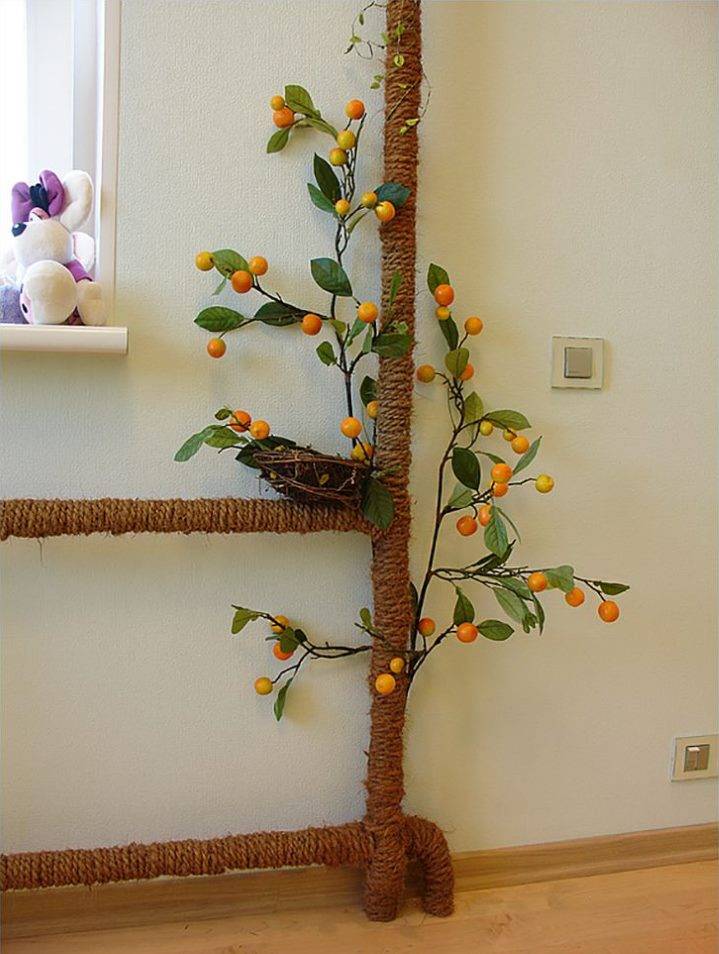
Lemon tree from a heating pipe
Shelf imitation
Perfectly implemented on a horizontal heating system. Use hemp cables, twine cords - you can attach a neat decorative shelf to them for storing knick-knacks and other light things. If the room is still under renovation, the shelf can be made more solid. Then it will be able to fully function, while being useful in everyday use.
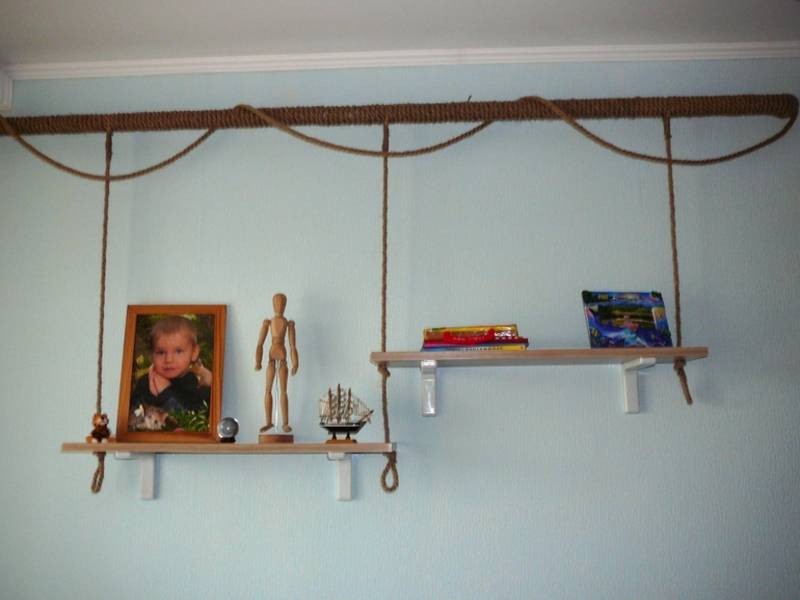
Decorative shelves suspended on a horizontal pipe
Hide in a box
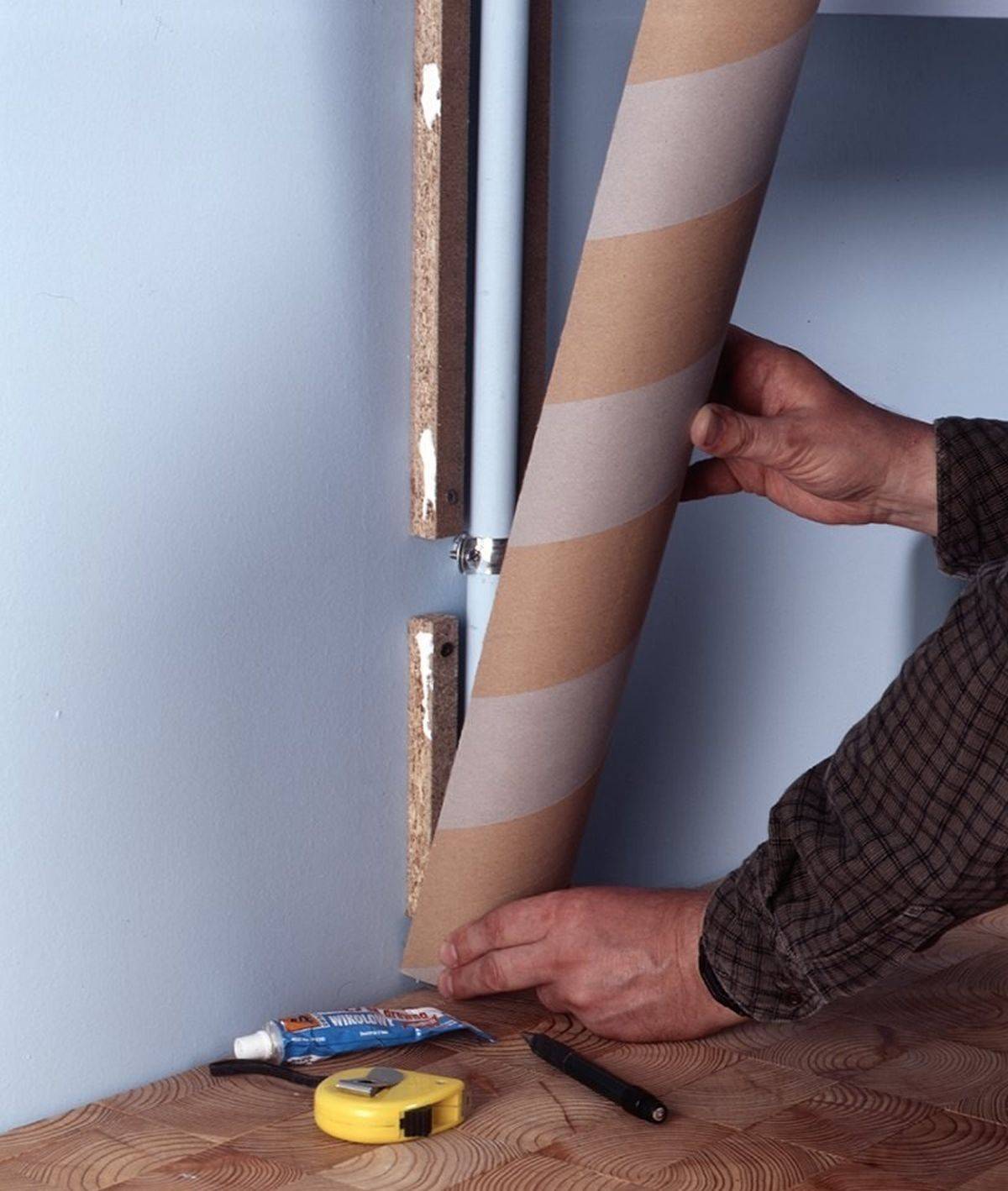
An original solution that will suit adherents of minimalism and geometric shapes.You can build a box without much difficulty: you only need a sheet of metal, fiberboard, at worst, ordinary plywood (drywall) will fit. But as a result - a neat appearance of the wall without unnecessary heaps of heating pipes, as well as other heating communications.
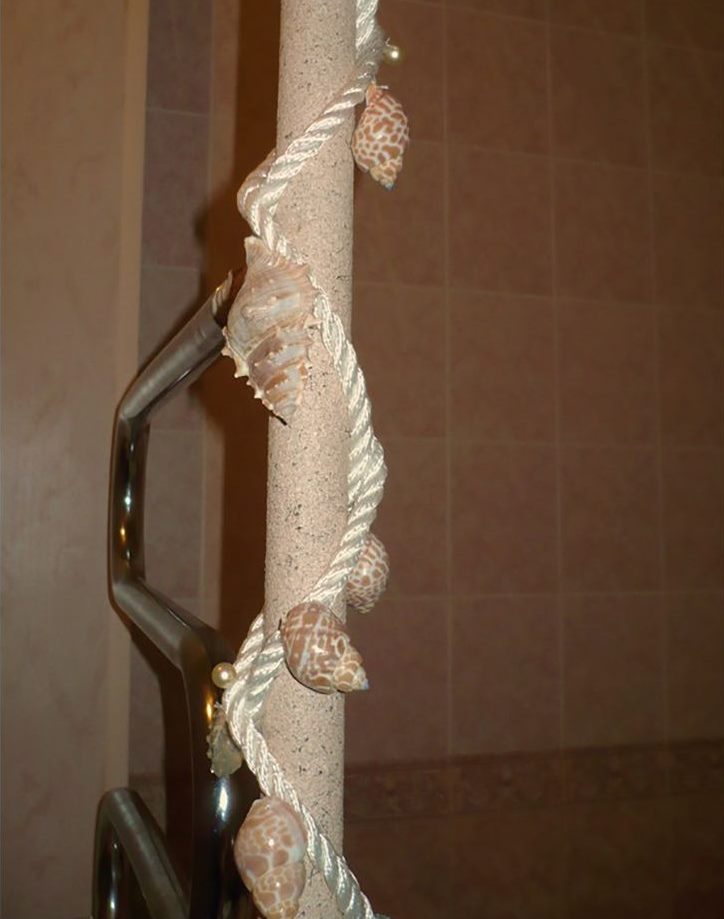


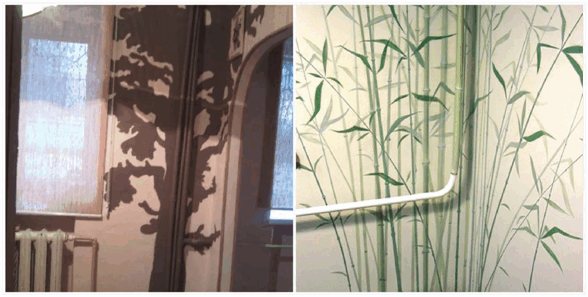



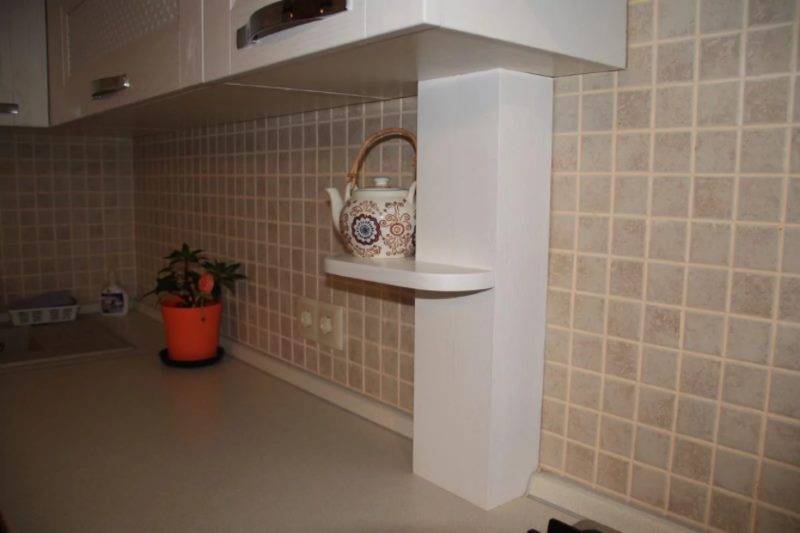
A simple box of boards with a small shelf

Stylish box made of sheet material and wooden slats, painted to match the brick wall
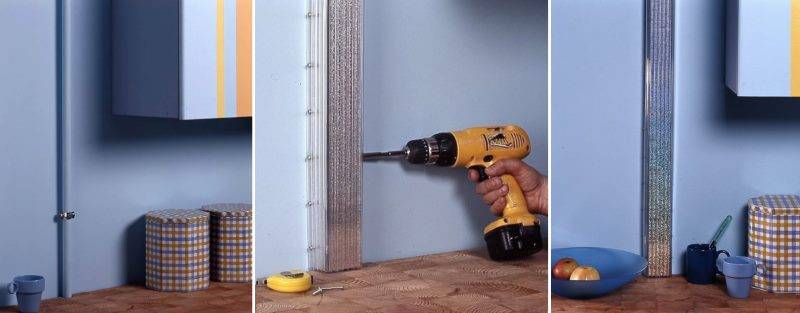
Masking the pipe with a galvanized profile
Hide in a locker
Convenient, simple, concise. This element is not difficult to mount, especially if you are not personally involved in the repair. You can ask a specialist - he will offer the most optimal options, at the same time tell you how to fit the cabinet interior. In addition, the locker-secret is very convenient. Especially when suddenly you urgently need access to the battery (for example, adjust the pressure, eliminate the leak).
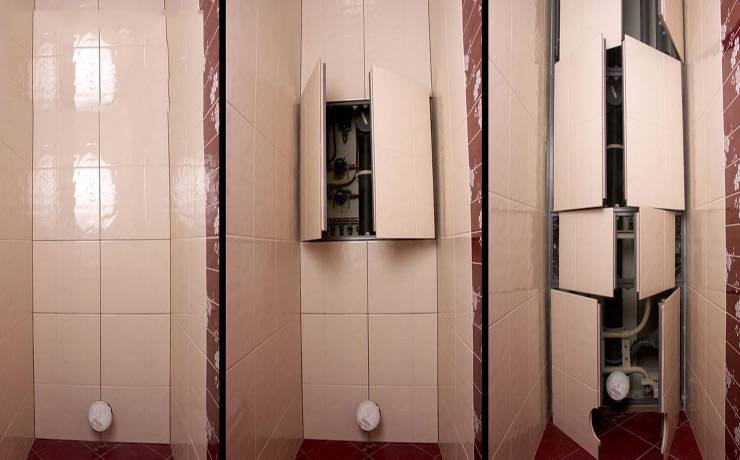
Cool bathroom cabinet
Types of decorative screens
All means for performing hidden laying of heating pipes can be divided into 2 groups:
- products of factory readiness;
- homemade boxes.
The first group is screens sold ready-made. Their advantage is low cost and ease of installation. You do not need to invent anything for the heating pipes, it is enough to assemble the finished structure and attach it according to the instructions. An additional advantage of such screens is that in the event of an accident or the need to replace the pipe, the box is just as easy to remove as it is to be mounted.
For reference. There are whole sets of decorative screens on the market, including a box for a battery and a pipe, made of the same material.
There are no serious flaws in the factory screens.What makes many homeowners sew up an objectionable pipe with drywall or plastic? The answer is simple: a drywall box covers the riser completely, while it becomes possible to veneer it as you like and fit it into any interior. Despite the wide choice, factory products are not so diverse as to satisfy all homeowners, and some simply do not like them, this is a matter of taste.
In turn, deaf home-made drywall screens have one drawback of the technical plan. The fact is that the riser, located in a closed space, heats the air inside it 5-10 degrees higher than in the room. At the same time, almost no heat enters the room from it. If we are talking about an apartment, then blank screens for heating pipes deprive you of a legitimate share of the heat for which you pay a lot of money.
The second nuance: the temperature difference between the closed space of the box and the street increases, therefore, heat transfer is more intense towards the street, and not towards the room. In simple terms, this means that you pay for heating the environment. But there is a way out: it is high-quality thermal insulation of the pipe under the drywall, which will lead to additional costs.