- Soft, flexible tiles - advantages, disadvantages of the material
- Necessary tools, installation steps
- Making a brick wall from plaster
- The main advantages of brick stucco decor
- Textured and paintable wallpapers
- Peculiarities
- Using ready-made decorative panels
- 4 Stucco wall - cheap and effective
- Imitation brickwork on the balcony
- Preparatory stage
- Types of plaster mixtures suitable for such a finish
- What you need to create a simulation
- In the interior of the apartment
- On the balcony
- Living room
- Kitchen - dining room
- Bedroom
- Bathroom
- Applying plaster
- How to draw brickwork with paint
- Surface preparation
- Drawing sequence and little tricks
Soft, flexible tiles - advantages, disadvantages of the material
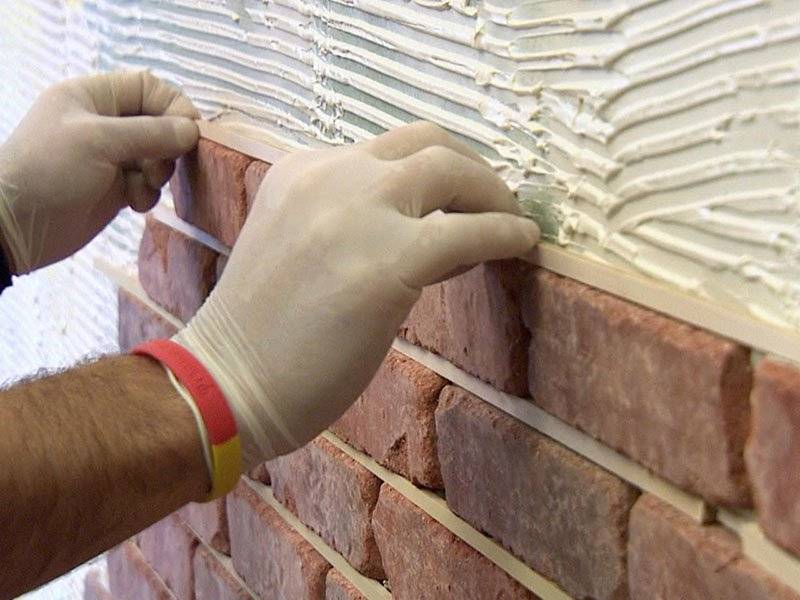
Soft tiles - one of the most "plausible" variations of creating realistic masonry
The flexible option is water-resistant, which is important when used in wet areas of the bathroom or toilet, home pool, greenhouse. This material has significant impact resistance, durability, it is vapor permeable, resistant to mold, fungus, easy to process, does not change color from exposure to the sun, has a beautiful appearance
Also, the positive properties of flexible tiles include the fact that it will be mounted not only on perfectly flat walls, but also on convex, concave interior elements - arches, internal, external corners, window slopes, brackets, fireplaces, round columns, small architectural forms, having a complex configuration.

Necessary tools, installation steps
To finish the interior with “soft bricks”, you will need some tools that are available in almost every home:
- a metal spatula, 13-17 cm wide, with which it will be stirred, an adhesive composition is applied;
- spatula 16-19 cm wide, with teeth, about four mm high;
- a ruler made of wood, plastic or metal 100-150 cm long;
- building level 100-150 cm long;
- center cord of bright color, for beating straight lines;
- large sharp scissors;
- a simple construction pencil for marking;
- medium-hard brush 10-13 mm wide. To align the seams between the tiles.
From the materials you need:
- the flexible tile itself is of a suitable color, size;
- tile adhesive - a dry mix in a paper bag or a finished composition in a plastic bucket; • high-quality primer.
Step by step process:
the surface, which it is decided to decorate, is preliminarily well cleaned of old coatings, leveled;
after the wall with the leveling compound applied to it dries, it is primed with an antiseptic so that fungus and mold do not “wound” under the lining, and adhesion is maximum;
after drying the layer, the tiles are directly installed
It is important to do it at a temperature not lower than five to seven degrees, since in the case of a lower one, the adhesion of the tile to the wall is reduced.This will negatively affect the appearance of the finished surface, individual parts in general can quickly fall off;
then the wall should be drawn into identical rectangles, where tile adhesive will subsequently be applied
If it is supposed to decorate the entire wall completely, the limiter lines at the top and bottom are necessarily beaten off;
the adhesive composition is not uniformly applied everywhere, but only on separate zones, 50 by 100 cm in size. The layer thickness is two to four mm. The application is made with a flat spatula, after which the surface is “passed” with a spatula with teeth to make furrows;
the bricks themselves are usually made with parameters of 25 by 12 cm or 10 by 15 cm - the material is easily cut with simple scissors. With serial laying, the first level begins with a whole “brick”, the second - with half or one third. Before cutting, the material is marked with a pencil and a ruler;
during the installation process, it is important to observe the same width of the joints between the tiles - usually nine to thirteen mm, but other values \u200b\u200bare acceptable. The horizontality of the rows is periodically checked with a level - the tile should not “walk”, move excessively up or down;
when the row "rests" against the inner or outer corner, the tile is carefully bent, sticking like everyone else. Rounded, wavy elements, columns, fireplaces are faced in exactly the same way;
each time when another area of about one square meter is pasted over with tiles, the tile joints are smoothed out with a wet narrow brush. This must be done before the glue grabs, completely hardens;
special grout for the space between flexible bricks is not required, which significantly reduces the cost of finishing.
Making a brick wall from plaster
Imitation brick plaster
Do-it-yourself brick wall made of plaster is a rather laborious option, but very practical. On the one hand, such an imitation looks more realistic than a wallpaper pattern. On the other hand, unlike clinker or tiles, stucco "masonry" does not burden the walls, is quite vapor-permeable and retains heat well.
The production of finishing consists of 3 stages: marking, laying formation and adjustment. The most difficult stage is the markup. In stores, you can find a ready-made form grid, which is applied to the surface. The step-by-step instruction contains a detailed description of the finish. If it was not possible to buy one, the markup is performed by improvised means.
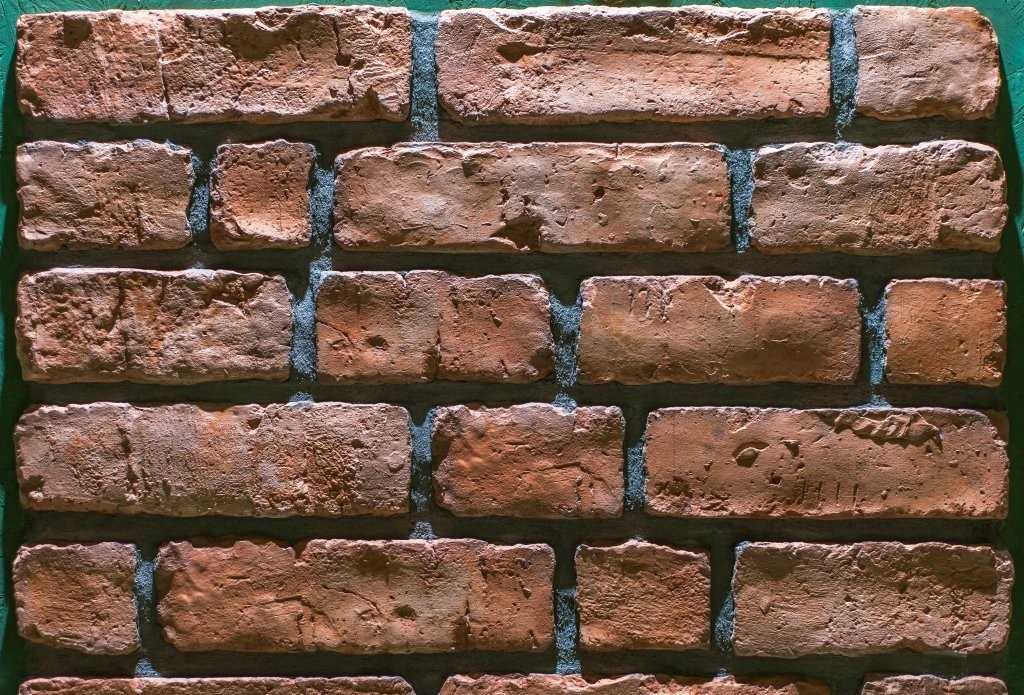

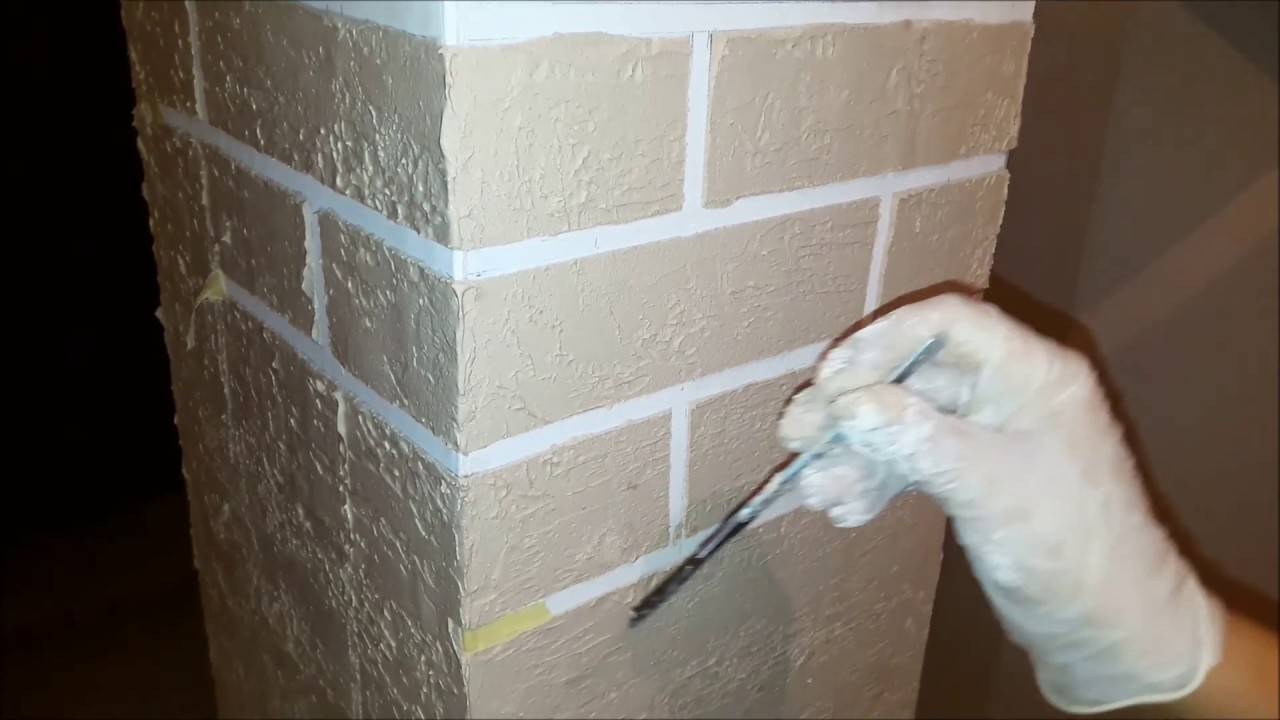



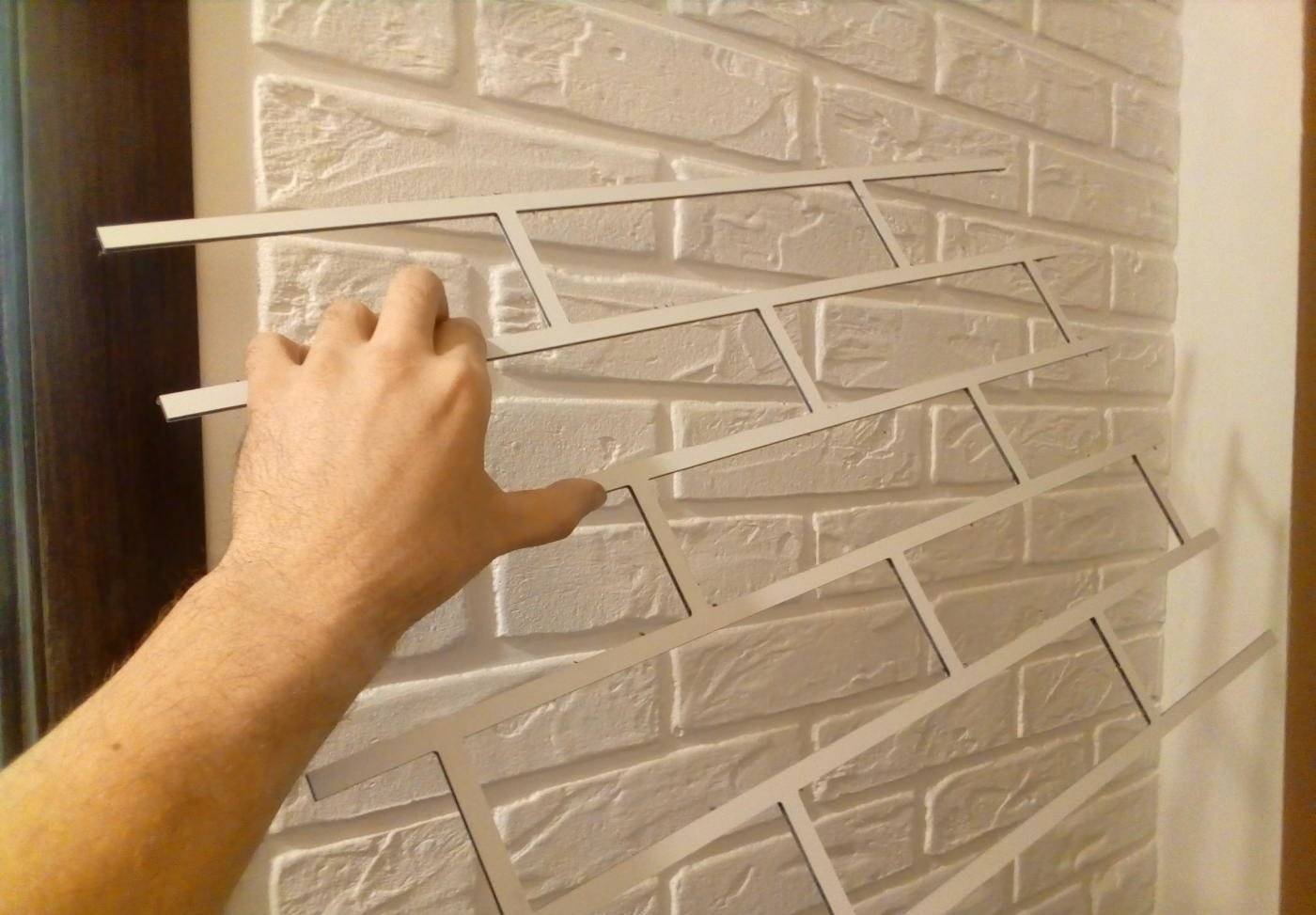
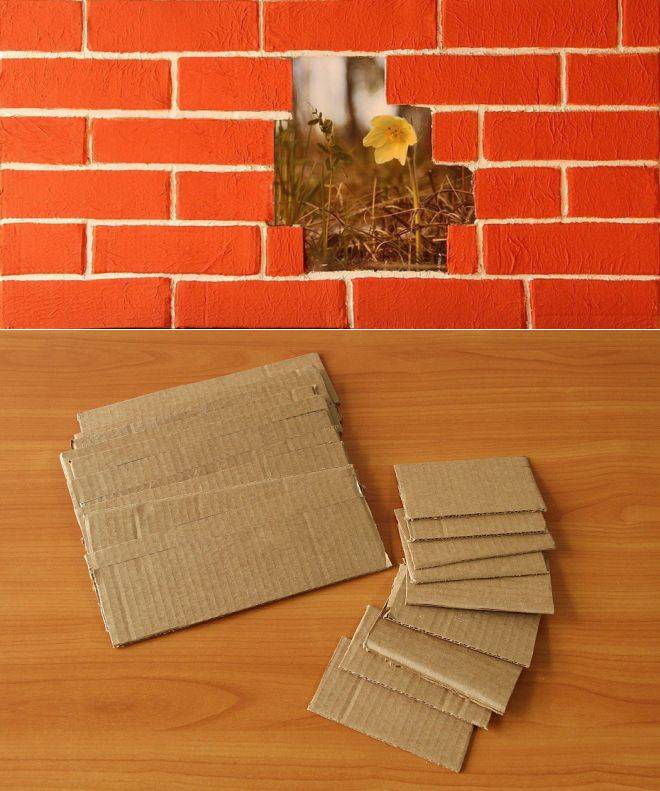
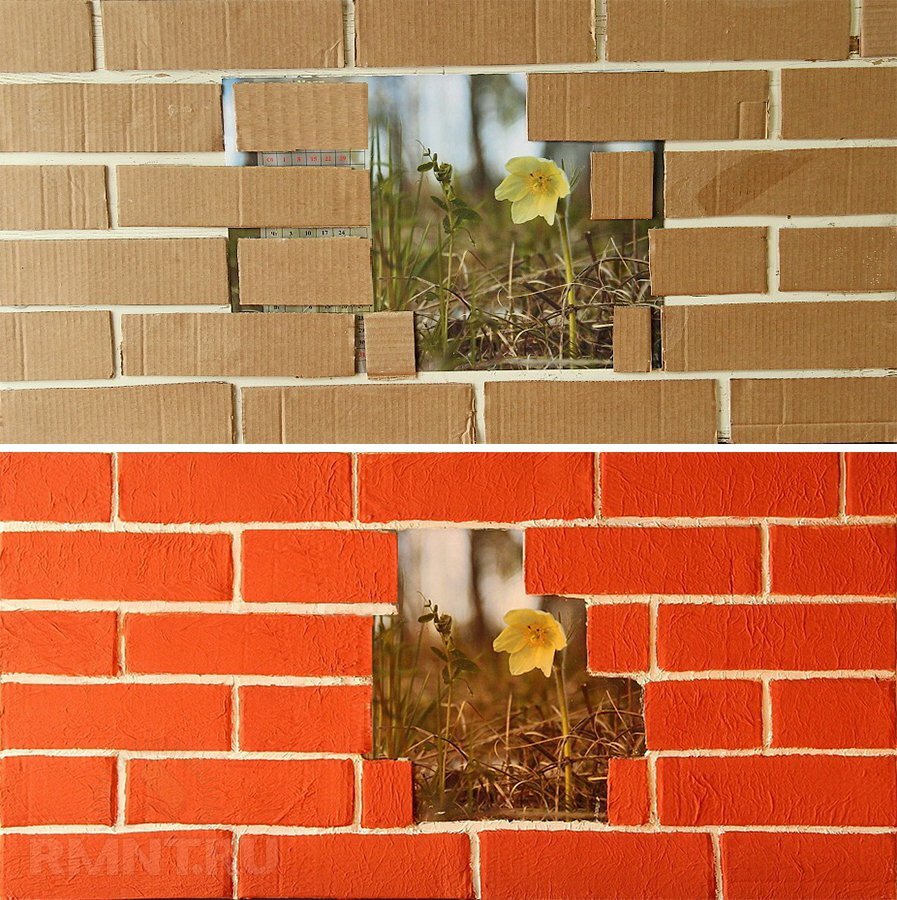
- A brick template is cut out of cardboard. On average, its length is 25 cm, and its height is 7 cm. 1.5 cm are taken to the seams. The template is cut out with seams. Designate the center of the brick on the drawing, taking into account the seams.
- Begin installation from the lower left corner. At least 5 cm recede from the floor and ceiling. The template is applied to the wall, contours are drawn and the center is marked. First, the wall is drawn like a grid, and then the “brick” is divided in half through the row, in the center. So it turns out the standard brick "masonry".
- The marked lines are glued with masking tape 15 mm thick. Be sure to leave free ends to make it easier to remove the tape later.
- Make plaster mortar. Most often, a mixture of gypsum plaster and tile adhesive is used. If the wall is made in the bathroom, a special plaster mixture is used. The solution is kneaded manually or with a construction drill or mixer.
- The plaster slowly but hardens, so cook it in portions.
- The mixture is applied to the wall with a spatula, carefully leveled with a wide spatula in an upward direction.
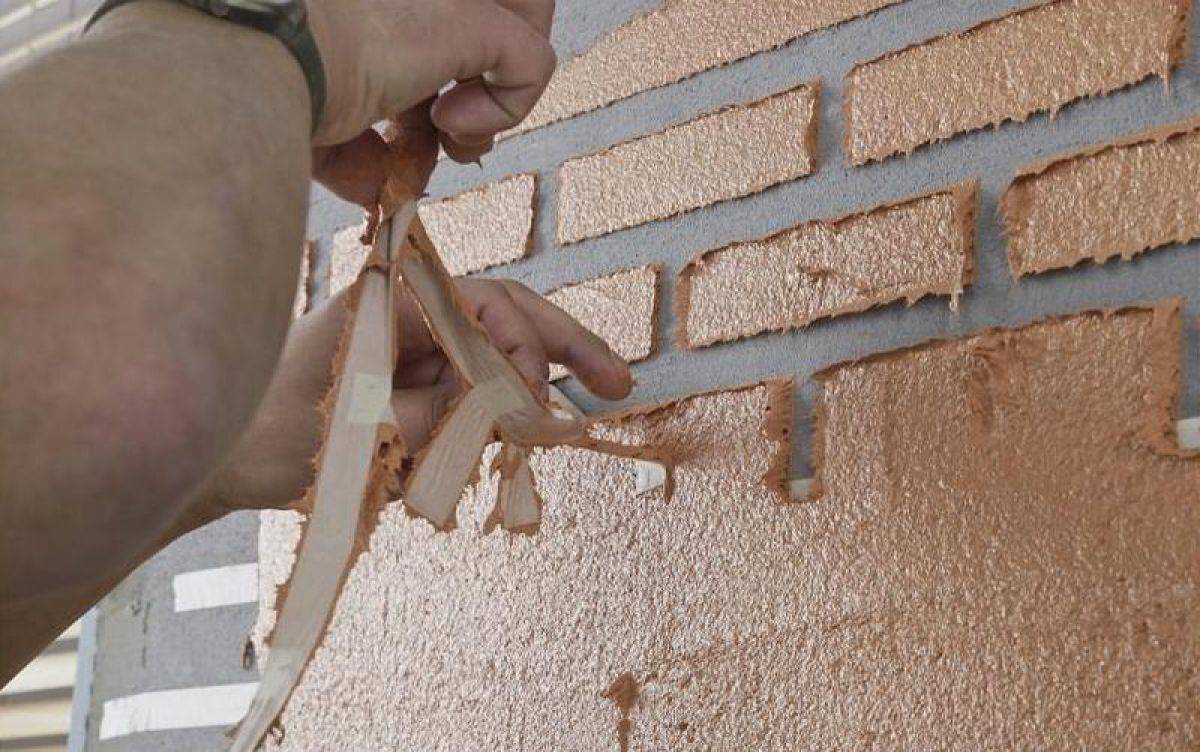
- As soon as the mixture has set, but not until completely solidified, the tape is removed. It turns out "laying".
- After hardening, the "bricks" are treated with fine-grained sandpaper, sharp edges are rounded off. To achieve a good imitation, small chips and scratches are made.
The own color of the plaster is not very attractive. Usually "brickwork" is primed and then painted. You can paint the entire wall, you can - only "bricks" or paint in 2 different colors "bricks" and "seams".
The main advantages of brick stucco decor
Any finish has its pros and cons.
Decorative plaster brickwork has its advantages:
- Light weight of the coating - in comparison with natural brick design, it does not overload the load-bearing elements of the building structures;
- Imitation of brick from plaster mortars is high-strength, resistant to various kinds of mechanical damage;
- Making a brick wall with your own labors is easy and simple. You can save on the services of specialists;
- Imitation of brick looks great in the interior of rooms of various styles (from loft to gothic);
- Can be used for indoors or for the facade;
- During operation, no special maintenance is required;
- Changing the decor when changing the interior is done by painting in any color.
In the loft style, decorative concrete-like plaster is a little less common than brick imitation.
Brick finishing also has disadvantages:
- The need for more frequent removal of dust accumulated by the relief;
- Ability to perform work only at temperatures above +10 C;
- The need to knock down the relief coating when changing the surface texture.
The following is information on how to make an imitation of a brick wall with your own hands.
Textured and paintable wallpapers
There are many types of wallpapers on the market. Two of them are ideal for creating a decorative coating - textured and paintable wallpaper.
Textured wallpapers have a relief surface that exactly imitates brickwork.
They are presented in a variety of colors - natural shades, solid colors, aged brick.
The surface where the imitation of brickwork will be located should be cleaned and primed. Dilute the glue and stick the wallpaper to the wall according to the instructions.
Wallpaper for painting is a more affordable option than textured. In order to make an imitation of a brick wall, the following materials are needed:
- Wallpaper (it is better to take fiberglass wallpaper);
- Glue;
- masking tape;
- Water-based paint;
- Color.
Work process:
- Stick the material on the wall and leave to dry for a couple of days;
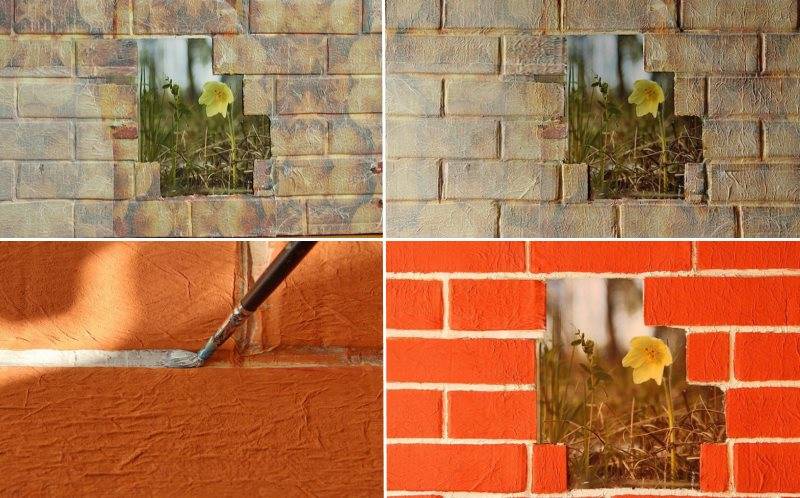
- Stick horizontal and vertical strips of paper tape, creating a pattern of a wall built of bricks. To achieve naturalness, it is worth taking the parameters of real bricks as a basis and observing the correct masonry pattern.
- The next step is to paint the surface. We pre-mix the paint with the selected color scheme, apply in two layers.
- Once dry, carefully remove the tape.
- Then, with a thin brush, paint over the resulting tile seams in white.
The advantages of this method are availability and a small amount of time spent during work.
Peculiarities
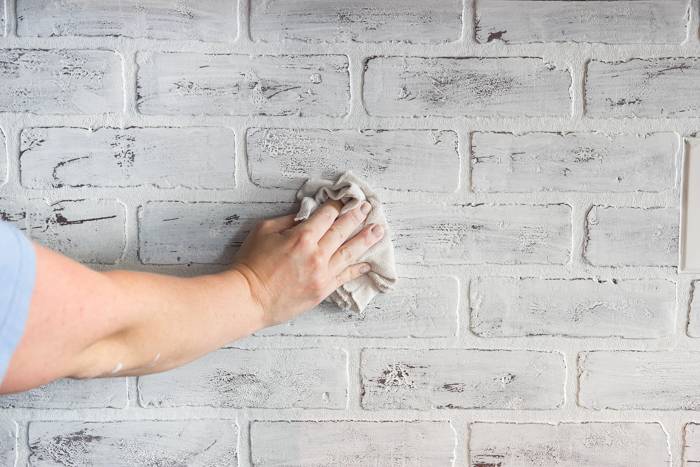
A brick wall fits well into almost any interior, as it is one of the oldest building materials. Whitewashed, such walls go well with Provence, Shabby Chic styles. Red and brown bricks are an integral part of the loft style, while gray and beige will perfectly complement the modern urban design of kitchens, bedrooms and halls.
It is the design of the room with the help of brick and its imitations that brings together different interior styles, as it goes well with both modern metal interior details and antique wood products.
Using ready-made decorative panels
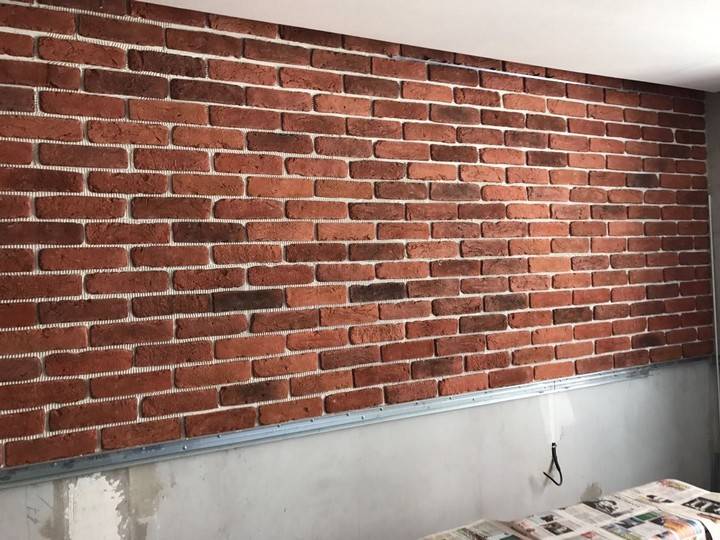
The use of ready-made decorative brick-like panels of various colors and textures gives concrete walls or gypsum partitions a different brutal look, depending on design decisions. At its core, the material is a panel on which bricks of various shapes and colors are attached using special glue. And you can pick up a panel with white brick. with red or retro style - everything will depend on your taste and the place where decorative brick-like panels will be used.
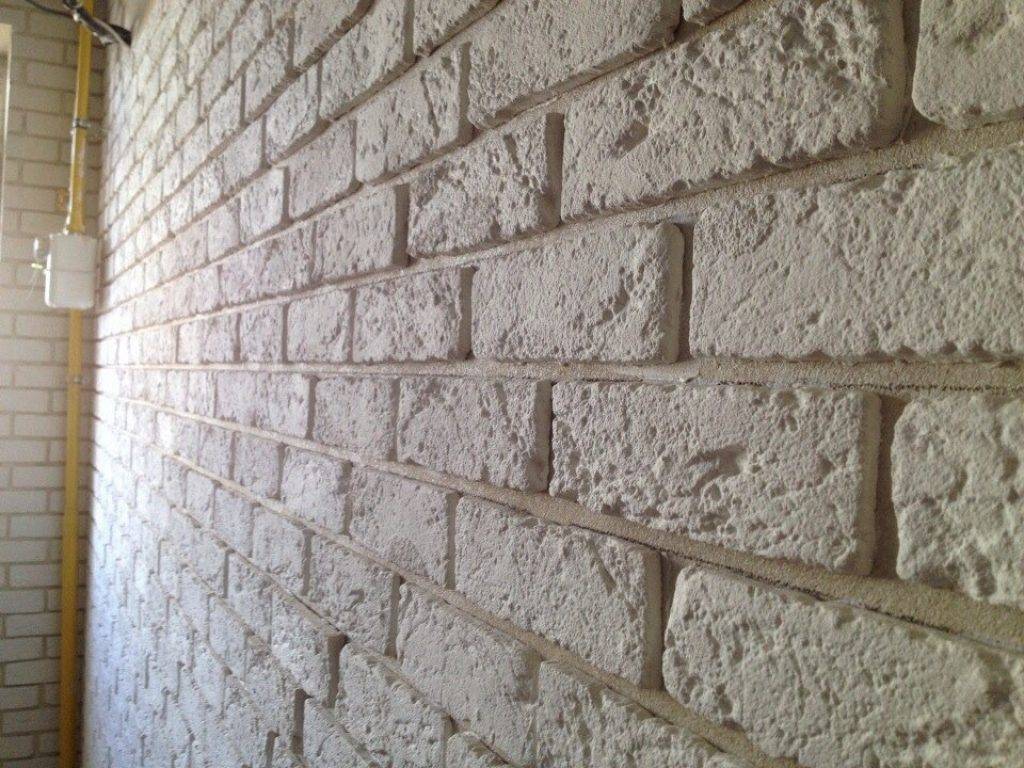


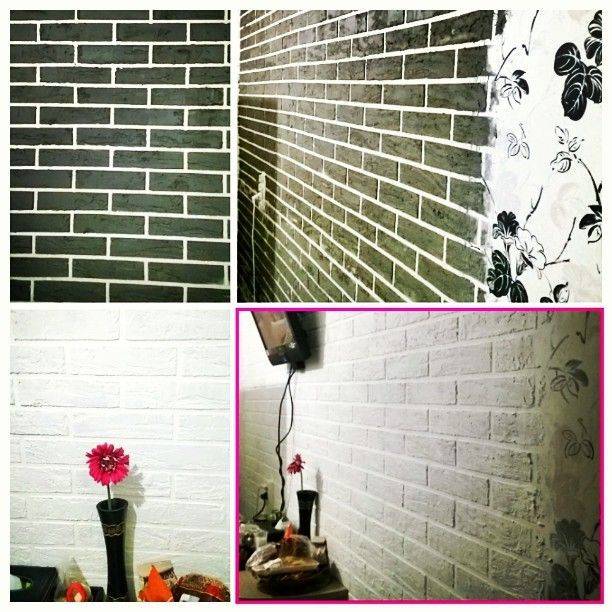


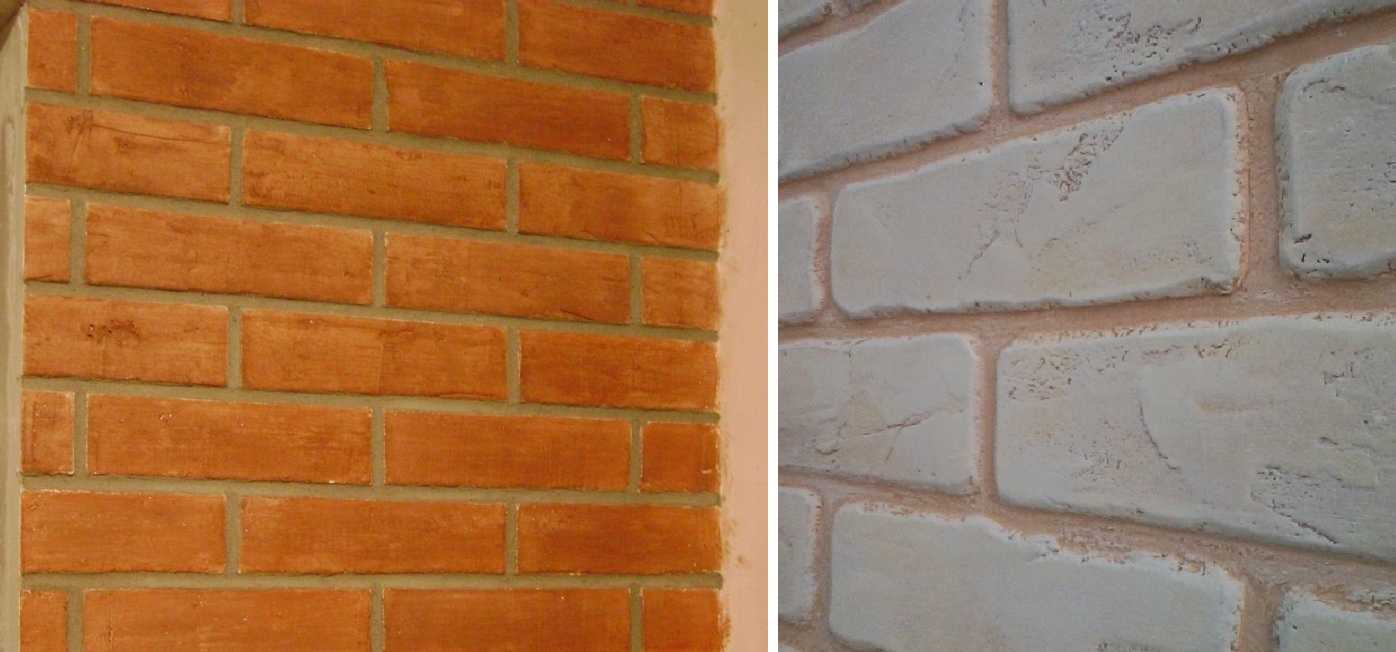
The advantages of the panels are obvious - it is lightness, water resistance, resistance to ultraviolet rays. Currently, corner panels, some shaped parts and even columns are being produced. Due to their exoticism, decorative brick-like panels are used in the decoration of partitions, bar counters, cabinets under the washbasin, in the interior of living rooms, but fireplaces are a particularly popular option.
4 Stucco wall - cheap and effective
Decorative brick for interior decoration is not cheap, the foam version burns and poisons the air with harmful chemicals, the painted one does not look realistic. As a result, the picky homeowner is left with only one option - to mold an "almost brick wall" of plaster.
Moreover, the lack of experience in plastering surfaces in this case will be more of a plus than a minus, because we need not a smoothly worn wall, but a torn texture with multiple layers, cavities and other defects. And from the tools you only need wide and narrow spatulas and a screwdriver with a mixer nozzle. The very process of making a cladding in a brick format with your own hands is as follows. Clear the space under the wall. Lay old newspapers on the floor, covering a meter section. This will come in handy when you clean the floor from blots from the plaster solution.
Coat the section of the wall with a primer that will increase the adhesion of the surface. The very possibility of holding the plaster on the wall surface sometimes depends on whether priming was done or not. While the primer dries, you can prepare a solution for a decorative coating. To do this, take a bucket, pour 300 milliliters of water into it and pour in the dry mixture. Moreover, as a basis, it is better to choose not a finely dispersed finishing plaster, but a starting composition with a rough structure. After the mixture is poured into the water, beat the solution with a construction mixer, obtaining a plastic mass.
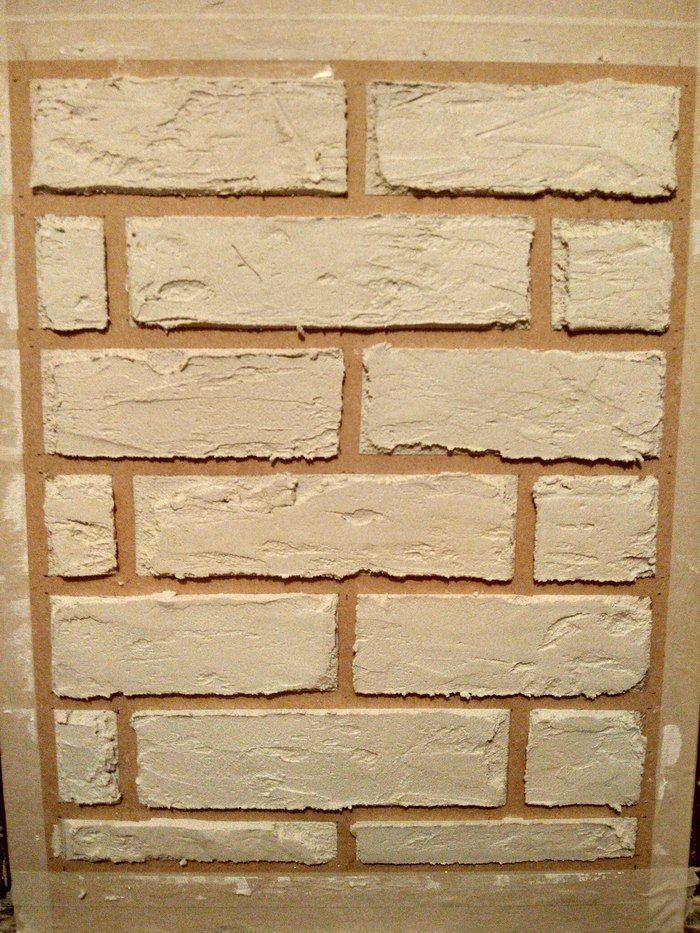
Next, you need to apply a 5 mm layer of plaster.To do this, take a small portion of the solution from the bucket with a narrow spatula and apply it to a wide tool; turn the wide spatula with mortar towards the wall and, laying it almost parallel to the surface, spread the plaster over the surface to be finished. Repeat this procedure until the entire area is covered with a layer of plaster. You will end up with a sloppy finished surface, which is very good. After all, we are not creating an evenly worn plane, but a texture that imitates the rough edges of a brick.
After application, the solution is allowed 30 minutes to partially dry. During this time, you must apply a masonry grid to the surface using a ruler and thread. And it’s done like this: you measure 7 centimeters from the ceiling on both sides of the wall, then your two assistants pull a thin but strong thread along these marks, and you, holding the middle of this segment, pull the thread and sharply release it, leaving it on the damp plaster well-marked furrow. After that, the procedure is repeated again. And so to the floor.
After 30-40 minutes, the plaster will dry out, but remain plastic, and you can cut horizontal grooves in its body using jointing - a masons tool that removes excess mortar from the masonry joints. It can be made from an old spoon by cutting a semicircular handle to a width of 8-10 millimeters. In addition, instead of stitching, you can use a centimeter-wide carpentry chisel. The process of selecting the groove itself is carried out as follows: press a plaster rule or a flat board against the stuffed line and draw a joint along it, pressing it into the wall.Once you've scratched through the soft finish and hit the hard surface, you can release the pressure. Just do not try to remove a layer of plaster in one pass by jointing - this way you can damage the entire texture by accidentally tearing out more mortar than necessary.
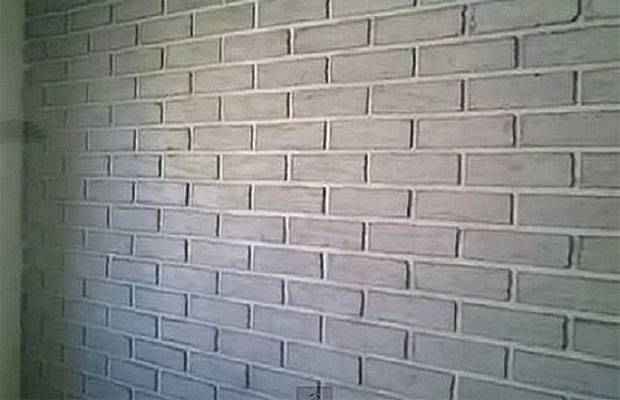
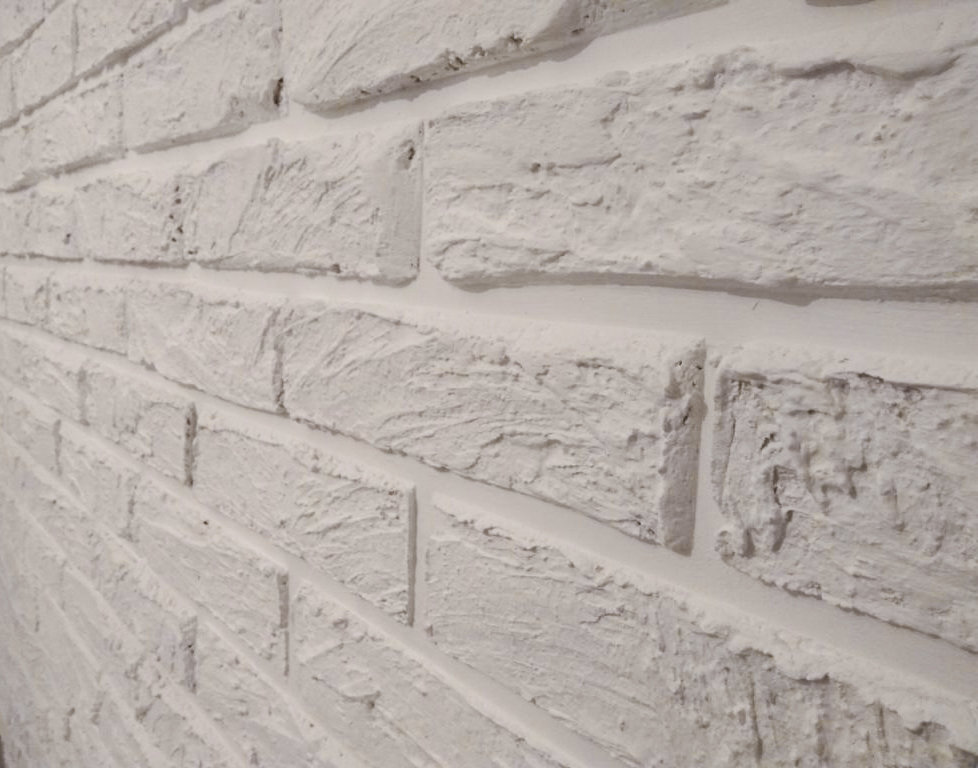
Brickwork from plaster turns out to be quite realistic
The next step is the formation of vertical seams. To do this, we need a foam brick 12.5 × 6 centimeters, which we will apply between the horizontal seams, outlining the vertical ones. At the same time, one should not forget that the vertical seam of the lower row must be blocked with a brick from the upper one. After the plaster has completely dried (after 1-2 days from the moment of application), you can clean the edges of the bricks with sandpaper, getting rounded edges, like on old masonry. Next, you have to paint the main surface and masonry seams.
As you can see, anyone who can read these instructions and hold a spatula and jointing in their hands can make an imitation of brickwork from ordinary plaster. Moreover, such a finish is carried out at the speed of coloring and gives the same reliable result as facing with decorative tiles. A wall made according to this scheme is not afraid of fire, looks very realistic and is easily removed after such a finish gets bored with the owners of the home. But before applying the decorative layer, the surface to be trimmed must be prepared.
Imitation brickwork on the balcony
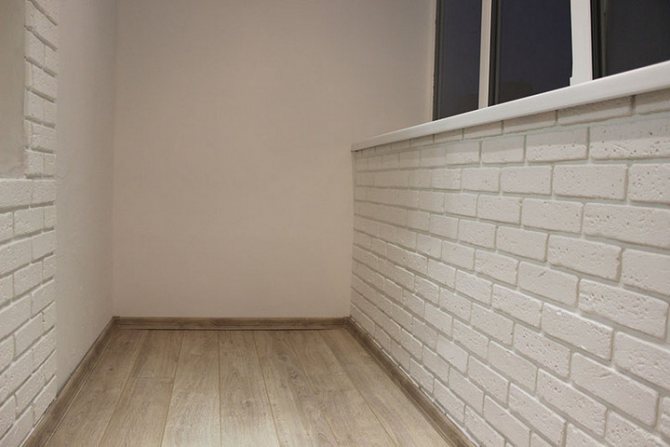
The design of the balcony through decorative brickwork gives the room a modern look. The imitation was created from champagne-colored plaster and a clearly defined relief. The surface has irregularities, due to which naturalness is achieved. The seams are painted in dark color.This creates the contrast of the coating. "Masonry" is made with deliberate irregularities.
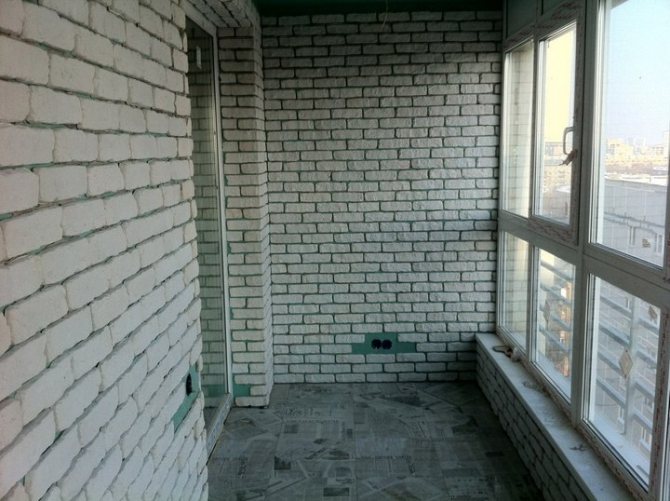
If the balcony is planned to be faced in pastel light colors, for this purpose, you can use an imitation of brickwork. Here fake "bricks" are combined with a flat surface of the walls. The masonry has a marked relief, the seams between the rows are recessed inwards. Applying champagne or ivory paint visually expands the space.



Preparatory stage
- remove the old finishing material;
- carefully scrape off all the lumps that one way or another, but may interfere with you in the future;
- inspect the wall for cracks and irregularities;
- if you notice cracks, then use a hammer and a chisel to make them a little wider and fill the holes with a deep penetration primer - this will help prevent the appearance of always unwanted mold;
- carry out the primary treatment of the wall surface with a primer - it is not necessary to achieve a perfectly smooth surface, since after puttying the priming procedure will have to be repeated;
- if the surface is very uneven and there are noticeable defects, then walk along the wall with plaster, also cover the cracks previously treated with a primer;
- to achieve a perfectly even wall after plastering, it makes sense to use gypsum-based putty - it is not so rough in consistency and will help make the wall flawless, eliminating those irregularities that plaster cannot cope with due to objective circumstances;
- the final touch is re-priming the surface, this time we are aiming to achieve excellent adhesion to the decorative material that will be used to imitate brick, the processing must be carried out carefully, liberally lubricating those areas that absorb the mortar very quickly.
How to check if your wall is ready for the next step? Everything is very simple: run your hand over it - if you do not feel any obstacles, unpleasant roughness, then you have successfully coped with such a tedious, but still necessary preparatory stage.
Types of plaster mixtures suitable for such a finish
Brick-like plaster in interior work can be implemented using the following compositions:
- Mortar based on sand and cement.
- Lime and sand mixtures.
- Clay based solution.
- Gypsum plaster.
Brick-like plaster in interior work can be implemented using several compositions.
But, regardless of the main composition, as additional elements can be introduced:
Coloring pigments - thanks to this, it is possible to achieve a wide variety of hue and saturation surfaces;
Additives - they increase the resistance of the coating to various aggressive media and water;
Plasticizers make the material itself more flexible
Their addition is quite important, since in this case the surface does not crack, shrink or deform for a long period of time. Thanks to coloring pigments, it is possible to achieve a variety of surfaces in terms of shade and saturation.
 Thanks to the coloring pigments, it is possible to achieve a wide variety of shades and saturation of surfaces.
What you need to create a simulation
Among the materials that will need to be purchased for the successful completion of decoration, there are:
- primer;
- masking tape;
- paint;
- plaster;
- putty;
- varnish.
In addition to materials, you need to buy a tool. Among the devices that will definitely be required during the repair, there are:
- putty knife;
- paint roller;
- tape measure and pencil;
- a bucket for mixing the solution;
- container for paint;
- stationery knife.
The method of imitation of brick decor depends on what materials and tools will be needed. If additional accessories are required during the repair, they can always be purchased in addition. It is recommended that you first provide yourself with the most necessary.
In the interior of the apartment
Brick is a common building material, but now it is used not only to create buildings, but also to decorate rooms.
In modern apartments, it’s not always possible to make original brickwork, but if you want to diversify the interior with it, you can perform an imitation.
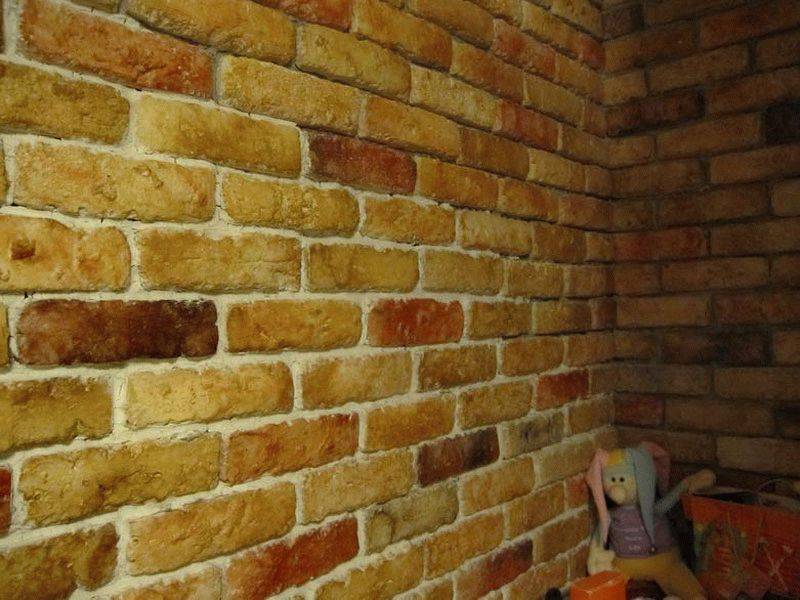
There are several alternatives to the original brickwork: brick tiles, wallpaper, plaster, foam, decorative panels, all of which allow you to very accurately imitate a brick wall.
The specified element can be used when decorating various rooms of your house:
On the balcony
Here the brick wall brings in an element of the street. You can imitate it with the help of tiles, which are light in weight, so they do not weigh down the walls and do not take up free space on the balcony. Imitation in the interior of the balcony in the photo below.


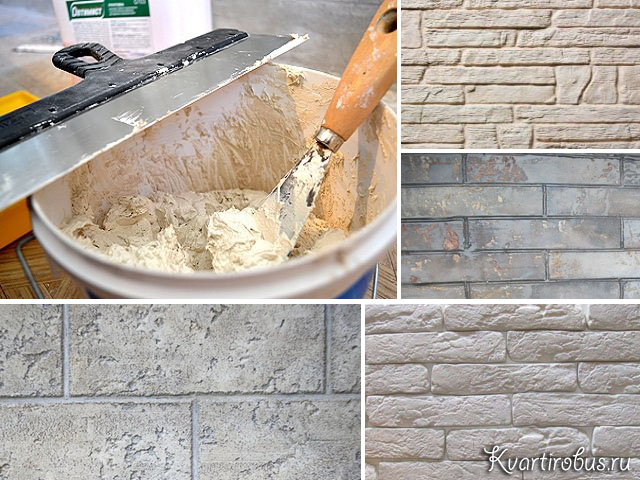

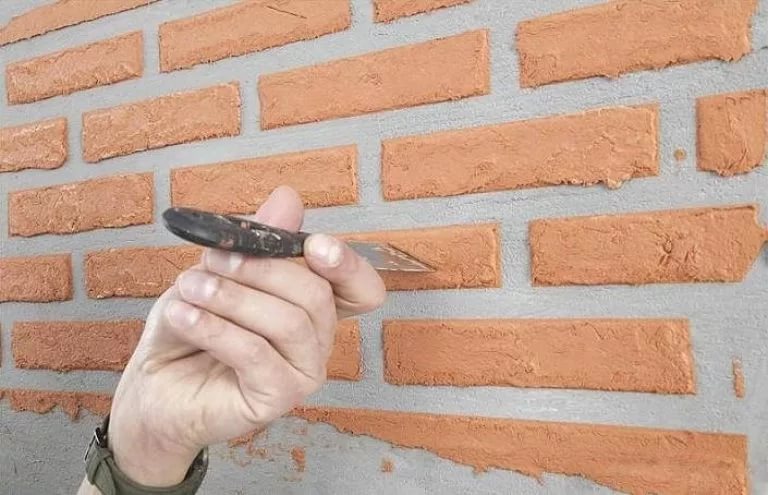
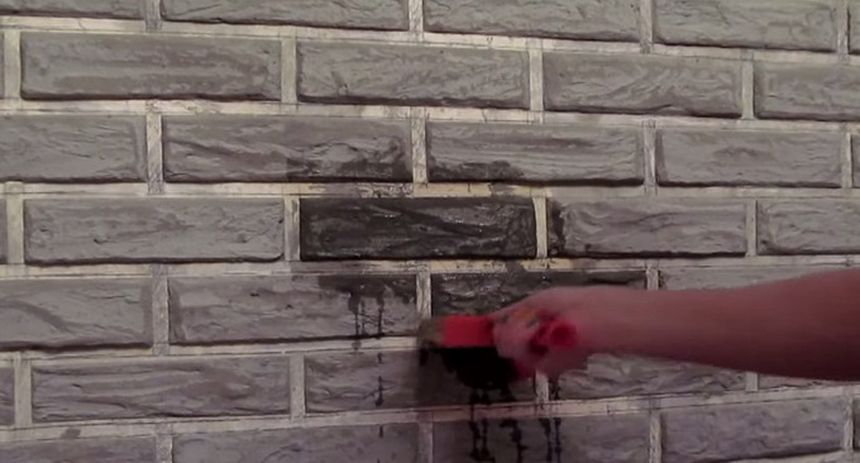
The glue must be of high quality, otherwise the tile may fall off from the constant vibrations that occur when the doors are closed. An alternative looks good in the form of wallpaper that mimics the texture and appearance of bricks.
Living room
Brick is combined with both classic design and ethnic style, minimalism and others. Brickwork may not decorate the entire wall, but only its individual elements.
Kitchen - dining room
The natural look of the brick brings country notes to this room, and if it is painted white, the kitchen-dining room will acquire a Scandinavian style. For imitation, ceramic or clinker tiles are most often used. In this way, you can decorate one of the walls or just an apron.
Bedroom
Modern designers use brickwork in the design of the bedroom. It allows you to create a more brutal design, while the brick looks good with textiles.
The wall can be left in its original form or painted in a certain color. Cream, blue and white shades are suitable for the Scandinavian style, while brighter ones are used when decorating the bedroom in an eclectic design.
Imitation of a white brick wall with a classic interior, in the photo below.
Bathroom
In this room, decoration with brickwork is also often used, but the material must be treated with means that will protect it from mold.
It is best to imitate such a surface in the bathroom with ceramic tiles or you can use moisture-resistant vinyl wallpaper.
Applying plaster
The technology of imitation of brickwork, made from plaster with your own hands, requires the obligatory preservation of the phased actions and the entire technological process.Most often adhere to the following scheme:
- They carry out all the preparatory work, including the purchase of materials, tools and the processing of the surface on which the brick imitation will be created.
- Then you need to dilute the mixture in the right proportion. Most often used:
- Concentration 1:3 for cement-sand compositions.
- Proportion 1:4 for those mixtures that include lime.
- Clay plasters should consist of 1 part lime paste, 1/4 clay and 3 parts prepared sand.
- Gypsum plasters include gypsum, clay, sand, respectively, in a ratio of 1:0.5:3.
- In order to obtain a smooth consistency that does not include lumps, it is necessary to add dry ingredients to the water only in portions, accompanying each time with thorough stirring.
 In order to obtain a smooth consistency that does not include lumps, it is necessary to add dry ingredients to the water only in portions.
How to draw brickwork with paint
In the process of work, the plinth and the adjacent area should be covered with a construction film. The boundaries of the masonry are outlined with adhesive tape. Then you can proceed directly to the preparation of the wall surface and further painting.
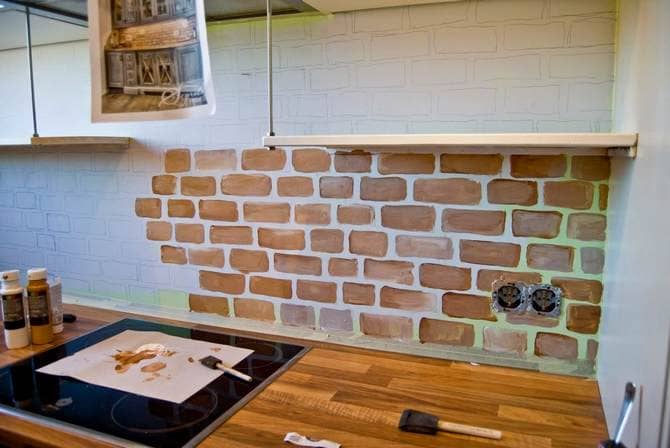
Drawn bricks
Surface preparation
Before applying the paint, it is necessary to prepare the wall according to the recommendations above. Therefore, both the elimination of irregularities in the original surface and the priming of the wall are important steps.
Drawing sequence and little tricks
The application of paint takes place according to the following scheme:
- White acrylic semi-gloss paint is applied to the surface and left to dry completely.
- Background paint is being prepared.To do this, mix 1/6 umber, 1/6 black paint and 4/6 titanium white.
- On a dried wall, several rows of bricks are marked by hand.
- Imitation details are painted with mixed ocher and sienna. So you can get a popular shade of brick.
- The traditional color can be obtained by mixing sienna, red ocher and adding white and a small amount of light ocher.
- The composition is applied with a sponge.
- Using an old toothbrush and burnt bone paint, a clay brick texture can be created. It is enough to dip the brush in the paint and spray it on the surface.
- To give the masonry elements volume, it is necessary to perform seams. To do this, a thin brush is dipped in a mixture of white and umber, after which it is drawn along the seams.
The work is quite laborious, so a beginner can draw no more than three dozen tiles in one day.
To get the most realism of the painted wall, you can use the following life hacks:
- To reduce the sharpness of the shadows around the brick, you can moisten the toothbrush in white and natural sienna, and then blend the shadows with this brush.
- After applying the paint, do not wait for it to dry. You should take white, pour a small amount of umber, dip a sponge and dilute the texture by simulating a heterogeneous surface.
- The color of a real brick is usually not uniform, but consists of a gradient of shades. To obtain such a palette, you must constantly experiment and add new tones to the main color.
- The size of the bricks and the seams between them should be different from each other - it is necessary to give the pattern a variety for greater realism.
If you show patience and make some efforts, the painted brick wall will look like natural masonry. It should be remembered about the heterogeneity of the bricks, and try to avoid the "ideal" pattern.