
- How to take water meter readings
- How to determine where the hot water meter is and where it is cold?
- How to take water meter readings
- How to pay for water by meters
- Does the counter count correctly, how to check
- What happens if you don't submit meter readings?
- Recalculation of utility bills
- Overpayment
- If no evidence was given for a long time
- Taking readings from water meters of various types
- Option number 1 - eight-roller device
- Option number 2 - five-roller flowmeter
- Option number 3 - model with a digital display
- Option number 4 - the use of smart meters
- Taking readings
- Correct readings
- The meaning of the numbers on the counter
- Step-by-step instructions for calculating the consumption of hot and cold water in an apartment
- How to take readings from five-roller counters
- How to correctly take readings of the device
- What numbers need to be written off from the water meter
- How to record readings
- Detailed example of reading
- Where are water meters located and how do they work
How to take water meter readings
Whoever encounters water meters in an apartment for the first time, after installing, or buying a new apartment, with already installed water meters, the question will definitely arise, how to correctly read the water meters? In this article I will describe in detail the instructions on how to do it correctly.
How to determine where the hot water meter is and where it is cold?
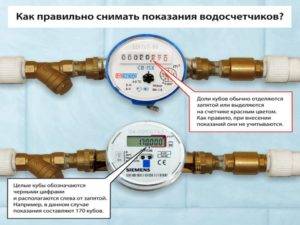
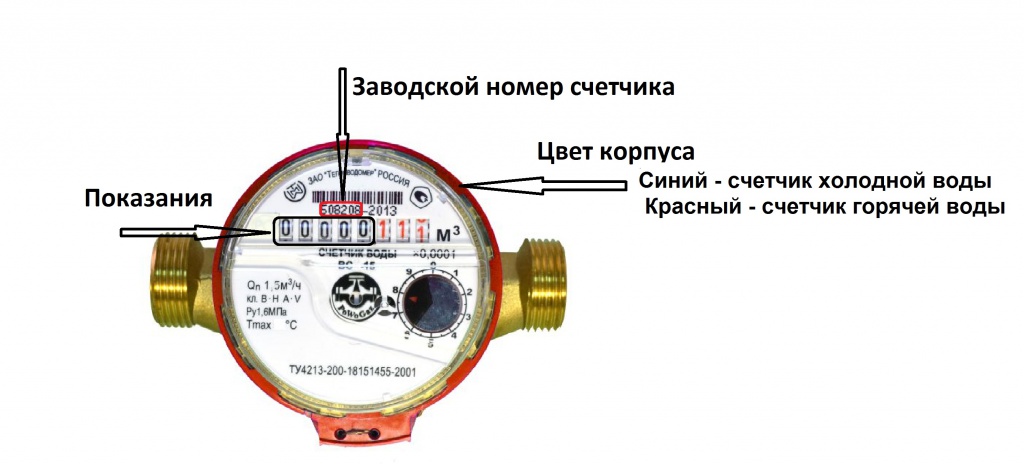
For the correct transmission of readings, we determine where the counter is hot and cold. The blue meter is always set to cold water, and the red meter to hot. Also, according to the standard, it is allowed to put a red device not only on hot water, but also on cold water.
How to determine in this case where it is correct to write off the testimony? According to the standard since Soviet times, at the entrances from the water risers to the apartment, cold water is supplied from below, and hot from above.
And the easiest way to determine, as they say, “at random”, if you haven’t determined by the other two parameters, since modern builders can do the piping as they like, just open a tap, for example, cold water, and see which counter is spinning, and so define.
How to take water meter readings
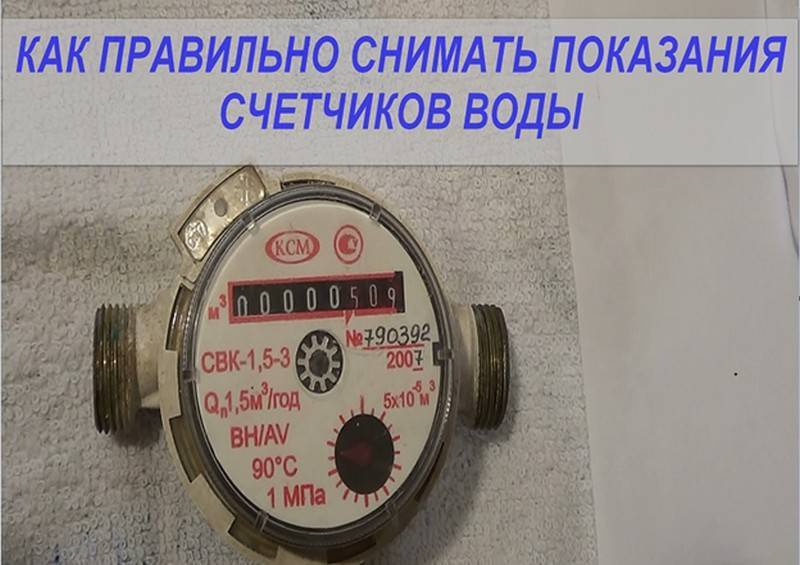
So, where we figured out which device, and now we’ll figure out how to correctly take readings from water meters. The most common counters with eight digits on the dial, and therefore we will start with such models.
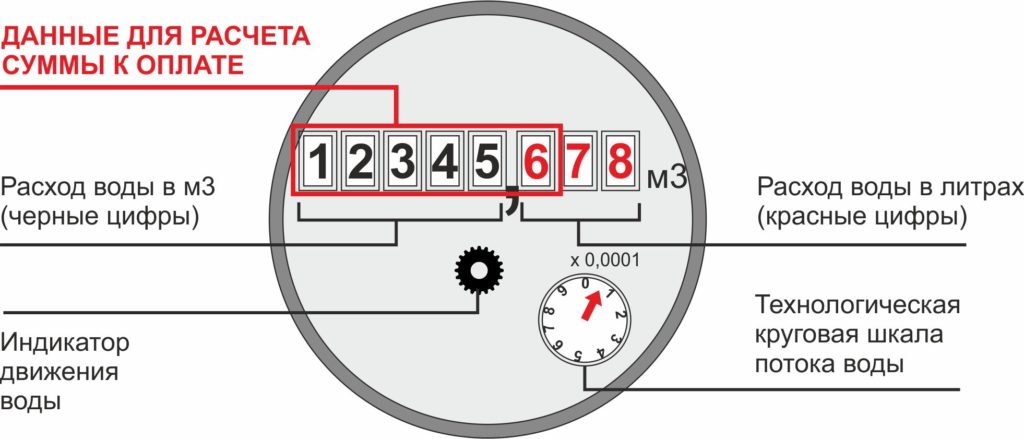
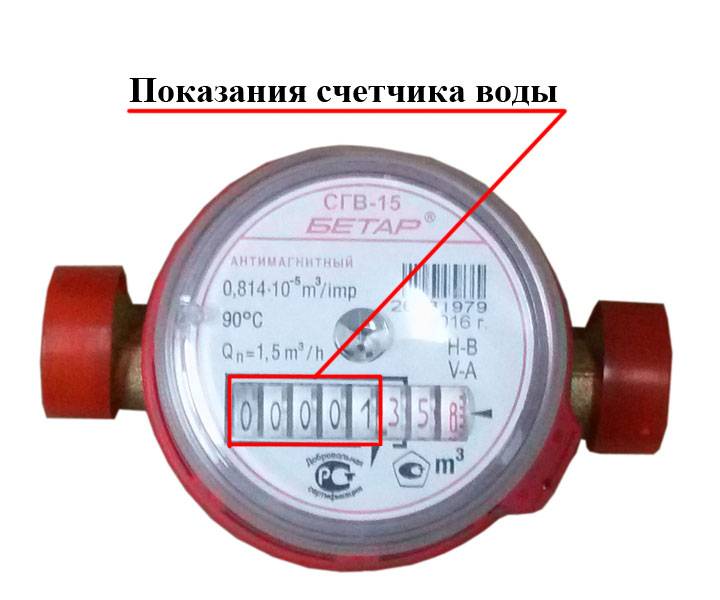
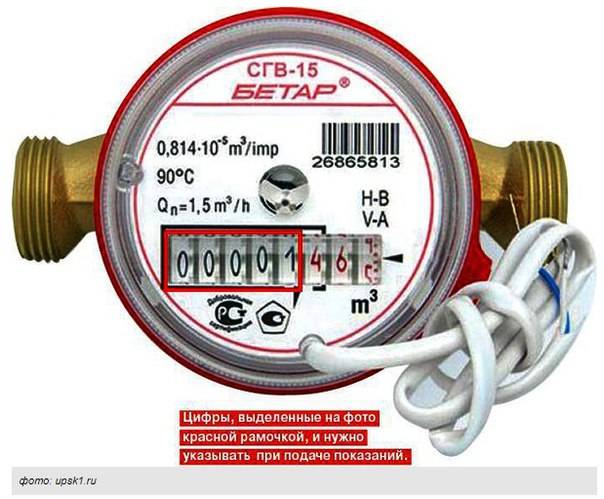
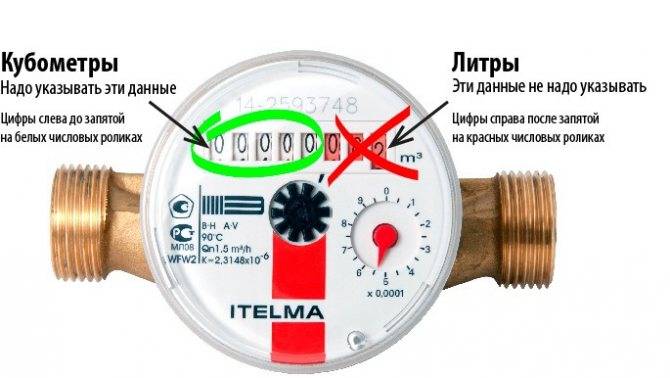
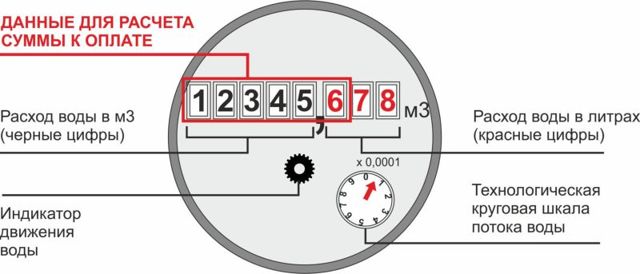
The first five digits are cubes, the numbers stand out on them against a black background. The next 3 digits are liters.
To write off the readings, we need only the first five digits, since liters, when taking readings, the controlling services do not take into account.
Consider an example:
The initial readings of the counter, 00023 409, will be based on this indicator, after a month the indicators on the counters are 00031 777, we round the red numbers to one, the total is 00032 cubic meters, from 32 - 23 (initial readings), and 9 cubic meters of water are used up. We enter 00032 on the receipt, and pay for 9 cubes. So it is correct to take readings for cold and hot water.
There are cold and hot water meters without the last three red digits, that is, excluding liters, in which case nothing needs to be rounded off.
How to pay for water by meters
For Russia, payment for water is made as follows:
Enter the initial and final indications for cold water in the receipt, for example, 00078 - 00094, subtract 78 from 94, it turns out 16, multiply 16 by the current tariff, you get the required amount.
Do the same for hot water. For example, 00032 - 00037, you get a total of 5 cubic meters of hot water, also multiply by the tariff.
To pay for sewerage (water disposal), sum these 2 indicators, 16 + 5, it turns out 21, and multiply by the sewerage tariff.
16 cubic meters of cold water, add 5 cubic meters of hot water used, 21 cubic meters come out, pay for cold water, and in the “heating” column, pay 5 cubic meters for heating. For water disposal - 21 cubic meters.
Does the counter count correctly, how to check
You can check the correct operation of the meter yourself with a 5-10 liter canister, or another container, gaining about a hundred liters, on a smaller volume it is difficult to calculate the discrepancies in the volume of drained water and the discrepancy in meter readings.
What happens if you don't submit meter readings?
If you do not take, send during the indication, then the relevant services will issue an invoice at the rate provided for, as for apartments where the meter is not installed, that is, according to the standards per person.
That's all the advice on how to properly take readings of water meters.
Good luck to you!
Recalculation of utility bills
In some situations, it may be necessary to validate the enumeration.
Overpayment
Due to incorrect meter information or errors by the receiving employee, excess funds may appear on the account. According to RF PP No. 354, if discrepancies are found, but on the condition that the IPU is fully operational and does not belong to the failed ones, the payment is recalculated.



To return the money, you must:
- Receive from the contractor a copy of the inspection report, which established the presence of surpluses due to the difference in testimony.
- Write a letter requesting that the payment be recalculated.
- Submit documents to a special department of the service company and be sure to receive confirmation that the information has been accepted for consideration.
If everything is done correctly, then the due deduction will be indicated on the next receipt. With a significant overpayment, the amount is distributed over several months.
If no evidence was given for a long time
The absence of information about the consumed resources recorded by the ISP does not exempt the owner or tenant from payment, since residents are not limited in access to the service and can use water. Based on existing legislation (PP RF No. 354), each owner of a room that is equipped with a meter has the right to count the water consumption according to the readings of a correctly installed and commissioned meter.In such a situation, the amount is calculated at a single tariff for a particular region.
If you do not submit meter data, then there is a change in the method of calculating payment: for the first 3 months, the average indicator for the past six months is taken as the basis, and then according to the standard. Changing the situation is quite simple: you need to invite a specialist from a service organization to check the meter and take control readings.
In this case, it will not be possible to achieve a recalculation, since it was the owner who ignored the right granted to him to submit monthly information.
Exceptions are special cases that may require litigation, where it will be necessary to prove the existence of force majeure circumstances or confirm temporary absence.
Taking readings from water meters of various types
The issue of collecting data on water consumption from meters must be treated very responsibly and carefully, since the amount of charges for water consumption depends on the information provided to the supplier.
For competent removal of information, it is necessary to understand well what indications are reflected on the front panel of the device.
When you first take water flow data from a new device, there is no need to perform any calculations. In the future, you should take into account the difference in the readings taken at the moment, with the previous values.
Basically, the following types of devices are used for water metering:
- roller;
- with electronic scoreboard;
- smart meters.
On the front panel of a roller water meter, as a rule, eight (more often) or five windows with numbers are displayed.Electronic meters are less in demand due to their higher cost, with the same functionality as roller meters, and the absence of noticeable advantages.
 The procedure for taking water meter readings is not very difficult. And all that is needed is to carefully write down the current value of the consumed volume of water displayed on the meter and, taking into account the previous readings, perform an arithmetic operation
Option number 1 - eight-roller device
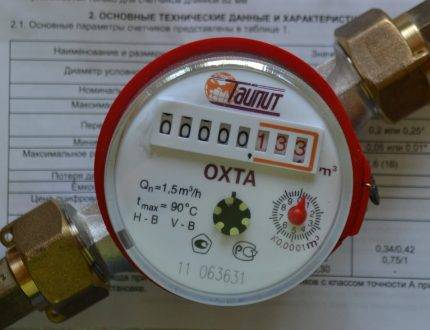
The fractional part of the instrument readings, with an indication of eight rollers, can be ignored or rounded off according to the rules of mathematics. With a value of more than 499 liters - down, with numbers over 500 liters - up.
In any case, rounding off the fractional part or ignoring it will not change the number of cubic meters submitted for payment. In order not to get confused, you need to stick to the chosen method when taking monthly data.
Taking as an example the readings shown in the figure, at the first data acquisition, 4 cubic meters can be taken for calculation, if the fractional value is not taken into account, or 5 cubic meters of water, if rounded off. In the next billing period, you can write 11 cubic meters, since rounding will not change this value
Option number 2 - five-roller flowmeter
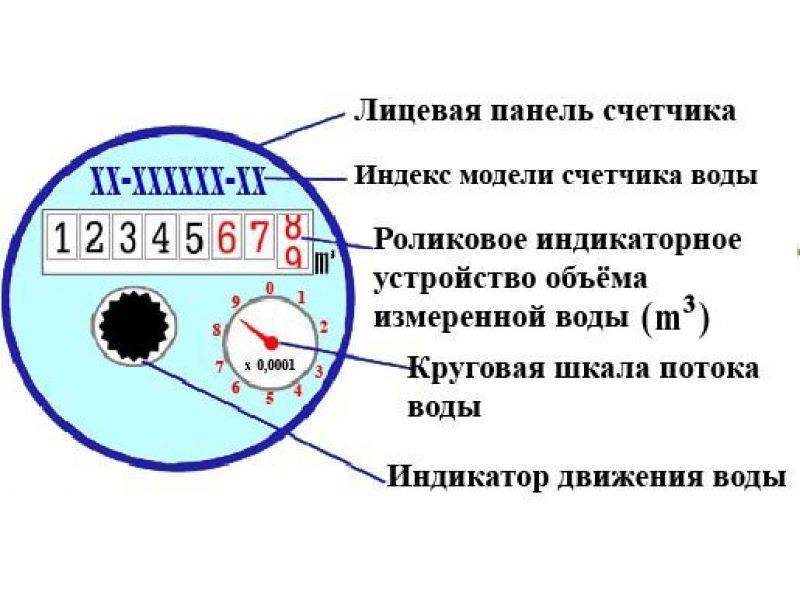
The front panel of some water meters is represented by combined indicators: digital (roller) and pointer. The digital scale also has five digits, which mean the whole part of the cubic meters of water consumed.
The fractional part is made in the form of three arrow scales showing the numerical order of magnitude of the consumed liters of water.
To obtain the corresponding fractional data, it is necessary to multiply the displayed values by coefficients:
- hundreds of liters - by 0.1;
- tens of liters - by 0.01;
- units of liters - by 0.001;
Then add up the resulting values of liters.
The algorithm for removing and rounding data from combined instruments does not differ from the example given with an eight-roller device.
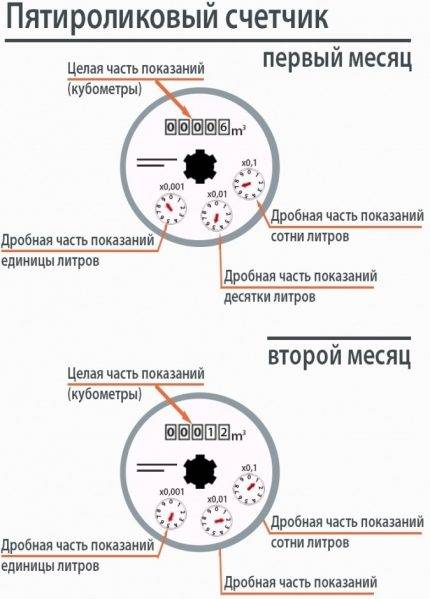 The coefficients by which the readings of the pointer indicators of five-roll counters are multiplied are displayed above the scales, which makes it easier to work with them
Option number 3 - model with a digital display
One of the disadvantages of flowmeters with a digital panel is the need to connect them to the power supply.
Water meters with digital electronic indication have no other significant differences from working with the above types of devices.
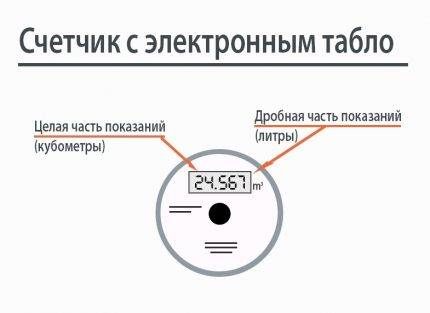 Using the example of the meter readings with an electronic display shown in the figure, it can be explained that in this case two options will be considered correct: take rounded figures equal to 25 cubic meters of water, or, ignoring the fractional value, write down the water consumption equal to 24 cubic meters
Option number 4 - the use of smart meters
Developing technologies dictate the introduction of electronic innovations and the issue of removing and transmitting metering data. A feature of the functionality of a smart meter is that the cubic meters removed by it are transmitted over the Internet.



The main functional significance in these smart appliances lies in the type of controller used. So, the most common of them is working in the most popular communication standard - Wi-Fi. The issue of installing a controller for a smart flow meter does not require coordination.
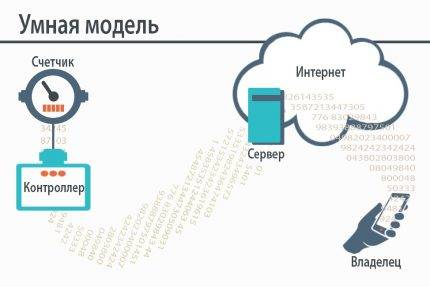 Water consumption accounting data can be monitored using a computer or smartphone.Smart meters allow not only to see the readings online, but also to manage them, transfer the necessary information to the supplier or to the management company
Taking readings
In order to correctly write off the readings for submission to the service organization, you need to know exactly what to read.
At the moment, water meters are produced with three types of panels, but in the domestic sector, type No. 1 is considered the most popular and easiest to operate.
- The first characters must be specified before the comma. It is taken into account that when transmitting information, it is not necessary to write off the leading zeros.
- If the last three digits are greater than 600, then it is advisable to round the value to the cube. This is not a violation.
To remove information from the counter should be according to the scheme:
- The numbers on the dial (for example, 00015.784) indicate that more than 15 m3 of water was used during the corresponding period.
- The number of liters is rounded up to 16 cubic meters. These indications are transmitted for calculation.
- Next month, the data will change and the dial will be conditionally 00022.184 (22 m3).
You need to understand that it is the current readings that are taken into account. But most often, the owner of the premises does not need to deal with the number of cubic meters, this is done by the service organization.
Correct readings
Even after installation, many users of water meters do not know how to take readings and how to enter them for a correct calculation.
First of all, you need to clarify which water meter is in front of you. This is easy to do with color. So, manufacturers produce blue or black meters, which show that they take into account the consumption of cold water. Red ones, in turn, are designed for hot water.
To account for the consumption of cold water, a red meter can also be used, since this is not prohibited. In this case, the owner makes a note on the device.
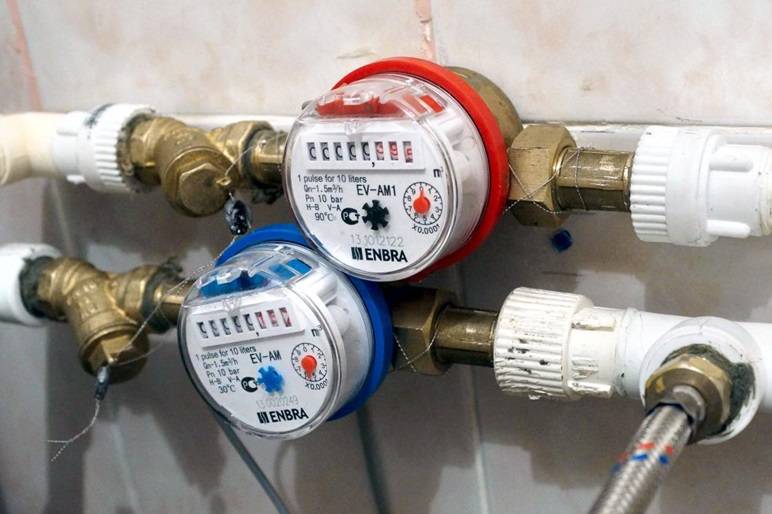
Color-coded counters
The meaning of the numbers on the counter
If you look at the device, then on its front side under the glass you can see a lot of numbers that an unprepared person is unlikely to decipher. So, there are 8 digits on the dial of the meter. Of these, the first five are black and three are red. The latter mean how many liters of water have been spent, they should not be taken into account.
The authorized organization is only interested in the first black digits, which mean the number of meters of water in cubic terms that were consumed over a given period of time.
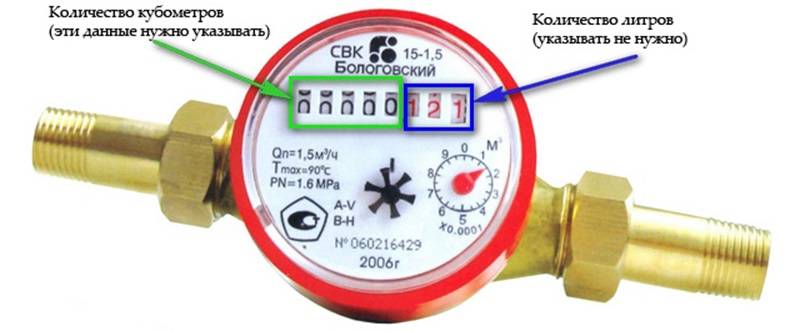
Indicating the designations of numbers on the counter
After clarification, follow the given algorithm:
- We write the data in black on a sheet of paper in exactly the order in which they appear on the dial.
- Round the last number up. This is done when the number of liters indicated in red is more than 500.
- We multiply this value by the UK tariff and enter the result into the receipt.
For a better understanding of what numbers need to be recorded, consider how the readings of the new meter change after a month of work.
So, devices were installed in the apartment that take into account the consumption of hot and cold water with zero readings at the time of installation, which look like this: 00000000.
Within the prescribed period, the owner of the apartment write out the expense data. On the dial, he saw, for example, the following value: 00019545.
This means that during the time of use, that is, the billing period, 19 cubic meters and 545 liters of water were spent. Since there are more than 500 liters, we round up the last digit. As a result, we get the consumption of 20 cubic meters of cold water.
For a device that takes into account the consumption of hot water, the algorithm of actions is no different.
To take readings from the meter next month, you need to round the amount again, if necessary, and subtract from it the number that was received in the previous month.
To check the correctness of the data, you should turn off the water in the entire house and see if the meters are working. If they continue to read data, then there may be a leak that needs to be found and fixed as soon as possible.

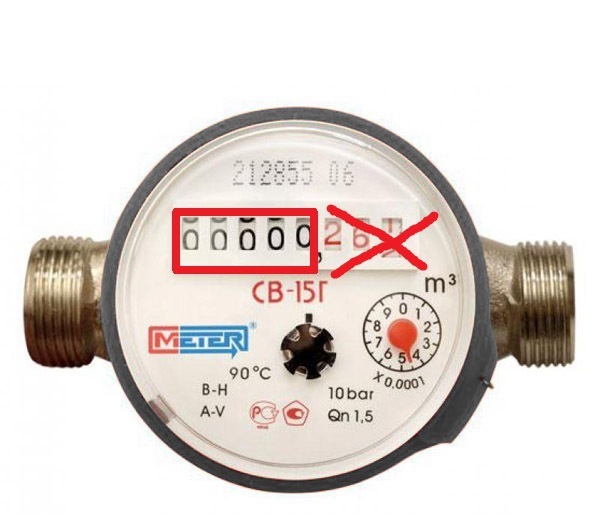


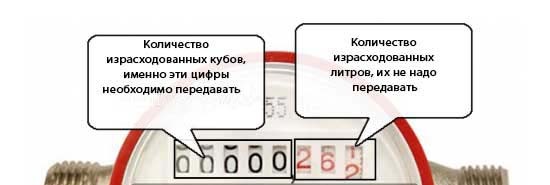
Step-by-step instructions for calculating the consumption of hot and cold water in an apartment
When installing metering devices, you should inform the management company or the resource supply organization (depending on who the consumption contract is concluded with) about their presence in the apartment. After that, you need to report the initial readings on the counters. These will be the first 5 digits of the black segment of the scale.
Further actions:
- The previous or initial ones are subtracted from the last readings. The resulting figure is the water consumption for a certain period in cubic meters.
- Submit current testimony to the Criminal Code in person, by phone or electronically
- Multiply the number of cubes consumed by the tariff of 1 m3 of cold water. The amount payable will be obtained, which, ideally, should converge with the amount in the receipt from the Criminal Code.
The calculation formula looks like this: NP - PP \u003d PKV (m3) PKV X tariff \u003d CO, where:
- NP - real testimony;
- PP - previous readings;
- PCV - consumed amount of water in cubic meters;
- SO - the amount to be paid.
The tariff for cold water consists of two tariffs: for water disposal and water consumption. You can find out each of them on the website of the water supply organization or your management company.
For example: a new meter for cold water is installed in the apartment. The scale of the metering device consists of 8 digits - five on a black background and 3 on a red one. The initial readings during installation are 00002175. Of these, the black numbers are 00002. They should be transferred along with information about installing the meter to the Criminal Code.
A month later, the numbers 00008890 appeared on the counter. Of these:
- 00008 on black scale;
- 890 - on red.
890 is a volume exceeding 500 liters, so 1 should be added to the last digit of the black scale. Thus, the figure 00009 is obtained on the dark sector. This data is transmitted to the Criminal Code.
Consumption calculation: 9-2=7. This means that in a month the family members “drank and poured out” 7 cubic meters of water. Next, we multiply the quantity by the tariff, we get the amount payable.
 The rules for hot water are similar to those for cold water:
- take readings (all numbers up to the red scale) from the counter;
- round the last number to one, discarding or adding liters of the red part of the scale;
- subtract current readings from previous readings;
- multiply the resulting number by the rate.
An example of a calculation using a meter of the 2nd type with a scale of 5 digits and three displays of displacement: in the receipt for the last month, the last reading of the hot water meter is 35 cubic meters. On the day of data collection, the scale numbers are 37 cubic meters. m.
On the far right of the dial, the pointer is on the number 2. The next display shows the number 8. The last of the measuring windows shows the number 4.
Consumed in liters:
- 200 liters, according to the first circular scale (it shows hundreds);
- 80 liters - on the second (shows dozens);
- 4 liters - readings of the third scale, which shows units.
Total for the billing period, the consumption of hot water amounted to 2 cubic meters. m. and 284 liters. Since 284 liters is less than 0.5 cubic meters of water, this figure should simply be discarded.
When transferring data to Vodokanal or UK, indicate the last reading - 37. To find out the amount payable - multiply the number by the tariff.
How to take readings from five-roller counters
On some counters, the integer part is represented by a roller scale, and the fractional part by three or four pointer scales.
Such counters are called "with a combined-roller digital scale" or five-roller. If you have a five-roller counter, you take the whole part of the readings from the roller numbers, and the fractional part from the arrows.
One arrow scale shows hundreds of liters consumed, the other tens, the third units. To get the value of the fractional part, you need to multiply the value of hundreds of liters by a factor of 0.1, multiply the value of tens by a factor of 0.01 and multiply the units by 0.001. Then add up the results of the calculations.
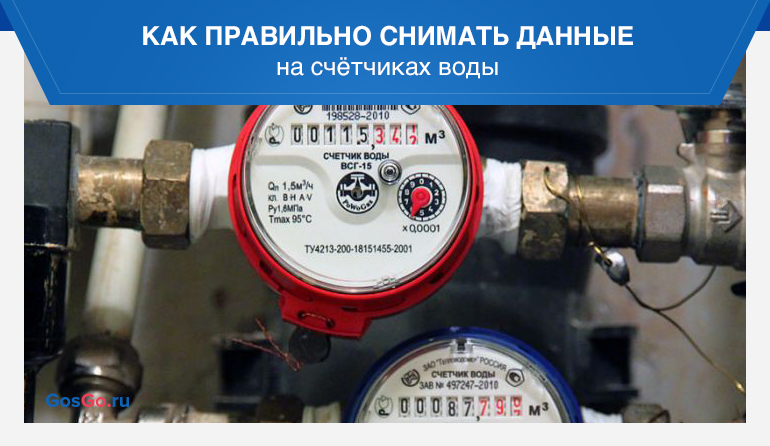
In our example, it will look like this: 7 * 0.1 + 5 * 0.01 + 9 * 0.001 \u003d 0.759 cubic meters.
We add the fractional part of the readings to the integer: 6 + 0.759. We get the water consumption according to the meter 6.759.
Since we write only integer values on the receipt, your choice is to round the fractional part according to mathematical rules or ignore the fractional part.
In the first case, you get 7, in the second 6 cubic meters. Don't worry about unaccounted liters if you choose the non-rounding option. The spent part of the cubic meter will be paid by you in the next period.
Just like for eight-roller counters, when you first give readings, the entire figure from the counter goes to the receipt: 7 or 6, depending on whether you will round the fractional part or not.
Next month, we write down the difference in the new and past values in the receipt: 5 (12 - 7) or 6 cubic meters (12 - 6) of water.
The main supplier of five-roller counters in Russia is the German manufacturer Zenner.
How to correctly take readings of the device
Even a child can easily cope with the task, but at the initial stage, even the most “experienced” specialist needs to be instructed.
And you will have to act according to the following algorithm:
- Meter identification. Hot and cold water metering devices usually differ in body color, but in some cases the same water meters can be used. According to the standard, the hot water pipe usually goes above the cold one, but these assumptions can also be verified empirically by opening the tap - whichever device works, there is hot water.
- Taking evidence. On the body of the water meter there is a counting mechanism, where the flow rate is shown in cubic meters and liters. These indicators must be read and provided to the inspector.
Reporting should be done once a month
Water meters rarely fail, but they are sensitive to even minor leaks. Therefore, if it seems that the device winds up too much water, it is necessary to check the serviceability of the faucets, drain tank, etc. Most often, it is their failure that is to blame. If everything is in order, you can make a premature verification of the counting device.Remove, check and re-install it should be representatives of the appropriate organization.




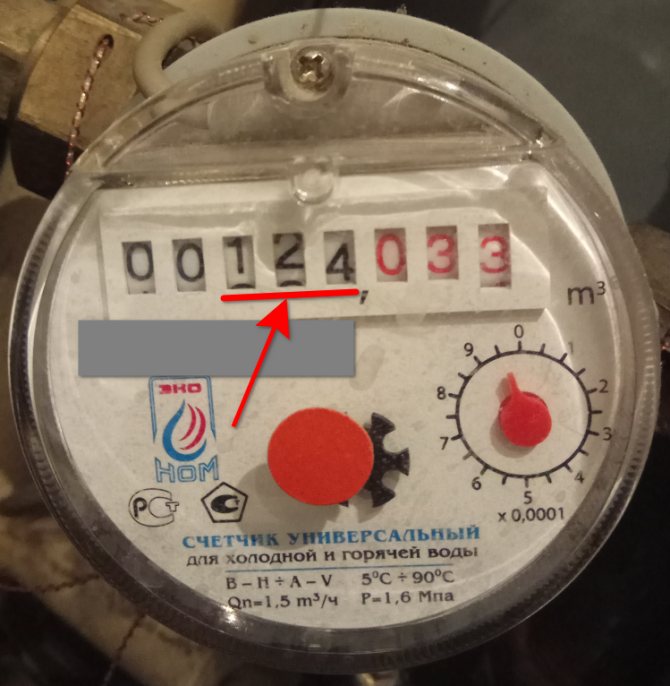
What numbers need to be written off from the water meter
All counters, regardless of the manufacturer, are very similar to each other, so taking readings will not be difficult. The question lies elsewhere: how to correctly record the received data and which of them should be taken into account.
In front of him on the case, the user can see eight numbers at once, five of which are painted black, and three are red. The latter denote liters that are of no interest to utilities. The scale shows the current consumption, which is more relevant for the owners. For the calculation, cubic meters are taken.
Meter readings can be transmitted via the Internet
To correctly calculate the readings, it is advisable to follow a few simple rules:
- You need to write off only the numbers that at the time of taking the readings are exactly;
- Liters do not need to be recorded on the payment receipt, but they must be taken into account according to the rounding rules;
- Indications must be taken monthly on the same day (mainly on the first day of the month).
Periodically, an inspector may come to the house for verification, who will make sure that the data transmitted is correct. In 99% of cases, the readings completely match and mean that the owner of the house performs all the actions absolutely correctly.
No matter how trite it may be, but before starting to use the meter, it is advisable to read the instructions, where there is usually even a clear example of the correct reading. After such a detailed presentation, questions usually disappear by themselves.
How to record readings
It is not enough just to determine how many cubic meters of water were used in the apartment
It is also important to submit the data correctly.At the initial start-up of individual metering devices, the data is reset to zero, so it will be very easy to read the readings in the first month - just write down the number of cubes received and, taking the sample as a basis, fill out the receipt
In the future, it will be necessary to make a calculation - subtract the previous ones from the current reading. So it will turn out to calculate the real water consumption.
When giving evidence counter should be careful
When filling out the receipt, you need to be extremely careful:
- The numbers should be written as legibly as possible;
- The billing month is written in cursive without fail;
- Making corrections is strictly prohibited!
The vast majority of misunderstandings arise from incorrectly completed receipts. Before handing them over for payment, you need to carefully double-check all the entered data.
Detailed example of reading
Before writing down the digital values, you need to determine which device takes into account the consumption of cold water, and which - hot.
The body of the water meter for cold water is usually painted blue, and for hot water it is red. But it is always possible that the water meters were installed with violations, or you have a hot water meter installed on cold water (allowed by the standards).
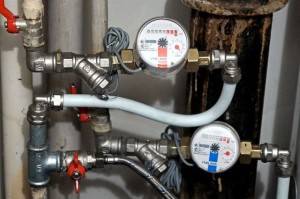 Therefore, it is necessary to open a tap with a cold water supply and see which counter will work. Do the same manipulations with hot water. If everything is in order, let's start taking readings.
To calculate consumption, only the first five digits, colored in black, need to be taken into account
The values of the red numbers are taken into account only if they show the number of liters from 500 and above.In this case, it is necessary to round the total value by adding one to it.
On some devices, all eight digits are black, which means that we do not count the last three - these are liters. In foreign water meters, there are only five numbers on the dial - use them in calculations.
For example, you have a new device installed only a month ago, and it has the following values - 00008, 521. It turns out that you have used up 9 cubic meters of water: 8 is the first five digits, plus 1 is rounding.
Next month, your digital values have changed and in order to calculate the number of cubic meters, you need to write down the current values \u200b\u200bof the water meter numbers and, using simple mathematical operations, find out the difference between today's values and those taken a month ago.
We had - 00008.521 (we wrote it down as 9), it became - 00013.230.
Subtract: 00013 - 00009 = 4
This is the number of cubic meters you need to pay this month.
Watch a video on how to properly take readings from water meters:


Important! Choose a specific date to take the information and don't forget to take it on time!
Where are water meters located and how do they work
Metering units are installed on all pipes of hot water and cold water systems included in the apartment. Sometimes the connection to the water supply occurs according to a complex scheme - the bathroom and kitchen are separately powered. We have to put meters on all connections to cold water, hot water. Access to them must be free. Supervisory organizations, representatives of the Council of an apartment building have the right to check the correct operation of meters 1 time in 6 months. So, they find craftsmen who install magnets, unwind the water meter dial, stop the rotation of the impeller.Violators pay for water at a rate with established multipliers and cover losses from the entire house.
It is permissible to place metering units in plastic boxes, they are mounted side by side, placed together with a block of the leakage protection system, stop valves. The panels of the boxes should open so that the seals and cells are visible. The principle of operation of counters is simple:
- The counting mechanism is driven by the flow of water.
- When the taps are open, the rotary indicator starts to turn.
- The stronger the flow of water, the faster it rotates.
Induction, tachometric, electronic models have been developed. Each owner chooses them at his discretion.



