- Use of other economical sources
- Keep water hot
- Save money by not heating all rooms equally
- Method number 1. Eliminate overheating of the room
- Analysis of heat losses and ways to reduce them
- Preventing overheating
- Saving gas with a thermostat: a real miracle of technology
- Automation of the heating process
- Do not release heat into the chimney
Use of other economical sources
Saving gas supply in heating is also possible by connecting alternative heating methods. These include:
- underfloor heating in rooms, bathrooms and shower rooms, which allow for more efficient energy recovery from the coolant;
- the use of a foundation based on an insulated Swedish plate. The method is effective for small, one-story buildings;
- heat pumps. Installing them is currently not cheap, but they quickly bring economic benefits. The principle of operation is based on the use of the heat of the earth's interior;
- solar heating, allows you to save up to 20% of costs even in winter. The effectiveness of this method depends on the number of sunny days per year.
Keep water hot
In addition to heating costs, blue fuel in a number of houses is used to heat hot water. The following measures will help reduce the amount of gas consumed:
- installation of a separate flow type gas heater. Its inclusion is made only when the hot water tap is opened, and fuel is not wasted;
- inclusion of a hot water boiler in one circuit with a heating system. With this option, the cost of heating water for domestic needs will be minimal;
- use of thermally insulated storage tanks for hot water. In such devices, heated water does not cool for a long time, and there is no need for frequent heating;
- use of solar collectors in water supply systems.
The combination of all the considered methods allows to significantly, up to 25-30% or more, reduce the cost of paying for the services of gas supply organizations.
Save money by not heating all rooms equally
Not all rooms and volumes of the house need to be kept at the same temperature. For example, pantries, gyms, garages, workshops may have a slightly lower temperature, and children's rooms, showers or bathrooms may have an increased temperature.
To maintain the desired temperature in a particular room, you need to install regulators on each heating radiator. The principle of their operation is simple - they change the working section of the pipe at the heater and reduce or increase the circulation rate of the coolant. It is enough to set the required temperature value on the regulator. This measure optimizes the total gas consumption for heating water in the boiler.
Method number 1. Eliminate overheating of the room
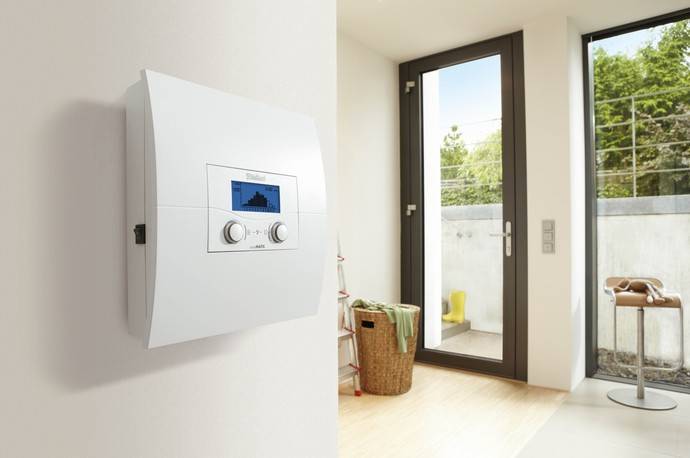
To maintain a comfortable temperature in the room and at the same time not overheat, you can install regulators and set the desired temperature yourself.For example, in the morning, when you leave for work and no one is left in the house, the regulator lowers the temperature to 17 ° C, since it is not practical to maintain a high temperature in the room when no one is there, and raises the temperature to a comfortable 22–24 ° C by the time returning home. With the Vaillant VRC 370 controller you can set the temperature schedule in your home, i.e. set the required temperature where and when required, and the schedule can be drawn up both for a day and for a week. Modern automation systems are able to maintain the temperature with an accuracy of 0.5 ° C, so you yourself can control costs and, accordingly, save.


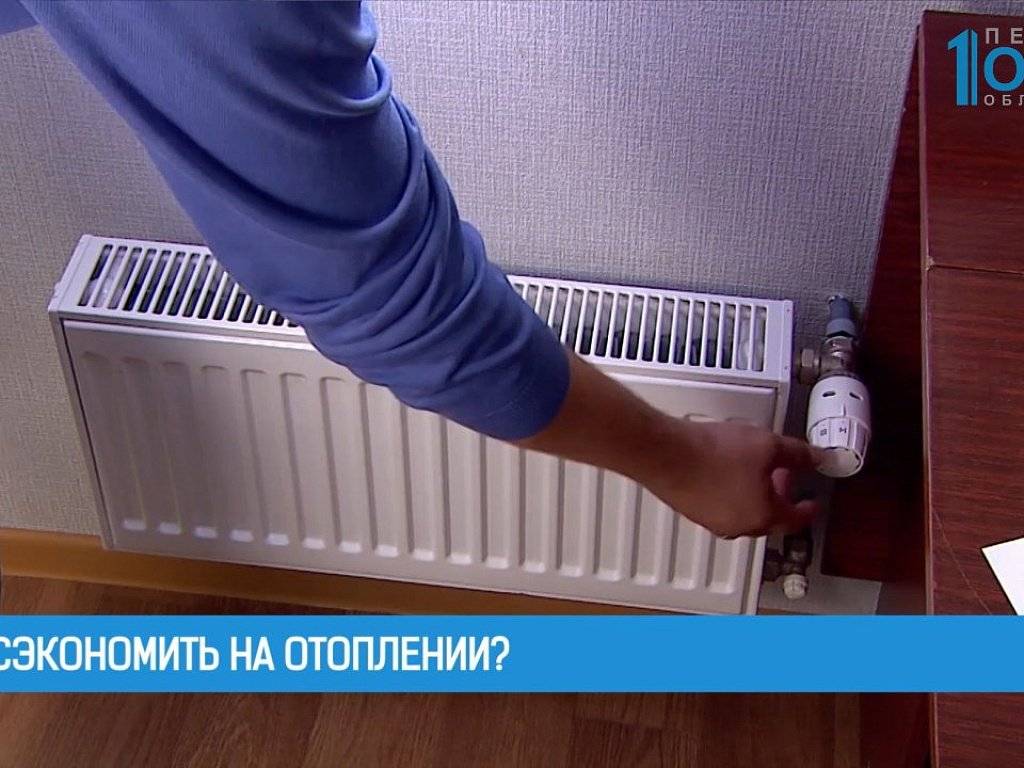

More modern weather-dependent automation is also effective and cost-effective. The principle of its operation is based on taking into account the temperature difference in the house and outside the window. For example, in the morning the temperature outside usually increases and if the boiler load is not reduced, in a few hours the temperature in the room will be significantly higher than the set value and, therefore, excess heat will be lost during ventilation. The weather-dependent regulator, on the other hand, begins to reduce the boiler power in advance and thus save gas. In addition, the new generation of Vaillant VRC 470/4 weather-compensated controller allows you to choose the cheapest source of energy for heating in accordance with the conditions and period: it takes into account gas and electricity tariffs (including peak and night tariffs) and selects the most economical variant of operation heating system.As a result, the use of a weather-dependent regulator saves gas up to 20-25% during the year, and its installation will pay off in less than one heating season. As a bonus, in addition to savings, you get the desired comfort, reliability and health: the automation itself warns of errors, there are functions of frost protection and even protection against legionellosis, an infectious disease like pneumonia.
Analysis of heat losses and ways to reduce them
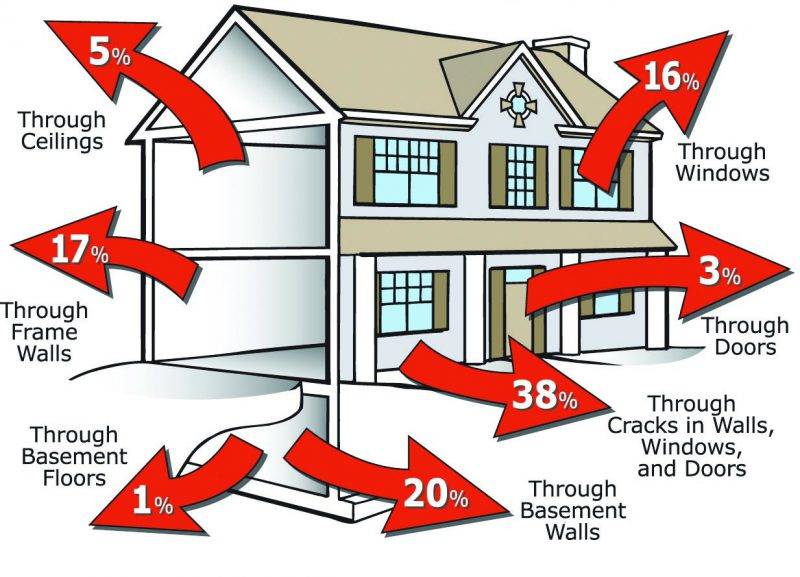
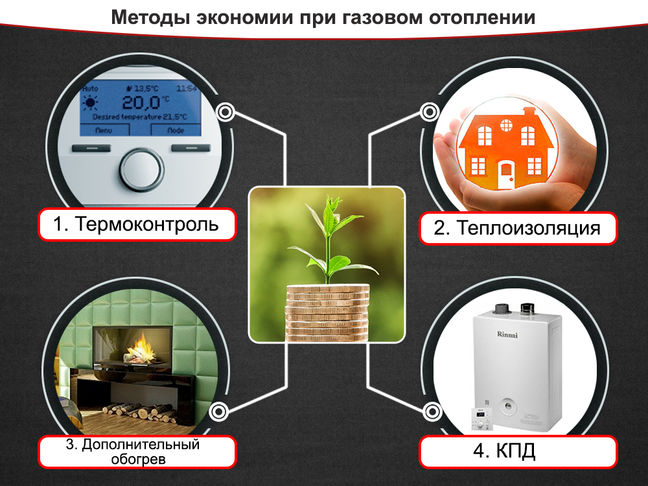
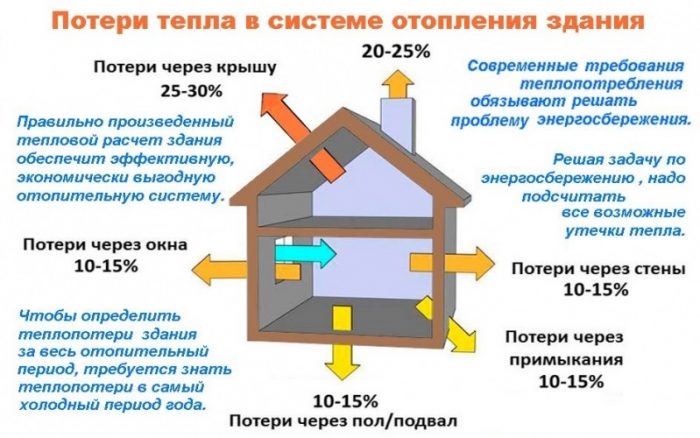
In a private house, the greatest amount of heat leaves through the windows, walls and roof. In addition, a certain amount of thermal energy is lost with the outgoing air through the ventilation system, because warm air is replaced by cold outside air. Therefore, the ways to save on heating will be as follows.
Firstly, roof or attic insulation - the use of stone wool, foamed polymers, covering the roof with "sandwich" panels. In each case, the choice is made based on the characteristics of building structures and the solvency of the owner.
Secondly, the reduction of heat loss through the windows. Two methods are acceptable here. The first is to reduce the total area of the windows of the entire house, but at the same time, the flow of sunlight into the premises is reduced. The second way is to install windows with better energy performance. These are windows with double and triple glazing, multi-contour window systems and special windows, the glass of which is coated on one side with a thin layer that reflects infrared radiation.
Thirdly, the insulation of the walls of the house or their construction from materials with better thermal characteristics.
Preventing overheating
According to statistics, it is the lack of normal adjustment of the coolant that is one of the main reasons for excessive gas consumption and increased bills.It does not matter how modern the boiler you have installed.
Scientists have calculated that for additional heating of the room by only 1 ° C, 7-10% more gas is required. That is, if you decide to heat the house to 24 ° C in winter, instead of the recommended 20 ° C, gas consumption and, accordingly, the cost of heating can increase by 40%. In addition, you can reduce gas consumption by setting automatic temperature control depending on the time of day.
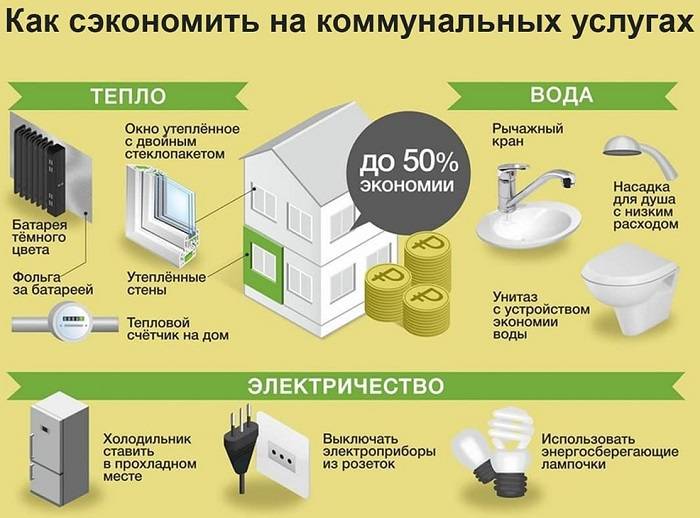



So, for example, at night you can easily lower the temperature to 18°C, and in your absence, set the heat index at 16-17°C. Modern heating systems also allow you to remotely control the temperature in the house using a tablet. Upon returning home, the temperature can be raised to a more comfortable level.
An excellent solution would be to purchase a weather-dependent automation unit that will regulate the temperature of the coolant, taking into account external temperature indicators. The use of such control systems will allow you to reduce gas consumption by at least 20%.
Saving gas with a thermostat: a real miracle of technology
Thermostat - stable temperature. If you don’t go into details, then you can describe this small device, which many are familiar with from the underfloor heating thermostat, as a device that completely turns off the heating boiler when the desired temperature is reached in the room. If a modern boiler controls the temperature of the coolant, while not paying attention to the surrounding air, then the thermostat, on the contrary, ignores the coolant and controls only the indoor climate.What does it give? At least 20% savings on blue fuel. Naturally, the fact of saving will be evident only if the heat loss in the house is minimized.
It should also be noted here that there are three types of thermostats - the amount of saved gas fully depends on the choice of one or another of them.
The simplest thermostat. You should not expect big savings from this device - nevertheless, a controller of this type allows you to reduce gas consumption by ten percent
Want more, pay attention to programmable thermostats.
Daily thermostat. Programmable for a cycle of 24 hours
It allows you to set the temperature in the room by the hour. One at night, another during the day, a third in the evening. That is, when necessary, the house is warm, and when there is no one in the house, there is savings by lowering the temperature in the house to a minimum.
Weekly programmer. Everything is the same as in the previous case, only with a weekly (7 days) work cycle.
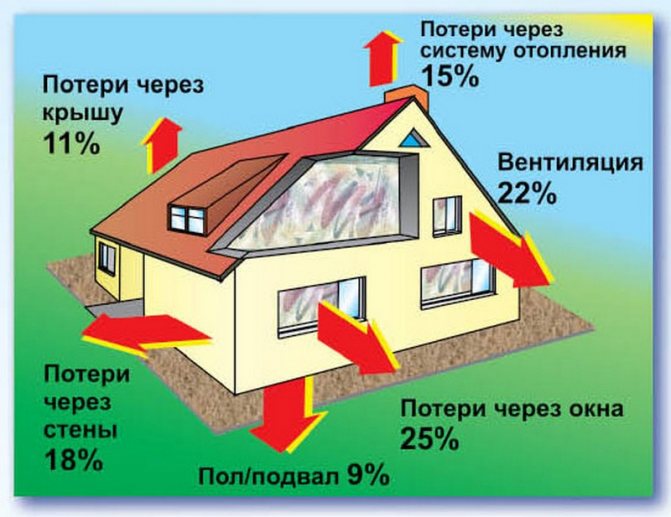


The principle of saving with a programmable thermostat is quite simple and it consists primarily in the correct programming of the boiler. Here you have to calculate everything yourself - or rather, think over the work schedule. Record the time when you go to bed and at that moment lower the temperature in the house, for example, to 20 degrees (sleeping at this temperature is just wonderful). It is also necessary to note the time of your rise and program the temperature increase in the house one hour before the alarm goes off. You go to work and no one stays at home? Do the same for another time period. Leaving the city for the weekend - again the same focus, only for a longer period of time.A correctly created boiler operation schedule allows you to reduce gas consumption very significantly - you can count on another 20 percent savings.
Together, you get an excellent picture - by insulating the house and modernizing the heating system, you can achieve a reduction in gas bills by almost half. Yes, this will require additional (and considerable) financial investments, but it should be understood that this is not done for one year. What is the payback period for this whole business? One and a half to two years - and investments begin to justify themselves, saving the family budget.
In conclusion of the topic of how to save gas, I will say a few words about radical options - you can not save gas at all. It can be completely abandoned in favor of other energy sources - for example, you can heat a house with wood or electricity. You can collect firewood yourself - it may not cost anything at all. Well, electricity is easier to steal than gas, which, you know, is not entirely legal and, as a rule, punishable.
Author of the article Vladimir Belov
Dome house do it yourself
How to choose plastic windows so that they last a long time
Options for finishing the facade of the house: the best methods and materials
Gable roof: the principle of self-production
Transparent slate - an interesting material for the roof of your site
Automation of the heating process
Even if heat losses in a building are kept to a minimum, gas for heating will be wasted if its supply to the burners is not regulated depending on external factors. These factors include the temperature of the external air and the temperature inside the heated premises.
Modern gas heating systems in their composition must necessarily have devices for regulating the supply of fuel - automation of the boiler. Such a system includes air temperature sensors outside and inside the house. When the outside temperature changes, these devices send a signal to the control system, and the flow in the gas boiler will be increased or decreased.



Do not release heat into the chimney
A modern smart and eco-friendly home should use every opportunity to save heating within its space. This property gives the dwelling a heat recovery system. It works like this:
- special heat exchangers are installed in the ventilation outlet ducts that bring warm and humid air to the street, communicating with the inlet ventilation pipes;
- as the warm air passes outside, it heats the cold air coming from the street. Thus, fresh air enters the house already slightly warmed up.
If we calculate how much heat is needed to heat 1 m3 of air by 1 ° C, we get 0.312 kcal / m3 * deg. 1 m3 of gas emits about 8000 kcal during combustion. The efficiency of a gas boiler is about 90%.
In a private house with a living area of about 100 m2, the average air exchange rate per hour should be at least 3 m3 per 1 m2 of area, that is, 300 m3 every hour. This figure will be 7200 m3 per day. Consequently, when heating the incoming air by 10°C, the savings will be 22464 kcal or about 3 m3 of gas per day for heating.
And if we take into account that the air exchange in kitchens, boiler rooms with gas burners should be, according to SNiP 2.08.01-89 * "Residential buildings", up to 90 m3 / hour for every 1 m2, then we get a savings figure of up to 5-6 m3 of gas every day.