
- LED lamp
- Use of LED lights
- DIY LED lamp
- Mains powered LED lighting
- 220 V LED lamp circuit
- Recycled LED Lamp
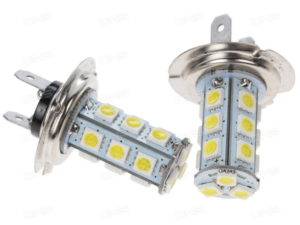
- LED for car
- DIY LED lamp for 220v
- How to connect an LED to a 220 volt network
- Calculation of the resistor for the LED
- Calculation of the quenching capacitor for the LED
- Lamp Assembly
- Power Supply
- electronic ballast
- What do you need to know about ceiling mounting safety?
- Where can I hang the LED lamp?
- We collect a lamp from an LED strip
- Principle of operation
- LED light bulb device 220V
- The difference between LED and fluorescent: a brief description
- Main conclusions
LED lamp
Represents a small luminous diode element, powered by direct current, mainly 12V. To create lamps, they are assembled in several, depending on the required light intensity. The advantages of such lighting:
- meager electricity consumption;
- service life from 100,000 hours;
- can work for days without shutting down;
- There is a wide range of different models available for sale.
 The main disadvantage is the high cost of finished LED lamps. Sellers are not well versed in the issue and can not competently answer your questions.The characteristic of the lamp itself does not take into account the losses during the passage of light through the diffuser, frosted glass and the properties of the reflector.
The packaging of the luminaire contains calculated data based on the characteristics and number of LED elements. Therefore, in fact, the luminous flux of the purchased lamp is much lower than required and the lighting is weak. The lamps themselves and the parts for creating circuits cost a penny. Therefore, it is easiest for craftsmen to do everything with their own hands.
Use of LED lights
In houses and apartments, constant lighting of a place is often necessary. It can be stairs and children's rooms, toilets where there are no windows, and a child lives in the house who cannot reach the switch.
Dim light and low energy consumption make it possible to install lighting in entrances and on the porch, in front of the gate and garage doors. Luminaires with a soft glow due to glare damping, used for lighting desktops in offices and kitchen.
DIY LED lamp
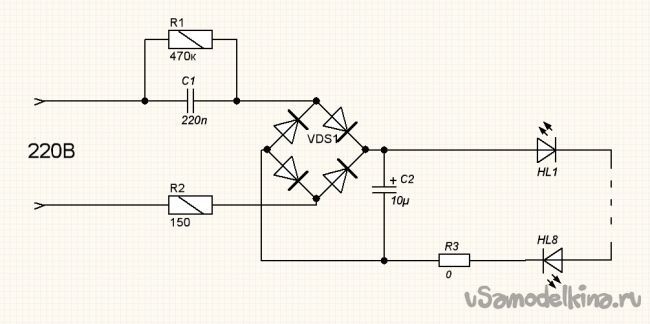
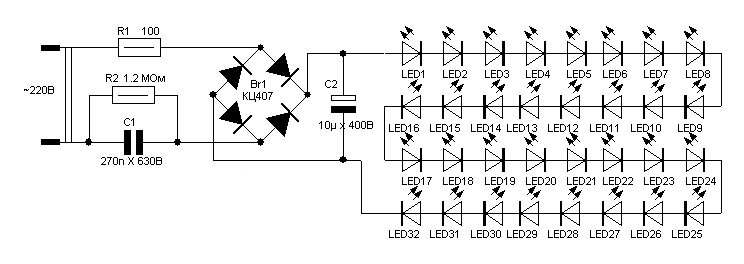
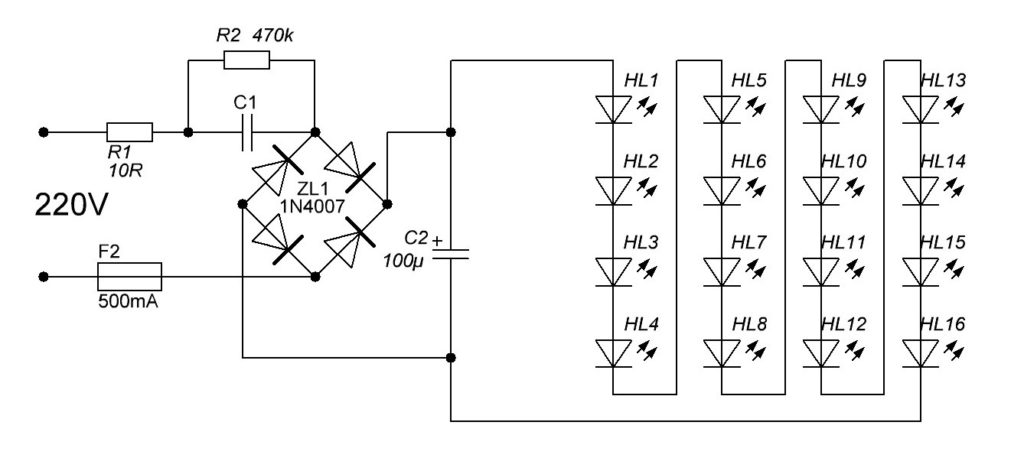
For the design we need: - part of the "housekeeper" type lamp, the one with a base; - 5630 LEDs; - 4 diodes 1n4007; - electrolytic capacitor from 3.3 uF; - resistor R1 - 470k, 0.25 watts - resistor R2 - 150 ohm , 0.25 watts - resistor R3 - about it later. - capacitor type K73-17 with a capacity of 0.22 uF and an operating voltage of 340 V;
The circuit is simple with a quenching capacitor. LEDs in the amount of 8 pieces.
Scheme for selecting the capacitance of the capacitor.
Adjustable resistor R3. It was set to maximum resistance before turning on, so that the arrow of the device did not go off scale. Then I minimized it. Capacitor C2 with a voltage of 340V. During the tests, I set 10 microfarads, but because of the size it did not fit into the case, I set it with a nominal value less.Why so much stress? This is in case of an open circuit with LEDs. Since the voltage will jump to a voltage higher than the AC mains voltage by 1.41 times (230 * 1.41 \u003d 324.3V).
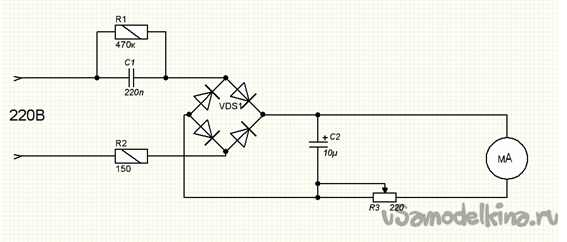
I was guided by the measurements taken on the test circuit with a milliammeter. I made the payment using LUT technology. Smd LEDs. Lay 6 version board is attached
We poison the board, drill holes and tinker.
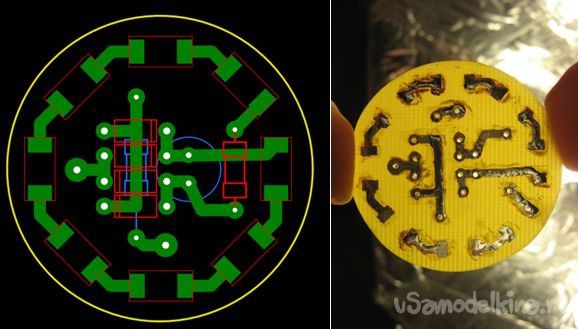
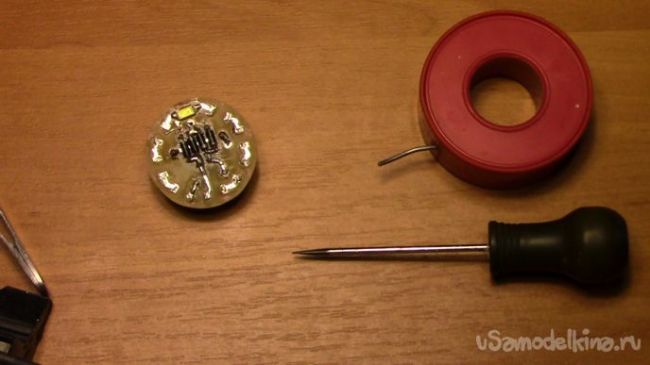
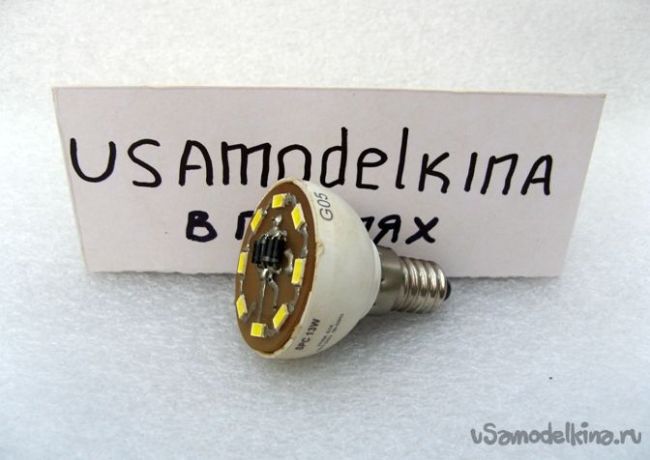
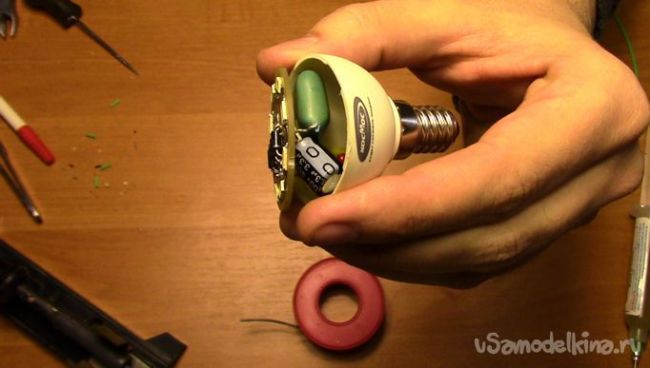
The board is mounted in the base part of the case. The diameter of the housekeeper case is 38 mm, the board is 36 mm.
Capacitor C1 is soldered by a canopy to resistor R1. Again, due to the limitation of the case. Resistor R2 is placed outside the board and acts as a "pull-up". Due to its board tightly pressed against the case.
Solder the resistor and wire to the base.
The first inclusion was made through a light bulb. The lamp consumption was 7.45 watts. It is not possible to measure the luminous flux, but more than 3 watts by eye (when compared with a nearby purchase).
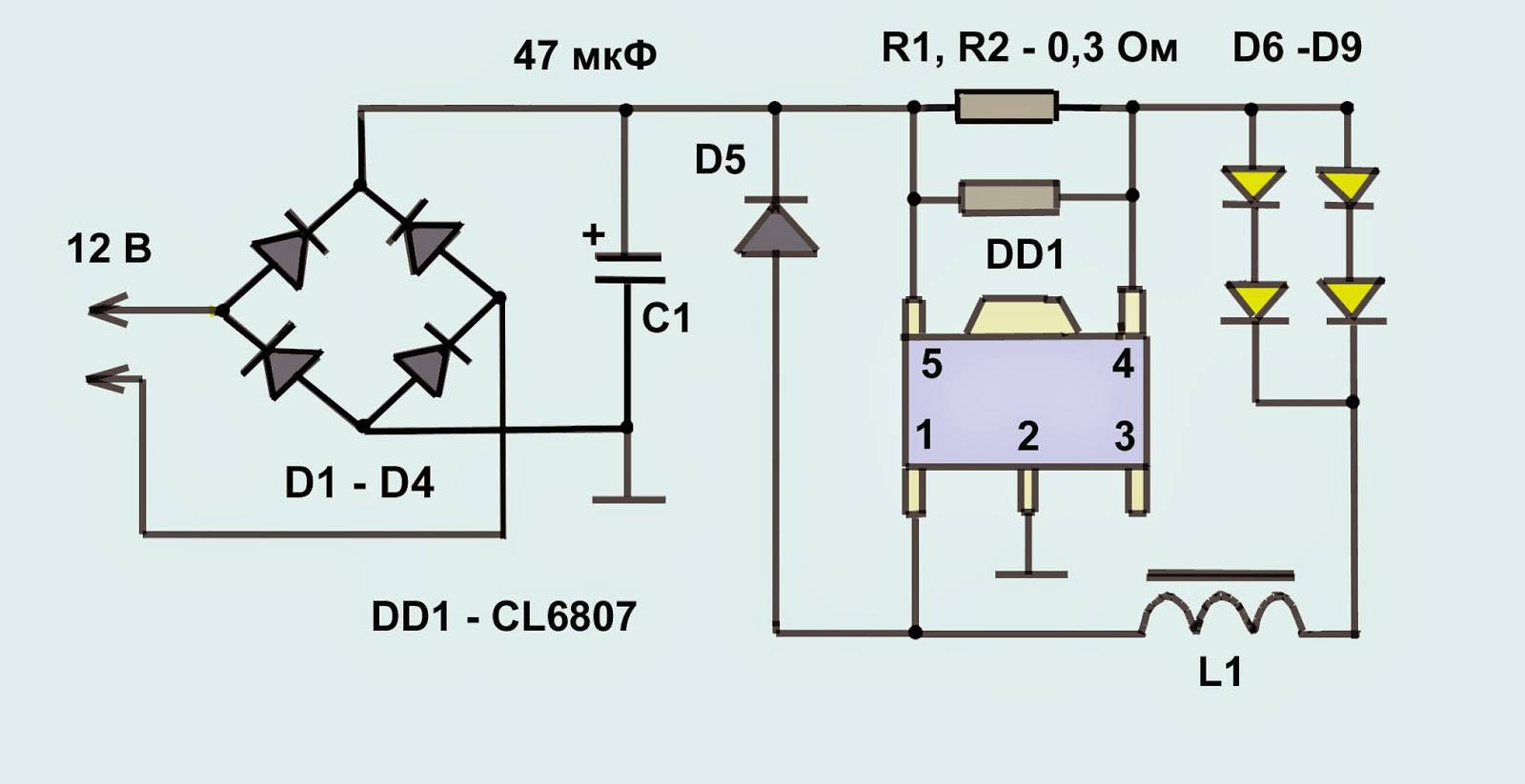
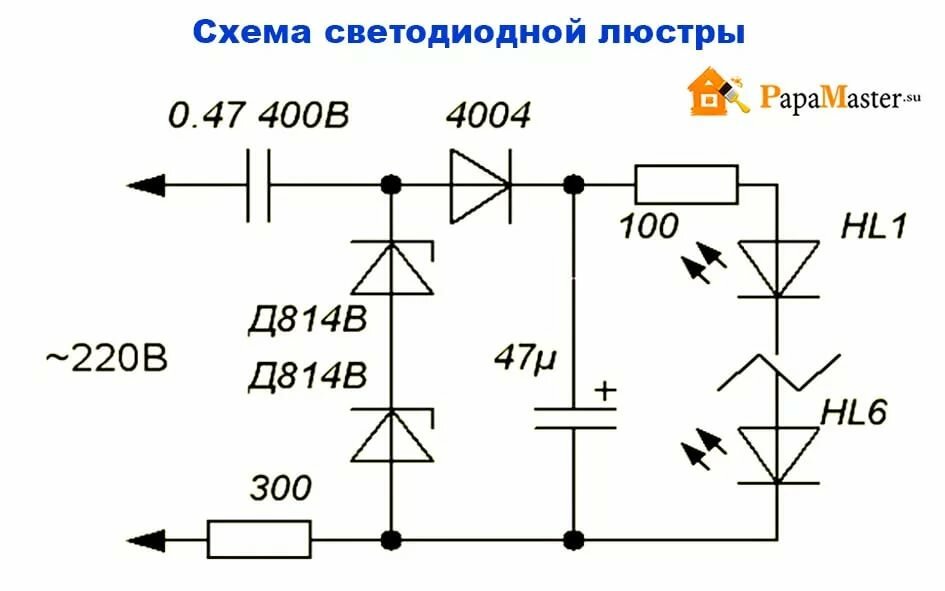




The circuit has no galvanic isolation from the network. Be careful when experimenting and operating
Also, be careful when installing the lamp. Installation to be carried out with the switch off
The lamp has been working for about a year and a half with constant on / off.
On the video you can see everything in detail:
Mains powered LED lighting
But to build an LED lighting circuit, it is necessary to build special power supplies with or without regulators, transformers. As a solution, the diagram below shows the construction of a mains powered LED circuit without the use of transformers.
220 V LED lamp circuit
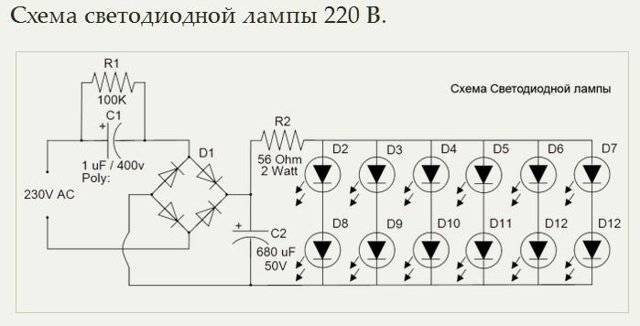
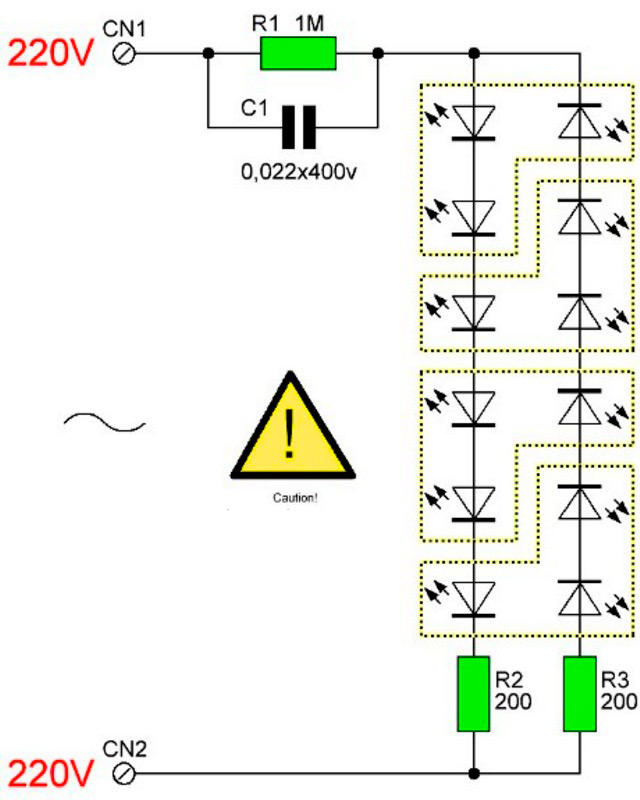
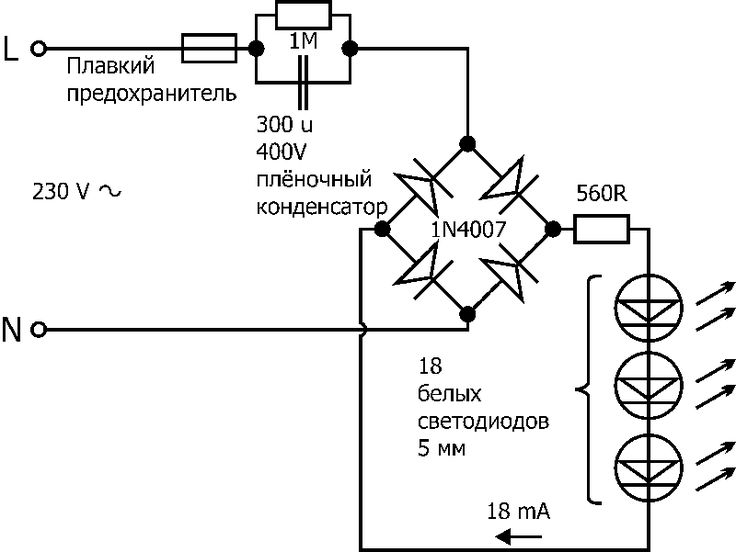
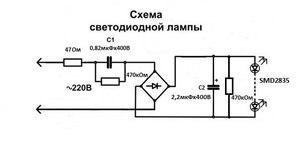 This circuit is powered by 220V AC as an input signal.Capacitive reactance lowers the AC voltage. An alternating current enters a capacitor whose plates are continuously being charged and discharged, and the associated currents are always flowing in and out of the plates, which causes an upstream reactance.
The response created by the capacitor depends on the frequency of the input signal. R2 drains the accumulated current from the capacitor when the entire circuit is turned off. It is capable of storing up to 400V, and resistor R1 limits this flow. Next stage LED lamp circuits do-it-yourself is a bridge rectifier, which is designed to convert an alternating current signal into direct current. Capacitor C2 is used to eliminate ripple in the rectified DC signal.
Resistor R3 serves as a current limiter for all LEDs. The circuit uses white LEDs that have a voltage drop of about 3.5V and draw 30mA of current. Since the LEDs are connected in series, the current consumption is very low. Therefore, this circuit becomes energy efficient and has a budget manufacturing option.
Recycled LED Lamp
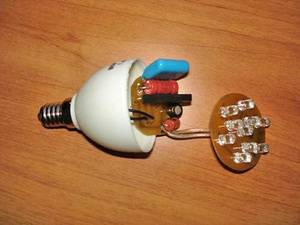
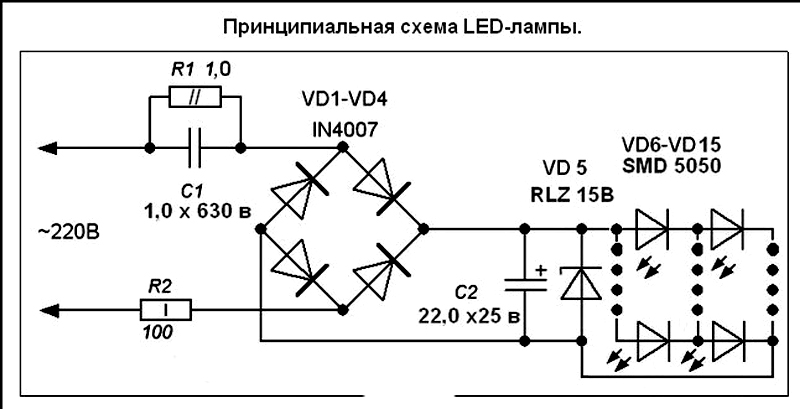
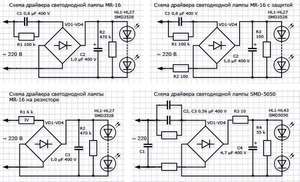 LED 220 V can be easily made from non-working lamps, the repair or restoration of which is impractical. A strip of five LEDs is driven using a transformer. In a 0.7 uF / 400V circuit, the polyester capacitor C1 reduces the mains voltage. R1 is a discharging resistor that absorbs the stored charge from C1 when the AC input is turned off.
Resistors R2 and R3 limit the current flow when the circuit is turned on.Diodes D1 - D4 form a bridge rectifier that rectifies the reduced AC voltage, while C2 acts as a filter capacitor. Finally, the zener diode D1 provides control of the LEDs.
The procedure for making a table lamp with your own hands:
Disassemble and carefully remove broken glass.
Carefully open the assembly.
Remove the electronics and remove it.
Assemble the circuit on a 1mm laminate sheet.
Cut a round laminate sheet (with scissors).
Mark the position of the six round holes on the sheet.
Drill holes to match the LEDs flush in the six holes.
Use a glue tip to hold the LED assembly in place.
Close the assembly.
Make sure the internal wiring does not touch each other.
Now carefully test at 220V.
LED for car
Using LED strip, you can easily make a beautiful home-made car exterior lighting. You need to use 4 LED strips of one meter for a clear and bright glow. To ensure water tightness and strength, the joints are carefully treated with hot melt adhesive. Correct electrical connections are checked with a multimeter. The IGN relay is energized when the engine is running and turns off when the engine is turned off. To reduce the car voltage, which can reach 14.8 V, a diode is included in the circuit to ensure the durability of the LEDs.


DIY LED lamp for 220v
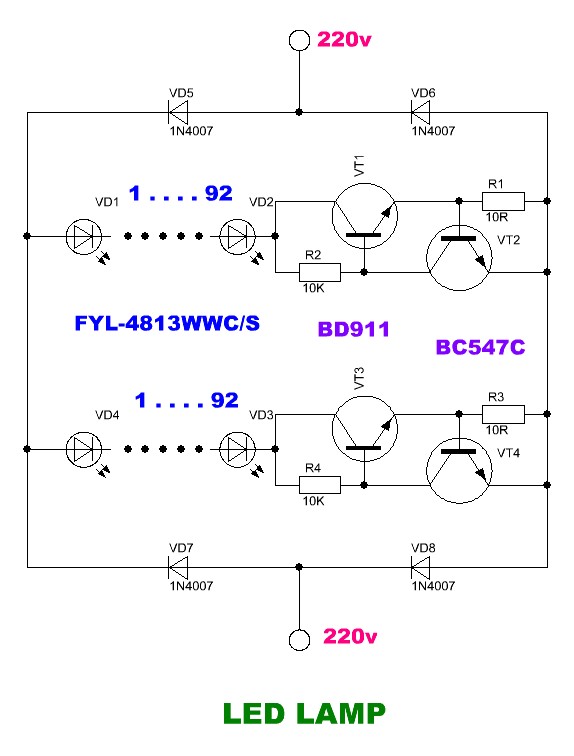
The cylindrical LED lamp provides a correct and even distribution of the generated illumination throughout 360 degrees, so that the entire room is evenly lit.
The lamp is equipped with an interactive surge protection function, ensuring the device is perfectly protected against all AC surges.
40 LEDs are combined into one long string of LEDs connected in series one after the other. For an input voltage of 220 V, you can connect about 90 LEDs in a row, for a voltage of 120 V - 45 LEDs.
The calculation is obtained by dividing the rectified voltage of 310 VDC (from 220 VAC) by the forward voltage of the LED. 310/3.3 = 93 units and for 120V inputs 150/3.3 = 45 units. If you reduce the number of LEDs below these numbers, there is a risk of overvoltage and failure of the assembled circuit.
How to connect an LED to a 220 volt network
An LED is a type of semiconductor diode with a supply voltage and current much lower than in a household power supply. When connected directly to a 220 volt network, it will instantly fail.
Therefore, the light emitting diode is necessarily connected only through a current-limiting element. The cheapest and easiest to assemble are circuits with a step-down element in the form of a resistor or capacitor.
First, what you need to know when connected to a 220V network, for a nominal glow, a current of 20mA must pass through the LED, and the voltage drop across it should not exceed 2.2-3V. Based on this, it is necessary to calculate the value of the current-limiting resistor using the following formula:
- where:
- 0.75 - LED reliability coefficient;
- U pit is the voltage of the power supply;
- U pad - the voltage that drops on the light emitting diode and creates a luminous flux;
- I is the rated current passing through it;
- R is the resistance rating for regulating the passing current.
After appropriate calculations, the resistance value should correspond to 30 kOhm.
However, do not forget that a large amount of heat will be released on the resistance due to the voltage drop. For this reason, it is additionally necessary to calculate the power of this resistor using the formula:
For our case, U - this will be the difference between the supply voltage and the voltage drop on the LED. After appropriate calculations, to connect one led, the resistance power should be 2W.
An important point to pay attention to when connecting an LED to AC power is the reverse voltage limitation. This task is easily handled by any silicon diode, designed for a current not less than what flows in the circuit.
The diode is connected in series after the resistor or in reverse polarity in parallel with the LED.
There is an opinion that it is possible to do without limiting the reverse voltage, since electrical breakdown does not cause damage to the light emitting diode. However, reverse current can cause overheating of the p-n junction, resulting in thermal breakdown and destruction of the LED crystal.





Instead of a silicon diode, a second light emitting diode with a similar forward current can be used, which is connected in reverse polarity in parallel with the first LED. The downside of current-limiting resistor circuits is the need for high power dissipation.
This problem becomes especially relevant in the case of connecting a load with a large current consumption. This problem is solved by replacing the resistor with a non-polar capacitor, which in such circuits is called ballast or quenching.
A non-polar capacitor connected to the AC network behaves like a resistance, but does not dissipate the power consumed in the form of heat.
In these circuits, when the power is turned off, the capacitor remains undischarged, creating a risk of electric shock. This problem is easily solved by connecting a shunt resistor with a power of 0.5 watts with a resistance of at least 240 kOhm to the capacitor.
Calculation of the resistor for the LED
In all the above circuits with a current-limiting resistor, the resistance calculation is carried out according to Ohm's law:
R = U/I
- where:
- U is the supply voltage;
- I is the operating current of the LED.
The power dissipated by the resistor is P = U * I.
If you plan to use the circuit in a low convection package, it is recommended to increase the maximum power dissipation of the resistor by 30%.
Calculation of the quenching capacitor for the LED
Calculation of the capacitance of the quenching capacitor (in microfarads) produced by the following formula:
C=3200*I/U
- where:
- I is the load current;
- U is the supply voltage.
This formula is simplified, but its accuracy is sufficient for connecting 1-5 low-current LEDs in series.
To protect the circuit from voltage surges and impulse noise, a quenching capacitor must be selected with an operating voltage of at least 400 V.
It is better to use a ceramic capacitor of the K73-17 type with an operating voltage of more than 400 V or its imported equivalent. Do not use electrolytic (polar) capacitors.
Lamp Assembly
First of all, it is necessary to remove the electronic ballast plateau from the luminaire. Then segments of the LED strip are glued onto it.In this case, the number of rows to be glued can be different, for example, six rows of three diodes each with a transverse installation. Installation variations can be different, the main thing is to accurately observe the power of the required glow.
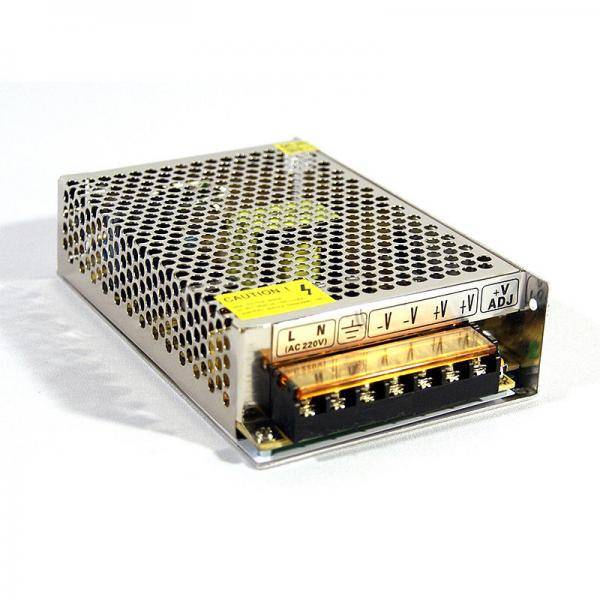
Power Supply
It is necessary to dwell on this element of the new lamp in more detail, because the LED strip on the power supply of the fluorescent lamp will not work. The thing is that the LED strip requires voltage and current stabilization. If this is not done, then the diodes will overheat, and eventually just burn out.

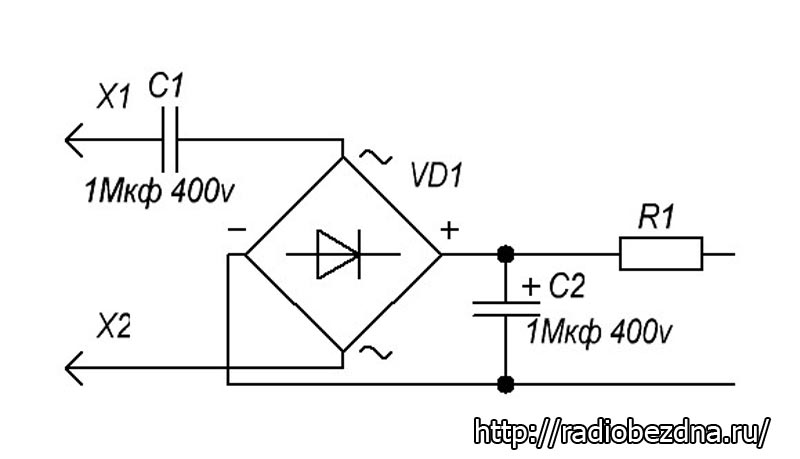
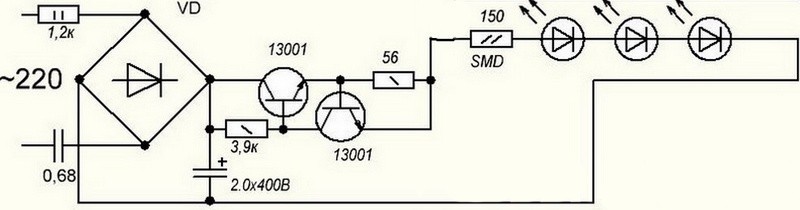


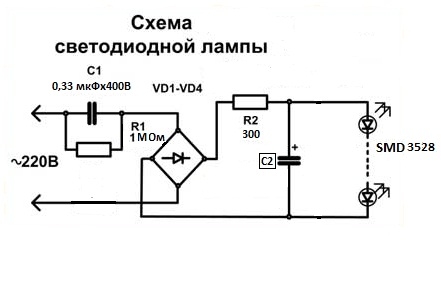
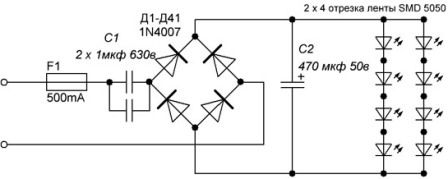
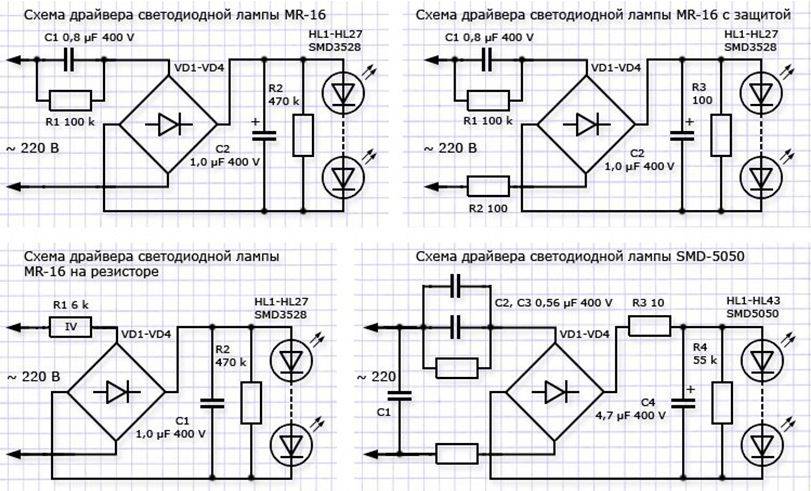
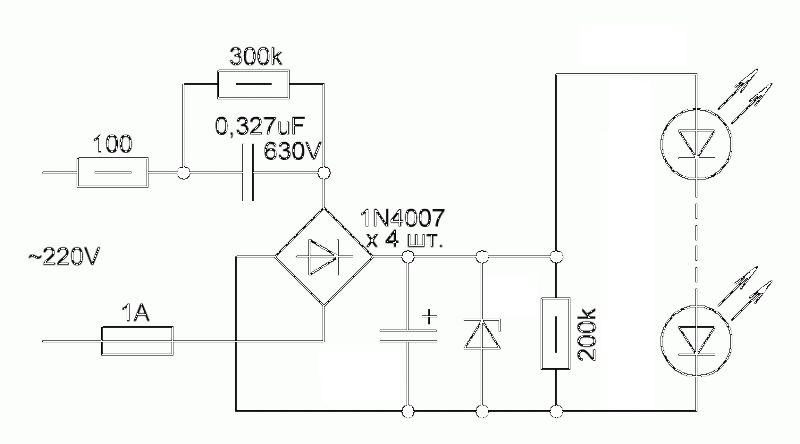
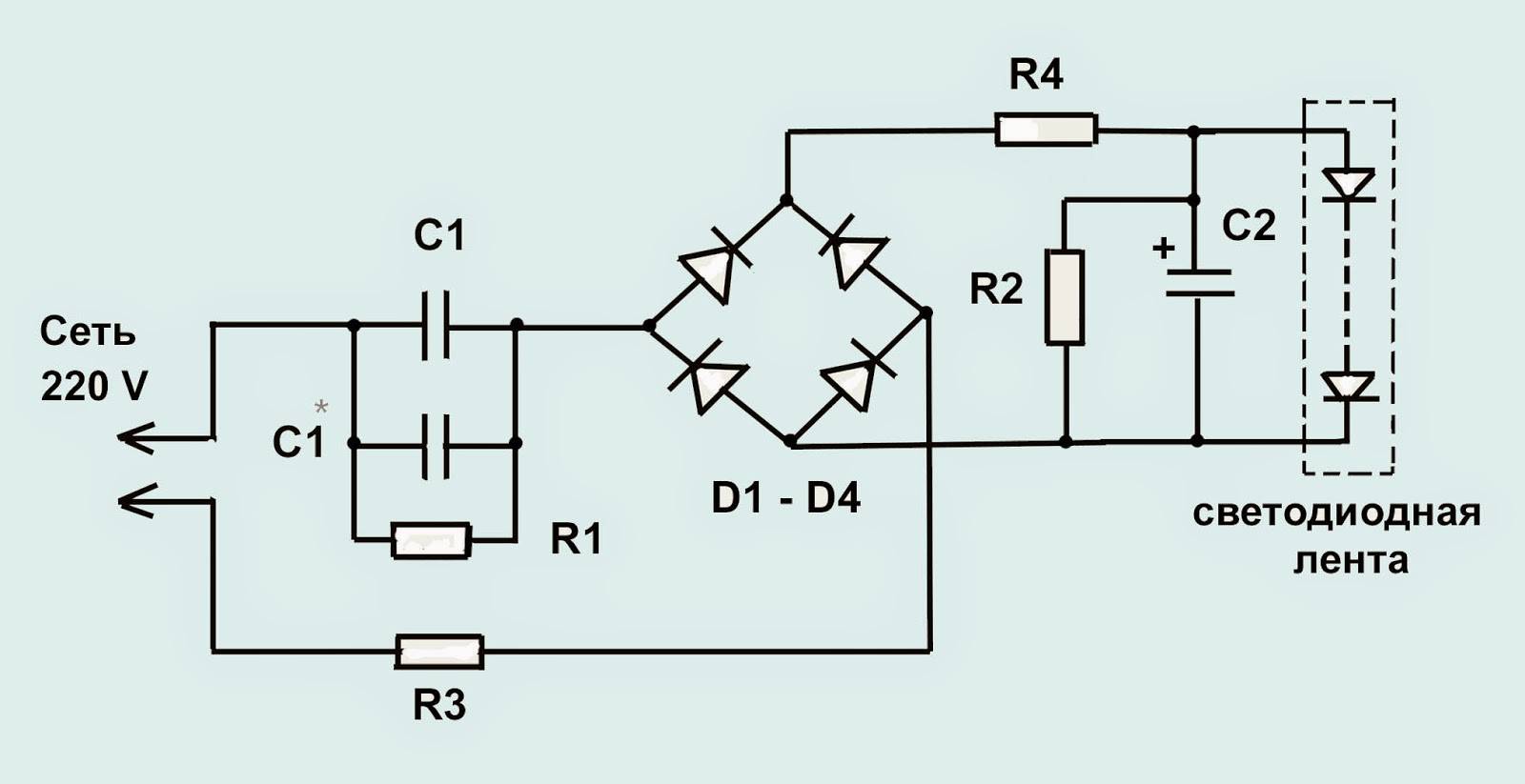
In our case, the best option is a power supply without a transformer, but with a ballast capacitor. Here is the diagram of the power supply from below.
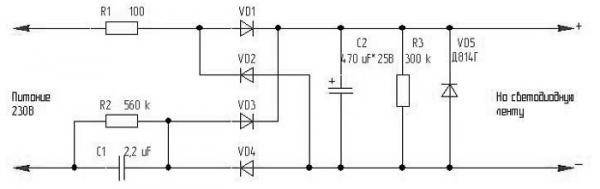
Power supply with ballast capacitor
In this circuit, C1 is the same ballast capacitor that dampens the mains voltage of 220 volts. After it, the current is supplied to the diode rectifier VD1-VD4. After that, a constant voltage is applied to filter C2. In order for the capacitors to discharge quickly, two resistors R2 for C1, R3 for C2 are installed in the circuit. Resistor R1 is a kind of mains voltage limiter, and diode VD5 is protection against output current overvoltage, which is a maximum of 12 volts (this is in case the LED strip breaks).
The most important element in this electrical network is the capacitor C1
Here it is important to accurately select it according to the required capacity parameters. Do not use complex formulas for this.
Just find a calculator on the Internet with which you can accurately calculate. True, this will require one introductory information: the current strength on the segment of the LED strip. This is usually indicated in the product passport.
But keep in mind that the accompanying documents indicate the maximum current parameter, so you should not take it as the main one. For example, a current of 150 mA would be normal for a new lamp 30 cm long. At the same time, the LEDs will not heat up, and the brightness of the glow will be sufficient.
Power supply for led strip
Try to enter our data into the calculator, you will get a capacitance indicator of the capacitor - 2.08 microfarads. We round it up to the standard - 2.2 microfarads, which will withstand voltages up to 400 volts.
electronic ballast
Constantly failing electronic ballasts do not need to be thrown away. It needs to be checked for correctness.
It is important here that the diode bridge be intact, all other details can be removed
And now you need to check power supply and plateau subject of correct operation. You just need to connect the LED strip to the unit, plug it into the outlet and check how the LEDs work. If everything suits you, then you can install the power supply in the lamp housing and make a major connection of all its parts to each other.
What do you need to know about ceiling mounting safety?
Here are some important tips from experts:
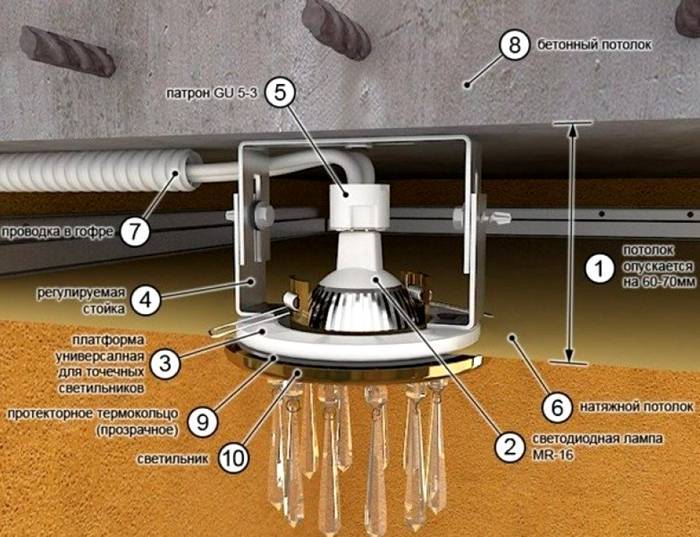
LEDs get very hot
Therefore, special radiators are used that are responsible for cooling.
Contact and heat dissipation is improved thanks to a special thermal paste at the junction between the two important elements.
When installing, it is important to ensure that there is free space around the radiators, not closed. Otherwise LEDs will fail ahead of time.
 It is also forbidden to mount lamps near heated appliances.
Special regulators and bulbs with a dimming function will be needed for those who are interested in adjusting the level of brightness and lighting. Availability of replacement lamps is an important factor in choosing suitable models.
Where can I hang the LED lamp?
Stretch and suspended ceiling structures - these are the products most often used with LED spotlights. Devices can be located in the center or on the sides. Here, each buyer chooses the option that best suits the current operating conditions.




We collect a lamp from an LED strip
We will analyze step by step the creation of a 220 V light source from an LED strip. To decide to use the innovation in the kitchen, it is enough to remember that self-assembled LED lamps are significantly more profitable than fluorescent counterparts. They live 10 times longer and consume 2-3 times less energy at the same light level.
For construction, you will need two burned-out fluorescent lamps half a meter long and 13 watts. There is no point in buying new ones, it is better to find old and broken ones, but not broken and without cracks.
Next, we go to the store and buy an LED strip. The choice is large, so approach the purchase responsibly. It is advisable to buy tapes with pure white or natural light, it does not change the shades of surrounding objects. In such tapes, LEDs are assembled in groups of 3 pieces. The voltage of one group is 12 volts, and the power is 14 watts per meter tape.
Then you need to disassemble the fluorescent lamps into their component parts.
Carefully! Do not damage the wires, and also do not break the tube, otherwise the toxic fumes will break out and you will have to clean up, as after a broken mercury thermometer.Do not throw away the extracted entrails, they will come in handy in the future.
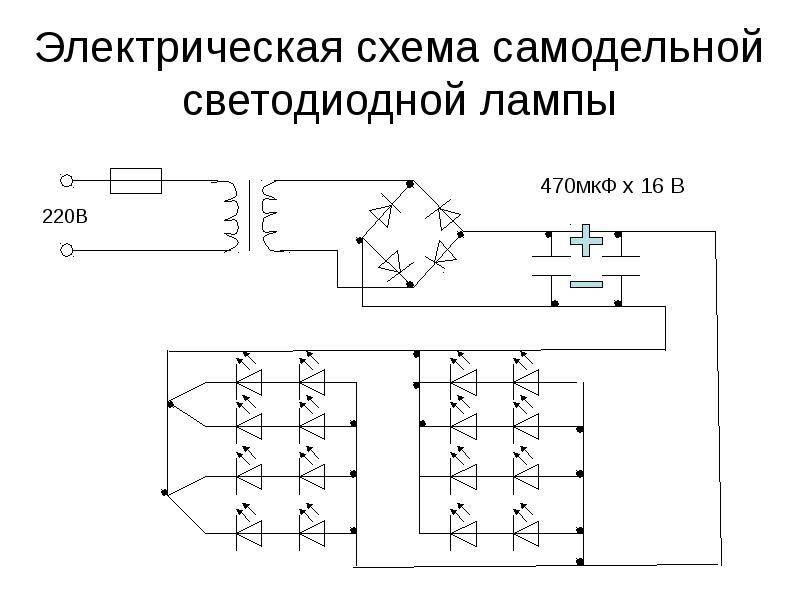
Below is a diagram of the LED strip we bought. In it, LEDs are connected in parallel, 3 pieces in a group
Please note that this scheme does not suit us.
Therefore, you need to cut the tape into sections of 3 diodes each and get expensive and useless converters. It is more convenient to cut the tape with wire cutters or large and strong scissors
After soldering the wires, the diagram below should be obtained. The result should be 66 LEDs or 22 groups of 3 LEDs each, connected in parallel along the entire length. The calculations are simple. Since we need to convert alternating current to direct current, the standard voltage of 220 volts in the electrical network must be increased to 250. The need to "throw" the voltage is associated with the rectification process.
To find out the number of sections of LEDs, you need to divide 250 Volts by 12 Volts (voltage for one group of 3 pieces). As a result, we get 20.8 (3), rounding up, we get 21 groups. Here it is desirable to add another group, since the total number of LEDs will have to be divided into 2 lamps, and this requires an even number. In addition, by adding another section, we will make the overall scheme safer.
We will need a DC rectifier, which is why you can not throw away the removed insides of a fluorescent lamp. To do this, we take out the converter, with the help of wire cutters we remove the capacitor from the common circuit. It is quite simple to do this, since it is located separately from the diodes, it is enough to break off the board. The diagram shows what should happen in the end, in more detail.
Next, using soldering and superglue, you need to assemble the entire structure. Don't even try to fit all 22 sections into one fixture. It was said above that you need to specifically find 2 half-meter lamps, since it is simply impossible to place all the LEDs in one. Also, you do not need to rely on a self-adhesive layer on the back of the tape. It will not last long, so the LEDs need to be fixed with superglue or liquid nails.
Let's summarize and find out the advantages of the assembled product:
- The amount of light from the resulting LED lamps is 1.5 times greater than that of fluorescent counterparts.
- The power consumption is much less than that of fluorescent lamps.
- The assembled light source will serve 5-10 times longer.
- Finally, the last advantage is the directivity of the light. It does not scatter and is directed strictly downwards, thanks to which it is used at the desktop or in the kitchen.
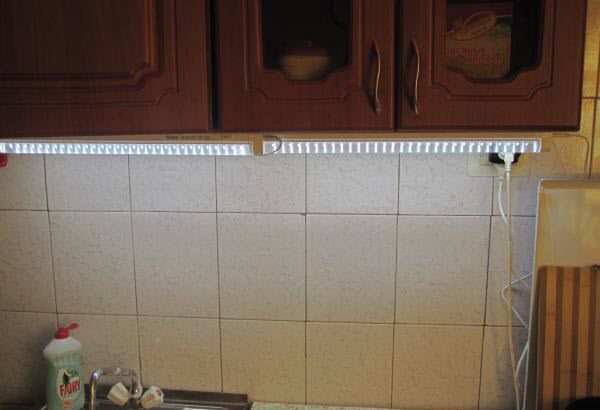
Of course, the emitted light is not very bright, but the main advantage is the low power consumption of the lamp. Even if you turn it on and never turn it off, it will consume only 4 kW of energy in a year. At the same time, the cost of electricity consumed per year is comparable to the cost of a ticket in a city bus. Therefore, such light sources are especially effective to use where constant illumination is required (corridor, street, utility room).
Principle of operation
Here, owners should consider several features:
- An alternating voltage of 220 V is supplied to the drivers of the LED lamps. The frequency of such energy is 50 Hz.
- Further, the flow itself passes through the capacitor, which limits the current.
- The next component where energy is found is a rectifier bridge, assembled on the basis of four diodes.
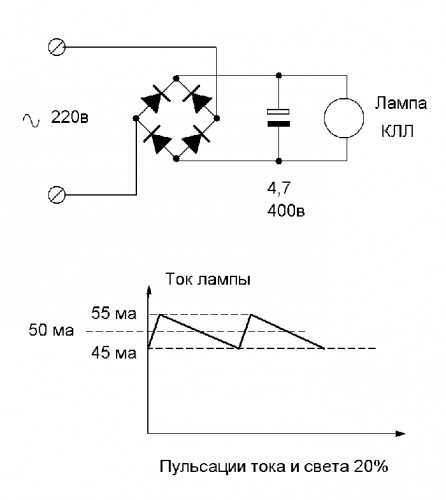
At the output of the bridge in the next stage, a rectified kind of voltage appears. It is this version of energy that is needed for the diodes to work correctly. But the driver needs to be supplemented with an electrolytic capacitor in order for the device to start working as it should. Then the ripples that occur when the AC voltage is rectified are smoothed out.
The device also contains resistances of various types. To discharge the capacitor, additional protection is a special resistor. The other, with the designation 1 on the diagrams, limits the current that goes to the light bulb when it is turned on.
LED light bulb device 220V
In any LED lamp, the following components are distinguished:
- The luminous flux becomes uniform thanks to the diffuser.
- Resistors or chips that protect against sudden changes in performance.
- Printed circuit board for soldering LEDs.
- Radiator that removes heat.
- Driver. It is the basis for assembling a circuit that converts AC voltage to DC. The main thing is to get the required value at the output.
- Dielectric gasket, between the body and the base.
- A base into which a chandelier and a sconce are screwed, a lamp.
The difference between LED and fluorescent: a brief description
The main differences are related to the design. The basis of fluorescent lamps is a glass bulb. Mercury vapor and inert gases fill part of this device inside. The seal ensures tightness. The scope of application is wider thanks to sets with plinths of various dimensions.
 LED lamps are built on electronic matrices. This is an electronic connection of several diodes with each other. There are other auxiliary elements in the products to ensure the stable operation of the mechanism. Low power consumption is the main advantage LED lamps compared with others.
Main conclusions
You can make a lamp with your own hands using improvised means and inexpensive radio products. It also requires direct LED elements - lamps or strips. They can be both weak and strong. When choosing a material for the housing, one must proceed from the parameters of their heat transfer. To connect such a device to a network without a power supply, you will need to make a driver with a quenching capacitor, having previously calculated it according to the formula.
Using the proposed technology, it is possible to manufacture lamps of any shape and parameters for installation as a main or decorative light source. You can install them by hand on the ceiling and walls in plafonds, in chandeliers and table lamps, as well as in any other specially made artistic design.
Previous
LEDsFormula and example for calculating the limiting resistor for the LED
Next
LEDsDetails about characteristics of LED lamps



