
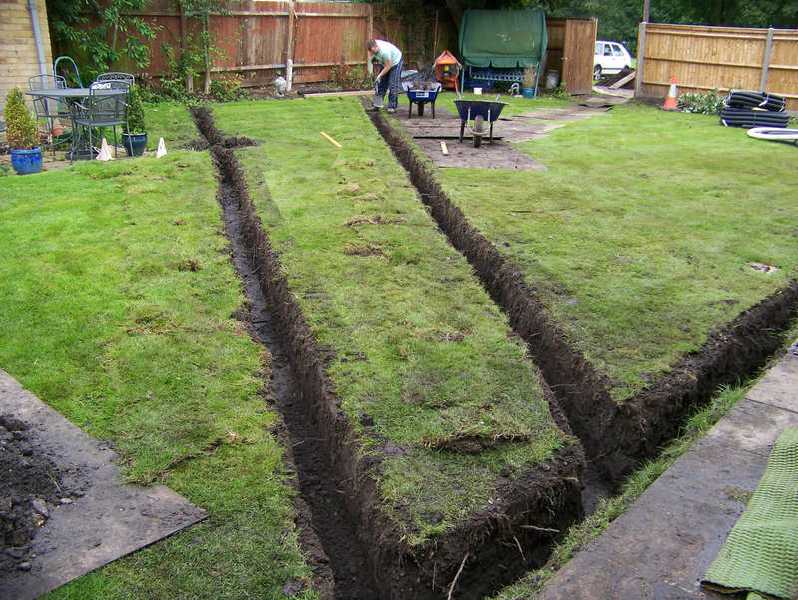
- Drainage in the suburban area: the easiest way to device for specific conditions
- An example of site drainage with a high groundwater level
- Do-it-yourself open drainage device on a site with clay soil
- Filtering and storage wells
- Option 1. With drainage wells
- Prices for popular models of drainage wells
- Option 2. With storage
- Do-it-yourself site drainage on clay soils - step-by-step instructions for installing various systems
- Deep drainage: step by step instructions
- Installation of surface drainage
- Drainage pipes for groundwater drainage: complete product classification
- Groundwater drainage pipes: an introduction to the topic
- How to make drainage with your own hands
- Choosing the right dehumidification system.
- Surface drainage of water from the site.
- Underground site drainage.
- Lowering groundwater drainage.
- Intercepting drainage.
- Storm sewer.
- Types of systems: surface and deep drainage of the site
- Not to drain
- Types of soil drainage systems
- Surface drainage
- deep drainage
- Backfill drainage
- First of all, plan!
Drainage in the suburban area: the easiest way to device for specific conditions
Before you make a drainage system on the site, you must choose its type, based on operational features.It is worth considering the most optimal options for arranging water drainage systems, which are popular under certain conditions.
Construction of a drainage system from the foundation of the house is underway
An example of site drainage with a high groundwater level
With a close occurrence of groundwater, a deep system of a linear type may be the best option. It will remove moisture from the entire site to a sewer, ravine or ditch located one level below. As the main elements, it is proposed to use perforated plastic pipes in the geotextile filter.
Special pipeline with perforation and geotextile
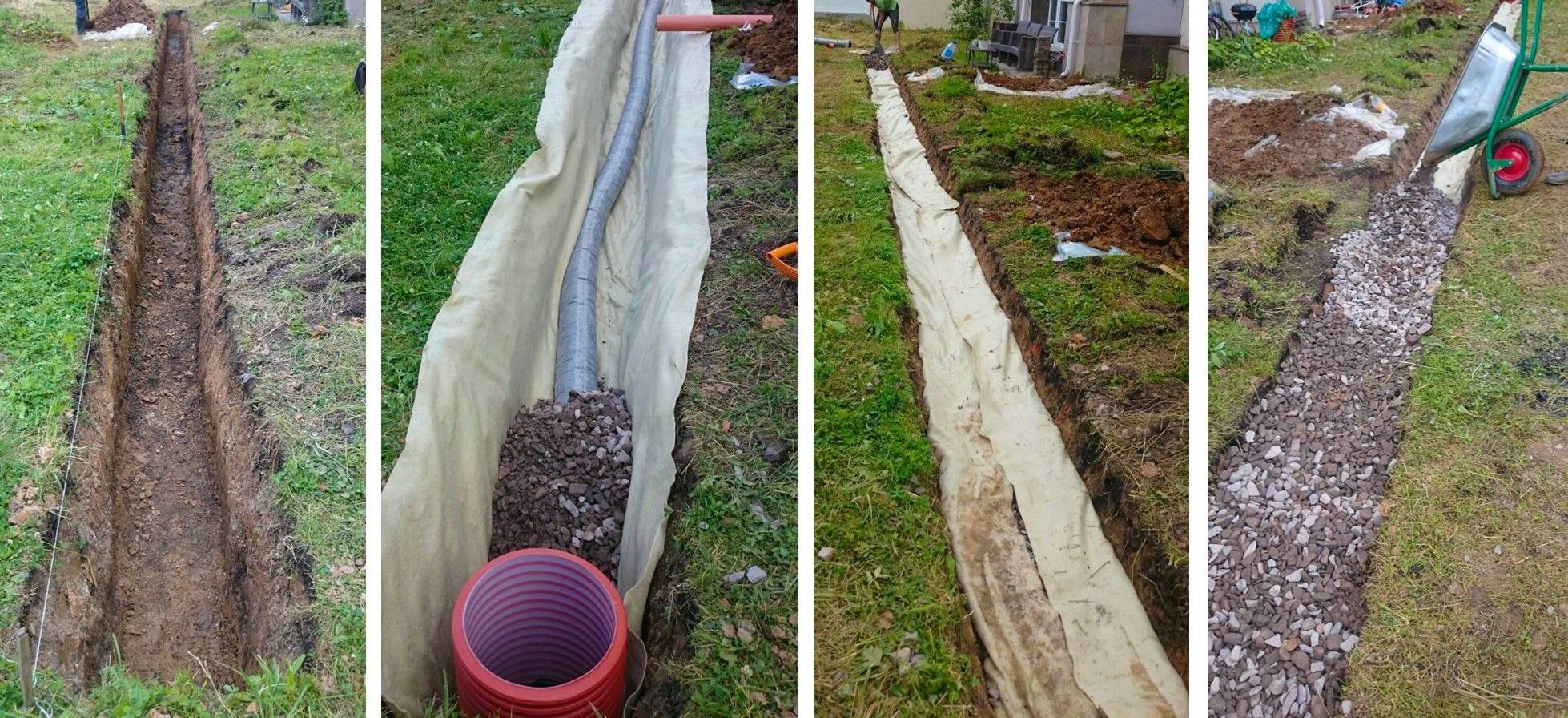
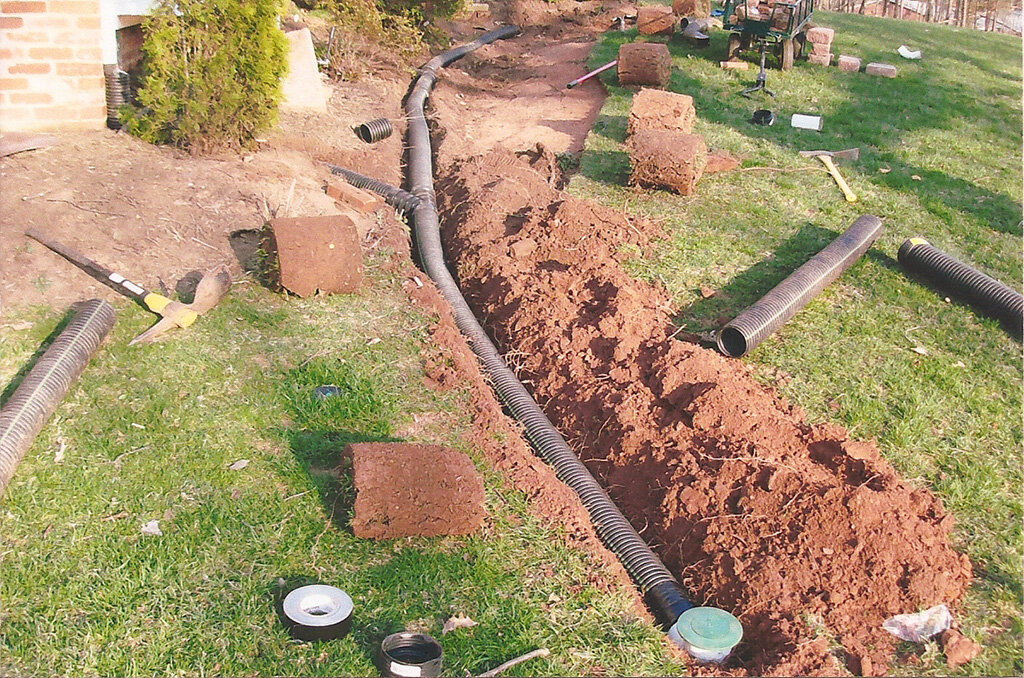
One of the simplest methods of drainage in a summer cottage with groundwater located near the surface comes down to the following scheme:
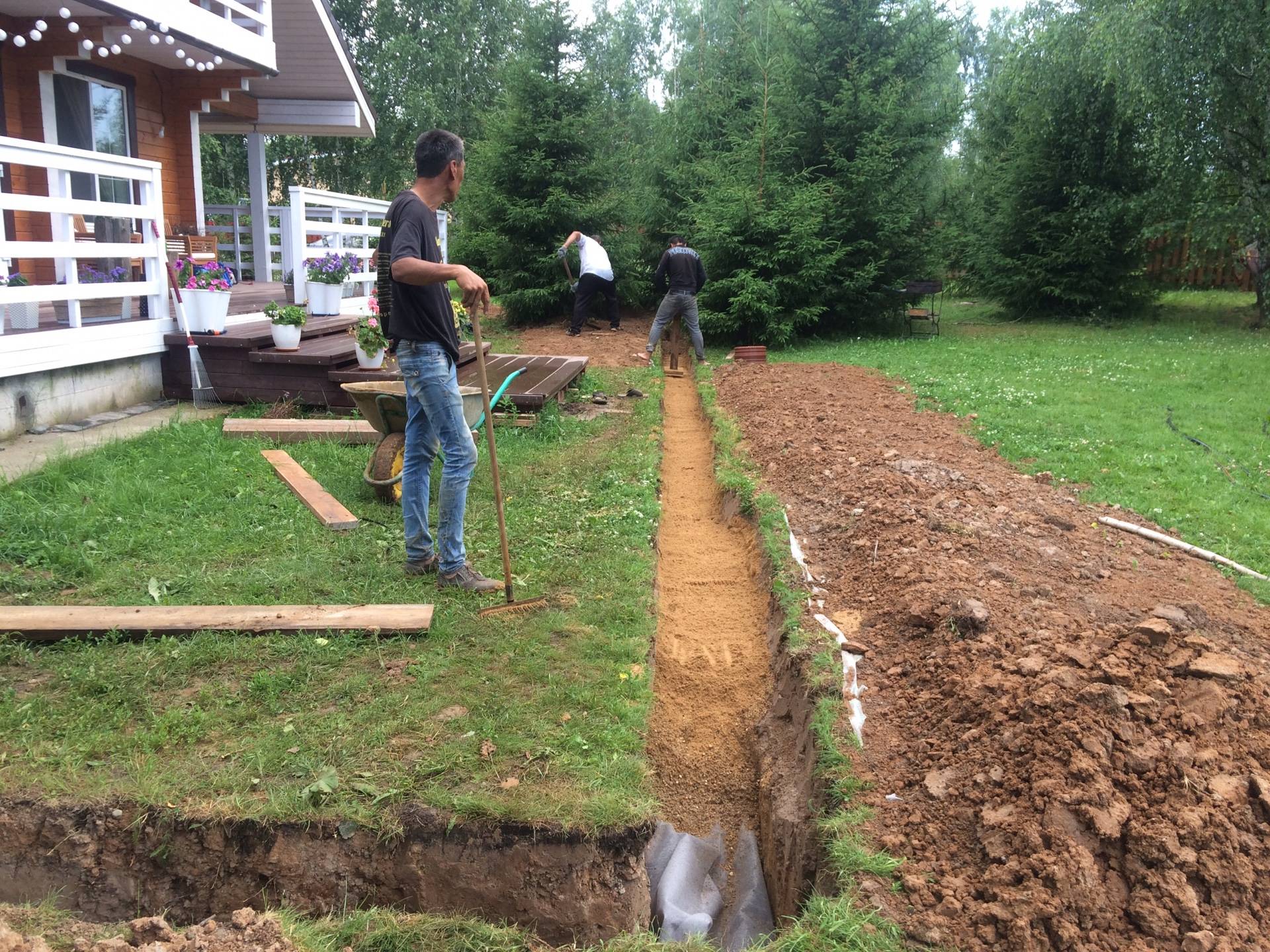
- A trench breaks out to the distance of soil freezing. Its slope should be 2 cm per linear meter towards the liquid collection point. For leveling, a layer of sand is poured.
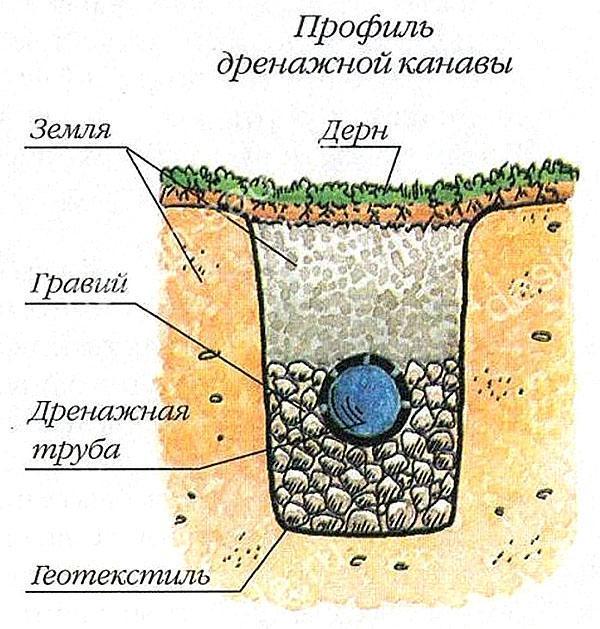
- Geotextiles are spread on the prepared bottom so that its edges overlap the walls of the pit by at least 1-2 m. A small layer of gravel is poured on top.
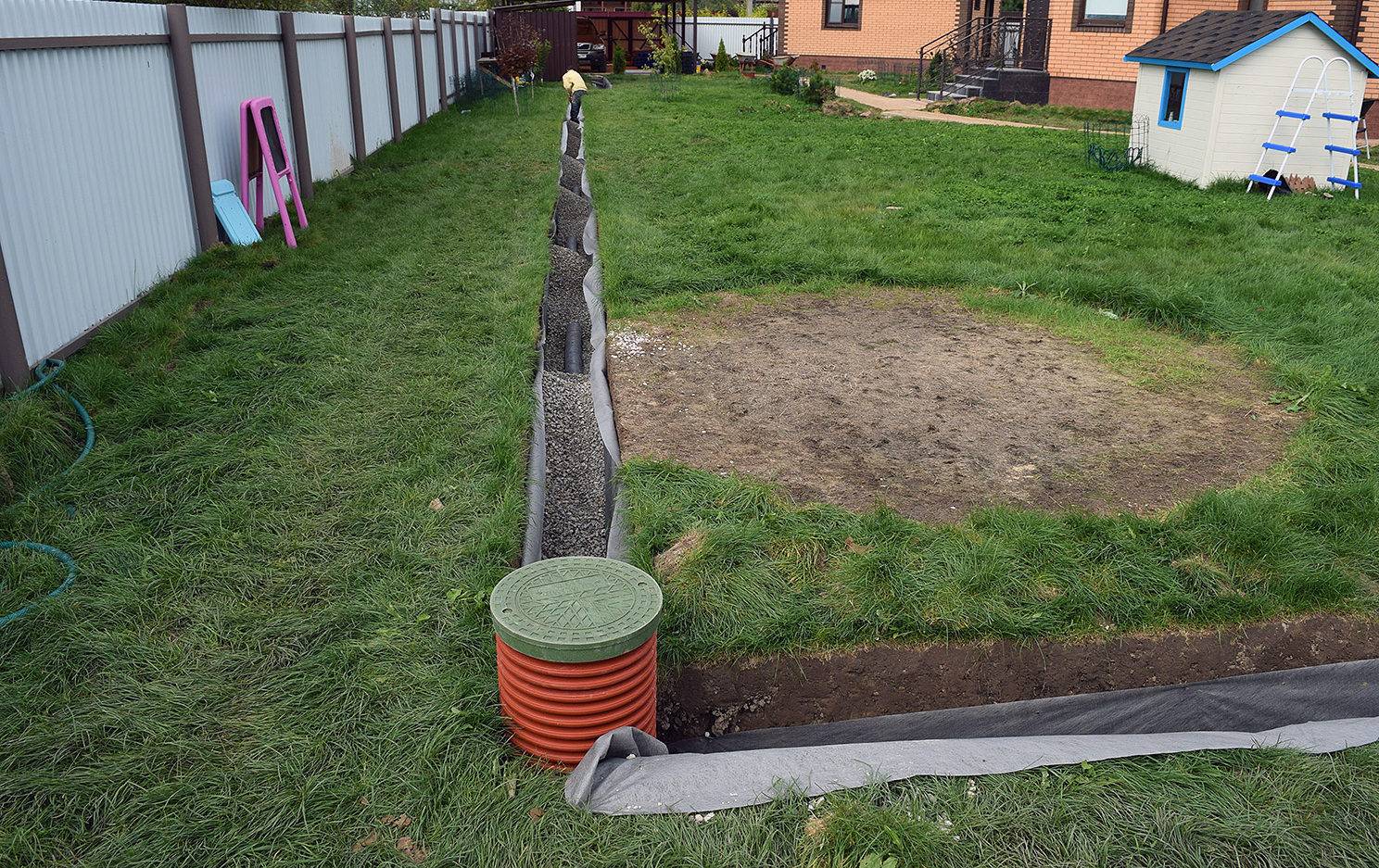
- Next, plastic pipes are laid, after which they are again covered with approximately the same layer of gravel. The ends of the geotextile roll up to form a protective barrier. The rest of the trench is covered with soil.
Visual diagram of closed-type drainage with linear collection
At high GWL, the drainage system takes on a tree-like form.
Do-it-yourself open drainage device on a site with clay soil
For land with clay soil, a system with an open channel arrangement is more suitable.With a closed piping system, water will not be able to seep through such soil and go to specialized septic tanks or other suitable places.
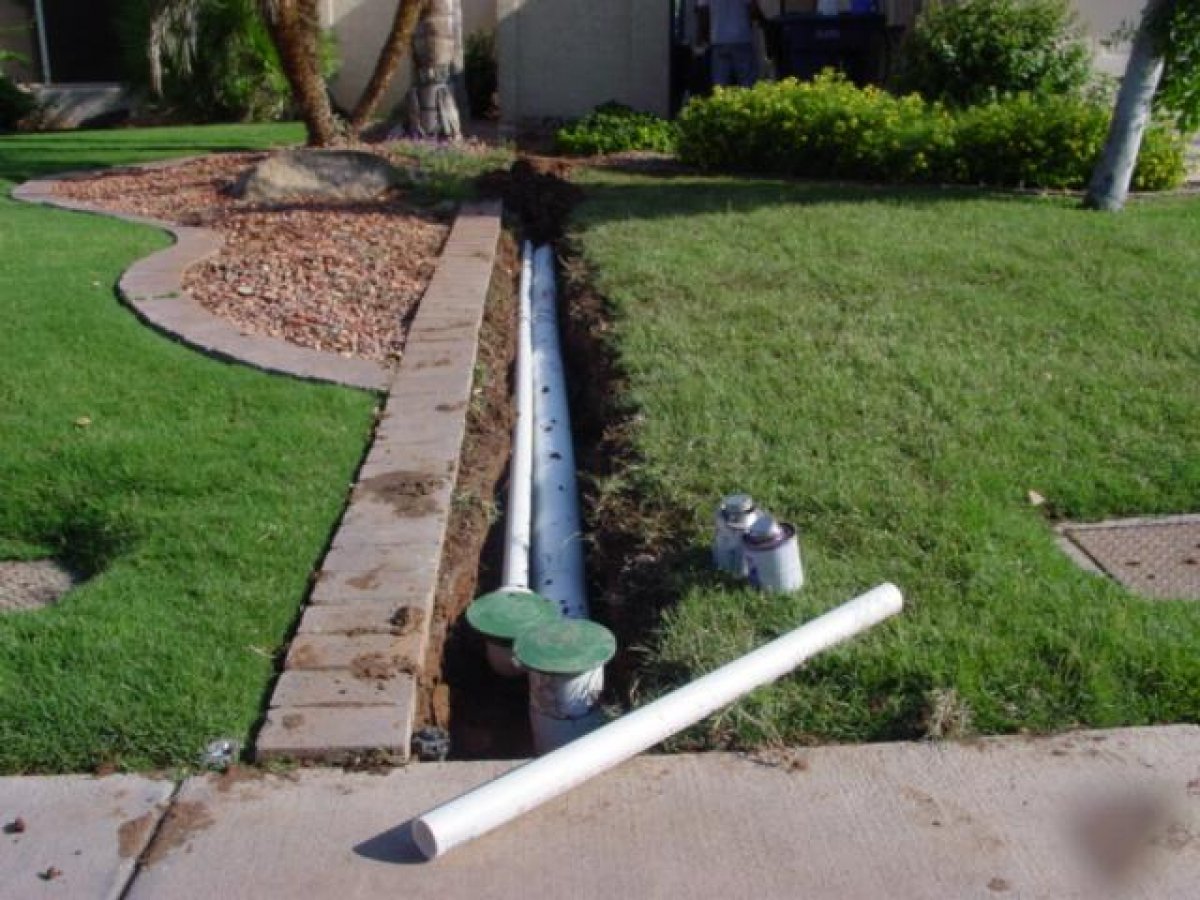
Land works for the drainage system are underway
In places where water accumulates, ditches are dug with a depth of at least 50 cm. Their width should increase as they approach the place of reception. It is necessary to make the widest trench, which collects water from the ditches adjacent to it. To facilitate draining and protect the edges from collapse, the side walls are cut at an angle of 30 degrees.
Since the open view of the trenches spoils the appearance of the site, it is necessary to decorate them. It not only allows you to increase the aesthetic properties, but also to strengthen the side surfaces of open lines. In this regard, the operation of the system is significantly increased.
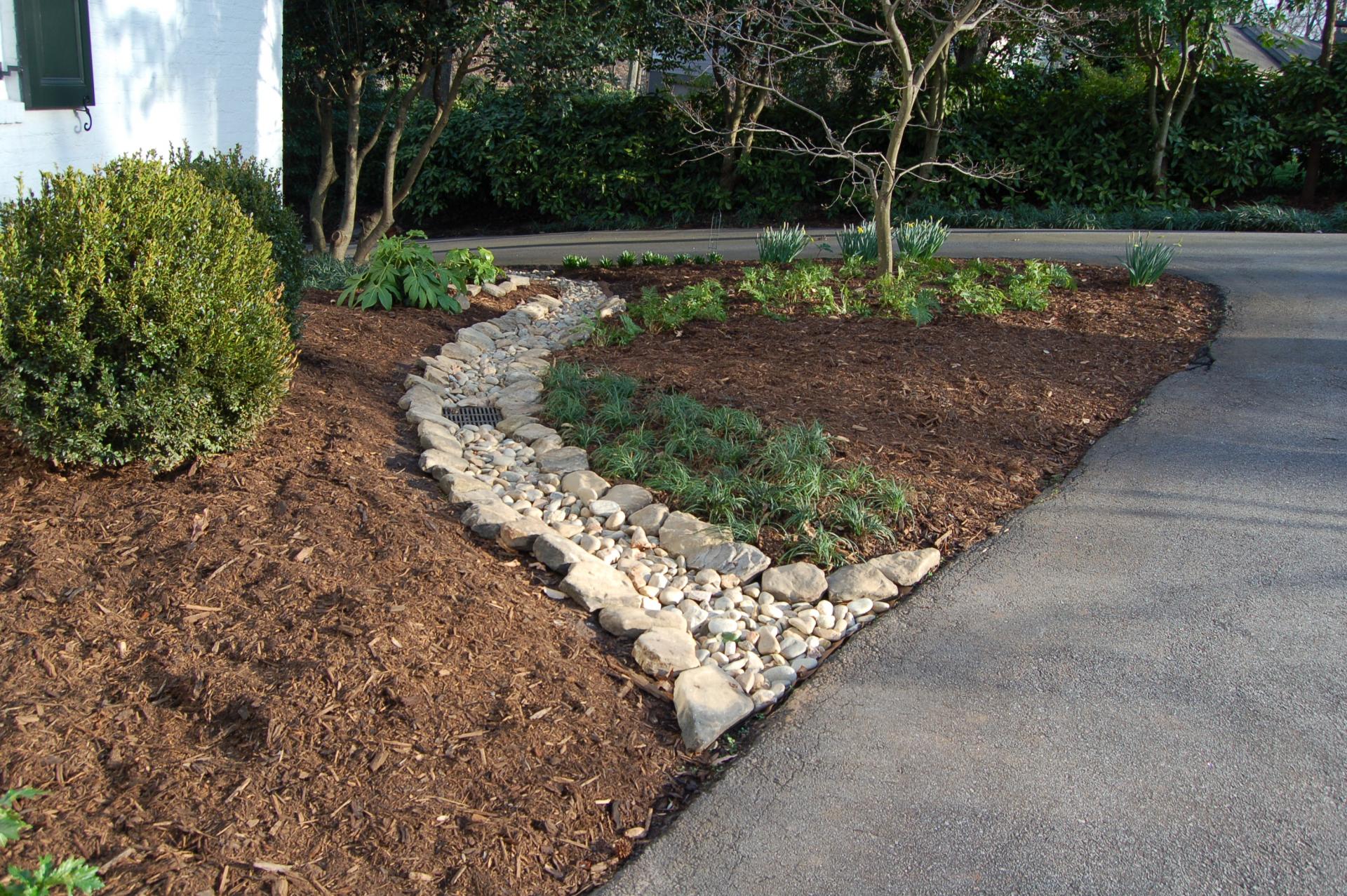
The process of decorating open channels with stone
As a material for decorating pits, stones of various sizes can be used. The largest of them should be laid on the bottom, and medium and small - on top. If there are good financial opportunities, the surface can be covered with marble chips, which will give the branch lines a respectable look.
If money is tight, then regular brushwood can be a good option for decoration. It is necessary to find dry branches of any wood species that grow nearby. They should be tied in bunches and laid on special stands installed at the bottom of the ditch.
Lines in the invisible part of the site can be reinforced with ordinary slate
The thickness of the bunches of brushwood should be no more than 30 cm. It is better to place the branches so that the larger ones lie in the center, and the smaller ones at the edges.
Filtering and storage wells
In the absence of the possibility of discharging water into natural water collectors: ditches, rivers, ponds, there is nothing left but to equip a well. There are two options: a well with a draining bottom and a storage tank.
Drainage of a suburban area
Option 1. With drainage wells
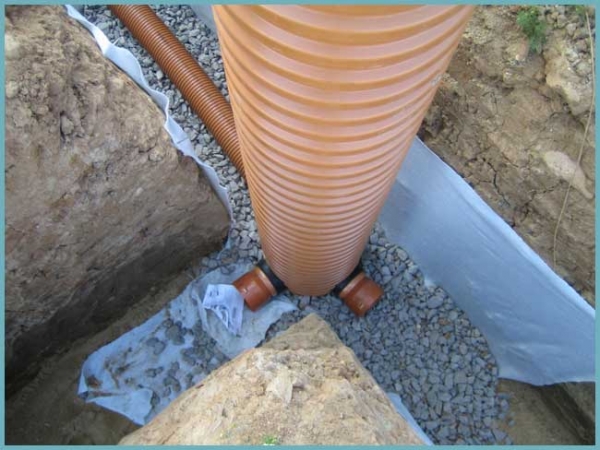
The essence of the device of the drainage well is that the water that enters it is filtered and seeps into deeper soil layers. There may be several of them in the pipe drainage system. They are located at the beginning of the line, at the places of turns, intersections, changes in the slope or diameter of the pipes.
Circular drainage in a plot with a drain into drainage wells
Homemade well from a pipe
Well in the factory
The well can be built from factory-made concrete rings with perforation, purchased a finished plastic product, or cut off a piece of a large-diameter pipe, make holes in its walls and install it in a cylindrical pit 1.8-2 m deep on a prepared crushed stone base.
Prices for popular models of drainage wells
Drainage well
Option 2. With storage
The water that is collected from the site can be used in some way on the farm: for washing cars, breeding fish or crayfish, watering greenhouse crops. In any case, if groundwater already reaches a high level on the site, it is irrational to add surface runoff to them.



- Water can be drained into a street storm collector, a ditch, or simply into a forest or a river. For this purpose, not a drainage, but a storage well is introduced into the system. The difference between them is that the first one has permeable walls and bottom, while the second must be airtight.
- A pump with a float sensor is installed in it.As soon as the container is filled above a predetermined level, it starts to work, discharging excess water into the drainage channel or a drainage well located farther from the site. The rest is always in stock, and if necessary, you can use the accumulated water.
Storm water tank with submerged pump
- It can be very helpful in case of fire extinguishing. Or when you start some kind of building in the yard that will require water - for example, to moisten a compacted sand cushion.
- During the summer drought, the water supply, for which you do not have to pay a penny, is also useful for watering beds that suffer from excessive moisture in other seasons. After all, in dachas there is often no water other than what its inhabitants bring for themselves to drink.
Electric submersible pumps
Do-it-yourself site drainage on clay soils - step-by-step instructions for installing various systems
Surface-type drainage can be organized with your own hands, using a diagram and selecting materials. A simple system consisting of trays, a well and other elements will ensure timely removal of moisture. Surface drainage is supplemented with deep or backfill, which enhances the efficiency of drainage.
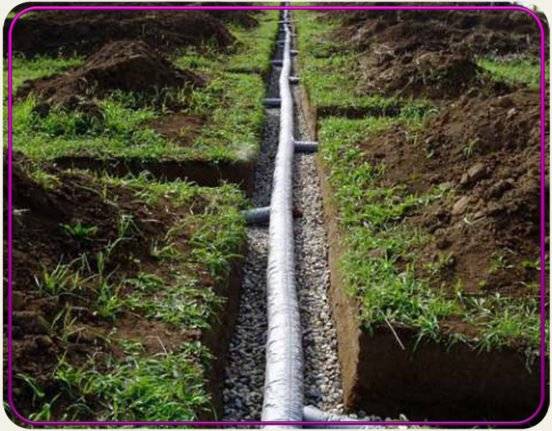
Deep drainage does not spoil the landscape design of the site
Deep drainage: step by step instructions
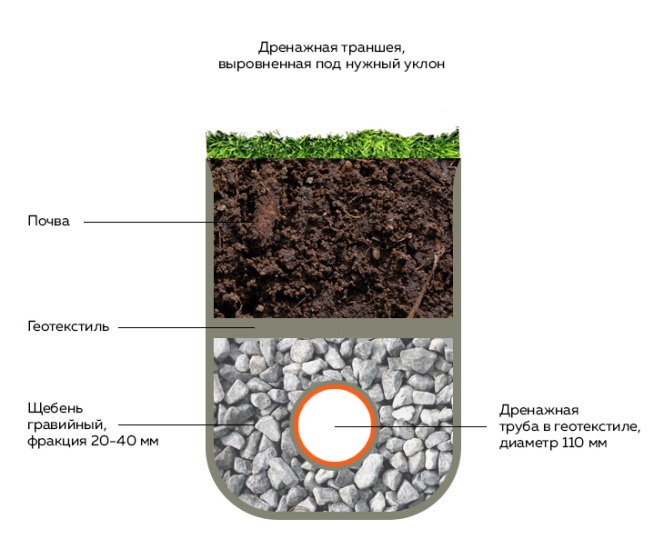
Pipes are needed to create deep drainage. For the main line, elements with a diameter of 110 mm are used, and pipes with a diameter of 60 mm are optimal for additional ditches. The well is constructed from concrete rings or a special polymer container is inserted into the recess. Crushed stone fraction 20-40, coarse sand, geotextiles are also needed to create a drainage complex.
The complex of works includes the following actions:
-
For a well, a hole should be dug, the depth of which is 2–3 m. Concrete rings are installed from the very bottom. The finished container is mounted in the same way. Sand is poured at the bottom with a layer of 20 cm, and then crushed stone by 30 cm. There should be holes for incoming pipes in the rings or walls of the finished container. The height of their location is equal to the depth of the pipes in the ditches, that is, about 100 cm from the upper edge.
-
Next, you need to dig trenches according to the scheme. Their width is 50 cm, and the depth is 120 cm in the main line and 100 cm in the side lines. The main channels reach the well, while the slope is 5 cm per 1 linear meter of pipe length. At the bottom of the ditches, sand should be poured with a layer of about 20 cm, and then geotextiles should be laid. The edges of the canvas should be higher than the edges of the pit. Next, crushed stone is poured in a layer of 20 cm, perforated pipes are laid in compliance with the slope.
-
Docking of pipes among themselves is made by coupling or bell-shaped connections. In the area of turns and on straight sections, inspection wells must be installed every 25 cm. The height of such elements should ensure their elevation above the soil level. Revision wells are necessary to monitor the condition and clean the system.
-
Crushed stone should be poured onto the pipes so that the filter material completely covers them. Next, wrap the geotextile. The space remaining in the trench is covered with sand, and a layer of turf or decorative gravel is laid on top.
Installation of surface drainage
Deep drainage is designed to remove moisture from the soil, and the surface system helps prevent water stagnation in the upper layer of clay soil. Rain moisture or melt water is immediately discharged into the well, transported through special chutes. This allows you to remove water from the roof of buildings and avoid the appearance of puddles in the area with clay soil.
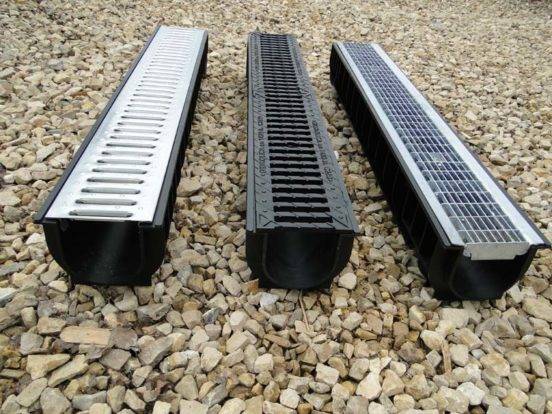
Trays are easy to install and have a small size
For surface systems should be noted on the plan plot the direction of the ditches that should lead to the well. The slope is the same as for deep drainage. Next, the following actions are carried out:
-
According to the scheme, small trenches are dug, which are well rammed. It is necessary to observe the slope of the ditches towards the well or water collectors. If the site has a natural slope, then the depth of the channels may be the same. The depth of the trenches in this case is up to 80 cm, and their width is 40 cm.
-
At the bottom of the trenches, sand is poured with a layer of 10 cm, and then the same amount of crushed stone of a fraction of 20–40. Next, you need to pour concrete mortar onto the filter material and immediately install trays to remove water.
-
At the end of each channel line, grit traps should be installed using the same mounting method as for the gutters. Rain inlets under the drainpipes of buildings are mounted according to the same method. All parts are well connected to each other, forming a single system. Next, the trays need to be covered from above with special gratings.
Drainage pipes for groundwater drainage: complete product classification
This article discusses groundwater drainage pipes: a complete classification of drainage products, their advantages, characteristics and main parameters are presented.Thanks to this information, you will learn how to select the appropriate types of pipes for certain types of drainage systems in accordance with their requirements, soil conditions, etc.
Corrugated pipe walls are highly resistant to any deformation changes under the influence of loads
Groundwater drainage pipes: an introduction to the topic
The drainage pipe acts as the main building element, on the basis of which a drainage system is formed, designed to drain areas. This element is responsible for collecting and diverting groundwater, melt and rainwater outside the territory with their preliminary filtration.
Note! A large volume of melt and storm water can provoke a rise in the groundwater level. The appearance of such a situation is highly undesirable, because as a result, the destructive effect on the foundation part of the building, as well as all elements of landscape design located on the site, increases. Drainage system helps to get rid of excess water in the area
Drainage system helps to get rid of excess water in the area
Installing large diameter drainage pipes allows you to cope with problems such as:
- high soil moisture
- mold formation,
- flooding of the site, the foundation of a residential building and buildings for household purposes, as well as cellars,
- permafrost formation,
- the appearance of puddles on paved surfaces,
- formation of ice on footpaths,
- rotting of the roots of garden flowers, vegetables and other vegetation due to an excess of moisture in the garden and summer cottages.
Features of drainage pipes with partial perforation, full or no perforation
If we talk about the general classification of products for drainage systems, the range is represented by the following types of pipes (by type of material):
- asbestos-cement,
- ceramic,
- plastic drainage pipes with and without perforation, as well as with its partial presence.
In the building materials market, drainage pipes are represented by a wide variety of types and sizes.
However, most construction companies have already abandoned the use of pipes made of ceramic or asbestos cement due to the numerous disadvantages inherent in them:
- Large weight, requiring significant costs for transportation and installation, because the installation of such dimensional products cannot do without the use of specialized construction equipment.
- The slow process of installing a drainage system, which can only be carried out by the hands of professionals.
- Low performance. Drainage pipes without perforation are usually on sale, so the holes are made manually. Because of this, during operation, the pipeline clogs faster, so frequent cleaning is required, and in some cases, a complete replacement of elements.
- The construction of systems based on them is much more expensive than in the case of using plastic elements.
Installation of a water drainage system on a land plot using corrugated plastic pipes with perforation
Note! The table shows the average price of drainage pipes 200 mm from various materials. There are other diameter options, however, in products made of ceramics, asbestos cement and plastic, the standard dimensional parameters do not match. Therefore, for comparison, a drainage pipe diameter of 200 mm was taken, which is present in the assortment of all these products.
Therefore, for comparison, a drainage pipe diameter of 200 mm was taken, which is present in the assortment of all these products.
Comparative pricing table:
Drainage pipes for groundwater drainage: complete product classification Drainage pipes for draining groundwater from a suburban area: types of products, their characteristics, prices and features of use in drainage systems.
How to make drainage with your own hands
Consider how to install different types of dehumidifier systems with step-by-step instructions.
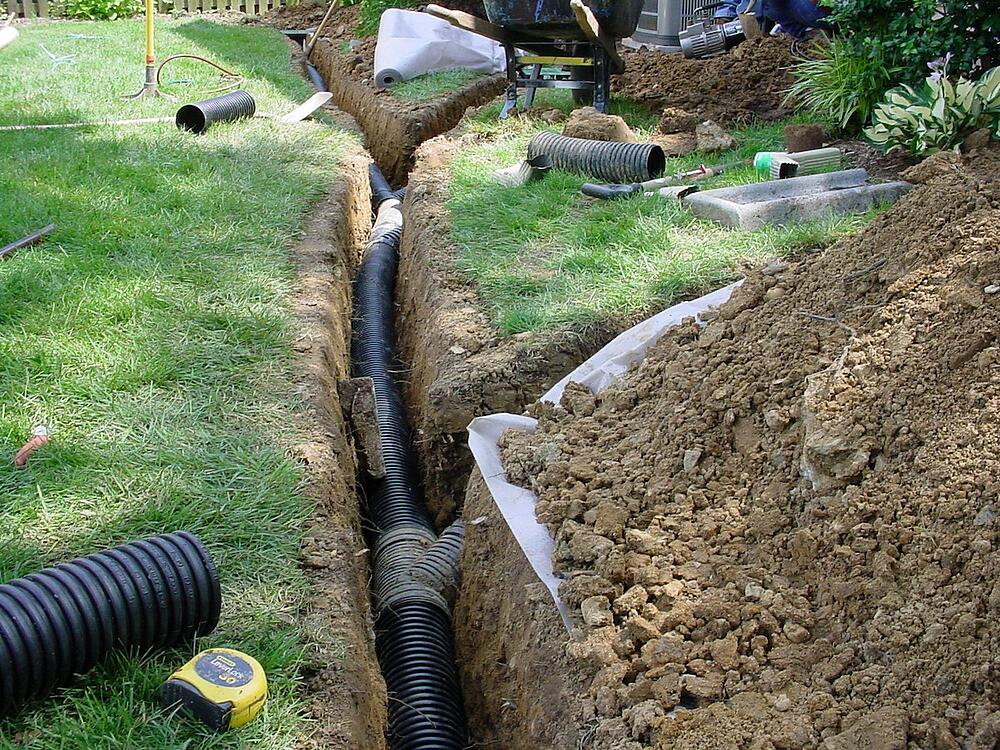
For deep drainage, you will need to calculate the lowest point on your site. This can be done using special equipment for geological research or a simple folk method. Dig a hole in the intended drain site, the hole should be about 10 centimeters deep. Pour water there and see in which direction the liquid will flow - if it remains standing still - then the place is chosen correctly, if a little to the side, then, accordingly, you need to step back a little in the right direction.




Video: Do-it-yourself drainage in a summer cottage: device, tips, recommendations.
In the chosen place, you need to dig a main trench, its duration determines the size of the site and the amount of average annual precipitation. Be sure to note that at its end there will be a septic tank or a drainage well.
Prepare the future highway. On average, the width is selected from 20 to 30 centimeters, the depth is determined by calculating the number of drains and the level of soil freezing;
The bottom of the pit must be covered with a sand cushion, compacted.The sand should take up to 5 centimeters of depth, it will be a kind of filter. After the trench, it is covered with large stones, rubble, construction waste, or boards are installed crosswise into it. This design will help ensure efficient water drainage;
On top of the first layer of drainage flooring, another one is poured, but with a smaller fraction. Further, as you approach the surface of the highway, the size of stones or debris becomes smaller;
You can leave only one main trench or make drainage like a river. In this case, dig additional highways throughout the site, but less than the width. The end of each of them should be included in the main
It is very important to ensure the slope of such a drainage system as follows: the lowest point of the additional trenches is at the junction with the main main;
After backfilling, you need to prepare a place for a drainage well. This is the lowest point on the site.
The main trench is connected to it, it is desirable to additionally seal the junction so that it does not fail under strong pressure. You can dig a cylindrical hole and place a barrel in it to collect water. Or leave the cavity empty so that the liquid itself can go into the lower layers of the earth;
It is necessary to fill up the deep drainage at the dacha with your own hands in an embankment, that is, an image of a hill on the surface of the earth.
Similarly, surface drainage can be done. For example, for a point, the lowest place on the site is selected and a pit for a septic tank is dug there. It is recommended to additionally insulate the drainage well so that the liquid that remains in it does not freeze during the first frosts. The walls of the well are additionally reinforced with wooden boards.Now concrete rings are very often used, but they are quite difficult to install without the use of additional lifting mechanisms. A mesh hatch is mounted on the surface of the septic tank, which will provide maximum water permeability, but at the same time it will filter it, preventing clogging.
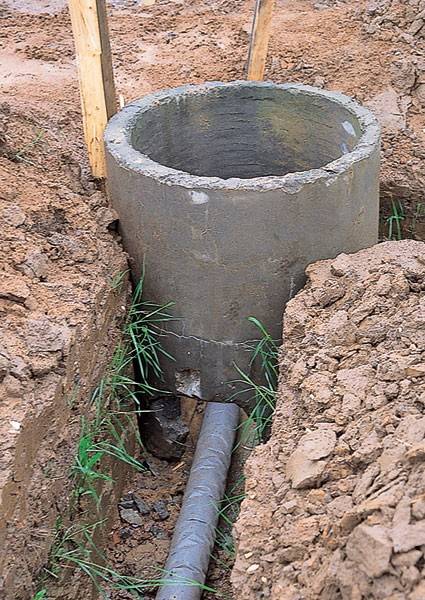
From such a drainage, you can pump out water with a special pump, using it for irrigation or other household needs, or leave the bottom open so that it is absorbed into the deeper layers of the earth. Many home craftsmen pour humus into such septic tanks in order to end up with not only dry soil, but also high-quality fertilizer for the soil.
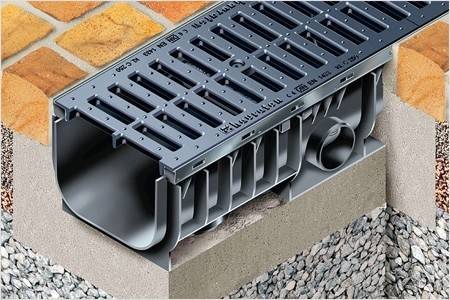 Point drainage
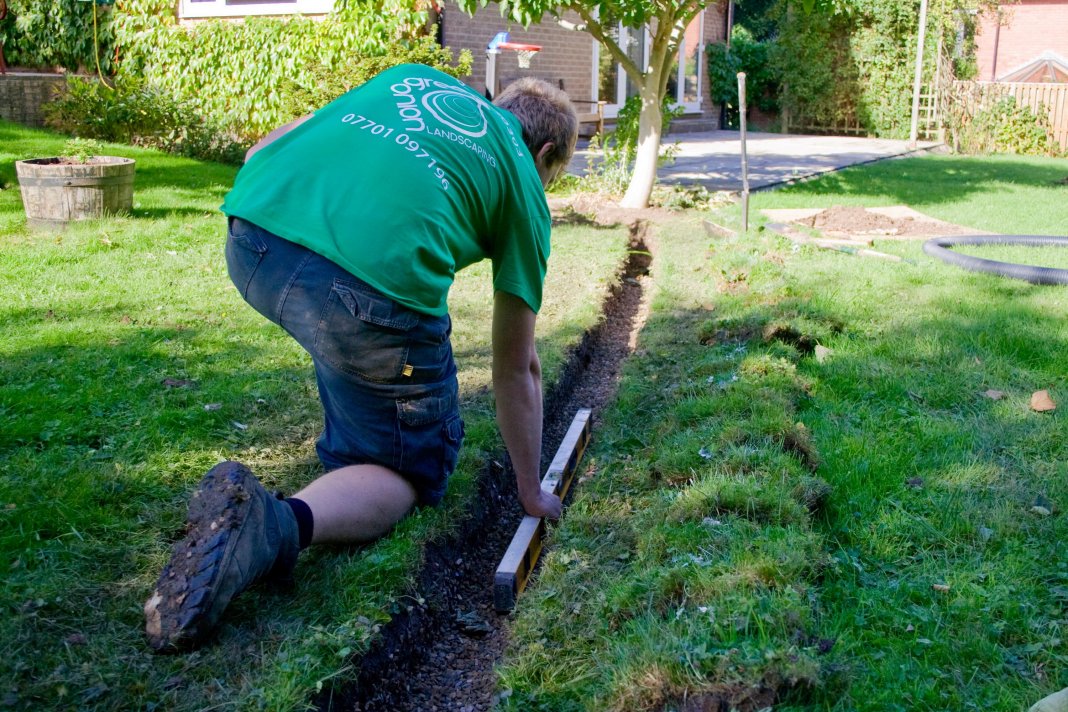
The linear drainage system in the country is an analogue of the deep one, but it is even easier to do it yourself. To do this, you also need to calculate the lowest place on the site, and mark the territory. Throughout the marked area, trenches are being dug, which in the future will be highways. Depending on the area of land, you can make beautiful streams and decorate the landscape or block the drainage with paths, and then fill it with earth.
 Surface drainage in the form of a pond
- Trenches are digging. Their width is from 10 to 20 centimeters, the average depth is taken 20-30 cm;
- Sand with crushed stone is poured at the bottom of the pits, you can not mix it, after which the pillow is well compacted;
- The trench needs to be thrown with stones, brushwood, textiles, in general, with everything that will provide drainage in the country. A plastic bottle system is often used, which is strong, durable and affordable;
- On top of such a system, depending on the requirements, you can install boards for paths, or equip a beautiful pond.
Choosing the right dehumidification system.
Before starting work, you should decide on the type of drainage that is necessary in this particular case. From this will depend on the amount of work on its manufacture. The choice of a drainage system depends on several factors: what object needs to be protected from water (house, plot), what type of water needs to be drained (precipitation, groundwater), the landscape of the site, and others.
Drainage system and storm sewer.
Surface drainage of water from the site.
Let's imagine a situation. The land plot is sloping and water flows over the plot from the neighbor's plot located above. In this situation, the problem can be solved in two ways. You can do underground drainage of the entire site, spending a lot of time and money, or you can make a simple watershed at the border of the plots, forcing water to flow around the site. To do this, you will need to make a small embankment, decorating it with bushes and trees, or put artificial obstacles in the way of water, for example, make a fence with a blank foundation. You can make it even easier: dig an ordinary ditch in the path of water and bring it outside your site. The ditch can be covered with rubble.
Drainage ditch.
Drainage ditch filled with rubble.
Underground site drainage.
If it is not possible to organize surface drainage of water due to the characteristics of the landscape or for any other reason, then it is possible to drain a piece of land using underground drainage. For this, channels are dug, a central drainage pipe and drainage pipes with branches are laid in them. Distance between drains depends on the type of soil. If clay, then there should be a distance of about 20 m between the drainage pipes, if sand, then 50 m.
Site drainage plan.
Site drainage.
Lowering groundwater drainage.
If you are building a house and you want the house to have a basement, but the groundwater level is high on the site, then the drainage must be arranged below the level of the foundation of the house. The drainage pipe should be laid below the foundation level by 0.5-1m and away from the foundation at a distance of 1.5-2m. Why does the pipe need to be below the foundation level? The fact is that the groundwater level will never fall to the level of drainage pipes. There will always be water backwater, and the water between the drainage pipes will take the form of a curved lens
Therefore, it is important that the top of this water lens does not reach the foundation of the house.
Scheme of downward drainage of groundwater.
Also, the drainage pipe should not be in the stress zone under the foundation. If the pipe is laid in this stress zone, then the soil under the foundation will be washed away by water that flows through the drainage, and then the foundation may settle and be destroyed.


Intercepting drainage.
If water appears in the basement of the house after rain or melting snow, then an intercepting drainage is needed, which will intercept the water on the way to the house. This type of drainage can be arranged close to the foundation of the house or at a short distance from the house. The depth of such drainage should not be lower than the sole of the foundation of the house.
Drainage scheme.
Drainage scheme.
Storm sewer.
If you want to organize the drainage of storm water from the house, then you can make an underground water drainage with point water inlets or surface drainage using special trays with a grate. Drainage from trays can be more expensive due to material prices, but it allows you to intercept water along the entire length of the trays.
Not
storm sewers should be confused with drainage of water from the site or from the house. it
two different things.
When draining storm water from the house, drainage pipes with holes are not used. Water is discharged through conventional sewer or special corrugated pipes. Some people make a very big mistake when storm drains are connected to drain pipes. In other words, storm water is run into pipes with holes. According to their logic, the water that is collected from the roof of the house will be discharged through these pipes, and additionally, water from the ground will seep into the drainage pipes and leave through them. In fact, a large volume of storm water will not completely leave through such pipes, but on the contrary, it will seep out of them and soak the ground around. The consequences of such improper drainage can be very bad, for example, soaking the foundation of the house and its subsidence.
Installation of storm sewer with corrugated pipes.
Installation of underground storm sewers.
Installation of storm above-ground sewerage with trays.
Storm sewer from trays.
Types of systems: surface and deep drainage of the site
When the question of the importance of drainage is closed, decide which system you need. It can be of two types
Surface - the simplest version of drainage. Its functional purpose is to divert water that enters the land in the form of various precipitation, for example, rain or snow. This system works great on flat terrain without pronounced slopes. This drainage is essentially a system of ditches located around the entire perimeter of the site. The water collected in the ditches, over time, is either discharged into a special water collector, or simply evaporates.The surface system can be combined with traditional storm sewers.
 deep drainage
Deep - drainage of a closed type. Such a system is needed if your site:
- located on uneven terrain;
- located on clay soil;
- has high groundwater;
- for any other reason is difficult to operate.
Deep drainage allows you to effectively protect not only garden and horticultural crops from increased moisture, but also the cottage itself, and all utility rooms.
Not to drain
The installation of a drainage system is an expensive undertaking. If it is possible to get by with other measures, it is worth doing it. Other measures include the following:
- Storm sewer device.
- A blind area device (for heaving soils, an insulated blind area is desirable).
- In areas with a slope, the device of the upland ditch is a moat of sufficient depth, which is located on a slope higher than the house. From this ditch, water is diverted below the site, into the sewer, discharged into a ravine, river, lake, etc.
So that the edges of the ditch do not sprinkle, it can be planted with moisture-loving plants with a powerful root system. - Foundation waterproofing. To eliminate capillary suction of moisture, several layers of waterproofing material are laid on top of the finished foundation, to eliminate problems with damp walls in the basement, external waterproofing of the foundation is made (dig out to the full depth and treated with waterproofing materials). For greater reliability from the inside, the walls of the basement and / or basement floor should be treated with penetrating waterproofing of the Penetron type.
If after all these activities the situation does not suit you, it makes sense to make a drainage system.
Types of soil drainage systems

Drying system
Depending on where the drains are located, there are two types of drainage systems: deep and surface. The decision which one to choose is made depending on the tasks for diverting water.
The main purpose of different types is presented in the table.
| Type of drainage system | For what purposes is it better to use |
|---|---|
| For what purposes is it better to use Surface (open) | Removal of precipitation, excess moisture from excessive irrigation or technological processes associated with pouring water |
| Deep (closed) | Lowering the water level in the soil, removing stagnant excess moisture in the flat terrain and in the lowlands |
| zasypnye | No pipes are used, suitable for draining the soil after heavy seasonal rainfall |
Surface drainage

Point and line elements for drainage
This drainage system is constructed most often around the perimeter of buildings, structures, structures or in places where drainage systems drain. Surface drainage is:
- point or local. Located in specific locations where a lot of water will obviously flow
- Linear. It is used for a larger area and can take the form of drainage trays and channels equipped with protective storm gratings and sand traps
As a rule, both types of construction are used in combination, forming a single drainage system in the area near the buildings.
For the industrial production of surface-type drains, the following are used:
- concrete
- plastic (polypropylene or low density polyethylene)
- polymer concrete
deep drainage

drainage well
It is a collection of drains that are dug into the ground to a depth below the depth of the foundation sole.Pipes are directed at an angle to natural or artificial reservoirs (wells or reservoirs).


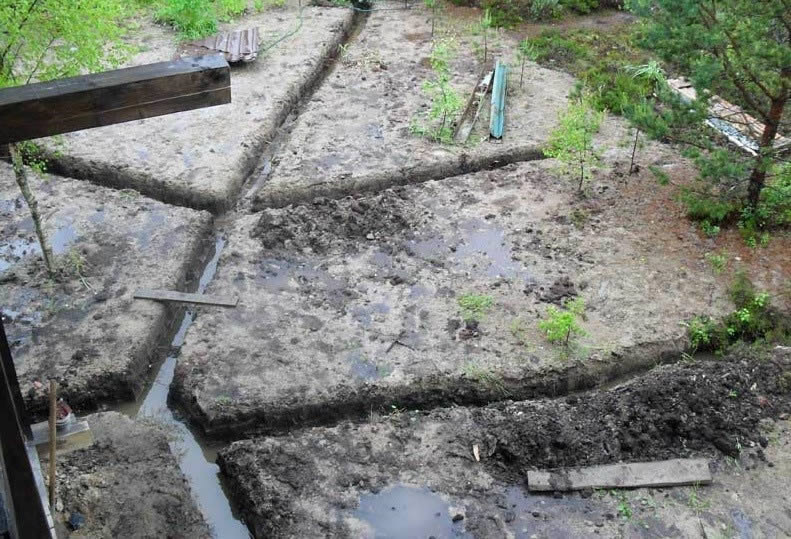

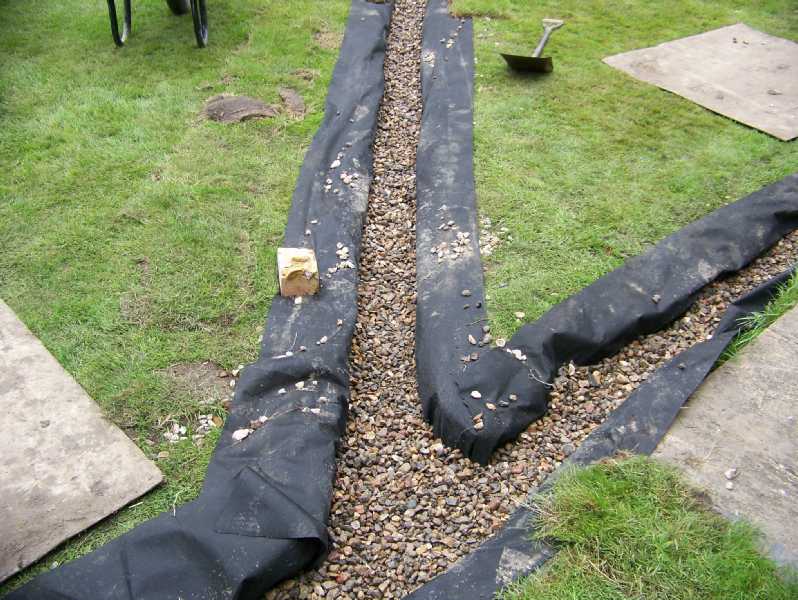

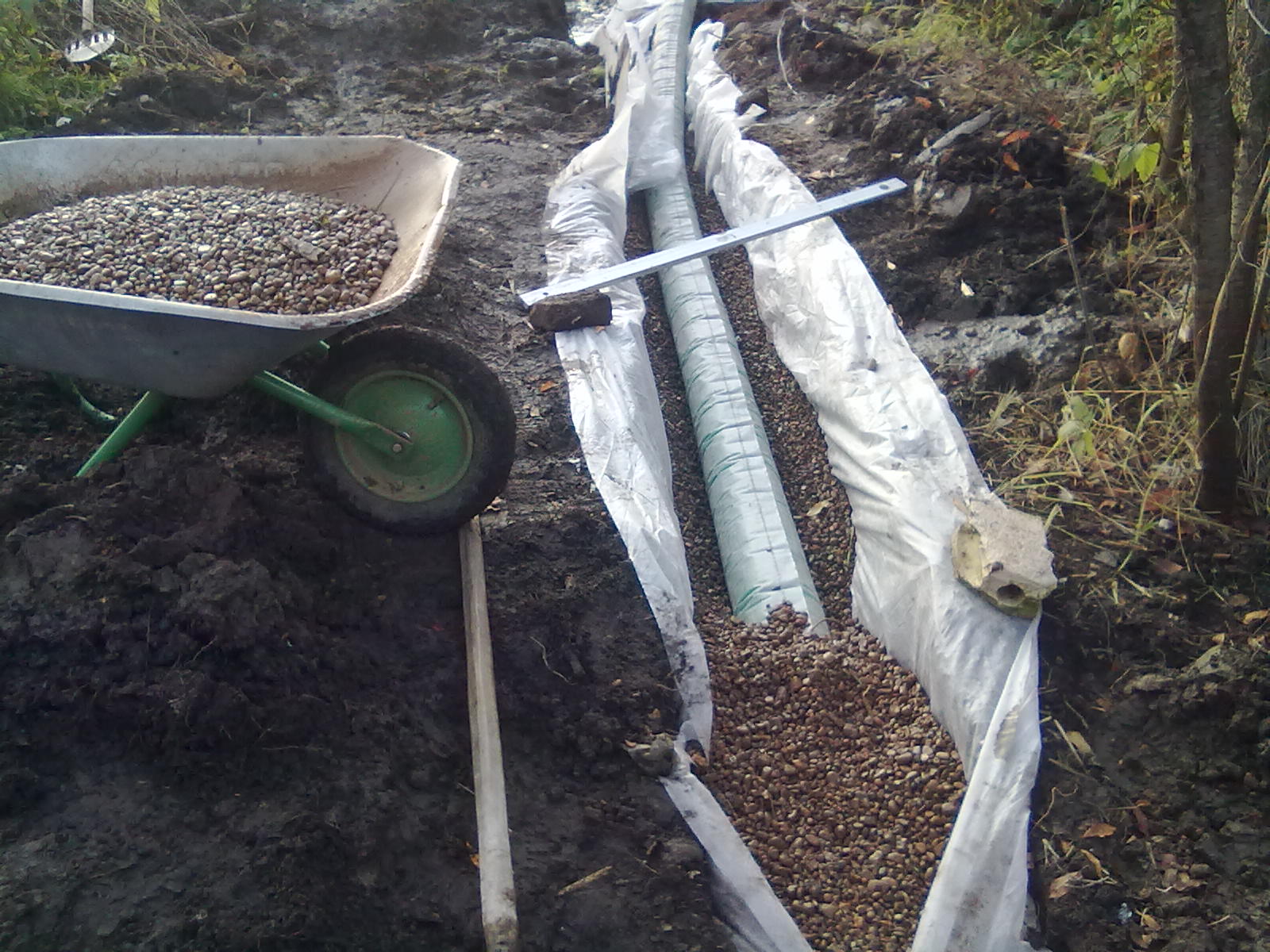


If the terrain is sloping, then the drains are laid in the direction from the higher area to the lowland. On a flat area, the slope is created due to the different depths of the trenches for the pipes.
The regulations are as follows:
- for sandy soil - lowering the level by 3 cm down every 100 cm of length
- for loamy and heavy clayey - 2 cm deep every 100 cm of distance
A drainage well is designed to take excess water. The main types of construction are summarized in the table.
| Type of well | Characteristics |
|---|---|
| water intake | Accumulates excess moisture that enters through the pipe system. Water is pumped out of it pump or just use for watering plants. |
| Turning | Are established in places of fastening of two differently directed drains. In addition to their direct purpose, they are used to revise the state and fullness of the entire system. |
| absorbent | It is used when the middle layers of the soil retain water, and the lower ones, on the contrary, can absorb moisture. They usually consist of light sandy soil. They are larger than other wells in diameter and installation depth. Able to withstand a limited amount of water. |
Previously, water intake wells looked like large monolithic tanks made of concrete, brick, or even concrete rings. Now they use plastic, which is sheathed with geotextiles or drainage sprinkles.
Backfill drainage

The method of laying drains "herringbone"
For this type of arrangement, drains are not left hollow inside, but are covered with soil with higher filtration properties. The inner surface of the pipes is sheathed with geotextiles.
As a natural drainage use:
- sand
- rubble
- gravel
- gravel
Drains in deep and backfill systems are most often located:
- "Christmas tree" (in the center there is a main sewer pipe, to which branches are attached on the sides)
- "snake"
- parallel
- in the shape of a trapezoid

How to make a children's house with your own hands: from wood and other materials. Dimensional drawings | (80 Photo Ideas & Videos)
First of all, plan!
First of all, taking up the device of the drainage system, draw a diagram of the future drainage
At this stage, it is important not to make a mistake and take into account all the features of your landscape. Each area is unique
For example, slope drainage is also necessary, as well as on absolutely flat. Water flows wash away the fertile layer and unevenly erode the soil. If gross miscalculations are made, then the opposite effect may turn out and the situation will not only not change, but will worsen. This can be avoided if you study the options, rules and principles of installation, and then draw your site drainage project.



