- Advantages and disadvantages of bath gasification
- Advantages of using blue fuel
- Cons noticed by owners and professionals
- Bath gasification
- Bath gasification
- The procedure for conducting gas, practical advice
- Stage No. 1 - installation of an external gas pipeline
- Stage number 2 - laying pipes inside
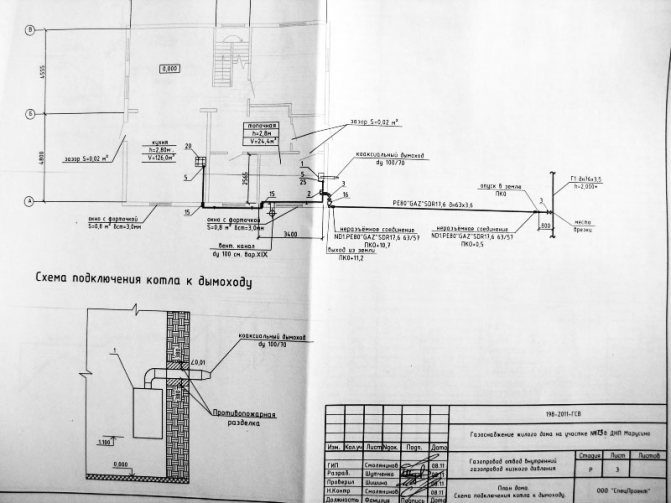
- Stage number 3 - installation of the chimney
- How is the pipeline being built?
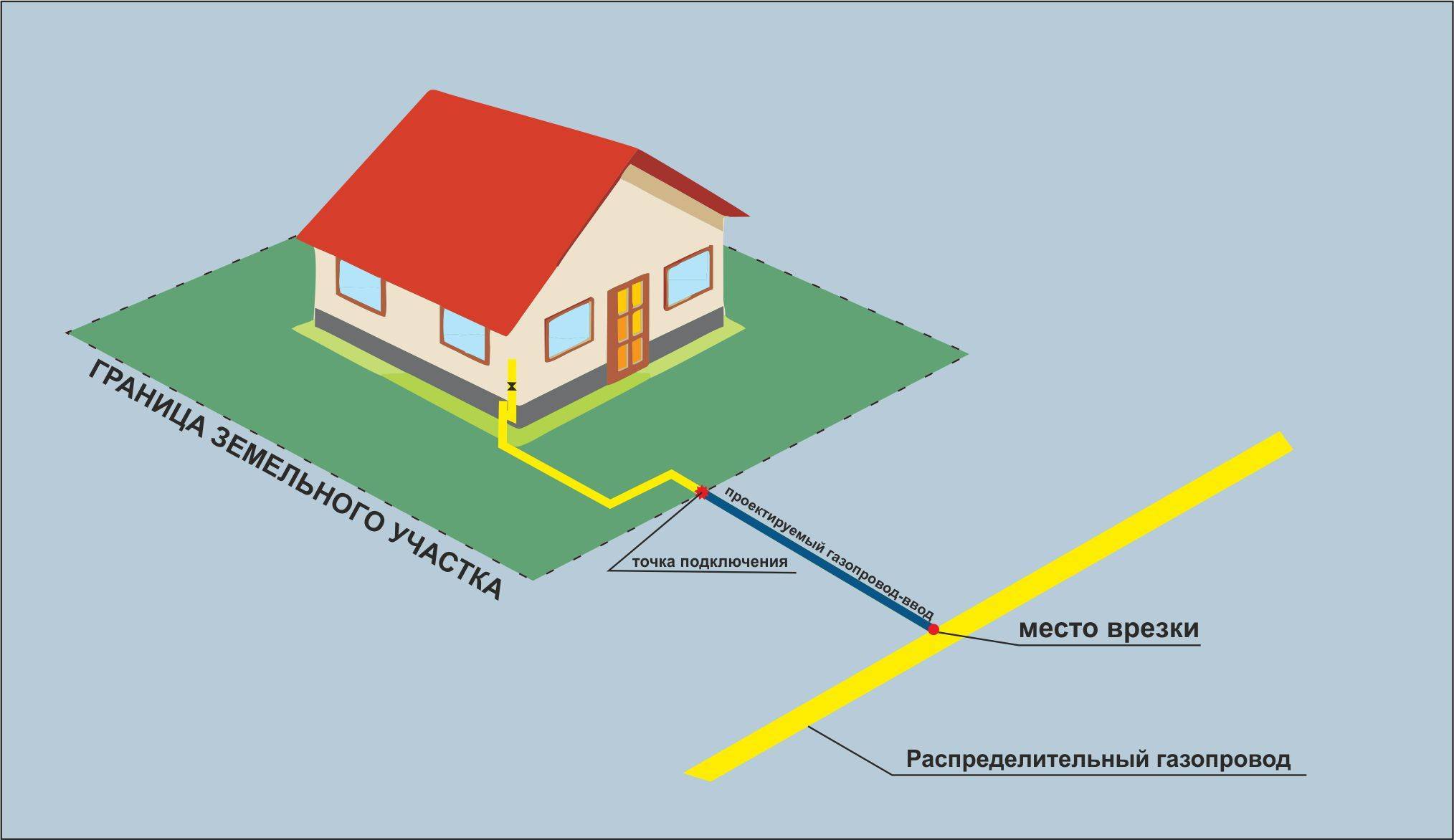
- Gas connection to the house
- Entering communications into the house
- Arrangement of a boiler room - if gas heating is planned in the house
- Trial run and final activities
- The price of connecting a private house to a gas pipeline
- Rules for connecting gas to private households
- Bath gasification options
- Steam room inside a residential building
- Bath in a separate house
- Legal requirements for the project, equipment, installation
- Conditions for approval of the project by technical supervision
- Equipment selection criteria
- Rules for the installation of a gas pipeline, furnace, chimney
Advantages and disadvantages of bath gasification
Before deciding to conduct gas to the bath, the owners of suburban areas try to take into account all the features of this method.
The cost of operation, environmental friendliness, complexity of care, efficiency are taken into account.
Advantages of using blue fuel
In addition to significant savings, the advantages of this method include the hygiene of gas - there are no smells, soot, soot during combustion.In addition, a gasified bath heats up almost twice as fast.
Firewood is inferior to gas in many respects: they need to be stored somewhere, to monitor the timely delivery and condition. However, they are still the most popular firebox material. And even used in combined gas-wood stoves
A big plus is the automation of the process. Kindling requires a minimum of labor on the part of the owner. Together with the cheapness of gas, this advantage makes the gasification of the baths especially attractive.
Cons noticed by owners and professionals
According to the owners, the main drawback is the difficulty in obtaining permission: with the slightest inaccuracy, the commission prohibits the use of gas to heat the bath.
Professional gas workers note a high level of danger if the installation rules are not followed, there are no safety devices and the vigilance of the owners
Other disadvantages include:
- the need to pay for the work of installation specialists;
- high cost of equipment;
- restrictions on the choice of sauna design.
Another subjective observation concerns the lack of smell. Many appreciate the aroma that spreads throughout a heated room when wood is burned. Gas equipment eliminates this possibility.
This is interesting: How to choose a hand tool - we describe in order
Bath gasification

Sauna at our base, in which assembly teams wash
We have a small bathhouse, which was brought by car and installed on a foundation slab. She is mobile. It can be moved from one place to another. But they need hot water and heating in winter. Because in the summer you can wash and so. And in winter without heating anywhere.
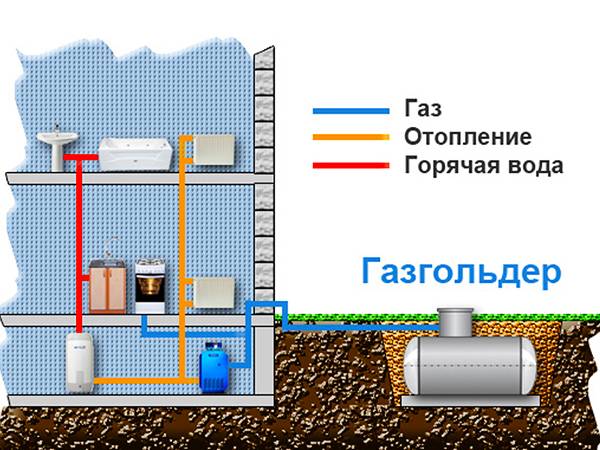
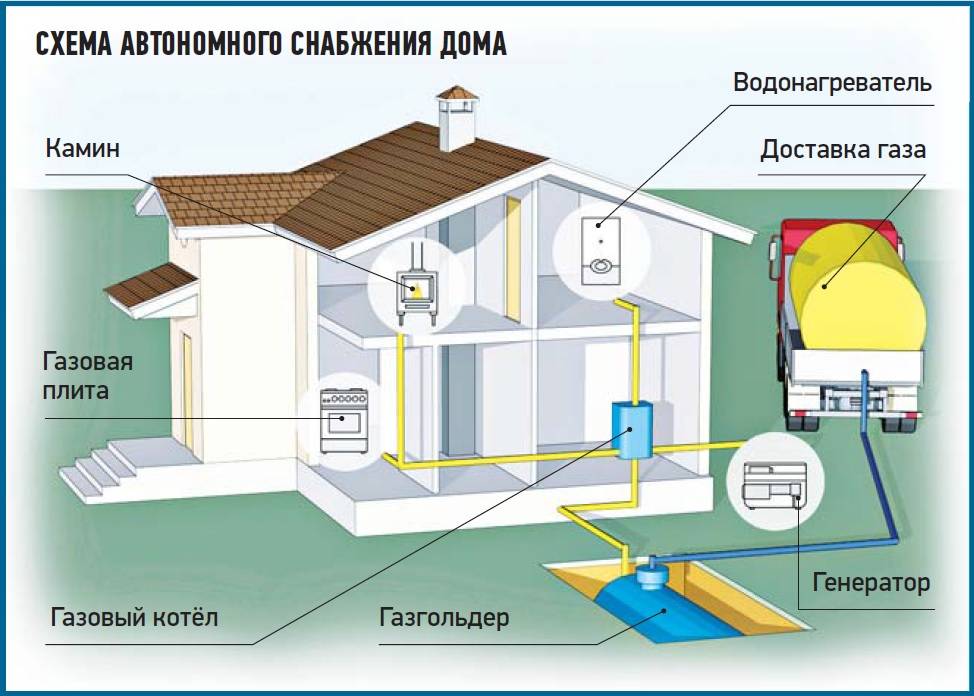
Heating wiring is done with radiators. A double-circuit boiler hangs here in order to heat and heat water when washing in the shower and in the washbasin. The sauna is gasified with the help of an 800-liter mini-gas holder. That also allows you to make it as mobile as possible. Wherever you transport it, wherever you install it, you transport the container along with it. And you always have gas, the boiler is working, which heats water and heating. The most convenient and safe way of heating.

Double-circuit boiler that heats water and heating
Bath gasification
Sauna at our base, in which assembly teams wash
We have a small bathhouse, which was brought by car and installed on a foundation slab. She is mobile. It can be moved from one place to another. But they need hot water and heating in winter. Because in the summer you can wash and so. And in winter without heating anywhere.
Heating wiring is done with radiators. A double-circuit boiler hangs here in order to heat and heat water when washing in the shower and in the washbasin. The sauna is gasified with the help of an 800-liter mini-gas holder. That also allows you to make it as mobile as possible. Wherever you transport it, wherever you install it, you transport the container along with it. And you always have gas, the boiler is working, which heats water and heating. The most convenient and safe way of heating.
Double-circuit boiler that heats water and heating
The procedure for conducting gas, practical advice
The preparatory stage is the purchase of pipes, consumables and gas equipment.In order to gasify the bath according to the rules, it is necessary to check the project and the technical conditions received.
The documents contain the calculation of the length of the pipes, an indication of their diameter, as well as the name and brand of permitted equipment. Experienced users are advised to purchase pipes and consumables with a margin of 30 percent.
Stage No. 1 - installation of an external gas pipeline
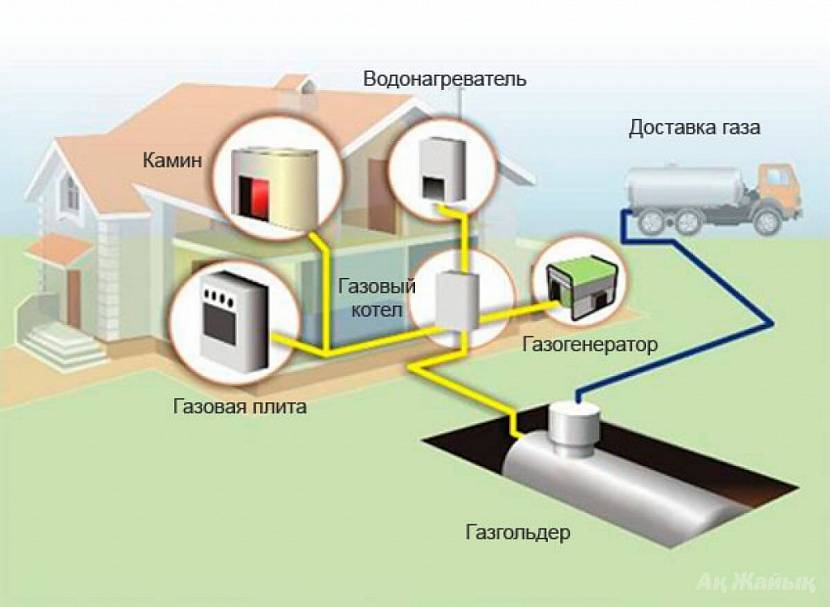
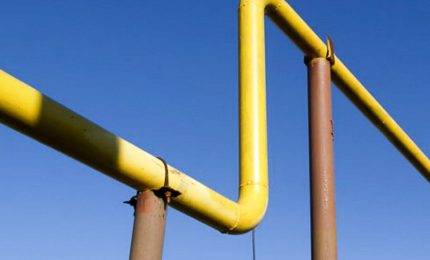
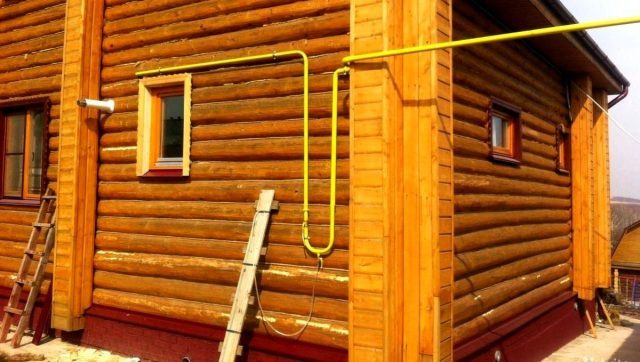
Since the arrangement of the external gas pipeline is recommended to be carried out above ground, reliable supports will be required to fix the pipes. They must raise the gas pipeline above the ground by at least two meters.



The requirements for supports are:
- the distance between the supports is determined by the project;
- structural strength should be calculated based on the dead weight of the gas pipeline and the weight of possible ice with a factor of 1.2;
- the fastening part must correspond to the design dimensions of the pipe.
If the project specifies the installation of a gas pipeline with a slope, it is possible to mount metal gaskets between the soles of the supports and embedded structures. The installation of such gaskets between the pipe and the support is prohibited.
 The rules for placing supports apply to distances between them and welded seams on gas pipes. This distance cannot be less than 5cm
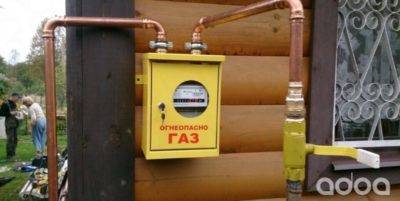
To protect against exposure to wet precipitation, the outer pipeline is painted over with bright yellow oil paints. This is done by employees of the gas company, which took over the installation.
But after they leave, many gardeners repaint the pipes in other colors that match the main palette of the site. Doing so is prohibited.
Stage number 2 - laying pipes inside
The internal gas pipeline must also consist of metal pipes.In places of passage through the walls, it is necessary to drill holes and install embedded iron sleeves in them. Laying pipes through walls is only permitted through such sleeves.
When gasifying wooden buildings, this is extremely important, since any wood shrinks over time. And this is fraught with damage to an unprotected gas pipeline.
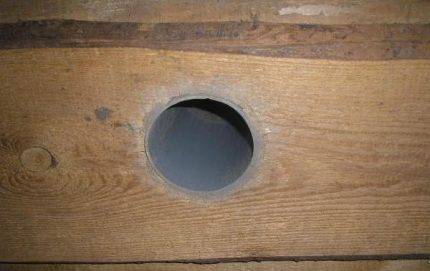 It is forbidden to make holes for the gas pipeline between logs or beams, at their junction. They must be located inside solid wood
Fastening must be carried out using the products specified in the project. It is better to purchase fasteners in specialized stores, since ordinary retail outlets often offer analogues that do not meet the requirements.
To implement turning moments, it is important to use an induction pipe bender - a device that allows you to change the angle by 90 degrees. The manual method of bending with heating is not suitable in this case, as it can disrupt the structure of the metal
At the points of connection of gas equipment, the end of the pipe is threaded. Filters are mounted on this thread and stop valves are installed. During the final pressure test, the specialist must check the tightness of these connections and the integrity of the welds.
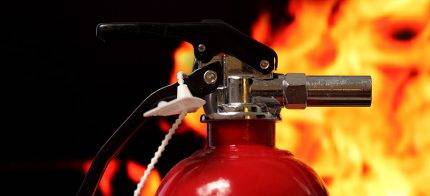 Before performing welding work, you should make sure that there is a fire extinguisher, cover the wooden walls of the bathhouse and nearby buildings with asbestos or metal sheets
It is important to ensure that the gas pipes inside the bath do not intersect with the electrical wire. The minimum distance between them is 10 cm
If water supply or sewerage is connected to the bath, then it is necessary to maintain a distance of 2 cm between them and the gas pipeline branch.
Stage number 3 - installation of the chimney
We have already stopped on the rules for installing a gas furnace. Therefore, the next step is the organization of the chimney. Gas companies also have special requirements for it.
During installation, it is recommended to follow the following:
- the absence of pipe joints in the ceilings - it is necessary to mount the chimney so that the connections are located above or below the ceiling;
- the location of pipes relative to flammable building elements - the distance between them should not be less than 1 meter.
Above a flat roof, the chimney can protrude 1.2 meters or more. Above a roof with slopes, the minimum elevation value is 0.5 meters.



How is the pipeline being built?
After the gas pipeline project is approved, it is necessary to contact an organization that has a state license to carry out work of this nature.
The final connection procedure will be established after agreeing on the estimated cost and signing the contract. The latter indicates that the full payment is made after the completion of the work and their acceptance by government agencies.
Gas connection to the house
The pipe can run above or below ground using horizontal drilling technology. To lay the pipe, 2 wells are made - near the building and the highway, which are connected by a horizontal hole. A pipe is laid in it.
Materials for connecting the main gas to the house must have quality certificates. The technology allows the use of a metal or plastic pipe. The latter has a number of limitations:
- can not be bred inside the house;
- not suitable for above-ground laying;
- not used in regions where the temperature is below -45°C;
- not suitable for seismically active areas.
In addition, when installing the pipeline:
- Pipes should not touch building elements subject to combustion.
- Pipe joints are not walled up in the foundation or walls.
- Horizontal sections are laid with a slope towards the devices by 2-5 mm. The vertical parts are exactly level.
- The axis of the faucet plug should run parallel to the walls.
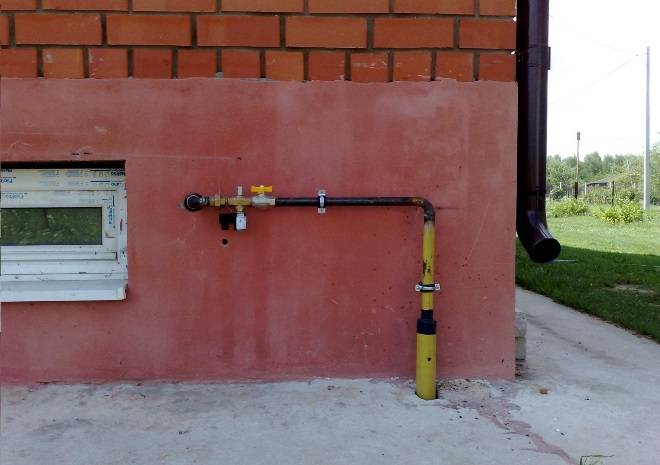
Entering communications into the house
There are rules for installing a gas supply system:
- A hole for introducing gas into the building is made in the outer wall in the lower part above the foundation.
- A steel liner is installed in the hole, through which the pipe is passed. Internal wiring and the main riser are connected to it.
- The pipe is placed at a slope to the riser, which is placed vertically 15 cm from the wall.
- Through all walls, pipe wiring goes through sleeves that protect against mechanical damage.
- With a layer of bitumen and tow impregnated with resin, a gap is laid between the sleeve and the surface of the pipe, which is previously covered with oil paint in several layers.
To avoid unnecessary connections, it is allowed to heat the bends of the pipe with a burner.
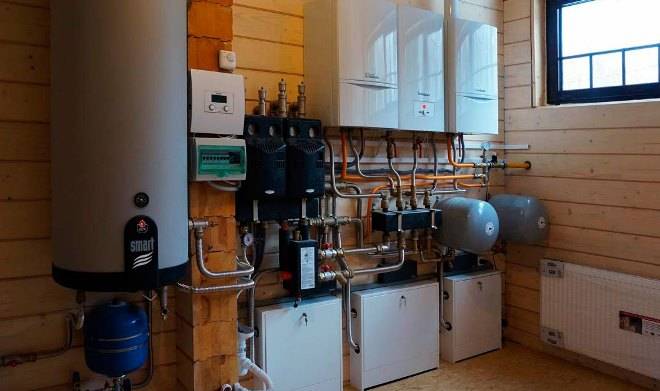
Arrangement of a boiler room - if gas heating is planned in the house
To install a boiler with a power of more than 30 kW, a separate room is required. In single-family houses, this can be a basement or basement, in other cases it is better to make a separate building. There are a number of required steps:
- Accurate horizontal positioning of the heater will help reduce noise and vibration.
- The walls and floor of the boiler room are made of non-combustible materials, with possible additional heat-resistant insulation near the boiler.
- Installation of equipment requires a supply of cold water and a sewerage system for draining the coolant.
- In volatile systems, electrical outlets are mounted with a ground loop.
Chimney and ventilation requirements:
- execution must be separate;
- the window is calculated based on the ratio of 1 kW of power per 80 mm² with inflow from the street or 300 mm² if the air comes from an adjacent room;
- ventilation never closes;
- the chimney in the wall is made with 2 entrance channels: revision and main;
- the distance between the flue gas outlet and the boiler must be kept to a minimum;
- it is forbidden to make more than 3 turns or bends in the chimney;
- the material for the chimney is carbon sheet steel or stainless steel;
- at a distance of 0.5 m from the nozzle in the boiler, layered materials, for example, asbestos concrete, can be used.
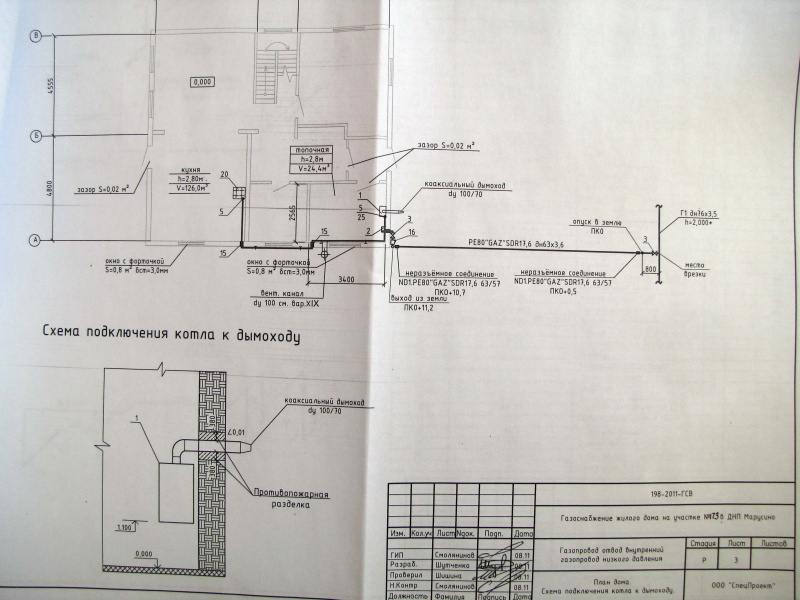
Gas installations are wall and floor. The latter are usually more powerful. Wall-mounted appliances have a coaxial chimney, which provides both air supply and removal of combustion products.
The specific power of a heating installation of 10 m² varies from the region of installation - from 0.7 kW in the South of Russia to 2 kW in the North.
Trial run and final activities
The final activities are carried out after the introduction of gas into the housing and the final assembly of the system.
Home owners are instructed on safety precautions before starting up and setting up the equipment.
Even if the installation was carried out by third-party licensed organizations, the connection to the highway is made by a special tie-in service.
A test run of the fuel is made and possible leaks are detected. This service charges a separate fee. A contract for the maintenance of the installation is preliminarily concluded. Warranty obligations come into force after setting up the equipment.
The price of connecting a private house to a gas pipeline
There are two types of tariffs for connection to the gas pipeline.
- Standard - I operate within the city, if the distance to the highway does not exceed 10 meters.
- Non-standard - operates outside the city (25 meters).
There are several factors that affect the cost of work. It:
- relief features;
- method of laying a gas pipeline;
- standard size of the gas meter;
- soil quality;
- house shape;
- terrain type.
Note! As you can see, it is impossible to name the exact cost of the work, since it is determined individually for each case and depends on a number of conditions. But if we generalize, we can derive approximate tariffs
They will look like this
But if we generalize, we can derive approximate rates. They will look like this.
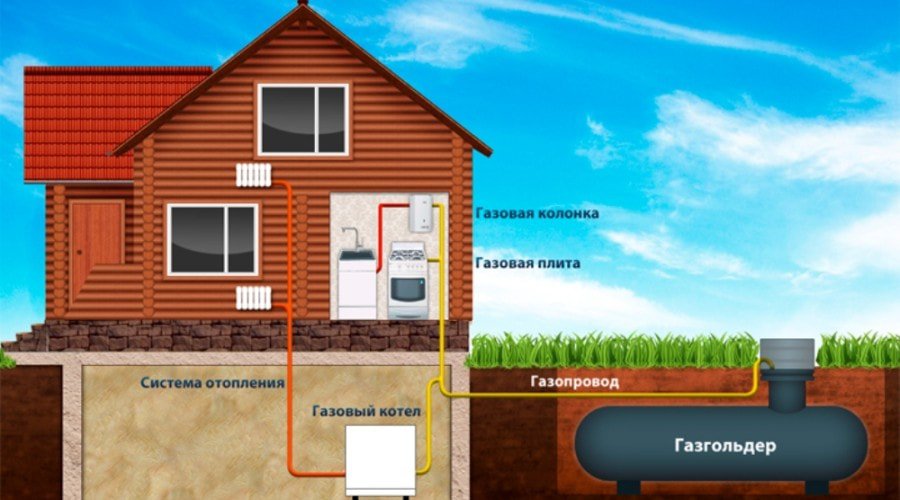
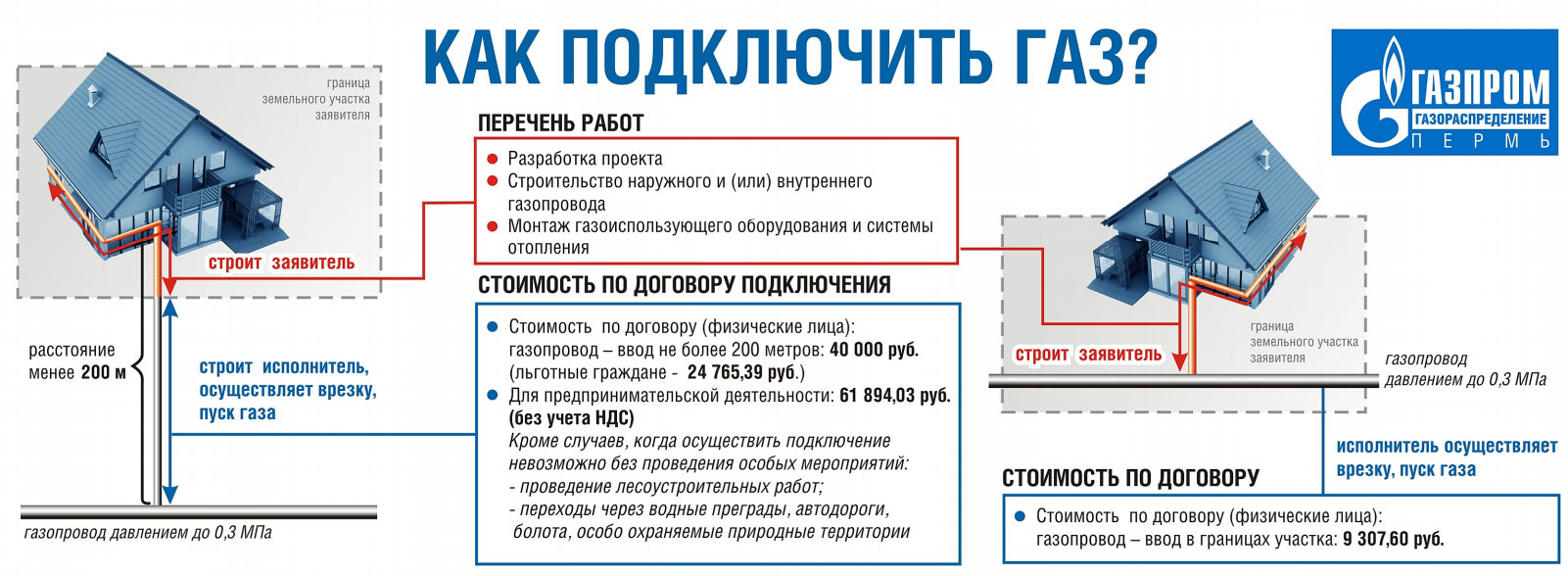


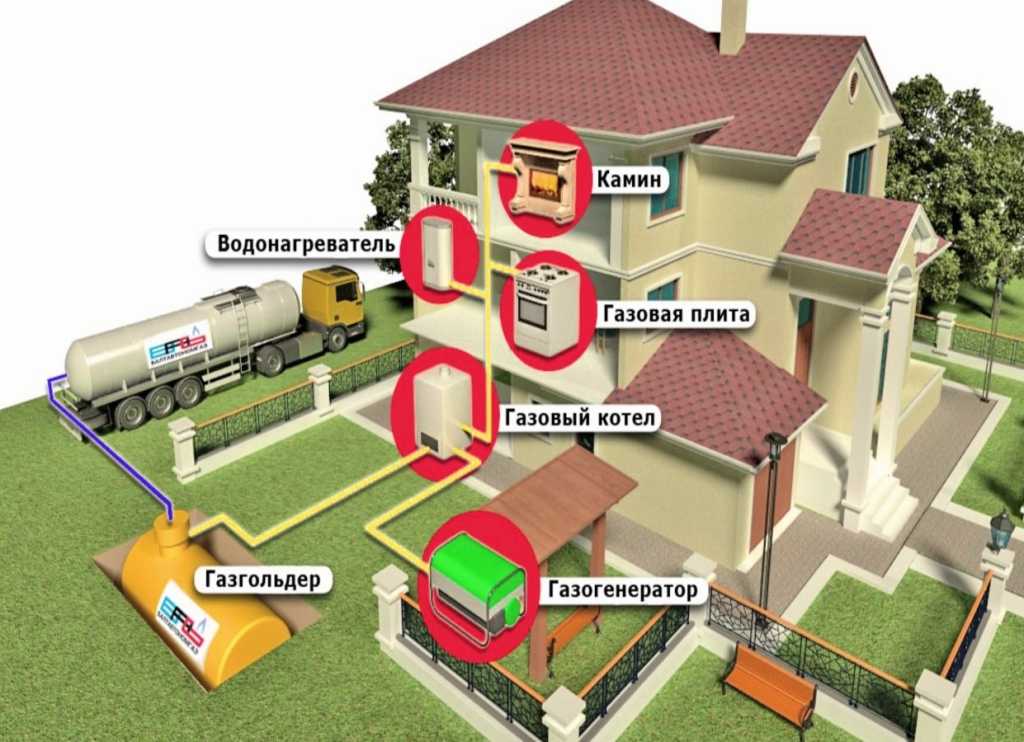


- Connection to the gas main - from 3,400 to 7,100 rubles.
- The interconnection of individual elements - from 25,700 to 158,500 rubles.
- Checking and inserting into a private house - from 51,000 to 158,500 rubles.
Table. Comparative cost of installation and operation of different types of fuel for heating a country house (for an area of 160 m2 - an example).
Note! Before tapping into a gas pipeline, it is necessary to find out who owns it. In most cases, this is GorGaz
You must acquire an owner's agreement for a tie-in, and then contact the design organization (it, as you might guess from the name, will draw up a gasification project).
Rules for connecting gas to private households
Connection to the gasification system has always required compliance with a certain order. The main condition was the presence and installation of gas equipment in a residential building in accordance with the requirements established by regulatory enactments.
Gas will be supplied to residential buildings only if the following requirements are met:
- Gas boilers (no more than two) can only be placed in the basement or basement.
- Double-glazed windows should be installed in the room where the boilers are located, provided that they can be easily knocked out if necessary.
- Mandatory equipment of a residential building with pressure and temperature control devices and gas meters.
- Gas equipment must be purchased from a manufacturer with a special certificate, with supporting documents attached.
- Hoses for connecting gas equipment (no more than 1.5 m long) must be made of a material that allows gas to be supplied safely to the house.
- The distance from the stove to the opposite wall must be at least 1 m. A prerequisite is the equipment of the stove with the "Gas-control" system; between the hose and the faucet, a dielectric coupling against stray current must be installed.
- If the gas stove is placed under a canopy, then the burners must be protected from wind blowing.
There are also requirements for the kitchen room:
- Ceiling height not less than 2.2 m.
- Volume: at least 8 m³ for a two-burner stove, at least 12 m³ for a three-burner stove and at least 15 m³ for a 4-burner stove.
- Be sure to have in the kitchen: a window, a gap under the door and an exhaust ventilation duct.
If the above requirements and conditions are not met, the connection of a private house to the gas supply system will be refused. The owner of the house is responsible for fulfilling the requirements.
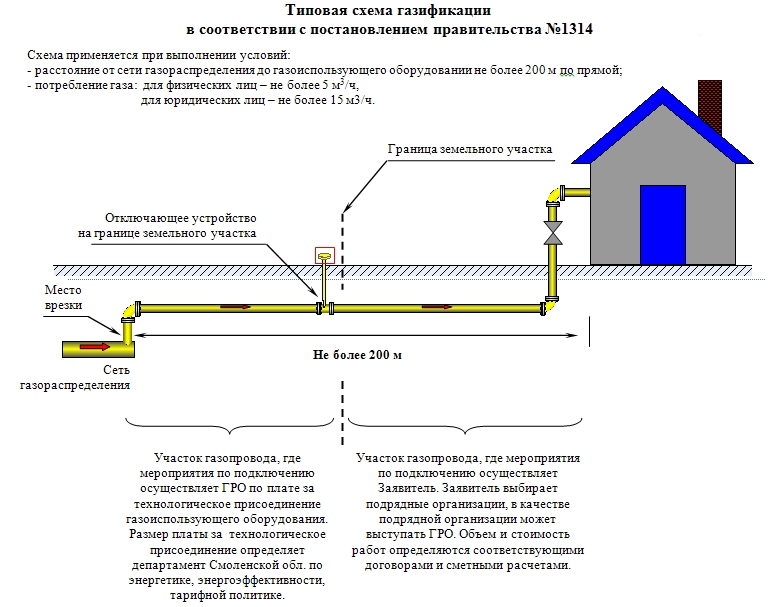
If the gas pipeline is located further than 200 m from the household, the cost of gasification will be quite high
The coordination of the passage of the gas pipeline through the lands of other owners, the preparation of technical specifications and the resolution of other "gas" issues have become completely the prerogative of the gas distribution organization (abbreviated as GDO).
It is OblGaz or RayGaz that are obliged to bring the gas pipeline to the boundaries of the applicant's site according to the completed application.
Technical conditions for connecting gas to a private house, as well as the price of gasification are part of the agreement with the GDO. Previously, before Decree No. 1314, specifications were a separate document that served as a justification for the design and construction of a gas pipeline. Now the technical conditions are just an appendix to the gasification agreement, i.e. not a standalone document.
Note that the technical conditions provided at the request of the homeowner within two weeks are preliminary. By providing them, the gas distribution organization only informs about the admissibility of gasification and it is impossible to use these data for the construction of the gas pipeline. However, preliminary specifications are required only for industrial consumers with a methane consumption of more than 300 m³/h.
Bath gasification options
It is rare that anyone refuses to build a bathhouse on their own site - this is not just a washing room, but a resting place associated with a mass of rituals and traditions of the Russian people.But it is too expensive to heat a bathhouse with firewood, and even more so with electricity, which is why a logical desire arises to install a gas fireplace or stove.
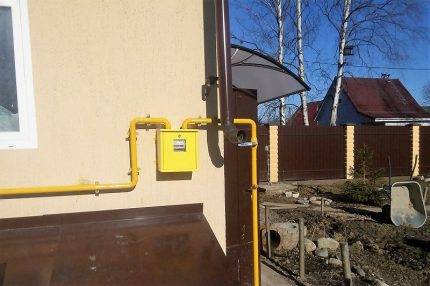 Maintenance of all equipment, home and bath, is carried out by the gas technical service using appliances installed in one place - for example, on the wall of the house
But in reality, everything is complicated - the bathhouse does not meet legislative standards and is not considered as a room suitable for installing gas equipment.
However, no one forbids running gas to residential buildings, so resourceful owners have found two legal options to get around legal obstacles:
- to include the construction of a bath in the project of building a house, that is, to place them under one roof;
- register a bathhouse as a residential guest house with a separate heating gas equipment.
Both options are actively used, and very successfully. But some owners of country houses were even more fortunate - they were simply given permission to gasify the bath. This also happens, therefore, in order not to waste extra effort and money, contact the gas workers first - what if you are lucky too?
Steam room inside a residential building
It turns out that no laws prevent the device of a bathhouse right in the house, and many people successfully use it. It turns out that the use of gas in non-residential premises of a residential building is possible.
True, there are several special conditions:
- it is necessary to equip a separate emergency entrance;
- use only heat-resistant materials for the manufacture of doors;
- it is possible to open the emergency entrance from both sides;
- install a fire alarm and fire extinguishing system;
- only certified factory-made gas equipment may be used.
An interesting addition to the law is that you cannot use the bathhouse for commercial purposes.
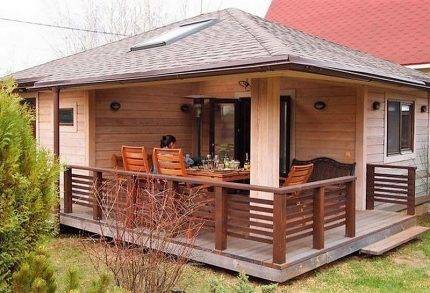 The entrance to the steam room can be arranged directly from the hallway or entrance hall, and an emergency exit to the terrace, which can easily replace the dressing room
If the inspectors of the gas or fire authorities treat their duties responsibly, then they will not allow the operation of the bath without an automatic fire extinguishing system and well-functioning ventilation.
But not everyone can allocate a piece of living space for a bath or sauna, so consider another option.
Bath in a separate house
First, you will have to come up with a project for a guest house or a summer kitchen, which could later be converted into a bathhouse, that is, the building must have a solid foundation and walls with mineral insulation, lined with non-combustible materials.
The main point in the design will be a gas boiler installed for heating and water heating. Usually there are no questions why a separate unit is needed.


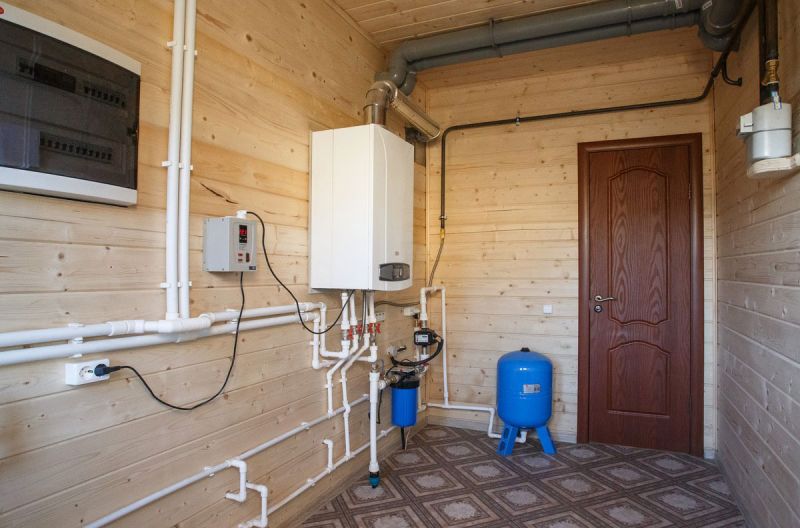



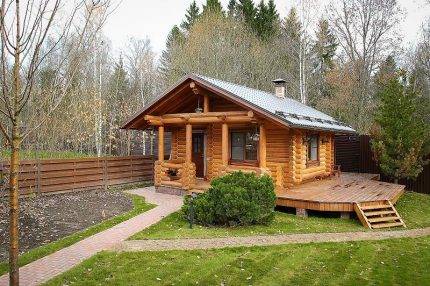 You will also need sewage and shower equipment - but this is not surprising if it is designed for a guest house in which seasonal accommodation is planned.
The approved project is implemented and a house is built, then it is registered with the BTI, changes are made to the general housing construction plan and an application for gasification is written. If the inspector, after inspecting the premises, does not reveal any violations, he will issue a permit and draw up a sketch of the location of the equipment and the gas outlet.
After the technical conditions are issued, it may be necessary to correct something, for example, to make forced ventilation or to additionally isolate the boiler installation site.
It remains to lay pipes and connect the boiler to the system. If a residential building is gasified, then making a branch will not be difficult and will not take much time.
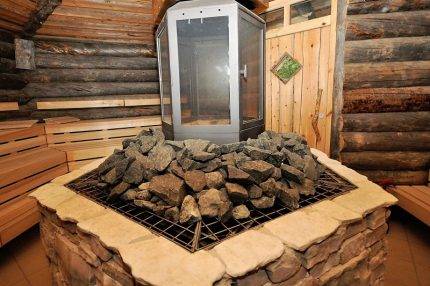 After testing and commissioning, the representative of the gas service gives the go-ahead for operation, and after he leaves, you can finally turn the house into a bathhouse - for example, arrange a heater
By the same principle, you can conduct gas to the garage. According to reviews, sometimes gas workers are allowed to conduct gas to any buildings, including garages - but subject to a number of fire safety and ventilation requirements.
Legal requirements for the project, equipment, installation
The basic requirements for laying gas pipes inside the bath, the design of furnaces and the parameters of the room are prescribed in SNiP 2.04.08-87.
The arrangement of an external gas pipeline and connection features are regulated by SNiP 42-01-2002.
Conditions for approval of the project by technical supervision
It is extremely rare for bathhouse owners to agree on gas wiring, as their buildings do not meet the requirements. It is more correct to first create a project, and then proceed with construction. Moreover, the building should be located on a capital foundation.
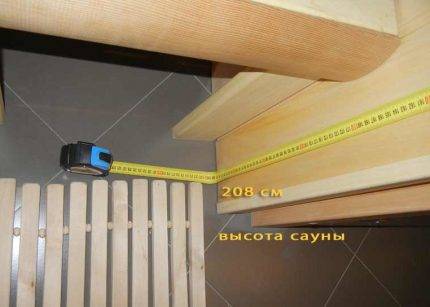 Old baths often have low ceilings. Already by this parameter they are not suitable for gasification. A properly designed room has a distance between the floor and the ceiling of more than 2 meters
The main criteria are the presence of an emergency exit, a transom for ventilation or an exhaust ventilation duct, and a sufficient area. The volume of the room where the furnace is located must be more than 8 cubic meters. And the passage next to it cannot be less than a meter wide.
Attention is also paid to the doors - each of them should open outward, have functional handles on both sides. The doors themselves can only be made of non-combustible materials.
All this is taken into account when agreeing.
Equipment selection criteria
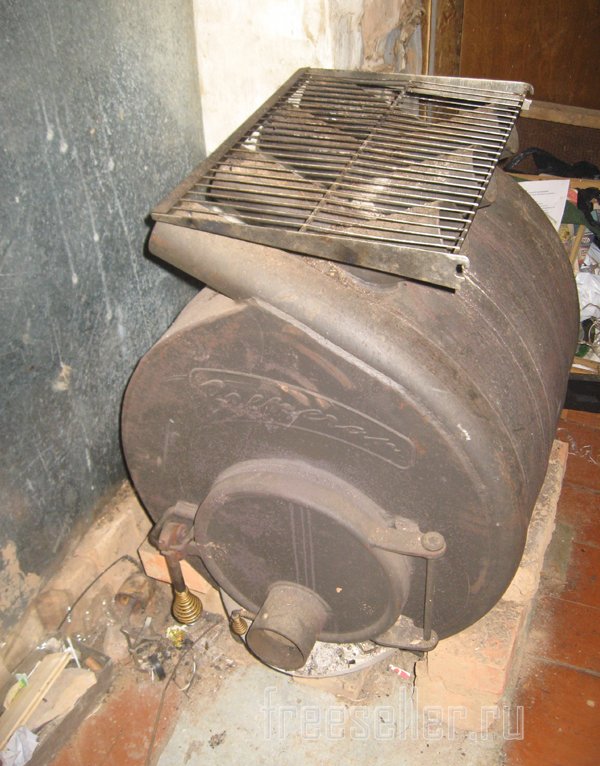
Not all types of stoves are suitable for installation in gasified baths. Only factory-made metal products are allowed, the design of which allows the removal of combustion products into the chimney. Stone and brick ovens are prohibited. Important points are the presence of a fuse that blocks the supply of fuel when the fire is extinguished and the tightness of the gas chamber.
It is worth noting that the leading Russian manufacturers, such as Ermak, Termofor, Teplodar, produce approved models with excellent automation and high-quality components. While the products of European factories are not always successfully tested.
 When buying, check the quality and safety certificates, check the product passport filled out by the manufacturer. It must contain marks on the successful completion of technical control.
Maintenance of the furnace should be carried out not in the steam room, but in the dressing room. Therefore, an external fuel channel must be present in the design.
Particular attention is paid to the type of jets: when using main gas supply, expanded nozzles are required, when using a propane mixture from a cylinder, narrowed nozzles are required.
Rules for the installation of a gas pipeline, furnace, chimney
Installation rules include requirements not only for laying a gas pipeline, but also for installing a fire alarm. This role can be played by highly sensitive carbon monoxide sensors.
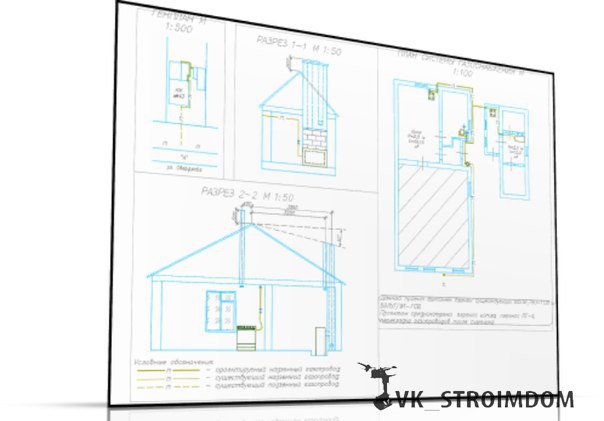
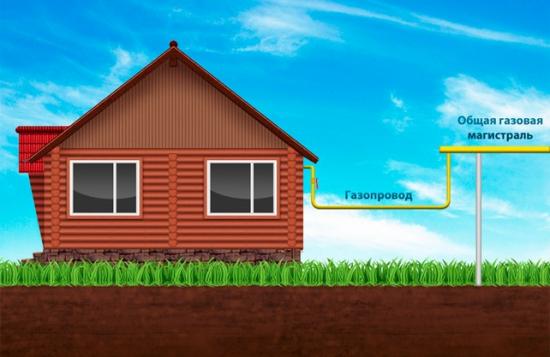


The outlet of the pipe from the house should rise 2 meters above ground level and enter the dressing room at the same height. Laying under the foundation and inside it is prohibited.
A valve is installed at the end of the pipe, which, when the equipment is depressurized, will instantly ensure complete shutdown of the gas pipeline.
When choosing equipment for a bath, you should always pay attention to the permitted temperature regime of operation. For example, many Chinese CO sensors are designed for temperatures up to 55 degrees. Particular attention is paid to the placement of furnaces
Wooden walls next to them must be insulated with non-combustible materials. Permissible option - sheathing with thermal insulation and steel sheet
Particular attention is paid to the placement of furnaces. Wooden walls next to them must be insulated with non-combustible materials.
A valid option is sheathing with thermal insulation and steel sheet.
The fireproof distance from the insulated wall to the body of the product is 60 cm. All other objects, ceilings, wall shelves must be at least 110 cm from the walls of the stove.
The supporting base of the furnace should also be made of refractory material, protruding beyond the boundaries of the product by 10 cm or more. It is allowed to connect the stove to the chimney only with steel pipes.
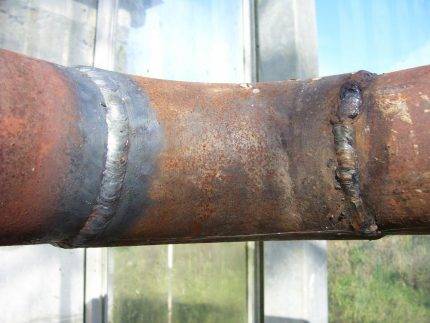 According to paragraph 5.1.4 of SNiP 42-01-2002, the joints of metal pipes must be one-piece, welded. Detachable connections are allowed at the points of connection of elements of gas equipment
The installation of the chimney itself is also regulated. In places of passage through the ceilings and walls of the bath, it is necessary to lay fire-prevention cuts.
Very often expanded clay is used for this purpose. Bulk material easily fills the space, has high refractory characteristics.