- Actions in case of sewer freezing
- Choosing parts for the pipeline
- Option #1 - cast iron pipes
- Option # 2 - polypropylene products
- Option #3 - PVC parts
- Do-it-yourself work
- Scheme of the sewer system
- Self-assembly
- Paving depth
- How to properly conduct internal sewage in a private house: do-it-yourself installation
- Types of sewer systems in a private house
- Types of autonomous systems
- Construction stages
- What is needed for the construction of an internal sewerage system
- Principle of operation and device
- Laying an external sewer pipe
Actions in case of sewer freezing
If you have not insulated the sewer pipes, or you have not insulated them enough, and they are frozen, first of all, you need to determine the damaged section of the pipeline in order to choose a method for solving the problem. Metal pipes can be heated with a blowtorch.
If the pipeline is made of plastic, open flames cannot be used. You can pour hot water into the sewer, in which you first dissolve salt (2 kg per 10 liters of water). You can direct a jet of steam or hot water to the revision closest to the frozen area.
If the damaged pipe is in the middle of the line, you can use a steam generator to warm up the soil. However, this process can take quite a long time.It is best to prevent the system from freezing, and when laying pipes, carry out their high-quality thermal insulation.
Choosing parts for the pipeline
First of all, we determine the material from which the elements are made.
Option #1 - cast iron pipes
Some time ago, there was simply no alternative to such details. Their advantages include durability, such pipes serve more than half a century, high strength and fire resistance. At the same time, cast iron is not sufficiently resistant to impact point loads, from which it must be protected as far as possible. The disadvantages of the material include a very large weight, high cost and difficult installation. In addition, the inner surface of such pipes is rough, which contributes to the deposition of layers, which, after time, can completely block the path of sewage.
Option # 2 - polypropylene products
The advantages of such elements are resistance to all types of corrosion and solutions of salts, alkalis and acids, durability, high heat resistance. The latter quality allows the parts to easily endure both low and high temperatures, which makes it possible to lay them in almost any conditions.
Another advantage is increased fire resistance. Polypropylene is able to withstand the effects of fire for quite a long time and does not emit toxic substances. Attractive and affordable price. Some difficulty is the installation of parts, which requires special equipment.
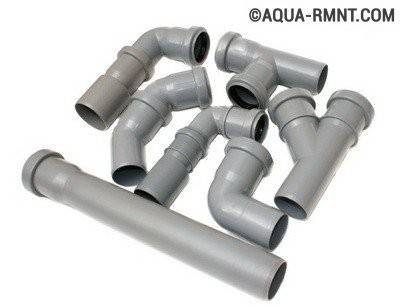
The most popular are plastic pipes for sewerage. They are lightweight, easy to install and have a smooth inner surface that prevents build-up on the inner walls of parts.
Option #3 - PVC parts
They can be made from non-plasticized or plasticized PVC. The characteristics of products made from these materials are similar. The advantages of PVC pipes include a low coefficient of thermal expansion, which allows products not to increase or sag when heated, as well as resistance to UV radiation. In addition, a very large range of shaped elements is produced, which makes it possible to assemble a pipeline of any configuration.
The disadvantages of products include fragility at low temperatures, low resistance to fire and the release of toxic substances during combustion, as well as sensitivity to certain chemicals.
Do-it-yourself work
To organize a sewerage device in a house with your own hands, you need a scheme with which you can calculate what types of materials and plumbing will be needed and in what quantity. The drawing must be drawn to scale.
You also need to take into account factors such as:
- Soil type;
- Groundwater level;
- Volume of water use;
- Climatic features of the area.
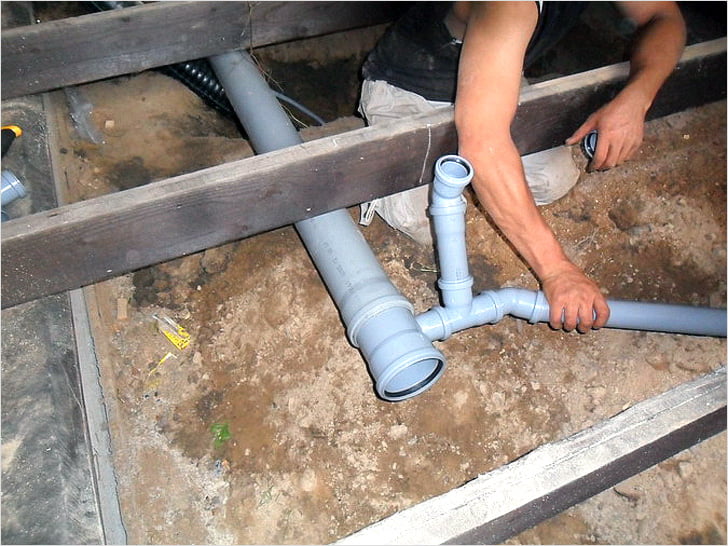
Several types of laying sewer pipes are possible: under the floor, inside the walls, outside, but this is less aesthetically pleasing. Pipes laid in walls or under the floor are plastered 2 cm or filled with cement. To reduce the noise of the system, the pipes are wound without air gaps.
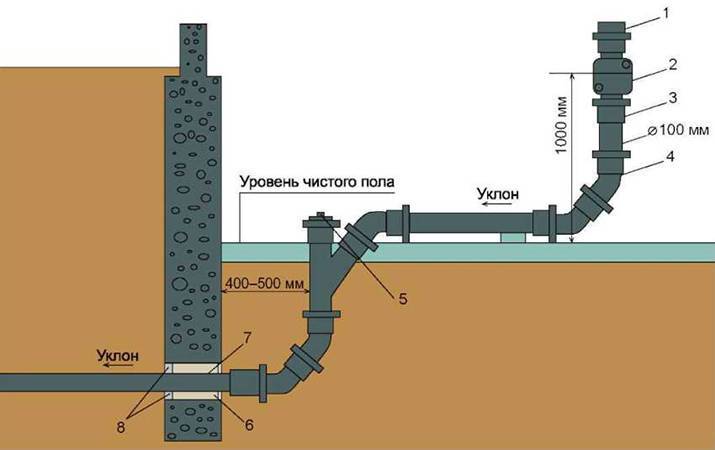


Scheme of the sewer system
The sewer system in a private house has a complicated scheme; it must take into account, in addition to depth and materials, the location, taking into account the requirements.
Namely:
- To install a septic tank or other type of wastewater treatment, the lowest place on the site is selected.
- The distance to the source of drinking water is at least 20 m.
- To the roadway - at least 5 m.
- To an open reservoir - at least 30 m.
- To a residential building - at least 5 m.
Plastic pipes are well suited for arranging sewage
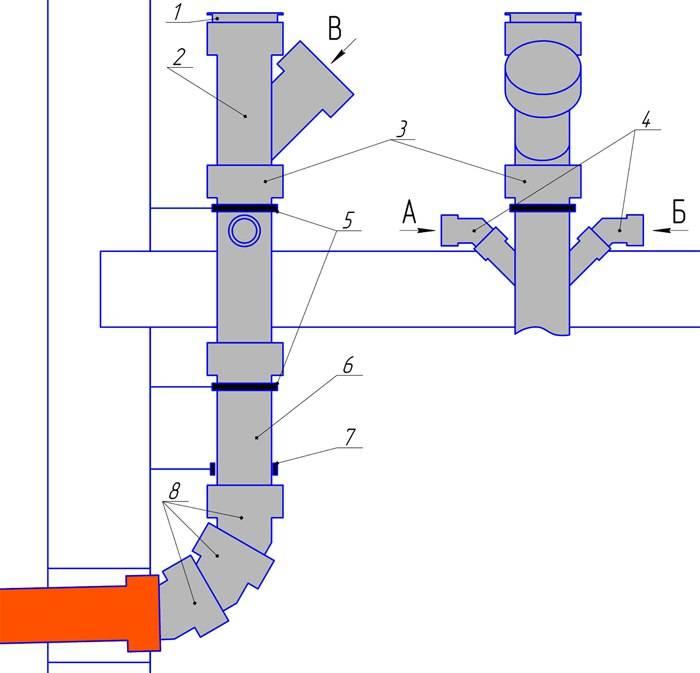
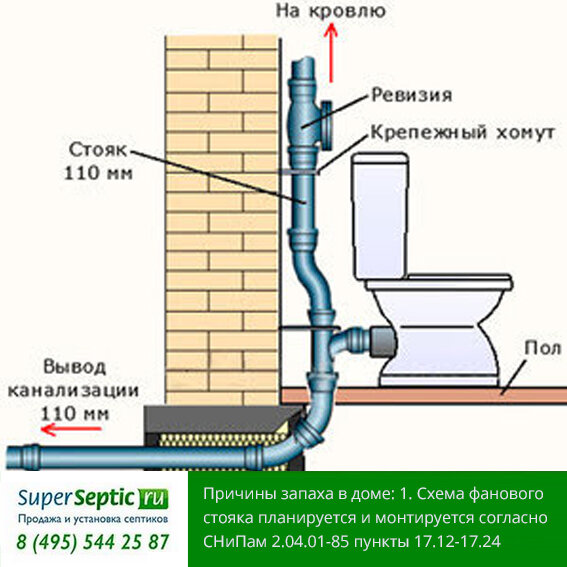
When drawing up a diagram, it is necessary to mark all the water drain points and the riser. The stand must be within easy reach. Usually it is installed in the toilet, because the toilet drain pipe has a diameter of 110 mm, like that of the riser.
Outflow pipes from the bathtub and sink are usually combined into one line.
It is important to remember that the toilet pipe should not have any inlets from other pipes. In addition, the diagram should include the location of the vent pipe.
Self-assembly
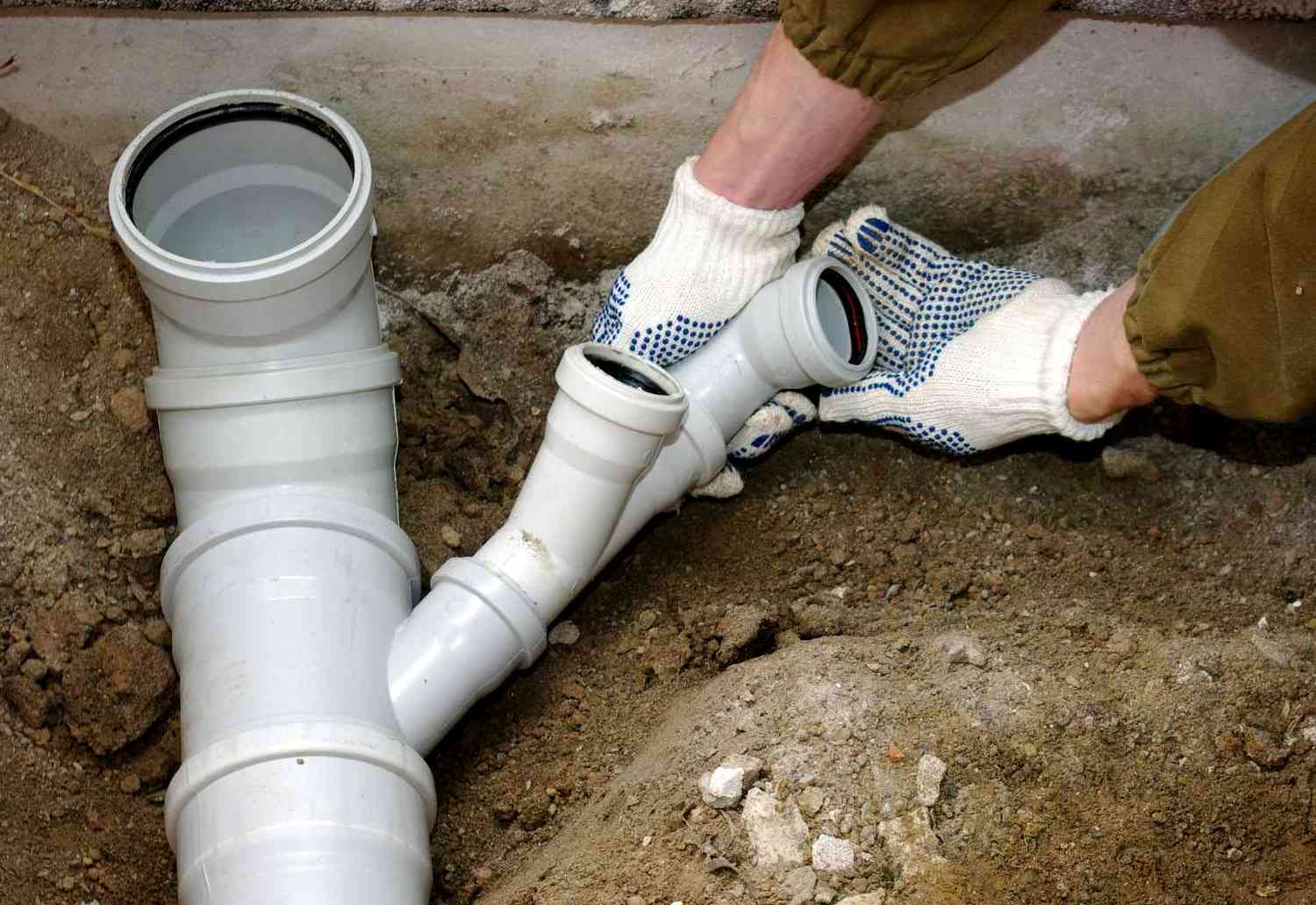
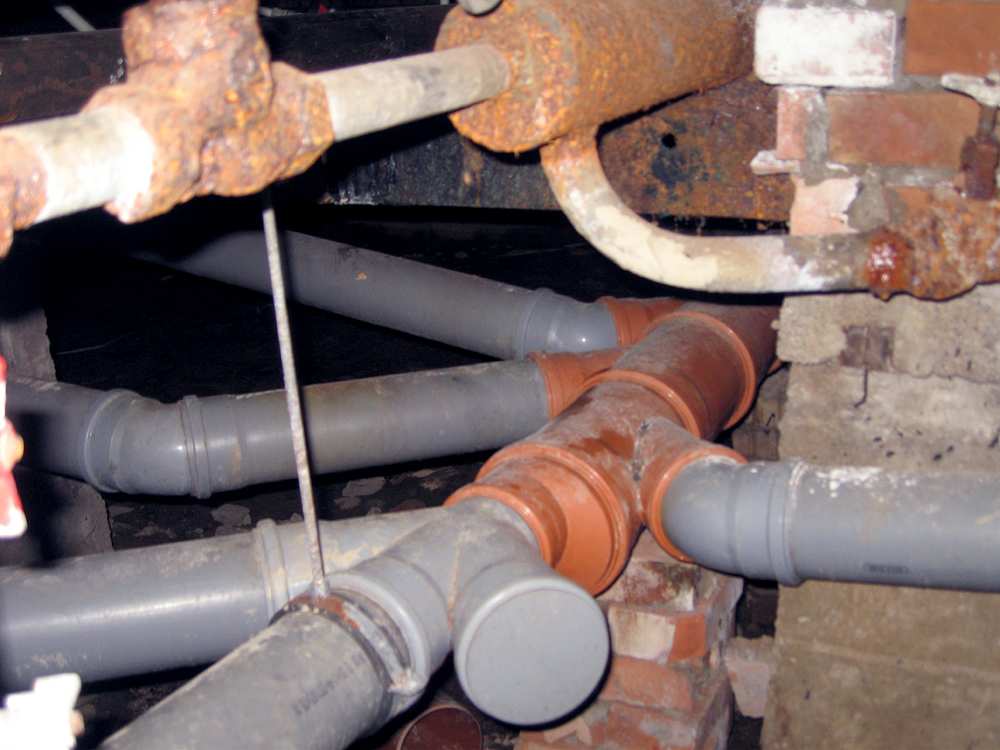
It is recommended to start installation in the house on your own from the inside of the sewer, as well as ventilation for it. The sewer system must contain hatches in the pipeline for inspection and repair. Pipes are fastened to the walls with clamps, hangers, etc. Crosses, tees and manifolds of large diameter (about 100 mm) must be used at the joints. Adapters will help to connect pipes of different diameters.
Ventilation is also important, which performs 2 functions at once - air inflow in rarefied areas, exhaust gases. Vacuum is more often formed when water is drained in the toilet bowl and when the pump for draining the washing machine is running. The influx of air prevents the capture of water in the siphon and the formation of a water seal, which has a loud unpleasant sound. A continuation of the riser on the roof is a fan pipe.
To install it correctly, you need to follow the rules:
- The diameter of the fan pipe is 110 mm to prevent ice blocking the passage.
- The height of the pipe on the roof is higher than the rest, including stoves, fireplaces, etc.
- Location at a distance of 4 m from windows and balconies.
- The fan pipe must be separate from the general ventilation and with a subsequent exit to the attic.
When arranging sewerage, safety regulations must be observed
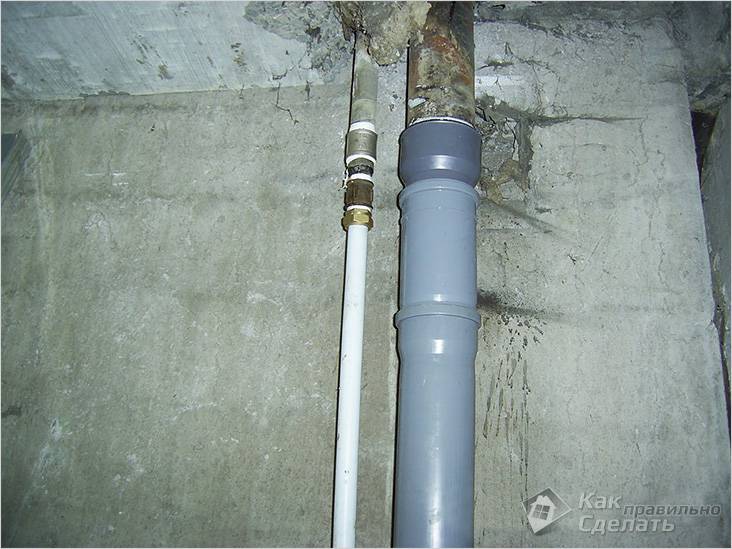
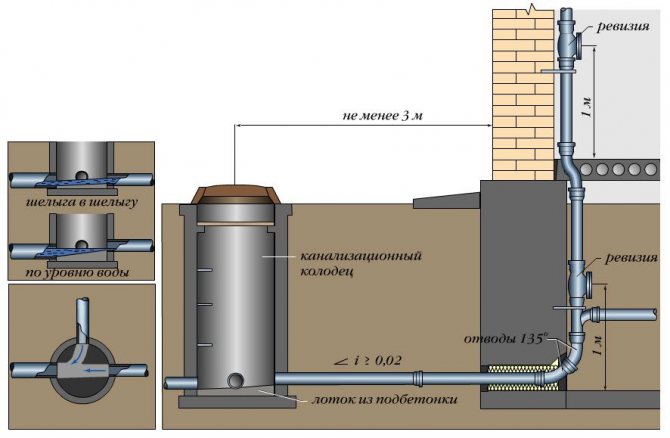
Through a sleeve with a non-return valve, the collector in the foundation exits to the external sewer. The sleeve diameter is 150-160 mm. The reverse flow of wastewater in the presence of a check valve is not possible in the event of contamination of the pipeline or overflow of the wastewater receiver.
Paving depth
At what depth to lay the pipes depends on the deepening of the septic tank and the depth of soil freezing in the region. Moreover, pipes must be laid below this level.
They are laid according to the following scheme and rules:
- Lack of turns from the house to the septic tank to prevent blockages.
- Pipes of the correct diameter.
- The same pipe material in the same pipeline.
- Compliance with the slope (approximately 0.03 m per 1 linear).
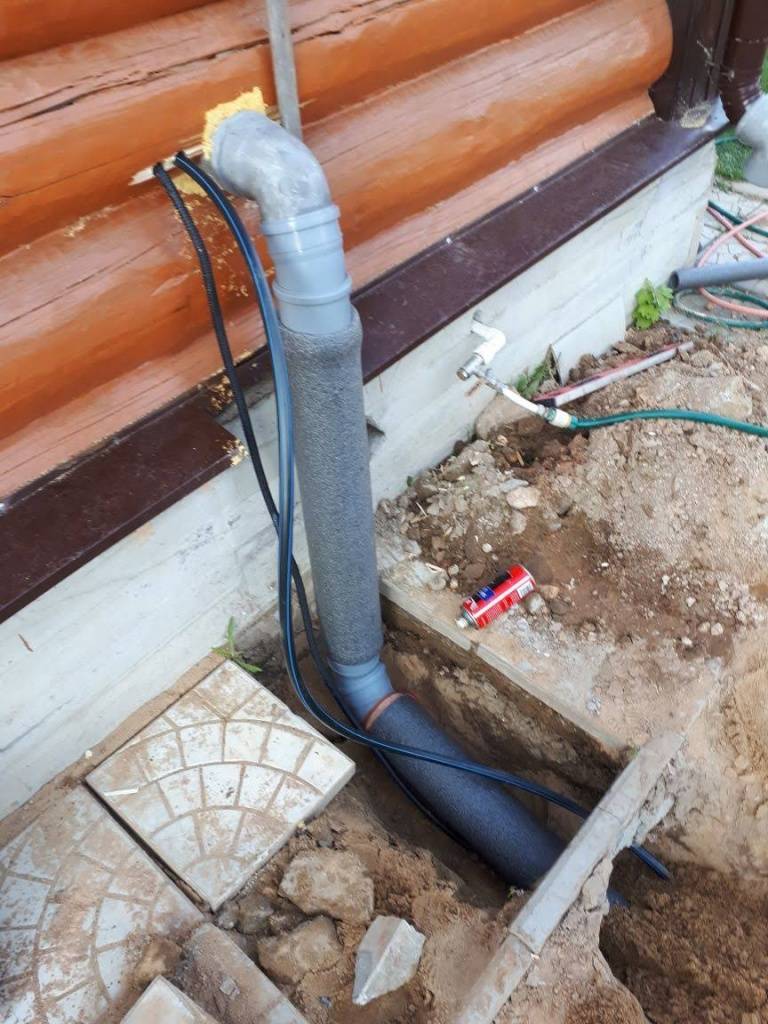



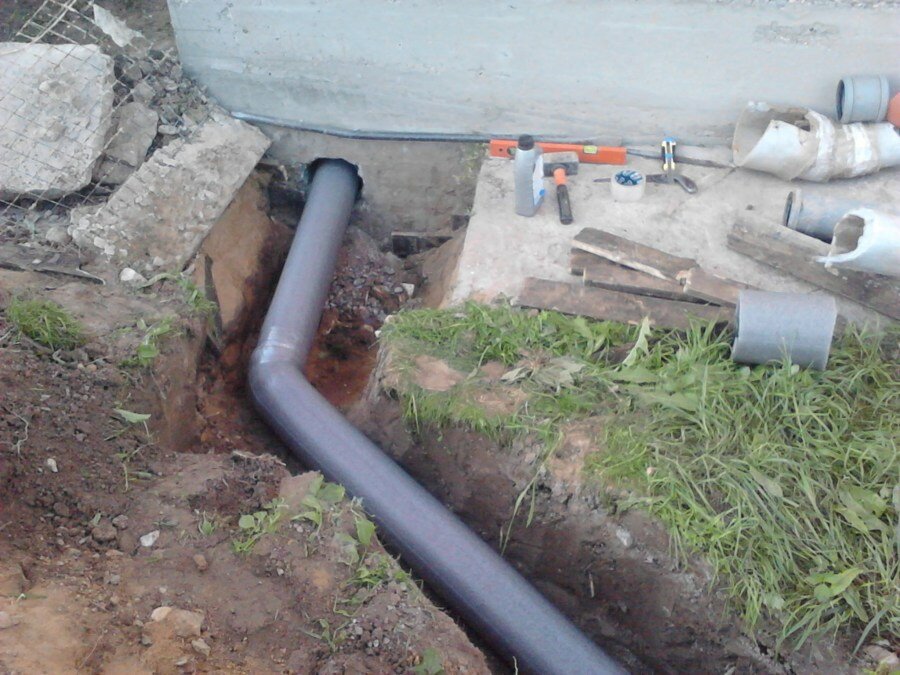


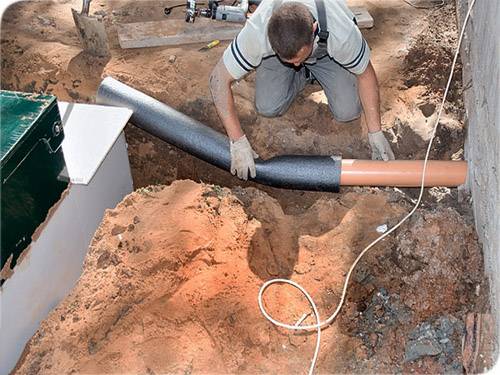
If there is no slope or it has an insufficient degree, then you will need to install a sewer pump. Also, additional wells should be included in the external sewerage scheme, especially if there are pipeline turns from the house to the septic tank. They will help in the maintenance of sewers and the elimination of blockages or freezing.
Sewerage, like plumbing, is recommended to be supplemented with thermal insulation made of polyurethane foam and polyethylene or to lay an electric cable.
How to properly conduct internal sewage in a private house: do-it-yourself installation
Internal sewerage is a system located inside buildings and structures and includes devices and pipelines that are used to collect inside the house and divert used water and household waste into an external sewer.
Plumbing fixtures include bathtubs, sinks, sinks, urinals, toilet bowls, drains and shower trays, and the piping system includes soundproofing, ventilation risers, manifolds and inlets, cleaning revisions and shutoff valves at outlets.
How to lay the inside sewerage for a private house right, given all the necessary requirements? Installation of internal sewerage in a private house is carried out using plastic pipes and rubber sealing rings to seal socket-type joints. A ring is installed in the groove of the socket, after which the end of the pipe, which has a smooth surface, is placed in it. The connection can be facilitated if a chamfer is made on the cut of the smooth end of the pipe. Stop moving the pipe at the moment when the mark on the smooth surface of the pipe is at the level of the socket. If the rotation of the parts connected to each other is easy, then the seal is located correctly. A pipe with a clearance of 5 cm is used for the drain of a sink, bathtub or washbasin, the outlet and riser for the toilet bowl are made with an inner diameter of at least 10 cm.
After the internal sewerage in a private house, laid by oneself, is prepared, they proceed to the final installation of the water supply and the connection of plumbing equipment, having previously completed the thermal insulation of the hot water pipeline
Particular attention should be paid to window sill niches, the main riser and the expansion tank. Pipes in the rooms and in the kitchen do not need thermal insulation
When installing an internal sewerage system in a private house, during the installation of the bathtub, you should check if there are rubber gaskets. It must be installed with a slope towards the hole. Sealing the outlet, as well as the joint of the drain pipe, is carried out by sealing the gap of the ring, using a linen tourniquet. Then the joint is closed with cement mortar or a mixture of cement and sand.
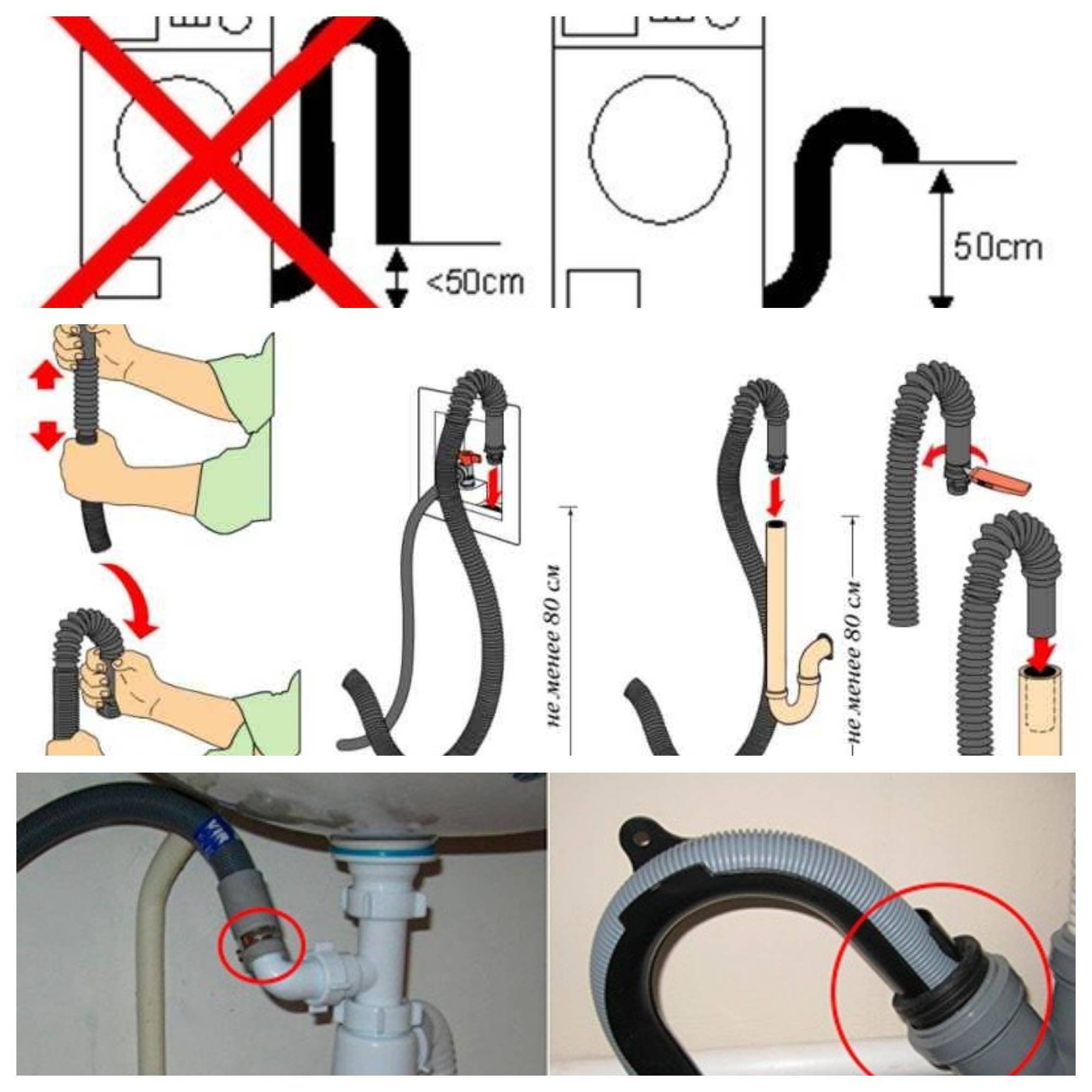
The installation of plumbing in a private house requires a special approach. It will not be difficult to connect a sink or washbasin, while simultaneously installing a modern plastic siphon on the outlet pipe.
The metal siphon should be connected to the drain pipe using an additional pipe having a diameter of 32-34 mm
During operation, pay special attention to whether the rubber sealing rings are correctly installed (in the event that the sink or sink is already fixed to the brackets)





Depending on the placement, the pipes are selected with different diameters: from the bathroom (or shower), pool and toilet - 10 cm, from the washbasin - 5-6 cm, it is desirable to make the riser with a diameter of 11 cm. 11 cm, although in large private houses where a complex sewer system is performed, their diameter can reach 15 cm.
Pipes with a diameter of 5 cm are laid at a slope of 3 cm every meter, pipes with a diameter of 10 cm - at a slope of 2 cm every meter. The riser should go 0.8-1 m above the roof. From above it is closed with a dome having a diameter 2 times larger than that of the pipe.
Types of sewer systems in a private house
Station plan
By degree of autonomy:
1. Autonomous - such systems do not have a connection to centralized sewer pipes and other infrastructure. Most often used in holiday villages, remote areas. This type of sewer is served directly by the residents of the house for which it was built.
2. Centralized - public sewage disposal systems, as a rule, owned by the municipality. This is a large and extensive communications network that serves from several houses to entire neighborhoods at the same time. In private houses in the city, it is possible to connect to centralized branches in agreement with the local authorities.
Concrete drain well
Types of autonomous systems
1Sump is a cheap, relatively inexpensive choice. But it has a number of disadvantages - the possible appearance of an unpleasant odor, a high filling rate and the risk of groundwater contamination
Drain well
2 Septic - this option performs several functions. In addition to wastewater disposal, there is also partial recycling of waste. In septic tanks, wastewater is settled, and organic waste is partially decomposed by bacteria. A septic tank is more expensive than a well, but it eliminates unpleasant odors and does not pollute the water
Three-chamber septic tank
2 Bio-purification station - a kind of purification facility, only designed for one house.Such stations have high productivity and the highest level of wastewater treatment. Among the disadvantages is the high cost of construction and maintenance




Sewer biological treatment plant
What should be the wiring in a private house, do-it-yourself installation, instructions for beginners
Construction stages
Consider how to remove the sewer from
private house on the street. This process cannot be done at random, it requires
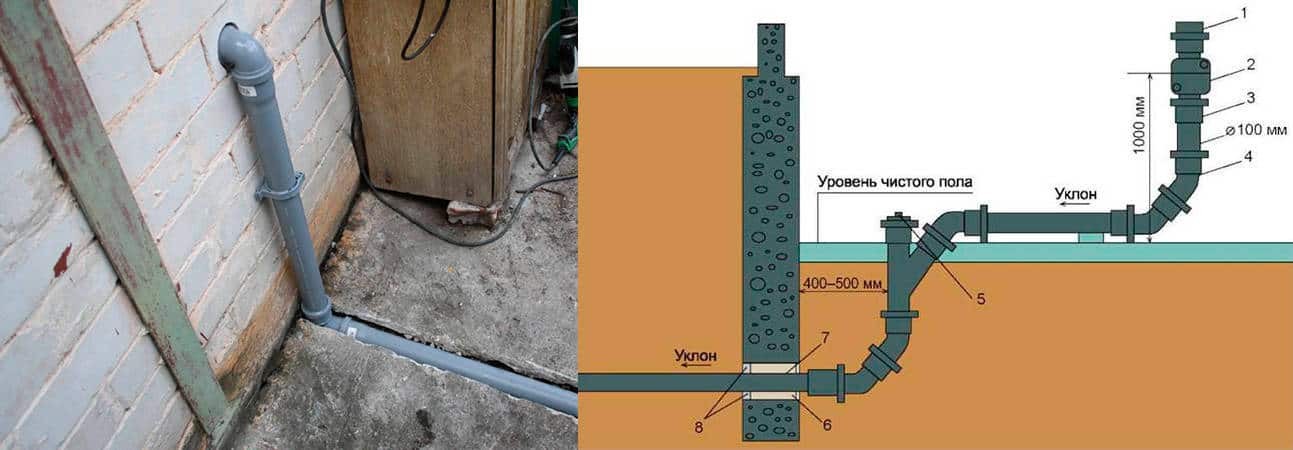
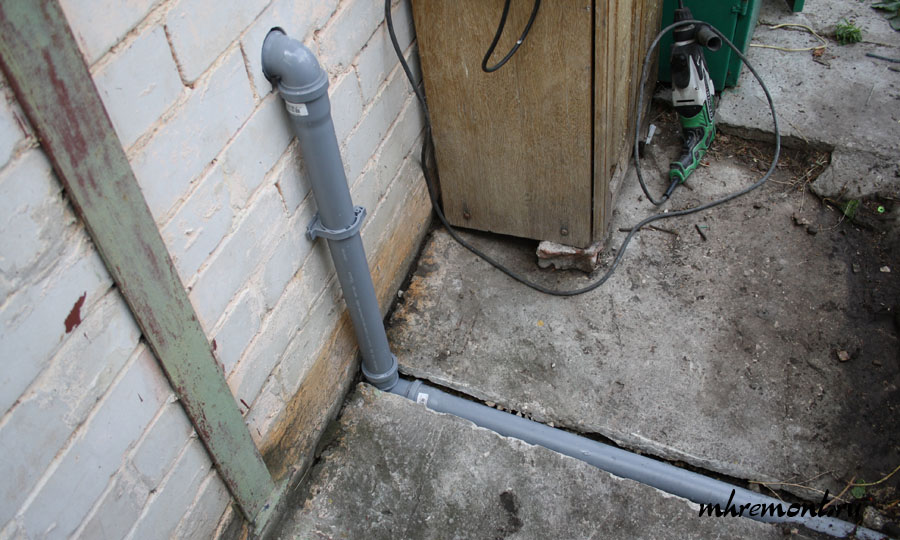
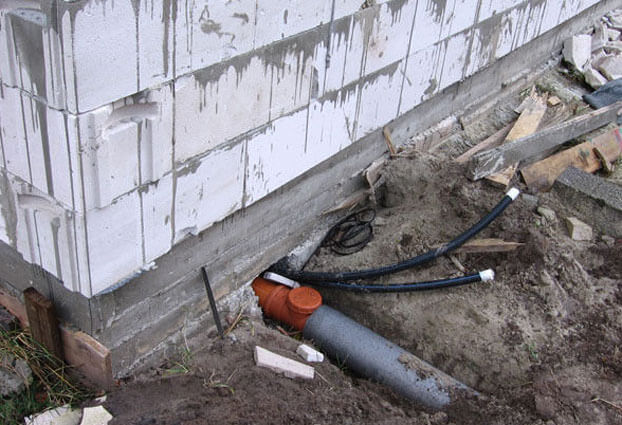
accurate calculation. It is necessary to determine the exit point of the system through the concrete tape, dig a trench under
pipeline, ensure the standard angle of inclination of the pipes. Solve these problems at random
it is forbidden. You must first draw up a project, make a drawing of the site to scale. it
will allow you to determine the number of fittings, find out the distance from the exit section of the riser
from the ceiling to the point of passage through the concrete strip.
First of all, you need to decide how to correctly derive
sewer from home. According to building regulations, the minimum
the depth of immersion of the sewer into the ground is 70 cm. This value
determines how the system is laid out. For shallow foundations
(about 50 cm) it is more correct to lay the pipeline under the tape. For this you need to do
digging to the depth of the pipe laying plus the thickness of the layer of sand backfill. If a
the foundation is immersed below the freezing level of the soil, a hole is made in the concrete.
Since you can remove the sewer from a private house
only through a special metal sleeve, the hole diameter must
match her size. Usually use a piece of steel pipe with a size
about 300 mm.Sewerage is passed through it, and the air gap for the entire
the length is filled with mounting foam. It will perform several functions:
- fix the position on the section of the passage through the foundation;
- insulate the pipe section hidden inside the sleeve;
- will provide waterproofing of the inner part of the sleeve.
To make a hole, a special diamond drill of a tubular design is used. If it is not available, you have to use a puncher or jackhammer. When making a passage with their help, one must be careful and try not to make cracks in the concrete. A serious hindrance will be the bars of the reinforcement, which will have to be cut off by the grinder. These methods are significantly inferior to drilling and do not allow you to get a neat and clean hole.
What is needed for the construction of an internal sewerage system
As mentioned above, the main thing in the sewerage device inside the house is to draw up its detailed drawing, indicating all the devices and the dimensions of the elements. For installation, sewer pipes made of polyvinyl chloride are used. The device of their ends is such that two pipes can be connected by placing the end of one in the socket of the other. For risers, pipes with a diameter of 100 mm are used, and for other devices, 50 mm. A corrugated pipe is used to connect to an external sewage system, due to its better resistance to soil movements.
Of the tools usually used: a saw for cutting plastic pipes, a sharp knife and rubber mounting seals. Pipes are cut with a saw, cuts are leveled with a knife and chamfers are made. Rubber seals are inserted into the sockets. Various fittings are used to connect pipes to the system:
- Knees or bends that are needed to decorate corners. They are produced with a bend of 45 and 90 degrees.Their ends are also equipped with sockets with seals to create tight connections.
- If it is necessary to connect cut pipes of the same diameter, transitional bends are used.
- Tees of various types are fittings for organizing pipe branches.
- Transition couplings are needed in order to create transitions between pipes of different thicknesses.
A common mistake when installing plastic sewer pipes is ignoring their heating. In order for the pipes to fit easier and more tightly into each other and into the connecting fittings, the sockets must be heated in hot water.
Pipes and fittings for sewerage
Principle of operation and device
All plumbing fixtures in the house are connected to the sewer outlet through a water seal, which prevents back penetration of gases. Pipelines from plumbing fixtures, toilet bowls, household appliances lead to the central riser.
Simultaneous discharge of water into the sewer from several sources raises the possibility of filling the entire clearance of the riser, where a fast flow entrains air and causes a vacuum. This contributes to the penetration of gases into the rooms, there is an unpleasant noise and gurgling in the pipeline.
The presence of a fan pipe allows atmospheric air to enter the system, equalize the pressure and avoid unpleasant consequences.
Laying an external sewer pipe

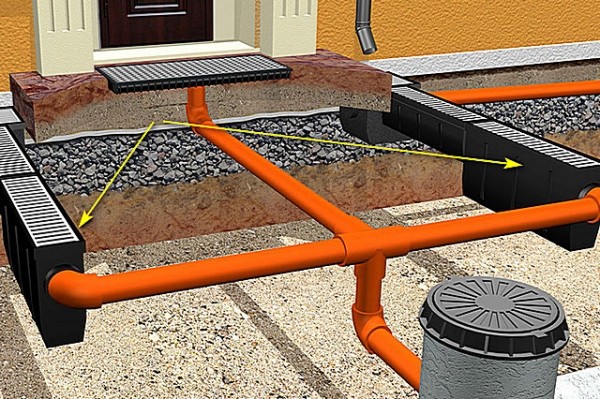
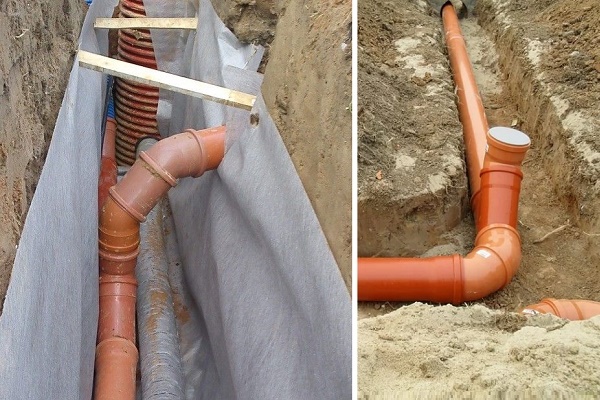
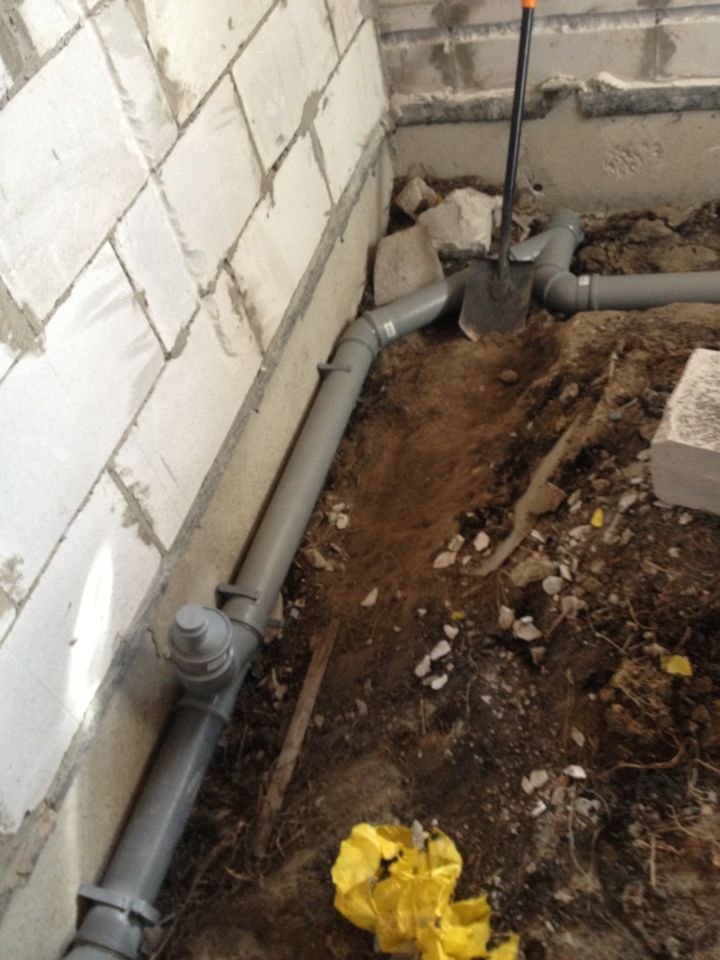
It is laid from the house to the drive of any type (septic tank or cesspool) directly, without turns. If you can’t do without them, you should try to make the rounding smoother. Alternatively, replace the 90° fitting with two 45° fittings or three 30° fittings.


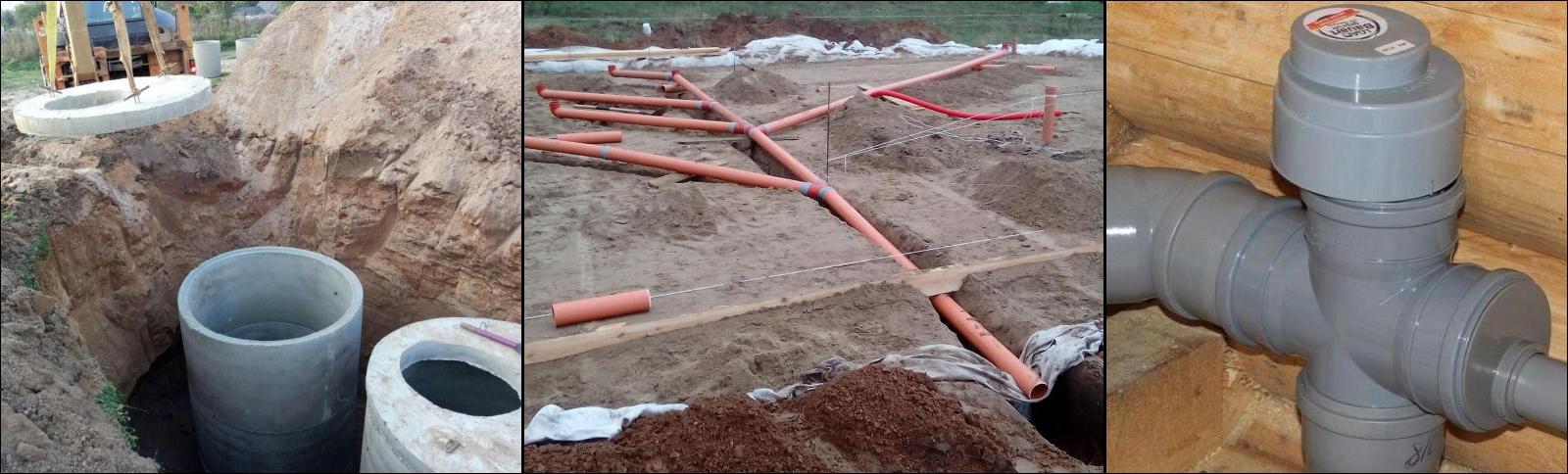


The external sewage system from the house to the storage tank must be laid with a slope, so that the socket is directed towards the drains.
NOTE! To lay the pipe at the bottom of the trench, it is necessary to prepare a “cushion” of crushed stone and sand, with a thickness of 20 cm or more with a concrete coating
This will protect the system in winter. Will not interfere with the installation of a septic tank.
We advise you to insulate the pipes so that the system functions well without interruptions in frost. Sometimes the insulated sewerage system is covered with a protective box, reinforced concrete trays, and sometimes impregnated railway sleepers to protect against ground pressure.