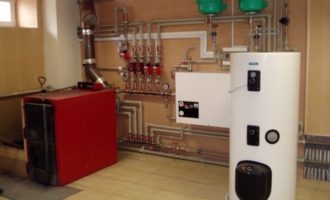
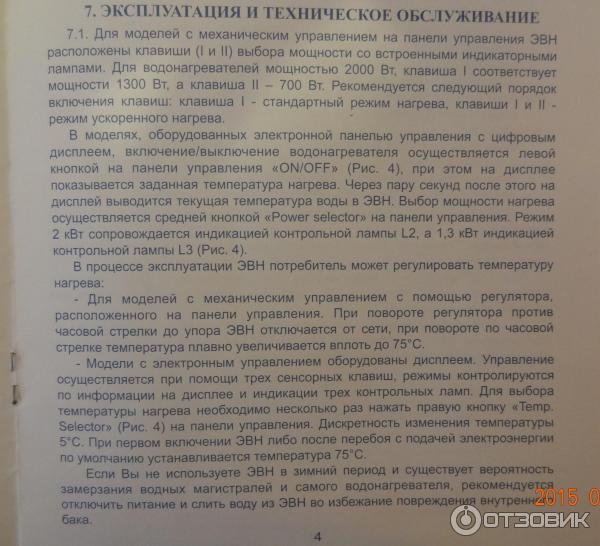
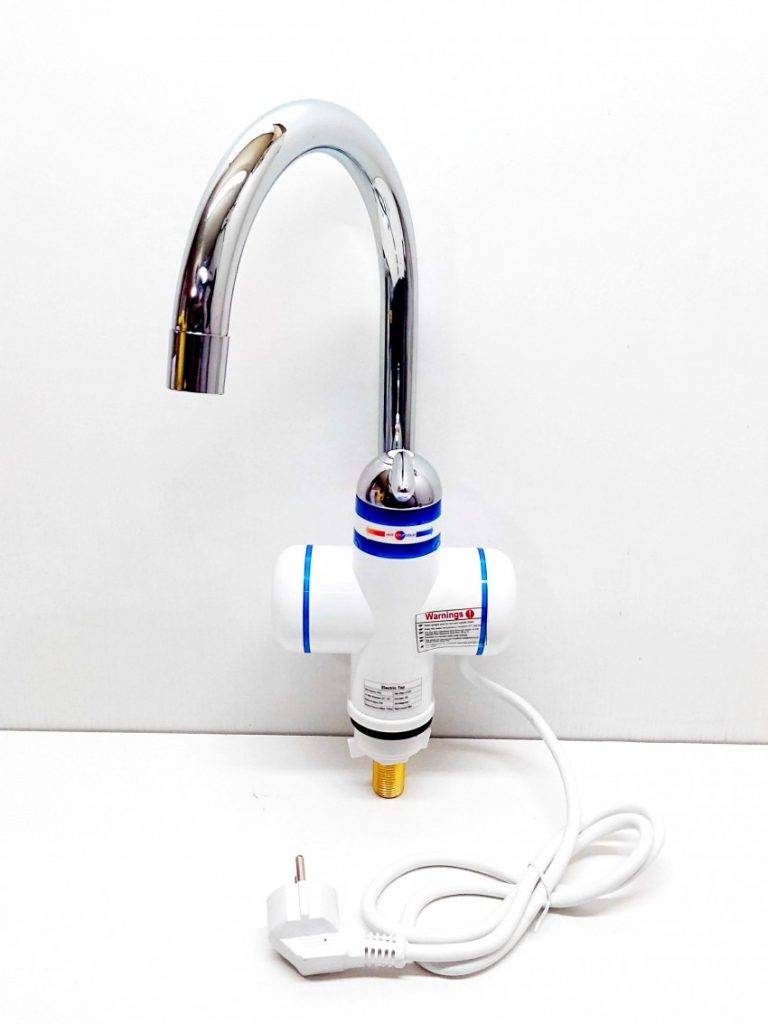
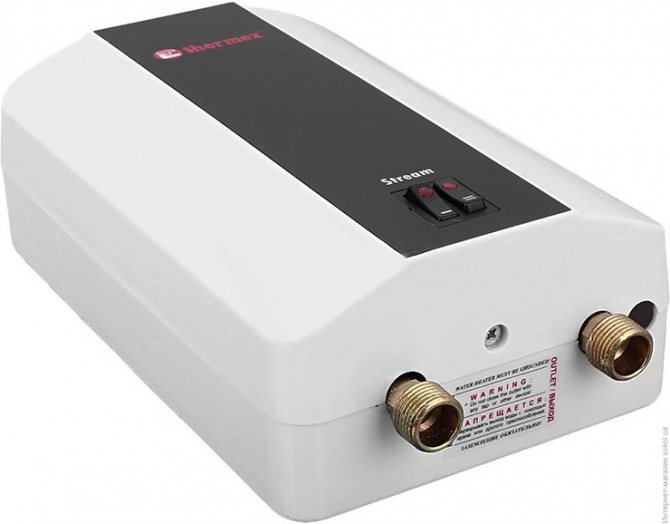
- Electric boilers
- How to use the Termex water heater correctly
- Breakdowns, causes, elimination
- Briefly about the device and the principle of operation
- What will be needed for manufacturing?
- Rules for using the storage water heater
- Instantaneous water heater control
- Hydraulic control
- Electronic control
- Scheme of operation of the storage water heater
- How to install and connect instantaneous water heater
- In the apartment and in the country
- To mixer
- To the water supply
- Electric - to the mains
- electric per shower
- Gas
- Advantages and disadvantages
- Rules for using the water heater Electrolux
- Built-in storage water heater protection
- Rules for using the water heater Electrolux
- How to connect a instantaneous water heater to the water supply and electrical network with your own hands
- Do-it-yourself instantaneous water heater installation
- Connecting the instantaneous water heater to the water supply
- Connecting the instantaneous water heater to the mains
- Ways to solve problems with equipment
- Basic rules for using a water heater
- How to use instantaneous water heater
- Gas or electric water heater
- What to do if the indicator light does not light up and the water does not heat up
- Preparing for installation
Electric boilers
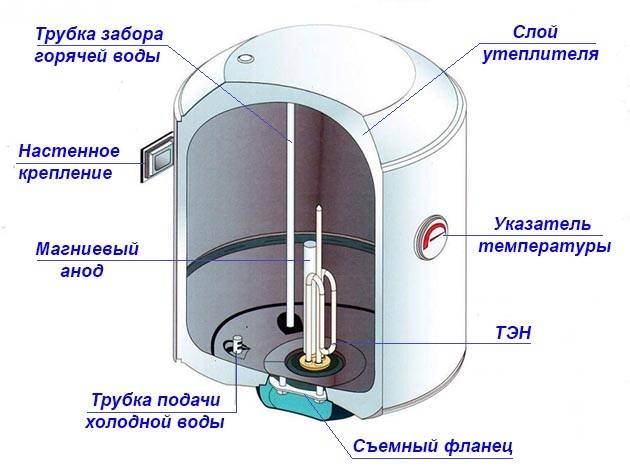
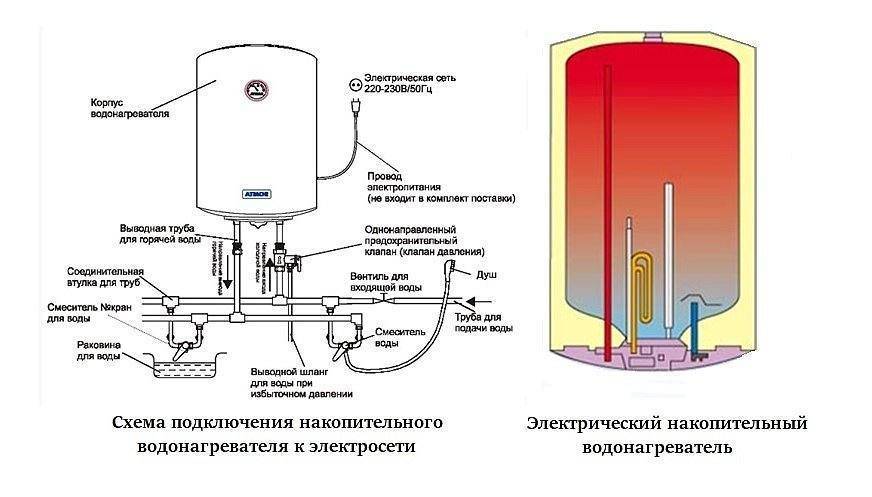
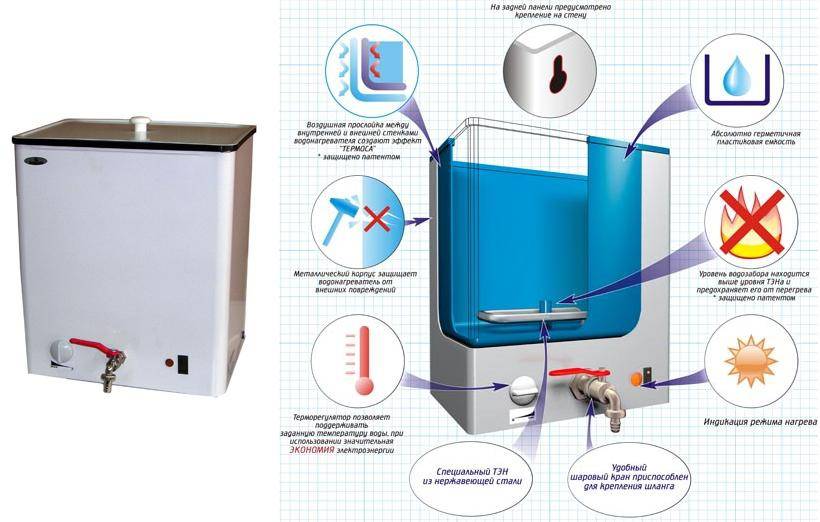
This is the most common type of hot water heater, most often used in apartments and small private houses. The reason for this popularity is the relatively low cost and ease of installation, which does not require any permits. The devices are quite reliable in operation and meet most of the requirements of users. To understand the principle of operation of a water heater, consider its device, shown in the figure:
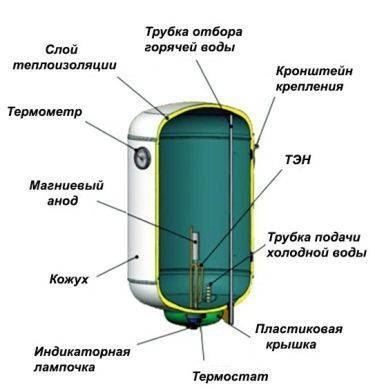
The unit is a tank, usually round or oval, enclosed in a layer of heat-insulating material (usually polyurethane foam), covered with a decorative casing. The container itself can be made of the following materials:
- steel with enamel coating;
- stainless steel;
- plastic.
An electric heating element located at the bottom of the tank heats the water to a temperature limited by a thermostat. Its maximum value, adopted in all electric boilers, is 75 ºС. While there is no water intake, the device of the electric boiler provides for maintaining the set temperature in the mode of automatic switching on and off of the heating element. The latter has additional protection against overheating and in an emergency will automatically turn off when the water temperature reaches 85 ºС.
Note. The optimal operating mode for the boiler is heating up to 55 ºС. In this mode, the device provides the right amount of water for domestic hot water and at the same time saves electricity. Unfortunately, often the storage water heater operates at maximum power due to the fact that in winter time too cold water comes from the water supply and the heating element does not have time to warm it up in the economy mode.
Water intake occurs through a tube led to the upper zone of the tank, where the water is the hottest. At the same time, cold water supply is provided in the lower part of the boiler, where the heating element is installed. To protect steel tanks from electrochemical corrosion, the water heater device includes a magnesium anode. Over time, it collapses, and therefore requires replacement approximately 1 time in 2-3 years.
How to use the Termex water heater correctly
The sequence of actions for starting the Termex water heating equipment is standard:
- Disconnect the equipment from the power supply;
- Shut off the hot water supply from the common riser in order to exclude the heating of the water of the central water supply system due to an unexpected malfunction (even with a check valve installed);
- Open the outlet for supplying hot water from the equipment;
- Open the hot water tap;
- Open the cold water inlet;
- Turn off the hot water tap after filling the tank (water starts flowing from the hot tap - the water heater tank is full);
- Make sure that there are no leaks, malfunctions;
- Connect the equipment to the electrical network;
- Make sure that the indication works properly;
- Set the required water heating mode;
- Measure the temperature of water from a hot tap;
- After 20-30 minutes of heating, the display of the device will show changes in the water temperature. If there is no display, you must again measure the temperature of the liquid from the hot tap.
With the correct connection, start-up, the sensors work properly, the temperature changes according to the instructions, corresponds to the specified mode.
Breakdowns, causes, elimination
Basically, safety valve for the water heater has only two breakdowns: water either often flows from it or does not flow at all.
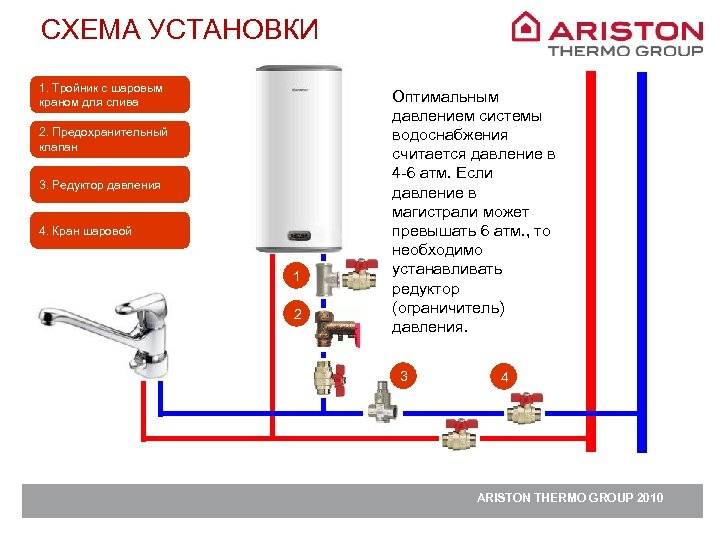
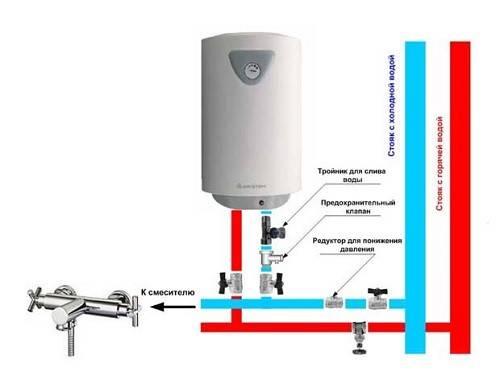
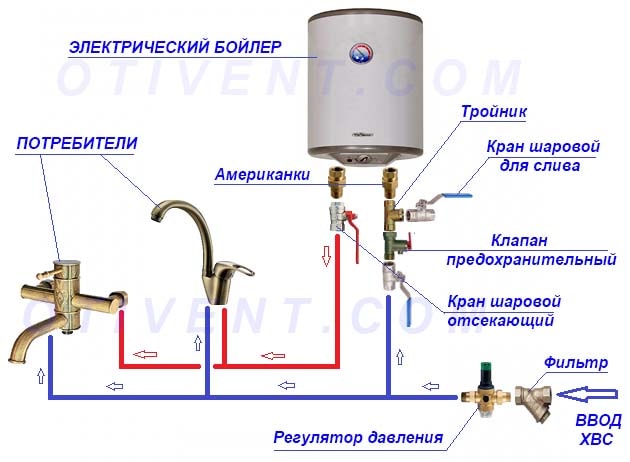
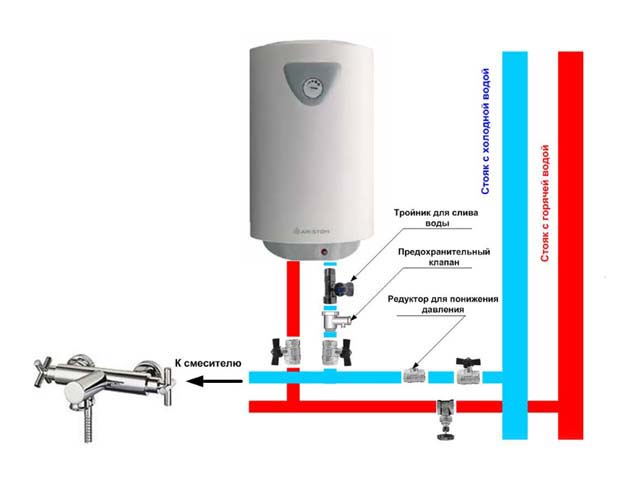
First of all, it must be said that bleeding off water when heated is the norm. This is how the system should work. Water can also be drained when the boiler is turned off, if the pressure in the cold water supply pipes is higher than the valve actuation limit. For example, a 6 bar valve, and 7 bar in the water supply. Until the pressure drops, the water will bleed off. If this situation is repeated often, it is necessary to install a reducer, and it is best on the water in an apartment or house, but there are compact models of reducers that can be installed at the entrance to the boiler.
Boiler piping with safety valve and reducer
How to check if the valve is working? If there is an emergency reset lever, this is easy to do. With the boiler switched off, it is necessary to raise the lever several times, releasing the excess pressure. After that, the dripping stops and does not resume until heating starts.
If the water continues to drain, the spring may be clogged. If the model is serviceable, the device is disassembled, cleaned, and then put in place. If the model is not collapsible, you just need to buy a new valve and install it.
This is how the gearbox looks like - to stabilize the pressure on the boiler
Constantly dripping water is unpleasant and “hit” the wallet, but not dangerous. It is much worse if, when heating the water, you never have water in the pipe. The reason is that the valve is clogged or the outlet fitting is clogged. Check both options. If it doesn't work, change the valve.
Briefly about the device and the principle of operation
In order to save money, users try to turn on the boiler according to a certain schedule.But if you want to reduce energy consumption during the operation of a water heater, you need to understand in general terms how it functions.
The picture below shows a storage boiler - an insulated tank made of stainless steel or enameled steel with a built-in tubular electric heater (heater) that has its own thermostat. At the bottom there are water inlet and outlet pipes, in the same place (or on the front panel) there is a heating regulator and a thermometer.
The water heater operation algorithm looks like this:
- Through a branch pipe equipped with a check and safety valve, the container is filled with cold water. The heating element automatically turns on and the heating process begins.
- When the contents of the tank reach the temperature set by the user, the thermostat turns off the electric heater. If there is no water intake, the automation maintains the heating at the set level, periodically turning the heater on and off.
- When the DHW tap is opened on any mixer, water is taken from the upper zone of the tank, where the corresponding pipe is connected.
So that the electrochemical reactions that occur between dissimilar metals during the heating process do not cause corrosion of the steel container, a magnesium anode is built into it, which takes the “shock” on itself. That is, due to the activity of this metal, the rod is gradually destroyed instead of the tank and the heating element.
What will be needed for manufacturing?
Tools required for work:
- Bulgarian;
- drill;
- inverter for welding;
- a soldering iron with a power of at least 300 watts;
- roulette;
- compass;
- core;
- scissors for cutting metal or secateurs;
- rivet tool.
The following materials should be prepared:
- a copper tube made of copper, the diameter of which is 4-8 mm;
- you will definitely need sheet steel (3 mm);
- a round mandrel made of metal or wood with a diameter of 10-12 cm;
- sheet iron 5 mm thick;
- paint against corrosion;
- two 90 degree elbows from a half-inch pipe;
- four pieces of pipe half an inch 10-15 cm long, with a standard type of thread;
- two half-inch threaded brass couplings;
- a half-inch stainless steel pipe with a diameter of more than 20 cm (a part of a gas cylinder is also used);
- solder for medium temperature copper and brass and the corresponding flux;
- PTFE sealing material.
For warming should be prepared:
- mineral wool;
- corner made of steel with a shelf measuring 50 mm;
- iron in sheets 1 mm thick;
- rivets.
Rules for using the storage water heater
Scheme electric instantaneous water heater.
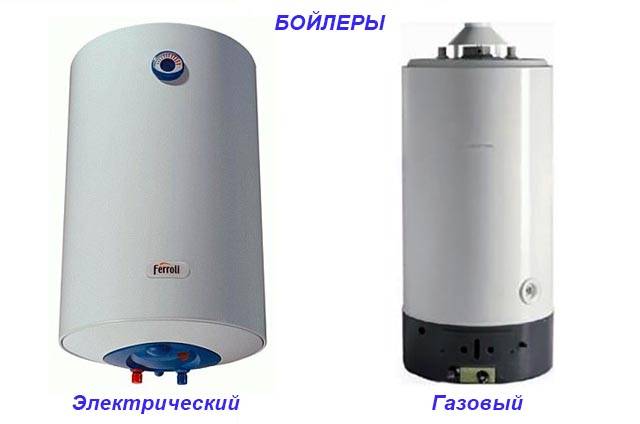
The storage water heater is distinguished by the fact that in its design it contains a sufficiently capacious water tank in which it is gradually heated. Electricity or a gas burner can be used to heat water. How to properly use a storage water heater?



Firstly, it must be installed correctly, taking into account the recommendations for choosing its location, methods of fastening. Since the storage tank is designed for a fairly large volume, fastening should be carried out only on load-bearing walls and with the help of special fasteners, which, as a rule, are supplied with the kit.
Secondly, it is necessary to correctly carry out its first start after installation and connection to the water supply system. The first start-up of the storage water heater is carried out in the following sequence:
- The correct connection to the heating system is checked. If an electric water heater is used, then you should check the correct connection of the mains, the phasing, the presence of a protective switching device - a circuit breaker. Before starting the boiler, its power supply must be turned off. If gas heating is used, check the elements of the system for connecting to the gas pipeline.
- Check whether the work on connecting to the water supply system has been carried out correctly, that there are no water leaks. Availability and serviceability of the back pressure valve. Only after checking, they start filling the water heater tank with cold water.
- In order to properly fill the water heater, the hot water tap is first opened. By the appearance of water from an open hot water tap, you can determine the full filling of the tank.
- After filling the tank, once again check the absence of water leaks in the system and start the heating system. It is not recommended to set the maximum heating mode when you first turn it on - this can lead to failure of the thermostat or temperature sensors.
How to use the device correctly if it is already turned on?
There are no special comments on this subject, the prerequisites are that:
- it is not recommended to disconnect the water heater from electric current during its operation;
- You can turn off the heater after heating the water in case of energy savings and if hot water is not needed for a long time.
The requirements for using a storage water heater also include:
- preliminary check of the water level in the tank;
- presence of grounding.
Electric water heaters must be grounded to prevent electric shock during operation and maintenance. If the heating element is damaged, the water will be energized and when hot water is turned on a person can be electrocuted. It is much safer to use such a device.
Instantaneous water heater control
For the normal functioning of heating devices, adjustment of their operating modes should be provided:
- Possibility to choose the heating temperature.
- Switching to different operating modes - by water pressure and heating rate.
- Enable additional convenience and security features.
There are two ways to control the protochnik - hydraulic and electronic.
Hydraulic control
Control by hydraulic pressure of water - mechanical switching of heating modes, carried out by a step switch. The mechanical rod regulates the water pressure and, accordingly, its outlet temperature. With this type of control, the heating always turns on at maximum power in any heating mode.
The disadvantage is also the inability to accurately set the temperature and reliably maintain the regime. The operation of the hydraulic switch depends on the line pressure. With low pressure The heater may not turn on at all. This type of control is typical for low-cost models and is convenient to use for non-pressure heaters.
Electronic control
Based on the electronic control of the signals of several temperature and pressure sensors. Allows you to set the water temperature output with accuracy up to one degree. Does not depend on pressure changes in the line.Control of sensors and maintenance of the heating mode is carried out by a microprocessor. There are models equipped with LCD screens showing the parameters of the heater.
Instantaneous water heater with electronic control
Scheme of operation of the storage water heater
Standard scheme of operation of water heating equipment is based on the principle of separating several water layers that differ in different temperature conditions. The selection of hot liquid from the water heater is made through the hot water pipe.
Such a tube has a strictly defined length, reaching the upper, most heated layer. The laws of physics do not allow a vertical water heater to be placed in parallel.
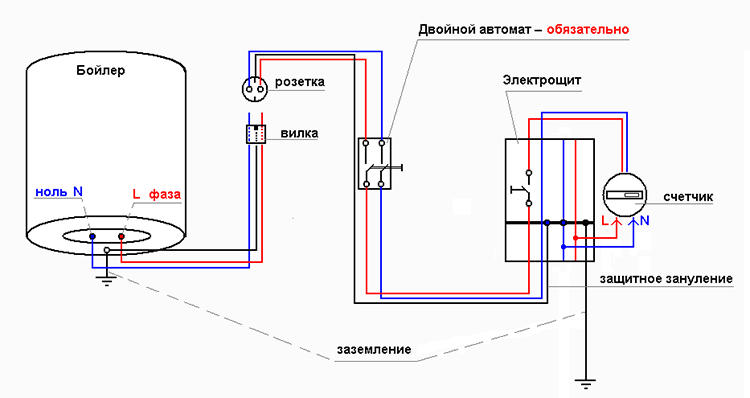
Electrical diagram of the storage water heater
When choosing a storage boiler for electric heating, you need to pay attention to its design features, as well as take into account basic installation rules water heater.
How to install and connect instantaneous water heater
Before choosing a model and installation scheme for a water heater, you should decide on its purpose. It also comes with technical specifications. Below are nuances of connection and installation instantaneous water heater to power supply and water supply in specific conditions.
In the apartment and in the country
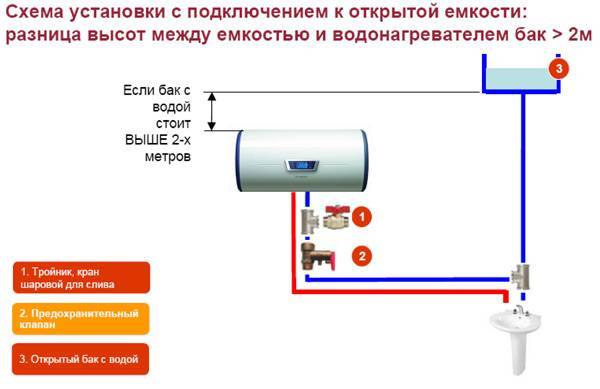
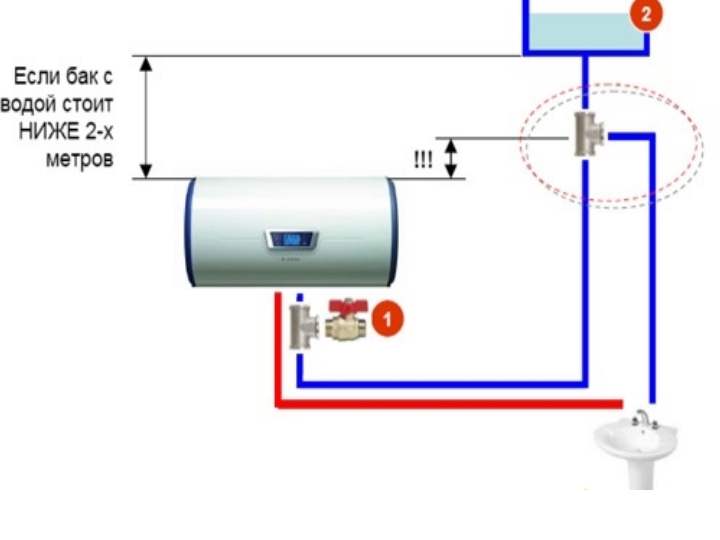
Temporary devices of low power with a small daily consumption are suitable. They are installed in case of a shutdown of hot water in a city apartment or in a country house for the summer period. For stable operation of a non-pressure device, it is mounted 2 meters above the draw-off point.
If there is no centralized hot water supply in the house or apartment, it is better to choose a powerful pressure apparatus and a hot water pipe distribution system. Such devices are designed for year-round use and require a minimum pressure in the line from 1.5 to 2 atmospheres.
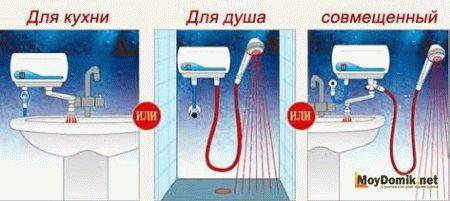
To mixer
A low-power flow heater is connected instead of a spout or a mixer shower hose. This scheme is used as a temporary.
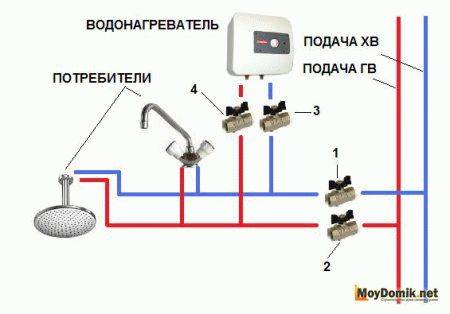
To the water supply
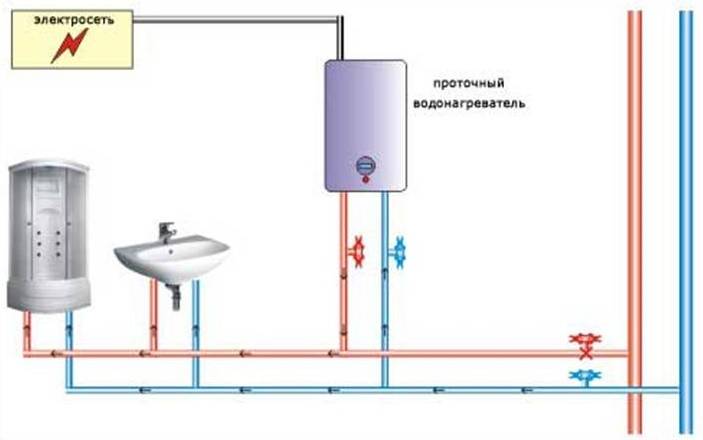
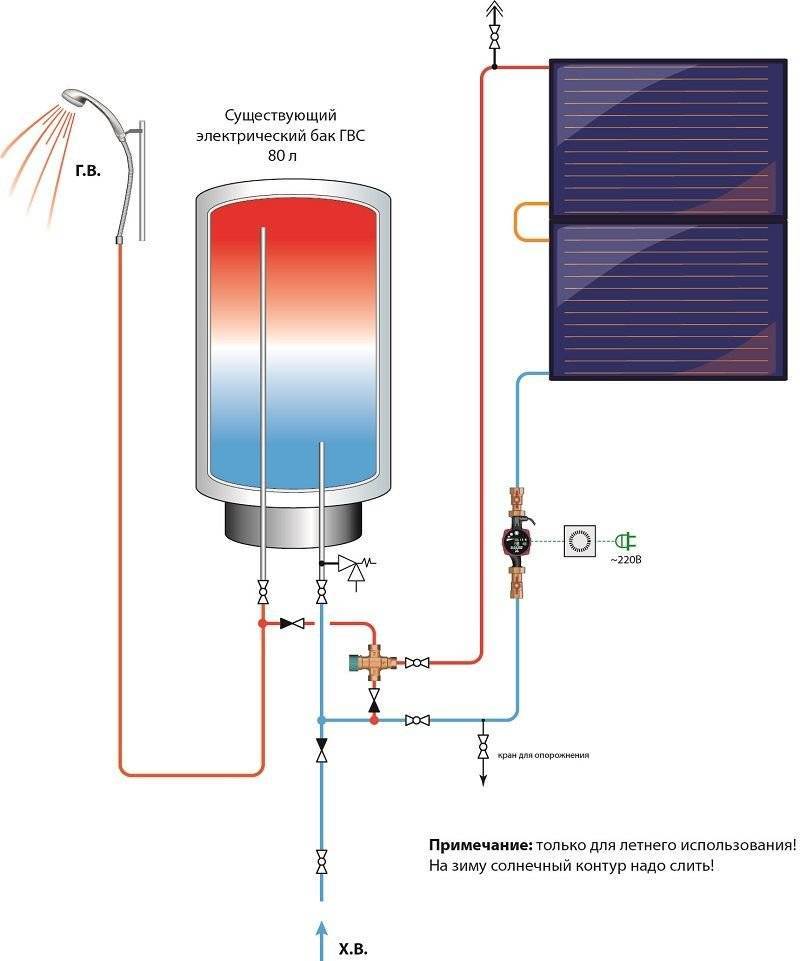
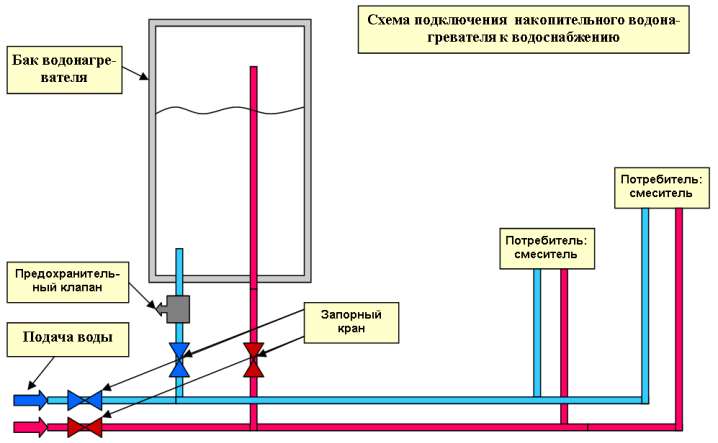
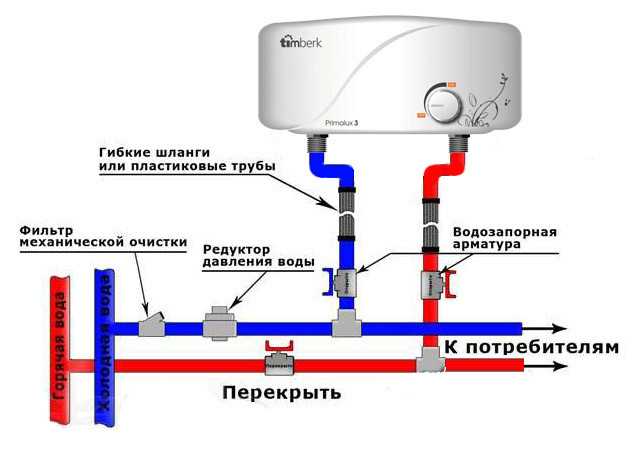
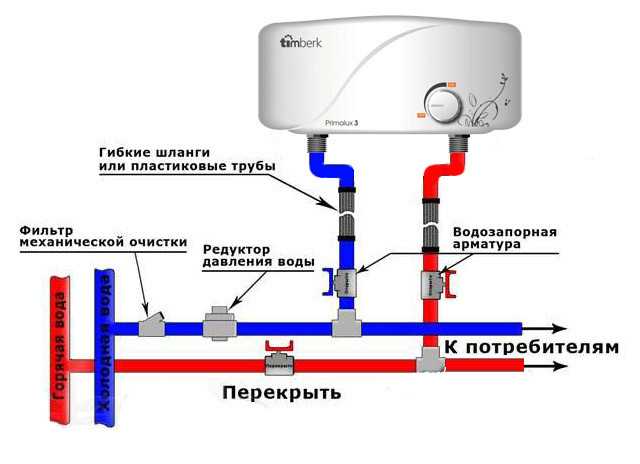
Below is a diagram that allows you to supply consumers with hot water, both from the mains and from the heater.
Plumbing connection diagram
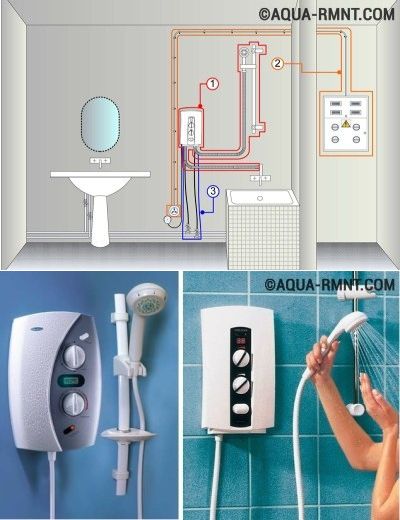
Electric - to the mains
One of the options is shown in the diagram. The RCD should be placed as close as possible to the heater.





Electrical connection. (SUP - feed control system)
electric per shower
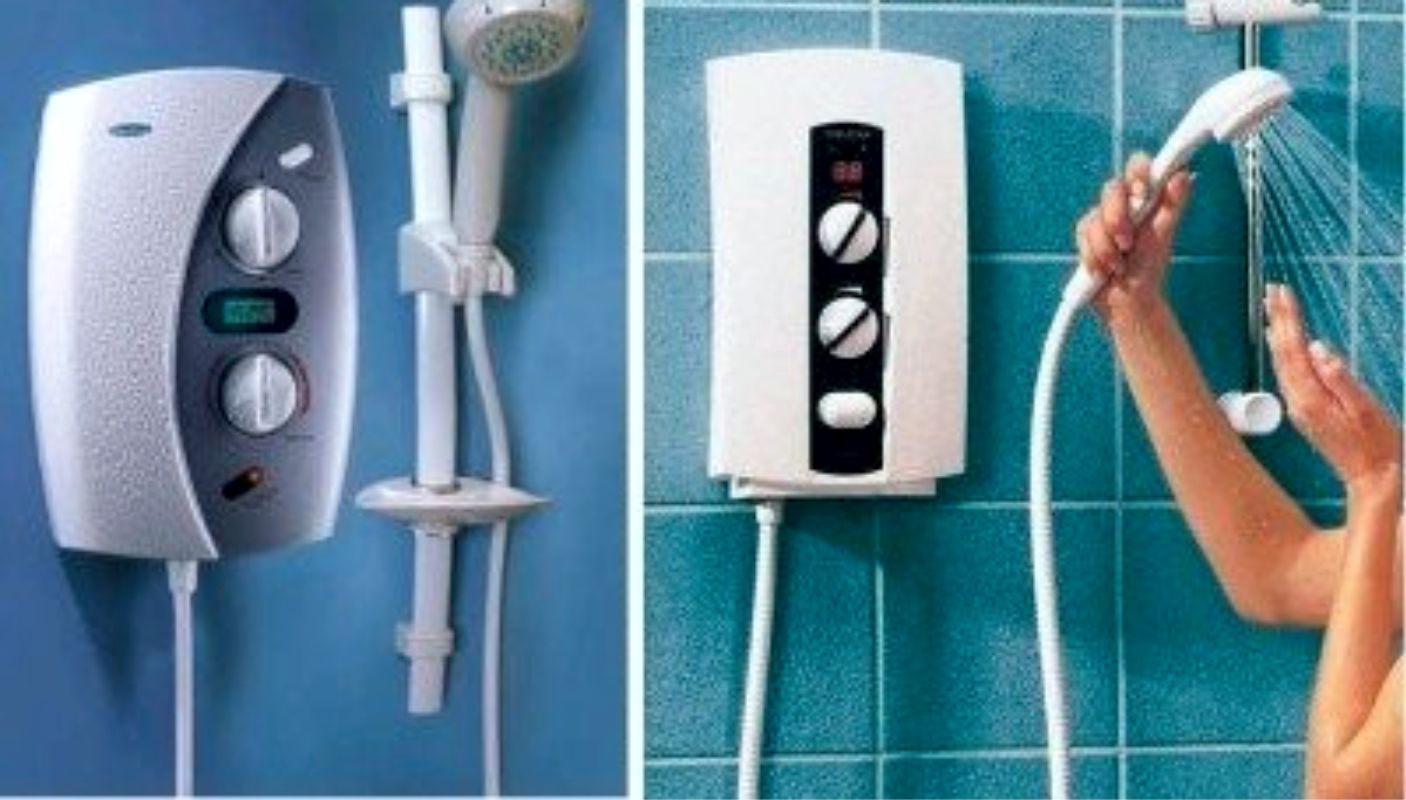
Low power devices designed for a single point of water consumption are often equipped with a spout and / or shower hose with a watering can.
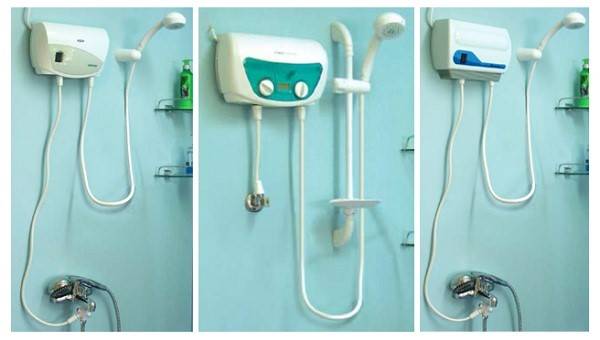
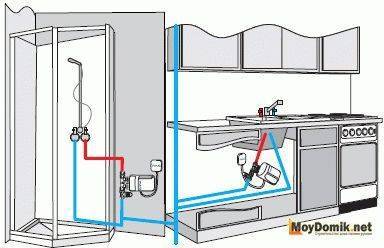
Shower heater installation examples
It is absolutely unacceptable to install taps or other shut-off valves on the outlet pipe of such devices. If the heating is on, it will cause overheating and failure.
Gas
If the main gas is connected to the apartment or house, the gas heater will be a convenient, safe and economical solution.
Gas appliances have great power and easily provide several consumers.
The installation of such a device requires coordination with local gas services.
Gas water heater connection diagram
Advantages and disadvantages
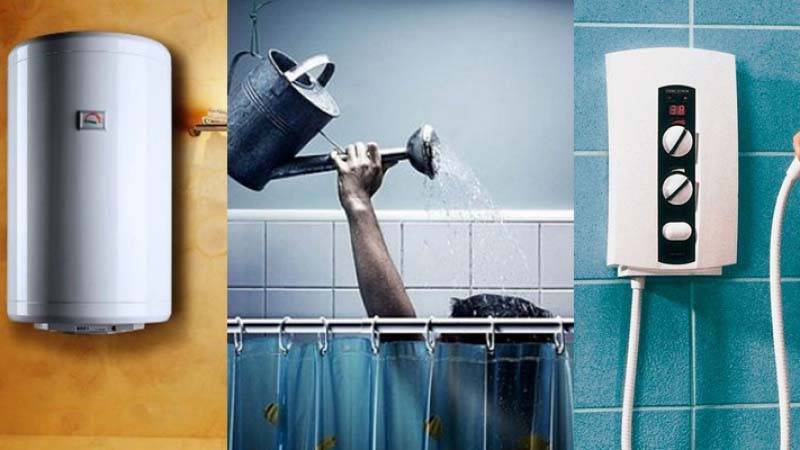
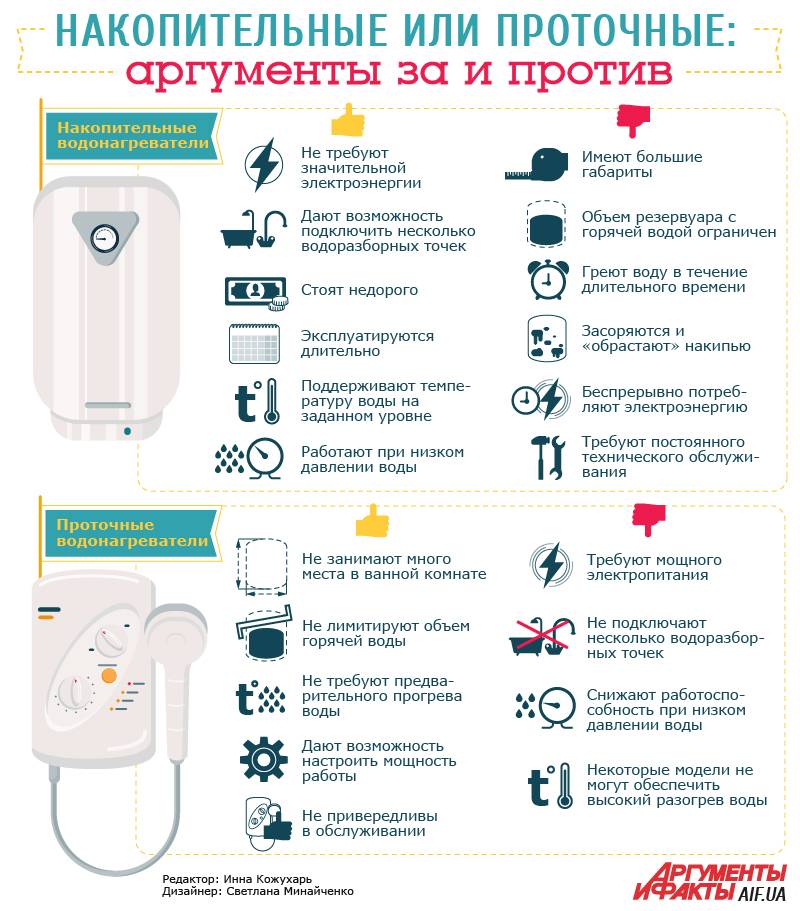
Storage boilers have a number of advantages over instantaneous water heaters:
- availability of access to hot water within the available volume provided by the design;
- round the clock use;
- maintaining the temperature in the selected range for a long time;
- ease of use and temperature control.
Disadvantages of boilers:
- the inability to use water in excess of the tank limit, which is inconvenient in large families;
- the need for periodic maintenance;
- the risk of flooding the premises during a breakdown;
- relatively low cost of service;
- the availability of an electric energy carrier at the installation sites, because gas is not present in every settlement;
- continuous heating of water to the desired temperature.
Advantages of flow heaters in comparison with storage boilers:
- no need to wait for water heating from the carrier;
- no restrictions on the amount of hot water;
- ease of use of any design;
- ease of installation and maintenance.
Flaws:
- the need to carefully monitor the equipment;
- modern designs are significantly more expensive than standard boilers;
- the need to choose a solution to provide the whole house with water, or each point separately.
Rules for using the water heater Electrolux
The first start, switching on after a long idle time is carried out according to the standard scheme listed above: opening a warm water tap, filling the tank, inspecting for malfunctions and leaks, closing the tap after supplying an even jet without bubbles, heating. After a long period of non-use, it is necessary to thoroughly rinse the tank with a long descent of liquid.
Let's take a closer look at other operating features that the manufacturer indicates.The main among them is to carefully monitor the quality of water, which should be supplied without mechanical impurities, derivatives of petroleum products, harmful substances, etc. Compliance with these requirements excludes increased scale formation inside the tank, rapid wear of the anode rod.
In addition, it is necessary to carry out timely maintenance of water heating equipment to ensure reliable operation with the call of a specialist. Technical work includes:
- Checking the tightness of connections;
- Filter cleaning;
- Inspection, cleaning of the internal space of the water-heating tank, heating element, which depend on the degree of hardness of the heated liquid;
- Checking the pressure in the water supply system;
- Inspection of the condition of the hull, thermal insulation;
- Checking the operation of protective, emergency devices, if installed;
- Inspection, replacement of the magnesium anode if necessary.

Built-in storage water heater protection
Even at the manufacturing stage, manufacturers equip devices with several types of protection necessary for safer operation. One of the most dangerous elements of the boiler is the storage tank, which is a kind of steam bomb. If you do not take care of the additional protection of the tank, then at high pressure caused by the boiling of the liquid, it will not withstand the load. Of course, the heater will continue to work for some time, but at one “perfect” moment it will simply explode.
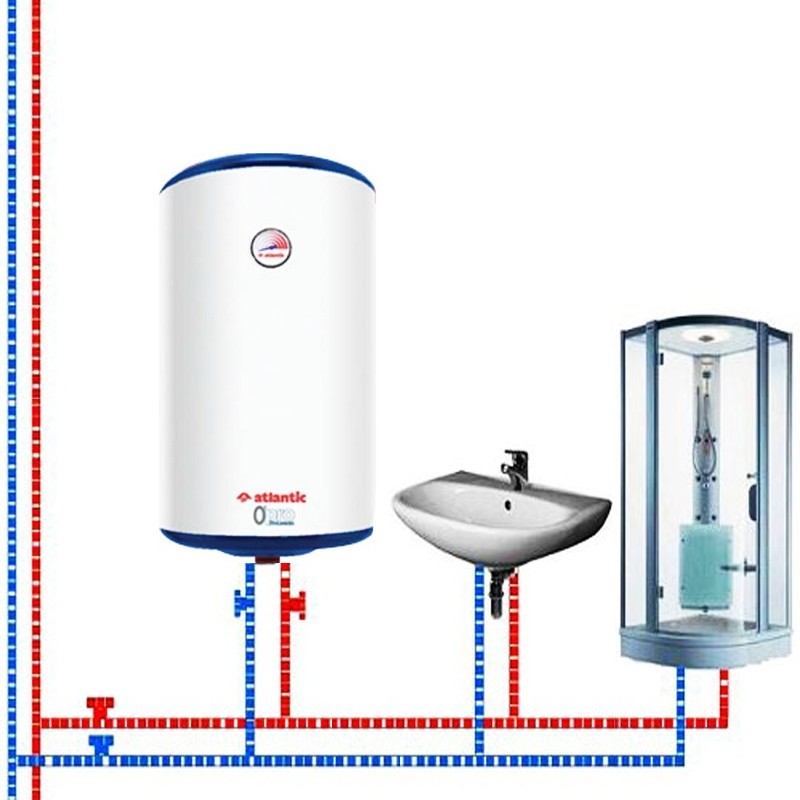
Boiler connection - diagram
Often, water heaters are equipped with three degrees of protection.
- A thermostat is a device that controls the operation of a heating element.
- Thermostat for temperatures above 90 ° C, which, structurally, is part of the first, but has a slightly different principle of operation. The main function of the second thermostat is to secure the first one, and if for some reason it does not work, this element will turn off the heating element so that the water does not boil.
-
The explosion valve is the last degree of protection to prevent an explosion. The valve is activated only after the thermostats for one reason or another did not work. It relieves the internal pressure in the tank, causing a lot of water to flow out. But the tank remains intact.
Rules for using the water heater Electrolux
The first start, switching on after a long idle time is carried out according to the standard scheme listed above: opening a warm water tap, filling the tank, inspecting for malfunctions and leaks, closing the tap after supplying an even jet without bubbles, heating. After a long period of non-use, it is necessary to thoroughly rinse the tank with a long descent of liquid.
Let's take a closer look at other operating features that the manufacturer indicates. The main among them is to carefully monitor the quality of water, which should be supplied without mechanical impurities, derivatives of petroleum products, harmful substances, etc. Compliance with these requirements excludes increased scale formation inside the tank, rapid wear of the anode rod.
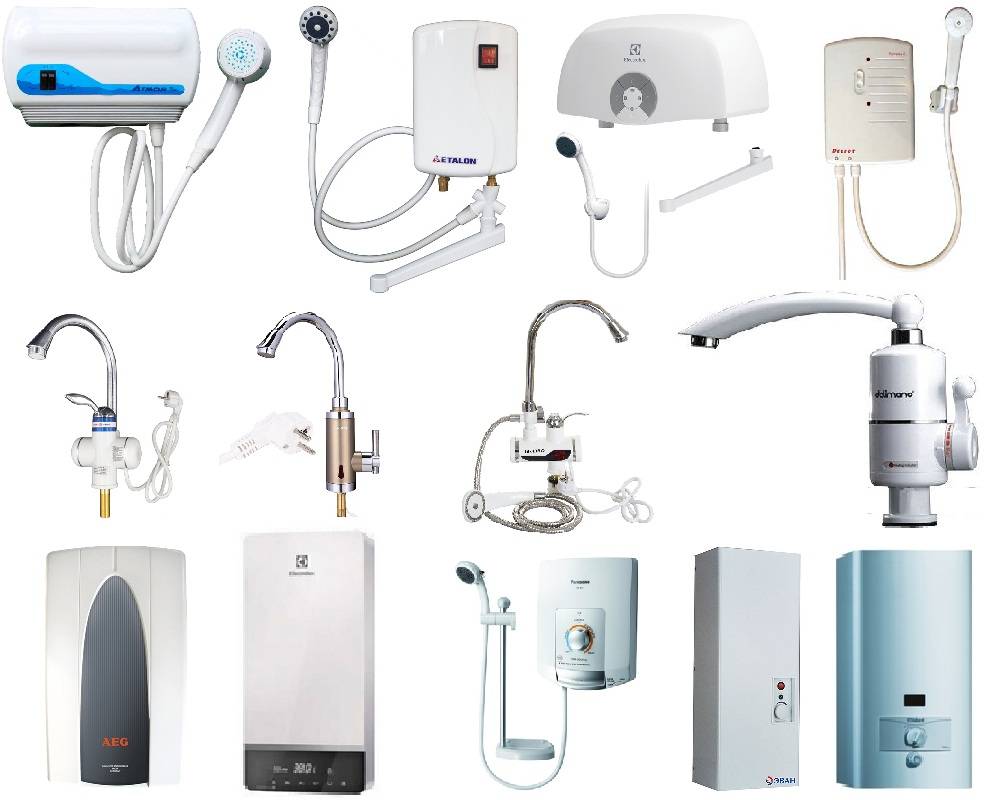

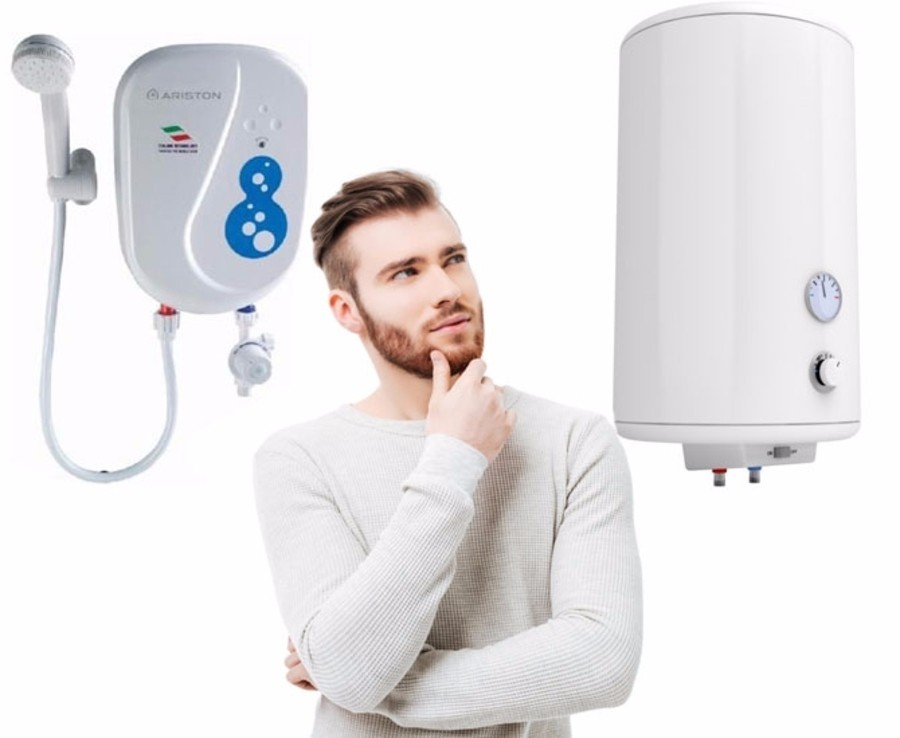




In addition, it is necessary to carry out timely maintenance of water heating equipment to ensure reliable operation with the call of a specialist. Technical work includes:
- Checking the tightness of connections;
- Filter cleaning;
- Inspection, cleaning of the internal space of the water-heating tank, heating element, which depend on the degree of hardness of the heated liquid;
- Checking the pressure in the water supply system;
- Inspection of the condition of the hull, thermal insulation;
- Checking the operation of protective, emergency devices, if installed;
- Inspection, replacement of the magnesium anode if necessary.
How to connect a instantaneous water heater to the water supply and electrical network with your own hands
Previously, we conducted a review in which the device of an instantaneous water heater is thoroughly covered, as well as recommendations for choosing.
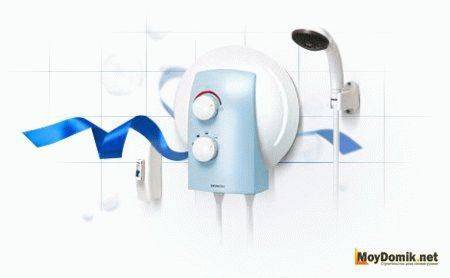
So, the new “protochnik” is delivered from the packaging, the instructions have been read and now is the time to think about how where is the best place to install instantaneous water heater.
It is advisable to choose a place for installing an instantaneous water heater based on the following considerations:
- whether in this place spray from the shower will fall on the device;
- how convenient it will be to turn the device on and off;
- how convenient it will be to use the shower (or faucet) of the device.
Before proceeding with the installation, you need to decide:
- whether it will be convenient to use the device directly in the place of taking a shower (or, say, washing dishes);
- whether it will be convenient to use different modes of operation (if there are such adjustments);
- whether moisture or water will get on the device (after all, there are clean 220V!).
- It is also necessary to take into account the future water supply - how convenient it will be to connect the instantaneous water heater to the water supply. There will be no special conditions for the wall - the weight of the device is small. Naturally, it will be somewhat more difficult to mount the device on curved and very uneven walls.
Do-it-yourself instantaneous water heater installation
Usually, the kit contains the necessary fasteners, but it often happens that the dowels themselves are short (for example, there is a thick layer of plaster on the wall) and the screws themselves are short, so I would recommend purchasing the necessary fasteners of the required dimension in advance. On this installation can be considered complete.
Connecting the instantaneous water heater to the water supply
An instantaneous electric water heater can be connected to water in several ways.
The first method is simple
We take a shower hose, unscrew the “watering can” and connect the hose to the cold water inlet to the water heater. Now, by setting the faucet handle to the “shower” position, we can use the water heater. If we put the handle in the "tap" position, then cold water comes out of the tap, bypassing the heater. As soon as the centralized supply of hot water is restored, we turn off the water heater from the “shower”, fasten the “watering can” of the shower back and continue to enjoy the benefits of civilization.
The second method is more complicated, but more correct
Connecting the water heater to the water supply of the apartment through the outlet for the washing machine. To do this, we use a tee and a skein of fumlents or threads. After the tee, to turn off the water heater from the water and to flow and temperature adjustments water from the water heater, a crane is required.
When installing a crane, you should also pay attention to the ease of use of the latter. After all, we will repeatedly open and close it in the future. The section of our water pipeline from the faucet to the water heater can be mounted using various pipes: from metal-plastic and PVC to ordinary flexible pipes
The fastest way, of course, is to make an eyeliner using flexible hoses.If necessary, our plumbing can be fixed to the wall (or other surfaces) using brackets or any other means of fastening
The section of our water pipeline from the faucet to the water heater can be mounted using various pipes: from metal-plastic and PVC to ordinary flexible pipes. The fastest way, of course, is to make an eyeliner using flexible hoses. If necessary, our plumbing can be fixed to the wall (or other surfaces) using brackets or any other means of fastening.
Connecting the instantaneous water heater to the mains
Forbidden use standard power outlets, due to the fact that in most cases they do not have proper grounding.
When connecting wires to screw terminals, phasing must be observed:
– L, A or P1 – phase;
- N, B or P2 - zero.
It is not recommended to perform electrical work on your own, it is better to use the services of a specialist.
Ways to solve problems with equipment
In the process of operation flow and storage water heaters certain problems may arise. Most often, this is the appearance of an unpleasant odor and mold flowing out of the tap along with warm water.


This situation occurs when a low heating temperature is set to 40 degrees or the device has not been used for a long time. These are favorable conditions for the development and reproduction of mold and fungi.
To eliminate this problem and not set the maximum heat, you can select the economy mode, if available for a particular model. In the eco mode settings, the boundary temperature of water heating is set at 50-55 degrees.
It is important to use the correct boiler connection diagram recommended by the manufacturer.
Secondly, you can not make a connection to the pipeline with hot water. Depending on the technical characteristics of the device, they are designed to work with water, the temperature of which ranges from 2 to 30 degrees.
This is the average range of acceptable values. For a particular model, the boundary values \u200b\u200bof the temperature of running water can be different, for example, from 5 to 20 degrees.
The third problem is when warm water stops running when the instantaneous water heater is running. One of the reasons is problems with the pressure of the incoming water.
For work some models require a special mixer low pressure. If it does not correspond to the technical capabilities of the device, the shutdown mechanism is activated. The heater will be able to resume operation only after the normalization of pressure.
Another reason is if blocked water supply by plumbing. It is not difficult to eliminate this, you need to resume the supply.
Fourth, too hot water may run. This problem in models with an automatic temperature control system indicates a breakdown and requires an urgent call to a specialist. Flow devices will have to increase the flow of water at the inlet or clean the supply pipes.
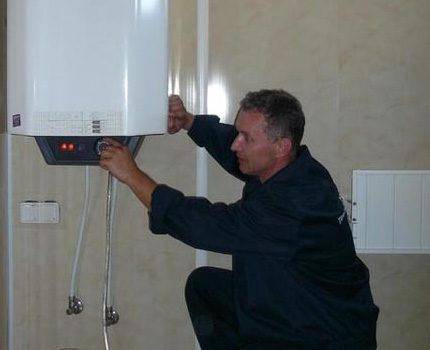
If the owner values the warranty service of an expensive device, then a specialist will have to be called in to eliminate any malfunction and annual maintenance.
The fifth problem is too cold water that does not satisfy the wishes of the owner of the water heater. In this case, the storage units are likely to break the thermostat.
It will not be superfluous to check the set temperature regime, because one of the family members could change the minimum water heating temperature.
For flow devices, this problem may indicate problems with the power supply. The second option is to increase the heating power.
After the expiration of the operating life provided by the manufacturer, do not continue to use the equipment. It must be dismantled and handed over for recycling.
If this is an electric model, then it is better to cut off the wire that is included in the network. This measure will protect against accidental use of the device by third parties.
Basic rules for using a water heater
Scheme of the device of an electric water heater.
- Before use, the device must be installed. The service life of the unit largely depends on the correct installation. During installation, follow the instructions supplied with the device. If grounding is required, then it must be done. In order for the device to work for a long time, it is not recommended to turn it off and on often. If hot water is needed every day, do not unplug the appliance from the mains. With frequent switching on and off, automation can quickly fail.
- Before turning on the boiler, you should close the hot water riser through which it is supplied to the apartment. After that, you can open two taps on the water heater and turn on the power. In order to turn it off, everything needs to be done the other way around. If there is no hot water supply to the apartment, then nothing needs to be closed. During bathing, it is not necessary to turn on hot water frequently.
- If you are leaving for a long time, then the boiler must be disconnected from the network.After a year of using the device, preventive maintenance should be carried out. The higher the water temperature is set, the more it needs to be diluted. If only one person lives in the apartment, then you can immediately set the required temperature so that there is no need to dilute the water later. This will save money. If a large number of people live, then you should set the maximum temperature so that there is enough water for everyone.
How to use instantaneous water heater
A tankless water heater has its advantages and disadvantages. The first include the fact that the use of such heaters does not limit your family in the amount of hot water consumption. You can even take turns swimming all day with the whole family. The inconvenience is the impossibility of simultaneously supplying hot water to multiple water points. Yes, and with a strong pressure of water, it is difficult to achieve a high temperature of its heating, if there is no way to adjust the flow.
Instantaneous water heater
Particular attention should be paid to the installation of an instantaneous electric water heater. The high power of this device is based on the high power consumption
And in order to avoid overheating of the network, it is wiser to lay a separate wiring and for this it would be more correct to invite specialists. High-quality installation and proper connection of the water heater will protect your family from misfortune.
For efficient operation of the equipment and reduction of energy costs, you need to know how to use an electric water heater:
- Remember, the closer you place the water heater to the faucet, the less the water will cool down “on the way”.
- With increased water hardness, it is recommended to install special filters, so you will extend the life of the device.
- Flowing water heaters should not be left in rooms with negative temperatures, this leads to their damage and breakdowns.
- Turning on the instantaneous water heater, check the water pressure at the tap. With a low pressure, it is recommended not to set a high heating temperature, as the device may not turn on at all.
In order for household equipment to work efficiently for many years, it is necessary to follow the rules of use and maintenance. Our article, expert advice and instruction manual will help you with this. instantaneous water heater or boiler.




Published: 27.09.2014
Gas or electric water heater
In this matter, everything is quite simple. Gone are the days of gas installations. This is not the safest equipment, which also requires compliance with established standards. For example, there is SNiP 42-01-2002 (was adopted instead of 2.04.08-87), which refers to gas distribution systems, there is a clause that says that gas appliances are not recommended to be installed in some rooms. For example, in bathrooms with a footage of less than 6 m2. Also, a chimney must be present in the room, since columns are not connected to the hood. There are many other requirements as well.
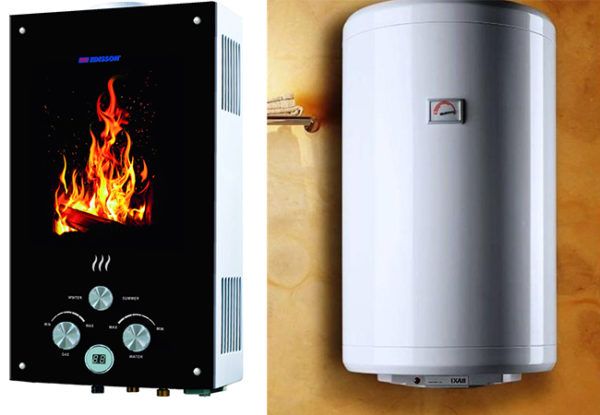
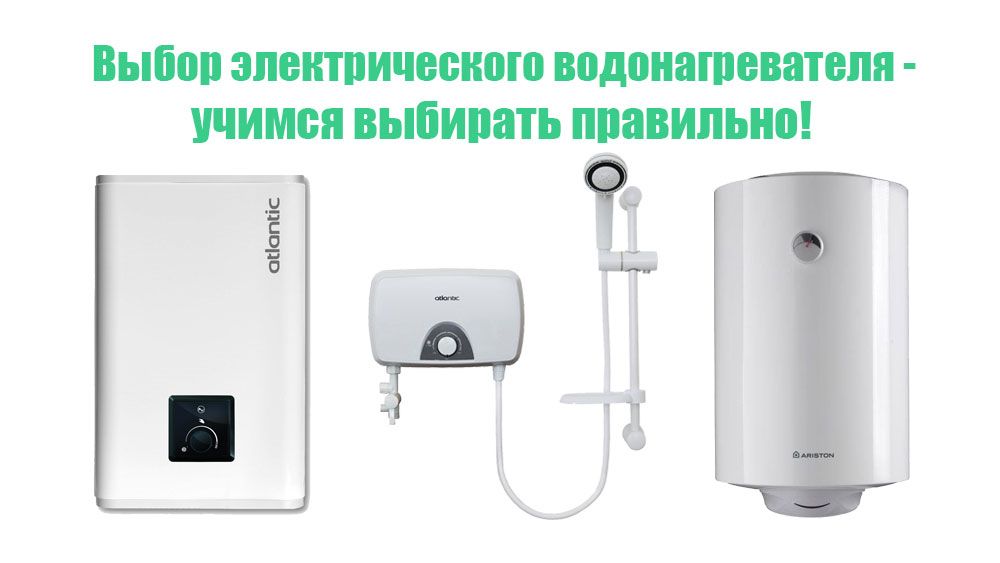
Electric water heaters are more modern systems that are much easier to operate and maintain. However, there are many such models. Before deciding on the main characteristics of boilers, it is worth deciding which type of equipment is better.
What to do if the indicator light does not light up and the water does not heat up
First, it is necessary check if power is being supplied to apparatus. Perhaps you started using the water heater to heat water, but forgot to plug the boiler power cord into the socket. If there are no problems with this, then check if there is a contact in the cable connecting the heater to a socket or electrical panel, depending on how you connect.
If the water heater is connected to the network, but still does not work, adjust the thermostat knob. It can stand at the minimum values. Turn the knob clockwise, the heater will work again.
If you turned the thermostat knob, but the heating did not start, the safety thermostat most likely worked. The inclusion of a protective thermostat is possible for a number of reasons: power surges, contamination of the device, scale formation, etc. The protective mechanism starts automatically, turning off the device immediately after it is turned on.
To turn on the water heater, you need to find the thermal protection button. In most cases, the button is located under a plastic cover at the bottom of the tank body. Before removing the protective cover, you must turn off the water heater electrical networks. After the appliance is turned off, you can remove the protective cover, press the thermal protection button, put the cover back in place, and then reconnect the water heater to the network.
Water heaters have already become an integral part of our everyday life. If you follow all the recommendations and use the water heater correctlythen it will last a long time. But do not forget that boilers, like all household appliances, tend to break. If the breakdown is serious, and none of the above methods solved your problem, do not try to disassemble and repair the equipment yourself.For more serious issues, the best option would be to contact an experienced specialist.
Read also:
Preparing for installation
Before installing a storage water heater several metal hooks are screwed to the wall. As a rule, mounting components are not included with the equipment. A water tank is attached to these elements. The tank should be parallel to the floor, vertical deviations are not allowed.
It is advisable to install the storage water heater on a load-bearing wall.
It is important to consider what material it is built from. The best option is brick or concrete
In these cases, the wall withstands the influence of a significant load, which turns out to be a water heater. Fastening is simple, it is carried out with 2 strong anchors. Additional fixing is not required.