
- Connection
- DIY pool filtration system
- The principle of operation and types of filtering devices
- Option #1 - sand filter
- Option #2 - cartridge filter
- Option #3 - diatomaceous earth filter
- Which filter is better sand or cartridge for the pool
- How to take care of your pool
- Acid-base balance of water
- Video description
- DIY cleaning system
- Kinds
- Lists of the best
- TM Intex (28602) - inexpensive
- INTEX 26652 - sand
- 220-240V JILONG FILTER PUMP 29P415EU - cartridge
- Pool filters: types and design features
- sand pumping
- Diatoms (earth)
- Cartridge disposable
- Conclusion
- Conclusions and useful video on the topic
Connection
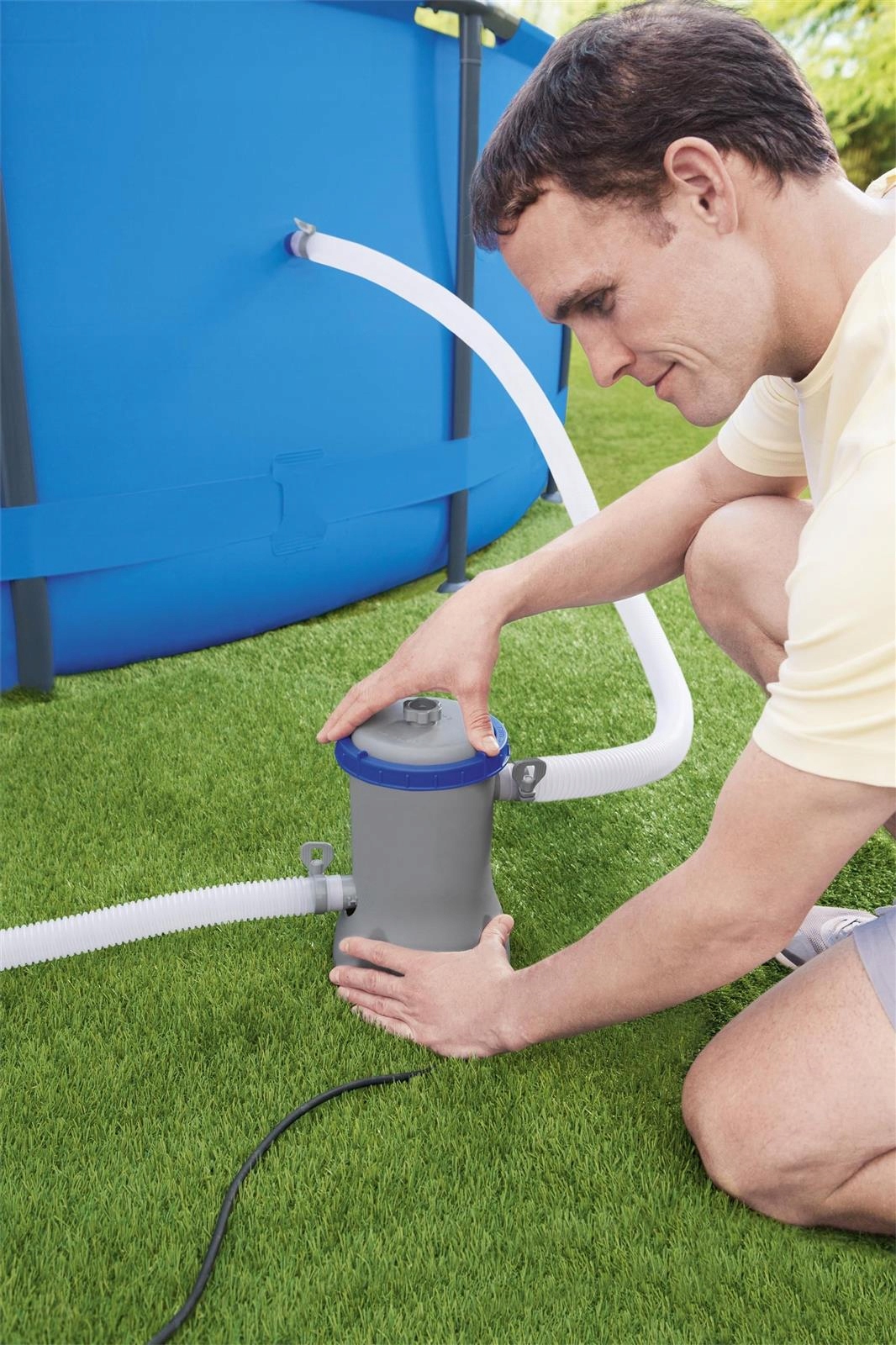
When connecting the system to the pool, you must first follow the instructions that came with the device. The fact is that different models may have differences in installation. But in general, the installation order looks like this:
First you need to determine where it will be located water purification system.
Then you should fix the filter on the bracket (if included) or without it in the chosen place in such a way that there is a gap of at least 10 cm between the floor and the device, as this will facilitate the replacement of cartridges in the future.
After that, you need to connect the filter to the water supply system and carefully open the water to check all connections for leaks.
If leakage is found in any place, it is necessary to coat the connection with silicone sealant.
When everything is in order, you can start using the filter.
Of course, you can carry out this procedure yourself, but it is still advisable to entrust the installation of equipment to professionals in order to be sure that the installation will be carried out in accordance with all the rules.
DIY pool filtration system
The filter itself is a simple device that you can easily build yourself if you intend to use it in small private pools. Homemade options are able to maintain the normal state of the water.
Floating cartridge cleaner. To assemble such a unit, you need a piece of polypropylene pipe about 2.5-3 meters with a diameter of 50 mm, a corner of the same diameter, one or more cartridges that are used for water purification, a pump and an M12 stud with a thread of the desired length.
At the bottom of the pipe, the pump pumps water, it passes through the filters and pours back into the pool through the corner.
- Drill a hole in the cartridges and the corner, string them on a stud, insert them into the pipe.
- Bring the pin through the hole in the corner to the outside and fix it here with a nut.
- Connect the aquarium pump to the lower end of the tube.
Do-it-yourself filter for a small pool is assembled. To make it "floating" at the top and bottom, you can attach several pieces of high-density foam.
Not the most productive device, but it is very simple, inexpensive and does not require connecting a large number of hoses.
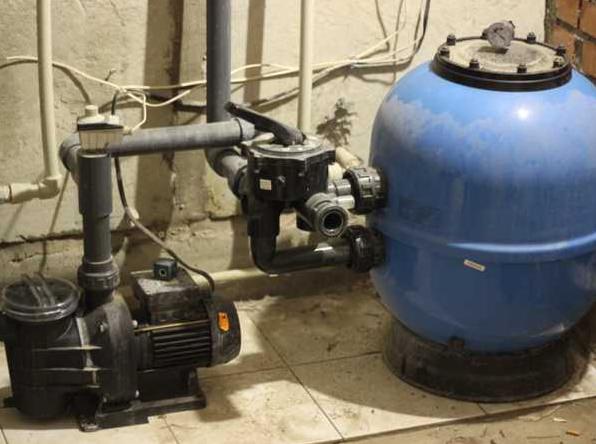
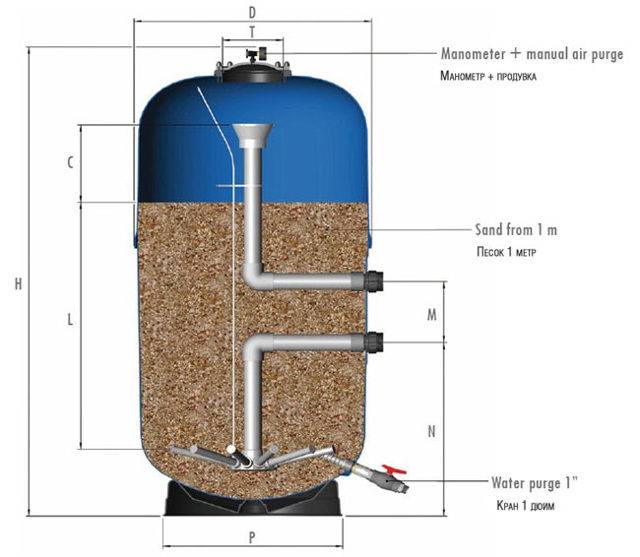
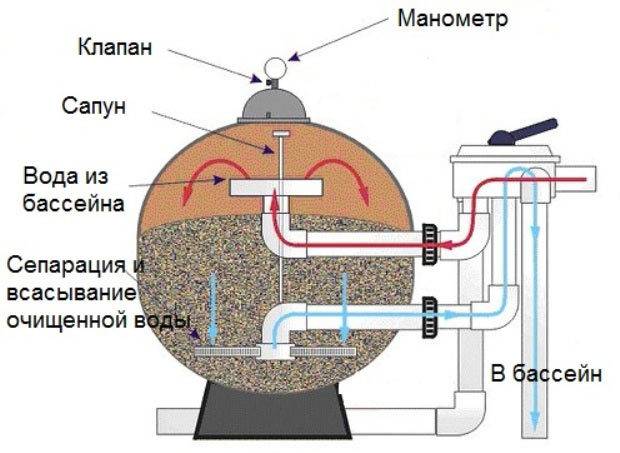
Sand filter.The design of the sand filter is simple and uncomplicated: a plastic container is filled with various fractions of sand, on which polluting particles settle. Water is supplied to the upper part, passing through the sand, cleaned, and below through a system of thin tubes in which small holes are drilled, it is collected and discharged through the second branch pipe.
The design can be made even simpler. Then the supply pipe or hose is connected through the cover. Water extraction can also be only with a hose connected at the bottom of the tank. To prevent sand from being sucked in with water, it can be covered with a filter cloth in several layers.
But such a system is not very effective: this piece of fabric will clog quickly. You can solve the problem if you make microscopic holes in the bottom, and install another container below, into which already filtered water will flow.
In this case, the outlet pipeline is connected not at the very bottom, but a little higher, so that the sand particles that fall into the tank settle, and clean water is supplied to the pool. The pump can be put on pumping water from the pool or pumping it out of the barrel.
Both schemes work. Whichever one you think is easier to create and more effective, use that one. It will be necessary to connect two durable hoses to the barrel: through one, contaminated water will be supplied to the barrel, and through the other, purified water will be discharged.
To ensure maximum cleaning, it is recommended to dilute them as far as possible. Ideally - in opposite corners of the pool. This will ensure good circulation.
After studying all the devices and systems, you know which pool filter is right for you.Using the above methods of purifying the liquid in combination, you can admire the purity of the water mirror for a long time. However, it is worth remembering the prevention and care of filling the bowl.
The principle of operation and types of filtering devices
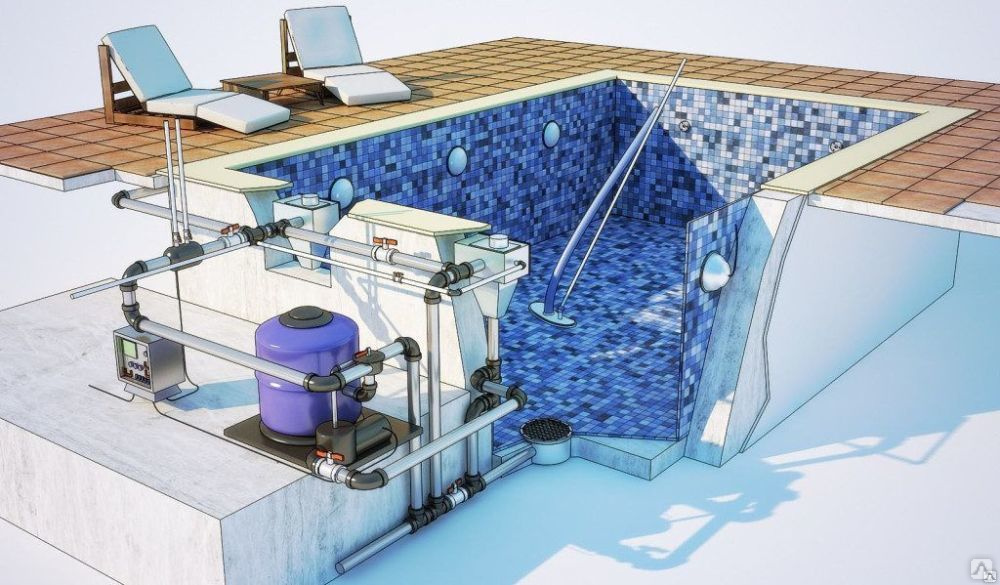
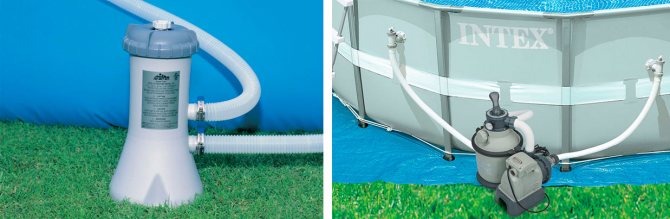
The pool filter is a device specially designed to purify pool water and keep it clean for a long time. According to sanitary standards, water filtration in the pool must be carried out 2-3 times daily, regardless of whether you swam in it or not. The principle of operation of the filter is quite simple: with the help of a pump, polluted water from the pool is passed through the water intakes and passes through the filter unit. The clean water then flows back into the pool.
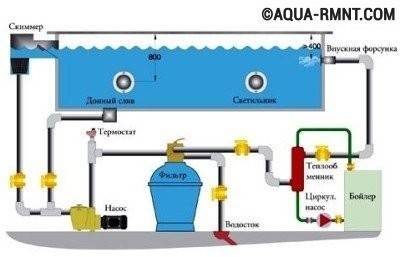
Water filtration is the most reliable method of purifying pool water from solid impurities, so the presence of a filtration unit is mandatory for its operation.
Modern filters for pools filter out both large particles and microscopic inclusions. The degree of purification depends on the type of filter used and on the speed of filtration. At a lower cleaning speed, a better purification of the liquid occurs. The filter installation is selected taking into account the type and size of the pool.

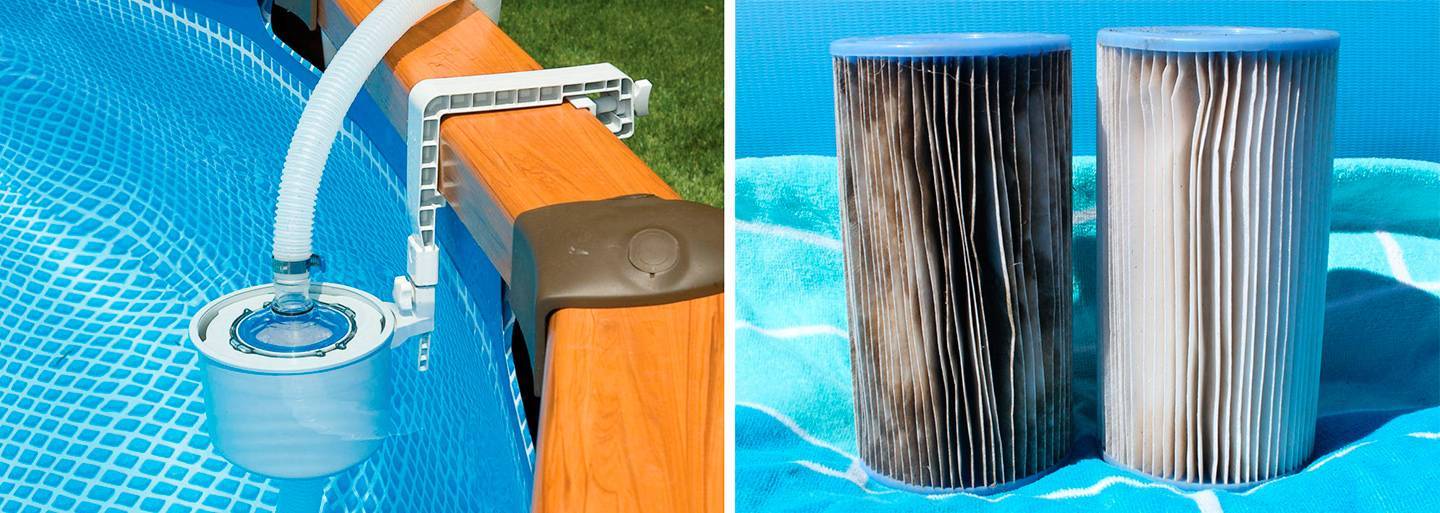
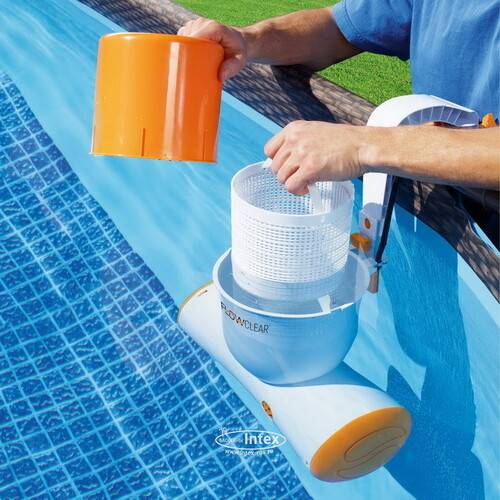

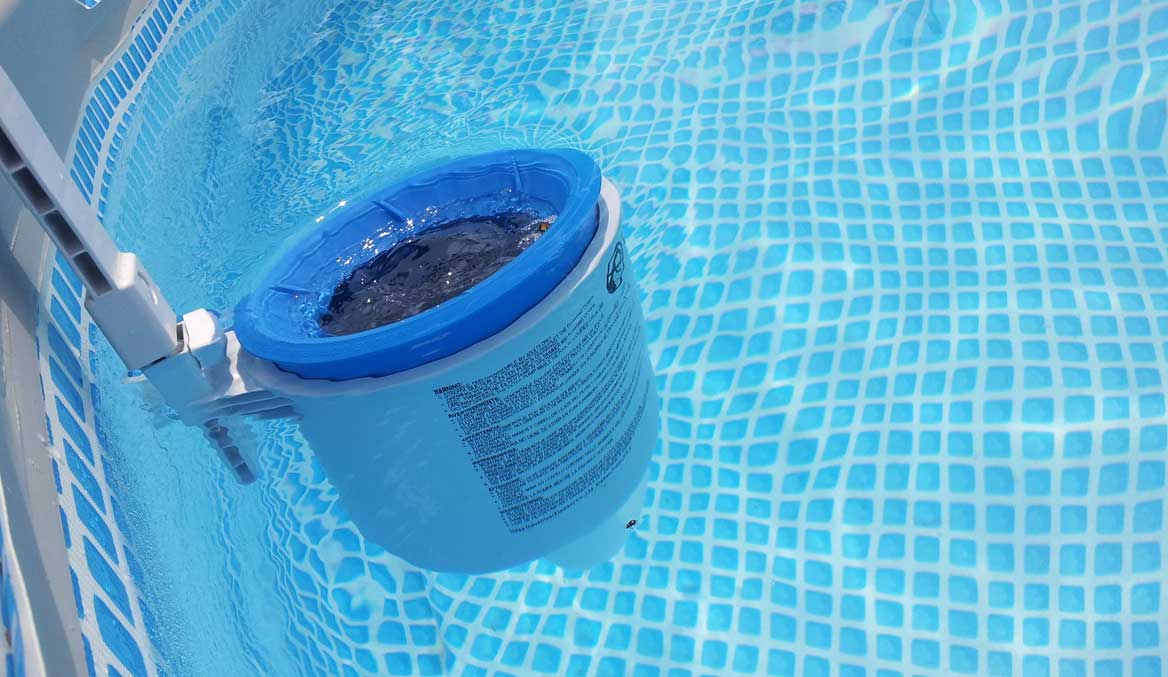
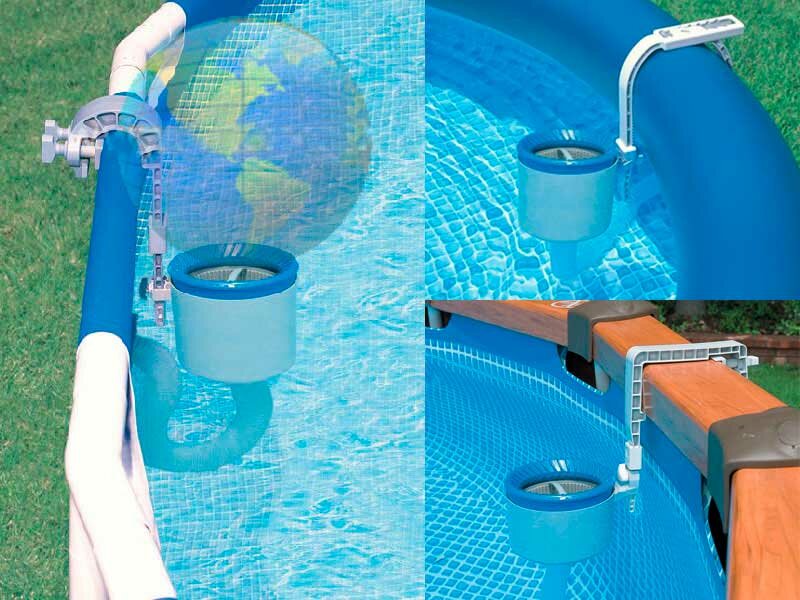

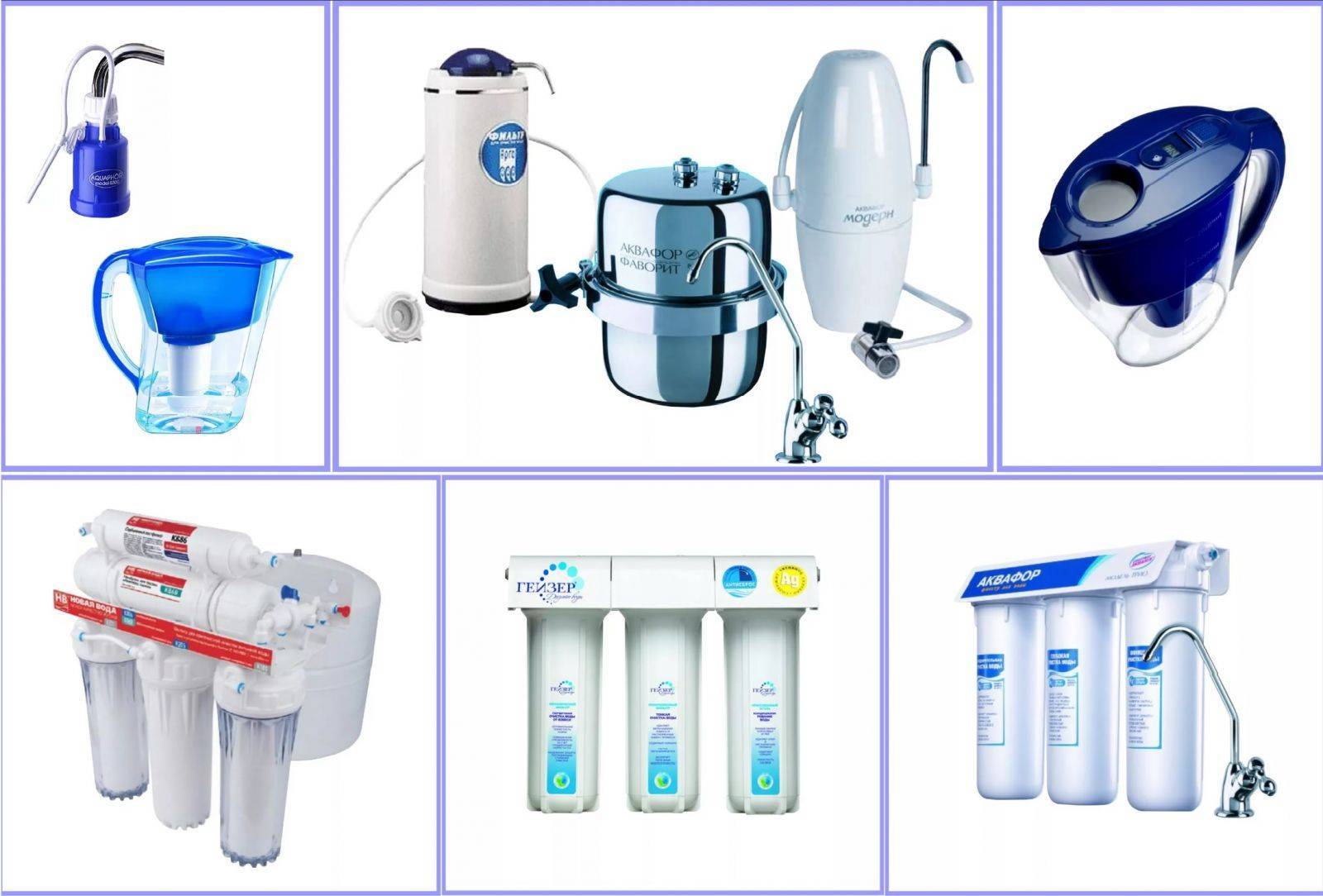
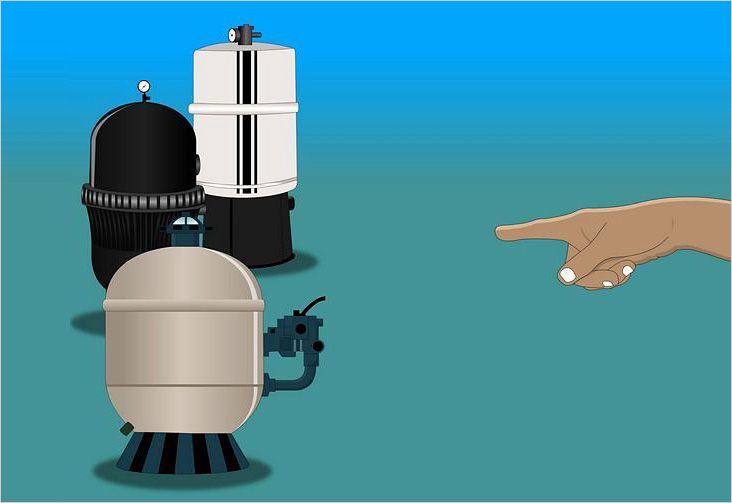
On the modern market, there are mainly three types of cleaning plants:
- sand;
- cartridge;
- diatoms.
In all cases, the water from the pool is subjected to mechanical filtration.
Option #1 - sand filter
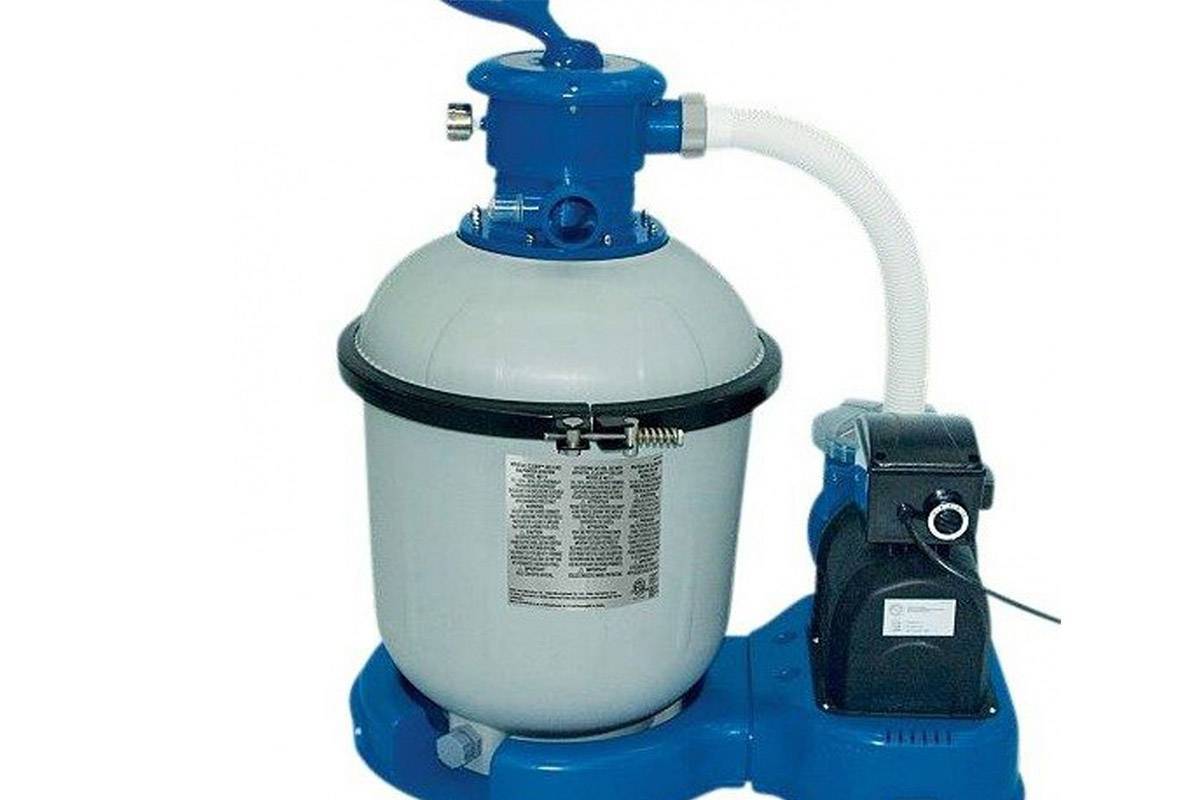
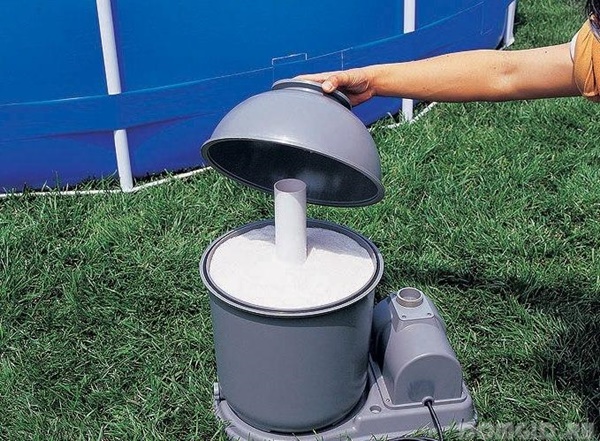
This is a device that does not differ in design complexity: the water in it is purified using fine calcined quartz sand. This is in fact a conventional sand-filled tank, into which water is supplied by a pump.It is possible to install a multi-layer filter made of gravel, quartz sand and carbon-anthracite. There are also variations with glass and silver sands in filters. Sand water purification is the fastest. The cost of such a filter is low, but its disadvantage is its impressive size and heavy weight, so such models are mainly used to filter water in stationary public pools. For washing water in inflatable and frame pools, cartridge models of filters are used.
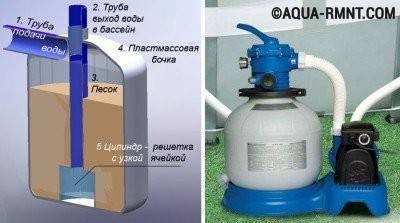
In the sand filter, the filter bed is quartz sand of different fractions with cubic sand grains that trap dirt particles.
Option #2 - cartridge filter
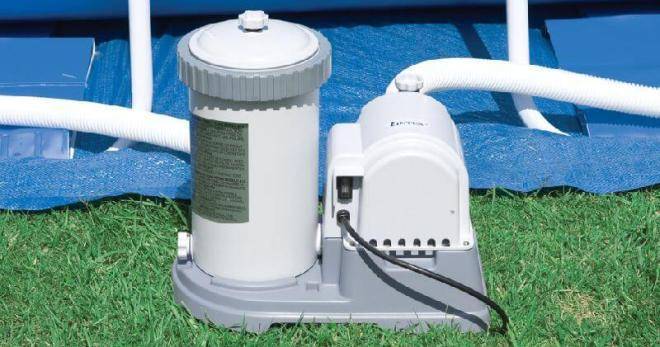
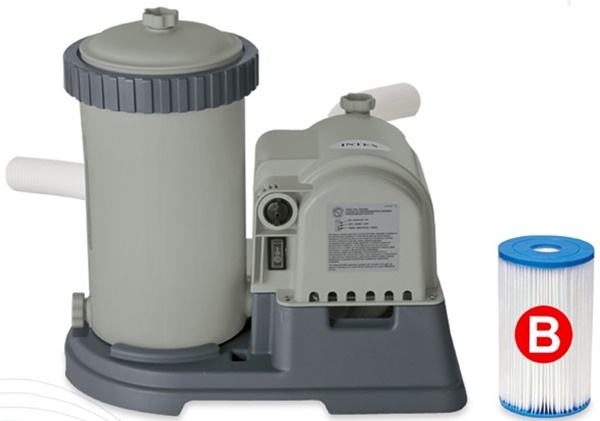
This variant contains propylene membranes as filter elements. They require frequent flushing and replacement, but are inexpensive, so in case of clogging or breakage, they are easily replaced. Cartridge filters, unlike sand filters, are small in size, they can be installed outside the pool and disguised so as not to spoil the appearance. At choosing such an installation, the main criterion - the volume of water passed per hour (filter performance). This parameter is indicated by the manufacturer in the instructions or on the packaging.
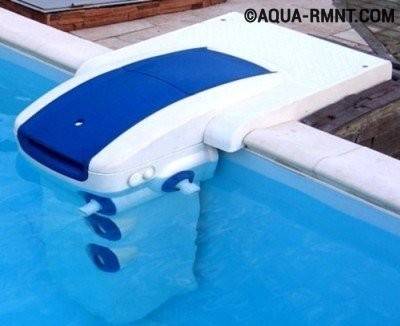
Cartridge filters are usually used for water filtration in small and medium-sized pools. If the cartridge is clogged, replace it with a new one.
Option #3 - diatomaceous earth filter
This option is the most expensive, but also the highest quality filter for the pool. It consists of several cartridges. The filter medium inside this device is diatomaceous earth (microscopic particles of the skeletal mass of fossils).The presence of several cartridges provides a high degree of cleaning: the declared fineness of cleaning is several micrometers. These filter units neutralize most microbes.
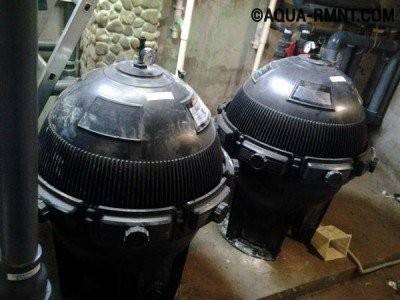
The diatomaceous filter works on the basis of soil with silicon dioxide. This is a rock formed from the fossilized shells of yellow-brown or gray algae.
This filtration method allows you to clean the reservoir from particles smaller than 1 micron in size. By applying this treatment, it is possible to reduce the use of chemicals by 80%. In addition, it is believed that water filtered in this way has rejuvenating and healing properties. Such water is popularly called silicon water. Bathing in such a pool improves the functioning of the immune system, the condition of hair, skin and nails. This water combines the miraculous properties of melt, spring and silver water.
Which filter is better sand or cartridge for the pool
In this section of the article, we will conduct a comparative analysis of two types of cleaning elements (with sand filler and combined cartridge). Based on the results of the survey, you will be able to familiarize yourself with the advantages and disadvantages of each of the above models and choose the most suitable sample for your conditions.
When evaluating the sand version, we immediately note that this method of water treatment is the fastest, which significantly reduces the effectiveness of cleaning procedures. Its disadvantages also include significant dimensions and a fairly large weight, which determine the area of use of this modification (mainly - these are stationary pools used for public purposes).At the same time, the only advantage of sand-filled filters is their low cost.
For high-quality water purification in inflatable or frame pools, as a rule, cartridge models of filters with a set of propylene membranes built into them are used. The indisputable advantages of these cleaning elements include:
- relatively small dimensions, allowing them to be installed even in miniature baths;
— high level of maintainability;
- low cost of replacement elements.
Unlike sand models, cartridge-type filters can be located both on the pool body and at some distance from it. At the same time, the product used can always be disguised in such a way that it does not violate the perception of the natural environment in the country house (that is, it is almost imperceptible within the boundaries of the area selected for the pool).
Thus, the question of acquiring the most suitable model of a mechanical water treatment device for your conditions boils down mainly to the following points:
- first of all, it is necessary to determine the type of pool in which it is planned to use one or another element of the purification of the aquatic environment;
- further, you should have a clear idea of how often you will use your reservoir;
- and, finally, you will need to make a careful calculation of the upcoming costs associated with the acquisition and maintenance of one or another type of cleaning device.
And only after you have studied in detail all the conditions indicated above, determined by the characteristics of the operation of a particular pool, it will be possible to choose one of the models of cleaning devices that we compare.
How to take care of your pool
In principle, there are no complicated cleaning measures. Here are some tips to help keep your pool in top condition. This applies not only to water, but also to the internal surfaces of an artificial reservoir.



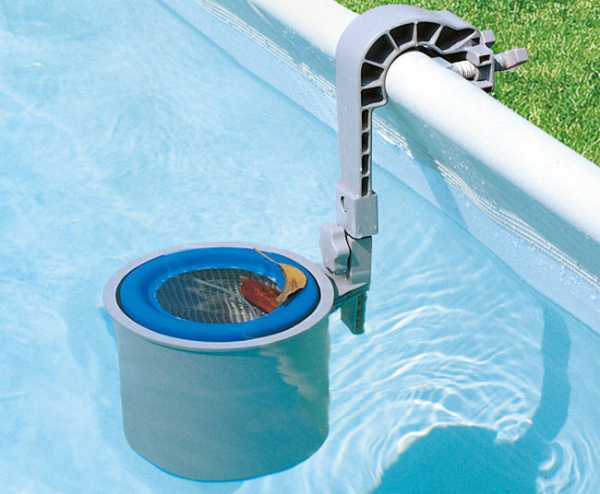
Be sure to install a filter in the pool.
Every day, and preferably twice a day, collect garbage from the surface of the water surface. Especially harmful are the leaves, which, under the action of sunlight, begin to rot.
Pay attention to insects that have fallen into the water, especially wasps, bees, bumblebees, earwigs and other equally dangerous insects.
Twice a week it is necessary to carry out water treatment with chemicals. In this way, you can protect the reservoir from the blooming of water.
If your pool is inflatable, change the water at least once a week.
If children under the age of 3 years old swim in the pool, then the water in the pool should be changed more often.
Separately, I wanted to talk about rust. Or rather, about water, in which there is a high content of iron salts. It is these salts that color the water yellowish, and sometimes brown. Swimming in this pool is not worth it. Iron in this form will negatively affect the skin. Therefore, iron must be eliminated.

Rusty pool water
The easiest option is to let the water settle in some other tank, and then pump it into the pool. You can use a special coagulant, which is added to the filled thicket. The chemical binds iron salts, which precipitate as flakes. It remains only to remove the latter with a vacuum cleaner.
Acid-base balance of water
There is a generally accepted indicator of acid-base balance for water in the pool. It is equal to 7.2-7.4.That is, when installing a bathing bowl in your country house, it is necessary to maintain water filling in this mode. For analysis, you can use special reagents. They are freely available and come with instructions on how to use them. Therefore, problems with the analysis should not arise.

You can check the pH of the water yourself
Many may have doubts whether it is worth it. Let's just say that the pH of this value does not allow bacteria to develop, plus the chemical reactions associated with the corrosion of metals weaken. That is, the operational characteristics of the hydraulic structure are increased. Namely: the filtration system does not clog, the lighting and heating system works efficiently and for a long time.
At the same time, a normal acid-base balance enhances the effect of chemicals that are used to purify the water mass. Today, manufacturers offer filters, inside which they additionally install separate containers, where the required coagulant is poured, which is responsible for normalizing pH.
Therefore, when buying filters, pay attention to this. Give preference to just such, although they are slightly more expensive than usual
Video description
In the video, a specialist answers surveys regarding pool water treatment:
So, in the article we tried to answer the question - how to purify the water in the pool in the country. Several ways have been dismantled to make the water cleaner. Of course, there are many cleaning methods, for example, ozonation, treatment of the water mass with ultraviolet radiation, active oxygen, and the ionization process.All these technologies are effective and guarantee a 100% effect. But they are expensive and are used mainly for large volume pools. And for country models, those that were described above are also suitable.
DIY cleaning system
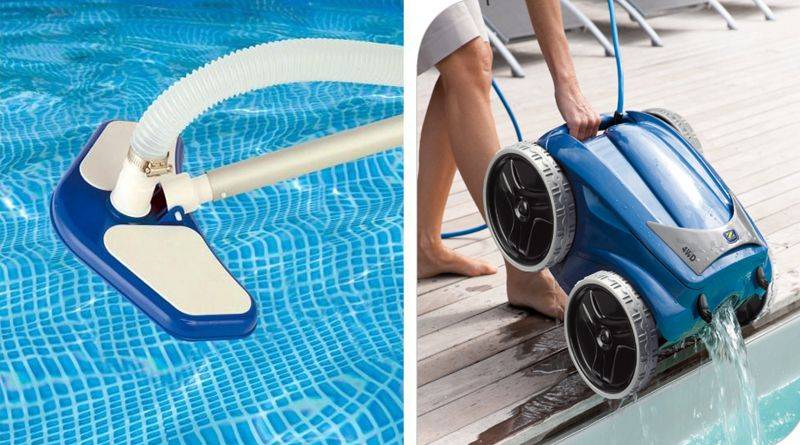
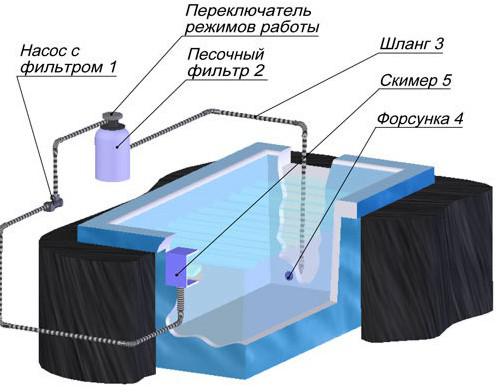
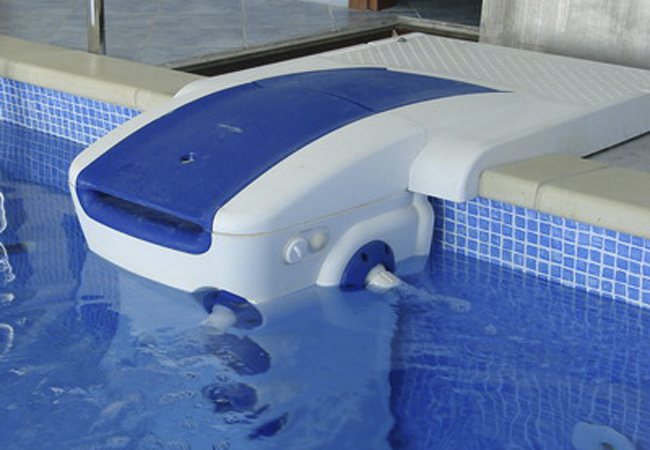
The system for cleaning framed pools includes mounted skimmers, thanks to which grease, hair and floating debris are removed from the surface. And usually a cartridge filter or sand. Either way, they both do a great job. It must be remembered that the smaller the tank, the more often it needs to be cleaned and replaced with water. Therefore, it is advisable to have a water vacuum cleaner in the frame pool care kit and, of course, use chemicals.
The do-it-yourself pool cleaning system is made from the following materials:
- Plastic container. Installed next to the pool.
- Sand. Plastic containers are filled with quartz or glass sand.
- Hoses. Connect to container. Through it, water will flow into a plastic container.
- Filter pump. Need enough power for your pool.
- Mounts. With their help, we connect the hoses to the filter system. The hoses can be brought to the built-in nozzles or thrown over the side. The inlet and outlet hoses should be in different places in the bowl so that there is good water circulation.
- Filter. It is placed between the container and the pump to avoid blockages.
- Water intake with mesh. Lower to the bottom of the pool, through it the purified water will flow back into the pool.
Floating cartridge cleaner.To assemble such a unit, you need a piece of polypropylene pipe about 2.5-3 meters with a diameter of 50 mm, a corner of the same diameter, one or more cartridges that are used for water purification, a pump and an M12 stud with a thread of the desired length.
At the bottom of the pipe, the pump pumps water, it passes through the filters and pours back into the pool through the corner.
- Drill a hole in the cartridges and the corner, string them on a stud, insert them into the pipe.
- Bring the pin through the hole in the corner to the outside and fix it here with a nut.
- Connect the aquarium pump to the lower end of the tube.
Do-it-yourself filter for a small pool is assembled. To make it "floating" at the top and bottom, you can attach several pieces of high-density foam.
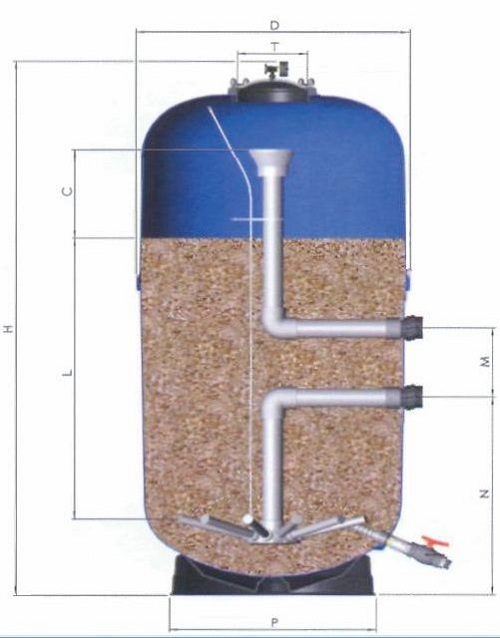
Sand filter. The design of the sand filter is simple and uncomplicated: a plastic container is filled with various fractions of sand, on which polluting particles settle. Water is supplied to the upper part, passing through the sand, cleaned, and below through a system of thin tubes in which small holes are drilled, it is collected and discharged through the second branch pipe.
The design can be made even simpler. Then the supply pipe or hose is connected through the cover. Water extraction can also be only with a hose connected at the bottom of the tank. To prevent sand from being sucked in with water, it can be covered with a filter cloth in several layers.
But such a system is not very effective: this piece of fabric will clog quickly. You can solve the problem if you make microscopic holes in the bottom, and install another container below, into which already filtered water will flow.




We invite you to familiarize yourself with: Powder for cleaning chimneys: anti-carbon chemical composition
In this case, the outlet pipeline is connected not at the very bottom, but a little higher, so that the sand particles that fall into the tank settle, and clean water is supplied to the pool. The pump can be put on pumping water from the pool or pumping it out of the barrel.
Both schemes work. Whichever one you think is easier to create and more effective, use that one. It will be necessary to connect two durable hoses to the barrel: through one, contaminated water will be supplied to the barrel, and through the other, purified water will be discharged.
Kinds
There are three types in total:
- With cartridges - replaceable filter elements purify the water, they will have to be changed periodically - about every month.
- Sand - the flow will pass through a container with quartz or glass sand. From time to time, the sand needs to be washed - weekly is recommended. And once a year, cleaning of the system with the help of chemicals is required.
- Combined - this is a device with a filter and a chlorine generator, which is a system that releases a disinfecting chlorine solution from ordinary salt (NaCl).
River sand and iodized salt should not be used. It is necessary to purchase special consumables for pumps with filters for swimming pools.
There are also diatom pumps, which use plankton powder as a filter mixture. They are more expensive than others, but purify water as efficiently as possible. One of the disadvantages of such a system is that the filter composition needs to be replaced periodically.
Classification by type of action:
- Centrifugal and vortex. Inexpensive models, have a high noise level, but low performance. Pumps are good for installation in small pools. Able to work for many years without any complaints.
- Self-priming.Well suited for installation in water treatment systems. Low cost and a fairly low noise level will make your stay as comfortable as possible. The performance is modest, so these pumps are most often used for small and medium pools.
- Circulating. The most powerful filter pumps, in 24 hours such a system can pump the entire volume of water at least 4-5 times, and when installed in small pools, this figure can exceed 6-7 times. Suitable for large artificial reservoirs, commercial pools.
Expert opinion
Kulikov Vladimir Sergeevich
The choice depends on the type, volume of the bowl and frequency of use.
Lists of the best
In addition to the above list of models, we have created another list of the best devices, distinguished from each other by their special characteristics. This TOP includes the following devices:
- Inexpensive.
- Sand.
- Cartridge.
Let's take a closer look at the presented range.
TM Intex (28602) - inexpensive
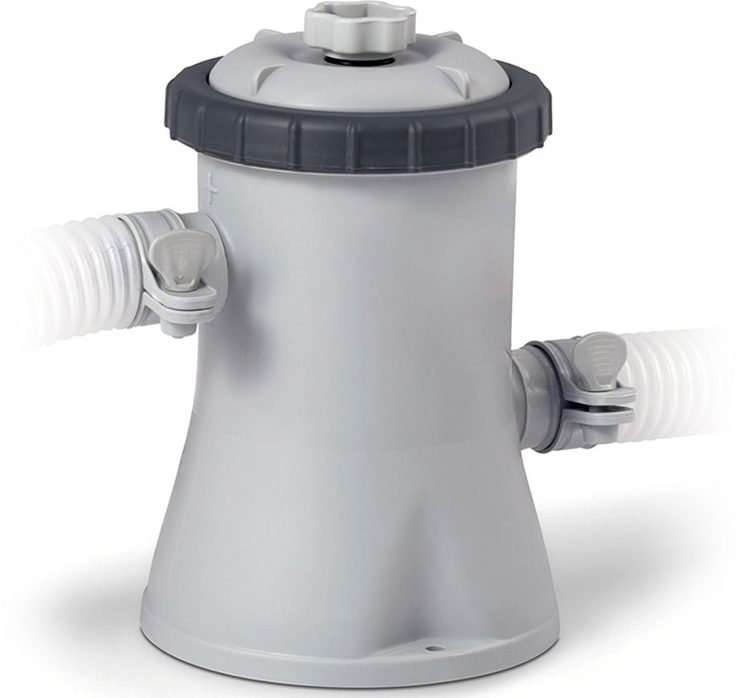
The presented filter is recommended for installation of round pools with a diameter of 183 and 244 cm and rectangular pools up to 300 cm in size. It is connected to regular pool openings using two corrugated hoses. The power consumption is only 30 W, and the productivity is 1250 liters per hour. Purifies the water in the pool in accordance with the norms and rules of hygiene.
Price category: from 1650 to 2700 rubles.
pool filter TM Inteks (28602)
INTEX 26652 - sand
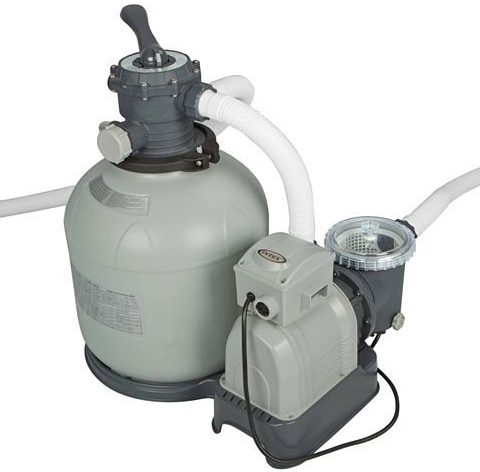
The presented filter with a capacity of 10,000 liters per hour can be used to clean frame and inflatable pools, with a diameter of 549 cm or more.This device is capable of operating in six different modes and, among other things, has a timer that automates its work cycle. There is also an emergency shutdown and a backwash mode for the filter element, if it becomes dirty during operation. This device perfectly purifies the water in the pool or in any other body of water, allowing you to feel comfortable in the aquatic environment without worrying about your health.
Price: from 14990 to 21300 rubles.
pool filter INTEX 26652
220-240V JILONG FILTER PUMP 29P415EU - cartridge
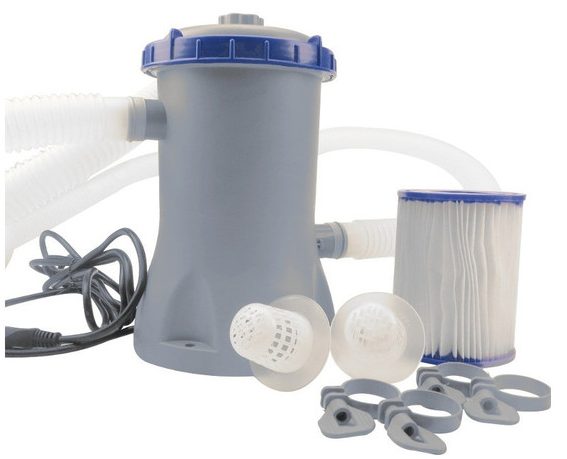
The presented device traps dust, small debris and various rubbish inside the filter cartridge. Using the device is very simple, just connect the hose to the filter pump housing and connect it to a 220 V mains supply. Each pump is tested and factory tested. This filter pump is recommended for purifying water in frame pools with a diameter of 366 cm.
Price category: from 3000 to 3600 rubles.
pool filter 220-240V JILONG FILTER PUMP 29P415EU
Pool filters: types and design features
All filter models have a single purpose - water purification and blocking of microparticles to avoid contamination. The difference in characteristics is the presence of additional modes of operation and design features.

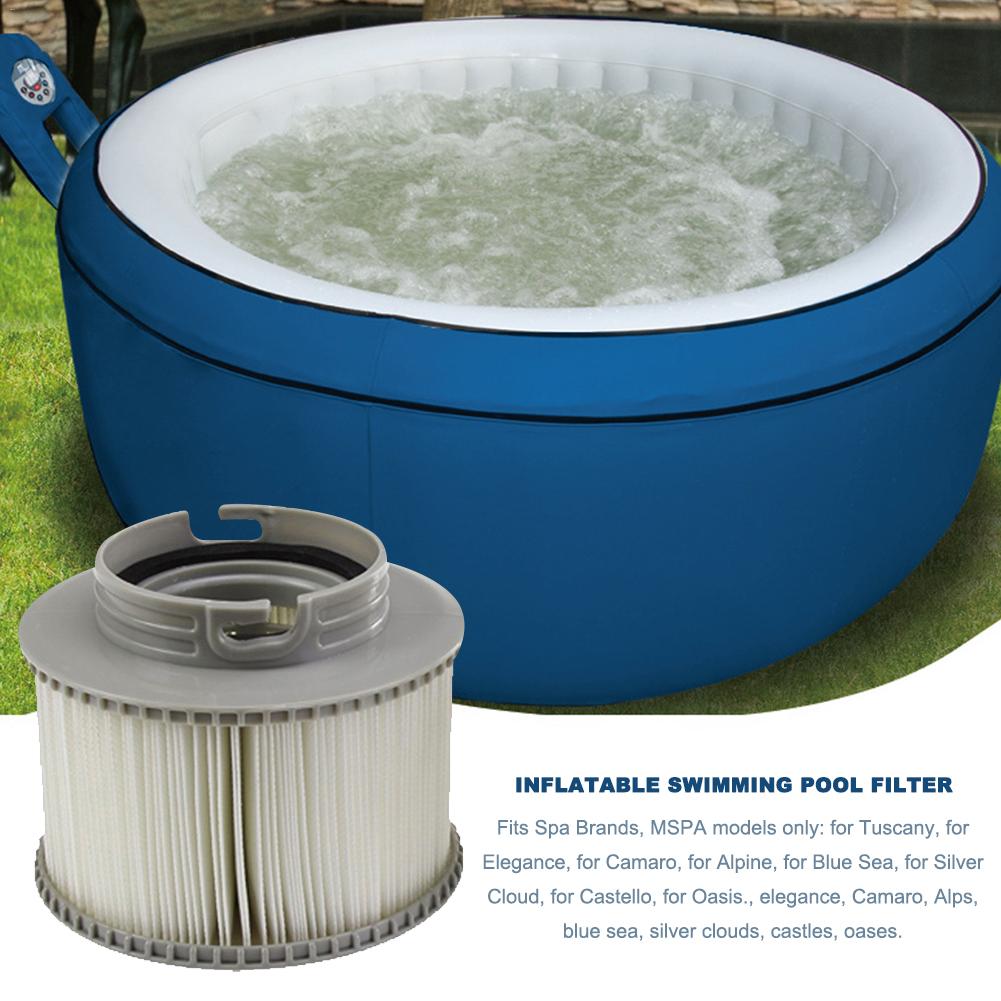




sand pumping
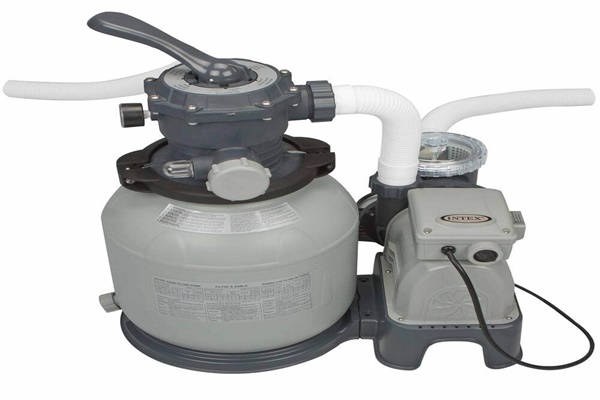
Sand filters are the most budgetary cleaning systems. The design consists of a sealed plastic container, which has two holes used for the supply and output of liquid.
The container is filled with quartz sand, and it plays the role of a filter. Heavy metal salts and organic suspensions remain in the quartz layer.The same applies to chemical compounds formed as a result of pool disinfection.
The disadvantage of this equipment is the inability to filter particles smaller than 20 microns. The period of operation is 3 years.
Even better is to use a combined placeholder. It contains sand, gravel and gravel in layers.
The sand system is easy to operate, cleaning is carried out by flushing during the back pumping process. Lime deposits are removed with special compounds that are introduced into the system for a certain time with the pump turned off. After that, you need to perform a standard cleaning process.
The inexpensive cost and ease of maintenance of this pool filter made the equipment versatile and popular, but there are certain nuances: the large size and weight of the cleaning device.
Diatoms (earth)
Diatom equipment is the most expensive among all mechanical cleaning devices. As a filter composition, diatomite powder is laid - a special rock, which consists of decay products of algae and hollow shells of microorganisms.
Before use, diatomite powder undergoes heat treatment: it is calcined in a special oven with a temperature of 1200C for at least a day. This helps to get rid of organic impurities and make a homogeneous fine filter fraction.
Filters are manufactured in several versions:
- The design of the filter resembles sand equipment. The difference is that diatomite powder is used instead of sand.
- The filter is a construction of cartridges installed in series in the housing, and water passes through them.This makes it possible to produce maximum cleaning, removing impurities up to 2 microns.
Attention! Due to the ability of diatomaceous earth to saturate water with silicon, its use helps to reduce the use of chemically aggressive cleaning compounds by 85%. It's no secret that silica water has rejuvenating and healing properties.
It is for this reason that such expensive pool filters based on diatomaceous earth successfully compete with budget sand filter devices.
It is no secret that silica water has rejuvenating and healing properties. It is for this reason that such expensive diatomaceous powder pool filters successfully compete with budget sand filter devices.
Cartridge disposable
As a working element of the filtering unit, membranes made of propylene plates are used. They do not let organic particles larger than 10 microns in size and heavy metal salts pass through. The effectiveness of cartridge filters for the pool is almost twice as high, unlike sand filter devices.
The design consists of a box with a removable lid, where the cartridge is located inside. Also here is a plastic bag, which is designed for the collected garbage.
Advantages of cartridge filtering equipment:
- effective cleansing;
- small sizes;
- backwash is not required;
- long period of work.
Taking into account contamination, the cartridge is taken out of the box and washed. The time of its operation will depend on the volume of the pool, and is up to 1 year. For trouble-free operation of the filtering equipment, it is recommended to have spare cartridges.
Often, modern models of cartridge systems are installed in a common housing of portable cleaning equipment, which is where another name for the device came from - filter pumps.
Despite effective cleaning and ease of maintenance, cartridge filter systems are not as common as sand filters, this is due to their high cost.
Conclusion
You need to choose a pump with a filter for the pool, taking into account the volume of the bowl. If the reservoir is actively used, then it is better to purchase a powerful device that can pump water quickly and without stress. In this case, the pump will last a long time


It is important to periodically clean the system and maintain the equipment in accordance with the manufacturer's recommendations.
How to choose a pool filter: their varieties, principle of operation, purpose, what to look for when buying, an overview of proven models, their pros and cons
How to choose a pool heater: their types, principle of operation, selection criteria, an overview of popular models, their pros and cons
Chlorine generator for the pool: why is it needed, principle of operation, types, installation, rating of the best models, their pros and cons
How to choose a skimmer for a pool: mounted or stationary, how to care for it, tips on choosing and reviewing popular models, their pros and cons
Conclusions and useful video on the topic
The video provides an overview of the most "running" Aqualine filter model:
You can install the filter under the sink with your own hands, if these hands grow "from where it is necessary." Here is a step by step guide:
p> From a choice of filters for water in specialized shops eyes run up. With such an assortment, choosing a model of good quality for reasonable money is a quite feasible task.Buy responsibly and drink only clean water!
Are you looking for an efficient water filter or do you have experience using such installations? Please leave comments on the article and your impressions about the use of water filters.



