- Optimum heights for different units
- Factors affecting the distance between the stove and the hood
- Device installation rules
- Device installation rules
- Arrangement of channels for air exhaust
- Outlet location
- The nuances of instrument designs and sizes between them
- How is the distance determined for combined hobs
- How is the distance for sloped panels determined?
- Hood above the hob
- What you need to consider for the organization of the hood in the home
- Important Installation Points
- The structure of a conventional horizontal hood
- Optimum heights for different units
- Horizontal Solutions
- Inclined aggregates
- Carrying out measurements and calculations
- Hood types
Optimum heights for different units
The installation height of the hood above the tile is determined taking into account 2 components - the type of hob and the design features of the location of the equipment for a particular kitchen. It must be understood that the height is never “tied” to the dimensions of the air intake, the components or the type of device.
Distance between hob and hood
The only exception to the rule is kitchens with low ceilings, where it is not possible to maintain the recommended distance between the hob and the hood.
Choosing a built-in hood for the kitchen: rating of the best latest models
How to install a hood over a gas stove
1.1
Horizontal Solutions
It is possible to determine exactly at what height the hood should be installed only if there is data on the type of stove used. Based on this, the distance between the inflow and exhaust is selected. The specified type of equipment is installed taking into account a number of parameters (type of hob, performance of the intake unit, etc.).
The ratio between the height of a person and the installation height of the device
But what distance is considered optimal in terms of safety and efficiency?
The norm for each device is different, but there are accepted standards that are predominantly advisory in nature:
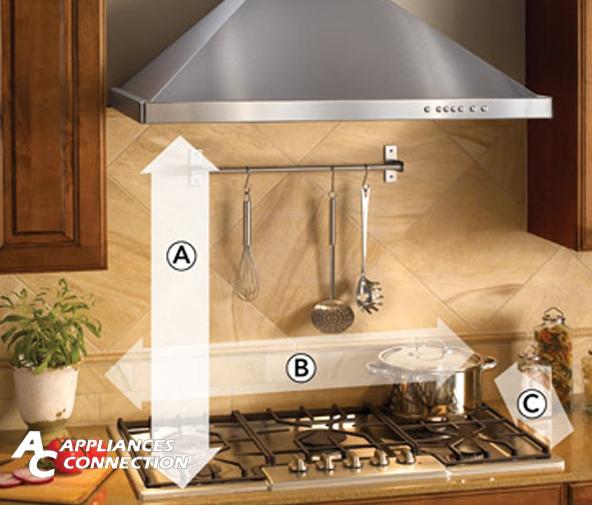
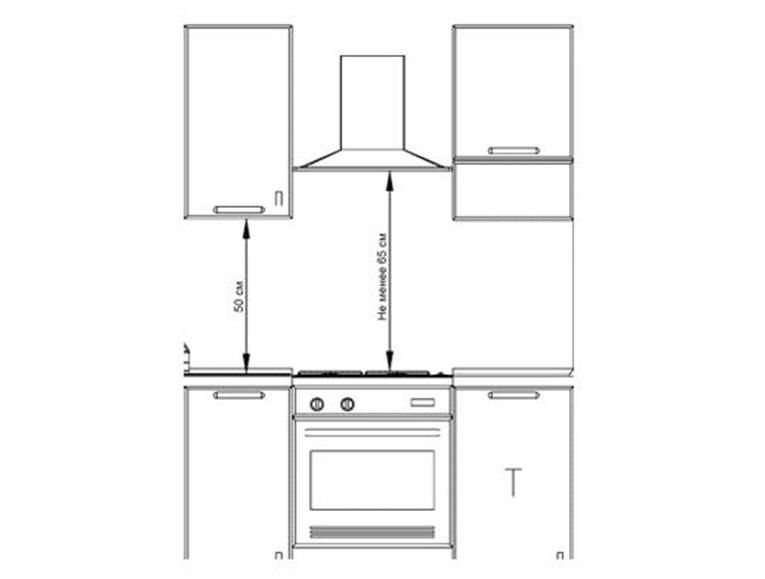
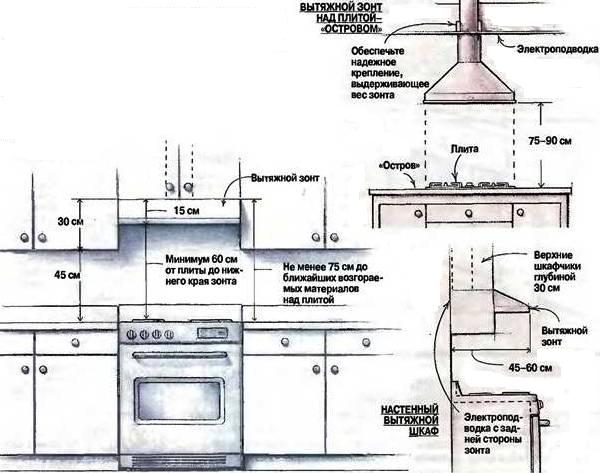
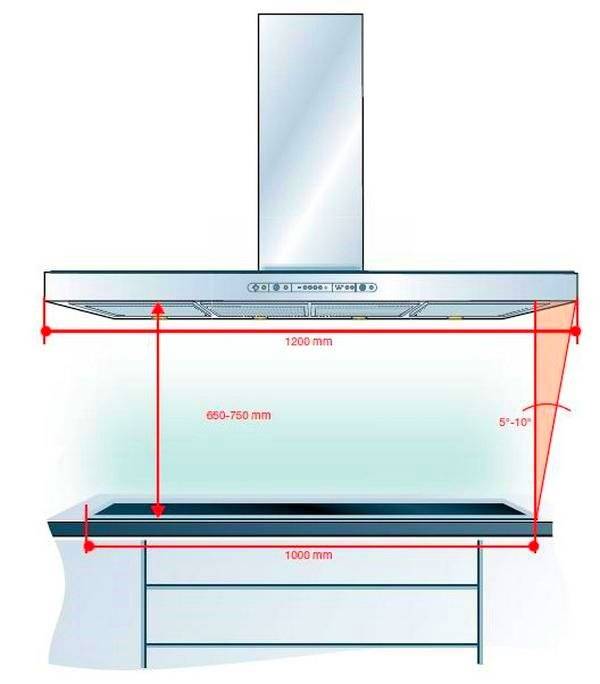
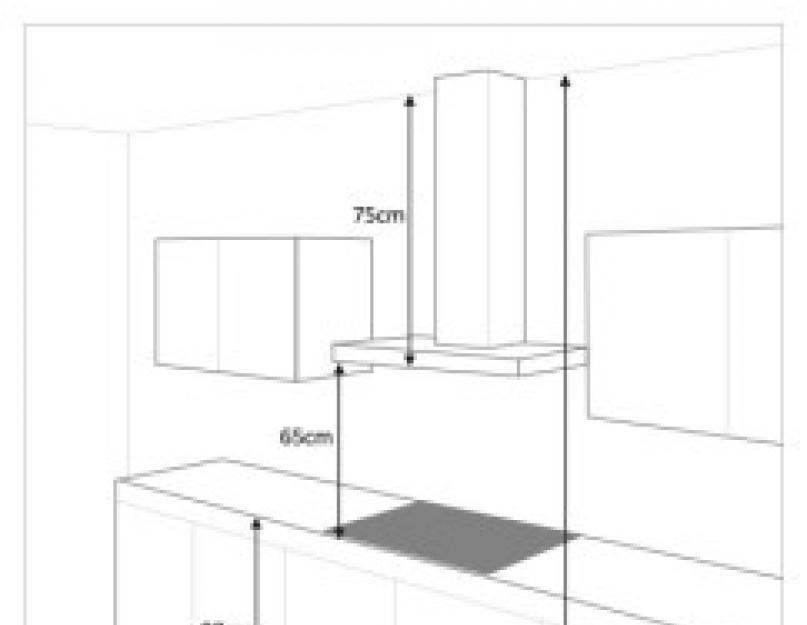
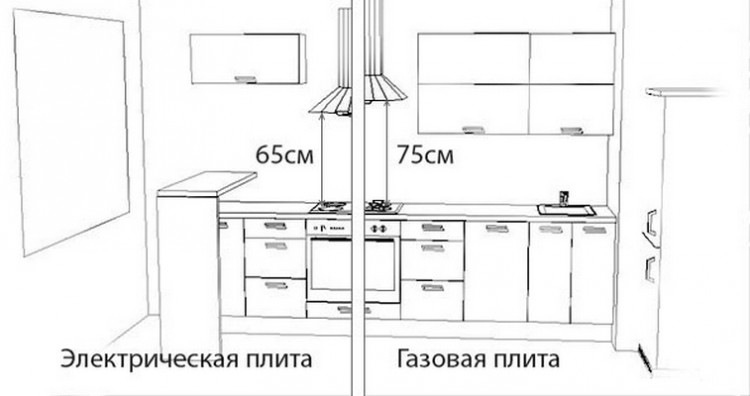
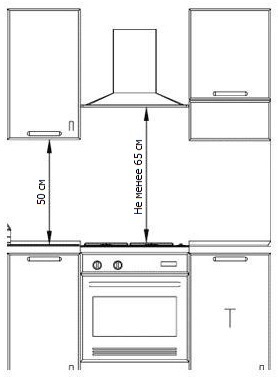
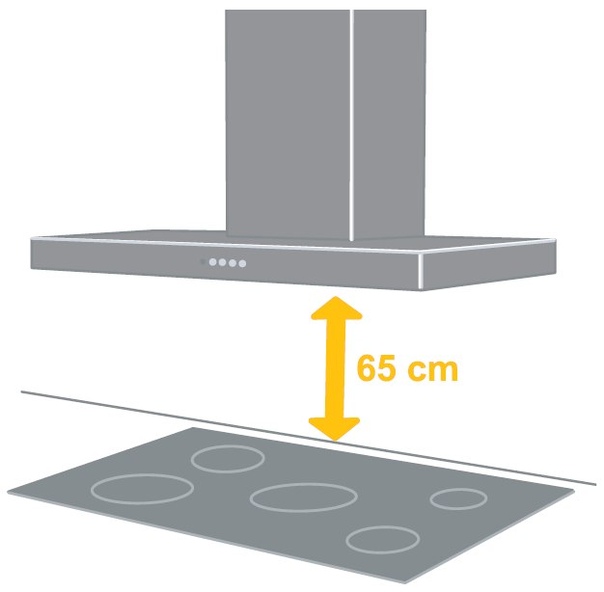
- the distance between the hood and the gas stove burners is from 65 to 85 cm;
- the minimum distance from the electric hob is 60 cm, and the maximum is 80 cm.
Minimum distance from the hood to the gas burners
These data are valid only for devices that are fixed strictly horizontally.
Horizontal unit installation video
How to choose the right hood for the kitchen
1.2
Inclined aggregates
Inclined unit
When mounting models of an inclined type, it is extremely important that the distance between the stove and the hood correspond to the following values:
- from 35 to 45 cm when working with an electric stove;
- from 55 to 65 cm - for gas burners.
In a real kitchen, it is customary to install ventilation units where operation will be not only efficient, but also convenient for the hostess. The distances indicated above are experimentally established values, confirmed by years of practice.You can calculate them yourself, but you just have to take into account a number of variables:
- kitchen area;
- planning features of the premises;
- approximate area of the cooking surface;
- performance and type of hood;
- growth of family members, housewives.
If the set distance is not respected and the unit is hung too low, there is a high probability that the device will operate in a constant heat environment. And this is fraught with premature failure of a faithful assistant. In addition, if the hood is installed too low above the electric stove, it will be simply inconvenient to use.
Kitchen air conditioner
Installation video of the inclined type
Choosing a built-in hood for the kitchen: rating of the best latest models
Factors affecting the distance between the stove and the hood
Separately, one should once again dwell on the factors that affect the distance of the installation of the exhaust device from the stove. The height depends on what will be:
- kitchen size;
- features of its layout;
- hob (type and dimensions);
- power and type of exhaust device;
- the growth of the one who will cook more than others on this stove.
At the same time, it is also important to comply with all the installation standards for the ventilation structure specified in the technical passport for it. The implementation of all these recommendations will make it possible to use the device designed for air ventilation in the kitchen, extremely efficiently, and save it from unnecessary odors and fat deposits spoiling the interior.
The implementation of all these recommendations will make it possible to use the device designed to ventilate the air in the kitchen as efficiently as possible, and save it from unnecessary odors and fat deposits spoiling the interior.
Device installation rules
The hood that filters the air and returns it back is easy to install. Above the electric stove, you can install it yourself.
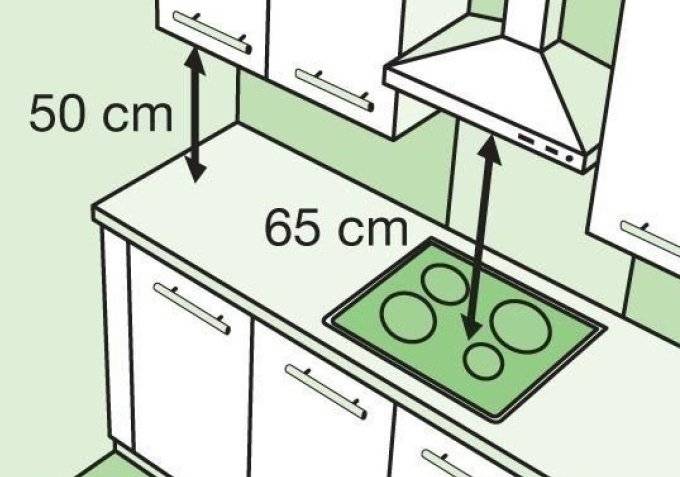

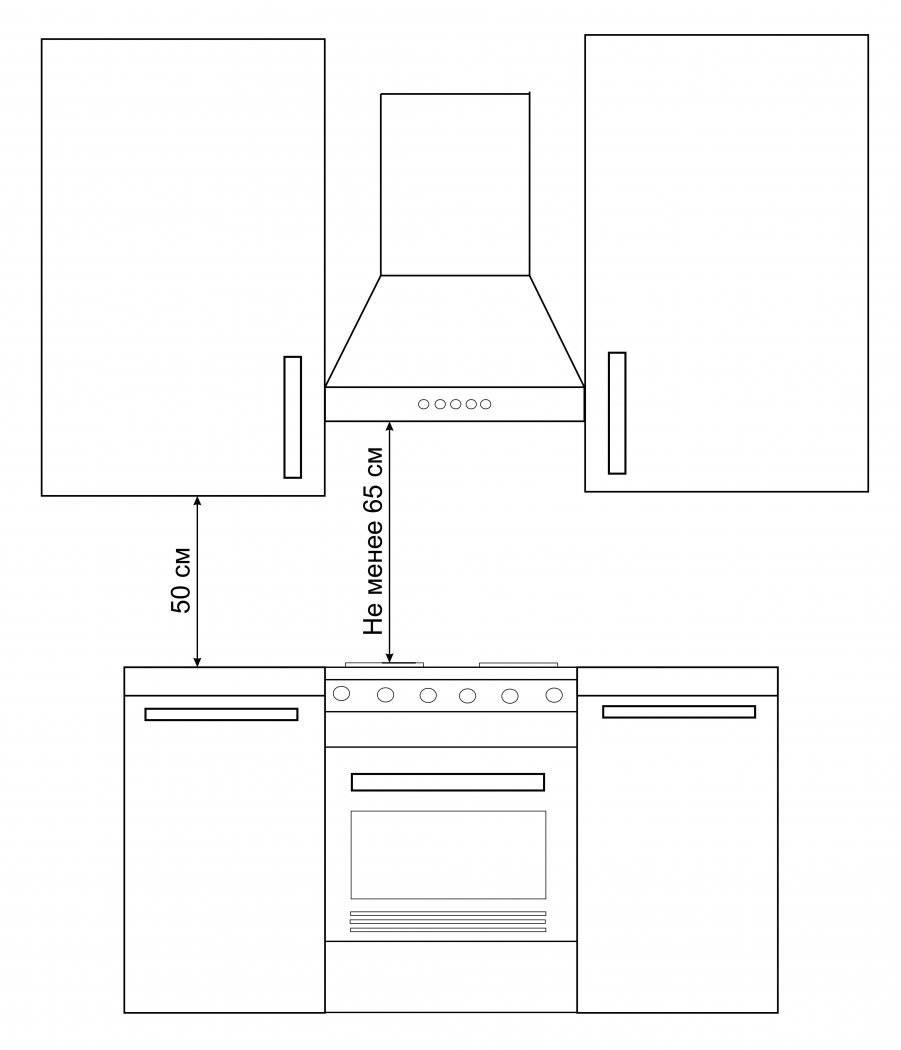


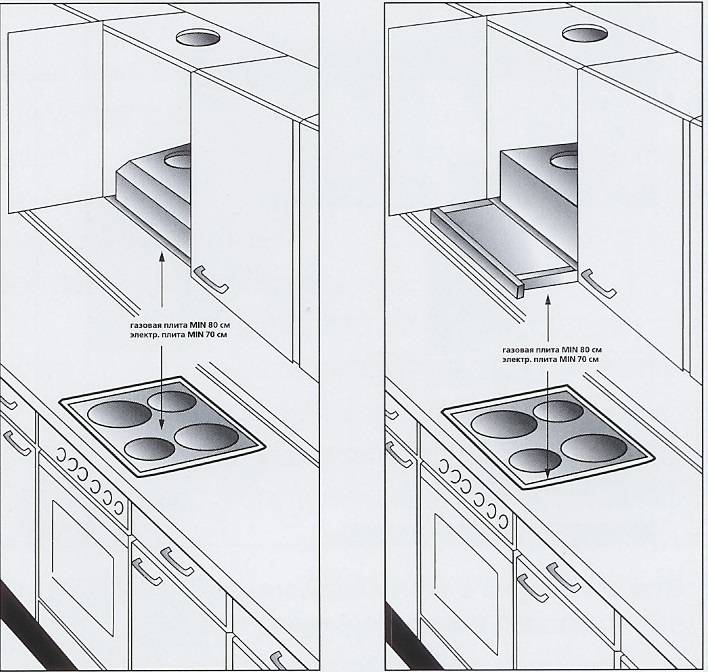
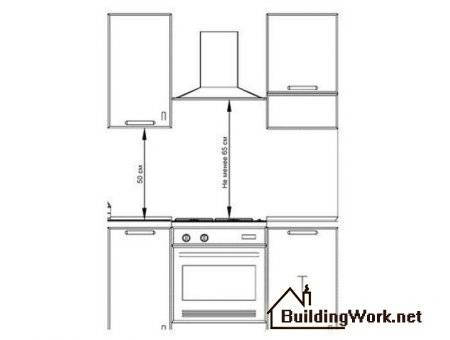

- It is necessary to draw a horizontal line above the hob at the height of the installation of the equipment - the distance between the gas stove and the hood.
- A vertical line is applied to the wall in the center of the slab. The standard provides for the rules for mounting the hood exactly above the hob.
- The template from the package is applied to the lines, and 4 points are marked - the location of the mounting bolts. Depending on the model, the distance between them is set as standard 200×200 or 200×100 mm.
- Holes are made, dowels are hammered in and screws are screwed in.
- A design without a filter grate and a housing is hung on the wall.
- Install the rest of the mechanism.
Spacious kitchen with electric stove
In cases where an extractor hood is purchased with air exhausted into a ventilation pipe or chimney, the design with fans is mounted on the wall in the same way as a model with a circulating air purification method. Then it is necessary to make the installation of the air duct, taking into account the minimum distance from the hood to the gas or electric stove. For normal ventilation, in order to prevent the effect of recirculation, that is, the return of air masses from the ventilation ducts back to the chimney, it is advisable to invite specialists.
Basic requirements for the duct:
- the cross section of the pipe is designed to allow air masses to pass through it at maximum equipment productivity;
- the safety factor is taken into the formula for a specific design;
- the optimal distance to the outer wall or ventilation duct should be no more than 5 m;
- a maximum of 3 bends are allowed in the duct;
- pipes of different sections for the exhaust structure are unsuitable;
- all turns are made smooth, with radii.
Kitchen with gas stove in a country house
The socket must be grounded and located on the side of the edge of the hood housing at a distance of 25 cm. The safest is to install a switch that can quickly turn off the equipment.
Device installation rules
The operation of the exhaust device also depends on how the rules for its installation are followed:
- the hob of any stove should be the same size as the ventilation device (standard 60-90 cm) - this will make it possible to suck in polluted air;
the hood must be mounted correctly, so that the distance from it to the stove does not contradict fire safety standards and corresponds to the type of stove;
The device must be connected to the mains in accordance with the technical requirements.
Of course, it is better to entrust the installation of exhaust equipment to specialists. But it is also quite possible to do it yourself.
Arrangement of channels for air exhaust
When installing air outlet ducts, a large number of bends should be avoided, because their excessive presence will impede the outflow of polluted air. Therefore, it is desirable that the pipes are straight, short and practically without elbows. They are installed so that the intake air can move from the socket to their thin end.
When laying channels for air outlets, it is also important not to narrow the holes and not use additional connections, because this will limit the free movement of the air mass, and contribute to an excessive load on the hood motor. The cross section of the outlet pipe must correspond to the size of the opening of the exhaust unit
Outlet location
The exhaust hatch, as a rule, is connected through an electrical outlet, which is installed at the top (2-2.5 m from the floor level). Hinged kitchen cabinets, thus, it exceeds by 10-20 cm. And from the air duct it should be shifted to the left or right by 15-20 cm.
It is desirable that the socket has a ground connection, since during voltage drops it will turn off and will not allow the exhaust equipment to fail. The hood is a guarantee of fresh air and cleanliness of interior items. The main thing is to correctly select, install the device and at the same time maintain the distance between the stove and the hood in the kitchen. This will not only ensure the reliable operation of the equipment, but also create certain conveniences. Buy, install correctly and use!
The nuances of instrument designs and sizes between them
How is the distance determined for combined hobs
If you are the owner of a combined hob, then when choosing a distance, you must be guided by the most stringent standard for gas stoves.
That is, leave at least 75 cm between the stove and the lower boundary of the hood.
How is the distance for sloped panels determined?
One of the common questions of the inhabitants is this: how is the distance from the surface of the plate to the inclined model of the exhaust hood measured correctly.
The answer is simple: you need to measure the minimum distance from the lowest point of the hood to the surface of the stove.
For happy owners of inclined models of exhaust hoods installed above the gas hob, the minimum distance, if necessary, can be reduced to 55-65 cm.
Owners of inclined exhaust hoods that are located above electrical equipment can place the lower edge of the product at a distance of at least 35-45 cm.
We have presented the norms that you need to know for the correct placement of the hood in the kitchen. Now you know at what height you should hang the hood.
We hope that our tips will be useful, you can easily cope with the task. And your hood will delight you with clean air in the kitchen.
Hood above the hob
Hoods above the stoves improve local ventilation, air circulation throughout the room. Built-in ventilation ducts do a poor job with the same task, and the owners of the kitchen have a choice - to use an exhaust device or constantly open windows, both in summer and in winter. Furniture and decoration will retain their appearance if the steam from the dishes comes out quickly.
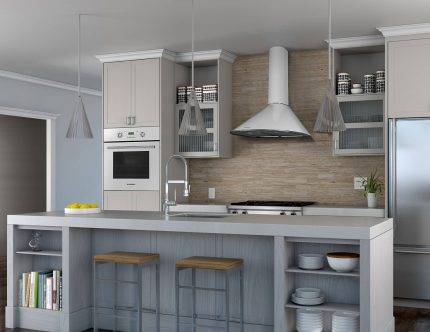 The image shows a hood of the classic domed model, but with a rounded shape, which is rarer for modern times, and an air duct extending into the ceiling
Ventilation devices are of 2 types according to the mode of action and have more than 10 varieties in structure. Hoods are placed over gas stoves, electric, mixed-type appliances.


The properties of the air are improved due to the fact that the hood eliminates:
- steam;
- residues of combustion gases;
- pollution;
- soot;
- smells.
Devices purify the gaseous medium by flow (outlet) and recirculation methods. Devices of the 1st type draw air in and take it out of the building. Among the disadvantages, it is worth noting that the systems need channels, and that the kitchen has to be filled with air from the street.
Recirculating hoods take in the air mass, pump it through the filters and give it back.They clean the air for a long time, and their parts wear out quickly, which is the main disadvantage.
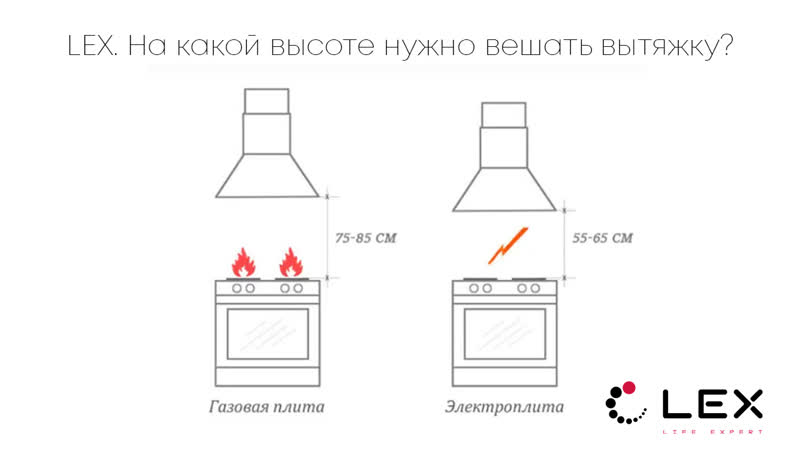
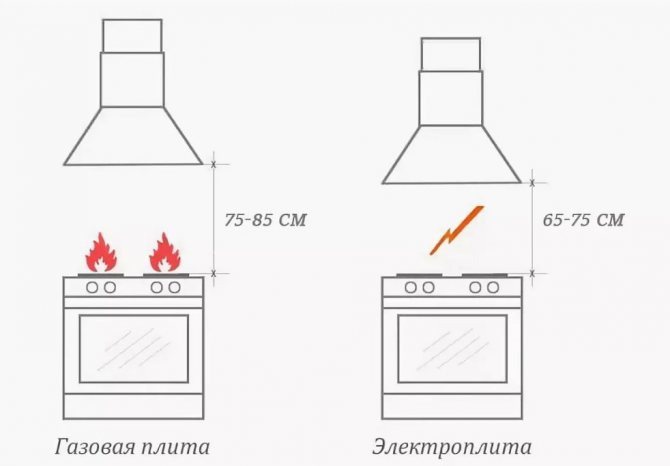
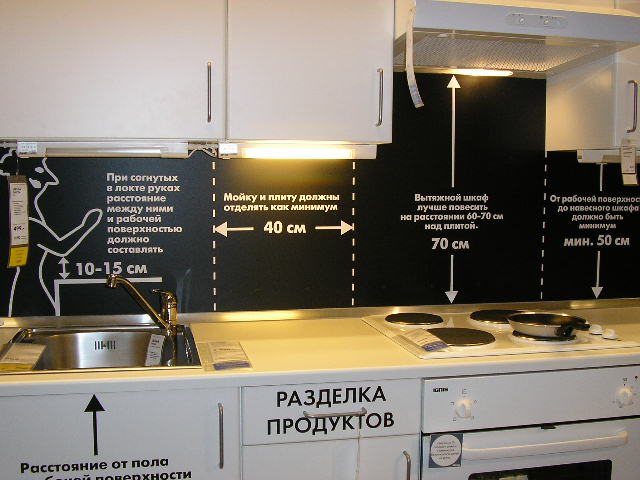
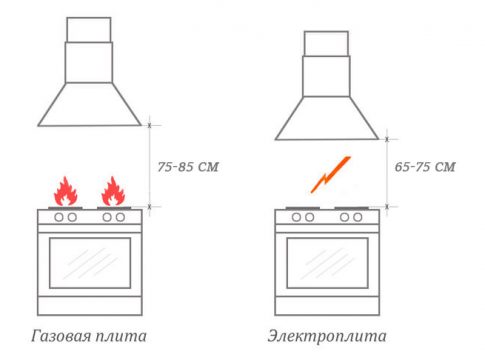
The smallest installation height of the hood in the case of a gas stove is 75-85 cm between the lower edge and the burners, in addition, the exact numbers are indicated in the instructions for the equipment. Devices with a lower traction force, about 300 m³ / h, are usually placed at the lower boundary of the interval, i.e. at 75 centimeters.
The same arrangement is suitable for systems that do not have a 10 cm margin on each side of the slab. Hoods for electrical equipment are mounted on average 10 cm lower - 65-75 cm above the hob.
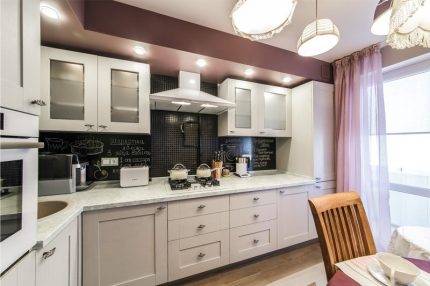 The ideal hood protrudes from the sides and front of the stove, has more depth, width and area than the hob
There is an exception to the general rules for inclined systems. Above gas stoves they are mounted 55-65 cm along the bottom edge. 20 cm higher than above the electric ones, with which a gap of 35-45 cm is enough.
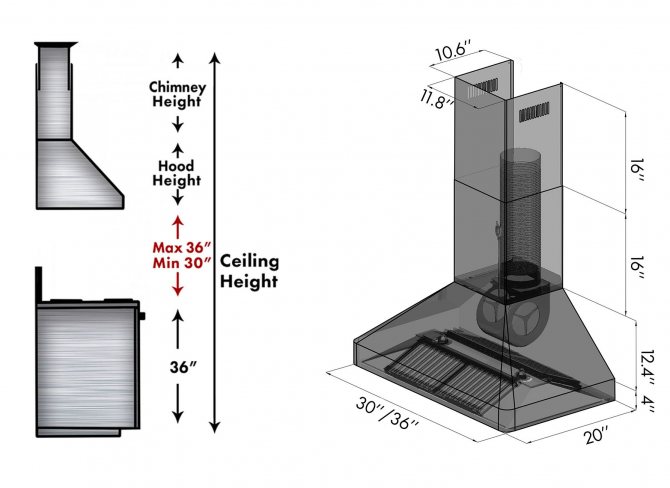
All types of exhaust systems are placed along the lower edge no higher than 90 cm above the hob of any appliance. An island hood 1.3-1.5 meters wide can be raised another 5-10 cm. Failure to comply with the lower installation limit increases the risk of breakage of parts and ignition of a greasy film.
The material of the hood does not affect the height of the location above the gas or any other stove. For placement within the allowable interval - too.
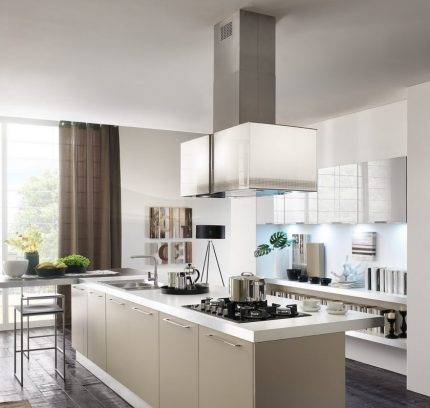 Island hoods are installed above kitchen islands and peninsulas: devices are made with a rectangular, cylindrical, square, T-shaped shape, as well as in the form of inverted tables and unusual geometric shapes
When choosing a height, three additional factors are taken into account:
- The presence of organized natural ventilation of the supply and exhaust type and the distance to it. The smaller the distance, the higher you can mount the device for the stove.
- Configuration of the kitchen, furniture and household appliances. We are talking about the placement of the second tier of the headset, objects above the hood, the height of the ceilings, as well as the presence, size and features of the stove cover.
- The presence of a stove. A preheated oven has a bad effect on the internal parts of the hood. Above a standard device with a stove, the hood is installed closer to the upper limit of the norm, if nothing interferes with this.
Difficulties arise due to the structure of the exhaust device. Suspended telescopic are designed to be installed below the bottom of the hinged box, which limits the choice of height. The same applies to built-in models that “replace” the bottom of the furniture section, but the cabinets for attaching and hiding the air intake are changed if something happens.
Installation of wall hoods at the optimum height is sometimes interfered with by pipes and stove covers. Island models are attached to the ceiling, so their height at the lower level is determined by the dimensions.
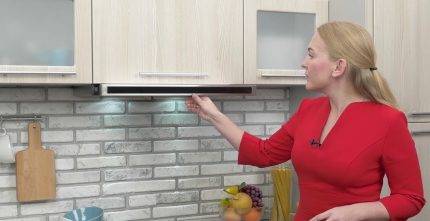 For everyone involved in cooking, access to the far part of the exhaust device should be arranged; its adjustment panel, which is usually located at the front, can be reached by any adult, even at the maximum placement height
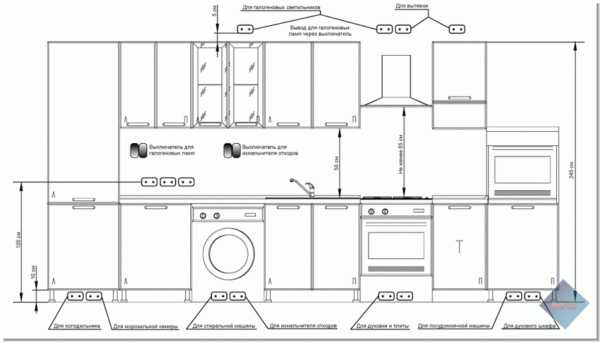
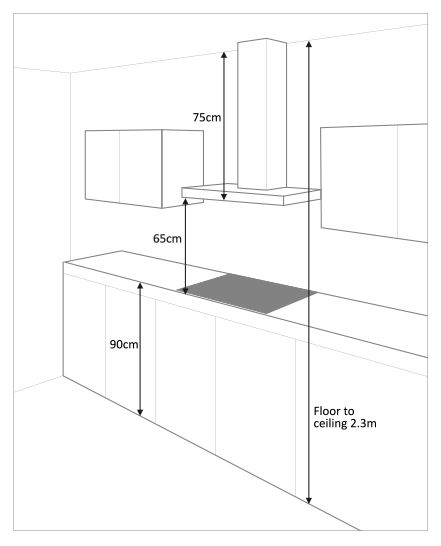
Sockets must not be used between the hob and the bottom of the hood. A point for power supply is provided at a level of 2-2.5 meters above the floor, inside wall cabinets or immediately above them.
The socket is removed at least 15 cm from the duct. The most universal height for the nest is considered to be 200 cm above the floor and 110 cm above the stove or countertop of the work area.
What you need to consider for the organization of the hood in the home
If you decide to install a hood in your home that takes the exhaust air outside, you may encounter some legal aspects of this process.
To equip the hood, it is necessary to make a hole through which air will escape, and also adjust the outlet of this air. Two questions arise: is it possible to make a through hole in the wall of an apartment building and is it allowed to remove dirty air outside the apartment?
If the diameter of the hole does not exceed 200 mm, then no permit is required for it. Such holes are allowed to be made for ventilation and air conditioning. However, it will not work to bring the hood into such a hole - according to the law, this can violate the comfort of neighbors, through whose window your exhaust air can go. Before installing the hood, it is necessary to design the exhaust duct and go through the approval procedure.
The simplest and most convenient option is a hood with an exhaust channel in the wall.
The video shows how to properly organize the exhaust channel:
Important Installation Points
In different cases, the distance between the hood and the stove can vary significantly. However, each case has its own standard. If we consider such a case as installing a hood over a gas stove, then the distance should vary from 55 to 65 cm - for an inclined type.
To install the hood for gas stove should be approached with more caution, since here you need to think about the issue of fire safety, which cannot be said about the electric option. For electric ovens, the same principle works, but with a different distance - from 35 up to 45 cm for inclined type and from 60 to 65 cm - for straight
For electric ovens, the same principle works, but with a different distance - from 35 to 45 cm for inclined type and from 60 to 65 cm - for straight.
The distance between the electric stove and the inclined hood.
When calculating the distance, the reliance is mainly on three factors - the power of the hood, the configuration of the room and the height of the owner or hostess who will cook in the kitchen. If all factors are met, then the appliance installed above the stove will perform its functions properly, without disturbing the owners of the kitchen at all. The given distance figures are minimal and it is already impossible to reduce the distance in any case. However, in certain cases, this figure can be increased if the functionality does not suffer. However, calculating the distance is not a difficult task, in most cases the recommended figures are indicated in centimeters in the instructions that came with the unit.



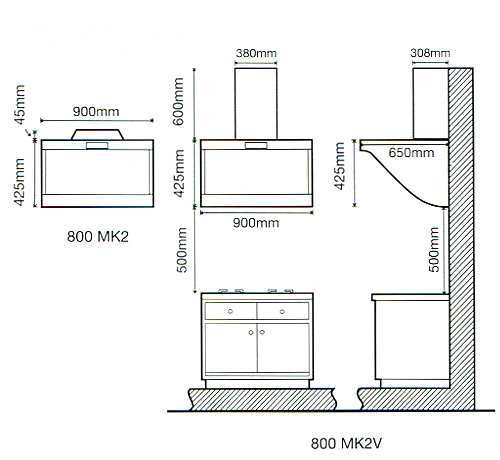
If you use the services of a master, then the issue of the installation height of the hood will not be relevant at all, he will be able to most optimally determine the position based on his own experience, as well as install the entire supporting system - sockets and air ducts.
The structure of a conventional horizontal hood
On the technical side, the structure of the kitchen hood is extremely simple. In fact, this is a box with a built-in electric motor, but let's dig deeper to know exactly all the important components of the device. This information can be useful to many during self-repair.
Table 1. The structure of the hood
| Detail, photo | Description |
|---|---|
| Powerful electric motor | The heart of the hood is an electric motor, which is connected in series through the shaft to the injection mechanism. It can be designed as a conventional impeller or turbine, as shown in a photo. With compact dimensions, turbines draw air more efficiently, but they create more noise, which must be taken into account when choosing a model. The power of electric motors is small, but you don’t need much to spin the blades that distill air - for household appliances it is 100-400 W. Tip! Many, especially Chinese manufacturers, write huge numbers that even surpass the characteristics of famous brands, but in fact they do not pull at all. Of course, manufacturers are cunning and deliberately overestimate the performance. Also, the design of their products is not perfect, which does not allow creating a sufficient air pressure drop to start moving it efficiently. In general, be careful. |
| Touch control panel | The hood is controlled using a control panel, which can be implemented as a set of mechanical switches and buttons, or a sensor, being stuffed with electronics. Such models belong to the "premier" segment, they are more expensive, but much more difficult to maintain and repair. Some hoods are equipped with remote control panels or special sensors that automatically start the device when steam and elevated temperature are captured. There are also models with displays that show the active mode, room temperature or time. When choosing, be guided by your taste preferences and ease of operation. |
| Lighting | When buying a hood, do not forget that the power consumption of the device also includes the light bulbs used to illuminate the work area. Typically, halogen or LED lamps are used, mounted in a housing with a diffuser, flush with the bottom panel of the hood. There are many other solutions, but these are common in the budget segment. The backlight turns on automatically when the front panel is pulled into position, although a separate toggle switch is installed that can turn off the lighting if it is not currently required. |
| Front drawer | The front panel is a passive part of the design, which, in addition to the suction, is a switch, or rather one of them. The system is designed so that it has contacts that close when the panel is extended almost to the end. At the same time, there is also a toggle switch, which can also break the supply network. The panel is also equipped with a grease trapping mesh, which can be easily removed if necessary. It moves along metal skids on balls, so the move is smooth and clear. |
| Grease traps | Aluminum nets in a plastic frame are grease traps. Air quietly passes through them, but the main part of the fat is retained in the cells. The filters are held in place with spring clips, making them easy to remove for cleaning. If necessary, they can be replaced with new ones that are suitable in size. |
| Outlet | In the upper part of the hood housing you can see the outlet nozzle through which the air drawn in from below is blown out. This part is connected to the ventilation pipes if the hood is flowing or covered with a decorative overlay if it is circulating.Some models of hoods are equipped with false linings so that everything can be neatly hidden. For embedded equipment, such additions are useless. |
| carbon filter | Circulation hoods are additionally equipped with carbon filters, in which dust, grease, gas combustion products, etc. settle during operation. The element is interchangeable, so the designs usually provide for convenient access to them. |
| Power wire | Do not forget that the hood is an electrical appliance. It needs to be powered, which means that at the installation site it is worth providing a separate outlet or laying a route from it with extension cords, which is not very nice when the device is open, but this does not matter for a hidden hood. |
You can disassemble the hood for spare parts in a matter of minutes, in fact, everything is hidden right behind the grease traps, so repairing them is quite simple, given that today's repair is a simple replacement of a faulty part with a new one.
Optimum heights for different units
The installation height of the hood above the tile is determined taking into account 2 components - the type of hob and the design features of the location of the equipment for a particular kitchen. It must be understood that the height is never “tied” to the dimensions of the air intake, the components or the type of device.
The only exception to the rule is kitchens with low ceilings, where it is not possible to maintain the recommended distance between the hob and the hood.
Horizontal Solutions
It is possible to determine exactly at what height the hood should be installed only if there is data on the type of stove used.Based on this, the distance between the inflow and exhaust is selected. The specified type of equipment is installed taking into account a number of parameters (type of hob, performance of the intake unit, etc.).
The ratio between the height of a person and the installation height of the device
But what distance is considered optimal in terms of safety and efficiency?
The norm for each device is different, but there are accepted standards that are predominantly advisory in nature:
- the distance between the hood and the gas stove burners is from 65 to 85 cm;
- the minimum distance from the electric hob is 60 cm, and the maximum is 80 cm.
These data are valid only for devices that are fixed strictly horizontally.
Horizontal unit installation video
Inclined aggregates
Inclined unit
When mounting models of an inclined type, it is extremely important that the distance between the stove and the hood correspond to the following values:
- from 35 to 45 cm when working with an electric stove;
- from 55 to 65 cm - for gas burners.
In a real kitchen, it is customary to install ventilation units where operation will be not only efficient, but also convenient for the hostess. The distances indicated above are experimentally established values, confirmed by years of practice. You can calculate them yourself, but you just have to take into account a number of variables:
- kitchen area;
- planning features of the premises;
- approximate area of the cooking surface;
- performance and type of hood;
- growth of family members, housewives.
If the set distance is not respected and the unit is hung too low, there is a high probability that the device will operate in a constant heat environment. And this is fraught with premature failure of a faithful assistant. In addition, if the hood is installed too low above the electric stove, it will be simply inconvenient to use.
Installation video of the inclined type
Based on decades of practical operation, experts have formed their own recommendations regarding at what height to hang the hood. There are unspoken rules for aggregates placed above the base of the gas burner. They are indicated in the user manual or installation instructions that are attached to each model of the exhaust unit.
Here are just a few examples:
- Products from Bosch are traditionally considered one of the highest quality on the market. The average capacity of the units is 650 m3/h. It is better to hang the hood of the specified performance at a distance of 65 cm from the surface of the burners.
- Solutions produced by the Shindo brand are characterized by reliability and affordability. For the most part, we are talking about a horizontal device of medium power. The average productivity of the devices is 450-500 m3/h. The kitchen hood is mounted at a height of 75 cm above the electric stove. The device must not be located above the open flame of the burner.
- The products of the domestic brand Saturn cannot boast of high power, but at the same time, a capacity of 240-300 m3 / h will be enough for an average housewife. The recommended distance to the hood is 75-80 cm from the burner.
It is up to you to decide which products to buy and from which brand, but in terms of mounting height, the units are almost identical. It should be noted that the distance from the surface of the gas stove to the hood is determined by a number of important requirements:
- convenience during operation;
- leveling the likelihood of spontaneous combustion (especially if there are tables with other household appliances nearby);
- effective intake of dirty air above the stove, stove.
Given the above requirements, it can be argued that the safest and most acceptable distance from the hob to the hood is in the range of 70-90 cm.
Carrying out measurements and calculations
As you can see, it is quite difficult to take into account all the factors and make an accurate calculation. But you need to try not to regret purchasing a device that does not cope with the tasks assigned to it.
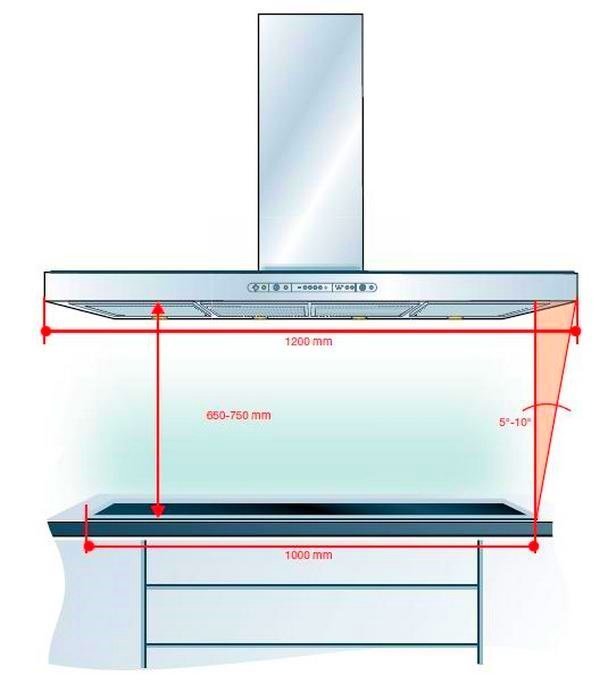


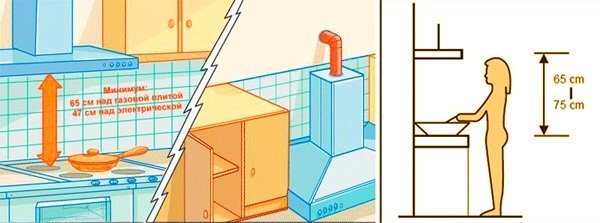
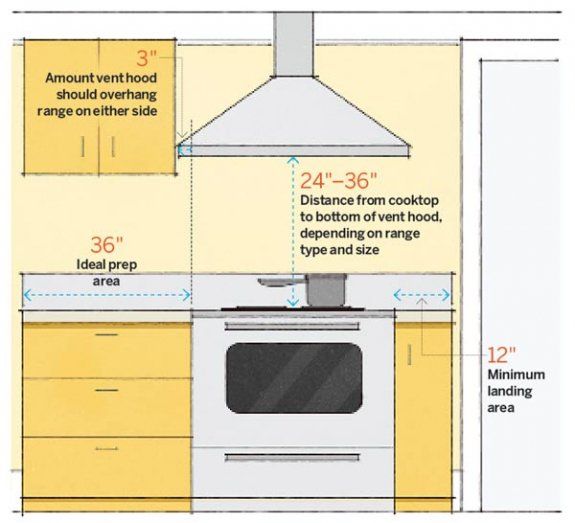
There are criteria developed by manufacturers:
- A device with a capacity of 200 to 300 cubic meters. m / h is suitable for those who cook a little or a small kitchen. That is, 1-2 burners are constantly used.
- Hood with a capacity of 300 to 400 cubic meters. m/h is recommended for families of 3-4 people, or for a medium-sized kitchen, as well as where 2-3 burners are used daily.
- A device with a capacity of 500-600 cubic meters. m / h will purify the air in a large kitchen, cover the needs of a large family. Such a hood will be indispensable if the stove is actively used daily and all burners are turned on (there may be 5-6 of them).
For indicative indicators, you can use special tables or data from manufacturers.
For a quick calculation of performance, two values \u200b\u200bare used, the area of \u200b\u200bthe kitchen and the height of the ceilings.This approximate data can be multiplied by the slab factor
If the kitchen has non-standard dimensions or its area does not exceed 40 cubic meters. m, then calculate this value for a particular room by simply multiplying the length of the kitchen by its width and by the height of the ceilings. The result obtained must be multiplied by 10 or 12
The numbers 10 or 12 are constant coefficients based on sanitary standards. They mean that the air must be cleaned every 5 minutes, that is, 10-12 times per hour. Therefore, productivity exceeds the volume of the kitchen at least 10-12 times.
Sometimes this coefficient increases due to the frequency of switching on and the characteristics of the stove used. For example, for a gas stove with large burners that are turned on every day, this number can be up to 20. For an electric stove, a factor of 15 can be taken.
If the stove is non-standard and is prepared daily, then to calculate the productivity, it is worth using additional coefficients for the number of storeys, for the stove, for smokers. But you should not buy a device with a large margin of power.
For example, the length and width of the kitchen are 2 and 3 m, respectively, and the ceiling height is 2.5 m.
Therefore, the estimated performance will be: 2 * 3 * 2.5 * 10 = 150 cubic meters. m/hour.
This figure can be multiplied by a factor of 1.3. It complies with health standards.
If someone smokes in the kitchen, then another 15% is added to the productivity for each smoker of the total.
The data obtained are correct for enclosed spaces. If the kitchen is not closed by a door, but is separated from other rooms by a passage, then another 30% of the received power should be added.
On our website there are detailed instructions for calculating the hood for the kitchen.
The next indicator is the height of the cook
It is very important that the hood does not touch your head and does not interfere with reaching far burners or placing large pots.
Therefore, before buying and installing, take measurements and simulate the process of working behind the stove. To avoid errors when taking measurements, remember that the inclined hood should be measured from the lowest point to the burners.
All straight hoods (domed or built-in) should be measured from the filters to the surface of the stove.
Inclined hoods experts recommend choosing for electronic, halogen and induction cookers. They do not require much space and do an excellent job of purifying the air.
You should also consider the length of the hood. Determine how much it will protrude forward above the hob, how convenient it will be to cook and replace coal and grease filters, as well as wash the stove and reach for distant burners.
All the described factors affecting the distance must be agreed upon. Otherwise, there is a risk that the hood will not cope with its tasks. Even the most powerful device, installed too high, will not cope with all the impurities in the air. Or, soot deposited on the bottom of a hood set too low can ignite.
Proper choice of installation height will extend the life of the hood, allow the device to work at full capacity with minimal cost. In the worst case, the device may not cope with its functions or simply burn out.
Hood types
There are four main types of kitchen hoods:
- Wall-mounted fume hoods;
- Island hoods;
- Embedded structures;
- Desktop devices.
The first type has the form of an umbrella with a pipe, which is fixed on the wall where it is clearly visible. Therefore, its design should be suitable for the interior of the kitchen. Outwardly, it is very reminiscent of a chimney from a fireplace.
Island-type devices are most often attached to the ceiling. They are used if the interior of the kitchen is thought out so that the stove is in the center of the room. This model works only in one mode, according to the principle of air removal.


Built-in appliances are placed inside cabinets. They are hidden from view, so they can not be finished too carefully. Their technical characteristics are not worse than those of other models, but they cost a little less.
Hood installation height calculations
Desktop structures are built into the hob itself. They look like another panel section. Due to the fact that this model is located in close proximity to the source of dirty air, the quality of cleaning is usually on top.