
- We care about filtration
- Additional equipment for home pools
- Location Tips
- Decorative pool - varieties of forms and materials for construction
- Building a pool with your own hands from a finished bowl
- Swimming pool with plastic or composite bowl
- What microclimate is created in the pool room
- Do-it-yourself frame pool on the site
- Mounting Features
- Pool Intex Rectangular Frame
- Planning calculations
- What you need to make a frame pool
- Options for the construction of country pools
- Nuances of care and operation
- How to make a platform for a frame pool with your own hands
- How to make a platform for the Intex frame pool
- How to make a wooden base for a frame pool with your own hands
- How to make a base from paving slabs
- Concrete
- From film / linoleum
- Ready-made bowl or do-it-yourself?
- Stationary pools: traditional or non-standard
We care about filtration
Maintaining cleanliness will become easier if you create a water circulation system. Here is a step-by-step instruction on how to make a sand filter for the pool with your own hands:
- 2 holes are drilled in the sides of a metal or plastic container. The diameter must match the inlet and outlet fluid lines.Pipes are installed, the joint is coated with glue or sealant. Connect corrugated or rubber pipes.
- A cartridge is installed on the drive, and a water intake is installed at the entrance. In the absence of the latter, they do this: they take a plastic bowl of a suitable size, make many holes, and wrap it with nylon.
- Sand grains of 1-1.5 mm are poured into the barrel. It is advisable to disinfect the mixture by boiling. The container is covered with a sealed lid.
- Install a pre-purchased pool pump. It can be a small-sized mechanism up to 200 watts. The scheme is as follows: from the reservoir, the sleeve goes to the nozzle, then to the pump, sand tank and pool.
- A manometer is installed on top. If it shows a pressure of 30% more than usual, then it's time to clean the filler with a backwash. To do this, just swap the hoses.
- To prevent the cover from being torn off by the pressure of the jet, it is necessary to make sure that it is securely fastened.
Additional equipment for home pools
Today, companies that install pools indoors, and outside too, equip their products with additional features. It can be a hydromassage, a wave acceleration system, springboards, fountains and waterfalls, as well as various slides. On the one hand, the construction of an indoor pool requires additional costs, but on the other hand, it provides certain advantages. The indoor pool can be used all year round, there are no costs for its conservation for the winter period. In addition, the consumption of electricity for heating water is significantly reduced.
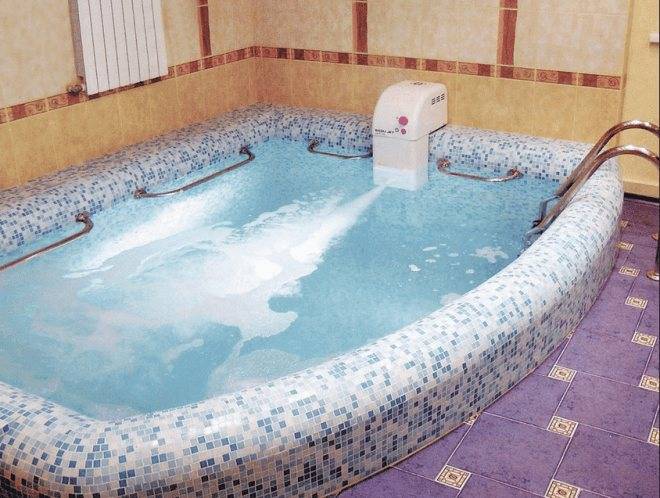
Swimming pool with additional equipment
You can build an indoor pool in any room of the house.Technical documentation may involve the arrangement of a pool in a separate annex, basement, on the upper floors of the house and even in a heated attic. The project should provide for a foundation of appropriate capacity, calculate the load on the skin, the strength and integrity of the load-bearing frame structures and their reliability throughout the entire service life. Sometimes a separate room is built for the construction of the pool, which is the best option.
Location Tips
For a pool that will only be used in the summer, any location will do. Inflatable pools are a cheap option that does not require drastic changes to the site.
If you opted for a stationary pool, before you dig it out, you need to choose the right location on the site. After all, it will not work to move such a structure after the completion of all work on its creation.
There are several important points to take into account:
Trees. They should not be near the pool for two reasons. The first is the root system, which negatively affects the waterproofing of the pool. The second is foliage that pollutes the water surface. If the leaves are not removed in time, the water "blooms" and the pool loses its attractiveness.
Soil type. Ideal if your site has clay soil
It does not let water through, which is important if damage to the waterproofing suddenly occurs.
- Direction of the wind. The pool one way or another will be clogged with debris brought by the wind. It will be nailed to a certain board. Therefore, make it so that it is there that the cleaning of the pool is as convenient as possible and you can quickly remove the brought leaves, blades of grass, etc. The drain system should also be placed here.
- Water pipes.By placing the pool close to the water supply, you will ensure the ease and speed of filling the bowl.
If you decide to install a frame pool, try to make sure that the surface reserved for it is absolutely flat. Potholes, bumps, dents, remnants of tree roots - all this should not be. Ideally, the site is concreted, creating a smooth base for the pool.
Decorative pool - varieties of forms and materials for construction
Unusually shaped pools look rather unusual. Of course, they need additional care, and it’s more difficult to design them, but how much more interesting they look than the usual rectangles, squares, ovals and circles.
 When designing the shape of the pool, show your imagination! Move away from conventional forms!
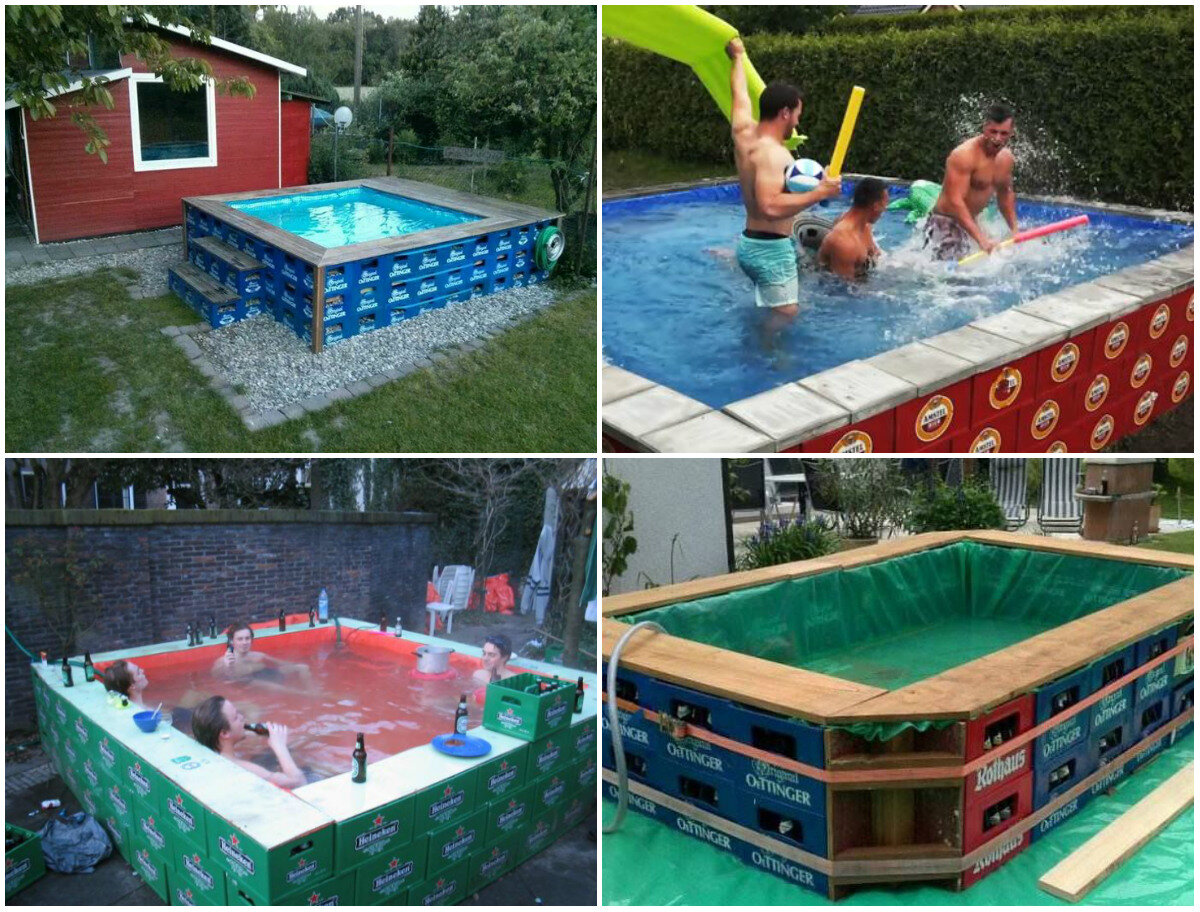
Lovers of something special will be interested in how to make a mini pool in the country with their own hands. Let's discuss what improvised materials you can build something like fonts in your yard:
- Tire mini pool. First, we are looking for a tire of the size we need. Tires from a combine or tractor have a suitable diameter. Trim one sidewall to the treads, leaving the sides. The place for such a font should be flat, clean, not much more than a tire. Fill in a sand cushion and pour concrete 15 cm. Install the tire. You can ennoble it with brick or stone. Use after complete solidification.
- Mini-pool from the bath. A cast-iron bathtub that has served you for many years can be turned into a mini pool for a summer residence. If you choose a place in the shade, then the bath and the water in it will not heat up so much. Although, given the size, only children can splash in it, it is better if the water is always warm.Under the bath you need to dig a pit and fill it with sand. Insert a bath into the bowl, and pour sand into the gaps, carefully tamping it.
- Gabion mesh products. Although gabions are used as fortifications to protect the coast from erosion, resourceful owners also use these structures to build pools. First you need, as in the previous options, to prepare the area for the pool. We lay a gabion mesh and a film on the concrete base to protect it from moisture.
- Containers. Not the most aesthetic option, but still interesting. A garbage, construction or shipping container can be turned into a font simply by treating it with an anti-corrosion compound. Also check the container for integrity. Bury it to the desired depth, and ennoble the sides.
Of course, you can simplify your task and buy a ready-made tank for the pool. The metal frame structure is sold with a ladder, pump and cleaning system. Collect it, fill it with water and use it in the warm season. A plastic pool can also be ordered ready-made. It is not correct to say that this is a very simple option - after all, a polypropylene pool also requires concrete pouring, but the polymer guarantees the highest quality waterproofing. You can also use a polymer bowl only in season.
Building a pool with your own hands from a finished bowl
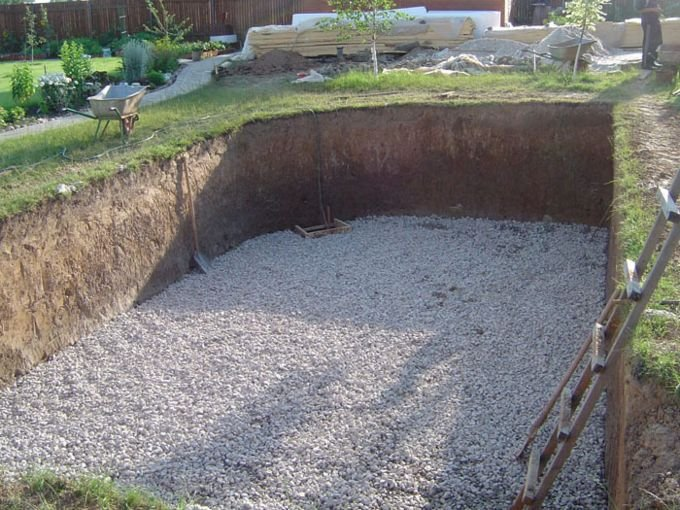
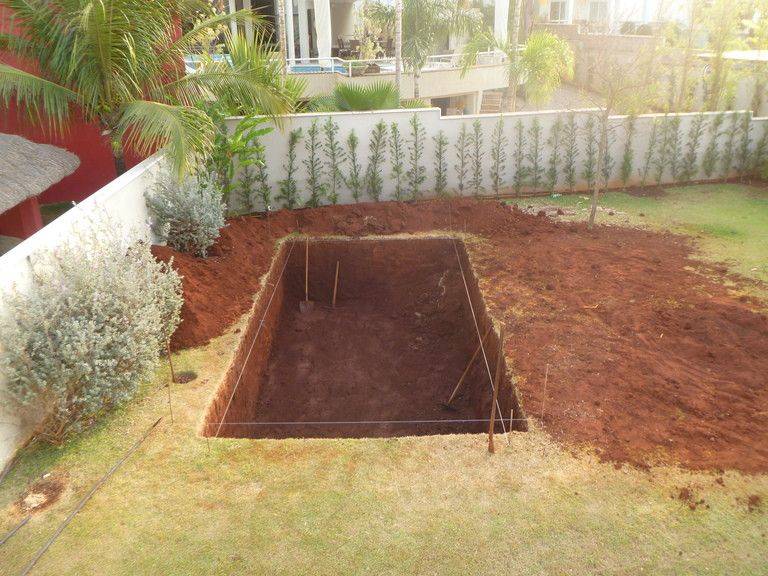
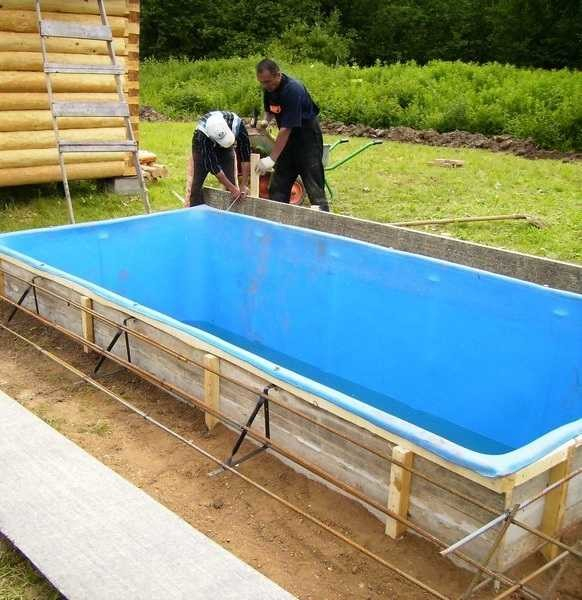
 To build this type of pool on the site, you need to step back another 100 cm from the preliminary marking and make a new marking - it is along it that the foundation pit will be dug. Such a calculation is necessary for convenient placement / installation of the bowl, the performance of all thermal insulation work on the outside of the polypropylene bowl.
Please note: the depth of the pit must be at least 50 cm greater than the height of the bowl itself - you will need to make a solid foundation for it. After the pit of the required size has been dug, we proceed to organize the “cushion” under the bowl
This process is as follows:
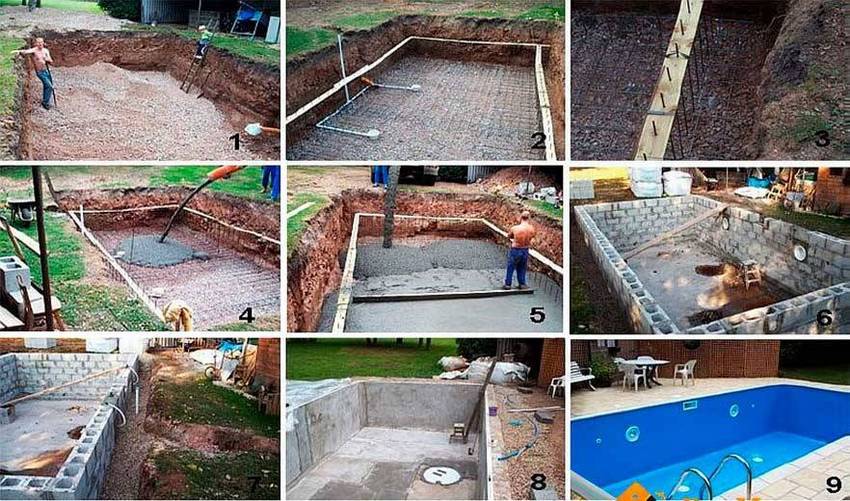
After the pit of the required size has been dug out, we proceed to organize the “cushion” under the bowl. This process is as follows:
- We cover the bottom with a layer of 20 cm of clean sand and carefully tamp it down. If the sand is found too dry, then you can slightly moisten it - this will provide a really good compaction.
- On top of the layer of sand we put a metal mesh (the step between the joints can be any) - it is needed to give strength, rigidity to the entire structure.
- A layer of concrete mortar is poured onto the grid - it should be no more than 25 cm thick.
Next, you will have to curtail construction work - you need to wait for the concrete floor to dry completely. And then you need to make a heat-insulating layer - it will protect the bowl from the cold of the earth. Experts recommend:





- spread a geotextile sheet on concrete;
- the next layer is to make polystyrene foam plates 3 cm thick;
- the final layer is a thick polyethylene film.
Please note: at this stage of building a pool from a finished bowl, you need to insulate the bowl while it is on the surface of the earth. To do this, use polystyrene foam soft plates, which wrap the entire outer surface of the bowl
From above, it is advisable to fix the sheet of polyethylene film.
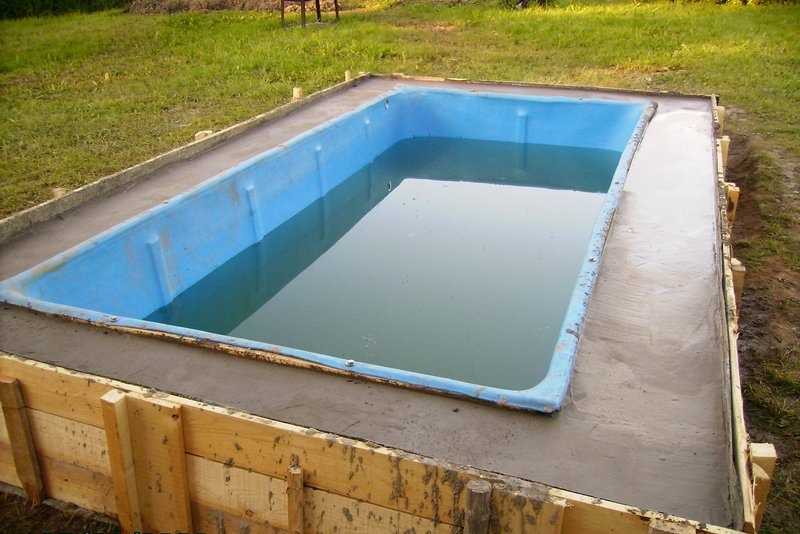
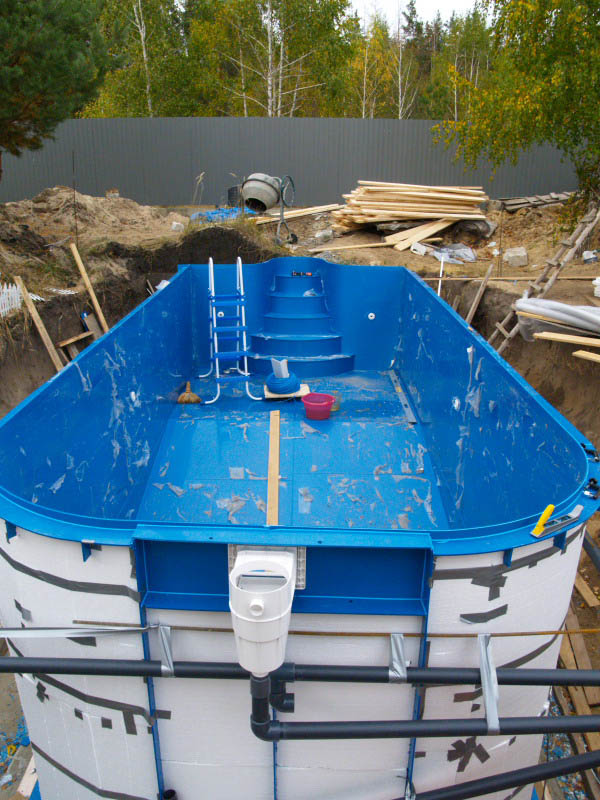 The next stage is the installation of the bowl in the pit and its concreting. Everything is done quite simply:
- The bowl is installed on the prepared "cushion" and is set strictly on a horizontal plane.
- All provided communications are connected, and the hoses are wrapped with adhesive tape - this will prevent the displacement of all communications during concrete work.
- Pour concrete into the remaining voids around the bowl. But you need to do this in compliance with certain nuances:
- inside the pool bowl, we install spacers between the walls - this will prevent the deformation of the material when pouring / distributing concrete inside the voids;
- formwork is exposed outside, only on the side adjacent to the ground;
- water is poured into the pool bowl at a height of 30-40 cm;
- then the void around the bowl is also concreted to a height of 30-40 cm;
- then water is poured again by 30-40 cm, then concrete. And thus the entire space around the bowl is concreted.

After completing all the steps, it remains to wait for the concrete solution to dry - usually it takes at least 24 hours. Then you need to remove the previously installed formwork, and fill the voids that have appeared with sand, moistening it and ramming it.
On this, the work on the construction of the pool with their own hands is over, it remains only to put in order the area around the structure in question - you can lay out the site with paving slabs, you can install a canopy directly above the pool bowl.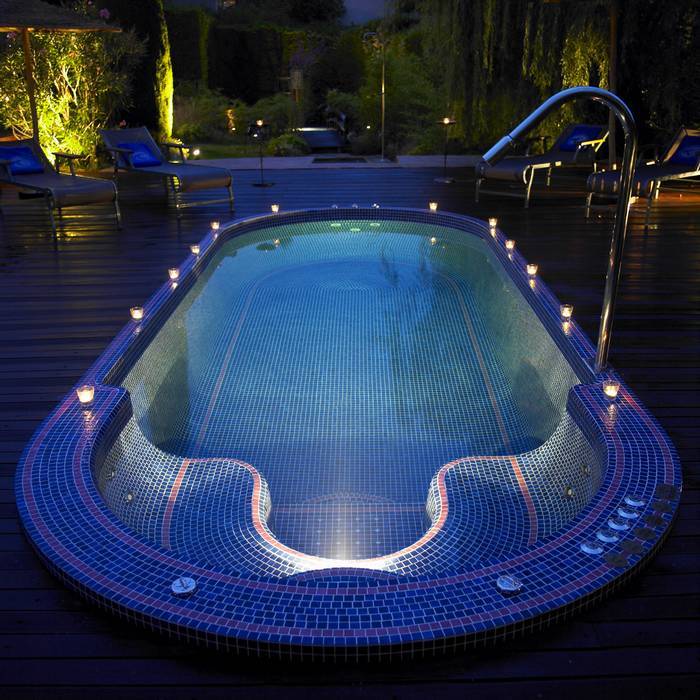
Swimming pool with plastic or composite bowl
| Ease of erection | ★★★★★ |
| Durability | ★★★★★ |
| Economy | ★★★★★ |
Economy
Ease of erection
Durability
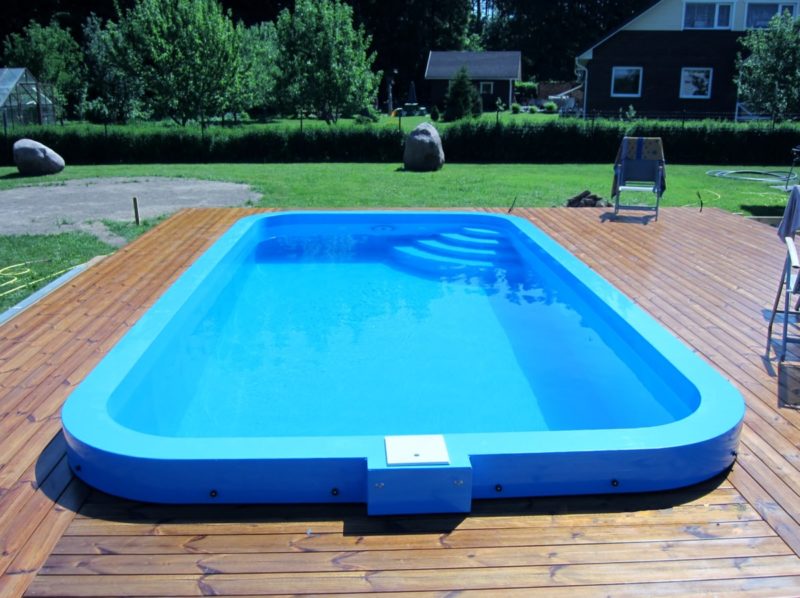 Ready-made tank bowl
Install finished bowl in your area Not difficult, but not that cheap either. At a minimum, you will have to spend money on the delivery and shipment of the bowl by crane.
It makes sense to choose this option if you need not a small children's pool, but a bowl for a comfortable rest of adults in a small company.
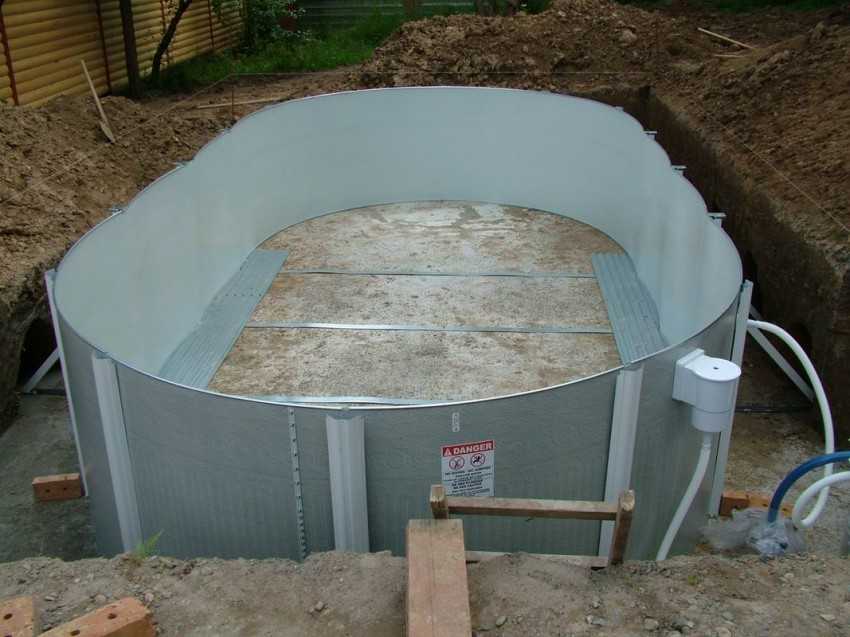
The step-by-step process of installing a plastic bowl looks like this:
- Choose a bowl;
- Create a plan, consider connecting to a water filtration and heating system;
- Dig a hole of the appropriate size, lay a pillow on the bottom;
- Install the bowl, connect the communications and conduct a test run.
By the way, the bowl does not have to be buried completely. But this should be allowed by the technical manual for this particular model, since in this case the pressure inside the pool will fall on the walls of the tank, which will not be supported by the earth from the outside.
What microclimate is created in the pool room
According to the school physics course, the surface of the water is capable of evaporating a huge amount of moisture. At a temperature of 25 degrees, up to 220 g of water evaporates from each square meter. The rate of evaporation and its volume are directly proportional to the size of the pool. The depth and differences in water and air temperatures also greatly affect evaporation. For year-round use of the pool, you need to think carefully about the heating system. The main issues will be: the position and number of heating devices and their performance. These parameters depend on the size of your room and the area of windows. Poor resolution of these issues can lead to serious problems. High temperatures and high humidity create fertile ground for the reproduction of molds, bacteria and even pathogens. Condensation accumulating on the ceiling can destroy even a very solid structure for a short time.
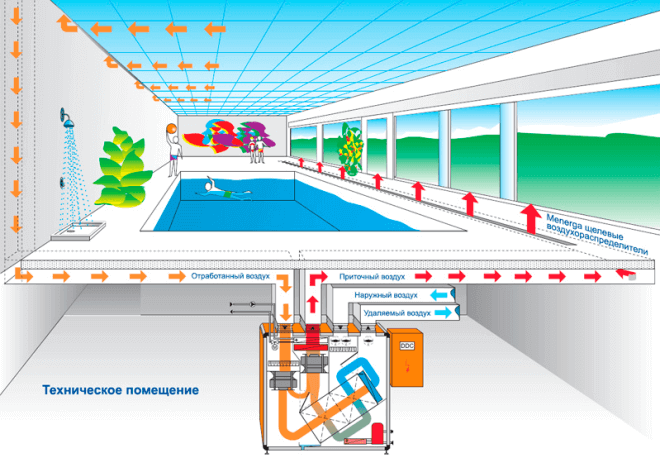
Pool ventilation system
To prevent this from happening, it is necessary to install effective ventilation, which can be supply and exhaust. Your health will depend on how well it is designed and installed. The comfortable water temperature in the pool should be from 26 to 28 degrees, and the air temperature from 27 to 30 degrees. In this case, the humidity in the room should not exceed 55 - 65%. The circulation of the air flow inside the premises must be at least 80 m3/hour per person. Addressing this issue requires an integrated approach. It is best to install automation that will regulate humidity, control dew point, prevent condensation and provide air flow.
Do-it-yourself frame pool on the site
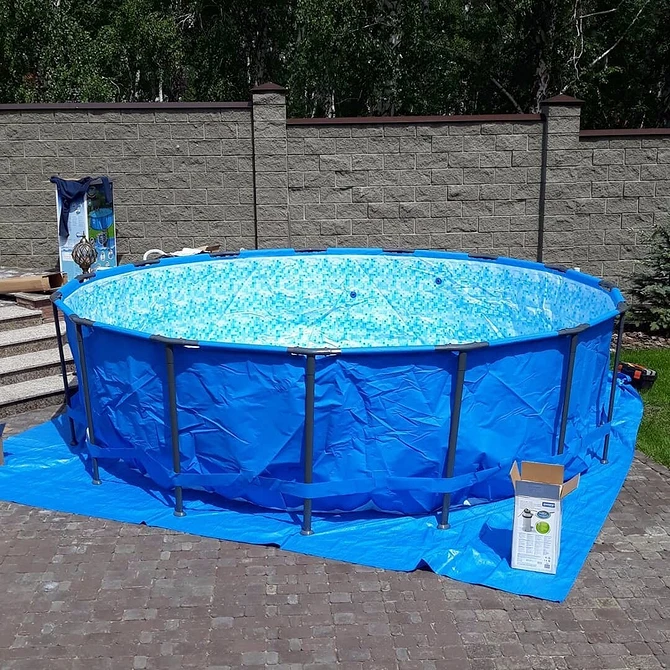
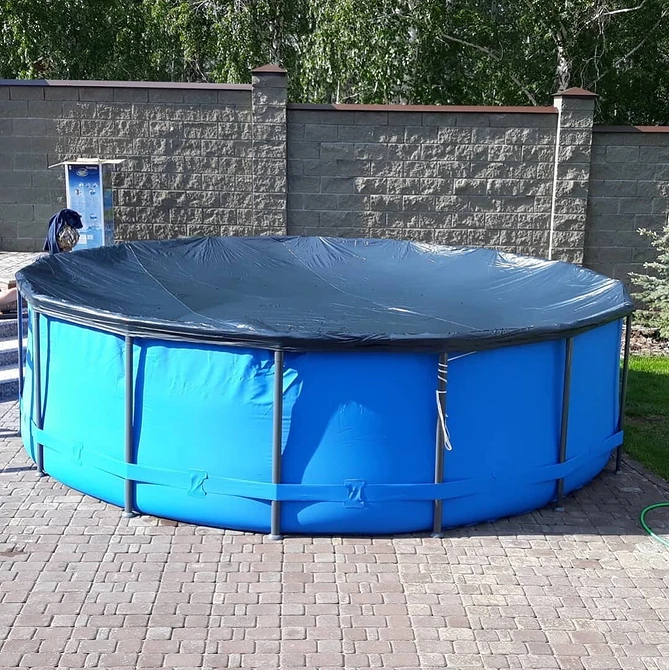
Unlike others, this type of reservoir can be installed independently, without resorting to heavy construction equipment and the help of professionals. There are other benefits as well.
There aren't too many downsides though. The main thing is to carefully monitor the condition of the elements of the system, especially those made of fabric. Yes, and large-area models are rare.
Instagram @lobeli_a
Instagram @magicnikk01
Instagram @davaipolivai
Instagram @davaipolivai
Instagram @davaipolivai
Instagram @magicnikk01
Mounting Features
The most important thing when installing frame reservoirs is to level the site. If this is earth, then you can tamp it with a vibrotamper or a simple bar when there is no special tool.

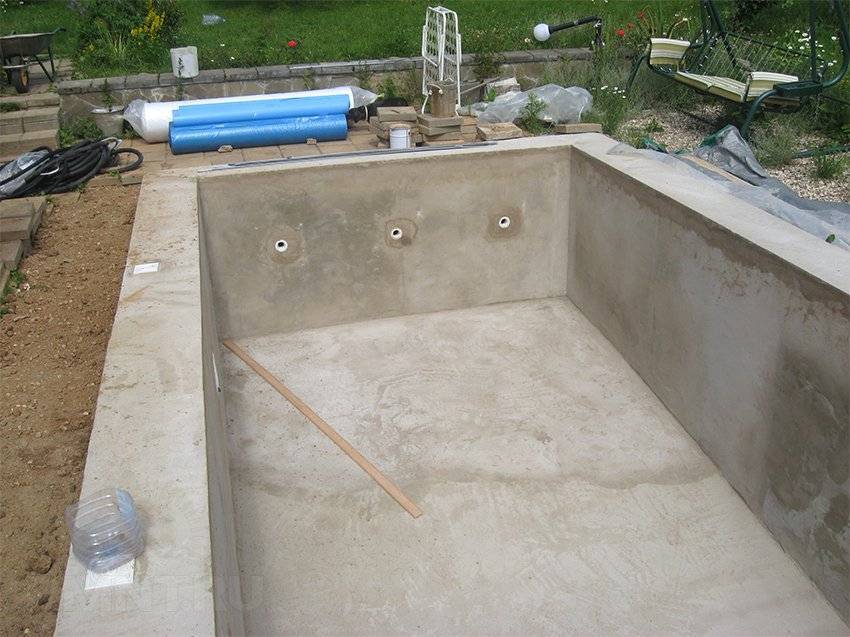


Pool Intex Rectangular Frame
If you plan to place it on asphalt or tiles, all irregularities, even small chips and protruding corners of the tile, must be hidden by laying soft protection, as in the video below, or wet sand and a protective film on top.
For a frost-resistant structure, it is necessary to prepare the place more carefully. And if there are no flat areas, you will have to remove the top layer of turf and level it with sand. Be sure to keep an eye on the level with a level! A detailed process of leveling the site is presented in the video.
There are no tricks in the assembly of the structure itself. Just follow the manufacturer's instructions.
Planning calculations
Everyone can make a pool in the country on their own, but before that you need to choose the right shape that best fits into the landscape of the site and make calculations. The purpose of the pool depends on its size and shape.
Rectangular and elongated shape is ideal for swimming. The round bowl is practical for relaxation and splashing of adults and children.
A separate issue is the depth of the reservoir. One and a half meters of depth is considered enough for a full swim and jumps from the edge of the pool. If you plan to jump from springboards, then choose a depth of at least 2.3 m. For maximum effect, you can make a smooth transition between different depths. Do not make a sudden transition, because it is not safe.
What you need to make a frame pool
First of all, you need to mentally imagine what a frame font assembled with your own hands will look like. Examples of work are found on the Internet, look at friends, neighbors.
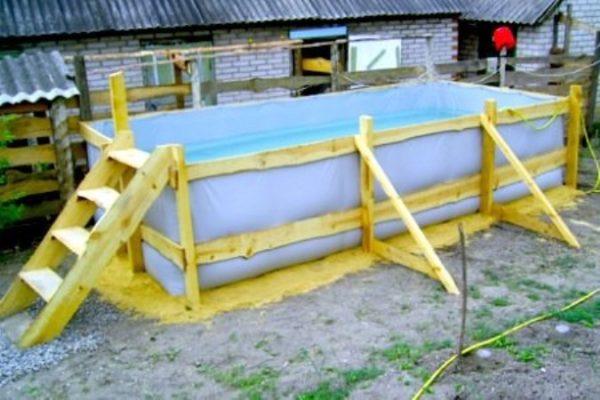
The next step is determined by the size. Frame-type pools are often placed in the country, where the area of \u200b\u200bthe site is usually 6-10 acres. For such a yard, it is optimal to assemble a rectangular font with a wall size of 4.5x2 m with your own hands. The height of the sides is 1 m. A pool with such parameters can hold up to 8 tons of water. Depth enough to swim for adults and children.A sunny area free from trees and high structures is chosen as the installation site.
Advice! It is optimal to install the pool with your own hands closer to the garden or garden plot. This arrangement will simplify the drainage of water. It can be used for watering garden and horticultural crops.
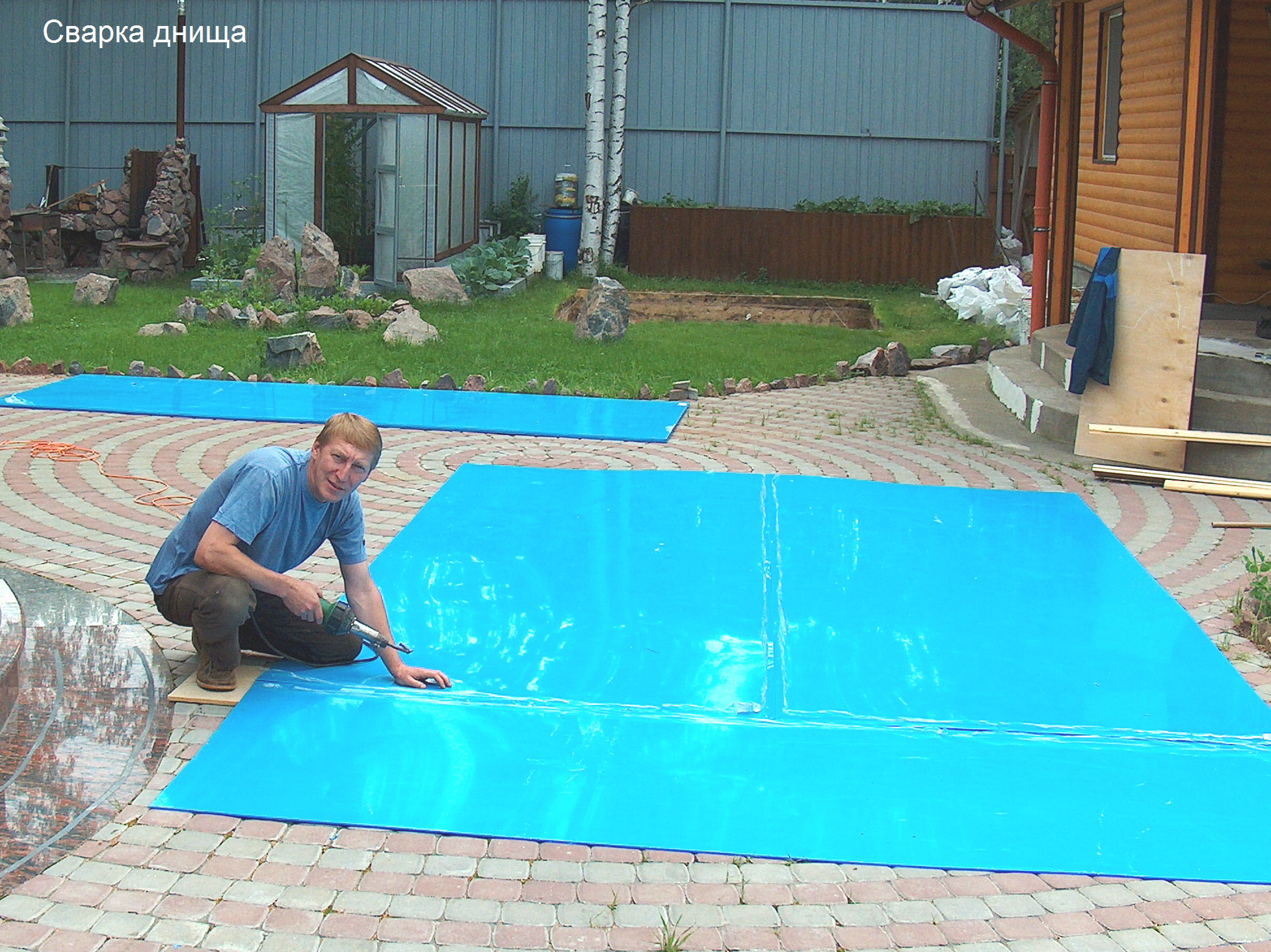
Of the materials for the bowl, you will need a PVC film. The Belgian canvas with a density of 600 g / m2 is considered the best. For such sizes of the pool, a film 2.5 m wide is suitable. The frame is traditionally easier to build from wood. We need particle boards, timber with a wall size of 50x100 mm, edged board with a thickness of 25 mm. Fasteners are carried out with self-tapping screws.
Advice! If you wish, you can weld the frame for the pool with your own hands from metal. The design will be stronger, but it will cost the owner more.
Under the bowl you need to prepare the base. Here you will need small crushed stone or gravel, as well as sand. Antiseptic is used to protect wood, paint, bitumen.

To work, first of all, you will need a woodworking tool and a special hot air gun with a nozzle for soldering the film. It should be designed for the temperature range from 20 to 700 °C.
Options for the construction of country pools
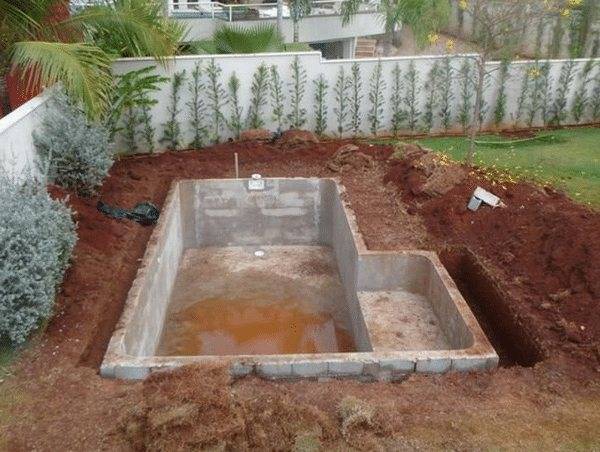
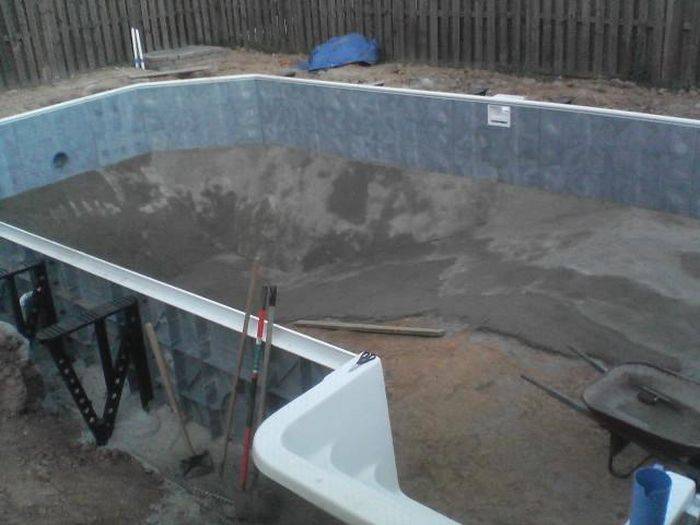
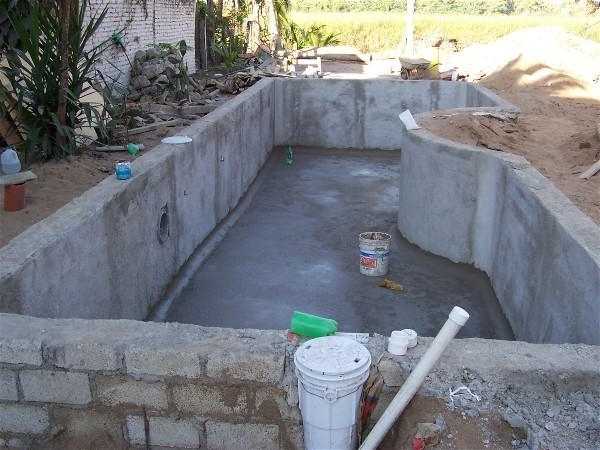
All pool designs can be divided into two large groups: stationary and temporary. Stationary structures include all structures partially or completely dug into the ground, which cannot be moved without destruction. The bowls of such pools are made of monolithic concrete, brick, sometimes concrete blocks are used in construction.They may use a polymer liner (plastic bowl) or provide waterproofing with film or coating waterproofing materials.
Temporary pools are mainly inflatable and frame pools. They differ in that they are installed in the spring, and in the fall, they fold and hide.
What is the best pool for a summer residence? If you are still not sure whether you need such an “attraction” on the site or not, buy the cheapest and fastest mounted: inflatable. It holds water due to the inflated ring. The disadvantage of such a pool is not the greatest depth: 1.2 meters along with the sides is its limit.
But, if you are for the kids, then you can’t imagine better, and adults can “hang” on the wall, relax after “rest” in the country. Depending on the quality and intensity of use, it can last from a couple of years to four or five.
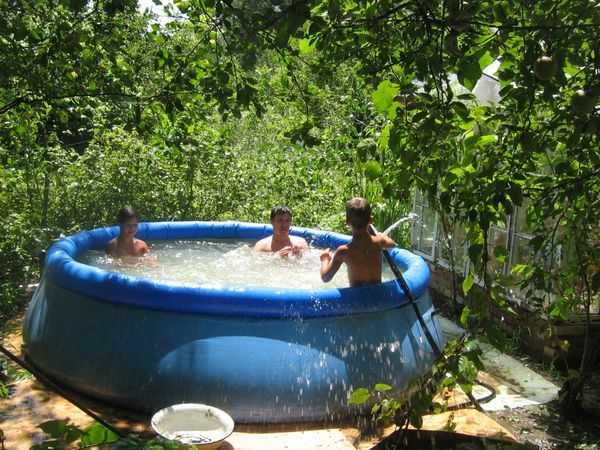
A little more expensive and a little more difficult to install a frame pool. It already has a frame in the form of pipes, on which a special film in the form of a bowl is hung. The depth of such a pool is up to 1.8 m.

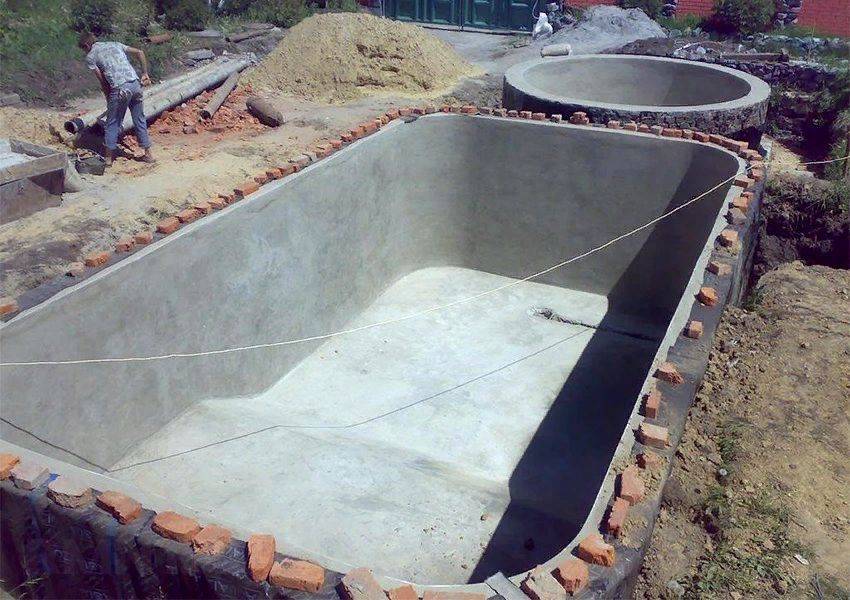
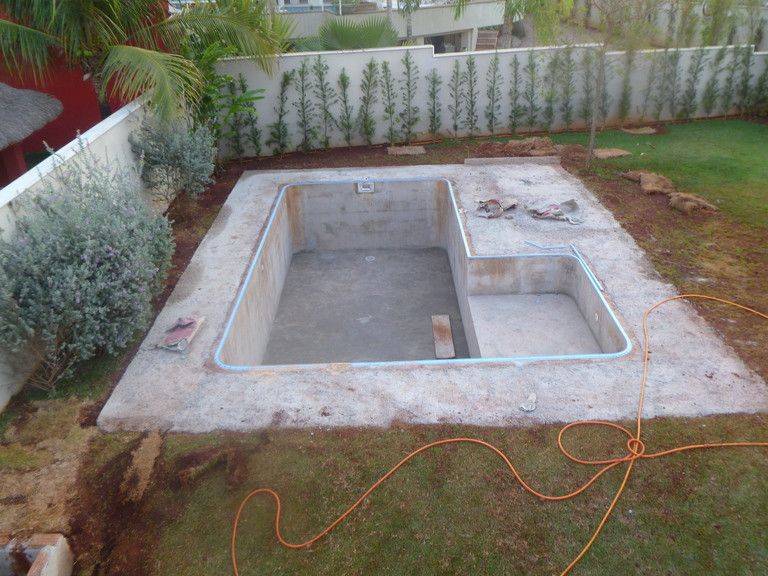

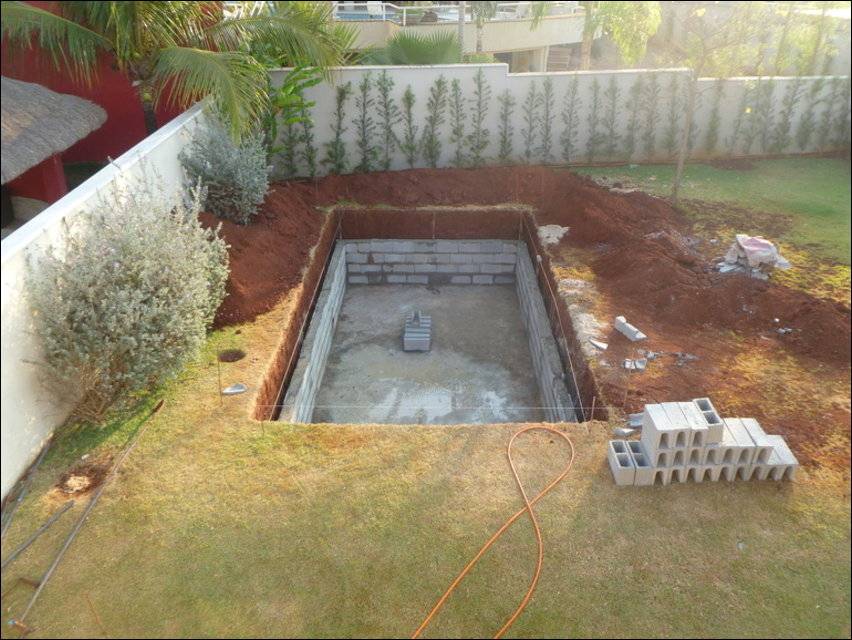
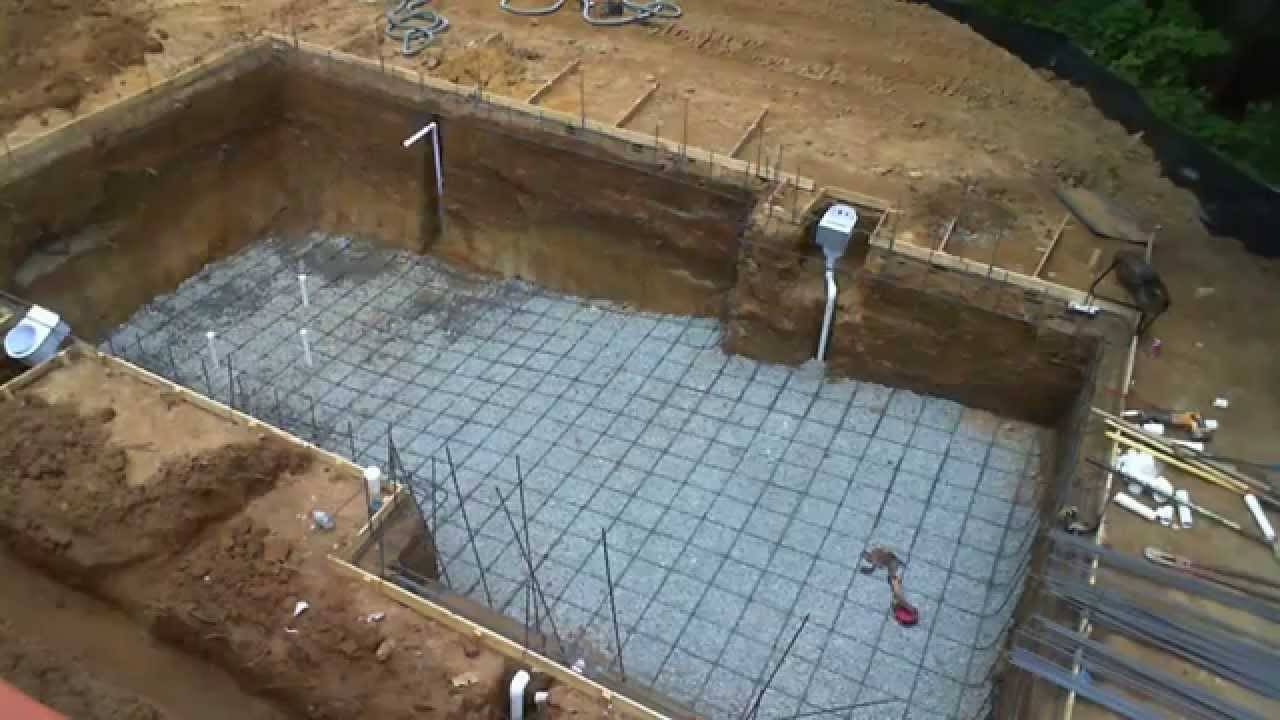


Stationary pools are already for those who decide that a pool in the country is simply necessary for him. The device and maintenance is not cheap. First, a foundation pit is dug, then a monolithic slab is poured, and the walls are erected at the second stage. Measures are needed to waterproof the walls from the outside - so that underground and melt water does not penetrate into the bowl. Next is wall insulation. If this is not done, it will be problematic to heat the water. After that, a set of measures for waterproofing the walls inside the bowl begins, and then finishing work.
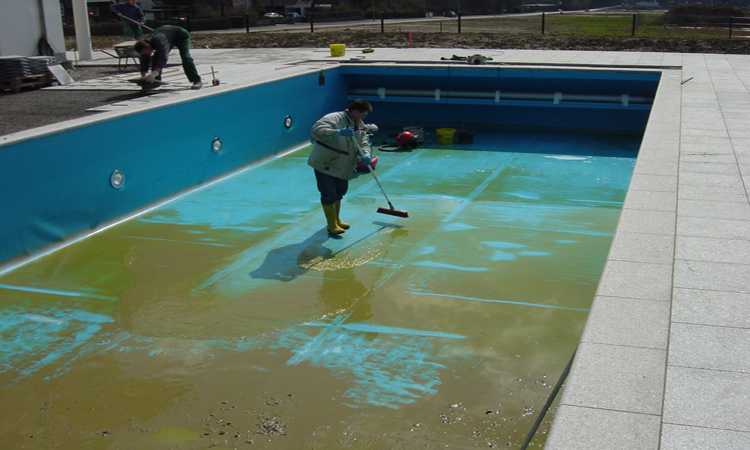
But the finished bowl is not the whole stationary pool.It is necessary to clean the water: leaves, dust and debris pour into it, bacteria and algae multiply. To put the water in order, you need a pump, a filter system, chemicals, and also means for “scooping out” leaves and sediment from the bottom. Part of the equipment is also needed to maintain a temporary pool, but since the volumes are smaller, you can often get by with manual cleaning or water replacement, or you can use improvised means. And if there is at least 5-6 tons of water in a stationary pool (this is a small bowl 2 * 3 with a depth of 1.4 meters), then even manually cleaning out such a volume is problematic.
Nuances of care and operation
No matter how clean the water is, leaves, branches and dust always get inside the pool. To avoid this, you can sew a cover from a fine mesh, which must be pulled over the water. Another option, it is more suitable for mini-pools, is to weave a lid from a vine. It will be beautiful and at the same time effective for protection against large particles. It is easy to remove debris that has got inside with the help of a juice, and algae growths can be easily removed using brushes. In this case, the water must be changed every 2-3 days. To make this water beneficial, it can be used to water plants in the garden. We must not forget that a chemically treated liquid is unsuitable for these purposes. For processing the bottom of small pools, it is convenient to use a vacuum cleaner.
Once a pool is built and beautifully decorated, it will last as long as you maintain it correctly.
With improper care, it will quickly turn into an ugly, bad-smelling swamp, no matter how big or small it is for swimming. It's all about time
In order to prevent such cases and enjoy swimming in the country yard, you need to understand the methods of water purification, which are:
- physical cleaning;
- chemical;
- electrophysical.
Physical cleaning of the pool involves removing debris of various sizes from the water. The following devices will help to do this effectively:
- Ordinary bag.
- Vacuum cleaner designed for underwater cleaning.
- Brushes of various hardness.
- Water filters.
From the specified list of devices, special attention should be paid to filters. They are most effective as they remove contaminants invisible to the human eye.
However, this method requires periodic monitoring.
Water filters differ in the quality of filtration and constituent materials. In this regard, they are divided into types:
- sand;
- cartridge;
- diatom.
The functioning of the sand filter has the main component - quartz, crushed into small particles. Through them, water is purified from particles no less than 20 microns in size. This option is considered the most budgetary. Most suitable for water purification in inflatable pools.
The cartridge filter is more efficient than the previous one, as it is able to trap particles smaller than 10 microns. The cost of this equipment is higher than previously indicated.
The diatom filter is a compressed plate of the remains of fossil microorganisms that can retain dirty particles ranging in size from 3 to 5 microns. This feature makes it highly efficient among devices of this type. Cleaning the filter is quite simple, you only need a pressure of water in the opposite direction.
Chemical treatment of the pool consists in the use of special substances.With this type of purification, pool water:
- disinfected;
- has a normal pH level;
- does not contain the smallest dirt and grease particles that filters are not able to remove;
- prevents the development of algae.
As disinfectants and antibacterial substances are used:
- Chlorine preparations that are commercially available in the form of powder, capsules or tablets. When using this remedy, the dosage must be observed. Otherwise, when bathing, you can get poisoning or damage to the skin. This tool has a low cost and high efficiency, so it is purchased for cleaning large pools.
- Preparations containing bromine, as well as the previous remedy, are very effective. They do not have a strong smell like chlorine, so buyers often stop at it.
- The most convenient method of chemical cleaning is disinfection with active oxygen. The use of this method does not entail the appearance of foam and unpleasant odors in the water.
Electrophysical cleaning involves the use of ozonizers, ultraviolet rays and equipment capable of releasing silver and copper ions into the water. The presence of this cleaning system makes chemical treatment unnecessary. Electrophysical cleaning does not cause allergic reactions and odor, which makes it the most effective way to remove dirt from water. Ultraviolet rays and silver fight organics, and the presence of copper destroys algae.
Compact versions of pools are full-fledged bathing places, which in their functionality are no different from stationary options, so the methods and methods for cleaning them are similar.
How to make a platform for a frame pool with your own hands
There are different ways to make a high-quality base for the installation of an artificial frame-type reservoir. It is easier to decide on the technology after familiarizing yourself with the most popular options.
How to make a platform for the Intex frame pool
Having chosen the territory for the bathing tank for both adults and children, they begin to prepare the site:
- Outline a place under an artificial reservoir.
- Remove the top layer of sod (10-15 cm), removing vegetation, stones and other debris.
- Lay and compact river sand.
- Make a platform from expanded polystyrene sheets and spread the substrate included in the kit for the pool. If it is not available, then you can use a thick film.
How to make a wooden base for a frame pool with your own hands
To build a wooden platform for a bathing tank, it is necessary to use planed boards 140-145 cm wide, 400-405 mm thick. The work process includes:
- Production of concrete posts with a depth of half a meter into the ground.
- Cut the boards according to the size of the site, adding 20 cm on each side. Treat them with a protective impregnation from moisture and allow to dry.
- Lay the prepared bars on a platform previously freed from the turf, which was also covered with sheets of roofing material.
- Fix the boards, maintaining a distance of 1 cm between them. Such a gap is necessary for their ventilation. The edges need to be sanded. Lay linoleum or a dense film.
How to make a base from paving slabs
The technology for organizing a platform for a bathing bowl is simple, the whole process consists of the following steps:
- Remove the sod from the site to a depth of 15-20 cm.
- Lay geotextile and a layer of sand, which must be well compacted, using a piece of plywood and a round beam. It is more convenient to use a vibrotamper for these purposes.
- Lay paving slabs. To quickly warm up the water in the tank, you need to make another layer of polystyrene foam sheets 30 mm thick.
Concrete
For the manufacture of a concrete base, it is necessary to adhere to the following sequence of actions:
- Remove sod.
- Lay geotextile and a layer of river sand, spill with water and tamp.
- Lay out the reinforced mesh, make a formwork 15 cm high. Its dimensions should be 30-40 cm larger from the base.
- Fill with cement mortar and level. Cover the concrete with a film for two days.
From film / linoleum
It is easy to make a base for an artificial frame-type pond from a film or linoleum if you follow the following technology:
- Remove debris from the site and remove a layer of turf (10-15 cm).
- Pour a layer of river sand and compact it, having previously spilled water from the hose.
- Level the sand with a steel profile/board. Lay reinforced film or linoleum.
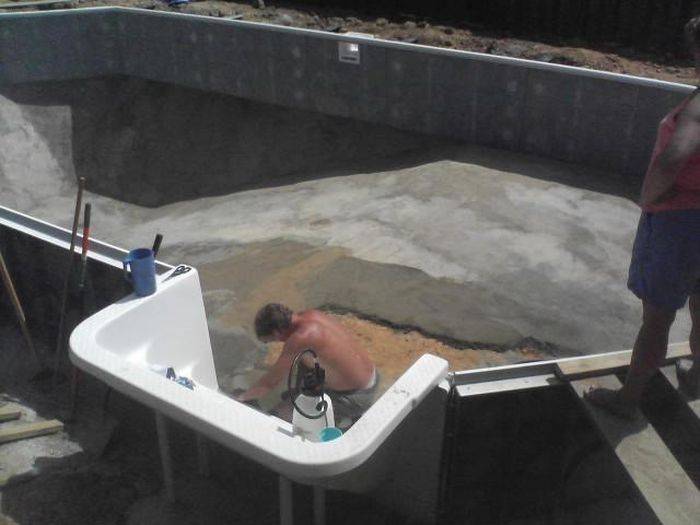
Video of site preparation for a frame pool:





Ready-made bowl or do-it-yourself?
In specialized stores, ready-made bowls for pools are sold - they can have completely different sizes, differ in shapes. The main material in the manufacture of bowls for pools is polypropylene - it has high quality characteristics. For example, polypropylene bowls have smooth walls - dirt / plaque will not form, the material is frost-resistant, has an aesthetic appearance, and so on.But there is also a minus - if the pool is located under the direct rays of the sun, then polypropylene can expand from heating. True, as soon as the temperature regime of the air stabilizes, the bowl returns to its usual forms.
But there is always the possibility of creating a pool bowl with your own hands, using for this the most reliable and long-known material - concrete. Both the bottom and the walls of the bowl can be poured from the concrete solution - this process, however, is laborious and lengthy. But on the other hand, the owner of the site can determine the desired dimensions and shape of the pool himself. Some summer residents simplify the process of building a pool with their own hands - they pour the bottom with concrete mortar, and expose the walls with steel sheets.
Any of these options has a place to be, and the choice of a particular one should be made on an individual basis, taking into account not only preferences, but also financial capabilities.
Stationary pools: traditional or non-standard
stationary monolithic pool
Having decided to install a stationary reservoir on a summer cottage, it is necessary, first of all, to find the optimal place for its location. The device of such a reservoir will require a significant investment of time and money, so the choice of site should be taken carefully and thoughtfully. An example of the arrangement of such pools can be seen. It is undesirable to have trees near the pond, as this will make it difficult to clean it and require the installation of a canopy. Location close to the electrical network and water source will reduce the cost of communications.
The choice of design and size of the pool, its configuration and depth largely depends on the material of the bowl. If finished products are used, then their forms are limited to the proposal of manufacturers.A do-it-yourself pool made of concrete can be built in a wide variety of configurations. This is the most time-consuming way to build an artificial reservoir, but more economical and durable than using ready-made bowls.
The construction of a concrete pool takes place in several stages:
-
Site preparation
pool pit
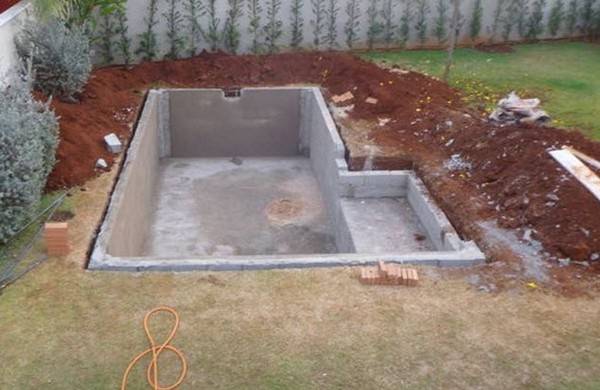
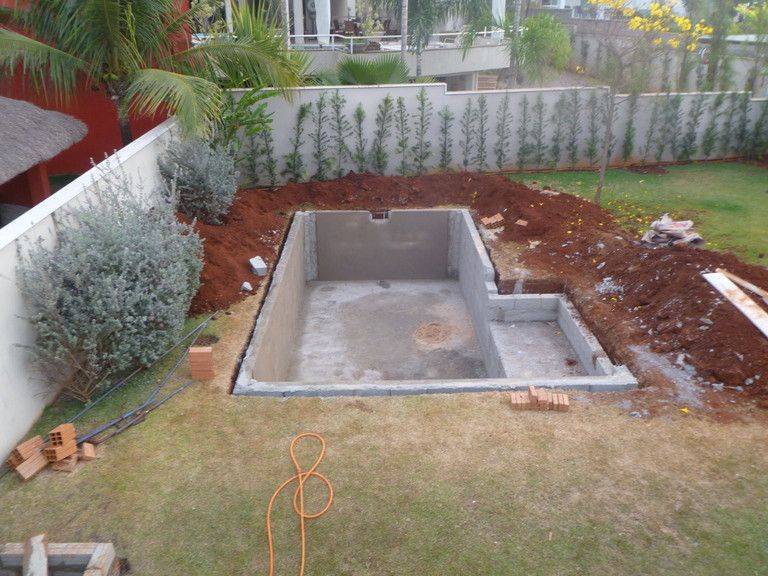
The selected place is cleared of debris, marked with twine and pegs, after which, manually or using mechanization, they dig a pit of the desired depth. After the pit has reached the desired size, its bottom is compacted with a rammer and covered with layers of sand and gravel, and then waterproofing is carried out using roofing material on bituminous mastic or other materials.
-
Formwork installation, reinforcement and pouring of the bowl
formwork for the pool
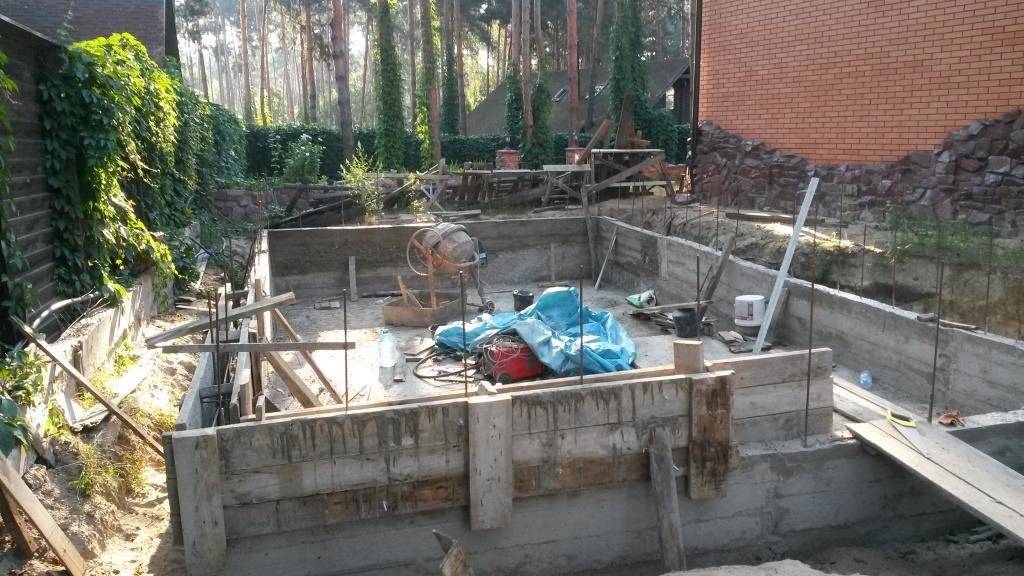
For formwork, boards and moisture-resistant plywood are used, which are coated with protective compounds. First, the bottom of the pool is poured, and after the frame is installed, the concrete bowl is cast. For strength, reinforcement is used, which is tied with wire or welded if the reservoir has a complex configuration.
It is desirable to carry out all works on the installation of the walls of the pool continuously to create a monolithic structure. In addition, before pouring, all communications should be carried out and the necessary holes for installing lighting should be provided.
-
bowl lining
After the concrete has hardened, the formwork is removed, and the inner surface of the resulting tank is covered with a liquid cement mortar with special additives, which provides additional waterproofing. After the wall, the bowls are lined with mosaics or tiles.
-
Equipment installation
One of the important stages in the construction of pools is the installation of an effective water supply and purification system, which is carried out using special equipment. The choice of the necessary equipment occurs at the design stage of the reservoir. At the same time, options for its lighting are also being worked out.
Less labor-intensive arrangement of reservoirs using ready-made forms from a variety of materials. It can be a plastic garden pool, which is a plastic container with an acrylic coating. Technical characteristics, performance properties and service life of such products depend on the type of polymers and the manufacturer. A more modern option is to use glass fiber reinforced composite tanks as bowls. Such designs do not require additional processing, are durable and reliable. Their disadvantages include the possibility of damage due to the volumetric expansion of the soil during freezing.


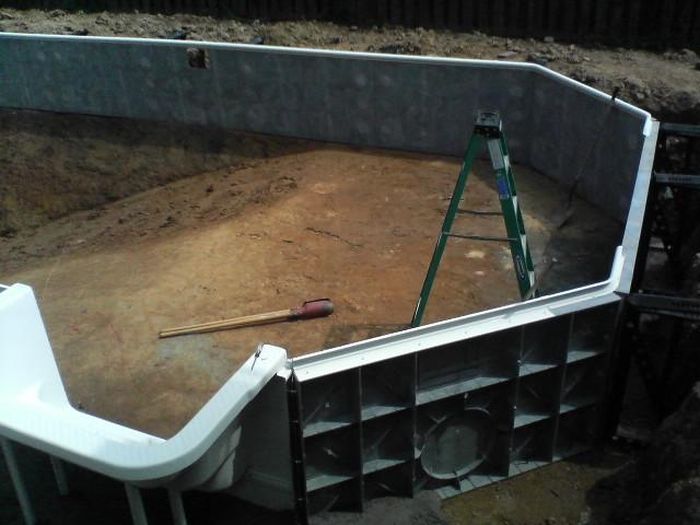
Composite pools for summer cottages, like plastic ones, are installed as follows:
-
They mark the site and dig a pit, manually or with the help of mechanization.
-
Sand and gravel are laid in layers at the bottom of the pit, compacting them with a rammer.
-
Set the form of plastic or composite material.
-
Install pumping and filtering equipment.
-
Fill the gaps between the walls of the pit and the bowl with sand.
-
Decoration of the coastal zone.
A variety of materials for the manufacture of pools and methods of their installation allow you to choose the best option for any suburban area. It is enough to apply imagination, a little effort and apply some skills and you can enjoy a hot day.
Successful implementation of an inexpensive indoor pool in the country:



