- Purpose of installing a heating meter
- Why is a heat meter needed and how does it work in an apartment building?
- Installation options for metering devices
- Method # 1 - common house counter
- Method # 2 - individual measuring devices
- How to choose the best heat meter?
- Is it possible to install heat meters in apartments
- Heat meter for a house with central heating - legal norms
- Heating meter options: individual and common house appliances
- Individual meter for heating in the apartment
- Installation of common house heat meters
- Who should install and pay
- Is it possible to refuse
- Types of heat meters
- Apartment units for heat metering
- Household (industrial) heat meters
- Mechanical
- Ultrasonic
- Scheme of work
- Registration and verification
Purpose of installing a heating meter
Heating a house is expensive. But private homeowners at least have a choice in terms of boiler equipment and fuel. Residents of high-rise buildings have no choice - central heating with tariffs set by the management company.
However, there is a tool to reduce the cost of heating an apartment - an individual heat meter.
Image gallery
Photo from
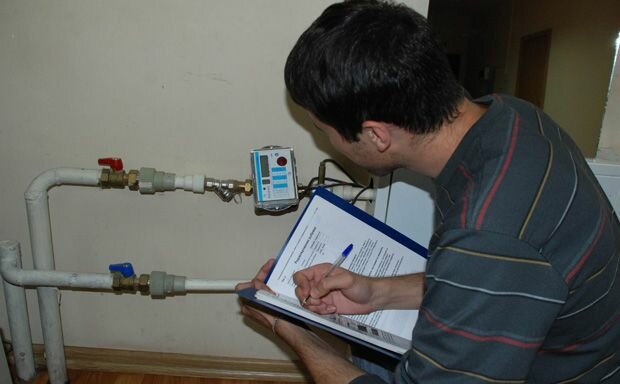
Heat meters are designed to measure heat consumption in the heating network of an entrance or in a section of a heating circuit
Installation of a device that measures heat consumption, fixes the volume of consumption of its devices
A heat meter in a private building guarantees tangible savings. Using the readings of the device, you can set the temperature 1º lower during the absence of residents, which reduces consumption by about 6%
The heat consumption meter in the apartment will ensure the control of the service provided by the management company, will identify unreasonable energy consumption
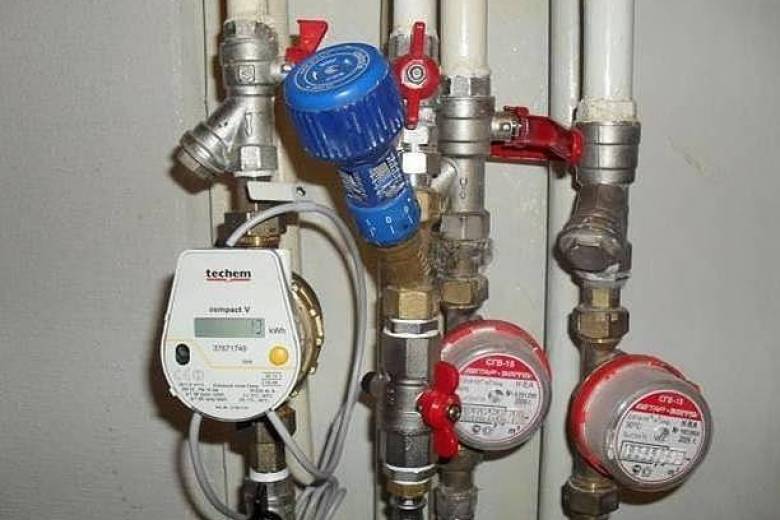
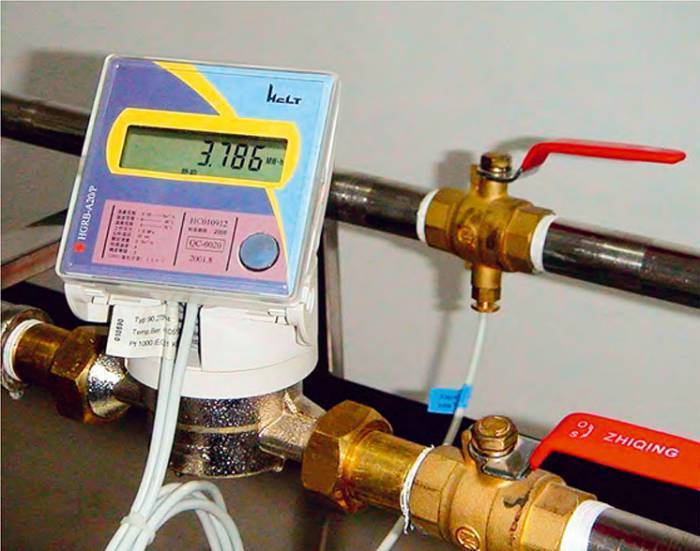
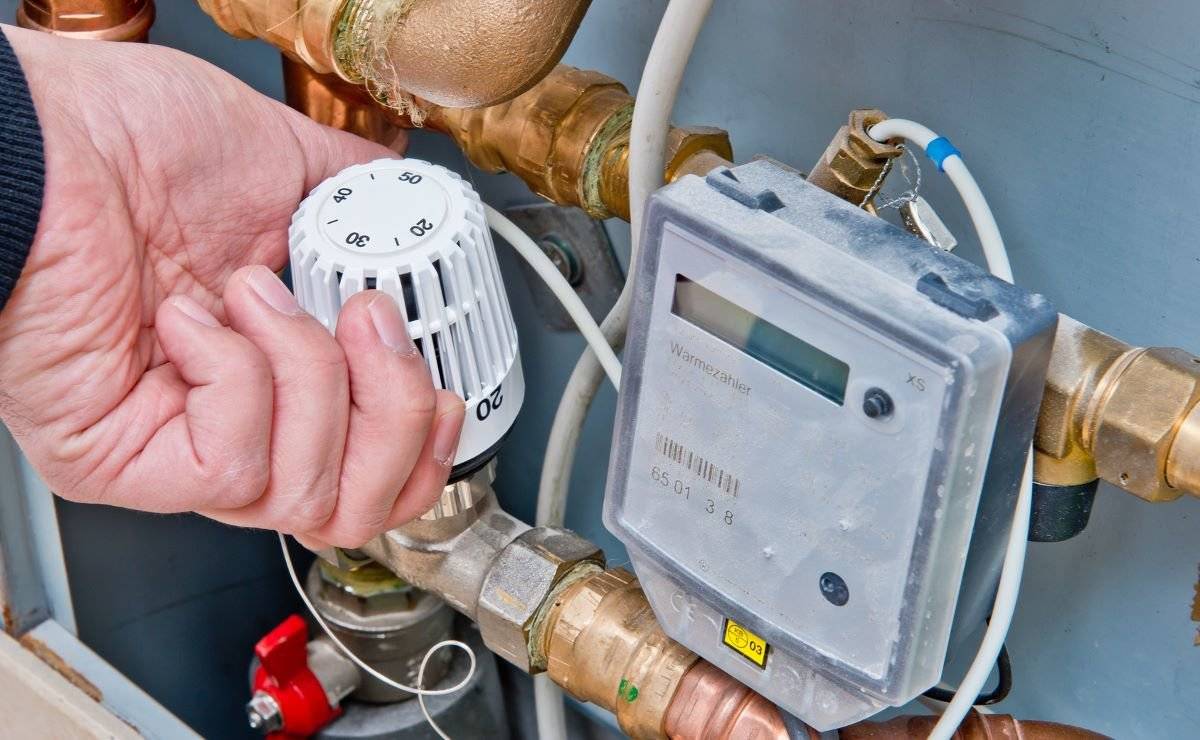
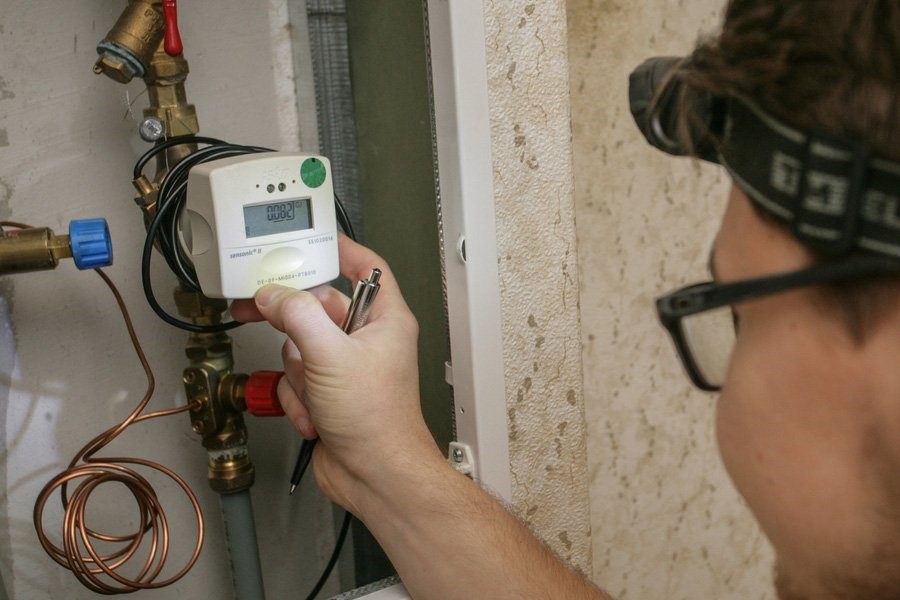
The heat meters used in everyday life are similar in design and principle of operation to water meters. They include: a flow part, a measuring cartridge, a thermal converter and a calculator
The heat meter records the flow rate of the coolant passing through the flow path of the device and the temperature in the supply or return pipe of the heating circuit
For comfortable reading of readings recorded by the device, heat meters are equipped with an optical interface
To read the data measured by the device from devices with an optical interface, remote access can be organized
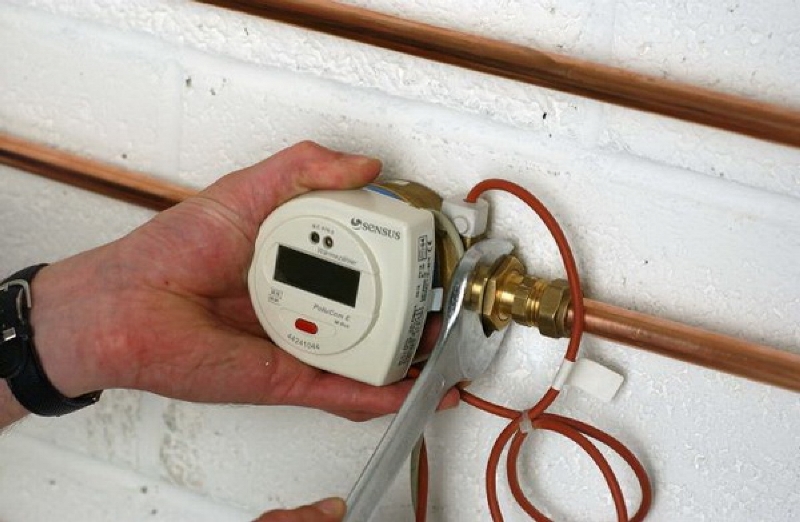
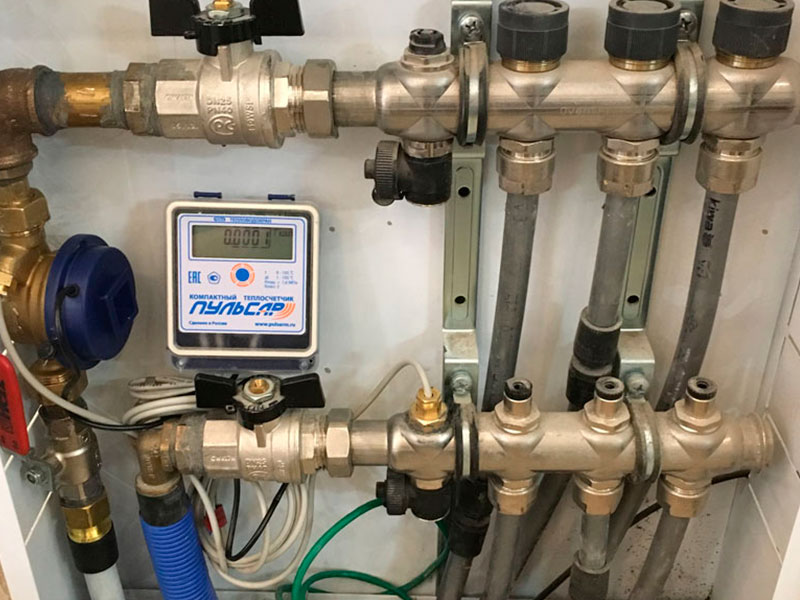
Compact heat meter
Measuring device installed
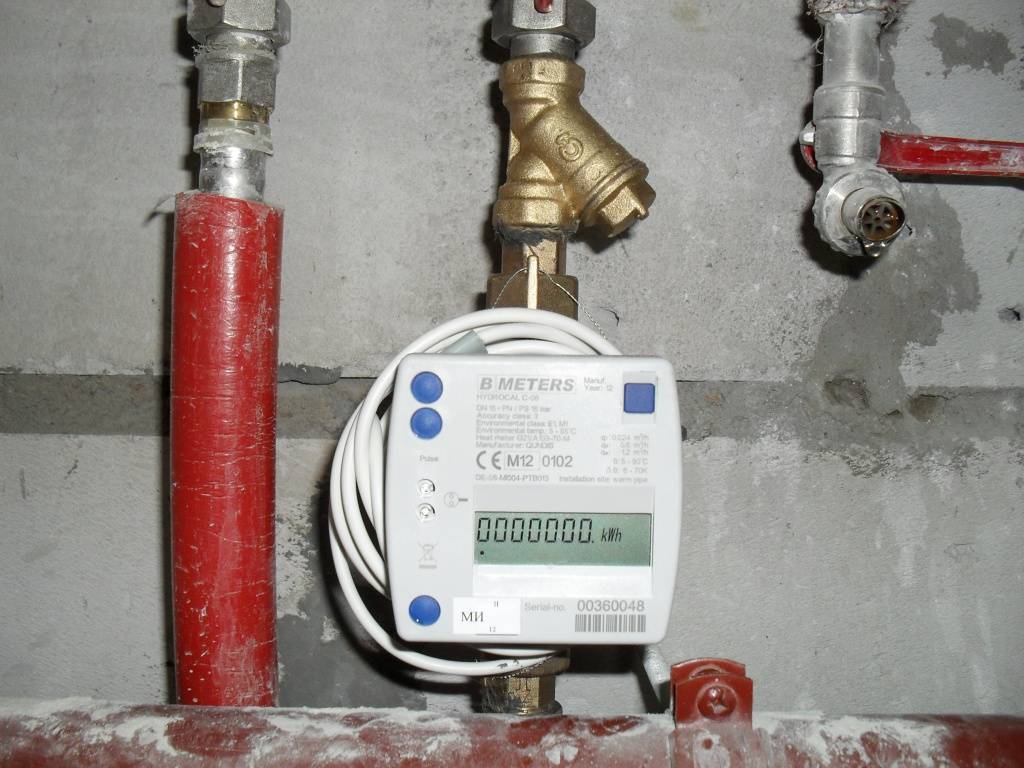
Heat meter in a private house
Heat flow meter in the apartment
Household heat meter components
Basic elements for mounting a heat flow meter
Convenient optical interface
Remote access meter
When there is no high-quality heating, it happens that malfunctions in the home heating network force us to look for alternative sources of heat.
Or the reason for the cold room radiators is the intention of the management of the housing office to save on general house heating costs.
Then the plumber fastens the shutoff valve, reducing the flow of hot water into the heating network of the high-rise building. Residents are freezing and warming themselves with electric heaters, increasing electricity bills. But the cost of heating does not decrease from this.






When there is too much heat Superheated air in the rooms is unpleasant, you have to open the window to lower the overall temperature level. But behind the outwardly simple methods are the money spent on "heating the street."
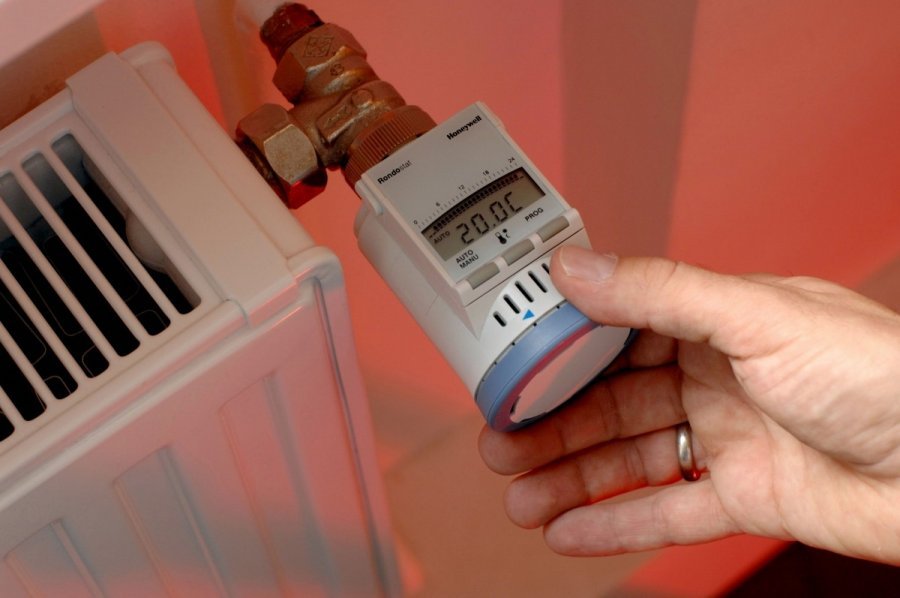
They can be saved by installing regulators on heating batteries and a heat meter on the heating circuit of the apartment.
In winter, ventilating an overheated room is the only thing that comes to mind to reduce uncomfortable indoor temperatures.
Hidden components of heating payments. From the boiler house, the coolant enters the main networks with one heating temperature, but at the entrance of the heating pipes to the houses, its temperature is different, lower.
The delivery of coolant through pipes is accompanied by heat losses due to poor insulation, this is understandable. But these heat losses are paid by the end consumer - the owners of apartments in high-rise buildings that are not equipped with heat meters.
Why is a heat meter needed and how does it work in an apartment building?
Heat meters are used to control the quality of heating services. If the batteries were not hot enough, then you would not have to pay the full cost for heating your home.
Given the constant increase in utility rates, an individual meter will help save a lot. At thermal power plants, such devices have long been installed to control the quality of services.
Multi-apartment buildings were also required to have heat meters to encourage energy-saving measures.Installing a heat meter allows you to check how correctly the coolant is supplied to the house, to detect and eliminate possible losses from incorrect laying and wear of the heating main.
Installation options for metering devices
The benefits of installing metering devices are obvious. The homeowner will pay only for the heat received, without forking out to pay for losses during its transportation. To maximize the savings, you should remove all sources of possible heat loss in the house: install sealed window frames, insulate the room, etc. There are two options for installing the counter.
Method # 1 - common house counter
Residents of high-rise buildings can solve the problem of heat metering by installing a common house meter. These are by far the cheapest option. After all, the price of a heat meter, which is not cheap, and its installation will be “scattered” among the owners of several apartments. The resulting amount will be quite acceptable. Readings of such a device are taken once a month. Payments are distributed to each apartment in accordance with its area. Moreover, if the service provider fulfills its part of the contract in bad faith and does not provide the agreed temperature in the house, it will be obliged to return the money paid to the tenants.
You should start with holding a general meeting of apartment owners. It is necessary to discuss all the nuances of the upcoming installation and determine who will take meter readings and issue receipts for payment. The decision of the meeting must be recorded in the minutes, after which you can contact the management company with a written application to connect the device.
The most inexpensive method of heat metering in the arrangement is a common house meter.However, for a number of reasons, the economic effect of it can not be expected.
Method # 2 - individual measuring devices
The main advantage of a common house device is its cheapness. However, the economic effect of its use may be much lower than expected. And there are many reasons for this. For example, insufficiently insulated entrances or apartments of neighbors, as a result of which heat losses turn out to be prohibitively large. Therefore, many choose individual heating meters, which are installed directly in the apartment. This is a more expensive but very effective option.
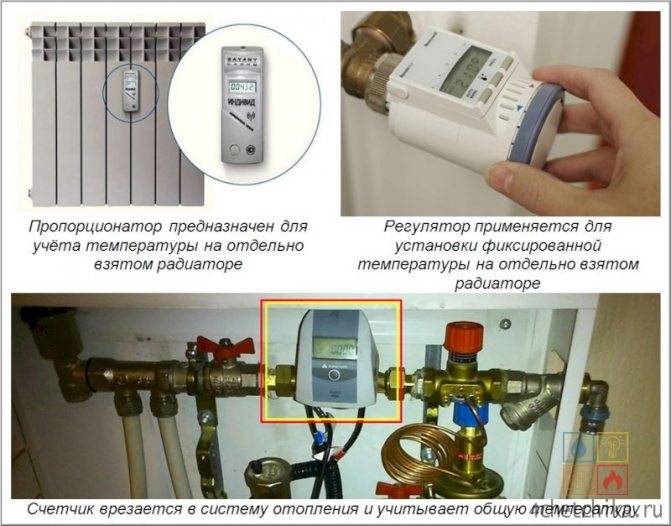
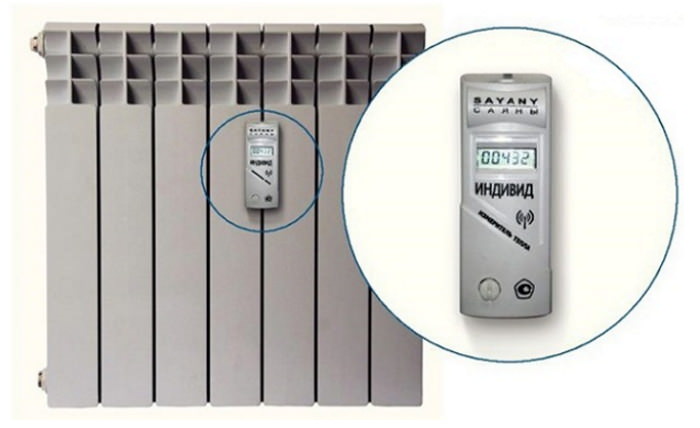
Distributors are installed on each radiator in the apartment. Within a month, they record the temperature of the batteries, tracking the slightest differences. Based on this information, the heat charge is calculated.
Before planning the installation of an individual metering device, you should familiarize yourself with some technical limitations. The heat flow meter is mounted on the riser leading to the apartment. In old multi-apartment buildings, vertical wiring of heating pipes was most often performed. This means that the apartment may have several risers, each of which must be equipped with a device, which is extremely unprofitable. The solution to the problem could be the installation of special meters for heating batteries, but such equipment is not used in our country, although this is a common practice in European countries.
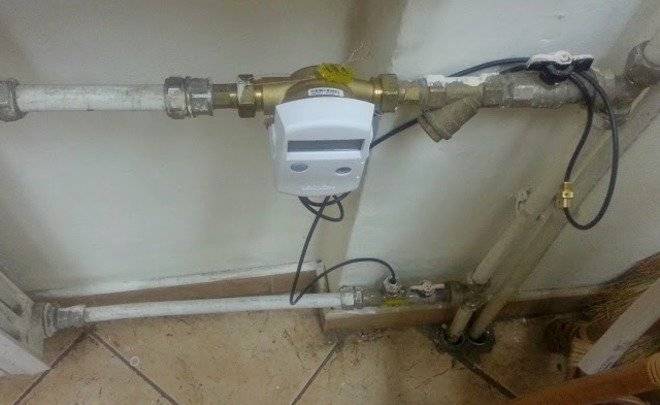
Manufacturers of metering devices offer to install so-called distributors in houses with vertical wiring, which measure the flow rate of the coolant based on the temperature difference on the surface of the battery and in the air of the room. Another solution to the problem is a common house metering device.In buildings with horizontal wiring, the installation of any heating meters in an apartment is not complicated in any way. Compact models of devices are mounted on a pipe supplying coolant to the room or, in some cases, on a return pipeline.
How to choose the best heat meter?
There are a lot of varieties of heat meters, but 5 types are most suitable for installation in an apartment:
- mechanical (otherwise - tachometric);
- electromagnetic;
- vortex;
- ultrasonic;
- overhead sensors for batteries.
Mechanical heat meters are so called from the fact that the flow rate of the coolant is determined using an impeller immersed in it. With the help of 2 sensors that cut into the supply and return pipelines, the temperature difference is determined. Based on these data, the calculator gives the result of the consumption of thermal energy. Heat meters of this type are quite cheap, but at the same time they are very demanding on the quality of the coolant.
Organizations involved in the supply of heat do not particularly favor such devices, not so much because of the sensitivity to the quality of the coolant, but due to the fact that, according to experts, this type of device is poorly protected from external influence on it by unauthorized persons in order to underestimate readings.
Electromagnetic counters. This type of meter works on the principle of the appearance of an electric current when the coolant passes through a magnetic field. These devices are quite stable and are used quite successfully. Inaccurate measurements may occur if impurities may appear in the coolants or wires are poorly connected during installation.




Vortex heat meters.This type of equipment works on the principle of assessing vortices that form behind an obstacle that is located in the path of the coolant. Mounted on both horizontal and vertical pipelines. These meters are very sensitive to the presence of air in the system, and are also demanding on the quality of impurities in the coolant and the quality of welding work.
For their proper operation, you need to install a magnetic mesh filter. Deposits inside the pipeline do not interfere with the correct operation of the instrument. This device makes great demands on the dimensions of straight sections of the pipeline before and after the flowmeter.
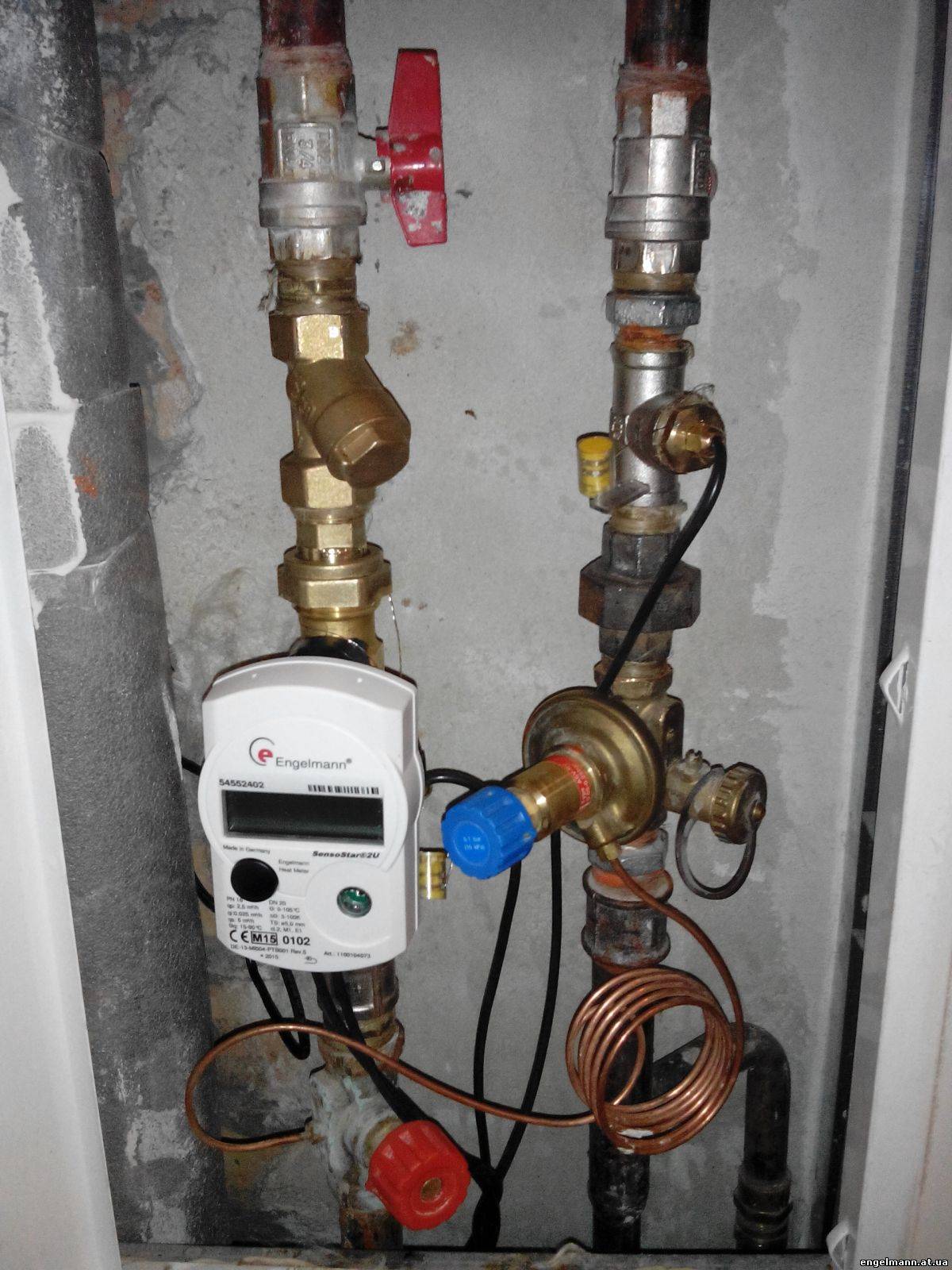
Ultrasonic heat meters practically do not have disadvantages. They are not demanding on the quality of the coolant, since its flow rate is determined by means of ultrasound passing through the working section. The temperature difference is calculated using sensors installed on the supply and return. The only negative is that this device is at least 15% more expensive than a mechanical one, but management companies recommend these devices for installation. And this is logical, since it is impossible to interfere with the operation of this device.
Heat meters mounted on the battery measure the temperature on its surface and the air temperature inside the room. After that, the calculator issues data on the consumed heat, based on the passport data on the radiator power, which are entered manually.
This type of device is unlikely to be accepted for operation by a company supplying heat, but if there is a general house heat meter, this device will help to more accurately calculate the heat consumed in each apartment, but it should be borne in mind that these devices must be installed in each room.
Like any metering and measuring device, a heat meter must have a passport and a certificate. Documents must necessarily indicate data on the initial verification, which was carried out by the manufacturer. This information should also be indicated on the instrument case in the form of a special stamp or sticker. During operation, these devices must necessarily undergo periodic verification. Its duration depends on the type of device. On average, verification is carried out every four years.
Is it possible to install heat meters in apartments
At the moment, there is no prohibition on such actions in the current legislation. However, your desire may not be “understood” by the company that supplies heat. Moreover, the current regulations do not allow intervention in the centralized heating network, even if you just want to install a meter. In this case, unauthorized equipment will not be accepted into operation. And the owner of the apartment also has to pay a fine.
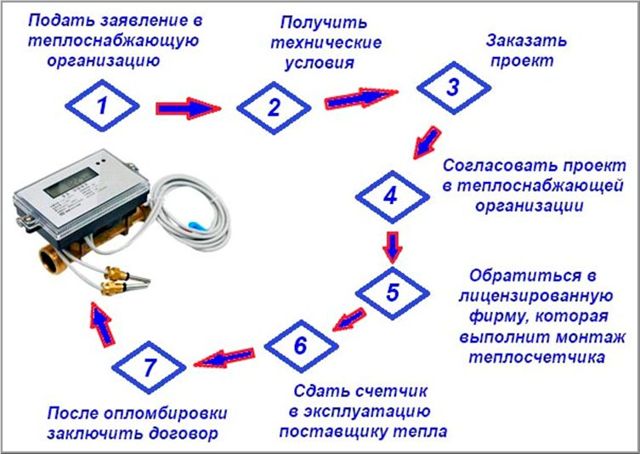
This means that before installing a meter in a house with central heating, you should write an application to the heat supply company. The procedure then looks like this:
- company specialists should check whether it is possible to install a metering device. If the answer is yes, then a special document is issued - technical conditions (TU);
- if there is an association of co-owners (OSMD) in the apartment building, then a copy of your application will have to be sent to the responsible person, and this issue will also be agreed with him;
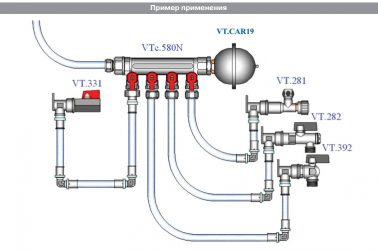
Heat meter installation diagram
- having received the technical conditions, you can contact the design organization, which has permission for such work.For a fee, its specialists will make all the calculations, draw up an installation project, and certify all the documentation with their seal;
- further, the project documentation is coordinated with the heat supplier;
- after the last approval, you can contact the installation organization licensed to install heat meters;
- the installed metering unit is put into operation in the organization supplying heat. An agreement is drawn up with an individual, the owner of the apartment, according to which the latter will pay for the supply of heat energy through the metering device.
Heat meter for a house with central heating - legal norms
But if we are already talking about the law, then we cannot fail to mention the current regulatory legal act that regulates the installation of these metering devices. So, according to law No. 261, the installation of heat meters is carried out at the expense of residents of an apartment building. But the methodology for calculating the cost of heat in the presence of such devices is described in the Decree of the Cabinet of Ministers No. 354. In fact, it will be difficult for a non-specialist to understand what is written in the data in the documents, but we will “translate” several main theses into a public language:
if there is no metering device at the input, then heat is paid at tariffs with a multiplying coefficient;
although the laws of the Russian Federation do not oblige apartment owners to install heat meters, they do not prohibit this;
the readings of your metering device are taken into account only if all other apartments, as well as heated common areas, are equipped with heat meters; and a common metering unit is installed at the input;
after installing the heat meter, it is taken into operation by the heat supplier, but at the expense of the owner of the apartment.
Heat meters for a house with central heating
However, at the moment, we can already draw a couple of important conclusions from all of the above. Firstly, it is still better to install a common house heat meter, otherwise the cost of this resource will cost you about one and a half times more
And the readings of an individual meter in the apartment are not taken into account. Secondly, in an individual metering device in an apartment, in general, there is no point, even if you have received all approvals for its installation.
In order for his testimony to be taken into account, the heat consumption must be controlled in all other rooms of the apartment building. Thirdly, sometimes a common house metering station is simply impossible to install technically on central heating.
The only way out in this situation is to reach an agreement with all the tenants, and install heat meters for everyone in each apartment, and even better - in the entrances. Otherwise, the cost of heat spent on heating non-residential premises will be divided among all residents.






Heating meter options: individual and common house appliances
Depending on the conditions and variant of the distribution of the heating network, there are two types of heat meters: common house and individual - in each apartment. Both methods have the right to life, and each has its own advantages and disadvantages.
A common house heat meter in an apartment building is considered an excellent option, especially if most residents are willing to financially participate in its installation.Despite the fact that the installation cost and the price of the heat meter are quite high, if the final amount is distributed among the residents, the result will not be such a big figure. Accordingly, the more applicants, the cheaper the work will cost. On a monthly basis, data from the meter is taken by employees of the heat supply organization, who distribute the resulting figure between apartments, taking into account the area of \u200b\u200beach.
Before purchasing a common heat meter for heating, the following tasks should be solved:
Heat meters can be individual and common house
- Hold a meeting of the residents of the house, interview those who are willing to invest personal funds in the installation of the device. It is allowed to install the device only when the majority of those living in the house are ready to support the idea.
- Discuss the features of subsequent installation, select a supplier company that will take readings from the meter and issue receipts for heat energy consumption for each consumer.
- Be sure to record the results of the meeting in the minutes and send a written statement about the desire to install a heating device to the company that is responsible for the supply of heat.
- Draw up an agreement with the heat supply organization and pay for the used heat energy upon the fact.
So that the process of installing the meter does not drag out, experts recommend immediately contacting companies that perform the full range of services for installation, project creation and coordination. And you also need to first find out if the current heat service provider is installing meters. Often, utilities have agreements with private companies that install heat meters in the houses entrusted to them on preferential terms.
As for the benefits, installing heating meters in the house is considered an economical solution. However, there are some nuances. For example, if the windows in the entrance are old, broken, then the heat loss along the entrance will be significant, which will subsequently affect the final amount for heating. Sometimes, due to such losses, heat costs can exceed standard norms. These nuances must be foreseen in advance and assess the feasibility of installation.
To install a common house meter, the consent of at least half of the residents is required
Individual meter for heating in the apartment
Despite the fact that in some cases the installation of heat meters in a house or in an entrance will cost less, but the economic effect may not be expected in the near future. For this reason, many consumers prefer individual meters, which are mounted directly in each apartment.
Before installing the meter, you first need to figure out how the meter works for heating in the apartment. So, the operation of an individual device involves the placement of a distributor on each battery, the task of which is to fix the temperature and its fluctuations over a certain period. Usually, differences are taken into account throughout the month. Based on the obtained indicators, the payment for the consumed thermal energy is calculated.
To understand whether it is possible to put a meter for heating in an apartment, you need to know some of the limitations that arise for technical reasons. Given that the installation of a heat meter is carried out on each riser, then if there are several risers in the apartment, several devices will need to be installed.Therefore, with vertical heating distribution, distributors are installed that calculate the heat consumption based on the temperature difference on the surface of the battery and in the air of the room.
Installing an individual meter will cost more than a common house meter, but the cost savings thanks to it are more significant.
With horizontal wiring, it is much easier to install the meter on the heating battery. In rare cases, thermal appliances are mounted on the return line, but in this case the calculation takes place according to a different principle.
Installation of common house heat meters
The process of installation of devices in apartment buildings is carried out in accordance with applicable law.
Who should install and pay
Thermal energy meters are an important tool that allows you to get real readings of the consumption of a communal resource. For greater effect, in multi-storey buildings with many owners, it is customary to install a set of appropriate equipment - a heat energy metering unit. The set of devices provides not only control over the amount of heat consumed, but also allows you to track the compliance of the carrier with the standard.
For apartment owners, the problem associated with paying for a common house meter and installing the device is quite important. According to the law, the following procedure applies:
- Based on the Federal Law of November 23, 2009 No. 261-FZ, the installation of heat meters is carried out exclusively at the expense of the owners of residential and commercial premises of a multi-storey building. A similar norm is prescribed by RF PP No. 354, which states that all costs for providing the facility with meters are borne by the owners.
- Decree of the Government of the Russian Federation of August 13, 2006 No. 491 (as amendedfor 2018) regulates that if the owners themselves did not decide on the placement of the ODPU in the house, the general meter will be installed forcibly. In such a situation, each owner must pay a part of the designated amount by the due date. Exceptions apply if funds were provided for the installation, which were formed as earmarked contributions or other types of savings.
- Based on execution No. 261-FZ, residents can take advantage of the opportunity to install heat meters on the heating system, which involves receiving installments for up to 5 years. In such a situation, the meter and installation will eventually cost more, because an additional annual percentage is charged, which is calculated based on the refinancing rate of the Central Bank of the Russian Federation.
The installation of flow meters is carried out only by specialized organizations: commercial structures with the appropriate approval or heat supply companies, which most often provide the full range of paid and free services (placement, adjustment, testing, commissioning and sealing). When contacting private companies, the utility service provider must be informed about the work being carried out by issuing an appropriate permit.
Is it possible to refuse
Apartment owners cannot independently decide that a house connected to a centralized heating system will not be equipped with a common meter. But there are reasons why heat meters for heating cannot even be forced:
- Works cannot be performed without changing the structure of the object or the systems located inside.
- The house is recognized as dilapidated or emergency, subject to resettlement.
- It is impossible to ensure compliance with the standards that apply to the installation site and external factors: organize free access to the installation site of the meter, exclude the effects of humidity, temperature or electromagnetic interference.
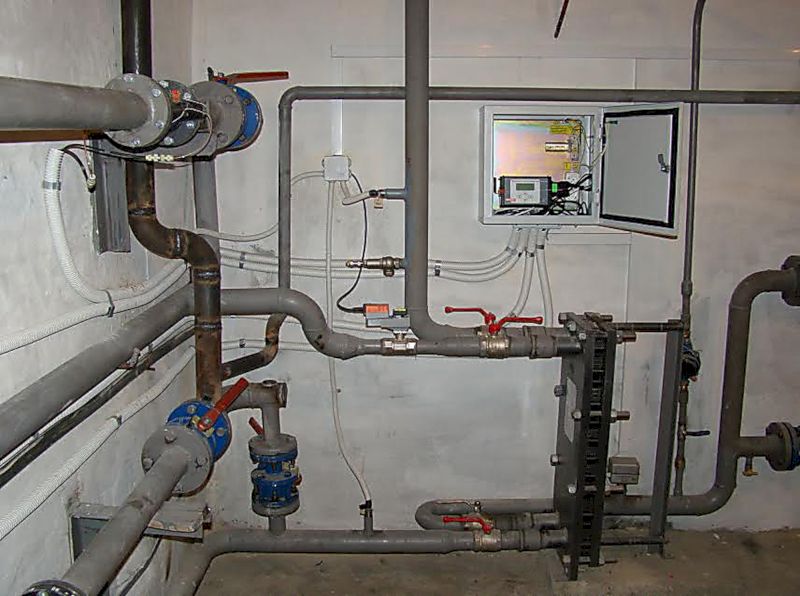
General building heat energy metering systems should be located in specially equipped, and most importantly, dry rooms, otherwise the installation of meters is prohibited.
The main factors are fixed in Order No. 627 dated December 29, 2011, which was approved by the Ministry of Regional Development of the Russian Federation. The UK or HOA, together with the heat supply organization, must draw up and confirm the impossibility of placing the device with the relevant act.




Types of heat meters
Heat meter from the manufacturer "NPF Teplocom"
Before considering the existing types of heat meters, I would like to clarify that the unit itself is not one specific device, but a whole set of them. Thus, the meter may include: pressure and resistance transducers, calculators for the amount of heat received, sensors, flow transducers. A specific set of the unit is determined and approved for each specific object separately.
According to the field of application, meters for heating are apartment and house (industrial). According to the principle of operation - mechanical (tachometric) and ultrasonic. Perhaps it would be better if we consider each of the species separately.
Apartment units for heat metering
Appliance for an apartment
An individual apartment heating meter is a device with small channel diameters (no more than 20 mm), and with a coolant measurement range of approximately 0.6-2.5 m3 / h. Electromagnetic measurement of heat energy consumption is possible, as well as vortex and turbine. As you may have guessed, this type of meters is designed for installation in private houses and apartments.
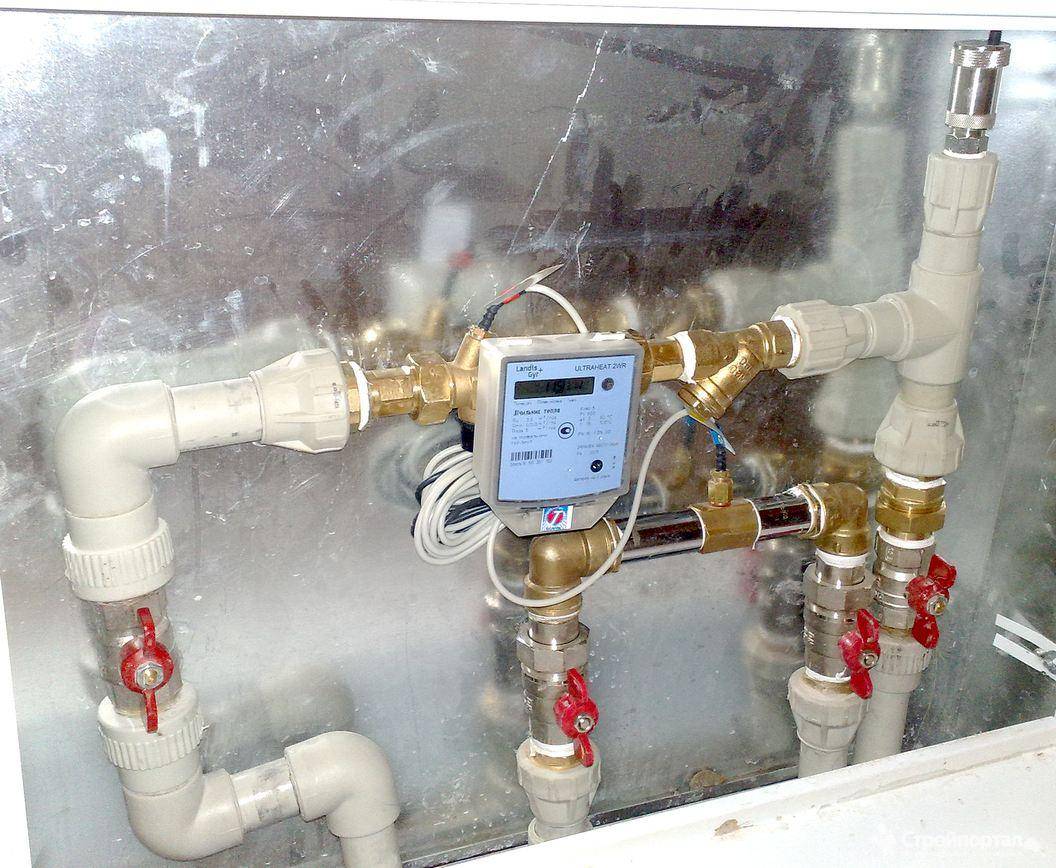
Almost always, the coolant here is water, which is heated to a specific temperature. The apartment meter consists of two complementary elements: a heat calculator and a hot water meter. How does a heating meter work?
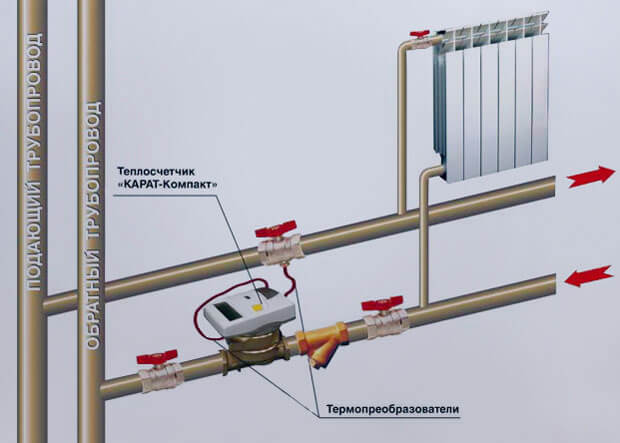
The heat meter is installed on the water meter, and 2 wires are removed from it, which are equipped with temperature sensors: one wire is connected to the supply pipeline, and the second - to the pipeline leaving the room.
The heat calculator collects information about the incoming coolant (in this case, water) at the inlet and outlet. And the hot water meter calculates how much water is spent on heating. Then, using special calculation methods, the heat meter calculates the exact amount of heat used.
Household (industrial) heat meters
Common house appliance
This type of meters is used in production and in apartment buildings. Heat is accounted for, again, by one of three methods: turbine, vortex, electromagnetic. In principle, house heat meters differ from apartment meters only in size - their diameter can vary in the range of 25-300 mm. The measurement range of the coolant remains approximately the same - 0.6-2.5 m3 / h.
Mechanical
Heat meter with mechanical flow meter
Mechanical (tachometric) heat meters are the simplest units.They usually consist of a heat calculator and rotary water meters. The principle of operation is as follows: the translational movement of the coolant (water) is converted into a rotational movement for convenient and accurate measurement.
Such a meter for heating in an apartment is considered an economical option. However, the cost of special filters must also be added to its cost. The total price of the kit is about 15% lower than other types of meters, but only for a pipeline with a diameter of no more than 32 mm.
The disadvantages of mechanical units include the impossibility of their use at high water hardness, as well as, if it contains scale, small scale particles, rust. These substances quickly clog flow meters and filters.
Ultrasonic
Ultrasonic apartment heat meter
To date, there are various models of ultrasonic heating meters, but the principle of operation for all of them is approximately the same: an emitter and a device that receives ultrasonic signals are mounted on the pipe opposite each other.
A signal is sent through the fluid flow by the emitter, then after some time this signal is received by the receiver. The signal delay time (from the moment of its emission to reception) corresponds to the speed of the water flow in the pipe. This time is measured and the water flow in the pipeline is calculated from it.




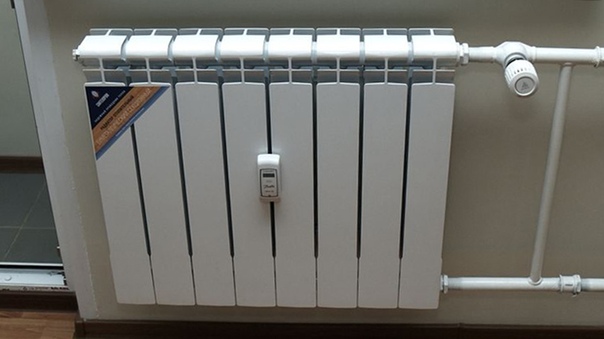

In addition to the main functions, this type of meters can be endowed with the ability to regulate the supply of heat. It should be noted that ultrasonic heat meters are much more accurate in readings, more reliable and more durable than mechanical devices.
Scheme of work
If you need to create maximum comfort in your personal space while maintaining an optimal microclimate even in winter, you need to follow certain rules and requirements. They mainly concern the technical and legal side.
- The installation of a heat meter begins with a call to representatives of the HOA or the managing organization, who must inspect the system and issue an inspection report with a positive conclusion about the technical feasibility of the installation.
- Then you need to submit an application to the Criminal Code and clarify what exactly is required for work.
- Then you should purchase a heat meter of a suitable modification (it depends on the composition and purity of the water in the heating network, as well as on the location of the device). At the same time, one must not forget to check the certificate of conformity of the equipment and the presence of a seal on service.
- At the next stage, it is necessary to contact a specialized company, which guarantees that the installation of the heat meter will be carried out with high quality, guided by the architecture of the system and the design of the house. In addition, the company itself must develop a scheme for installing heat meters in an apartment, having coordinated it with the HOA, for which it must have a license for this type of service.
- At the end, you need to seal the heat energy meter in the presence of an employee of the Criminal Code and submit all the relevant documents so that the charges for calories consumed are already made according to individual indications.
We will help you to avoid such long and complicated procedures while complying with the standard rules and requirements, for which we have the appropriate certificate. We independently resolve installation issues with the management company, perform sealing and issue official documents that take into account the HOA.Usually the process takes a little time and is carried out in stages:
- our representative visits the site and examines the place of work, selects the optimal installation point;
- we draw up a project, a scheme for installing heat meters in an apartment and an official contract for the comprehensive execution of an order, coordinate them with the client and sign them;
- we obtain permission to install a heat meter from the organization on whose balance sheet the house is located;
- we will coordinate the plan for connecting the device with the heat supply company;
- we carry out a complete set, assembly and installation of a heat meter;
- we hand over the device into operation after commissioning and sealing (according to the act of primary acceptance);
- we provide a full package of documents for the heat energy meter for further putting on the balance sheet of the management company for maintenance, reading and verification in accordance with applicable rules and requirements.
Registration and verification
Only authorized companies can legally register the device for heat after installation. The heat meter is installed in the apartment after the development and approval of the project, if necessary, then it is registered, put into operation and the data is recorded, which are transmitted to the central heating organization. Verification is a necessary procedure, usually all meters go on sale, already having the data of the initial verification, which was carried out in the conditions of the manufacturer.
The confirmation is a brand, record or sticker, it can be found on the device itself or viewed in the documents attached to the device. Additional verification is not necessary while the period of the verification interval is valid, which is 3-5 years.The owner of the device can take readings of his meter at a convenient time. When the interval expires, verification is carried out in Rostest, special organizations or a service center from the manufacturer.