
- Which class of dust and moisture protection to choose
- No. 2. Types of LED strips: one color or several?
- Single color ribbons (SMD)
- Multicolor Ribbons (RGB)
- Dimmer for LED strip 24V
- Frequently Asked Questions for 24V LED Strips
- Main selection criteria
- Conversion method
- Cooling
- Execution
- Output voltage
- Power
- Additional functions
- How to choose a transformer for lamps
- Application of 24V LED strip
- Main selection criteria
- Conversion method
- Cooling
- Execution
- Output voltage
- Power
- Additional functions
- Power supply options for LED strips
- Features and characteristics of LED strips
- Kinds
- Advantages
- The difference between 24V LED strip and 12V LED strip
Which class of dust and moisture protection to choose
We determined the main parameters of the PSU - voltage and power - it remains to choose the type of case that would meet the operating conditions of the device. If the power supply will work indoors, then moisture protection is not so relevant, but lighting, for example, the facade of a building, of course, will require the purchase of a sealed device.
But there are many cases, sometimes the most bizarre ones, so it’s quite difficult to assess how reliably this or that power supply is protected from environmental influences.
How to choose a device for the conditions in which it will be operated? It's easy if you pay attention to the marking, consisting of the letters IP and two numbers. The first of them indicates the class of protection against solids and particles, the second - against moisture
Now let's take a look at the table below.
Table of environmental protection classes according to DIN EN 60529
| 1st digit (protection against solids and particles) | 2nd digit (moisture protection) | ||
| No protection | No protection | ||
| 1 | Protection against penetration of particles larger than 50 mm | 1 | Defence from vertically falling drops |
| 2 | //-//-//-// over 12 mm and over 80 mm | 2 | Protection against drops falling at an angle of 15° from the vertical |
| 3 | //-//-//-// more than 2.5 mm | 3 | Protection against drops falling at an angle of 60° from the vertical (rain) |
| 4 | //-//-//-// more than 1 mm | 4 | Splash protection from any angle |
| 5 | Protection against the ingress of dust in quantities that could interfere with the operation of the device | 5 | Protected against water jets from any direction |
| 6 | Complete protection against ingress of dust | 6 | Protection against strong water jets from any direction |
| 7 | Protection against short-term immersion in water to a depth of 1 m | ||
| 8 | Protection when immersed in water to a depth of 1 m for a period of not more than 30 minutes | ||
| 9 | Protected against high temperature water jets |
If our power supply will work outdoors or in the bathroom, then, according to the table, you will have to choose a device with a degree of protection of at least IP65, and preferably IP67. Installing in a dusty environment? Suitable for IP54. Dry clean room, and even wired under a false panel? Let's choose IP20. Well, if the PSU is built into some other device, then protection is not important at all.
No. 2. Types of LED strips: one color or several?
According to the type of glow, two types of tapes are distinguished: SMD (single-color) and RGB (multi-color). What better led strip choose, you can’t say so unambiguously - it all depends on the interior idea, lighting tasks and budget.
Single color ribbons (SMD)
Such a tape can give a luminous flux of only one shade. What for the color it will, depends on which crystals are installed. Ribbons with white crystals (W) are the cheapest, blue (B), red (R) and green (G) crystals are slightly more expensive. Ribbons that give intermediate shades, such as purple, orange, turquoise or pink, will cost even more. Such a glow is obtained by applying a luminifor to the crystal, or by installing crystals of different colors in one LED and their simultaneous operation. If tapes of standard colors are sold even in small stores, then specific shades will still have to be looked for, and they will not shine so brightly.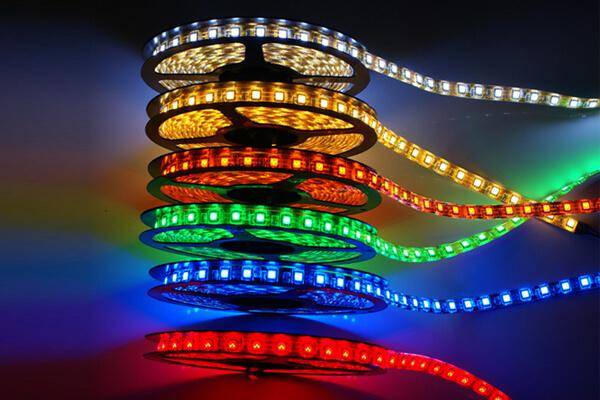
Colored tapes are used as decorative lighting, since there will be less light from them, but white tape can be used as working lighting, for example, for backlighting working area on kitchen. However, white is different for white
For some reason, few people pay attention to the color temperature, depending on which three groups of white are distinguished:
- warm white with a temperature of 2700 K and below;
- neutral white, up to 4000-4500 K;
- cold white, 6000 K and above.
To illuminate the bathroom, work areas, it is better to choose a neutral white light. In theory, you can take cold white, but then the kitchen or bath risks turning into an operating room. For the living area, it is better to take a warm white ribbon, which brings coziness to the room.
Also pay attention to such an indicator as color fidelity (CRI). It is necessary to take a tape with CRI> 70, and even better with CRI> 90, otherwise the colors of products, furniture and decor, and even household faces can be greatly distorted
To connect a monochrome tape, you only need a power adapter - no additional equipment will have to be purchased. The main thing is just to correctly determine the shade.

Multicolor Ribbons (RGB)
Why choose a ribbon of any one color, if you can take one that can change shade depending on your mood? Multi-color tapes can produce several different colors at once due to the fact that they receive LEDs with three crystals: red (R), green (G) and blue (B). The first letters of these colors gave the name to the tape - RGB.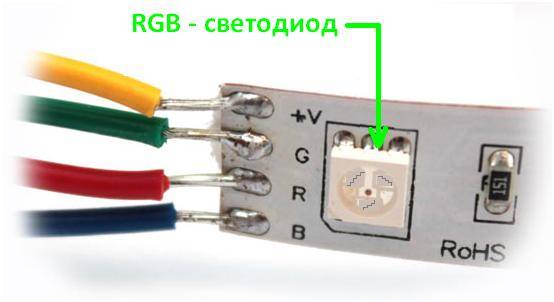
Different shades are obtained due to the glow of three crystals with different intensities - their radiation, as it were, is mixed, and as a result forms the necessary shade. True, such a tape is not capable of shining with pure white light, and if it is necessary, then it is better to take a product that is additionally equipped with white glow crystals (W). These tapes are sometimes also referred to as WRGB.
The hue of the glow, its intensity and brightness is determined by the signal from the RGB controller, which becomes a mandatory element when connecting led strip of this type. Thanks to him, the implementation of such effects as a treadmill, alternating shades, flicker, etc. is possible. Just like a garland!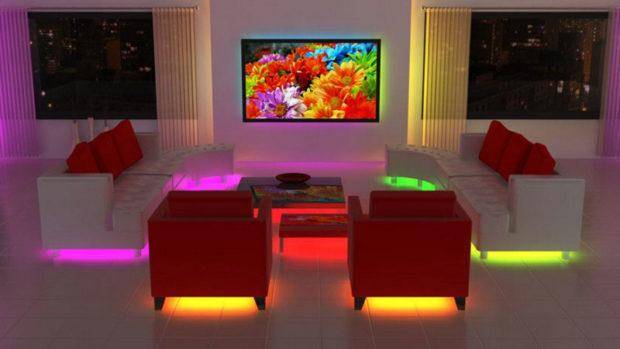
Multi-color ribbons are 2-3 times more expensive than monochrome ones and cannot be used as the main lighting due to the reduced brightness of the glow.Why does colored tape give less light? It's simple, because each diode consists of three small crystals, usually only one shines, or two or three, but not at full power (depending on the selected mode). Even if all three crystals work simultaneously, and at full strength, the light will still turn out to be less bright than from a single-color tape, where each LED has one large crystal.
The ability to change the color of the backlight seems like a significant advantage, but in fact, it often turns out that such a toy gets bored after a couple of weeks. The user stops at one shade and calms down.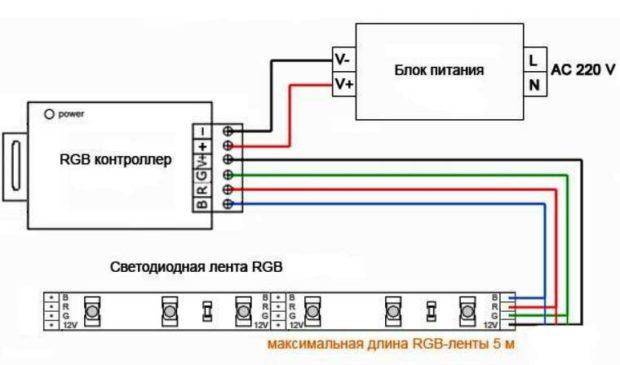
Dimmer for LED strip 24V
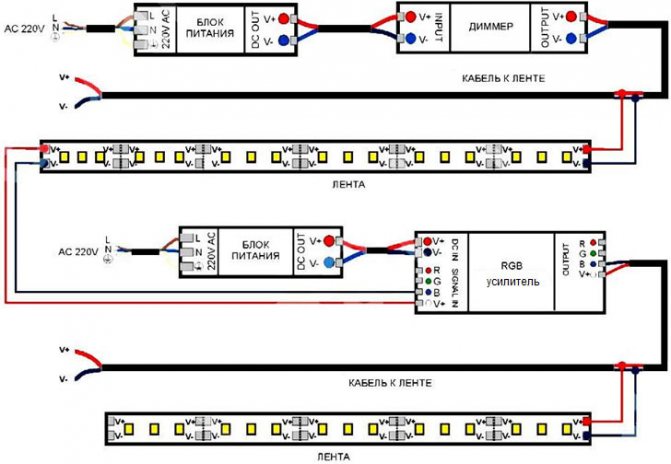
Connected to a high-quality power source, LED strips shine with continuous light without any flickering and brightness changes. Standard LED drivers cannot control the brightness of LED strips, as the brightness changes when the current on the power supply changes.
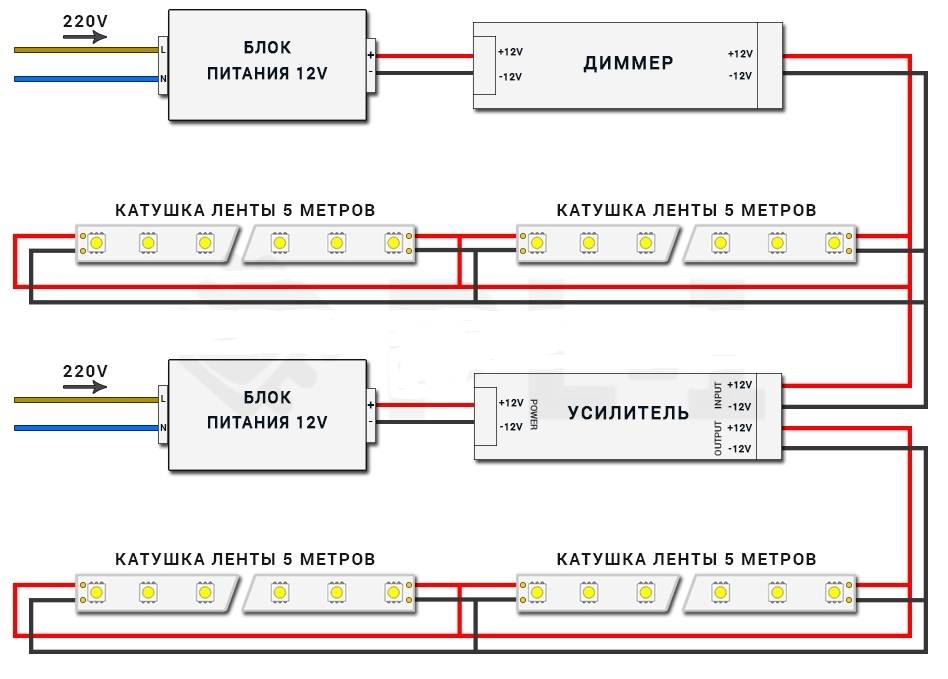
To change the brightness of LED strips to 24V, special devices are used that can change the current flowing through the LED strip. Such a device is called a dimmer and is connected to the power supply circuit of the LED strip without any additional modifications.

Dimmers can be of three types: digital, digital-to-analog and analog. They differ in the principle of current control and each of them has its own advantages and disadvantages. The digital dimmer has become the most popular, as it is compact, inexpensive and can control the brightness of the LED strip in a wide range, from completely off to maximum brightness.
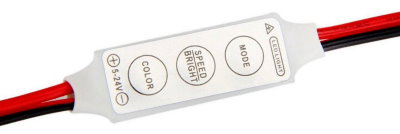
The dimmer is used only to control the brightness of monochrome single-color LED strips and is selected based on the characteristics of the connected LED strip. When choosing, it is necessary to take into account the supply voltage of the LED strip and its power.
Frequently Asked Questions for 24V LED Strips
What is 24V LED strip?
The 24V LED strip is a flexible printed circuit board LED strip designed to operate from a 24V power supply. The LEDs of such a tape are placed sequentially in a row of six pieces.
Where is 24V LED strip used?
24V LED strip has a number of advantages over standard 12V LED strips. Such tapes can be connected twice as long without using additional power supplies or laying additional wires. It is used in the same place as standard 12V LED strips.
What colors are 24V LED strips?
Monochrome 24V LED strips can be in the primary colors of blue, red, yellow and green. You can also find turquoise, raspberry, purple and special ones, which include infrared and ultraviolet LED strips. When installing white LEDs, the LED strips will emit cold and warm white light.
Main selection criteria
When choosing a power supply for SL, you need to pay attention to the following main characteristics:
- Voltage conversion method.
- cooling principle.
- Execution.
- Output voltage.
- Power.
- Additional functionality.
Conversion method
As I said above, the power supply can be transformer or switching.If you need a power supply of relatively low power, then it is better to give preference to a pulsed design. Buying a serious TBP will only pay off with powers of hundreds of watts - UPSs of this power are expensive and often have cooling fans that create noise and collect dust.
Cooling
Cooling can be passive or active. In the first case, the cooling of the device components is carried out naturally, in the second case, a fan serves for these purposes. If the PSU power is low, then it is better to refuse a device with forced cooling: the fan is noisy and, together with the air, sucks in a lot of dust that settles on the units of the unit. Such sources require regular maintenance and, most importantly, are poorly protected from moisture.
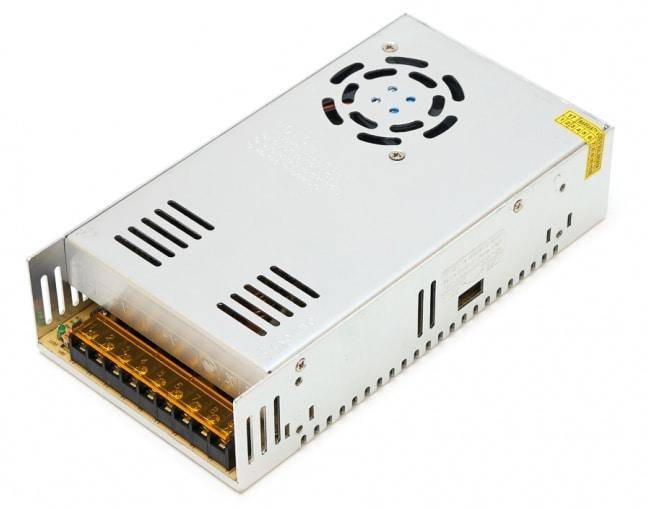
Such a unit not only makes noise, but also acts as a kind of vacuum cleaner.
Execution
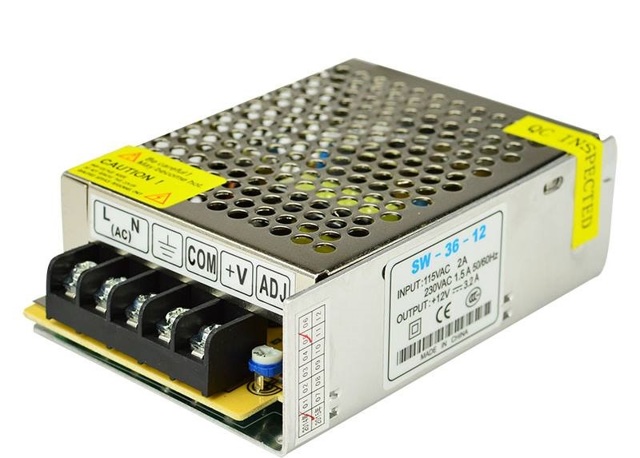
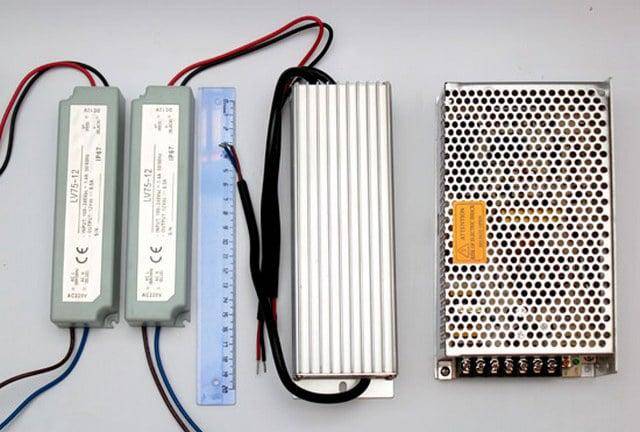
The degree of protection against the environment depends on the design. If the power supply will work outdoors or in a humid / dusty room, then you will have to choose a dust-proof, and even better, sealed design. No holes, slots and, of course, no fans. For difficult mechanical conditions (vibration, shaking, shock, etc.), a device in a metal solid case is perfect. For a typical living space, you can choose a unit in an open casing with many ventilation holes - it will be better cooled.


Output voltage
Everything is simple here. SL are available for 2 voltages - 12 or 24 V. Read on the packaging box or even on the tape itself, what voltage it is designed for. Then select the PSU that has the desired parameters.
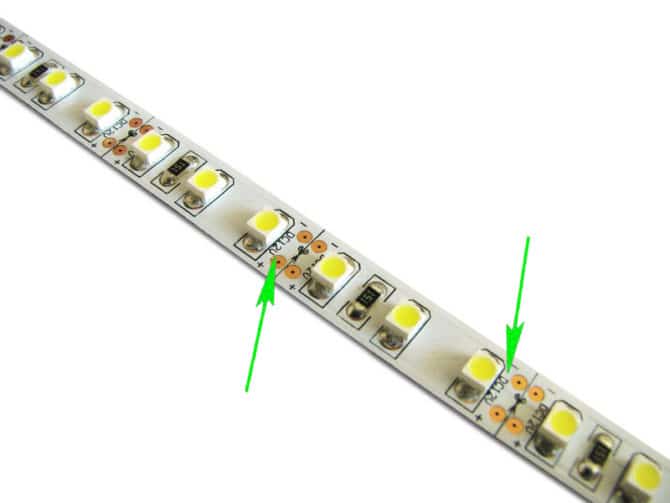
This SL is designed for 12 V, which means that the power supply is needed for the same voltage.
Power
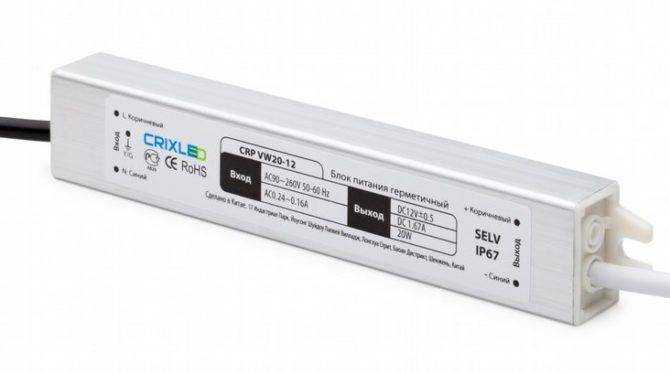
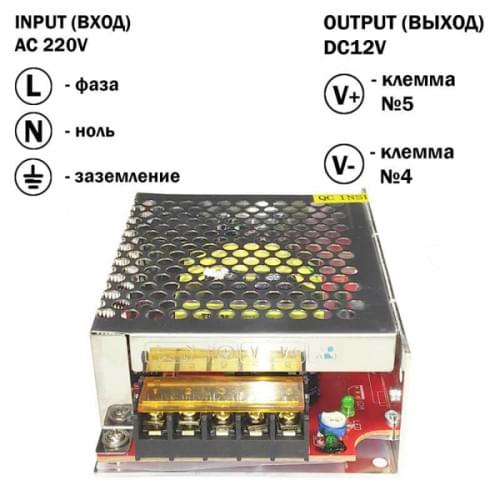
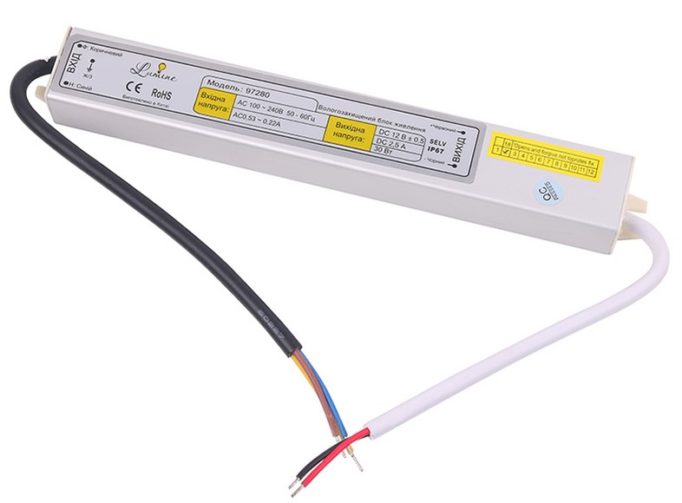
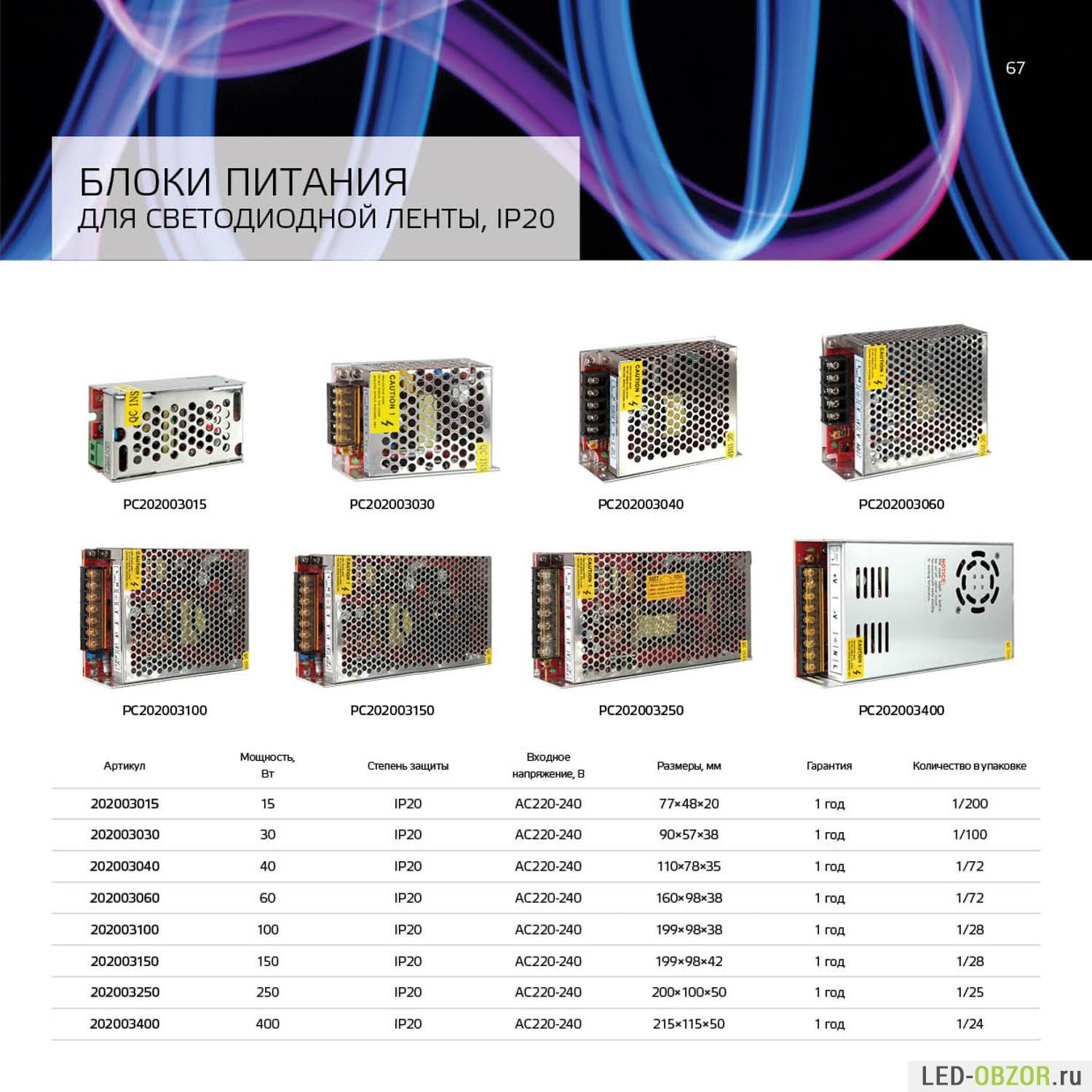
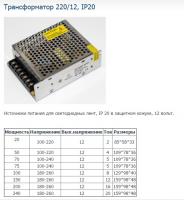
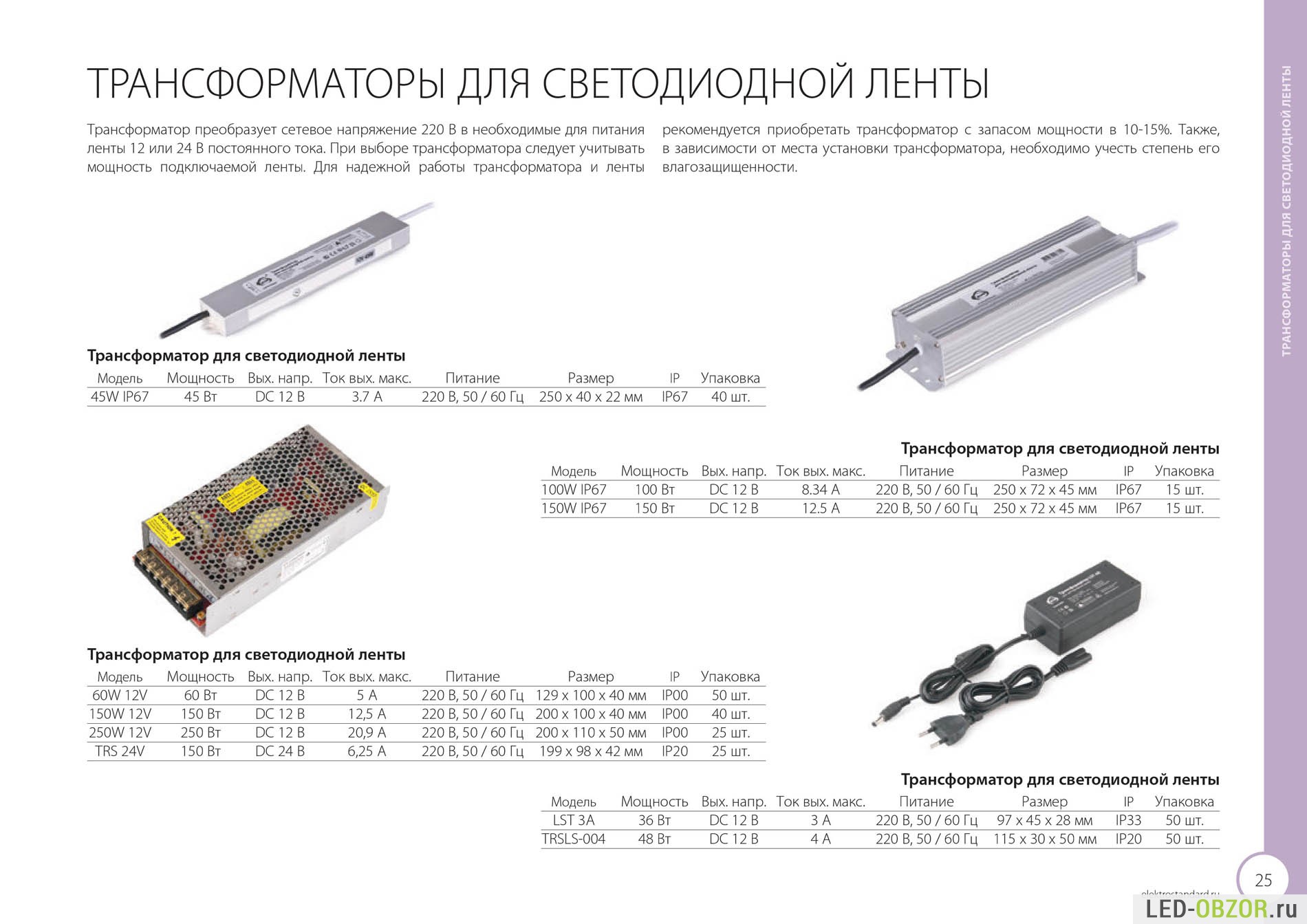
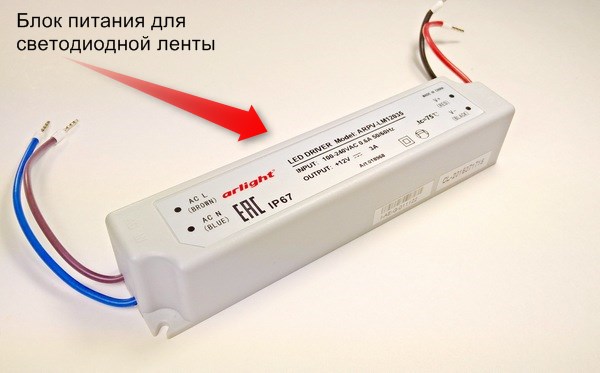
The power of the power supply must be at least 15-20% higher than the power consumed by the tape(s). Everything seems simple, but there is one caveat. It is rare, but it happens that the power is not written on the power supplies, but only the maximum allowable current is indicated. How to convert it to power? Elementary. Multiply the operating voltage (12V or 24V) of the unit by its maximum current rating in amps and you get the power in watts.
This power supply (photo above) indicates a power of 20 W, a current of 1.67 A and a voltage of 12 V. Let's check for interest: 12 * 1.67 \u003d 20.04 W. Everything converges.
Additional functions
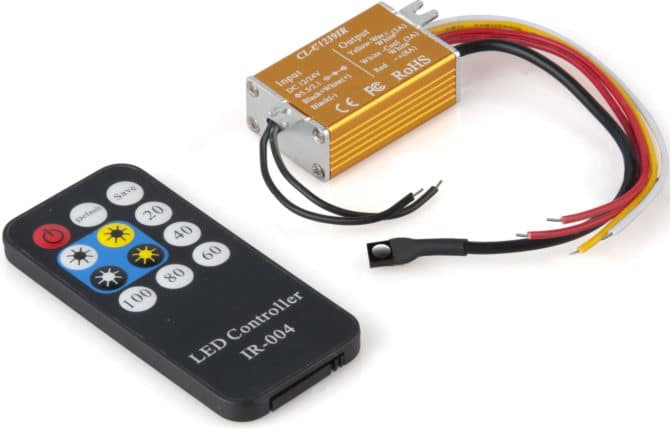
In addition to its main work, the power supply can perform some additional functions. There are, for example, devices with built-in dimmers (brightness controls), timers, automatic effects, and even with wireless remote controls. This is up to you, but keep in mind that any additional function is reflected in the cost of the structure.
How to choose a transformer for lamps
Content:
A transformer is a device that is designed to convert alternating current of one voltage into alternating current of another voltage. These devices are divided into current transformers, which are powered by a current source and voltage transformers, which are powered by a voltage source.
They, in turn, are divided into the so-called step-down current or voltage transformers and lower the values of current or voltage to specified limits. Step-down voltage transformers, as a rule, have found their application when connecting electric lamps. A huge selection of lamps with halogen lamps involves the use of step-down transformers.The lamps require a voltage of 12 V., and we are offered 220 from the outlet, so the use of transformers is necessary so that the lamp does not fail. Transformers can be electronic, they are used for halogen and LED lamps and electromagnetic are necessary for track systems. The use of a step-down transformer prolongs the life of the light source, and the surface in which it is mounted does not overheat, thereby ensuring a high level of safety. Electronic transformers are compact in size, which allows installation in a narrow space. A huge selection of step-down transformers can be a problem for an inexperienced consumer in this matter. After all, an error in the choice can cause a decrease in the brightness of the lighting, a deterioration in the operation of the device. When choosing an electronic transformer for halogen lamps, keep these parameters in mind. 1. The efficiency of the device should tend to unity. 2. Temperature thresholds. The wider the temperature range over which the transformer can operate, the better. However, when used indoors, this parameter does not matter much. 3. Operating voltage range. 4. Power. 5. Moisture and dust resistance class. Step-down transformer applications Step-down transformers can be used in rooms with high humidity - bathrooms, basements, cellars. Due to its compactness and low weight, the transformer can be installed in a suspended ceiling, furniture shelf, attached to a chandelier box. As a rule, the reliability of the transformer depends on the manufacturer and, accordingly, the price of the product. High-quality transformers have protection against short circuit, overheating, have soft starter lamps. In order to correctly select the transformer power you need, you need to add the power of the lamps connected to it (in w) with a 10% margin. For example, if we have 5 bulbs of 20w each, then a transformer with a power of 110-115 w would be an ideal option for you
Please note that it is strictly forbidden to exceed the rated load of the transformer and load more than 90%. Divide the lamps into groups and to each of them install your transformer
Application of 24V LED strip
The use of 24 volt LED strips is no different from the use of 12 volt LED strips. They are equally well used as decorative lighting, marketplace lighting, billboard lighting, and sometimes as primary lighting. The flexible printed circuit board is convenient in that it can be bent in the right places, repeating the corners, and the ability to make small segments allows you to highlight even the smallest spaces.
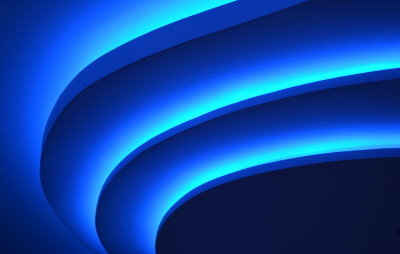
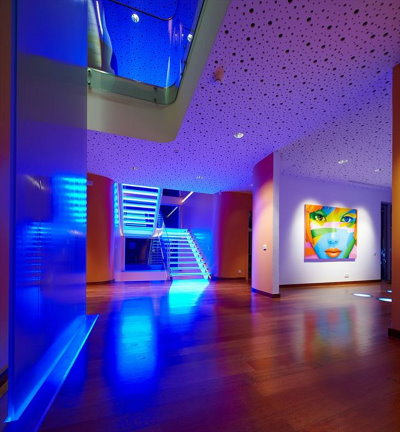
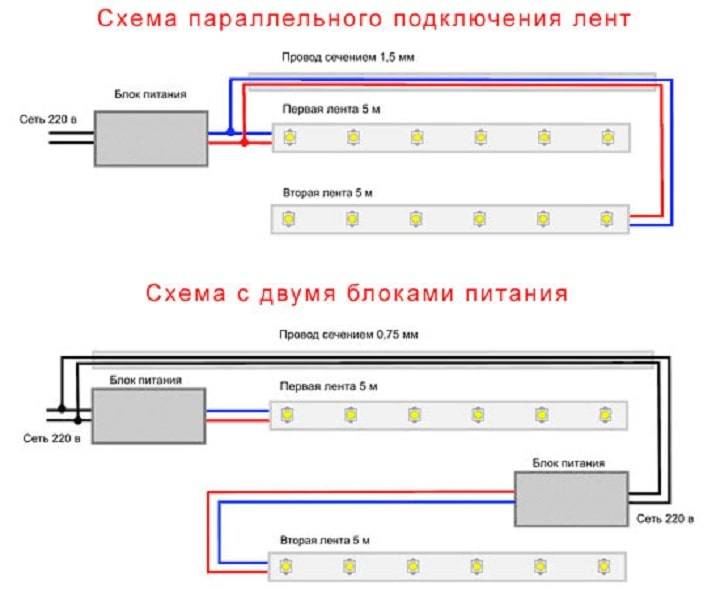
24V LED strips can be installed in lengths up to 10 m, which will make it possible to illuminate long areas without the need for additional power cables. The only negative at the moment may be a smaller selection of 24 volt power supplies.
Main selection criteria
To choose a power supply for an LED strip, you need to pay attention to the following key characteristics of this device:
- the value of the output voltage - it must necessarily correspond in terms of the indicator to the lighting device;
- device power indicator - calculated by a special formula;
- level of protection;
- availability of additional functions.
When choosing a power source, you also need to consider its cost. Models protected from moisture will cost more. Pricing is affected by the conversion method of the device and its power ratings.




Conversion method
The principle of operation of a switching power supply
According to the conversion method, power supplies can be divided into 3 main types:
- linear;
- transformerless;
- impulse.
Linear-type power supplies were invented in the last century. They were actively used until the early 2000s, before the appearance of impulse devices on the market. Now they are practically not used.
Transformerless models are of little use for powering LED lamps. They have a complex design - the voltage of 220V in them is reduced by means of an RC circuit, followed by stabilization.
The main serious disadvantage is that the unit cannot be turned on without load. Otherwise, the power transistor may fail. On modern models, this problem was solved with the help of feedback. Eventually at idle the output voltage is not out of range.
Cooling
Depending on the applied cooling system, power supplies are divided into 2 types:
- Active cooling - the device is equipped with an internal fan responsible for cooling efficiency. This design makes it possible to interact with sufficiently high powers. In this case, the fan can hum and it needs to be cleaned periodically, since dust gets inside the case with the air flow.
- Passive type cooling - the device is not equipped with a fan (natural cooling).Such power supplies are very compact, but at the same time they are suitable exclusively for domestic use, as they are designed for small loads.
Execution
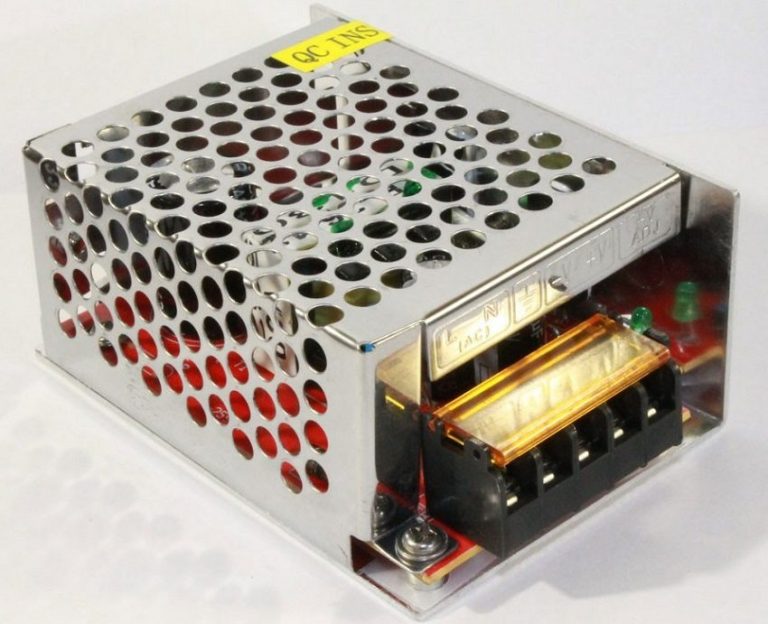
 Compact power supply for LED strip
By type of power supply divided into the following structures:
- Small plastic case. Such a device is outwardly similar to power supplies from laptops and has a collapsible plastic case. Models of this class function stably and will be the best option for use in dry rooms.
- Sealed aluminum housing. The design features, tightness and strength of the material used make it possible to use such an LED block in rooms with high humidity. It is resistant to moisture and has a long service life.
- Metal housing with ventilation holes. Such devices are not protected from external influences, therefore they are mounted in special closed boxes. The open-type housing makes it possible to quickly reconfigure the unit.
Output voltage
This characteristic sets the voltage rating into which the power source converts the initial mains voltage of 220V. Usually it is 12V and 24V DC or AC type. The most common are 12V LED strips with a constant voltage type. Accordingly, they need a DC12V marking power supply.
Power
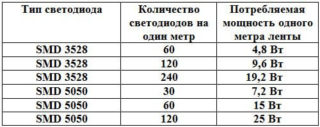 LED consumption
In some situations, there is simply no need to calculate the power of the power source. For example, if you need to connect a 1 meter tape on SMD class LEDs with a power supply of 12V, any block with a constant voltage at the output of 12V will do.If a more powerful load is expected, you will need to use the calculation formula.
You can choose the power of the power source based on the maximum length of the LED strip and on the consumption of 1 meter of the product. To facilitate this task, manufacturers prescribe the requirements for the power source in the instructions for the LED strip.
Additional functions
 Power supply with control panel
In addition to the main characteristics, when choosing power supplies, attention should be paid to the presence of additional functions in them:
- can be trivial and exclusively provide nutrition;
- more functional models have a built-in dimmer;
- some devices are equipped with an infrared sensor or a radio channel for control using a remote control.
Power supply options for LED strips
Depending on the functional purpose, the electronic ballast is available in the following versions:
In the form of a compact network PSU. Such devices look like ordinary chargers for mobile devices. Compact power supplies for LED strips


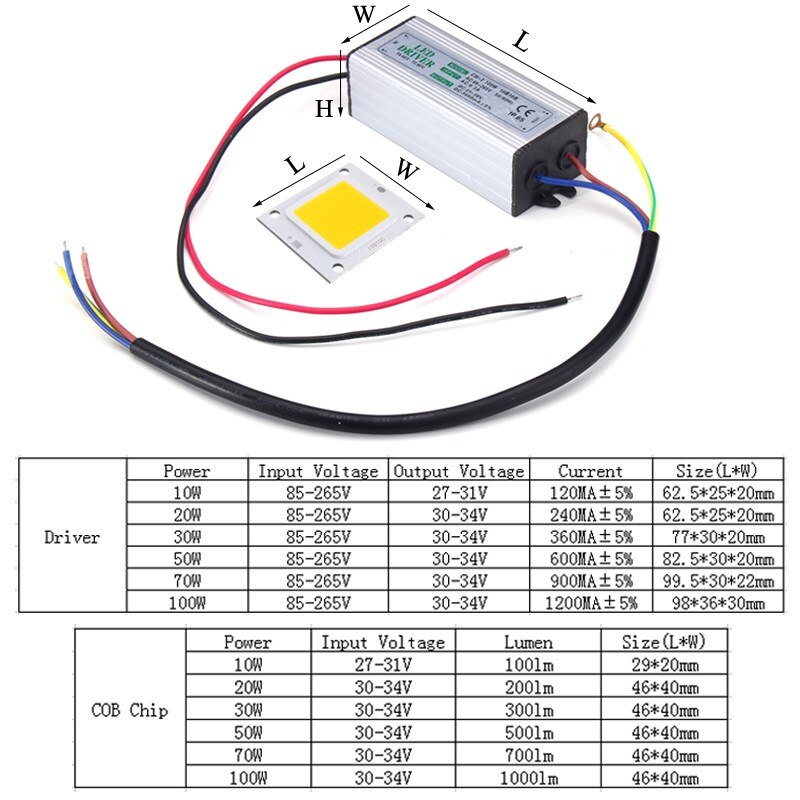


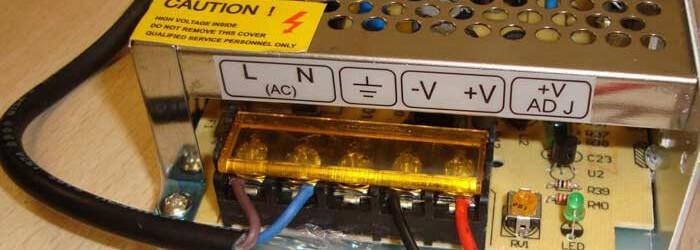
This solution can be called an economy option, because of all the types of execution it is the lowest in cost. The reverse side is low power, as a rule, it does not exceed 30-36 W (there are Chinese products for 60 W, but this parameter is greatly overestimated in them). The main scope of application is the connection of a simple backlight. The main advantage is that installation is not required, it is enough to plug the driver into the socket, having previously connected the tape to the output.
Compact unit housed in a sealed plastic case. The maximum power of such devices is 75 watts. The figure of 100 W found on Chinese products is not true.Sealed compact electronic ballast, closed from external influences
Distinctive features: light weight, compact dimensions, protection against moisture and dust
This is almost an ideal option for organizing lighting in ceiling niches, if you do not take into account the high cost of the adapter (almost twice as expensive as analogs with a leaky case)
Electronic ballast in sealed aluminum housing. This version is designed for harsh operating conditions. The scope of such PSUs is the lighting of outdoor advertising, the illumination of buildings and other objects where high-power LEDs are installed. Installing household light sources as an adapter is not economically justified. Arlight power supplies in a sealed aluminum case
Distinctive features: resistance to mechanical impact and destructive natural factors (rain, snow, UV radiation). As for power, taking into account the frequent manufacture of such adapters on special orders, it can be in a fairly wide range. For typical products, this parameter, as a rule, is from 80 to 200 watts. The price is much higher than other options.
Leaky ballast. The most popular PSU, widely used to power the lighting of apartments, offices and trading floors. It costs a little more than a compact network unit, but can be much more powerful with the same dimensions. PSU in leaky design
Powerful devices of this type can be equipped with forced ventilation, which provides cooling of electronic components, which extends the life of the adapters. They are made for voltage 12 or 24 V.The low price and a wide range, which allows you to choose the most optimal option, have made such PSUs the most popular.
Features and characteristics of LED strips
LED strips are long flexible boards with contacts on which SMD diodes are located at a certain distance from each other. In order to limit the current flowing through the tape, special resistors are soldered on it. Designers and planners very often use LEDs to create a special interior style, visually expand the space of a room, hide light sources while installation of suspended or suspended ceilings etc.
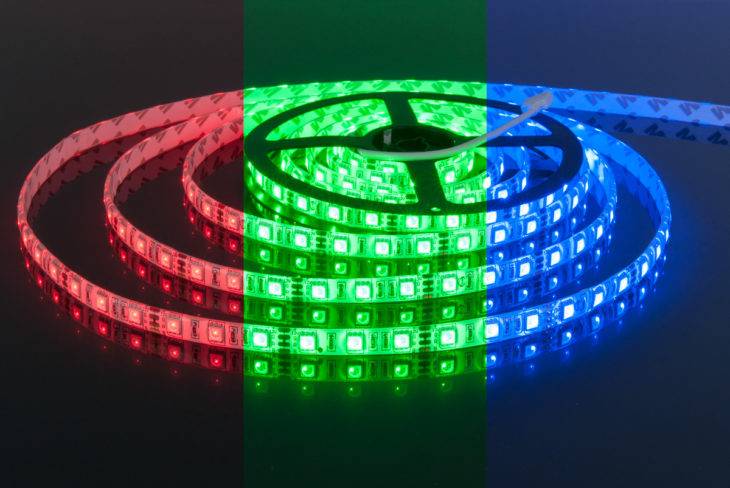 Reel with LED strip
Kinds
LED strips can be of various types:
- Self-adhesive. In order to stick it, you just need to remove the sticky layer and apply it to a flat surface area, bending it in any geometric shape.
- Beskleev. Plastic brackets are used for fixing ip68.
- Waterproof IP65. They are used for mounting lighting in rooms with a high level of humidity.
- Sealed ip67 and 68. Designed for lighting in rooms with a high level of humidity, as well as under water in the pool.
- open. They are used to create lighting in rooms: under the ceiling, on the walls, etc.
- Multicolor RGB. Ribbons are able to change their color by means of a special controller.
- White or single color. The degree of their brightness is regulated by a special dimmer.
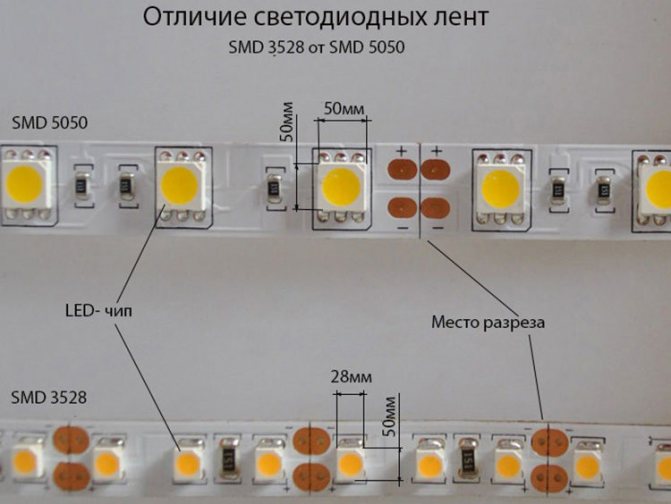
Tapes with LEDs can have a different number of diodes of different types. The most popular are LEDs of the brand 3528 and 5050. The numbers indicate the dimensions of the diodes: 3.5x2.8 mm and 5x5 mm. The first are equipped with a plastic case with a single crystal.The second ones also have a plastic case, which contains 3 crystals, so these LEDs shine much brighter.
In addition, they produce double-row tapes with a large number of diodes. Currently, new types with special smd2835 chips can be purchased in stores, which have improved light characteristics. Due to their low cost and high light output, they are rapidly gaining popularity. Since the LEDs in such tapes operate in a safe mode with reduced current, this fact allows them to be used for a long time without losing the degree of brightness. They may well work out their 50 thousand hours, which were declared by the manufacturer.
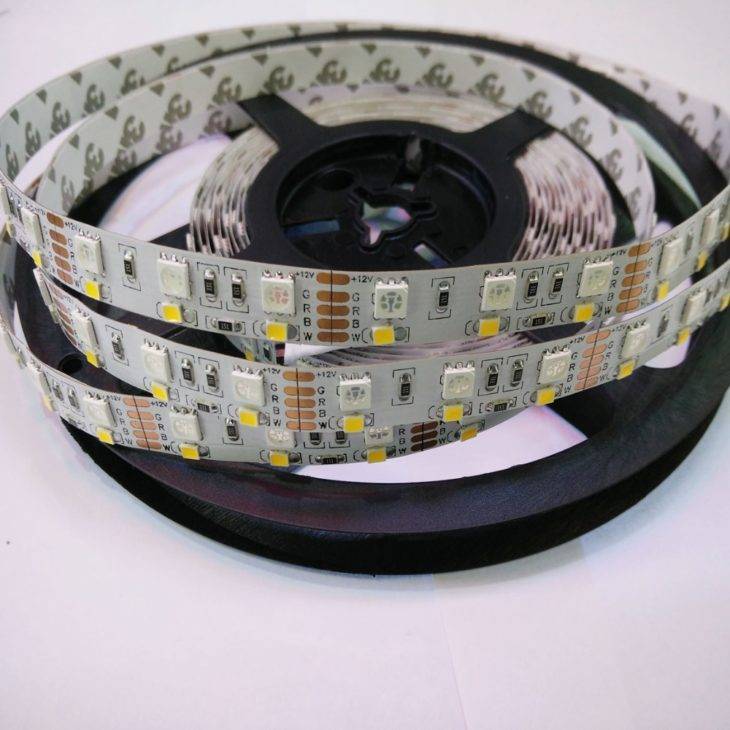 Coil with double row LED strip
LED strips are low-power, so they consume a minimum amount of electricity. Currently, there are many types with different types of power: 4.8 W / m; 7.2 W/m; 9.6 W/m; 14.4 W/m, etc. LEDs give such a powerful bright light that they can be used not only as additional lighting, but also as the main light source. To do this, they usually use special tapes such as LED-TED, which are the brightest.




Advantages
- Minimum electricity consumption;
- Service life more than 10 years;
- The possibility of fastening the tape at any angle and giving it a different geometric shape;
- Uniform distribution of lighting around the perimeter of the room;
- Large selection of colors;
- High degree of fire safety and environmental friendliness;
- LEDs do not contain mercury and emit a minimum amount of heat into the room;
- Do not change their color during the entire working period;
- Have no radio interference.
The difference between 24V LED strip and 12V LED strip
The differences between 24 volt and 12 volt LED strips are insignificant, but the latter have received great popularity. The first difference, which immediately stands out even in the name of the tapes, is related to the supply voltage, i.e. they require a 24 volt and 12 volt DC power supply to connect.
The next difference that can be seen visually is related to the connection scheme of the LEDs themselves. The 24 volt strip is powered by twice as much voltage as the 12 volt LED strip. In 12 V strips, three LEDs are connected in series in one chain, in 24 V LED strips, six LEDs are connected in one chain. Accordingly, at least a section with six LEDs can be cut off from such an LED strip.
The third difference is one of the important advantages of 24 volt LED strips, it is associated with the current flowing through the current-carrying tracks of the flexible strip board. With a higher voltage and the same power, a 24-volt LED strip current flows half as much as a 12-volt LED strip. Less current leads to less heating of the board and, accordingly, to less additional heating of the LEDs, which prolongs their service life.
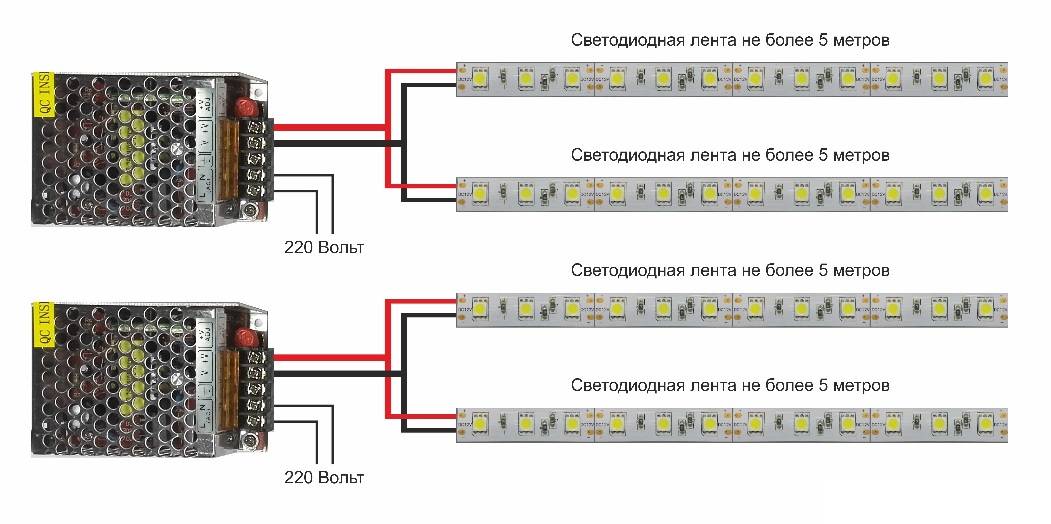
The last difference between 24V and 12V LED strips is the total length of the strip, which can be connected to one power source. If in 12V LED strips the maximum allowable section length is five meters, then when connecting 24V LED strips, you can connect up to 10 meters with one strip due to the lower flowing current. But the recommendation for connection still remains the same, no more than 5 meters.

Differences between LED strips 24 volts and 12 volts:
- Supply voltage (24V and 12V);
- The number of LEDs connected in a row (6 pcs for 24V and 3 pcs for 12V);
- Less current at the same power (at a voltage of 24V, the current is half as much);
— The maximum length of one lane (allowed up to 10 m).



