
- Existing cleaning technologies
- The use of ilosos
- Vacuum pumping aids
- Hydrodynamic cleaners
- Washing with chemicals
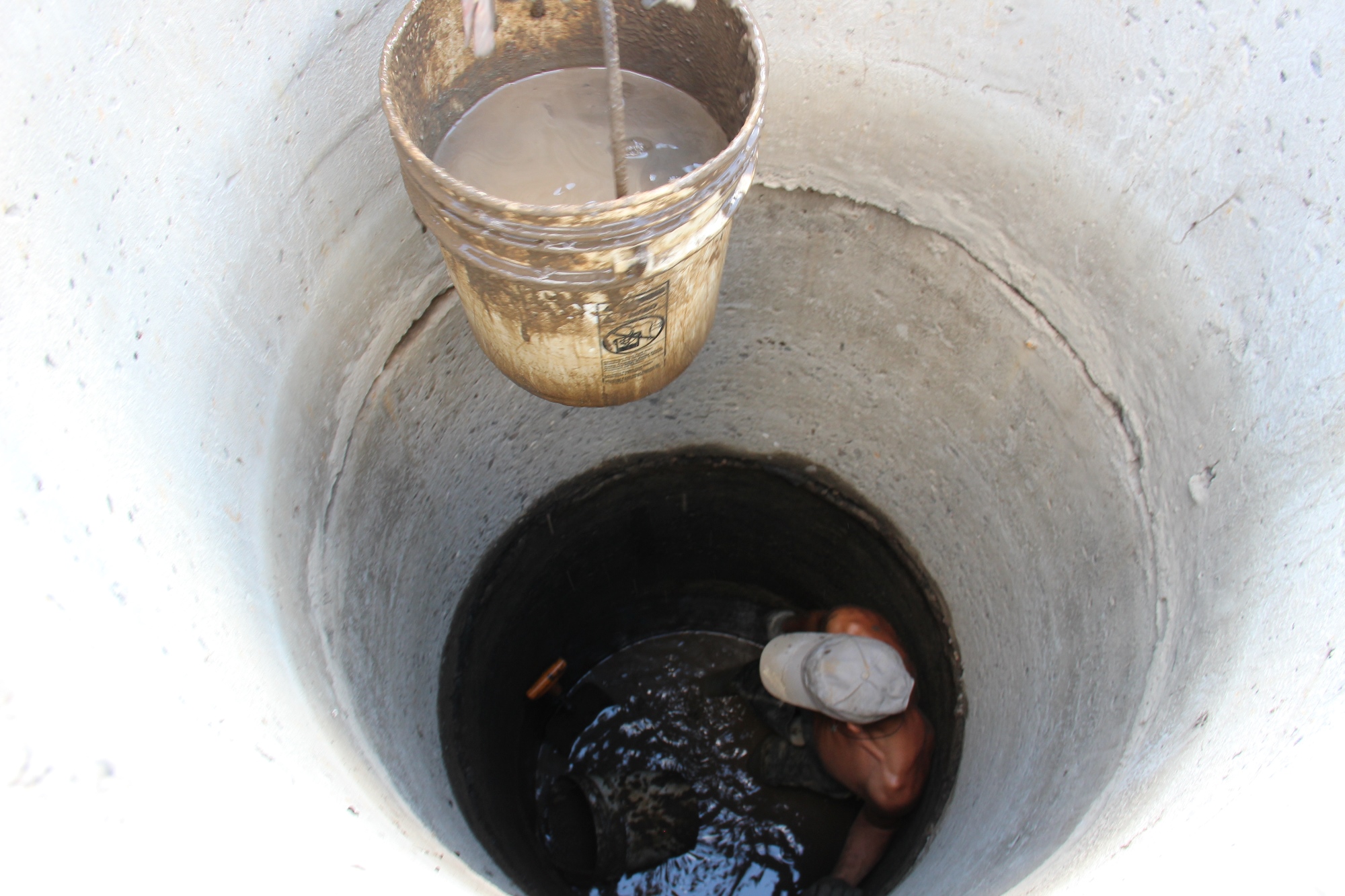
- Cleaning the well manually
- How to clean a well with your own hands
- Jamming mechanism
- Selection of a hose for pumping water
- Cleaning the well with your own hands: the main steps
- Tool preparation
- Water pumping
- Cleaning walls and flushing drains
- Well disinfection
- Well design
- Disinfection, cleaning products
- White
- Potassium permanganate
- Bleaching powder
- Iodine
- Tablets
- Ultraviolet
- When is a drinking well cleaning necessary?
- Other ways to clean well water
- Prevention of water pollution
- Well safety
Existing cleaning technologies
Proper operation of the sewer system will always be the key to quality work. To do this, you must regularly perform the procedure for cleaning all communications. The regularity of such actions is always due to the type of design, as well as the volume of the reservoir for the accumulation of wastewater. As mentioned earlier, due to irregular cleaning, garbage collects in sewer systems, an unpleasant odor appears, and harmful microbes multiply intensively.Even systems with installed drainage pumps will necessarily require constant cleaning so that various debris and silt do not collect at the bottom.
Today, sewer wells can be cleaned using the following technologies:
- Vacuum pumping.
- Washing with chemicals.
- Removing dirt with a sludge pump.
- Hydrodynamic cleaning.
- Washing with hot liquid.
Vacuum pumping and removal of sludge is possible only with the use of special equipment at the disposal of the sewage services. Maximum results can only be achieved by manually cleaning the well.
The use of ilosos
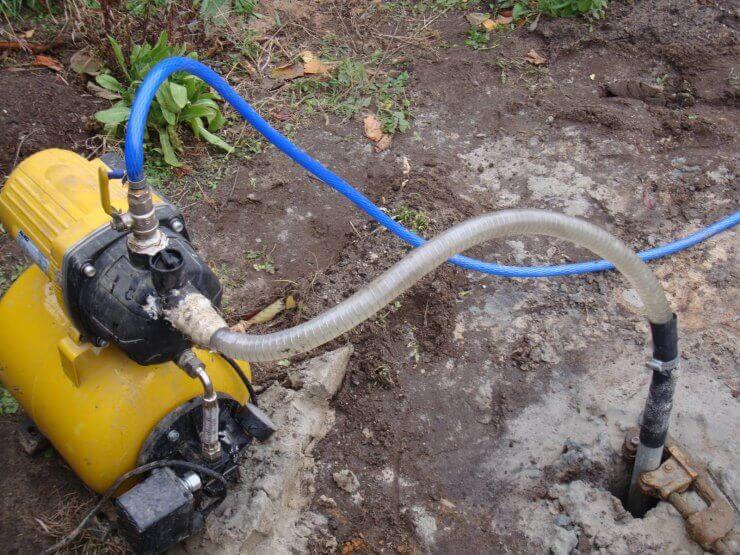
The use of sludge pumping equipment is considered optimal when pumping sewer wells. This technique is used in the performance of various types of sewage works. The simplest technical tool consists of a volumetric tank and a special vacuum pump.
All-season use is a positive feature of this method. Such sludge pumps are used everywhere in the process of performing various preventive and cleaning works.
Vacuum pumping aids
This technology involves the use of a powerful vacuum portable pump well cleaning station Wastewater. After using such devices, the procedure for collecting and disposing of hazardous waste is carried out. Vacuum cleaning fully complies with current environmental regulations and is considered one of the most efficient technologies in terms of maintaining appropriate sanitary conditions.
Hydrodynamic cleaners
The principle of operation of hydrodynamic sewer cleaning systems involves the removal of accumulated deposits from the walls of the well with a powerful pressure. With the help of such devices, organic and inorganic substances are removed without much effort. After completion of the cleaning procedure, the collected waste is subject to subsequent disposal. The volume of accumulated deposits determines the required number of pumping tanks.
Washing with chemicals
This technique involves the use of potent chemicals. Thanks to such means, the procedure of softening and subsequent transformation of various condensate deposits is carried out without much difficulty. The special chemical composition creates a sufficient amount of foaming mass.
Thus, the surface of the inner walls of sewer systems is processed as efficiently as possible. Chemical cleaning is performed relatively rarely due to the high cost of reagents, but the effectiveness of this technology, as well as environmental safety, has been confirmed by many years of experience.
After reviewing the above materials, each owner of a private house with an equipped sewer system can choose the most suitable cleaning method that meets specific needs and financial capabilities.
Interesting materials:
- sewer wells;
- septic Microbe;
- sewerage pumping.
Cleaning the well manually
So, how to clean the well in the country on your own? Obviously, buying specialized equipment is irrational. Fortunately, in most cases for cleaning the well in the country, you can use the tools that are in the arsenal of every summer resident.
You can clean the well yourself
For convenience, the process of cleaning the well with your own hands in the country is divided into several steps:
- Preliminary work.
- Pumping water from a well.
- Mechanical cleaning of the well shaft itself.
- Replacing or repairing the bottom filter.
- Repair work. For example, sometimes it becomes necessary to seal the seams of the mine.
- Well sanitation.
preliminary stage
- rubber high boots (the best option is fishing "bogs");
- work overalls (the work is very dirty, so it’s better to pick up things that you don’t mind throwing away);
- buckets;
- safety rope and ropes;
- stairs. Sometimes the depth and design of the shaft does not allow the use of a ladder. In this case, it is recommended to assemble a kind of swing from ropes and boards;
- scrapers, metal brushes and large sponges.
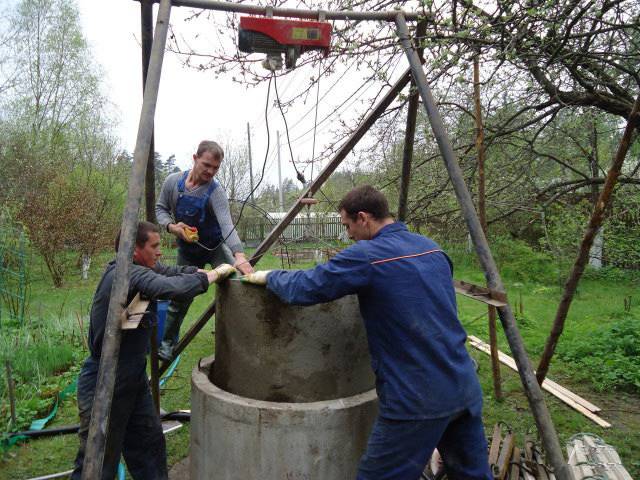
Well cleaning begins with the preparation of the necessary tools
After checking the availability of the necessary tools, free access to the well shaft. If there is a canopy, then it will have to be dismantled. Garbage accumulated on the surface of the water is removed with buckets or by hand.


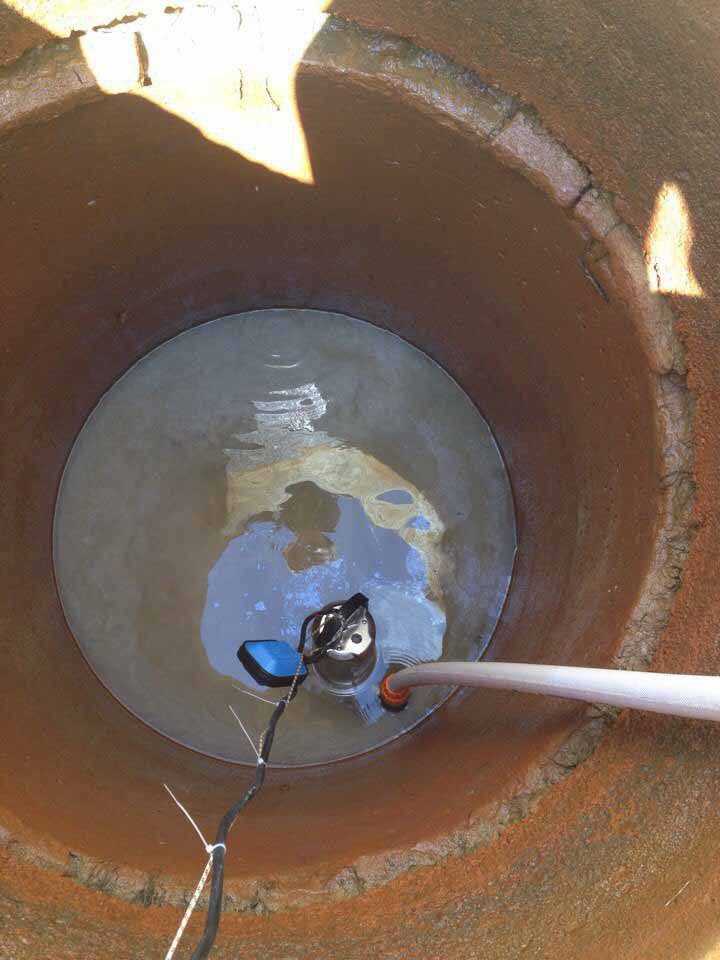


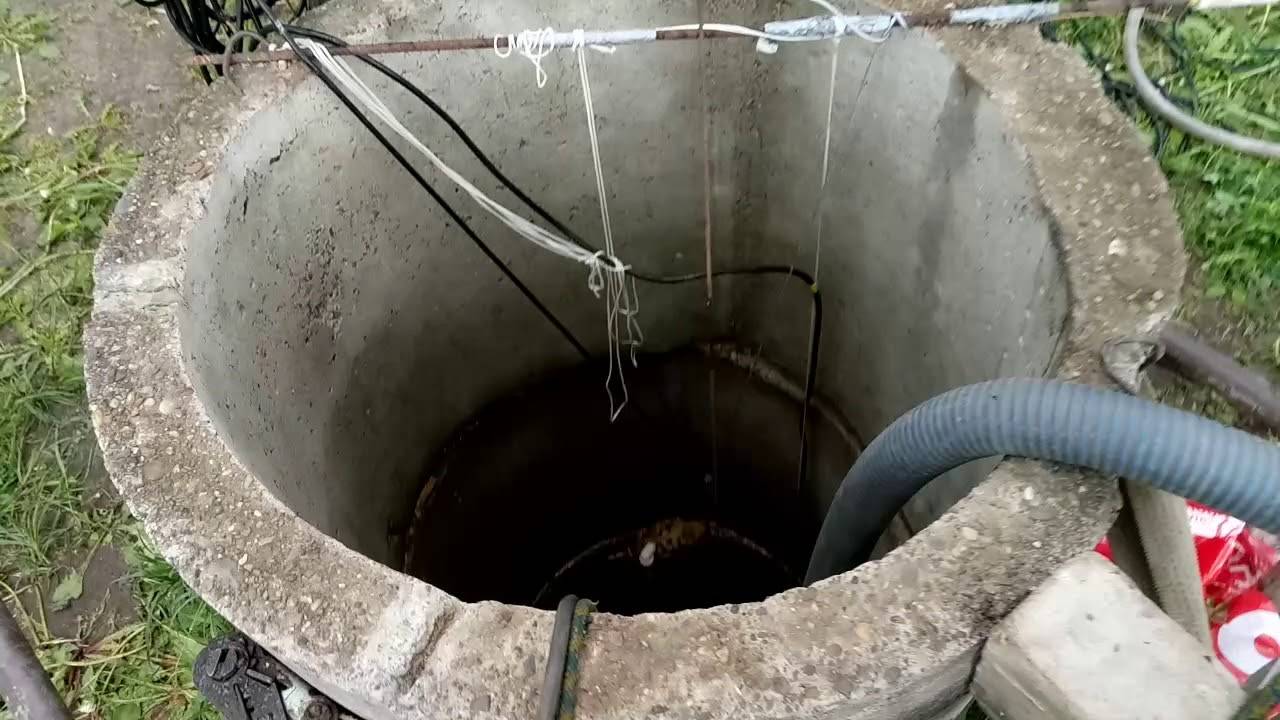


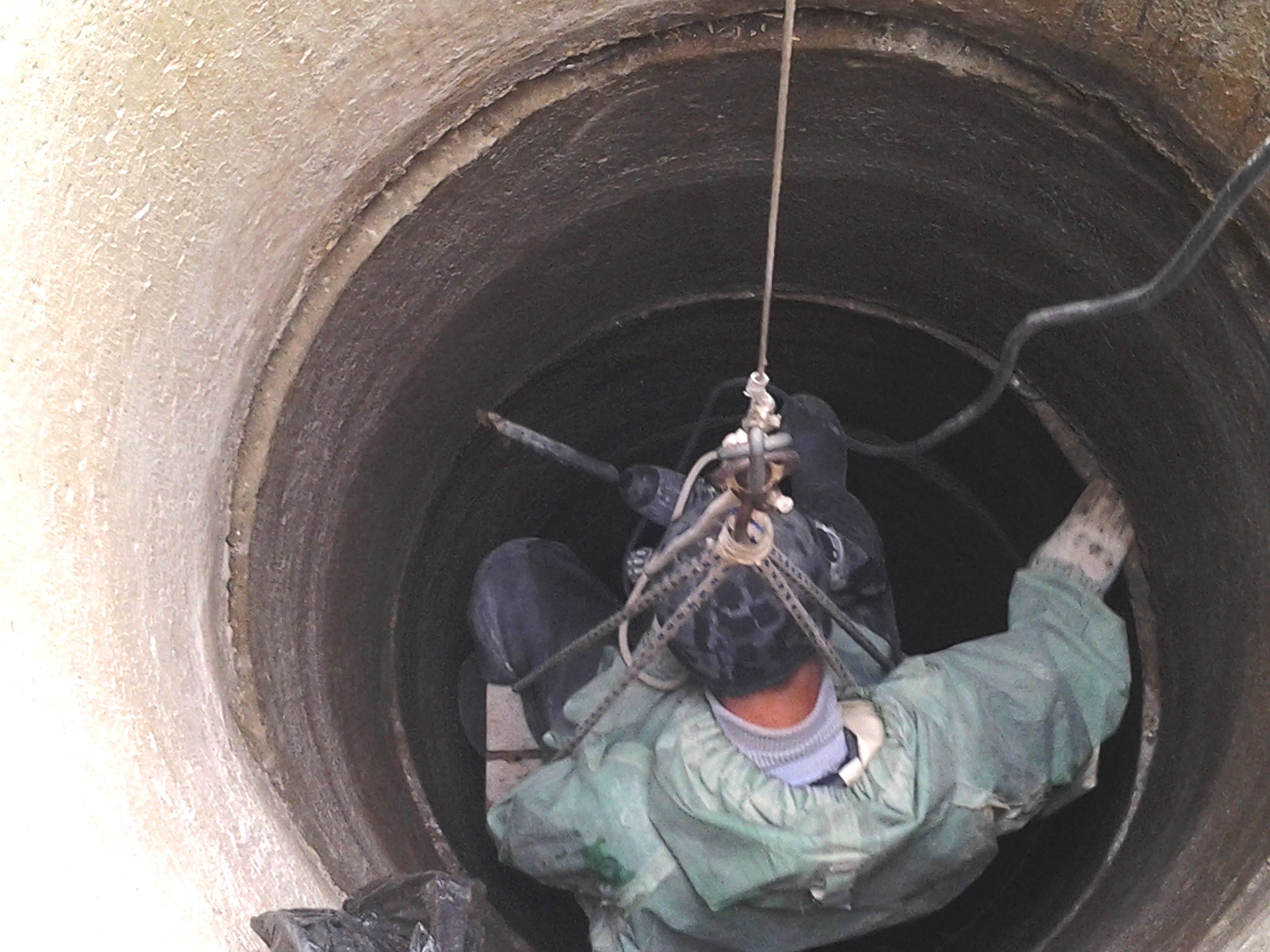
Important! Do not work at depth alone. It is dangerous to life and health
Cleaning work is carried out by at least two people, so take care of finding a partner in advance.
Water pumping
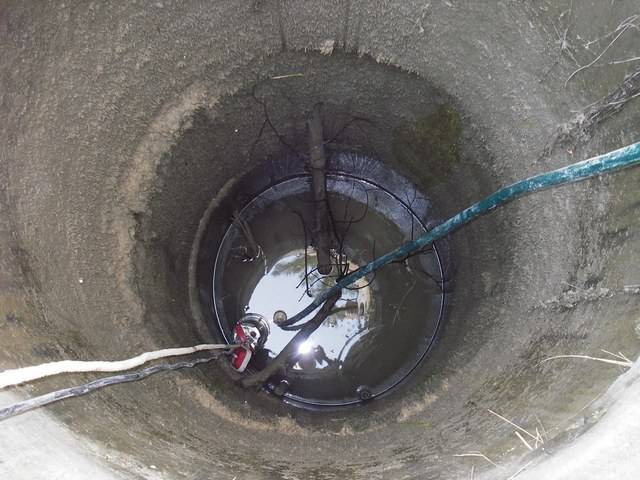
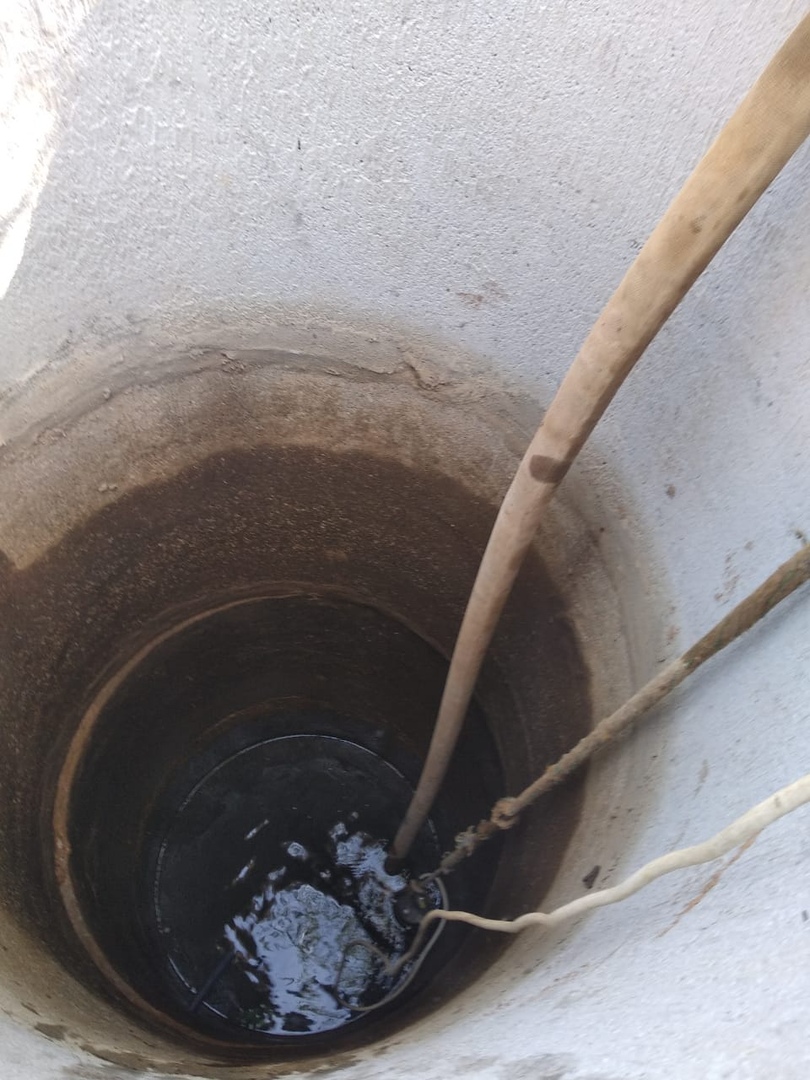
You can empty the well shaft with buckets, but with the help of a pump, cleaning work can be done much faster. A low-power pump of the "Rodnichok" type and its analogues will cope with pumping water from the mine. The price of such devices rarely exceeds 2,000 rubles. However, such a pump may well be found with friends or neighbors.
By the way, it will not work to completely drain the well, there will always be some water at the bottom.
Manual well cleaning
The walls of the shaft are cleaned with pre-prepared tools (brushes, scrapers, etc.). Dirt removed from the walls will fall down the well shaft. It's not scary, removing bottom debris, you will throw out these remnants. The walls of the shaft after cleaning must be washed several times. When cleaning the mine, check its integrity. It is possible that it needs repair.
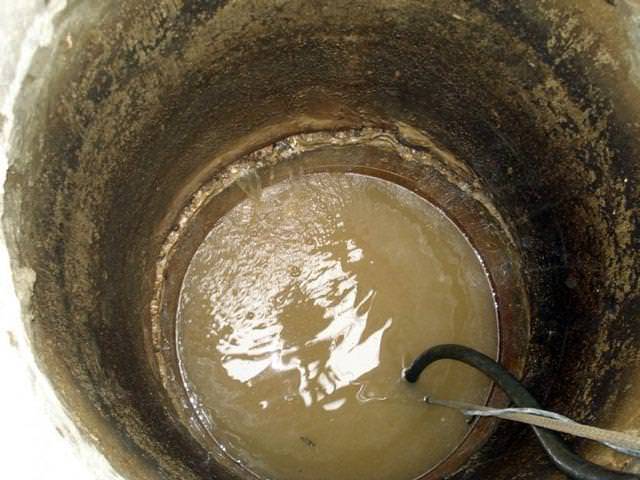
Manual well cleaning
Well wall sealing
The integrity of the walls of the mine is broken as a result of displacement, the appearance of vegetation. For repair work, mortar is used, the only difference is the increased content of cement. However, recently special mixtures have appeared on store shelves. For better adhesion, it is recommended to clean the surface to be treated.
Bottom filter
You can clean the bottom of the well using ordinary buckets or using a special grab bucket. Such a bucket consists of two interlocking halves; it serves to lift silt. It is lowered to the bottom with a cable or winch. After lifting the bottom filter, evaluate its condition, wash or replace it if necessary. When forming the filter, large stones are placed on a loose clay bottom or bottom shield. If the bottom is sandy, it is advisable to use small stones.
When disinfecting a well shaft, it is recommended to use bleach based solution or similar substances. The solution is diluted based on the following parameters: 1 liter of water accounts for 20 mg of lime.In order to find out the required amount of mortar, it will be necessary to multiply the diameter of the well shaft by its depth. That is, the usual formula is used, with which you can calculate the volume of any cylinder.
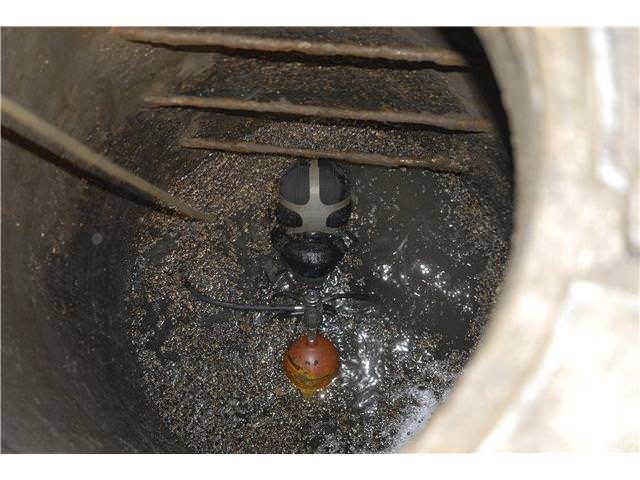
Special cleaning of the country well
After adding the solution to the well, close it for 5-6 hours. Water from a well treated in this way will have to be pumped out at least twice, and then boiled for a week. Such disinfection is recommended if traces of organic matter or bacteria were found in the well.
Important! After completion of all cleaning activities, it is recommended to give a sample of water from the well for analysis
How to clean a well with your own hands
If the cost for the work that a private company takes does not suit you, then it is quite possible to clean it yourself and save some money. But in return, you will have to spend your time and effort.
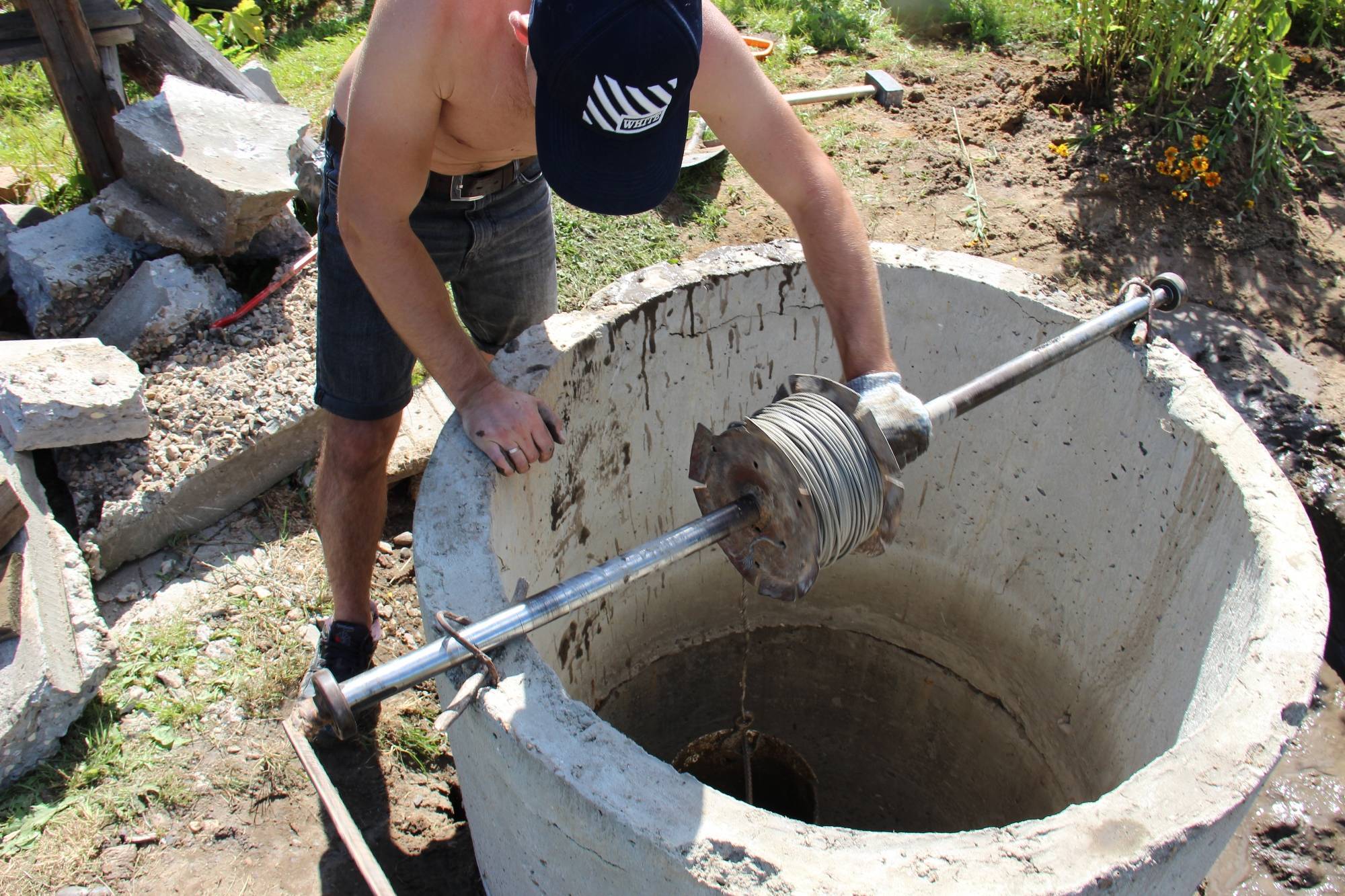


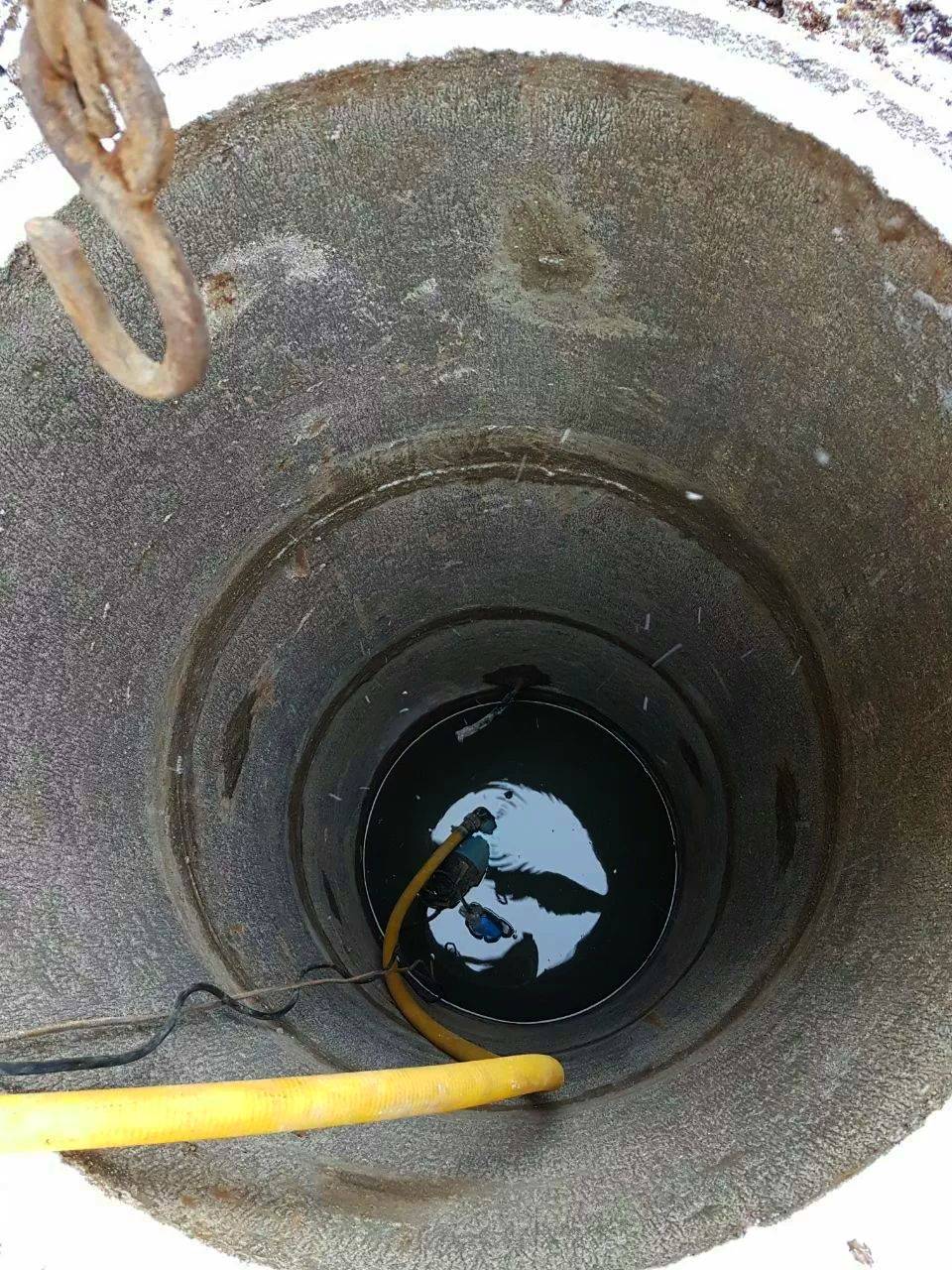

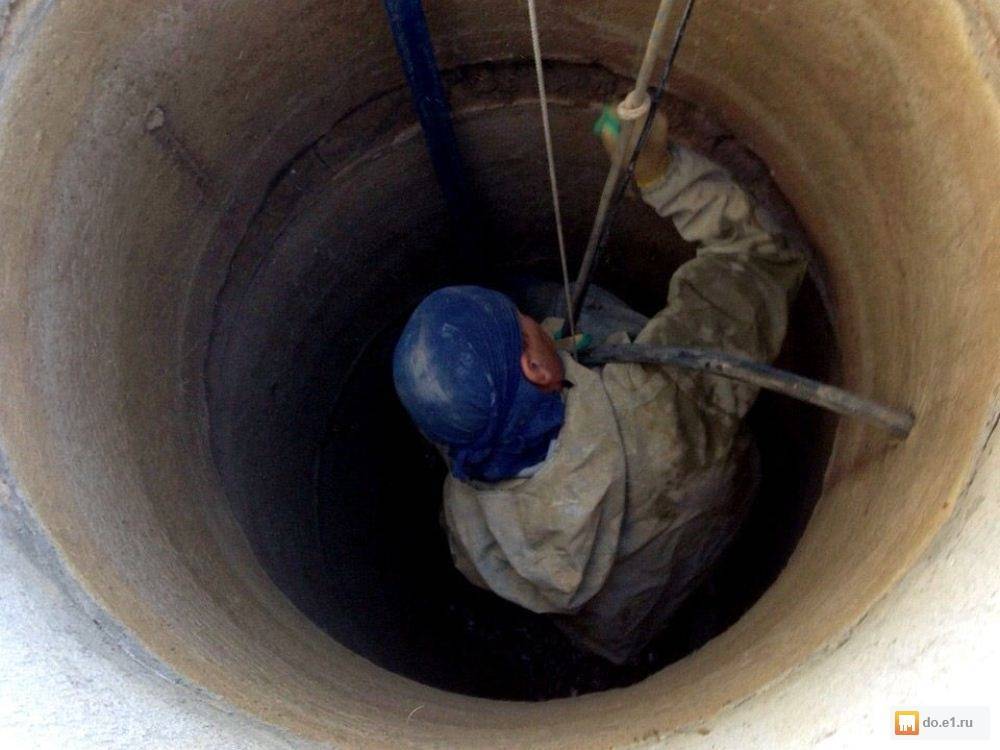
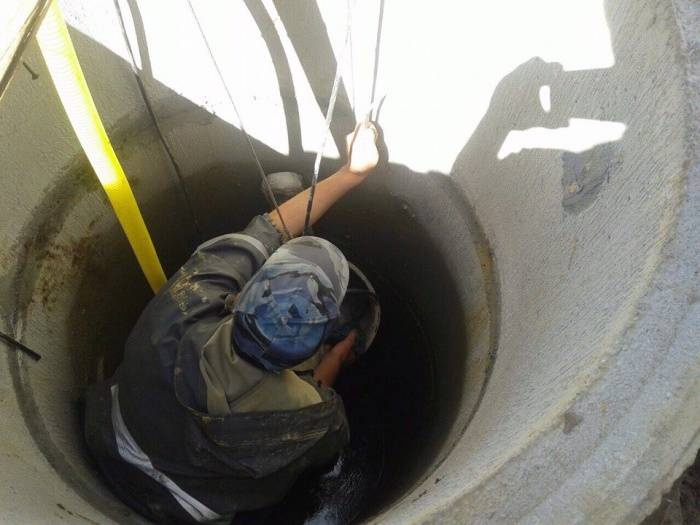


First of all, you need to check if there is an accumulation of gas dangerous to humans at the bottom of the well. This is done as follows: on a rope into a well, carefully lower a lit candle. If it is extinguished, then it is impossible to go down - there is an accumulation of gas, the concentration of which is dangerous for humans. Obviously the gas needs to be removed. This is done quite simply with a conventional vacuum cleaner.
However, this method is not as effective as using a potbelly stove. They put it near the well, take a pipe, one end of which is lowered into the well to the water, and the other is fixed in the blower. And start heating the stove. Thus, the gas is drawn out.
You also need to know safety precautions. Being in the well shaft, monitor your condition, and at the slightest deterioration, go upstairs.We repeat once again that you should not be alone, the presence of a partner who will insure you is a must.
Now you can clean up. Stick to the following steps:
- Go down into the shaft and, using a metal brush, carefully clean the walls of dirt, moss, mucus and other deposits. Rinse several times with water.
- We begin to clean the bottom and water from debris. It is collected with a fine mesh. The filter, if present, must also be removed, cleaned of silt and sand, or replaced with a new one.
- Next, you need to disinfect the well. To do this, you need to know the volume of the well, which is determined by multiplying its depth by the cross-sectional area. We pump out all the water with a pump and pour or wipe the walls with a mop with a rag with a special solution (water with bleach - 20 g per 1 liter of water). Then we prepare a solution for water disinfection. While the water is collected in the well, we take a container and dilute the solution in it (200 mg of bleach per 1 liter of cold water), tightly close the lid and mix. Then we defend and pour into another container without sediment. Pour the solution into the well, mix, close so that the chlorine does not evaporate. The procedure must be repeated the next day.
- After disinfection, the water from the well must be removed. When it is typed, we pump it out again. We do this until the water stops smelling like bleach. However, you can’t drink it for another two weeks, and then it must be boiled.
Another point that you need to pay attention to is the stagnation of water if you do not use the well for a long time, which is especially important for summer residents. Such water cannot be drunk, it must be pumped out.And in order to avoid stagnation, lower a ventilation pipe (diameter 20 cm) into the shaft, the bottom of which should not reach the water by 15 cm, and the upper end should protrude 1-1.5 m above the top of the well
Moreover, the top of the pipe must be closed with a fine mesh and make a cone from the rain
And in order to avoid stagnation, lower a ventilation pipe (diameter 20 cm) into the shaft, the bottom of which should not reach 15 cm of water, and the upper end should protrude 1-1.5 m above the top of the well. Moreover, the top of the pipe must close with a fine mesh and make a cone from the rain.
You can protect the well from freezing in winter by insulating the house with environmentally friendly material, such as mineral wool.
Useful video on the topic:
s-dzXFMtauM
Jamming mechanism
Having connected two rods together, it is necessary to install worm screws on them and lower the structure to the bottom of the well. There is always a gutter at the bottom of the well, into which you need to insert screws and advance to the end of the downpipe
Additional rods are added to the structure as needed, however it is important to remember that each of them can only be turned clockwise one turn to prevent unscrewing the structure
Under the influence of slow forward movements of the drain cleaner, the plug will move along the drain, as evidenced by the resumption of water flow and the appearance of water in the nearest inspection well. However, this is not the end of sewer cleaning. With the help of the remaining nozzles, it is necessary to thoroughly clean the drain pipe - its underground section, in order to prevent a recurrence of the situation in the near future.
If everything is done correctly, the emergency gang will probably not be needed, besides, this method is quite simple and does not take much time, if, of course, there is a drain cleaner at hand. If there were no special equipment and devices, perhaps the emergency gang will be the best solution until the sewer drains are completely clogged?
Selection of a hose for pumping water
The dimensions that the outlet pipe has are an important, but not the only criterion that affects the choice. Strength is taken into account, expressed in the amount of internal pressure that the walls can withstand. Compliance with these parameters ensures a long service life and efficiency of the pumping treatment equipment.
If you use a fire hose, you need to take care that there are clamps for secure fastening hose to the nozzle. In the process of work, it is necessary to monitor that the sleeve thrown over the wall of the well is not pinched. This can lead to overloading of the equipment, up to the failure of the pump.
Cleaning the well with your own hands: the main steps
If you decide to clean the well and want to do it yourself, then this process must be taken very seriously, strictly adhering to the instructions below.
Tool preparation
Before proceeding with cleaning activities, you need to prepare the appropriate tools and accessories, namely:
- ladder (rope or ordinary);
- safety devices (belt, slings);
- bucket;
- sapper shovel;
- a large sponge or brush for metal;
- drainage pump (if any);
- means of disinfection.
You should also take care of your own equipment. It is advisable to use waterproof clothing, high rubber boots and a construction helmet. At the same time, clothes and shoes should not hinder movement and cause any discomfort.


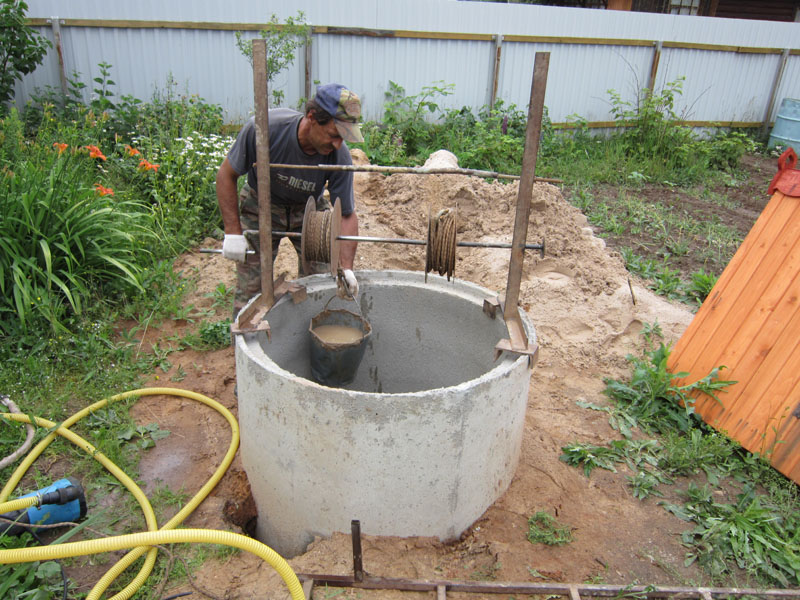


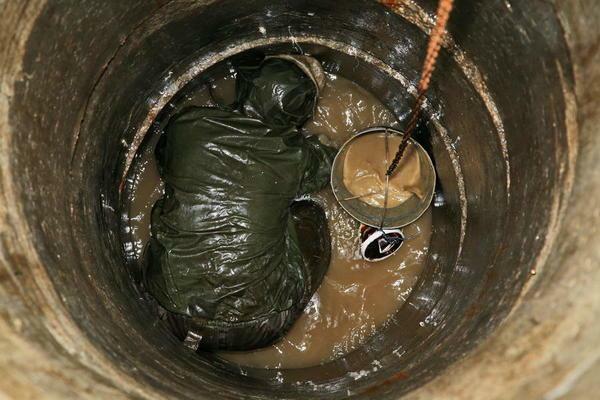
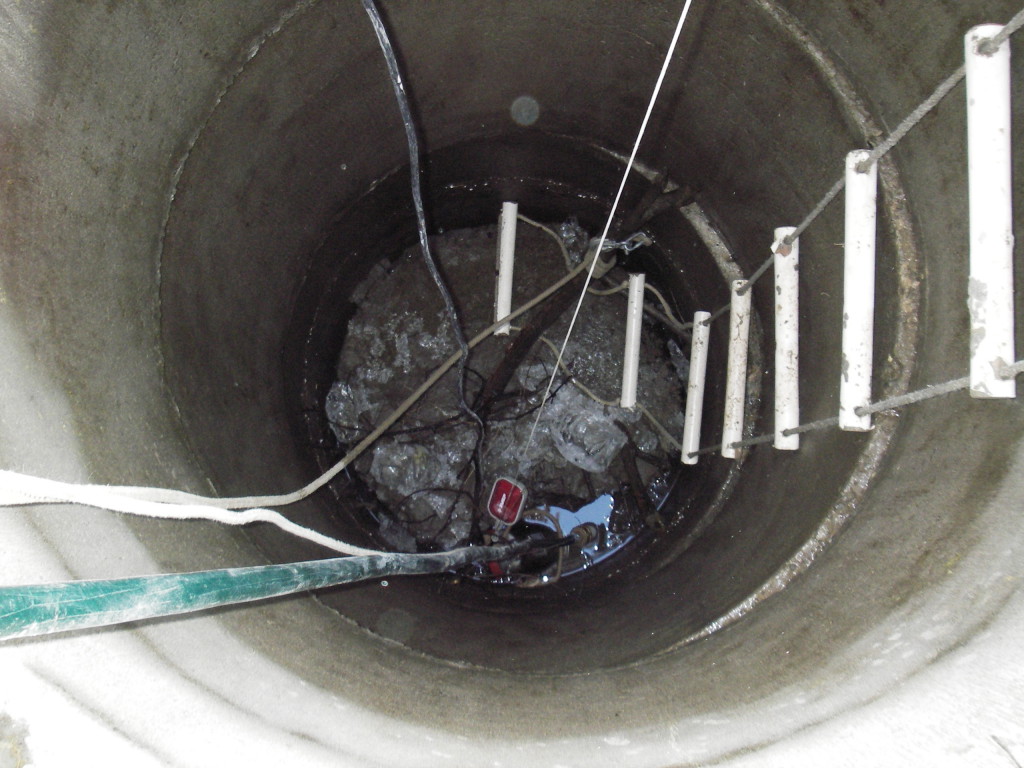

To clean the well you need to thoroughly prepare
Water pumping
Unfortunately, it will not work to clean the well without going down into it. Therefore, first of all, it is necessary to pump out all the water from it. There are two ways of pumping: manual and using a pump. In the first case, you will have to lift all the water with a bucket, which is extremely difficult and tiring. Given this, it is advisable to purchase or borrow a drainage pump from friends, which will greatly simplify the task.
When using a drainage pump, it is necessary to remove large debris from the surface of the water so as not to clog the device’s hose, and also periodically clean the filter element.
The use of a drain pump greatly simplifies the pumping of water.
Cleaning walls and flushing drains
To clean the walls of the well, large sponges or a soft metal brush are used. However, the use of household cleaners is strongly discouraged.
In the process of cleaning the walls, attention should be paid to the integrity of the joints between the concrete rings. If necessary, they must be sealed with cement mortar or liquid glass.
An important prerequisite for the purity of well water is the condition of the bottom filter. It must be thoroughly rinsed or completely replaced.
Drainage for a well usually made from shungite, crushed stone, gravel, pebbles or quartz sand. The layer thickness must be at least 10 cm.
Shungite bottom filter device
Well disinfection
To purify the water in the well from harmful bacteria and microorganisms, the walls and bottom are disinfected at the last stage. The most common remedy for this is a solution of bleach. After processing, the well is covered with a tight lid and tarpaulin, and left in this form for 48 hours.
After disinfection, the water from the well must be pumped out several times until the smell of bleach is completely gone. Usually two or three cycles are enough for this.
Well design
Before starting work on cleaning the well, it is necessary to study its design and depth. Most often, wells are built using concrete rings, which are lowered as the soil is excavated at the bottom.
Scheme: well device
The rings themselves are fixed together with metal brackets, and the seams are smeared with cement mortar. At the bottom the well is equipped with a bottom filter - This is a mixture of gravel, coarse sand and crushed stone. The purpose of cleaning the well is to remove plaque from the walls (concrete rings) and flush the bottom filter (and, if necessary, replace it).
This is interesting: Disinfection of water in a well using bleach: work procedure
Disinfection, cleaning products
There are several disinfection methods that can be used to disinfect well water.
White
The amount of whiteness should be calculated based on one can per ring. Having treated all the walls of the mine with this solution, you should leave it for a day. The head must be covered with plastic wrap.






After a day, all the accumulated liquid should be pumped out. If necessary, it can be pumped out several times during the week.
Potassium permanganate
Simple potassium permanganate will allow high-quality disinfection of country wells with drinking water.One bucket needs one tablespoon of potassium permanganate. Dilute it by mixing thoroughly. Pour all the means into the source to clean it from bacteria. After that, you need to wait about two hours, closing the head. After the time has elapsed, pump out the water. You can drain into the garden, such a composition will be useful for the soil.
Bleaching powder
If the liquid in the source was contaminated with bacteria or contaminated with organic matter, then a bleach solution is used. One liter of water requires 20 milligrams of bleach.
After adding this chemistry to the source, leave it for six hours. After the time has elapsed, the liquid is pumped out twice. After one week, it is recommended to boil the water. Now you know how to disinfect the water in your well if it has been attacked by bacteria or organic matter.
Iodine
Before you start cleaning the source with an iodine solution, you need to weigh the pros and cons. A number of researchers claim that this remedy has an excellent antibacterial effect. It destroys a large number of microorganisms and does not allow them to multiply. On the other hand, there is an opinion that iodine will make the liquid undrinkable.
If it is not possible to do a complete disinfection, then this tool is used to delay the completion of this work. So, for one liter of water you need three drops. The entire composition is poured into the source. The iodine should improve the quality of the water.
Tablets
There are a lot of tableted products, mostly they contain chlorine, for example, Ecobreeze, Septolit and others.Their use is permissible only after preliminary cleaning of the source from all kinds of deposits on the bottom and walls of the mine. The method of their use is indicated in the instructions from the manufacturer. By adhering to it exactly, you will be able to clean your source yourself and understand how often this procedure is necessary.
Ultraviolet
The use of ultrasound and ultraviolet refers to an alternative method. We immediately note the high cost of this purification option. But the advantage is that it is less labor intensive. Ultrasonic disinfection is carried out only after a preliminary cleaning of the shaft.
The disinfection process is carried out by a special unit, inside which there is an ultraviolet lamp. It is worth noting that this technology does not change the chemical composition of the liquid.
When is a drinking well cleaning necessary?
Water enters the well from clean underground sources, however, the contamination of the well occurs constantly, there can be many reasons, for example:
- Organics accumulating on the walls of a wooden or concrete ring well, loving a humid environment. Algae, growing, and then, dying and decomposing, poison the water, lead to its darkening, give a musty aftertaste;
- Often an open well cover leads to the fact that leaves, sticks, algae, and even a small animal can get there, the water can turn green;
- Damage to the well due to depressurization of pipes leads to a deterioration in water quality, the ingress of bacteria or other contaminants into it;
- Minerals, sand, clay, etc., entering the well water during a flood leads to clouding;
In all these cases, it is necessary to clean the well, however, even if the water is visually in order, after the winter, preventive procedures must be done to avoid pollution after the flood.
Other ways to clean well water
There are other ways to purify water, used if the pollution is not associated with depressurization of the well shaft. Each method is applied individually, taking into account the type of pollution:
1. Dosing cartridges. In the event that contamination is not associated with depressurization of the structure, dosing cartridges are used. These containers contain a composition of calcium hydrochloride and bleach. The cartridge is immersed in the well for a certain time and completely cleans it. This method is used when water is contaminated with organic decay products when flowering occurs.
2. Charcoal filters. This method is used for purification from large organic impurities. Balls filled with coal are immersed in a well for a certain time, after which they are removed. There are several types of such filters, which differ in the outer shell, the most harmless birch and coconut.
3. Ultraviolet radiation. This method is almost universal (however, it requires special equipment). The advantage of this method is that the water remains alive, because the radiation only disinfects the water without changing its properties. In addition, with this method, no reagents are added to the well.
Prevention of water pollution
Cleaning and disinfecting water in a well requires a lot of time and effort. To minimize the occurrence of this kind of trouble in the future, do not forget to carry out preventive disinfection measures.
To prevent water pollution in the well, following a number of simple rules will help:
- When constructing a hydraulic structure, take care of the construction of a clay castle. To do this, dig a trench around the well 1.5-2 meters wide and 50-100 cm deep. It must be covered with clay and compacted tightly. The constructed clay castle will simultaneously perform two functions: to prevent the penetration of moisture and to prevent contamination of the structure through the seams between the rings.
- When arranging a bottom filter, use flint gravel, which has the ability to soften water, or zeolite, which acts as a natural sorbent.
- Equip the head of the well with a lid or canopy. They will prevent dust and small debris from entering the mine, and also protect well water from direct sunlight.
- To reduce the risk of leaks during the operation of a hydraulic structure, use stations with remote ejectors and submersible pumps.
Proper arrangement of the water source will eliminate the need for frequent disinfection work.
If your summer cottage does not yet have its own source of water and you have not decided on its type, we recommend that you familiarize yourself with the information in the article comparing a well and a well, evaluating the pros and cons of both options.
Well safety
Working at depth is very dangerous, so it is unacceptable to neglect the rules of personal safety. Experts recommend enclosing the mine with boards placed on edge for the period of repair work.


In addition, the area around the well mouth should be cleared of foreign objects so that nothing could accidentally fall into the well.Especially if there is a working person there.
All tools and equipment must be in good working order and safe. Be sure to check for breaking the strength of the rope that will be used to lift the container with silt or soil.
If work is to be done at a depth of more than 6 meters, another safety rope must be tied to the bucket. Lifting gear, if used, must function flawlessly.
Before the first descent into the shaft, as well as after breaks and every morning, it is necessary to check the quality of the air in the well. This can be done by lowering a burning candle down, if it goes out, it is necessary to take measures to ventilate the trunk.
Then check the air quality again. If the influx of harmful gases in the well is strong and constant, it is necessary to carry out continuous ventilation.
For these purposes, a fan or a burning stove installed on the surface is used, the blower of which is connected to the bottom of the mine through a pipe. When lowering or raising any objects, you should always notify those who work below. In the process of immersion, the depth of the barrel wall unprotected by fastening should not exceed one meter.
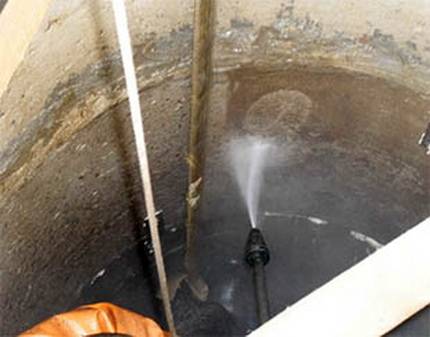
To clean the walls of the well from deposits, you can use a high-pressure washer. It will make the process go much faster.



