- Necessary equipment
- Pump
- Pipes
- metal fittings
- Safety cable
- Hydraulic accumulator
- Equipment selection
- Step-by-step work algorithm
- Single family house
- Tees and manifolds
- Hidden and open installation
- Circulating and dead-end DHW
- Types of pipes for water supply
- The documents
- Drafting a project
- Video description
- Contract clauses
- Briefly about the main
- How to design a plumbing scheme
- Plumbing indoors
- Tips & Tricks
- Wiring types
- Orientation
- Basement and attic
- Dead end and circulation
- Tees and manifolds
Necessary equipment
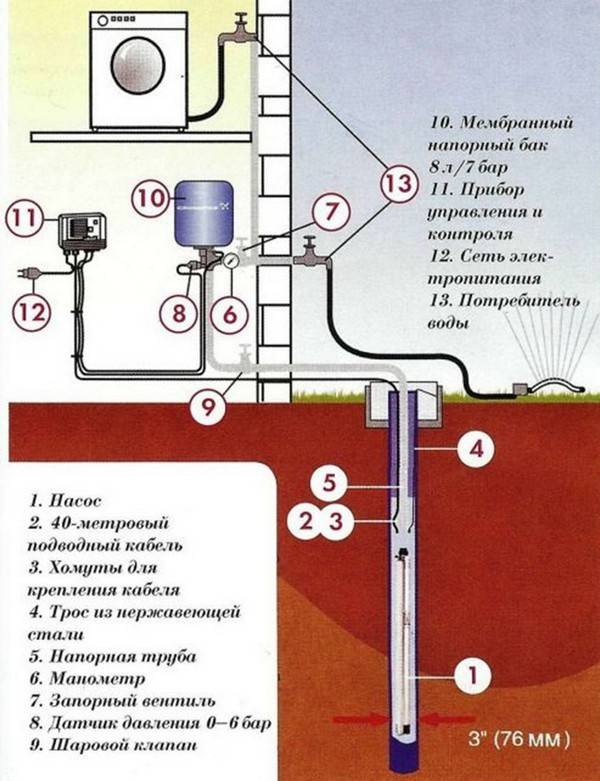
When a person has already decided on the choice of source, then with confidence you can begin to draw up calculations and drawings. The first thing to do is to decide on the choice of equipment.
Pump
First you need a pump, which is both the "brain" and the "heart" of the water supply system. Therefore, it is not worth saving on its purchase. It is necessary to choose a pump with the calculation of the dynamic water level plus forty meters and plus 20% to increase the pressure.
Pipes
They are the "arteries" without which it is impossible to supply water to the tap. For not very deep wells, as well as for laying in the ground, polypropylene pipes are suitable. They withstand pressure up to ten atmospheres.And those that are designed for both cold and hot water can withstand pressure levels up to twenty atmospheres. When buying pipes for water supply, you need to take into account other subtleties.
Here are the main points to pay attention to:
If you take pipes with thick walls, then they can narrow the passage a little, and the pump will work from this with a greater load.
When doing installation work with your own hands, you need to pay special attention to the seals so that you do not have to remove the entire barrel with a pump full of water.
In severe frosts, it is impossible to work with pipes.
Couplings must be purchased from the same manufacturer as the pipes.
- Be sure to read the instruction manual to know how much you need to heat and cool them.
- Dirty or wet pipes must not be soldered, they must be cleaned and dried, and only then proceed to work.
- If the connections are combined, then they need to be installed on flax and sealant.
- It is necessary to test pipes under pressure only by installing and loading the pump to a depth.
metal fittings
These are integral elements of the water supply system. These include a check valve, which is installed at the very outlet of the pump, metal or plastic valves, various couplings, tees and other elements.
Safety cable
The pump itself literally hangs on the pipes, and the cable is used as insurance, and also helps when lowering and raising it. The deeper the pump is located, the thicker the diameter of the cable should be. If the depth is about thirty meters, then the cable should be up to 3 millimeters in diameter. More than thirty meters - the diameter of the cable should be up to 5 millimeters.
Hydraulic accumulator
When buying a membrane tank, you need to calculate the number of people who live in the house. Usually a 50 liter tank is bought.
Equipment selection
If you decide to provide water supply cottages from the well do it yourself, it's important choose the right pumping unit - the efficiency of the system will depend on its work. Such units have a number of advantages: Such units have a number of advantages:
Such units have a number of advantages:
- low (compared to a pumping station) noise level,
- large lifting depth (a pumping station without an ejector cannot operate at a depth of more than 8 meters),
- lower cost
- Due to being in the water environment, the submersible pump is effectively cooled in a natural way, which reduces the risk of overheating and the associated equipment failure.
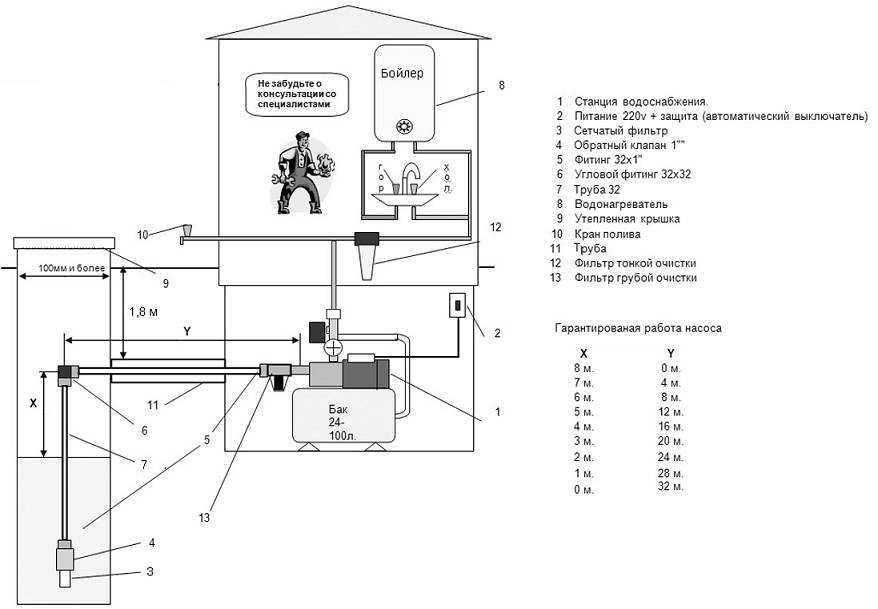
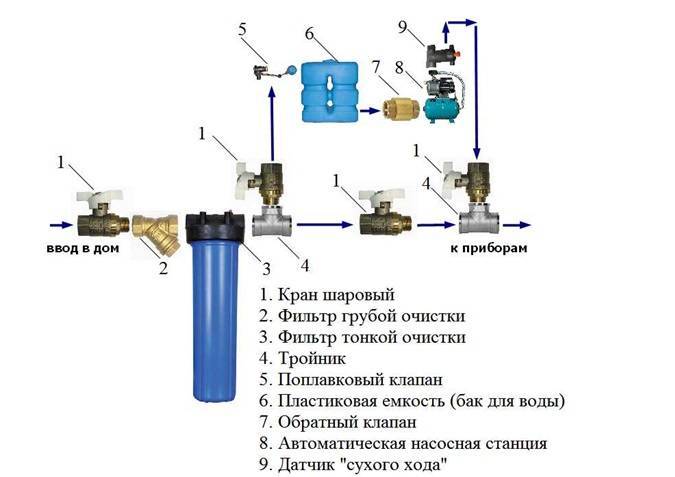
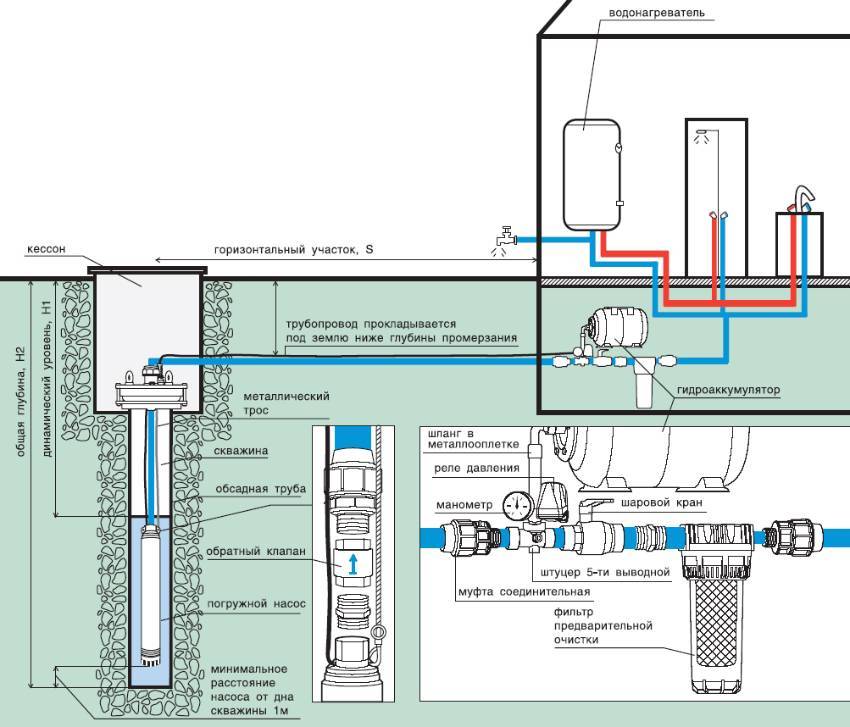
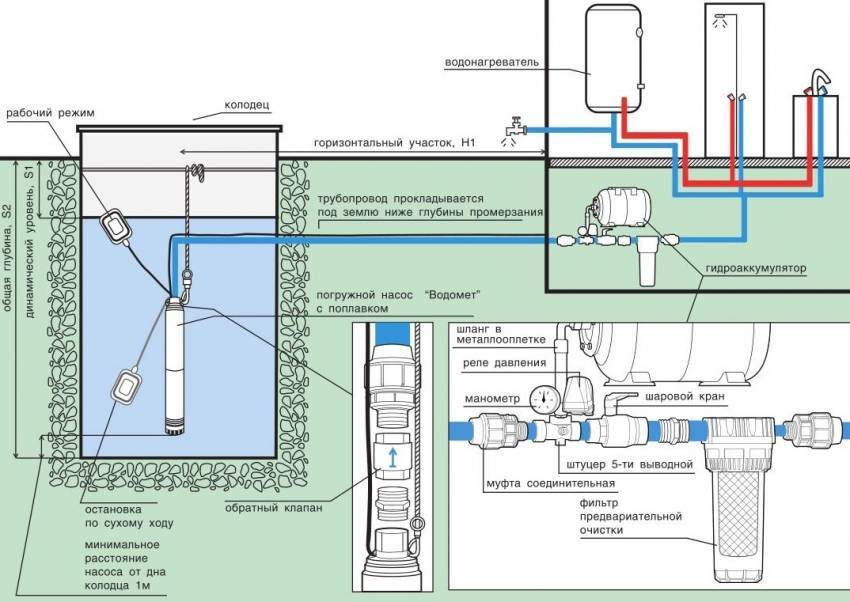
When choosing a system using a pumping station, the well is equipped with a water intake head and a check valve on it. To prevent debris from entering the water supply system, the water intake is equipped with a mesh filter.
The pumping device and the automatic equipment control and protection system can be installed at a certain distance from the source, in a heated room, in a house. A damper tank is also installed there. If the pumping station has a soft start function, the need to install a buffer tank disappears, although it will be useful in any case to reserve a certain amount of liquid.
The choice of braided hoses for the installation of summer systems was mentioned above. For winter systems, it is better to choose pipes made of modern polymeric materials (the best option is HDPE low pressure polyethylene), durable and resistant to corrosion.
- If you do the installation of a water supply system in a country house with your own hands from a well, the water temperature will not be high, so the choice of pipe material is practically unlimited. In some cases, it is recommended to carry out sections of the main line from cast iron, but only if communications are laid under sidewalks or paths with a heavy load.
- When installing a pipeline from a well to a house, one should be guided by a rule that is fair for all engineering systems - the smaller the number of joints, the higher the reliability of the structure as a whole.
- Methods for connecting pipes and fittings during installation of the line are selected depending on the material of the pipes. In any case, all connections must be hermetically sealed. Detachable and permanent connections of polymer pipes with the help of heating (partially melting material) equipment and modern compression fittings do not let water through and provide high reliability of joints.
Step-by-step work algorithm
How to make water distribution in apartments? To replace the old plumbing in the apartment, you can turn to a professional and you do not have to choose the material, wiring diagram and installation systems, however, such services are quite expensive. In turn, the organization of water distribution in an apartment with your own hands requires careful observance of building codes and regulations. This event is divided into several main stages:
First, experts recommend preparing a plan for future work. Such a plan should include two main points:
- choice of material. Many people are interested in one question: which pipes to choose for plumbing? Pipes can be made of metal, metal-plastic or plastic.Each material has its own characteristics, which must be carefully studied in order not to encounter unexpected problems in the future. Which material is better suited for the installation of water supply: polypropylene or metal-plastic? For self-distribution of water supply, metal-plastic pipes are most suitable. Mounting metal-plastic communication is quite simple, so even a beginner can do such work. In any case, polypropylene or metal-plastic are the best suited for water pipes;
- choice of water distribution scheme in the apartment. The scheme of installation of water communication is determined depending on the type of multi-storey building. To date, the most popular are two schemes: serial and parallel. A sequential wiring diagram is used if the water pressure in the apartment is always stable, however, this is extremely rare. Therefore, most often for the installation of a water supply structure, the second option is used, namely: parallel or collector wiring of water supply and sewerage.
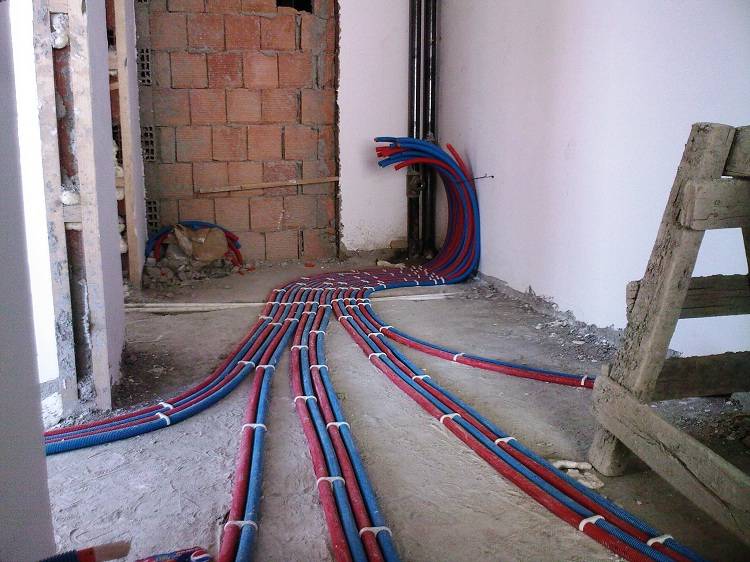
The collector wiring system is a modern and more practical option, in such a water supply system the pressure will be stable
Calculation of fittings and other auxiliary elements, as well as the indicator of the pipeline section. It is recommended to install shut-off valves in front of each source of water intake.
It is important to remember that the pipe cross-sectional index must be less than that of the connecting elements
The fourth paragraph of the scheme includes a list of tools necessary for wiring.
Dismantling of the old communication and laying a new one
During the dismantling of the old structure, it is very important to take care of observing the cross-sectional index of all outlets and pipes, otherwise you will have to use special adapters
As a rule, in standard apartments, rooms where plumbing structures are located have a limited area. In this regard, it is recommended to give preference to the most compact option for laying water supply. As mentioned above, pipes made of different materials can be used for plumbing in an apartment.




Single family house
What can be the layout of the water supply of a private house?
- Sequential and collector;
- open and hidden;
- In the case of hot water supply - circulation and dead-end.
Hot water supply scheme with a circulation pump
And now let's figure out what are the advantages and disadvantages of each of these solutions.
Tees and manifolds
Let's start with definitions.
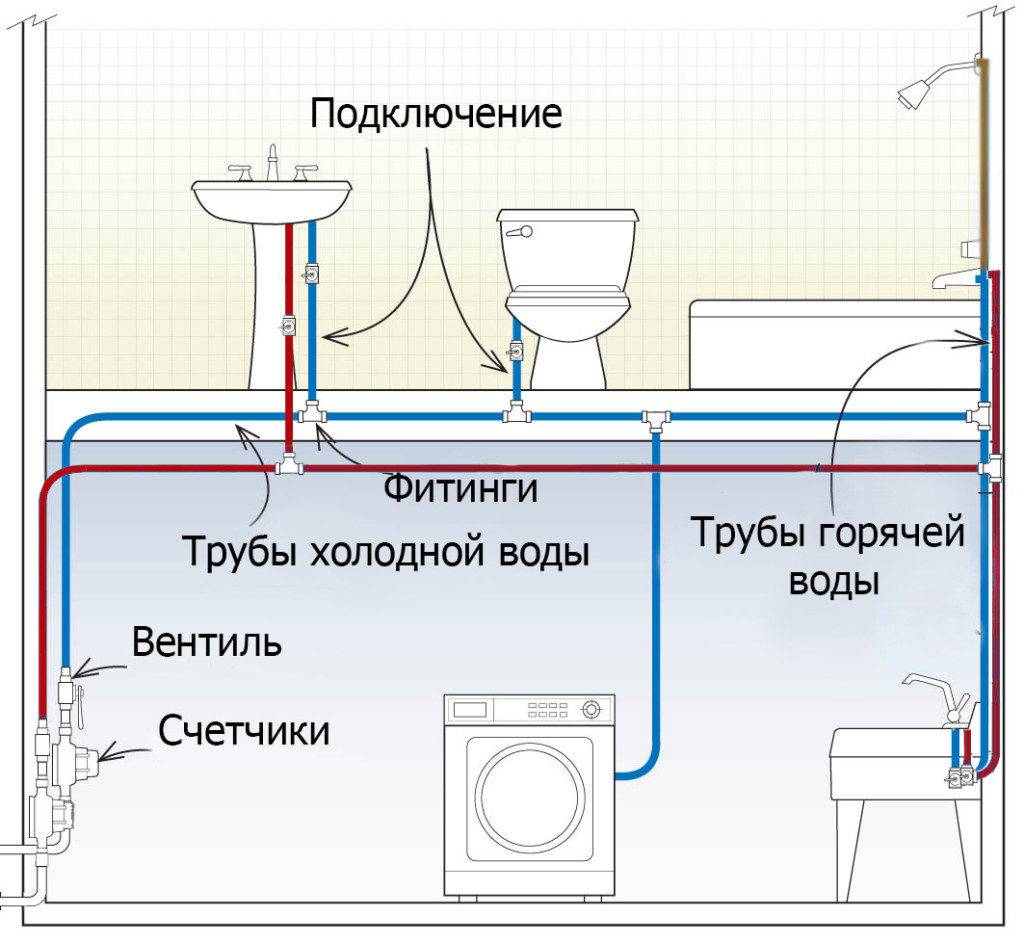
That scheme for connecting sinks and baths to the water supply, which we are all used to seeing in the apartments of our childhood, is called sequential, or tee. All appliances are connected to a single supply with tee connections.
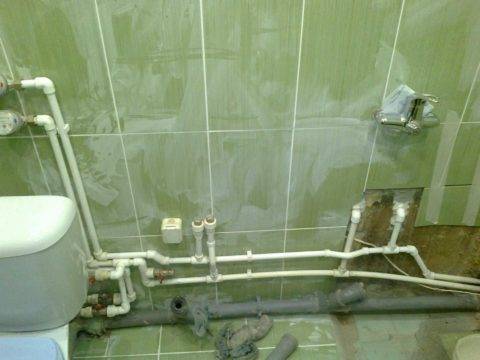
Faucets and toilet bowl connected via tees
Why did Soviet designers opt for such a layout?
Due to its low material consumption, which on a national scale meant significant savings. However, the tee scheme has one serious drawback: if you fully open the tap on one mixer, the pressure on other plumbing fixtures will instantly drop.
If you turn on the cold water in the kitchen, the angry cry of a wife scalded with boiling water may well come from the bathroom.
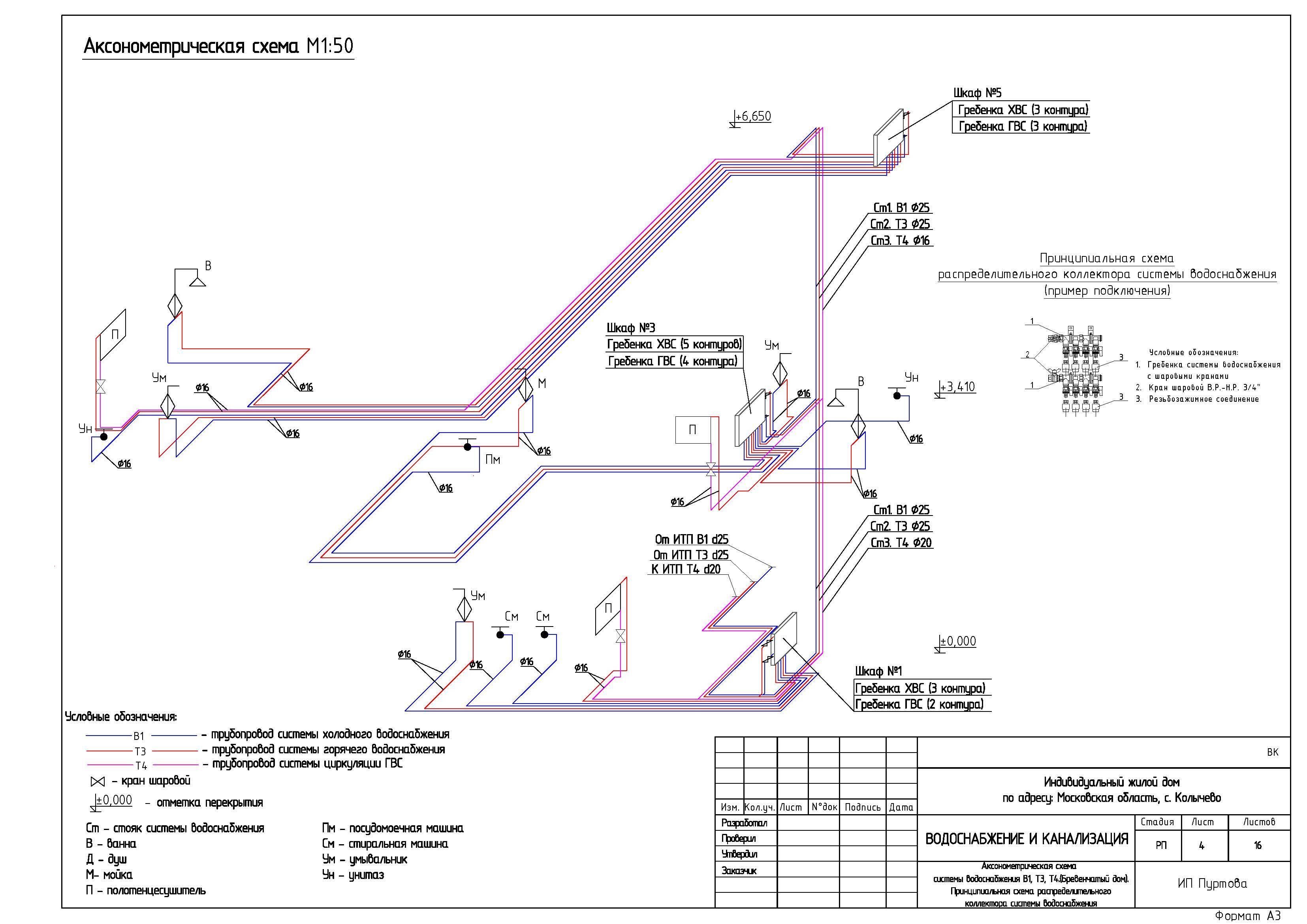
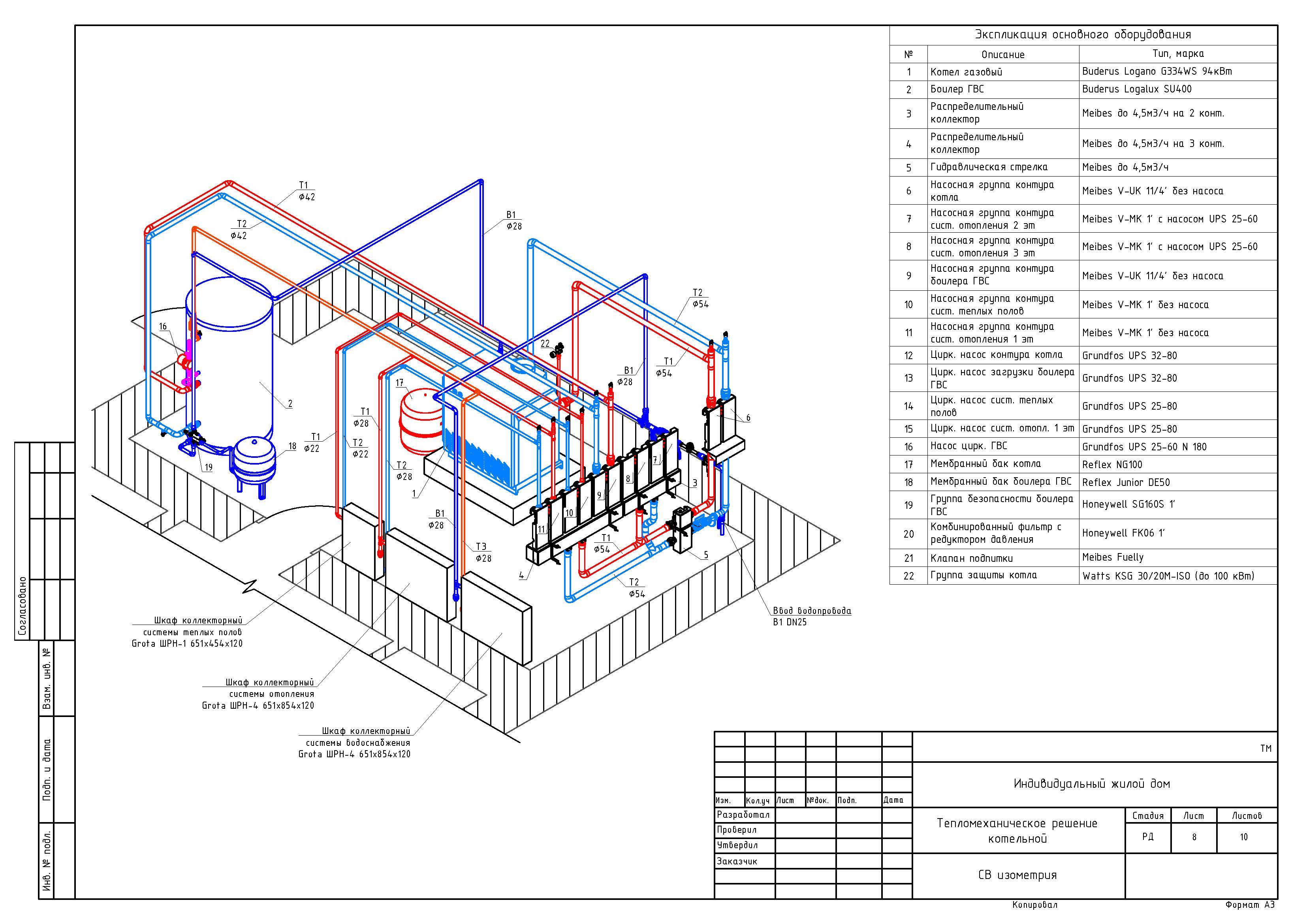
The collector circuit assumes that each device has its own supply connected to the comb collector. In this case, the water pressure is determined only by the pressure in the section of the water supply to the collector and (in dynamic mode - at water flow) by the length of the connections.
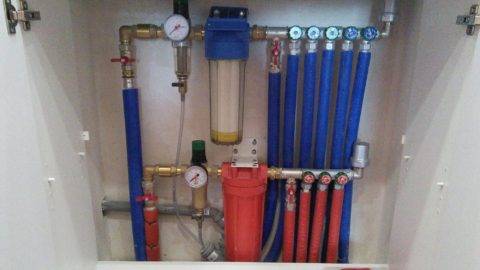
Cold water and hot water collectors
In addition to the obvious advantages, the collector circuit has a couple of equally obvious disadvantages:
- The total length of the pipes increases several times, resulting in a noticeable increase in costs;
- A large number of eyeliners will be a very dubious decoration of your walls, so the collector wiring, with rare exceptions, is hidden. Why this is bad, we will now find out.
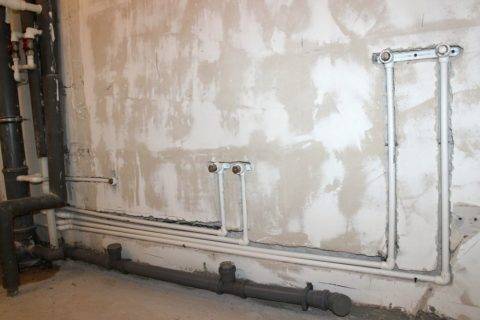
Connections to devices are laid in strobes
Hidden and open installation
The advantage of hidden wiring is the aesthetics of the design of the room: engineering communications are usually shamefully hidden. However, the author, a plumber with many years of experience, advocates with both hands the open installation of water supply connections to appliances.
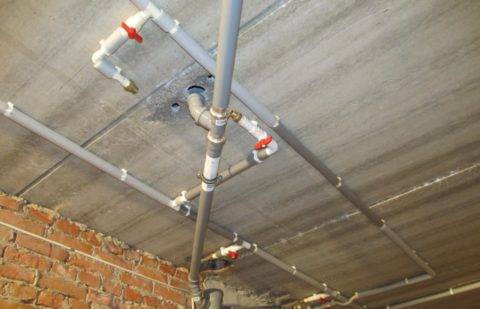
Most of the leash is under the basement ceiling
What's wrong with concealed mounting?
- There are no permanent materials. Marriage has not been canceled either. A broken section of openly laid wiring can be replaced without damaging the finish;
- Hidden wiring can be performed only at the stage of repairing the premises. Open - at any time;
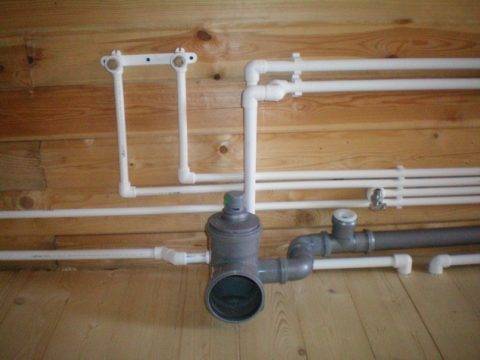
Open water distribution in a wooden house
Open piping makes it possible at any time to connect a new appliance (in particular, a dishwasher or washing machine) to an arbitrary point in the water supply. With hidden installation of pipes, this is not possible.
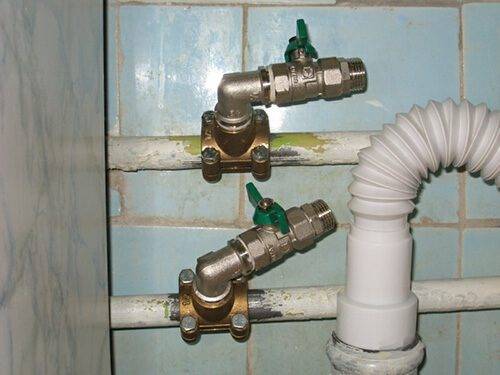
Connect a new washbasin? Easily!
Circulating and dead-end DHW
Circulating hot water supply in the cottage provides a small, but quite real saving of water at a large distance from the distant points of water intake to the water heater: the cooled water from the pipes is uselessly drained into the sewer.
Let's, for example, find out how much water we will drain before it is heated with a length of 20 mm polypropylene eyeliner of 12 meters:
- The inner diameter of the pipe with 2 mm walls is 16 mm, or 0.016 m;
- Radius - half the diameter, or 0.008 m;
- The volume of a cylinder is equal to the product of the square of its radius, height and number π;
The formula for calculating the volume of a cylinder
The internal volume of the liner is thus equal to 0.0082×3.14159265×12=0.0024 cubic meters, or 2.4 liters.
Water flow through water fittings
In addition, as we remember, the circulation of hot water ensures the continuous operation of water heaters.
However, the author will allow himself to make a couple of remarks:
Installing a separate electric boiler on the far sink completely solves the problem of waiting for water heating in a dead end system;
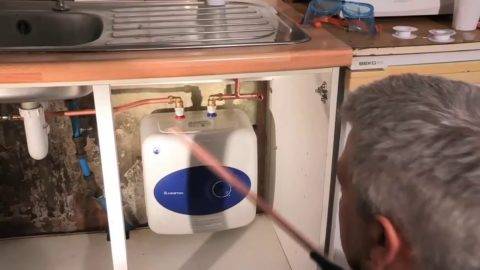
Compact boiler provides hot water washing
Electric heated towel rails consume 40-100 watts, that is, about the same as a circulation pump.
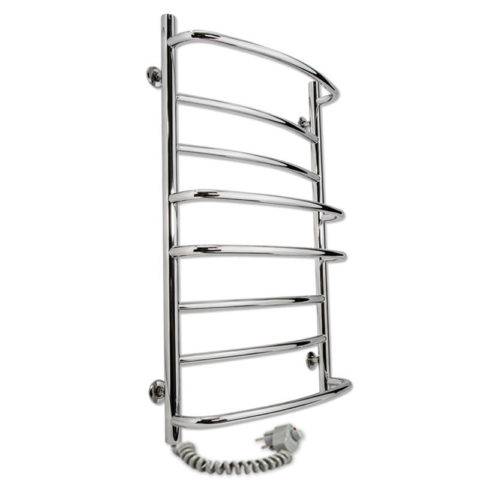
The power consumption of this appliance is only 80 W
Types of pipes for water supply
The main types of pipes used in the organization of water supply:
- Copper pipes connected with special solders. The mains are resistant to corrosion, withstand heating up to 250 ° C. Pipes are flexible, which allows you to create pipelines of complex configuration.The disadvantage of the material is the formation of a galvanic couple in contact with aluminum or steel elements. When used in multi-storey buildings, high current conductivity should be taken into account; if equipment breaks down at neighbors, the pipeline becomes energized.
- Metal-plastic pipes, consisting of several layers of plastic with an aluminum gasket. Products are highly elastic; threaded bushings or crimp elements are used for connection. Products are not used for hidden laying, since the rubber seals in the joints lose their elasticity and allow water to pass through. The advantage is the absence of corrosion, the smooth inner surface prevents the formation of deposits.
- Products made of polybutylene withstanding heating up to 90°C. The elements are connected by soldering technology, the seam is characterized by increased strength. Due to the high cost, polybutylene products are not widely used; pipes are used in the arrangement of heated floors.
- Polyethylene reinforced pipes, designed for pressure up to 3.5 atm. In water supply networks, use is not recommended, since the material does not have high strength. Details are used for distributing water in personal plots or in domestic buildings, the material allows the liquid to freeze. When connected, a reducer is required to reduce the pressure of the water flow to a safe level.
- Lines made of polyvinyl chloride, which is characterized by high chemical resistance and allows operation at temperatures up to 80 ° C. The disadvantage of the material is the low resistance to ultraviolet radiation.Soldering or glue is used to connect pipe fragments, but the strength of the joint does not allow water to be supplied under pressure above 3.5 atm. Pipes are used for water supply of technological premises or in the organization of irrigation systems; a reducer is provided in the line to reduce pressure.
- Pipes made of polyisopropylene, which allows connecting elements by soldering. The material is low cost, allows pressure up to 12 atm. and temperatures up to 130°C. The surface of the pipes is rough, but there is no plaque in the inner part of the lines. Products are used in the organization of risers and in the distribution of water inside residential or office premises.
When selecting pipes, the cross section of the internal channel, on which the throughput depends, should be taken into account. To determine the parameter, it is necessary to find out the required pressure in the lines, the coefficient of pressure drop inside the pipe and at the joints is taken into account. Straight lines should be used when planning the laying pattern, but excessive elongation and cluttering of the branch with reinforcement will result in a pressure drop.
The documents
The owner of the site, the one who has a power of attorney from him or the service with which he has concluded an agreement, can submit an application for drawing up a contract for work, connecting water or changing supplies. To obtain permission to connect to a neighbor's water supply (the sample documents are similar to the usual ones) or a common supply network, you need:
- For individuals, it is necessary to collect details, in the form of a postal address of the place of registration or residence, full name, identity confirmation document and data for further communication with the applicant.
- Legal entities and private enterprises must provide their number in the State Register and the date it was entered, TIN, current address of residence with place of residence and postal code, as well as confirmation from the bank, which gives permission that the applicant can sign the contract.
- The application must indicate the name and location of the site or facility that you want to connect to the network.
- Attach to the package of documents data on additional sources of water supply (volume and owner).
An example of an application with a list of attached documents
- If there are no additional septic tanks (cesspools, treatment plants) on the site, and standards are established for waste disposal through sewers, then it is required to indicate the properties of these restrictions and the number of changes in the volume of network use per year.
- You must provide a copy of the site plan, which has a sewerage scheme, a display of all constructed objects and their characteristics, as well as a list of residents.
- Information should be provided on what kind of activities are taking place on the site. This is necessary for carrying out normalized spillways.
It is also required to attach to the list of documents for the application:
- Copies of all concluded contracts for connection to the public network.
- Copies of documents that are made when connecting, flushing, as well as cleaning the line and equipment in a designated area or indoors.
- A copy of papers for measuring instruments (meters) to check these devices for compliance with state standards, their installation scheme and indications at the time of application.If the water consumption is less than 0.1 m3/h, then the installation of the meter is not needed, and, consequently, copies of the described documents.

Example of a meter approval certificate
- A diagram of the location from which the samples will be taken.
- Copies of papers that confirm that the applicant owns this site.
- A document on the maximum load on the water supply network, which indicates for what purposes the water will be used (daily needs, fire system, pool, irrigation).
- Expert decision of federal or private SES, if required.
Before starting the application, it is recommended to make a topographic plan of the site with the help of surveyors, if it is not available or it was drawn up more than 1 year ago.

Topographic plan of the site
Drafting a project
To obtain a permit for land work for a water supply system, it is required to draw up a site project. This may be necessary if major repairs are being made to the premises or for newly installed buildings. To obtain such project documentation, you can contact private architectural offices or relevant specialists in the company that owns the water supply network.
In the process of compiling, it is required to provide the current number of people living on the site, as well as the layout of sanitary facilities and household appliances that are connected to the water supply. If there are additional sources of water on the site, then they are also indicated. You will also need a plan of the house, a topographic survey of the site, the type of plumbing that is used and a list of restrictions on the use of plumbing.
With the help of the finished project, you can understand the layout of the pipes, the size and material from which they are made, the thickness of the concrete screed if the plumbing is built into the wall or floor, as well as the required amount of material for installation and additional means for pumping water (if the pressure is insufficient).
Video description
This video shows an example of a water supply plan:
The applicant must receive from the construction organization a package of documents, which includes:
- The title page, which displays general data and there is an explanatory note.
- Plan-scheme, which shows the location of the main water supply line.
- A piping layout that shows all the nodes and points where the fastener is located.
- Volumetric scheme of plumbing and heating elements.
- List of used materials for installation and wiring, as well as what they are made of.
Without this scheme, it will be difficult to calculate the amount of water consumed and the correct location of the outlet to the main supply line.

Specification example
Contract clauses
In order to obtain permission to commission a water supply system or conduct a new supply line to the site, it is required to draw up an agreement with the water utility. This cannot be done without obtaining all the permissions that are described above. The clauses of the contract with the water supply company should list:
- Drawing up an agreement on the required connection conditions.
- The amount of time the applicant will receive water supply.
- The quality of the water received and the procedure for monitoring this parameter.
- List of conditions under which a short-term shutdown of water supply can be carried out.
- Water meter.
- Terms and conditions under which payments for the use of the common network will be made.
- List of items showing the division of responsibility for the use of the water utility between the consumer and the supplier.
- Rights and obligations that both parties must fulfill, as well as punishment for their violation.
- In what order will disputes between the supplier and the consumer be resolved?
- Permission to collect samples and access to meters for representatives of the supplier company.
An example of a water connection agreement
- When and how the user will submit data from the counter, if it is installed.
- How the user will be informed if the service provider transfers its rights to another organization.
- The conditions under which water will be supplied to those who are connected to the applicant's water supply, if contractual obligations have been drawn up with the supplier company.
After installing all the pipes and water supply units, it is required to draw up an act on the work performed, which the applicant must sign. If hidden work was done during the installation process, then a separate form is needed for them. They can be carried out during the laying of the pipeline. It is also required to draw up an SES act when flushing pipes and checking water quality for compliance with standards.
An example of a contract for connection to the sewer
Briefly about the main
Before submitting an application that will allow the signing of a contract with a company supplying water supply services, it is required to make a project of the site with a list of all equipment that consumes water and a topographic map.
Self-connection and laying of water supply must be officially authorized by the relevant services, otherwise an administrative penalty will be received.
Connection to the public water supply network may not be necessary if it is possible to install a personal well, well and septic tank.
How to design a plumbing scheme
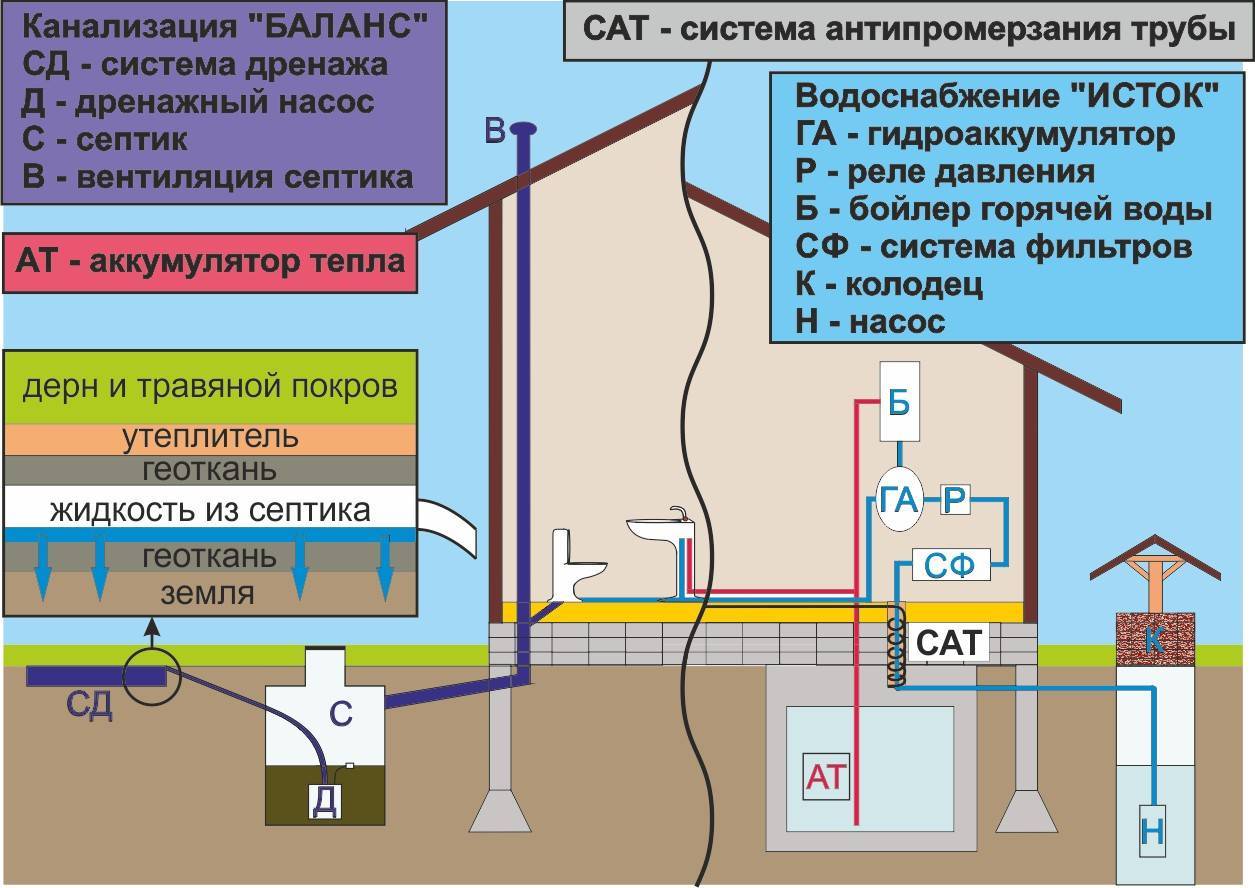
In order for everything to turn out right in the end, before installing the water supply system, it is necessary to carefully work out the scheme for laying it on the street and wiring in the cottage. If this project is done correctly, this will avoid many problems during installation work and subsequent operation of the assembled water supply system.
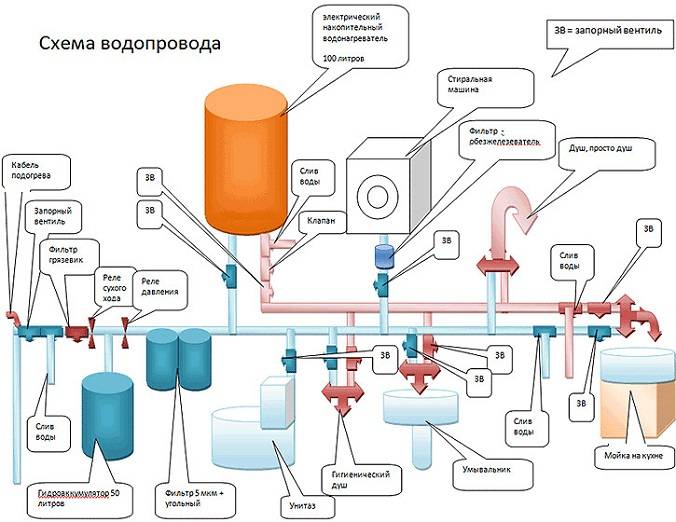
Private house water supply scheme
When developing such a water supply scheme, it is calculated:
- the number of water points in the house;
- the need and number of collectors;
- pump power and water heater capacity;
- pipe dimensions;
- valve characteristics.
Plus, the option of piping (collector or serial) and the location of all elements of the water supply system in a private house are selected. The same electrical wiring in an apartment or a ventilation system is easier to install at first glance. However, there are nuances here and there. And with the slightest mistake, in all cases there will be a lot of problems.

Plumbing indoors
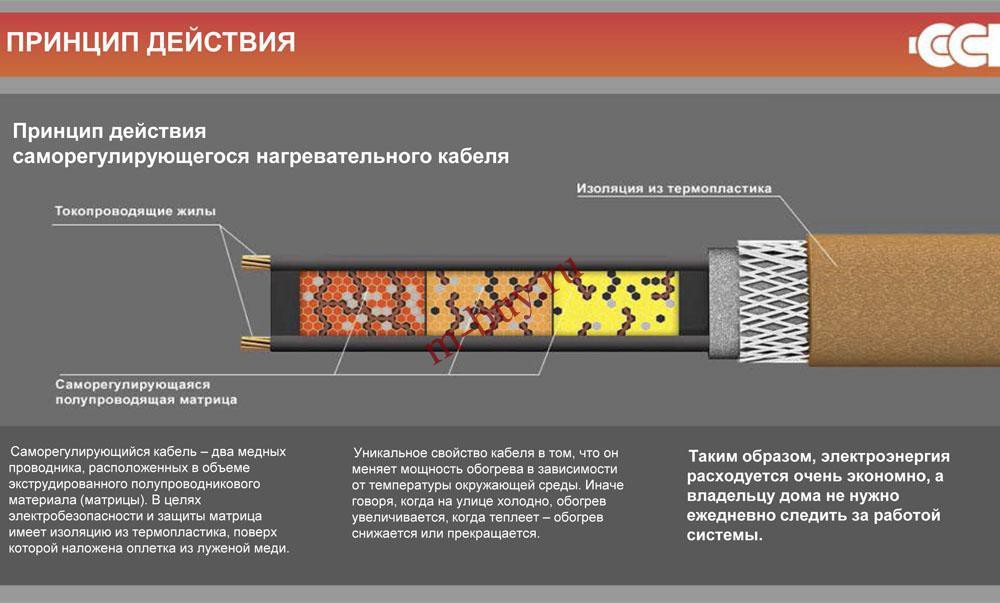
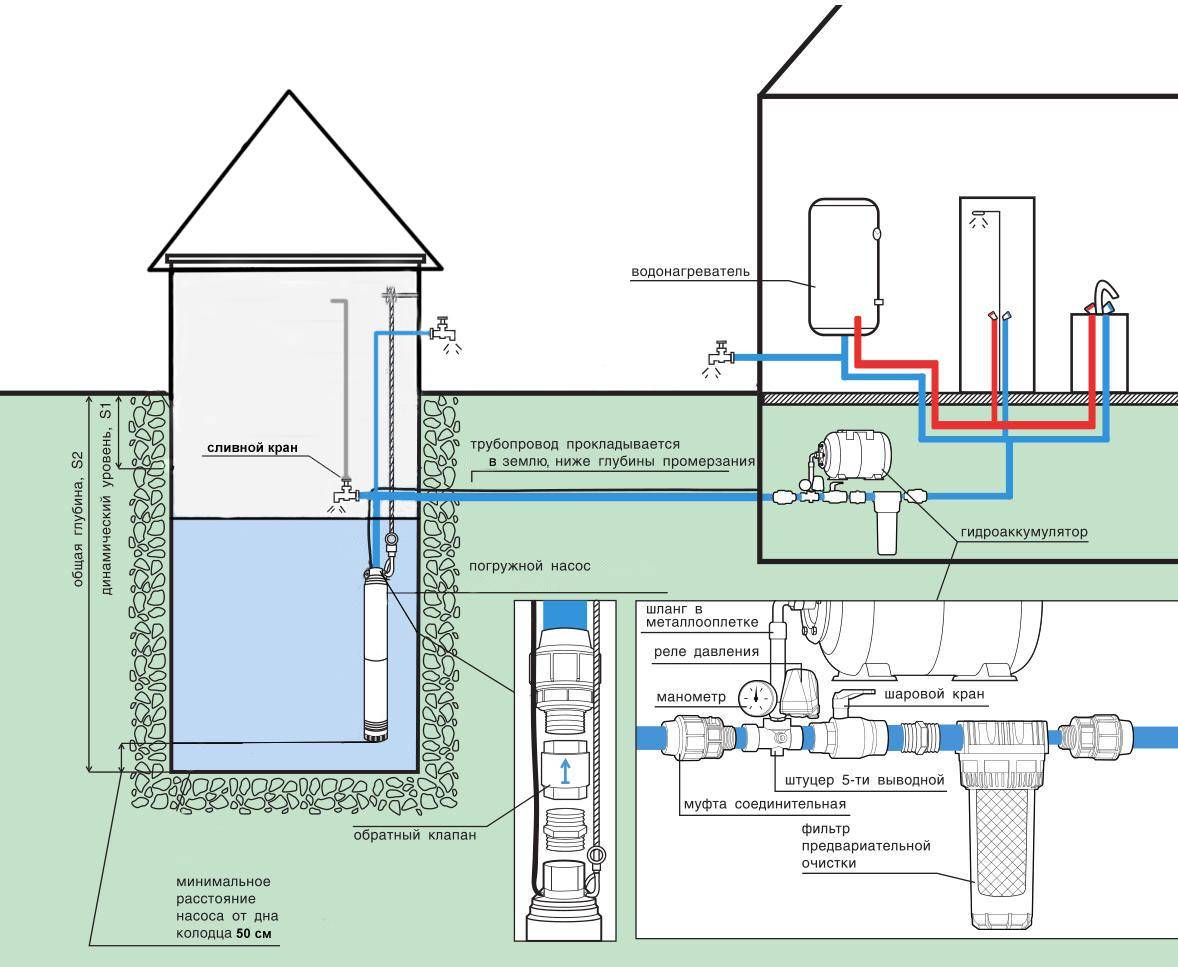
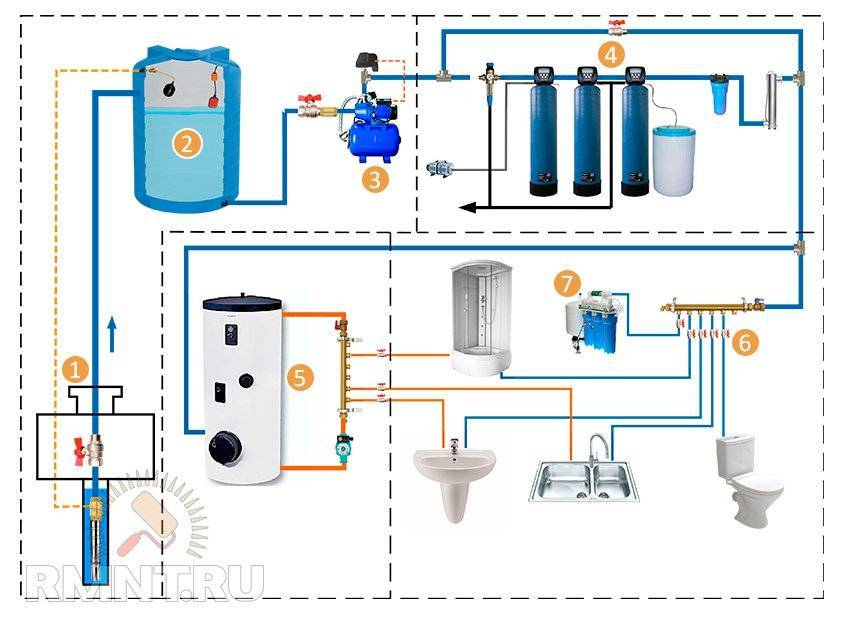
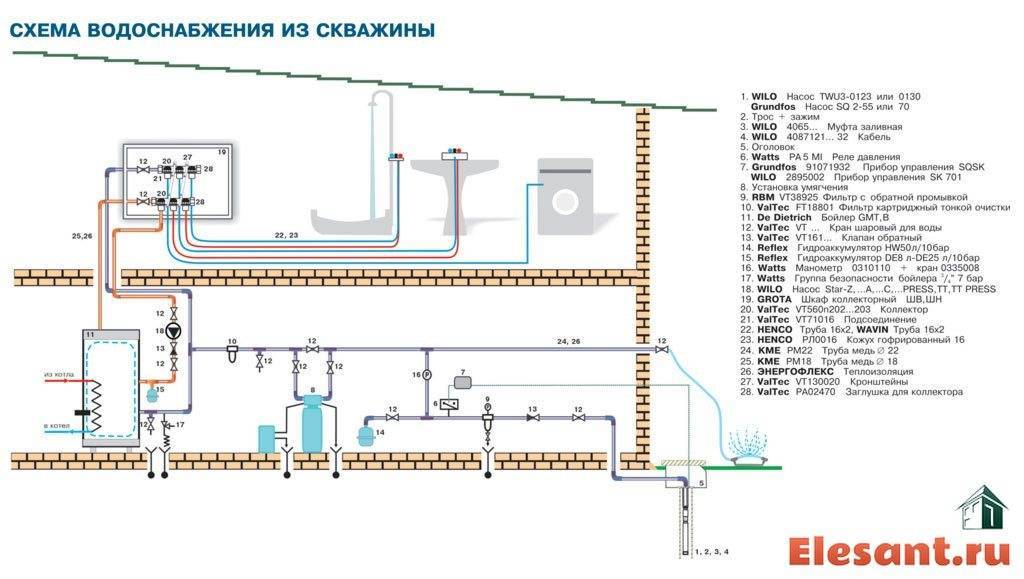
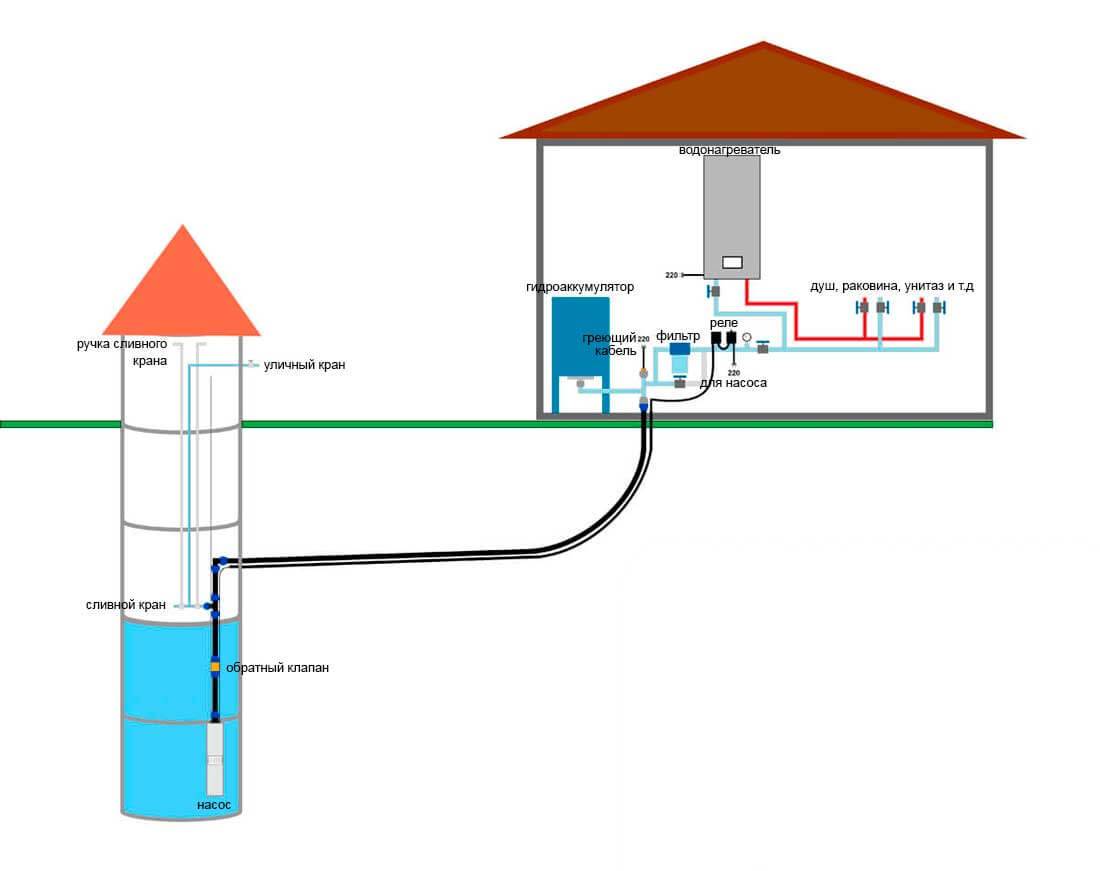
How to bring water into well house? It is better to do this through the foundation so that frost does not reach the pipe in winter. If this did not work out, then the section of the transition from the trench to the room is wrapped with a heating cable and then a heater (what is a heating plumbing cable).
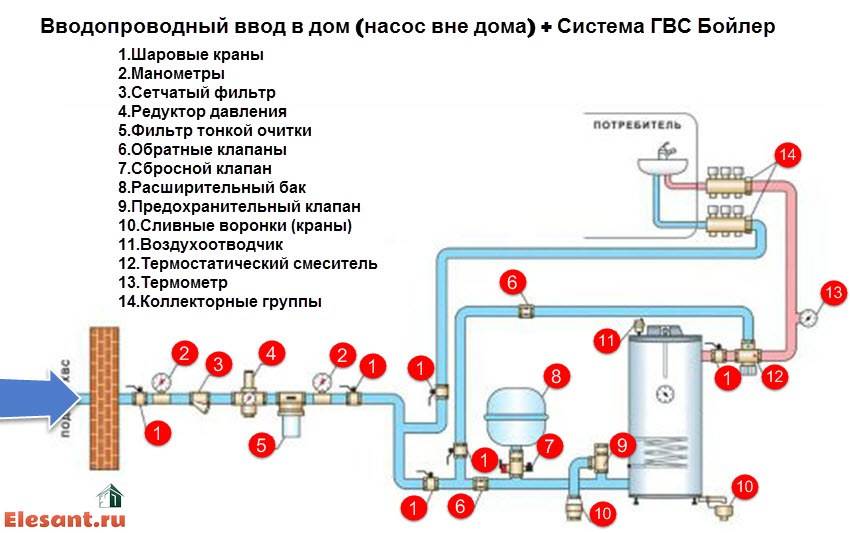
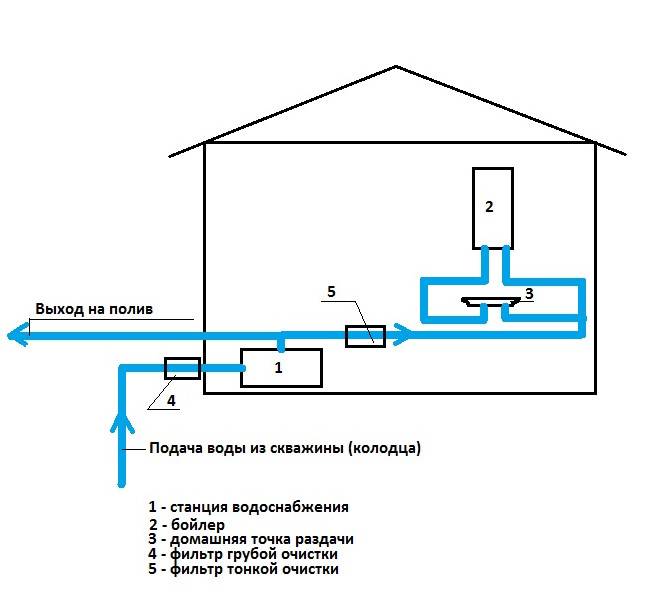
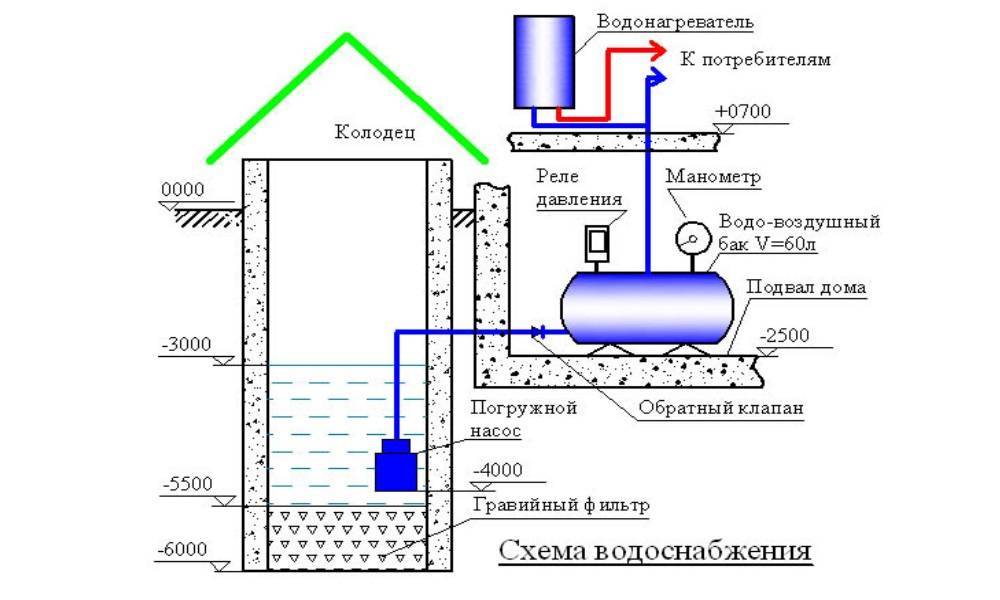
Inside, after entering water from the well into the house, the following units should be:
- The pump when it is surface or with an ejector.
- Hydraulic accumulator, if you did not place it in the technical compartment near the well.
- Boiler or boiler (how to connect the boiler to the water supply).

Scheme of connecting the water supply from the well to the house and inside.
To ensure that you have enough 20 mm pipe, consider the rational placement of consumers in the house to reduce the length of the system. No need to lay bypass water lines and install additional fittings. This will save you money, and the water in the system will not have to overcome unnecessary resistance. After all, one corner fitting can reduce pressure by 0.01 atm.
Therefore, the collector method of piping is uneconomical when a separate line is laid from the main line entering the house to each consumer. This option equalizes the pressure at each point of use of water, but increases the volume of the system and the cost of materials.
If you have 2-3 mixers, a toilet, a bidet, a washing machine and a dishwasher, then it is more profitable to connect them through tees. It only needs one line that will capture everyone. It is enough to insert a tee into it next to the consumer and supply water to it by adding a pipe segment.
When the pump creates a pressure above 2 atm, and you use no more than three water consumers at the same time (faucets, toilet bowl, shower, washing machine), you will not feel a drop in pressure with a tee wiring.
Tips & Tricks
Creating a water supply from a well or a well in a private household requires a number of preparatory work, some of which are quite large-scale. Such activities include the arrangement of a well with a waterproofing system or the drilling of a water well with the installation of a casing type pipe.Also, in some cases, it is possible to install a special reservoir, which will be underground - water is supplied to such a storage, which in the future can be fearlessly drunk. All of the above options are well combined with a water supply scheme that includes a pumping station with a relatively small capacity.
It should be borne in mind that during the first start-up of water supply to a private house from a well in a system that was made on its own, various problems are possible. Naturally, it often happens that the plumbing is debugged almost perfectly, then there will be no problems, but mistakes can happen to anyone. Thus, when starting the system for the first time, you need to carefully monitor how it works, for which you need to check how it functions at home. First of all, you need to closely monitor such an important indicator as pressure.
When pipes don't seem to be buried deep enough to keep the water flowing throughout each season, they can be further insulated with a material such as mineral wool. Then the water will be supplied to the room almost all year round. In addition, you can arrange a hot water supply from a well to solve such an urgent problem once and for all. Outside the city limits, in households, hot water supply is most often done using solid fuel boilers.
In the vast majority of cases, autonomous water supply from a well to a private house is seasonal due to the fact that the pipe from the well goes directly to the surface.Accordingly, it is necessary to install the pipeline in such a way that it is underground at a depth of at least about one and a half meters.
It is also important to remember that if the water in the pipes freezes, and the pump does not have dry running protection, it may simply fail.
How effective an autonomous water supply will be depends largely on the pressure indicator in the system. Whether water is taken from a well or from a well, in any case, the water supply must be arranged in such a way that there is good pressure from the tap. Sometimes it happens that there is simply no way to ensure the correct pressure and, accordingly, a good pressure of water from the tap. Then you can use non-pressure tanks powered by electricity. However, such equipment is sometimes difficult to combine with household appliances such as a washing machine or dishwasher.
The quality of water from such sources is quite enough to water the garden. Moreover, the first stage of filtration provides sufficient cleaning to wash a car with such water without fear of damaging the paint. But in order for the well to be fearlessly drunk and used for cooking, it must be brought separately to impeccable quality.
The main problem is that the chemical and bacterial composition of water from an ordinary, not very deep well or well is extremely unstable. Back in the 50s of the last century, most well owners did not think about whether or not to drink well water, since the upper layers of the soil and, accordingly, the water were not yet so badly spoiled by human activity.Today, water from wells, especially if they are located near cities, can be drunk with great caution.
In modern conditions, even 15 meters of land will not filter the water well enough for its natural purification. Even when a site with a well is located at a considerable distance from megacities and industrial zones, the composition of rivers and precipitation will affect the chemical composition of the water. For this reason, a plumbing system connected to a not very deep well or well requires regular correction and adjustment of the filters installed in the water treatment system.
The following video shows in detail the water supply of a private house.
Wiring types
So, what kind of piping can the water supply have?
Orientation
Vertical wiring includes risers and vertical connections, while horizontal wiring includes spills and horizontal connections. The vast majority of residential buildings use both type of water distribution plumbing fixtures: in a typical apartment building, after the water metering unit, water enters the horizontal bottling and then into the vertical risers, and from there it is transported to the water points along the horizontal pipes.



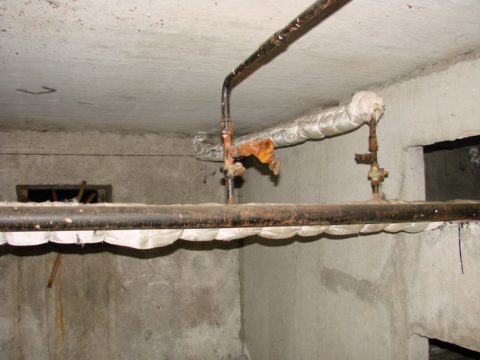
Connecting vertical risers to horizontal filling
Basement and attic
The lower distribution of hot water supply is more typical for multi-apartment and private houses: one dead-end or two circulating bottlings are bred in the basement with its year-round positive temperature.
In most cases, cold water supply is also installed: the lower wiring in the basement or underground eliminates the defrosting of the bottling in the absence of water analysis.
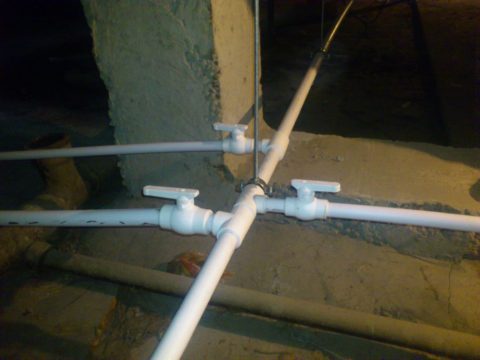
Lower wiring: bottling in the basement
An alternative is the installation of bottlings in the attic.A few words about the advantages of the upper wiring: water supply when water is supplied from a pressure tank is made non-volatile and is accompanied by minimal hydraulic losses.
In addition, if the house has an upper wiring, the hot water supply with circulation will not suffer from airing the jumpers between the risers: all the air will be forced out into the expansion tank at the top filling point in the attic and further into the atmosphere through an automatic air vent.
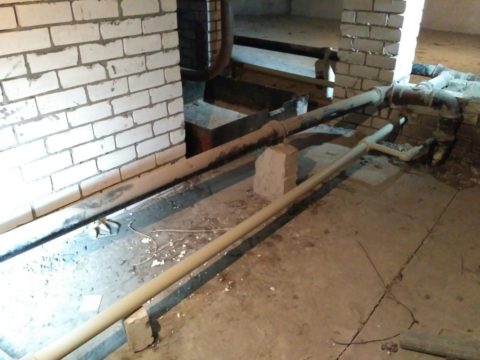
Bottling hot water in the attic. Nearby is a prefabricated sewer ventilation outlet
Dead end and circulation
In passing, we have already mentioned circulation and dead-end water supply schemes.
It's time to give a couple of clear definitions:
- A dead-end system is called a system in which water comes into motion only during its analysis: it passes through the bottling, riser, eyeliner and plumbing fixture;
- In the circulation scheme, the pressure difference or the operation of the pump ensures the continuous movement of water through the looped pipeline. This stabilizes the temperature of the water at the points of its analysis (remember how long it takes to drain water in the mornings in the houses of the old fund?) And ensures the continuous operation of water heated towel rails.
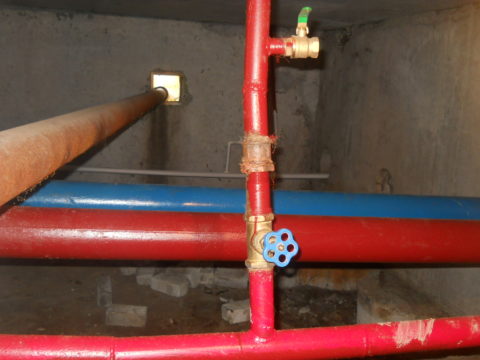
The DHW circulation system is indicated by the presence of two bottlings with hot water
Tees and manifolds
Serial (tee) wiring is common for residential buildings built in the last century: all water points are connected to one pipe through bends and tees. The obvious advantages of the solution are the possibility of open mounting and low material consumption.
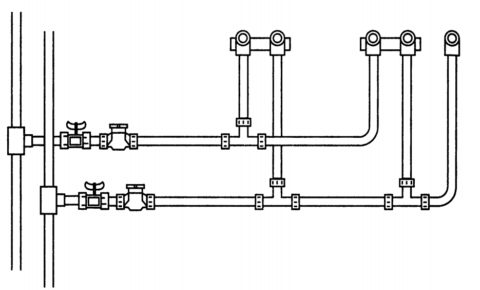
serial wiring
Collector wiring is the connection of water points to the collector-comb with its own connections.Such water pipes are much more expensive than tee pipes and are only mounted hidden (imagine a dozen parallel pipes spread along the wall in the bathroom!), Which means laying only during construction or overhaul.
Each device has its own connection
There are two pluses to the collector wiring:
- If you fully open the DHW or cold water tap in the kitchen, then the ratio of cold and hot water pressure on the shower or bath mixer will remain unchanged. No one will be scalded or doused with ice water;
- Disconnection of any device is possible from a single center - a manifold cabinet. This is very handy in a hostel or hotel: in an emergency, you can selectively turn off one consumer, even without having access to his premises.
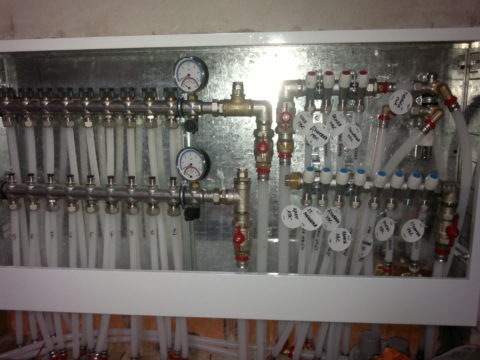
From the collector cabinet, you can turn off the water to any plumbing fixture