
- Principles of operation of various control systems
- Principles of operation of a local lighting control system
- Operating principle of the control system with simple on/off
- The principle of operation of the control system with dimming via DALI (broadcast)
- Operating principles of a busbar lighting control system
- The most popular lighting control protocols now are:
- Smart light system
- How to create a modern lighting control system
- Wiring devices for automating indoor lighting
- Wiring devices for outdoor lighting automation
- What it is?
- Light level control
- Pros and cons of automation
- REMOTE LIGHT CONTROL
- Light control systems
- Tasks that the lighting control system solves
Principles of operation of various control systems
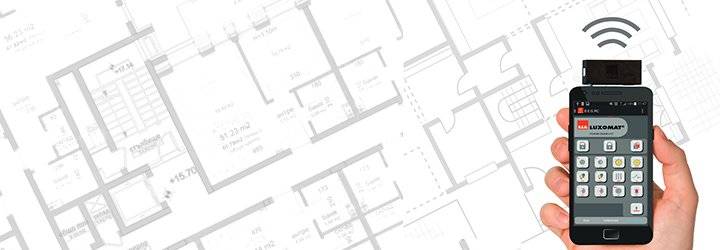
Principles of operation of a local lighting control system
For example, let's take lighting control in classrooms or offices, they use different technologies depending on the needs of the customer. It is possible to implement two types of control:
- normal on / off according to the current illumination and the presence of an employee
- dimming of luminaires with maintenance of constant illumination at workplaces, as well as orienting lighting without presence.
In these solutions it is possible to integrate a simple push button switch for manual lighting control.
Operating principle of the control system with simple on/off
Presence sensors work according to the following scenario: when an employee comes to his workplace in the morning or enters the office, the sensor fixes him and measures the illumination (the sensor then measures the illumination when registering each movement). As a rule, in the morning in winter, natural light is not enough and the sensor turns on artificial lighting. During the day, the amount of natural light increases, for example, up to 500 Lux, the sensor turns off the lights. In the evening, there is not enough natural light, and the sensor turns on the light again. When the working day ends or when the employee leaves the office, the sensor stops detecting him and, after a time delay, turns off the artificial lighting. In summer, with enough natural light, artificial light may not be turned on during the working day, thereby significantly saving energy.
The principle of operation of the control system with dimming via DALI (broadcast)
Presence sensors work according to the following scenario: when an employee comes to his workplace in the morning or enters the office, the sensor registers him and measures the illumination. In the absence of natural light, for example, in the morning in winter, the lamps flare up to 100%. During the day, the amount of natural light in the room increases, the sensor measures the current illumination and adjusts the lamps so that the sum of natural and artificial lighting is constantly 500Lux.When natural light reaches a threshold above 500Lux, the sensor turns off the lamps for a while until the total illumination falls below the specified threshold. Using this solution, you can build a full-fledged local lighting control system based on the presence and lighting parameters, without additional devices, because. the sensor is a power supply for DALI luminaires and a controller. One sensor is enough to control DALI luminaires according to the given illumination and the presence of employees.
Operating principles of a busbar lighting control system
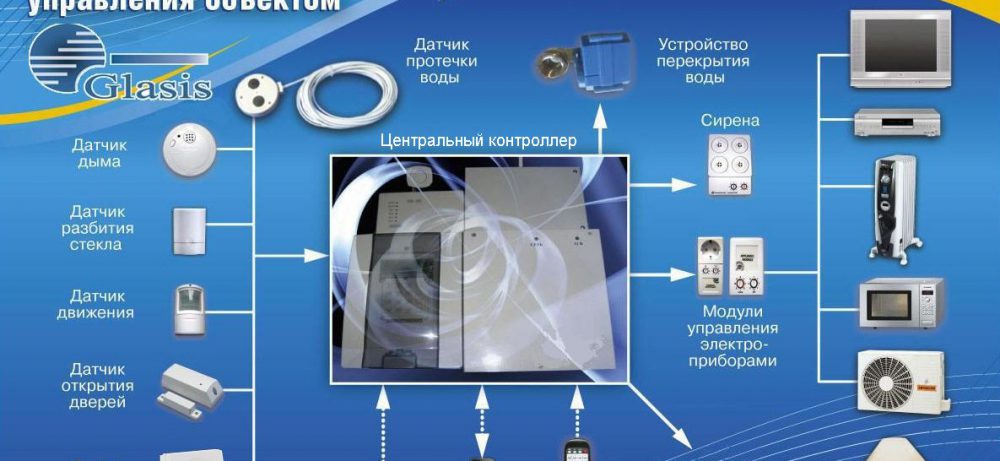
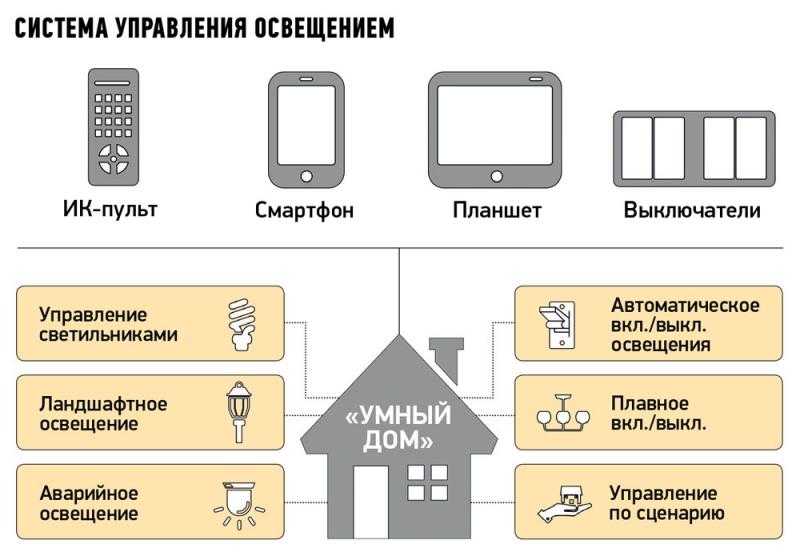
With the help of bus systems, it is possible to significantly expand the capabilities of the lighting control system and dispatch all processes into a single building automation system (BMS). Any logical scenario can be written with the devices of a bus lighting control system:
- create a calendar of events (when a person came, left, what kind of illumination was, became, etc.)
- display the statuses and service life of luminaires (relevant for operating companies)
- make remote control on tablets, smartphones
- bring control and management far beyond the building
- and much more.
With the development of technology, many different lighting control protocols have appeared. It all started with the simplest analog 0-10V systems, which have many limitations, but are still used in various solutions. Over time, analog systems have been replaced by digital technologies.
The most popular lighting control protocols now are:
- DALI
- KNX
- DIM(0-10V)
- DMX
- Low current and IP systems
We will write more about each of them in one of the following reviews. Subscribe to our newsletter and be the first to know about new articles.
Smart light system
Lighting in the "smart home" system includes not only lighting devices, but also electronic systems responsible for their control and management. Various new generation fluorescent, LED and xenon lamps are commonly used as light sources. Sensors, microcontrollers, on and off relays, as well as other elements responsible for regulating light in rooms act as control equipment.
It is worth noting that all the functions for "smart" lighting do not work on their own, but are combined into certain lighting scenarios. Such layouts can be specified in the settings of the central smart home application. This is achieved by combining several groups of lamps, each of which has an individual power. So, for example, the "Rest" mode involves replacing bright lighting with subdued soft light. When integrating "smart" light with other smart systems, additional options for relaxation appear: close the curtains, turn on your favorite music and much more.
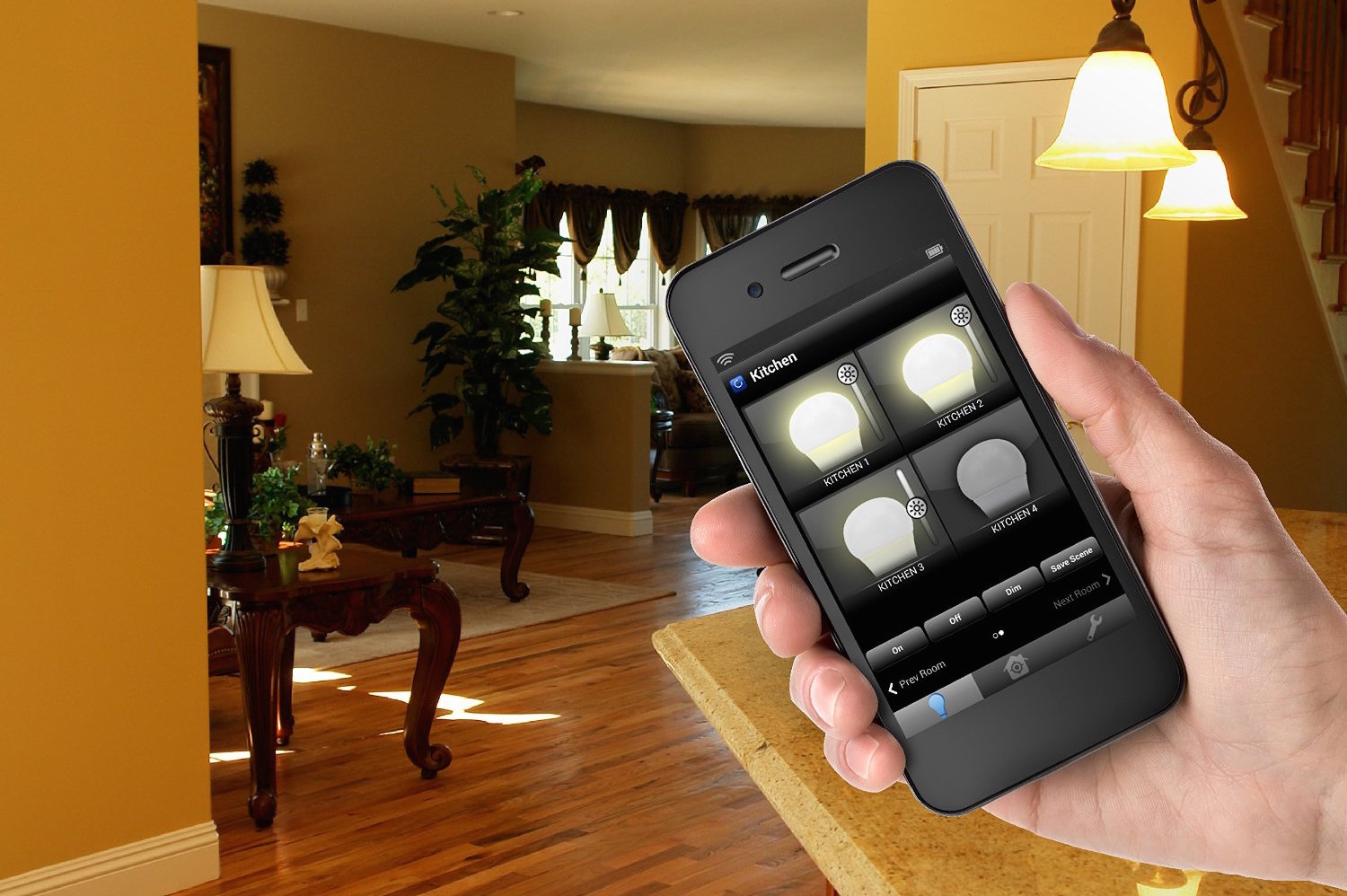
These modes can be switched with just one button in the application installed on the homeowner's mobile device or computer. You can control it remotely from anywhere in the world due to wireless technology. It is noteworthy that with the help of automatic analysis of the system of the daily schedule of households, it is possible to ensure absolutely autonomous operation of lighting without any participation from the smart home operator.
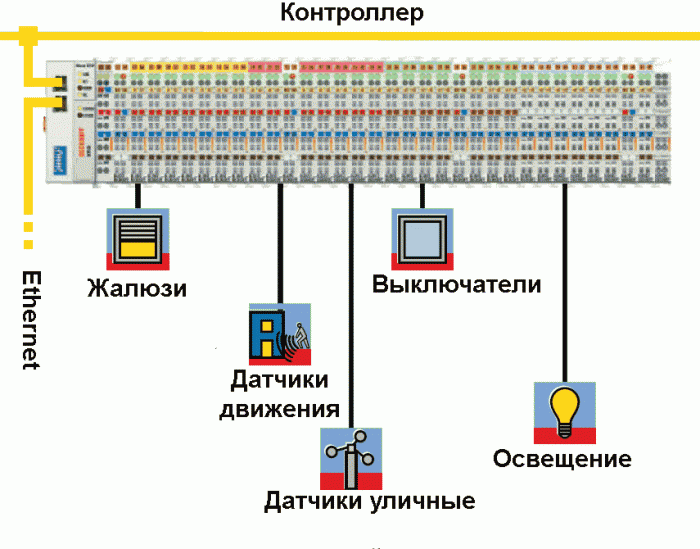
How to create a modern lighting control system
As you understand, it is quite difficult to create a complete analogue of modern systems on your own. But it is quite possible to bring closer and achieve maximum energy efficiency.
At the same time, we can significantly reduce our costs by installing smart devices only in certain places, and leaving ordinary electrical installation devices in the rest of the apartment or house.
Wiring devices for automating indoor lighting
The lighting control system for an apartment or house starts with clear requirements. For example, in the corridor there should be a lamp luminescence level regulator (dimmer), which will turn on the lighting completely if there is movement in the corridor. And in the kitchen there should be an outlet that will turn on only at a strictly specified time and turn off after so many minutes. And so on for each room.




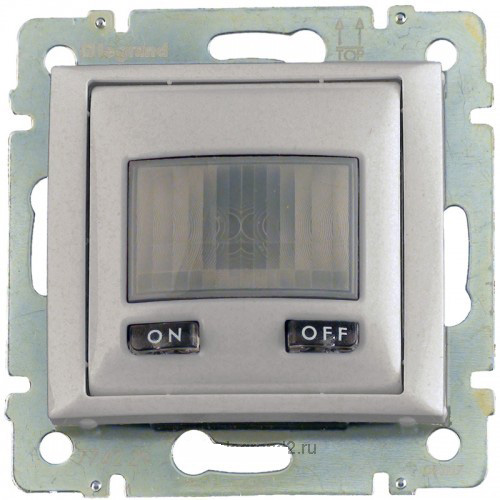 Switch with built-in motion sensor
So:
- Having compiled a list of requirements, we can proceed directly to the implementation. We will consider only the most common options, but knowing the capabilities of modern electrical installation devices, you may well supplement the proposed options with your requirements.
- So if you need circuit breaker with built-in motion sensor, then such devices are quite widely represented on the market. Moreover, you can find models both with a clearly defined time delay for turning off the device, and with modulated parameters.
- In addition, switches with a built-in light sensor are widely represented. This sensor can be adjusted or supplied with predetermined minimum parameters.
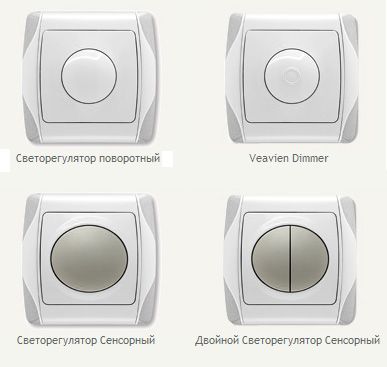 Types of dimmers
Also, various dimmers are widely represented on the market.Moreover, modern devices are made on semiconductor circuits, which provide significant energy savings, unlike earlier resistor models. Some models have a built-in timer and the ability to set tasks for a smooth decrease in light levels depending on the time of day or on the action of external sensors.
- Switches with timers are also not a problem. Depending on the model, these can be devices that can be programmed for one action or for a long period of time. Typically, the instruction of such timers allows you to adjust the step up to 1 minute.
- Separately, I would like to note a variety of wiring devices for controlling mechanisms. It can be blinds, shutters, shutters and other equipment. Such switches can also have timer control or control from external sensors.
- Using only these devices, we can easily complete most of the tasks. If you combine them correctly, you can achieve even more complex tasks.
Wiring devices for outdoor lighting automation
Automation of outdoor lighting in most cases has a number of differences. First of all, they are related to the location of the equipment.
So the lighting control box is usually located indoors, and the sensors for its control are directly at the installation site of the lighting itself. This somewhat complicates the task at high power of the lighting network.
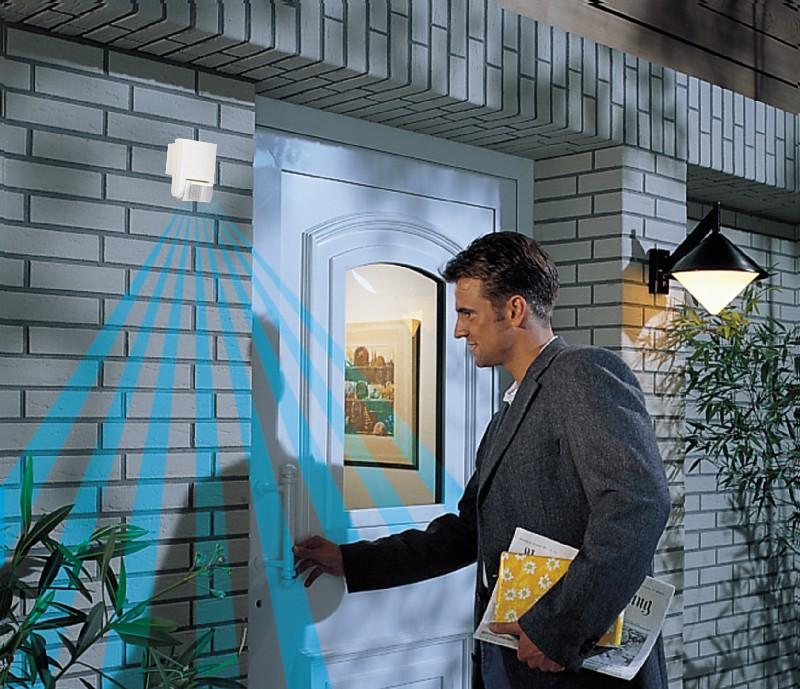
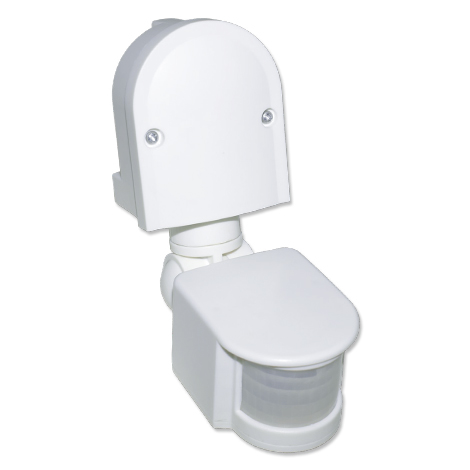 Motion detector with built-in switching device
- Automation of outdoor lighting in most cases is performed using motion sensors (see Connecting a motion sensor for do-it-yourself lighting) and illumination.Most of these devices contain built-in timers. If they are not there or a long time delay is required (usually the built-in timer has an adjustment within 5 - 1000 seconds), then an additional time relay or timer must be purchased.
- There are currently two types of devices on the market. The most common is a motion or light sensor, the power contacts of which provide switching currents up to 25A. But this is the maximum allowable current of such sensors. Usually it does not exceed 10A.
- Such devices are usually used to control lighting with a small number of lamps. If we are talking about controlling the outdoor lighting of industrial sites (see Industrial lighting: design) or simply high power, then remote sensors connected to switching devices come to the rescue.
- The main feature of such sensors is the placement of a separate sensor, a separate switching device. Communication between them is carried out either by radio signals or by cable. When triggered, the sensor sends a command to the switching device and it is triggered.
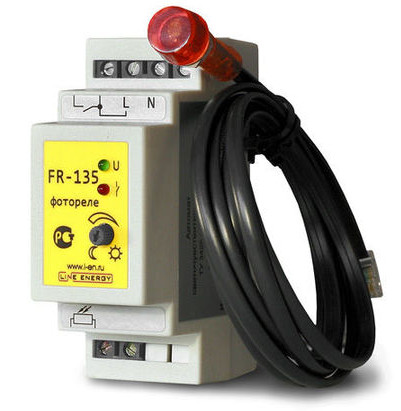 Remote light sensor
What it is?
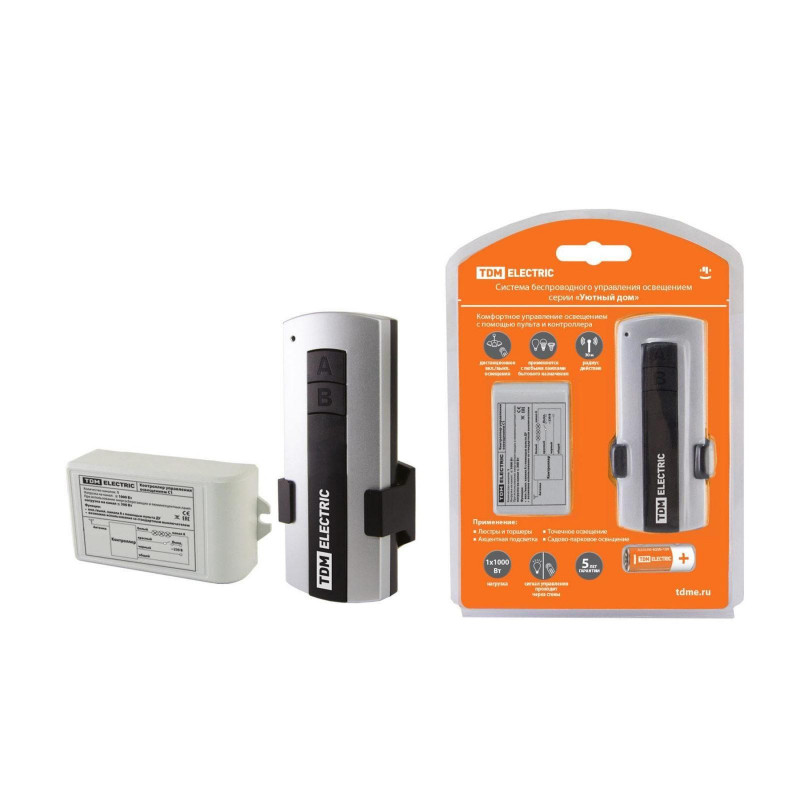
Wireless light control kit
A wireless lighting control system is a set of equipment that will be used to control the level of light in a house or apartment. It does not use a standard switch. Activation takes place via the remote control.
Such a system will be relevant both in large houses and in small apartments. At the same time, it will prove to be effective in industrial enterprises.After all, such a system will allow you to get rid of wires, which not only make the appearance of the premises less aesthetic, but, say, in production, they can still become a potential cause of a traumatic situation. Any kit (such as Zamel and NooLite) has a radio transmitter, which is the "heart" of the entire system. It is thanks to him that the signal is transmitted to each individual lighting device. Due to the range of the transmitter, the lamp can be located at a sufficient distance from it.
Motion Sensor
Light control in such a wireless system is carried out by a special remote control. The remote control can be designed for a different number of channels. The volume of the channel depends on the model and type of kit (for example, Zamel or NooLite). Such a remote control is capable of automating the activity of several dozen lamps at once within the range of the transmitter. As a result, the remote control here will act as a switch or light switch. But a remote control isn't the only addition you can make to make your home more comfortable in terms of lighting. For example, a set of wireless equipment for controlling the level of lighting can be equipped with a motion sensor.
Such devices react to the appearance of movement in the controlled area. When properly configured, the sensor will only respond to human movement, and smaller objects (pets) will not be able to activate the light. Most often, motion sensors are equipped with a set of wireless equipment designed to control street lights. But for the home, they are just as effective.





This is interesting: How to make formwork for overlapping - we consider it in detail
Light level control
Modern smart systems, as a rule, have a dimming function, namely, control over the level of illumination depending on the needs of users. This approach allows you to save energy consumption, as well as create the most comfortable conditions for households at one time or another. The desired options can be configured manually, and if there is a light sensor, entrusted to the system software.
In today's smart market home equipment presented lighting devices in which the sensors and sensors necessary for the operation of the automatic mode are already laid. In the system of "smart" lighting, both smart lamps and ceiling lights. With all the richness of choice, in the segment of interest to us, the best value for money is offered by such companies as Xiaomi, RedMond, Philips.
For example, a ceiling lamp Philips Smart LED Ceiling Lamp from Xaiomi supports the option of automatic temperature control. The user can manually program the parameters for the degree of brightness and even the temperature of the glow, as well as set the timer to turn on and off the "smart" ceiling lamp. Synchronization occurs with the homeowner's mobile device and remote control using a module built into the device for wireless transmission of a data packet using the 802.11 (wi-fi) protocol.

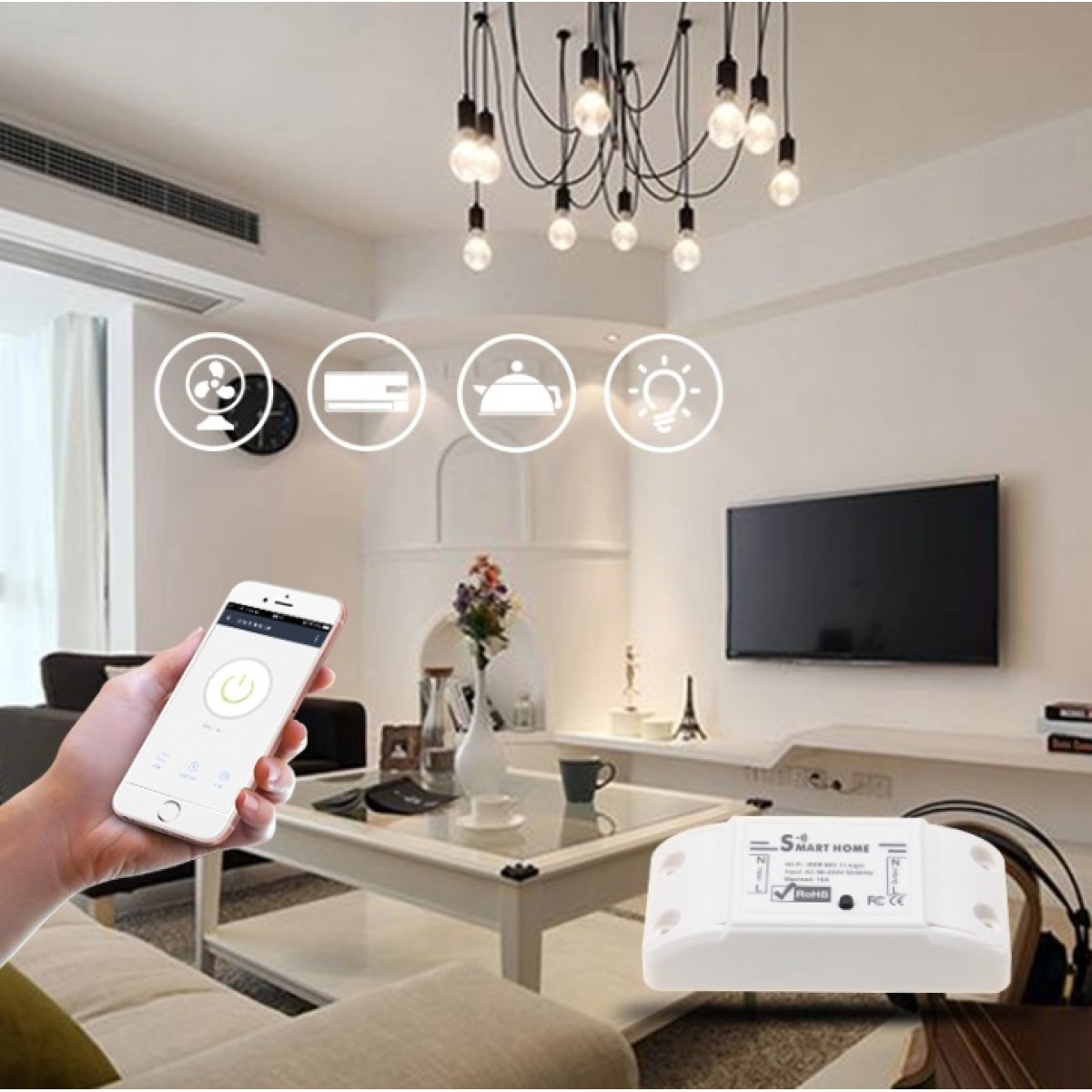
A smart luminaire involves controlling lighting with a remote control.In a special application on a phone or tablet - Mi Home, the user can control and control the device using his smartphone.
High-quality work is provided by 64 LEDs, which offer a wide range of brightness control from 0.1 to 3000 lumens. In addition, it is possible to adjust the color content of the lamp, which is provided in the range from 2700K to 5700K. The device is connected directly to the mains. It copes well with controlling the brightness of lighting in a Smart Home - wifi light bulb from Meizu X Light Plus. It, like all smart lamps, is controlled using an application installed on the phone, or via a remote control. The lamp allows you not only to change the brightness and color of the lighting, but also provides various scenarios for automatically changing the color of the glow.
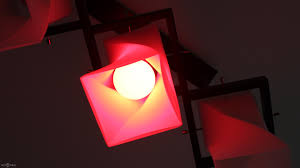
smart lamps such as Xiaomi Yeelight Smart LED RGB Ceiling Lamp or Philips zhirui bulb light are also capable of dimming the light according to the needs of the user. Both of these lighting fixtures work using the Wi-Fi standard and special applications that are installed on the homeowner's smartphone. By pressing a button on the phone, you can change not only the brightness, but also the color of the glow. Suitable for these lamps apps is Xiaomi Mi Home and Apple Home kit, which work on Android (version 4.4 or later) or iOS (8.0 and above), respectively. The applications provide various scenarios for "smart" light, allowing you to adjust the power of lighting in the house depending on the situation.
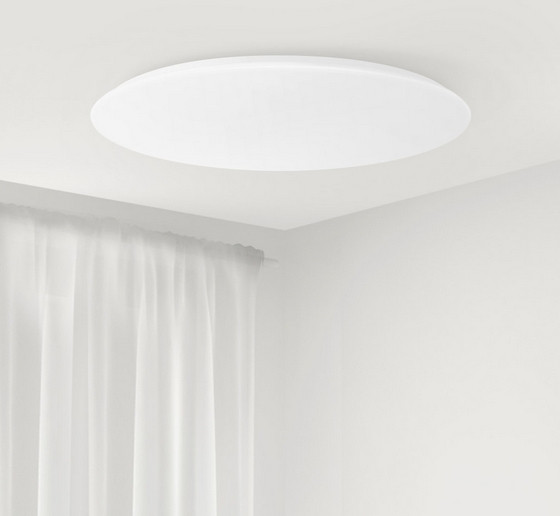 Xiaomi and Philips are friendly and open to almost all manufacturers of smart systems and smart gadgets. Management of such a device and their installation will not be difficult even for a consumer who is far from the world of multimedia. All of the above bulbs are supplied with the most common base - E27.
Pros and cons of automation
Main advantages:
- Reducing the cost of power supply of illumination systems up to 80%;
- Reduction of expenses for design, installation and commissioning up to 50%;
- Obtaining detailed information about the energy consumed, the temperature in the premises, as well as the presence of people in them;
- Increasing the security level of the complex of conjugated systems.
 Control scheme
Important! The degree of functionality and productivity of systems largely depends on the level of modification and equipment configuration. Due to the high efficiency and positive prospects, the client sees cost savings, as a result of which the cost of smart lighting pays off very quickly
Among the shortcomings of smart lighting in an apartment, the relatively high cost of technology is distinguished. However, with the growth of competition, today, this problem is no longer so relevant.



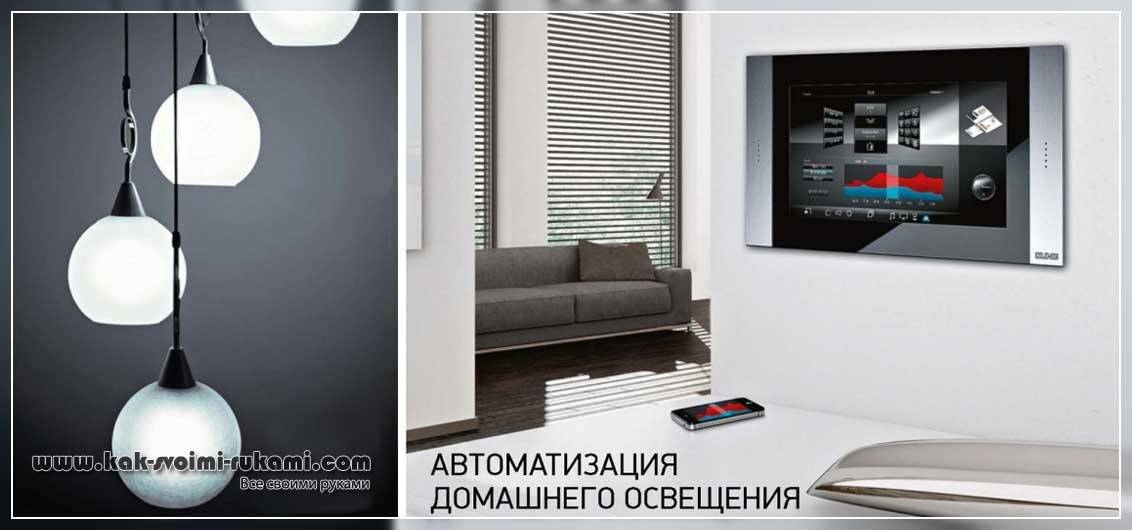

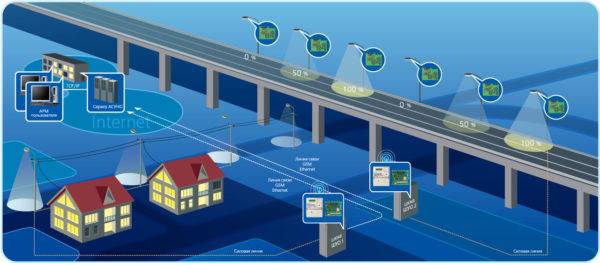
 Operating principle
In the modern market, you can find premium-class smart lighting, as well as more budget-friendly counterparts. The main thing is to choose products only from trusted manufacturers trusted by buyers from all over the world. In general, the cost of the technology will depend on the number of lighting fixture functions that the client is going to prescribe in the program.
Important! Another disadvantage of smart lighting is the complexity of the system.Due to the design features, minor breakdowns may occur in it, which prevent the use of all the functionality of the devices.
REMOTE LIGHT CONTROL
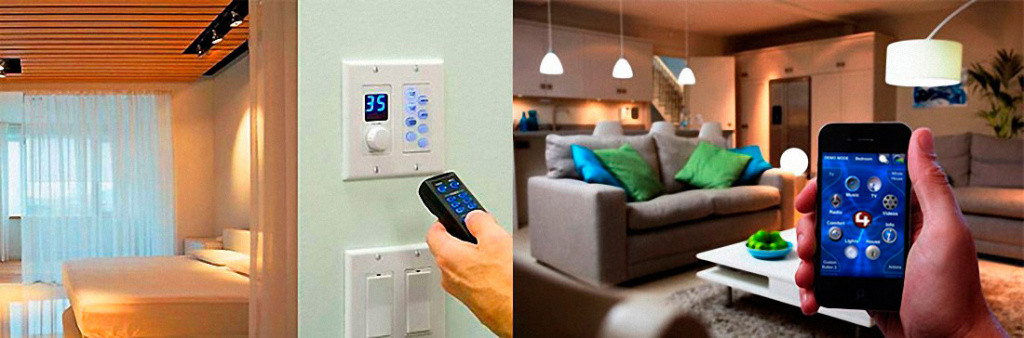
Remote control and adjustment of lighting in a house or apartment is usually provided in one of two ways:
1. Using radio or infrared (IR) remote controls (RC), as well as by controlling voice (sound) while in the room or in close proximity to it.
Radio remotes.
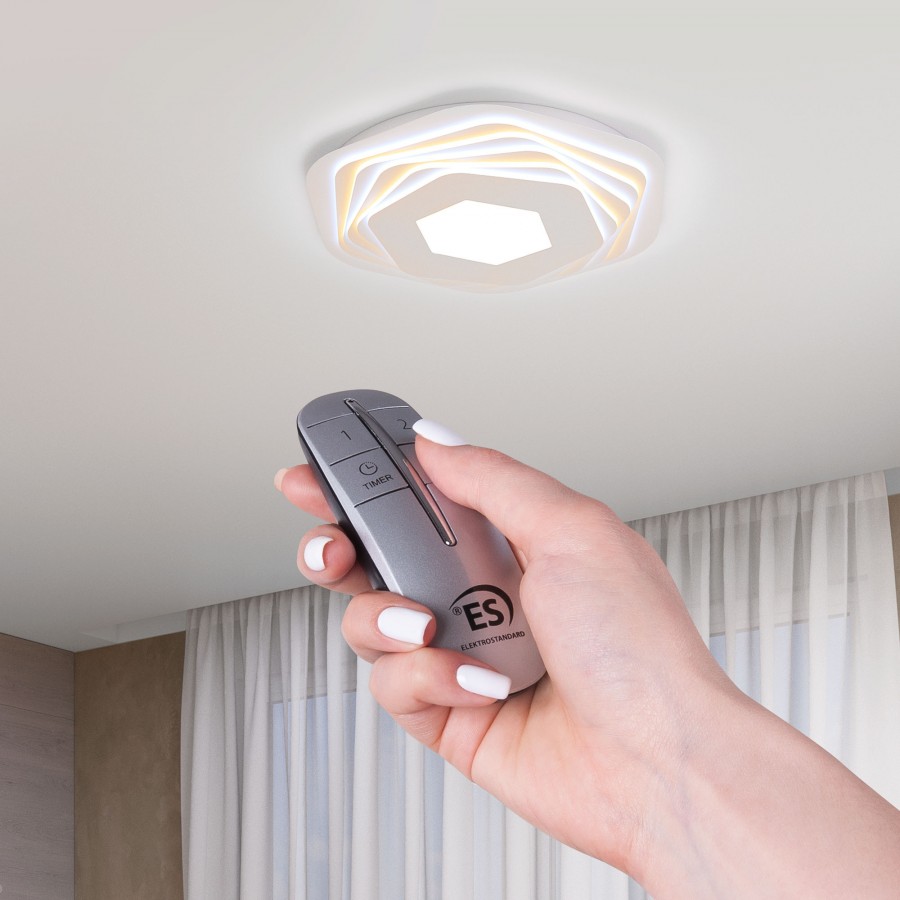
The light source in the house can be controlled from any point by installing one radio remote control near the door, and the other, for example, by the bed. Radio remotes, depending on their technical characteristics, differ in functionality, appearance and range (10-100 m).
The simplest single-channel remote controls turn a single lamp on and off. Multi-channels work in several zones and are configured separately for each power unit. When placing the receiver and transmitter in different rooms, it should be borne in mind that the power of the radio signal decreases in the process of passing floors and walls, to avoid this, repeaters are used.
| Material | Signal attenuation, % |
|---|---|
| Drywall, wood | 10 |
| Brick, chipboard (chipboard) | 30 |
| Reinforced concrete | 70 |
| Metal, metal grill | up to 90 |
infrared remote control used in small spaces.
This is due to its main disadvantages - the need to accurately point the device at the signal receiver, since it only works within the line of sight of the light source, and has a short beam range.
One of the main advantages of a system with an infrared remote control is that it can be used to control not only the lighting of a “smart” home, but also a TV, home theater, ventilation, heating, etc.
Sound (voice) control.
Here, the main advantage is ease of operation and the absence of the need to monitor where the remote control is located, since it is not provided in this system. The downside is that often any noise can turn the lights on or off.






Therefore, in order to prevent accidental operation, most modern voice switches are equipped with a tonal signal differentiation system. However, such switches require careful and competent adjustment.
Another disadvantage of such devices is that they can only be used with fixtures connected to a socket, so they are convenient for turning on / off floor lamps, table lamps, etc.
2. Control via GSM channel over long distances.
The ability of the lighting control system to receive commands from any distance is the main purpose of the GSM control. Installation of such a system allows you to create a "dialogue" between the owner of the house and "smart" equipment (GSM module). The principle of operation is that a GSM module and an electronic board are built into the fixtures, on which there is a slot for a SIM card.
For the same purposes, GSM signaling units can also be used if they have a relay module and the corresponding option or “smart” sockets.
Information is transmitted through short calls or SMS messages.Installing just such a system is relevant for those who often forget to turn off the lights in the house, even leaving it for a long time.
Light control systems
Now many different systems are beginning to appear, which are gradually conquering the market for smart home components. In this chapter, we will talk about the already proven nooLite light control system, which was developed by a Belarusian company.
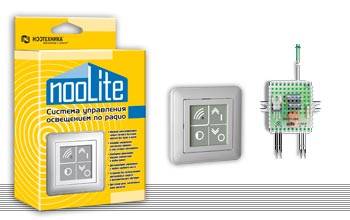
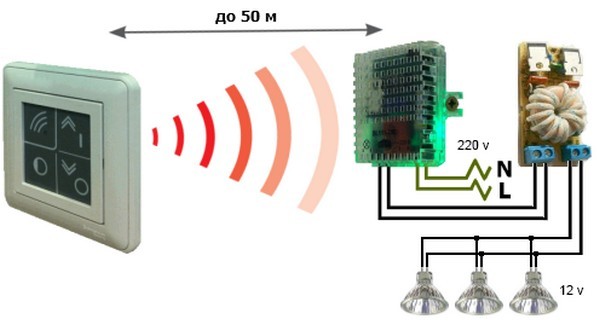
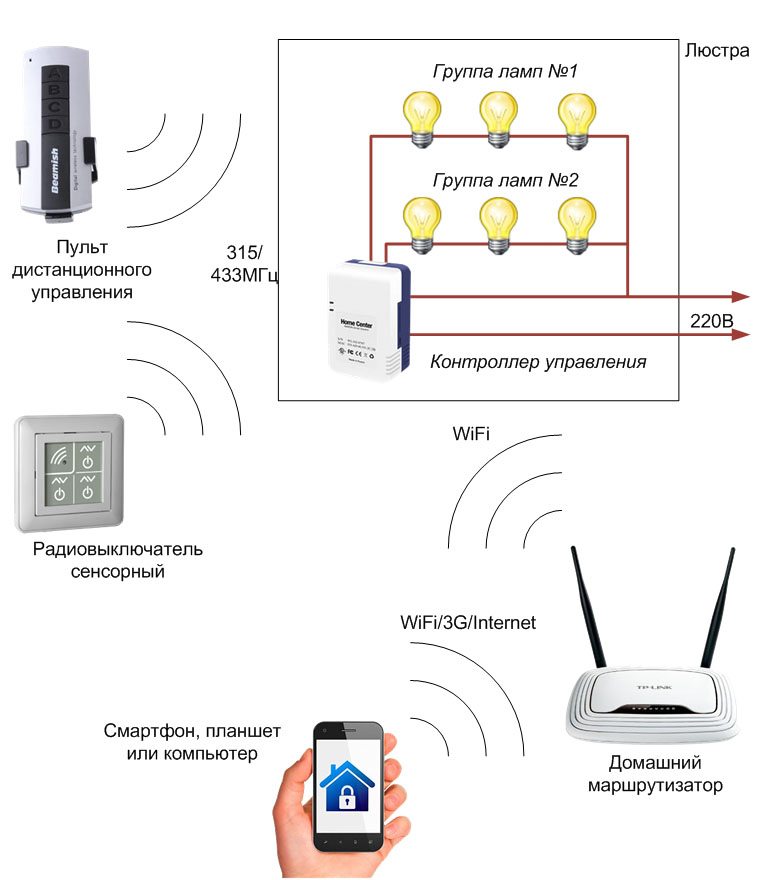
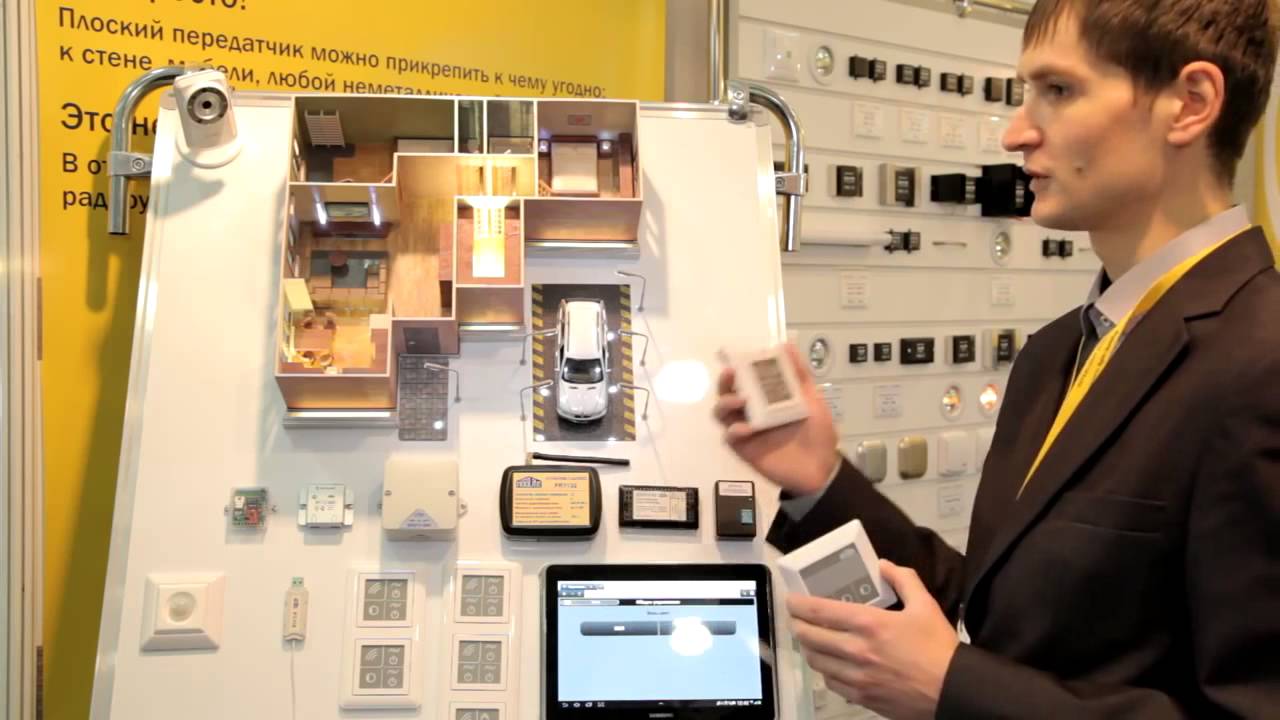
This system is a set of components that includes devices such as special consoles and radio switch power units. Based on nooLite, everyone can assemble a lighting system with their own hands. The control principle of this system is shown in the diagram below.
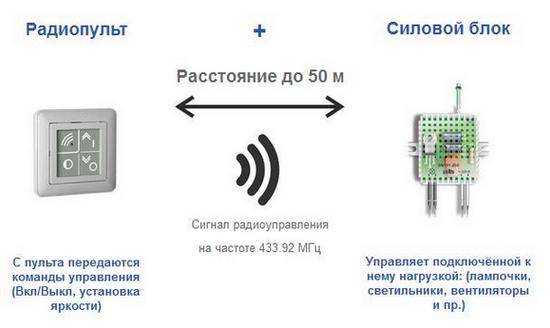
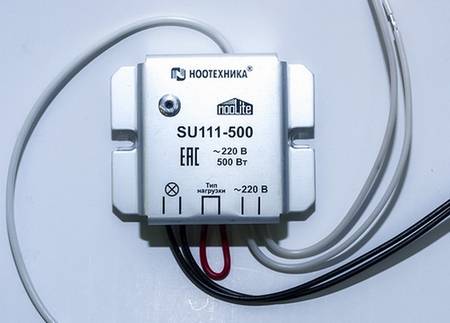
The diagram shows that the lighting is controlled using remote controls that transmit a radio signal to the power units. The power blocks of the radio switches, in turn, when they receive commands from the remote control, turn off or turn on the light of a lamp or lamp, and also adjust the brightness level. The radio switch power unit itself is a small plastic box that is connected with two wires to a 220 V network and the remaining two wires to the light bulb or lamp itself. The small size of the radio switch allows it to be mounted anywhere in an apartment or house. The fifth wire is an antenna, which receives a radio signal from the remote control.
The remote itself is a four-button block that can be glued anywhere in the room. For example, such a place can be a free place under the switch.




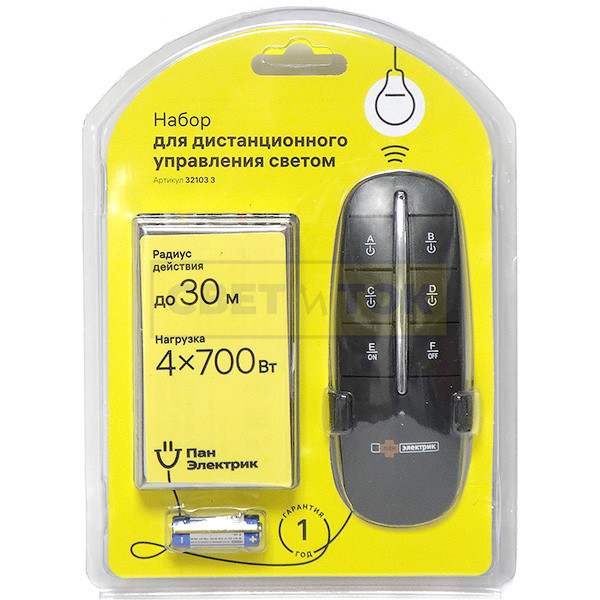
The remote control has a built-in lithium-ion battery that provides more than one year of operation without recharging. The functionality of the nooLite system does not end there.The system itself is sold in the form of kits, which, in addition to two or three consoles, as well as two or three power units, also include the following components:
- Ethernet Gateway PR1132;
- Motion sensor PM111;
- Humidity and temperature sensor PT111.
The PR1132 Ethernet Gateway is a device that can be connected to a wireless router or ethernet switch. This connection allows you to turn on the power units, as well as motion and temperature sensors using a smartphone and an Internet browser via a Wi-Fi network. In addition to browser control or control via a smartphone via a Wi-Fi network, you can develop your own applications for the PR1132 Ethernet gateway, thanks to the support for its own API. For example, thanks to the "Google Speech API" and API for the gateway, you can organize voice control of the light.
From the reviewed chapter, we can conclude that the nooLite system will provide remote lighting control at the highest level, which you can assemble with your own hands today.
Tasks that the lighting control system solves
- Saving electricity. We have already written more than once that the use of automated systems allows you to save several times the electricity consumed by lighting, depending on where the system is used. Energy efficiency in each case is calculated individually.
- Maintaining a constant level of illumination in the presence of presence in the premises.
- Lighting groups in the premises and in the adjacent territory are combined into a single system. In the case of using scalable solutions, this will ensure the interaction and control of all processes of the control system.
- Automatic or semi-automatic lighting control, integration with the overall building automation and dispatching system.
- Automatic control according to pre-programmed parameters.
- The system allows you to control the presence, measure the current illumination, manage time, and much more.
There are local control systems using only motion, presence and light sensors. Sensors, in turn, already have all the necessary devices in one package for automatic lighting control according to the above factors. 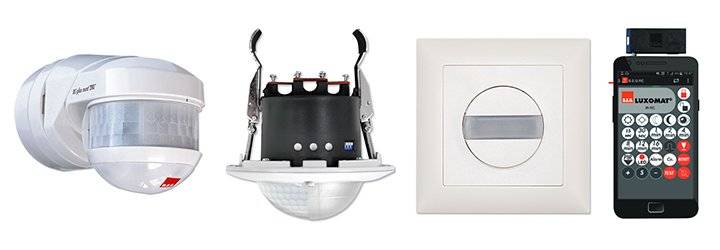 In these solutions, sensors can control not only lighting, but also other loads such as air conditioners, fans, and others. Their switching on and off should not depend on the current illumination. For example, when a person enters an office, there is enough illumination and the light does not turn on, but the air conditioner should turn on. Local systems cannot be fully integrated into the overall building dispatching system, therefore there are bus lighting control systems that operate on different protocols, and with the help of special gateways are freely integrated into various top-level systems.



