
- Popular ways to search for water on the site
- Use of pottery
- Observations - where do plants grow?
- Definition by height difference
- Observations of natural phenomena
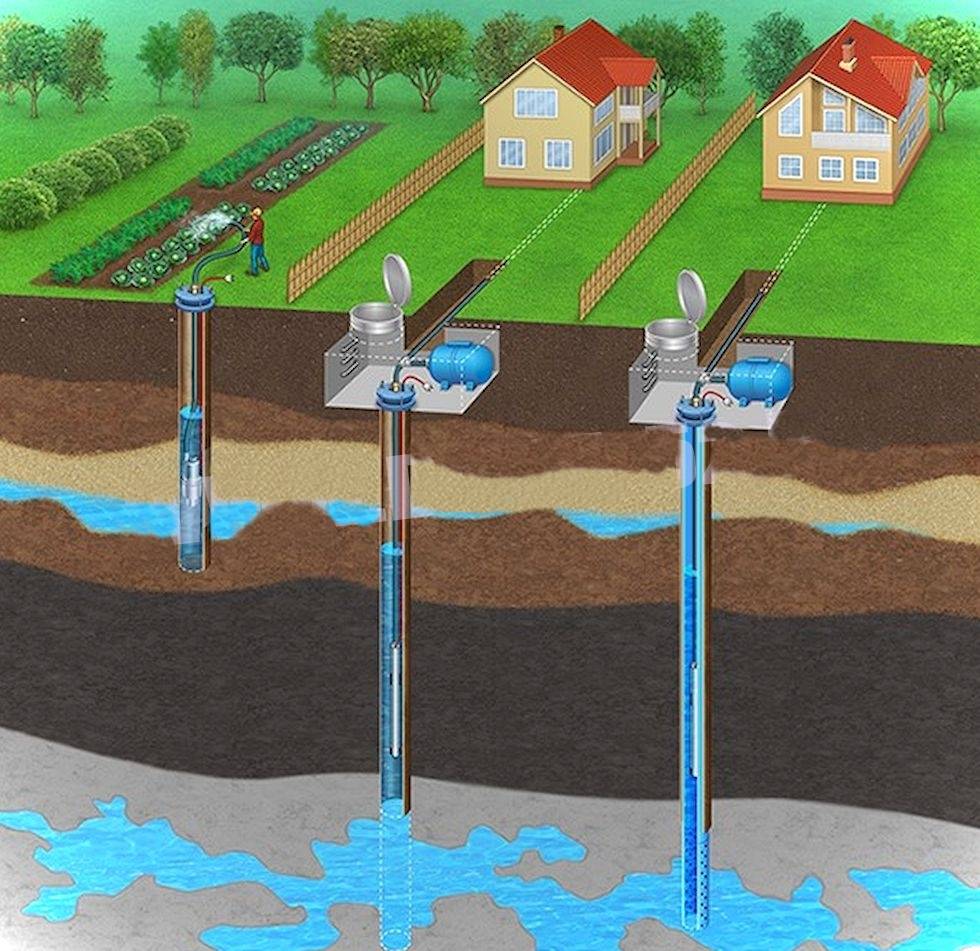
- Step-by-step instructions for drilling a well at the site
- Determining the amount of water in an underground source
- Well depth and type of lifting equipment
- Where to look for water for a well
- Observation in search
- Observation #1 - summer mists
- Observation #2 - Animal Behavior
- Observation #3 - Species of Growing Plants
- Observation #4 - Help from Friends and Neighbors
- What are the health requirements for the location?
- Where to look for water for a well
- Search Practices
- Use of glass containers
- Application of hygroscopic material
- Effective ways to find water
- Practical Water Detection Methods
- The simplest thing is to interview neighbors in the area
- Dowsing with a frame made of vine or aluminum
- The most reliable is to conduct exploratory drilling
- Folk method - arrange pots and jars
- Method for finding water by measuring the mass of hygroscopic materials
- The use of a barometer and other instruments is serious
- "Grandfather" methods of finding water
- Analysis of plants growing on the site
- Pet observations
- The study of weather phenomena
- Desiccant weighing
Popular ways to search for water on the site
If desired, the search for water under the well can be done in several ways. The most common of them:
Use of pottery
The ancient method of determining the presence of water involved the use of a clay pot. It was dried in the sun, then turned over and placed on the ground over the place where the water vein was supposed to lie. After a while, the dishes fogged up from the inside, if there really was water under it. Today, this method has been somewhat improved.
You need to take a liter or two of silica gel, which is an excellent desiccant. It is thoroughly dried in the oven and poured into a clay pot. After that, the dishes with the gel are weighed on accurate scales, better than pharmaceutical ones. Then they are wrapped in cloth and buried to a depth of about half a meter in the place where it is supposed to drill a well. Leave it there for a day, then dig it out and carefully weigh it again.
Not one or two aquifers have been found with silica gel yet
The more moisture absorbed into the gel, the closer the water. You can bury several pots at the initial stage and choose a place with the most intensive return of water. Instead of silica gel, an ordinary brick can be used, which is also dried and weighed.
Observations - where do plants grow?
Some plants are excellent indicators of underground water.
Plants will tell you if there is water in the area
For example, a birch growing above a stream will be of low height with a knotty, twisted trunk. The branches of the tree located above it will form the so-called "witch's panicles". The water close to the surface will be shown by thickets of woodlice, a low herbaceous plant.River gravel directly points to the watercourse located under it. But the pine, with its long tap root, says the opposite - in this place the water is deep enough.
Definition by height difference
This method can only be used if there is any body of water or well nearby. You will need an ordinary aneroid barometer, with which pressure will be measured. Based on the fact that for every 13 m of elevation difference, the pressure will drop by about 1 mm of mercury, one can try to determine the depth of groundwater. To do this, you need to measure the pressure at the site of the proposed well and on the shore of the reservoir. The pressure drop is about half a mm Hg. Art. indicates that the depth of the aquifer is 6 or 7 meters.
Observations of natural phenomena
The soil, saturated with underground moisture, will surely evaporate it.
In the early morning or evening at the end of a very hot summer day, you should pay attention to the area where it is supposed to equip the well
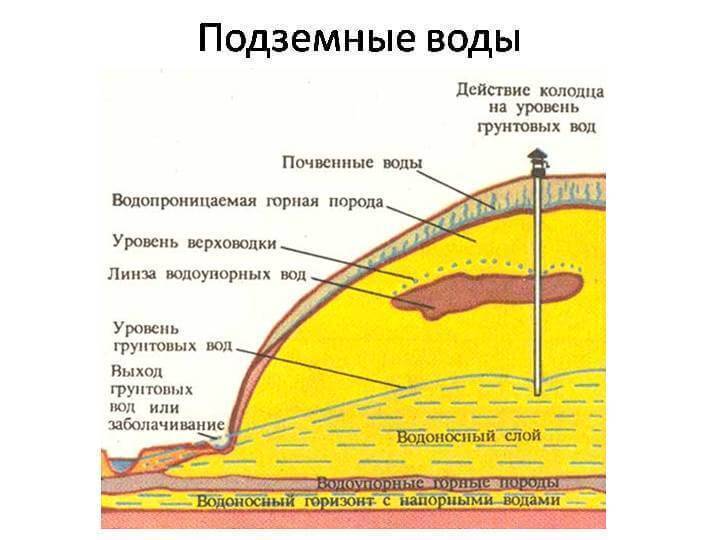
If fog forms over it, there is water there. It is best if the fog rises in a column or swirls, which means that there is a lot of moisture and it is close enough. You should also be aware that water-resistant layers usually follow the terrain. Thus, in the hollows and natural depressions, surrounded by hills, there will definitely be water. But on the slopes and plains it may not be.
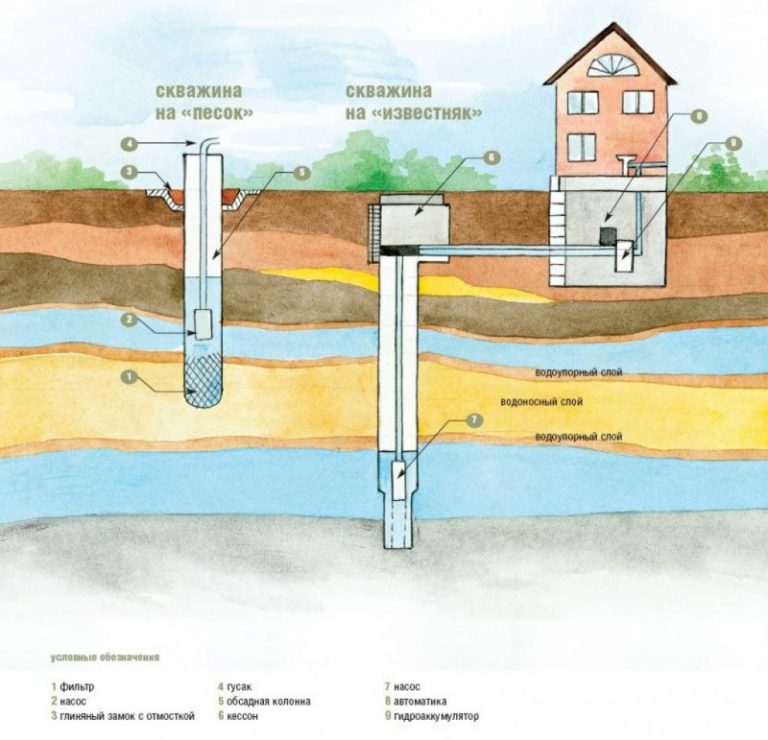
Step-by-step instructions for drilling a well at the site
Before starting work on the summer cottage, it is recommended to ask the neighbors what the level of water occurrence in your district is, after which you can drill a well on the site. If there are wells nearby, look into them.If the water level is above 5 meters, this is a good sign, since in this case, only a garden drill and an approximate layout of the water source will be required from the drilling tools.
A small-sized drilling rig or a mechanical drilling device - a handbrake - can be rented. Thus, you will have the opportunity to use convenient equipment without overpaying an extra amount to get water on the site.
Let's describe the general instructions of the site of relative technology, how to make a water well with your own hands in the country:
- In the ground, it is necessary to make a square recess with dimensions of 1.5 × 1.5 m and a depth of 1 to 2 meters, this will be the so-called pit. It is needed in order to prevent shedding of the loose soil surface into the well. From the inside, the pit must be sheathed with boards or plywood, and a boardwalk is laid on top of it for ease of installation.
- After the installation is assembled, two coaxial holes are cut out in the upper and lower floors of the pit, after which drilling begins.
- The drill rod rotates manually or with the help of a geared motor. At the same time, a bodice is put on the bar, on which one of the workers will strike with a hammer. Another option: the drill is lifted with a winch and dropped in the same way as it is done with shock-rope drilling. If necessary, water or drilling fluid is supplied to the rod.
- In parallel with drilling, a casing pipe is installed in the well with a special shoe installed from below. It is also gradually built up, like the drill rod.
- After quicksand (soil with high humidity), drilling accelerates (due to the beginning of the aquifer), and then slows down again. This is a sign that the drill has reached the water-resistant layer and drilling can be completed.
- It is necessary to lower the filter column into the well, after which it can be washed with strong water pressure.
- A submersible pump must be lowered into the well to pump out water until it becomes crystal clear.
At the last stage of arranging the well in the country house with their own hands, a caisson is installed, all cavities must be filled with a sand-gravel mixture, and a pipeline is laid to the house in a trench. In this case, it is highly recommended not to lower the water pipe to the very bottom. It should not reach the extreme point of about 50 cm, so the best water flow to the top will be ensured.
The pipe that leads to the well must be provided with ventilation holes, otherwise, without air, the water will quickly dry out and it will become impractical to extract it for most needs. For permanent access to the well, a hinged cover can be equipped on the pipe.
Advice! After the well, made by hand, was put into operation, be sure to give the water obtained from it for examination. Water can be considered drinking water if it has the following characteristics: transparency of at least 30 cm, nitrate content - no more than 10 mg / l, 1 liter contains no more than 10 Escherichia coli, maximum odor and taste score - 3 points.
Determining the amount of water in an underground source
There are several characteristics that determine the characteristics of an underground watercourse:
- Depth. You can determine it by drilling a well. There are two levels: the sole and the roof. Everything in between is water.
- Debit. This is the amount of water that is selected per unit of time. This parameter is measured in l / h, m3 / h, m3 / day and so on.
- The thickness of the aquifer.In fact, this is the amount of liquid in the underground source.
If you want to dig a shallow well, then the most reliable way is to make a test drilling, What is a hand drill used for?. This tool is sold in the store today, and making it yourself is not a problem. That is, it is necessary to drill until water appears in the well. This is the top of the aquifer.


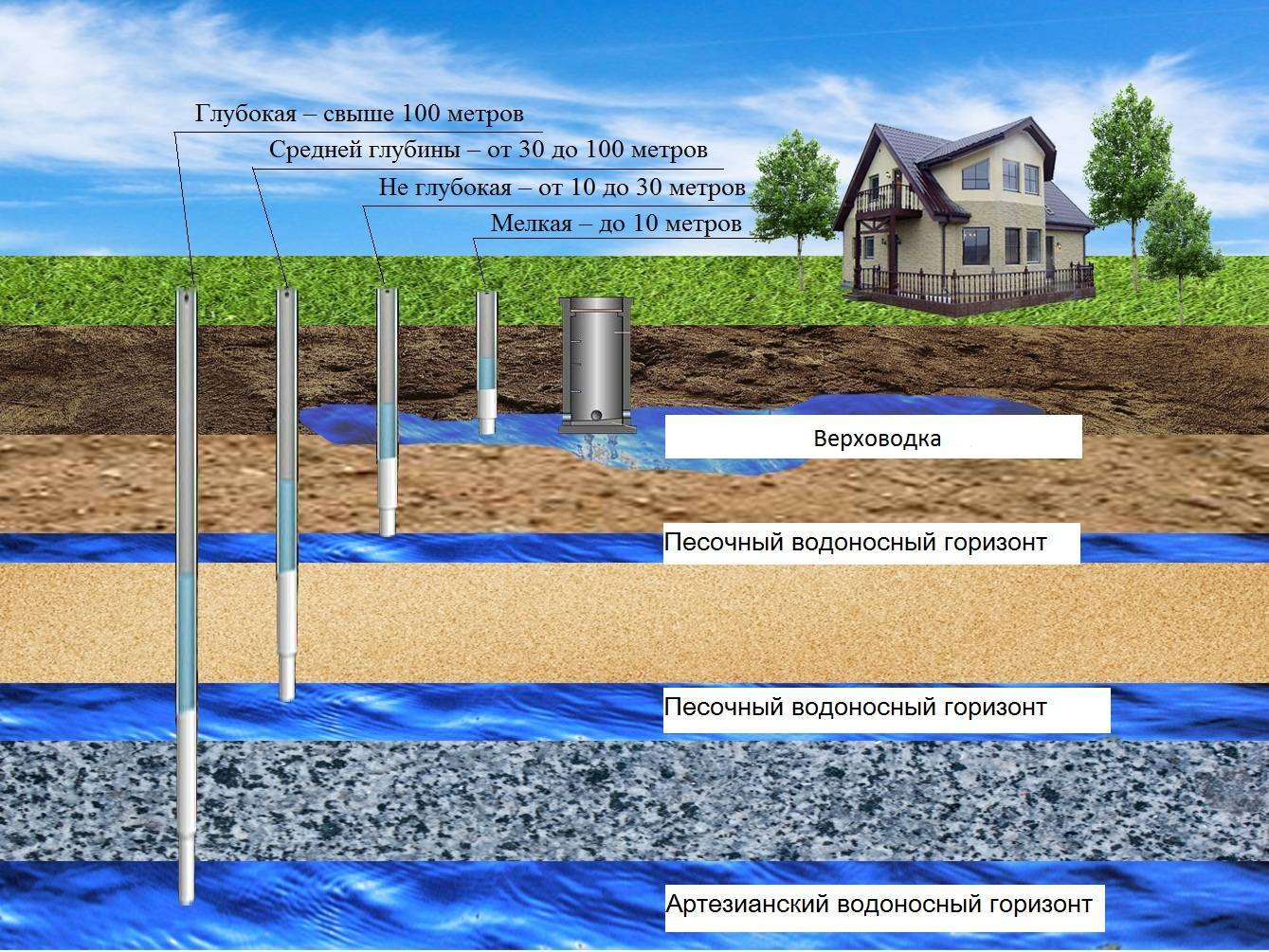


Drill further until the tool begins to screw into solid ground. This is the sole. The difference in depth between them gives the thickness of the watercourse.
If you are sure that there is water on the site, then you can do without test drilling. We must immediately dig a well. We got to the water - this is the roof
Notice how the well begins to fill. If intensive, then the power of the source is sufficient to talk about the possibility of using it for an autonomous water supply
If filling is slow, then the structure can only be operated as a conventional well. That is, to choose water with a bucket.
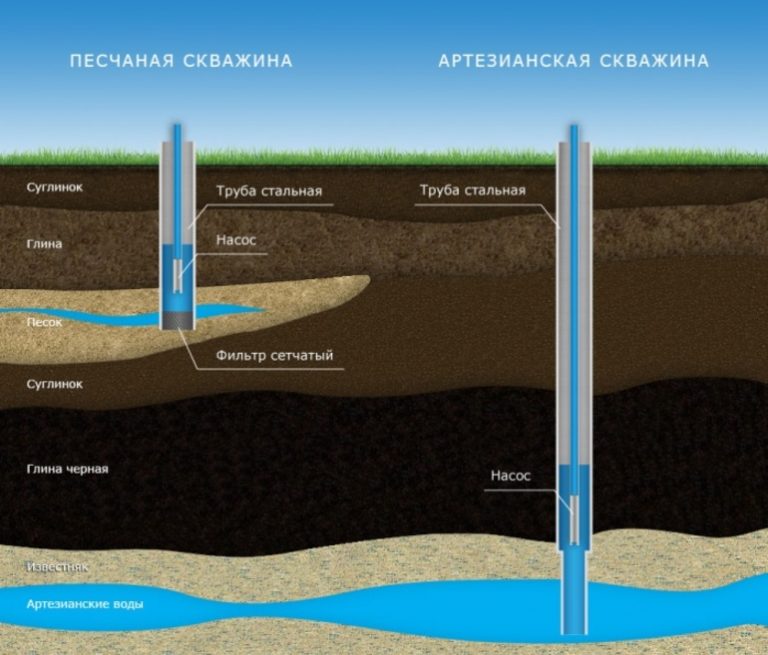
Another important point. When digging a well, you need to get to the sand or gravel layer. Clay is a sign that the water is impure. It cannot be used as a drink. But in any case, it is required to do an analysis in the laboratory.
That is, it turns out that the hydraulic structure should be deep. The deeper, the cleaner the aquifer. Usually they try not to drink water from the top water. But deeper than 10 m, a well cannot be dug manually. But sometimes this depth is enough to run into the continental sands.
This layer contains large volumes of groundwater. They are clean because they have been filtered by sand.And the thicker the sand layer, the clearer the water. The thickness of the sand varies from a few meters to tens. It is not worth digging deep in this case. The main thing is to create a shaft so that it is filled with water at a constant level, the height of which from the bottom of the structure was at least 2 m.
Well depth and type of lifting equipment
Not that the depth of the water well depends on how you are going to raise the water up. Rather, on the contrary, the equipment has to be selected depending on the dynamic water level, above which the depth of the pump immersion in the well should not be. How to calculate the level based on the power of the pump and the flow rate of the source is a separate topic, the materials can be found on our website. The dynamic level can be determined practically by measuring it in the dry season, actively watering the garden. So, the equipment:
Gate or "crane" - manual lifting: twist faster and pull harder. The deeper, the more physical effort you have to spend.
A complete water station, including a pump, a hydraulic accumulator and the necessary automation, is a good thing, inexpensive, and easy to maintain. Only the hose is lowered into the water, the pump is placed on the surface. Unfortunately, the station is able to raise water from a depth of only 8-10 m, no more.
With a lifting height of more than 10 m, you will have to use a submersible pump. A cheap vibrating "Stream" or its analogues have a lifting height of 40-60 m, which is more than enough.
Centrifugal submersible pumps are more expensive, but more powerful and capable of pumping water under significant pressure. They should be preferred if a pressurized water supply is planned in the house using a hydroaccumulating tank. Most submersible pumps are designed for installation in a narrow well and have a small diameter, which complicates their design and reduces the ability to cool. There are special pumps for wells, they are better cooled, have a wider body and are somewhat cheaper.
A well submersible pump is cheaper than a borehole pump, its body is wider. It just won't fit in the well.
By the way, the height of the well pump is much lower than the well pump, which is important for sources with low water levels.
And yet, to what depth should the pump be lowered into the well? The minimum, as we have already mentioned, is the dynamic water level. The maximum is half a meter from the bottom of the well. There are models that can be installed on the bottom, if specified in the instructions.
As you can see, there is no universal answer, what should be the depth of the water well near your house. And it cannot be. Finally, we repeat once again that the construction of a well is not an easy task and is associated with a certain risk. If you do not have knowledge and experience in this area, it would be wiser to entrust such work to professionals.
Where to look for water for a well
It is not recommended to search in such places:
- Closer than 30 m from toilets, manure heaps, animal sheds, and other similar places.
- Closer than 5 m from the foundation of the building.
- Closer than 300 m from sedimentation tanks and chemical plants.
- Closer than 100 m from industrial waste dumps.
- Near neighboring areas where drains can enter your well.
- In the lowlands of the slopes of beams, ravines, as well as in the lowest part of the site. It is allowed to dig a mine anywhere on the slope, if its angle does not exceed 3 degrees. In other cases, the source should be at the very top of the allotment.Such an arrangement will help to avoid flooding of the spring after rain or melting snow and the ingress of substances that can harm a person into the mines. If the aquifer is located in such a place, you will have to build a drainage system.
- Do not look for water where the well will interfere with the passage to the house, driveway, gardening, etc.
- Near trees with a strong root system.
- Near power lines.
- In thickets of bushes and trees. So that the fruits and leaves do not create a problem in the operation of the well, they need to be cut down within a radius of 5-10 meters, which not everyone will like.
- Do not look for water in the basement of the house either. There will be problems with pumping out the technical fluid and installing a submersible pump, which requires high ceilings.
Observation in search
The ability to take note of everything and analyze the collected information has never been superfluous. It was in this way that our ancestors found water, who were not yet armed with the achievements of science and technology. What facts and phenomena of nature will help us in search of water?
Observation #1 - summer mists
Fog may appear on the site during the warm season. This natural phenomenon happens either in the early morning or in the late afternoon.
If you observe fog in your area, pay attention to its density: it will be highest in the place where the water is closest to the soil surface
If early in the morning you see fog in your garden, swirling or concentrated in one of its corners, then we can say with confidence that there is water in your area
The reason for the occurrence of such fog is the evaporation of water, which is underground. In one place, like ordinary fog, it will not stand.Moisture vapor can swirl or travel very low above the ground.




Observation #2 - Animal Behavior
Unlike humans, animals know exactly where the groundwater is. Too bad they can't tell us about it. Yes, they will not be able to tell, but please share your knowledge.
By observing the behavior of domestic and wild animals and birds, we can get all the necessary information:
- Dog. A dog is a man's friend and it will definitely help him in finding water for the well. In the heat, dogs are always looking for an opportunity to cool their body, so they dig holes where it is cooler. These are just the places we are looking for.
- Horse. When thirsty, the horse beats with its hoof in the place where there is water underground.
- Harvest mouse. But mice like where it's dry. They will never make their nests near places of high humidity. It is better to climb a tree or some building that rises above the soil level.
- Domestic bird. The chicken does not rush where it is wet, and the geese, on the contrary, choose the intersections of underground aquifers for their nests.
Even midges feel the proximity of water. If you look at its behavior at dusk, when the summer heat has already receded, then we will see columns of insects circling in the air exactly above those places where it is coolest - where underground there is what we need.
Dogs, like people, can hardly tolerate heat and drought. They try to get to the bottom of the coolest layers of soil, which are just above the aquifer.
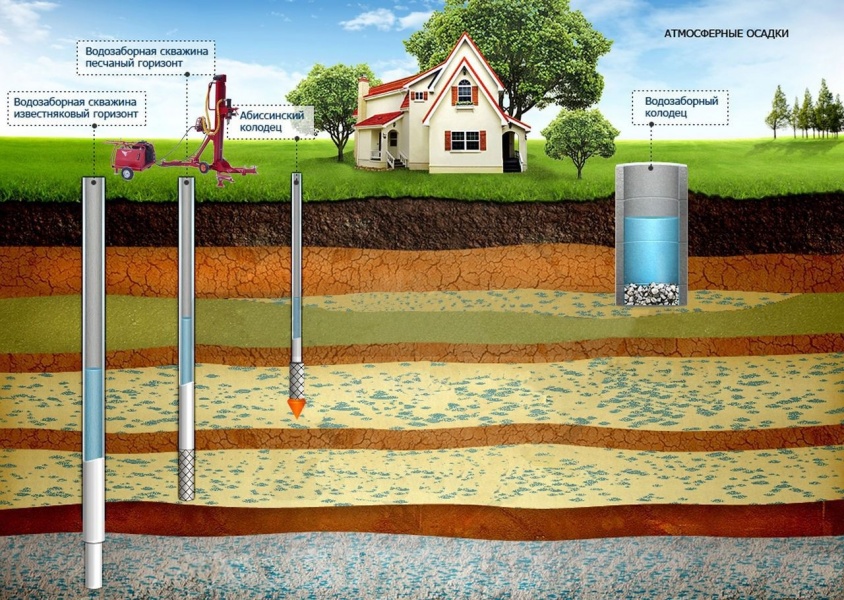
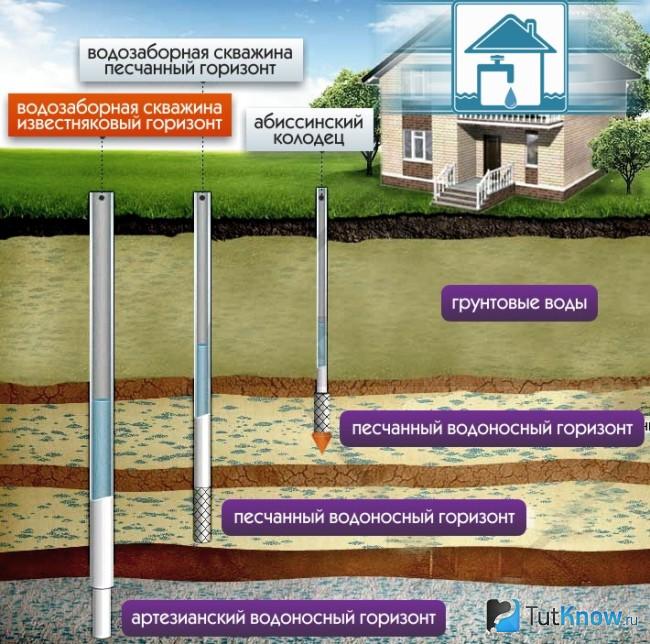
In the place, involuntarily pointed out to us by representatives of the animal world, you can safely hit the Abyssinian well for extracting water for watering the garden and for taking care of the territory.
Observation #3 - Species of Growing Plants
Who should know about the presence or absence of water on the site, if not plants? Not surprisingly, they are used as indicators. If blackberries, buckthorn, lingonberries, bearberries, bird cherry, wood lice and wild rosemary feel good on your site, then it makes sense to look for an aquifer - it is always present.
Plants do not always like excess water. If there is too much of it, then they can even get sick and stop bearing fruit.
Take a closer look at the birch: its modest growth and knotty trunk with curvature betrays the presence of a nearby watercourse. Coniferous trees also prefer to grow where it is dry.
By the way, the presence of nearby groundwater is not always a boon for gardeners. After all, cherries and apples prefer moderate humidity: their waterlogging can provoke tree diseases and fruit rot.
Observation #4 - Help from Friends and Neighbors
If your site is part of a horticultural society or you have neighbors nearby, be sure to talk to them. As a rule, they have already solved the problems that you are struggling with today. If there is an operated well or well on their site, then you will also have water.
It is worth asking the neighbors at what depth the water in their source is, whether the level in it is stable. Thus, it is easiest and easiest to collect information and plan work on the device of the well. For private traders, polling the owners of adjacent sites is the only viable way to obtain hydrogeological data.
You always need to maintain friendly relations with neighbors: they will be the first to come to your aid, if something happens, they will protect your property from thieves
Try to find out not only the current state of the local water intake, but also the fluctuations in the water level throughout the year, as well as the composition of the water. Agree that it is not too pleasant to find your site flooded with flood waters in the spring. Get vital information in a timely manner.
What are the health requirements for the location?
The water intake point should be located at a distance from toilets, cesspools upstream of groundwater at least at a distance of fifty meters. Otherwise, there is a high possibility of mixing harmful substances into the water, infecting it with pathogenic bacteria.
This is the optimal distance. If the household plot of an ordinary summer resident is four acres, densely planted and built up, then such a norm is difficult to implement. In this respect, there is an opinion that it is quite enough to make a well at a distance of about 8-10 meters from the toilet and cesspool.
According to the regulations, when looking for a place for a well, you should avoid:
- Frequently flooded areas.
- Wetlands.
- Proximity (less than 30 meters) to public roads and motorways.
Where to look for water for a well
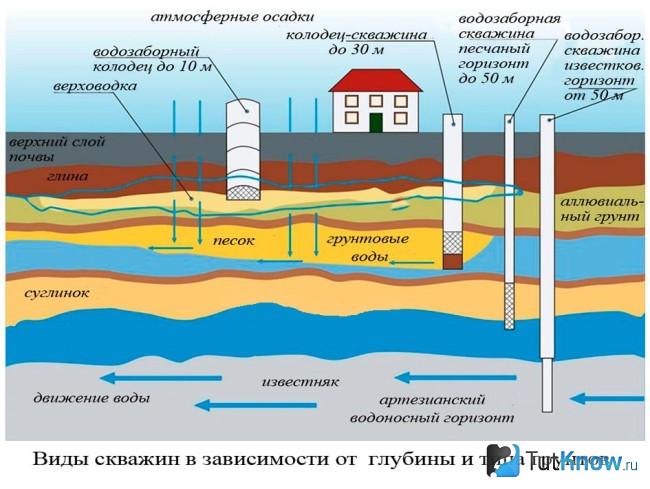
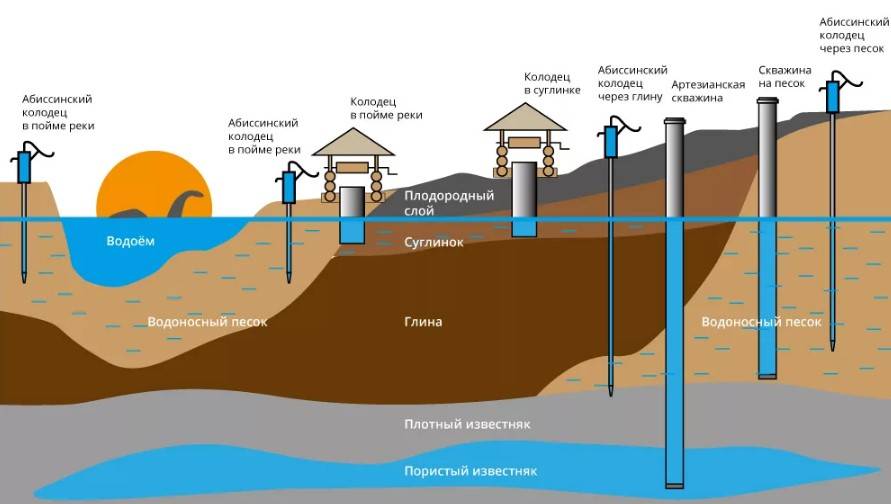
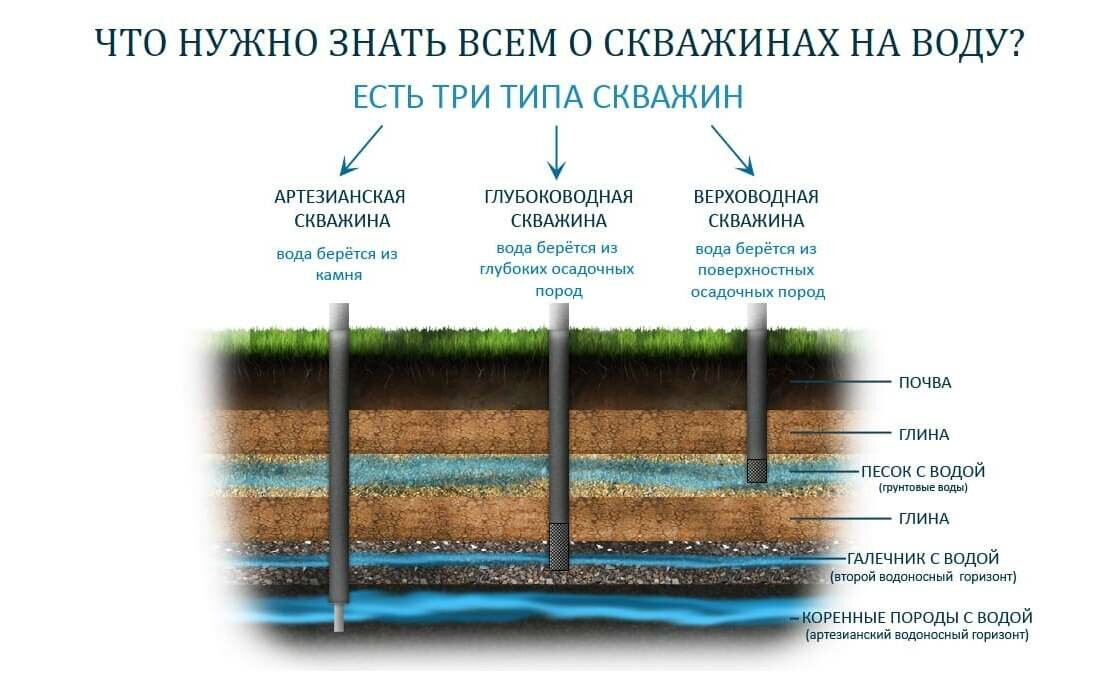
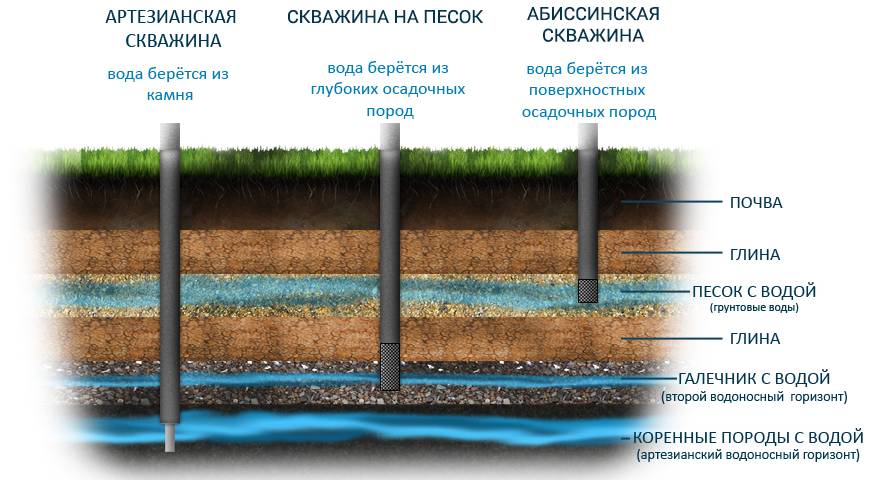
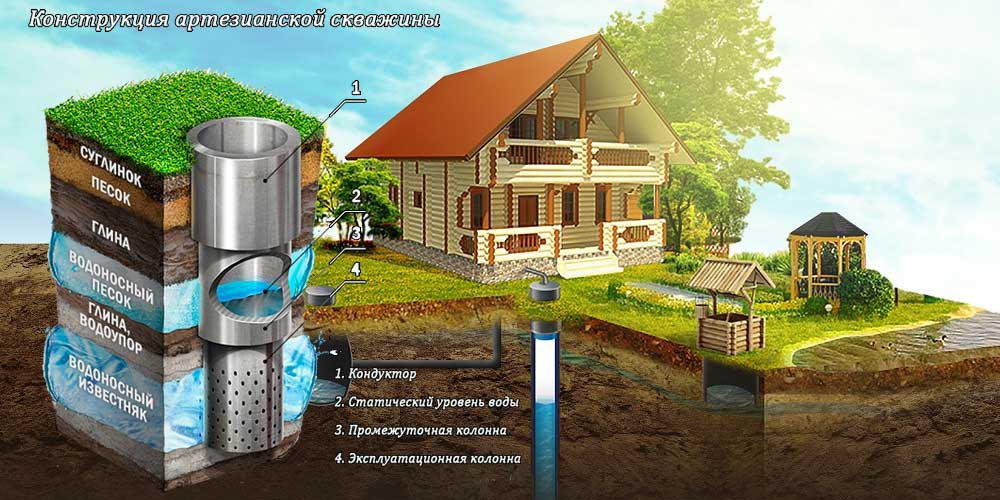
The search for water consists in finding special formations underground, consisting of two layers of clay and sand between them, which retains moisture. The loose layer can reach a depth of tens of meters and occupy vast areas. The greatest amount of moisture is not in the horizontal layers, but in their breaks and bends. In such places, lakes with a large supply of liquid are formed.
Consumers try to find aquifers at a depth of more than 10-15 m. At this distance from the surface there is a liquid for irrigation, washing and other needs. In some cases, they even drink it.
High-quality cooking water, enriched with minerals and salts, lies deeper than 30 m. It must be taken into account that the legislation allows the construction of a well no more than 20 m deep. If the water layer is lower, make a project and obtain permission from the regional services and the local government architect . Therefore, in your area, it is recommended to search closer to the surface, where water is easier to find and can be extracted without certificates.
Underground layers that repeat the terrain are considered successful for wells. Rain streams flow from the hills to the lowlands, from where they rise to the level of the aquifer, already cleaned.
It is not recommended to search in such places:
- Closer than 30 m from toilets, manure heaps, animal sheds, and other similar places.
- Closer than 5 m from the foundation of the building.
- Closer than 300 m from sedimentation tanks and chemical plants.
- Closer than 100 m from industrial waste dumps.
- Near neighboring areas where drains can enter your well.
- In the lowlands of the slopes of beams, ravines, as well as in the lowest part of the site. It is allowed to dig a mine anywhere on the slope, if its angle does not exceed 3 degrees. In other cases, the source should be at the very top of the allotment. Such an arrangement will help to avoid flooding of the spring after rain or melting snow and the ingress of substances that can harm a person into the mines. If the aquifer is located in such a place, you will have to build a drainage system.
- Do not look for water where the well will interfere with the passage to the house, driveway, gardening, etc.
- Near trees with a strong root system.
- Near power lines.
- In thickets of bushes and trees. So that the fruits and leaves do not create a problem in the operation of the well, they need to be cut down within a radius of 5-10 meters, which not everyone will like.
- Do not look for water in the basement of the house either. There will be problems with pumping out the technical fluid and installing a submersible pump, which requires high ceilings.
It is recommended to search near residential buildings - no need to carry buckets far or buy a heavy-duty pump to pump water over long distances.
Search Practices
After the observation stage, you can start a practical search using standard and folk methods.
Use of glass containers
Finding water with cans.
Opened dry glass jars upside down are placed on the territory to search for a stream. Banks are inspected after 7-8 hours. Where the inner surface of the container is most moistened and the accumulation of condensate is greatest, it is recommended to dig a well.



Application of hygroscopic material
You can find water using hygroscopic materials. These include salt, red brick, silica gel. For this method, it is necessary to prepare an unpainted clay pot and choose a hot period for research so that the soil is dry. Pre-dried salt, brick chips or silica gel must be poured into a pot, the container with the contents weighed, wrapped in gauze or agrofibre and buried in the ground to a depth of 50 cm. After a day, the pot is dug out and weighed again, if the difference in weight is significant, moisture is close.
Effective ways to find water
There are more than a dozen ways to determine the proximity of water to the surface. The search for water under the well can be done using one of the following effective methods.
To do this, the granules of the substance are carefully dried beforehand in the sun or in the oven and put into an unglazed clay pot. To determine the amount of moisture absorbed by the granules, the pot must be weighed before instillation. A pot of silica gel, wrapped in a non-woven material or dense fabric, is buried in the ground to a depth of about a meter at the site where the well is planned to be drilled. A day later, the pot with the contents can be dug up and weighed again: the heavier it is, the more moisture it has absorbed, which in turn indicates the presence of an aquifer nearby.
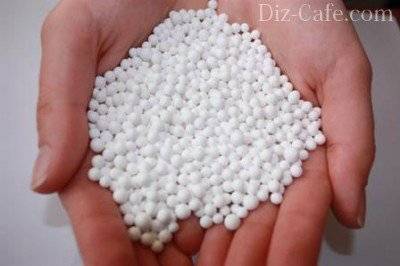
The use of silica gel, which belongs to the category of substances that have the ability to absorb moisture and retain it, will allow in just a couple of days to determine the most suitable place for drilling a well or arranging a well
In order to narrow down the search for water for a well, several of these clay containers can be used simultaneously. You can more accurately determine the optimal location for drilling by re-burying the silica gel pot.
A reading of 0.1 mm Hg of a barometer corresponds to a difference in pressure height of 1 meter. To work with the device, you must first measure its pressure readings on the shore of a nearby reservoir, and then move together with the device to the place of the proposed arrangement of the source of water production. At the well drilling site, air pressure measurements are taken again, and the water depth is calculated.
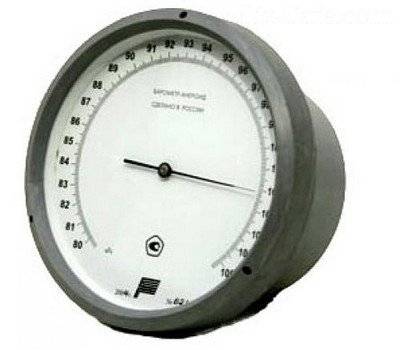
The presence and depth of groundwater is also successfully determined using a conventional aneroid barometer.
For example: the barometer reading on the river bank is 545.5 mm, and on the site - 545.1 mm. The level of groundwater occurrence is calculated according to the principle: 545.5-545.1 = 0.4 mm, i.e. the depth of the well will be at least 4 meters.
Trial exploration drilling is one of the most reliable ways to find water for a well.
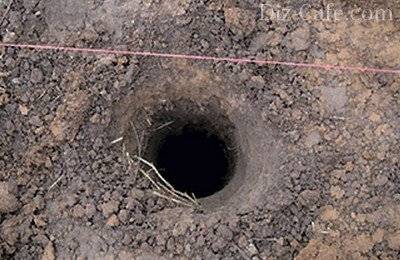
Exploratory drilling allows not only to indicate the presence and level of occurrence of water, but also to determine the characteristics of the soil layers occurring before and after the aquifer
Drilling is carried out using a conventional garden hand drill. Since the depth of an exploratory well is on average 6-10 meters, it is necessary to provide for the possibility of increasing the length of its handle. To carry out the work, it is enough to use a drill with a screw diameter of 30 cm. As the drill deepens, so as not to break the tool, excavation must be carried out every 10-15 cm of the soil layer. Wet silvery sand can be observed already at a depth of about 2-3 meters.
The place for arranging the well should be located no closer than 25-30 meters from drainage trenches, compost and garbage heaps, as well as other sources of pollution. The most successful placement of the well is on an elevated site.
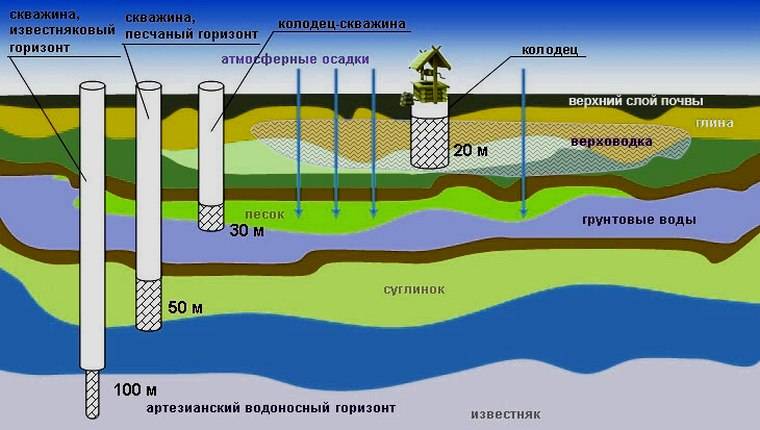
Terrain-following aquifers at elevated locations provide cleaner, filtered water
Rain water and melt water always flows from the hill to the valley, where it gradually drains into the water-resistant layer, which in turn displaces clean filtered water to the level of the aquifer.
Practical Water Detection Methods
In addition to visual observation and analysis of what you see, practical methods for detecting water on the site using various tools and devices will help you find water. These can be glass jars and clay pots, grapevine and aluminum wire, moisture-absorbing materials (silica gel or red brick, and so on).
It must be said that at present these methods are used less and less. Although independent searches for an aquifer are very exciting, here you can imagine yourself as a gold digger. It is much more reliable and efficient to carry out exploratory drilling in the right place. True, this requires financial costs.
The simplest thing is to interview neighbors in the area
The simplest, but at the same time the most effective method of finding a place where it is best to equip a well is to interview neighbors in the area.
Those of them who have already acquired their own autonomous source of water supply, probably conducted research before digging it.
They can provide effective assistance by providing information on the intelligence work carried out. This information will help save a lot of time looking for an aquifer. If the neighbors in the area do not have wells, you will have to look for water on your own.


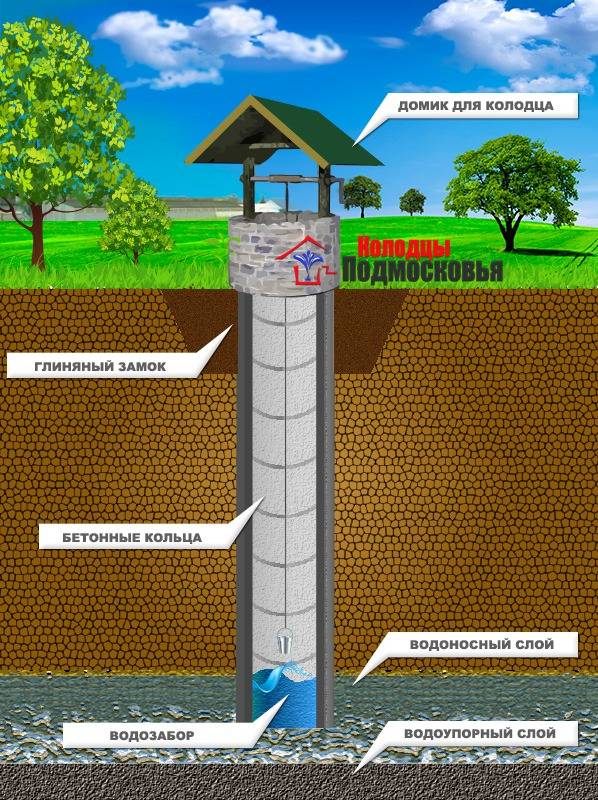
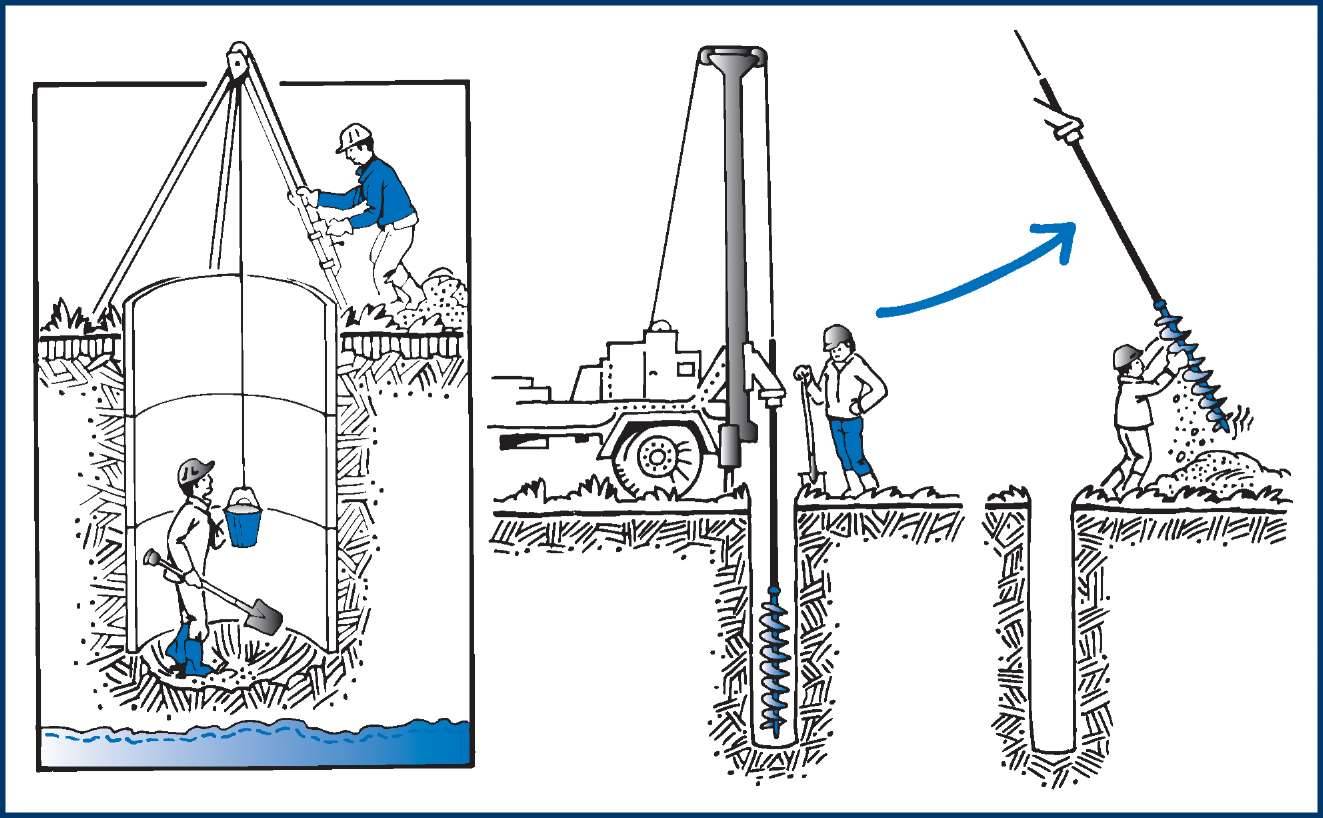


Dowsing with a frame made of vine or aluminum
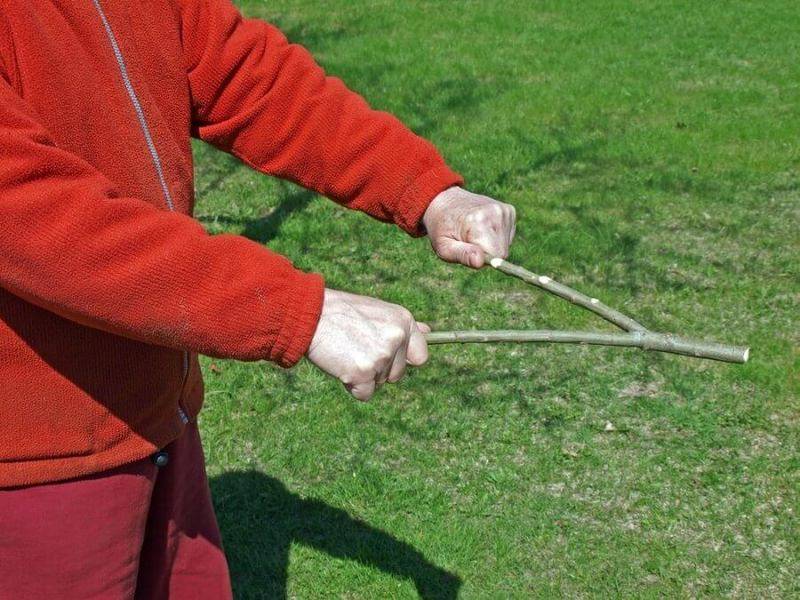
The location of the aquifer can be determined by dowsing using an aluminum frame or willow vine. The procedure for the aluminum frame is as follows:
- two forty-centimeter pieces of wire are bent at a right angle, as in the photo, and placed in a hollow tube so that they can rotate freely in it;
- having turned the ends of the wires in different directions and taking the tubes in hand, we begin to move along the site;
- in the place where the ends of the wire converge, there is an aquifer;
- the control passage of the section is carried out in a perpendicular direction.
The manipulations when using a willow frame are similar. This method is called dowsing and is as follows:
- a branch is cut from a willow with a fork of approximately one hundred and fifty degrees;
- the vine is thoroughly dried;
- when passing through the site, the vine is taken in hand so that the trunk is directed upwards;
- in the place where it goes down, there is water.
The most reliable is to conduct exploratory drilling
The most reliable method of detecting water on the site is to conduct reconnaissance drilling on it.
Using a conventional drill, several meters of rock are passed before colliding with the water horizon. Before you start digging a well, you need to send a sample of it for analysis to determine the presence of harmful impurities in its composition.
Folk method - arrange pots and jars
The folk method of searching for water on the site is carried out using glass jars and clay pots. In the evening, ordinary glass canning jars or pots are placed upside down throughout the site. In the morning they are carefully examined. The containers, at the bottom of which the largest amount of condensed moisture has collected, will indicate the location of the water vein.
Method for finding water by measuring the mass of hygroscopic materials
Moisture-absorbing material, such as ordinary table salt, is placed in identical clay pots. Pots of salt are weighed and buried in the ground evenly throughout the site. They are then dug up and weighed again. Those of them who received the greatest weight gain will show the location of the water.
The use of a barometer and other instruments is serious
A device such as a barometer, which can measure atmospheric pressure, will allow you to determine the depth of the water vein if there is a river, lake or other body of water near the site and, thus, help answer the question: how to find water for a well?
Atmospheric pressure is measured at the site and on the shore of the reservoir. Then you should remember from the school physics course that one millimeter of mercury corresponds to a height difference of thirteen meters and compare the measurement readings. If the difference was half a millimeter of mercury, then the aquifer is located at a depth of 13/2 = 7.5 meters.
We hope that the above information will help you find crystal clear water on your site. The following video sets out the authoritative opinion of a hydrologist on this issue.
"Grandfather" methods of finding water
Wells have been dug since ancient times, so the most successful methods used by our ancestors have survived to this day.
Analysis of plants growing on the site
Plants can tell you if there is an aquifer in your area, and at what depth it is located. If coltsfoot, sedge feel good on the ground, alders, birches grow, then there is water under you, and not deep.But the pines, in which the root system is able to “burrow” to great depths in search of water, indicate that the distance to the aquifer is rather big.
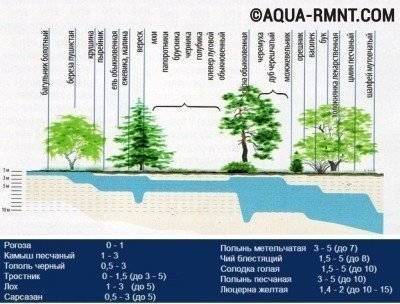
Plants growing on the site can tell about the level of groundwater occurrence (click on the image to enlarge)
Pet observations
Watch how your dog behaves on hot days. Usually dogs begin to look for the most humid (and therefore cool!) places, dig a hole in them and lie down. This means that there is an aquifer in this place.
For example, a horse that is thirsty will begin to beat with its hoof in a place where it feels close to water.
Also, in the evening, pay attention to where the midges “crowd” in the area. They choose a place with high humidity
The study of weather phenomena
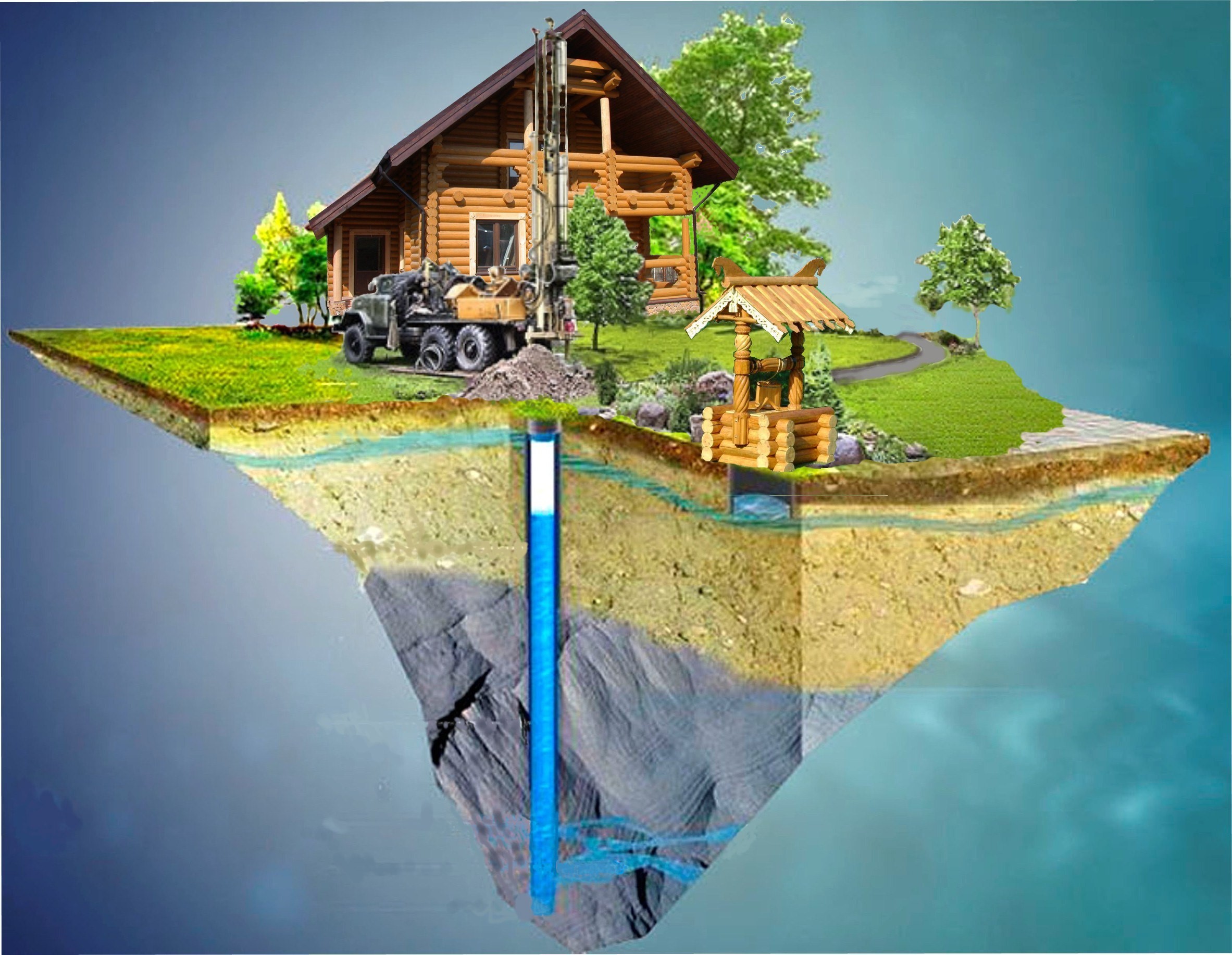
In the evening after the summer heat or in the early morning they watch the territory. In places where the water is close to the surface, the level of humidity will manifest itself as a fog that will creep along the ground or come out in clubs. Moreover, by the density of fog, one can determine the depth of groundwater: the denser it is, the closer the vein.


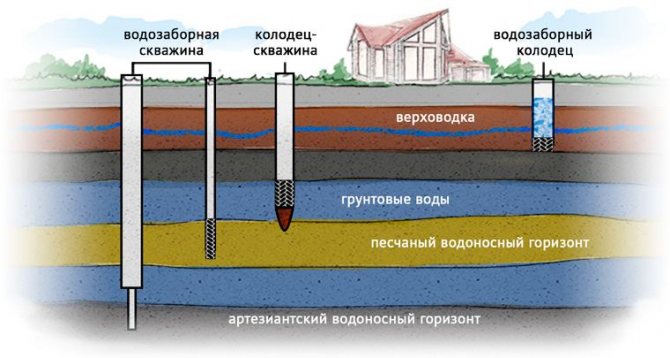

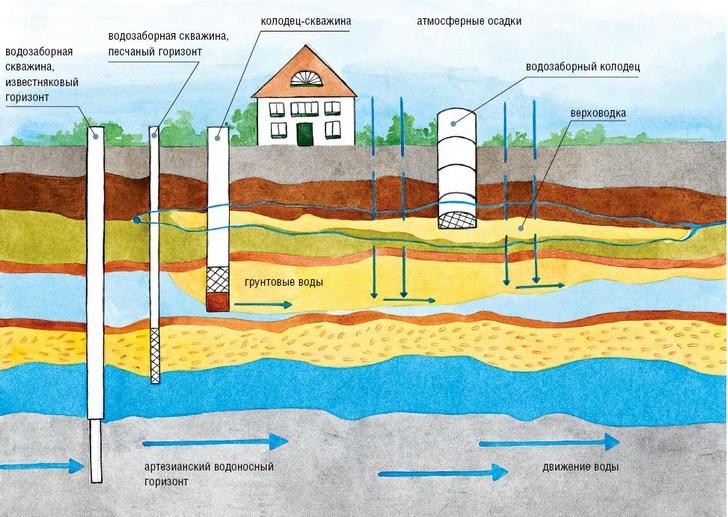


Desiccant weighing
You can also find out about the saturation of the earth with water by weighing desiccant materials - materials that can absorb moisture. Previously, only red brick played this role, and today silica gel has been added to it.
Procedure:
- Find an unglazed clay pot.
- Break the red brick into pieces and dry it thoroughly in the oven. If you use silica gel, you do not need to crush it, but it is necessary to dry it.
- Pour the prepared moisture accumulator into the pot and weigh it.
- Wrap it with non-woven material and bury it 0.5 m into the ground.
After a day, take it out and weigh it again. The greater the difference in mass, the closer the water.
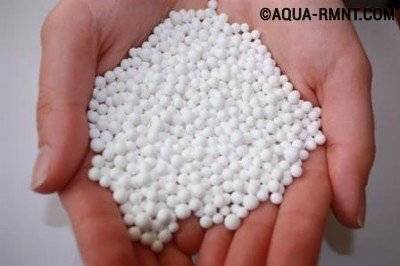
It is best to use several pots of silica gel at once in different places to determine in which zone the aquifer is closer to the ground
For the purity of the experiment, learn that in the previous days, before looking for water for the well, precipitation should not have fallen, otherwise the earth will be wet, and the pot will nourish the water that has fallen from the surface. The desiccant is buried only in dry soil.



