- A little about the heat transfer of radiators
- Design Options
- Some important requirements for decorative screens
- A little about heat engineering and grids for batteries
- Efficient radiator screen design
- markup
- box
- Wall
- Increases the efficiency of the radiator by installing a reflector on the wall
- We also recommend reading:
- plastic screen
- Do-it-yourself installation of a drywall box
- How to hide the battery in the room
- Beautifully close the batteries in the room: decoration options
- Decorative box with sliding doors
- Covers for radiators
- Decoupage radiators
- Decorative film for radiators
- Antique style radiators
- Drywall constructions
- Box of lamellas for central heating radiators
- False fireplace instead of a radiator
- Service and Troubleshooting
- How to fix the radiator screen on the wall
- A simpler approach
- Conclusion
- How to sew up a battery with drywall
- Finishing the structure
A little about the heat transfer of radiators
It is not uncommon for new aluminum or bimetal radiators are knocked out of the interior, breaking its harmony.The issue of finishing is quite relevant and requires a special approach, since by installing a decorative casing on the radiator, its pleasant appearance is ensured, but the process of heat transfer from the device to the room is disrupted. Why this happens and whether it can be avoided, let's try to figure it out before we start making the screen.
The thermal energy released into the room by a heating radiator has 2 components: radiant and convective. The first is characterized by direct infrared radiation entering the room from the hot surfaces of the battery. At a low coolant temperature (up to 50 ºС), the share of radiant energy is small, but at 60 ºС and above, it increases significantly. When a decorative battery box is placed, the path to the flow of this radiation is inevitably blocked, which means that part of the thermal energy does not enter the house.
A good article on the topic about comparing the heat transfer of radiators.
An exception is convector-type water heaters, their front surfaces are not hot and the radiant component is practically absent. But such heaters are rare.
The convective component is the transfer of thermal energy to the air. The battery panels also affect it, as they create an obstacle to the air passing through the fins and other elements of the heater. And in the case when the screen design is unsuccessful, part of the hot air simply accumulates inside the box, not being able to go outside.
The brief conclusion is as follows: by installing decorative screens for radiators, we disrupt the heat exchange process and part of the energy is returned to the heating network through the return pipeline.This is not so scary in a private house, where the system is located throughout the house and this warmth will not leave it anywhere, but will simply be given away in another room. But in the case of an apartment, we simply give the heat we paid for to the neighbors in the riser, this must be understood.
Design Options
There are many technologies that allow you to decoratively cover the radiators with plasterboard and at the same time guarantee the calculated thermal regime. The most expensive is an individual order for the author's interior. But for reasons of economy, in most cases they draw up batteries on their own:
- Construction of a hinged screen structure.
- Creation of a wooden removable panel.
- The use of gypsum boards - for arranging the box.
It is worth noting that the latter option is considered especially popular today. However, it cannot be considered as the most impeccable.
 How can I close the battery with drywall
The protective structure must comply with the following characteristics:
- The jets of hot air must not be obstructed in their movement.
- Absolutely all threaded connections must be easily accessible.
- When developing a protective system, it is necessary to provide access to the battery control fittings.
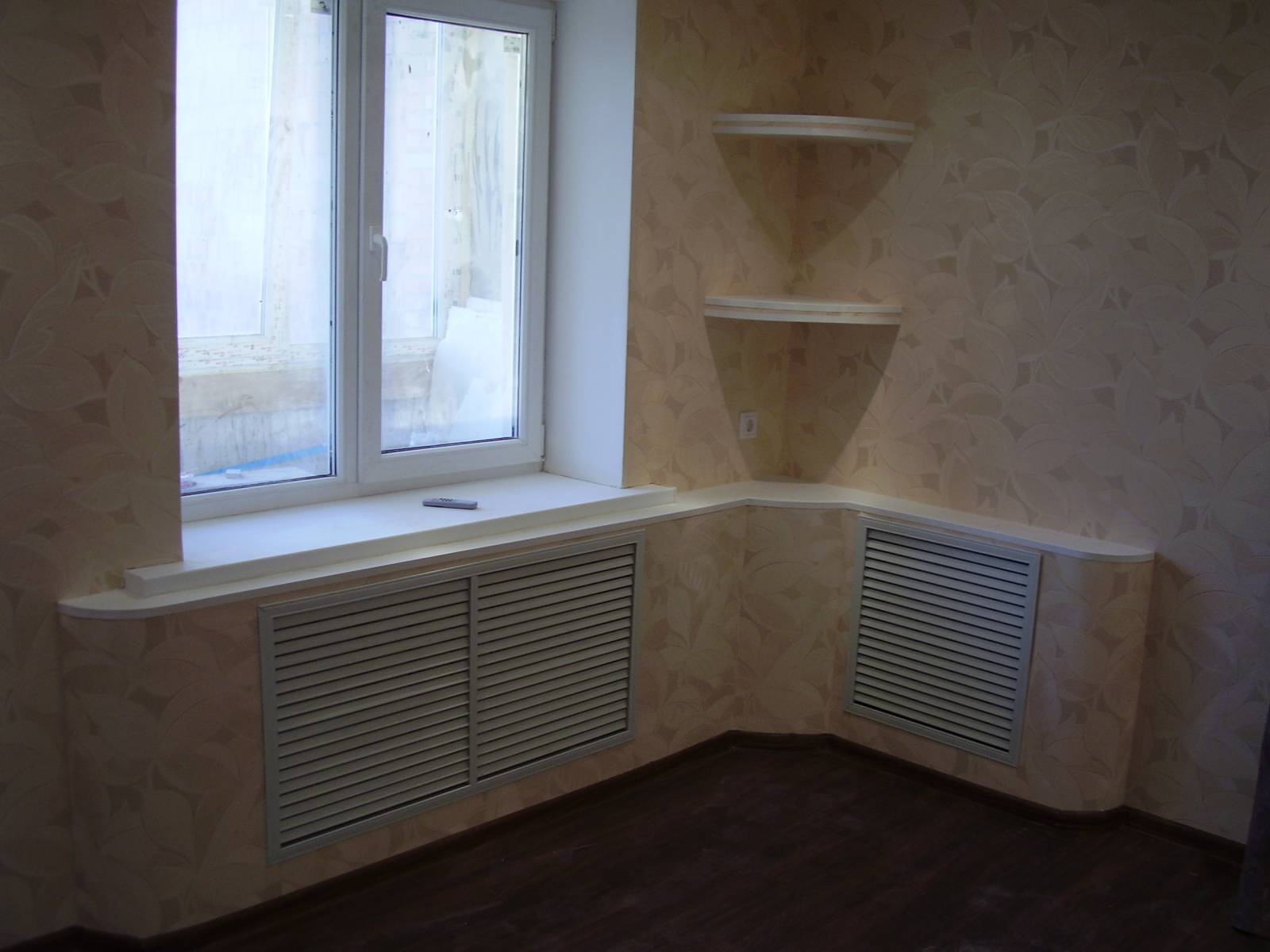
There are two options for using drywall with which it is possible to close the radiator: a decorative wall made of plasterboard or the arrangement of an ordinary drywall box with a removable metal lattice coating. The choice will depend on the location of the battery with communications in the apartment.
Some important requirements for decorative screens
In addition to the above conditions, when choosing a decorative panel, you should take into account a few more important points that ensure sufficient heat transfer from heating radiators.
- The material from which the screen or grating is made must have good thermal conductivity. This is a necessary condition so that heat does not linger in the space between the surfaces of the battery and the panel, but freely passes into the room.
- It is recommended to paint the inside of the decorative panel in a dark color, dark brown or black - this factor will contribute to the good absorption of heat coming from the radiator and its transfer to the room. The front side of the panel can be painted in any shade that best suits the overall color scheme of the room.
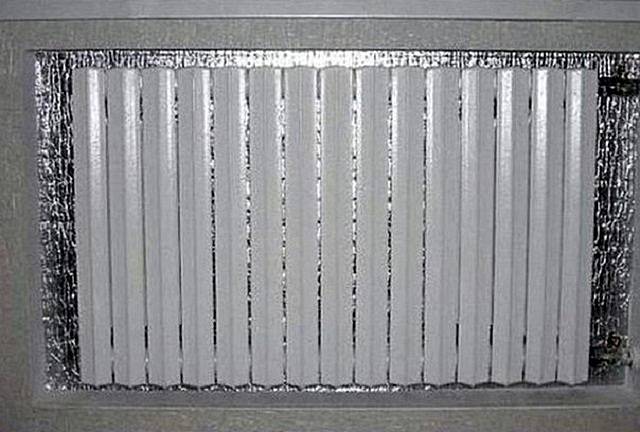
The simplest device - a reflective screen made of thin foil insulation can significantly increase the heat transfer efficiency of radiators
Another device that will help save thermal energy from unproductive escape to the outer wall can be a heat-reflecting screen. It is fixed on the wall, behind the radiator. Most often, foil-foamed polyethylene with a thickness of 3 ÷ 5 mm is used as this device. The insulation is fixed with a reflective surface outward. Thus, all the heat coming from the radiator will be directed towards the room, which will increase its passage through the decorative panel.
If the radiators are yet to be installed, then instead of thin polyethylene, foil foam 10 mm thick can be fixed on the wall. This material will help to significantly save on heating costs.
A little about heat engineering and grids for batteries
Even if you need grilles for radiators for decoration, do not forget that batteries should heat the room. Any screen reduces heat transfer, even the most openwork and thin. Another question is that one will reduce the amount of heat transferred by 10-15%, and the other by all 60% or even more. It is unlikely that you will want to sit in a beautiful, but cold room, so when choosing a decorative lattice, you must also consider how heat will spread.
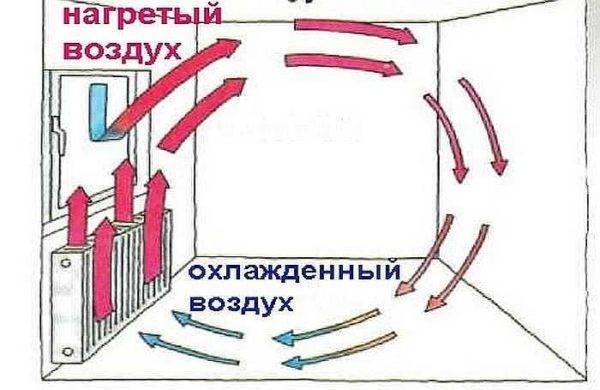
Heat distribution
The principle of heat transfer from a heating radiator without a grill is shown in the figure. The main idea is that air should come from below, pass along the battery, heat up, go up. This is how our heating works. When choosing a grille or screen, you need to keep this in mind. For normal air circulation, it is necessary that there is a gap at the bottom, and there is no cover at the top. As a last resort, the lid should have a large perforated area.
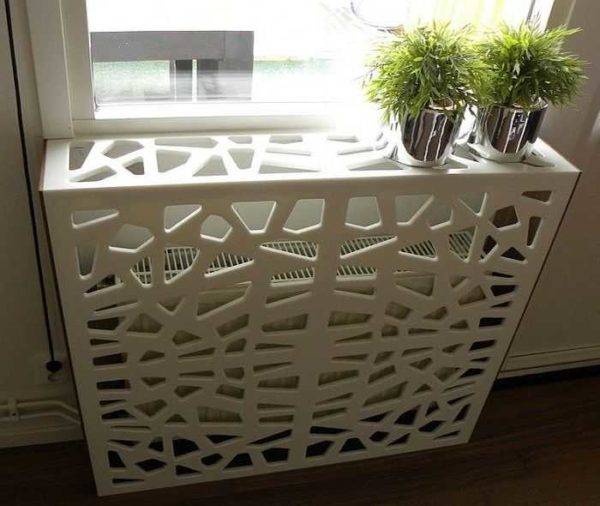
Not a bad option - large holes allow air to move freely
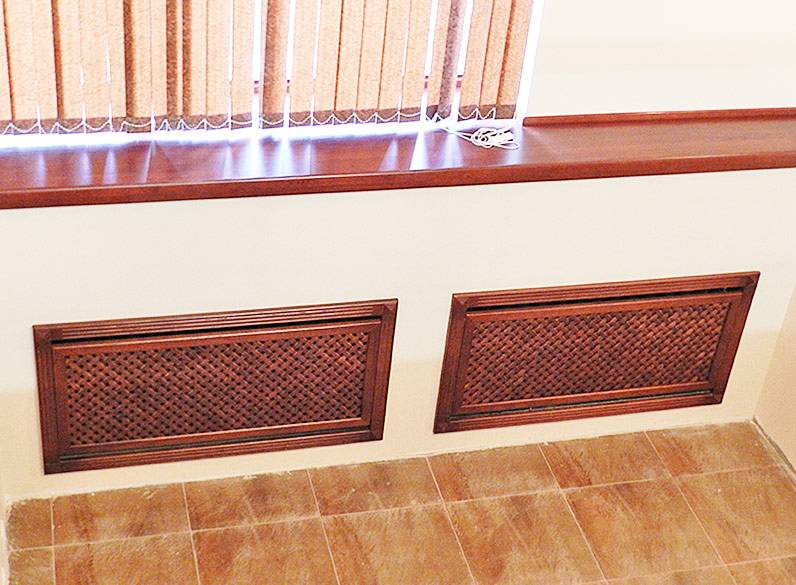
But if you look at many from decorative lattices, you can immediately tell that the room will be cold. Especially gratings on heating radiators in the form boxes that have walls on all sides. If they are very openwork, as in the photo above, there is not much trouble, but if they are made of solid wood (as in the photo below), with almost no perforation or with minimal holes, be prepared for heating inefficiency.
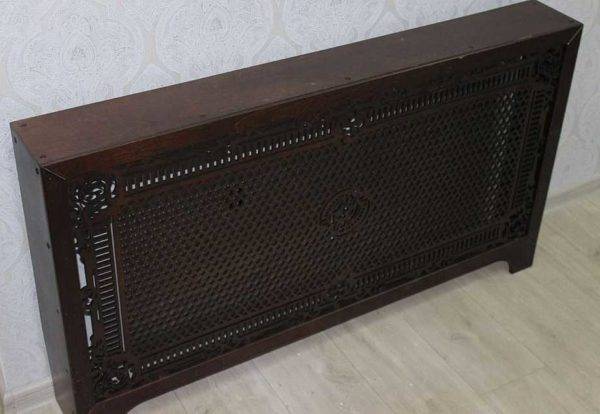
From above, the battery is covered with a solid layer of wood without holes.
Wood, of course, is an aesthetic material, but it has a high heat capacity. Until the wood heats up, the room will be cold.And since the array is located above the radiator and there are no holes for circulation, the radiator under such a grill will be hot, but the room will be cold.
Efficient radiator screen design
A cross section of a radiator with a heating screen, namely how everything should be arranged, can be seen in the figure. The main design will have two highlights - an aerodynamic visor and an injector for warm air convection. They can be made of cardboard, tin or galvanized. If you made from cardboard, then be sure to paste over the inside with foil. You can also use a regular baking sleeve.
Making a visor is necessary for any type of radiators. For both aluminum and cast iron batteries. If there is no visor, then in the corner under the window sill a thermal air cushion will constantly form, which will block the convection.
The main function of the injector is to suck in warm air flows from the radiator, namely from its front side. At a low temperature of the radiator itself, the effect will work poorly, but as soon as the heating increases, the thrust will become much more powerful and warm air will pour from above the visor. You have probably noticed more than once how during the heating season the curtain on the window sways from the flow of warm air.


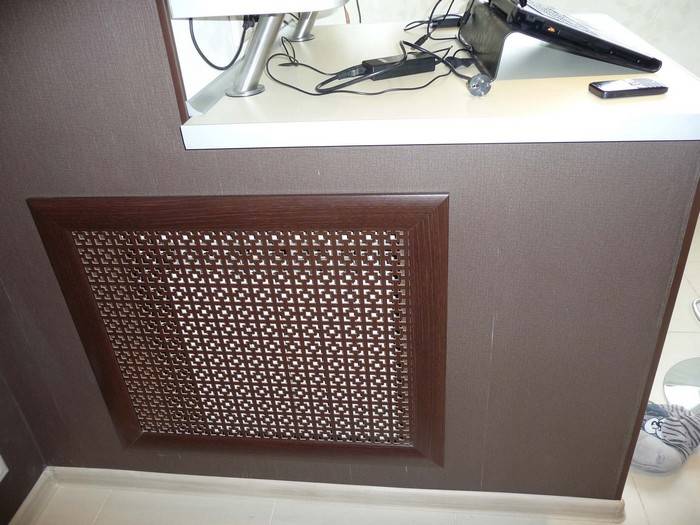
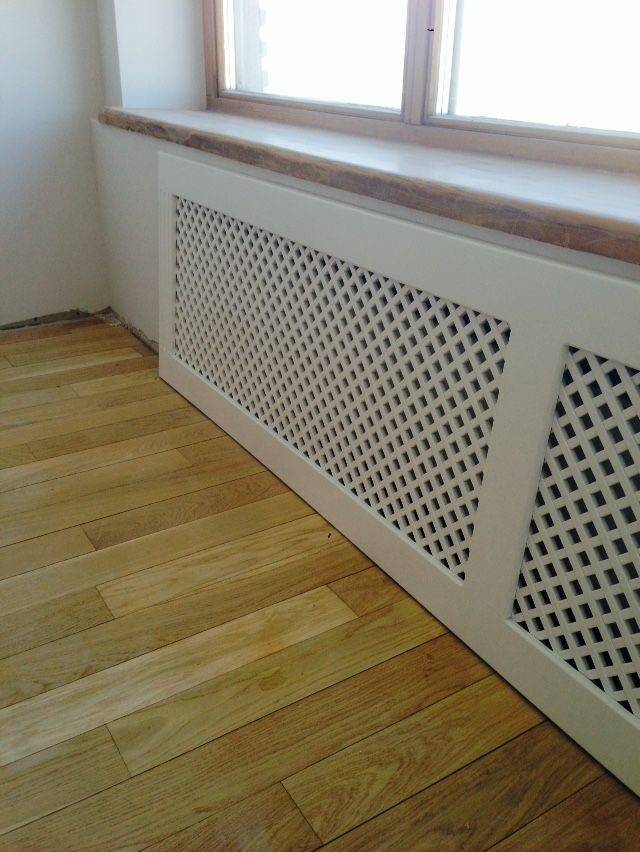



A radiator with a conventional screen will not work effectively, but if there is a reflective screen and a visor, then the battery efficiency will be even greater than without a screen. The injector and the visor do not have specific dimensions. In any case, they can be both moved and bent.
You can fix the screen for the radiator to the wall by any means, both with anchors and studs. The screen will in any case work effectively if the total area of the front surface is less than the totality of the gaps between them. If the radiator is cast iron and the fins are naturally arranged vertically, then the screen crate must be made vertically.
Be sure to choose a screen for radiators, taking into account the characteristics of heat transfer. Otherwise, everything will turn out beautifully, but the room will not be heated. After all, everyone knows that the main guarantee of a prosperous winter is comfort and warmth in the apartment.
If you find an error, please select a piece of text and press Ctrl+Enter.
Around the battery, decide on the size of the future decorative grille. This place should be made slightly smaller than the grid. There are three main standard grating sizes: 60x60, 60x90, 60x120. These dimensions are optimal for apartment renovation, and I recommend focusing on them. Actually there is a way out!
It is necessary to make a drywall box that will cover all the problem area from the floor to the windowsill from the eyes. This solution to the problem has a huge advantage. As a result, it will be very beautiful, including due to the presence of an overhead grille, which I recommend to match with the color of the furniture. The dimensions of the box will depend on the battery to be hidden.
It is important to consider that the edges of the box will be about 15 cm further from the battery, from all sides. In addition, the box is marked on the floor in such a way that the end of the box on the front side protrudes 15 cm relative to the radiator
markup
How to fix the battery on drywall - marking stage
The markup of the future design is carried out using:
- measuring tool - tape measure, ruler, corner;
- descriptive tool - a simple pencil, marker;
- precision tool - building or laser level.
Carrying out this stage, it is desirable to adhere to the exact dimensions, limited to whole centimeters. Millimeters are used only in the case of a particularly precise design, for example, for an established interior project.
Before you sew up the battery with drywall and get rid of its unpleasant appearance, you need to decide which way to terminate the markup:
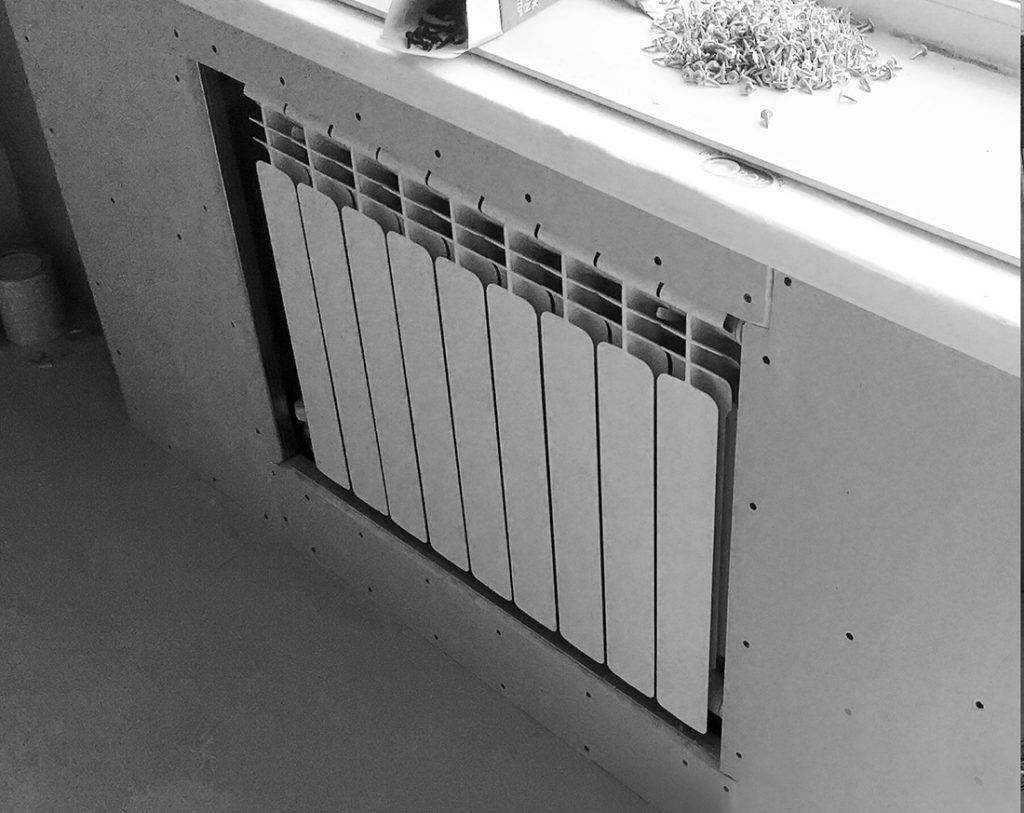
- box - a simpler and faster method of work (only the area of \u200b\u200bthe battery is closed and, literally, 12-20 cm beyond it);
- wall - a more time-consuming method (the wall with the radiator installed is completely sealed; if the heater is installed near the window, slopes must be made).
In terms of the amount of work, the termination of batteries according to the first method is simpler: a smaller amount of material is used and a small number of construction processes are carried out. In the second case, even fewer building processes are used, but more material is used.
box
Radiator box
When installing a box, the design takes up little space, covering a little more space than the radiator itself. The depth of such a box depends on the width of the heater (most radiators are narrower than radiators with metal plates).
Instructions for marking the box:
- Depending on the required position of the structure, a horizontal strip is drawn. If the box hangs, measure the distance from the floor and draw a marking line using the level.If the structure rests on the floor, there will be 3 lines (two along the edges - depth, one front - the edge of the structure).
- It is necessary to set a corner to the bottom face and draw vertical marks - we achieve a right angle. With the help of the level we bring the vertical lines to the required size.
- On the vertical lines, identical marks are marked, between which a connecting segment is drawn.
The result should be a square or a rectangle (in the case of resting on the floor - additionally marking the base).
Wall
How to close batteries with drywall - wall device method
After analyzing the room and thinking about how to cover the radiators and pipes with drywall and do it right, the decision to install an alternative wall comes by itself.
The essence of the solution is that together with the radiator, the entire surface to which it is attached is closed. This method is wasteful, since you can get by with small volumes of material by arranging a dotted box. But the wall is the only way to completely hide the heater from the room with your own hands.
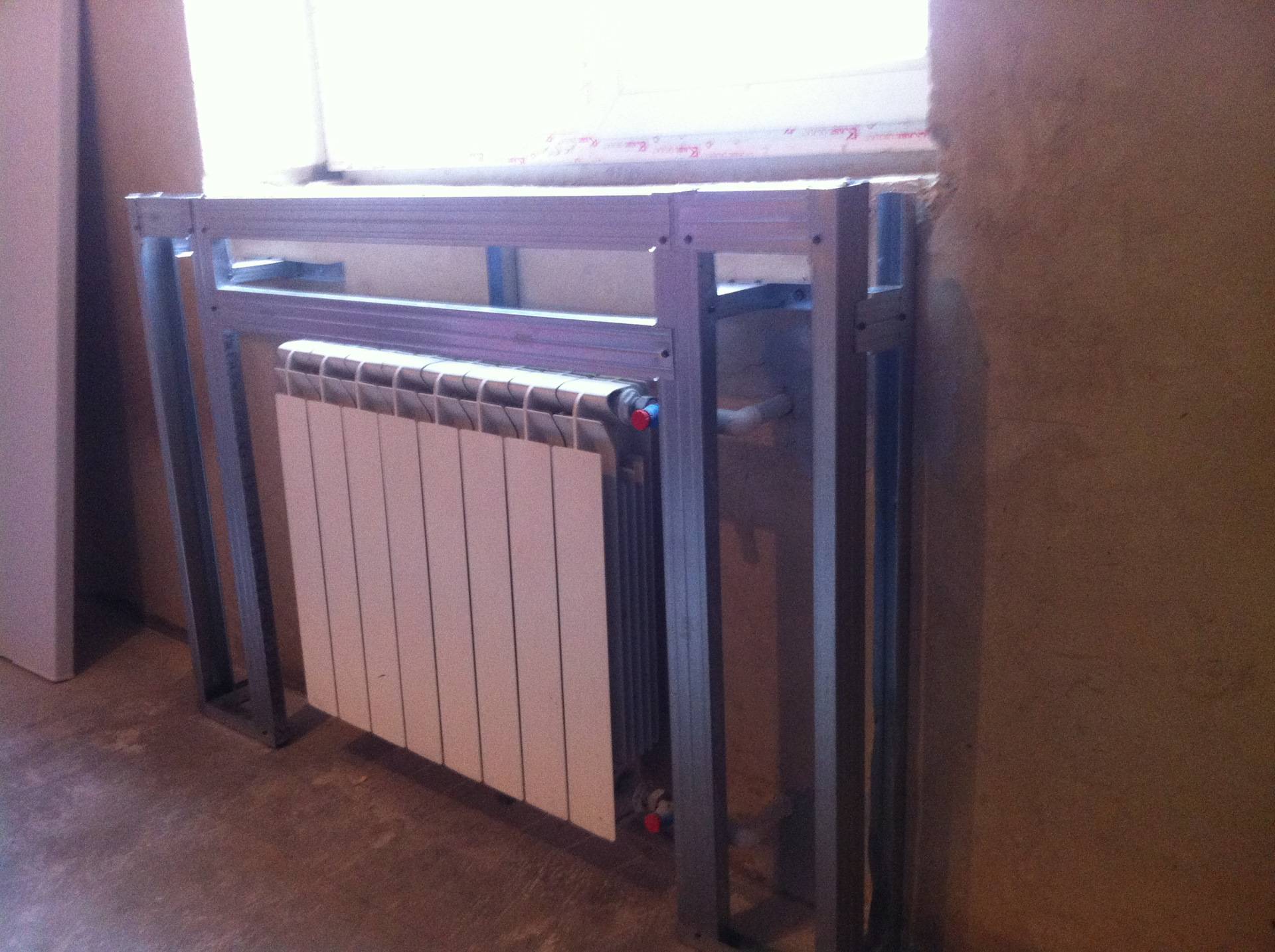
For the wall device, the frame is built to the entire height of the room:
- With the help of the level, several vertical lines are drawn on the base for the frame. Step - 60-100 cm. Mandatory lines for profiles in the corners of the room.
- From each vertical line it is necessary to extend to the floor. For this, a corner is used. The depth of the floor lines is equal to the width between the main wall and the alternate.
- Similar to the floor, lines are drawn on the ceiling - of equal depth and strictly parallel.
- The last marking lines are drawn above and below the heater, at a distance of 7-10 cm.
Marking is also carried out on the sides of the radiator - along the perimeter of the device, profiles are needed in which a removable screen will be installed. But to get rid of unnecessary work, you can make basic markings (which are the entire height of the room) directly on the sides of the radiator.
Increases the efficiency of the radiator by installing a reflector on the wall
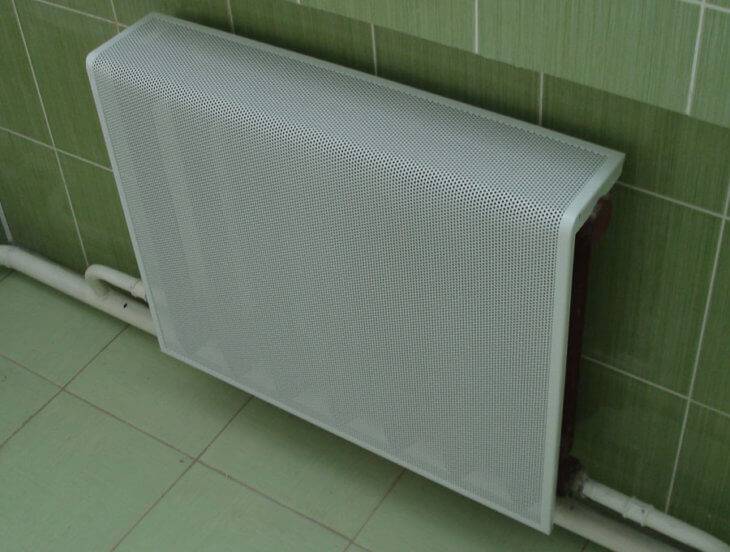
Decorative grids for batteries
When closing the batteries, care must be taken to increase the heat flux in the room. The first is the location on the wall of a special shielding heat-insulating material. The simplest and cheapest consists of a sheet of foam rubber coated on one side with foil.
Foam rubber glued to the wall is a good heat insulator. It does not let the cold to the battery. Shiny foil reflects heat and partially returns it to the radiator, the rest of the air flow takes it up. Heater sections become even hotter.
If you decide to cover the battery with a metal screen, paint it black on the back. It attracts heat and absorbs it. The efficiency of heating systems will increase.
We also recommend reading:
How to sheathe a house inside with drywall beautifully and for a long time How to equip basement in a private house do-it-yourself Warming of the house with mineral wool. Sheathing guide Insulating a house with polystyrene foam: how to sheathe a house with polystyrene foam with your own hands? Art Nouveau houses with do-it-yourself fachwerk elements
plastic screen
A screen made of plastic is a cheaper option than wood. But when buying, be sure to ask for quality certificates. And do not buy such an important part of the interior in non-specialized places and unknown brands.

Plastic is not the most reliable material and a product bought simply on the basis of the price can release toxic fumes at high temperatures or even melt on the battery.

A more elite option is special built-in furniture, which is made to order according to individual measurements and sketches. It is easiest to hide pipes in a table, cabinet, chest of drawers, seat, etc. But an important condition is the free circulation of air from the place of heating, which will allow both to close the battery and to heat the room without interference.



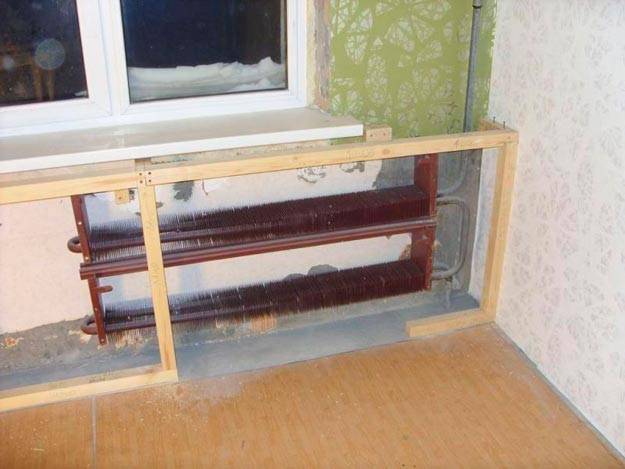

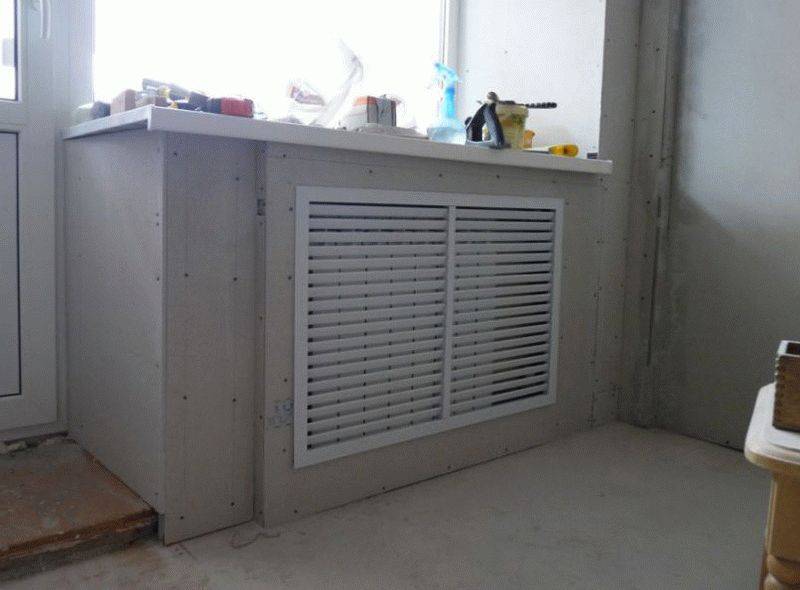

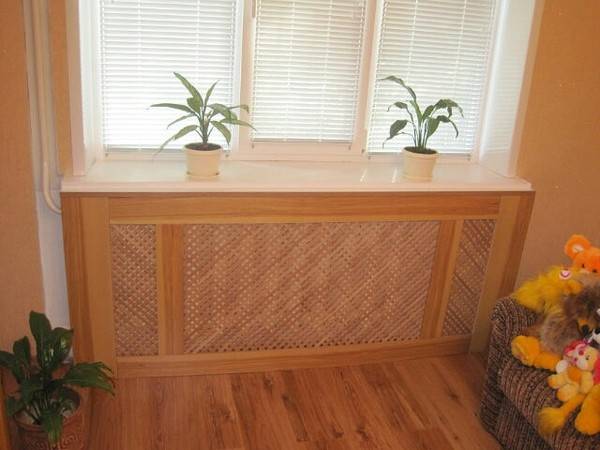
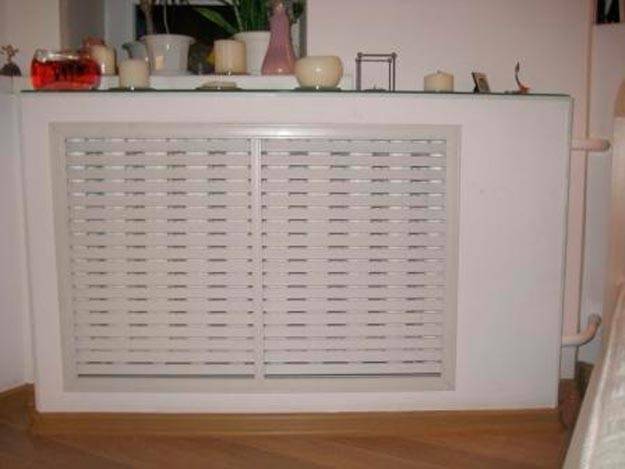


The first option is to make adjustments at the stage of building a house, which will allow you to install the system behind the wall. If you live in an already fully built house or apartment, then you can create a false wall. Just sheathing everything a short distance from the radiator.

Of the shortcomings, this is a decrease in free space and a clear reduction in the room. And also the room will be heated a little worse. There will be natural difficulties, as well as costs in the event of a breakdown.
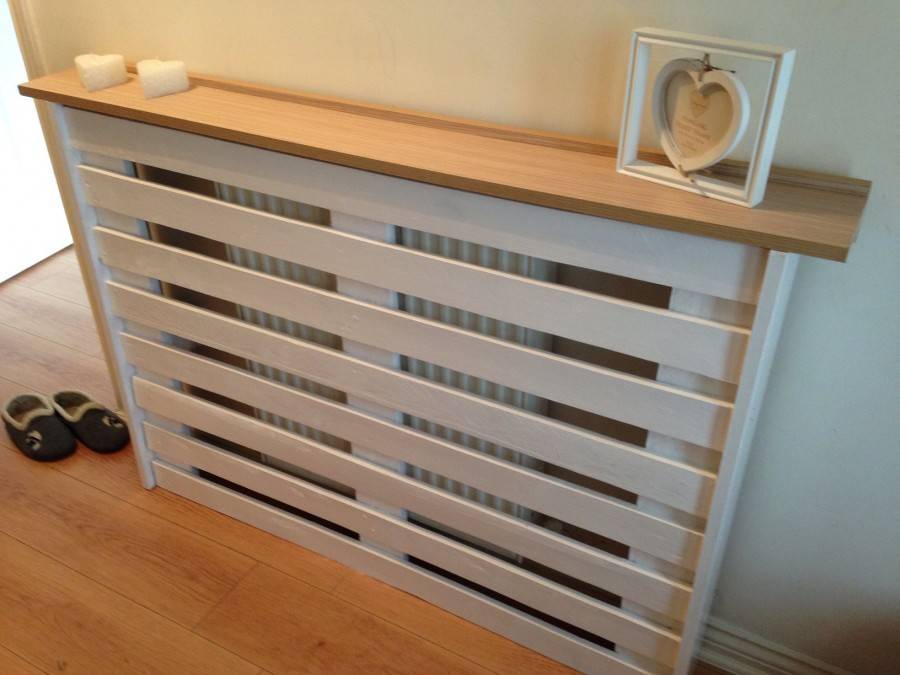
For a long time, including now, batteries are masked with heavy curtains made of dense fabric. The idea is good because it does not require extra costs and investments. And curtains are a natural part of the interior and do not attract much attention.
You can paint or wallpaper the heating pipes. This will help reduce their visibility in the room. But everything must be done well.
Paint with smudges or obliquely glued wallpaper will only attract unnecessary attention and will involuntarily catch the eye.

Do-it-yourself installation of a drywall box
In order to close the battery, you need to measure it, and then buy metal profiles and other additional products.
- What materials are needed: plasterboard sheet 12 mm, metal profiles 27x28 and 60x27, self-tapping screws for drywall and metal, dowel-nails 6x40 in size, construction sickle, perforated corners.
- Tools: screwdriver, puncher, metal scissors, clerical knife, construction stapler, pencil, tape measure, building level.
Attention, for the construction of a drywall box there is an important requirement: the window sill must extend beyond the radiator by at least 3 centimeters. Work order:
Work order:
How to hide the battery in the room
We figured out the technical requirements, the design questions begin
First of all, you need to pay attention to the color. Often on a colored wall a white radiator is like an eyesore
A white radiator looks harmoniously on a white or very light wall. If this is a modern model, then there is nothing to hide. They just blend into the background. They simply don't exist.
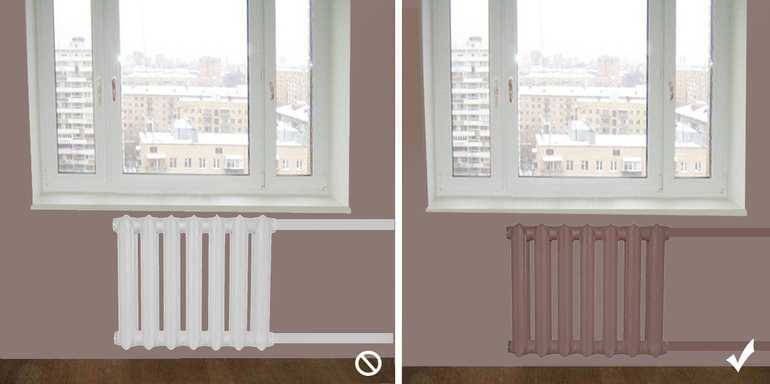
A white radiator looks good only on a white or very light wall. On the rest, it needs to be painted to match the wall.
If the color of your walls is far from white, but the walls are plain, everything is solved simply. Choose a heat-resistant paint that is close in color. If you hit tone on tone - perfect, if not, it's not scary either. A difference of two or three tones in one direction or the other does not play a role. Here are some examples in the photo.
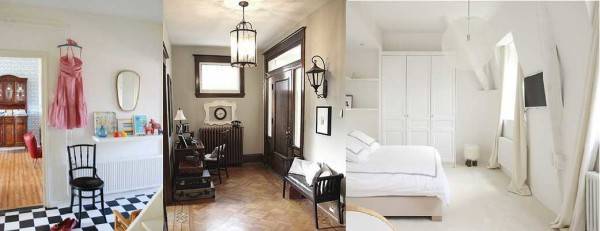
If you choose the right color, then there are simply no radiators in the interior (click on the picture to enlarge it)
What to do if there is a drawing on the walls. Now more often if wallpaper with ornaments is glued, then usually on one wall, a maximum of two.The rest are pasted over with plain or almost plain wallpaper with different textures. Then you can stick strips of one or another wallpaper on the radiator plates. Which ones, you need to look, as they say, "on the spot." It is not difficult to cut the strips, you can lightly bait one first, and then the other. And in this way, by experience, to determine what will look more harmonious.
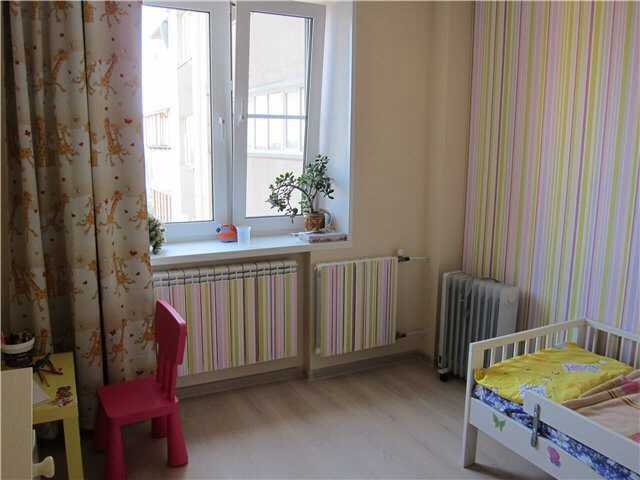
It turned out very harmoniously to paste over the radiators with wallpaper
The most correct way in terms of design is to drown the radiator in a niche, and then close this niche with a screen. But it should be from wall to wall, and of the same color.

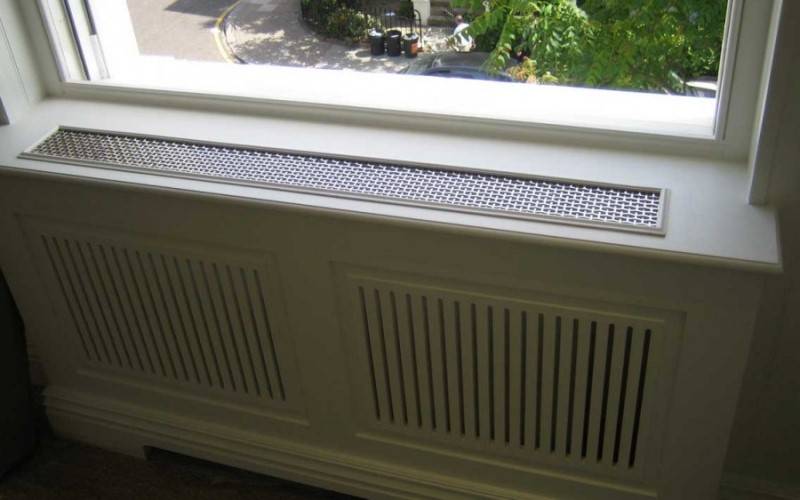

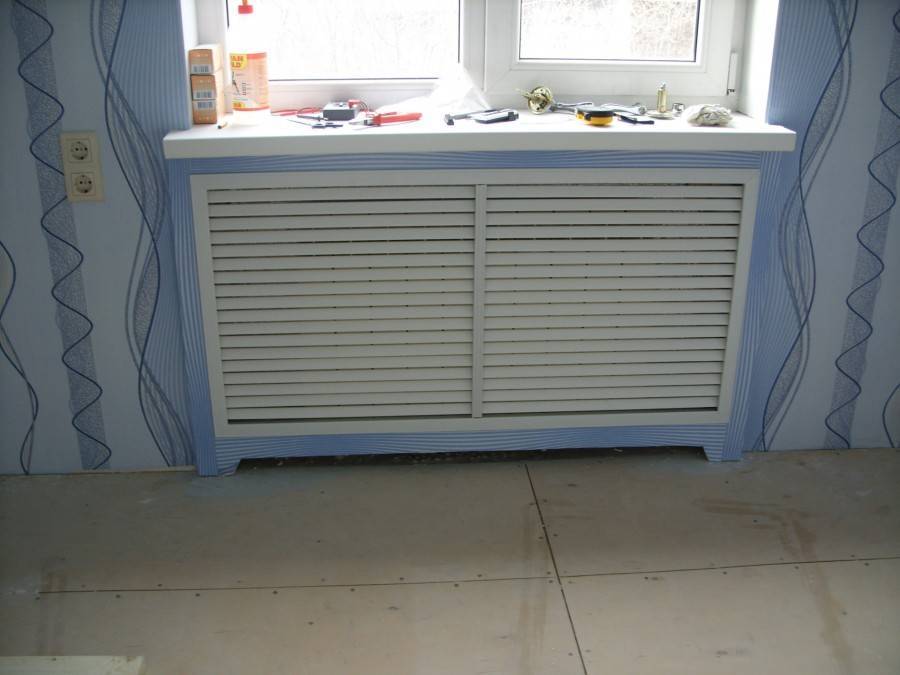
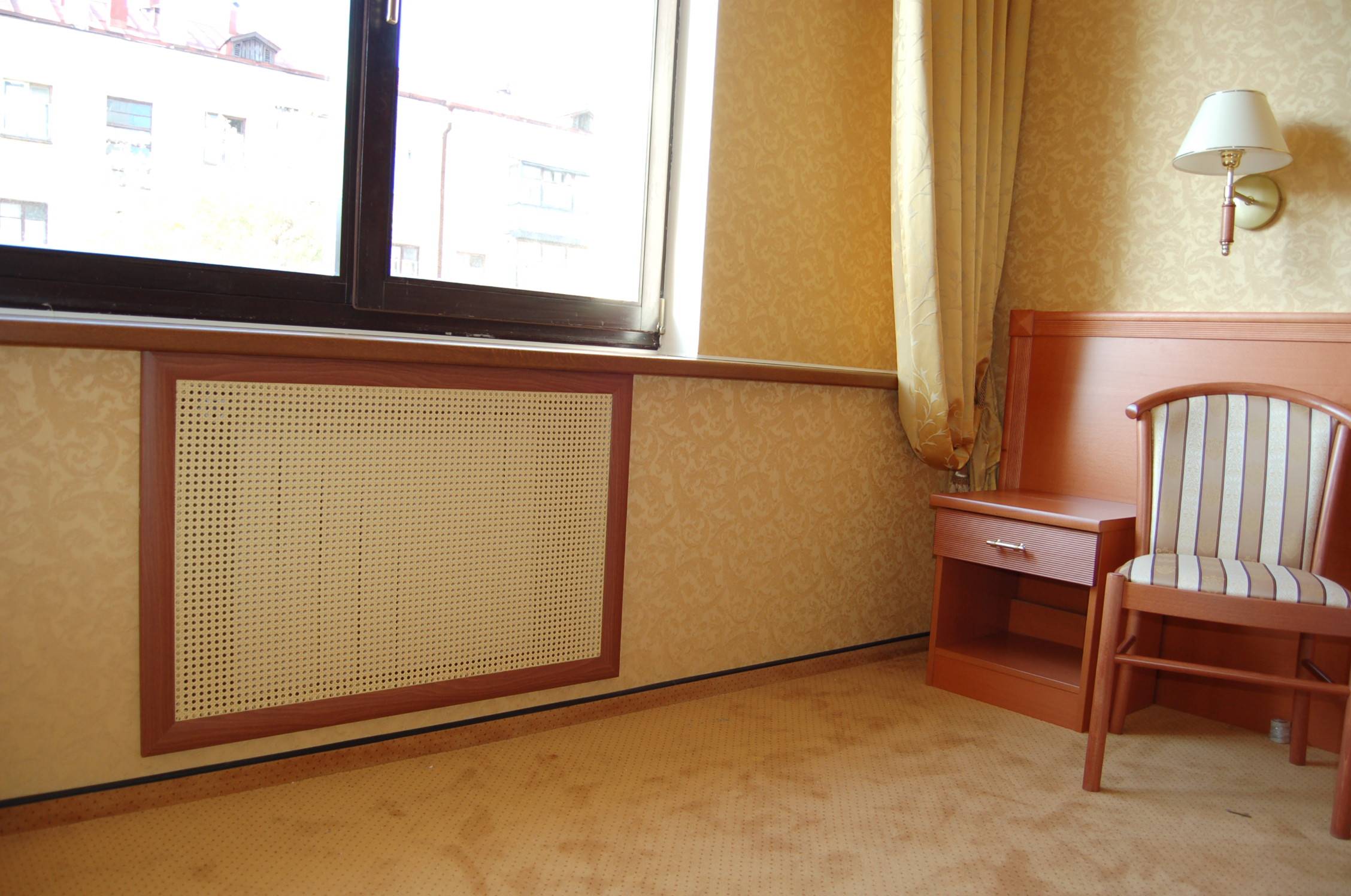
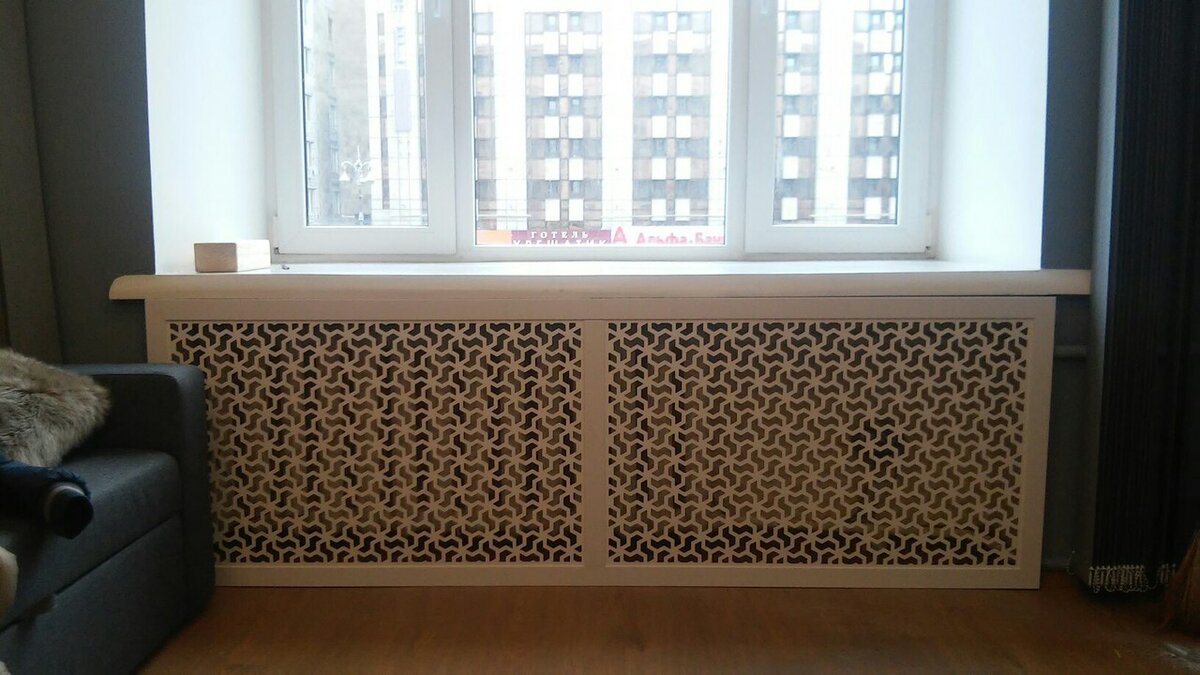

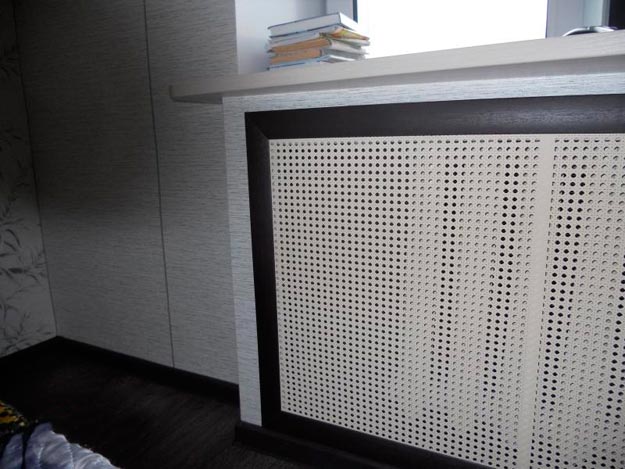

If the depth of the resulting niche and the degree of illumination of the room allow, you can make a table out of it. In this case, you can generally use a fabric screen for the radiator.
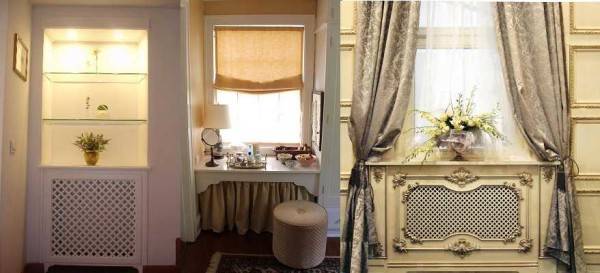
How to hide a radiator heating (click on image to enlarge)
Another way to hide the battery is to cover it with a functional structure. It, of course, should be lattice. For example, give the screen the look of a chest of drawers, attach shelves to the side, as in these photos.
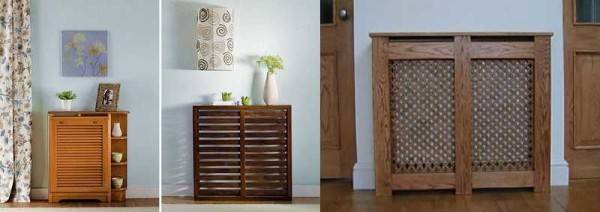
One option is to make the radiator screen look like a piece of furniture (click on the image to enlarge it)
One option is to make a closet up to the window sill for the entire width of the room. One part of it will cover the radiator - the second one really serves to store things.
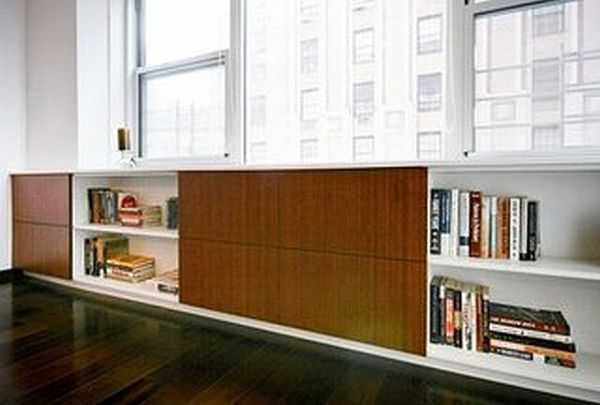
Such a cabinet is up to the windowsill and will disguise the heating battery and will serve to store things.
A more difficult method for competent implementation is to decorate the battery under the fireplace
It is important not to overdo it with the details. For example, here is a screen in the form of a fireplace
This design is assembled from plywood sheets, then pasted over with a film.
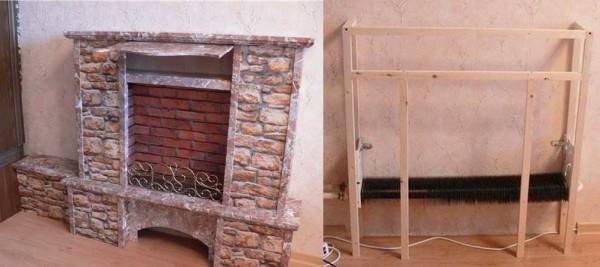
How to decorate a battery under the fireplace with your own hands (click on the picture to enlarge it)
The middle part is just an attached sheet of paper in the appropriate coloring. The photo looks great.
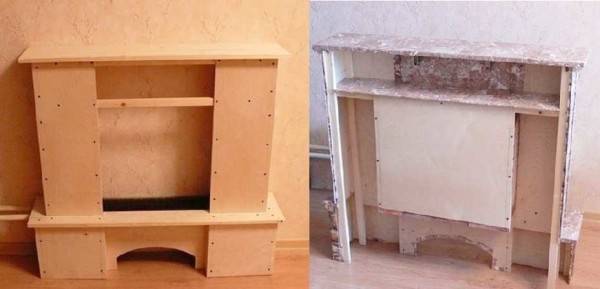
How to decorate a battery under the fireplace with your own hands (click on the picture to enlarge it)
The most common way to decorate radiators along one of the walls is an attached screen. It can be made from wood or MDF. But he just looks ugly. We need more details that will justify its presence in this particular place. Here are some ideas that might be helpful to you.
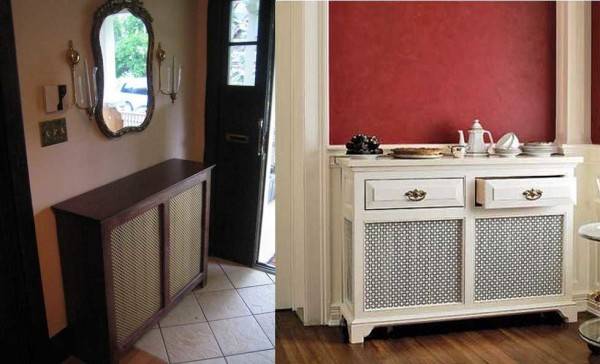
Just put the screen near the wall, it's like writing: "here we hide the radiator" (click on the picture to enlarge it)
Screens are also used to decorate heating appliances under window sills. But closing only part of the wall is like writing in large letters "we are hiding the radiator." And the main task is to hide it, not stick it out. What is the difference - you can see in the photo.
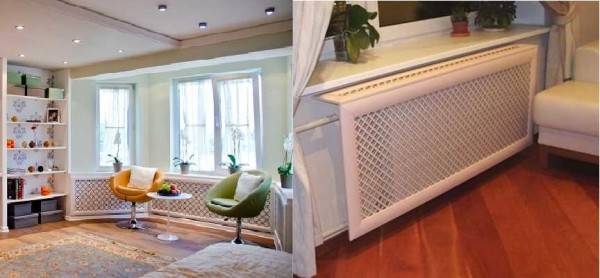
If the screen is from wall to wall, or the entire width of the window, it will not attract attention (click on the picture to enlarge it)
Recent trends do not exclude the use of screens. This is still the most affordable way to hide the battery. The main idea when decorating radiators is that everything should be logical. If the screen - then either the entire width of the window, or, if necessary and possible, then from the wall to the wall. Changed color and stylistic solutions. If frames are needed, then they must be in the tone of the grid. You can make contrasting or eye-catching ones when the room has the same frames on other objects in color and style.
In some cases, the decorative grille may not be in the tone of the walls, but in the tone of the window frame and window sill. But the style has to match.
Beautifully close the batteries in the room: decoration options
The most interesting way to convert the heat source is in several ways:
- using the decoupage technique;
- decorative screens from various materials;
- special decorative film;
- drywall construction.
In turn, each of the methods has many original solutions. Consider the most spectacular and affordable ideas for implementation.
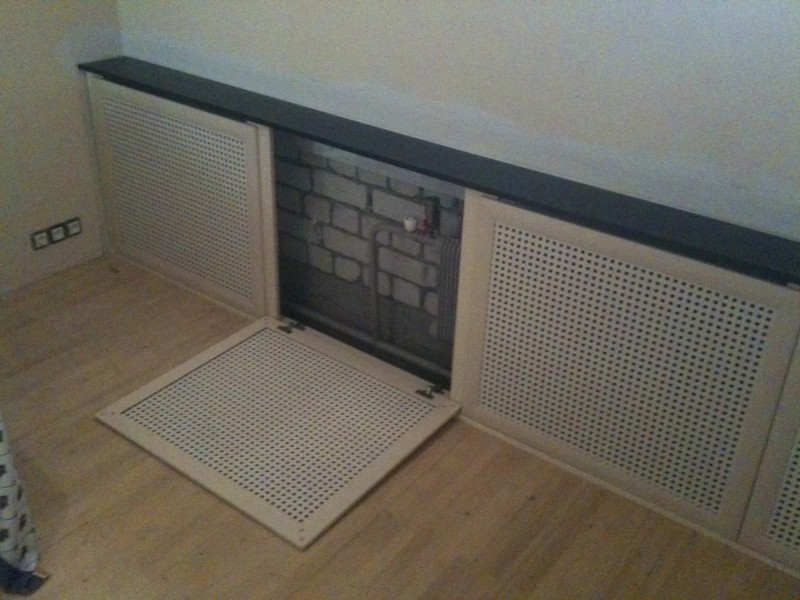
Decorative box with sliding doors
The design with sliding doors is one of the most technically difficult options. But this is the most ergonomic way to hide the battery under the windowsill. Making such a model will require skills in carpentry tools, the tools themselves, the necessary material and drawing. For the facade, we recommend purchasing prefabricated MDF panels with perforation. Fittings, including rails, will help you choose an experienced sales assistant of any furniture store.

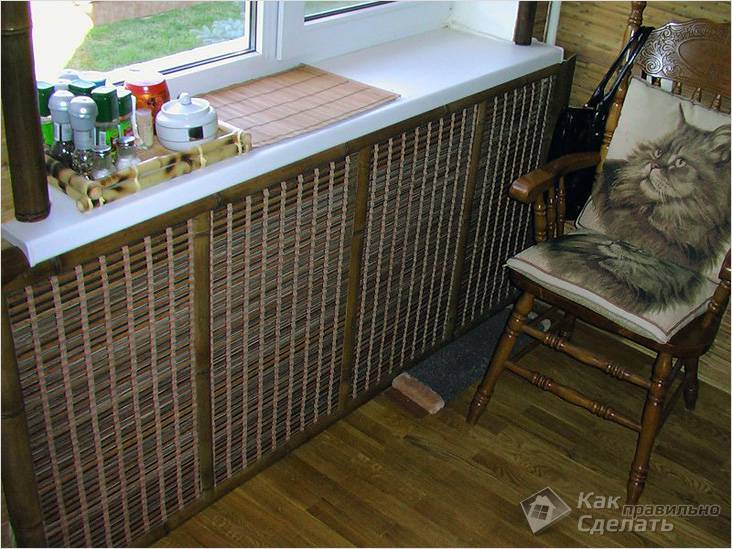

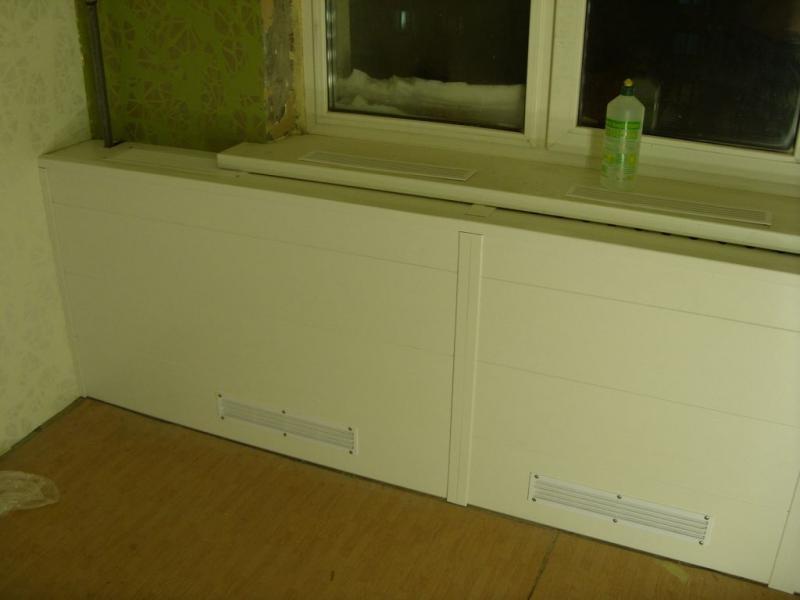


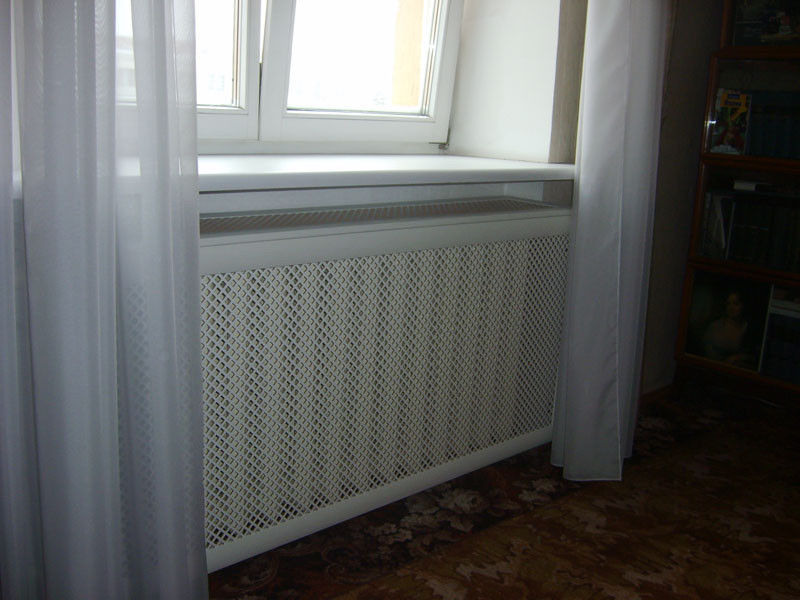


Covers for radiators
The easiest way is to buy ready-made linings in a plumbing store. The range of such camouflage is not rich, but pleases with ease of installation. The pads are easy to install with your own hands, without the help of a specialist. It is enough to drill a couple of holes in the wall and fix the selected pads with fasteners.
Decoupage radiators
Decoupage is not one of the easily implemented ideas. This option will bring a lot of fun to people with creative potential. For those for whom the very process of creativity is already a pleasure. Decoupage technique is a topic for a separate article, it is so complicated.Sufficiently accurate information can be found on the forums of mural lovers.
Decorative film for radiators
The next offer will be especially interesting for families with small children. The construction market will help realize the most daring fantasies that kids will surely like. Particularly spectacular in the interior are glass screens imitating an aquarium.
Another original solution for the nursery is to paint the heating sections in the form of a set of pencils. A drawing from your child's favorite cartoon looks no less attractive.
Antique style radiators
With the help of a simple set of painting accessories, a massive cast-iron battery turns into an antique rarity. Moreover, antique styling is a fashion trend in design.
For work you will need:
- putty knife,
- oil-adhesive putty,
- pattern stencil,
- brushes,
- sponge,
- fine-grained skin
- gold or silver paint on metal.
- Thoroughly sand, rinse and degrease the surface.
- After complete drying, apply the stencil.
- Pick up putty with a spatula and apply to the stencil.
- Once the drawing is dry, apply a coat of gold paint.
- Colorize the edges.
Drywall constructions
We offer another ergonomic way to beautifully close the batteries in the room
If you want to make the most of every centimeter of space, especially in the kitchen, pay attention to drywall. This affordable, versatile material will help you create the most creative designs.
It can be a shelf for a vase, a rack or even a resting place. Having shown imagination, you will get a functional and original element of the interior.
What is especially important in a small apartment
Box of lamellas for central heating radiators
Lamellas are a great way to hide heating appliances. An additional bonus is the visual increase in space. Strips of wood, arranged horizontally, will make the room somewhat wider. And vertical slats will help to "raise" the ceiling in the room. In addition, such a design solution will contribute to the proper circulation of warm air.
False fireplace instead of a radiator
The classic fireplace has always been, is and will be out of competition. Interior designers offer a simple and, at the same time, bold solution - a false fireplace as a camouflage of an old battery.
- Cut a square or rectangular hole in the center of the plywood sheet.
- Etch the shield with stain. Attach it with self-tapping screws to the wall, as you fix the shelf.
- Clean the surface with fine-grained sandpaper.
- Paint the batteries with a brick-like pattern or just white.
- Apply 2-3 layers of acrylic paint to the surface of the portal.
- To simulate fire, attach a lamp to the shelf, which is covered with stones from the garden plot.
Service and Troubleshooting
In centralized heating systems, ordinary industrial water acts as a heat carrier, the purity of which is far from ideal. Having passed through the heating main, to the elevator unit and risers, by the time the water is in the battery, it is enriched with various suspensions, which are deposited in the radiators.
Because of this, the instruments must be flushed every few years. This process requires access to the flush valve located in the lower corner of the radiator on the opposite side of the supply.Thus, if there is no free access to the device, you need to either remove the protective screen (and this is not always possible), or put up with poor heating efficiency. For this reason, when choosing how to close the battery in a room, you should give preference to such a product that will allow you to freely access the heater.
Also, we must not forget that sooner or later the radiator will fail. And since heating appliances are usually hidden due to the fact that they are too old and look unattractive, it is not long to wait for the moment when repairs are needed. The main types of faults:
- risers welded from an electric-welded gas pipe sometimes start to leak along the factory seam (read: “Fixing leaks in the heating system, sealing joints“);
- the steel pipes on the thread in front of the radiator are thinner than the straight sections of the riser, and leaks appear in them first of all;
- cast-iron batteries are characterized by frequent leaks from under the locknut;
- in spring and autumn, leaks often occur between radiator sections - paronite gaskets cease to provide tightness after a few years of operation of the heater (in more detail: “The heating battery is leaking, what to do, how to eliminate the leak in a short time“).
How to fix the radiator screen on the wall
Here is the screen and ready. If you have a screen for a heating battery designed in such a way that its lower part rests on the floor, then you can consider the matter finished.
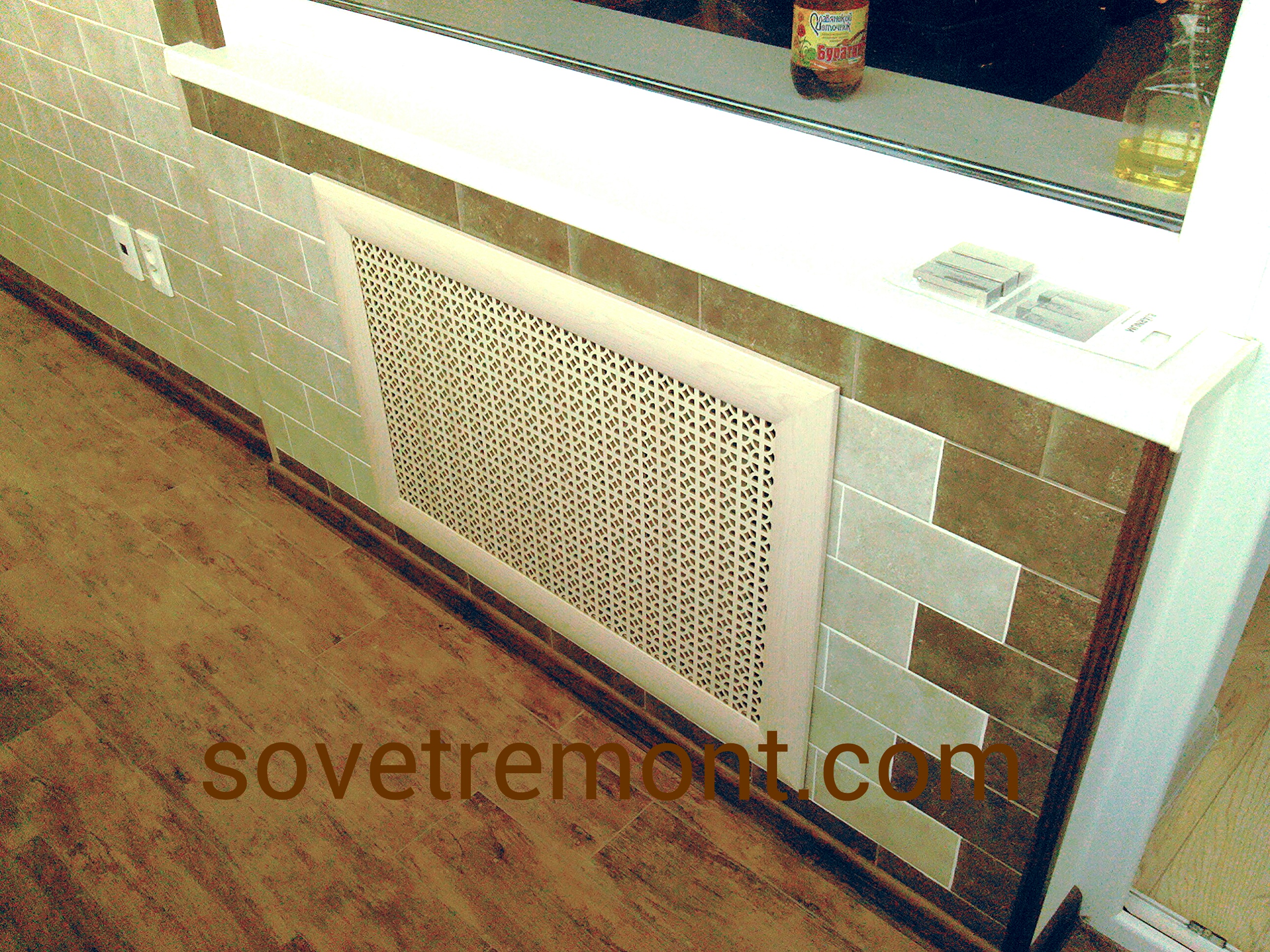
But in my case, since the grate for the radiator is installed in the kitchen, and for aesthetic reasons, it was decided to use a hinged version.One of the main requirements was the ease of removal of the structure in order to remove dust from the radiator and there was access to a drain valve for flushing the battery. The oblong shape of the sample was not made by chance. At first I drilled a hole, but it was not so easy to get on the screw when installing the screen. I had to improve.

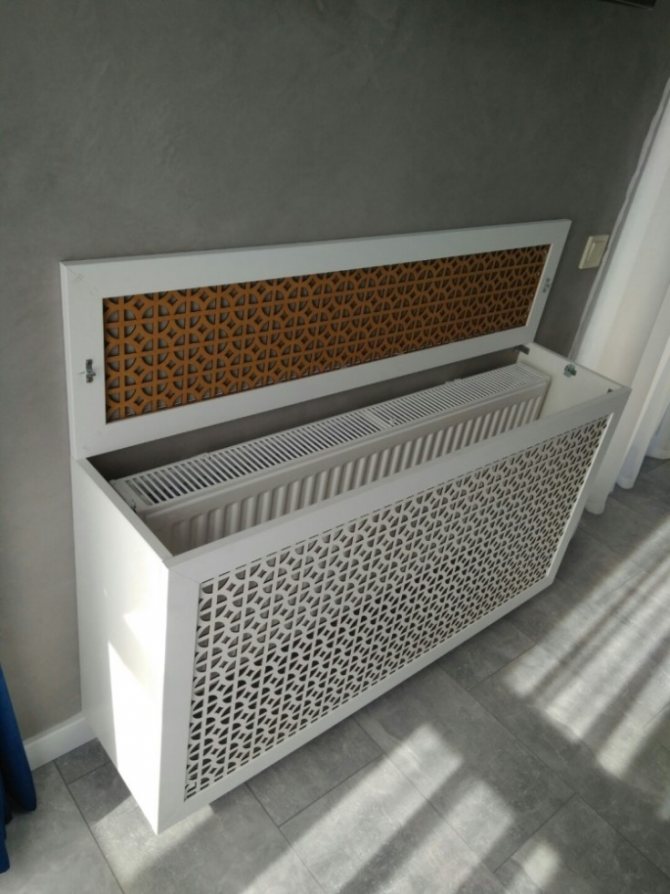
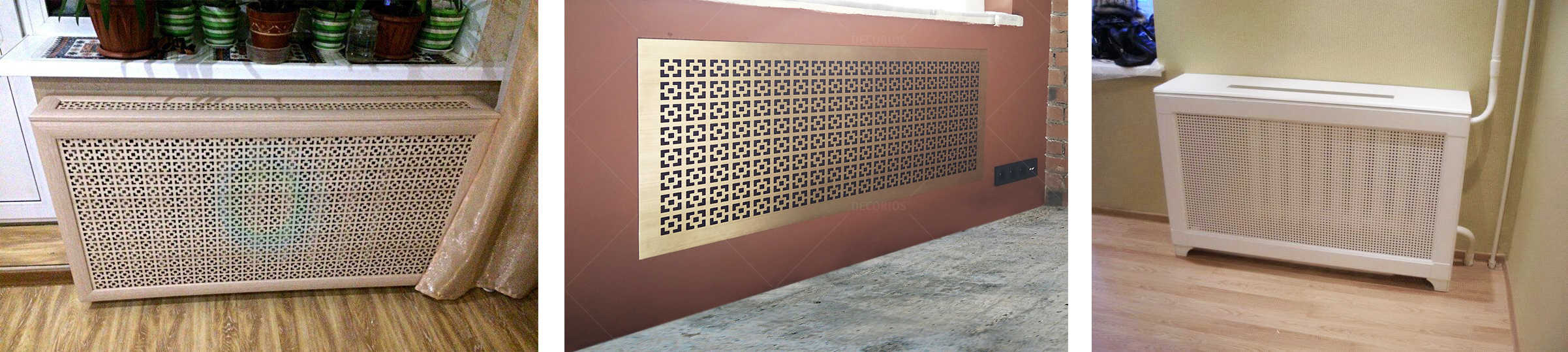

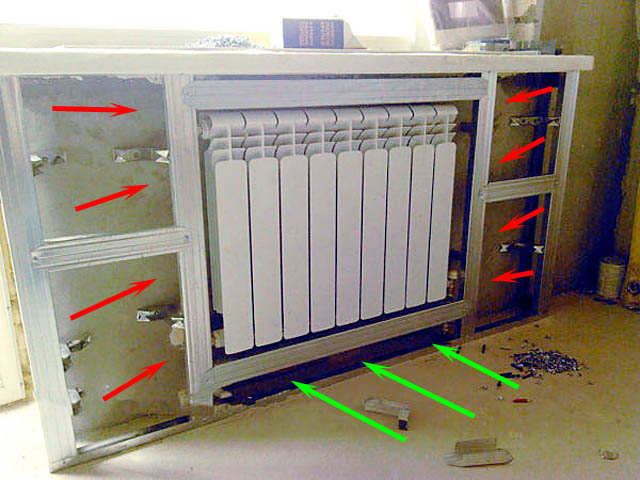




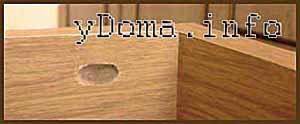
I fixed a corner that turned up under my arm on the wall, into which I screwed an M5 screw, since there was already a threaded hole in the corner at the place I needed. The protruding part of the screw, when the screen is installed in a regular place, is included in the sample and securely fixes the screen. If the length of the corner allows, then you can simply bend it up to a length of 10 mm, and then the sample will fit on the protrusion made. If you are not familiar with the technology of drilling holes in brick and concrete walls, you can fill in your knowledge gap by reading the article “Drilling holes in walls”, which describes in detail the drilling technology, how to choose a drill and choose drills
I draw your attention to the fact that it is better to mark up the sample before weaving, by attaching the screen case to a regular place, after fixing the corner on the wall. Otherwise, the markup will be extremely difficult. Since it was possible to lean the right side of the heating battery screen on the heat supply pipes, only one fastening was made, on the left side
To securely fix the screen on the pipe, in the place of its abutment against the upper pipe, a selection was made a few millimeters up
Since it was possible to support the right side of the heating battery screen on the heat supply pipes, only one fastening was made, on the left side.To securely fix the screen on the pipe, in the place where it rests on the top pipe, a selection of several millimeters upwards is made.
The same sample was also made on the down tube, although it can be omitted. And so the screen will be fixed securely.
We close the battery screen and invite friends to the presentation! No one believed that I made this screen with my own hands. I had to prove it, remove the screen from the battery and show it from the inside.
A simpler approach
The complexity of the work in this case depends on what kind of material you need to decorate the surface. If it is paint, then everything will be very simple - you just need to purchase a special brush with a curved handle or make your own kind of thin roller by attaching a foam rubber coat to the wire. With other materials it is more difficult, and there are several finishing options:
- Wallpaper
- Plaster
- Plastic or mdf panels
- foam ceiling tiles
- Tile
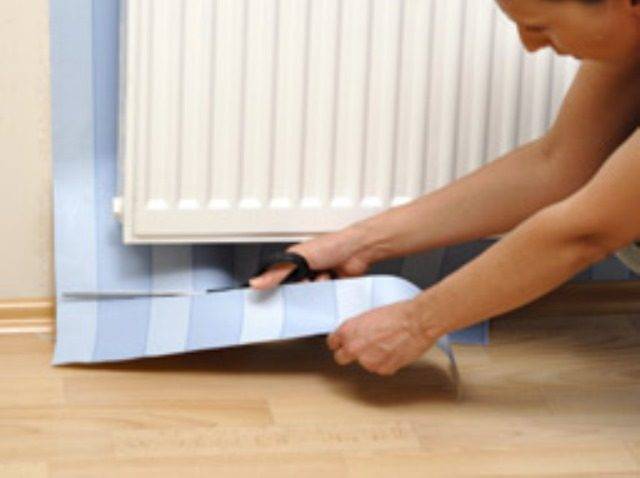
The most difficult thing will be with the tile - it does not bend, it is difficult to stick it into the narrow space behind the radiator, and it is even more difficult to align the tiles relative to each other. In addition, you will have to cut grooves in some tiles, which will include brackets on which the heater hangs. That is why the decoration of the walls behind the battery with tiles is usually carried out with the removal of the heating device.
It is not so difficult to deal with wallpaper and the most important point will be a tight pressing of the panel to the surface. The cut canvas is smeared with glue, pushed behind the radiator and leveled there with a long brush with a curved handle or other suitable device. Bubbles cannot be completely removed, but in this place they are practically invisible and this moment will not be the most critical.The main thing is to glue a piece of wallpaper well so that it does not peel off later.
Panels are also easy to install. They can be fixed with glue or with a crate. In the first case, the work is simple and there is no need to consider it separately. The second case is not so simple. You will have to arm yourself with a screwdriver with a very long sting in order to be able to screw the panels through the heater sections. In addition, finishing the walls behind the radiators with panels on the crate is possible without removing them only with a vertical arrangement of the panels. Otherwise, it is almost impossible to mount the crate. The most difficult case with plaster and it is worth talking about it separately.
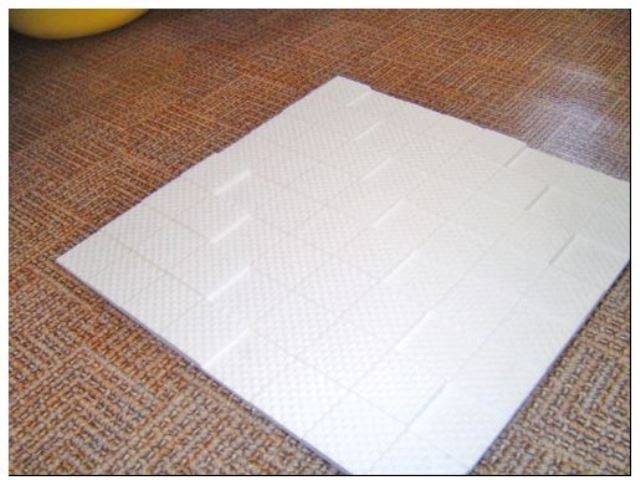
In addition to all the above methods of decorating the surface behind the radiator, there is another universal option that is not suitable in all cases - decorating the walls behind the radiator with ceiling tiles. It is simply glued to the desired surface, easily pushed into a narrow space. However, this method is not always suitable, since the designed surface will differ from the rest of the space.
Conclusion
To close any heating element, special screens are used, which can be done independently. The main thing is to correctly calculate the size of the structure and complete the frame.
How to sew up a battery with drywall
The most difficult stage in the construction of a wall or box for a drywall battery is the creation of a metal frame. The installation of drywall itself is not difficult. It is carried out in the following sequence:
- a sheet of drywall is applied to the frame of profiles;
- using a pencil or felt-tip pen, markings are applied to it, indicating the places of the cuts;
- then the sheets are cut into pieces of the required size and shape. It is convenient to do this with a clerical knife with replaceable blades;
- the finished parts are leaned against the part of the frame under which they were cut out, and attached with screws.
The interval between the screws should be 10-15 cm. Pieces of drywall should be cut one at a time and immediately mounted in their place, otherwise it is easy to get confused due to protruding corners in some places.
It is important not to overdo it when screwing screws. If, without calculating the force, they are screwed in too deeply, then the material at the place of their installation will be damaged.
A plastic screen with holes for heat penetration is installed in the front plane of the box. Even before the installation of drywall, its inner part is fixed on a metal frame. After the box is completely ready, then its outer part is inserted into the hole for the screen.
Finishing the structure
The finished structure still needs to be prepared for fine finishing. This process includes several steps:
- it is necessary to seal the joints of the drywall parts so that they represent an absolutely smooth surface. For this purpose, a sickle mesh is applied to the joint, after which it is puttied;
- now the installation sites of fasteners are processed in the same way;
- to give the corners of the structure additional strength and clarity of lines, perforated corners are installed on them;
- after that, the entire structure is puttyed, regardless of whether it is a box or a wall. When the putty layer is completely dry, it should be leveled and sanded with fine sandpaper.
The last step is finishing. After its completion, work begins on the design of the box.It is best to decorate it in accordance with the style, interior and color scheme of the entire room.