
- mechanical cleaning
- Video: cleaning with a ruff from a plastic bottle
- Video: cleaning the chimney with firecrackers
- Burn the soot with fire
- Cleaning methods
- Mechanical
- Chemical
- Mechanical way to clean the chimney
- What is ersh?
- How to clean a chimney with a ruff:
- Is it possible to clean a complex winding chimney with a ruff?
- Chemistry for soot control
- Features of cleaning stainless steel pipes
- Why does the chimney get clogged?
- Mechanical soot removal technology
- Chimney sweep tools and ammunition
- Working conditions: safety basics
- Step-by-step process of cleaning the chimney
- How to reduce chimney pollution?
- Selecting the optimal fuel
- Dependence on humidity and combustion temperature
- When is it time to clean?
- Mechanical tools for removing blockages
- Chimney cleaning methods
- mechanical cleaning
- Chemical cleaning
- Folk ways
mechanical cleaning
There are traditional sets of professional chimney sweeps - weights, brushes, scrapers and ruffs on chains and flexible cables. They do not belong to mass demand goods, so they are purchased in specialized stores or ordered directly from manufacturers. Modern industry also offers complex devices for large volumes of work: vacuum cleaners, vacuum units, punches smoke and ventilation ducts, live steam generators.
The chimney sweep is depicted on a coin of 1 lats
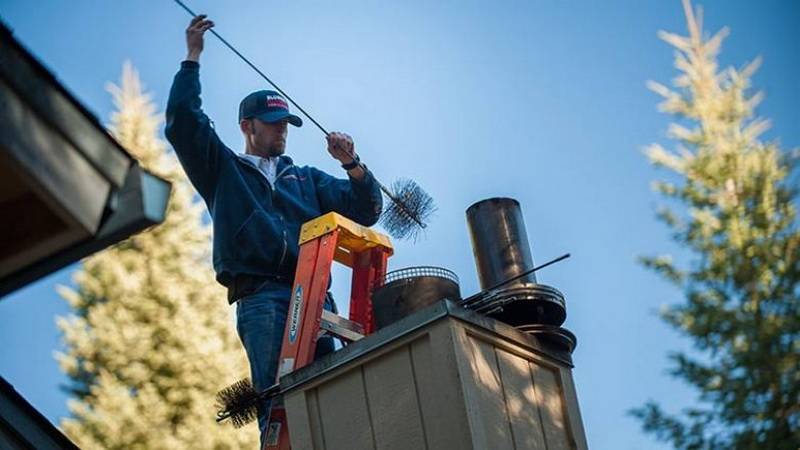
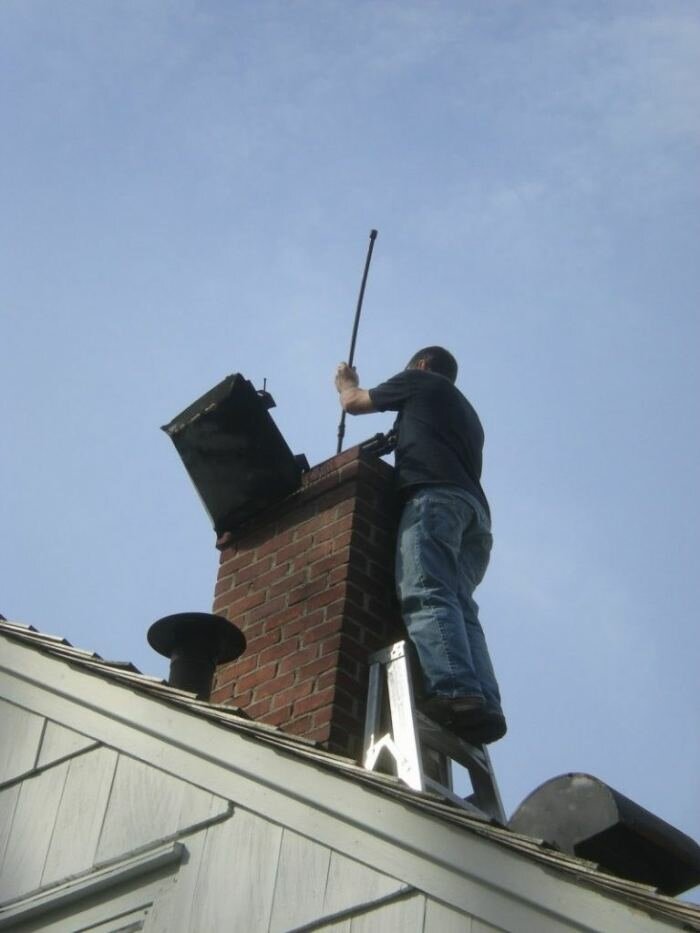
The technique of work is simple, the main thing is to remove the accumulated soot and other layers of products of incomplete combustion as much as possible. The chimney sweep rises to the roof, where, with the help of cables (chains), he sharply lowers a weight with a ruff into the chimney. Ruff knocks down soot, it crumbles into the furnace. Additionally, scrapers and brushes on long flexible poles are used. If inspection holes are provided in the chimney, which are normally closed with dampers, they are also used for cleaning and inspection. In fireplaces and in some types of stoves or boilers, there is the possibility of partial penetration into the chimney from the side of the firebox.
In the absence of special tools in the household, you can get by with improvised means. Any chain will do, it can be easily replaced by a plumbing cable, hose or strong rope. Instead of a weight, they tie an old barn lock, a dumbbell, a plastic bottle with sand, a stone in a stocking. You can’t quickly make a metal ruff, but the same plastic bottle will help out.
Video: cleaning with a ruff from a plastic bottle
If a powerful draft is created in the chimney, then the soot will rush up the pipe in a natural way. Folk craftsmen use vacuum cleaners, fans, chainsaws and grinders for this. True, this method is not always practical, since puffs of black smoke rush into the atmosphere, and soot falls on the plot and to the neighbors.
In this case, reasonable care and agreement is required.
Devices that can create a sharp shake inside the chimney give a good effect on soot collapse. Even firecrackers come into play.
Video: cleaning the chimney with firecrackers
Burn the soot with fire
For chimneys made of refractory bricks use dry firewood from alder and aspen. They quickly burn out with a flame temperature up to 1100 ° C. At this temperature, the soot burns out completely. The method is ancient, but nowadays it is rarely practiced due to restrictions on fire safety rules.
The procedure is as follows:
- They collect aspen and alder firewood and dry them well.
- They clean the firebox from coals and ash, fully load it with prepared firewood and ignite it.
- Alert fire fighting equipment.
- During combustion, sparks from the chimney are controlled and ensure that sparks do not accidentally ignite the roof or adjacent buildings.
- If necessary, load the furnace again and repeat the ignition.
- The work is considered completed if white flakes fly from the pipe and the characteristic buzz from burning soot stops.
This method has found its development using other means of burning soot. Gasoline, diesel fuel, naphthalene were used. But it is better not to risk and not to experiment. Such combustible substances are not safe, their vapors are capable of a volumetric explosion. It will blow away not only soot, but the entire chimney.
Cleaning methods
Most often in practice, two methods are used to eliminate blockages in chimneys: chemical and mechanical. As a prevention of pollution, you can use the biological method of cleaning chimneys. The choice of method depends on the degree of contamination and the technical features of the chimney design.
Mechanical
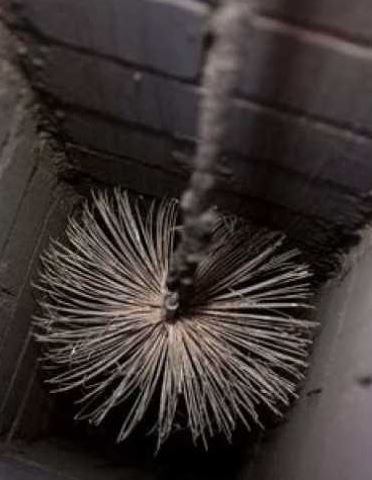 Pipes are cleaned of soot buildup using special ruffs. They are hung on flexible cables and weighted with a load that is centered. When immersing the ruff in the chimney, distortions should not be allowed.
The best are brushes with metal or plastic bristles. The first brush option cannot be used to clean soot in metal chimneys.
Before the ruff is immersed in the pipe all openings must be closed.available in the oven. Through them, soot dust can enter the room.
When everything is ready, the ruff begins to be slowly dipped into the chimney, keeping it strictly in the center. Chimneys, which have several turns in their design, are cleaned not only from above, but also from below.
Expert opinion
Torsunov Pavel Maksimovich
For lower cleaning, the brushes are attached to flexible or prefabricated sticks. They are introduced into the chimney through special vents. When cleaning the chimney, the devices must move progressively up and down. Circular movements lead to imbalance and spin of the cleaning tool. Work is carried out in dry, calm weather.
Chemical
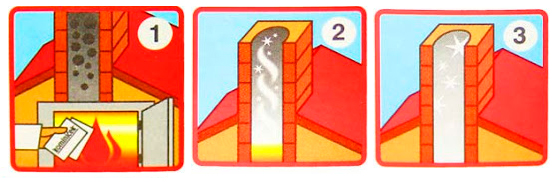
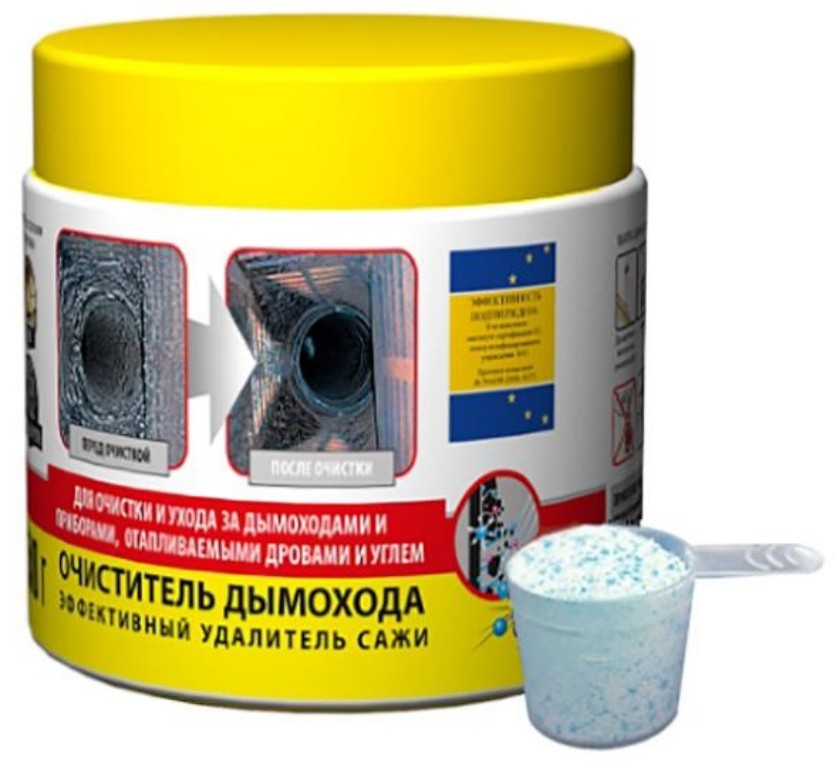
The essence of the method is to burn chemicals in the furnaces of furnaces along with fuel. When burning, they release substances that destroy the structure of dirt growths inside the chimneys. This method can be used for furnace structures made of any kind of materials. For stainless steel pipes steel and ceramics, this method is recommended as the only acceptable one. Conventionally, all chemicals are divided into household and special.
Household substances include substances that are not directly intended for cleaning chimneys, but can be used for these purposes. Many summer residents always have them in stock. Such means include naphthalene and a mixture of copper sulphate, saltpeter and coke of the middle fraction, which is prepared in a ratio of 7:5:2. These substances cope with cleaning chimneys no worse than special tools.
Naphthalene has one significant drawback - a sharp, irritating smell to the nasal mucosa. After burning it in the furnace, the room has to be ventilated for a long time. Experts do not recommend using it in stoves with open fireboxes and fireplaces.
The most common specialty chemicals:
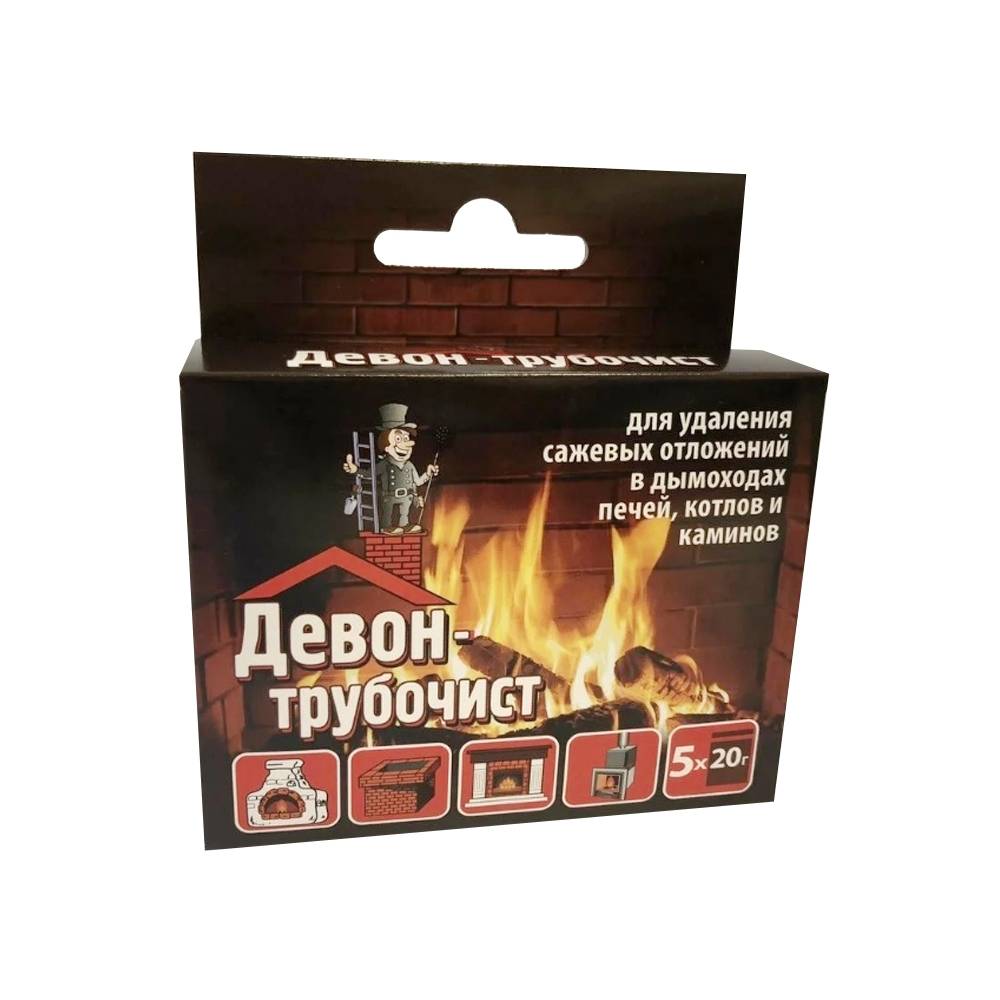
Log-chimney sweeps
Made in the form of a bar, the product releases substances during combustion that corrode soot buildup in the chimney. It is recommended to burn such a log together with firewood once every 1-2 months.
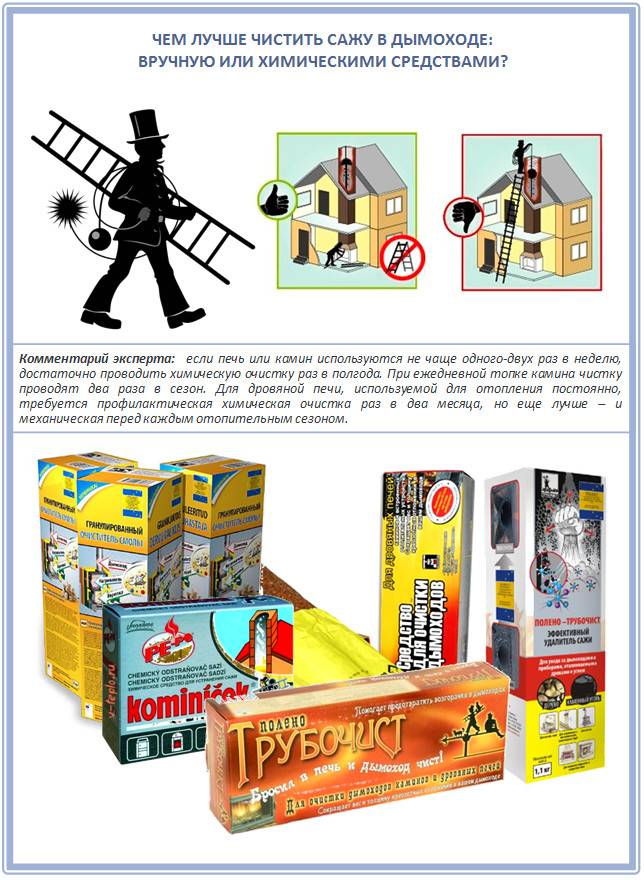




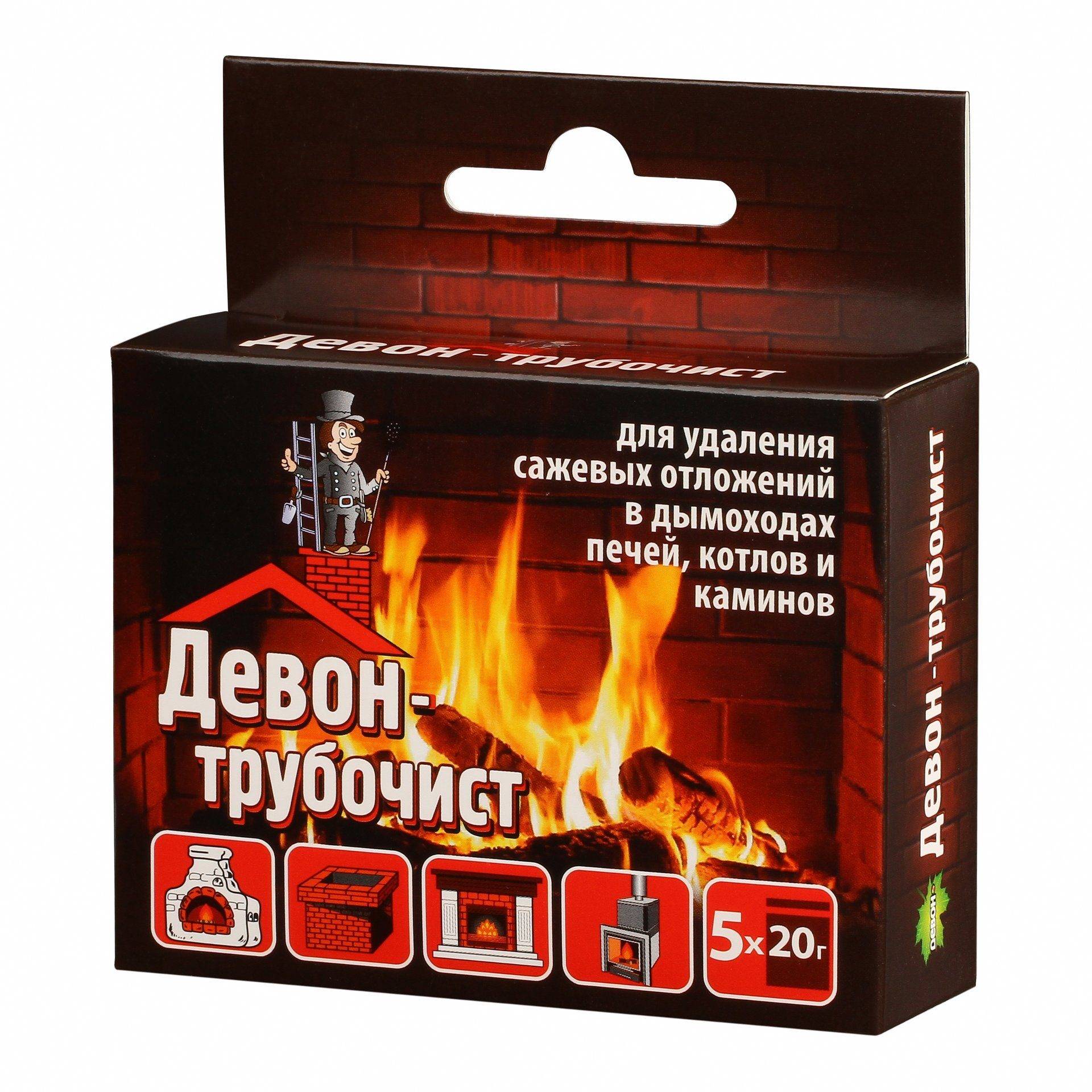
Kominichek
Long lasting agent. In order to clean the chimneys, it must be burned during the heating season for 30-40 consecutive days.
"Hansa"
The tool is intended for the destruction of creosote layers. Pulling moisture out of the resins, "Hansa" leads to their peeling from the walls of the chimney.
PCC powders
They are burned in the furnace along with fuel and packaging. The dosage of drugs should not exceed 200 g per 1 ton of firewood.
"Smoke"
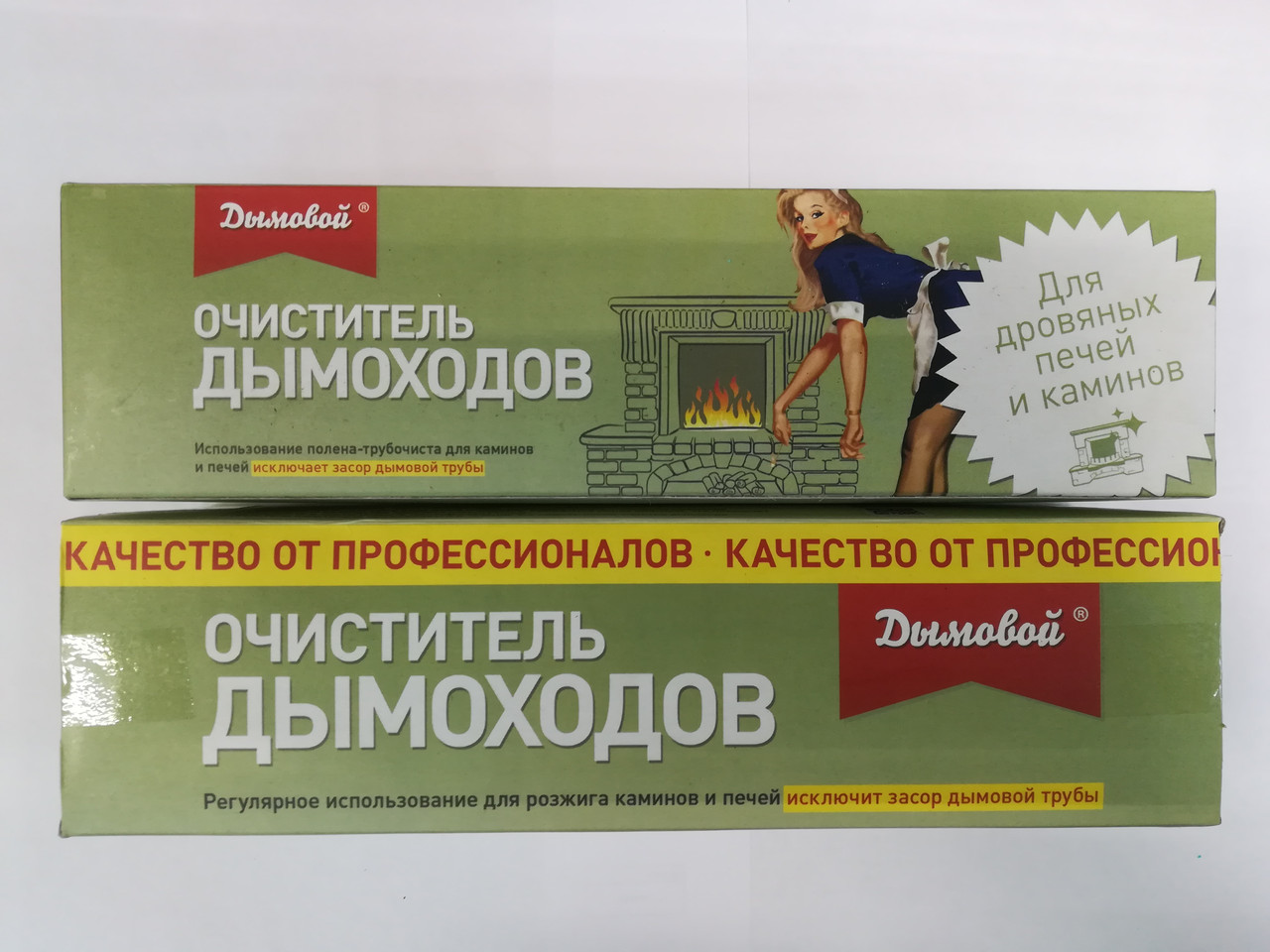
A series of chimney cleaners available in the form of boxes, logs and pellets.
Chemical funds can be used not only for cleaning chimneys, but also for preventing their pollution.
Mechanical way to clean the chimney
Mechanical cleaning consists in removing soot using a metal ruff, which is inserted into the chimney and, making rotational and translational movements, scrape off the soot from the surface of the chimney. The method has several advantages: it is effective against blockages and hard deposits, it is cheap and quite simple, and does not require special knowledge and skills. At the same time, manually cleaning the chimney through the pipe is a rather dangerous task, because you have to climb onto the roof.
What is ersh?
This is a twisted cable with steel wire, equipped with a twisting handle on one side and a wire or plastic nozzle on the other. The length of the cable can be different and depends on the length of the chimney. The ruff is introduced into the pipe forward with a nozzle, while rotating its handle. In this case, the rotation is transferred to the nozzle, and it mechanically scrapes off the soot layer from the pipe walls.
Chimney brush
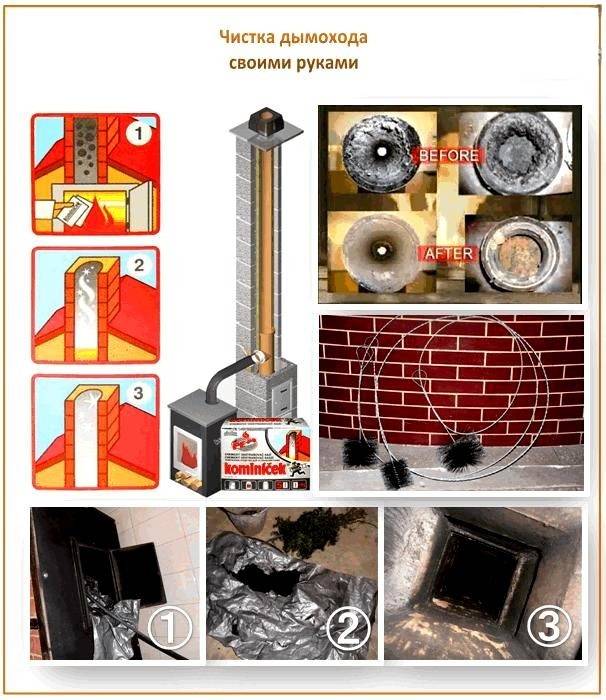
How to clean a chimney with a ruff:
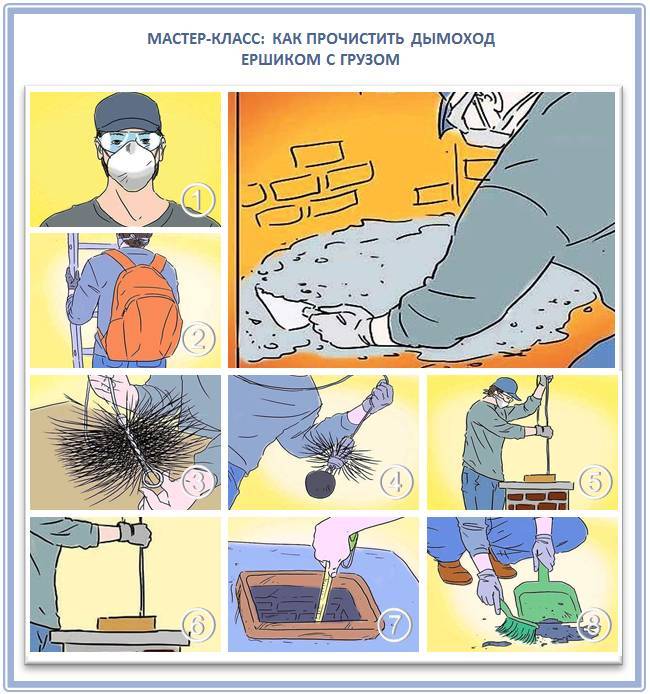
Fully open all latches and vents that block draft in your stove or fireplace. Place a container for soot under the chimney at the mouth of the stove or in the fireplace insert - there will be quite a lot of it. In order not to stain the furniture and floors in the room, an open fireplace insert can be curtained with an unnecessary cloth.
Observing safety precautions and using a safety belt, climb to the roof. Remove the cap from the pipe
Carefully insert the cleaning cable into the pipe and try to push it some distance. Rotate the handle on the cable at the same time
If the length of the chimney is more than 3 meters, it is more convenient to do it together - one person directs the cable into the pipe, the second rotates the handle, standing at a certain distance.
If the cable does not pass through the gap of the pipe in any place, it is necessary to determine where it is stuck - at a bend in the pipe or in a straight section. If the pipe in this place does not have turns, most likely, a serious blockage has formed there. It can be pierced with a weight tied to a rope, lowering it into the pipe rather sharply.
It is necessary to clean the chimney using this method until the moment when soot stops pouring from the chimney into the furnace.After cleaning, check the draft with a lit newspaper - it should improve significantly.
It is necessary to clean the chimney using this method until the moment when soot stops pouring from the chimney into the furnace. After cleaning, check the draft with a lit newspaper - it should improve significantly.
It is sometimes impossible to clean a Russian stove with a complex chimney, including several turns at an angle of 90 degrees, with a ruff through a pipe from the roof - the length of such a chimney is quite large, and the ruff is stubbornly doesn't want to go through turns. In this case, it is possible to combine pipe cleaning with mechanical cleaning of the chimney.
Is it possible to clean a complex winding chimney with a ruff?
Of course you can, to do this, follow these instructions clearly:
-
Inspect the oven carefully. On its side and back walls you will find doors designed for cleaning the chimney. They may be smeared or painted over, but they will need to be opened. Place a bucket or other container under each door.
-
Change the standard nozzle on the ruff to a plastic bottle, cut in half and slightly notched around the circumference so that you get a "chamomile". You can fix it like this: the ends of the wire, acting as a ruff, must be collected in a bundle, passed through a cork with a hole previously made in it and bent. Screw the cork onto the bottle. The plastic brush is much softer than the metal brush and goes through the turns better, and by using different bottle sizes you will be able to gradually clear all the turns.
-
Enter the resulting device into the chimney from the side of the firebox and push it as deep as possible, rotating and from time to time extracting it along with the soot that has fallen into the bottle.Clean the chimney until the amount of soot is reduced to negligible. Also clean the chimney from the side of all doors.
- Open all dampers and clean the chimney from the roof as described above. If you do this before cleaning the chimney, you can seriously clog it, as there is simply nowhere for soot to fall.
- Once again, clean the chimney from the side of the firebox. Sweep away soot with a brush, including from latches and views. Close all doors on the rear and side walls and check the draft with a newspaper or a torch. With good draft, light the stove with a small amount of wood. If the doors for cleaning the chimney are smoking, cover them with a solution of clay and sand.
Sometimes, instead of doors for cleaning the chimney, stove-makers install removable bricks. It is not recommended to remove and install them yourself without special skills; it is better to contact specialists to clean such an oven.
Chemistry for soot control
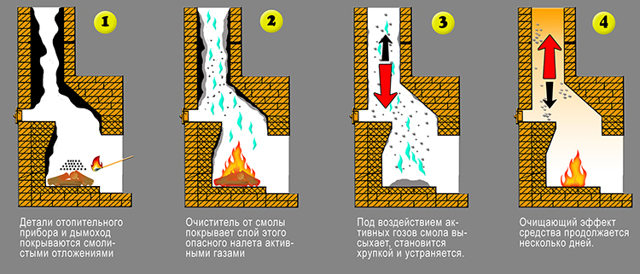
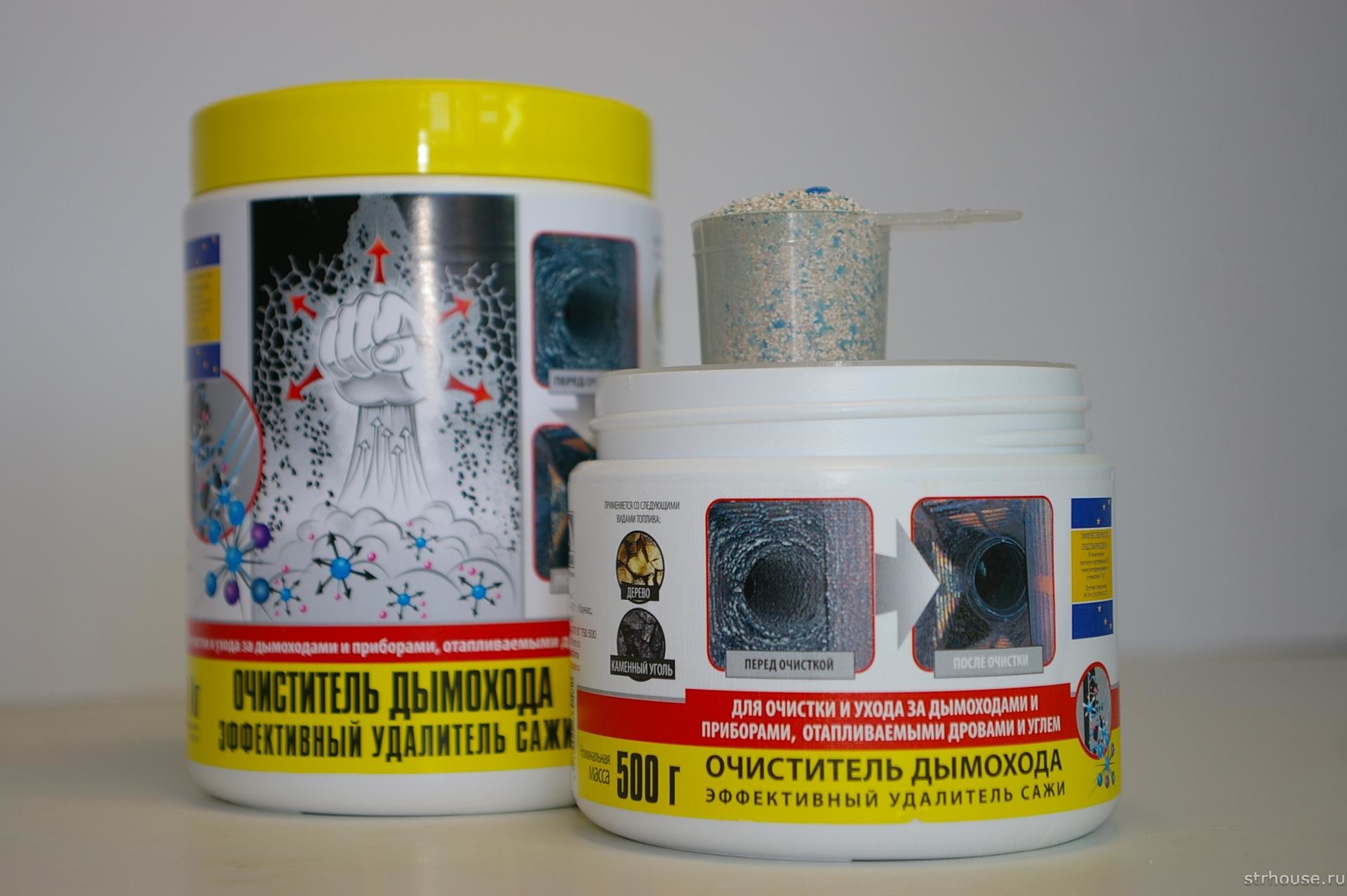
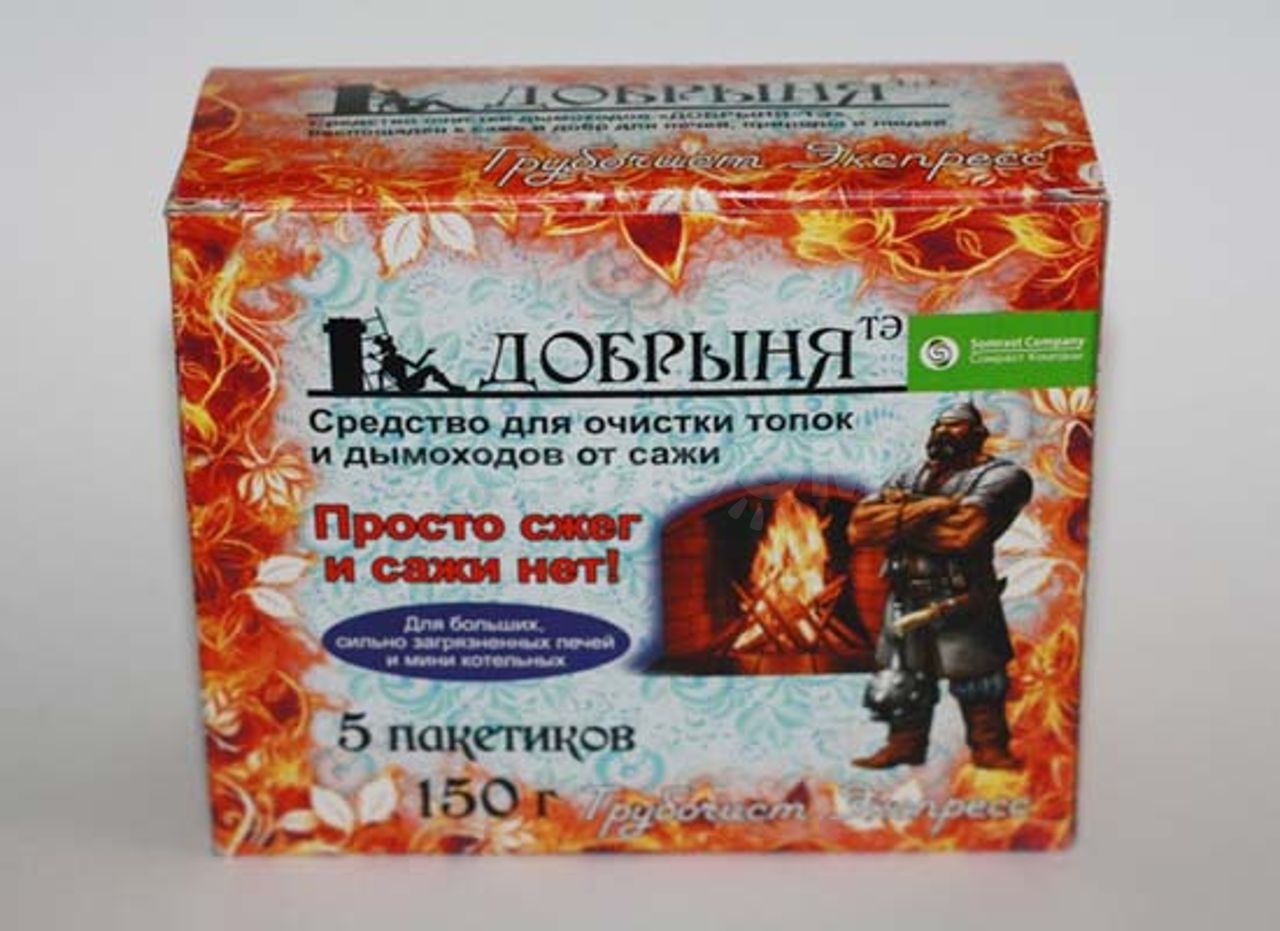
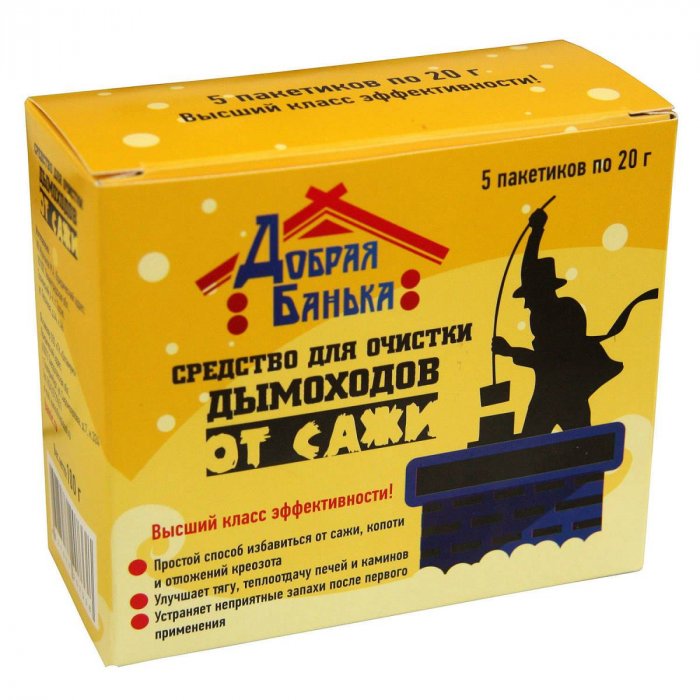
To reduce the need for chimney sweep services, you can use chemical agents to prevent the formation of soot - liquids, powders or briquettes that must be added to burning wood. All these tools contribute to the destruction of the soot layer and its shedding down the walls of the chimney.
The most popular means:
- PHC protivonagarny powder - is burned simultaneously with firewood, 150-120 g is enough for one ton of fuel;
- cleaner Kominichek - a product made in the Czech Republic and sold in the form of a package with five sachets weighing 14 g;
- chimney sweep log - has the shape of a bar, when burned, substances are released that clean out carbon deposits along with the flow of combustion products escaping through the chimney;
- Cheerful chimney sweep powder contains resins that lower the temperature and help burn out soot, it is not a toxic agent, which distinguishes it from competitors.
You can buy all of the above chemicals at any household supermarket.

According to the instructions, one bag is enough to clean the stove or fireplace, two are required for a wood-burning heating boiler. The bag should be thrown onto the burning firewood without opening it, and the firebox door should be closed. The dose cannot be increased.

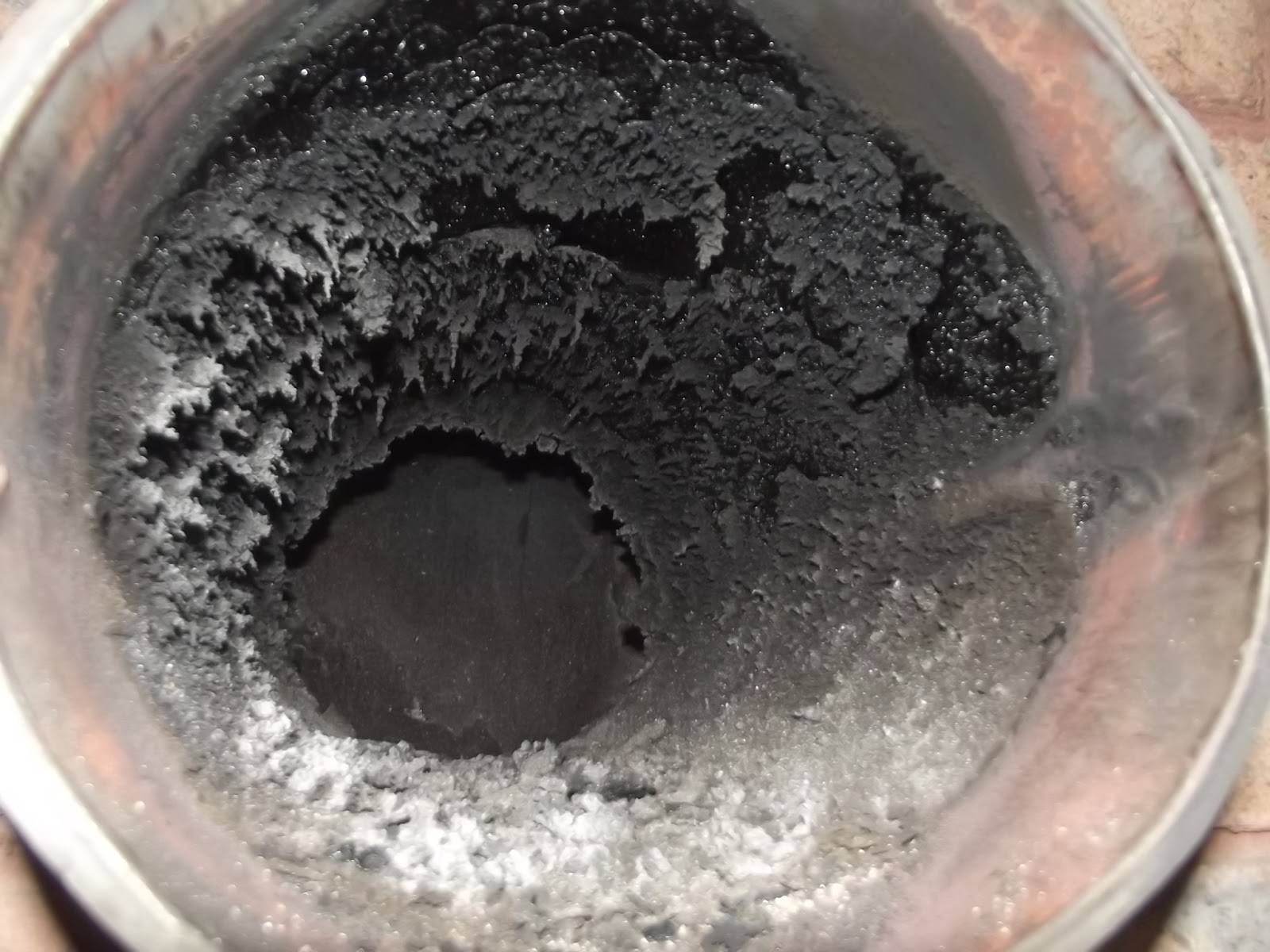




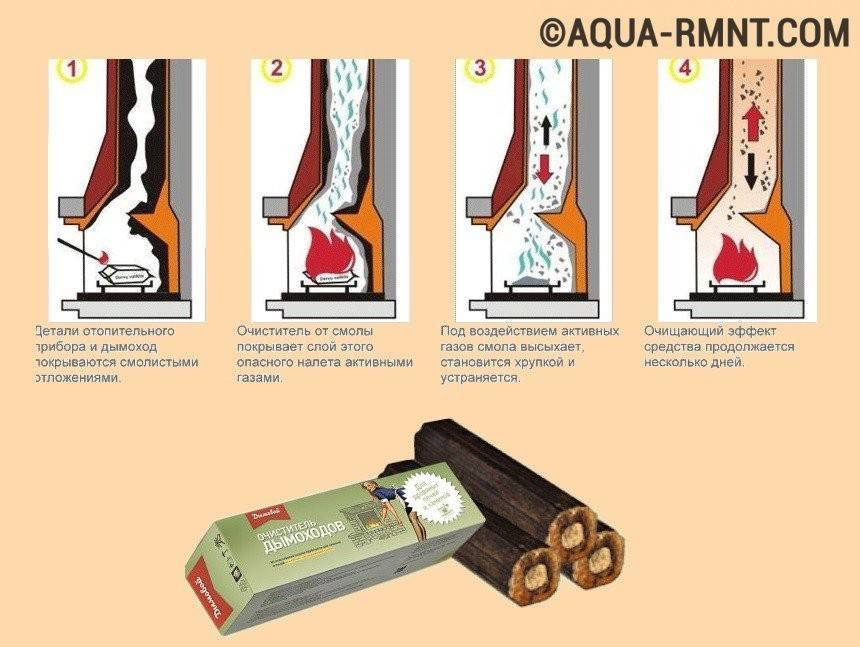

If the soot layer is very thick, it is better to repeat the procedure. For prevention purposes, it is advisable to burn one sachet every two weeks. In addition to removing soot, this tool increases the efficiency of wood-burning heaters and saves money when purchasing fuel.
The second most popular tool is the Chimney Sweep log - a bar (briquette), during the combustion of which substances are released that act on soot deposits and contribute to their shedding down. The main purpose of this chemical cleaner is to prevent narrowing of the chimney section due to soot and soot deposits.
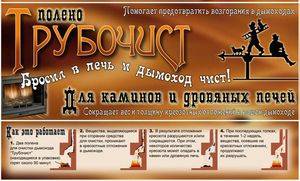
Stove maker's note: in large Russian stoves, it is necessary to burn two briquettes of "Chimney Sweep" at a time.
The "chimney sweep" consists of sawdust, coal wax with coal dust, ammonium sulfate, urea, zinc chloride, sodium sulfate, silica and phosphorus oxide. This tool is especially effective for brick chimneys.
Before using the Chimney Sweep for the first time, you must make sure that there are no loose bricks, debris, bottles or bird nests in the chimney. The most efficient burning of briquettes is on hot coals. Additives entering the pipe affect its inner surface to two weeks.All this time, soot falls into the furnace from above. After two weeks, it is advisable to clean the knee and the smoke damper.
Features of cleaning stainless steel pipes
AT stainless steel chimneys a special condensate collector is provided - a special compartment where water flows from the surface of the pipe. It is periodically opened, moisture is removed and put in place. But in any case, cleaning should be carried out annually. For this, it is recommended to use mechanical cleaning method from soot and resinous deposits:
Attach a round brush with hard bristles to a flexible shaft. Immerse into the pipe and start rotating with an electric drill (you can also manually)
Carefully move down, focusing on the sensations: how freely the brush will pass. clean the stove
Burn potato peels or chemicals. Check traction. After the procedure is completed, insulate the riser so that excess condensate does not form due tofor temperature fluctuation.
Attention! If the pipe is magnetic, then the material from which it is made belongs to the ferritic or semi-ferritic class.
In the future, it is better to replace it with austenitic stainless steel - this design will last longer.
Why does the chimney get clogged?
Chimney clogging is a natural process that occurs as a result of combustion. Only part of the fuel, breaking up into fractions, acquires a gaseous form and goes out into the atmosphere as an emission.
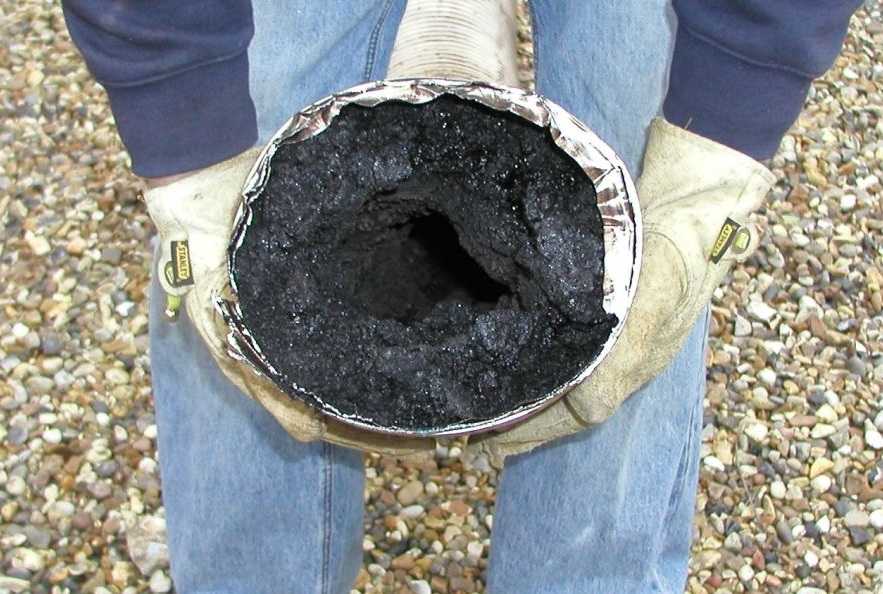
Other fragments with a heavier, denser structure take the form of soot deposits and settle on the inner surface of the pipeline, over time significantly worsening its throughput.
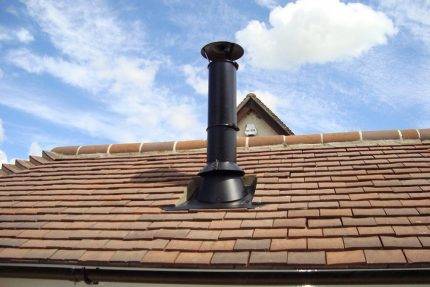 The chimney coming out of the roof must be closed with a special windproof cap.Then, during the period of seasonal downtime, a bird or wasp nest will not be built there, and in winter leaves, branches, ice and other foreign elements will not get inside
The use of firewood from coniferous trees provokes clogging of channels. Viscous resinous substances, contained in excess in the composition, form a powerful adhesive base and help retain soot deposits on it.
Such contamination is difficult to prep clean and requires careful removal by means of mechanical devices.
Household garbage, packaging containers, remnants of old furniture, textiles and other items that are not a fuel resource by definition emit caustic ether complexes, heavy carcinogens and resinous compounds during combustion.
Therefore, burning in the furnace or fireplace of such human waste adversely affects the operation of heating equipment of any class.
All of them in the form of a dense, viscous sediment cover the inner surface of the pipes and create conditions for retaining soot, soot and soot. The channel through which the gaseous elements escape into the atmosphere narrows to a minimum, the draft overturns, and part of the smoke enters the living room.
The temperature in the room drops and the use of heating equipment becomes dangerous due to the risk of carbon monoxide poisoning.
They accelerate the clogging of the chimney channel with deposits of firewood from a recently sawn, damp forest.
If the current moisture content of a log exceeds 12%, it is strictly forbidden to throw it into the firebox immediately. It is necessary to dry it thoroughly in a warm room for at least 1 week.
A damp log reduces the level of heat transfer by 35%, contributes to the rapid clogging of the smoke exhaust system, and eventually disables it.
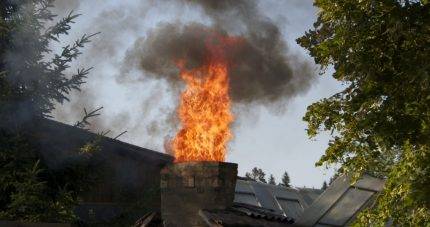 The soot, which covers the inside of the pipe in a thick layer, is highly flammable and can suddenly ignite. This is fraught with a fire in the room and the spread of fire to neighboring houses and nearby outbuildings.
Sometimes an active accumulation of soot inside the pipe provokes errors that are accidentally or due to inexperience made in the process of laying the furnace and arranging chimney for fireplace or stoves.
It could be:
- incorrectly calculated angle of inclination of the pipe;
- too thin walls of the drainage system;
- improperly selected chimney pipe;
- increased volume of condensate formed due to insufficient thermal insulation;
- excessive number of bends and turns of the chimney path;
- roughness on the inner surface of the outlet channels.
It is these reasons that accelerate the pollution of chimneys and several times reduce the efficiency of stoves, boilers and fireplaces. Homeowners are advised to be very careful in choosing stove-makers and contact only those who have already confirmed their skills and high qualifications.



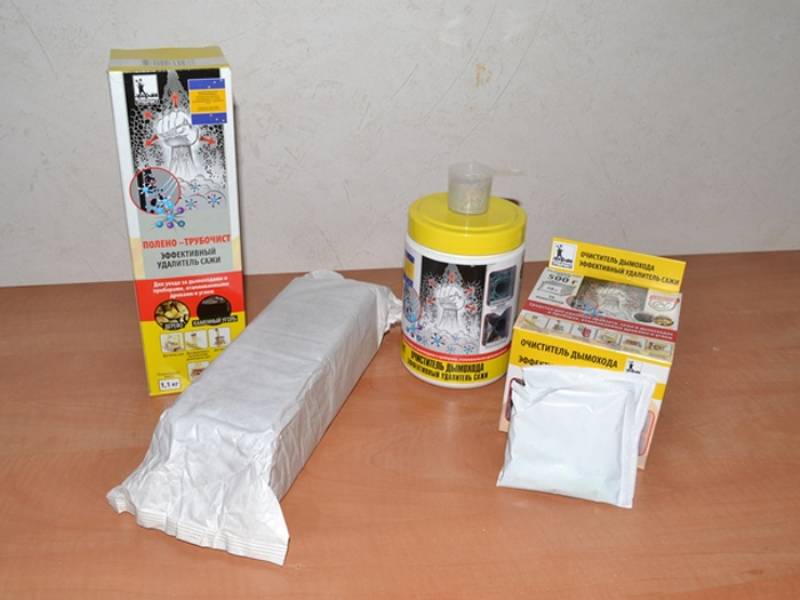
Otherwise, with enviable regularity, the question will arise of how to clean a home chimney, giving you a lot of trouble and requiring constant financial costs.
Mechanical soot removal technology
The most effective method to quickly bring the chimney back to normal is mechanical cleaning. The work is laborious and requires the performer to comply with a number of rules.
Chimney sweep tools and ammunition
Cleaning accessories chimneys used many years ago are still relevant today.
Indicative list:
- A metal ruff with a diameter of 20-30% more than the cross section of the chimney. For square pipes, a stiff brush is selected.
- Cable and brush holders.
- Steel round core with rope and carabiner. The diameter of the weight is 2/3 of the cross section of the chimney.
For cleaning, it is better to choose a brush with nylon hard bristles.
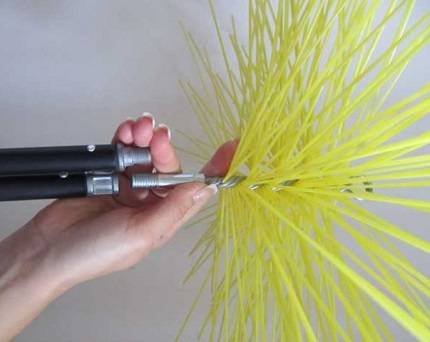
Polyamide bristles take the form of a channel, and unlike a metal scraper, do not scratch the inner walls of the chimney. The high flexibility of nylon helps to get rid of plaque in hard-to-reach places in the chimney
Before doing dirty work, you need to take care of personal protective equipment - wear long-sleeved clothes, goggles, a respirator and gloves, put on shoes with non-slip soles.
Working conditions: safety basics
When cleaning, it is important to observe the following precautions:
- The inspection hatches of the chimney must be closed so that soot does not get inside the room and does not spoil the finish. Hang the open fireplace with a damp cloth.
- Work is carried out in calm, dry weather.
- Be sure to use a safety rope and belt.
- It is advisable to enlist the support of one responsible assistant.
- It is strictly forbidden to start cleaning in a drunken, tired state or after taking medications that slow down the reaction.
The chimney must be inspected in advance for the presence of foreign objects, such as bird nests.

If the nest is low, then it must be pushed in the direction of the combustion chamber. Highly placed item can be reached from above
Step-by-step process of cleaning the chimney
The whole course of work consists of several steps:
- Remove the pipe head from the top of the chimney and remove visible dirt with a broom or a long stick.
- Carry out a test pass with the weighting compound.The core should split large layers - small fragments will fall into the furnace.
- When the patency of the channel is restored, pull out the cable and connect the brush to the core.
- Clear a small area by lowering and raising the rope.
- Clean the rest of the chimney in the same way.
- Check inspection chamber and remove fallen soot.
The described technology is effective for straight chimneys - even at an angle of 45 °, the passage of the core will be difficult.
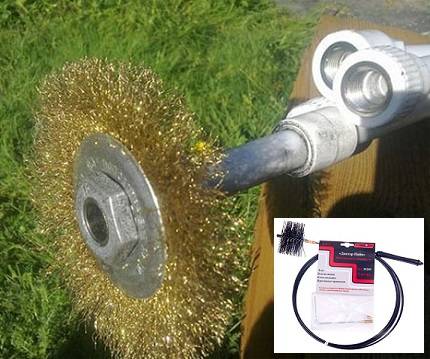
Multi-faceted professional brushes on a flexible shaft are designed for cleaning chimneys, ventilation systems and sewers. Marking on the cable allows you to control the depth of the passage
How to reduce chimney pollution?
For different types of heating devices, it is common to accumulate soot in the smoke channels at different rates. So, the more protrusions, roughness and irregularities, the more soot settles on the walls. Prevents soot from escaping into the atmosphere and multiple turns or incorrectly lined smoke channels.
But if the stove, fireplace, boiler are already installed, then there is no way to change its design. But you can minimize other negative factors that lead to severe pollution of the chimney.
Selecting the optimal fuel
During the combustion of any fuel in the chimney, a coating of soot and soot is formed. But one of its species can form more deposits than the rest. You can reduce the intensity of pollution if you use the "right" fuel.
The wood of different tree species has a different chemical composition. The different content of resin, oils, tar, creosote affect the degree of sediment formation on the chimney pipes. The less of these substances in the wood, the less soot will be formed during the combustion process.Other solid fuels also contribute to pollution to varying degrees.
Which fuel forms soot more than others:
- coniferous firewood - spruce, pine;
- birch firewood, which has a high tar content;
- briquettes and pellet granules from seed husks, due to the high oil content, give intensive soot formation.
It must also be said that burning household waste in an oven, especially plastic, also contributes to the formation of plaque.
A counterweight these types of fuel firewood from oak, hornbeam, beech, walnut, plane tree, pear, apple tree can be noted. These hard rocks are much less likely to lead to fouling of flue ducts.
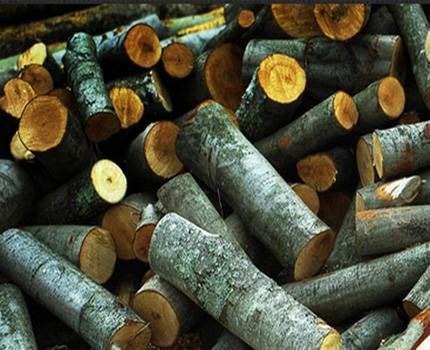
Aspen firewood forms little soot, and, in addition, is a prophylactic in the fight against its settling on the walls of the chimney
Sawdust briquettes, otherwise called Eurowood, burn well and leave a little soot. When burning, they do not spark, weakly absorb moisture, so they can be stored in kitchens next to the stove.





Dependence on humidity and combustion temperature
It is highly desirable to use dry firewood for space heating - the drier, the better. The fact is that when burning wet fuel, the ash under the influence of steam rises with it and sticks together into lumps. It becomes heavier and cannot leave the chimney. As a result, it accumulates inside the chimney in the form of soot.
Therefore, they must be harvested in advance and stored under a canopy, in special covered rooms, sheds. In such conditions, it will be possible to achieve 15-20% humidity. At the same time, the degree of dryness will always fluctuate depending on the humidity of the air in the room, on the street.
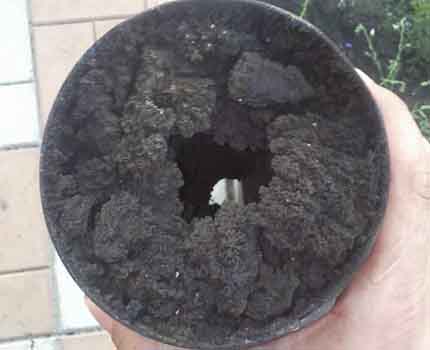
The more water vapor is formed during the combustion of fuel, the faster blockages form in the chimney, combustion chamber of the furnace, boiler, fireplace
The combustion temperature also affects the amount of soot formation. The worse the firewood burns, the greater the degree of pollution, the more often it will be necessary to clean the chimney.
This is due to the fact that at low temperatures an excess of carbon particles is formed, which settles in the form of soot and soot. This phenomenon is especially characteristic for the initial combustion, when the firewood is just flaring up.
Therefore, when kindling a stove or fireplace, you need to strive to increase the temperature in the firebox as quickly as possible - kindle the stove with dry wood, use more thin and dry chips.
In addition, after the fire is extinguished, it is necessary to keep warm. To do this, as soon as all the fuel burns out in the stove, close the gate. And then, during the next kindling, the temperature inside the stove will be much higher than if it had not been closed.
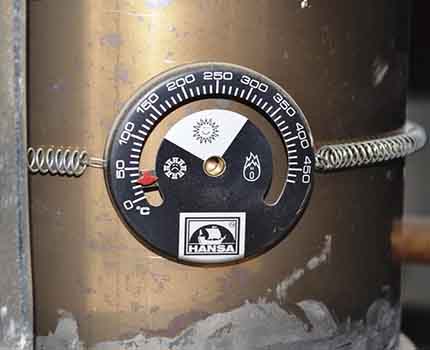
You can determine the combustion temperature using a special device - a combustion indicator, which is attached to a metal chimney and measures flue gas temperature
When is it time to clean?

It will not be possible to completely do without cleaning the chimney, no matter what material and what design it is.
Indeed, over time, due to soot, the passage in the chimneys narrows and the so-called reverse draft effect occurs, when the smoke no longer enters the street, but into the room.
If you wait a little more time, then any furnace will simply become unusable. Not to mention that reverse thrust is dangerous even for people living inside the house!
When approaching the issue of cleaning the chimney, the following factors must be considered:
- Downtime, namely how long there was no cleaning.
- What is the design of the chimney, how smooth are its walls and what are the lines of its operation.
- What kind of fuel was used, whether plastic bottles or similar garbage were thrown into the firebox.
- Was raw wood used? Were there pine or spruce among the firewood, because from them resinous substances settle on the wall of the chimney.
 To notice that your chimney needs cleaning, you can independently by the following signs:
- Smoke color change. Ideally, if almost transparent, hardly noticeable white smoke comes out into the street, and it is bad if it becomes dark - this indicates the presence of a large amount of soot.
- Flame color change. The color of the fire in the furnace also signals problems: if it is light orange and the firewood crackles, then everything is in order. And if the flame turns dark orange, almost orange, this is a sign that the chimney needs to be cleaned.
- And, finally, the simplest and most logical way remains - a preventive inspection of the chimney. It’s good if a professional master can do this, but even you can notice problems.
For example, professional chimney sweeps lower a special load along the diameter of the pipe into the chimney, and if it passes easily, everything is in order, if it rests, then it will have to be cleaned.
Moreover, the situation with soot can reach such a critical point when pollution completely blocks the chimney and ice plugs appear. And even worse - coking, when soot accumulates on the chippers and burns out there to large solid fractions, similar to coal.
Such fractions clog the chimney and block the draft.And in order to remove all this, just a brush with a load will not be enough, you will have to use a special jack to raise the chimney and clean the stove.
That is why it is so important to make all sections of the chimney straight. And on rare bends, install tees with a cleaning system
In total, three types of methods for cleaning the chimney are practiced today:
- mechanical, with the help of special devices that need to penetrate the pipe;
- biological, when natural ingredients are used and chemical;
- and the last, when cleaning is carried out with the help of industrial special preparations.
Let's dwell on each of them in more detail.
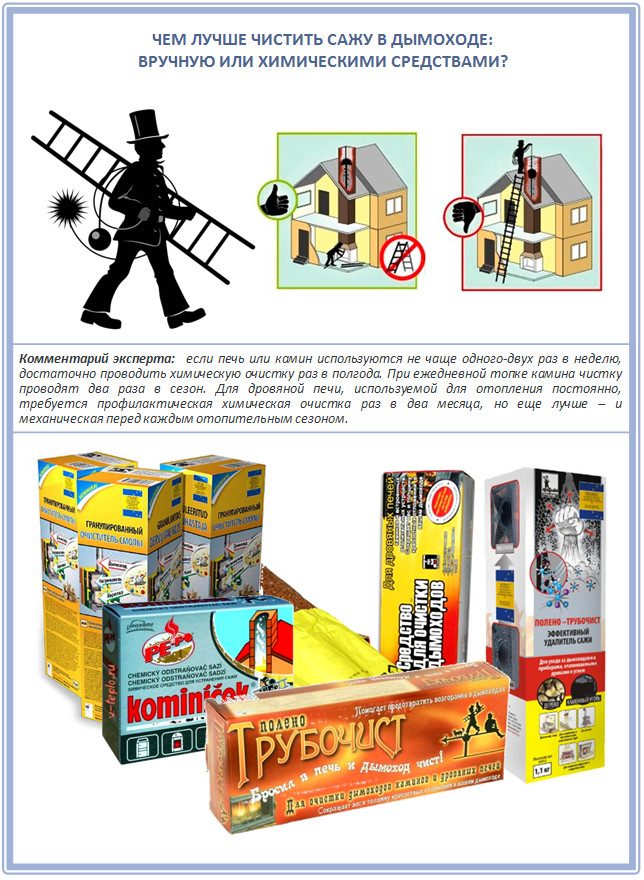
Mechanical tools for removing blockages
This is an efficient, inexpensive method in which a flexible metal rope with a heavy ball at the end is guided through a pipe. At a short distance from the core is a special bristly brush that acts as a cleaner.
Ruff can be made by hand. The main difficulty is to find a well-centered ball that will not get stuck in the outlet channel, since this situation leads to disassembly of the entire chimney. It is not difficult to make a brush from metal wires.
When using a ruff, safety precautions must be observed. With good traction, accumulated debris can fly out of the pipe and get into your face, so you need to wear a protective mask and goggles before cleaning. Do not make sudden movements so as not to fall from a height. It is better to secure yourself with a safety cable.
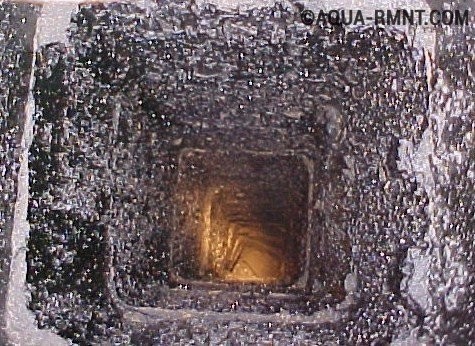





Sometimes, due to the inaccessibility of cleaning the chimney from the roof, it is necessary to clean the system from below. In the absence of a glass for cleaning, it is necessary to disassemble the beginning of the chimney.
Removing dirt from a metal furnace channel with a brush is not always of high quality, therefore, instead of a bristle (iron) brush, it is better to wind a rag winding, which will completely eliminate contamination.
Chimney cleaning methods
Before you clean the chimney from soot, you should choose the appropriate method. There are only three of them: mechanical, chemical and manual cleaning.
With a mechanical one, a ruff is thrust into the chimney, which knocks soot off the walls. This method cannot always be used, since not every pipe has good access. In addition, the entire contents of the pipes are poured down, after which the garbage must be removed.
In the chemical method, powders and logs are used. They are laid at the firebox. Under the influence of temperature, substances are released that soften the soot and it flies into the pipe or falls down. Such funds are best used for prevention, when there is little soot.
Folk methods are also used to clean pipes. The problem of soot formation is dealt with by salt or potato peelings.
If professional cleaning is required, you can contact the fire department and call a specialist. The quality of work will be at the highest level, but you will have to pay for the services.
mechanical cleaning
This method of cleaning pipes involves the use of additional funds. The most common devices are ruffs. They come in different diameters for specific chimneys. The ruff brush is put on the end of a long and flexible cable, a metal ball can be attached under it for easier passage down. The structure is lowered into the pipe and rises, as a result, soot is removed from the walls.
Before you clean the chimney in the stove with your own hands with a brush, you should take care of technical safety. When working on a roof, you need to provide insurance so as not to fall. You will also need gloves, goggles and respiratory protection. A respirator is needed, as cleaning produces small dust particles that enter the mouth and nose.
Before you clean the chimney pipe in a private house, you should put a container in the fireplace in advance into which combustion products will fall.
Chemical cleaning
If the chimney in the country is not too clogged, you can use various chemical compounds to remove a small layer of soot. If the chimney pipe is brick, such substances will allow mechanical cleaning to be done less frequently. As an independent cleaning agent, they are used for ceramic or stainless steel chimneys.
Periodic use of dry cleaning of chimneys of stoves and fireplaces from soot allows you to make it softer, after which it is easier to remove the residues mechanically. The combination of these two methods will keep the chimney free of plaque for a long time.
Among the most popular means for cleaning pipes from soot are the following:
- Kominichek. This is a Czech drug that is sold in paper bags in the form of granules. In a heated oven on firewood, you need to put the package without tearing it. During the combustion process, substances will be released that will effectively clean the pipes. It is recommended to use when the soot layer does not exceed 2 mm.
- Log. They are produced under the names Chimney sweep and others. The boxes will differ in appearance depending on the manufacturer. The rules for use are the same - the log must be placed in a well-heated oven.During combustion, smoke will be released, softening the soot. It will volatilize or fall down.
- Pipe cleaning powders. Are issued in the form of packages with the packaged powder. The package should be placed in a hot oven. There are both domestic and foreign production.
Folk ways
If it is not possible to clean the pipes mechanical or chemical you can use folk remedies. The simplest of them is the firebox of an already heated stove with aspen wood. The flame from them is hotter, the soot burns instantly. But this method cannot be used with a large raid - soot can explode and damage the chimney. Therefore, before cleaning the chimney, you should inspect it. Aspen is recommended to be used for prevention. When kindling, it is enough to put a couple of logs to ordinary fuel.
There are safer chimney cleaning methods folk remedies. A kilogram of table salt or a bucket of potato peels is placed in a red-hot and heated oven and heated. They must first be dried so as not to lower the temperature in the furnace. The action of the funds will be softer than from chemicals.



