
- Interesting solutions
- Helpful Hints
- What should be done to save money at home?
- When using technology
- Teeth cleaning
- Toilet use
- Taking a shower
- washing dishes
- Wet cleaning
- Taking a bath
- car wash
- Houses built to save energy
- Technologically advanced utilities
- Proven ways to save water in the bathroom
- Devices to help reduce consumption
- Shower Heads
- Faucet nozzles
- Effluent recycling systems
- Other home appliances
- Ways to save water in the toilet
- Useful technical devices
- Distribution nozzles for taps
- shower heads
- Toilet cisterns
- Economic sink drains
- Exotic "dry" toilet bowls, dry closets
- Eco kettle with two tanks
- Ways to reduce water consumption
- Plumbing
- Recommendation
- Faucets
- Toilet
- Recommendation
- Shower instead of bath
- Recommendation
- Install boiler
Interesting solutions
In addition to the main ways to save money and recommendations, we have prepared for you TOP 3 original solutions for saving water in an apartment and a private house at home.
Solution #1 - eco kettle
Is it possible to save both water and electricity at the same time at home? Yes, if you use eco kettles. Using standard electrical devices, we boil too much water for tea.The Eco Kettle solves this problem with two reservoirs:
- the first is intended to be filled in advance,
- in the second, exactly as much water constantly flows as you need to boil (from 1 to 8 glasses).
Isn't it an interesting solution for your home? It reduces water and energy consumption by up to 30%. Another advantage is that the eco-kettle boils quickly (for example, 35 seconds is enough for 1 glass).
Solution #2 – Rainwater Harvesting
The device for collecting water from rain is designed to save it and further use it in places of the entire private house (toilet flush, a set of washing machine or containers for watering the garden). One option is to install underground tanks in the local area with a network of pumps and cleaners, but a project development is required first. The volume of one tank varies from 1,600 to 10,000 liters.
If the family budget is not designed for such expenses, then a simplified option can be applied - install a water tank and use the resulting rainwater to water the garden and vegetable garden, wash your own car and for other needs.
Solution #3 - Custom shower fixtures
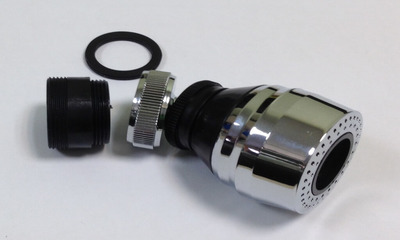
Special diffuser nozzles are available at many hardware stores. By installing them on the shower head, it will be possible to reduce the volume of fresh water inflow, ensuring its savings in everyday life. In addition, you will not notice that the jet is smaller than a standard shower.
It's great if you find nozzles whose mechanism of action involves adding air to the water stream. It gives a feeling of intense pressure, but the resource consumption does not increase. The cost of the nozzle starts from 500 r. It is easy to install and does not require complex maintenance.
Helpful Hints
In addition to the above methods to reduce costs, you can:
- replace taps with 2 valves with a lever mixer for quick shutdown and effective temperature control;
- turn off the water when lathering your head, brushing your teeth, washing difficult stains on clothes;
- soak and treat clothes with a stain remover when heavily soiled to avoid repeated washing;
- prefer baking in the sleeve instead of frying in oil, which requires a long washout of greasy pans and baking sheets;
- wash hands and dishes under low pressure;
- do not pour unused boiled water into the sewer (after boiling eggs, from a kettle, etc.), but use it for watering plants, washing and pouring washing vacuum cleaners;
- rinse the hair dye first in a bucket of warm water, and then in the shower;
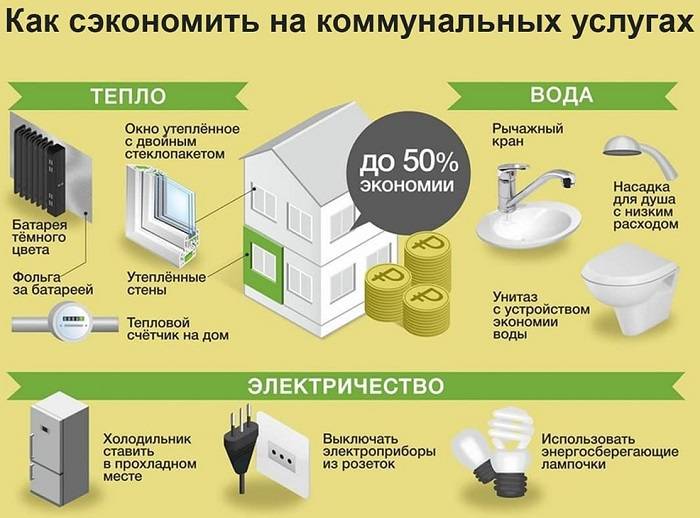
- install aerators and other nozzles on faucets and showers for economical use;
- wash the car with a bucket, and rinse with a hose only at the end of the procedure;
- turn off auto payment for utilities and record average monthly consumption in order to track leaks and abuses of the management company in a timely manner;
- apply for subsidies for utilities if the family is poor or the cost of them exceeds the percentage established in the region.
The tips above are mainly about saving money in an apartment. In a private house, you can use other opportunities: install sewage treatment and rainwater collection systems for irrigating the garden and garden, equip a well or a well. The price of a cubic meter in the presence of a well is determined by the pump capacity, electricity tariffs, maintenance costs and equipment depreciation.
The latter measure should be resorted to when designing a house or conducting plumbing. If a centralized supply pipe has already been laid on the site, then drilling a well and buying a pump will not be economically profitable.
What should be done to save money at home?
 You can get the maximum effect from saving water only with the help of a whole system of measures.
It is not enough to install aerators or use a wastewater recirculation system.
If there are leaks on some appliances, they will negate all the measures taken, since the loss from one dripping faucet per month is about 250 liters, and a leaking tank releases about 600 liters of water into the sewer.
These indicators can be increased many times if there are a lot of appliances in the living room, and their condition requires urgent repair. Consider the basic rules that should be followed to reduce unproductive water consumption.
The main rule is to be attentive to the flow of water, use it strictly for its intended purpose. If the faucet is open, but water is not drawn anywhere and simply flows into the sewer, this is a waste of money that should be stopped immediately. There are many options for reducing losses, which should be discussed separately.


When using technology
Using this technique, you can significantly reduce water consumption and increase the efficiency of the equipment. To do this, you need to make it a rule to use devices with a full load.
If the washing machine is designed for 5-6 kg of laundry, then this amount must be loaded into it. Otherwise, it will turn out that the same amount of water was used to wash a pair of shirts as for a full basket of clothes.
The same principle should be used when working with dishwashers.You should not drive it empty, you must completely load all the trays with dirty dishes in order to get the maximum effect from the operation of the machine.
Read more about how a dishwasher saves water.
Teeth cleaning
It is recommended to close the tap until it is needed specifically for the procedure. This will give a very noticeable savings, especially if the family is large, and all its members will use this method.
Toilet use
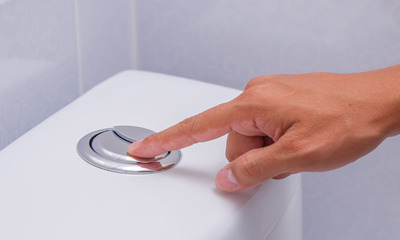 Modern models of flush tanks are equipped with several buttons that allow you to drain different amounts of water.
You can adjust the flow yourself, using the flush mechanism.
To do this, you will have to conjure a little with him by removing the tank lid, but the resulting effect is worth it.
There is another way, which is called the "brick method". It is used for old models of tanks that do not have settings. The essence of the method is to install a massive object inside the tank (it can be a real brick, or any other object of a similar size). The volume of the tank decreases, the water flow automatically drops.
Taking a shower
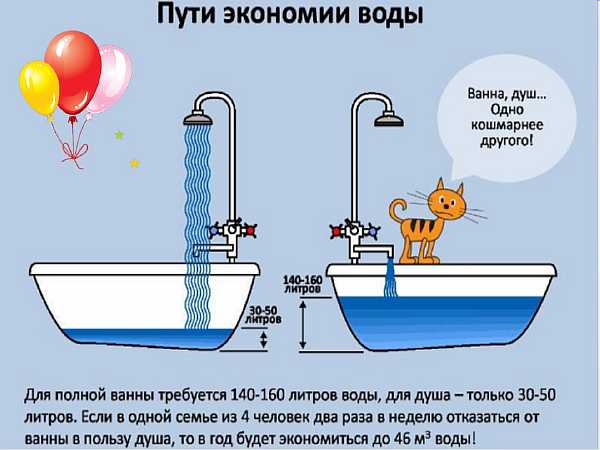
Taking a shower instead of a traditional bath can reduce water consumption by 2-3 times. If the volume of the bath is about 150 liters, then taking a shower requires no more than 30-60 liters.
That is, for a family of 3 people, daily savings can reach 270 liters of water, which will be almost 100 m3 of water per year. The savings are significant, and hygiene does not suffer from this at all.
washing dishes
Most housewives wash dishes with an open tap, when most of the water immediately runs into the drainage system.
If you plug the drain of the sink with a cork, draw a certain amount of water, pour in the detergent and wash the dishes, as in a basin, useless losses will decrease many times over.
The quality of washing dishes will not decrease at all (sometimes, on the contrary, it will improve).
Wet cleaning
For wet cleaning, it is recommended to draw water into a container with sufficient (but not excessive) volume.
Usually, a whole bucket of water is used to clean a small area.
At the first rinse of the rag, it becomes dirty, the water is changed - and so on several times. If the capacity is smaller, the volumes will noticeably decrease.
Taking a bath
Taking a bath is a traditional procedure loved by everyone without exception. Saving here is difficult, but some countries have found ways to reduce water consumption.


In Sweden or Japan, where problems with fresh water are quite noticeable, the whole family takes a bath in turn, not renewing, but only heating the water. At the same time, the rule is used - you can only dive into the bath clean, after taking a shower. So you can reduce the cost several times.
car wash
To wash the car, you can use technical water obtained from the cleaning of drains from sinks or car washes. This is possible if the house has a recirculation or clarification system installed.
It is connected only to bathtubs, sinks or sinks, drains from the toilet go to the septic tank. Washing the car with technical water is no worse, and the savings are quite significant.
Houses built to save energy
You can save even more on housing and communal services by settling in an energy-efficient home. This is not about the use of "green" energy or little-known technologies, but about modern materials and lean appliances.
“In an energy-efficient home, a number of technologies are used to reduce heat loss. Utility bills are reduced by about 35%, - says Anton Shiryaev, Deputy General Director of the Sibpromstroy Group of Companies. - Most of them are, of course, construction technologies used in the construction of a house. Any person in his apartment will not use them, but there are simple measures for owners. For example, LED lights have been installed in the common areas of our homes. The apartments have modern hygroscopic ventilation valves and thermal heads that allow you to regulate the temperature. Only cold water is supplied to the houses, and electric water heaters are installed to heat the water.”
Technologically advanced utilities
Choosing a management company that cares about energy efficiency is not a technical, but definitely a smart decision. Residents pay for light and heat consumed not only in apartments, but also in common areas: entrances, elevators. Obschedomovye counters are in the basement. Every month, employees of an ordinary management company go around the basements of houses (there are dozens or hundreds of them) to rewrite the numbers from the counters. Sometimes they find non-working meters. In such cases, the management company considers consumption according to the standards, which is more expensive for the consumer. And there are companies that did not install meters.
“Approximately 30% of homes equipped with meters, according to our estimates, consider the consumption according to the standards. Why? Or meters have not been working for a long time, and repair and replacement are only in the plans. Or the company does not take indicators at all, ”explains Roman Vlasov, founder of the Eldis startup.His firm helps management companies remotely monitor the operation of common house meters (if the device breaks down, managers will find out on the same day) and remotely collect data. This means that employees do not need to climb into basements to rewrite testimony.
Now "Eldis" works in 68 regions and takes readings from 36 thousand objects (houses and state institutions). In addition, the startup has services that allow you to evaluate the quality of services from resource supply companies - water utilities, heating networks and others. “Hot water should not be lower than 60 and not higher than 75 degrees according to the standards. For each hour of hot water supply, the temperature of which is below 40 degrees, payment is made at the rate for cold water. The management company can make claims in court, - Vlasov gives an example. — How often do management companies monitor quality and fight for consumers? It cannot be said that this is a trend, but I have met companies that have won court cases for their users with resource users. And I am sure that people will become more literate, they will begin to consciously choose a management company. Ask: “How do you analyze readings?”, “How do you do energy saving?”.
Services that help collect and analyze data are needed mainly so that the company understands how much consumption in the house meets the standards. If it exceeds the norm or is on the verge, you can increase efficiency: put metal-plastic windows in the entrances, light bulbs with motion sensors (on when someone enters).
Proven ways to save water in the bathroom
So, we decided to save initially on the bathroom.
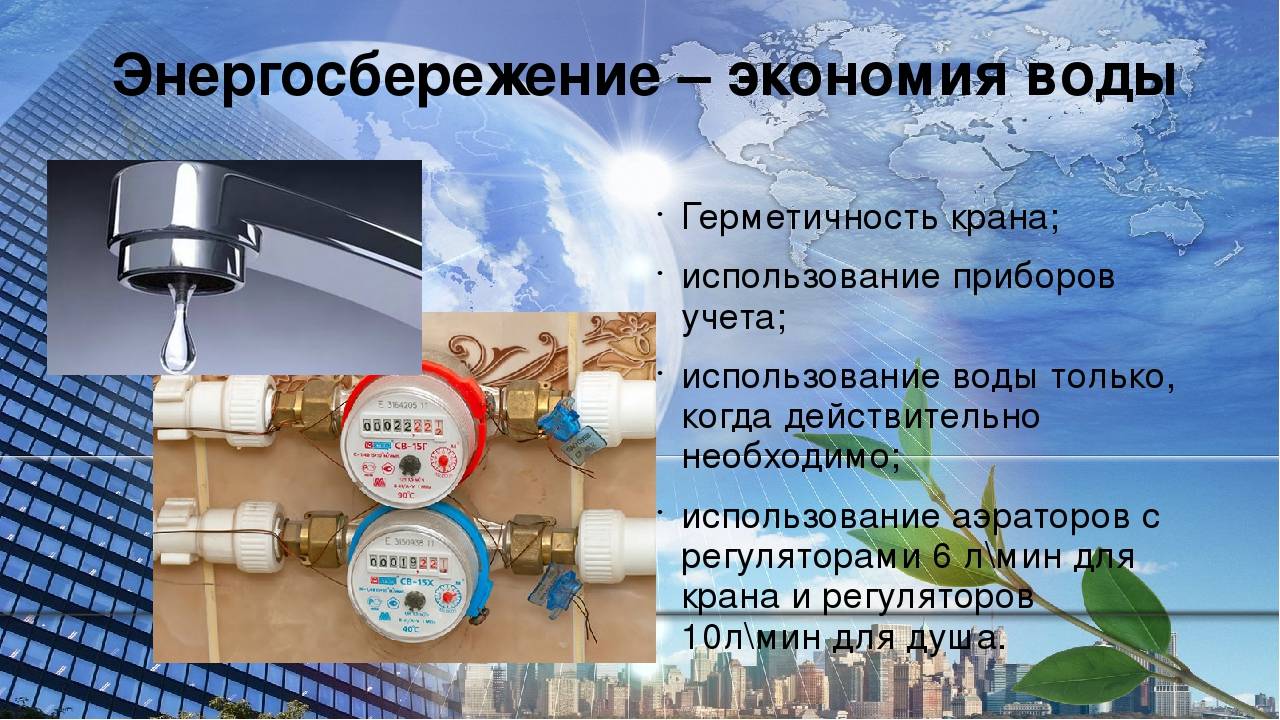
- First of all, we installed a special water-saving nozzle on the shower.It is quite inexpensive, but it really helps to use less water. What led us to this decision? Internet information. It clearly shows how much water can be saved by installing such a nozzle. I will share information with you. With a regular nozzle, about 12 liters of water are spent per minute, and with a water-saving one, only 5! In this way, showering can save a huge amount of water!
For example, you take a shower for 15 minutes, with a regular nozzle you use 180 liters of water. And if you use a special dispersing nozzle, then the amount of water used will be only 75 liters!
We have been using this shower head for two years already, the amount for water in the receipt has decreased by 15% with the help of this upgrade. We save more than 2,000 rubles a year on such a shower.
- Take a shower, not bask in the bath. This is also a very effective way. When taking a shower, we spend only 50-80 liters of water with a water-saving nozzle, and when filling a bath, we spend more than 150 liters. This is three times more. For me personally, such savings are not a problem, since for several years now I have only taken a shower. I can lie in the bathroom when I want to warm up.
This type of savings allows us to save an average of 1,500 rubles per year.
- Turn off the water when not in use. These are moments in the shower when you shave or scrub your skin. Those few minutes can save you a lot of money.
For 5 minutes of shaving or applying a mask, more than 25 liters of water will merge into the sewer. Using such procedures every day, you waste more than 9,000 liters of water per year. In my region, in money for a year, this amount will be about 500 rubles only for cold water.
- You can also save water while brushing your teeth. Turn off the faucet with only one glass of water. This water will be enough to rinse your mouth out of toothpaste. Thus, you will spend a maximum of 10 liters of water on washing, and not 50. This is also money. Moreover, we do not count the spent water resources per day, but per month.
I have a family of three. That is, we spent about 4.5 cubic meters of water per month on brushing our teeth and washing ourselves as usual. And using a glass of water to rinse your mouth, we spend less than a cube. In terms of money, we began to pay 580 rubles a year for morning washing instead of 2000-2500 thousand.

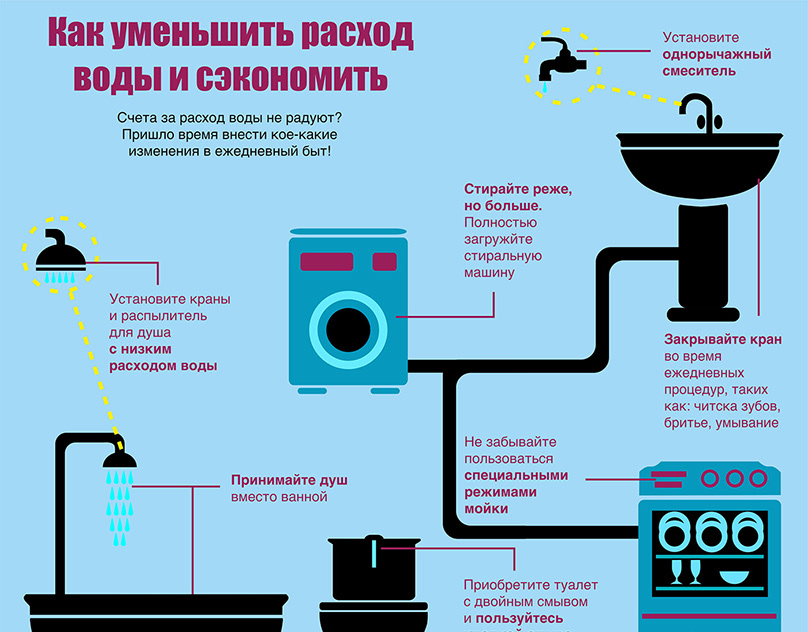

- Installed a mixer, which has one lever for adjusting the water temperature. It has been noted that when using a double-wing mixer, when the temperature is adjusted, the water simply flows uselessly into the sewer. Our money also runs there after the water. It is better to spend money on a mixer once than to constantly drain water into the pipe.
Such a mixer will help save water up to 8 liters per minute!
- Installed a water heater. Yes, this is again a cost to save money. Hot water is much more expensive than cold water. Why pay more when you can pay less? Yes, the water heater is expensive, but it pays off quickly. There are still moments when hot water needs to be skipped, in many homes there is such a problem. This is when hot is barely alive for a long time, or when it has an unpleasant brown color.Another plus of the water heater is that when the whole city is disconnected from access to hot water in the summer and people have to wash themselves with hot water in a saucepan, we wash ourselves, as always, without inconvenience.
We consider how much we save on such equipment per month and year. Hot water at the rate of the region in which I live costs 159 rubles per cubic meter. Cold - 49 rubles. According to the latest meter readings, before the water heater was installed, it was prescribed that we used 8 cubic meters of hot water, and 6 cubic meters of cold water. In money it came out 1566 rubles. The next time we received a receipt, there was, accordingly, only cold water consumption - 12 cubic meters, that is, 588 rubles. Electricity with a heater began to be spent more by 500 rubles a month (taking into account its shutdown for a time when no one is at home). That is, water for a month cost us 1088 rubles. We saved 478 rubles in a month, and more than 5,000 rubles in a year. With the fact that we bought a water heater for 8,000 rubles, it paid off in less than two years.
- They hung a "reminder" for the child. This is a small poster in the bathroom, which says that you need to conserve water. Moreover, it helps not only the child, but also us not to forget about this nuance. I just look at this inscription, as the brain is already starting to rush me, and my hands themselves quickly lather the washcloth! In saving a trifle, but still nice.
Devices to help reduce consumption
The need to save water is clear to everyone, including plumbing manufacturers. They produce various devices that reduce the useless consumption of water. Some of them are highly efficient, reducing losses by a factor of 2 (or more).
At the same time, the user does not feel any changes in the usual mode of using resources. Some of these devices have already become familiar and are installed on faucets or shower heads by default.
Many users do not even know that they have had water saving devices in their apartment for a long time, and they use it daily. Let's take a look at some of these devices.
Shower Heads
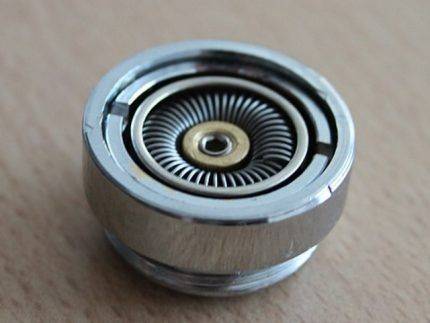
Everyone knows how a shower head works. This is a nozzle with many small holes from which water is sprayed. Its slight improvement allowed to reduce consumption by 20%. The device is called an aerator.
It mixes the flow of water with a large amount of air, having previously increased the pressure by reducing the cross section of the tube.
As a result, the flow energy remains the same (or even increases), but the flow rate decreases markedly. The user does not notice a decrease in the flow volume, there is no effect on the quality of water procedures.
Full information about the nozzles for watering cans here.
Faucet nozzles
Faucet heads use the same aeration principle as shower heads.
There is a simultaneous reduction in the cross section of the tube, the supply of flow into the chamber of a larger volume and the release through the distribution grid.
There are simpler nozzles on the mixer, which are made in the form of a simple mesh. It reduces the throughput of the outlet, thereby reducing water consumption.
For an overview of faucet nozzles, see our article here.
Effluent recycling systems
Some procedures, such as flushing a toilet or watering garden plants, can use pre-treated wastewater.
Installations that perform this procedure have been used for many years, but household models have appeared relatively recently.
They are systems of filters, sedimentation tanks and other units that purify water from:
- organics;
- chemical elements;
- other unwanted components.
The result is industrial water that can be used for some household procedures that exclude food use.
Other options for reusing wastewater are:
- connection of the outlet of sinks to the tank, from which the toilet flush tank is filled;
- water recycling systems that provide partial use of effluents mixed with clean water (not used for drinking networks);
- specialized installations that receive water from kitchen sinks, settle and filter, after which they send clarified water to a tank for technical use.
All these installations have their own qualities and can be used both in private houses and in apartments.
Other home appliances
There are other devices that can reduce water consumption. Among them there are the simplest elements, like ordinary washers that reduce the cross section of the pipe, to more complex devices called savers.



Their design uses the principle of operation of the aerator, but the design is supplemented with elements that increase work efficiency. When using such devices, the user feels more comfortable than when using conventional plumbing.
In addition, there are various models of signaling devices and information devices.They are configured for a specific mode of water consumption and notify the user of the need to limit the flow if the drain is too active.
Such devices do not provide water savings and do not limit the flow, but only notify of the occurrence of an excessive consumption mode.
Ways to save water in the toilet
The toilet in the apartment also accounts for an impressive share of water consumption. You can reduce it in the following ways:
- It is necessary to inspect the toilet for leaks at the points of its connection with other equipment. If there are problems, they must be fixed immediately. In terms of the volume of water consumed, such a problem is comparable to a running tap.
- Many plumbing manufacturers have already launched the production of toilet bowls, which provide two drain modes. In the first mode, a full tank descends, and in the second, half.
- There is another simple way to reduce water consumption in the toilet. You can put a 2-liter bottle of water inside the drain tank. So to fill the tank, water will be spent 2 liters less than usual.
Useful technical devices
Distribution nozzles for taps
Crane adapters are used as advanced devices for filling the jet with air bubbles or for crushing, “fluffing” one narrow jet into several dozen with a “rain effect”. This increases the droplet distribution area without increasing the water flow.
They are used in cases where the standard factory mesh on the crane is not effective enough.
Online sellers give advice on how to save water on the meter with this device, showing a video of how in 10 seconds a jet from a control tap fills three times the volume.
shower heads
Simple shower heads operate on a similar principle, are widely distributed and can reduce water consumption when showering by 20%. However, the task of modern engineers is more difficult, because it is necessary to distribute moisture throughout the body without compromising the feeling of comfort during showering. This is solved thanks to the complex design of the nozzles and computer simulation.
Introduced in 2015 as a startup nozzle Nebia (USA), creating a "warm fog", increased the area covered by drops of the body by 10 times with a decrease in water consumption by up to 70%. The declared annual savings for a family of 4 is 80,000 liters.
Toilet cisterns
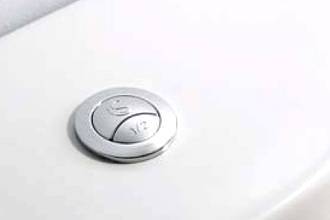 Toilet cisterns during flushing account for about 25-30% of the total water loss in the apartment. Help reduce costs:
- "Double buttons" that regulate the descent volume. On average, a small drain is 2-3 liters, a standard one is 6-8 liters. At the same time, thanks to the auger and the set rotation, the toilet bowl is cleaned efficiently even in the economy mode.
- "Aqua-stop-mode" button. The first press of the button starts the drain, the second one stops it.
- Reducing the tank by inserting a special Hippo bag, which occupies a volume of 2-3 liters, or a technological "brick" Drop-A-Brick. Such a rubber "brick" is able to increase in size up to 2 liters, saving up to 11 thousand liters per year. The domestic analogue of these technical devices is a real brick or a filled plastic bottle.
Economic sink drains
This category includes all plumbing fixtures that are designed so that the water from the washbasin, either directly or through an intermediate storage container, enters the toilet while flushing.
- The washbasin is one piece with a cistern, the constant filling of which occurs with each turn of the tap.
- Recirculation system using pipes, when the tank is automatically filled with used and new water in a proportion of 50% to 50%.
- The AQUS system, which is installed under any sink, collects, filters and disinfects wastewater before it is poured into the tank. The estimated reduction in metering losses is 35 liters per day per person.
Exotic "dry" toilet bowls, dry closets
A device that is more often used in trailers, mobile camps (tent camps), however, in case of interruptions in water supply, it can also be used in apartments. One of the latest developments is the Dry Flush toilet. In such devices, flushing is not provided at all, and all the mandrels fall into the bag. When you press the button, the bag is wrapped, sealed and goes into the container at the bottom of the toilet bowl, and a new one comes out of the rim in its place.
Eco kettle with two tanks
The first is filled completely and the temperature in it does not increase. In the second of the first, as much water is collected as needed for boiling (1-8 cups). Repeated boiling raises many questions among physicians, therefore, in order not to empty the kettle after each boil, an economical innovation is used.
Ways to reduce water consumption
Plumbing
Before (or after) installing the meter, the condition of all devices and lines must be given increased attention.With us, as a rule, either our hands “do not reach”, or just laziness, but in any dwelling there are places where there is at least some kind of leak, albeit insignificant
Considering that now not only the liquid goes into the sewer (into the ground), but also our money, then it’s not a sin to spend a little.
For reference, the losses per unit of plumbing per year are approximately as follows:
- faulty drain tank - about 65,000 l;
- leaking faucet - about 75,000 liters.

To this, you can add the joints of pipes laid on the site. The total amount, considering the tariff, is impressive. Only for 1 crane (at 20 rubles / m3) - about one and a half thousand. But there are several of them in the apartment, and many of them leak from a bad owner.


Recommendation
To reduce water consumption, it is advisable to install a lever mixer instead of conventional valves operating on the unscrewed / twisted principle. Such a valve closes the highway instantly. If we take into account that we use mixers every day, many times, then the calculation of savings will result in a considerable amount only on this.
Faucets
As already mentioned, lever-type models are preferable. We spend a lot of time trying to choose an acceptable hot water temperature, and constantly turn both taps, wasting it. These mixers can reduce the flow rate by about 8 l/min.
Toilet
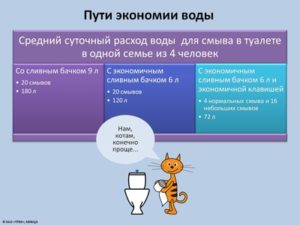
It's not just that the old one constantly "leaks". There are devices with two modes of operation - full drain and economical. From the point of view of ethics, it is not worth going into details (the reader himself has already guessed when which one is needed), but water savings of the order of 20-25 liters per day are ensured. About 7500 liters per year.
Recommendation
Sometimes a leak in the toilet is not noticeable.To make sure that the tank valves are working properly, it is enough to add dye to the water (slightly). If after a while some shade appears at the bottom of the bowl, then there is a leak. How to solve the problem with a leaking tank - read here.
Shower instead of bath
The benefits are obvious, especially for those who like to take water treatments several times a day, even in the morning before work. First, it saves a lot of time. Secondly, water consumption will be significantly reduced. “Through” the shower it will take about 80 liters for a 5-minute procedure. These are 8 buckets of 10 liters each, which are clearly not enough to fill a bathtub of standard dimensions even halfway. Such foresight will save about 1,700 rubles a year.
Recommendation
If you install a shower head with smaller holes, the flow rate can be reduced by 1/3 – 1/2. On sale there are products with aerators that mix water with air. And it is good for massage, and saving water - 2.5 - 3 times, and without reducing the effectiveness of the procedure.
Install boiler
In each region, tariffs for en / resources are set by local authorities. In some cases, a storage water heater will also save water. It makes no sense to use hot water for small household needs if hot water can also be taken from the boiler tank. It is necessary to compare the costs of heating it (the cost of the filled liquid + energy consumption) and for using the main line. At the same time, it is advisable to install an electric / energy meter with separate calculation for day and night tariffs, and heat water after 22.00 or early in the morning.
What else to pay attention to
- Every person who is used to taking care of himself brushes his teeth, and not only in the morning.The question is - how much water flows in vain while we “work” with a brush, rinse our mouth? Conclusion - the valve should be opened only when necessary. If you calculate the savings for the year, it will not be funny.
- It is necessary to properly organize the washing of dishes. Usually the tap in the sink is constantly open, regardless of what we are currently doing (approximate flow rate is up to 5 l / min). To this can be added the inadvisability of too intensive use of detergent compositions, since more water will be needed to rinse the dishes. Consider choosing a dishwasher - it will save both water and your time.
- Often housewives have to wash fruits or vegetables. It is much more economical to do this in a container, and not under running water.
- The same applies to defrosting poultry, fish or meat. In any house there are basins, pots, which do not need a lot of water to fill.
- In terms of cost-effectiveness, one "large" wash using a washing machine is better than several "small" ones.
The article lists the most effective savings options that will allow you to save a lot of money by not using hard limits on daily needs, but only by reducing unnecessary water costs.



