
- Work technology
- How best to apply stain on the surface: a master class
- Basic rules for work
- Types of wood stain
- Water
- Alcohol stain
- Oil stain
- Acrylic and wax
- Stain with whitening effect
- General information about stains
- Using different stain colors to create beautiful effects
- What color are stains for wood, depending on the type of composition
- The color range of stains for wood and the effect of the composition on the painted material
- Compositions for tinting wood from coffee, tea and vinegar
- So, to give the wood a brown tint, you can do this:
- Morilka is done like this:
- Keep in mind that:
- Sequence of work
- Surface preparation
- Application methods
- Why put stain on wood
- water stain
- Alcohol stain
- Oil stain
- Alcohol stain: types and advantages of using the composition
Work technology
If the composition is characterized by an intense odor, it should not be applied in the presence of children. The room must be ventilated. The wooden structure must be properly prepared. If the recommendations are followed, the desired effect is ensured, otherwise the composition will not protect the tree from negative factors, and may further worsen the appearance.
How best to apply stain on the surface: a master class
Instruction:
- The mixture must be mixed, for which the container is shaken.The recommended temperature of the substance is +36°C. Such a stain is applied with your own hands much better, it penetrates deeper into the wood more strongly.
- If you plan to use an airbrush, the solution is poured into a special container. When using a brush, roller, the tool is slightly wetted in the stain.
- The material is applied from bottom to top.
- If the workpiece is horizontal, the surface is treated with the mixture alternately in different ways: along the fibers, across, then again along, etc.
- When smudges form, they must be removed immediately with a lint-free rag.
- Do not take breaks during processing. This can cause spots on the surface as the mixture dries quickly.
- Considering that the stain belongs to the compositions of deep penetration, it is possible to achieve the required shade only after repeated application - 2-3 times. Moreover, re-treatment is performed when the surface is completely dry.
Basic rules for work
Recommendations:
- Despite the high adhesion of such materials, it is necessary to grind the wooden product before starting work. For this, a special tool is used. It is necessary to achieve maximum smoothness. Eliminate chips, recesses.
- When the top layer of wood is removed, the resin begins to show through. It must be removed. An excess of this substance will contribute to a deterioration in the appearance of the product: stains will appear, especially if you plan to use a water stain.
- Despite the fact that the top layer of wood was removed during grinding, it is recommended to additionally degrease the surface. This will remove the smallest contaminants and increase the adhesion of materials.
Types of wood stain
Compositions differ in the type of components. Accordingly, the finished mixtures differ in their main characteristics, which determines their intended purpose and scope. When choosing, these parameters should be taken into account. Otherwise, wood stain treatment will not provide the desired result.
Water
You can buy a composition of this type in 2 forms: powder, ready-made solution. Dry stain is diluted with water. It is necessary to observe the proportions of the substance and liquid, which will make it possible to obtain a mixture with the required properties. The advantage of water stain is the variety of shades. In addition, it is an environmentally friendly composition that does not contain toxic components, does not provoke allergies.
This stain is odorless. It does not exfoliate from the surface of the product, because it is characterized by increased adhesion. This type of stain can be applied indoors and outdoors. The main disadvantage of the composition is the limited application. So, it is not used if the wood contains a large amount of resins. After applying a water stain, grinding is required, because the surface becomes rough. If the material has been in contact with water for a long time, it loses its properties. This is due to the fact that the stain is gradually washed out.
Alcohol stain
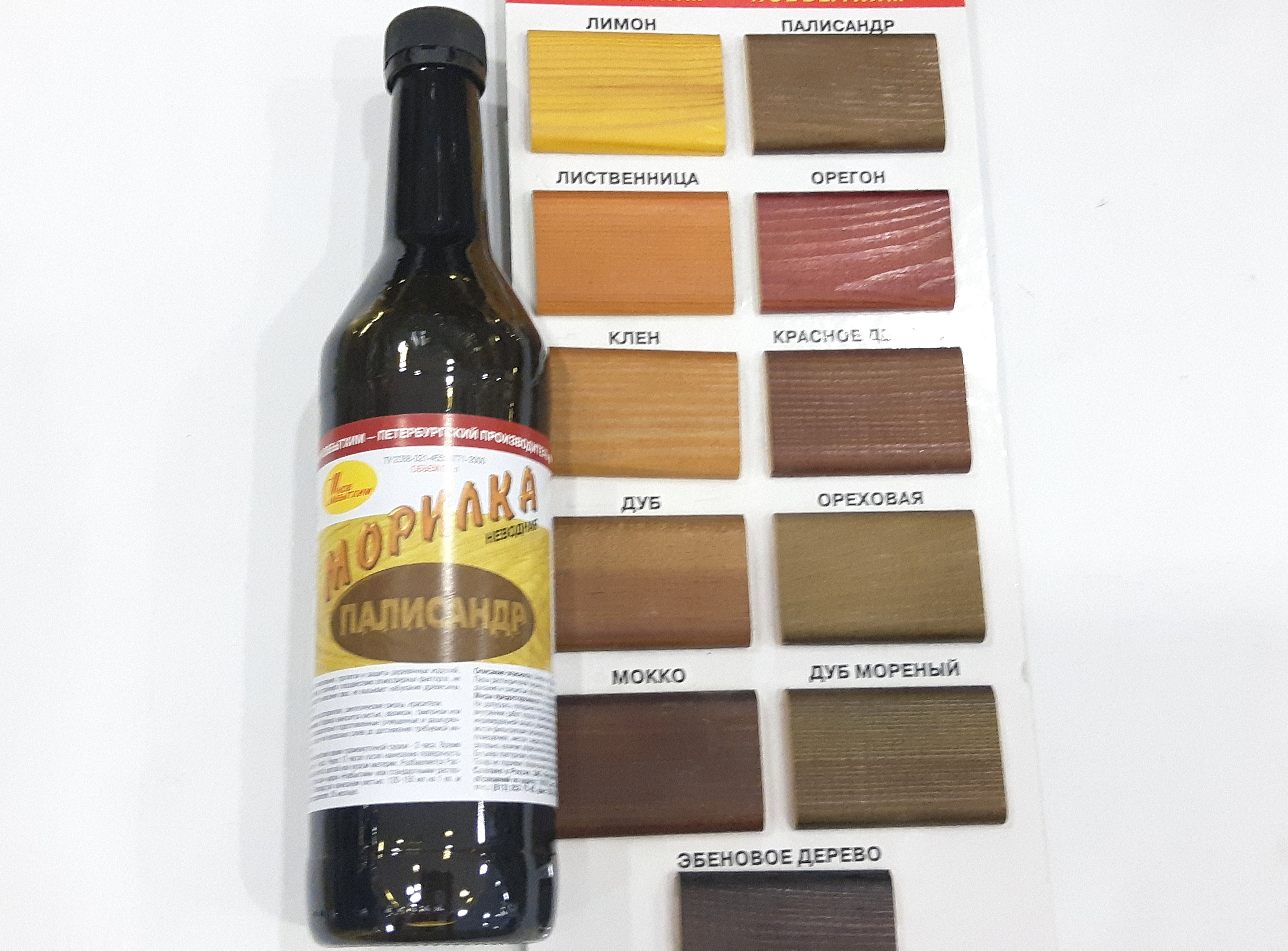
The basis of the solution is denatured alcohol. Additionally, the composition includes aniline dyes. There are different types of stains for alcohol: powder, ready-made solution. The substance quickly penetrates into the structure of the tree, stains from the inside, while it is possible to change the shade of the product. You can choose any of 9 colors: walnut, oak, ebony, oregon, mahogany, mahogany, pine, fern, marigold.
The disadvantage of this composition is a thick consistency.As a result, stains and stains form during painting. You can avoid this by using a spray gun. It is recommended to use alcohol solutions in the fresh air. This is due not only to the appearance of a specific intense smell, but also to the ability to protect wood from the negative effects of precipitation.
Oil stain
There are the following types of compositions:
- based on linseed oil;
- containing drying oil.
Wood stain can be painted with any tool. In this case, stains will not appear, and the surface will remain smooth. The advantage of such compositions is to ensure resistance to moisture, temperature extremes. The oil stain does not burn out, as a result, the wood retains its attractiveness for a long period.
Unlike water-based wood stain, this type of solution does not contribute to the roughness of the product. This is due to the fact that when applied, the oily material does not fill the wood fibers with moisture. As a result, smoothness is maintained. If the mixture is too thick, it can be thinned with a thinner; White spirit will do. The oil solution is used without restrictions: indoors and outdoors.
Acrylic and wax
The main advantages of such compositions:
- the ability to paint the tree in any tone;
- increased moisture resistance;
- no pronounced odor.
If you are wondering what acrylic stain is, you should know that the main component is resin. When applied, the substance creates a thin film. This provides protection from negative factors. Acrylic stain refers to fireproof materials, is versatile (suitable for different types of wood), environmentally friendly. There is no unpleasant odor upon application.To obtain the desired result, the mixture is applied to the surface twice. The stain dries quickly. This allows for 1 approach to apply a layer with a thickness of 3-4 mm.
Stain with whitening effect
White wood stain is designed for highlighting. After application, the material acquires a light shade. The tree looks neat, becomes cleaner. The composition of such mixtures includes hydrogen peroxide or acid. The task of these components is to discolor the surface. Thanks to this effect, it becomes possible to update the product. Colorless wood is varnished after staining.
General information about stains
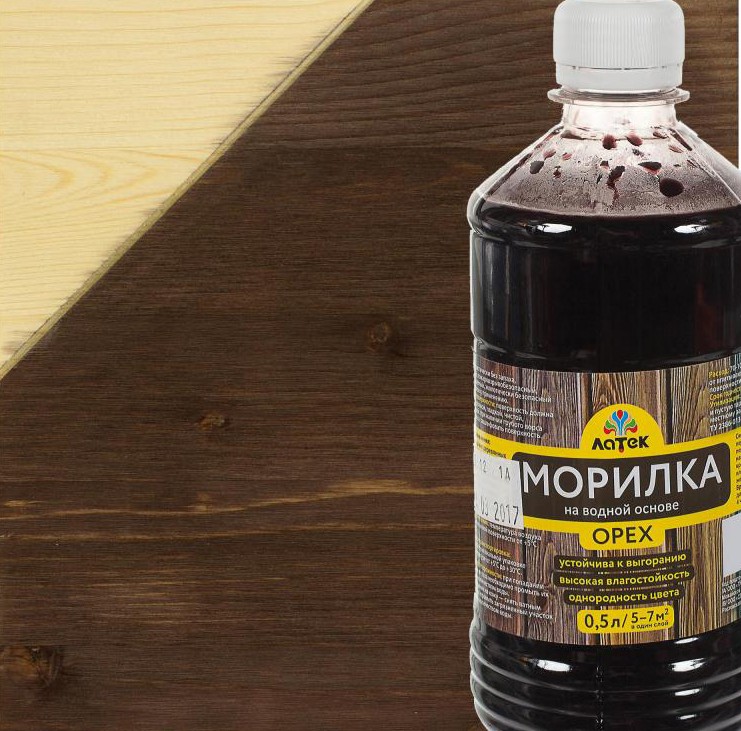
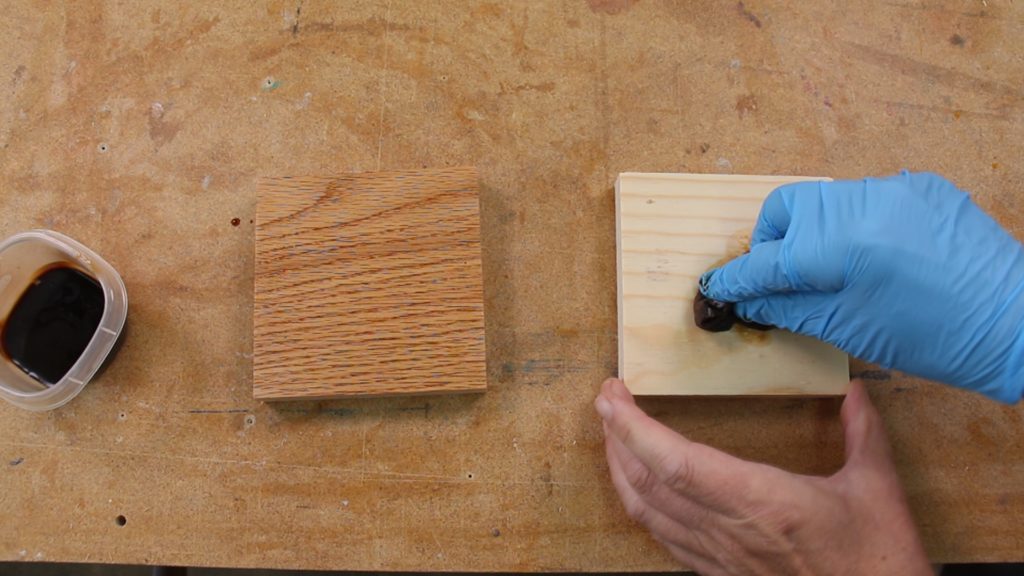
Stain is a liquid composition, more often of a dark color, which is capable of imparting various translucent shades to wood, which allows you to radically change the appearance of the product, as well as protect the material from external destructive influences. Therefore, such a tool for processing wooden parts can be called multifunctional.
Stain is able to give wood different shades, dramatically changing the appearance of products.
So, with the help of similar protective and decorative compositions, the following operations can be performed to change the appearance and characteristics of wood:
- It becomes possible to tint while preserving the textured pattern of the tree.
- A special purpose wood stain is able to bleach wood - this is a necessary process when restoring work, when changing color to a lighter shade or when preparing a surface for applying varnish.
- Imitation of shades of elite expensive wood species is widely practiced.
- Mordant has the property of deep penetration into the structure of the material, and its antiseptic qualities of the composition protect the wood from putrefactive processes and the damaging effects of wood-boring insects.
- The action of the stain is accompanied by the strengthening of the wood structure.
- An important quality is giving the material water-repellent properties.
- Any type of stain significantly extends the life of wooden products.
The use of different shades of stain allows you to give the wood pattern a visual volume.
- The stain is suitable for both internal and external work.
- The quite affordable cost of the material is also attractive - the price of a stain is two, two and a half times lower than paints and varnishes similar in terms of the created effect.
Different types of stain interact with wood in different ways, depending on the basis of their manufacture. Some of them penetrate deep into its structure, while others create a protective film on the surface.





Using different stain colors to create beautiful effects
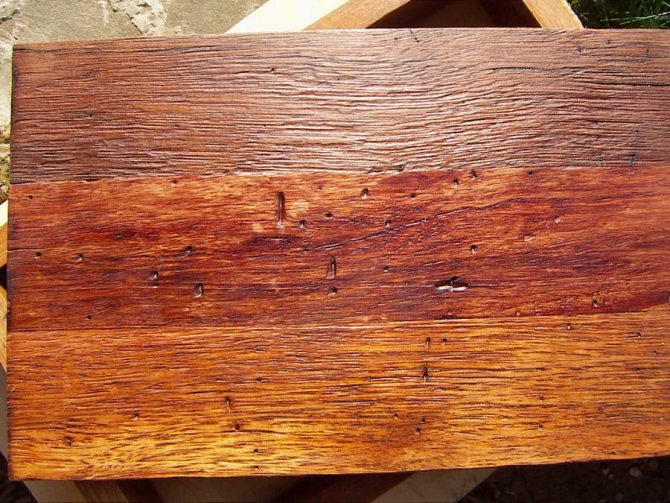
The use of various combinations and color combinations, as well as application techniques, allows you to get interesting decorative effects. For example, the rubbing method is used to create a realistic imitation of noble breeds during the dyeing process. For this, stains with a touch of oak or pine are suitable. It is not recommended to select compositions from the category of quick-drying for these purposes.
If you want to create a memorable interior, they resort to tinting wood with concentrated bright colors. To get a rich tone, you will need to mix several shades (two or more). As a result of mixing mahogany and blue stain, a purple impregnation is obtained.The same shade can be achieved by combining ebony and mahogany. A mixture of marigold and plum gives the mocha color. A similar effect is obtained by mixing rowan and walnut.
A huge range of stain colors allows you to create updated interiors
Color stains look very unusual in the interior of the room. To get this effect, you need to cover the tree with the main background. After that, stains of other colors are applied with strokes. A colorless lacquer composition is used as a finishing layer.
If you combine black, burgundy and blue stains in one interior, you get quite interesting combinations. Burgundy furniture looks very impressive in a room with blue wood floors.
The list of options for decorating rooms with stain does not end there. A huge range of colors allows you to create countless combinations and secondary shades, which significantly expands the design possibilities of these impregnations.
What color are stains for wood, depending on the type of composition
The palette of available shades depends on the type of composition. The colors of water-based wood stains are very diverse. Manufacturers claim that such compounds can give the surface any shade. However, the palette of water stains mainly covers the colors of the natural range. This includes brown tones of dark and light shades. When processing the surface, the water stain lifts the fibers of the material. Thanks to this, its structure becomes clearer and more pronounced, although the degree of protection against moisture is significantly reduced.

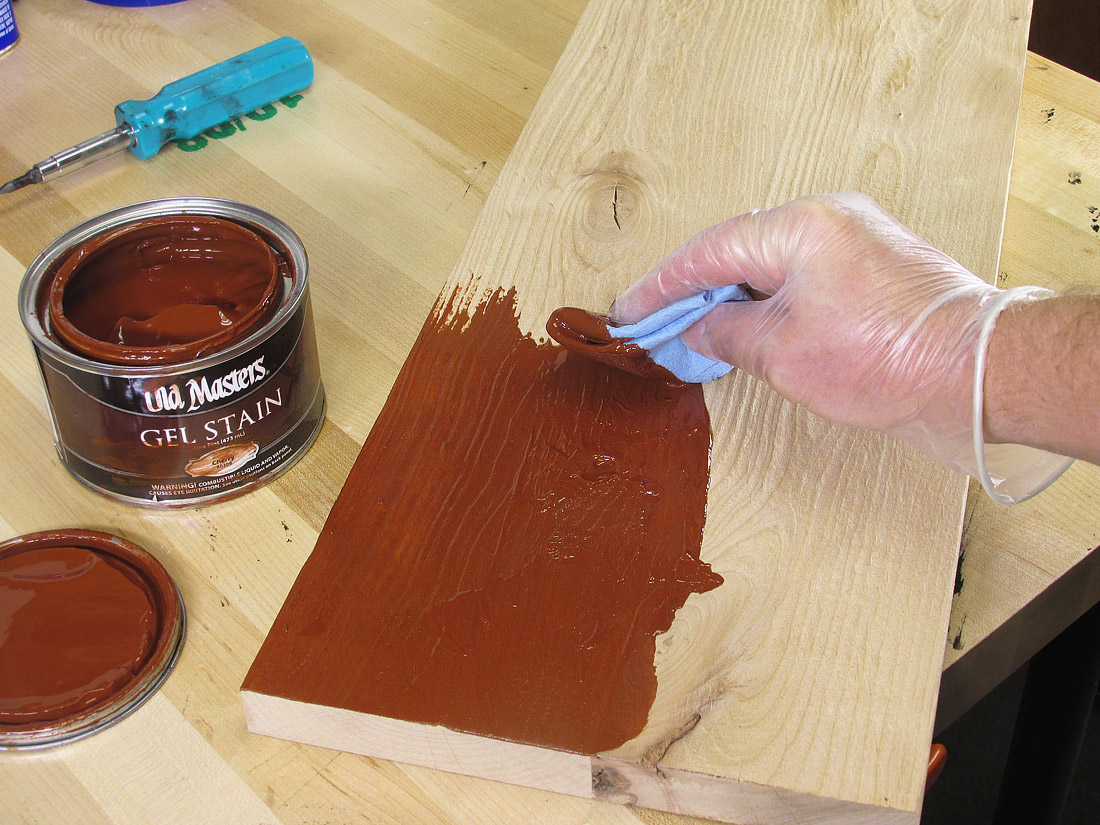
For very soft woods, many manufacturers offer special gel stains.
Acrylic stains, which are a type of water stains, have the most extensive palette of all existing products. It's all about the improved composition, expanding the decorative possibilities of these solutions. Unlike water stains for wood, the colors of acrylic stains can be more exotic and atypical. Such stains emphasize the structure of the material without lifting the fibers. Wax stains also have similar properties, which also differ in a wide range of colors.
Among acrylic stains, there are also colorless compositions. Such impregnations are produced by the Tikkurila company. The color of the wood stain in this case will depend on the color scheme that is added to the solution. The Tikkurila Pirtti (Pirtti) stain palette includes 36 different shades.
The materials of the modern generation include stain-gels. Like wax products, they have a thick consistency and are applied to the surface with swabs. As for the palette of gel stains, it is very limited.
Spirit stains are characterized by a good color variety. However, due to the pungent odor in interior decoration, consumers prefer water-based stains, and for outdoor work often used oil compositions with an impressive range of colors and rich shades.

To date, stains are presented in a huge assortment
The color range of stains for wood and the effect of the composition on the painted material
Wood stains made on a water basis are distinguished by a large selection of colors. These compositions make it possible to quickly and easily give a wooden surface an expensive and noble shade or radically change the appearance of the material.
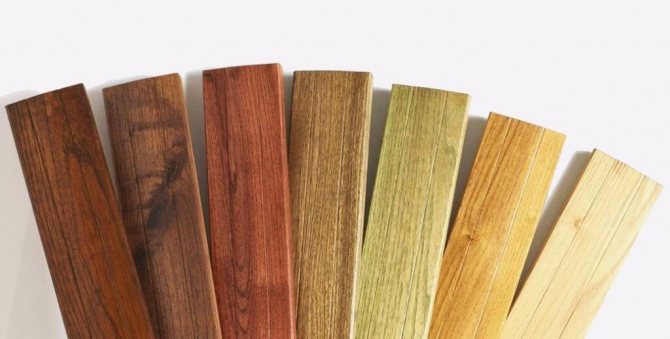
The color palette of stain for wood can be conditionally divided into three groups:
- Neutral color scheme - it includes all shades of white, black and gray.
- Natural colors - includes natural shades of wood that are found in nature, for example, the color of the wood stain for wenge wood, walnut, maple, oak, cherry.
- Exotic colors - used to give wood atypical shades, such as blue or purple.
This table contains information about what colors wood stain comes in.
| Color name | Coloring result |
| Beech | Natural shade, warm and well emphasizes the wood grain |
| Oak | Dark brown tone |
| Ebony | Creates a visual effect of aged wood, emphasizes the relief of the material and its natural lines |
| Cherry | Can give surfaces a rich dark burgundy hue or light red tones |
| Fern | Wood acquires a pleasant green tint |
| Mahogany | After drying, the treated surface becomes brown with a slight shade of red. |
| Black | Used to create an aging effect |
| Rowan | Lightly tints material to a pale pink or sheer beige |
| mocha | The painted surface becomes coffee |
| Bog oak | Gives a matte effect to natural color |
| Hazelnut | Outwardly similar to a nutshell, it is used to deepen the structure of the material |
| Blue | Matches the color of wolfberries |
| Ash | After staining, a light pink color appears on the surface. |
| Larch | Available in a wide range of shades, from dark yellow to orange |
| Maple | Delicate shade of peach |
| Lemon | Yellow, which can be made contrast by repeated application |
| Plum | Dark pink color |
| wenge | Dark shade of brown with black streaks and inclusions |
| bleached oak | White shade |
| light walnut | It is used to protect wood while preserving its natural color. |
| The Red tree | noble red color |
| kaluzhnitsa | The treated surface becomes darker |
| Pine | Transparent, almost invisible coating |
Compositions for tinting wood from coffee, tea and vinegar
Natural stains are good precisely because they are absolutely safe for human health - what can be wrong with ordinary food products?
So, to give the wood a brown tint, you can do this:
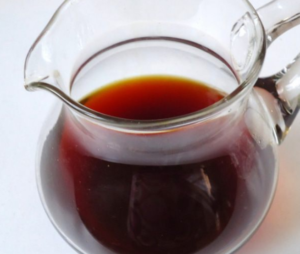
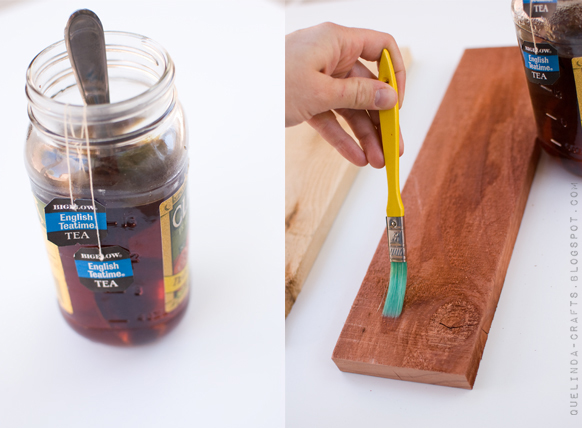
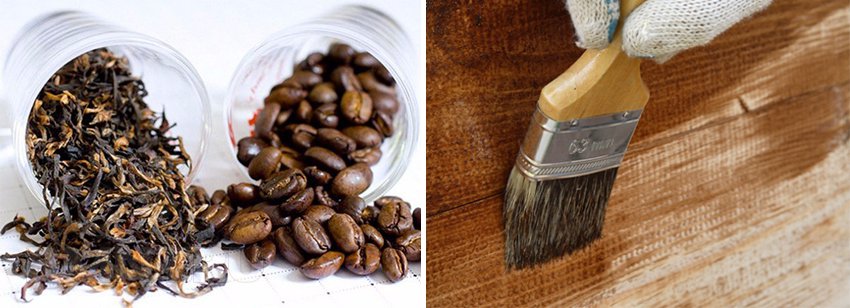
- Brew tea, let it brew, then strain the tea leaves. The resulting composition can be impregnated with wood, saturating it with tannins (contained in tea). Depending on the amount of impregnation and the concentration of tea leaves, many shades of brown can be obtained.
- Ground coffee beans need to be brewed, insisted and filtered. Process the wood with the resulting infusion. The color will be darker than in the previous case, and it depends on the strength of the resulting drink.
- You can add a little soda to ground coffee - in a ratio of 1: 4 (1 part soda to 4 parts ground coffee) and brew in the same way.
Vinegar is useful in order to give the wood a dark shade. True, you will need not only vinegar, but also small nails or iron shavings (stock up if you have a familiar metal turner).


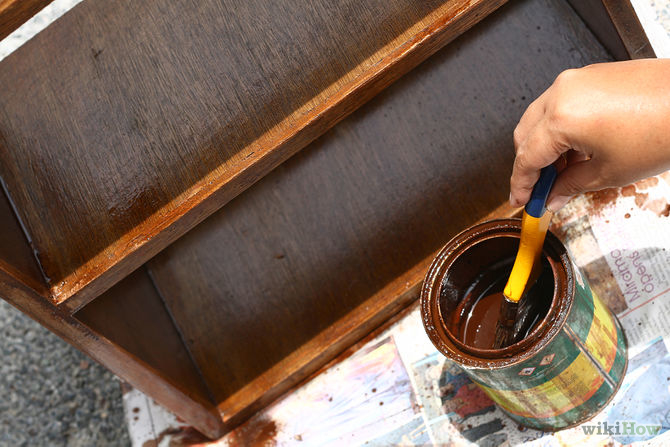



Morilka is done like this:
- Nails or shavings must be degreased and poured with vinegar.
- The container must be placed in a dark place and left for up to 7 days - depending on the desired color and stain concentration.
- Then the wood is impregnated with stain. This process is called "ebonyization" - that is, giving the material a black tint. The method allows you to get various shades of black, but it is especially effective when used for staining rocks like walnut (with a high content of a substance such as tannin).
The use of vinegar stain requires caution
Keep in mind that:
- It has a strong smell, so you need to work either in a well-ventilated area or outside.
- Processed products should not be coated with polyurethane varnish - it will curl up. It is better to use nitro varnishes.
Sequence of work
Surface preparation
A high-quality finish is obtained only on a surface cleaned of dust, dirt and grease, without defects in wood processing. If the surface of the wood has already been painted with something, then the old finish must be removed completely. Coniferous trees need to be tarred.
The cleaned surface is polished twice. First, this is done using a larger sandpaper (No. 120), then a smaller one (No. 220). Wood grinding is carried out only along the fibers. The resulting dust is removed with a damp cloth, and the dirt is somehow solvent or alcohol.

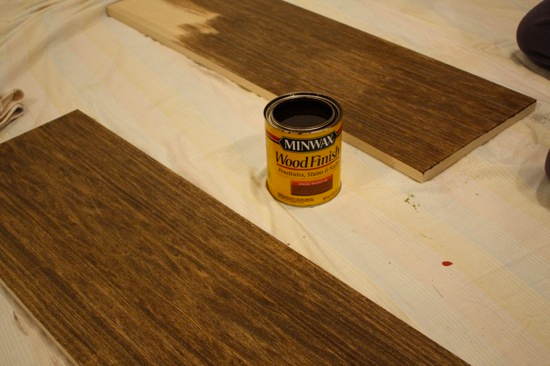
It is possible to apply stain only on a clean and dry surface of the tree. In order not to make a mistake with the color of the coating, make a test paint. You need to take a small sample. First, cover it with one layer of stain, after complete drying, cover 2/3 of the sample with a second layer. The third layer should cover 1/3 of the wood piece. This will allow you to choose your favorite finish.

Application methods
With a brush, you can apply almost any stain to the prepared surface. Difficulties arise only with alcohol-based stains due to rapid drying. The vertical surface begins to be covered from below so that smudges are not absorbed by unpainted wood. This greatly improves the uniformity of the coating.

The second and subsequent layers can be applied after the previous one has dried. For oil-based stains, the drying process lasts up to 3 days, for water stains - up to 3 hours. Coating is applied along the grain of the wood
When painting the surface with a brush, it is important not to go into neighboring areas that have already been stained. This way you can avoid unwanted stains.
A water-based stain can lift the hairs of the wood. After the first layer, wait for the stain to dry and sand the surface with sandpaper. Then remove the resulting dust and cover the surface with the next layer.
A swab is applied stain by rubbing. This method is only suitable for small surfaces. A tampon can be made from a piece of foam rubber or a dense fabric. Wax stains are applied with this method. It allows you to achieve a uniform surface coverage. This is especially true for rocks with a porous structure.

Stain spraying on a wooden surface most often used for large areas of coverage. Alcohol-based stains dry quickly and it is difficult to avoid spotting during application, for example with a brush or swab. Spraying with an airbrush allows you to achieve a high decorative quality of the finish, regardless of the stain base.
Why put stain on wood
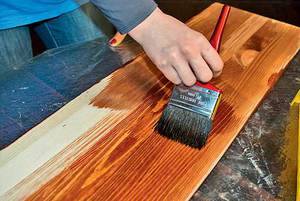 To better protect the wood coating and prolong its service life, it is recommended to treat it with a stain. Such impregnation penetrates deep into the pores of the wood and enters into a chemical reaction with the tannins in the annual rings, giving the wood a light and waterproof color.
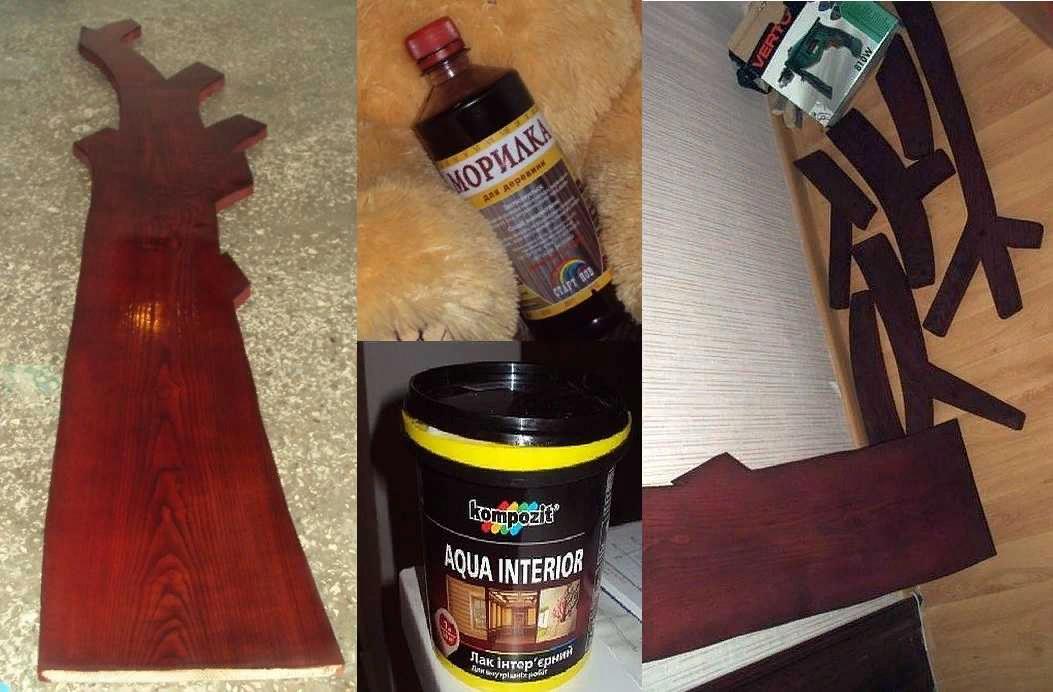


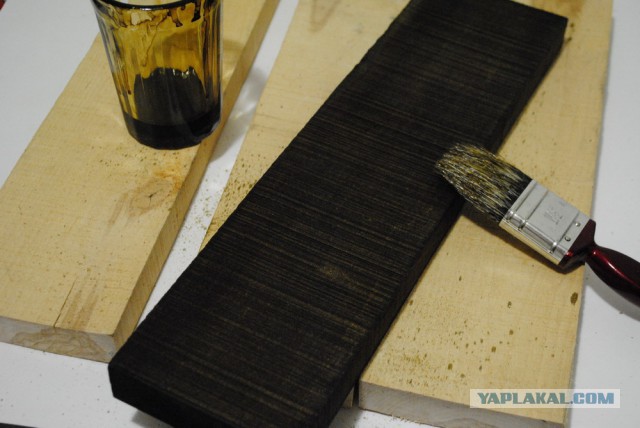

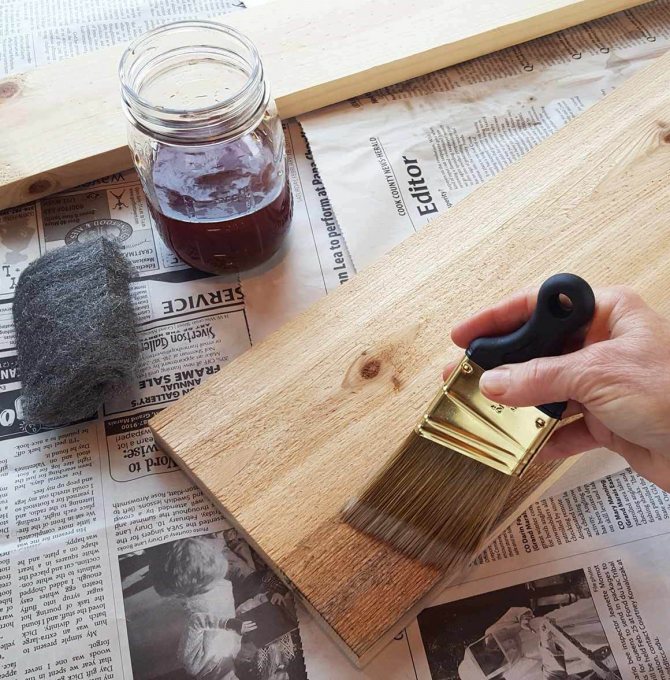


In addition, the stain protects the wood from grinder beetles, mold fungi and other infections and pests. Modern liquid stains are of the following types:
- oil;
- alcohol;
- water.
Let us consider their characteristic properties in more detail.
water stain
 Such impregnation is of two types: in the form of ready-made solutions that can be used immediately, and in the form of a powder. A solution should be prepared from it. Water stain does not need drying oil, white spirit and other solvents.
However, it has one significant disadvantage: when the impregnation penetrates into the wood, it lifts its fibers, leaving the wood unprotected from excess moisture.
But, on the other hand, with the help of such processing of the tree, its structure is emphasized and highlighted. Therefore, today this type of stain is considered the most common.
Alcohol stain
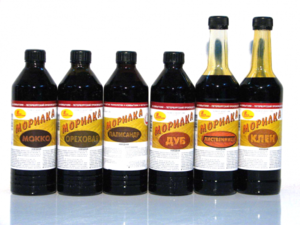 This impregnation is a solution of aniline dye in ethyl alcohol. It is used for decorative and antiseptic coloring of wood products. With the help of an alcohol stain, the pile rise is reduced and the wood does not swell.
Using this type of stain, it is quite difficult to achieve uniform coloring, because the composition dries very quickly and spots can form.This impregnation is best suited for tinting small items, but it will be unsuitable for painting parquet.
Oil stain
Such an impregnation is a coloring matter dissolved in flax oil. It is the most convenient to work with and can be applied in many ways. The oil stain does not lift the fibers and is evenly distributed over the entire wooden surface. Products treated in this way can always be easily repainted and restored.
Alcohol stain: types and advantages of using the composition
Alcohol stain for wood allows you to protect against excess water, prevent the reproduction of destructive microflora, and also give the product a beautiful intense color.
Stain will update wood surfaces and give the whole room a fresh look.
Colored or transparent stain on alcohol penetrates deeply into the wood structure and makes a special film on the inside and outside of the product.
Due to this, the wood fibers are lifted and the structure becomes more prominent.
Alcohol stain can be obtained by diluting aniline dye in denatured alcohol. The substance can be purchased in the form of a powder or a ready-made mixture.
The main advantage of alcohol stain is the rapid drying time of the layer applied to the wood surface.
But this property can also be attributed to the shortcomings of an alcohol-based substance.
In order for the surface to moderately absorb the applied tone, you need to use an airbrush, otherwise (with the manual method of tinting), greasy spots appear on the surface.
In order to very reveal the structure of the tree or "age" it, the surface can be treated with liquids of different colors.
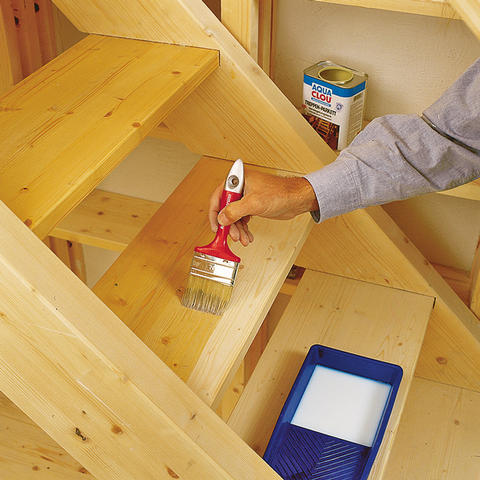
By diluting several varieties of stains, you can get the colors "Arctic oak" or "bleached oak".
Before applying the alcohol stain to the surface, it is necessary to test it on a small area of the board. Specifically, this way you can determine the required tone and the number of layers applied.


It should be noted that hardwoods perfectly absorb stain, and conifers, due to the presence of a huge amount of resin in them, are worse.
Before choosing a tool for applying a substance to a tree, you need to pay attention to the following points:
- The choice of inventory depends on the footage of the treated surface.
For small areas, a brush or foam rubber swab is suitable. For large surfaces, it is better to use a pneumatic sprayer. When using a sprayer, the possibility of oil stains and smudges is reduced.
- In order for the color of the tree to get a rich shade, you need to apply a few words of tinting agent. The 2nd and subsequent layers can be applied only after the final drying of the previous ones. The same rule applies to the final layer.
- It is necessary to paint the surface on wood fibers.
Thanks to this, you can highlight the sketch, avoid smudges and reduce stain consumption.
- The stain must be of the correct consistency.
- The lacquer coating does not need to be applied twice to the same place, then very black areas can be avoided.
- Alcohol stain for drying requires a maximum of 3 hours.
- The rules for applying the substance for exterior and interior decoration are the same.
Among the more popular manufacturers of alcohol-based stains, there are three companies whose products amuse customers with a price-quality ratio:
Products presented by the St. Petersburg company "Novbytkhim" can be used for tinting door panels, skirting boards and railings inside the premises, as well as products made of veneer and plywood.
Among the advantages of the stain produced by this company, the following can be noted:
- does not require varnishing;
- is not washed off with water;
- easily polished;
- emphasizes the pattern of wood;
- prevents swelling of the coating;
- gives the wood surface non-combustible properties.
The Anles company produces alcohol stains, the main purpose of which is to give the tree protective parameters and a certain color that imitates another type of wood.
The substance does not form a film on the surface of the product, but seeps into the structure of the wood, thereby emphasizing the natural outline of the natural.
When working with stain from the Anles company, certain conditions must be observed.
The temperature in the room should not be below +5 degrees, and the humidity should not be less than 80%. The wood surface must be completely dry before treatment.
Liquid from the brand "Expert" is suitable for processing wood surfaces inside and outside the premises, for tinting furniture, railings, log surfaces, doors.
The substance seeps deep inside, allowing you to recreate an imitation of valuable wood species.
Presented stain colors: maple, mocha, oak, reddish wood, larch.
See the following video for more details on the stain.
All rights reserved, 14+



