- Connectivity
- Therefore, for heating glass structures, the choice is made in favor of baseboard heating.
- Advantages and disadvantages of warm baseboards
- Installation of a water warm skirting board system
- Calculation of baseboard heating
- How to act
- Advantages and disadvantages
- Principle of operation and scope
- Economy and the laws of physics
- Connection to the heating system
- Electric plinth: equipment installation
- The cost of a warm skirting board and its types
- Choosing a plinth infrared heater
- Cable heater device
- The principle of operation of the skirting convector
- Installation Features
- Mounting
- Kinds
- Water
- Electric
- Application area
Connectivity
- Connection to the central heating system.
- Organization of the main autonomous heating.
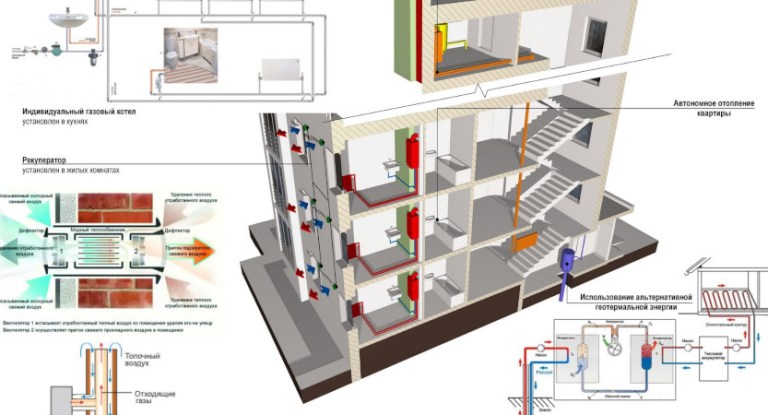
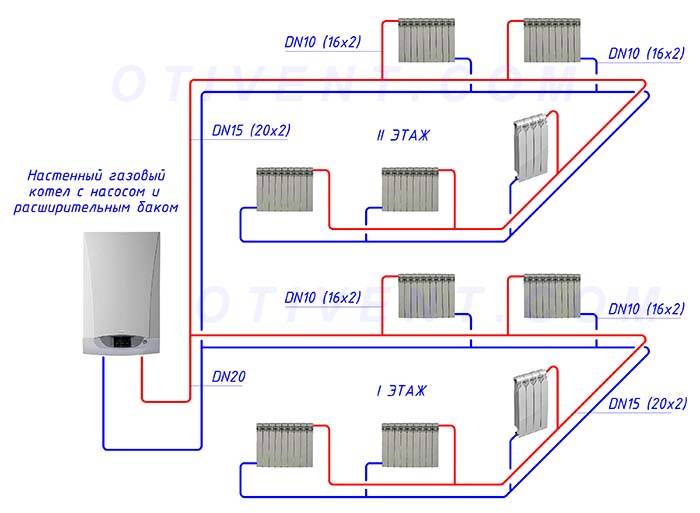
- In multi-storey buildings with a radiant heating system (two vertical risers made of steel pipes). A distribution manifold is attached to each riser, equipped with a filter for water purification and shutoff valves. The coolant (hot water) is supplied to the collector, and then to the heating baseboard. The plinth heating system will allow you to have uniform heating. The advantage of such a heating system with beam wiring is: economy, efficiency, ease of installation and repair, autonomy, the ability to install a heat meter.
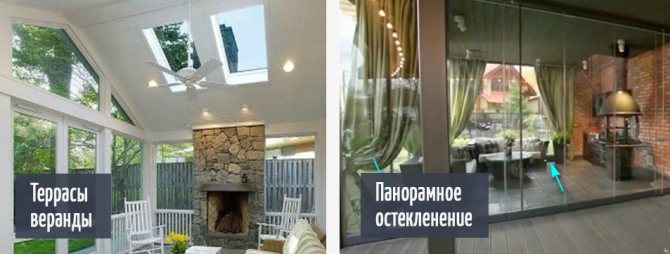
Panoramic glazing, full-wall windows, a picturesque view from the window are signs of the elitism of modern housing and are mostly represented in business class housing, penthouses.
Panoramic windows have both pros and cons. Glass "walls" provide maximum daylight. However, in summer, an excess of sunlight leads to the fact that the room is very hot, and in winter, on the contrary, it is cold, since a large glass area leads to significant heat loss.
The thermal conductivity of glass is much higher than the thermal conductivity of walls. Therefore, it is necessary to use more energy-efficient window systems, as well as to increase the intensity of space heating.
To raise the surface temperature of the inner glass above the dew point, you should install heating equipment around the perimeter of the window unit. However, the installation of a convector or radiator against the background of panoramic glazing will spoil the aesthetics of the room, and floor convectors will require complex and expensive construction work. Thermal curtains with a top or side arrangement are also not aesthetically pleasing for modern luxury housing.
Therefore, for heating glass structures, the choice is made in favor of baseboard heating.
- The plinth heating creates an effective thermal barrier for cold.
- Installation does not require preparatory construction work.
- Modern materials allow you to attach the plinth directly to the glass.
- A warm plinth does not violate the aesthetics of the room and does not block the panorama that opens from the window.
- A variety of color schemes of the plinth allows you to emphasize the stylish interior design.
Advantages and disadvantages of warm baseboards
Next, we will consider the pros and cons of warm baseboards, both water and electric. Let's start with the positives:
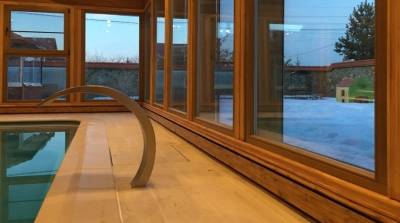
Plinth radiators are an excellent choice for rooms with panoramic windows.
The diminutiveness of the equipment is perhaps the most important advantage characteristic of any warm skirting boards, including electric ones. Thanks to this, we have the opportunity to have at our disposal an extremely compact heating system that is not conspicuous;
The possibility of heating rooms with panoramic windows - warm skirting boards will provide reliable protection from cold air flows and prevent the formation of condensate;
Low case temperature - as a rule, it does not exceed +40 degrees, due to which accidental contact with baseboard radiators does not lead to burns;
Uniform heating of air masses throughout the volume - you will not feel discomfort and feelings of freezing feet;
Warm skirting boards (including electric ones) are suitable for use in any premises - these are kitchens, living rooms, bedrooms, corridors, loggias, covered balconies, terraces, retail premises, entrance groups, halls and much more;
Possibility of simultaneous operation with any other heating devices
For example, electric convectors can be used together with electric warm skirting boards, and classic batteries are often mounted together with water appliances.
There are also some disadvantages:
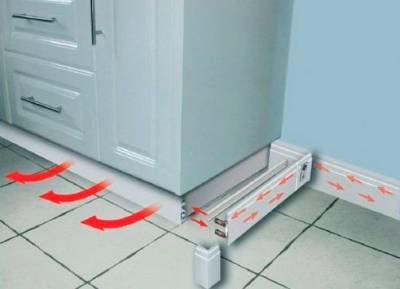
There are some difficulties when installing warm skirting boards in a room with built-in furniture.
- The high cost of warm baseboards is typical for any equipment, including electrical;
- Lack of efficiency - many manufacturers claim that baseboard heating saves money, but these statements can be called into question;
- High power consumption is typical for electric models. Even if your area has rural tariffs, the costs will be very high;
- Warm baseboards cannot be laid where built-in furniture is installed - it closes the space necessary for installing equipment.
However, baseboard heating continues to grow in popularity. Where until recently there were bulky cast-iron batteries, today there are extremely compact warm skirting boards - electric and water ones. Thanks to a well-thought-out design, they provide fast and uniform heating of the premises, giving people warmth.
Installation of a water warm skirting board system
Installation of an electric warm plinth is very simple: we fix it on the wall. Everything, the system is ready for operation. It remains to plug in the sockets. The main thing is that the wire cross-section is correctly calculated, there are circuit breakers of the correct rating. This is the main problem in the case of using an electric warm plinth. Water is much more difficult to mount. Everything must be assembled into a single system, and this is not easy.
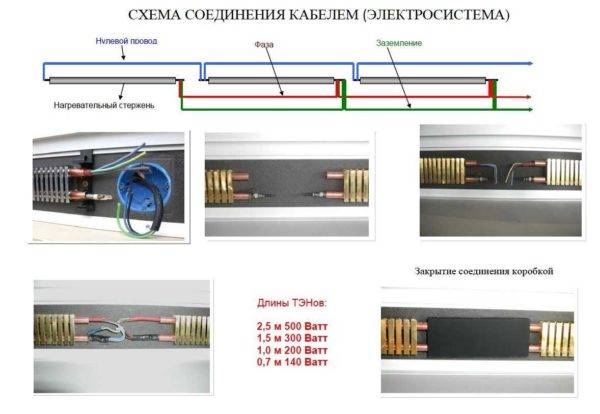
Installation of a heating skirting board: you need to know the nuances
Calculation of baseboard heating
A complete heat engineering calculation of heating is a long and complicated matter.
The size and geometry of the room, the material of the walls, floor, ceiling are taken into account, the degree of insulation of all structural elements, including windows and doors, is taken into account. In general, the calculation is quite difficult
Therefore, most often they take the average figure, which is derived from the analysis of many calculations.
It is believed that 100 W of thermal energy is needed to heat one square meter of a room with medium insulation. That is, to calculate the power of a warm baseboard, you need to multiply the area of \u200b\u200bthe room by 100. Get the required figure. That is how much (and preferably more by about 20-25%) should give in total all the elements of a warm plinth.
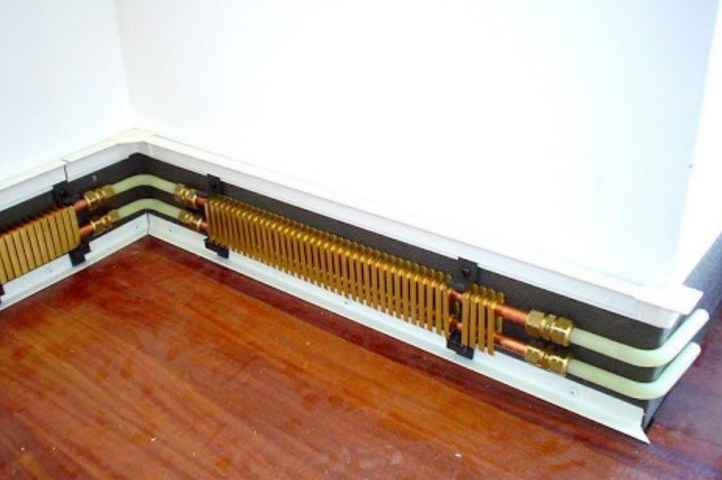

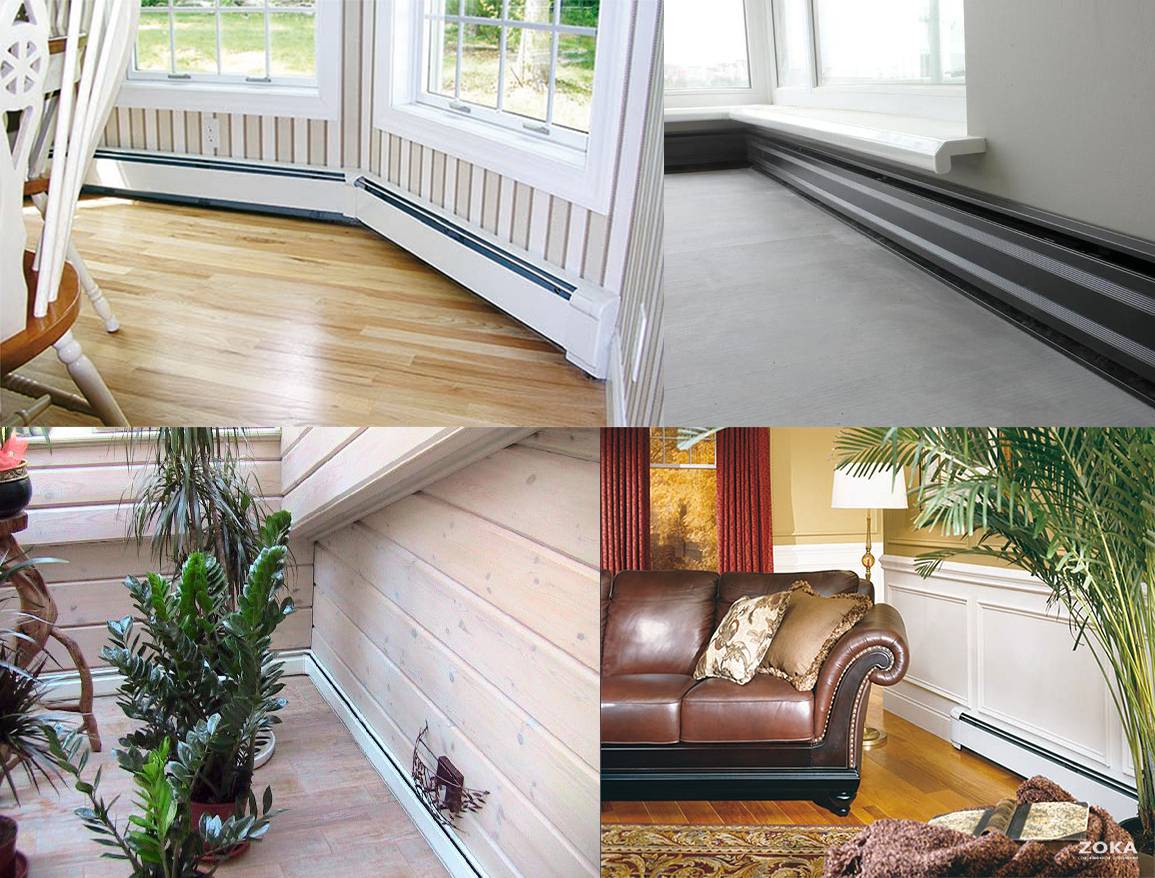


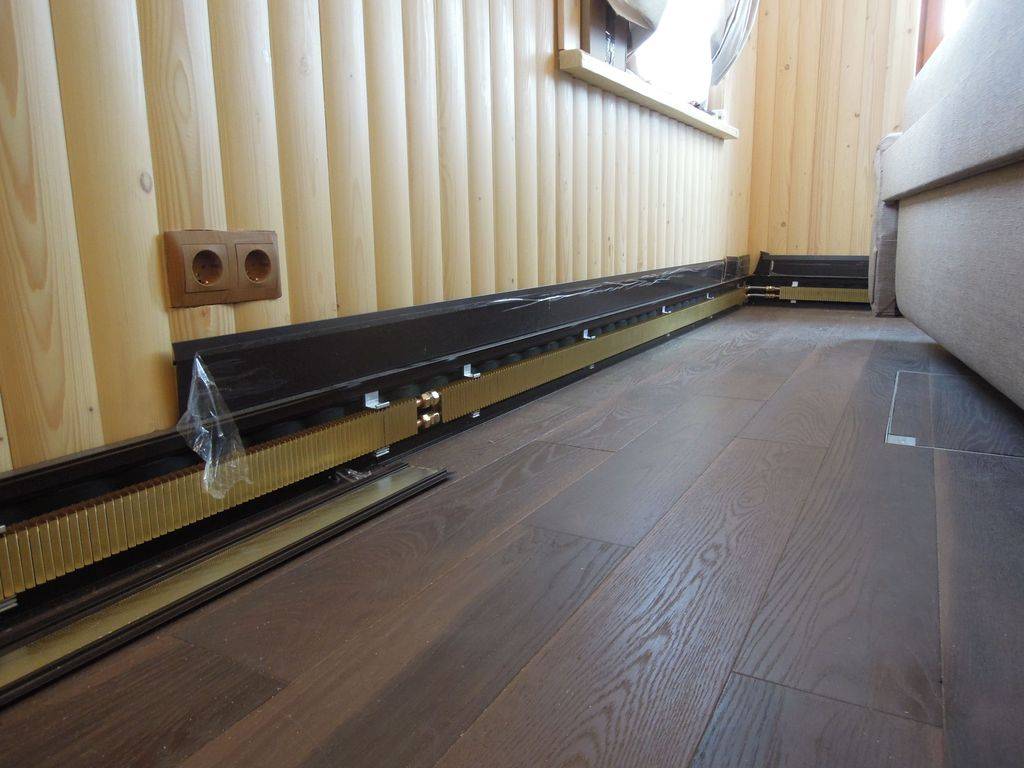
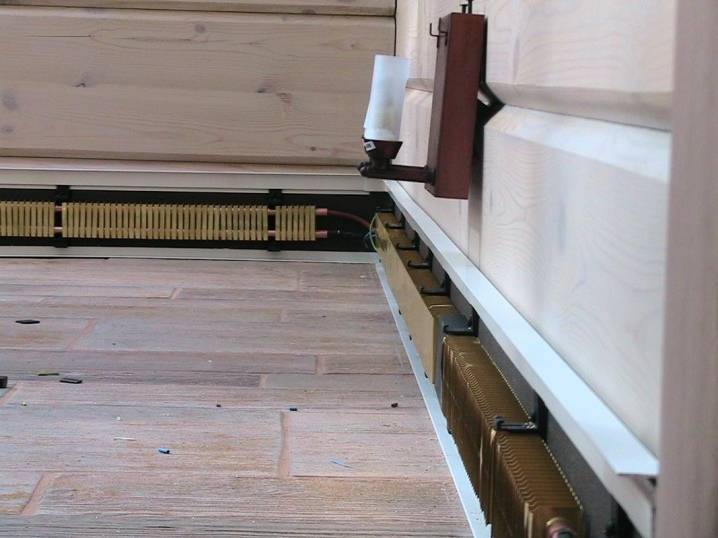


An example of the technical characteristics of the Best Board warm plinth for different operating modes of the system
For example, the area of the room is 18 square meters. For its heating, 1800 watts will be needed. Next, we look at how much heat is emitted by one meter of heating. A water heating skirting board can work in different modes, depending on the mode it emits a different amount of heat. The table above shows data for one of the systems. For example, let's take the heat output of one meter of warm plinth from this table (other manufacturers may have significant differences).
For example, the system will operate with a supply temperature of 50°C. Then one running meter produces 132 watts of heat. To heat this room, you will need 1800/132 = 13.6 m of warm plinth. When ordering, it is better to add a margin of 20-25%. This reserve is necessary so that the system does not work all the time at the limit. This time. And also in case of abnormal cold weather. This is two. So, with a margin we take 17 meters.
Once again, we draw your attention: these are average data for some average house. And here even the height of the ceilings is not taken into account
It is again taken as an average - 2.5 meters. If you have better insulation, you will need less heat; if worse than "average" - more.In general, this method gives only approximate calculations.
How to act
The first thing to do is to draw a plan on which to indicate the length of each heater, the length of the connecting tubes. After all, the length of a warm baseboard is not always equal to the perimeter of the room. In this case, the segments of heating devices are interconnected by copper or polymer pipes. It is undesirable to use steel, as they chemically interact with copper (it is gradually destroyed).
Preparation for installation takes place long before its actual start. At the very beginning of the repair, even before the leveling of the floor, pipes are pulled from the boiler or collector unit to the connection point of the warm baseboard. Pipes are laid, tested for integrity, filled with a screed in a filled state under pressure (working pressure in a private house is 2-3 atm, in a multi-storey building you need to find out in the housing office). Then all repairs are carried out and only after the finishing of the walls and floor does the installation of a warm baseboard begin. Here is its order:
-
A heat-reflecting tape is attached along the perimeter of the walls. It prevents the consumption of heat for heating the wall.
- Fasteners are installed on top of the tape with a step of 50-60 cm. They are fixed to the wall with dowels or self-tapping screws (depending on the material of the walls).
-
In fasteners, according to the plan, sections of the heating plinth are fixed, connected to each other by copper or polymer pipes.
- The tightness of the system is checked by pressure testing.
-
If everything is fine, pipes are connected from the collector unit or from the boiler, the system is filled with coolant and tested.
- After successful tests, decorative covers are installed, the baseboard heating system is ready for operation.
Actually, the installation of warm baseboards is not too complicated.
But the tightness of the joints is important and special attention must be paid to this.
Advantages and disadvantages
Despite the fact that the heated skirting board has a compact size, it can surpass any heating system in terms of its performance. Its design has the following advantages:
- Hygiene. In rooms where such heating is located, the walls will never be covered with mold.
- Uniform space heating. The air in the rooms has the same temperature, both at the floor and at the ceiling, with the only discrepancy of only 1 degree.
- Saving on electricity. A warm baseboard during operation consumes no more than 0.5 kilowatts per 2.5 meters of battery.
- Safety. Fire and electro - safe properties allow you to install this design in wooden buildings.
- Room space. The small size of the equipment excludes the presence of overall radiators.
- Design. The presence of decorative skirting boards makes it possible to decorate the room in an original way.
- Ease of installation. You can install the structure without certain skills.
And they can also create the comfort of a warm floor, not only indoors, but also on balconies, terraces and greenhouses.
But, despite such positive qualities, warm skirting boards also have their drawbacks, which you should pay attention to when choosing them:
- High price. For the manufacture of this model, expensive and high-quality materials are used.
- To avoid wiring shorts, this device must not be used in buildings with high humidity.
- Models should not be placed behind large furniture, as the heat supply will decrease.
Having considered all the qualities of the model, you also need to familiarize yourself with the principles of their heating.
Principle of operation and scope
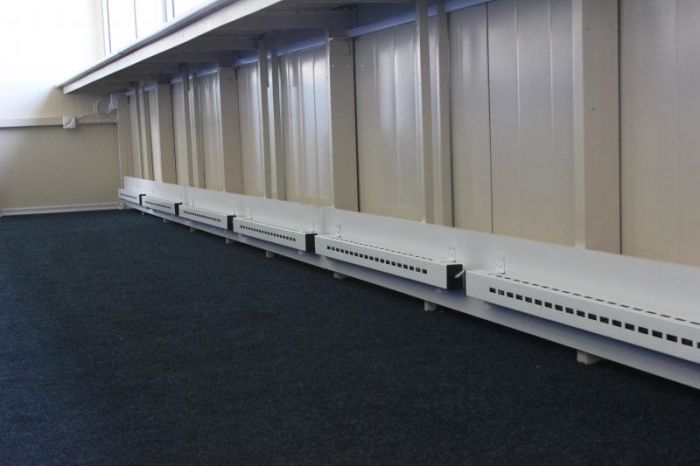
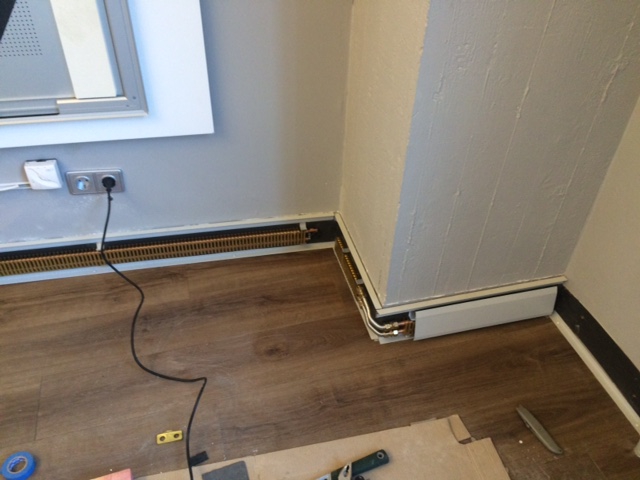
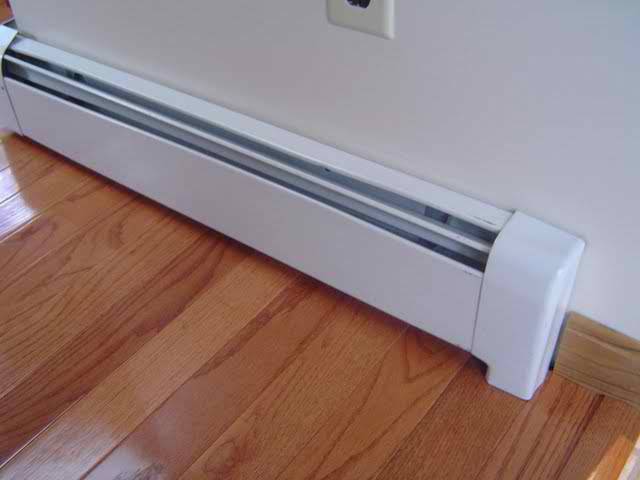
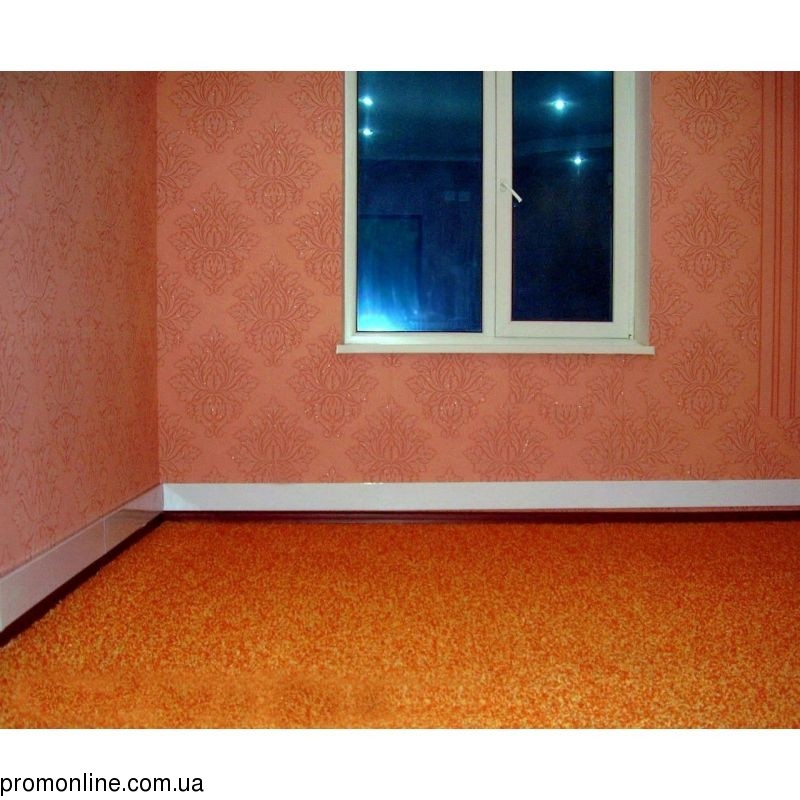
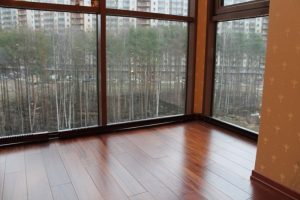 Compact equipment is mounted at the joints of the floor and walls at a low height. Outwardly, such units differ little from standard skirting boards, but they come in various designs.
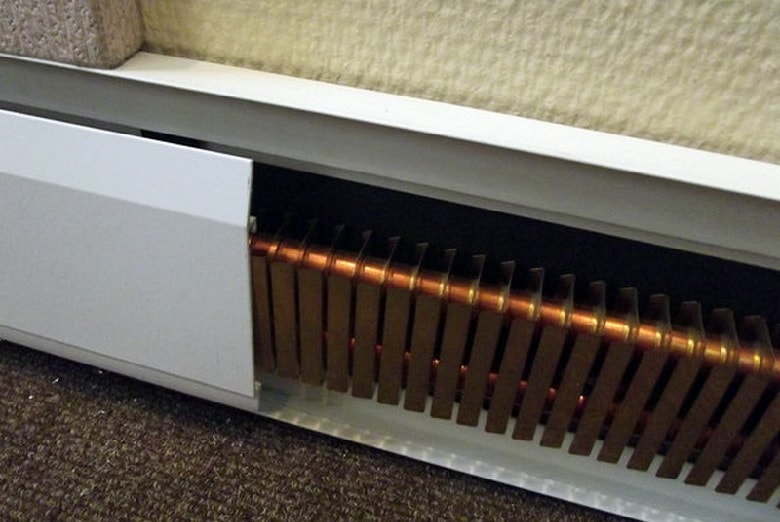
The main heating element in this system is a long heater with a small cross-section through which infrared radiation enters. The heat emitter is placed in a decorative protective casing and fastened with brackets to the walls.
Such devices are used for heating apartments, private houses, offices and other premises. With the help of heating models, space in the building is saved, at the same time heat is maintained in the room. Use the device in kindergartens, medical clinics, hotels and restaurants. In houses with high ceilings, centralized heating is inefficient, therefore, the baseboard type will be a good alternative.
Healthy! This type of heating is most popular in country houses, due to the high energy efficiency, easy installation and connection to networks with a minimum power.
Economy and the laws of physics
However, not everything here is as rosy as it seems at first glance. If your entire wall is heated, then the heat loss from it increases.


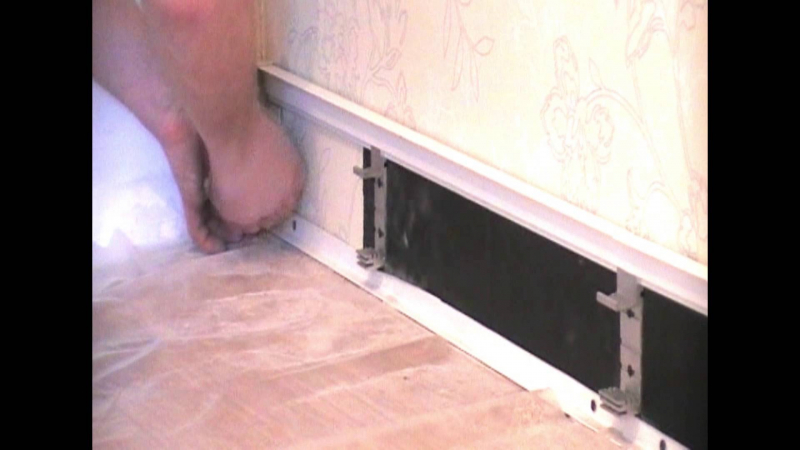

This means that it must initially be made heat-intensive and strive for maximum heat impermeability. 
Here, for example, the formula for calculating heat loss known from a physics course:
Where:
S - wall area
T \u003d (T inside - T outside) - the temperature difference between the wall inside the house and outside
R is the heat transfer resistance of the surface
From this formula it becomes clear what heat loss primarily depends on. R - both with batteries and with a plinth, you do not change. The wall is the same.
But the parameters in the numerator will be different. The greater the temperature difference (T), the greater the heat loss. Suppose, when heated from batteries near the window, the wall will conditionally have t=20C.
The temperature along the wall from the radiator to the far point (in the corners) is distributed along a gradient. Sections of the walls to the right and left of the windows do not warm up at all.
If the entire wall inside the house is heated with a warm baseboard, from the same boiler with the same coolant temperature, then the wall will warm up more. Conditionally up to + 25C, which means, according to the formula, the difference in the numerator will increase, and heat transfer through the walls will increase.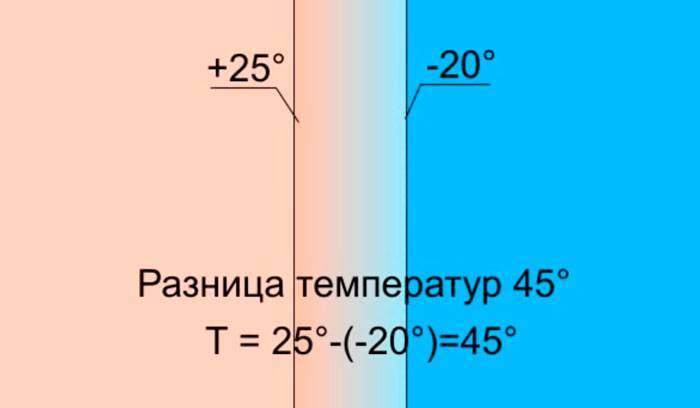
It turns out that the more heat you lose, the more you have to replace it.
It doesn't matter how this heat is brought into the room - by radiators or thermal plinths.
As a result, there will be no significant savings and super-energy efficiency here.
The same applies to the area - S. The surface heated by the plinth is much larger than the surface located directly behind the radiator.
It will be possible to slightly improve the situation if the heating plinth is placed not only on the outer walls of the house (as with radiators), but also on its internal partitions.
Most of the heat generated in this case will remain in the house, and not immediately try to go outside. A slight heating of the outer walls is useful not only as a source of heating, but also for the building itself. Dampness as such completely disappears.
Given all of the above, many therefore perceive such innovations with skepticism. There are long-tested and understandable ways - the same radiators under the windows, or a warm floor in a screed.
All other tricks are too expensive either at the construction stage or during operation and repair.
For a room of 16m2 you will need from 10 to 12 meters of plinth. Its price today averages 4000-5000 rubles per meter and above. And this is in addition to the cost of components. Add here the work itself (in Moscow they charge about 1,400 rubles per linear meter), all the rooms in the house and count your expenses.
Is it possible to fully survive the winter with such thermal plinths? Yes, definitely. In the presence of sufficient linear footage and the appropriate temperature of the coolant.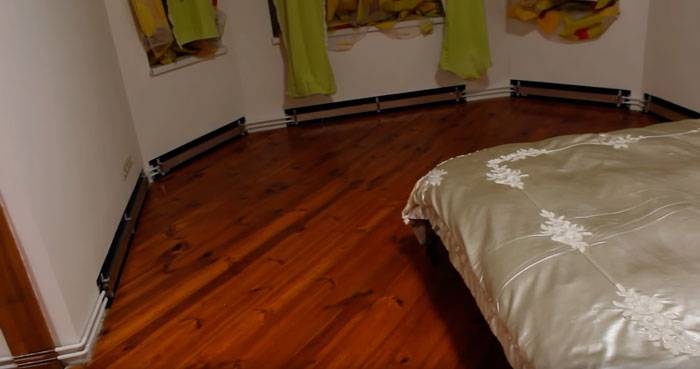
And numerous reviews on the forums confirm this. To warm up the house on the coldest winter days, the temperature of the coolant withdrawal in the collector of warm skirting boards will need to be kept around 75C. On normal days, 50-70C is enough.
The higher the temperature, the more radiant energy you will receive. When it drops to the level of 45C and below, the warm plinth turns into a kind of mini-convector, which heats mainly with air currents.



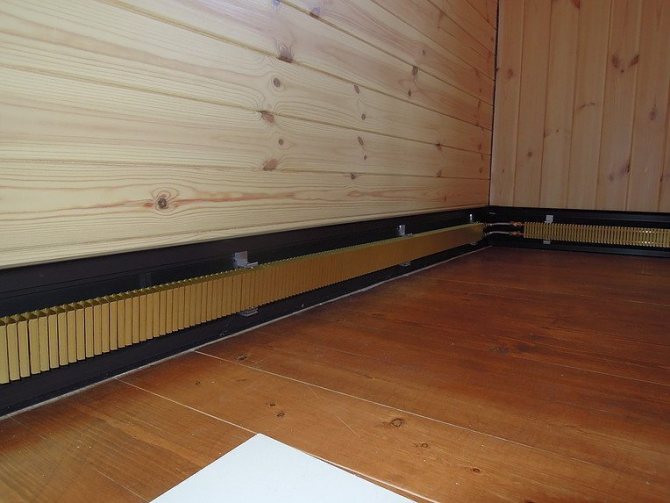

Therefore, do not expect any unrealistic savings figures from thermal plinths. She won't. A warm floor in this respect is much more profitable.
Nevertheless, the system has been widely used and some consumers actively use it both as the main and additional source of heating for their apartment or individual rooms in the house.
Connection to the heating system
As with any heating, you will need an element that plays the role of a thermostat. Usually this is a manifold with control valves.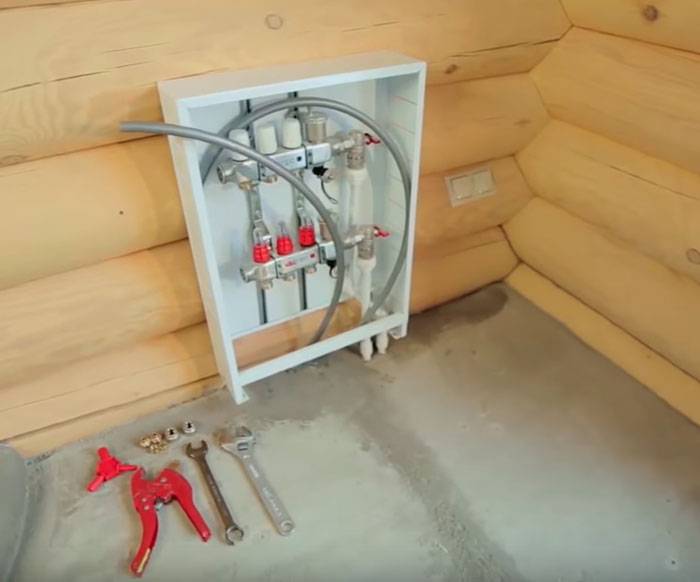
With their help, you can completely or partially close the coolant supply. There are both manual and automatic valves.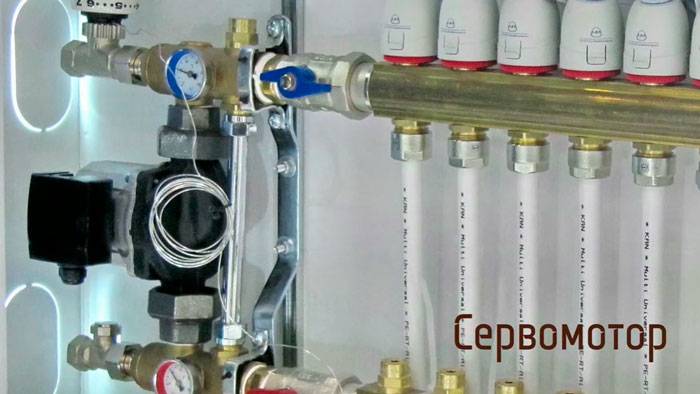
In the latter, thermostats and servomotors are used as closing elements.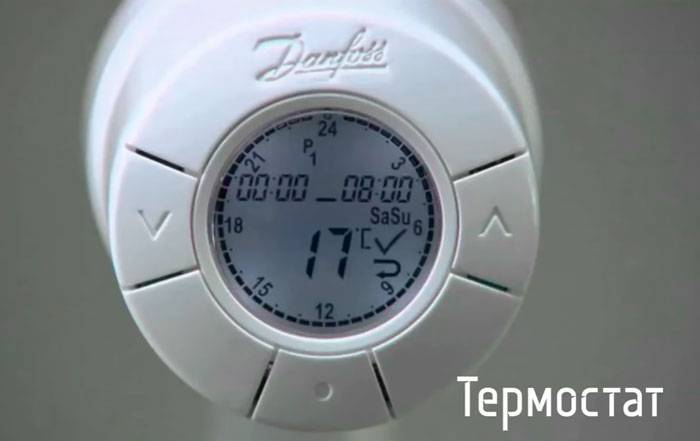
It is desirable to connect each room from its circuit.
To connect the supply pipes to the collector, cut them to the required length. Next, flare and insert the tightening nut. Then the retaining ring and fitting.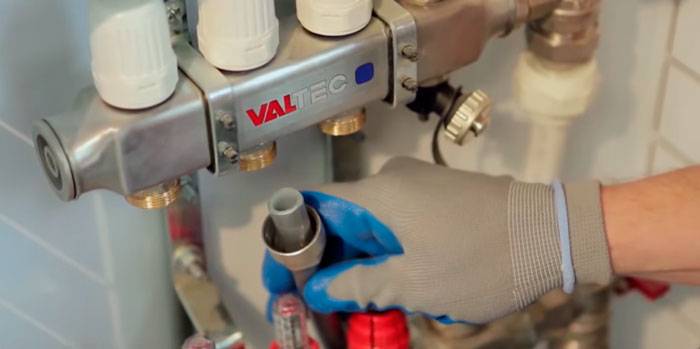
Connect the whole thing to the manifold connector and tighten the nut
Please note that the manifold must have an air removal system
Mayevsky cranes are not used here. Requires automatic air vents.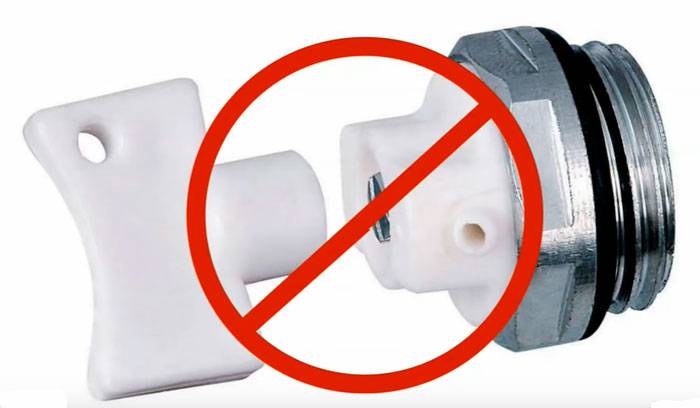
The first heating module is connected to the collector through pipes and fittings in the same way. The main thing to remember here is that the bottom tube is the feed. The top is the return.
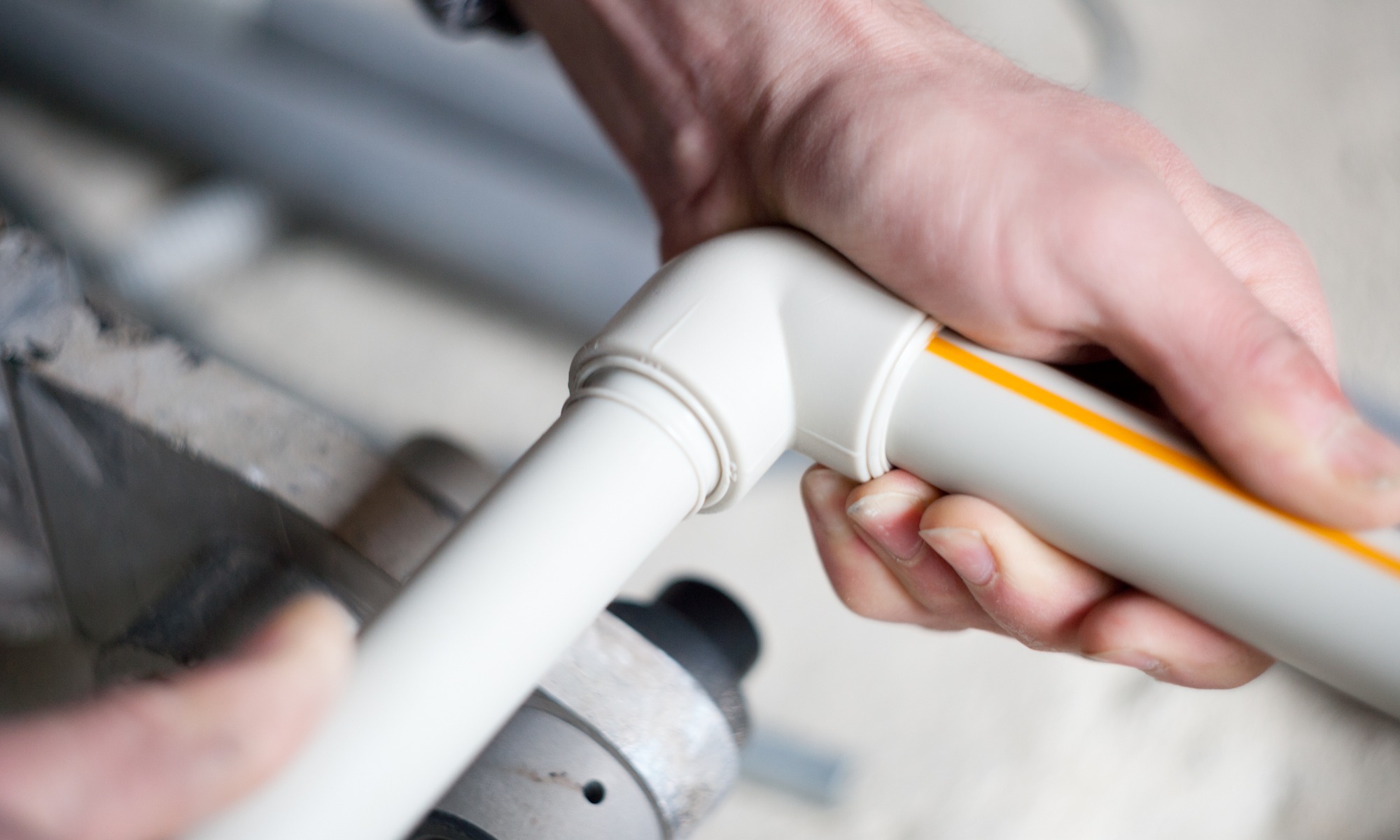
Tubes are best used from cross-linked polyethylene. Pipe diameter - 16mm or 20mm. The thread on the connections is ½ inch.
If you have a high pressure system, then you will need copper or steel pipes. The working pressure of the system is 15kgf/cm2.
After mounting or soldering all joints, fill the system with water and check for leaks. If it is possible to check all joints and joints under pressure, then be aware that the maximum allowable crimping pressure is 23 kgf / cm2.
A linear meter of a standard module holds 0.19 liters of liquid.
If everything is fine and there are no comments, snap the upper decorative strip onto the plinth and enjoy convenient and functional heating.
Electric plinth: equipment installation
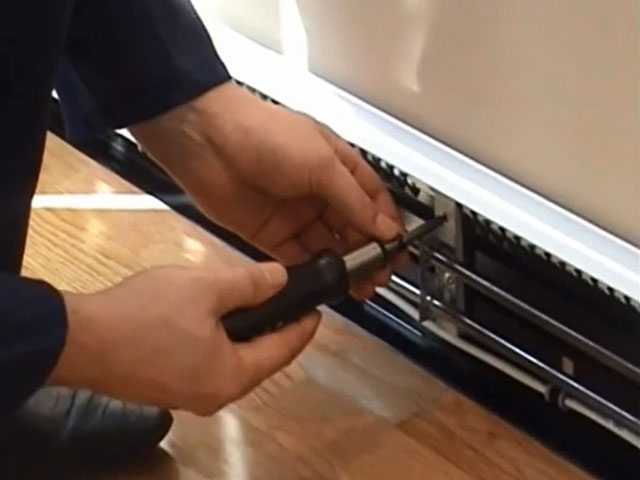
Electric baseboard heaters are installed in much the same way as their water brothers. Only they work from el, and not due to the hot coolant. Instead of a collector, a distribution electrical panel is installed in the structure. Instead of pipes, we have electrical wires in the device.
To control the temperature, it would be nice to install a thermostat per room, then separate adjustment will make it possible to turn off an unnecessary heating circuit and save on electricity.
Installation of skirting convectors is carried out as follows:
- Laying thermal insulation;
- We attach the bases with heat exchangers;
- We carry out electrical special connections;
- We cover the equipment with decorative panels;
- We attach the circuits to the thermostats and to the switchboard.

Once again, we analyze the state of all electrical circuits, make sure that the connections are made correctly and that there are no protruding and bare conductors. After making sure of the literacy of the installation, we turn it on to the machines and check the operability of the system.




The cost of a warm skirting board and its types
The cost depends on the materials used. Copper heating devices are expensive. The segment price may exceed 12,000 rubles. But it is copper options that are the most effective - high efficiency, increased durability, safety. Due to the high price, aluminum and brass versions of the heating system are more often used, but a warm skirting board made of these materials heats up the room longer and has a lower heat transfer coefficient. But just as durable and reliable as copper. Price from 4 900 rubles. The best manufacturers are Mr.Tektum, Termia, Best Board and others.
The price also depends on the type of system. Released:
- Warm plinth, powered by central heating or an autonomous boiler in the house. The second option for organizing the system is preferable, since it can be very difficult to connect to a centralized system in an apartment building. YES, and the installation of a warm baseboard will be much more difficult. The equipment uses from 0.34 to 0.44 liters of water per 1 m. One circuit will use up to 4.5-5 liters of water. To heat an object with an area of 100 m2, heating equipment will require only 8 liters of water. Power at a heat carrier temperature of 650C will be 200 W/m.
- Electric skirting board with heating element. The most popular version of the system. Power 200 -2 000 W. There are two types of heaters with a heating cable and a heating element in one tube and a water coolant in the other. Often, having figured out what a warm electric baseboard is, the price of which is slightly higher than the water one, they choose it. It will bring less hassle when connecting. Its main advantage is that there is no need to hide water pipes in the floor.
- Infrared warm plinth with special heating elements. This is a relatively innovative invention. By the principle of air heating, it does not differ from the devices described above, but there are design differences. We can assume that the IR type is an electric heating baseboard, the core of which is an infrared film. It is also sewn into decorative plinth-like covers. The system is characterized by very simple and quick installation. But most importantly economy. Many consumers are interested in the question of whether it is possible to replace a warm floor with a warm baseboard installed around the perimeter of the premises. Quite.Especially if the system is used as an auxiliary.
Choosing a plinth infrared heater
In order not to make a mistake with the choice of an electric baseboard convector, you first need to get acquainted with the existing varieties. The most demanded both in Moscow and in other cities are infrared devices. Such designs have an operating power of not more than 150 watts. They can be used as the main heating method, since they are able to generate 5 times more heat than similar devices.
The design of such a system includes anodized aluminum lamellas, which provide strong heating of the walls and nearby surfaces. Due to the installation of such skirting boards, an effective curtain is created, which perfectly protects the room from cold air.
Cable heater device
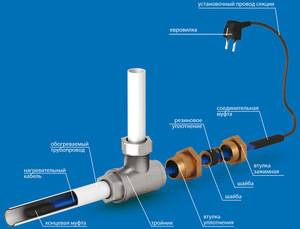
Skirting boards of this type can be used to heat any room, except for those where high humidity prevails. The advantage of these heating systems is a more simplified assembly scheme. The heating elements are mounted in a box, while installing a collector and laying supply lines is not required.
The principle of operation of the skirting convector
During the operation of heating skirting boards, maintaining a comfortable temperature in the room is ensured not only due to the impact on the air located in the lower part of the room, but also due to the transfer of heat to the wall surfaces. In order to heat the air by convection, you have to spend about 30% of all energy, and the rest of it goes to warm the walls.
After the air warms up to the required temperature, it begins to rise up along the walls, where it mixes with warmer air currents. The result is an air cushion. After the walls warm up to a temperature of 37 degrees, they begin to give off the received heat to the space of the room.
Choosing the best option for a warm skirting board, you need to pay attention to its price. The cost of such a system may vary.
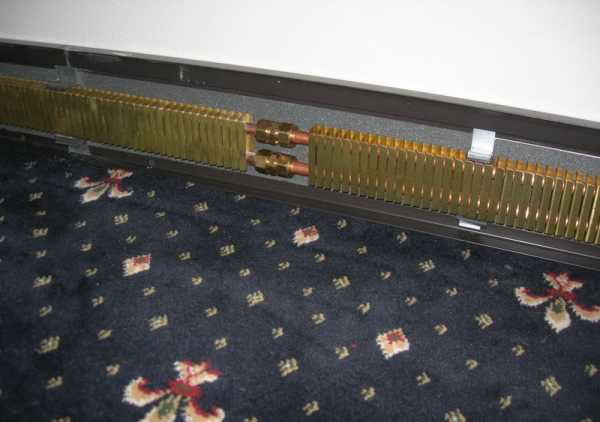
Much depends on the features of the device and the characteristics of a particular model. The design of skirting boards has a heating element, which is covered with a light metal bar. This element includes copper tubes to which radiator plates are connected.
Installation Features
effectively
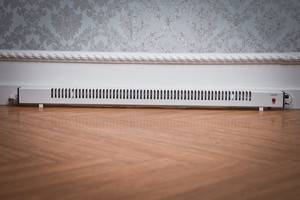
Installation of a warm skirting board Megador is carried out in two stages. It all starts with preparing the leads for connecting the structure, then the supply lines are laid and the cable is connected.
The second stage begins only after the completion of the decoration of the premises. When using the water type of the heating skirting board, all its elements are first installed, the modules are connected to the output elements, after which the contours are adjusted and the system is pressure tested. In the case of an electric warm baseboard, you first need to install all the elements of the case, connect it to the terminals of the circuits, and then measure the insulation. The final step is to adjust the thermostat.
Particular attention should be paid to calculating the number of sections, where it is important to avoid mistakes.Here it is necessary to pay attention to the power of the system and possible heat losses. The end results will vary from case to case.
It all depends on the quality of the thermal insulation of the walls, window structures and air temperature. I would like to draw attention to the fact that when using the electric type of skirting boards on an area of 10 m2, 0.5 kW will be required. If the water option was chosen, then this figure is increased by 2 times
The end results will vary from case to case. It all depends on the quality of the thermal insulation of the walls, window structures and air temperature. I would like to draw attention to the fact that when using the electric type of skirting boards on an area of 10 m2, 0.5 kW will be required. If the water option was chosen, then this figure is increased by 2 times.
Mounting
If the installation is carried out by a professional, then, as a rule, he will make the optimal calculation of the required system power
If this work is carried out independently, it is necessary to pay special attention to calculating the required number and power of heating elements, so that later in winter it would not be painfully cold. To do this, it is necessary to roughly estimate the possible heat loss due to the thermal insulation of the walls, the tightness of the windows and the severity of the climate. The more favorable the conditions, the lower the heating costs.
For example, a room with standard ceilings of 2.5 m and an area of 20 square meters, subject to the presence of double-glazed windows and good overall thermal insulation, can be easily heated by a 1 kW device. This is about twice as profitable as conventional convector heaters.

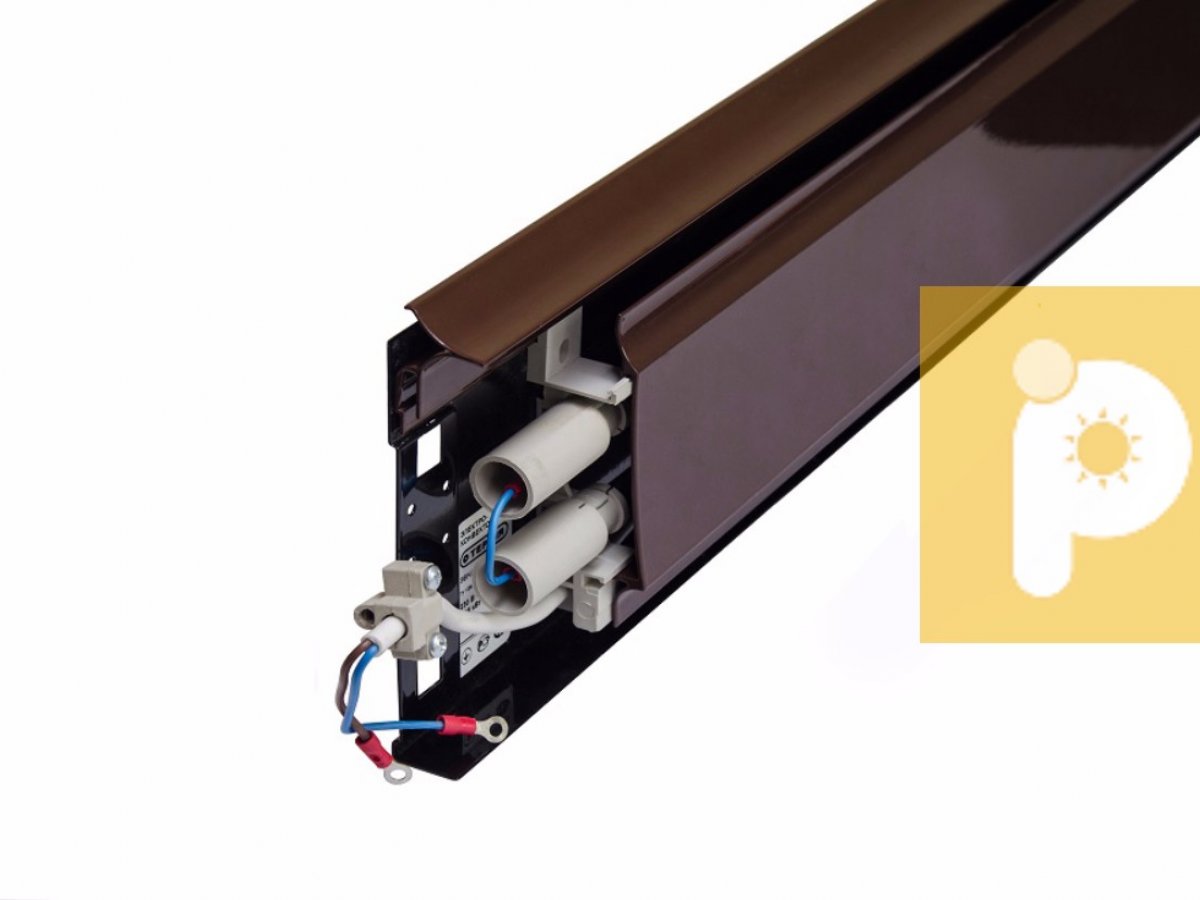


In terms of installation, the system of electric skirting boards is many times simpler than the warm floor familiar to everyone; its installation does not require capital construction work.Its installation is so simple that anyone who knows how to hold a puncher, hammer, level and tape measure can handle it. Due to the compact dimensions and low weight of the elements, they can even be placed on plasterboard or plywood partitions.
The delivery set of the device, as a rule, includes consumables in the form of self-tapping screws and brackets for fasteners. In terms of placement of devices, there are no special restrictions and rules; heating elements can be mounted in a continuous line around the entire perimeter of the room or to save money where they are most needed. At the same time, thanks to the ability to decorate parts of the system as you like, they can easily be combined with a regular skirting board without heating elements.
Proper installation of the unit provides for the installation of elements along the walls according to the level, at a height of about 1 cm from the floor, with a gap of 15 mm from the wall. It is necessary for the circulation of air masses, preventing excessive heating of the heating element.
Kinds
Today, only two types of warm plinth are common - water and electric. Each of them is used in specific conditions for arranging rooms and furnishing the apartment itself. It is worth considering each of the types in detail.
Water
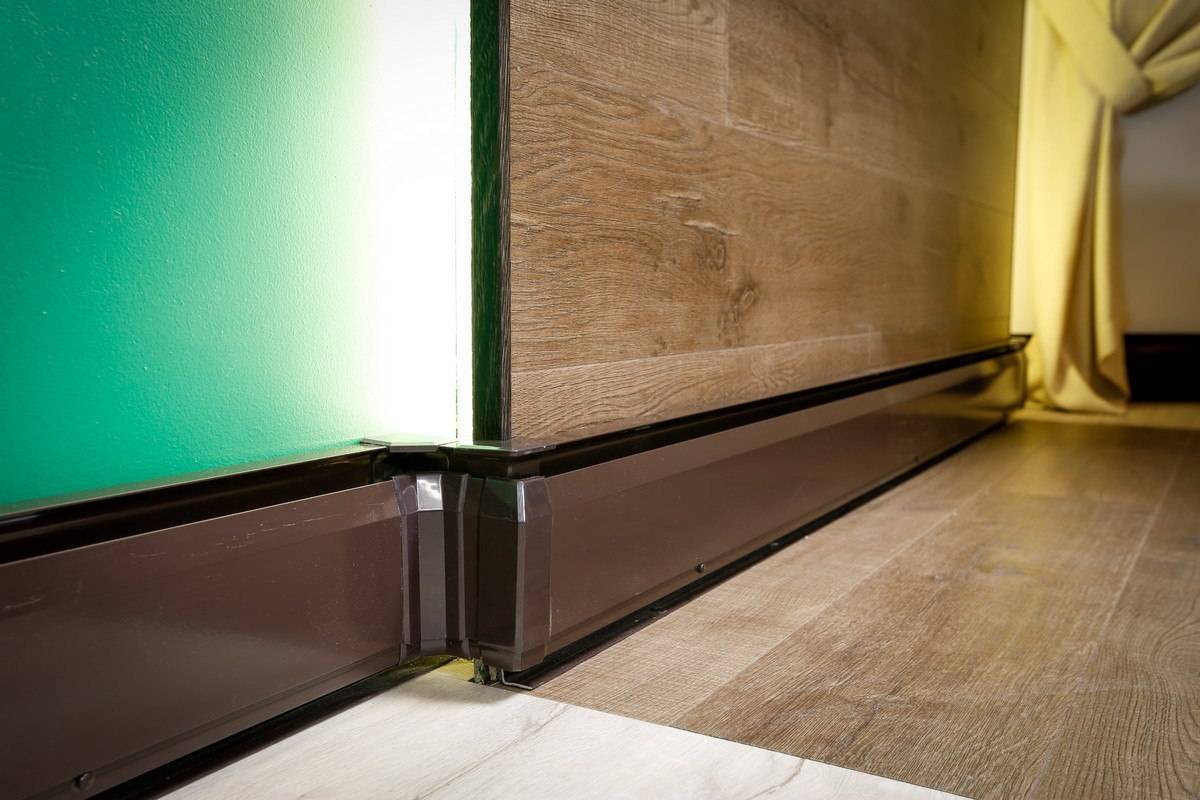
This installation option is quite common - it can be seen in the interior of some modern residential buildings, office buildings, even shopping centers. It is worth noting that the water type of warm plinth is widespread in many Western countries. Such interest is due to such factors as: ease of use and low maintenance requirements. Water warm plinth It is an externally metal panel or box, inside of which is placed a heating or heating module with mini-tubes for water supply and heating. The outer or back side of the device is also equipped with a metal panel, which is already designed to protect the wall itself from high temperatures.
This method of connection by technicians is called beam. The difference between this type of warm plinth and electric is a wide range of possible installations in the interior. Water warm plinth can be mounted on attics, loggias, even on a balcony, while the heating efficiency does not decrease, and energy costs remain relatively small. Another feature of the water type is the speed of heating the air, since the physical properties of water make it possible to freely transfer even the hottest streams through pipes. However, it is necessary to constantly monitor the temperature level in boiler rooms.
Electric
If the water version of the warm baseboard is valued for its quick heating and ease of maintenance, the electric type is common due to the following characteristics:
- ease of installation work - unlike the water type, the electric one is installed on site, the installation process is simple and fast, because it is enough to fix the heating panels to the wall;
- the presence of more advanced heat regulation systems - most models of water skirting boards are not equipped with special devices for measuring temperature - for this it is enough to monitor the average water level in boiler rooms. The electric type is often equipped with specialized thermostats that look like conventional thermometers.Thermostats can work both automatically and can be adjusted manually, and their work is aimed at optimizing energy costs.
Here it is worth noting the negative aspects of using such a plinth:
- high energy consumption - when using any equipment with power supply, the question arises of cash costs. The electric type, unfortunately, even with thermostats consumes a large amount of energy;
- installation of the electric type is much simpler, however, the connection process itself can cause some difficulties - this is the preparation of a dedicated line with the correct rating;
- one potential downside for many buyers is the availability of power. The probability of wiring damage and fire is extremely small, however, for some this is a determining factor under certain operating conditions.
If the buyer liked the aquatic variety more, then do not despair and think that these species differ in appearance.
In addition to the presence of terminals or wire attachments to the electrical supply, these varieties are outwardly absolutely similar. It is worth noting such a type of plinth equipment as an infrared warm plinth. The peculiarity of this type is the use of a special film tape, which, under the influence of high temperatures, heats up and becomes a kind of source of infrared radiation, which provides additional and high-quality heating of the room.
Application area
Today on the market you can easily buy an electric skirting board for heating. In terms of its performance, it significantly surpasses all options for conventional heating, which are not applicable everywhere.For example, in country houses, in the absence of heating plants, and sometimes a gas pipeline, only firewood and electricity can serve as the only source for heating. In this correspondence competition, of course, the skirting board wins, because it is much easier to turn on any electric heater than to melt the stove.
Such a plinth is essentially a conventional heating element with a heating coil made of a special heat-resistant alloy, which ensures a long service life of the device.
The plinth system is similar in operation to electric floors, it also has a temperature controller for individual adjustment of the microclimate in the room. Temperature data comes from sensors placed on the walls, at the level of human growth. You can also connect such a device to a regular household outlet, professionals recommend not to overload the electrical wiring at home once again and connect the heating device directly through a separate branch of the electrical wire to the switchboard with the provided machine.