
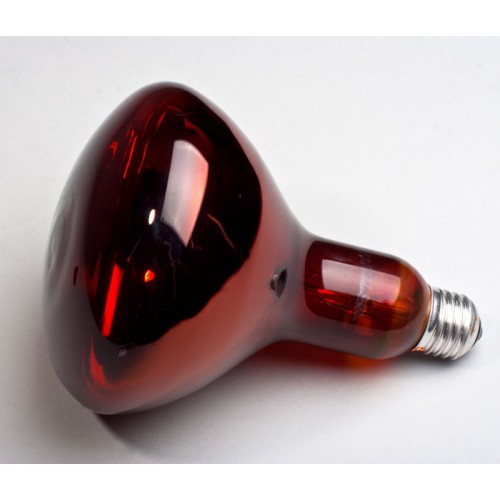
- How to choose an infrared heater for a chicken coop
- IR lamp for chicken coop heating
- IR heater for chicken coop
- Types of IR heating lamps
- IR lamp device
- Advantages of IR heating
- Temperature control
- Some IR lamps and heaters
- Overview of IR lamps
- Overview of IR heaters
- General information and scope
- Design
- Advantages
- main parameters
- Other options for IR heaters
- Advantages and disadvantages of heaters
- Types of lighting
- The principle of operation of the halogen heater
- Lamp heaters of infrared radiation (lamps, lamps, spotlights)
- Advantages and disadvantages
- What is an infrared lamp
How to choose an infrared heater for a chicken coop
The red lamp is the simplest infrared heater. There are other more efficient devices. The IR heater is different in that the rays emanating from it heat the object that comes across the path. They don't heat the air.
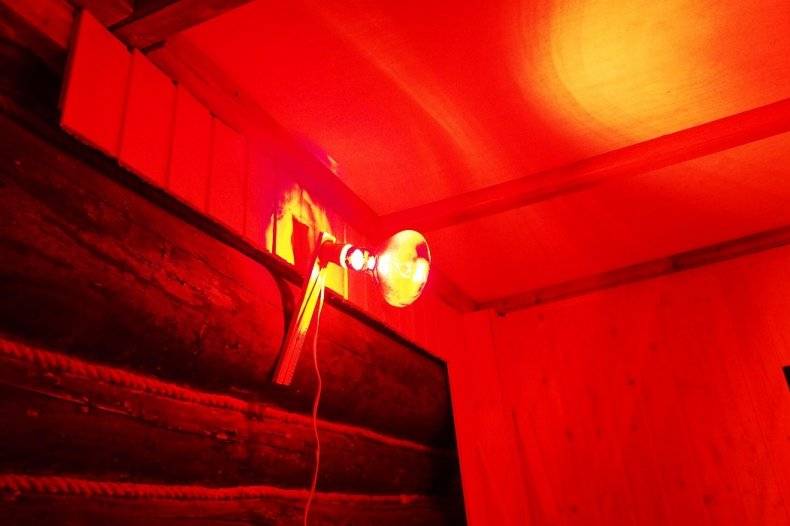
Important! A red lamp suspended from the ceiling in a chicken coop will give a better effect than a radiator mounted on the wall.
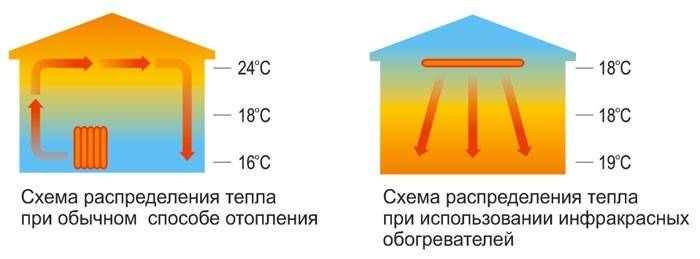
When using conventional heating devices, according to the law of physics, the heat emanating from them is directed upwards. It turns out that it will be cold at the bottom of the chicken coop.The rays from the red lamp or infrared heater are directed downwards, warming up the litter, food, drinkers, nests and other objects. The reflected heat is evenly distributed inside the chicken coop.
Important! The red lamp and all other types of IR heaters do not burn oxygen
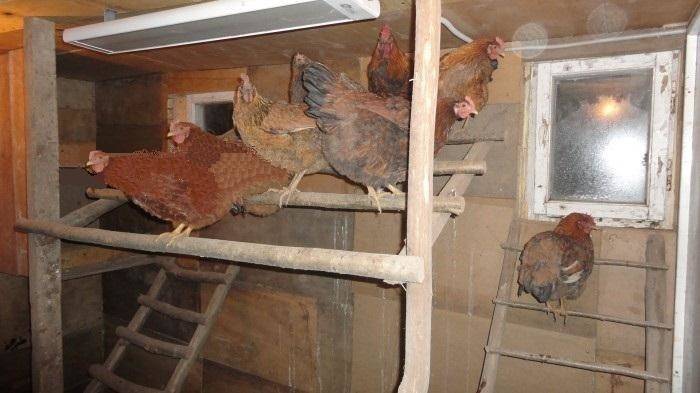
The choice of an IR chicken coop heating device is carried out taking into account two important parameters: efficiency and safety of operation. As for the first requirement, it is optimal to install an infrared heater for a chicken coop with a thermostat that automatically turns on and off at a given temperature. In terms of power, the device is selected at the rate of 80 W / m2 of the barn.
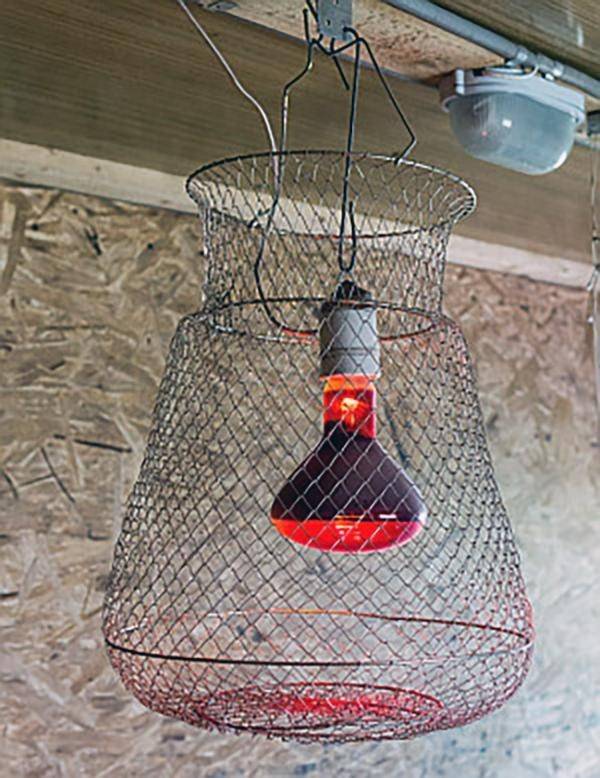
For safety, preference is given to wall or ceiling models. The bird will not be able to touch the heated device. Wires will not get tangled under your feet. Red lamps are also hung from the ceiling, but they are protected by a metal mesh, otherwise a curious chicken will break the glass bulb.
IR lamp for chicken coop heating
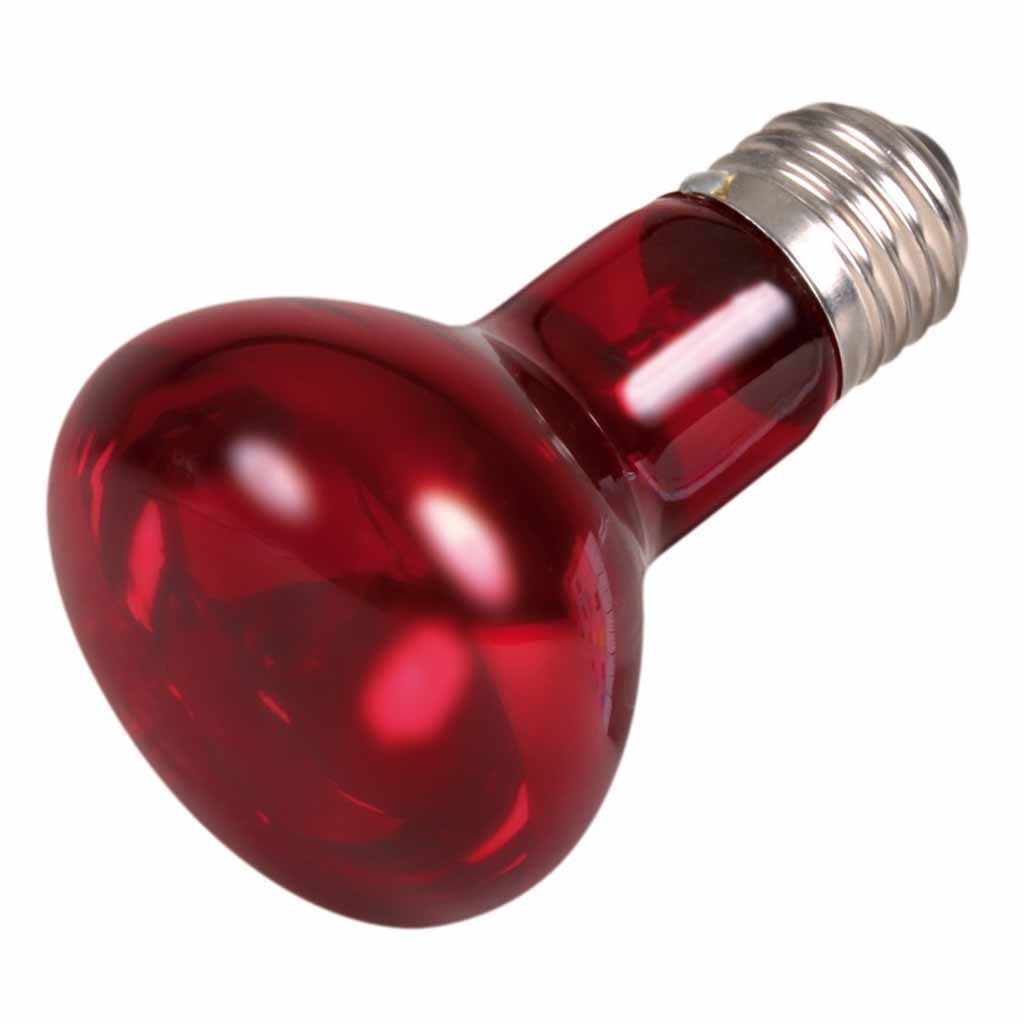
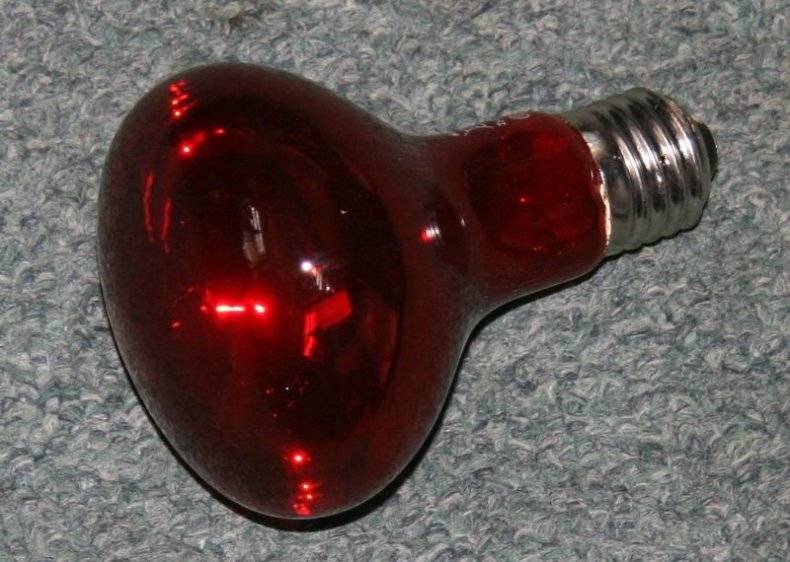
Red lamps with a large glass bulb have been used in the last century to heat poultry and animals. The advantage of the lighting device is that, together with the heating, the barn is illuminated. If you understand the principle of operation, then this is the very infrared lamp for heating the chicken coop, which does not burn oxygen, heating only the surface of objects.
Important! To calculate the number of red lamps per chicken coop, it is assumed that 1 lighting fixture can heat 10 m2 of area. The efficiency of the red lamp reaches 98%
Due to the mirror coating on the inside of the bulb, there is a directed reflection of IR rays. Red light has a calming effect on the bird.It is impossible to hang the lamp closer than 1 m to any object. It is important to protect the glass flask from curious chickens. A bird with a blow of its beak or wings can break it. The best way to protect is to hang a red lamp in a metal mesh
The efficiency of the red lamp reaches 98%. Due to the mirror coating on the inside of the bulb, there is a directed reflection of IR rays. Red light has a calming effect on the bird. It is impossible to hang the lamp closer than 1 m to any object
It is important to protect the glass flask from curious chickens. A bird with a blow of its beak or wings can break it
The best way to protect yourself is to hang a red lamp in a metal mesh.
IR heater for chicken coop
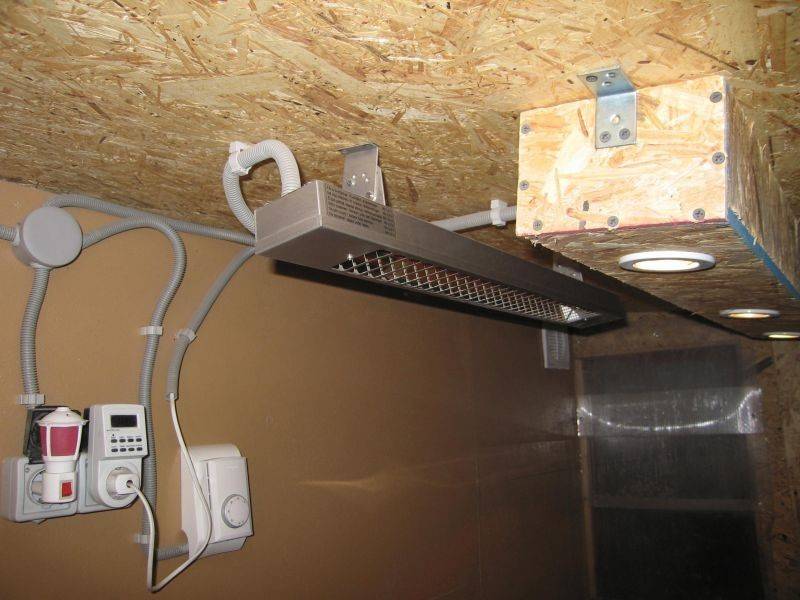
IR heaters inside the chicken coop can create a whole heating system. It is better to buy the device with a thermostat so that it can automatically respond to the air temperature. According to the execution, there are models of ceiling, floor and wall installation. It is optimal to choose an infrared ceiling heater for the chicken coop so that the bird does not burn on the heating element. In extreme cases, a wall-mounted model is suitable. Floor heating devices are not installed in the chicken coop.
Unlike the red lamp, IR heating devices differ in heating elements:
- Longwave models are equipped with a plate heater. The element is heated to a temperature of 230°C. When installing, the maximum proximity to the object is allowed - 50 cm.
- Shortwave models are equipped with a spiral heater placed inside a glass tube. The element is heated to a temperature of 600°C. During installation, a distance of 3 m from the nearest object is provided.
The device can be installed so that it will heat a large area or direct heat to a specific place. IR rays instantly warm up an object that gets in the way, and it, in turn, gives off heat to the air.
Types of IR heating lamps

The most popular lamps are made of transparent pressed glass. They can be dyed in different colors. As a rule, these devices are designated by the letter abbreviation IKZS, IKZ or IKZK. The fact that the inner flask has a mirror coating is indicated by the letter "Z" in the letter designation. The most popular lamps are blue (IKZS) and red (IKZK) colors. As a heating element in the device, a carbon or tungsten filament is used. Transparent flasks are designated IKZ. They are used for lighting and space heating.
The most popular among infrared devices is the IKZK 220-250 R127 model with the following technical characteristics:
- Electric heater power 250 W.
- The maximum heating temperature of external surfaces is 500°C.
- Reflective surface with a mirror finish.
- Base E27.
- The range of radiation is 3.5-5 microns.
- Working life 6500 hours.
- Voltage - 220 V.
In addition to appliances for lighting and space heating, if units that are designed exclusively for heating.
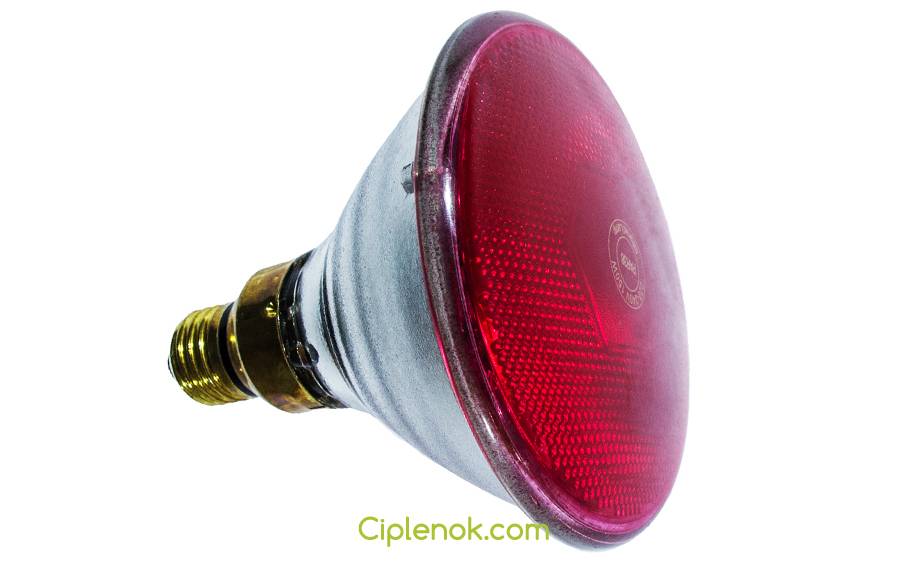
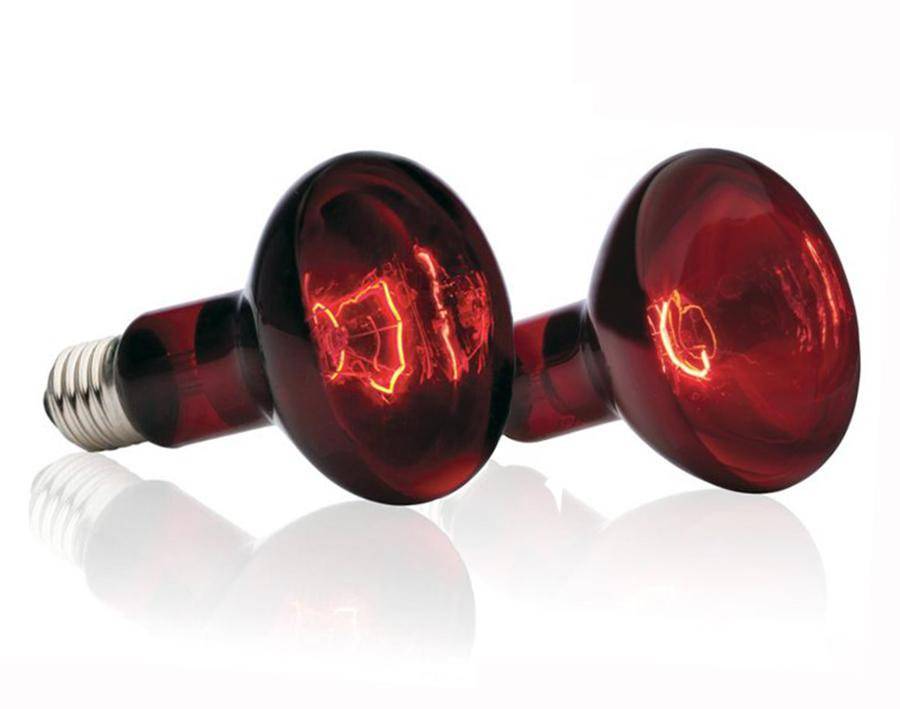


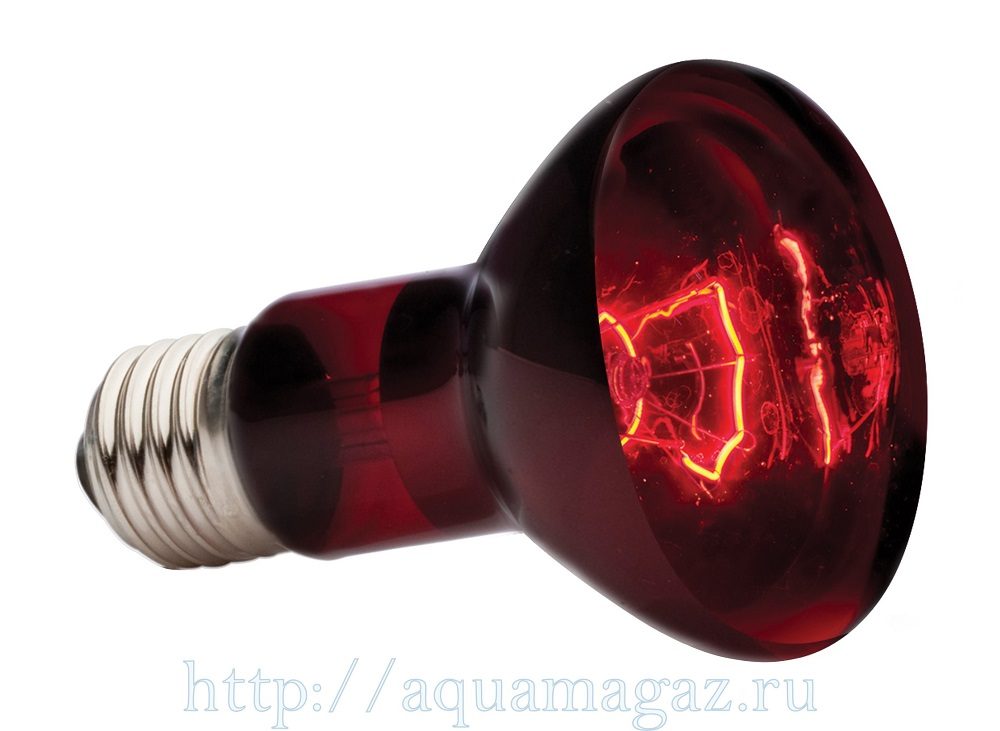


Among them are the following models:
- Ceramic infrared heaters ECZ/ECX with a nichrome heating element in a ceramic housing.
- Units with ECS/ECP/ECH halogen tube heater encased in quartz glass. The heater is made of rheostat wire.
- Infrared protectors with emitters and IR lamps of various types.The device allows you to direct the flow of infrared radiation in the right direction.
As you can see, infrared lamp devices can be called universal units that are used in various fields of human activity. In everyday life, they are actively used for heating rooms for various purposes.
IR lamp device
The infrared lamp is designed not so much for lighting as for heating. To provide heat to an entire room or even a house, special heaters of various types and sizes have been created. IR lamps are more suitable for thermal effects on certain areas of the room.
The most common models of such devices are a glass bulb, inside which is a tungsten filament.
The mirror coating directs the flow of infrared radiation in the right direction and increases the efficiency of thermal exposure. Most often, such a light bulb can be screwed into a standard E27 type cartridge and powered from a conventional 220 V network.
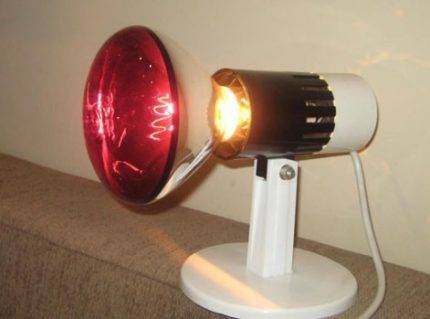
The infrared lamp consists of a bulb and a reflector, inside there is a filament. The device has a standard E27 base, which allows it to be used with suitable fixtures.
Lamp power can vary between 50-500 watts. It is not recommended to use a plastic cartridge with such devices; it is better to take ceramics. The cartridge and lampshade for an IR lamp must withstand heating up to 80 degrees, not every plastic is capable of this.
For the same reason, it is not recommended to touch the included IR lamp, you can get a serious burn. A grid is used to protect against accidental touches.
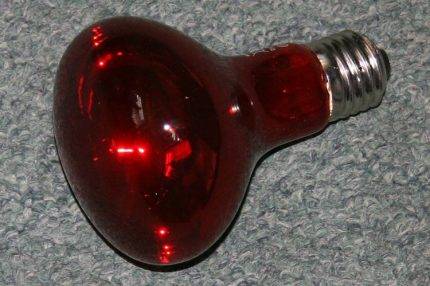
Traditionally, flasks of infrared lamps are painted red, but models with transparent glass are also popular. There are also blue IR lamps
The glass from which such a lamp is made can be standard, tempered or pressed. The flask is left clear, but is often dyed red or blue.
Contrary to popular belief, blue coloration is not at all an exclusive feature of ultraviolet devices. The filament in IR lamps can be not only made of tungsten, some manufacturers use carbon for this purpose.
The reflector is labeled as IKZK, IKZS and IKZ, which indicates red, blue or no staining. Separately, it is worth mentioning the IR lamps, made not like a traditional bulb, but like a narrow tube.
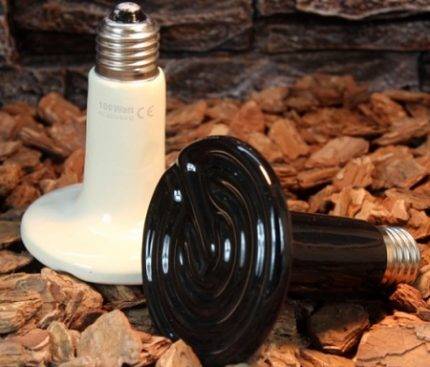
The bulb of a ceramic infrared lamp is more resistant to heat, moisture, temperature changes and shock than glass counterparts
Finally, there is a very special type of lamp of this type, they are equipped with a ceramic body and are intended only for heating where lighting is not needed.
Nichrome or fechral thread is used as a heating element in such devices. These are very strong and durable devices, they are not afraid of contact with water splashes. Such devices are widely used for night heating of young animals, as well as for keeping exotic animals at home: reptiles, snakes, etc.
Advantages of IR heating
As already mentioned, IR lamps are used for spot heating of individual zones. Although in crop or livestock production, a few lamps can fully meet the heat needs of a greenhouse, chicken coop, etc.
A winter garden, a balcony, a stand-alone kiosk, and other similar objects are advantageously heated using IR lamps.
Here are the main advantages of this type of devices:
- compact dimensions;
- simple installation;
- high efficiency;
- heat distribution without the use of fans, etc.
The air practically does not absorb infrared waves, which deliver heat directly to the heating object.
As a result, it is not necessary to direct heated air flows so that they spread throughout the room, as is done with convection methods. Even if the lamp is located under the very ceiling, the heat will reach the goal.
For the operation of such a heater, oxygen is not needed, so its presence favorably affects the atmosphere in the room.
When raising chickens, infrared heating is a must. At night, you can use a ceramic lamp that does not give light
Due to the absence of convection, dust also does not move around the house. IR lamps are not difficult to store if they are only used seasonally. To install or dismantle the device, you just need to screw it into the cartridge or unscrew it from it.
The device does not require special storage conditions; with careful handling, it more than fulfills the resource provided by the manufacturer.
Such lamps are convenient to use if you need to heat a specific place. For example, if the balcony turned out to be too cold in winter, a couple of small lamps will help to quickly solve the problem, and in the summer they can simply be removed and hidden.
It is also worth remembering the beneficial effects of infrared radiation on human health.
If you equip the infrared lamp with a temperature controller, you can change the intensity of heating depending on the situation.
They are used for medicinal purposes in medical institutions, but at home the healing effect does not disappear anywhere. Although there are medical devices for treatment, household lamps are not suitable for this.


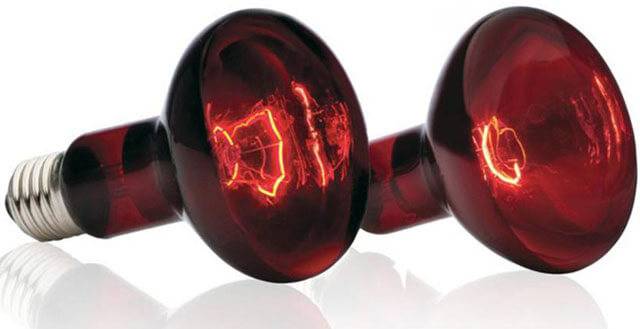

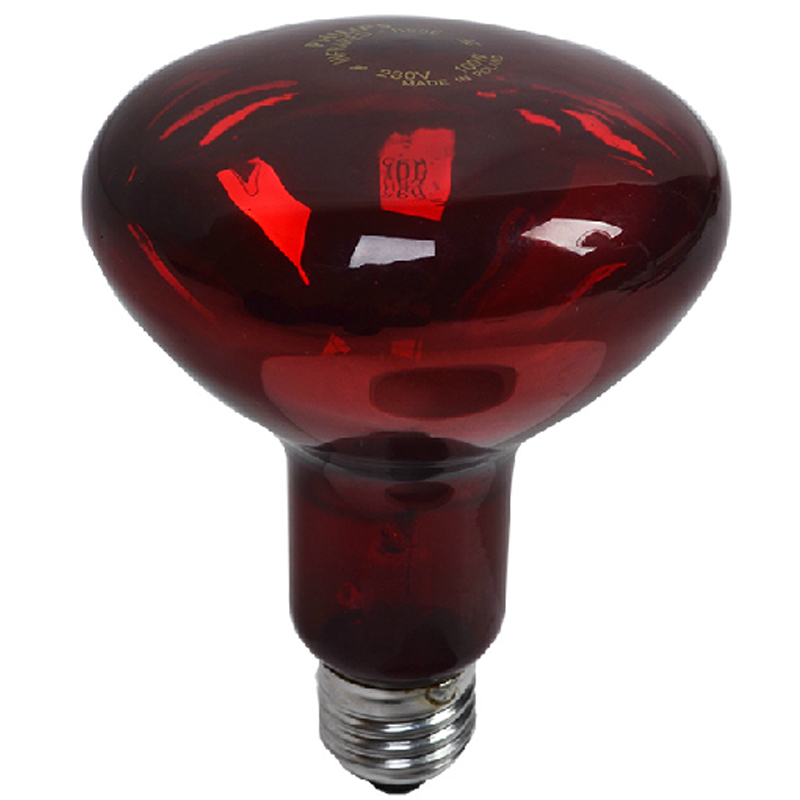
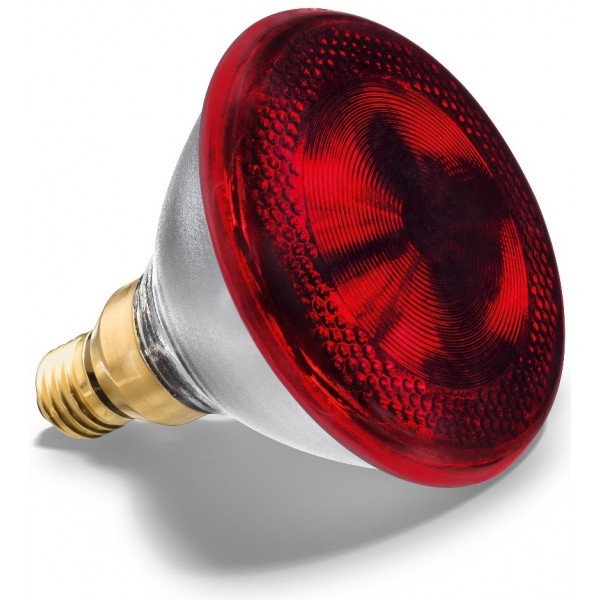
Another advantage of infrared lamps is the ability to easily change the height of the lamp above the floor. This point is especially relevant when growing plants and young animals.
Temperature control
During the period of intensive growth, the chicks are afraid of both hypothermia and overheating. Therefore, the main task of arranging a brooder heating is to maintain the required temperature in accordance with the above schedule. Control can be carried out using a thermometer installed inside the brooder. The main ways to adjust the temperature:
- The simplest (however, not the most effective) method of maintaining the desired temperature is to change the height of the heating device relative to the floor level. If you raise the lamp (or infrared ceramic emitter) higher, you can reduce the intensity of heating. Conversely, by lowering it lower, you can easily increase the temperature inside the brooder.
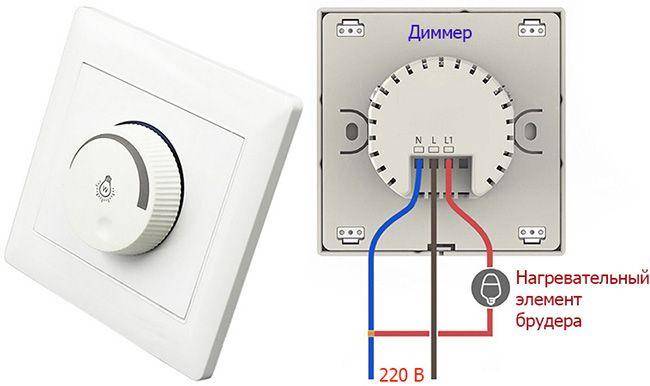
- By connecting the heater through a manual electromechanical power regulator, you can significantly increase the usability of the heating system. However, this method also requires constant monitoring of the thermometer readings.
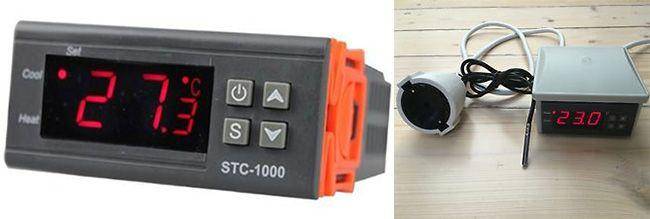
The most convenient and most effective way to maintain the desired temperature is to use an automatic electronic thermostat. Such a device has a remote sensor, which is fixed inside the brooder.The user only needs to set the required temperature using the control buttons and connect the heating element (according to the diagram in accordance with the instruction manual). During operation, the device will automatically turn on / off the heater in accordance with changes in the readings of the temperature sensor. And although the purchase of a thermostat leads to some increase in the cost of the heating system (by 900–1200 rubles), this greatly simplifies the process of rearing chicks.
Some IR lamps and heaters
Overview of IR lamps
The products of Philips, Osram, InterHeat, Sylvania, General Electric are not cheap, but the price is compensated by the quality.
Philips ILs are not afraid of splashing water. They can be used in animal husbandry, crop production, in rooms with water. Many models have increased strength. The Philips IR150 RH model is convenient to use for heating the car hood in the garage in winter.
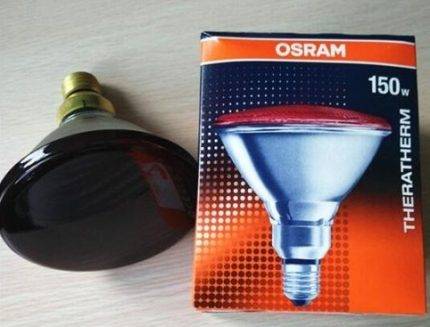
IR lamps manufactured by Osram SICCA THERM are in the power range from 150 to 375 W. Equipped with an e27 base. Well suited for animal husbandry and paint drying.

OSRAM SICCA 250W
InterHeat manufactures IR heat sources equipped with a standard plinth. They have increased mechanical strength and moisture resistance. Power in the range of 100-375 watts. Good for animal husbandry.
The competition for imported products for heating young animals and seedlings is the domestic model IKZK 220-250 R127 E27.

IKZK 220-250 R127 E27
The mirror heat source shines with red light. It costs 250 rubles.
For medical purposes, the following models are suitable:
Beurer IL50. Designed to warm the human body. It has good ventilation. (Price: 4900 rubles).

Beurer IL50
Sanitas SIL16 150W. (Price: 2100 rubles).
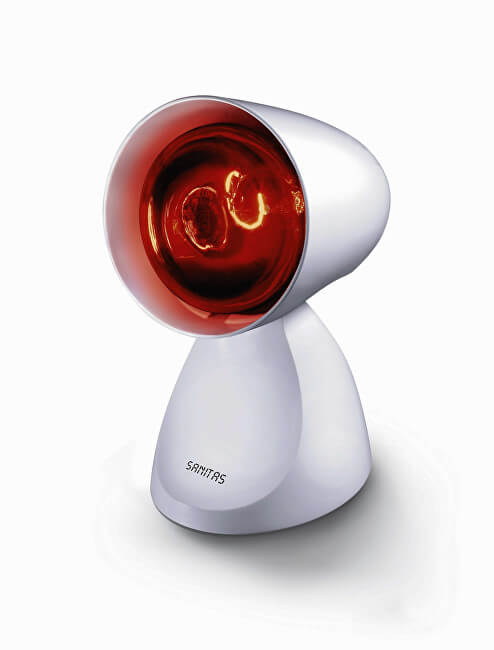
Sanitas SIL16
Minin reflector with blue IL. (Price: 1500 rubles).
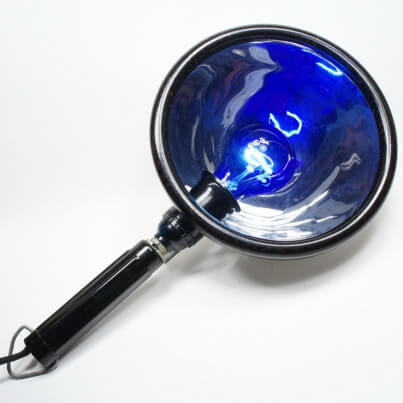
Minin reflector
Overview of IR heaters
For space heating it is convenient to use infrared heaters. They usually use several linear ILs placed behind a protective grille.
For example, a floor infrared halogen heater with three power modes: 400, 800, 1200 W.
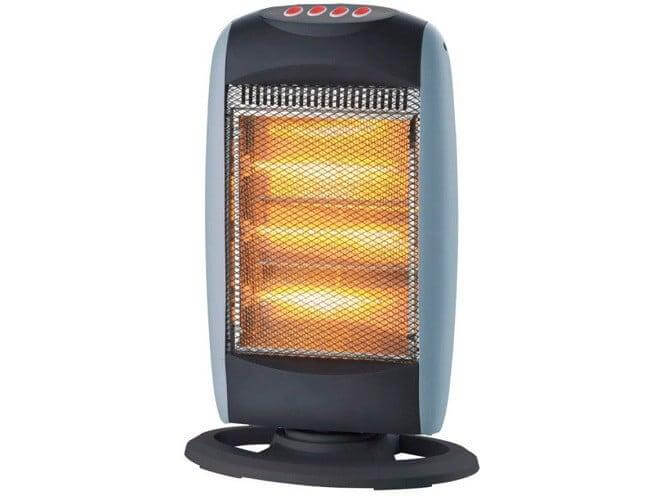
The price is 3500 rubles.
Or wall mounted infrared heater Ballu BIH-LW-1.5. Designed for an area of 25 m2, power 1500 watts. Protected from moisture.


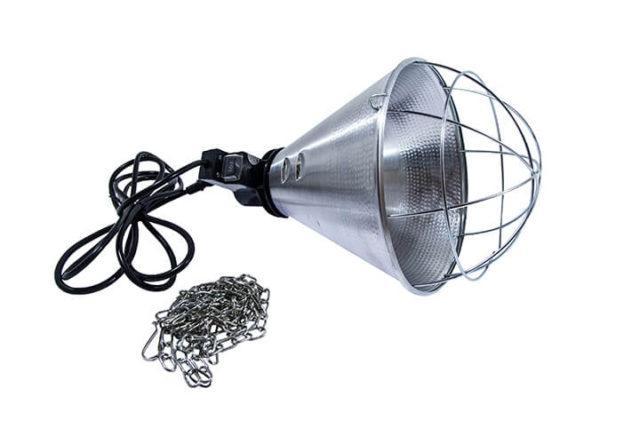



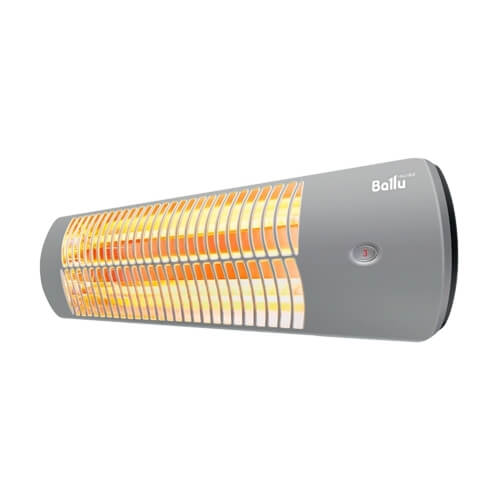
Price: 1500 rubles.
Floor heater Ballu BHH/M-09N. Heats an area of 15 m2. Power 800 W. Has functions of shutdown at an overheat, is protected from moisture.
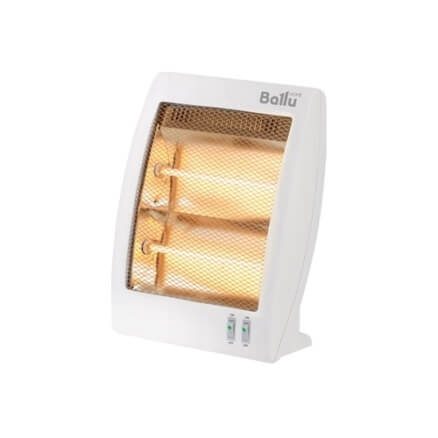
Price: 800 rubles.
General information and scope
An infrared lamp and a lamp are light sources that radiate heat in the direction in which they are directed. Principle of operation - when connected to the electrical network, the lamp filament instantly heats up and due to the special design of the bulb, infrared radiation is generated, the temperature of which can reach 75 C.
Infrared lamps are classified according to the following criteria:
- application (medical, for heating, for drying);
- depending on the length of the light wave (short-wave, medium-wave and long-wave);
- constructions (incandescent, halogen);
- form (ordinary, in the form of tubes);
- light (red, white, blue);
- power (from 50 to 500 W).
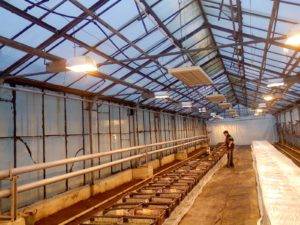 The scope of such lamps is extensive. They can be used for heating small areas (kiosks, balconies, winter gardens, living quarters, offices, etc.).They are also used for medical purposes. An infrared lamp for treatment has found application for colds, joint and muscle pain, and lowering blood pressure. Such lamps can be bought at a pharmacy. In paint shops, repair shops, car workshops, infrared lamps are sources that speed up the drying of paints, enamels and varnishes and make coatings of better quality.
Agriculture is an industry that is indispensable without infrared lamps. In livestock and poultry farming, they are used for heating and rearing young animals. Infrared illumination not only heats, but also helps to increase the appetite of calves, piglets, foals, bird chicks, which increases weight gain. In addition, the young organism of animals and birds is better resistant to disease. In a brooder where chickens or other poultry are reared, infrared radiation dries the hay at the same time, which improves hygiene. Directed heat provides the necessary temperature conditions. The installation of such sources of heat and lighting in greenhouses and winter gardens contributes to the growth of the crop, because. allows you to adjust the heating height of seedlings and seedlings.
Design
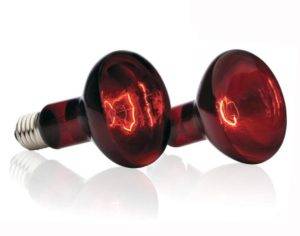 An incandescent lamp and an infrared lamp have much in common. Structurally, the IR light source is a flask, on the inner surface of which a mirror amalgam is applied. There is a tungsten spiral inside the glass case in red, blue or white. The sealed housing is filled with gas (a mixture of nitrogen and argon in various proportions). To connect to a power source, the heat and light emitter is equipped with an E27 ceramic cartridge.
Powerful products have protective fittings to protect the source of heat and light from moisture and overheating and can be used in dusty and humid areas.
Low-temperature models, which include long-wave products, are ideal for use in private houses and apartments, medium-wave ones heat the areas of kiosks, shops, stalls and other medium-sized premises, and short-wave ones heat up production workshops, warehouses and rooms of considerable size.
Advantages
The main advantages of infrared radiation sources include:
- small dimensions;
- possibility of use for different purposes;
- high efficiency;
- instant heating;
- noiselessness;
- they do not burn oxygen;
- fast installation;
- environmental friendliness;
- safety.
main parameters
When choosing a lamp, you need to pay attention to the following indicators:
- lamp type;
- power;
- cartridge type.
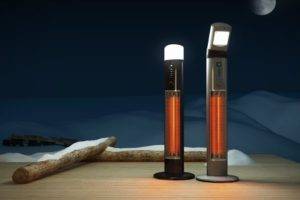 Infrared lamps will replace expensive equipment for drying, curing and heating. It is only necessary to choose the right source of light and heat. The best products are General Electric (USA), Philips (Netherlands), Osram and Sylvania (Germany), which are world leaders in the production of lighting equipment. These companies manufacture their lamps on high-tech equipment from high-quality materials in compliance with production technology. Therefore, their products are capable of serving 6,000 hours or more. Customer reviews indicate that the most popular models are: Rubystar, Thera Red and Halotherm of the German company Osram, Ir - the company Sylvania.
Other options for IR heaters
In addition to lamps, other types of IR heaters can be installed in chicken coops. 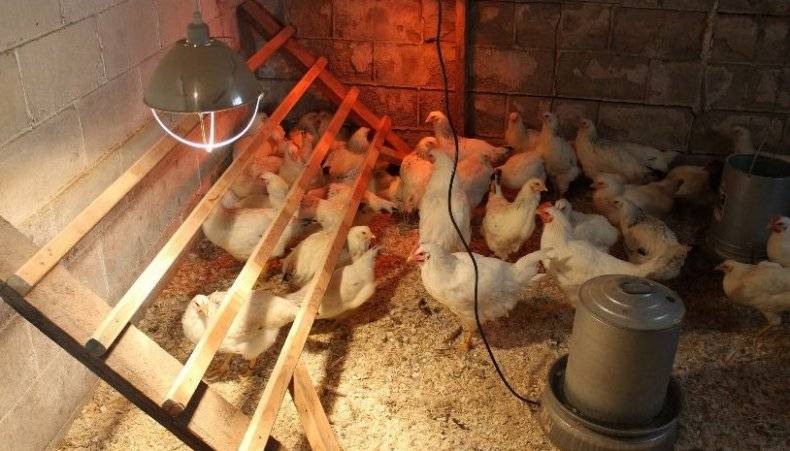
All of them can be divided into three main groups:
- lamps;
- spotlights;
- ceiling lamps.
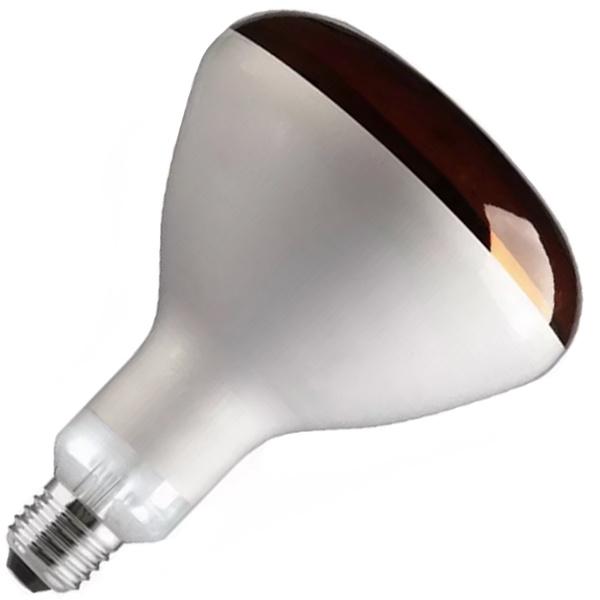
Two main types of infrared lamps will help you get both light and heat at the same time: mirror lamps with the IKZ marking (in fact, those lighting elements that resemble ordinary incandescent lamps) and infrared mirror red lamps, on which you can see the designation IKZK (in this case, the bulb is made of red dark glass, due to which most of the energy is transformed into heat, and not into light).
It is the latter that are more relevant in animal husbandry and can successfully perform their functions in poultry houses. If we are talking about linear infrared light sources, then among them there are three main types:
- with a ruby red tube (suitable for heating large rooms);
- with a quartz tube made of transparent glass (they do a good job of drying varnish and paint, and also help rid the room of harmful microorganisms);
- a tube with a golden coating (its use is relevant if it is necessary to heat warehouses and showrooms, where regulation of the brightness of the light flux is required).
Did you know? Even the highest quality and most powerful light bulbs are not as expensive as some of the chandeliers sold at auctions around the world. For example, the Pink Lotus lamp from Tiffany was valued at almost $3 million and was sold to private owners back in 1997.
Whichever option you choose, take care of the thermostat, which ensures that the "winter" temperature in the chicken coop is maintained at +12 ° C - the most optimal value for chickens.With it, birds will always feel good even without constant control. 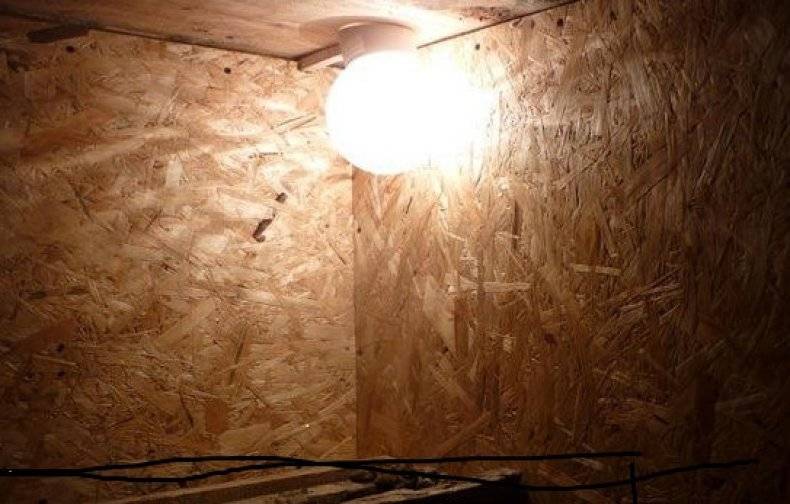 Of course, infrared lamps or heaters are an expensive option for insulating a poultry house, but if you have already decided to install them, then be prepared to do everything right by spending a certain amount of money on it. When operating, all your costs will pay off quickly enough.
Advantages and disadvantages of heaters
These devices are considered the most mobile and compact. They can be easily moved from one place to another, so they are popular with owners of country houses and cottages. The advantages of the device include:
- During operation, they do not consume oxygen, compared to other heaters.
- During the heating process, air convection does not occur, which ensures a comfortable microclimate.
- The use of lamps in the ceiling surface allows you to heat a much larger area, with maximum energy savings.
- The operation of the devices is not accompanied by unnecessary noise and the release of toxic substances.
- In terms of financial costs, this is a particularly efficient equipment, since there are no extra costs for fuel materials.
- The approximate service life of the device is about 30 years, which far exceeds the operation of other heating equipment.
- There is no need for additional ventilation, as there are no products of combustion.
- Infrared heaters perfectly withstand changes in the electrical network, which significantly increases their performance.
- Lamps have increased protection against electric shock and fire.
- It is allowed to leave the device turned on, even if the owners have left the house.
If you choose the required number of lamps, then it is possible to heat quite large areas of the room. Medical experts recommend using infrared radiation to improve the health of the human body. The only drawback of such a heater is the mandatory presence of electrical energy. To avoid interruptions, you should purchase a battery with a 220 V inverter.
Types of lighting
Mortise lamps, in turn, are also divided into several types:
Rotary - such a lamp has hinges, thanks to which the beam of light can be directed in the right direction
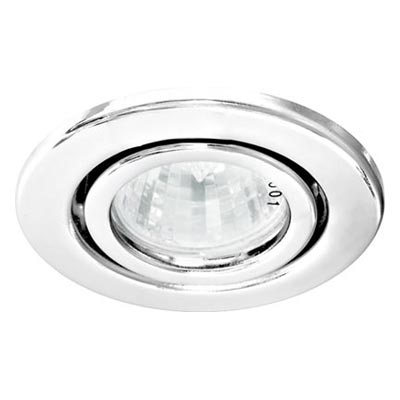
Rotary lamp
Internal - the direction of the flow of light is not adjustable
indoor light
External - mount, the same as the rest of the mortise fixtures. The difference lies in the removal of the lamp on the outside.
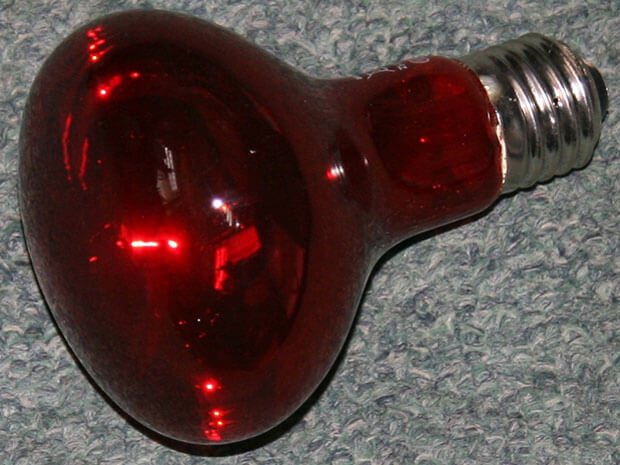


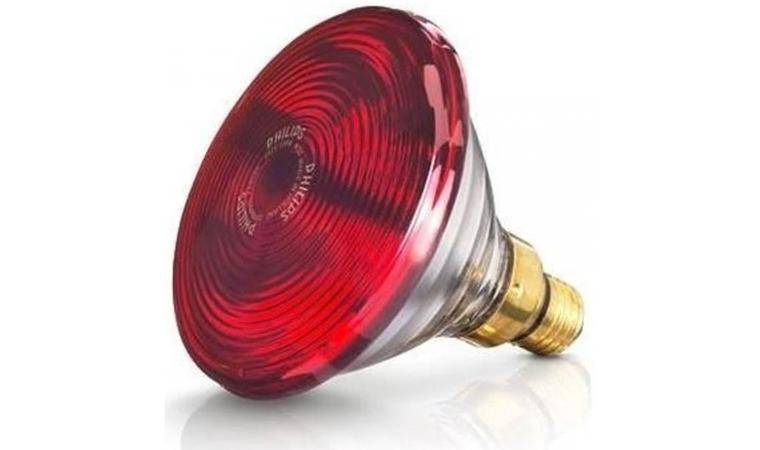


External light
Stretch ceilings are also made with lower film illumination, using an LED strip built into a special niche.
Now most people prefer to do home repairs themselves, without resorting to the services of craftsmen. And many mount the frame under the stretch ceiling with your own hands, resorting to the help of specialists only to stretch the canvas (see Frame for plasterboard ceiling: design features).
For those who decide to start making a ceiling at home, in this article they will be able to learn in detail how to mount LED light bulbs. One of the advantages of installing the fixtures yourself is the fact that even before the film is stretched, you can experience the quality of the lighting after dark.Subsequently, you can add, remove unnecessary, or completely change the location of the fixtures. All work on the installation of fixtures should begin before fixing the film, but with a ready-made frame for a stretch ceiling.
The principle of operation of the halogen heater
Halogen lamps act as a heating element. They are tubular flasks, the length of which is in the range of 20-50 cm. Inside, each shell is filled with a buffer gas, which prevents the coil from burning out during heating from an electric current.
Halogen equipment differs from other heating devices in its rapid heating. In just 100-120 seconds, tungsten atoms begin to break away from the spiral and settle on it. This contributes to strong heating. The lamp connected to the network emits light and infrared wave streams. The heat flow is directed not to heat the air, but to heat the objects that are located in the room. The room begins to heat up from objects that emit heat.
It should be borne in mind that prolonged use of the halogen device causes the air to dry out. That is why experts recommend turning on a humidifier in the room.
Important! The light weight of the heater makes it easy to carry it from one room to another. The ceiling version of the halogen device is preferably used in rooms with high ceilings
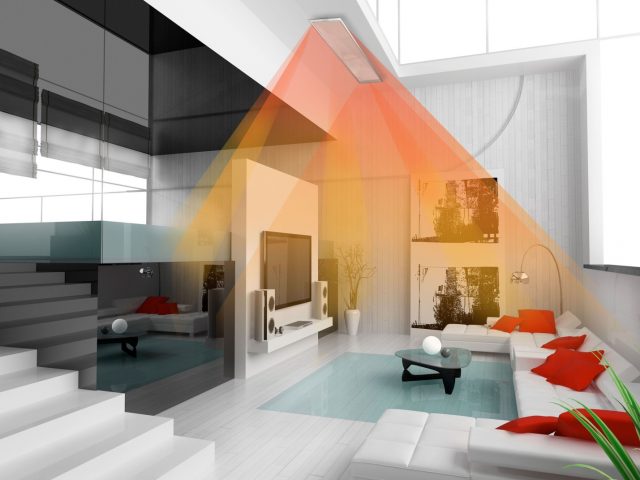
The ceiling version of the halogen device is preferably used in rooms with high ceilings
Lamp heaters of infrared radiation (lamps, lamps, spotlights)
This type of device uses halogen lamps as a source of radiation.A tungsten filament is placed in its flask filled with a mixture of nitrogen and argon.
The uniqueness of such heaters lies in the fact that they simultaneously emit heat and light.
These lamps are available in two types:
infrared mirror (IRS), outwardly very similar to conventional halogen lamps used for lighting; they can be used to provide heat to small rooms (balconies, kiosks, bathrooms), but when used in several pieces, they can illuminate and heat workshops, corridors and foyers of offices and residential buildings;
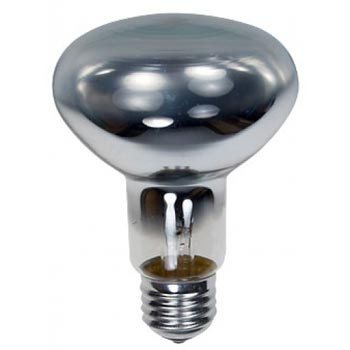
Figure 11 - Lamp IKZ
infrared mirror red (IRSC), the flask of which is made of dark red glass, as a result of which they emit more heat than light, therefore they are most used for heating livestock and poultry facilities.
Figure 12 - Lamp IKZK
The power of such lamps is 150-250 watts, and they are installed in a regular E27 cartridge.
Their main disadvantage is a short (about a year) service life.
Another type of lamp IR heaters are lamps. Structurally, they are a conventional case model, in which a lamp is additionally built in.
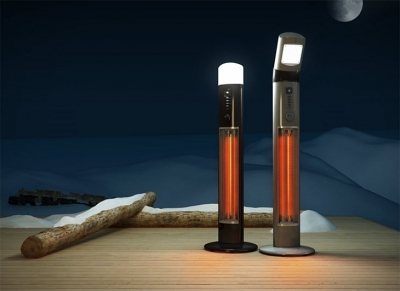
Figure 13 - Infrared lamp
Such devices are mainly used for lighting and heating outdoor objects: terraces, gazebos, outdoor cafes, etc.
There are also IR illuminators used mainly for heating outdoor facilities, as well as livestock buildings and greenhouses. According to the principle of operation, they are similar to IKZK and IKZ lamps, but they have large overall dimensions.
Figure 14 - IR illuminator
Advantages and disadvantages
Let's see what are the good and bad infrared lamps. Let's start with the positives:
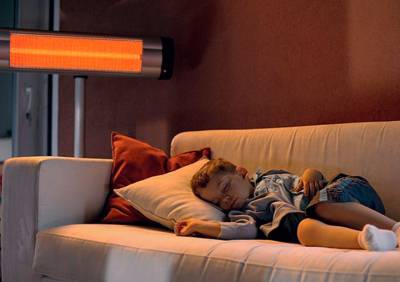
Among all types of space heating, infrared is the safest and most environmentally friendly.
- Complete noiselessness of operation - unlike heat guns, IR radiation spreads without the help of fans and at the speed of light;
- Maximum efficiency - like almost all electric heaters, it approaches 100% (but does not reach this indicator due to certain laws of physics);
- The simplest installation - just screw the infrared lamp into the cartridge and flip the switch;
- The possibility of spot heating is relevant for animals kept in small cages and pens;
- Extremely compact - a traditional 500 W infrared lamp takes up no more space than an ordinary incandescent bulb;
- Environmentally friendly - IR lamps do not burn oxygen and do not emit any gases into the air.
There are also some disadvantages:
- High temperature of the flasks - you can get serious burns;
- Discomfort during a long stay in the area of \u200b\u200bthe lamps - here most often non-compliance with operating standards affects;
- High power consumption is typical for any electric heating appliances.
The cons are not the worst, they can be neglected if you follow the rules of operation.
Despite the shortcomings, infrared lamps continue to be in demand heating equipment - agricultural workers, breeders of poultry and livestock need them, and they also find their application in heating open areas.
What is an infrared lamp
An infrared lamp is an ordinary light bulb that is screwed into a standard E27 ceramic socket.Inside the glass flask, which can be transparent or colored red or blue, there is a tungsten filament placed in a flask with an argon-nitrogen mixture.


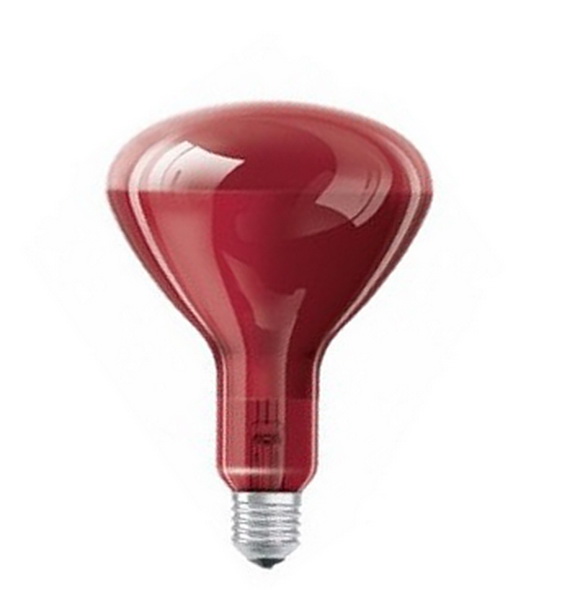


The radiation of such lamps does not affect the entire room, but objects and living organisms located in its immediate vicinity. Infrared rays, in contact with them, are absorbed and converted into thermal energy. It does not take time to heat up - an object or a living organism feels heat immediately after the lamp is turned on.
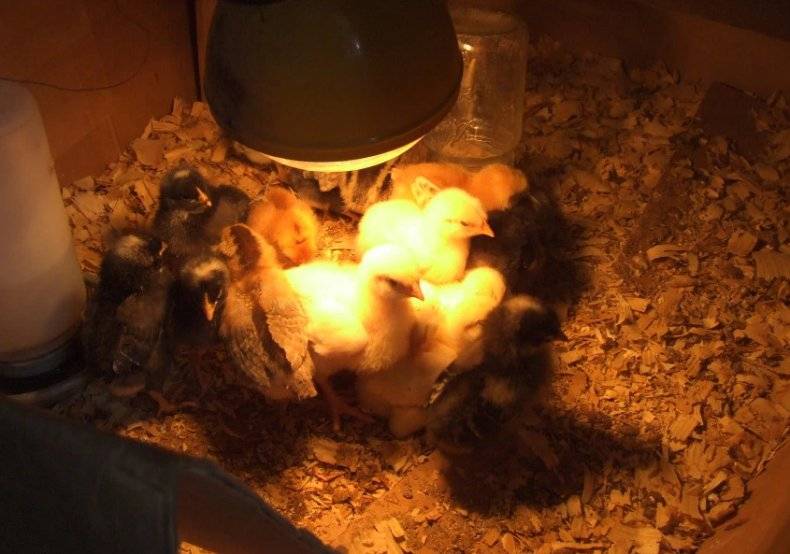
Agree that the benefits of comfortable keeping chickens are huge. We advise poultry farmers to learn how to choose, build and equip a chicken coop, namely: to make a perch, nest, ventilation, and also read the rules for choosing and using fermentation litter for chickens.
Technical characteristics of infrared lamps:
- maximum power - 50–500 W;
- maximum temperature - 600 ° C;
- IR wave range - 3.5–5 µm;
- supported voltage - 220 V;
- service life - 6 thousand hours.
increased energy costs - when using a 250-watt light bulb, about 0.25 kW per hour is used;
some discomfort with a rather long stay at the site of action of the light bulb - the mucous membrane of the eye dries up in a person;
if handled carelessly, there is a possibility of getting burned when touched.
Did you know? Infrared rays were discovered by English scientist Frederick William Herschel in 1800. He was engaged in the study of the Sun and was looking for a way to protect the research instrument from overheating. Thus, the scientist accidentally discovered that objects that are under saturated red rays heat up most strongly.



