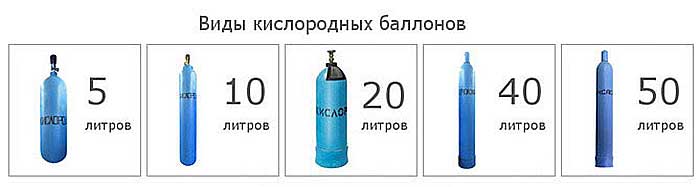
- How much does a propane tank cost for 5, 12, 27, 50 liters?
- How much does it cost to fill a gas cylinder (5, 12, 27, 50 liters)
- How and what to fill the balloon
- Price comparison across multiple regions
- The weight of the gas in the cylinder 27l
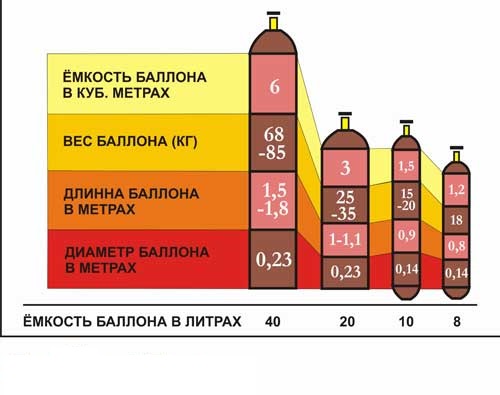
- Propane cylinders for 5, 12, 27, 50 liters - what is the pressure and volume of propane, as well as how much the cylinder weighs, its size and type of thread
- Delivery across Russia
- Construction of a steel gas cylinder
- What load can the container withstand?
- How many liters of gas in a 50-liter bottle How many cubic meters of gas in a 50-liter bottle
- Physical properties of these chemicals
- Gas storage methods
- Gas cylinder volume
- Safety precautions when handling gas cylinders
- 4 How gas cylinders are stored and transported
- Rules for the safe operation of propane cylinders
- What is the gas pressure in a propane tank?
- Refueling rates
- Rules for the safe operation of gas cylinders
- Who buys gas from Russia
How much does a propane tank cost for 5, 12, 27, 50 liters?
The price depends on the specific area in which the customer lives. How much does an empty propane tank cost in our region, as well as the cost of refueling, is shown in the following table:
| Tank volume (liters) | 5 | 12 | 27 | 50 |
|---|---|---|---|---|
| Estimated cost of a new empty bottle | 1080 | 1380 | 1500 | 2250 |
| propane fuel cost | 1155 | 1560 | 1905 | 3000 |
*prices are indicative depending on the manufacturer
The price of the cylinder is sometimes several times higher than the cost of the contents. But on the other hand, repeated refueling allows you to use the tanks for many years and even decades.
How much does it cost to fill a gas cylinder (5, 12, 27, 50 liters)
On average, in the Russian Federation, the cost of refueling gas cylinders costs 14.7-19 rubles per liter.
How and what to fill the balloon
Let's start with the fact that filling cylinders with a propane mixture (and at modern filling stations, pure propane will not be filled into your car) at ordinary car gas stations is not worth it. This is due to the fact that technical butane (С4h20) is filled at the gas filling station, which stops actively evaporating at a temperature of -0.5oC. When driving, in the tank of the car, this gas is actively mixed and heated from the gearbox.
For industrial purposes, for example, for cutting metal structures at temperatures below +10oC, it is permissible to use technical butane, but on condition that the container and equipment are heated. Pure Butane and Propane technical mixtures are extremely rare. Northern and hot countries are the main exception to this. They use pure PT (C3H8), due to the fact that it has an active evaporation termination temperature of -42.1oC.
It is necessary to fill gas cylinders in specialized companies that provide services of this nature.
Price comparison across multiple regions
In Moscow and the Moscow region, the prices for refueling cylinders on average are as follows:
Propane 21kg / 50l - 950 rubles.
Propane 11kg / 27l - 530 rubles.
Propane 5kg / 12l - 340 rubles.
Propane 2kg / 5l - 220 rubles.
Prices in the capital are given without packaging. Unsurprisingly, these are the highest prices that have been found on the Internet.But everyone is well aware of the Moscow prices for absolutely everything, which is why this price list is not so surprising. It should be noted that in some cities of our country, such as Krasnodar, refueling household cylinders within the city is prohibited.
2
What load can the body and valve withstand
Standard containers manufactured according to GOST standards can withstand operating pressure ranging from 9.8 to 19.6 MPa. Moreover, the thickness of the sheet from which the shell and bowls for the cylinder are prepared, which can withstand pressure up to 190 atmospheres, reaches 6 mm. However, no gas-consuming device can withstand such a pressure. And the weight of a cylinder made of 6 mm steel will be very significant. Therefore, the working pressure of gas in a cylinder with a capacity of 50 liters is always equal to 16 atmospheres, or rather 1.6 MPa. It is for this pressure that household gearboxes are designed, to which household boilers, columns, stoves, ovens and convectors are connected.
In a cylinder of 50 liters, the working pressure is 16 atmospheres
However, the seams of the body and the shut-off unit of the container are oriented towards a more significant pressure in the gas cylinder - by 25 atmospheres (2.5 MPa). True, the container experiences such pressure only once every five years - during the current check. And if the seams of the cylinder cannot withstand 25 atmospheres, then the container is rejected and scrapped. The valve can withstand enormous pressure - up to 190 atmospheres. It is this pressure that a locking assembly consisting of a stem and a threaded pair can resist. Although even during testing, constipation holds only 25 atmospheres, and during operation - no more than 16 atmospheres. It is precisely this pressure that you need to focus on when calculating how much gas is placed in a 50-liter steel cylinder.
The weight of the gas in the cylinder 27l
How many kilograms of household gas in a 27-liter cylinder?
depends on filling pressure and mixture type
type of city gas mixture:
summer - 50 to 50 propane and butane
winter - 90% propane and 10% butane
should fill a 27 liter cylinder (weight 14.5 kg) not “under the lid”, but 23 liters. Then the weight will be:
if you fill it "under the lid" the weight will be:
Much depends on what kind of gas the balloon is filled with. Can be filled with propane (most common) or butane (less common). The density of gases varies somewhat. The gas pressure can also vary. Approximate figure - 12 kg.



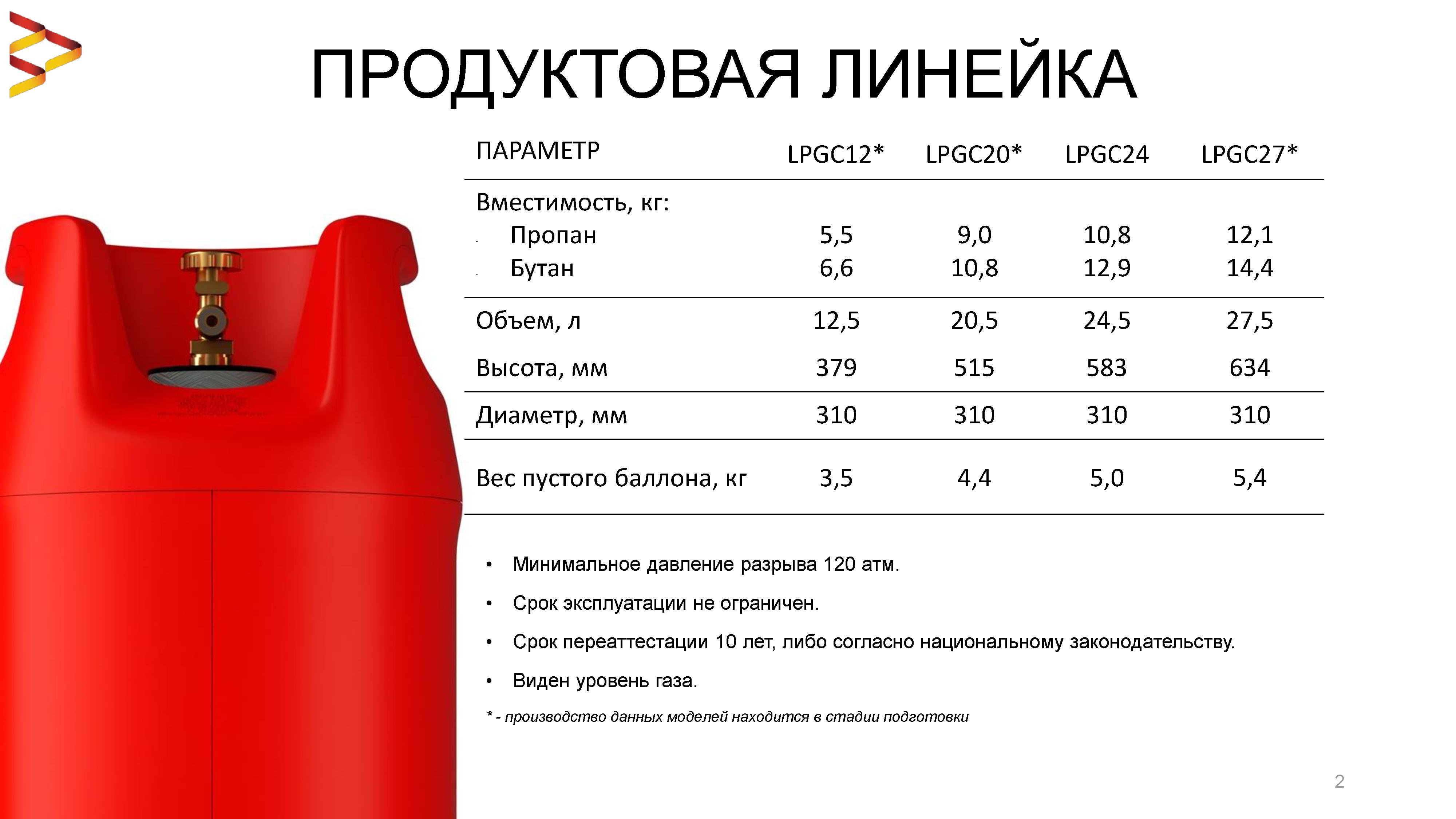
The peculiarity of filling any gas cylinder is that it must be filled (according to current standards) with liquefied gas no more than 85% of the total volume of the cylinder. In addition, for summer and winter there are different norms for filling the cylinder with gas:
- summer gas mixture consists of 50% propane and the same amount (50%) butane (such a mixture has a calorific value of 6470 kcal / l (11872 kcal / kg), and its density will be 0.545 kg / l);
- winter gas mixture contains 90% propane and only 10% butane (has a calorific value of 6175 kcal / l (11943 kcal / kg), and a density of 0.517 kg / l).
As a result, we get that a 27-liter cylinder (with a dead weight of 14.4 kg) will contain 22.95 liters of gas, which will be:
- summer: approx. 12.5 kg);
- winter: about 11.86 kg.
Well, in order to assess the transportability of such a cylinder, you can estimate its mass when completely filled:
Cylinders for liquefied hydrocarbon gases. Designed for storage and transportation of liquefied petroleum gas - propane (propane-butane mixture).
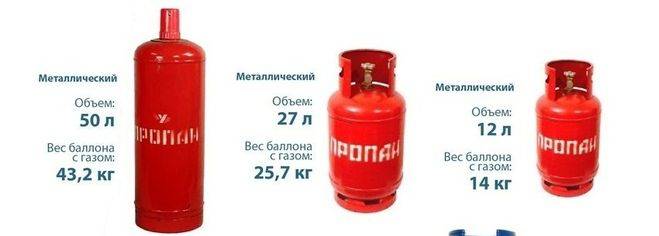
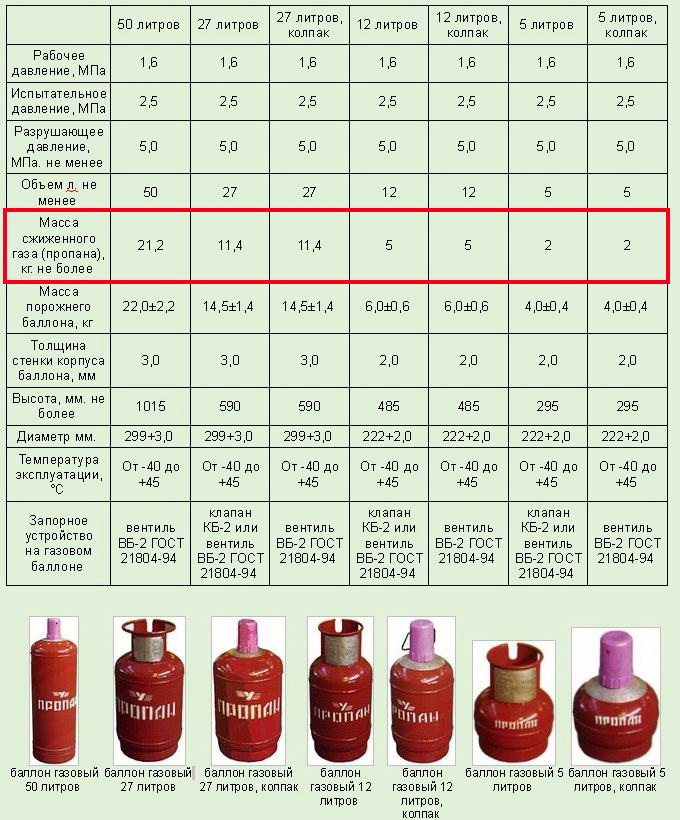
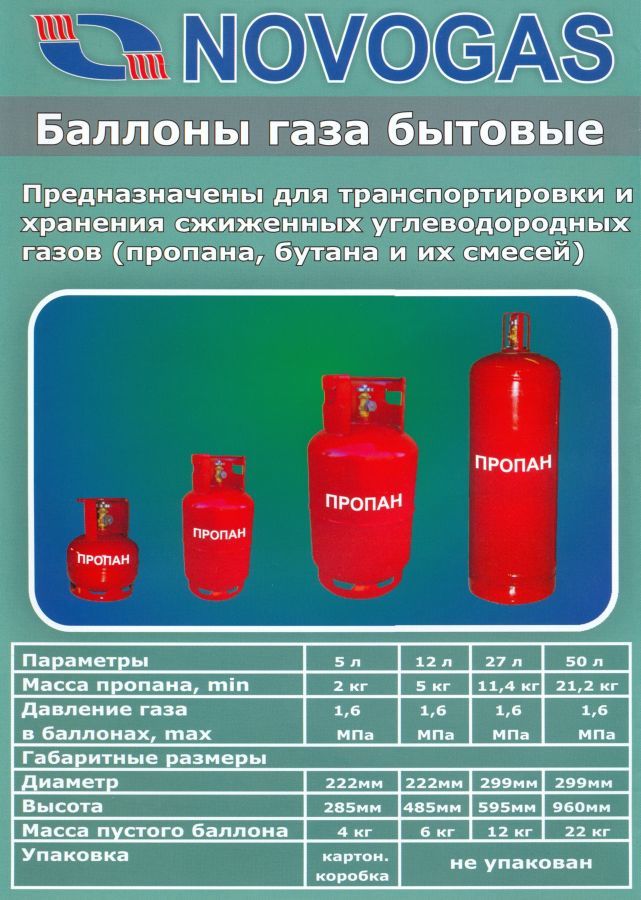
Propane cylinder 50 liter with valve: Volume - 50 liters.The highest working gas pressure is 1.6 MPa. Dimensions - 300x920 mm. Wall thickness - 3 mm. Operating temperature - From -40 to +45. Permissible mass of liquefied gas (max.) - 21.2 kg. The mass of an empty cylinder is 22.5 kg. The weight of a full cylinder is 43.7 kg.
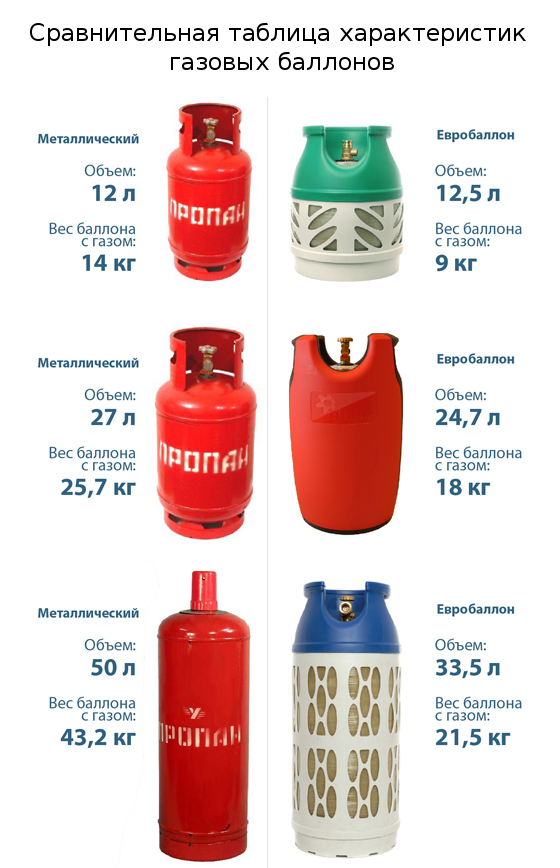
Cylinder of 27 liters gas propane with a valve: GOST 15860. Volume - 27 liters. Dimensions - 300x600 mm. Wall thickness - 3mm. The highest working gas pressure is 1.6 MPa. Operating temperature - From -40 to +45. Permissible mass of liquefied gas (max) - 11.3 kg (20 liters). The mass of an empty cylinder is 14.4 kg. The weight of a full cylinder is 25.7 kg.
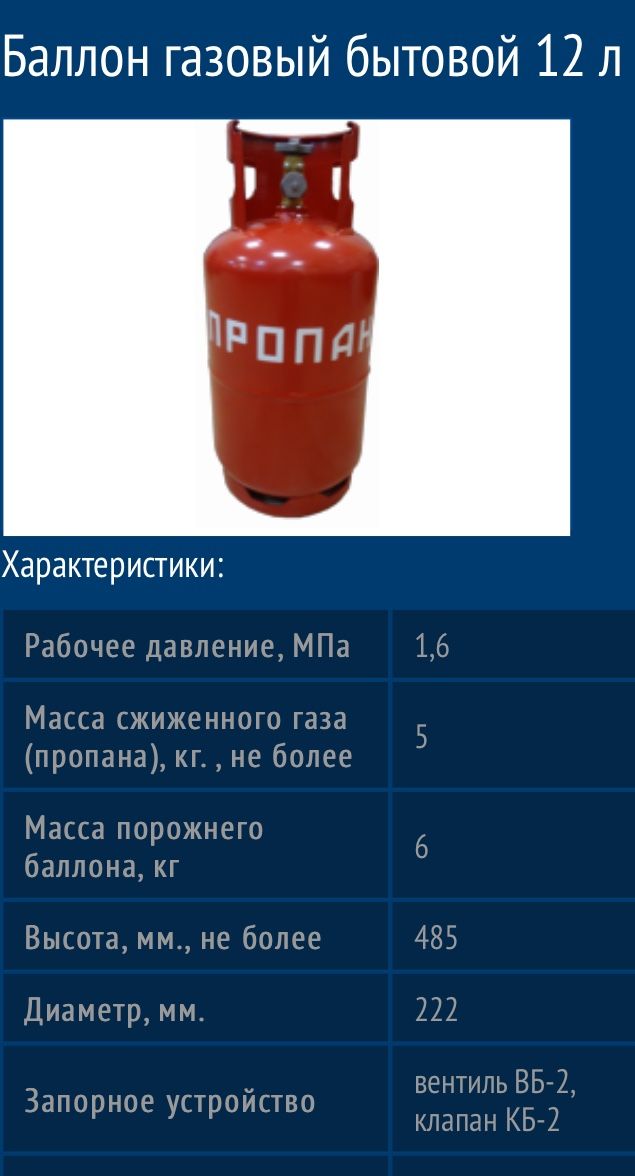
Cylinder 12 l for liquefied gas (propane) with a valve: Locking device - valve VB-2. Dimensions: diameter / height - 220x540 mm. The highest working gas pressure is 1.6 MPa (16 atm). Operating temperature - From -40 to +45. Permissible mass of liquefied gas (max) - 5.3 kg (6.8 liters). The mass of an empty cylinder is 6.0 kg. The weight of a full cylinder is 11.3 kg.
Propane cylinder 5 l with valve: Volume - 5 l. The highest working gas pressure is 1.6 MPa. Dimensions - 220x290 mm. Wall thickness - 3 mm. Operating temperature - From -40 to +45. Permissible mass of liquefied gas (max) - 2.2 kg. The mass of an empty cylinder is 3.1 kg. The weight of a full cylinder is 5.3 kg.
Considering that pressurized cylinders are explosive vessels, they are made of structural steel by pressure treatment. Before empty cylinders reach the consumer, they undergo rigorous testing and certification.
Random entries - how much does it weigh:
- Volume: 27 l
- Height: 590 mm
- Diameter: 299 mm
- Propane weight: 11.4 kg
- Weight of an empty container: 10.5 kg
- Operating pressure: 1.6 MPa
- Wall thickness of the cylinder body: 3 mm
- Operating temperature: From -40 to +45 °С
- Valve: VB-2
- Producing country: Belarus
- Guarantee: 12 months
- Characteristics
- Detailed description
- Instructions and certificates
- Delivery
- Pickup
- Reviews
- Calculator
Comments
- Volume: 27 l
- Height: 590 mm
- Diameter: 299 mm
- Propane weight: 11.4 kg
- Weight of an empty container: 10.5 kg
- Operating pressure: 1.6 MPa
- Wall thickness of the cylinder body: 3 mm
- Operating temperature: From -40 to +45 °С
- Valve: VB-2
- Producing country: Belarus
- Guarantee: 12 months
Propane gas cylinder 27 l with valve
The cylinder is intended for storage and transportation of propane. Manufactured from high-alloy steel that withstands external and internal loads without violating the original properties of the contents of the cylinder. It should be remembered that as the temperature increases, the pressure increases, therefore, during storage and transportation, do not allow a sharp increase in temperature.
Never fill the tank more than 80%
This is especially important in winter at low negative temperatures!. Download certificate
 Download certificate
Propane cylinders for 5, 12, 27, 50 liters - what is the pressure and volume of propane, as well as how much the cylinder weighs, its size and type of thread
Propane gas is used to ensure the operation of cooking stoves, heating residential, industrial and warehouse premises, refueling cars, gas welding and metal cutting.
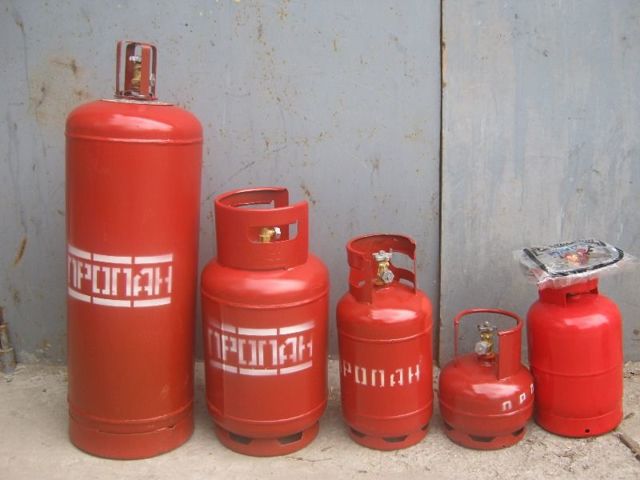
In our country, steel propane cylinders with a capacity of 5, 12, 27 and 50 liters are most often used for domestic gas supply. Such containers are easy to distinguish from others - they are always painted red.
In order to order a propane tank, you only need to call us or fill out the feedback form on the website.Our consultants will be happy to provide comprehensive information on any issue related to gas equipment. Our offers are transparent and profitable, just like propane gas itself.
Delivery across Russia
order must be placed through the shopping cart on our website
in the "Delivery method" section, select "Transport company, Russian Post".
after filling in all the data and choosing the method of delivery, payment, a message with the order number will appear on the screen
In the last sentence of this text you will see "Download Receipt"
ATTENTION! be sure to click "Download receipt", after which a receipt for payment will automatically be sent to your e-mail .. Method of payment for the order:
Order payment method:
on a bank statement
Note! Payment is made without VAT (in the purpose of payment, indicate "VAT is not subject to")
transfer in the Sberbank.Online system.
on the account for legal entities (excluding VAT!). Before paying, ALWAYS wait for confirmation of the order in the form of an email or a phone call from the manager
The receipt includes the cost of delivery by courier in Moscow to the transport company 350 rubles. Payment for delivery services of the transport company itself is paid separately upon receipt of the goods
Before paying, ALWAYS wait for confirmation of the order in the form of an email or a phone call from the manager. The receipt includes the cost of delivery by courier in Moscow to the transport company 350 rubles. Payment for the delivery services of the transport company itself is paid separately upon receipt of the goods.




| Transport company | Link |
|---|---|
| Business Line | |
| Auto trading | |
| PEC | |
| Post office |
You can also calculate the approximate cost of delivery using the TC calculators: * You can determine the volume of cargo using the following formula: D (m) x W (m) x H (m),
where D is the depth, W is the width, H is the height of the load in meters.
D = 320 cm; W=450 cm; H=540 cm.
then V = 0.32 m x 0.45 m x 0.54 m = 0.08 m 3
Pickup point BP Rumyantsevo is OPEN!

on foot: The business park is located right next to the Rumyantsevo metro station, from the metro go to the third building from the road, building G, entrance 7. pavilion 329. Welcome to our store!
by car: Go to the region along the Kievskoe highway, after about 500 m turn to the entrance to the business park Rumyantsevo (near the gas station). Further building G, entrance number 7. Next to our building is a parking lot, which shop customers can use absolutely free of charge for 1 hour.
2. m. Semenovskaya, Trade and office center, st. Tkatskaya, 4, floor 2, shop "Products for home and garden"
From m. Semenovskaya 5-7 minutes on foot. After exiting the metro, turn right, walk 200 m along the street. Izmailovsky Val to st. Weaving. Turn right and walk 250 m along the street. Weaving to house number 4. You go up to the 2nd floor and go to the door with a sign "Products for the home and garden". Welcome to our store!
If you have any questions, you can contact us by phone:
If you do not have the opportunity or time to pick up the goods yourself, you can order it with delivery. Learn more about the delivery of orders HERE
Construction of a steel gas cylinder
For transportation and storage of light hydrocarbons such as propane, propane-butane or butane, composite cylinders with a capacity of up to 47 liters can be used.
However, larger 50 liter LPG vessels are made of steel.For the storage of other liquefied or compressed gases, only steel tanks of various sizes are used.
GOST 15860 describes in detail the varieties, characteristics and allowable sizes of gas cylinders for hydrocarbons. GOST 949-73 specifies the parameters of gas containers suitable for operation, with an internal pressure of up to 19.6 MPa.
 The wall thickness is dictated by GOSTs that regulate the design of cylinders. The blanks for steel 50 liter cylinders are seamless pipes made of steel grades: 45, 34CrMo4, 30XMA and 30XGSA
Both GOSTs indicate that for the safe transportation and storage of gases, each vessel must have the following structural elements:
- Base shoe.
- Housing consisting of a shell, lower, upper bottom and backing ring.
- Information plate.
- Neck.
- valve or faucet.
Modifications are allowed in which there is a collar, handle / handles and a cap.
In addition to the basic standards for the manufacture of gas cylinders, there are additional standards that manufacturers must comply with without fail.
Supporting documentation includes safety rules: PB 03-576-03 "Rules for the Design and Safe Use of Pressure Vessels". They describe in detail the requirements for valves and other auxiliary mechanisms.


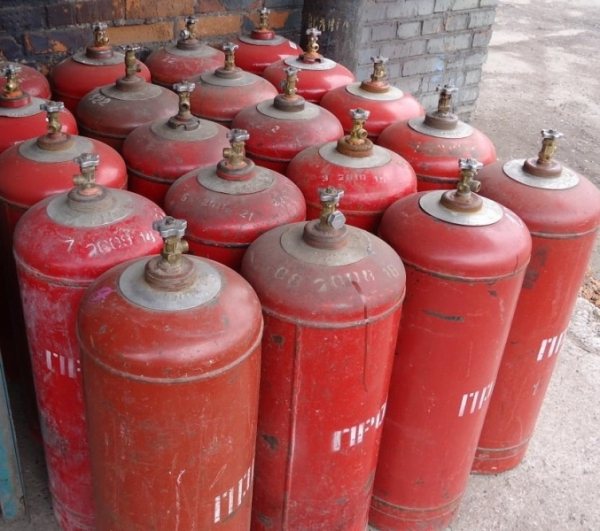

What load can the container withstand?
Standard cylinders can withstand pressures up to 19.6 MPa. In this case, the wall thickness can reach up to 8.9 mm. However, no gas distribution or consuming device can withstand such a powerful pressure.
The standard pressure in a 50-liter container is always 1.6 MPa.This pressure indicator is optimal for the operation of all household gearboxes to which stoves, heaters, ovens and boilers are connected.
Manufacturers of standard containers are guided by a pressure of 2.5 MPa, because the vessel must withstand it during the test, once every five years. If the seams do not withstand, the flask is immediately discarded.
The locking unit must also withstand a pressure of 2.5 MPa. Although his device allows you to contain pressure up to 19.6 units. Cylinders are subjected to such a test in exceptional cases, they are mainly filled with gas with a pressure of 1.6 MPa.
How many liters of gas in a 50-liter bottle How many cubic meters of gas in a 50-liter bottle
When gas comes to a rural settlement, civilization comes to it. Stove heating, or individual water heating with a solid fuel boiler, is not only the romantic crackle of firewood in the furnace. Heating with solid fuel is always soot, smoke and soot, the need for annual repainting of ceilings. And besides the troubles associated with constant dirt, it is also necessary to procure or purchase and store a supply of firewood somewhere for the whole winter.
Unfortunately, natural pipeline gas is not installed everywhere. In many settlements, residents have to be content with gas in cylinders. And people are interested in how many liters of gas are in a 50-liter bottle?
Recall the basics of school organic chemistry. Methane is the first saturated hydrocarbon. The molecule of this gas consists of one carbon atom surrounded by four hydrogen atoms.
- methane CH4;
- ethane C2H6;
- propane C3H8;
- butane C4H10.
The last two compounds - propane and butane - are the contents of household gas cylinders.
Physical properties of these chemicals
Propane at normal atmospheric pressure is a liquid in the temperature range from -187.7 to -42.1 °C. Below the specified interval, propane crystallizes, and above, respectively, it passes into a gaseous state. Butane has this range: -138.3 ... -0.5 ° С. As you can see, the liquid transition temperatures for both gases are not much below zero, which makes them quite easy to liquefy by increasing the pressure.
Gas storage methods
In everyday life, as a rule, a propane-butane mixture is used. In private homes, standard 50-liter gas cylinders are used to store a liquefied mixture. They act a little differently when supplying gas to high-rise buildings. Well, how many liters of gas can fit in a 50-liter bottle?
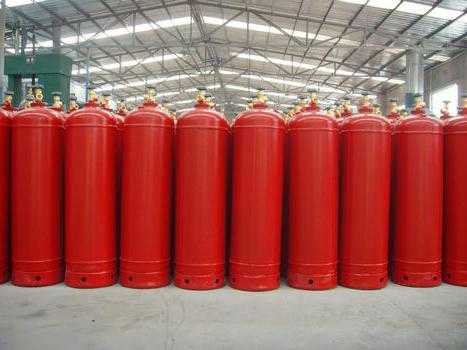
And to change cylinders with 42 liters of gas (this is how much liquefied gas is stored in a cylinder) plus the weight of the cylinder itself on all floors and apartments ... Therefore, in such cases, in the courtyard of the house, as a rule, a grounded storage is arranged, into which the gas mixture is delivered by special gas carriers. In a special device, it is transferred to the gaseous phase and in this form enters the household pipeline.
Gas cylinder volume
So how many cubic meters of gas are in a 50-liter bottle? To answer this question, it is necessary to decide which gas we are interested in. 42 liters of liquid mixture of gases are poured into the cylinder. But how much is it in kilograms, cubic meters? The density of liquefied: propane - 0.528 kg / l, butane - 601 kg / l.
In order to find out how many liters of gas are in a 50-liter cylinder, we will make small calculations.
| Propane | ||
| Liquid phase density | 0,53 | kg/l |
| Liters in a bottle | 42,00 | l |
| The mass of gas in the cylinder | 22,18 | kg |
| Density of the gaseous phase | 1,87 | kg/m3 |
| Volume occupied by 42 kg of gas (1 cylinder) | 22,44 | m3 |
| Butane | ||
| Liquid phase density | 0,60 | kg/l |
| Liters in a bottle | 42,00 | l |
| The mass of gas in the cylinder | 25,24 | kg |
| Density of the gaseous phase | 2,52 | kg/m3 |
| Volume occupied by 42 kg of gas (1 cylinder) | 16,67 | m3 |
Thus, how many liters of gas are in a 50-liter cylinder depends on what composition is pumped into it. If we assume that the cylinder is filled with one propane - 22.44 m3, butane - 16.67 m3. But since a mixture of these chemical compounds is used in everyday life, the indicator will be somewhere in the middle.


If we assume that propane and butane are in the cylinder in equal proportions, then the answer to the question of how much gas is in a 50-liter cylinder (m3) is about 20.
Safety precautions when handling gas cylinders
- Never remove plates and labels from cylinders.
- Do not lift or move the cylinder by holding on to the valve.
- Leaks should be checked with soapy water, not with a lit match.
- Open the cylinder valve smoothly.
- Never heat the balloon.
- Independent pumping (overflow) of liquefied gas into other containers is prohibited.
4 How gas cylinders are stored and transported
When operating 50-liter containers with pure propane or propane-butane mixture, it is customary to adhere to the following rules:
- Cylinders stand only in a vertical position, leaning on a shoe.
- Tanks with liquefied gas are exclusively on the street, in an iron box.
- The box for cylinders necessarily has a perforation that provides ventilation.
- The distance from the container to the door and window of the first floor cannot be less than 50 cm.
- The distance from the place of storage of containers to the well or cesspool should not be less than 300 cm.
- Cylinders should be placed on the north side, since the maximum operating temperature cannot be higher than 40-45 degrees Celsius. And in direct sunlight, the metal heats up more.
- Between the cylinder and the gas consuming device there must be a reducer that equalizes the pressure in the gas pipeline.
Moreover, this set of rules applies to both one cylinder and a whole group of containers, combined with the help of a gas distribution manifold.
Rules for the safe operation of propane cylinders
- During use and storage, overheating of cylinders should not be allowed (for example, left in direct sunlight for a long time);
- it is not recommended to etch the propane-butane mixture until the tank is completely empty (under certain conditions it can suck in air, and this is dangerous);
- when transporting, be sure to use plugs and protective caps;
- in case of detection of dents or other defects, the product must be sent for an unscheduled recheck;
- individuals are allowed to transport no more than five cylinders in one vehicle (they must be separated by gaskets from each other).
- it is necessary to constantly monitor the condition of the cylinders, because it is not in vain that they are considered fire and explosive objects.
What is the gas pressure in a propane tank?
According to GOST 15860-84, the working pressure in the tank should not exceed 1.6 MPa. In this case, the proportion of propane in the hydrocarbon mixture must be at least 60%
This is very important for the safe operation of LPG installations. Of course, products are designed for a much higher pressure - more than 5.0 MPa. Production and periodic tests are carried out at a pressure of 3.0 MPa
Production and periodic tests are carried out at a pressure of 3.0 MPa.
Refueling rates
At gas cylinder filling stations, employees are familiar with the regulations. Since an overfilled cylinder can explode or its valve can be torn off. So, if you refuel from a reliable supplier, you have nothing to worry about.
| Cylinder type (l) | 5 | 12 | 27 | 50 |
|---|---|---|---|---|
| The maximum allowable amount of propane, l | 3,5 | 8,4 | 18,9 | 35 |
Rules for the safe operation of gas cylinders
When operating containers with compressed gas, certain safety rules must be observed.
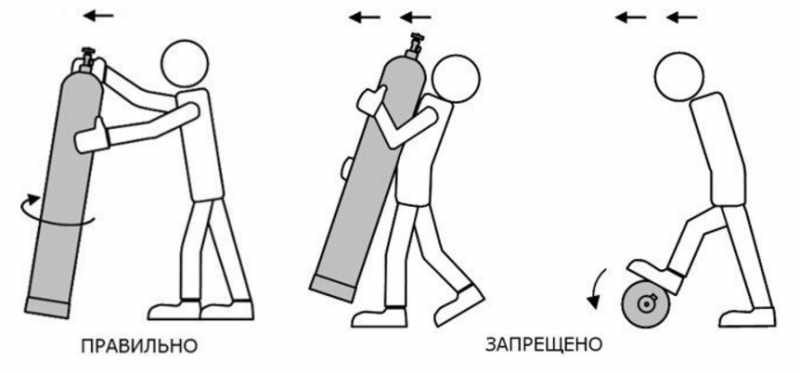
Moving the gas cylinder
In particular, you must not:
- Gas leaks through joints and threaded connections and the formation of an explosive mixture with air.
- Thermal effects on containers, which can lead to an increase in gas volume and pressure inside the cylinder.
- Mechanical impacts of the impact type, which can damage the walls of the container.
Safety regulations require that containers be transported with protective caps installed on them.
Vessels with gas can be transported from place to place in a horizontal or vertical position. But at the same time, it is necessary to provide protection against spontaneous movement of containers inside the body.
It is unacceptable to throw gas containers to hit them on hard objects.
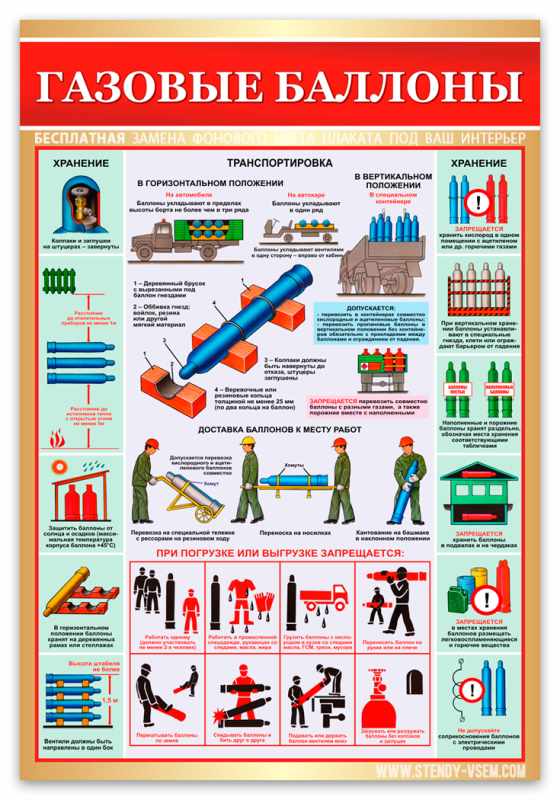
Rules for the safe operation of gas cylinders
It is unacceptable to store a gas tank in a residential area. Ideally, the gas vessel should be stored in a free-standing iron box.
Who buys gas from Russia
The main consumers and buyers of our natural gas are European countries. The main importers of gas are such countries as the Republic of Turkey, Italy and Germany.These countries buy gas in large volumes. Many countries in Europe depend on Russian gas. Belarus and Armenia buy gas only from Russia, so they are 100% dependent on our supplies in this component. These fraternal countries buy gas from us for an average of $170 per thousand cubic meters. Although the average price of natural gas in the world market is more than $400. Also, Finland, Latvia, Bulgaria, Lithuania and Estonia are completely dependent on Russian gas. These states, except Finland, pay for gas 419 conventional units per thousand cubic meters. Of course, we are not doing well with these countries, but we also cannot lose customers with whom we directly border. Countries such as the Czech Republic, Ukraine, Turkey, Slovakia and Poland depend on 60-70% of Russian gas supplies. Although Ukraine and Turkey want to stop importing our gas, it will be extremely difficult for them to find a replacement. Italy, France, the Netherlands and many others also depend on 20-40% of our gas supplies. Recently, imports of natural gas to China have been discussed. Projects for the construction of the gas pipeline are already ready. This is a very good chance for Russia not only to enter the Asian market, but also to create the necessary competition there.
We can draw a small conclusion that Russian natural gas must be used rationally. This is the raw material that must be preserved for our children, grandchildren and great-grandchildren.
Now there are many local wars over resources, so you need to pay attention to the security of not only the country, but also gas fields
(No ratings yet)
investobox/ article author
This article was written and published one of our authors (an expert in his field).Behind each article is an experienced member of our team who checked the material for errors and relevance. Let's make money online together!