
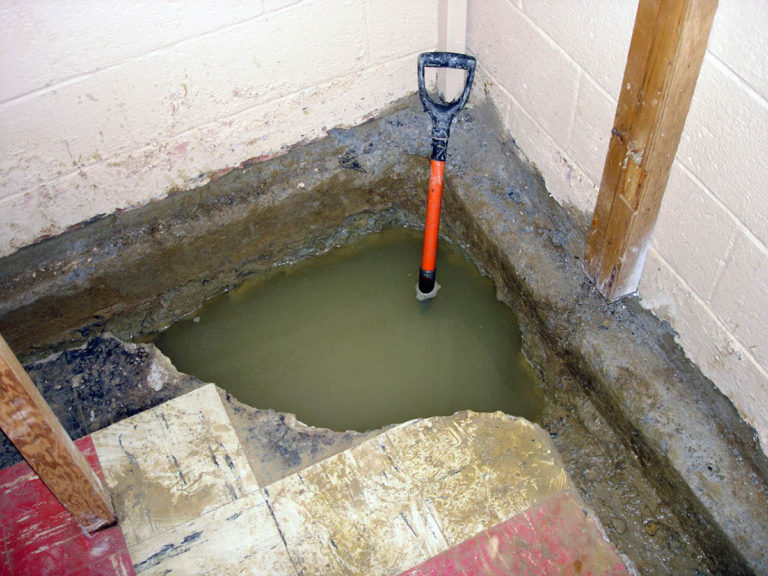
- Basement above groundwater
- Concrete monolithic cellar
- Additional waterproofing
- Folk ways of drying and dealing with condensate
- Prevent dampness
- Inspecting the floor
- Improving waterproofing
- How to prevent the occurrence
- Pit arrangement
- Drainage for drainage
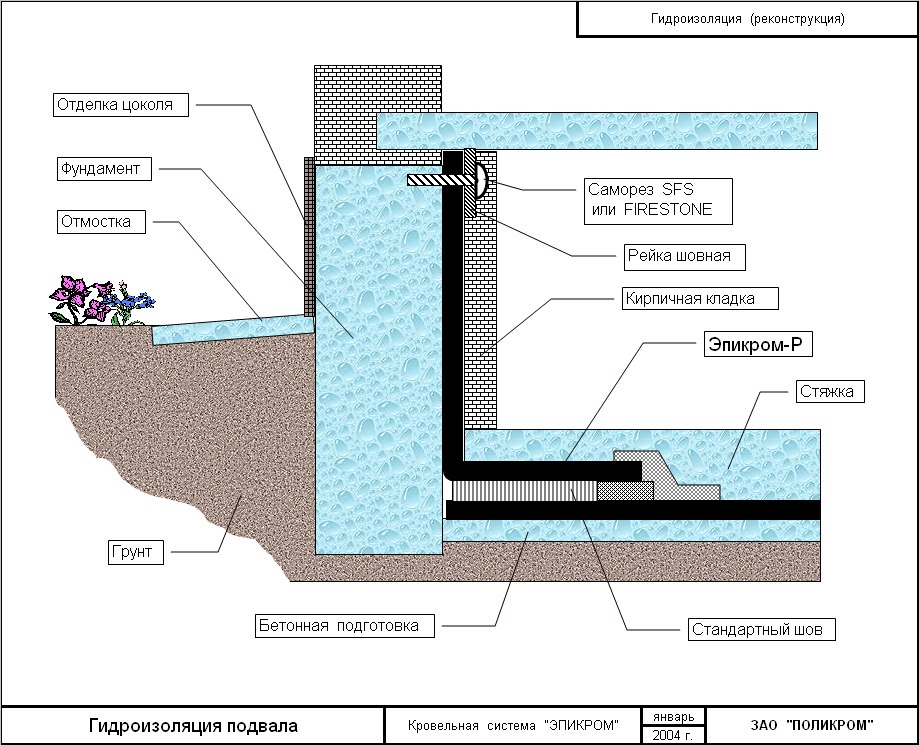
- Waterproofing the walls inside the basement of the house
- Basement floor waterproofing
- Where to divert water?
- How to get rid of groundwater in the basement
- Basement below groundwater
- Metal cellar-caisson
- Why is the basement flooding?
- Recommendations for the construction of a cellar with a high level of groundwater
- Preparatory work
- Buried part of the building
- The base of the cellar. Drainage
- Ventilation device
- Semi-buried cellar
- Additives for concrete
- CemFix
- Fiber basalt
- What is the danger to the house
- Ring drainage device
- Creation of an automatic water pumping system
- Causes of flooding
- Negative consequences of flooding
- Conclusion on the topic
Basement above groundwater
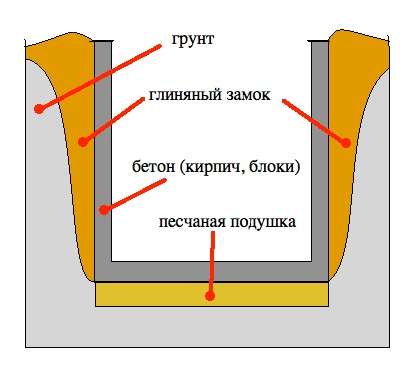
Basement above ground water.
In the case when the groundwater in the basement is located below the basement floor, then drip suction takes place here. It, in turn, entails the formation of condensate and all the same mold.
For such an arrangement of groundwater, the waterproofing work of the cellar is carried out according to the following scheme:
- digging a trench around the entire perimeter of the basement;
- cleaning the walls of the foundation;
- works on horizontal wall insulation are being carried out. Special protective compounds are pumped through the pits;
- work on the vertical insulation of the walls. For these works, special sealants with a penetrating effect are used, they cover the bases of the walls;
- laying drainage along the perimeter of the building with equipment for storm drains and storm ditches;
- restore the trench and blind area;
- restore the horizontal insulation of the walls inside the room. To do this, waterproofing compounds are pumped into the pits drilled in the walls in a certain sequence;
- restore the ventilation system.
Concrete monolithic cellar
A cast-in-situ concrete cellar is a reliable and affordable structure for storing supplies during the cold season. It can be done buried or partially buried at a high level of groundwater. The construction of a concrete cellar is carried out when groundwater does not rise high.
In a pit up to 2 m deep, a pillow of sand and crushed stone 20-25 cm thick is laid along the waterproofing layer. Formwork is arranged along the walls for pouring concrete, beforehand, waterproofing and reinforcement in the form of welded frames or meshes are placed there. After the concrete is poured, the formwork is removed, the floors are concreted along the reinforcing mesh. First, a layer of concrete is poured and the mesh is laid. When the first layer sets, you can pour the second. After the concrete has hardened, the walls and floors are covered with a layer of liquid waterproofing. You can glue the roofing material.
Additional waterproofing
For internal waterproofing of the surfaces of the walls and floor of the cellar, special penetrating compounds are used, they are best applied to slightly damp concrete.Penetrating waterproofing contains substances that react chemically with water and multiply on the concrete base, like crystals. These "growths" seal capillaries, pores and microscopic damage, protecting the concrete from water up to half a meter deep. They are not afraid of any mechanical influences. Chips and scratches do not affect the tightness of surfaces treated with such penetrating compounds.
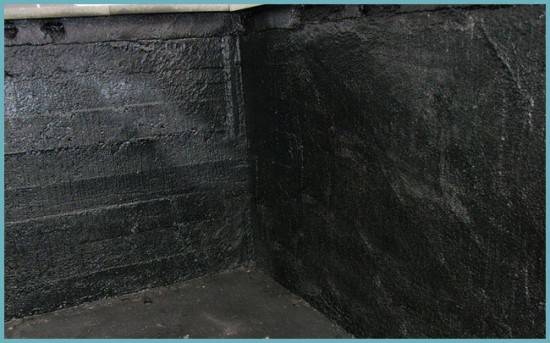 Cellar walls after application of waterproofing liquid rubber
Folk ways of drying and dealing with condensate
Old-fashioned methods come in handy in such a situation. In order to stabilize the humidity in the basement, you can:
Use clay bricks to dry. They are heated on a fire, and then placed in the corners of the room. Enough 2-3 red-hot bricks. They will cool down and absorb excess moisture, as well as dry the air. Usually a few procedures are enough to forget about the problem for a while.
Healthy! Bricks can be replaced with glowing coals, which are laid out in buckets and also placed in the corners.
If mold has already begun to form on the walls and ceiling, then boric acid (20 ml per liter of water) or citric acid (100 g per 1 liter of water) will help. Ordinary table vinegar is also highly effective (if there is a lot of mold, then it can not even be diluted with water). Wear gloves and protect your eyes and respiratory tract. After processing, you need to wait for the walls to dry, after which they can be whitewashed.
- Ash and salt. As you know, the adsorbent quickly absorbs moisture. However, salt or ash will require a lot. But, this method helps for a very short time.As soon as the adsorbent is saturated with moisture (and this will happen in a few days), it will have to be changed to a new one.
- Paper and sawdust. As you know, these materials have a very high hygroscopicity (the ability to absorb moisture). Therefore, along the perimeter of the room, you can lay out old newspapers, sawdust, cardboard, and so on. After they become wet, the material will need to be replaced.
Such methods are easy to implement, but short-lived. If it is not possible to immediately solve the shortcomings in the design of the cellar or basement, then you can use one more means.
Prevent dampness
As usual, this “disease” is easier (and cheaper) to prevent than to treat. It is still being decided at the design stage:
- If groundwater is nearby or in spring/autumn its level rises significantly, external waterproofing is necessary. Liquid compositions are applied to the walls outside (better) or rolled (cheaper, but less effective).
- If the cellar is built on a slope, above it it is necessary to lay a drainage pipe in the ground, which will drain the precipitation flowing down the slope.
- A blind area is made around the cellar (or the building under which it is located), which diverts precipitation flowing from the roof.
-
Inside the cellar in opposite corners there should be two ventilation pipes with a diameter of at least 125 mm. One of them ends at floor level - 10 cm higher. Air from the street or premises (supply pipe) enters through it. The second ends almost under the ceiling - 10 cm below its level. This is an extractor. Ventilation pipes on the street should be covered with umbrellas so that foliage and precipitation do not get into them.The exhaust pipe (the one that ends near the ceiling) should be higher and it is better to install a deflector on it - to activate the draft. It can be painted black: due to the heating from the sun, traction should be better. Another subtlety: in order for the draft to be good, the ventilation ducts with natural air movement must be straight. If it is necessary to make a branch to the side, its angle of inclination must be at least 60 ° relative to the horizon, the length of the inclined section should not exceed 100 cm.
- Between the room located above and the basement there must be a vapor barrier that prevents the penetration of moisture both from the basement and into the basement.
Inspecting the floor
Very often in the cellar the floor is made of earth. Often it is the source of excess moisture. Through it, the moisture contained in the soil gets inside. To reduce the humidity in the cellar, you need to level the earthen floor, tamp it down and cover it with a thick plastic wrap. You can use roofing felt, but it breaks more often. Although it seems more durable, it breaks due to less elasticity.
It is not necessary to pour sand or earth on top of the film. Sometimes there is a large amount of water in the basement (accidental flooding). Then you simply take out the film, the water goes partly into the ground, partly evaporates through ventilation. After the dampness is gone, you can lay the floor again. If there is earth or sand on top, you will need to poke around in this liquid, extracting a film.
If the floor in the cellar is earthen, most of the moisture enters through it
If, after laying the film, the level of humidity in the cellar has decreased, then you have found the cause. You can leave everything as it is, only periodically change the “flooring”, or you can make a concrete floor with full waterproofing.The choice is yours. To prevent the film from tearing when walked on, knock down the wooden shields and throw them on the floor.
Improving waterproofing
The second reason why humidity rises in the basement is an insufficient degree of vapor barrier or waterproofing of the walls. This usually occurs if the cellar is lined with bricks, especially silicate. The material is very hygroscopic and passes water vapor well. They settle in drops on the ceiling and all objects.
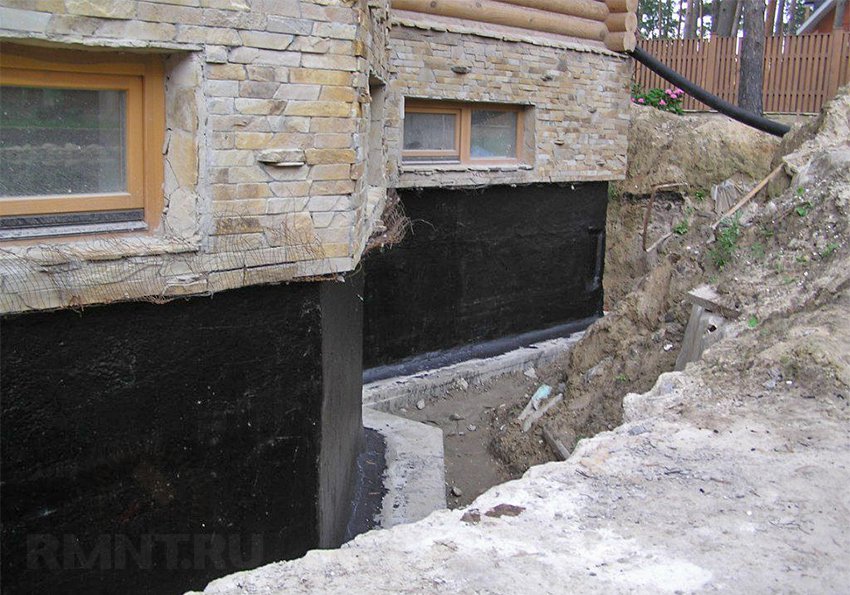
The problem can be solved if you make a good external waterproofing: dig out the walls and apply bituminous mastic in two layers. Previously coated with resin, but mastic is more effective and easier to handle.
Brick walls require additional waterproofing
But excavation is far from always a joy, and it is not always possible to dig out the walls. In this case, you can make an internal waterproofing of the walls of the cellar. For this, there are cement-based impregnations: Pnetron, Kalmatron, Hydrotex, etc. They penetrate to a depth of up to half a meter into the thickness of the material (concrete, brick, etc.) and block the capillaries through which water seeps. Water permeability is greatly reduced. Their only downside is the price. But they are really effective.


All these measures will prevent the appearance of high humidity in the basement. But what to do if there is already moisture, how to dry the cellar? Next, consider ways to reduce humidity.
How to prevent the occurrence
To prevent flooding of the basement, the following tips should be followed:
- If possible flooding is known in advance (before the snow melts), then it is necessary to inspect the inside and outside of the house in order to identify methods for draining the fluid flow.
- Clean gutters of fallen leaves. Otherwise, water will drain into the basement, increasing the possibility of flooding.
- When water accumulates in the basement of an apartment building, it is worth observing during heavy rains the areas through which liquid enters the house. The problem should be shared with a plumber or other specialist who will suggest ways to solve it.
Pit arrangement
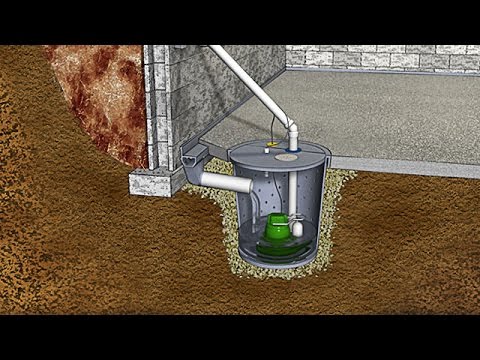
This method is the most common and low-cost way to eliminate flooding in the basement of a private house. To install the pit, the following recommendations should be followed:
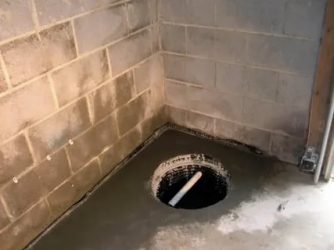
- In the central part of the basement, you will need to make a pit in the shape of a cube. Its volume should not be less than 1 cubic meter. The larger the area of the cellar, the larger the hole will have to be dug.
- In the middle of the hole, dig another one, the size of a bucket.
- A stainless steel bucket is placed in a small pit. The earth surrounding the pit is thoroughly compacted and laid with solid bricks. From above you need to apply a 2-centimeter layer of cement.
- A reinforcing mesh is installed on the cement. Between the rods, a distance should be observed that allows pumping out the accumulated liquid with a pump.
- To drain water in the pit, you need to make grooves. You can also lay it out with tiles. Water will flow through the seams between it.
Drainage for drainage
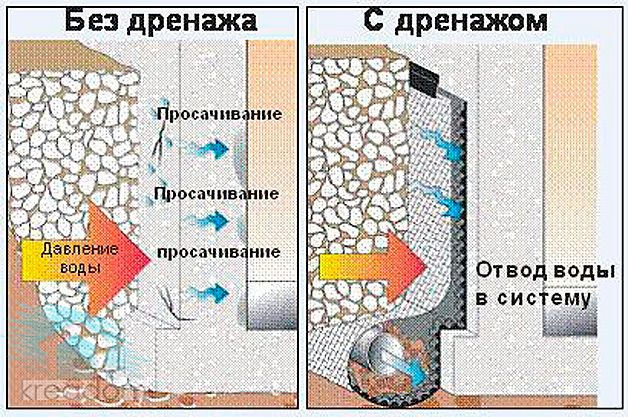
To prevent the accumulation of groundwater in the basement, drainage can be done. Its arrangement is carried out as follows:
- Along the outer perimeter of the house, you need to dig a ditch with a width of at least 1.2 m.
- From the ditch it is necessary to dig additional trenches in 4 directions. Each of them should end with a recess corresponding to the size of the concrete ring.
- Geotextiles are laid along the entire length of the main ditch, and a drainage pipe is placed on top.
- Every 7 m, you need to cut the pipe and install manholes.
- Further, the drainage is covered in several layers: with crushed stone (up to a level of 10 cm before the foundation), sand (before the foundation), large gravel (up to about 15 cm before the beginning of the soil).
Waterproofing the walls inside the basement of the house
Next, all the cracks, seams and corners are smeared with mastic. Then a 2-centimeter layer of mastic is applied over the entire area of \u200b\u200bthe walls. A reinforcing mesh is laid on it, for the subsequent application of a 3-centimeter layer of cement. After the cement has dried, the waterproofing is complete.
Basement floor waterproofing
The procedure for waterproofing a floor is similar to waterproofing a wall. The same materials are used. Until the cement is completely dry, it is impossible to enter the basement.
Where to divert water?
In most cottage settlements there is a place for this - either a general sewerage system or a system of surface drainage trays or ditches. In many villages, a deep general sewage system is provided, and when it is laid lower than the drainage network on the site, the pump can be abandoned: water will flow there through the pipe by gravity due to the slope.
If the above options are not suitable, then you will have to pump water into a reservoir, ditch, ravine or forest located near the house, stretching a hose or pipeline underground for this.True, you need to carefully consider the place of water discharge so that it is not in close proximity to other buildings in the village, otherwise there is a risk of flooding neighboring areas. In addition, if the system collects water in a small volume (up to 1000 l / h), then it can be diverted into the ground at some distance from the building (except when the water-resistant layer lies close to the ground surface). To do this, dig a shallow trench, which is covered with rubble or gravel. to improve water filtration into the ground.
How to get rid of groundwater in the basement
rlotoffski 2-03-2014, 19:00 21 479 Construction
OK
Groundwater problem and possible basement flooding - two complex issues that should be addressed even at the stage of building a country house. Ignoring these points can lead to such undesirable consequences as the destruction of the foundation, its subsidence, flooding of the basement and damage to all its contents, as well as the floors of the first floor. How protective measures should be taken to prevent disaster? If, nevertheless, the problem could not be avoided, what to do? Perhaps the following information will be useful to you.
What causes groundwater to rise?
For example, these may be floods of closely located rivers or a rise in the water level, provoked by heavy rainfall. Can we influence the first factor? We personally, as summer residents, are unlikely. But we can provide for the fastest removal of precipitation.
How to divert ground water?
So that groundwater in the basement of a country house does not create problems, they simply should not be there. To do this, it is worth taking protective measures.What should be attributed to them? Well, firstly, it is a well-timed drainage and, secondly, waterproofing.
Waterproofing is necessary from the moisture contained in the soil in any case, and when groundwater flows significantly below the level of the basement floor, without affecting the underground part of the structure. It is possible to treat all concrete surfaces with special water-repellent compounds, to seal the joints "wall-wall", "wall-floor".
Due to its special properties, a substance injected under pressure with special equipment quickly fills all existing external and internal voids, hardens, thereby reliably blocking access to water. You can forget about flooding basements if, in addition to waterproofing, take care of the drainage system on the site.
Option 1.
With the help of a drill, we will make several wells with a diameter of at least 10-15 cm, and an average length of 3-5 meters.
As a rule, this length is sufficient to provide liquid access to permeable layers through dense clay layers, which trap water, causing it to accumulate.
As a result, water does not accumulate in the upper layers of the soil, for example, during rain or snowmelt, but freely and deeply goes through the waterproof layers of the soil. And very fast too! Such wells are recommended to be made around the entire perimeter of the basement and in its vicinity.
Option 2.
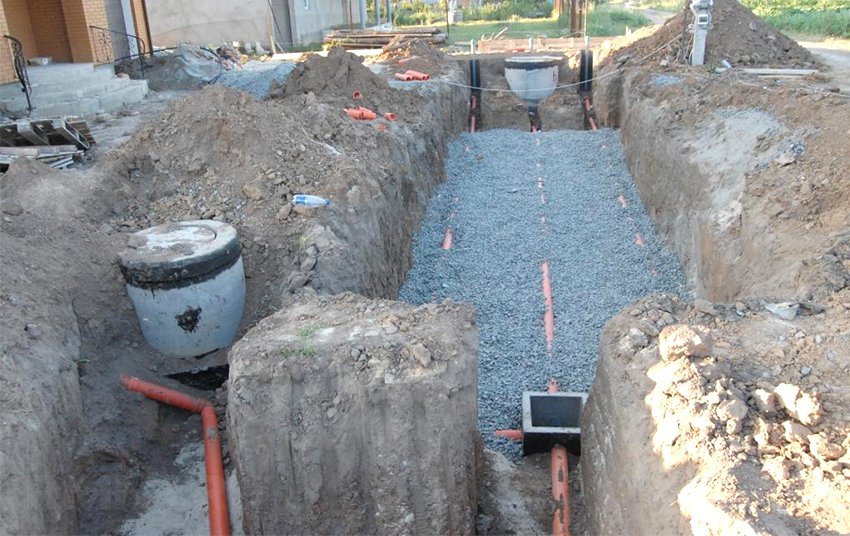
You can also build a drainage system as follows. First of all, it is required to assess the nature of the slope in the summer cottage, which in turn will determine the degree of slope of the pipes. In addition, the larger the diameter of the pipe, the greater the slope. Thus, an independent flow of water is ensured in the direction opposite to the site.
We dig trenches along the perimeter of the house and one or two more in the direction from the house to drain the liquid. They should be about 1.5 meters deep, 0.4 m wide, and the slope at the exit should be below the level of the basement. We cover the bottom with a waterproofing tecton, then with geotextiles (the width of the material should be sufficient to wrap the subsequent elements of the entire system with it).
If the basement is already flooded.
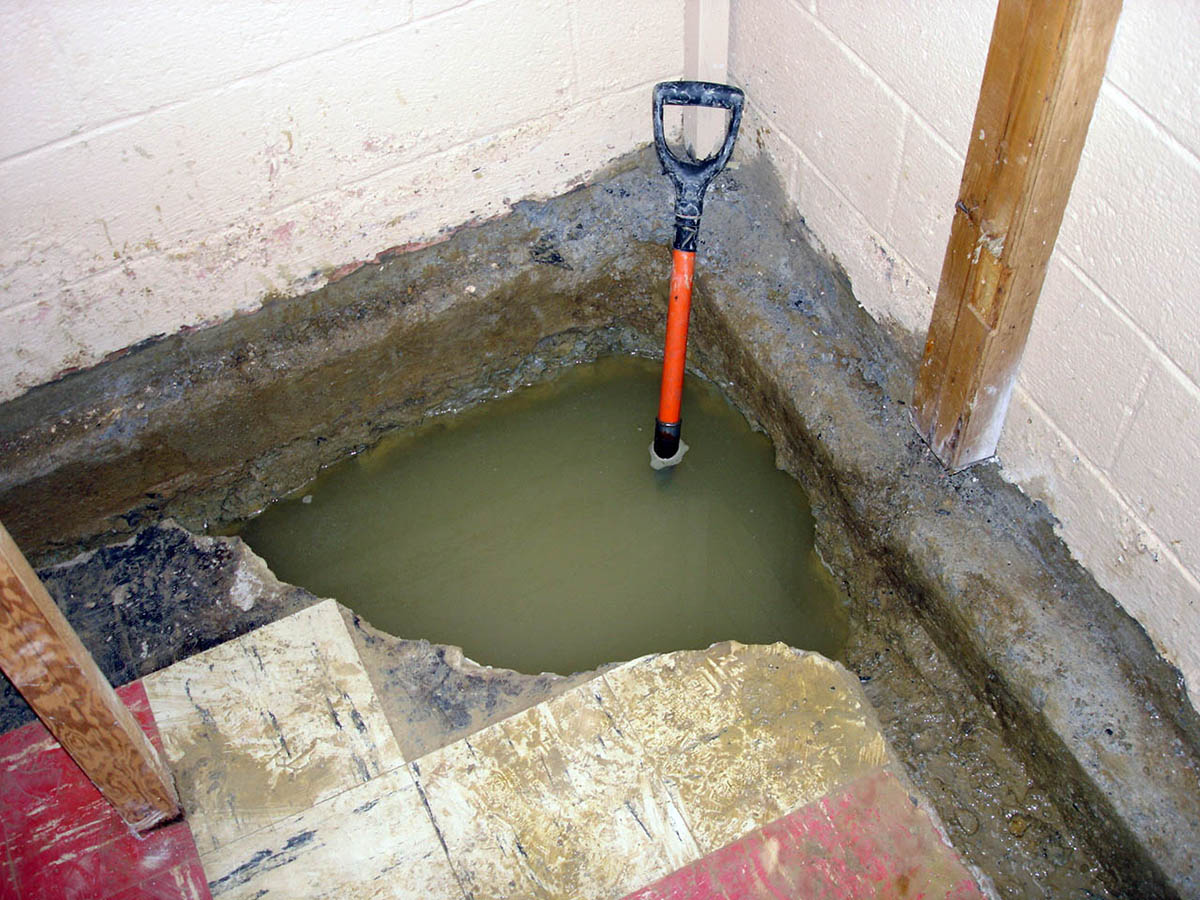
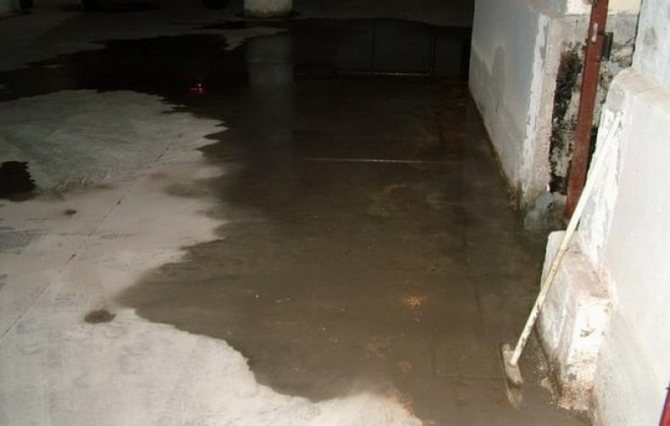
If the organization of waterproofing during construction was not discussed, and the basement was flooded, then it is urgent to drain it, and then think about the drainage system.
A properly laid network of drainage pipes will collect and drain not only groundwater, but also melted, rainwater, constantly protecting the foundation, basements from excessive moisture. Drain the flooded room using a submersible drainage or fecal type pump.
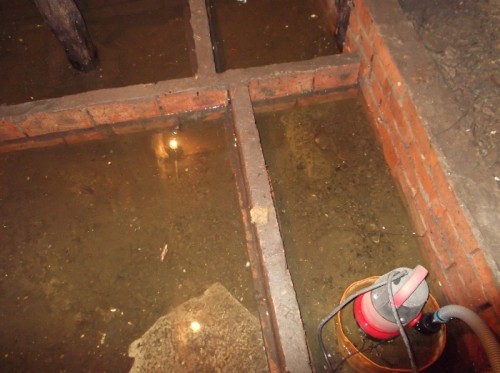



There is nothing complicated in their design, as well as operation, which does not prevent the devices from effectively solving their tasks. The choice of model depends entirely on the composition of the liquid in your area, the number and size of foreign particles in it. The drainage pump will perfectly cope with clean or heavily polluted water.
www.kak-sdelat.su
Become the author of the site, publish your own articles, descriptions of homemade products with payment for the text. Read more here.
OK
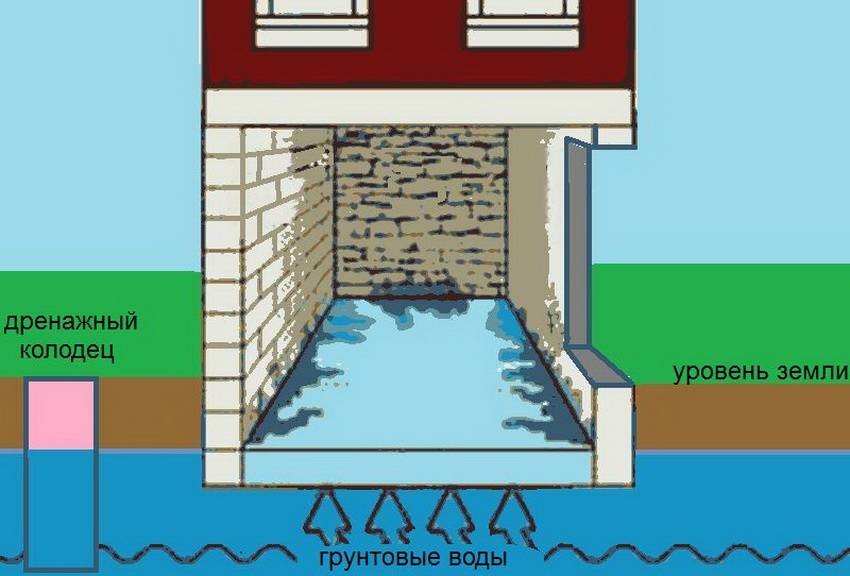
Basement below groundwater
The groundwater level is below the level of the basement floor.
Methods for carrying out waterproofing work are the same, only the use of related materials, their price and quality are different.
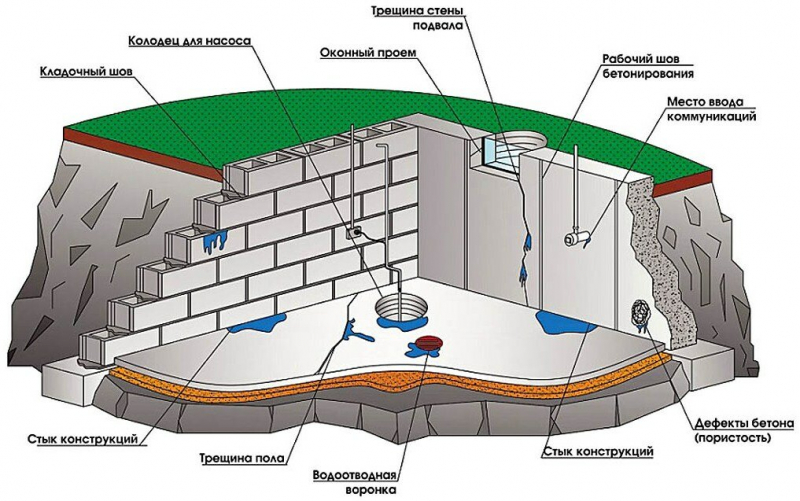
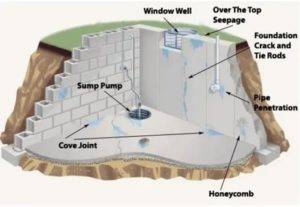
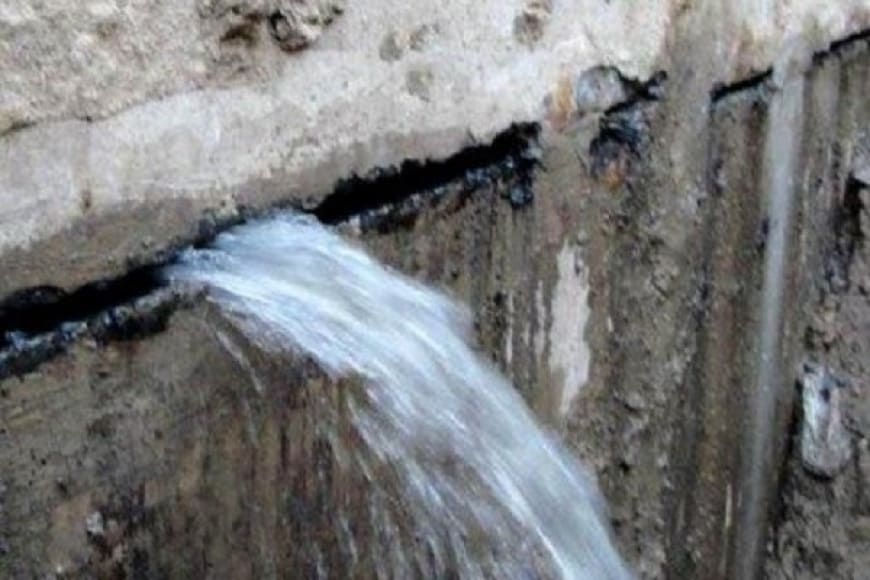
Groundwater penetrates into the basement only through cracks in the floor and walls, corner joints of the floor with the wall.Since groundwater is above the basement floor, therefore, the water pressure is very significant. For such work, you should choose only materials of high quality and proven by many years of experience, you should study everything in depth and consult with a specialist in this matter.
The scheme of waterproofing works, provided that the groundwater level is above the cellar floor, is as follows:
- a trench is being dug around the entire perimeter of the basement;
- external walls are thoroughly cleaned of soil and other dirt;
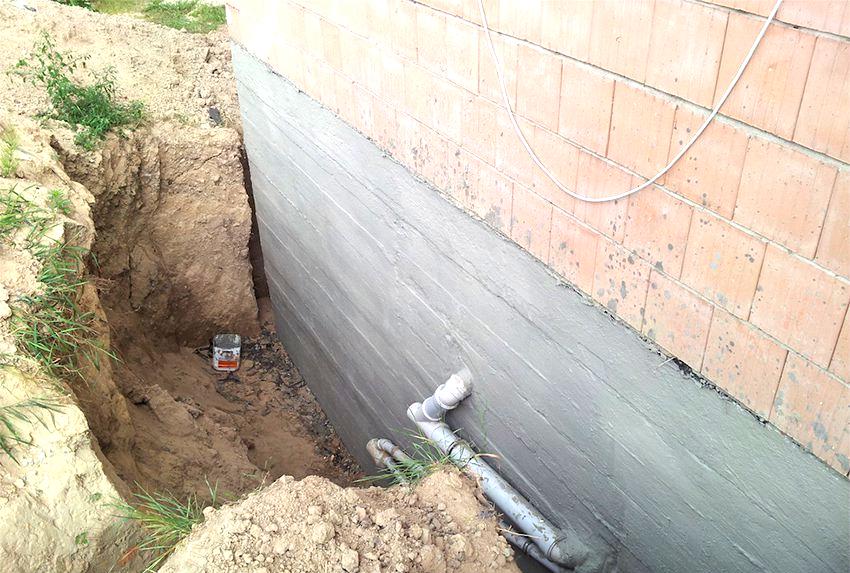
- work to restore the insulating properties of walls. Carefully carried out vertical and horizontal isolation of the basement from water. For vertical waterproofing, a penetrating water repellent and coating sealants should be used. Water repellents should be selected in such a way that they contain antiseptics, water repellents and other moisture insulators;
- laying drainage around the perimeter of the cellar. In the future, drainage will protect the walls of the building from excessive rainfall. To do this, storm water storage tanks (pipes) are attached to the storm water inlets under the drainpipes. Not far from the cellar, a storm well is equipped. Then the storm pipes are diverted to the well;
- backfilling of the trench, restoration of the blind area around the entire perimeter of the basement.
Next comes the interior work. If the case is neglected, then first of all, water is pumped out of the basement of the house.
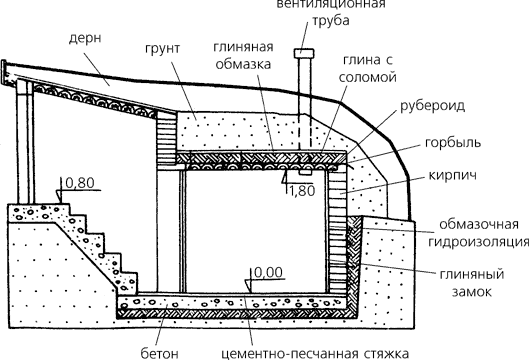
Basement layout.
Internal works include:
- installation of a substrate for waterproofing;
- corner joints between the floor and the wall are lined with a self-inflating betonite cord;
- pouring concrete. Concrete must be enriched with water repellents and modified fibers.
If the groundwater level is much higher than the level of the cellar floor, then it would be very rational to equip wells under the basement floor. They also install special pumps. These pumps are self-submersible and are switched on when necessary to pump out groundwater. Further, when the critical level of water in the basement of the house is raised, it enters the well, and is artificially discharged from there. It is also necessary to restore the insulating properties of the walls. For this, it is necessary to height above groundwater level make holes. In them, under pressure, using appropriate equipment, special compositions of water repellents are pumped into the walls.
Further work is carried out for the restoration of the ventilation system. She plays an important role in the basement. The supply and exhaust system balances the level of humidity in the room, helps to get rid or prevent the formation of mold spores, and eliminates unpleasant odors.
Metal cellar-caisson
This is a one-piece structure, which is made to order, and then delivered directly to the site where the cellar will be built. These structures exhibit remarkable moisture-resistant qualities. It should be noted right away that such cellars are quite expensive, during installation they require appropriate preparation, as well as the use of auxiliary equipment.
To reliably secure such a basement, it is only necessary to isolate the entrance from the penetration of moisture, since liquid cannot penetrate through the walls of the caisson. The facilities are provided with interior decoration, which includes the necessary shelves and racks.
Why is the basement flooding?
Flooding occurs during summer showers or due to sudden snowmelt in spring. Water also seeps into the basement due to leaks in the wall or foundation from groundwater or rainwater drainage. There are several factors that affect the flooding of premises:
- Basements that are built below ground level are prone to flooding.
- Groundwater is located above the level of the basement.
- Sanitary, storm and storm drains are usually buried below the foundation but above floor level. Water can flow into the basement, for example, if there is a crack in the foundation.
Sewerage has two directions - from the premises and to it. Usually water flows from the building. It can go inside due to several violations:
- cracks appeared in the foundation, which opened the way for the waters;
- pipe defects appeared: bell, depressurization, etc.

Deformed Foundation
Most of the time, flooding occurs during rains and downpours. But you also need to know what to do if the ground water in the basement of a private house appeared in dry weather. This phenomenon has three main reasons:
- Sewer lines or sewer breaks. Pipes wear out and fail. Tree roots eventually penetrate the pipes and clog them. Normal descent of water is impossible, drains are inhibited. Due to the broken structure, the basements of houses are flooded with sewage. The solution to the problem is the replacement of pipes and subsequent prevention during the year.
- Clogged plumbing fixtures. Remains of food, grease, rags and personal hygiene products are often dumped into the toilet. The sewerage is blocked. In this case, it is better to contact a plumber and use the toilet only for its intended purpose.
- Failure of the drainage system.During the laying of the foundations of houses, drainage is installed in the lower sections of the basements, which automatically regulates the level of groundwater within the normal range. When the system fails, flooding occurs.

Old plumbing is the cause of many floods
Floods are often caused by heavy summer rains that overload drainage systems and sewer pipes. Water leaking into the building due to high surface water levels or flooding in the streets. It accumulates around the foundation and flows into driveways and roads, from where it penetrates inside for several reasons:
- Cracks and deformation of the foundation. Most often, it collapses in old houses or because of fragile materials. In winter, when there is a lot of water in the ground, the flood will not keep you waiting.
- Failure of the drainage system or pump. Due to the annual floods, land owners find the answer to the question: how to get rid of water in the basement of a private house, and install a pumping pump. Water from it is directed to the rain sewer or to the street. If the system fails, the water level rises and floods the basement from the sump.
- Clogged sewer. Filled pipes raise the water level, the sewer is overloaded and releases liquid into the building.

Sewer pipe clogged with earth and roots
Recommendations for the construction of a cellar with a high level of groundwater
When arranging a cellar in a country house or in a private house with your own hands, you need to do all the work step by step. Then the building, even if ground water closewill be securely protected.
Preparatory work
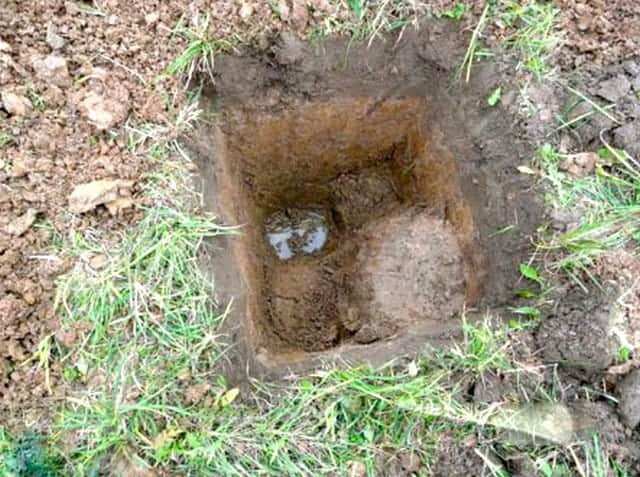
Preparatory work must necessarily precede the start of the construction of the cellar.Before you make a cellar, if groundwater is close, you need to find out the depth of their occurrence. To do this, in the spring, during the intensive accumulation of flood waters in the layers of the earth, it is necessary to make a hole in the ground at the site of the proposed construction using a drilling rig.




The drilling depth should be taken equal to the depth of the cellar, i.e., approximately 2 m. If the soil raised from this mark turned out to be dry, there is nothing to fear, and construction can begin. If water began to accumulate in the hole, you need to determine the depth of groundwater. You can do this with a rod.
When lowering into a well, it is easy to determine the depth at which the water is located. Within 3 days, it is necessary to make 3 measurements and take the maximum mark to take it into account when arranging the cellar. If the depth of the soil is not higher than 1.2-1.7 m, a semi-buried cellar is possible. With a smaller value of this indicator, it is permissible to arrange only an above-ground cellar. But what to do if the site is subject to flood waters or the groundwater level is high enough?
To avoid trouble, you need to know how to implement do-it-yourself basement construction with high groundwater levels.
Buried part of the building
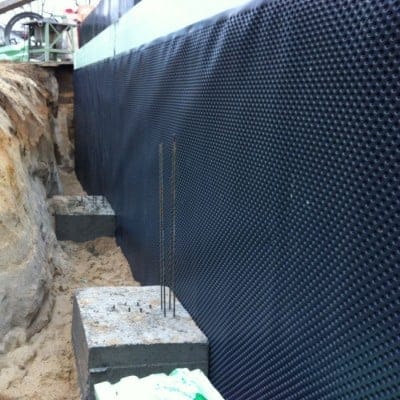
A cellar in a site with a high level of groundwater needs additional protection against moisture penetration. The buried part of the building, located below the soil surface, is exposed to the damaging effects of dampness. For the installation of floors, it is necessary to use concrete grade M300 with water-repellent additives.
For better protection, special penetrating compounds are used, which are applied to the still wet concrete.Reacting with water, they additionally penetrate and crystallize in the thickness of concrete or other material of the pit wall. One of the best sealants is liquid rubber.
The base of the cellar. Drainage
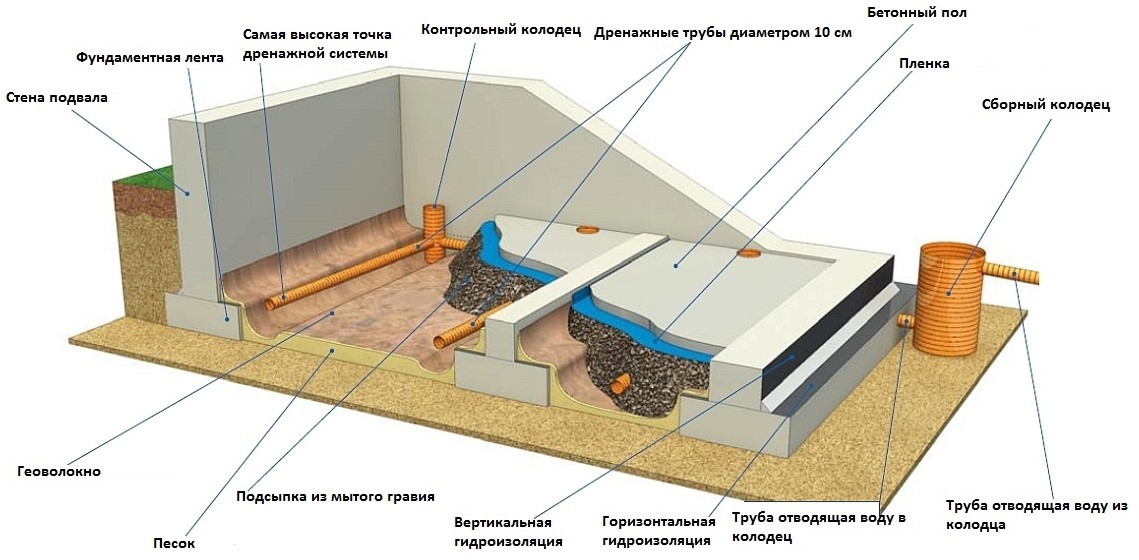
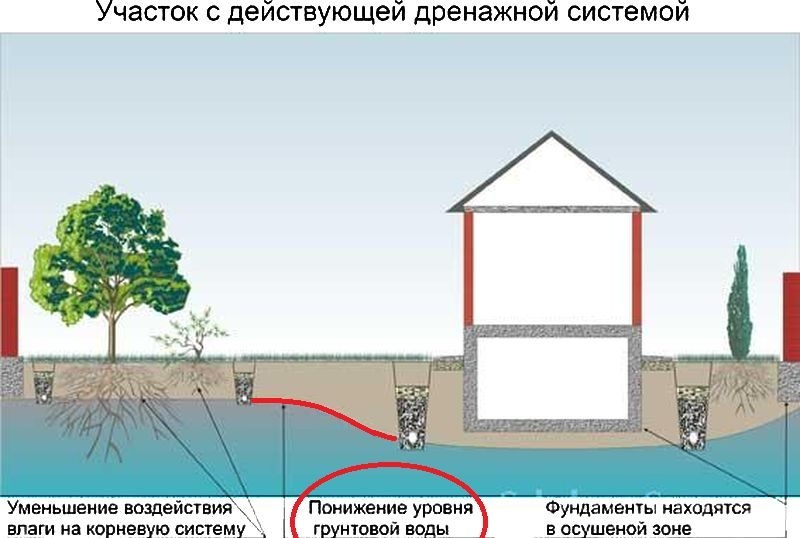
In order to prevent rising groundwater from penetrating into the basement, a drainage system is arranged. Drainage of the premises is carried out using an external and internal drainage system.
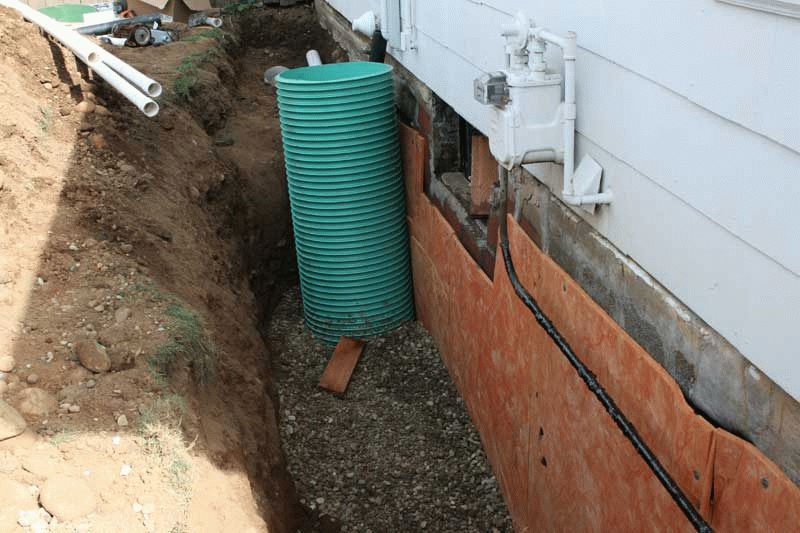
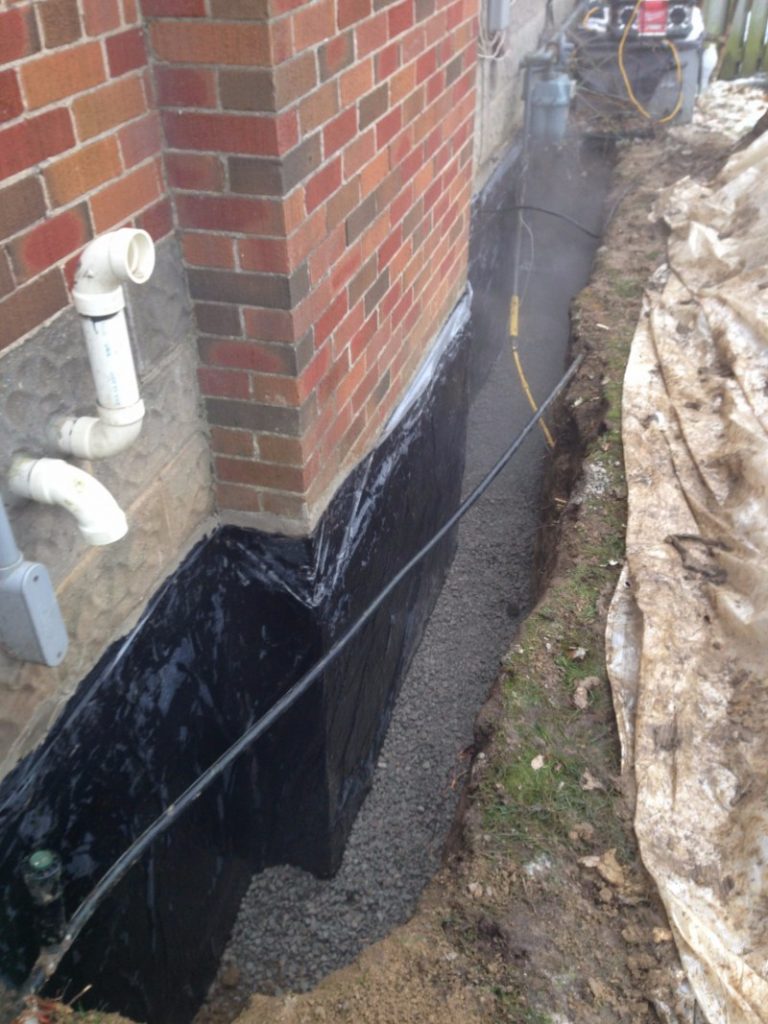
For external drainage, they dig a trench along the perimeter of the structure, 20 cm below the basement bottom. A sand cushion at least 10 cm thick is poured onto the bottom, a layer of geotextile is laid, crushed stone or gravel is laid on it. If incoming water interferes with work, using a sump pump
Pumping should be carried out carefully to avoid sinking of the soil. Then drainage pipes are laid at the bottom of the trench.
Holes should face down. From above, the pipes are covered with rubble, covered with geotextiles. Fill the trench to the top with crushed stone, gravel, sand and compact.
The internal drainage of the basement is arranged similarly to the external one. With a dense building site, it is sometimes impossible to find a place to lay drainage pipes around the basement. The difference between internal drainage is that the pipes are laid indoors under the basement of the basement. Floors with the necessary waterproofing are arranged from above.
A pump with a float sensor is placed in the drainage well. When the groundwater level rises, the pump removes water from the space near the basement into an additional reservoir or sewer.
Walls and ceiling.Wall insulation For cellar walls and ceilings, materials are used that additionally protect the basement construction material from moisture and maintain the required temperature. You can apply cement-based plaster with water-repellent properties, or treat it with mastics with pasting films or roofing material. Waterproofing works are carried out on the outer and inner surfaces. Outside, the walls and ceilings of bulk and semi-buried cellars are insulated with earth, and inside - with foam plastic or foam plastic.
Ventilation device
The cellar room must be equipped with supply and exhaust ventilation. Otherwise, the dampness that occurs during the storage of stocks will quickly destroy them. For air inflow, the pipe is located at a height of 10-15 cm from the floor, its upper end is 30 cm from the ground. The exhaust pipe is installed under the ceiling, and the upper end is at a height of 50 cm from the top of the roof. It is necessary to provide protection against rodents and valves to regulate the air flow. Sometimes forced ventilation is used.
Semi-buried cellar
The construction of a cellar with a high level of groundwater must correspond to the increased risk of flooding. In this case, the following is recommended:
- use a one-piece box as a structure;
- securely isolate the entire room with waterproofing;
- install high-quality ventilation inside the room;
- take additional measures to remove moisture;
- install a mechanical or electrical drainage system.
Along with this, it is also recommended to regularly clean the surface of the embankment so that precipitation does not linger, but leaves through a previously prepared drainage system.
Additives for concrete
Universal complex antifreeze additive for concrete.
Complex antifreeze additive for work at low temperatures
Multifunctional special additive for foundation work.
Highly effective complex additive for masonry and other mortars.
Universal superplasticizing and super water reducing admixture for concrete.
All-purpose concentrated cleaner for removing efflorescence, grout and rust
Waterproofing admixture for concrete.
A complex water-repellent agent for surface treatment.
Universal protective impregnating agent for concrete and other building materials.
Multifunctional plasticizing and water reducing additive for concrete.
Elasticizer and construction adhesive
CemFix
Fiber basalt
Basalt fiber (from roving) is designed for volumetric reinforcement of concrete, mortar and composite materials.
Universal polypropylene reinforcing fiber for mortar addition.
What is the danger to the house
Flooding the basement can adversely affect the entire house:
- the basement will become damp, a fungus, excess water will appear, which will provoke the unsuitability of the room;
- the accumulation of water after showers can ruin the paths in the yard, ruin the flowers, wash the walls of the building;
- ground water can destroy concrete, which will cause damage to the foundation.
Expert opinion
Mironova Anna Sergeevna
Generalist lawyer. Specializes in family matters, civil, criminal and housing law
During construction work, it is necessary to find out the level of groundwater using a well on your own or neighboring site. You can also use the services of geological exploration.


Ring drainage device
With a close occurrence of soil water, excavation is complicated by the fact that the soil becomes heavy and viscous. The first step is to lower the height of the groundwater below the bottom of the pit to at least half a meter.
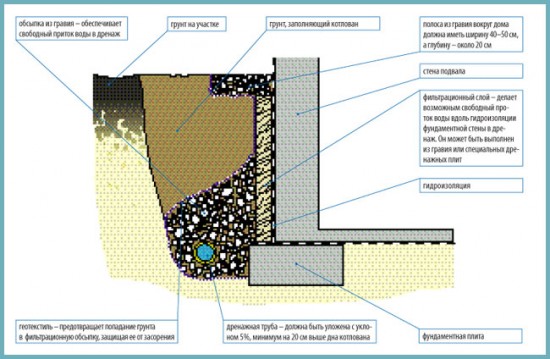 Cellar drainage device
- We mark the contour of the pit. We dig a trench along the outer contour of the future pit, deepening 30 cm below the sole of the future foundation.
- Pour sand on the bottom, rubble on top. We lay the geotextile in such a way that after laying the drainage pipes, wrap the drainage with it.
Waterproofing device
- We lay drainage pipes at a slope to the storage tank. We arrange two wells: a viewing and storage. If there is a reservoir nearby, then you can bring a pipe with a drainage system there.
- We wrap the geotextile, top with a layer of sand and a layer of gravel, and then fill the entire trench with the excavated soil and tamp it down.
- When the water starts to go away, we start digging a pit.
Creation of an automatic water pumping system
Not all basement owners have the opportunity to create a slope with a drainage system. Therefore, in such areas, a different method is used. To drain the room, an automatic system for pumping excess water is installed.
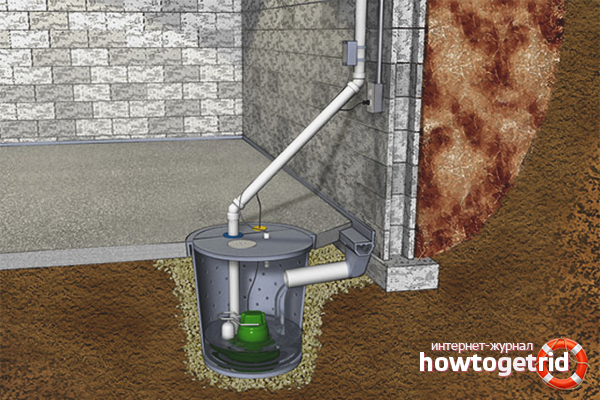
What does that require:
- Create a recess (pit) in the basement. Dig a hole measuring 50x50x50 cm. Then reinforce it with concrete or brickwork - this must be done to prevent the walls from collapsing. Pour 10 cm thick gravel into the hole.
- Purchase a special pump that automatically turns on when a certain level of water accumulates.
Mounting
In the excavated pit, place the pump, connect the hoses to it and take them away from the room.When the volume of groundwater increases, it will first accumulate in the pit. The pump will work, reacting to the rising level, and pump out excess moisture. This will continue until the groundwater finally subsides.
Conclusion
A fairly simple system that is inexpensive. Quick to install and easy to set up. But this system has two significant drawbacks. First, the pump works properly until it exhausts its resource, and then it will have to be replaced. Second, the pumping system will not eliminate the cause of flooding, but only temporarily relieve the consequences.
Causes of flooding
Water in the basement can form for several reasons.
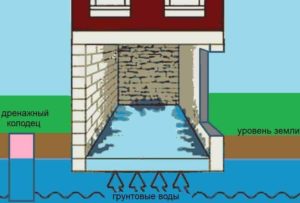
The list is this:
- making mistakes in the formation of low tide;
- increasing the volume of groundwater depending on the season;
- violations in the wastewater system;
- misconduct of citizens living on the first floors of apartment buildings;
- the formation of an emergency on the water supply line;
- breakdown of communications.
Depending on what reason influenced the flooding of the basement, the guilt of the management company or a specific person is established.
Negative consequences of flooding
For this reason, at the initial stage of solving the issue of flooding, you need to contact the management company. This organization is responsible for the common property of MKD.
If proper measures are not taken in time, negative consequences may occur:
- the formation of an unpleasant odor, which is a consequence of stagnant water;
- the manifestation of mold and fungus that harm the health of residents of the house;
- the appearance in the basement of insects, for example, fleas, midges;
- permission for the foundation of the building;
- breakdown of equipment stored in the basement.
To prevent these consequences from happening, you need to remove the water as soon as possible.
Conclusion on the topic
So, two questions were considered: how to divert groundwater from the house, and how to waterproof and seal the basement after pumping out the water. It should be noted that not everything is as simple as it might seem at first glance. But, knowing the technology of work, taking into account the nuances of each construction and repair process, you can guarantee the quality of the final result. Even if all operations will be carried out by hand. The most important thing is not to be afraid, especially since all the described building materials are present on the market in full.
Don't forget to rate this article:



