- We install geothermal heating ourselves
- System features
- Classification by construction type
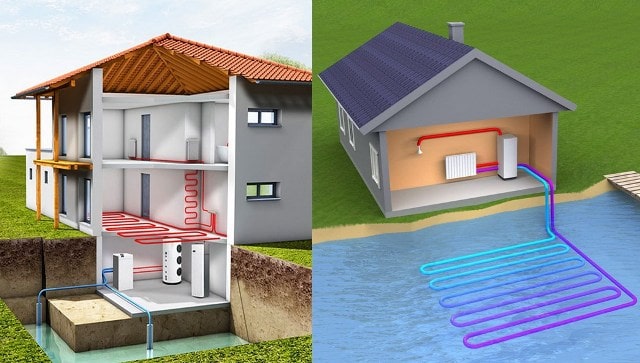
- Horizontal heat exchanger
- Vertical heat exchanger
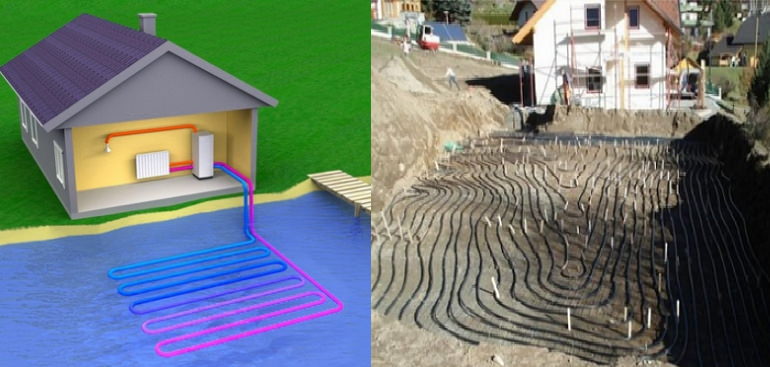
- Water placed heat exchanger
- Approximate costs and payback of the system
- What is geothermal heating?
- Advantages and disadvantages of the system
- Options for arranging geothermal heating
- Horizontal geothermal heating scheme
- Vertical diagram of geothermal heating
- Features of the heating system
- Real advantages and disadvantages
- Air collectors
- Features of geothermal heating system
We install geothermal heating ourselves
Immediately, we note such a feature: those who decide to equip heating with the heat of the earth will need to invest a huge amount in this once. Of course, over time, this cost will pay off, since we do not build housing for ourselves for a year or two. Also, gas and electricity prices go up every year, and with a geothermal system, you don't know what those price hikes are.
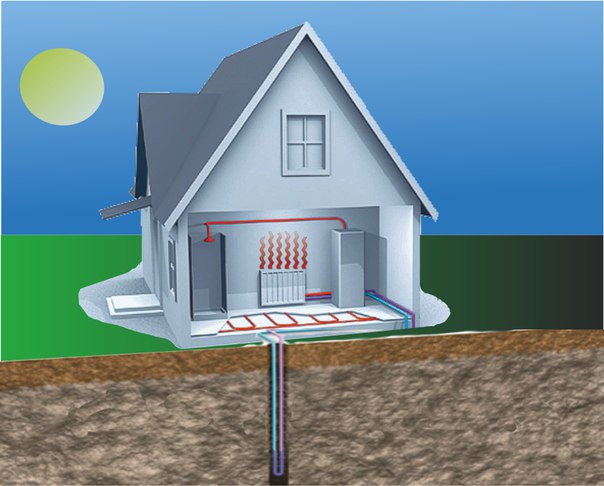
However, in this system, most of it will be hidden underground. Heating with earth energy is the presence of a well and a heat exchanger. In the dwelling, you only need to put a device that will generate heat - usually it does not take up much space.
On such a device, the user will be able to control the temperature and supply thermal energy. The installation of the heating system itself in housing is done as usual - with a branching of the pipeline and radiators. If you have a private house, or the building itself is small, then in this case the generator of the system is displayed in a separate room or in the basement.
System features
Of course, it is not so easy to make geothermal heating with your own hands, but it is quite possible. And for starters, a mine is being made. The parameters of the mine are calculated for each case separately. Its dimensions will depend on the climate in your area, the type of soil, the structural features of the region's earth's crust, and the home area where such a system will be installed. As a rule, the depth of the mine is from 25 to 100 m.
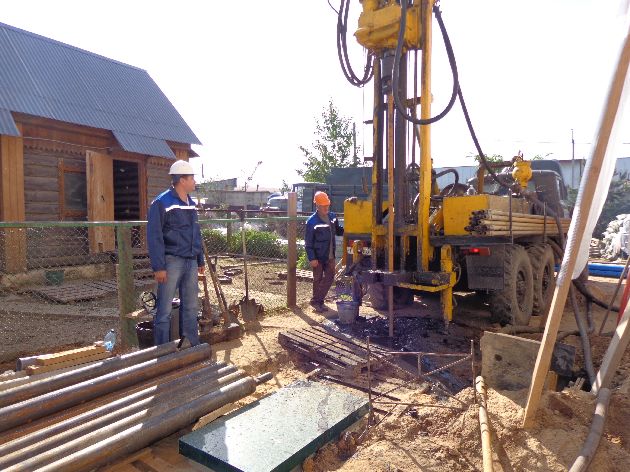 Well drilling for a heat pump
Further, the installation of geothermal heating involves such a step as lowering heat-absorbing pipes into the earth's mine. The functions of these pipes are as follows: they will supply heat to the pump, which will raise the temperature of the liquid and bring it to heating. Note that if you decide to make geothermal heating systems with your own hands, then you will need an assistant, because pipes can be very heavy.
Classification by construction type
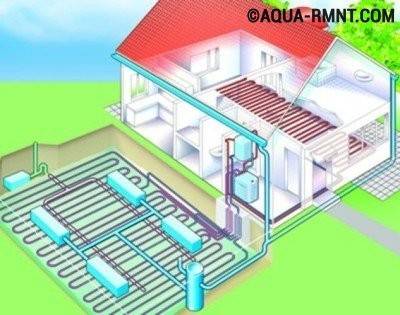
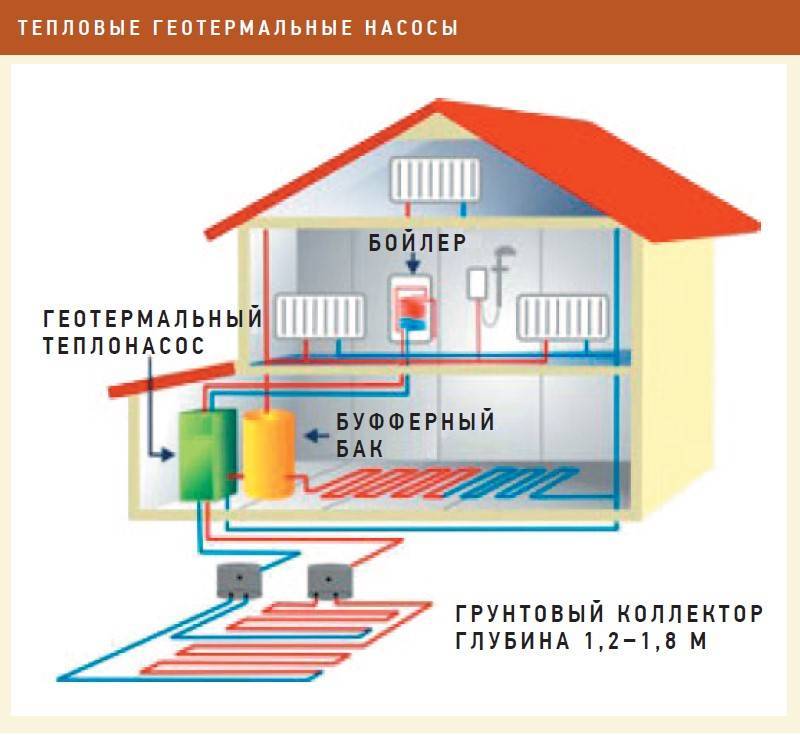
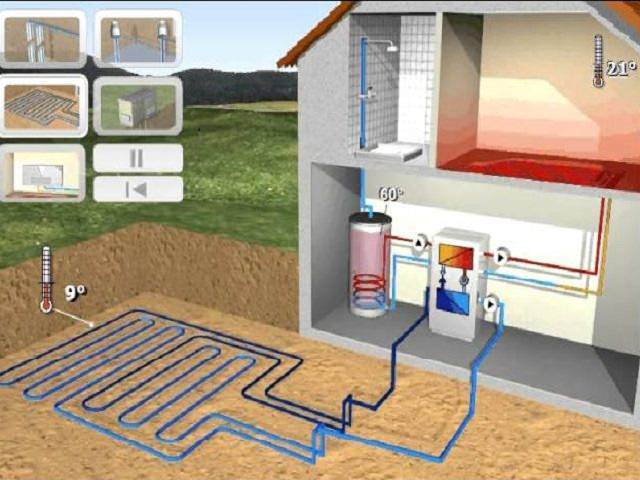
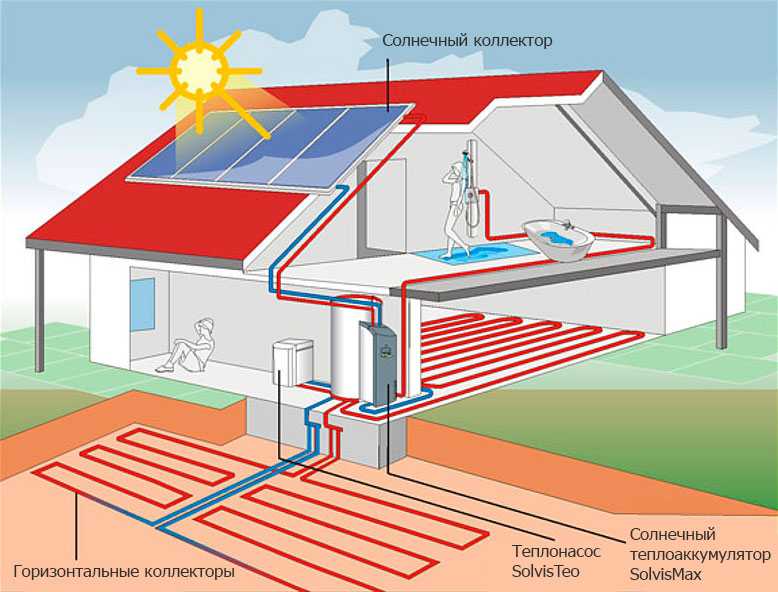
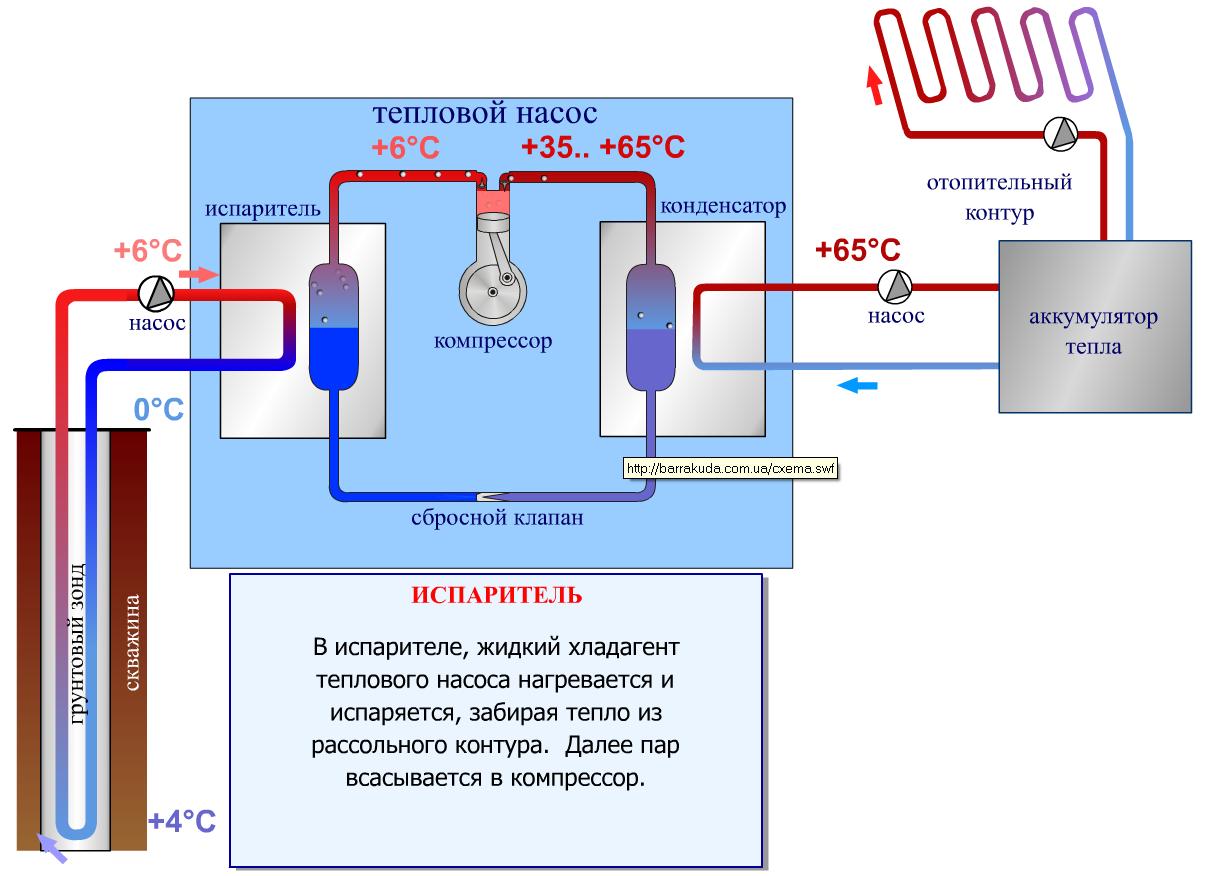
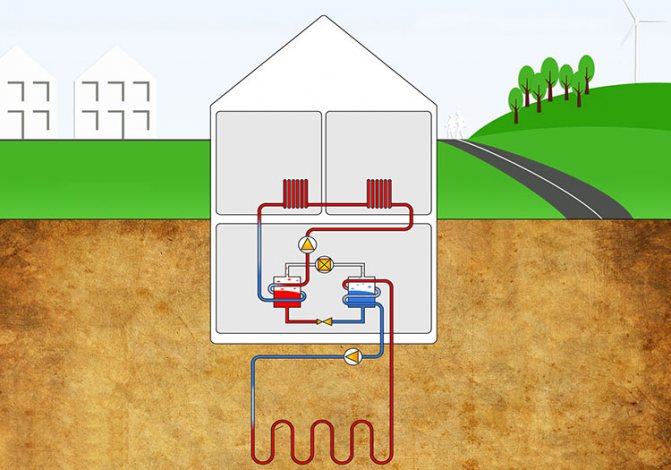
The principle of operation of geothermal heating is similar to the principle of operation of an air conditioner or refrigerator. The main element is a heat pump included in two circuits.
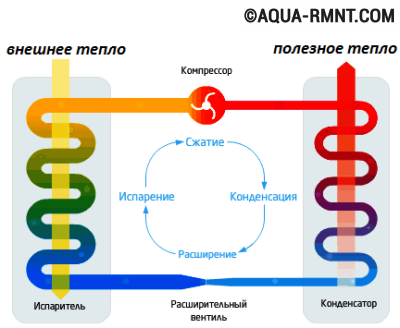
The principle of operation of a geothermal (heat) pump
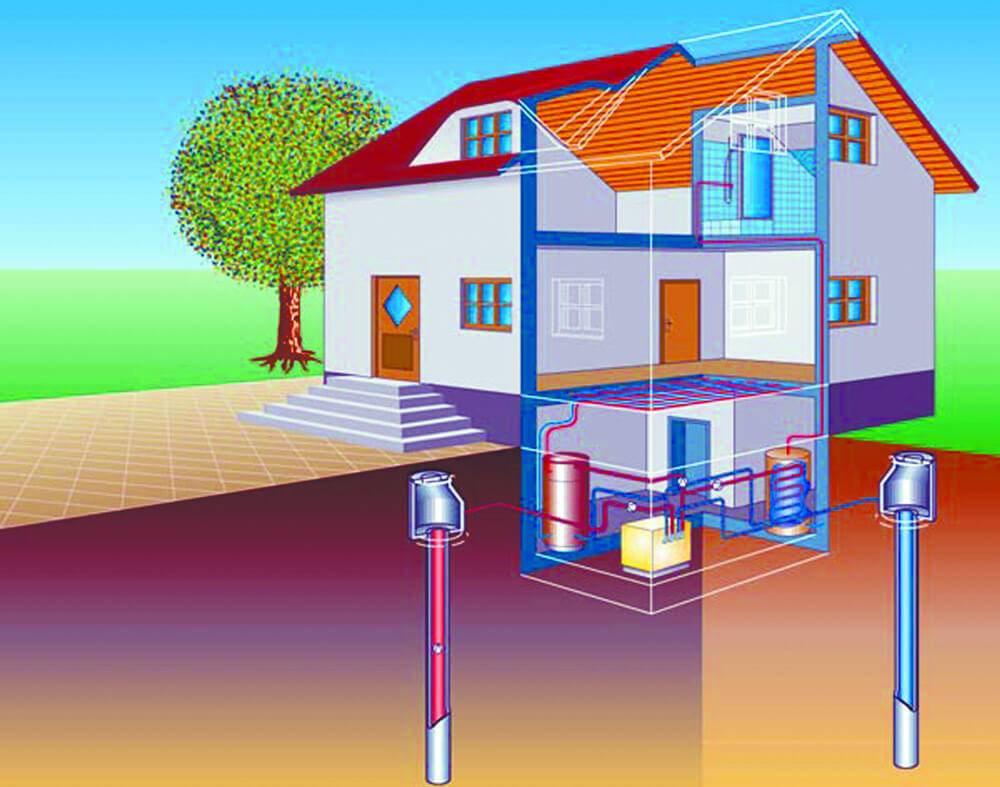
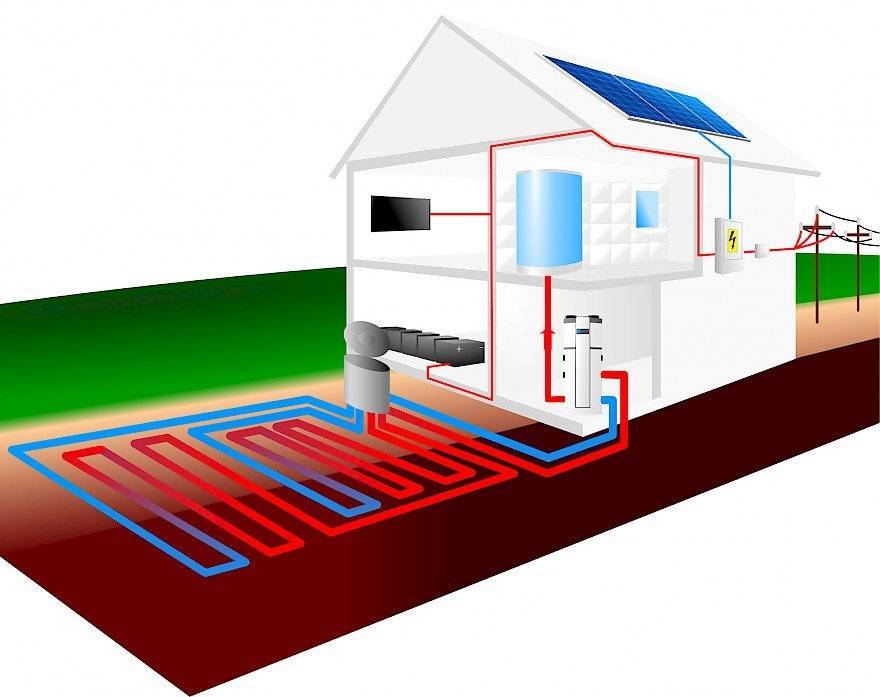
The internal circuit is a traditional heating system, consisting of pipes and radiators. External - an impressive size heat exchanger located underground or in the water column. Inside it, both a special liquid with antifreeze and ordinary water can circulate. The heat carrier assumes the temperature of the medium and “warmed up” enters the heat pump, the accumulated heat is transferred to the internal circuit. Thus, water is heated in pipes and radiators.
Geothermal (heat) pump is a key element of the system. This is a compact unit, it takes up no more space than a washing machine familiar to our eyes. If we talk about performance, then for every 1 kW of electricity consumed, the pump "gives out" up to 4-5 kW of thermal energy. While a conventional air conditioner, which has a similar principle of operation, for 1 kW of electricity consumed, 1 kW of heat will “respond”.
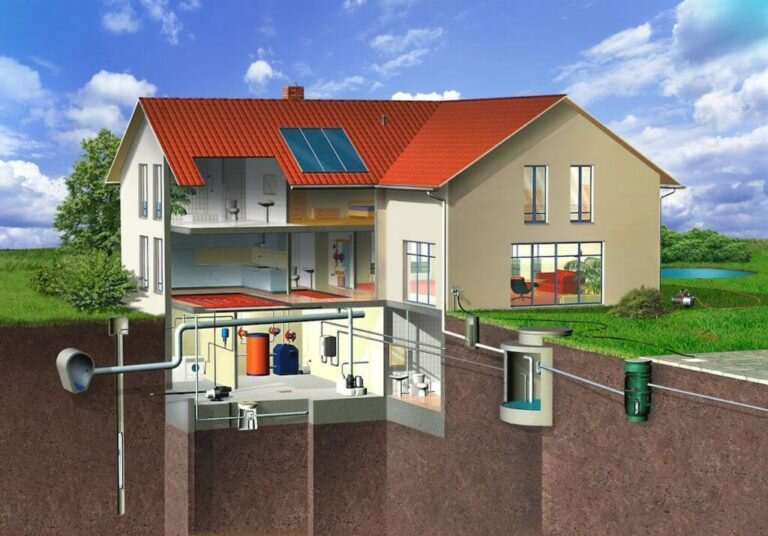
Scheme of a geothermal heating device in a private house
It must be admitted that the device of this type of heating is the most expensive and time-consuming today. The lion's share of its cost is the purchase of equipment and, of course, earthworks. Naturally, a thrifty owner thinks, is it possible to save money, for example, on installation and make geothermal heating with your own hands? In order to answer this question, it is necessary to understand which systems are used most often and to understand the features of their device.
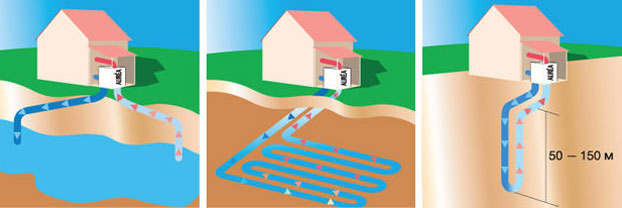
Horizontal heat exchanger
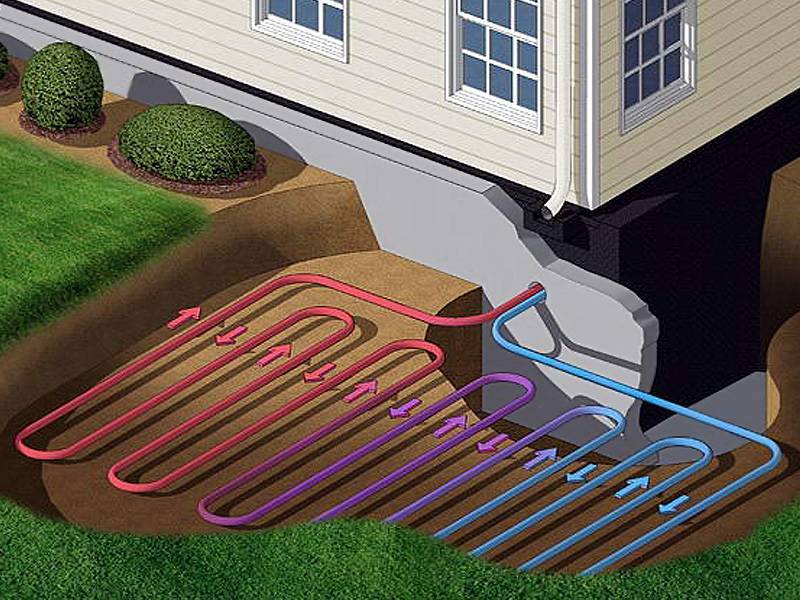
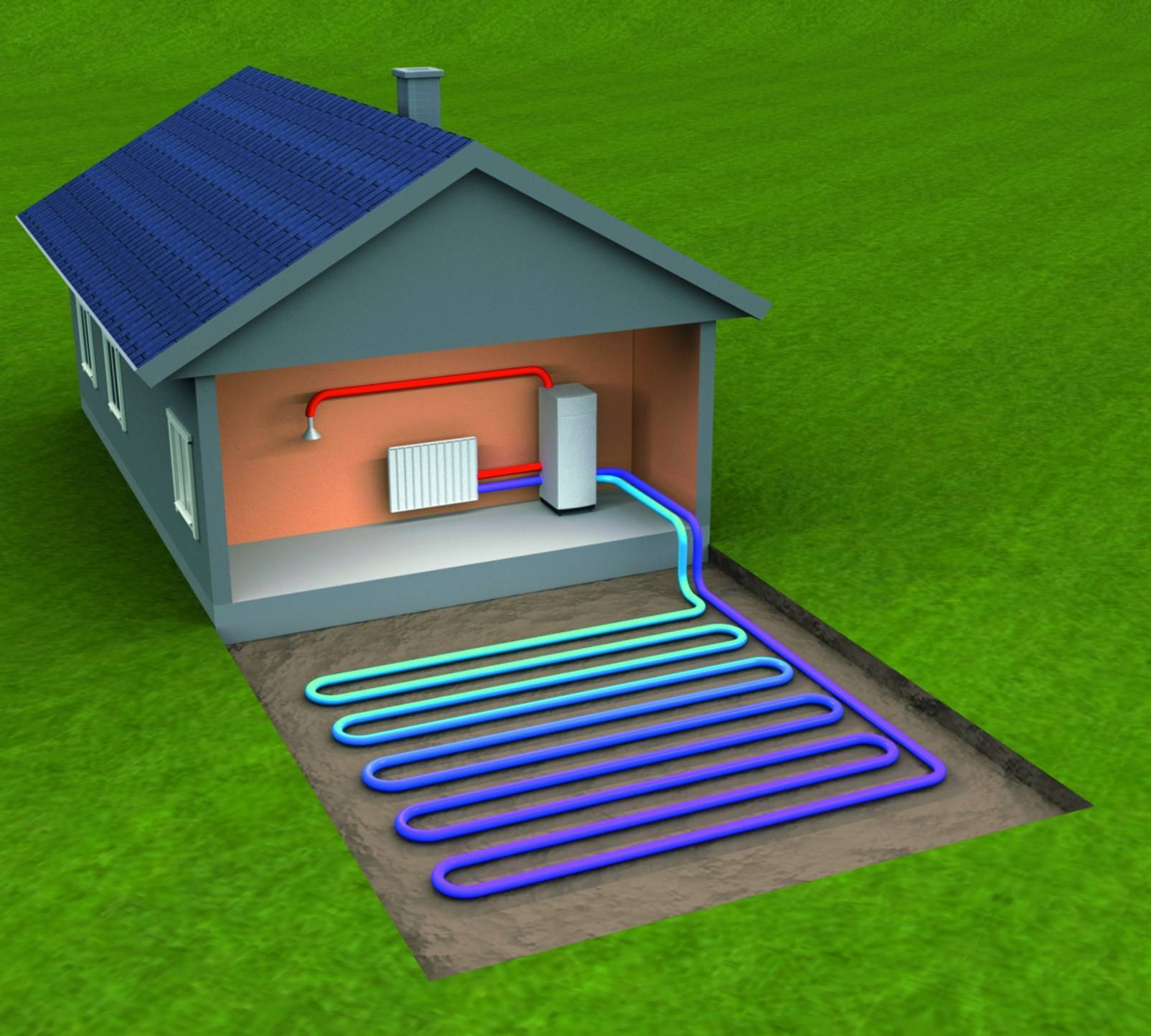
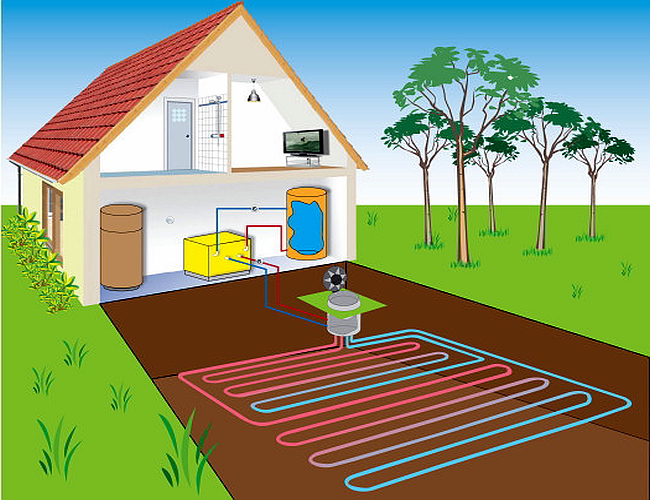
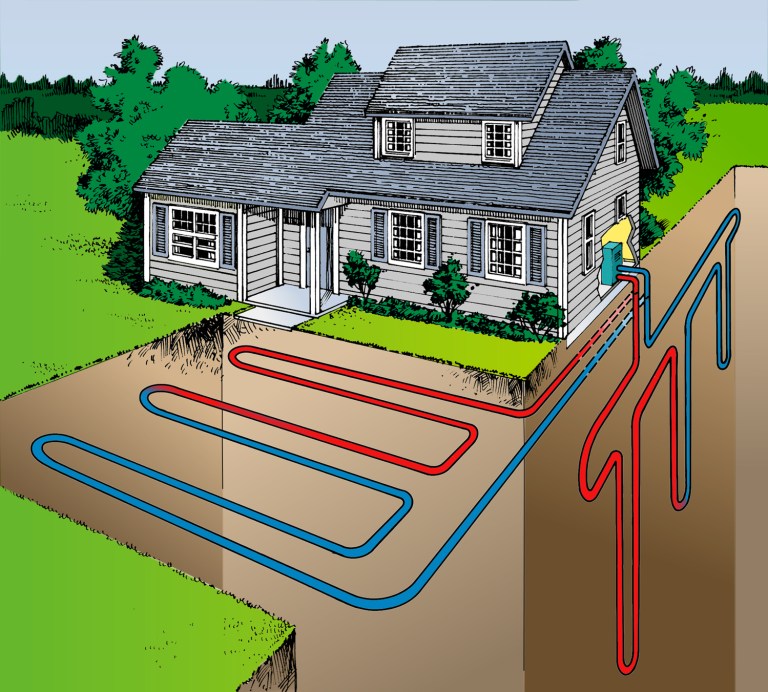
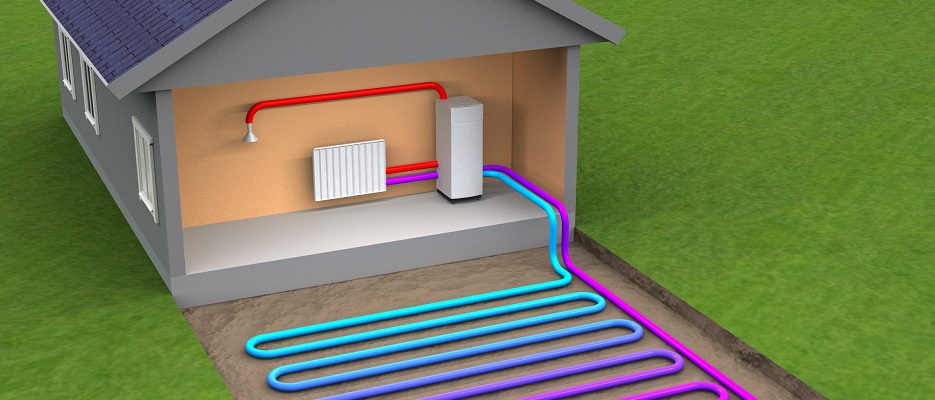
Quite often, a horizontal contour is used, during which pipes are laid in trenches to a depth greater than the level of soil freezing in a given area.
Flaw geothermal heating systems with horizontal contour - a large area occupied by the collector
The disadvantage is that the area occupied by the circuit should be much larger than the house itself, so, for heating a building with an area of 250 m², about 600 m² will “leave” under the pipes. Not every developer can afford such a luxury.


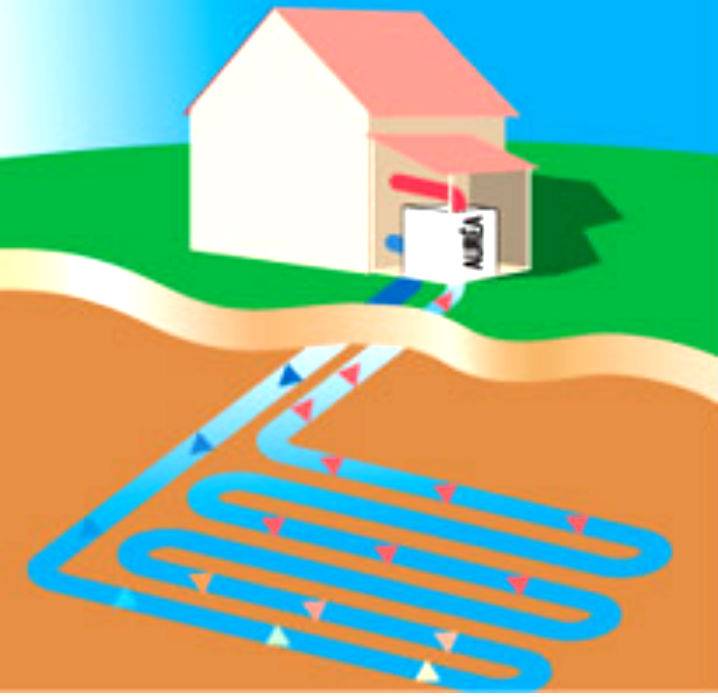
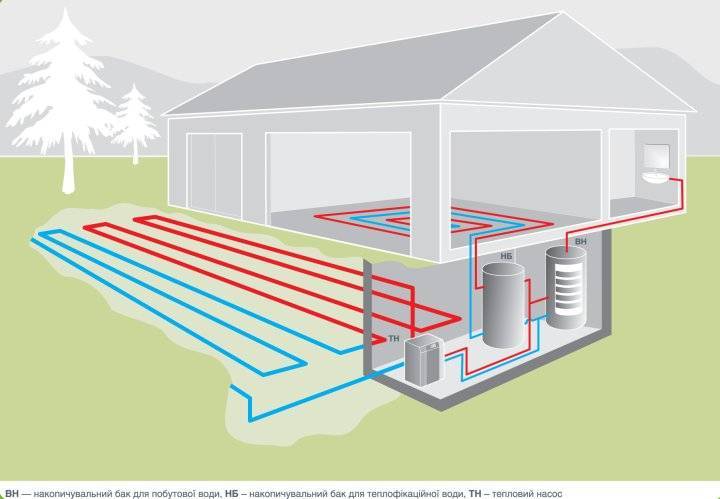


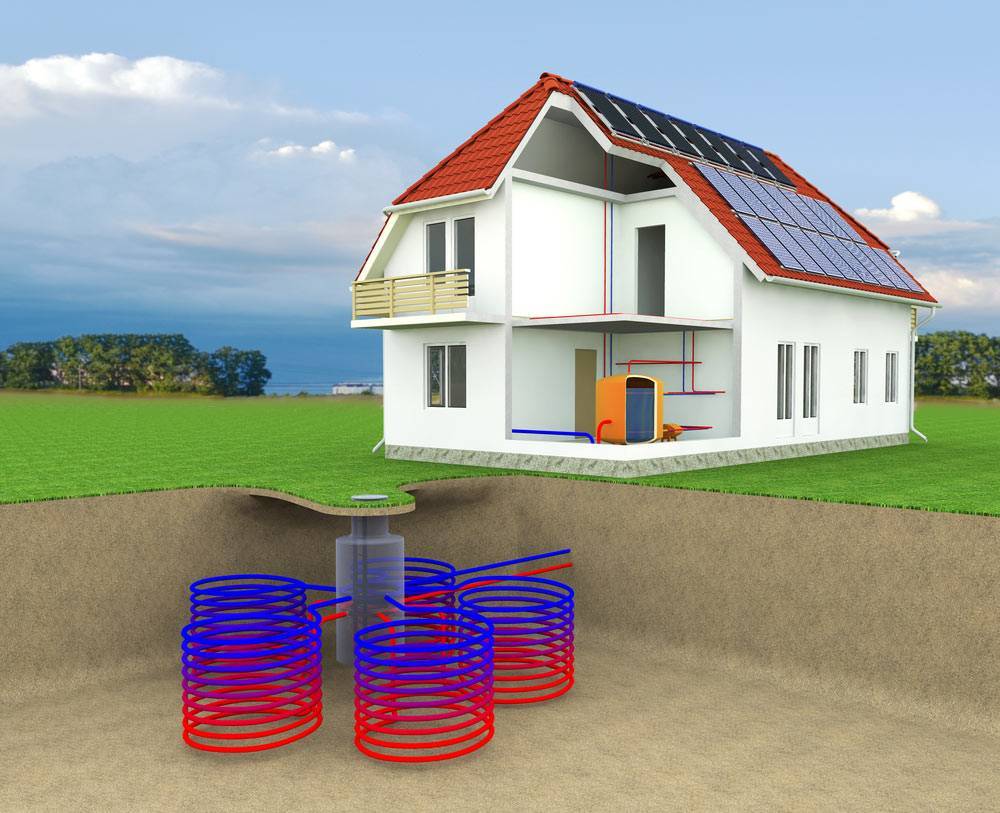
In addition, there are inconveniences if the site is already ennobled, you have to observe, for example, the distance from the trees (1.5 m) and many other nuances.
Vertical heat exchanger
A more compact, but also more expensive option is a vertical heat exchanger. Its installation does not require a large area, but it will require special drilling equipment.
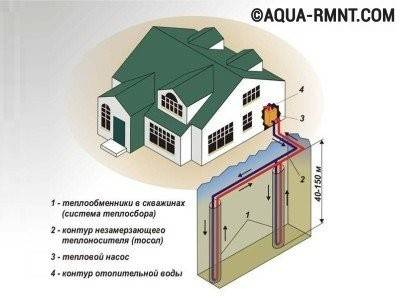
Installation of a vertical heat exchanger requires the use of special drilling equipment
The depth of the well, depending on the technology, can reach 50-200 m, but its service life is up to 100 years. This method is especially relevant when planning a geothermal country house heating with an equipped adjacent territory, it allows you to save the landscape almost in its original form.
Water placed heat exchanger
The most economical geothermal installation uses the thermal energy of water. It is recommended if the distance to the nearest body of water does not exceed 100 m.
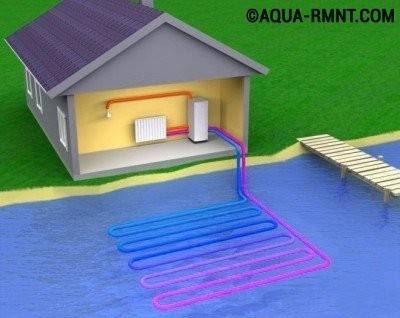
The water-placed heat exchanger is the most advantageous and therefore more appropriate for the device.
A contour of pipes in the form of a spiral is laid on the bottom, the depth of occurrence should be less than 2.5-3 m, that is, deeper than the freezing zone. The area of the reservoir is from 200 m². The main plus is that there is no need to carry out laborious earthworks, but it is necessary to obtain permission from special services.Having spent significant funds on expensive equipment, you should not save on high-quality installation. After all, the quality and efficiency of the entire system will depend on it.
As you can see, installing geothermal heating at home with your own hands is not so simple. Of all the listed types, perhaps only the last option will be quite easy to implement on your own. But even in this case, it is worth weighing all the pros and cons.
Approximate costs and payback of the system
When choosing thermal heating, the principle of which is already known, the owners should be aware that certain investments will be required. The brand of equipment is selected according to the requirements of the user, the price of the units depends on many factors, for example, power.
Devices for 4-5 kW are estimated at $3000-7000, for 5-10 kW they cost $4000-8000, for 10-15 kW already $5000-10000. Plus, 40-50% of the amount will be the cost of installation work and the launch of the system. The result is a very impressive amount of costs. But all of them will pay off in about 3-5 years, and then only the electricity bills that the heat pump will consume remain.
What is geothermal heating?

It is heat extracted from the earth or water. At certain depths of the soil, a positive constant temperature is maintained, and there are no drops even in severe frosts, the same with water. The task of a person is to take heat from the earth or water, sending it to ensure comfort in living rooms.
Geothermal heating is a conventional refrigerator, but vice versa - the system does not produce cold, but heat.The pump algorithm is based on the transfer of heat from a source with a low thermal energy potential to a heat carrier, and soil or water act as active heat sources.




Advantages and disadvantages of the system
Geothermal heating has several advantages:
- The release of thermal energy is many times higher than the cost of electricity consumed by the pump.
- Ecological cleanliness and safety. The system does not emit harmful substances, there are no emissions, slag after fuel combustion.
- There is no need to purchase fuel, gas, all the work of the structure is built without the use of chemicals and other substances, so heating with the heat of the earth or water is considered the safest.
- Subject to the installation and operation technology, the equipment and the entire heating system will last at least 50 years without technical support.
- The heat pump works silently, there are no acoustic effects.
The maximum economic benefit is achieved by the absence of additional investments. The user needs to purchase all the equipment once, set up the design and no longer have to interfere with the operation of the system. An additional advantage is the location of all elements outside the building - heating from the ground or water does not require the placement of overall installations in the house, so the method of extracting and supplying heat is suitable for houses of any size.
The disadvantage is a large amount of one-time costs for the purchase of equipment, installation and commissioning of the system. To form the structure, a pump, a certain amount of materials, installation of an external manifold and an internal circuit are required.
Options for arranging geothermal heating
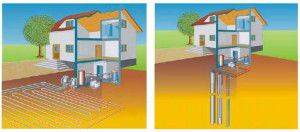 Methods for arranging the external contour
In order for the energy of the earth to heat the house was used to the maximum - you need to choose the right external circuit diagram. In fact, any medium can be a source of thermal energy - underground, water or air.
But it is important to take into account seasonal changes in weather conditions, as discussed above.
Currently, two types of systems are common that are effectively used to heat a house due to the heat of the earth - horizontal and vertical. The key selection factor is the area of the land. The layout of the pipes for heating the house with the energy of the earth depends on this.
In addition to it, the following factors are taken into account:
- Soil composition. In rocky and loamy areas, it is difficult to make vertical shafts for laying highways;
- soil freezing level. He will determine the optimal depth of the pipes;
- Location of groundwater. The higher they are, the better for geothermal heating. In this case, the temperature will increase with depth, which is the optimal condition for heating from the energy of the earth.
You also need to know about the possibility of reverse energy transfer in the summer. Then the heating of a private house from the ground will not function, and the excess heat will pass from the house into the soil. All refrigeration systems work on the same principle. But for this you need to install additional equipment.
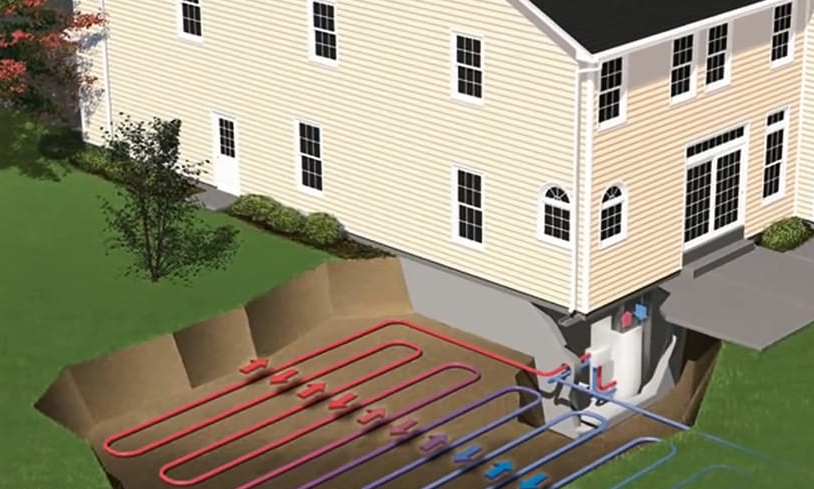
Horizontal geothermal heating scheme
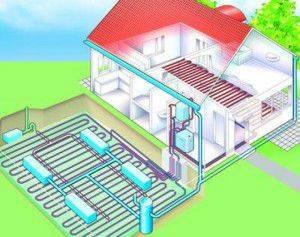 Horizontal arrangement of outer pipes
The most common way to install outdoor highways. It is convenient for ease of installation and the ability to relatively quickly replace faulty sections of the pipeline.
For installation according to this scheme, a collector system is used.For this, several contours are made, located at a minimum distance of 0.3 m from each other. They are connected using a collector, which supplies the coolant further to the heat pump. This will ensure the maximum supply of energy for heating from the heat of the earth.
However, there are some important things to keep in mind:
- Large yard area. For a house of about 150 m², it must be at least 300 m²;
- Pipes must be fixed to a depth below the freezing level of the soil;
- With the possible movement of the soil during spring floods, the likelihood of displacement of highways increases.
The defining advantage of heating from the heat of the earth of a horizontal type is the possibility of self-arrangement. In most cases, this will not require the involvement of special equipment.





Vertical diagram of geothermal heating
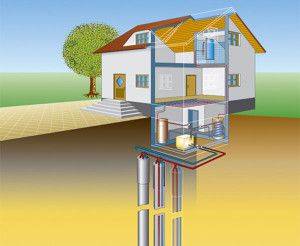 Vertical geothermal system
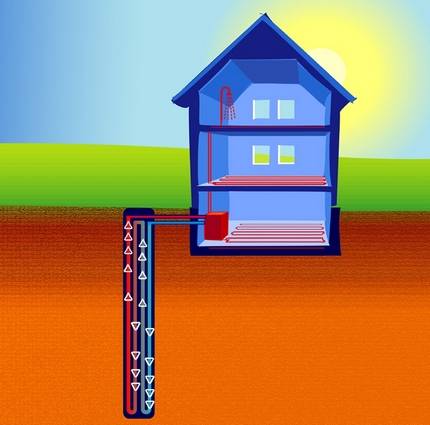
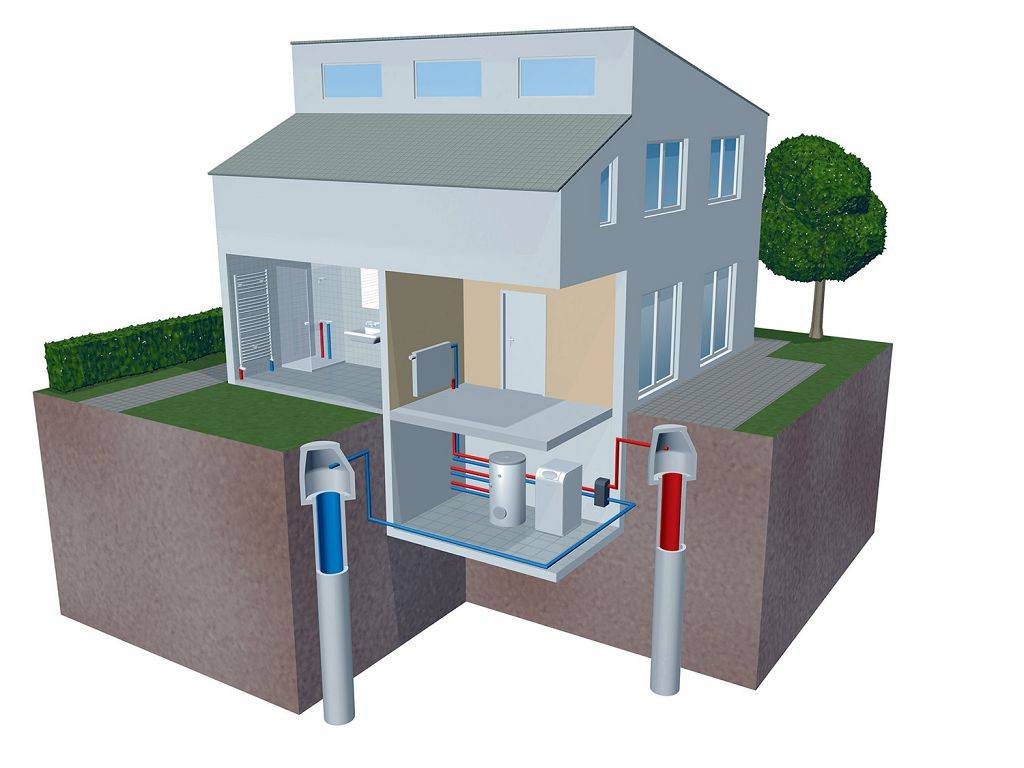
This is a more time-consuming way of organizing heating of a private house from the ground. Pipelines are located vertically, in special wells
It is important to know that such a scheme is much more efficient than a vertical one.
Its main advantage is to increase the degree of water heating in the external circuit. Those. the deeper the pipes are located, the more the amount of earth's heat for heating the house will enter the system. Another factor is the small area of land. In some cases, the arrangement of the external geothermal heating circuit is carried out even before the construction of the house in the immediate vicinity of the foundation.
What difficulties can be encountered in obtaining earth energy for heating a house according to this scheme?
- Quantitative to quality. For a vertical arrangement, the length of the highways is much higher. It is compensated by higher soil temperature. To do this, you need to make wells up to 50 m deep, which is laborious work;
- Soil composition. For rocky soil, it is necessary to use special drilling machines. In loam, to prevent shedding of the well, a protective shell made of reinforced concrete or thick-walled plastic is mounted;
- In the event of malfunctions or loss of tightness, the repair process becomes more complicated. In this case, long-term failures in the operation of heating the house for the thermal energy of the earth are possible.
But despite the high initial costs and the complexity of installation, the vertical arrangement of the highways is optimal. Experts advise using just such an installation scheme.
Features of the heating system
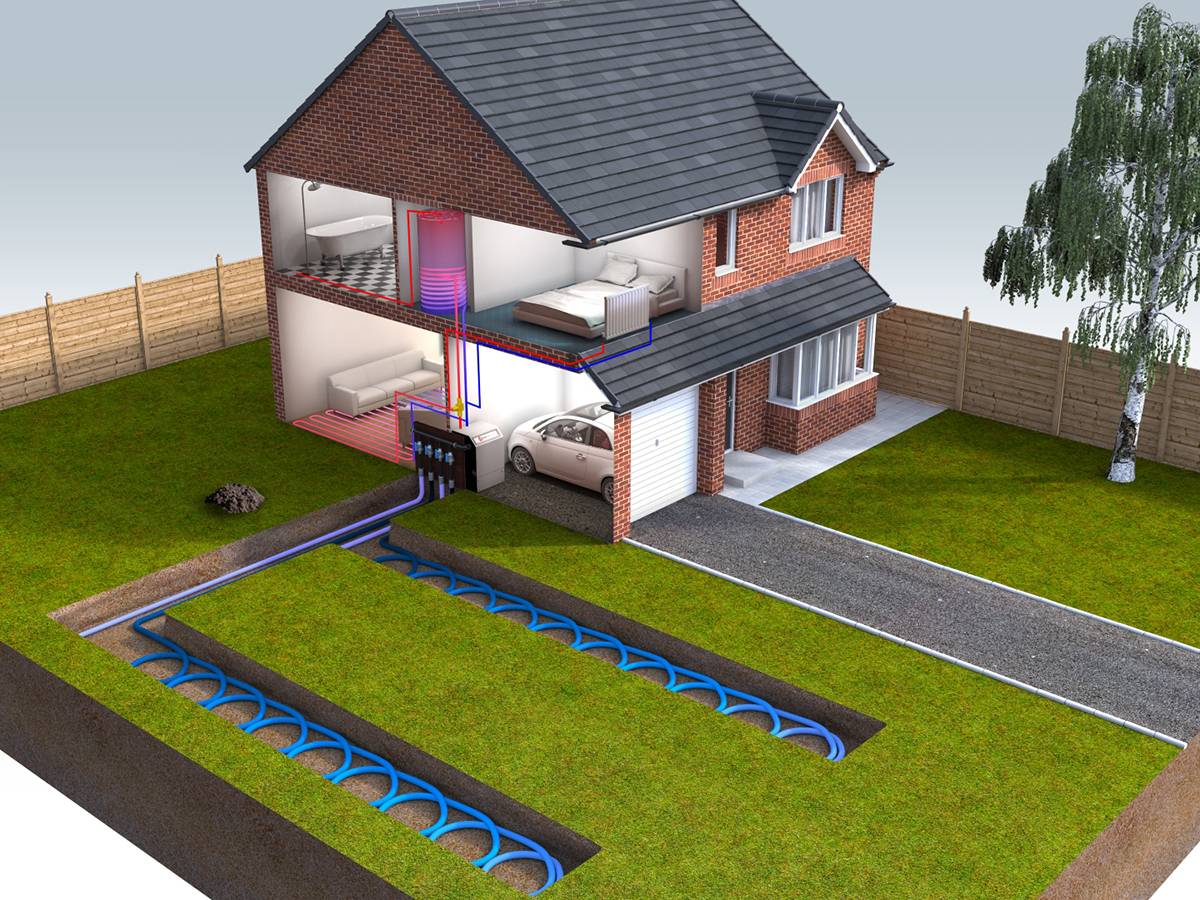
Unlike a gas boiler, a heat pump does not need to heat the heat carrier of the heating system to a high temperature, since the formation of condensate during a cold “return” does not threaten it. In addition, low-temperature operation will require less energy consumption.
To compensate for the low temperature of the coolant, the surface of the radiators would have to be greatly increased, so instead of them it is better to use the "warm floor" system. This type of heating is also the most rational, since the heated air first of all enters, so to speak, into the living area, and not under the ceiling.
Heat from the ground
Another argument in favor of the “warm floor” is the minimum heat loss.After all, their value depends, first of all, on the temperature difference, and it is the smallest in low-temperature conditions. The second factor is the area of contact of heated air with the outer walls. The air rising from the "warm floor" does not touch the outer walls (when using conventional radiators, it literally washes the window glazing and adjacent sections of the outer wall).
The main disadvantage of the "warm floor" - energy dependence - is irrelevant in this case, since the heat pump will also not be able to work without electricity.
The danger of latent leakage can also be ignored if the circuit is made integral of flexible polymer pipes.


Real advantages and disadvantages
If in Russia geothermal heating of the private sector has received a relatively small distribution, does this mean that the idea is not worth the cost of its implementation? Maybe it's not worth it to deal with this issue? It turned out that this was not the case.
Using a geothermal home heating system is a profitable solution. And there are several reasons for this. Among them, the quick installation of equipment, which can work for a long time without any interruption.
If you use not water in the heating system, but high-quality antifreeze, it will not freeze through and its wear will be minimal.
We list other advantages of this type of heating.
- The procedure for burning fuel is excluded. We create an absolutely fireproof system, which, during its operation, will not be able to cause any damage to housing. In addition, a number of other issues related to the presence of fuel are excluded: now there is no need to look for a place to store it, to procure it or deliver it.
- Substantial economic benefit.During the operation of the system, no additional investments are required. The annual heating is provided by the forces of nature, which we do not buy. Of course, during the operation of a heat pump, electrical energy is consumed, but at the same time, the amount of energy produced significantly exceeds the consumption.
- environmental factor. Geothermal heating of a private country house is an environmentally friendly solution. The absence of the combustion process excludes the entry of combustion products into the atmosphere. If this is realized by many, and such a heat supply system will be properly widespread, the negative impact of people on nature will decrease many times over.
- The compactness of the system. You do not have to organize a separate boiler room in your house. All that will be needed is a heat pump, which can be placed, for example, in the basement. The most voluminous contour of the system will be located underground or under water; you will not see it on the surface of your site.
- Multifunctionality. The system can work both for heating in the cold season, and for cooling during the summer heat. That is, in fact, it will replace you not only with a heater, but also with an air conditioner.
- acoustic comfort. The heat pump runs almost silently.
Choosing a geothermal heating system is cost-effective, despite the fact that you have to spend money on the purchase and installation of equipment.
By the way, as a drawback of the system, it is precisely the costs that you have to go to install the system and prepare it for work.It will be necessary to buy the pump itself and some materials, to carry out the installation of the external manifold and the internal circuit.
It is no secret that resources are becoming more expensive year by year, so an autonomous heating system that can pay off within a few years will always be economically beneficial for its owner.
However, these costs pay off in just the first few years of operation. The subsequent use of a collector laid in the ground or submerged in water saves a lot of money.
In addition, the installation process itself is not so complicated as to invite third-party specialists to perform it. If you do not engage in drilling, then everything else can be done independently.
It should be noted that some craftsmen, in an effort to save money, learned to collect geothermal heat pump personally.
Air collectors
Underground heating of a private house can also be carried out with the help of air collectors. This is a very simple way of air-type heating in a private house in comparison with the previous 2.
To warm the air in the room to the optimum temperature, a certain amount of heat is required. The lower the initial temperature, the higher the costs. With help ventilation and heating systemsobtained from the soil, you can increase the air temperature in the house for free. Heating with the heat of the earth in this case is very simple.
For the organization of heating systems it is necessary:
- remove the ventilation air intake below the ground freezing level;
- to carry out a curved, straight or multi-pipe collector using ordinary sewer pipes (the shape is selected depending on the site, for every square meter of the house area there should be 1.5 meters of the collector);
- perform an air vent at the farthest end of the collector from the house, bringing the pipe to a height of at least 1.5 meters from the ground and equipping it with an umbrella-deflector (of course, the air flow into the house will be forced.
In this case, ground heating will not be able to fully provide the house with heat.
All the same, it allows you to implement two ideas:
- The air entering through the ventilation can be heated by any heating device (gas, solar, electric, etc.) and then diluted through the rooms using ventilation ducts. Such heating from the ground will not be completely free, but all the same, the costs will decrease: it will not be cold air from the street that will warm up, but the one that has already warmed up to about +10 degrees. You can save quite well if the winters in the region are cold.
- The air heated by the heat of the earth can be used to blow the external unit of a conventional air conditioner or an air-to-air heat pump. Any device of this class will be able to work well at a temperature of about +10 degrees. The complexity of implementation lies only in providing the necessary air flow. As a result, the air is heated by the heat of the ground, enters the heat pump and is discharged outside the house.
Ground heating is a good substitute for conventional heating methods, but it is not currently considered widely popular (see also: "Alternative heating for a private house - the choice is very large").This is due, as a rule, to the complexity of the installation process and high initial costs. Drilling wells and placing pipes in them is considered an excellent option, but this type of heating system is very expensive. On the other hand, this makes it possible to heat the house using a free heat source.





You should also always remember that such a heat supply option is environmentally friendly and very efficient, because the soil temperature at a depth of more than ten meters remains constant. Video about how to use the heat of the earth to heat the house:
Features of geothermal heating system
Geothermal heating of a country house refers to an alternative, almost ideal way of supplying heat to a residential building. For the functioning of the system, geothermal energy is used, which can be extracted from various natural sources.
The principle of operation of geothermal heating has much in common with the operation of refrigeration systems. At the same time, the main difference is that in the refrigerator the refrigerator produces chilled air, and geothermal installations generate thermal energy.
With thermal heating, the air is cooled in the heat of summer, and heated in frosty winter. At the same time, the financial costs of arranging such a heat supply option are much lower when compared with the costs of other thermal systems. Geothermal heating of the house contributes to the creation of comfortable living conditions in it.