
- Well in basement
- Methods for locating a well on a site
- Where it is impossible to make a well, when is it most expedient to start drilling a well?
- The depth of the well for water: what depends on
- Drilling depth: how to determine
- Drilling in winter conditions
- When is the best time of year to start drilling?
- Requirements for the location of the well
- Process Features
- Where is the best place to build a well?
- A source outside the perimeter or a well in the house?
- About method
- Choosing a place for drilling a water source
- Where is the best place to build a well?
- Conclusions and useful video on the topic
Well in basement
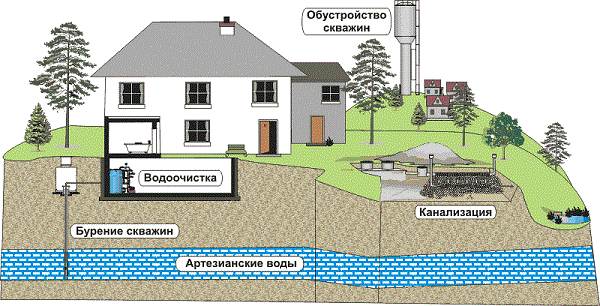
Many homeowners consider placing a well in the basement of their home an ideal option.
Image gallery
Photo from
If a water intake device is planned inside a private house, then it is better to drill a well after the foundation has been erected
Despite the fact that the depth of the well eliminates the possibility of undermining the foundation, the development should not be located near it. It is necessary to anticipate the possibility of accidents
It is reasonable to combine the device of a bored pile foundation with the organization of a water supply source
Needle well drilling can be carried out at any time in an already equipped room. This technology does not require extensive free space
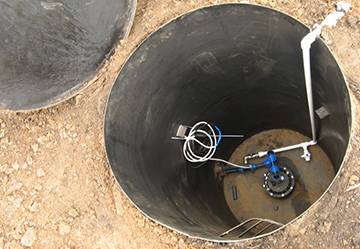
Borehole inside the foundation of the house
Choosing a place inside the house
Drilling a well and installing piles
The process of drilling a well-needle
Indeed, if the aquifer passes just in the area where the house is located or will be built, then this option will have many advantages:
- significant simplification and reduction in the cost of the process of arranging a water supply system from a well;
- the shortest route of the water supply;
- no need for insulation and construction of a caisson.
If you want to arrange a water intake within the house, it is necessary to drill a well at the construction site even before the foundation is erected. It is optimal to reflect in the project of the house the presence of an aquifer in the basement.
The well cannot be located under the living rooms, kitchen and bathrooms, the best place would be a basement under a closed veranda, pantry, boiler room
Disadvantages of locating an aquifer in the basement:
- sufficient space is required;
- difficulties with the installation of pumping equipment due to the inaccessibility of the well;
- problems in the process of washing with sewage removal;
- the possibility of soil erosion around the water source and the threat of subsidence of the foundation of the house.
Between the end of drilling and the beginning of the construction of the foundation, at least 1 month must pass. This period is necessary to identify and eliminate all problems associated with the operation of the well.
Keep in mind that there should be enough space around the well for its maintenance or repair. The minimum size of the maintenance platform is 3x4 meters.
Methods for locating a well on a site
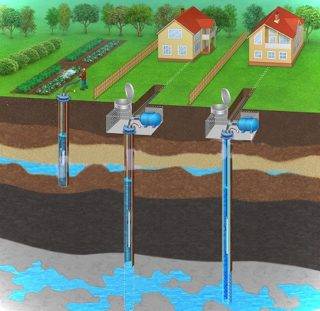
In total, there are two types of source location on the site - in the basement of the house and outside the building.
The first option is carried out even before the construction of the cottage. Here they act more on the principle of "where I found, I drilled there."Then they start planning the building, already based on what they have. The advantages of such drilling are as follows:
- the presence of a well in an almost heated basement, which means that the system does not freeze in winter;
- minimum distances for transporting water, which requires less powerful pumping equipment.
There are more cons here:
- constant moisture in the basement;
- noise of operating pumping equipment;
- difficulties with summing up special equipment if it is necessary to carry out repairs, flushing the source.
Thus, "internal" drilling of a well is not the best option. In addition, it strongly disagrees with sanitary requirements.
As for the location of the hydraulic structure outside the building, there are more advantages:
- ease of access for special equipment if maintenance is required;
- less noise from a running pump;
- the possibility of free watering the garden, vegetable garden without the need to pull a long hose from the basement;
- arrangement of a caisson or head in interesting landscape design options.
Of the minuses is the need to install a protective platform and insulate the upper part of the casing string in order to avoid freezing of the system in winter.
To choose a good place for drilling, it is important to consider the following parameters:
Depth of the aquifer
Moreover, if several neighboring structures have already been built on it, it is important to remove the new one as much as possible so that they are not all fed from one section of the horizon. Otherwise, the productivity of all wells will fall.
The presence of plantings in the proposed location of the source device. Here it is better to choose less landscaped (cultivated) areas.
Site relief
The well is not made in its lower part on the slopes, since during the rainy season a large amount of precipitation will flow here, and the caisson will be flooded.
Here it is better to choose less landscaped (cultivated) areas.
Site relief. The well is not made in its lower part on the slopes, since during the rainy season a large amount of precipitation will flow here, and the caisson will be flooded.


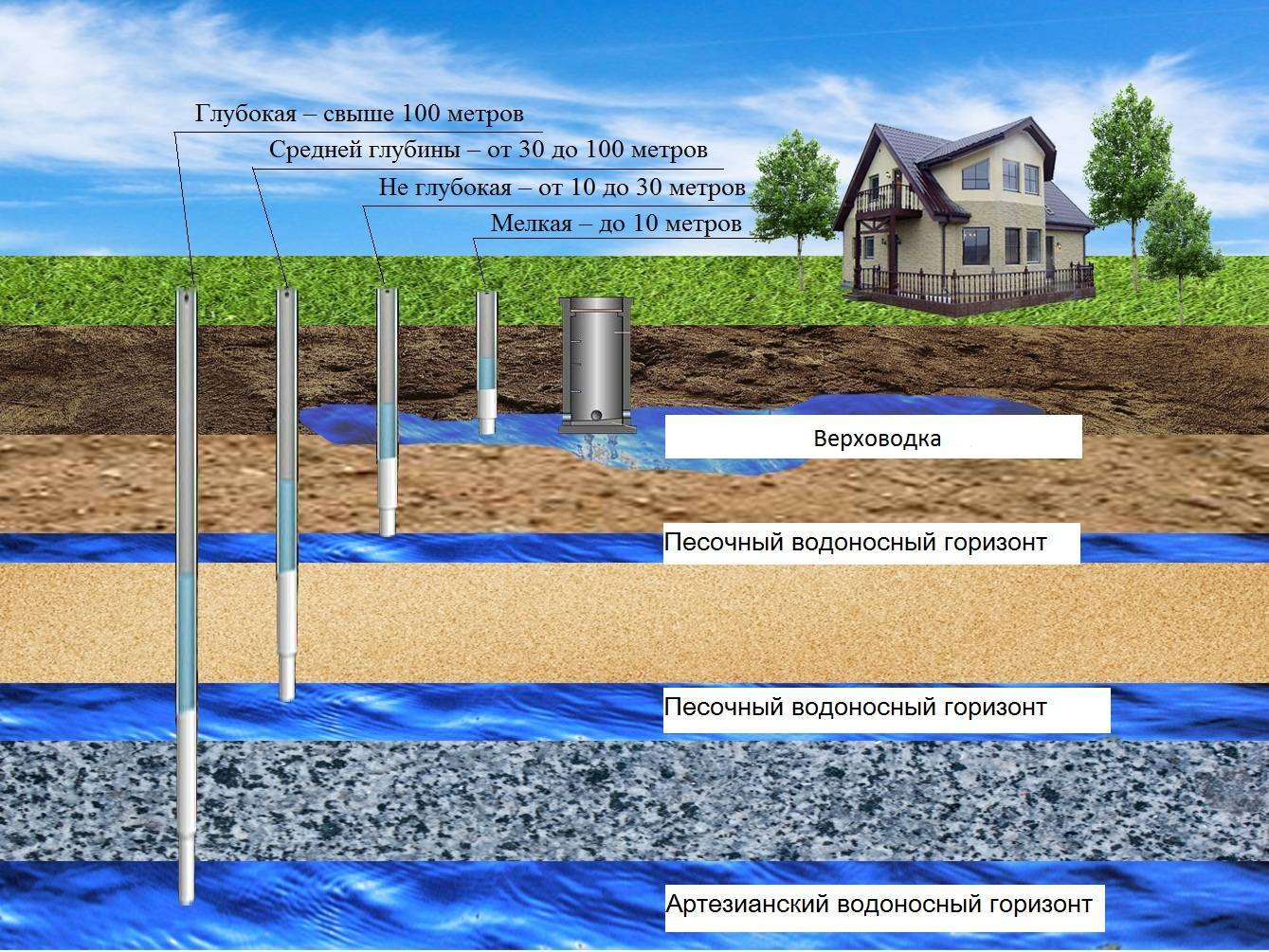

Where it is impossible to make a well, when is it most expedient to start drilling a well?
Despite the fact that the main condition for future drilling is the presence of an aquifer, there are a number of factors that should be considered. For example, when looking for a place, we must not forget that the future well must be reliably protected from all sorts of third-party pollution. Based on this, it is recommended to choose a place that is environmentally friendly. The well cannot be located near a sewage pit, sump, septic tank, sewage well. The well cannot also be located close to garbage heaps, landfills, warehouses, industrial enterprises. The well should be located no closer than 100 m to such places. No less important is the fact that the well should be close to the living quarters, summer cottages.
It is strictly forbidden to drill near power plants and near trees that have a large root system.
As soon as the place of future drilling is chosen, it is necessary to determine the time when it will be carried out. Drilling is best in the summer or early autumn. However, modern drilling machines can also drill in winter. In addition, it will be more economical to drill in the winter. Naturally, we cannot talk about drilling in severe frosts.The temperature should be at least -20 ° C. Drilling in winter is easier, because groundwater is at a minimum level. This facilitates the task of getting into the aquifer, the accuracy increases several times. And the condition of the soil will be less damaged. The drilling machine in the winter can reach the most inaccessible places.
Another advantage of drilling in winter is that there is no melt and rain water. In addition, when drilling in winter, by spring it will be possible to use your own spring water. Based on the foregoing, we can also talk about when drilling does not make sense. You can drill at any time of the year. If it is required to drill a well to a depth of no more than 30 m or a drilling machine with large dimensions cannot enter the territory of the site, then it is more profitable to drill from the beginning of April to November.
For such drilling, workers at the MGBU should be involved. In the event that it is possible for a drilling machine to drive to the site, then it is better to drill in the winter, this is the most profitable and rational.
The depth of the well for water: what depends on
Before proceeding with the development of a water supply system project, it is necessary to know what criteria affect the drilling of a well and what should be its optimal depth.
For this you need to consider:
- The depth of the aquifer. This value can be determined by test drilling or after geodetic work on the analysis of the area.
- Appointment.For simple irrigation, it is not necessary to reach the lower aquifers, arranging an Abyssinian well, and for drinking water, you will have to look for such water, the quality of which will meet regulatory requirements.
- Terrain relief. The earth profile also belongs to the features: in flat areas, water can be found not so deep, while hilly terrain will require drilling at the lowest point - a depression.
- The required volume of water, or debit. This is the amount of water pumped per unit of time, called the productivity of the well. For example, for irrigation, it is enough to take into account the water flow rate of 0.5 m³/h, and for sandy layers, the flow rate increases to 1.5 m³/h.
For artesian wells, the volume can reach 4 m³ / h.
Drilling depth: how to determine
This value is determined after clarifying the structure of the aquifer. Since groundwater depth characteristics may vary in the same area, several test drillings are necessary.
Another option for determining the depth of the aquifer is the analysis of vegetation - the roots of plants allow us to judge the layout of the soil layers.
In order to start drilling, you need to know the structure of the water layer.
Trial work can be core and one of the proven methods in determining the depth of the liquid. In this case, when a moistened sandy layer appears, the process can be stopped: the channel is filled with water, then it is pumped out and thus the flow rate of the future well is determined.
If the obtained indicators meet the requirements of the owner of the site, then drilling stops and a well is arranged.Otherwise, the well is developed further - until the next aquifer is reached. When water is received, it must be collected for analysis to determine if the source is potable.
Drilling in winter conditions
Drilling wells in the cold season has many advantages and is always positively evaluated by professionals.
A significant level of soil freezing during severe cold weather makes work difficult. But if it’s not worth the bitter cold, you can choose this option.
- It is easier to transport equipment and goods without damaging the surface layer of the soil.
- Due to the cold, the well shaft almost does not crumble, and its column is not clogged with mud, which helps to reduce the cleaning time.
- Errors in the calculation of the water horizon are minimal - a frozen top water does not interfere with determining the level of underground water and the installation point of the casing filter element.
If you decide to break through the water intake in the winter, by the spring you will have a ready-made well, which will significantly reduce the time for plumbing at a summer cottage or personal plot.
When is the best time of year to start drilling?
Having decided on the place, it is necessary to set the time when the well will be drilled on the site. It is traditionally believed that for such work the most optimal time is summer or warm autumn. But thanks to modern technology, you can change your point of view: drilling equipment is able to cope with its task even in winter. Moreover, from an economic point of view, it is more profitable to drill a well in cold weather. Of course, we are not talking about severe frosts: mercury on a thermometer should not fall below 20 degrees.
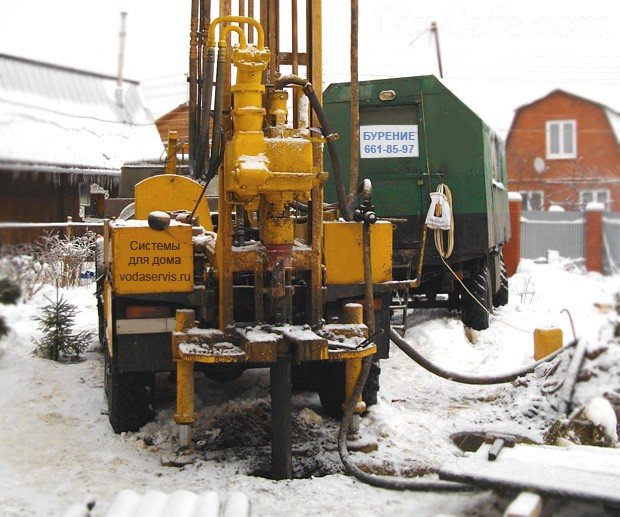
Winter drilling is fully justified - work is much easier to carry out than during spring floods or during rain
In the cold season, drilling is facilitated by the fact that at this time groundwater is at a minimum level. Therefore, it is much easier to hit the aquifer with maximum accuracy. By the way, the ground will not suffer so much from heavy equipment. Any car in winter can easily get to a swampy or most inaccessible area.


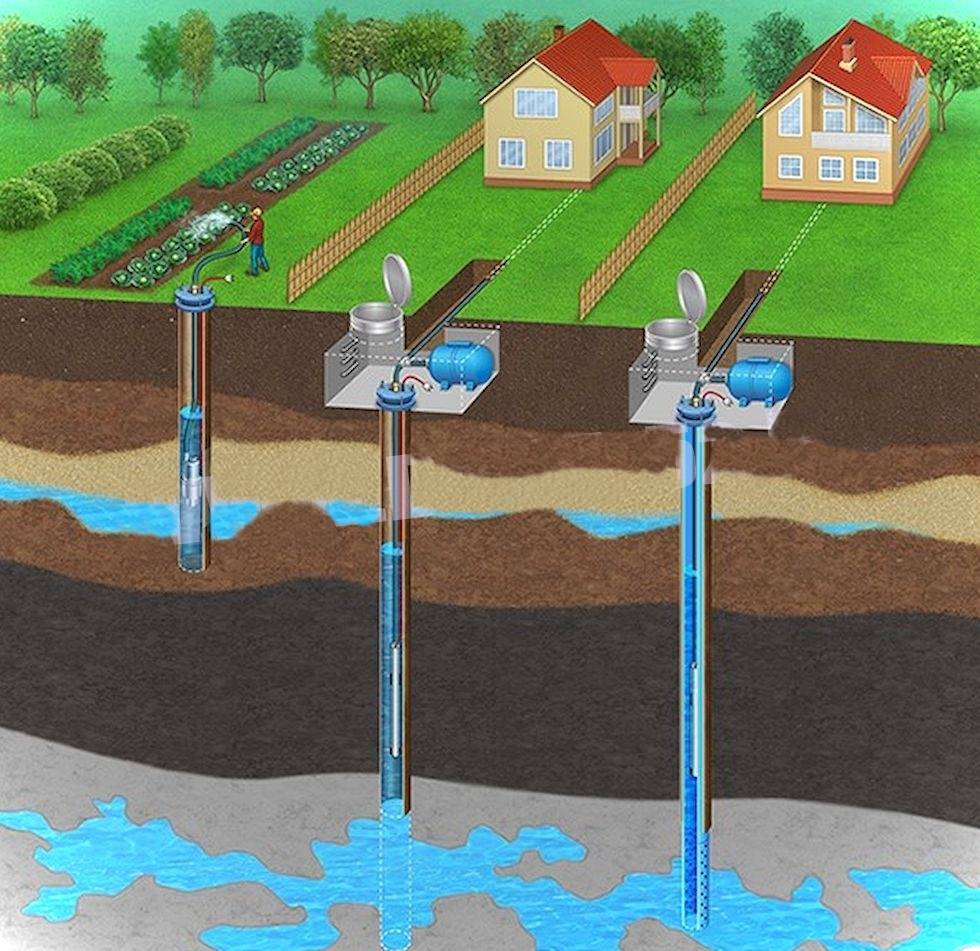

Another plus of drilling in the winter is the absence of rain or melt water, which can significantly complicate the drilling process. Finally, having taken up this useful business in winter, by spring you can provide the site with excellent water. And with it it is much more fun to start a new planting season.
Requirements for the location of the well
When choosing a drilling site, many factors are taken into account: the geological features of the site, its topography, the influence of hydrological factors, and the location of other economic activities.
In addition, the convenience of the location of the future source of water supply is important, which will allow it to be operated without problems in the future. The selected location for the well must meet the following requirements:
The selected location for the well must meet the following requirements:
- the presence of an aquifer;
- convenient location for water intake;
- the possibility of plumbing;
- providing access to the drilling machine and other equipment for servicing the well;
- compliance with sanitary standards;
- lack of power lines, underground utilities.
Also, at the stage of choosing a place for a well, it is worth considering how the pumping equipment will be connected, i.e. take into account the presence of power lines.
If in the future you plan to lay a surface water supply from the well, then it is desirable that the slope of the site does not exceed 35º.
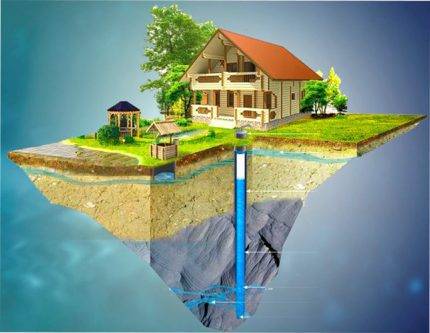
When choosing a location for a well, not only the characteristics of its own site are taken into account, but also the surrounding areas for compliance with the specified requirements
Process Features
Directly from the characteristics of the site on which the work is carried out, you should choose the right method of drilling. The type of work and their quality will determine how good the water will be, the productivity of the well, and its lifespan.
According to the same principle, it enters the ground at a certain angle and, as it were, is screwed into the earthen layer. After passing a small section, the auger is removed from the soil along with the selected soil, cleaned and continues to work. The screw method has rightfully earned the title of the most productive. It is also used for self-drilling.
Particular attention should be paid to the choice of drilling method
To do this, you will need tools such as:
- Shovel;
- Directly auger;
- Winch;
- Pipes;
- Pump.
An important aspect in choosing this drilling method will be the scope of its application. In this way, dry soil is drilled. Not applicable in wet viscous soil and rocky soils. The second drilling method, no less simple and popular, will be shock-rope. The bottom line is that the soil is crushed under the force of impact with a heavy object, which is applied from a great height. This method is more laborious, takes more time, but its scope is wider.Unlike the previous method, this one can be used on almost any soil.
For percussion drilling, you will need the following tools:
- Shovel;
- Derrick;
- Bucket (drilling);
- Winch;
- Pipes;
- Pump.
Both in the first and in the second method, a pit is dug at the location of the well, in other words, a hole with dimensions of at least 1-1.2 m. This will clear the place of excess soil, avoid its further entry into the well, and conveniently position the tool. The depth of the source starts from 8-12 meters and can reach 100 meters. It will take a long time to dig. But if you place it in the country, there will be many pluses.
Where is the best place to build a well?
They try to build a water well in the highest place of the site. If it ends up in a lowland, melt and rainwater can flood the caisson and enter the shaft, which will cause water pollution and infection with pathogens. The slope of the relief may not be visible to the eye, but it can be determined by the places where water accumulates after rain, and even better - order a survey from surveyors.
 Avoid building wells and wells near sources of pollution - cesspools, septic tanks, livestock farms, garages, etc.
According to the norms, the distance between the well and similar objects must be at least 50 m. True, not every site has sufficient conditions to comply with this requirement.
Therefore, in practice, this distance is often reduced to 30 m: as the test showed, the water at such a distance from the source of pollution remains clean.
Do not forget to take into account the presence of potentially dangerous objects on the site of the neighbors. It doesn't hurt to know their plans for the future: perhaps they are going to put up a poultry shed right next to where you plan to build a spring.



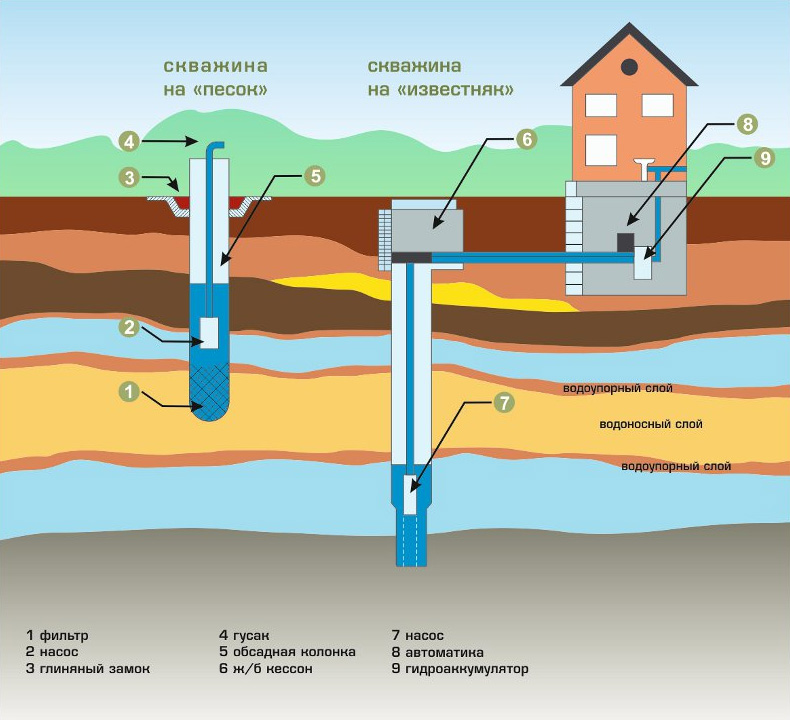
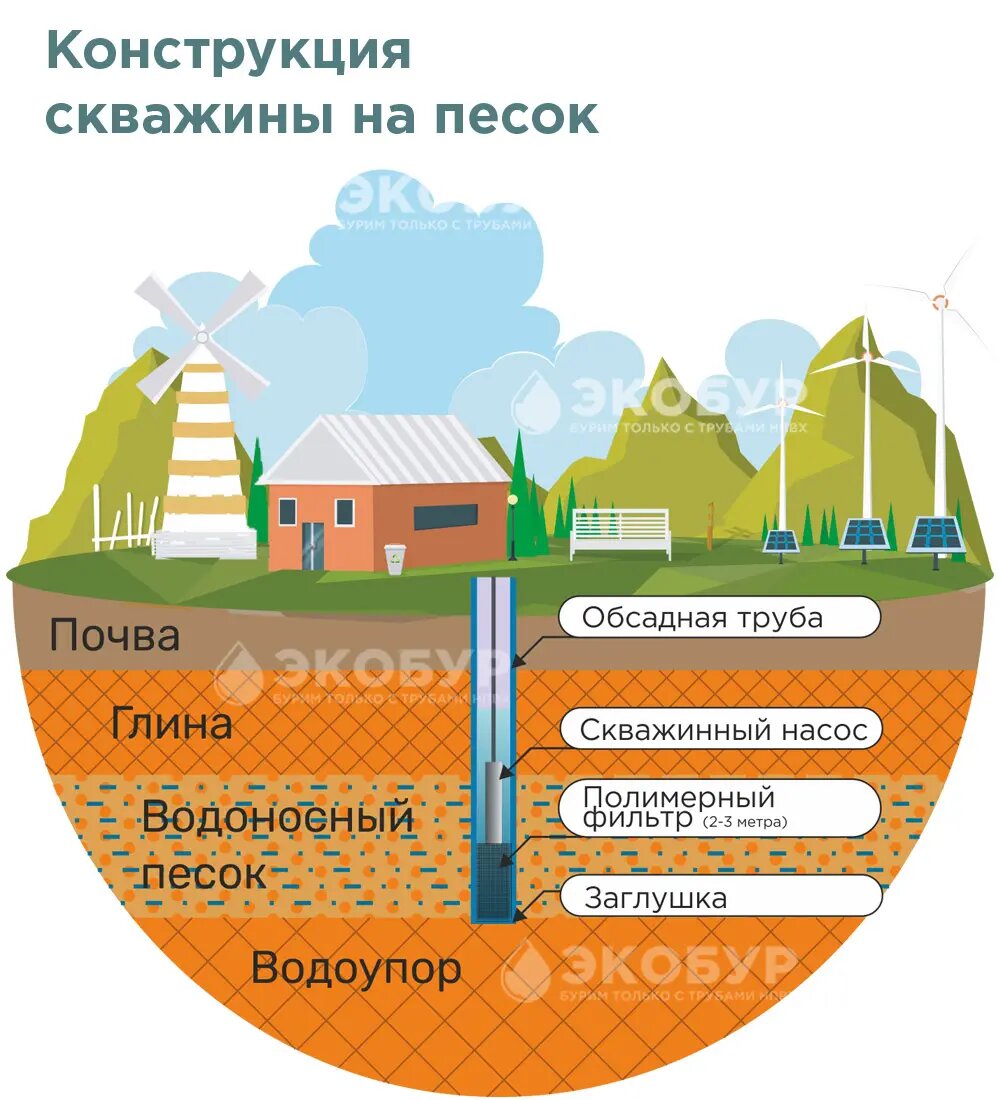
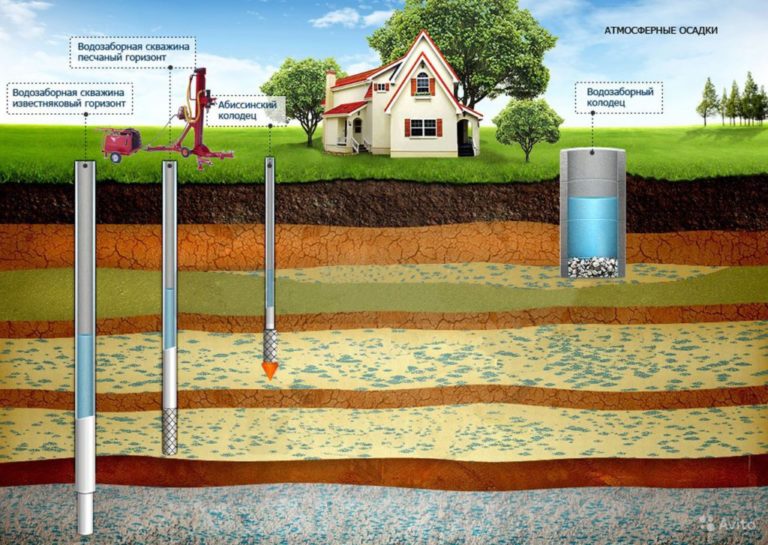
Of course, the equipment of drillers should be able to drive up to the place of work. The minimum passage width is 3 m. Sufficient space above the ground is also required: the height of the drilling mast reaches 10 m.
With all this, it is desirable to locate the well closer to the house (minimum distance - 5 m) - fewer pipes will be needed. Just do not drill in the basement of a house under construction: after its construction, maintenance of the well will become impossible, since for this there must be free space above it at least 7 m high.
A source outside the perimeter or a well in the house?
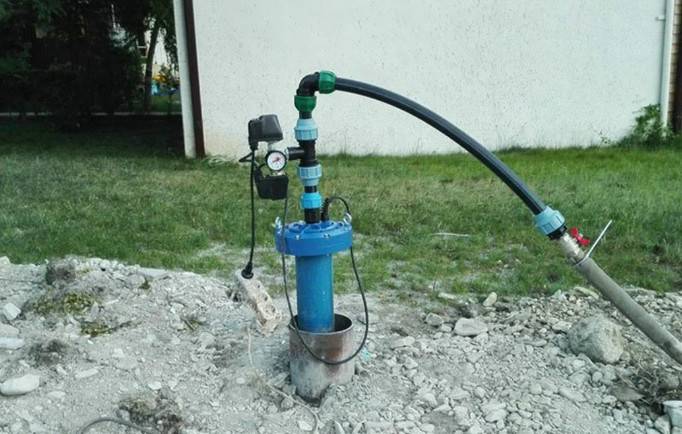
Homeowners who are still undecided about the best option for themselves should consider accommodation options from all angles.
- Residential building: is there or is it just planned? In the first case, it is better to prefer a street structure, since work and construction are not limited by anything: neither the area that is needed for equipment, nor the depth of the well.
- Selection of the type of source. The minimum deep Abyssinian needle remains ideal for the home, which can be relatively easily arranged for “permanent residence” in the basement. More serious wells are still better to build on the street.
- Expenses. If a residential building has not yet been built, then internal work will cost half as much as external work. When it is already completely ready, the situation is the opposite: the construction in the house will be 2 times more expensive than outside it.
- The possibility of using special equipment: both “now”, and in the future, for maintenance.The best place is at the gate, next to the road. In this case, it is possible to provide a removable section in the fence.
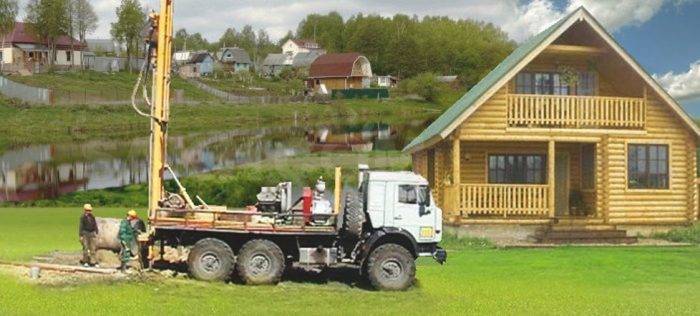
Service life is another important criterion. It is believed that street wells are more durable than those that are protected at home. There is another option - a well located under the building, but not under the residential (workshop, garage, separate cellar, greenhouse). It is better if it is possible to partially dismantle the structure in order to provide the water source with trouble-free scheduled maintenance or repairs.
About method
This method is suitable for different types of soil:
- Sandy;
- sandy loam;
- loamy;
- Clayey.
This method is not suitable for rocky soil, since its principle is to soften the rock with water pumped into the drilling zone using a pump, which greatly facilitates the process. Waste water enters the pit next to the installation, and from there it returns to the well through hoses. Thus, the whirlpool has a closed system and a lot of liquid is not required.
Hydro-drilling of wells is carried out by a small-sized drilling rig (MBU), which is a collapsible mobile structure of compact size and light weight. It consists of a bed, which is equipped with:
- A reversible motor with a gearbox (2.2 kW) that creates torque and transmits it to the drilling tool.
- Drill rods and drills.
- A manual winch that raises and lowers the equipment when building up the working string with rods.
- Motor pump (not included).
- Swivel - one of the contour elements with a sliding type of fastening.
- Hoses for water supply.
- A petal or exploration drill in the shape of a cone, which is used to penetrate compacted soils and center the equipment.
- Control unit with frequency converter.
The presence of rods and drills of different diameters allows drilling wells of different depths and diameters. The maximum depth that can be passed with the MBU is 50 meters.
Water well drilling technology consists of several stages. A frame is mounted on the site, an engine, a swivel and a winch are attached to it. Then the first elbow of the rod is assembled with a head in the lower end, pulled up to the swivel with a winch and fixed in this knot. The elements of the drill rod are mounted on a conical or trapezoidal lock. Drilling tip - petals or chisel.
Now we need to prepare the drilling fluid. Near the installation, a pit is made for water or drilling fluid in the form of a thick suspension, for which clay is added to the water. Such a solution is poorly absorbed by the soil.
The intake hose of the motor pump is also lowered here, and the pressure hose is connected to the swivel. Thus, a constant flow of water into the shaft is ensured, which cools the drill head, grinds the walls of the well and softens the rock in the drilling zone. Sometimes an abrasive (such as quartz sand) is added to the solution for greater efficiency.
The torque of the drill rod is transmitted by a motor, below which the swivel is located. Drilling fluid is supplied to it and poured into the rod. The loosened rock is washed to the surface. Waste water is reused many times as it flows back into the pit. The technical fluid will also prevent water release from the pressure horizon, as back pressure will be created in the well.
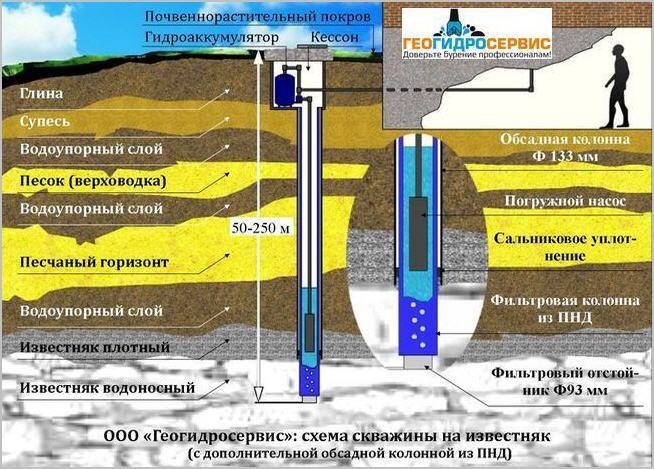
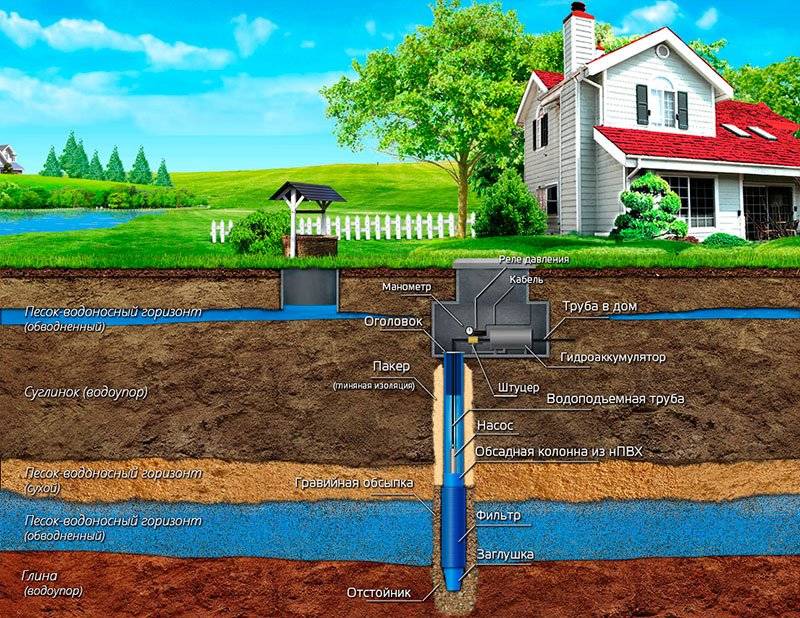
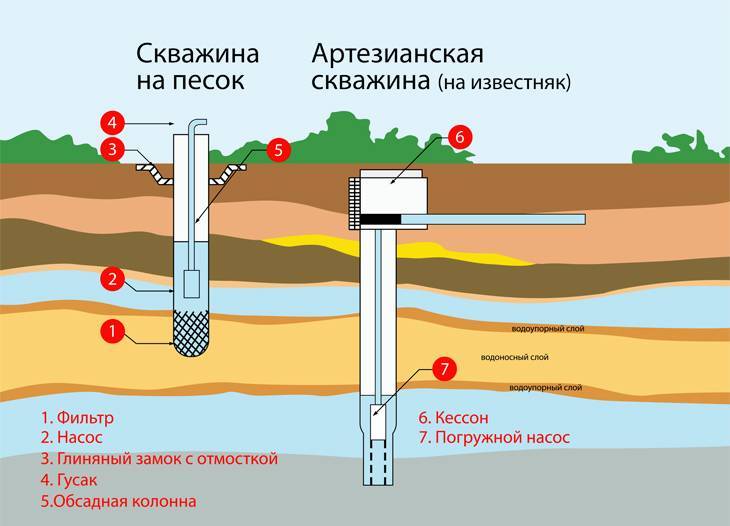
As the well passes, additional rods are set until the aquifer is opened. After drilling is completed, a filter with casing pipes is inserted into the well, which are threaded and extended until the filter enters the aquifer. Then a cable with a submersible pump with a hose and an electric drive is lowered. Water is pumped until transparent. The adapter connects the source to the water supply.
This is interesting: Purification of water from a well - we learn from all sides
Choosing a place for drilling a water source
When choosing a location for drilling a well, the presence of aquifers is crucial. It is the depth of their occurrence that will depend on many factors: the footage of the mine, the method of drilling, the need for cementing and filtering, etc.
Let us consider in more detail what types of groundwater can serve as a water source for household needs and how to determine their depth.
Image gallery
Photo from
If the drilling of the source will be carried out by a drilling organization, when choosing a location for a well on a site, one should take into account the dimensions of the equipment with a drilling rig
To drill a working, you need a free site on which a machine can be located without causing damage to buildings
Be sure to take into account the height of the tower and choose a place so that when it is raised, power lines are not affected.
When drilling with a small rig, it is not necessary to consider the previous aspects, but it is important to choose a convenient location
It is necessary to determine the place so that the wellhead is conveniently equipped with a caisson
If the pumping station is installed in a separate pavilion, it is necessary to provide unhindered access to it
If the well is planned to be used for irrigation, then it is advisable to position it so as to reduce the length of hoses and pipes
And when arranging water supply at home, it is desirable to reduce the length of the external branches of the pipeline so as not to build unnecessary manholes
Well drilling rig
Accounting for the location of buildings on the site
Accounting for the height of the tower and the location of power lines
Drilling with a small rig
Place for the device of the caisson
Installation of a pumping station in the pavilion
Construction of a well for watering the garden
Inspection water well
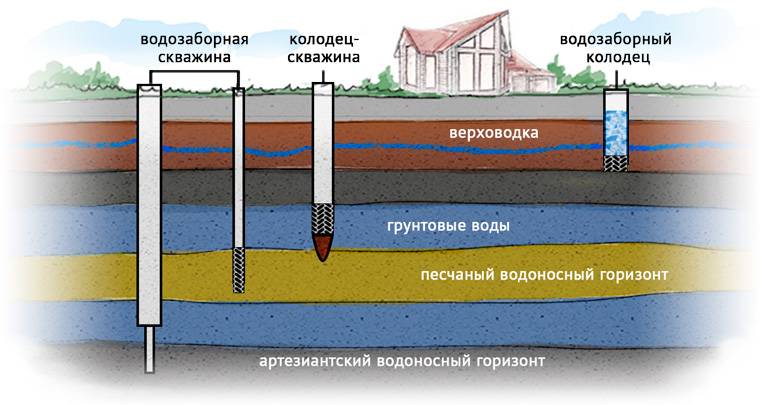
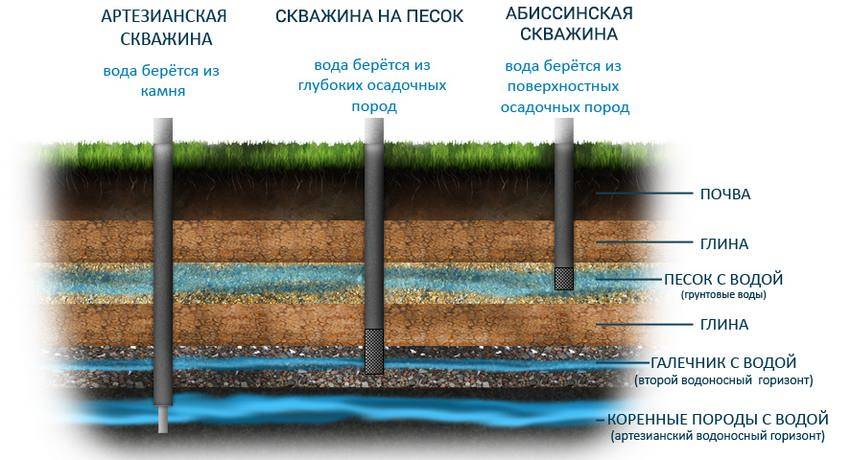
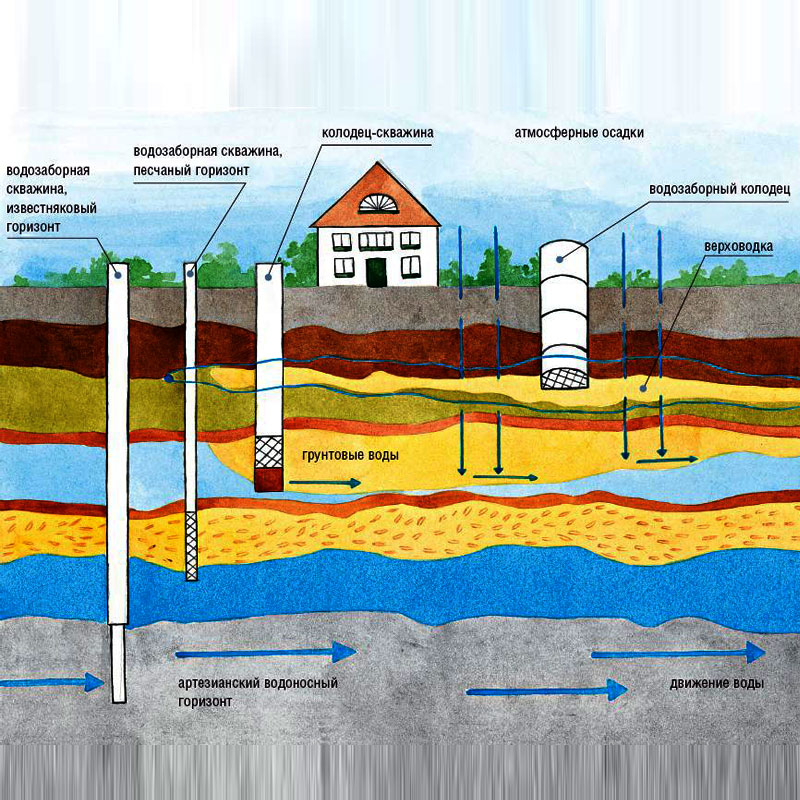
Consider four types of groundwater that can become a source of water supply for your site:
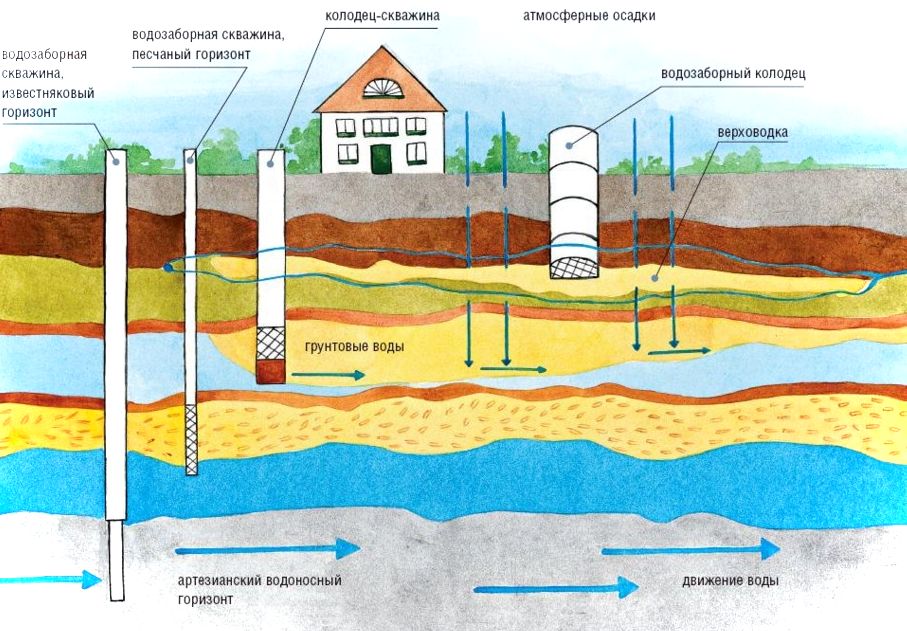
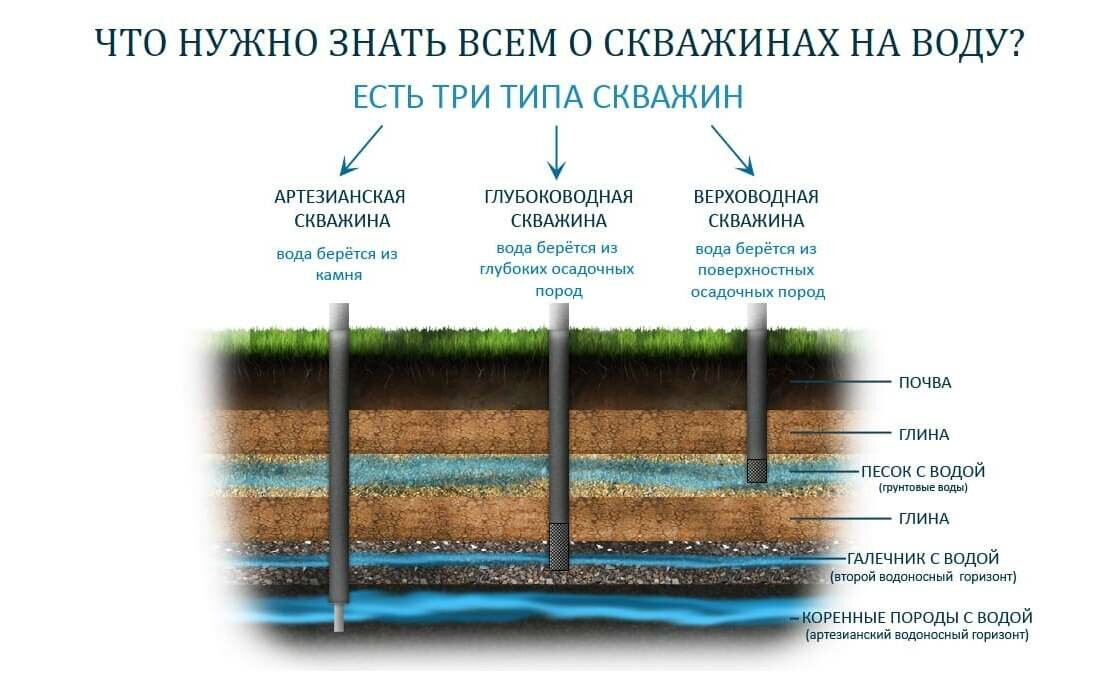
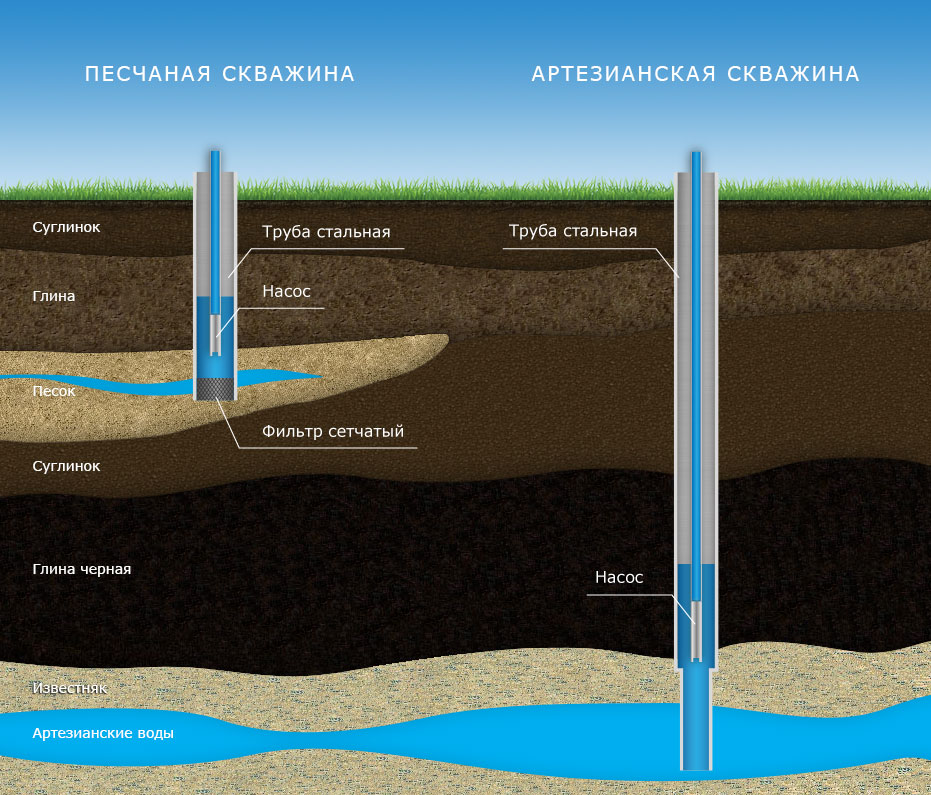
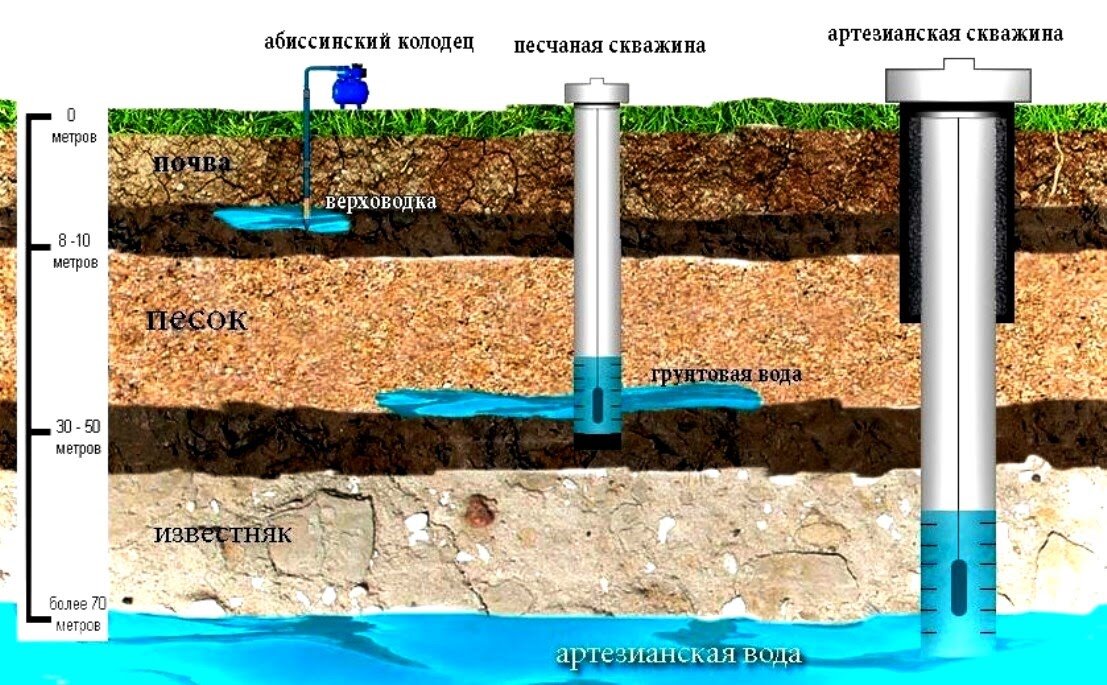
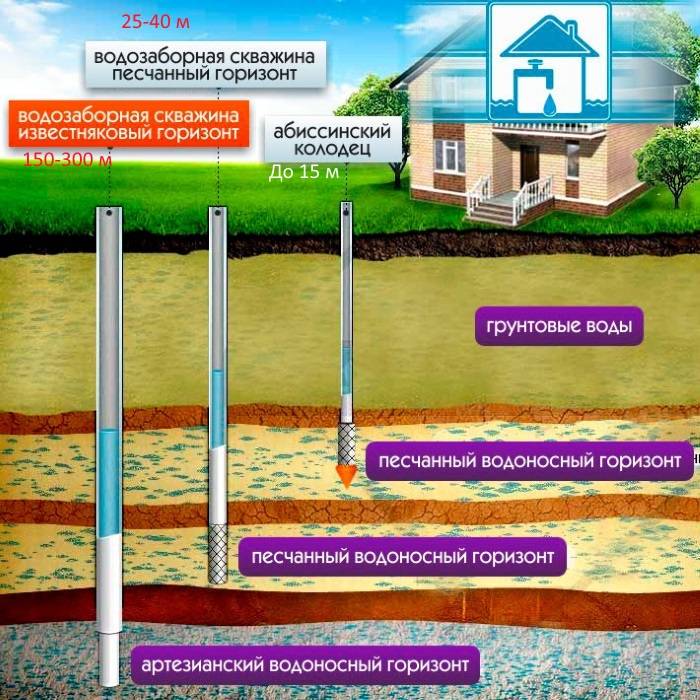
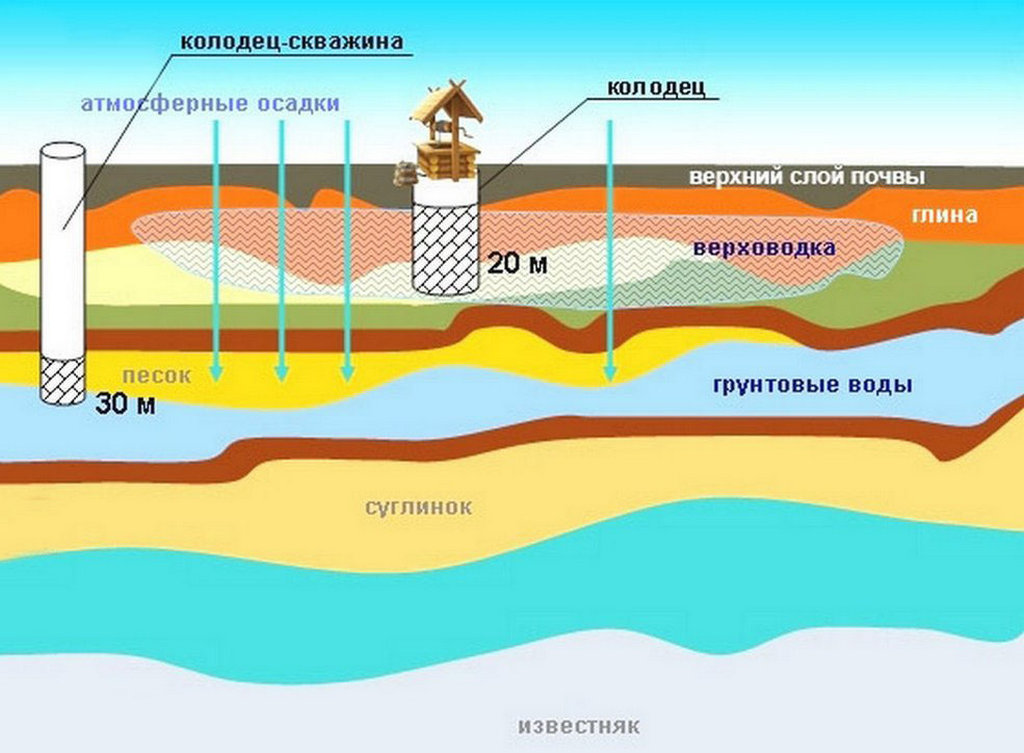
- Verkhovodka is the upper aquifer, lying at a depth of up to 3-4 m. It is filled with melt and rain water, therefore it is characterized by a high degree of pollution. It is forbidden to use such water for drinking and watering of domestic animals; this water can be used for watering plants. During the period of drought and winter, perched water can simply disappear, so drilling of a well is never carried out before them.
- Groundwater at a depth of no more than 10 m. Such an aquifer is formed due to the fact that below it there are hydro-resistant soils that do not allow water to seep down. Ground water does not dry out even during a drought. The quality of such waters is quite high, in the presence of filtration systems and compliance with sanitary standards, in most cases they can be used for drinking.
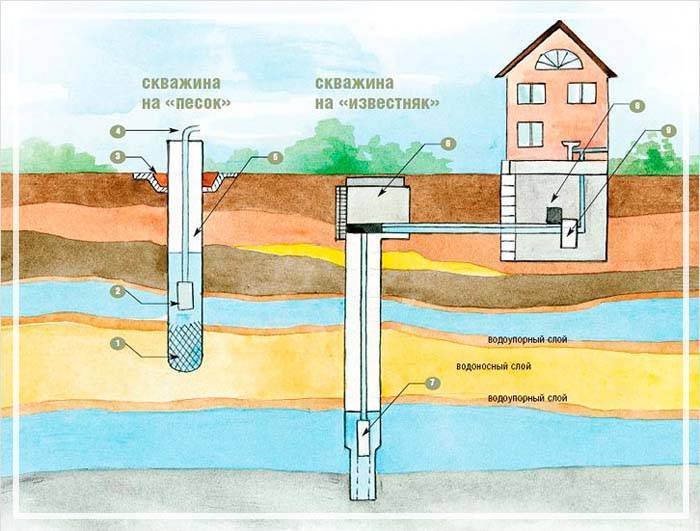
- Interstratal non-pressure waters. They lie at a depth of 10 to 110 m between two water-resistant layers.Layers can have a different structure and water permeability, for example, there can be sandy loam on top, and loam on the bottom. Water quality - usually high, depends on the specific characteristics of the site. Wells that open interstratal waters are most often found in private farms.
- Artesian waters. They are located at a depth below 100-110 m. Despite the fact that the water from an artesian well is clean and drinkable, drilling such a well is a complex process that not every site owner decides on.
The fact is that for the construction of an artesian well, it is necessary to coordinate with the authorities and comply with current legislation, including the Federal Law "On Subsoil".
Wells are drilled “on sand” and on “limestone”, as it is called in geological slang. The most watery and stable horizon is considered to be confined to cracks in limestone.
Where is the best place to build a well?
Many comfort lovers are sure that the ideal place for a well is the basement of their house. This is a very controversial decision. Difficulties begin with drilling, which, in principle, is possible only at the first stage of construction, with a maximum of a standing foundation. Further maintenance of the system, and especially repairs in such conditions, will be extremely difficult, if not impossible.
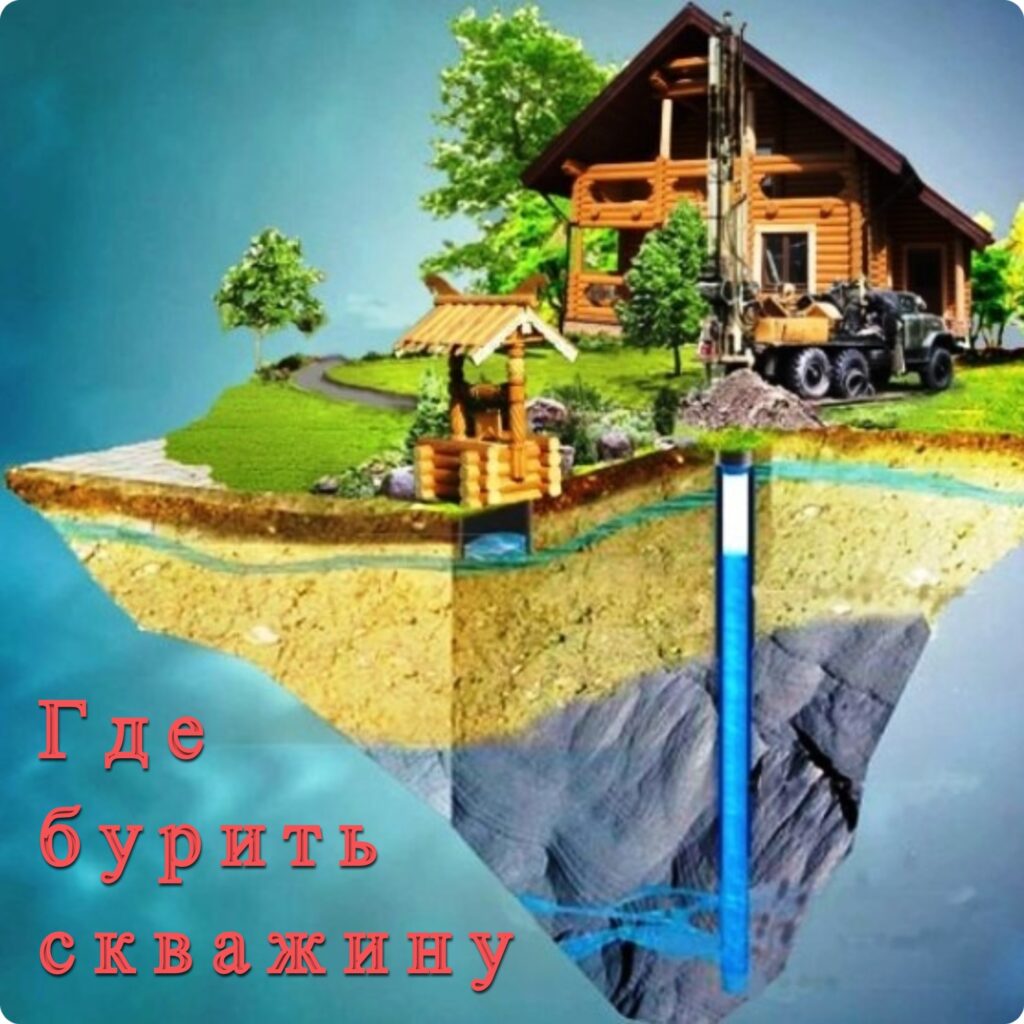
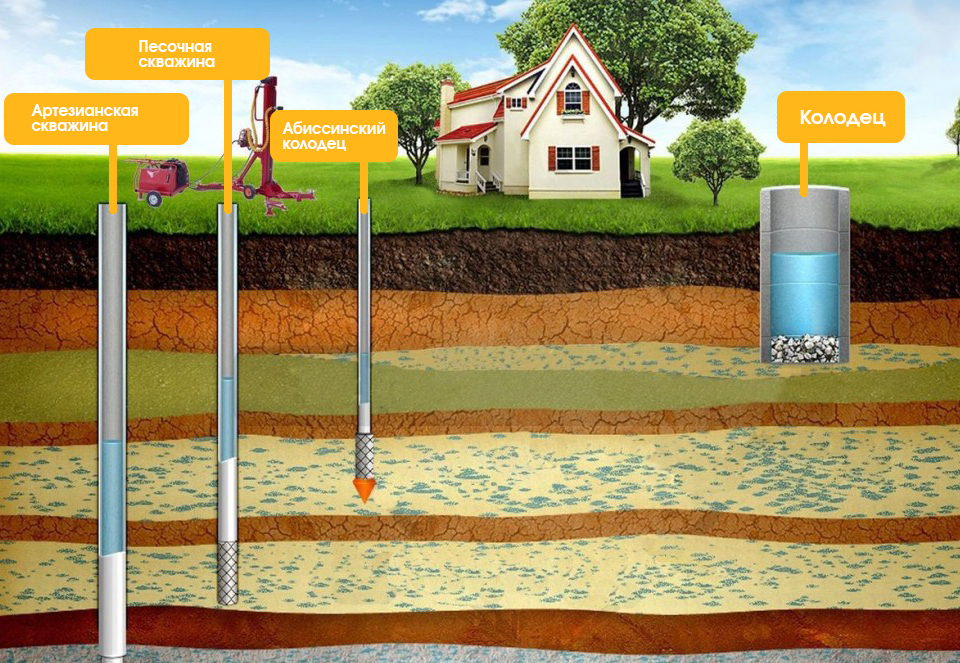
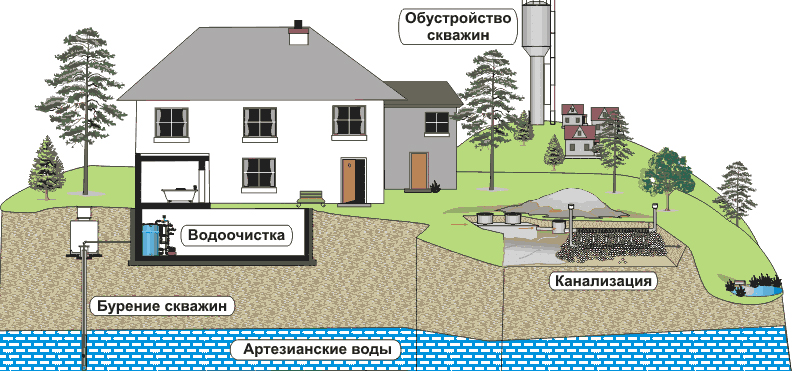


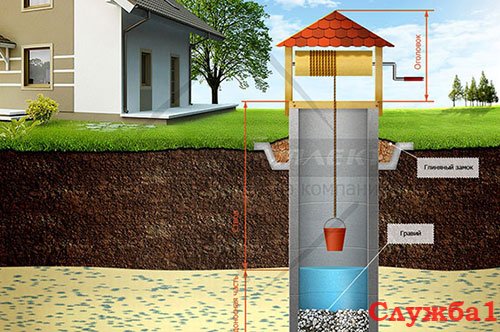
Since some operations can only be carried out with the participation of heavy equipment, it is not possible to drive it into the basement of the house. The only viable option in such conditions is a shallow well equipped with a self-priming pump located on the surface. The benefit of making such a decision is that there is no need to pull the pipeline from the well to the house. But this advantage is easily offset by many serious disadvantages.
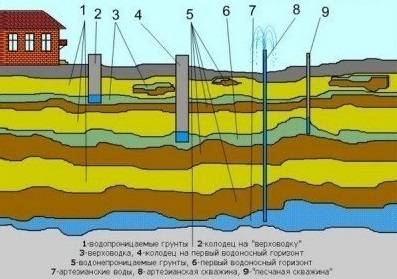
Of course, the best place for a well is not far from home. But you need to take into account a map of aquifers - how deep will you have to drill?
When considering where to drill a well on a site, you need to consider several important aspects:
In addition, a steel caisson is airtight, and a concrete well is almost impossible to make impervious to moisture, which can lead to contamination of the well with surface water. Another caveat: the slope at the drilling point should be less than 35 °.
- To facilitate the supply of water supply, saving on the arrangement of the pipeline, it is necessary to locate the well as close to the house as possible. However, this distance cannot be less than 3 m.
- The drilling site should be at least 50-100 m away from potential sources of pollution, such as a cesspool, a landfill, and manure heaps.
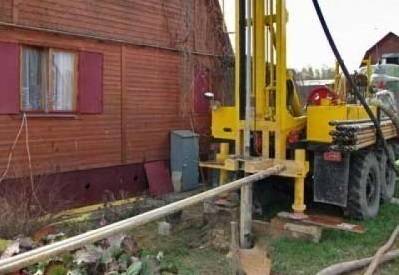
The distance from the house to the well should not be less than 3 meters
- To the site where the well will be located, it is necessary to provide free access for the drilling rig. Its dimensions should not be less than 3 m in width. The installation site is usually chosen at least 4x9 m. Do not forget about the height of the equipment: the drilling mast is rarely lower than 10 m. work. In addition, it should be taken into account that in order to build up the drill string, about six meters of free space in the aft part of the installation will be required.
- On a landscaped site, it is worth considering all the ways of entry and placement of heavy equipment in order to minimize all kinds of disturbances to the landscape.It is worth trying to provide the largest possible area for placement, since in addition to the drilling rig itself, it may be necessary to place a water truck with drilling mud or a kung for workers.
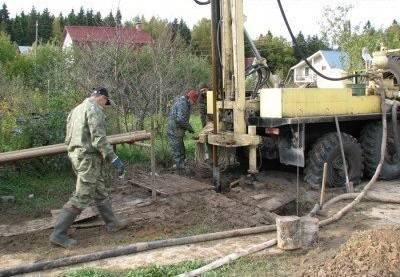
The drilling site should be as large and free as possible
All questions related to when and where it is better to drill a well are solved quite easily.
It is only necessary to carefully consider all possible options, take into account the advantages and disadvantages of each solution. A well-equipped well will become the basis for autonomous water supply, allowing you to enjoy the benefits of civilization in any place, even the most remote from large cities.
Conclusions and useful video on the topic
Selection of a place for drilling an aquifer on the site:
Practical application of the dowsing method in the search for water:
A video about self-exploration using a primitive drilling method:
Choosing the right place for a well device is an important event on which the future fate of the water supply system of your site and home depends. Carefully weigh all the pros and cons of the chosen place, try to take into account and predict as much as possible all the factors that may affect the quality and availability of groundwater
Carefully weigh all the pros and cons of the chosen place, try to take into account and predict as much as possible all the factors that may affect the quality and availability of groundwater.



