
- Important points in the arrangement of the well
- Plastic vs Metal
- Galvanized or steel?
- Well construction process
- How do I know if I can start a well?
- How to determine the location of the aquifer?
- How to determine the place where to drill a well on the site?
- Methods for locating a well on a site
- Optimal well depth for drinking water
- Selecting a point for drilling a water source
- Manual well drilling
- rotary method
- screw method
- How to check the depth of the well after drilling, so as not to be deceived
- Time to drill
- Well in basement
- How to find a respectable well construction contractor?
- Conclusions and useful video on the topic
Important points in the arrangement of the well
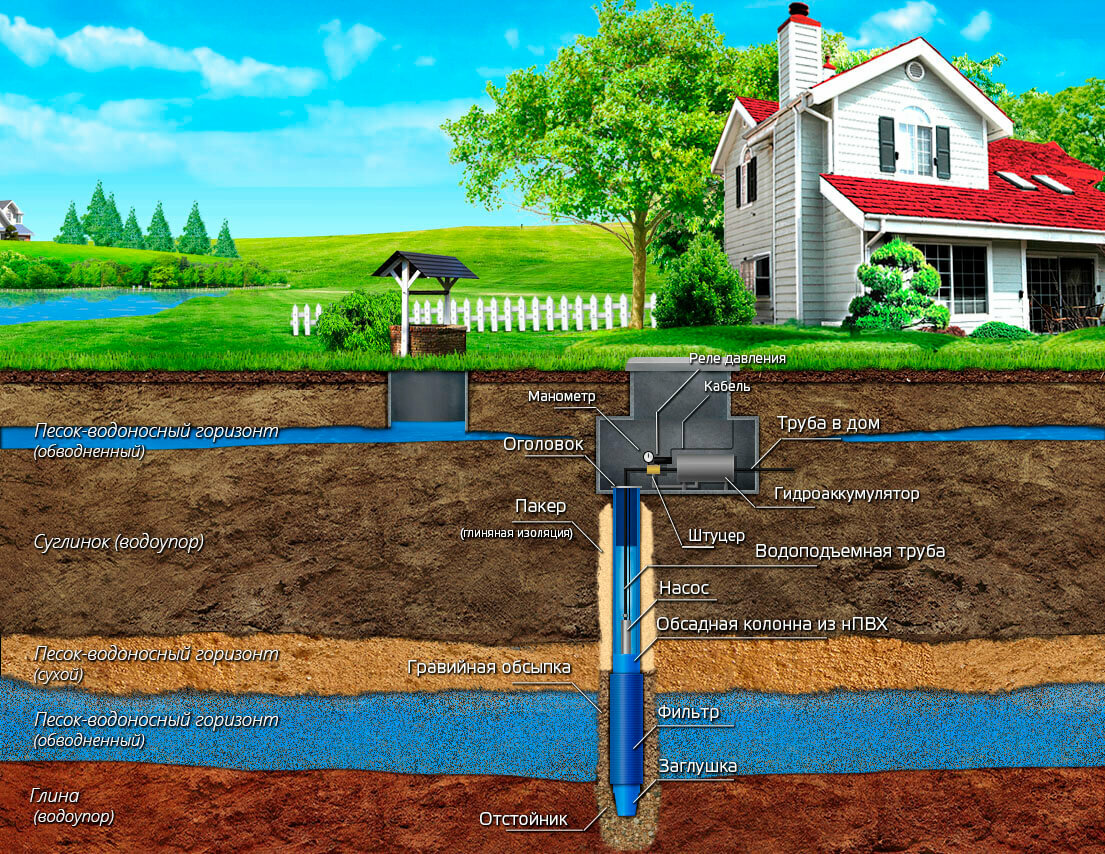
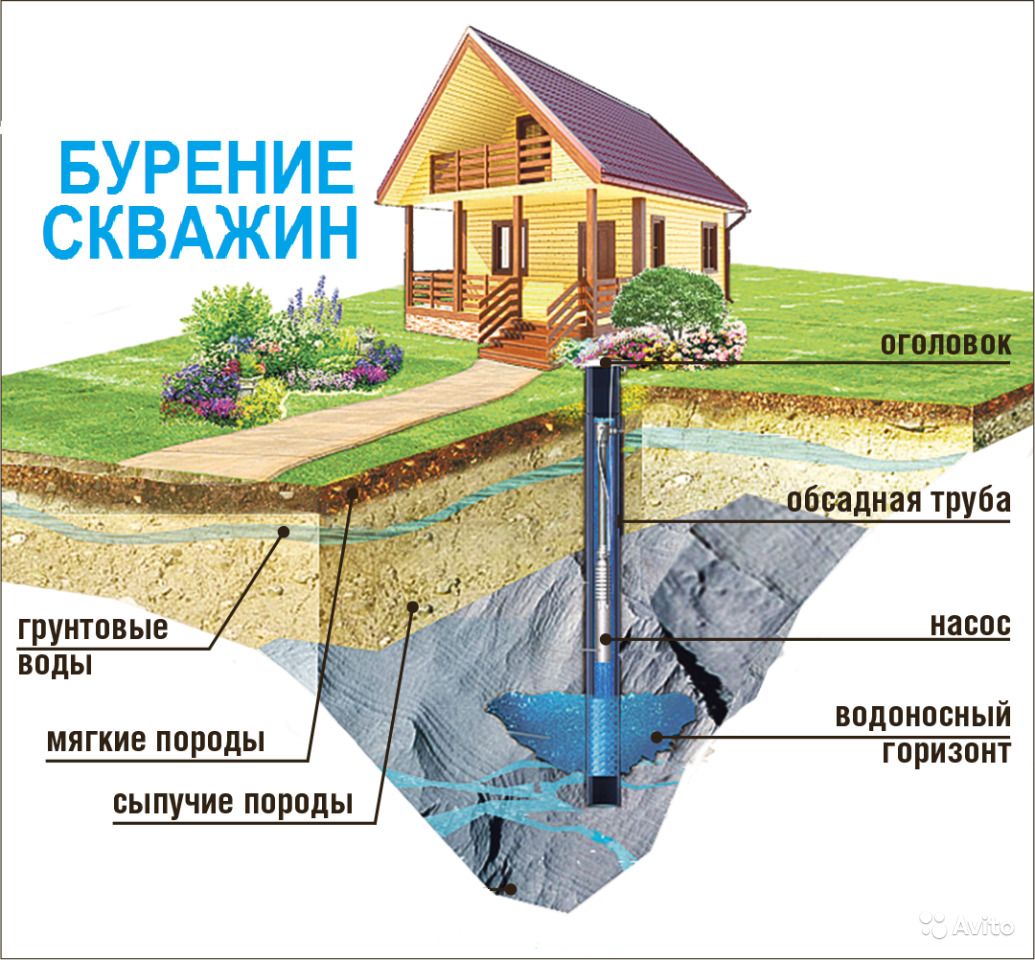
The drilling process is quite monotonous, but requires constant monitoring. When the pilot has reached the aquifer, we can assume that the first major stage of work has been completed! Now you need to equip the well.
First of all, it is necessary to decide on the materials for the casing. It can be plastic, steel (uncoated) or galvanized pipe. It is necessary to understand their differences, and also to understand what the diameter of the column affects.
Plastic vs Metal
Thanks to the persistent advertising of polymer products manufacturers, the consumer has a stereotype about "eternal" plastic.
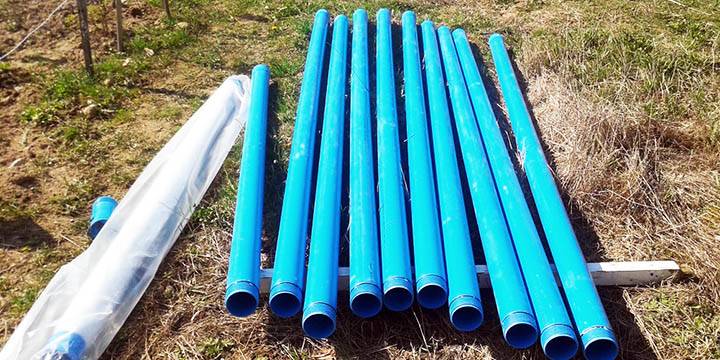
The HDPE and PVC-U used for the manufacture of casing pipes do not really decompose, absorb or emit harmful substances. But underground metal behaves in exactly the same way. In conditions of lack of oxygen, the steel is covered with a dense layer of patina (ferrous oxide), which protects the metal from further oxidation. With bacteriostatic properties (the ability to stop the growth of bacteria), everything is also in order there.
The indisputable advantage of plastic lies in its cheapness, but there is also a serious drawback. Neither HDPE nor PVC-U can withstand compression by “unstable” and coarse-grained rocks. As a result, the casing string cracks, and a mixture of artesian and groundwater flows from the tap.
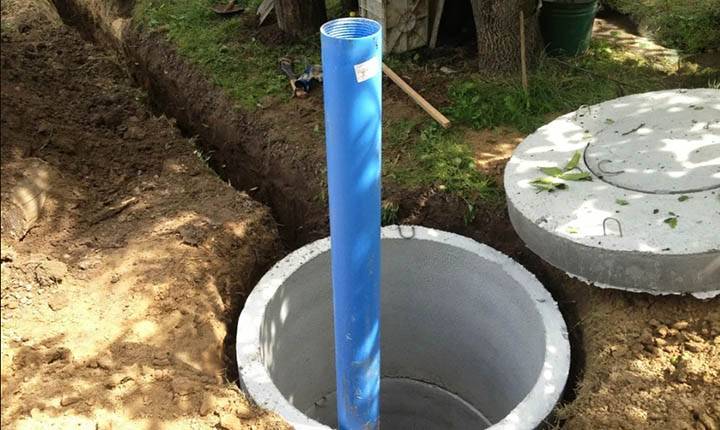
Another thing is two-pipe casing strings: a metal pipe on the outside, and a plastic one on the inside. They are somewhat more expensive, but are superior in reliability to any one-pipe systems.
Galvanized or steel?
Some contractors offer galvanized pipe for arranging the casing. The advantage is the same - low cost. But the fact is that galvanized pipes were originally intended for the installation of irrigation systems, that is, for the transportation of process water. And we want to drink!
After some time, the underground zinc plating, instead of protection, becomes a source of premature destruction of the pipe walls. Different potentials of iron and zinc, plus stray static currents - and instead of a sealed column, we have a "leaky sieve".
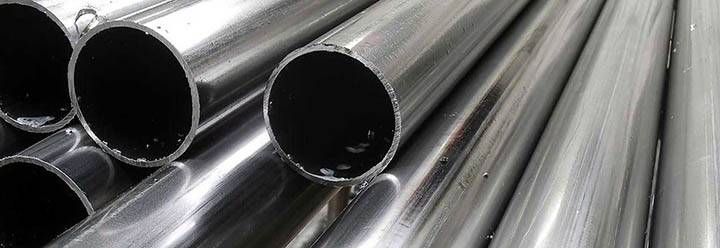
In addition, in the process of electrochemical reactions, so-called galvanic gases are released, which accumulate above the surface (water mirror) and partially dissolve in it. In the well, conditions are created for the reproduction of bacteria.Water quality is deteriorating.
Well construction process
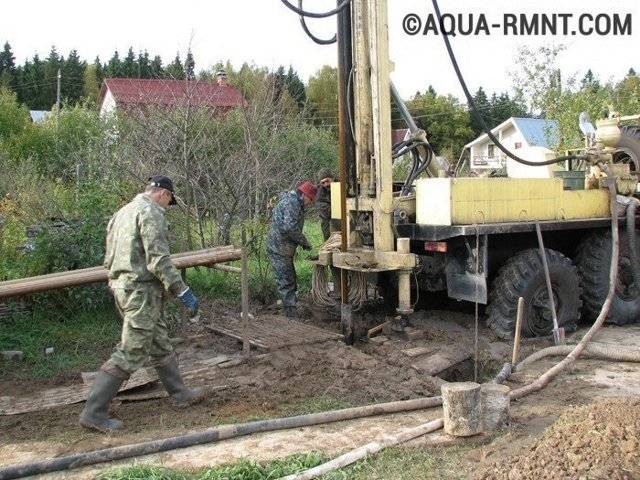
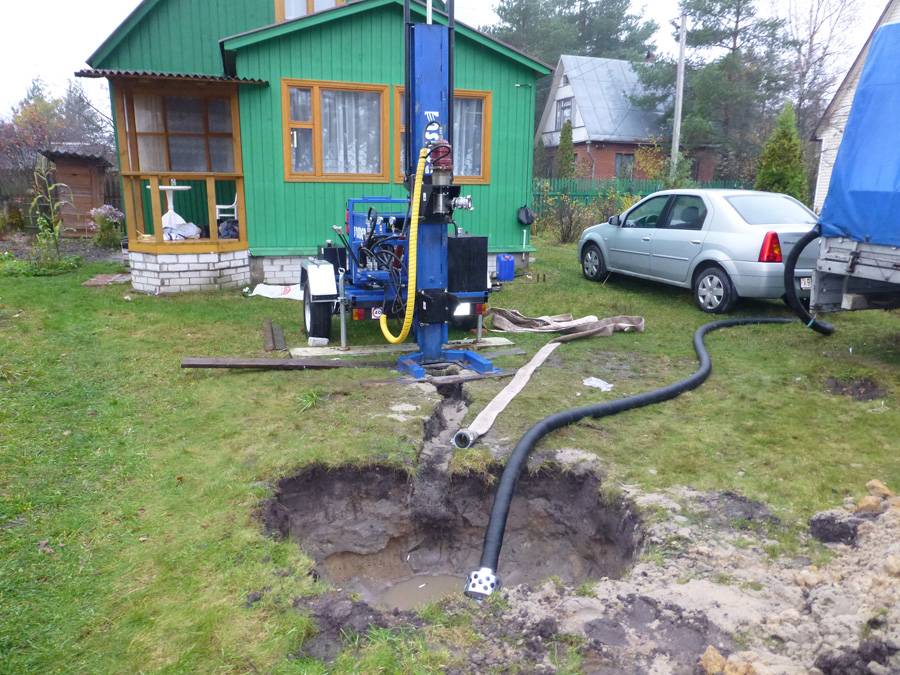
After all work on the preparation of equipment and material for well construction completed, proceed to drilling. Carrying out work:
- For such work there is an instruction. All available tools are used: shovels, crowbars, buckets, etc.
- Initially, a depression is dug on the surface with a diameter of at least 1 m and a depth of 50 cm.
- Then a hand drill is inserted in the center and they work until it becomes difficult to pull out the earth.
- After that, you need to use the drill columns. Only a few people can turn their valve. One cannot do this kind of work.
- The principle of operation of the drill is that it is able to push the soil to the surface
- Drill to the desired depth until water appears.
- Then it is pumped out with the help of pumping equipment.
- Then the water is collected again and its quality is checked.
- After that, filtering equipment is installed and performed.
The video in this article shows the process of drilling a well. You need to drill a well in one day.
Otherwise, there may be collapses of the structure, and all the work will have to be done again, but in a different place.
Well depth is considered an important parameter. In many ways, it is he who determines the cost of the drilling work carried out and the quality of the resulting fluid. Most often, the desire to correctly determine the amount of payment for drilling forces customers to calculate this indicator. For each additional meter they have to lay out quite real amounts.
With independent work, the distance from the water surface to the surface of the well will be required for the correct selection and installation of pumping equipment.
How to check depth wells after drilling ? Professionals most often know the approximate level of passage of aquifers even before work is carried out. They determine it on the basis of the geological map of the territory. In other cases, this size is found out after the drilling of the object is completed. For this, several methods are used. The difference between them lies in the degree of complexity, accessibility and level of accuracy.
The most simple and affordable way is mechanical. It will require only a cord, a metal weight and a tape measure. The load is tied to a cord and gently lowered down until the tension is relieved. After that, the home-made device is removed and the size of its wet area is determined using a tape measure. This value is the depth of the well. To measure in this way, it is recommended to use a special hydrogeological tape measure. It is a flexible ruler with an attached weight at the end.
The disadvantages of this method include the inability to measure the dynamic water level. Using this method, it is allowed to measure structures with a depth of not more than 10 m.
The magnetic method is considered the most popular when determining the depth of the well. It provides accurate information about the location of deep aquifers.
The method is to use a spool of logging cable with magnetic marks. The principle of its operation essentially coincides with the mechanical one, but is improved by the presence of a reader. Magnetic marks are applied to the tape at certain distances. They are processed by the receiving device. As a result, accurate information about the location of the cargo is obtained.In the intervals between the marks, the depth is determined using a special roller located on the coil.
How do I know if I can start a well?
If your neighbors have it, you will too. You can find an aquifer almost anywhere in the world (and of course in the Moscow region). Another question is how deep you have to drill, and only a specialist can answer it.
If you are serious about drilling a well, contact a drilling company. Maybe not even one. Companies that respect themselves and the client inspect the site for free. At the same time, you will have the opportunity to get an initial understanding of the contractor.
They are different: some come with electronic devices, others - with a shaman's tambourine. What works better has not yet been found out, but in any case, you need to look at people. There are specialists who, from a distance of 100 meters, determine the depth of the aquifer without any instruments.
How to determine the location of the aquifer?
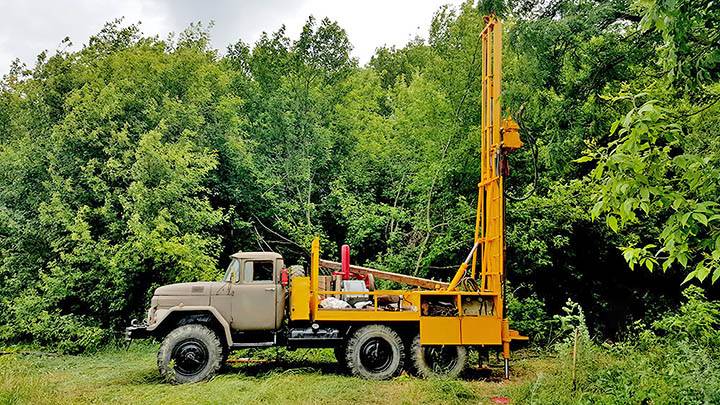
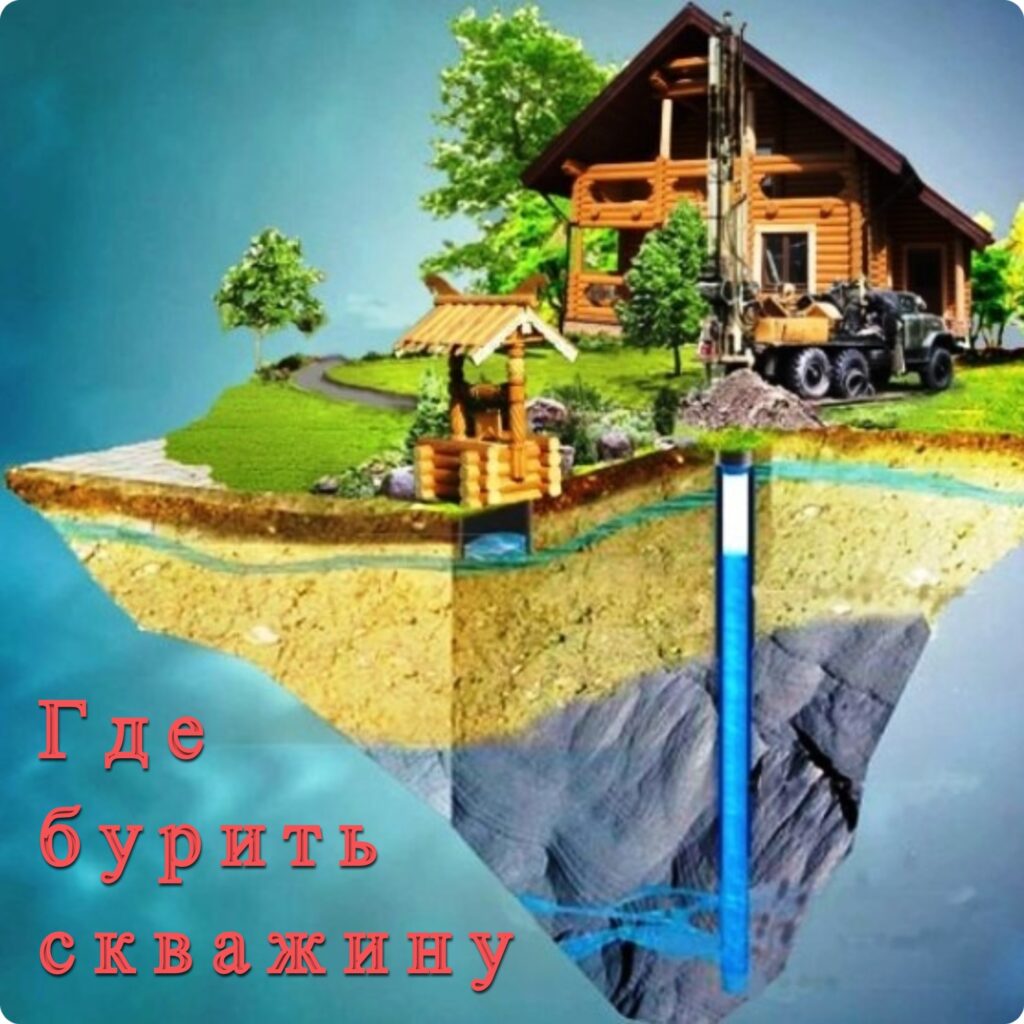
The most important thing in choosing a place for drilling is the location of the well above the aquifer. Otherwise, you can make an attempt after an attempt, and you will not be able to get to the water. In addition, it is necessary to place the well in such a way that it is convenient to use it and carry out repairs if necessary. By the way, do not forget that drilling machines should drive up to the drilling site.
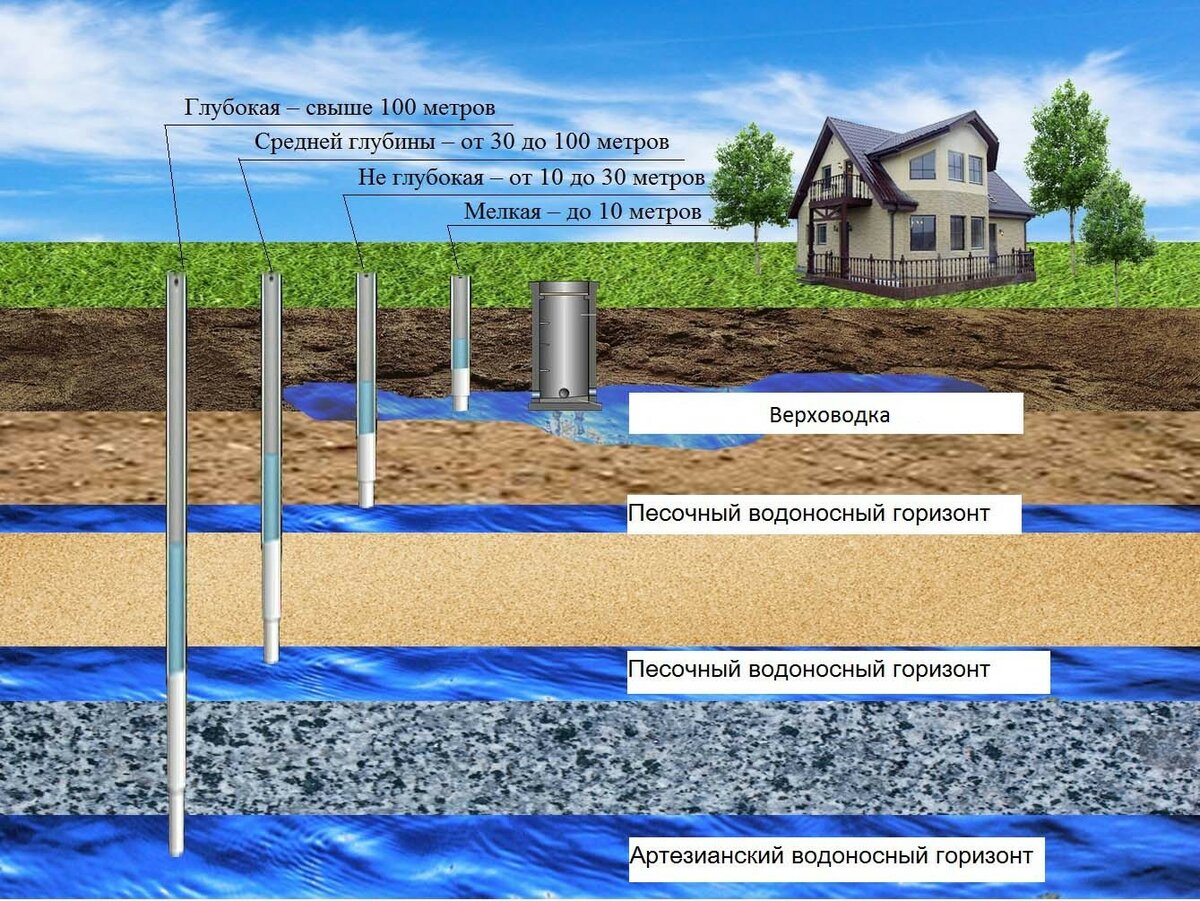
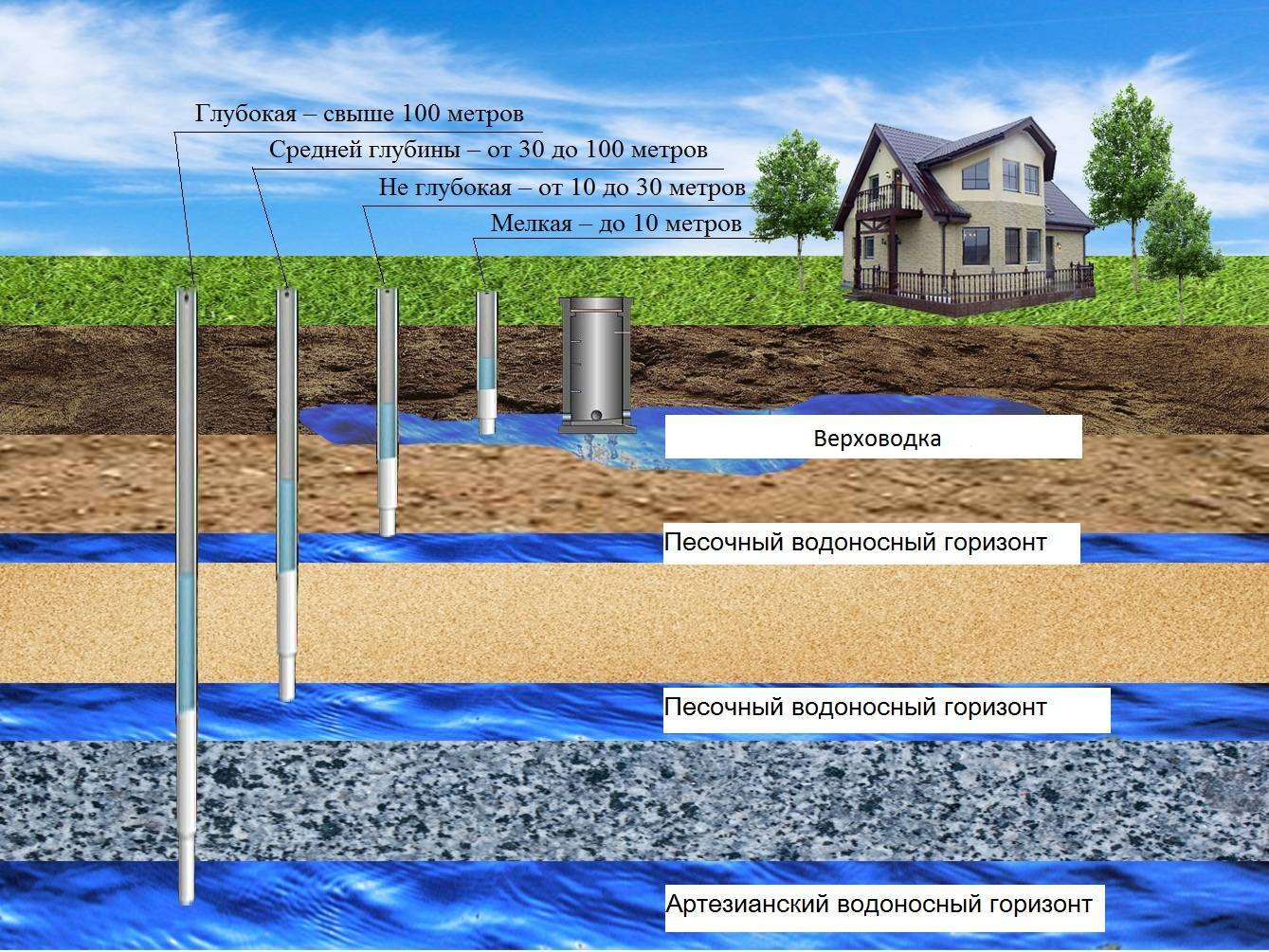
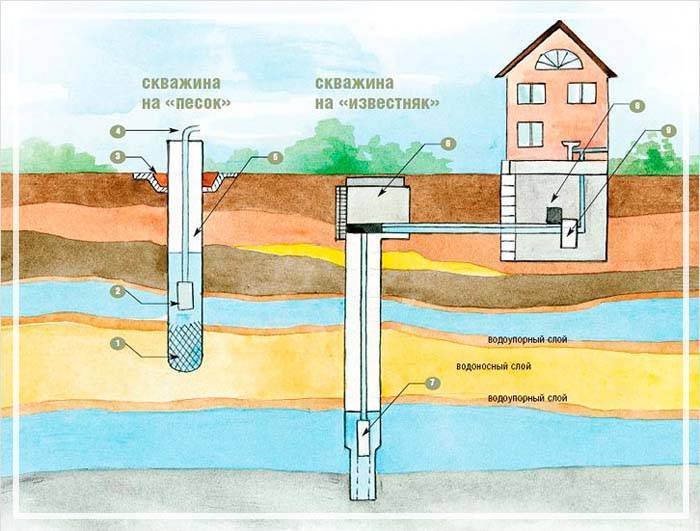
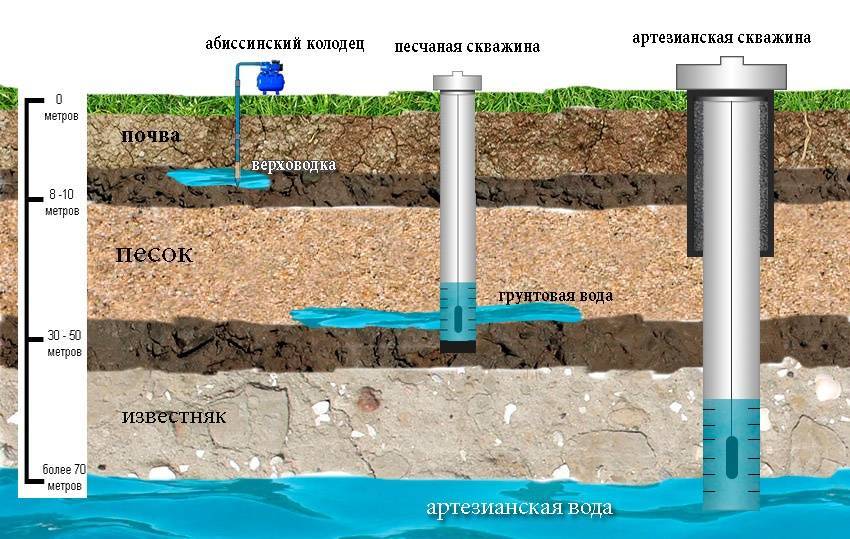
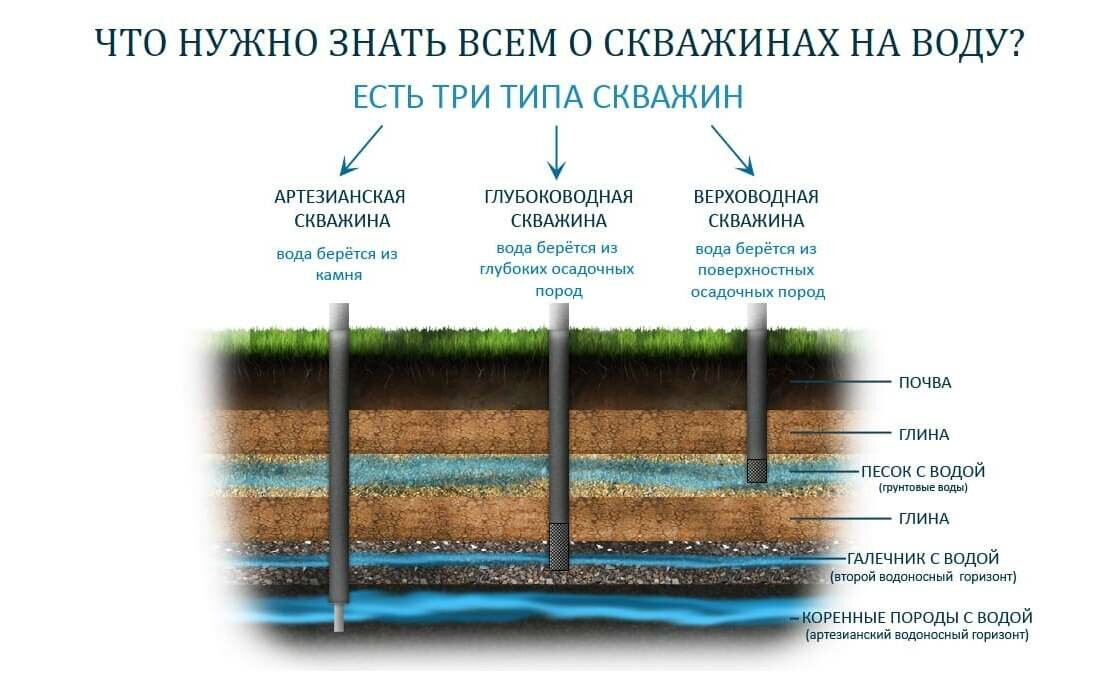
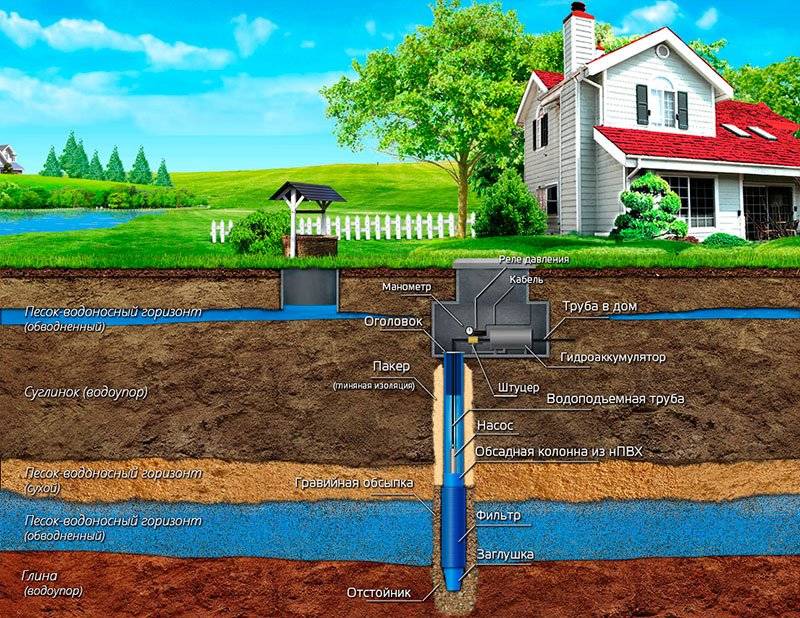
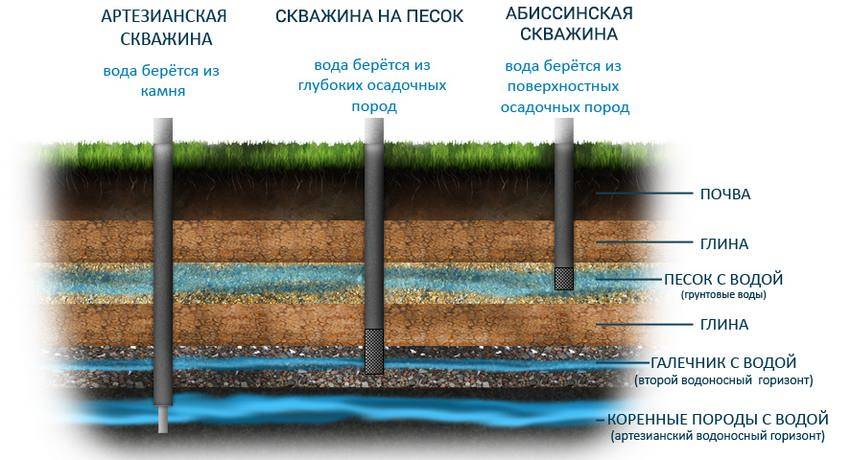
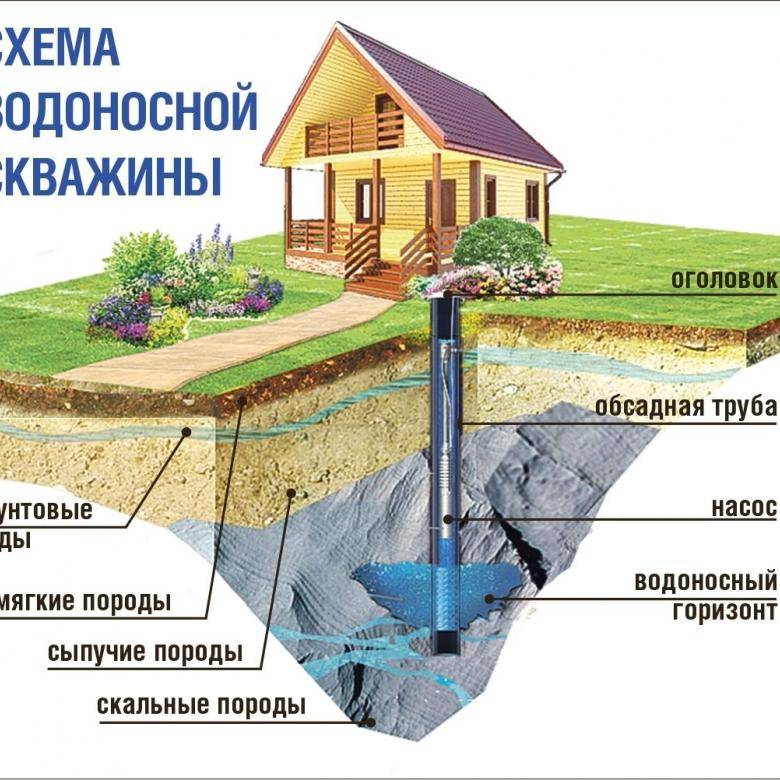
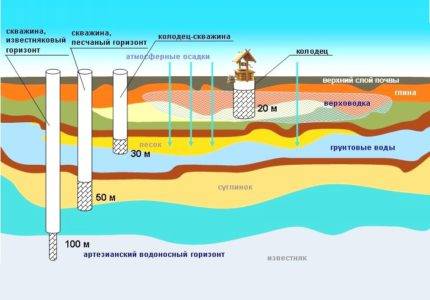
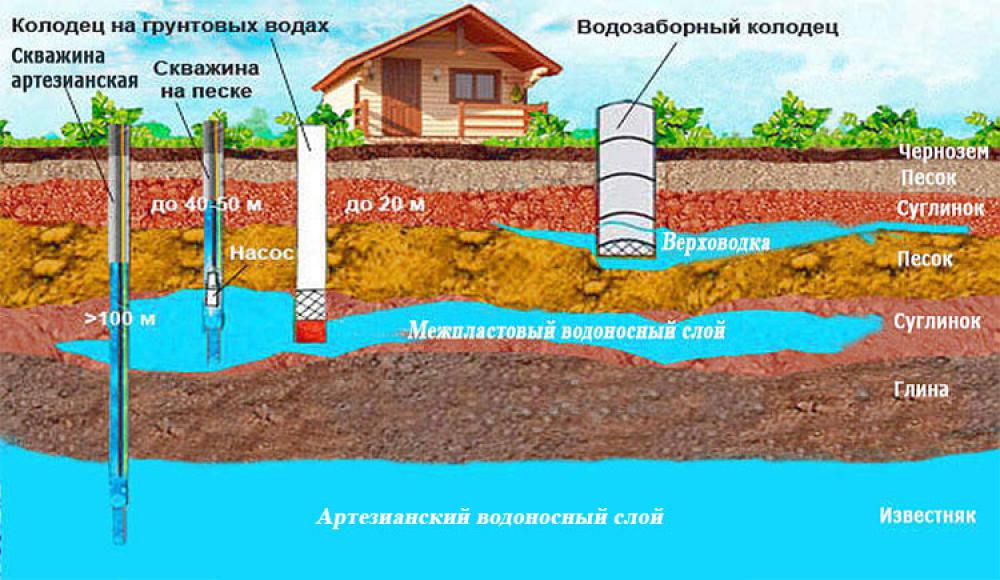
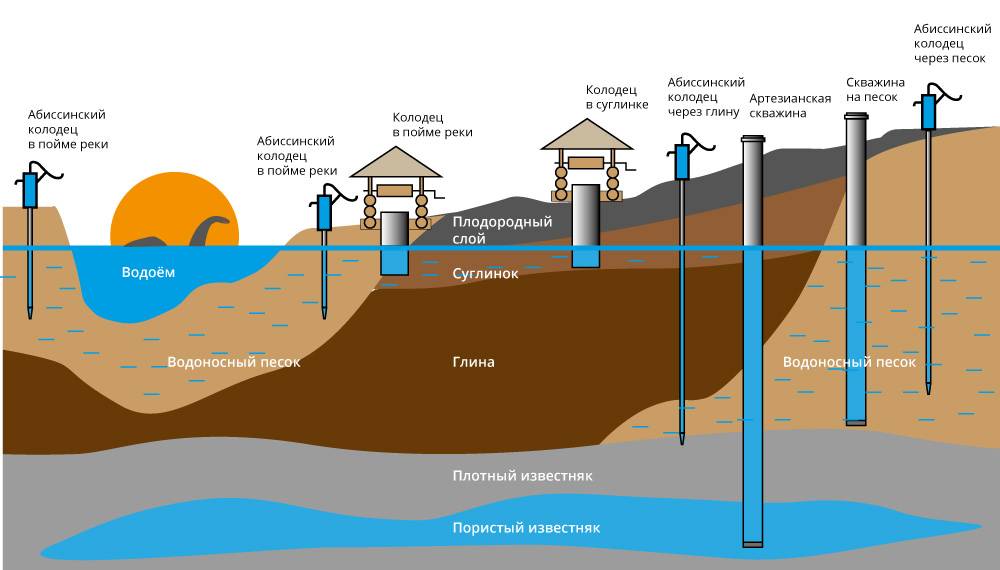
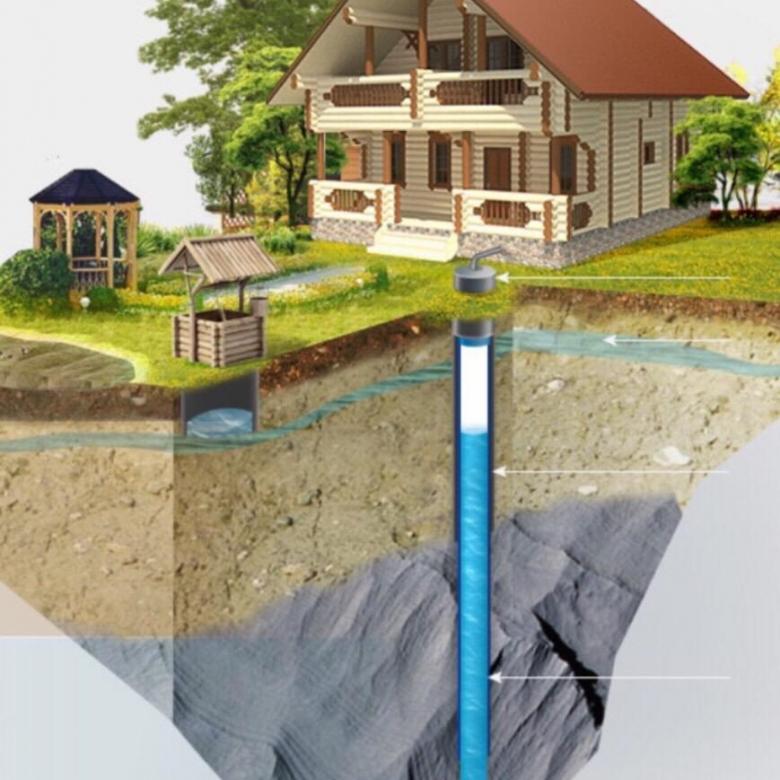
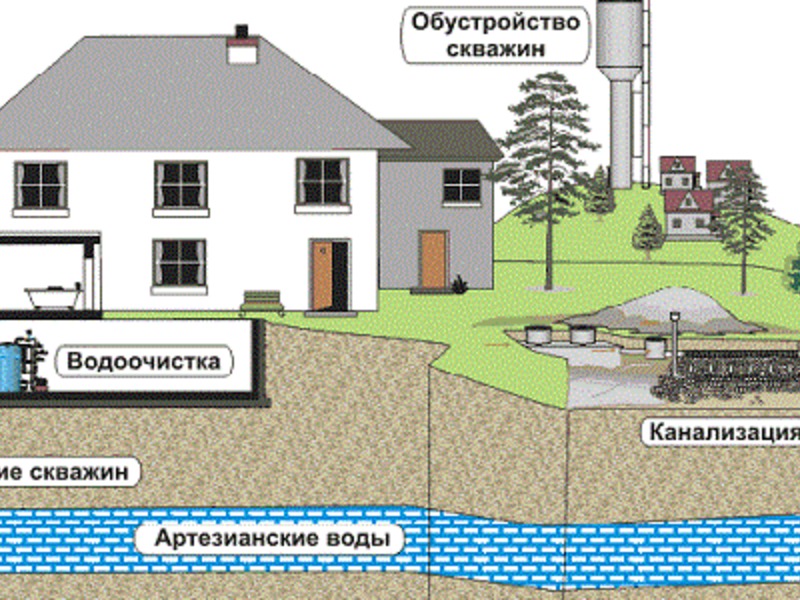
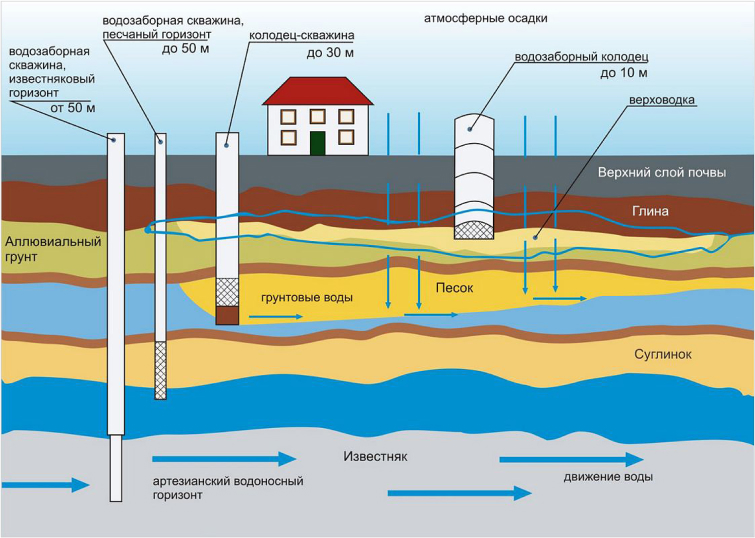
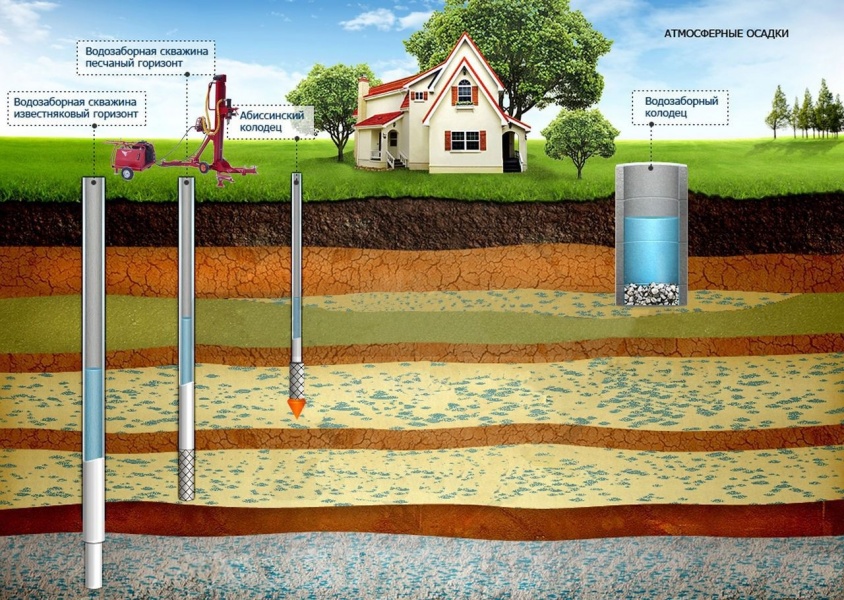
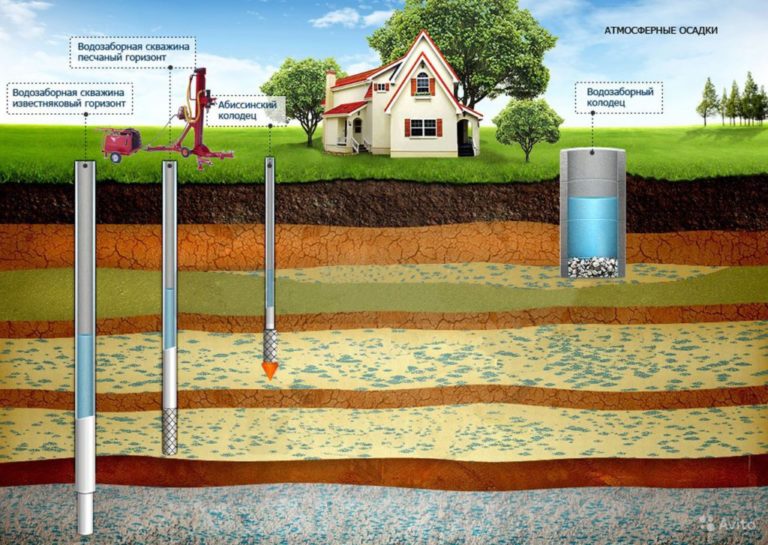
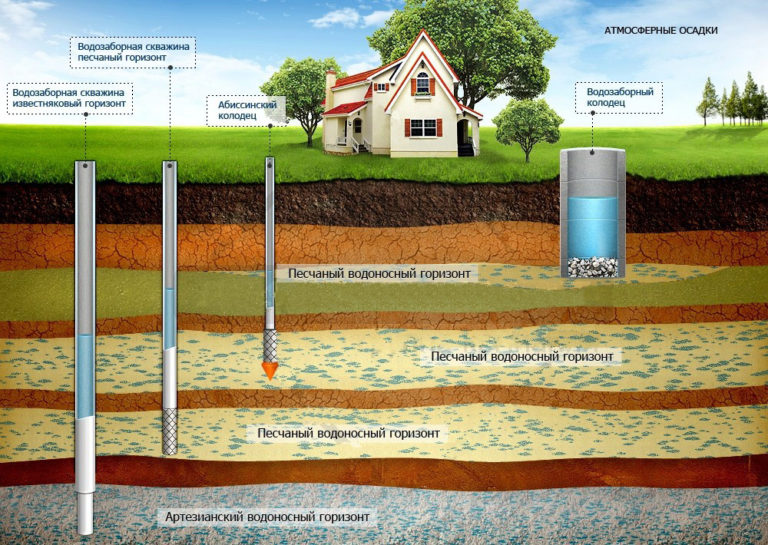
Finding an aquifer is not so easy - the diagram shows possible well designs depending on their depth (click to enlarge)
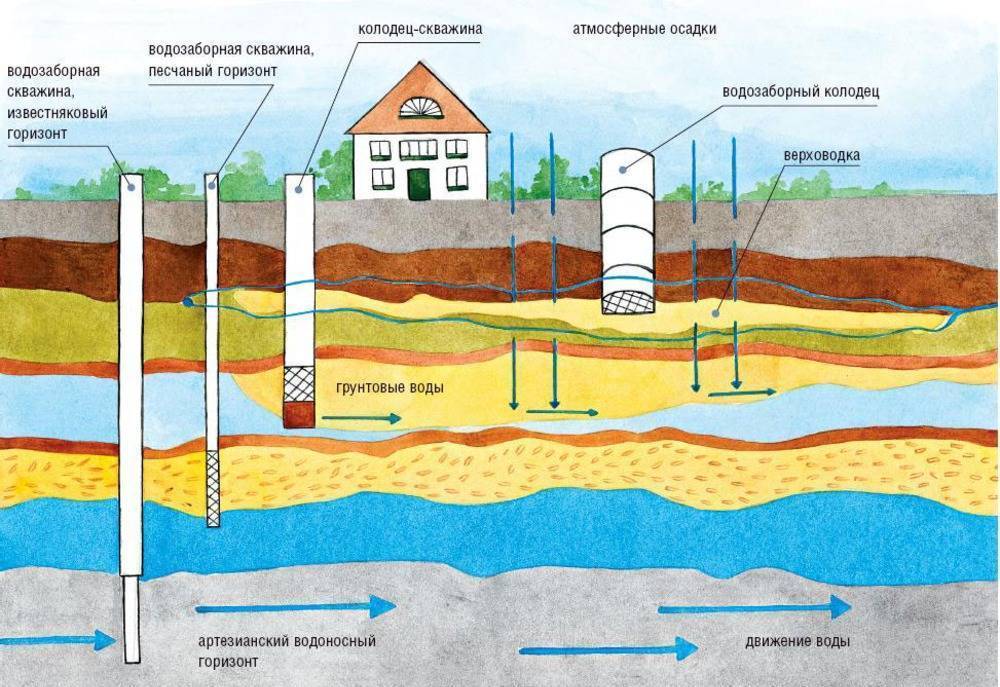
In order to be sure that it is in this place that it makes sense to drill the earth, it is necessary to study a number of factors. The presence of an aquifer is indicated by:
- surface waters;
- certain types of vegetation;
- geological features of the area.
For example, when studying your own site for where it is better to drill a well, you need to pay attention to the places where willows and sorrel, wild rosemary and birch, bird cherry and lingonberry grow. If small insects hover above the ground in dense vegetation, then the people also consider this a sign of groundwater.
To be sure for sure, it is necessary to carry out exploratory drilling. How to do it yourself is described in this video clip:
Additionally, you can verify the presence of an aquifer by resorting to the help of the so-called dowsers. They explore the territory of the site with special frames, after which they indicate specific places and even sometimes the thickness of the soil that separates the water from the surface of the earth.
new entries
How birch leaves can be useful for the garden 6 non-obvious reasons to plant hydrangea in the garden Why soda is considered a versatile and effective tool for the garden and vegetable garden
How to determine the place where to drill a well on the site?
It is very important, when choosing a territory for a drill, to determine the location of the well above the aquifer. If the place is determined incorrectly, then, after repeated attempts, it will not be possible to reach the source. In addition, the well must be located in such a place that later it would be possible to use it effectively and carry out timely repairs without any problems.
We must not forget that unhindered access of the drilling machine to the site where the well is planned to be drilled should be ensured. To give confidence that drilling should be carried out in the found place, some factors will allow. The presence of layers of water indicates that there are:
In addition, the well must be located in such a place that later it would be possible to use it effectively and carry out timely repairs without any problems. We must not forget that unhindered access of the drilling machine to the site where the well is planned to be drilled should be ensured. To give confidence that drilling should be carried out in the found place, some factors will allow. The presence of layers of water indicates that there are:
Location of aquifer.
- surface water;
- herbs, trees, shrubs;
- geological features of the place.
For example, when studying your site for the subject where it will be most profitable to drill a well, it is recommended to pay attention to the territory on which trees such as willow, mountain ash grow, and plants such as wild rosemary, sorrel, cowberry. If a place is found where small insects fly above the soil, then you can also drill here. This indicates that groundwater is present in this area.
The exploration process, the so-called exploration drilling, will make sure that there is groundwater.
This indicates that groundwater is present in this place. The exploration process, the so-called exploration drilling, will make sure that there is groundwater.
If a place is found where small insects fly above the soil, then you can also drill here. This indicates that groundwater is present in this place. The exploration process, the so-called exploration drilling, will make sure that there is groundwater.
Methods for locating a well on a site
The aquifer can dry up if several wells are connected to it
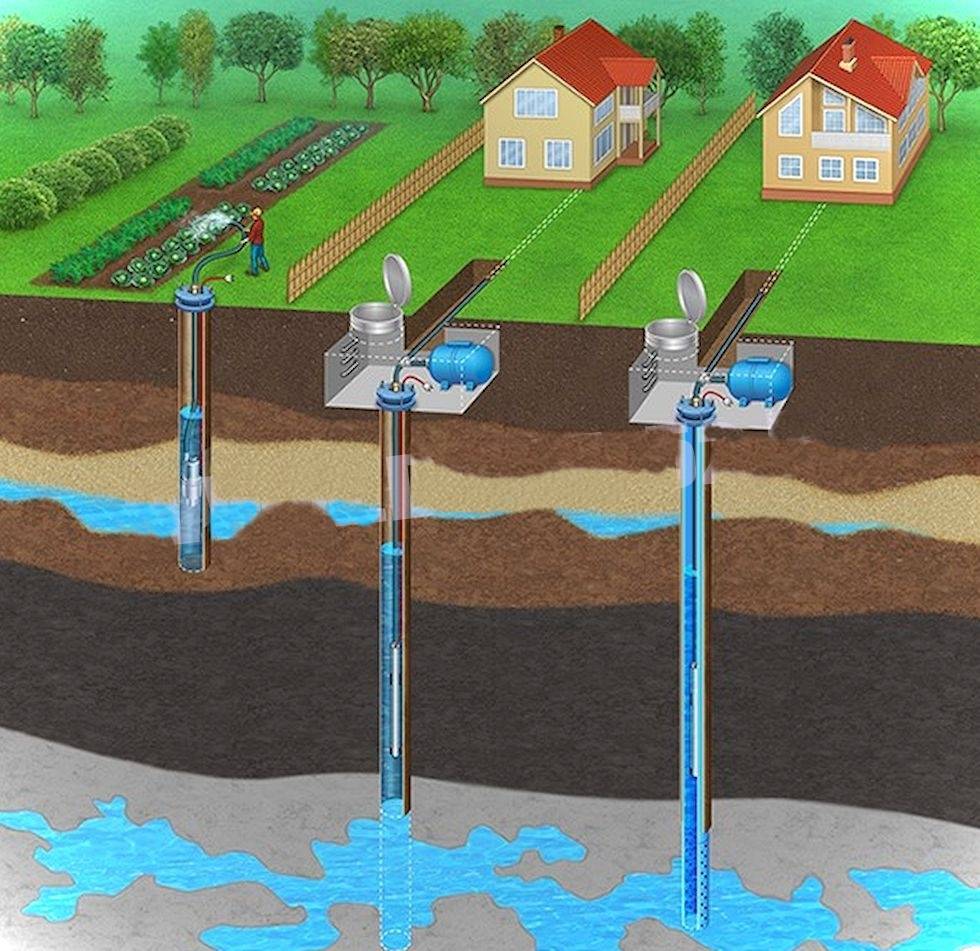
The first option is carried out even before the construction of the cottage. Here they act more on the principle of "where I found, I drilled there." Then they start planning the building, already based on what they have. The advantages of such drilling are as follows:
- the presence of a well in an almost heated basement, which means that the system does not freeze in winter;
- minimum distances for transporting water, which requires less powerful pumping equipment.
There are more cons here:
- constant moisture in the basement;
- noise of operating pumping equipment;
- difficulties with summing up special equipment if it is necessary to carry out repairs, flushing the source.
Thus, "internal" drilling of a well is not the best option. In addition, it strongly disagrees with sanitary requirements.
As for the location of the hydraulic structure outside the building, there are more advantages:
- ease of access for special equipment if maintenance is required;
- less noise from a running pump;
- the possibility of free watering the garden, vegetable garden without the need to pull a long hose from the basement;
- arrangement of a caisson or head in interesting landscape design options.
Of the minuses is the need to install a protective platform and insulate the upper part of the casing string in order to avoid freezing of the system in winter.
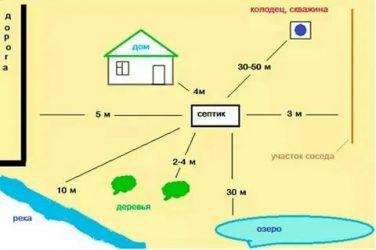
To choose a good place for drilling, it is important to consider the following parameters:
Depth of the aquifer
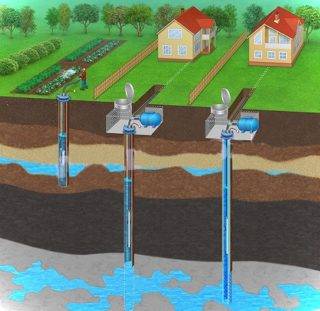
Moreover, if several neighboring structures have already been built on it, it is important to remove the new one as much as possible so that they are not all fed from one section of the horizon. Otherwise, the productivity of all wells will fall.
Presence of plantings in the proposed location of the source device
Here it is better to choose less landscaped (cultivated) areas.
Site relief. The well is not made in its lower part on the slopes, since during the rainy season a large amount of precipitation will flow here, and the caisson will be flooded.
Optimal well depth for drinking water
A person who has nothing to do with drilling thinks something like this: water starts from 10 meters and the deeper it becomes, the cleaner and cleaner it becomes, and starting from 40 meters (conditionally), it is as clean as possible. It is this water that is potable, and a well for such water is called artesian. This is where the classic question arises: “at what depth is drinking water?” Having learned such a depth from someone, people want to drill a fixed well of 70 meters, or 30 or 100 meters.
We also often hear similar words: “I don’t need a lot of water, I just need to water the plot.” Some people believe that if a well is drilled in a summer cottage and the water will go mainly for irrigation, then it is possible to drill shallow. This is a myth and let's find out why it's not true.
Selecting a point for drilling a water source
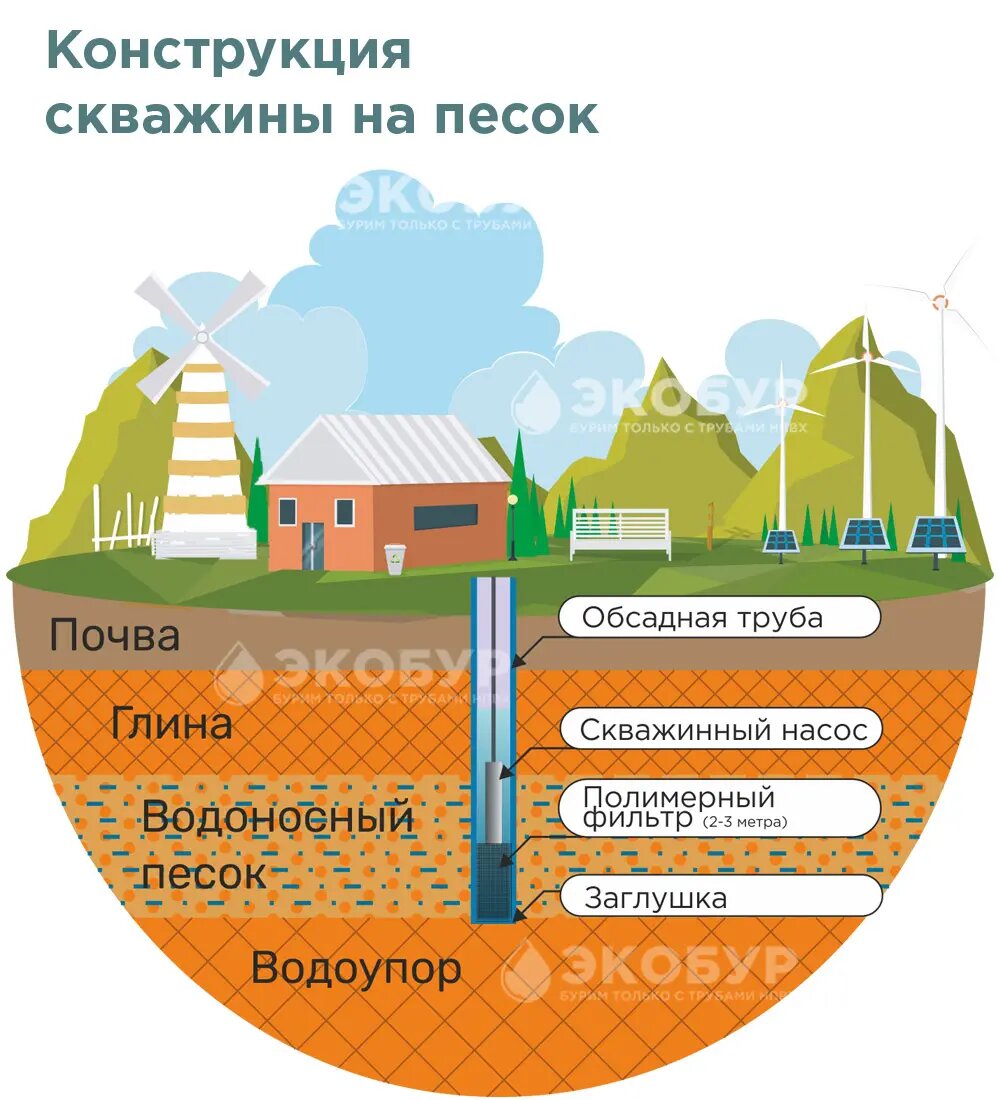
When choosing a location for drilling a well, the presence of aquifers is crucial. It is the depth of their occurrence that will depend on many factors: the footage of the mine, the method of drilling, the need for cementing and filtering, etc.
Let us consider in more detail what types of groundwater can serve as a water source for household needs and how to determine their depth.
Consider four types of groundwater that can become a source of water supply for your site:
- Verkhovodka is the upper aquifer, lying at a depth of up to 3-4 m. It is filled with melt and rain water, therefore it is characterized by a high degree of pollution. It is forbidden to use such water for drinking and watering of domestic animals; this water can be used for watering plants. During the period of drought and winter, perched water can simply disappear, so drilling of a well is never carried out before them.
- Groundwater at a depth of no more than 10 m. Such an aquifer is formed due to the fact that below it there are hydro-resistant soils that do not allow water to seep down. Ground water does not dry out even during a drought. The quality of such waters is quite high, in the presence of filtration systems and compliance with sanitary standards, in most cases they can be used for drinking.
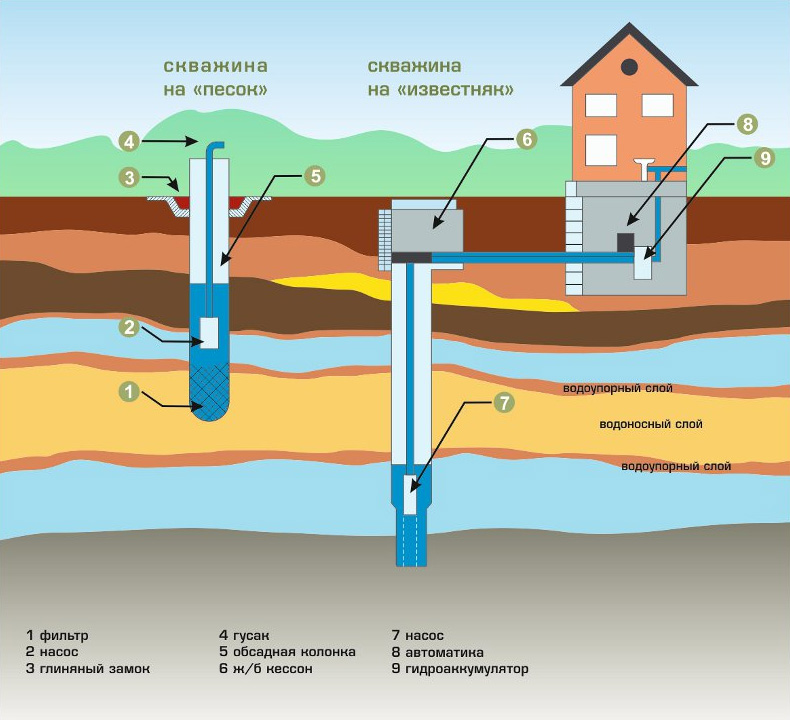
- Interstratal non-pressure waters. They lie at a depth of 10 to 110 m between two water-resistant layers. The formations can have a different structure and water permeability, for example, there can be sandy loam on top, and loam on the bottom. Water quality is usually high, depending on the specific characteristics of the site. Wells that open interstratal waters are most often found in private farms.
- Artesian waters. They are located at a depth below 40-110 m. Despite the fact that the water from an artesian well is clean and drinkable, not every site owner decides to drill such a well. To open the aquifer, you need to go through a considerable thickness of rock, and this is a very laborious process.
In addition, the device will require a package of permits. The fact is that for the device of an artesian well it is necessary to coordinate with the administration of the settlement and comply with the current legislation, including the Federal Law “On Subsoil”.
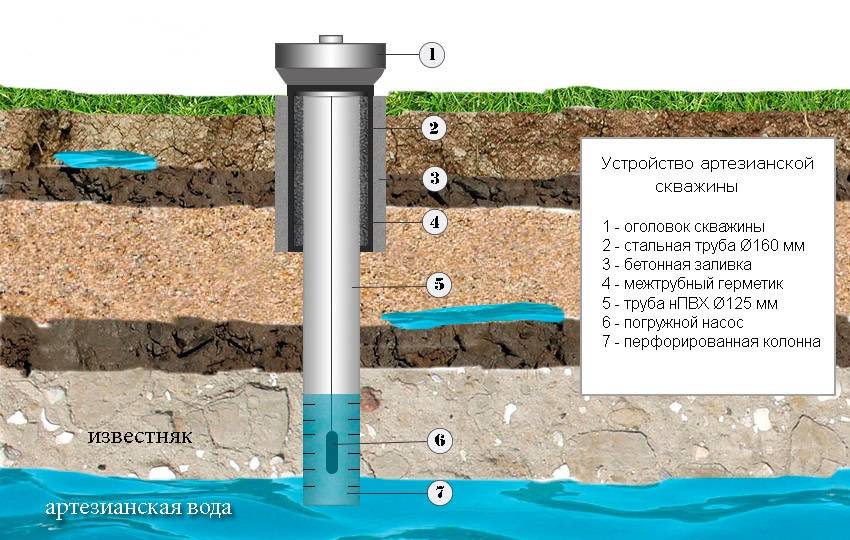
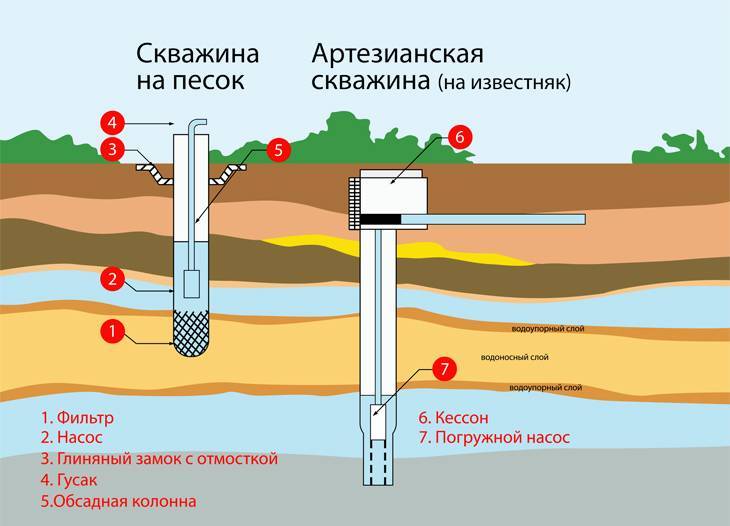
 Wells are drilled “on sand” and on “limestone”, as it is called in geological slang. The most watery and stable horizon is considered to be confined to cracks in limestone.
Manual well drilling
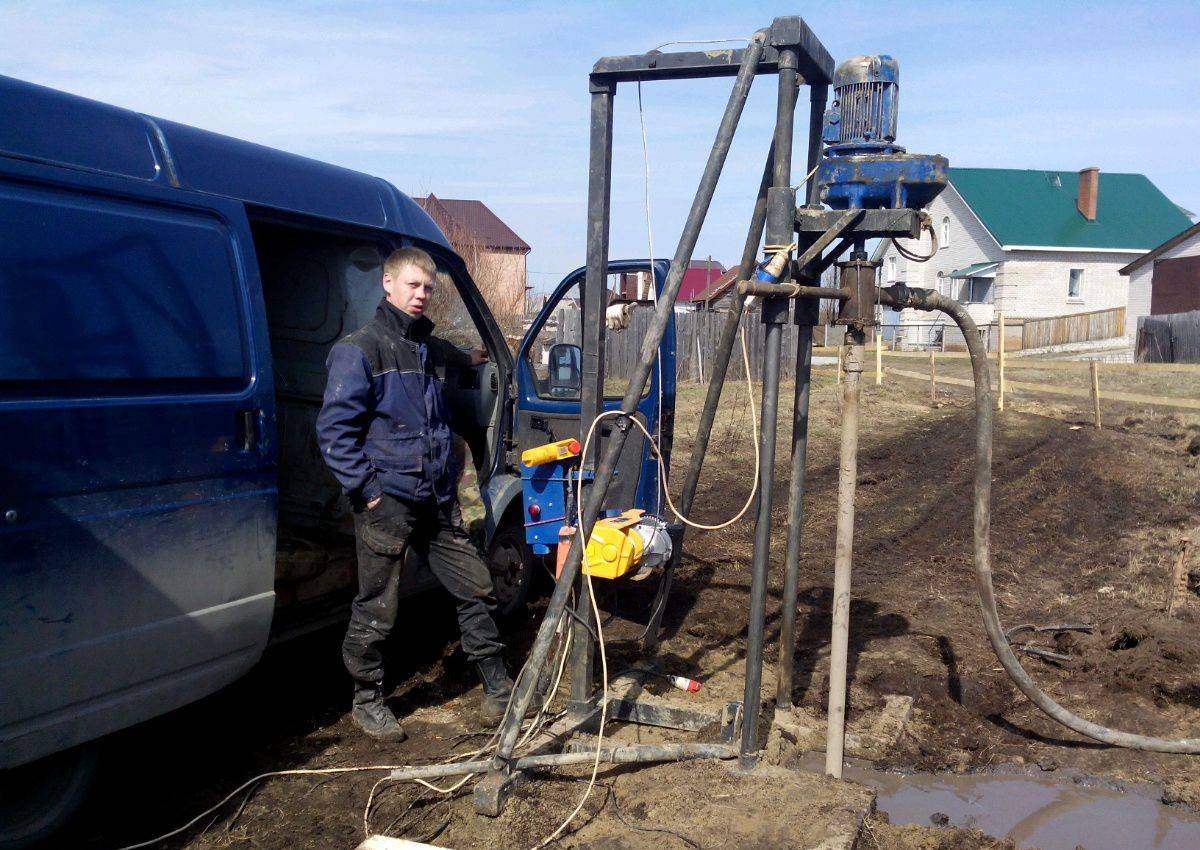
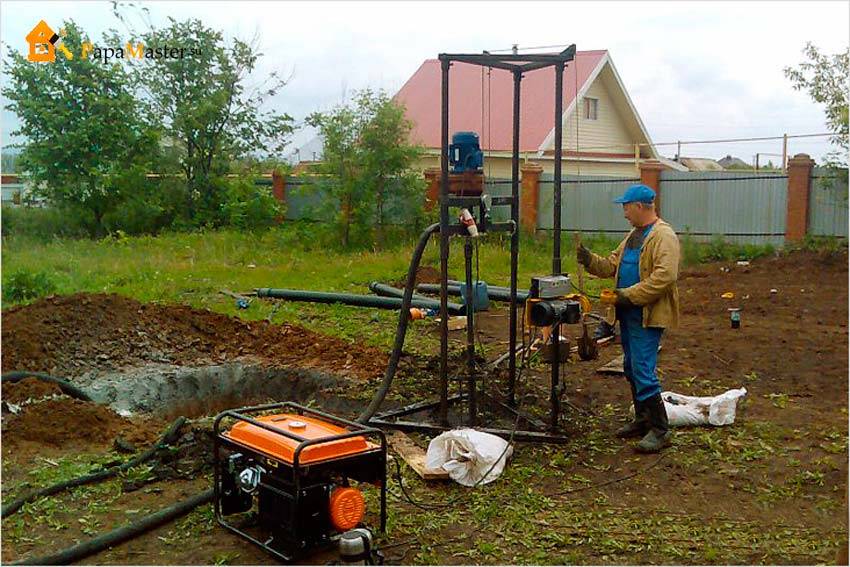
Most often, summer residents are interested in how to drill a well with their own hands, and not just a well. You will need such equipment for drilling wells as a drill, a drilling rig, a winch, rods and casing pipes. The drilling tower is needed for digging a deep well, with its help, the drill with rods is immersed and lifted.
rotary method
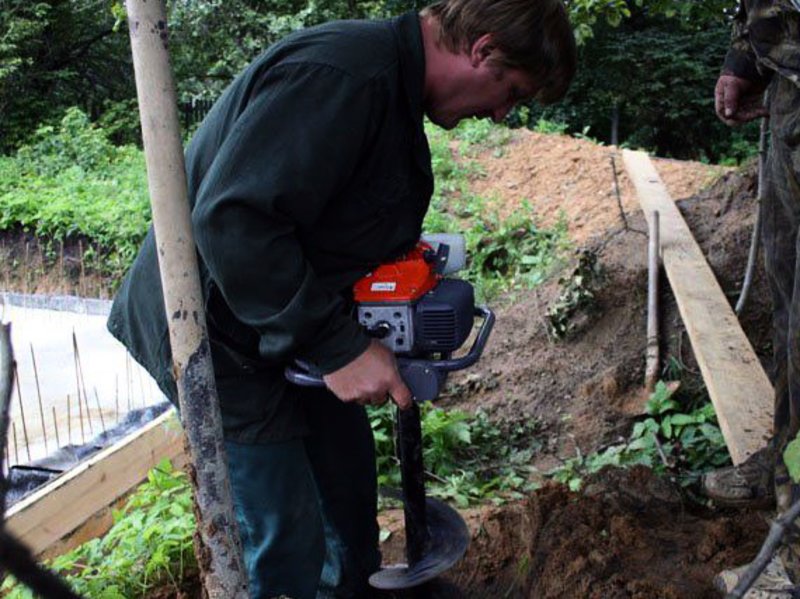
The simplest method of arranging a well for water is rotary, carried out by rotating the drill.
Hydro-drilling of shallow wells for water can be carried out without a tower, and the drill string can be removed manually. Drill rods are made from pipes, connecting them together with dowels or threads.
The bar, which will be below all, is additionally equipped with a drill. The cutting nozzles are made of sheet 3 mm steel. When sharpening the cutting edges of the nozzle, it must be taken into account that at the moment of rotation of the drill mechanism, they must cut into the soil in a clockwise direction.
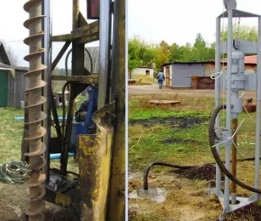
The tower is mounted above the drilling site, it must be higher than the drill rod in order to facilitate the extraction of the rod during lifting.After that, a guide hole is dug for the drill, about two spade bayonets deep.
The first turns of rotation of the drill can be done independently, but with a greater immersion of the pipe, additional forces will be required. If the drill cannot be pulled out the first time, you need to turn it counterclockwise and try to pull it out again.
The deeper the drill goes, the more difficult the movement of the pipes. To facilitate this task, the soil must be softened by watering. When moving the drill down every 50 cm, the drilling structure must be taken out to the surface and cleaned from the soil. The drilling cycle is repeated anew. At the moment the tool handle reaches the ground level, the structure is increased with an additional knee.
As the drill goes deeper, the rotation of the pipe becomes more difficult. Softening the soil with water will help facilitate the work. In the course of moving the drill down every half meter, the drilling structure should be brought to the surface and freed from the soil. The drilling cycle is repeated again. At the stage when the tool handle is level with the ground, the structure is extended with an additional knee.
Since lifting and cleaning the drill takes most of the time, you need to make the most of the design, capturing and lifting up as much of the soil as possible. This is the principle of operation of this installation.
Drilling continues until an aquifer is reached, which is easily determined by the condition of the excavated land. Having passed the aquifer, the drill should be immersed a little deeper until it reaches a layer that is located below the aquifer, waterproof.Reaching this layer will make it possible to ensure the maximum inflow of water into the well.
It is worth noting that manual drilling can only be used to dive to the nearest aquifer, usually it lies at a depth not exceeding 10-20 meters.
In order to pump out dirty liquid, you can use a hand pump or a submersible pump. After two or three buckets of dirty water are pumped out, the aquifer is usually cleared and clean water appears. If this does not happen, the well needs to be deepened by about another 1-2 meters.
screw method
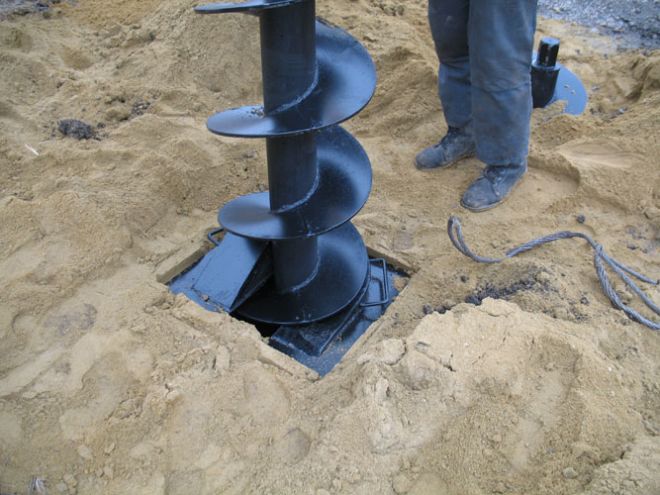
For drilling, an auger rig is often used. The working part of this installation is very much like a garden drill, only much more powerful. It is made from a 100 mm pipe with a pair of screw turns welded onto it having a diameter of 200 mm. In order to make one such turn, you need a round sheet blank with a hole cut in its center, the diameter of which is slightly more than 100 mm.
Then, a cut is made at the workpiece along the radius, after which, at the place of the cut, the edges are parted in two different directions, which are perpendicular to the plane of the workpiece. As the drill sinks deep, the rod on which it is attached increases. The tool is rotated by hand with a long handle made of pipe.
The drill must be removed approximately every 50-70 cm, and due to the fact that the more it goes deep, it will become heavier, so you will need to install a tripod with a winch. Thus, it is possible to drill a well for water in a private house a little deeper than the above methods.
You can also use the manual drilling method, which is based on the use of a conventional drill and a hydraulic pump:
How to check the depth of the well after drilling, so as not to be deceived
And in the end, let's move on to the most important point, how to verify the words of the drillers and find out how many meters they actually drilled. After all, it is generally accepted that a priori they want to deceive you.
After the drilling has been completed, the drilling crew hands over the well to you and makes a depth measurement. You must be present at this process, because it is you who sign the act of work performed and if something is wrong, then there will be no one to present claims.
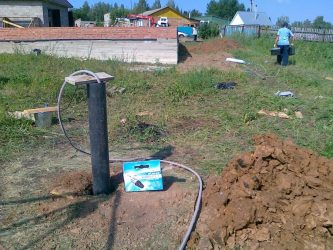
Measurements are made by drillers with their drilling tools, namely drill rods, which have the same length (pictured)
The bars are alternately lowered to the bottom, a mark is made on the last bar, then they are taken out and laid out. Then take a tape measure and measure the length of the rod and multiply by their number + part of the latter. Everything is simple. You have the right to measure at least every barbell.
As you can see in the photo, the rod is rigid metal and even if you want, it is impossible to lower more than necessary into their well. This is the simplest and most accurate method of measuring the depth of the well
You must be present at this process, because it is you who sign the act of work performed and if something is wrong, then there will be no one to present claims.
Measurements are made by drillers with their drilling tools, namely drill rods, which have the same length (pictured). The bars are alternately lowered to the bottom, a mark is made on the last bar, then they are taken out and laid out. Then take a tape measure and measure the length of the rod and multiply by their number + part of the latter. Everything is simple.You have the right to measure at least every barbell.
As you can see in the photo, the rod is rigid metal and even if you want, it is impossible to lower more than necessary into their well. This is the simplest and most accurate method of measuring the depth of the well.
Therefore, when a well is handed over, come and check the depth so as not to do what we will write about later.
Practice shows that many do not trust this or were not there when the well was commissioned and are simply sure that they were deceived. Therefore, having received a working well, they begin experiments, sometimes right on the day the drillers leave.
-
Classic case #1.
After reading articles on depth measurement (from theorists), you decide to lower a hammer, ax or other heavy element into the well. Everything would be fine, but those who advise this method probably forgot that, at a certain depth (indicated in the passport), the well has a transition to a smaller diameter. Your hammer will rest against this smaller diameter and will not go further, you will decide that this is the bottom and consider that you have been deceived. -
-
Classic case #2.
Your hammer nevertheless entered this smaller diameter, plunges deeper and deeper into the water, the rope becomes heavy, and even if your object has sunk to the bottom, the rope itself stretches further under its own weight.
And it's good if you can pull your hammer back. It often happens that either the rope just breaks, or the hammer gets caught on something, you pull it and get a rope break, or you just can’t get your hammer back.
As a result, you lose the warranty, lose the opportunity to install the pump and get a new well that needs to be repaired.They will try to repair it for you, but for some money.
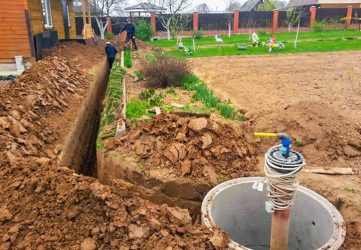
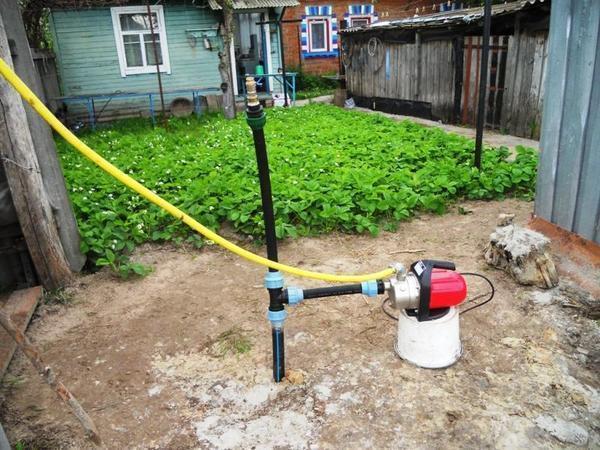
Sometimes the depth measurement service is provided by third-party workers whom you have called to install the pump. Their method is about the same - a load on a rope. The result is the same as with self-measurement.
You can learn more about cheating by drilling firms.
Time to drill
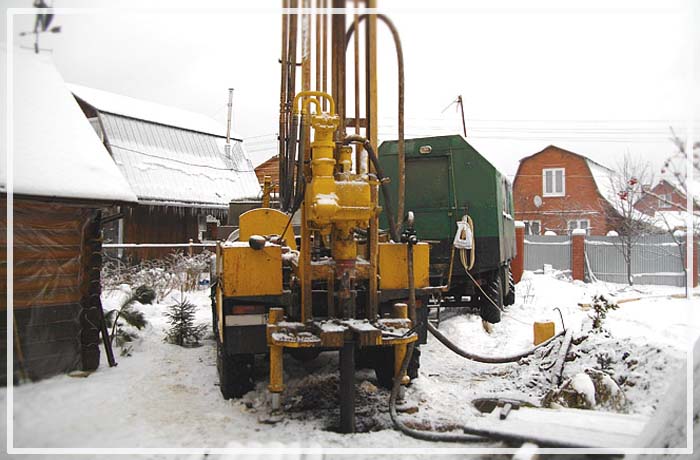
The second question is when better to drill a well? Each season has its own advantages and difficulties, so it is worth considering the seasons in detail:
In winter, you can drill a well for water, if you are not afraid of opening the frozen soil layer. The advantages of drilling in winter: no groundwater in the mine, the ability to use heavy equipment without the risk of soil damage, complete stabilization of the groundwater horizons, minimal risk of collapse of the mine walls.
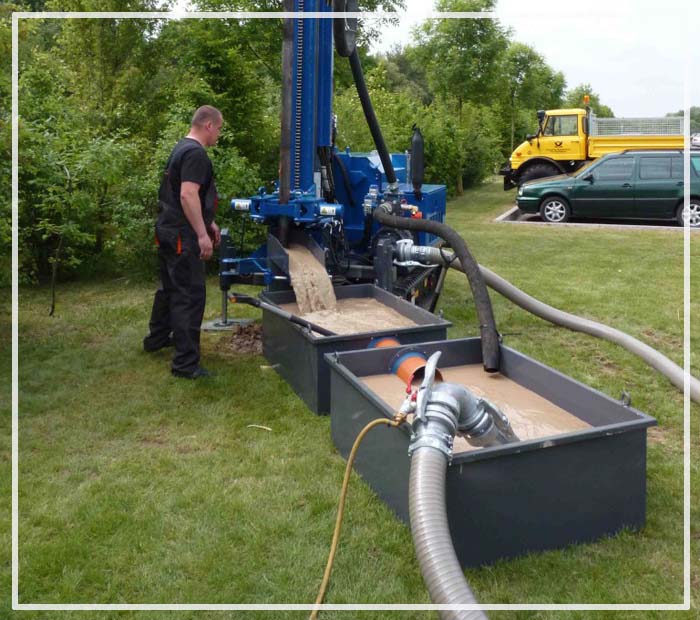
- In summer, you can drill any well for water. Dry land, stabilized soil, it is enough to simply determine the location of the aquifer. There is only one drawback - in the case of planning work by professionals, it will be difficult to find a team that knows a lot about business. Therefore, you need to either rely on your own strength or decide on an order and performers in the spring.
- Autumn work is not much worse than summer work, especially in the first warm months. But even small mines up to 25 m can be dug before frost. Therefore, even without having time to drill the well to the end and complete the full construction cycle, there is no need to rush, the initial stage of deepening into the ground will ideally fit in the warm season, and the final work can be completed in the winter.
Well in basement
Many homeowners consider placing a well in the basement of their home an ideal option.
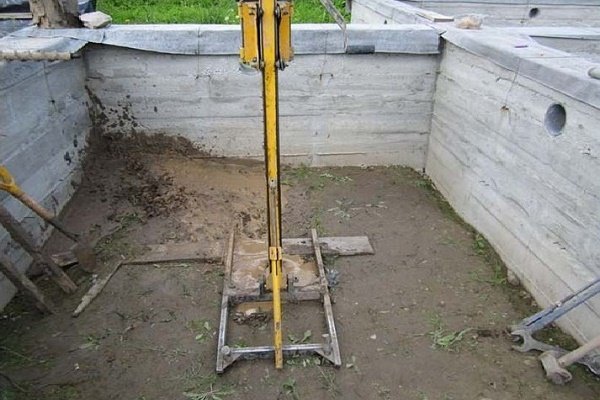
If a water intake device is planned inside a private house, then it is better to drill a well after the foundation has been erected
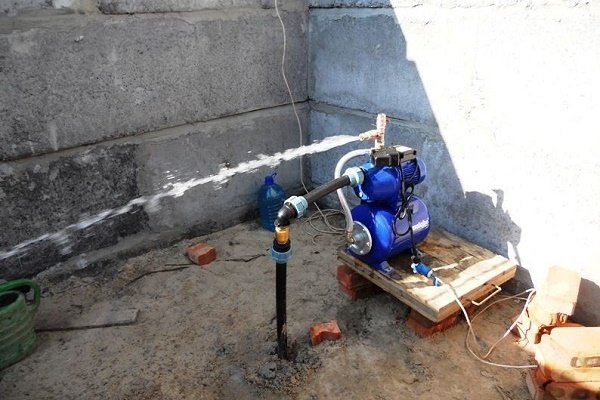
Despite the fact that the depth of the well eliminates the possibility of undermining the foundation, the development should not be located near it. It is necessary to anticipate the possibility of accidents
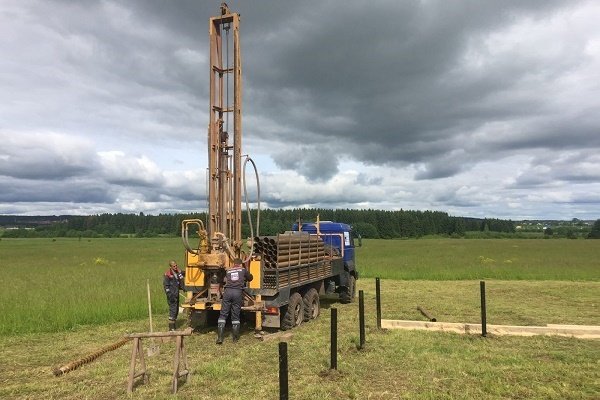
It is reasonable to combine the device of a bored pile foundation with the organization of a water supply source
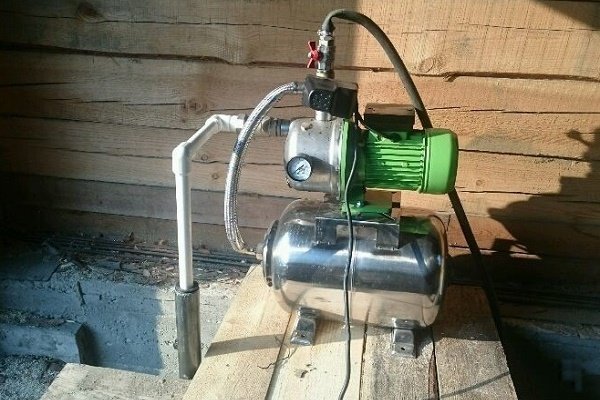
Needle well drilling can be carried out at any time in an already equipped room. This technology does not require extensive free space
Indeed, if the aquifer passes just in the area where the house is located or will be built, then this option will have many advantages:
- significant simplification and reduction in the cost of the process of arranging a water supply system from a well;
- the shortest route of the water supply;
- no need for insulation and construction of a caisson.
If you want to arrange a water intake within the house, it is necessary to drill a well at the construction site even before the foundation is erected. It is optimal to reflect in the project of the house the presence of an aquifer in the basement.
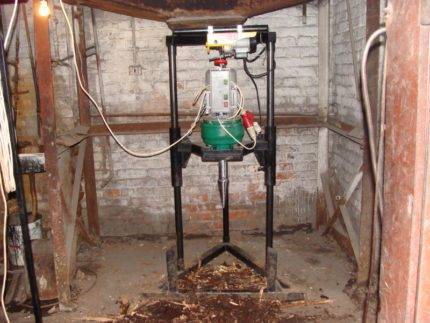
The well cannot be located under the living rooms, kitchen and bathrooms, the best place would be a basement under a closed veranda, pantry, boiler room
Disadvantages of locating an aquifer in the basement:
- sufficient space is required;
- difficulties with the installation of pumping equipment due to the inaccessibility of the well;
- problems in the process of washing with sewage removal;
- the possibility of soil erosion around the water source and the threat of subsidence of the foundation of the house.
Between the end of drilling and the beginning of the construction of the foundation, at least 1 month must pass.This period is necessary to identify and eliminate all problems associated with the operation of the well.
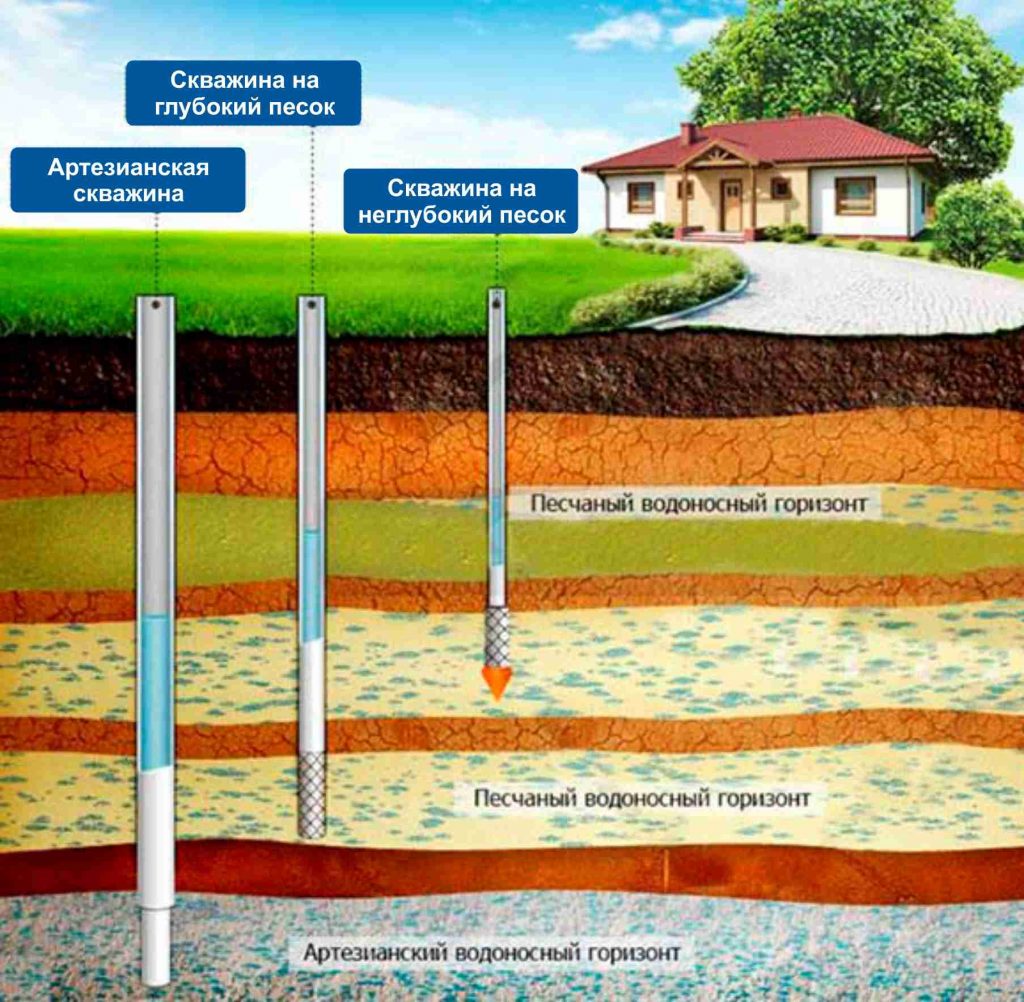
Keep in mind that there should be enough space around the well for its maintenance or repair. Minimum platform size for maintenance 3x4 meters.
How to find a respectable well construction contractor?
How to choose from a large number of companies the one who will do everything the right way?
To do this, when evaluating a potential contractor, you should find out whether he has his own equipment or whether he will rent it. Or maybe he will outsource the work to another firm?
It is worth contacting only those companies that do the entire cycle of work on their own, that is, on a turnkey basis. Then they initially work on a single project, understanding the nuances of each stage and bearing responsibility for each of the work performed.
Their opposite is dispatchers who take orders and pass them on to other performers. In the event of a decline in water quality, a well breakage or other problems, it will be difficult to find the last one. No one wants to take responsibility and a banal “kicking off” will begin.
It is not difficult to check the contractor "for lice": in the contract for drilling, development, installation of water treatment equipment, the contractor should be one company, and exactly the one you called.
Buy a well pump
Conclusions and useful video on the topic
Roller #1. Selection of a place for drilling an aquifer on the site:
Roller #2. Practical application of the dowsing method in the search for water:
Roller #3. A video about self-exploration using a primitive drilling method:
p> Choosing the right place for a well device is an important event on which the further operation of the water supply system of your site and house depends. It is imperative to take into account sanitary standards, the location of the foundation
It is desirable, if possible, to reduce the external route of the water supply, if automation of the system is expected.
It is imperative to take into account sanitary standards, the location of the foundation. It is desirable, if possible, to shorten the external route of the water supply, if automation of the system is expected.
Those who wish to share their own experience in determining the optimal location for a water intake device in a suburban area are invited to leave comments. If there are points of contention in the information provided, please ask questions. Please comment in the block below.



