- Boiler room in a private house in a separate room (built-in or attached)
- Special requirements for attached boiler rooms
- Rules and regulations for installing a gas boiler in a private house
- Ventilation for a boiler room in a private house
- Features of installation according to SNIP
- Requirements for individual rooms
- Basic requirements for the premises for the placement of gas boilers
- To the kitchen
- To the apartment
- To a private house
- To the boiler room
- Norms of the room for the installation of a gas boiler, where it is better to install the device
- Standards for installing the appliance in the kitchen of wooden and other types of houses
- Requirements for a separate boiler room
- Installation of a wall-mounted gas boiler
- General requirements for furnace buildings
- Boiler placement options
- How to hide the floor model?
- Location of the gas boiler
- Simple disguise rules
- "Invisible" boiler in the interior of the kitchen
- What to do in a small kitchen?
- Installation of a gas boiler in combined kitchens
Boiler room in a private house in a separate room (built-in or attached)
Separate boiler rooms for the installation of gas boilers with a power of up to 200 kW must be separated from the rest of the rooms by a non-combustible wall with a fire resistance limit of at least 0.75 hours. These requirements are met by brick, cinder block, concrete (light and heavy). The requirements for separate furnaces in a built-in or attached room are as follows:
- The minimum volume is 15 cubic meters.
- Ceiling height :
- with power from 30 kW - 2.5 m;
- up to 30 kW - from 2.2 m.
- There must be a window with a transom or window, the glass area is not less than 0.03 square meters per cubic meter of volume.
- Ventilation should provide at least three air exchanges in one hour.
If the boiler room is organized in the basement or basement, the minimum size of the boiler room will be larger: 0.2 m2 is added to the required 15 cubic meters for each kilowatt of power that goes to heating. A requirement is also added to walls and ceilings adjacent to other rooms: they must be vapor-gas-tight. And one more feature: when installing equipment with a capacity of 150 kW to 350 kW, a furnace in the basement or basement must have a separate exit to the street. Access to the corridor leading to the street is allowed.
It is not the area of \u200b\u200bthe boiler room that is normalized, but its volume, the minimum height of the ceilings is also set
In general, it is advisable to choose the size of a boiler room in a private house based on the convenience of maintenance, which, as a rule, far exceeds the standards.
Special requirements for attached boiler rooms
There are not very many of them. Three new requirements are added to the points above:
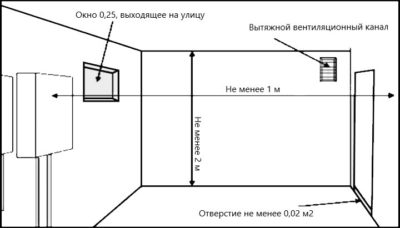
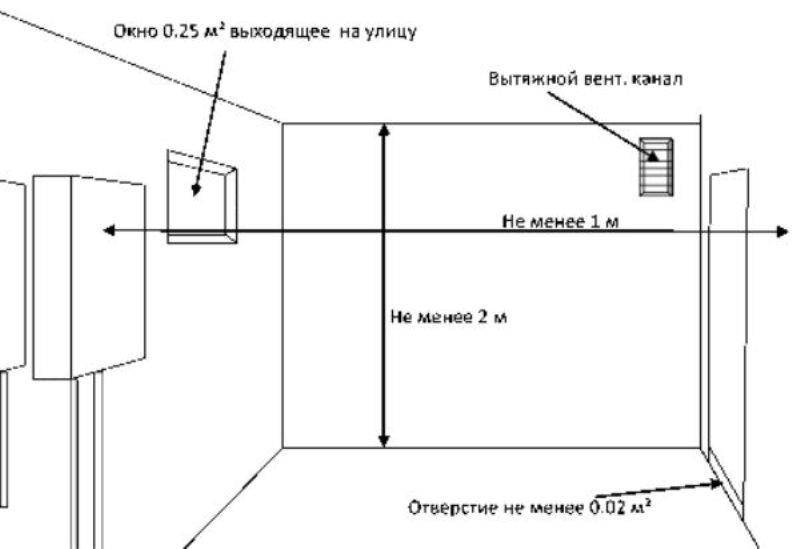
- The extension should be located on a solid section of the wall, the distance to the nearest windows or doors should be at least 1 meter.
- It must be made of non-combustible material with a fire resistance of at least 0.75 hours (concrete, brick, cinder block).
-
The walls of the extension must not be connected to the walls of the main building. This means that the foundation must be made separate, incoherent and not three walls should be built, but all four.
What to keep in mind.If you are going to arrange a boiler room in a private house, but there is no room of a suitable volume or the ceiling height is slightly lower than the requirements, you may be met and demanded in return to increase the glazing area. If you are planning to build a house, then you must meet all the requirements, otherwise the project will never be approved for you. They are also tough on the construction of attached boiler houses: everything must comply with the standards and nothing else.
Rules and regulations for installing a gas boiler in a private house
The choice of installation location for a gas boiler depends on its power:
- with a power of up to 60 kW, installation is possible in the kitchen (subject to certain requirements);
- from 60 kW to 150 kW - in a separate room, regardless of the floor (subject to the use of natural gas, they can be installed in the basement and basement as well);
- from 150 kW to 350 kW - in a separate room on the first or basement floor, in an annex and a separate building.
This does not mean that a 20 kW boiler cannot be installed in a separate boiler room. You can, if you want to collect all life support systems in one place. That's just the volume of premises there are requirements. The minimum size of a boiler room in a private house should be:
- for boilers with a power of up to 30 kW, the minimum volume of the room (not the area, but the volume) must be 7.5 m3;
- from 30 to 60 kW - 13.5 m3;
- from 60 to 200 kW - 15 m3.
Only in the case of installing a gas boiler in the kitchen, other standards apply - the minimum volume is 15 cubic meters, and the ceiling height is at least 2.5 m.
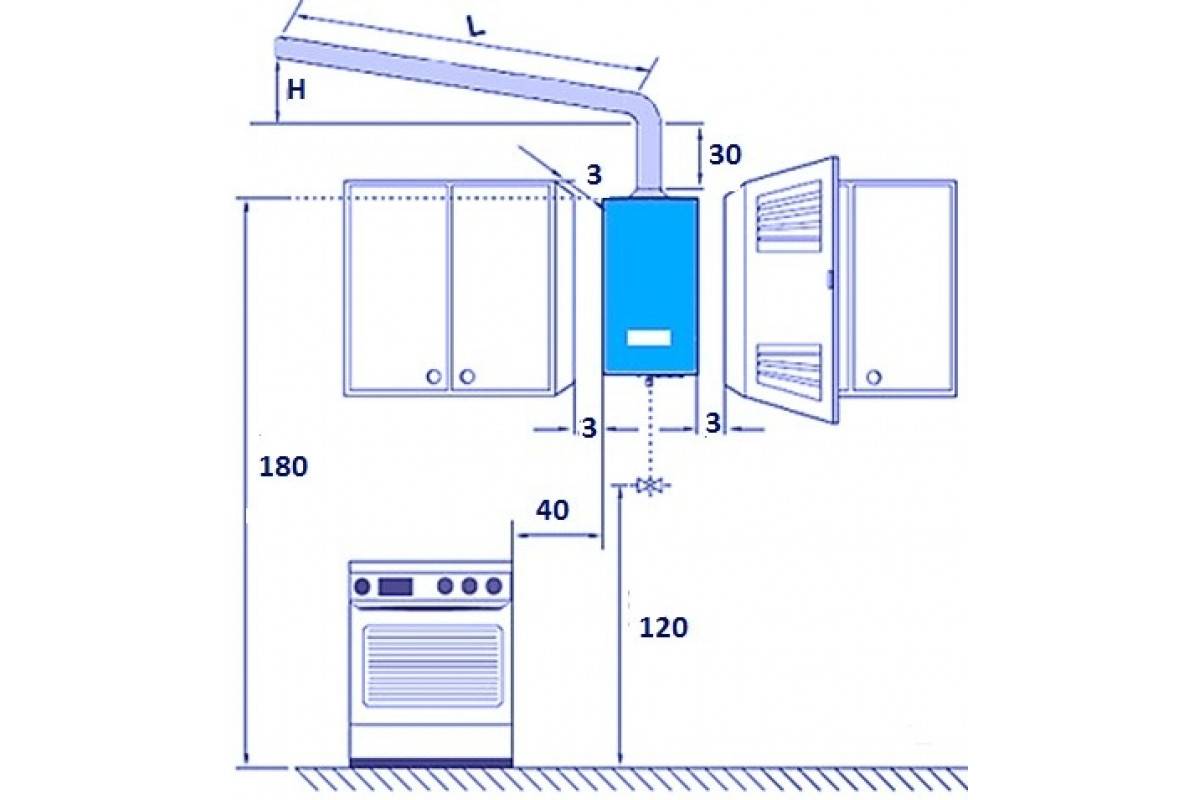
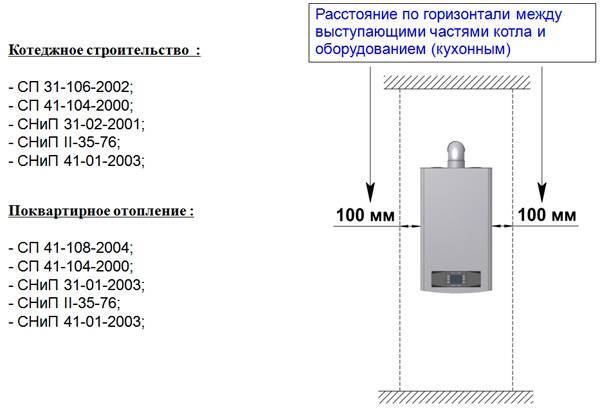
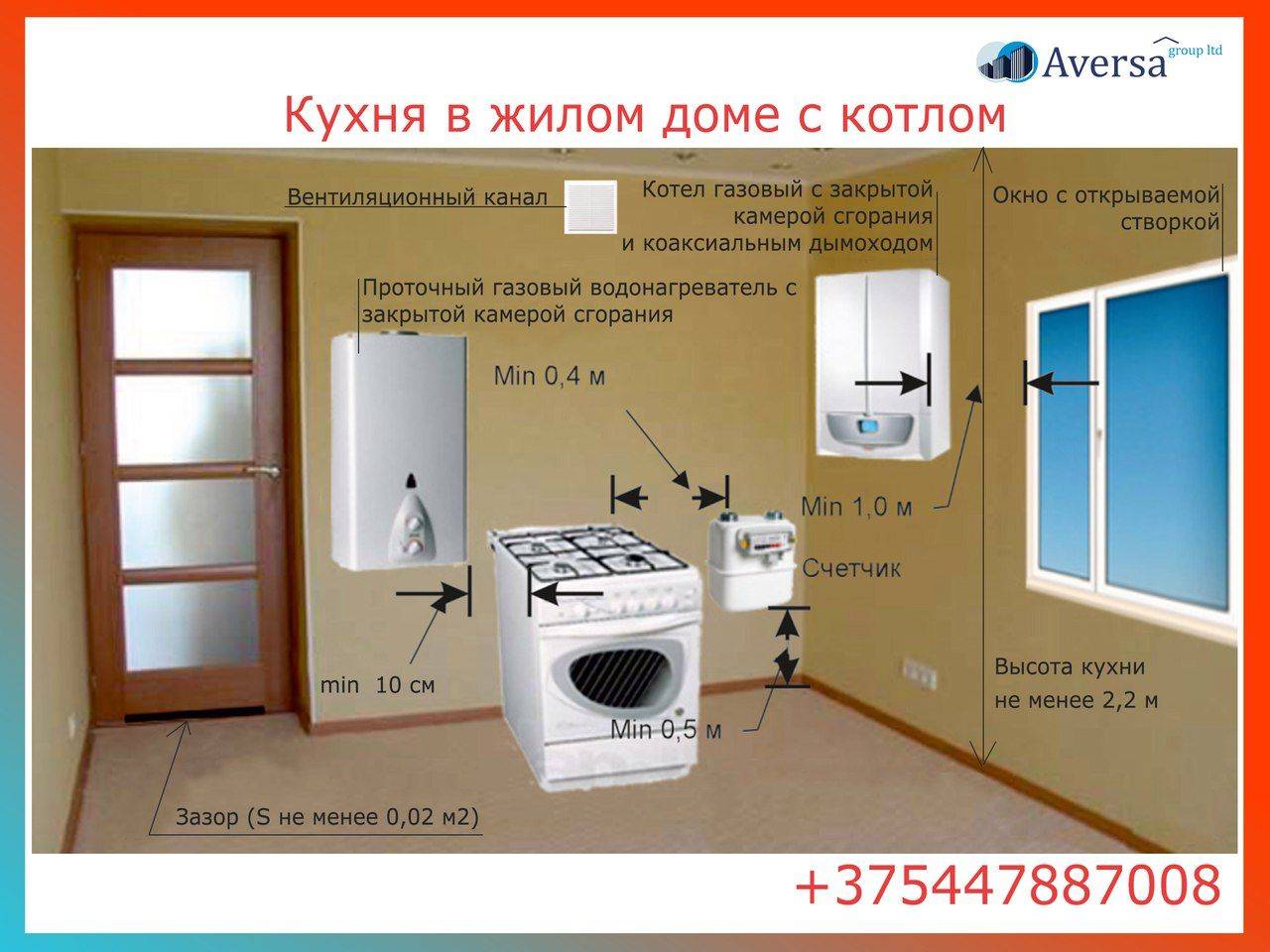
Installation option for a wall-mounted gas boiler - up to the wall at least 10 cm
For each variant of the premises for a gas boiler room, certain requirements are imposed. Some of them are common:
Any boiler room in a private house should have natural light. Moreover, the area of windows is normalized - at least 0.03 m2 of glazing should fall on 1 m3 of volume
Please note that these are the dimensions of the glass. In addition, the window should be hinged, open outward.
The window should have a window or transom - for emergency ventilation in case of gas leakage.
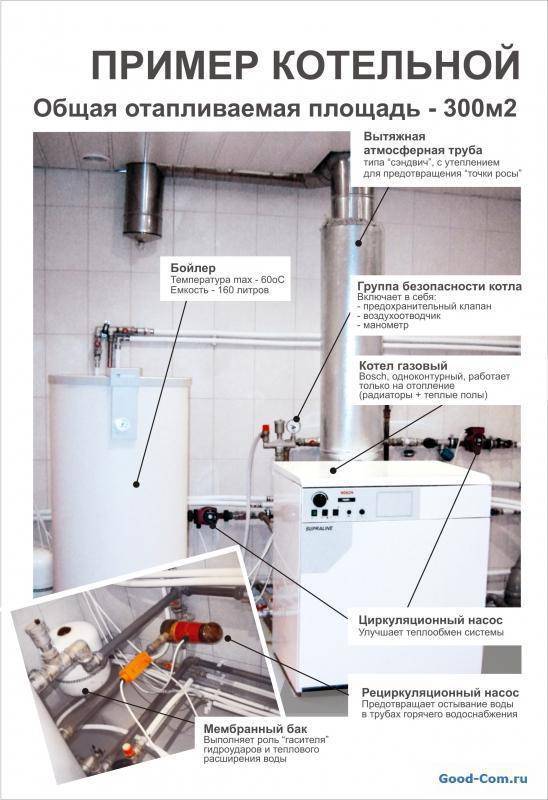
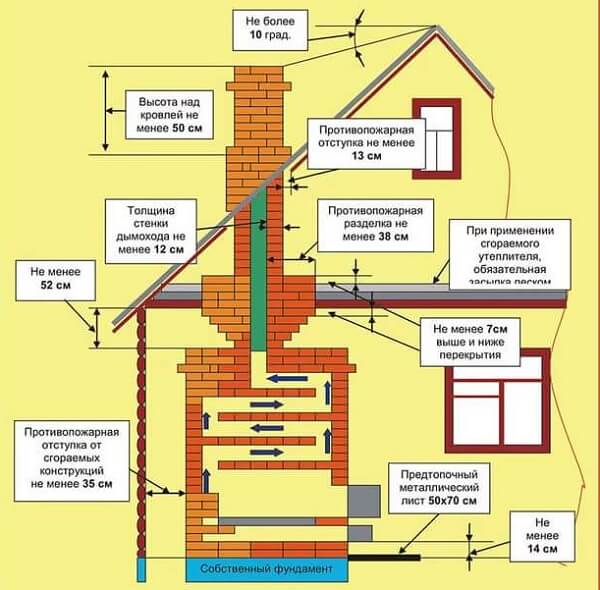
Mandatory ventilation and removal of products combustion through the chimney
The exhaust of a low-power boiler (up to 30 kW) can be led through the wall.
Water must be connected to the boiler room of any type (feed the system if necessary) and sewerage (heat carrier drain).
Another general requirement that appeared in the latest version of SNiP. When installing gas equipment for hot water supply and heating with a capacity of more than 60 kW, a gas contamination control system is required, which, in the event of a trigger, will automatically stop the gas supply.
If there is a boiler and a heating boiler, when determining the size of the boiler room, their power is summed up
Further requirements differ depending on the type of boiler room.
Ventilation for a boiler room in a private house
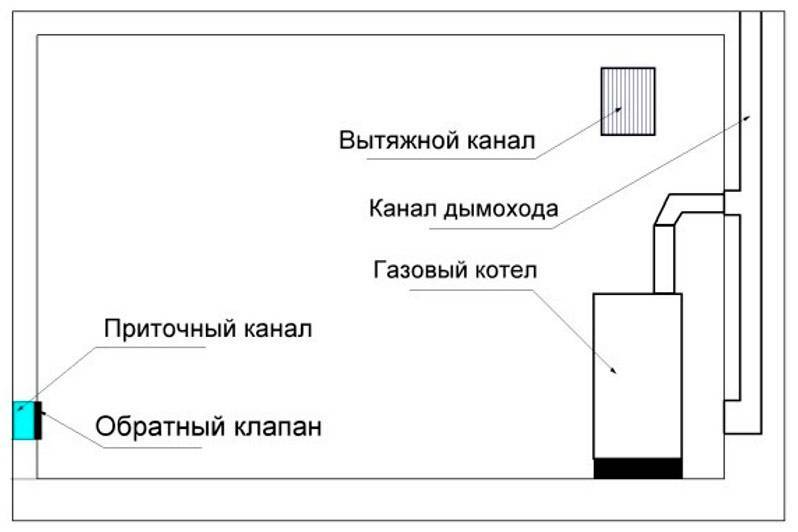
As already mentioned, the calculation of ventilation performance is calculated from the volume of the room. It must be multiplied by 3, add about 30% to the reserve. We get the volume that needs to be “pumped” per hour.
For example, a room 3 * 3 m with a ceiling height of 2.5 m. Volume 3 * 3 * 2.5 \u003d 22.5 m3. Three exchanges are required: 22.5 m3 * 3 = 67.5 m3. We add a margin of 30% and get 87.75 m3.
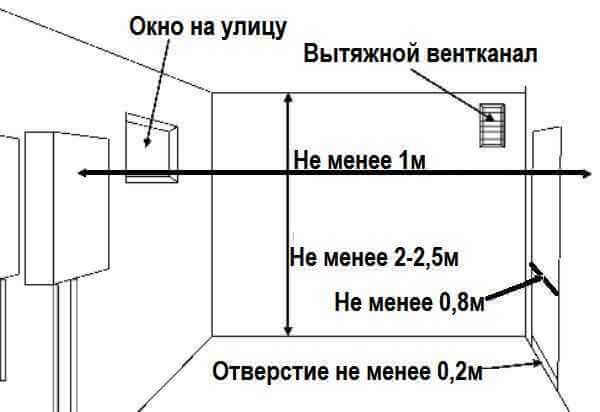
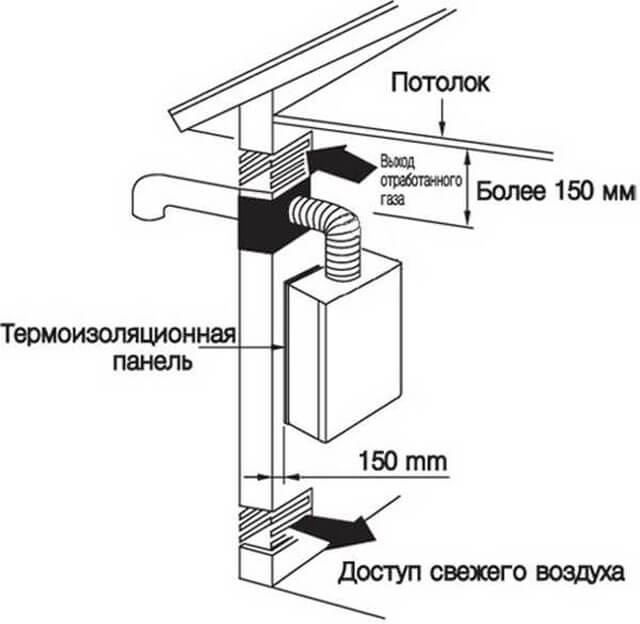
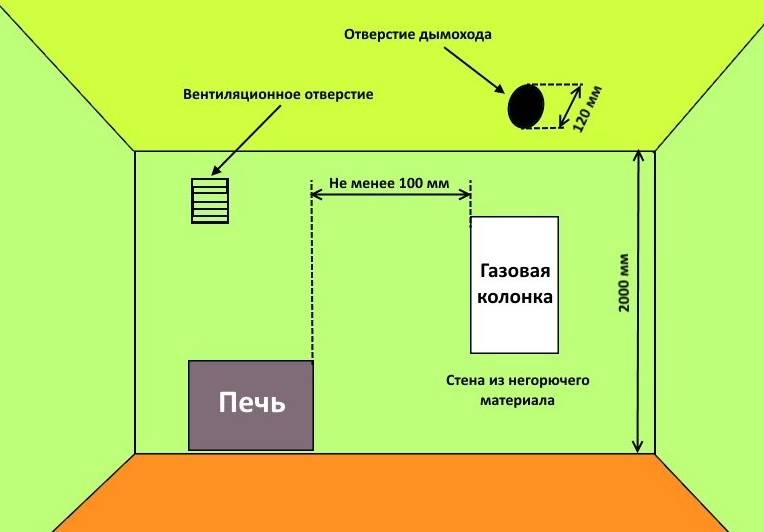


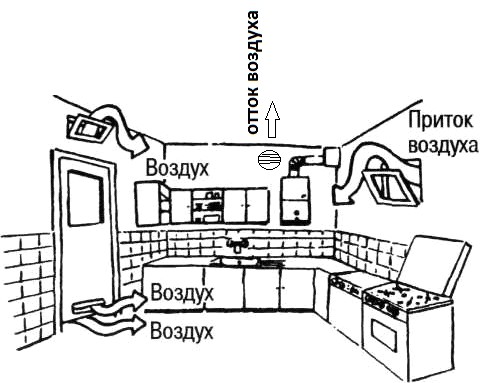
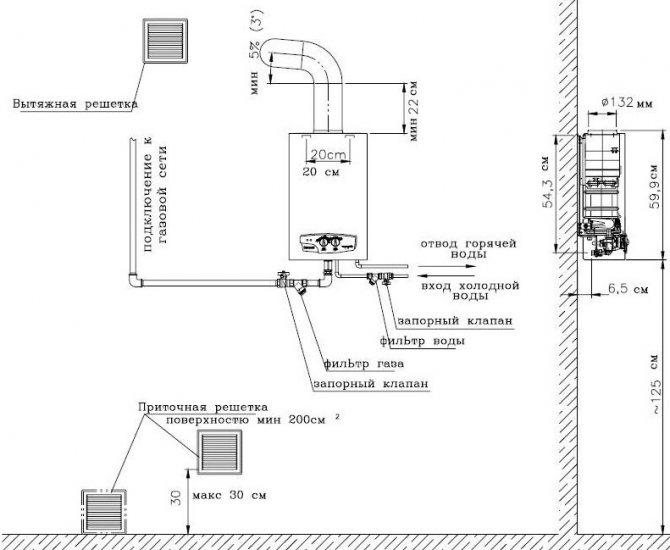
To ensure natural ventilation in the lower part of the wall, there should be an inlet, covered with a grate.The exhaust pipe must exit through the roof, it is possible to exit through the wall in its upper part. It is necessary to bring the ventilation pipe to the same height as the chimney.
Features of installation according to SNIP
In the absence of specific recommendations in the documents attached to the boiler, it is worth using the SNIP standards, according to which:
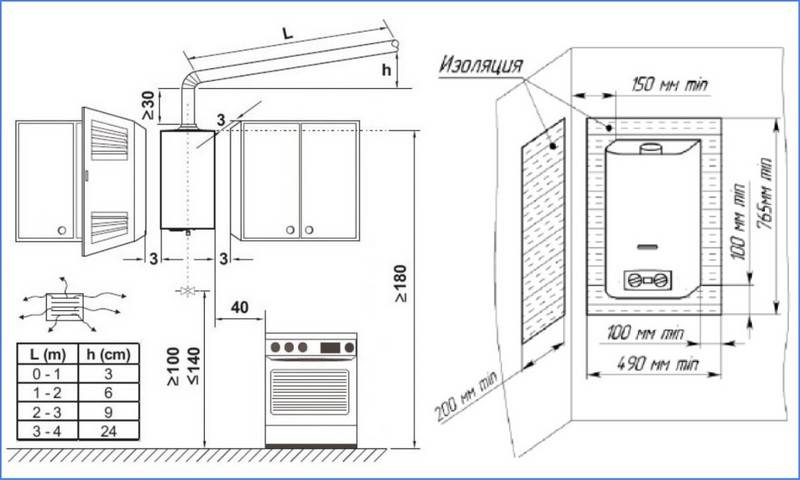
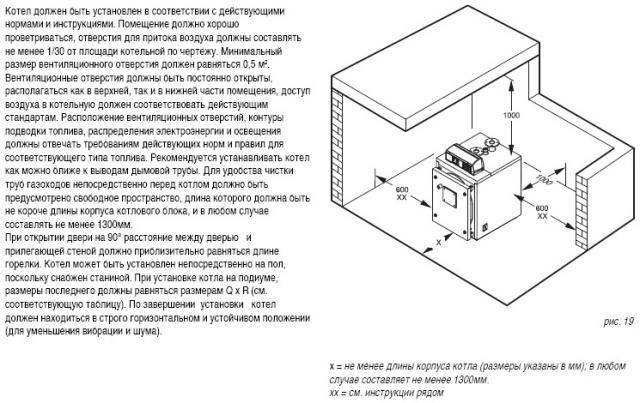
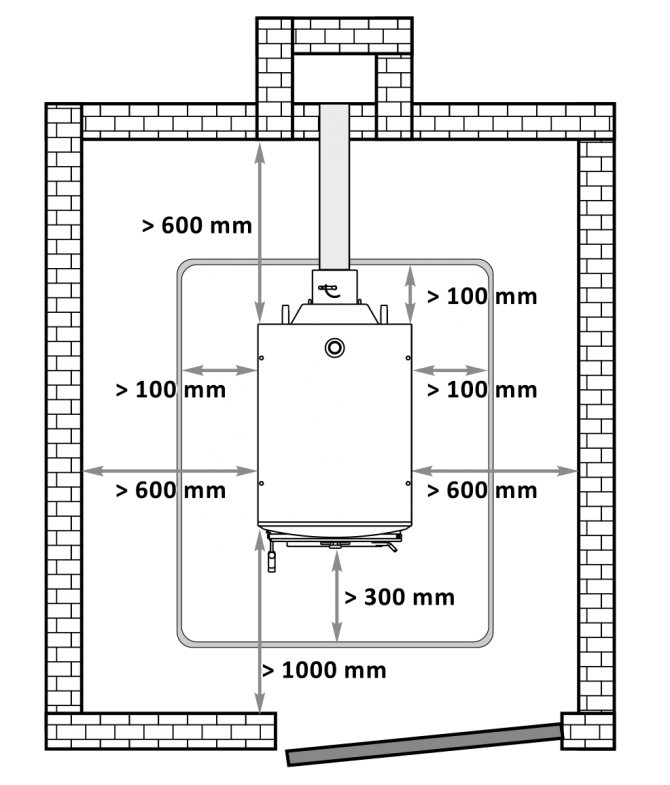
- Installation of gas boilers is possible only on walls made of non-combustible materials. The distance from the gas boiler to the wall must exceed 2 cm.
- In the event that the walls are still subject to the combustion process, then they must be protected with refractory material. The most common options are a layer of asbestos with a metal sheet, plaster over 3 cm thick, ceramic tiles or mineral wool cardboard.
- On the sides, the distance from the boiler to the wall must be at least 10 cm. If the walls are made of combustible materials, this distance increases to 25 cm.
- It is possible to install a gas boiler only on a substrate made of non-combustible material. In the case of wooden coatings, special supports are made of tiles or bricks, which provide the necessary fire resistance. The base for floor units must be at least 10 cm wider than the dimensions of the boiler itself.
Requirements for individual rooms
Boiler rooms, equipped in separate rooms, must meet a number of requirements that are very similar to the previous ones:
- The ceiling must be at a height of over 2.5 m;
- The area and volume of the room are selected depending on individual preferences, but the minimum allowable volume is 15 m3;
- Each wall of the boiler room must have a fire resistance of 0.75 hours and no flame propagation (this requirement corresponds to brick, concrete and building blocks);
- The requirements for ventilation are the same as when installing a boiler in the kitchen - three times the outflow and the same amount of air intake, increased by the amount of oxygen consumed during the combustion process;
- The room must have at least one window with a glazing area of 0.03 m2 per 1 m3 of the volume of the room.
When installing gas boilers with a power of over 150 kW, it should be possible to exit the boiler room directly to the street. Placing a gas boiler in an individual residential building suggests that the equipment cannot be adjacent to living rooms. In any case, the boiler room must be equipped exclusively with fire doors.
Basic requirements for the premises for the placement of gas boilers
The fire safety of the premises is ensured by the fire resistance of the walls and floor, as well as by reliable triple natural air circulation.
The minimum room volumes depend on the heat output of the units:
- Up to 30.0 kW - 7.5 m3;
- from 30.0 to 60.0 kW - 13.5 m3;
- over 60 kW - 15 m3.
For units with a power of more than 60 kW, 0.2 m3 of volume is added for each additional kW, for example, for a gas boiler with a power of 150 kW, the volume of the furnace room should be equal to:
150-60 = 90 x 0.2 + 15 = 33 m2.
To the kitchen
This room today is the most applicable for arranging gas boilers, especially the wall-mounted version. Many users try to close the boiler from public view, so they install it either in a special box or cover it with a decorative panel.
The boiler in the kitchen can also be beautifully placed
In order for the gas service not to impose a ban on such an installation, it is necessary to know and comply with the rules for placing boilers in the kitchen.
In terms of the main parameters: the height of the ceilings, the minimum area and the presence of three times the air circulation, the requirements for kitchens are similar to other furnace rooms.
To the apartment
Installing a gas heating boiler in an apartment is much more difficult, especially in a multi-storey building with access to central heating. The owner needs to be very reasoned in order to obtain permission from the local administration for such an installation.
Next, you will need to obtain technical specifications from all engineering services: city gas, heating network and balance holder of the house. Further, according to the general scheme, the project is carried out, coordinated with the architectural department of the local administration, and the boiler is installed by a specialized organization.
The rules allow the installation of boilers in multi-apartment residential buildings no higher than 3 floors and with a power of up to 30 kW. In kitchens integrated into the living room, installation of closed-type units is allowed.
All these actions will become impossible if the room for installing a gas boiler in an apartment does not meet the general requirements. The most difficult will be to make a through hole in the wall to connect the chimney pipe.
To a private house
In a private house, there are more opportunities for the safe installation of gas heating equipment. In accordance with current regulations, gas equipment is allowed only in rooms with good natural ventilation.
They may be located:
- On the 1st floor.
- In basements or basements.
- In the attic.
- In the kitchen units up to 35 kW.
- Thermal power up to 150 kW - on any floor, in an individual building.
- Thermal power from 150 to 350 kW - in extensions.
To the boiler room
The boiler room attached or equipped inside the house is built from fire-resistant building materials. The interior finish is also heat resistant.


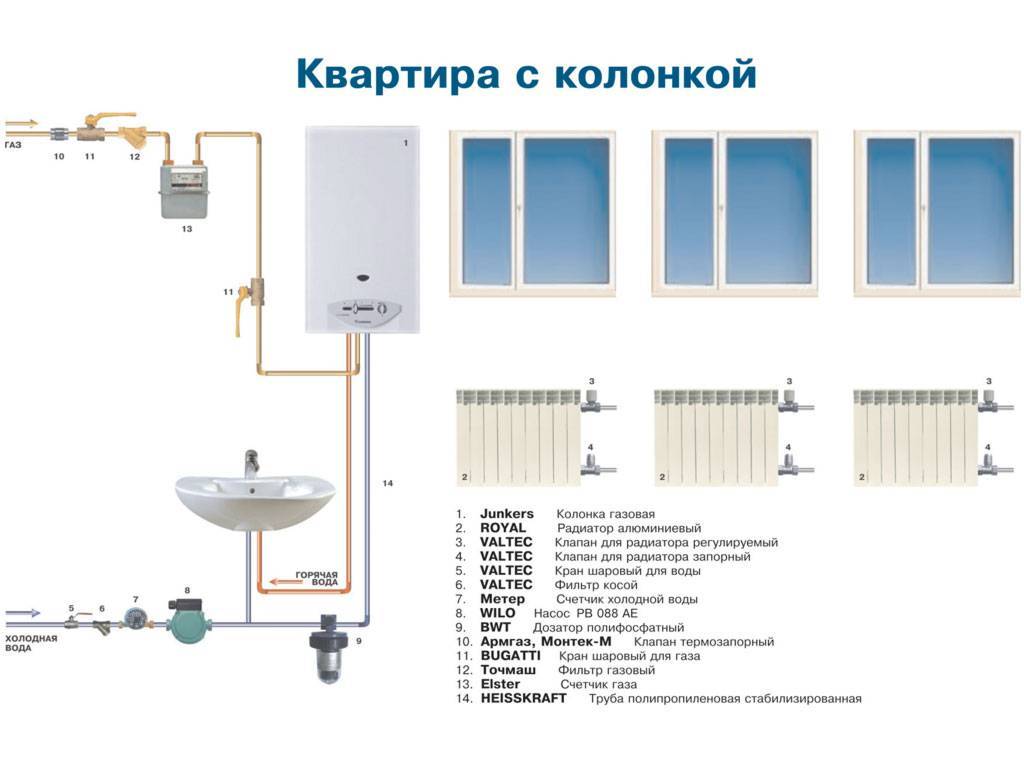


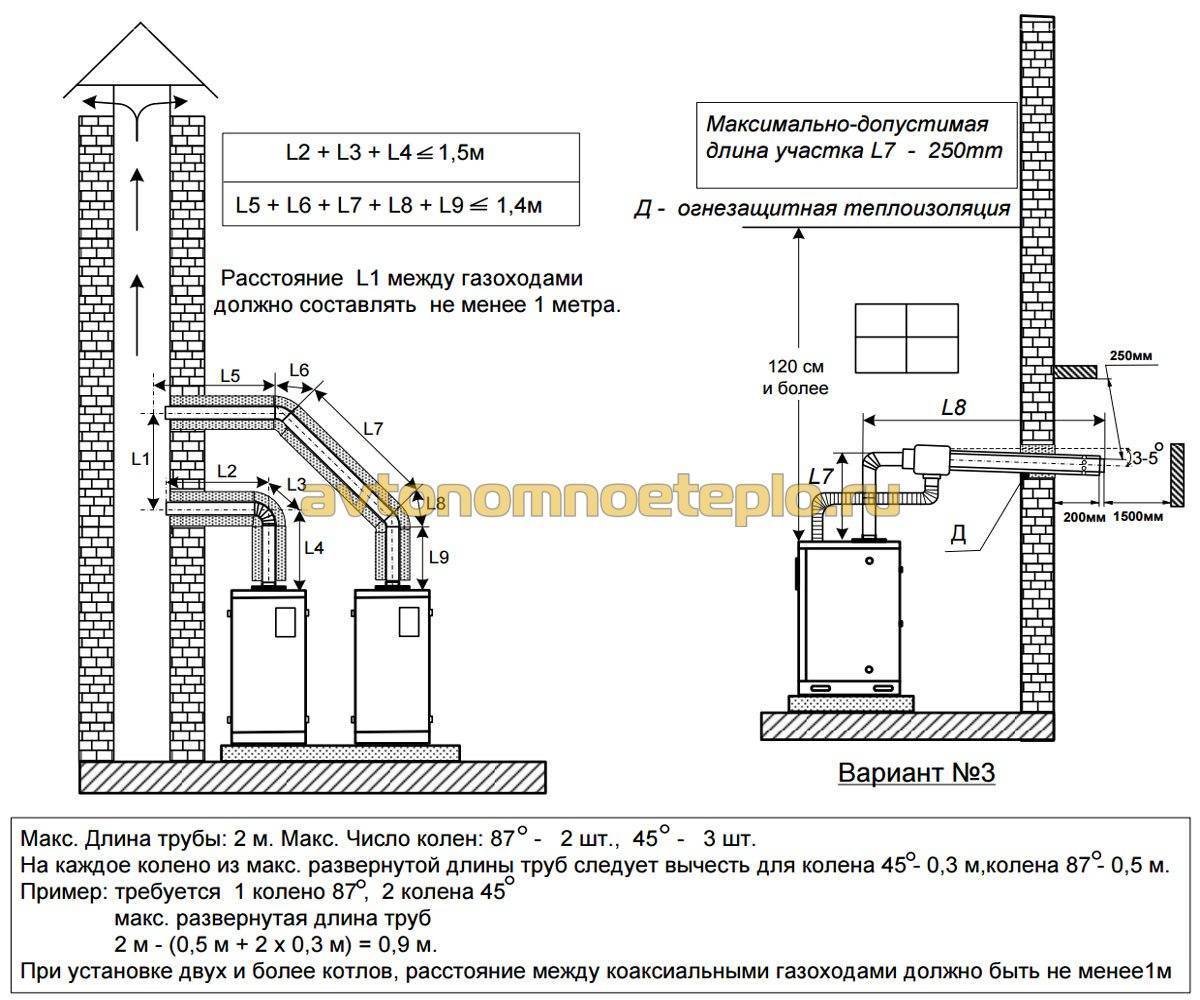
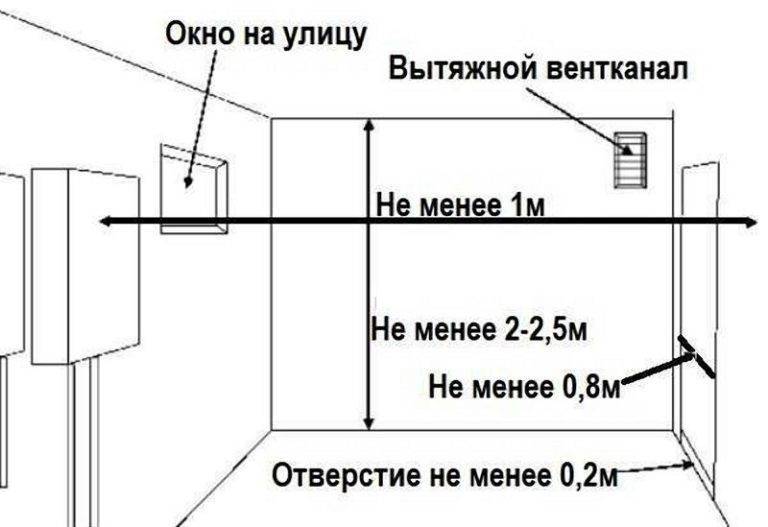
The gas boiler room must have:
- Individual foundation and concrete floor covered with ceramic tiles.
- Adjacency to a blank solid wall of an object.
- Be at a distance of 1 m from the window and door.
- Have natural ventilation with three air changes per hour.
- Have an opening window with a glazing area of 0.03 m2 per 1 m3 of the furnace volume.
- Ceiling height over 2.2 meters.
- Have a separate power supply with devices: sockets, switches, machines.
- For power below 30 kW, the volume of the furnace should be more than 7.5 m3, and for 30-60 kW - more than 13.5 m3.
- Air intake for the gas combustion process must be carried out through a coaxial chimney, a window, ventilation holes.
Norms of the room for the installation of a gas boiler, where it is better to install the device
The most stringent requirements are imposed on the premises where the installation of a gas unit is planned.
According to current regulations, it is allowed to carry out their installation in non-residential premises, equipped with high-quality ventilation.
In addition to the presence of ventilation, the area of \u200b\u200bthe room must correspond to the power of the unit and the design of the combustion chamber. When the boiler and gas column are installed together, their capacities are summed up.
Important! According to existing standards, it is allowed to install two gas devices in one room. The following standards have been established:The following standards have been established:
The following standards have been established:
- gas boilers with a power of less than 30 kW are allowed to be installed in rooms with a volume of at least 7.5 m³;
- boilers with a capacity of 30-60 kW require a space of more than 13.5 m³;
- for the installation of more efficient boiler equipment, the minimum volume is from 15 m³.
Standards for installing the appliance in the kitchen of wooden and other types of houses
For homeowners planning to place equipment in the kitchen, it is important to know that there are special regulations for this room:
- The area is more than 15 m².
- The height of the walls is at least 2.2 m.
- A window that opens outward, equipped with a window leaf. There should be 0.03 m² of window area per 1 m³ of the volume of the room.
Photo 1. Gas boiler located in the kitchen. The device is installed in a special cabinet, which is closed with a lattice door.
- If the building is wooden, then the wall adjacent to the boiler is covered with a fireproof shield. The size of the shield is determined so that it protrudes 10 cm beyond the boiler at the bottom and on the sides, and covers 80 cm of the wall from above.
- When choosing a floor model, a base made of fire-resistant material (brick, ceramic tile) is installed under it, protruding 10 cm on all sides of the boiler.
- In addition to the presence of exhaust ventilation, a gap is provided at the bottom of the door for fresh air to enter. It ensures constant air circulation.
- When installing the heating unit, a certain distance between the wall and the boiler must be observed (more than 10 cm).
Requirements for a separate boiler room
When erecting, for the placement of boiler equipment, an extension to the main building, the following conditions must be observed:
- the foundation of the extension is carried out separately from the main building;
- the design is made of fire-resistant materials, the same requirements are imposed on interior decoration;
- mortar is kneaded on sand;
- the foundation for installing the boiler is poured separately, after the completion of the extension;
- the base intended for the installation of equipment is 15-20 cm above the floor surface.
Further requirements correspond to the conditions for the installation of boilers in non-residential premises:
- a ventilation system that provides three air changes within an hour;
- the distance between the floor and the ceiling is at least 2.5 meters;
- the volume of the boiler room is more than 15 m³, a larger volume ensures the comfort of servicing all elements of the equipment;
- water is necessarily carried out, and a drain is arranged in the floor;
- all electrical outlets available in the room are grounded;
- daylight;
- when placing the boiler plant, a free approach to the unit is provided.
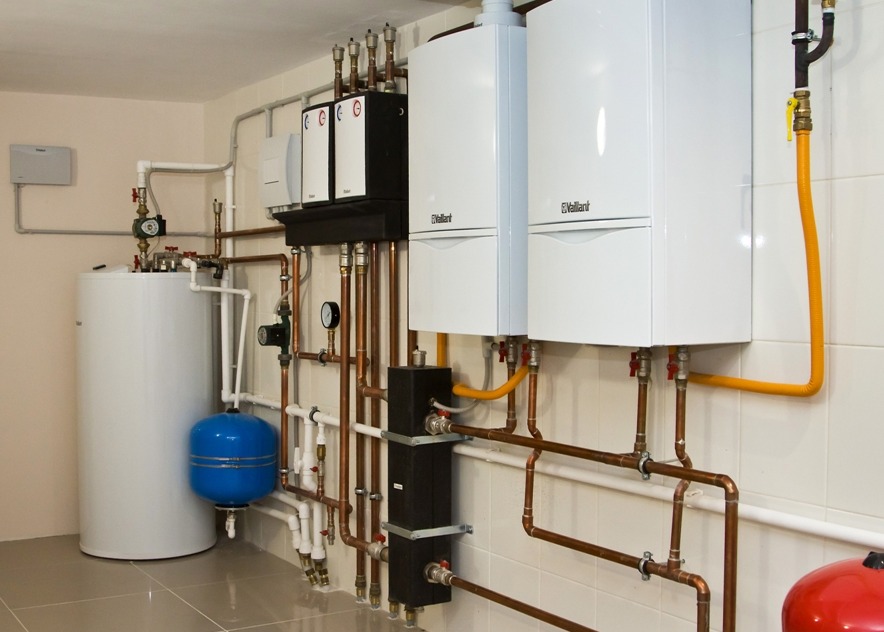
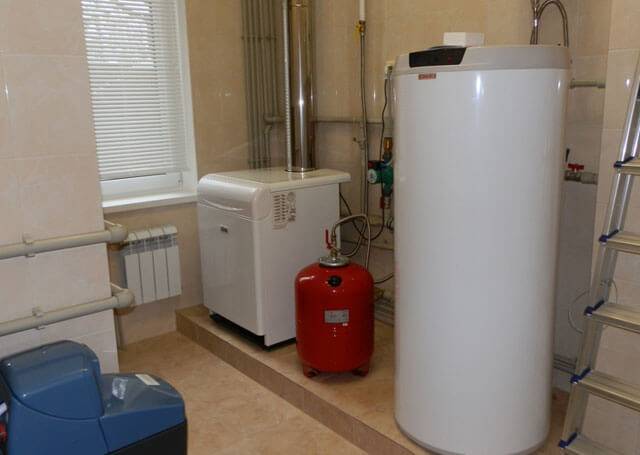
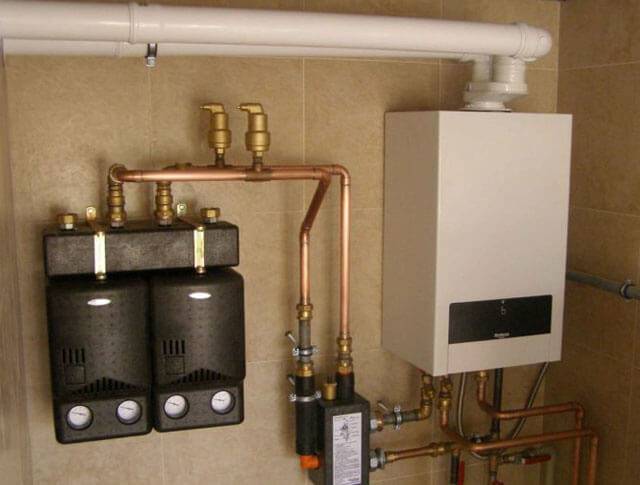
Photo 2. Boiler room with two gas boilers. The devices are installed on a special pedestal, access to sunlight is provided.
Certain requirements are also imposed on the equipment used in the operation of the boiler:
- gas pipelines are used only metal;
- the device is grounded using a separate ground loop;
- without a gas meter, an automatic valve that shuts off the gas supply in case of leakage, and a gas analyzer, the equipment is not accepted for operation.
Reference. Modern gas units are equipped with protective automation of varying complexity, which turns off the gas supply in case of malfunctions.
Installation of a wall-mounted gas boiler
Wall-mounted boilers are installed if the room does not have free space, and the power of the boiler itself is not too high.
Such boilers are mainly used for heating water and heating in high-rise buildings.

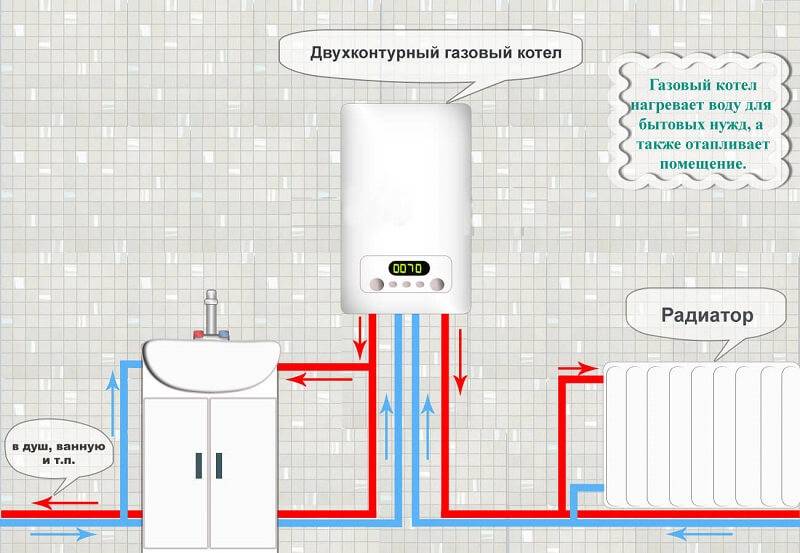
A wall-mounted gas boiler is able to create an autonomous heating system for a house with central heating, for this you only need to have a gas supply, and the room must comply with acceptable standards and requirements.
Wall-mounted boilers do not require a lot of free space, and can be installed next to other appliances.
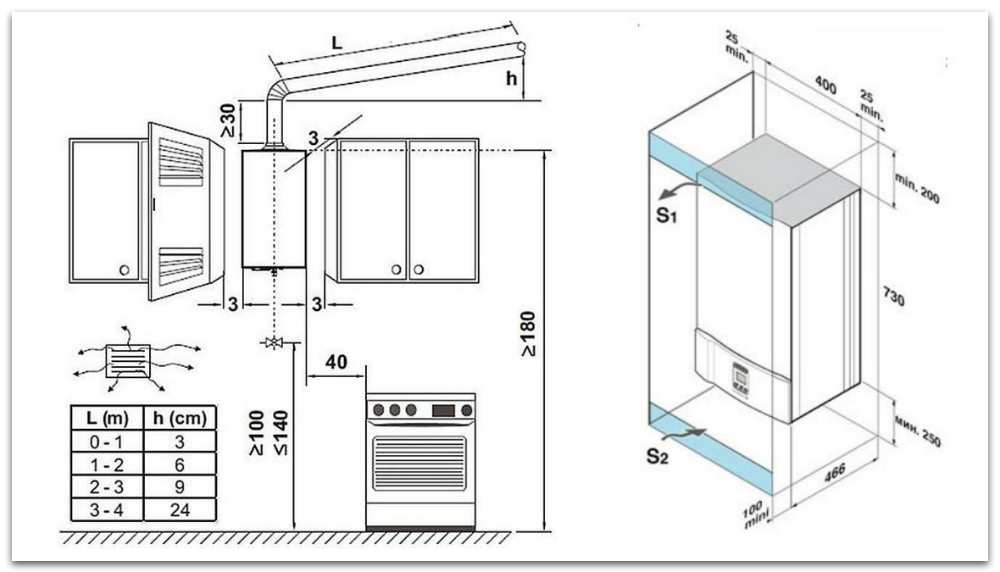
Installation of the equipment must be carried out at a distance of at least 20 cm from other devices, while the power supply must be nearby.
After purchasing a gas boiler, you need to check its completeness: the presence of instructions, brackets and mounting accessories.
Before direct installation, flush all pipes of the unit.
It is worth remembering that the wall must be strong and reliable enough to support the weight of the boiler.
The boiler is fixed with slats. Before connecting to the water supply, you need to remove the plugs installed on the sockets.
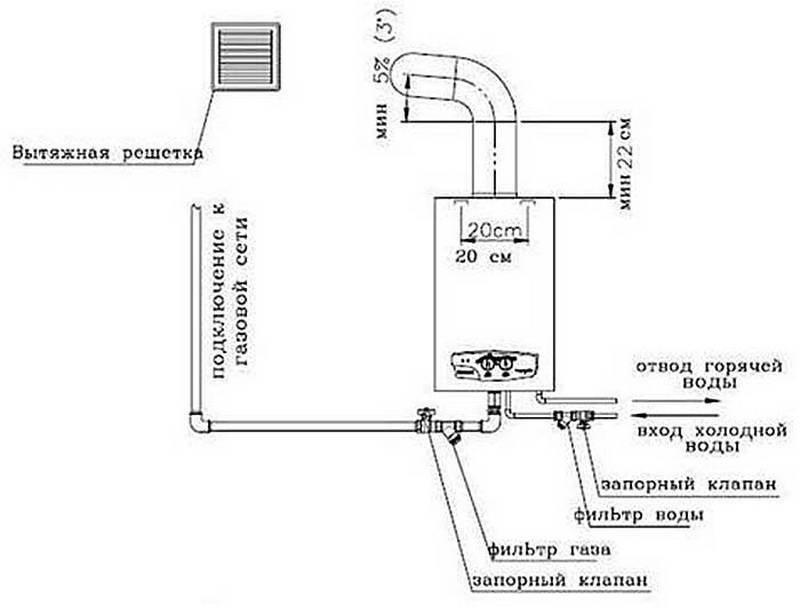


In order to avoid possible clogging of the condenser, an angle strainer should be installed at the water inlet.
Gas pipes must be connected only with a metal pipe, and it is imperative to use a paronite gasket.
General requirements for furnace buildings
To conduct a heating system in private homes, it is possible to use heating units of various types: gas, electric, solid fuel. Therefore, when choosing a building, the type of boiler is taken into account. But there are requirements common to all types of heating devices.
The boiler can be inside the house:
- on the attic or attic floor;
- in the basement;
- in the kitchen.
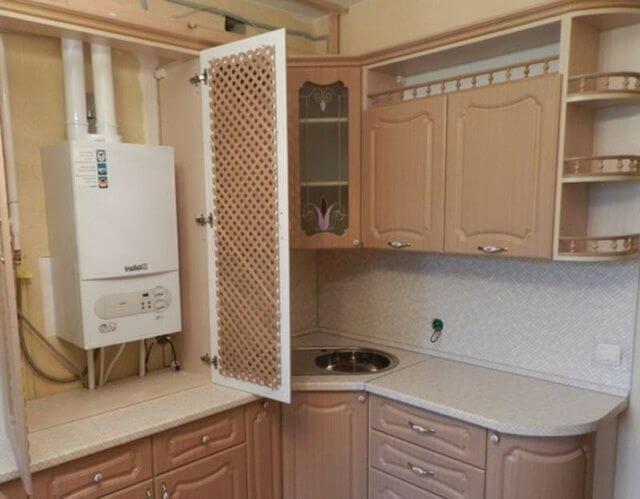
Boiler in the kitchen
The boiler room can be located in a stand-alone building, an extension or a stand-alone module (container).
The furnace compartment is being built taking into account the rules that ensure fire safety:
- The walls are constructed from fire-resistant material: concrete, brick, cinder block. Wall cladding with tiles is allowed.
- When installing a floor appliance, the floors are concreted or insulated with a metal sheet.
- When installing a wall-mounted device, a section of the wall is lined with ceramic tiles or sheathed with a sheet of metal.
- Storage of explosive and flammable substances is prohibited.
- Provides free access to the equipment to control the maintenance of devices.
- The door should open outward. Two doors are installed in the extension, so that one can get inside the structure, and the second one can go outside.
- Be sure to have natural lighting and a ventilation system.
It is advisable to start the construction of the boiler room with the preparation of the project.
It takes into account all the requirements that meet the following by-laws:
- SNiP (construction norms and rules) applicable to furnace equipment;
- set of rules (SP), which regulates the design of individual heating systems.
Boiler placement options
If you choose a wall-mounted boiler in accordance with the color scheme of the kitchen, then there is no need to hide it. Easiest to pick:
- a boiler with a chrome body for a hi-tech kitchen interior;
- boiler with a white body for a kitchen interior made in white.
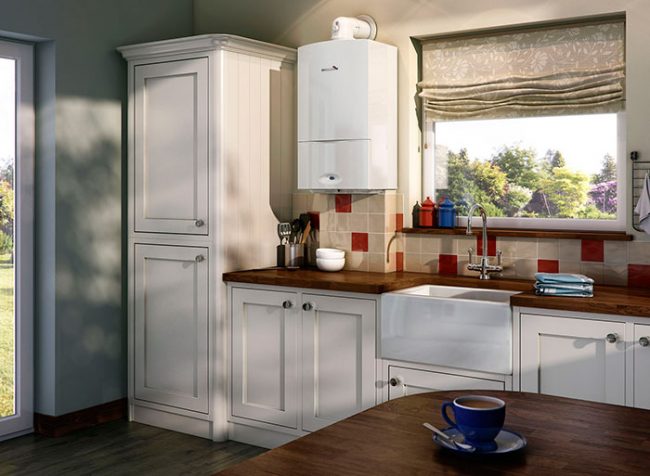 If you choose a boiler in the color of the kitchen facades, then the need to mask it will disappear
If this option is not suitable, then the gas boiler in the kitchen can be placed:
- in the corner;
- between kitchen furniture;
- apart from the furniture.
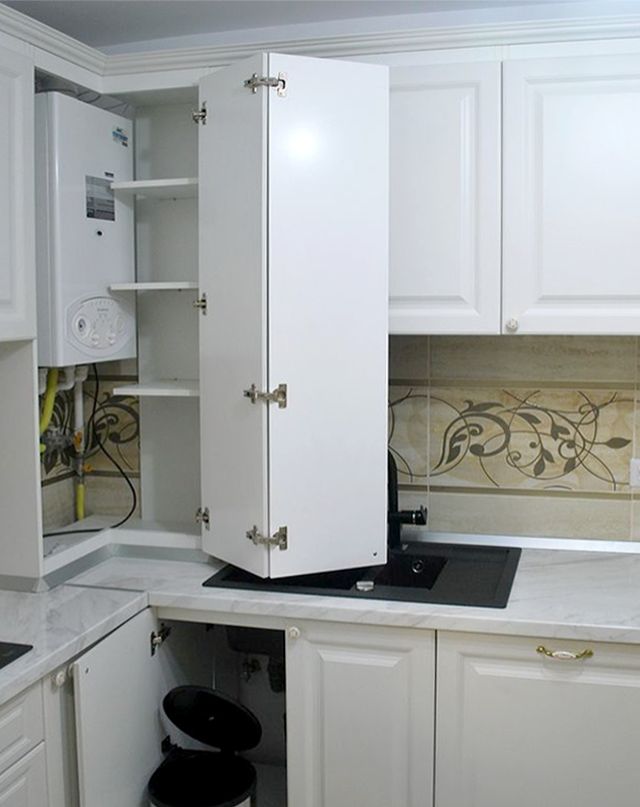
To hide the boiler in the kitchen, you can use built-in cabinets or decorative structures that imitate them.
- As a masking structure for a gas boiler, you can use one of the kitchen cabinets, a little larger than the boiler itself. To do this, use a jigsaw to cut out the back wall, lid and bottom of it. And drill small holes in the side walls to ensure free ventilation.
- When placing the boiler between cabinets, make sure that their side walls are covered with a special non-combustible material or impregnation.
- A gas boiler can be made less visible by hanging it behind a kitchen cabinet or column.
- If there is a niche in the kitchen, you can place the boiler in it, hiding it behind a decorative door, textile curtain or blinds. Placing the boiler in a niche will also allow you to hide the gas and drainpipes without much effort. For the same purpose, you can use the pantry adjacent to the kitchen, in which it will also be possible to place a gas meter.
Regardless of the placement of the gas boiler, an important requirement is compliance with safety standards:
- the possibility of unhindered access to gas equipment;
- the presence of natural ventilation due to the free space around the equipment (about 3-5 cm);
- the use of refractory materials or the treatment with a special solution of structures hiding gas equipment.
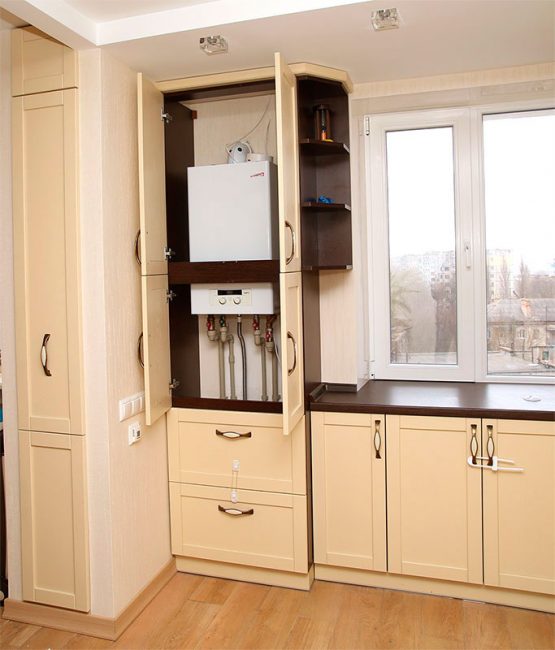 Gas boiler in the cabinet
How to hide the floor model?
When it comes to floorstanding speakers, the easiest way to hide the boiler in the kitchen is to place it in a specially installed cabinet, this will help to optimally plan the other elements of the room. Moreover, this method allows you to solve the problem with the masking of communications.
If the area of the room is large, and in this case a classic interior is often used, an imitation of a fireplace with a wrought iron grate can be an excellent solution for decorating equipment. To do this, you will need to cover the body of the device with non-combustible paint and select suitable images in accordance with the general surroundings.
Meanwhile, the decor of gas boilers largely depends on the chosen style of the room. For example, if the furniture and interior items are made in country style, the most suitable designs for the column will be: a lattice door of the headset, painting the case using decoupage technique, masking the unit with curtains and curtains made of natural materials (linen or cotton) matched to the tone of the furniture.
If a high-tech style is created, then the chrome-plated surface of the boiler does not need to be optimized, the same can be said about the loft style, when masking is not required, and the appliance is a specific design accent.
In a word, you can beat the presence of not too attractive heating equipment as you like, the main thing is to take into account the totality of environmental conditions and comply with safety standards.
How to hide a gas boiler in the kitchen, see below.
Location of the gas boiler
A gas boiler in an apartment is usually placed in the kitchen, which is due to the presence of all necessary communications, and the distance from the gas pipe to the boiler is maintained without problems.As a rule, wall-mounted boilers are used for apartments, which are attached to the walls using special brackets that come with the equipment.





If the house has a staircase leading to the upper floor, the owners have a desire to install a boiler under it. As a rule, there is enough space under the stairs for the boiler, but there are problems with ventilation, so it has to be equipped separately, using large diameter pipes.
Simple disguise rules
Hiding equipment is not difficult if you follow certain recommendations.
- If you leave the equipment exposed between two modules located on both sides and identical in design, the column can look organic. However, do not forget about fire safety rules, especially if the cabinets are made of natural wood or flammable materials.
- If the location is between two modules, then it can be hidden behind a simple exquisite curtain. This trick will be indispensable for country-style interiors.
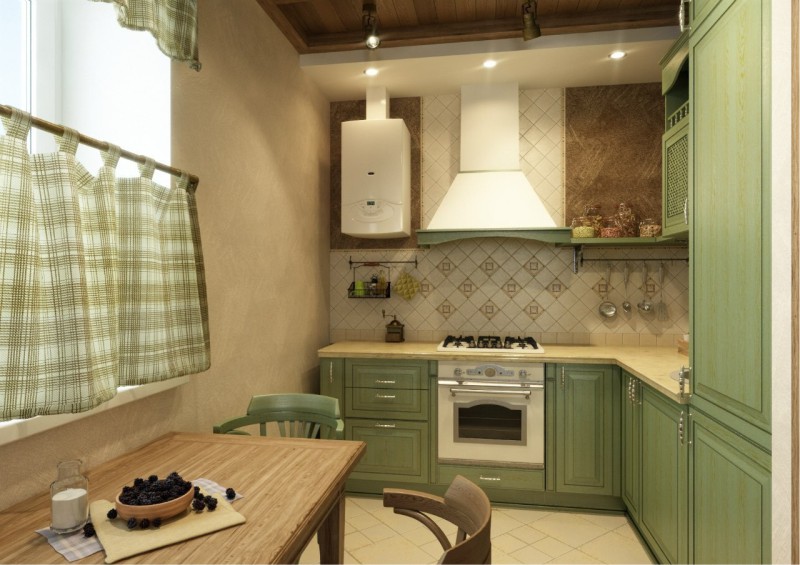
Gas boiler in the kitchen in country style
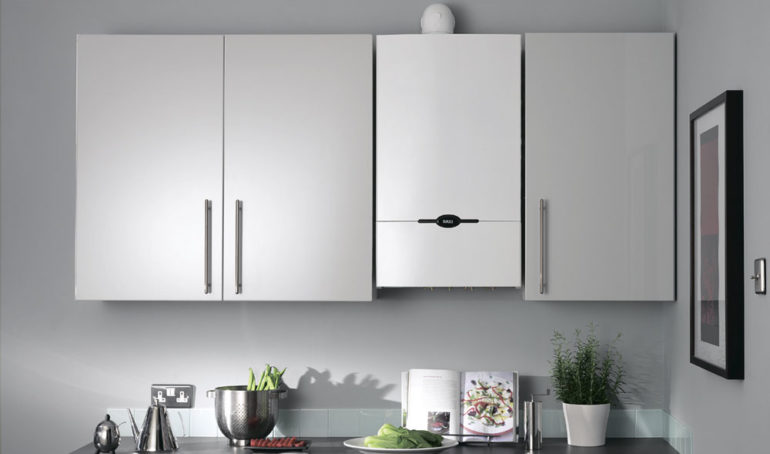
Compact model of a gas boiler in the interior of the kitchen
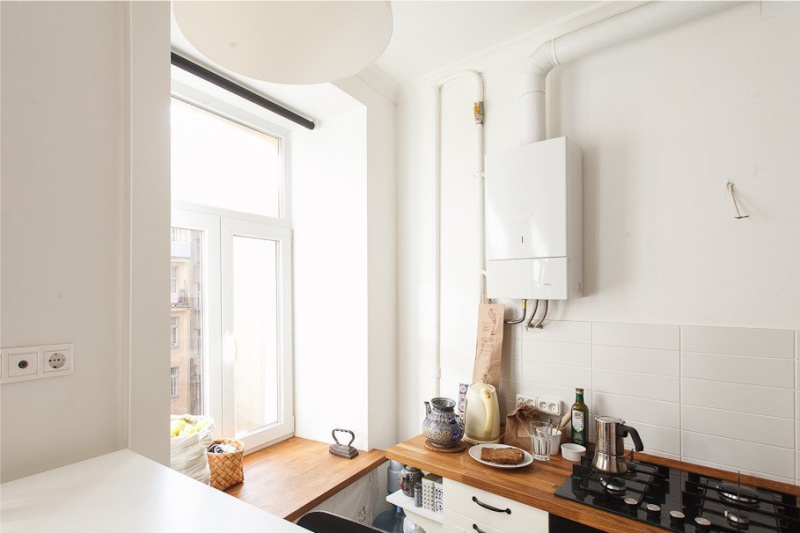
Boiler disguise example against a white wall
"Invisible" boiler in the interior of the kitchen
To completely disguise a gas boiler, you can only hide it and communications in a rack that is suitable in size. Otherwise, partial disguise is possible, ranging from simple curtain decoration to a fancy high-tech design when all communications look out.
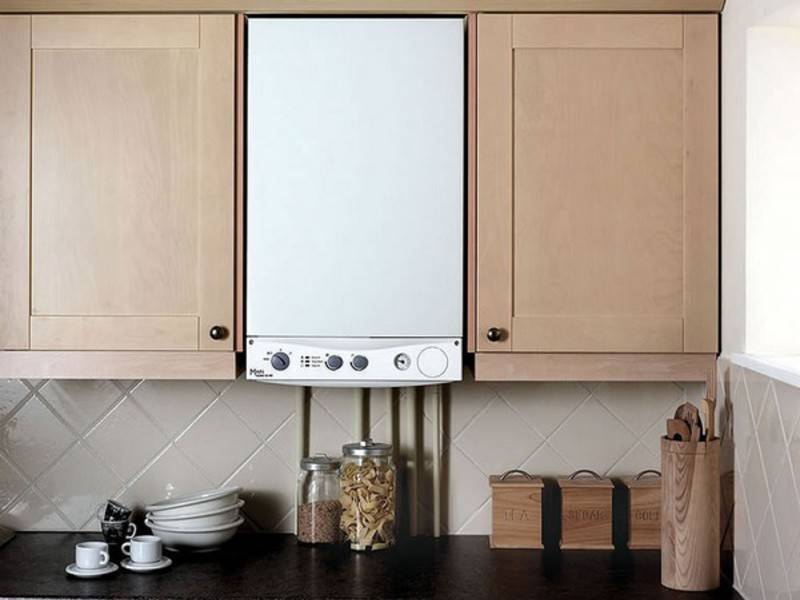
Although most gas boilers have a similar appearance, some features can emphasize the style direction of the kitchen interior.
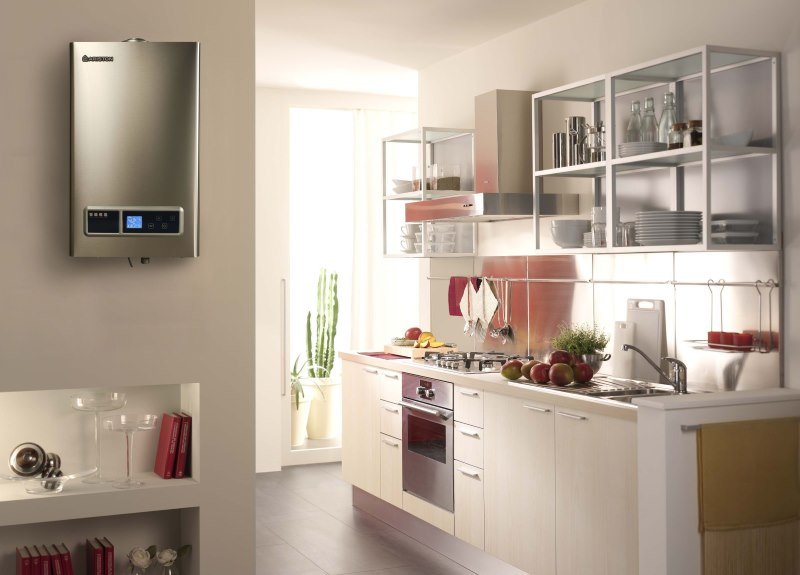
An open boiler will be appropriate in any industrial interior.
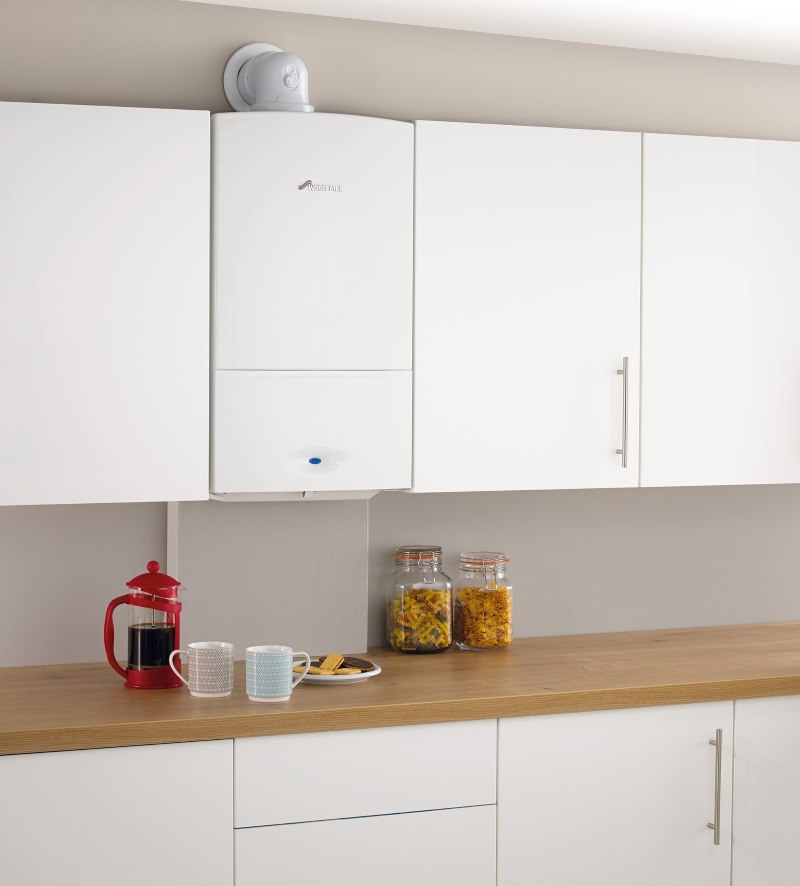
A successful combination of the appearance of the boiler with the facades of the kitchen set
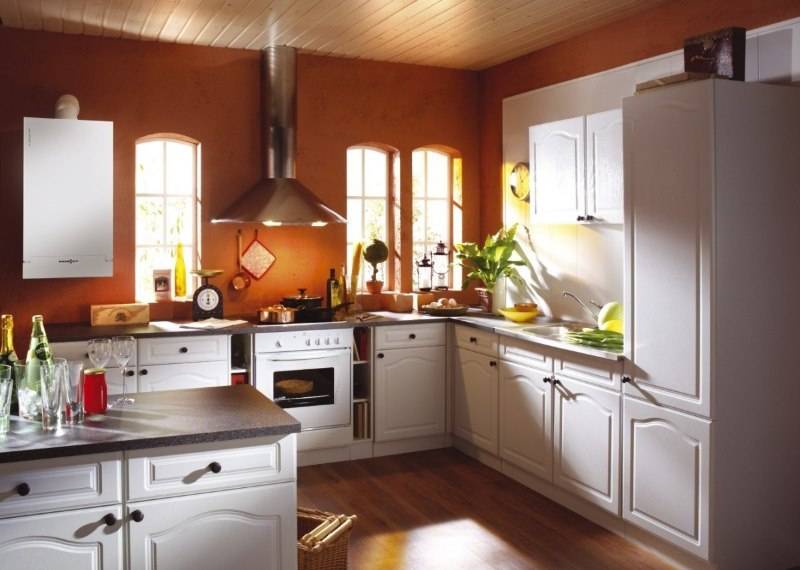
The owners of this kitchen decided not to hide the boiler, but on the contrary, they highlighted it against the background of the contrasting color of the wall.

Gas boiler, "covered" by a corner shelf
What to do in a small kitchen?
In small rooms, a gas boiler can take up most of the space. In such kitchens, the equipment immediately catches the eye, looks massive and awkward. The column should be placed not in the middle of the wall, but in the corner farthest from the entrance, it is there that it will be easiest to hide bulky equipment. Disguise as a kitchen module, additionally exclude heavy bulky furniture from the workspace - it will create the effect of "clutter". Instead, choose light, transforming and light colors.
The gas boiler will be less conspicuous if it is placed in the corner between the cabinets
Corner cabinet for gas boiler
Installation of a gas boiler in combined kitchens
In modern construction, the arrangement of studio apartments or layouts is actively practiced, in which the living room and kitchen are combined into one large space. Of course, such a solution has a lot of advantages - for example, a large part of the free space appears, which is perfect for implementing all kinds of design ideas.



The problem is that such layouts are regarded by gas services as residential, so the installation of any gas equipment in them is prohibited. In studios, this problem cannot be solved, but when combining the living room with the kitchen, options are possible.